1	
  
Perforce integration in a AAA game engine
The Strength of the C++ API
Marc Desfossés
Lead Tools Programmer
Jean-Sébastien Pelletier
Technical Lead
Perforce integration in a AAA game engine
Ubisoft Entertainment
2	
  
Introduction
The organized chaos of the game industry
3	
  
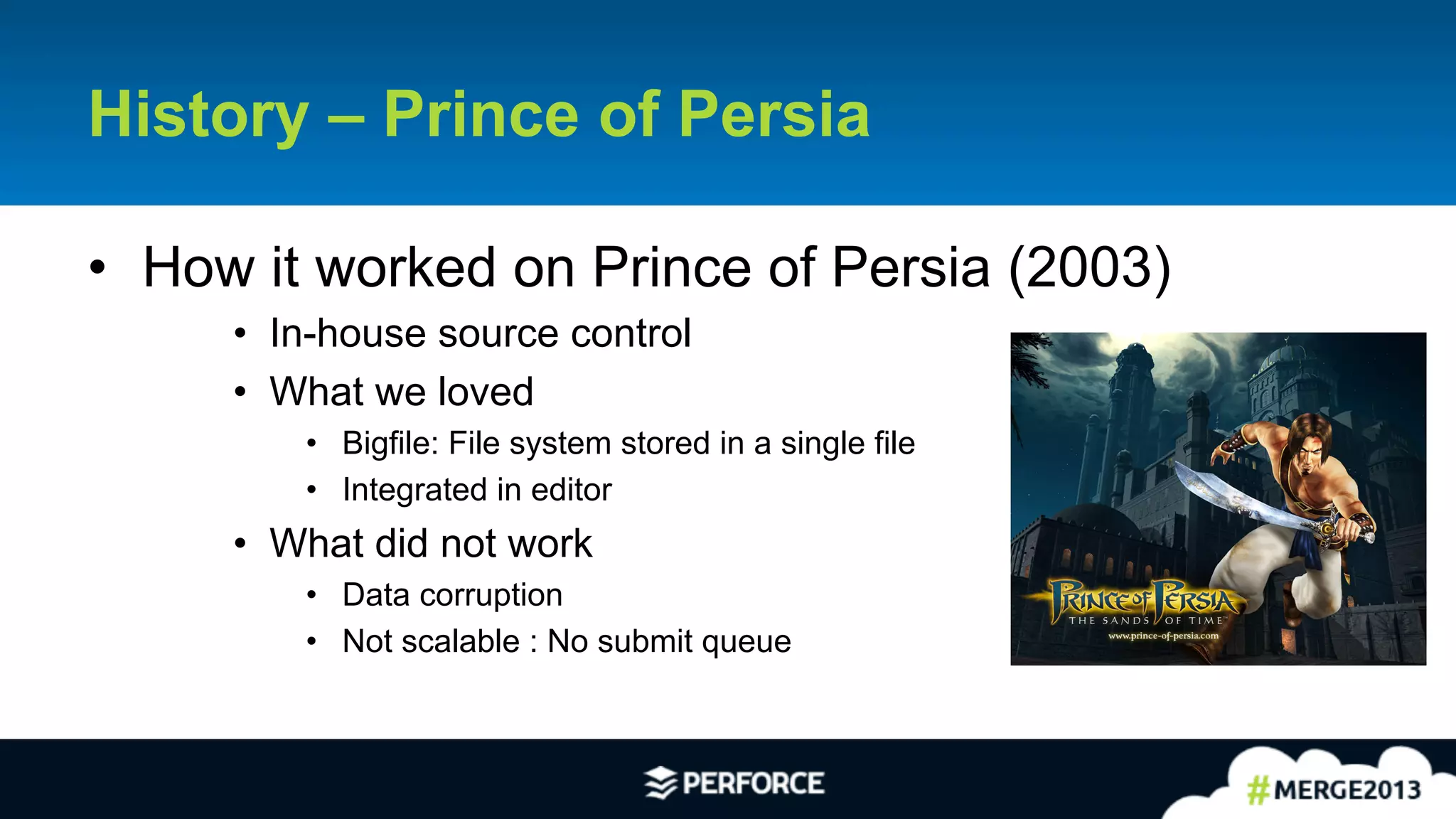
History – Prince of Persia
•  How it worked on Prince of Persia (2003)
•  In-house source control
•  What we loved
•  Bigfile: File system stored in a single file
•  Integrated in editor
•  What did not work
•  Data corruption
•  Not scalable : No submit queue
4	
  
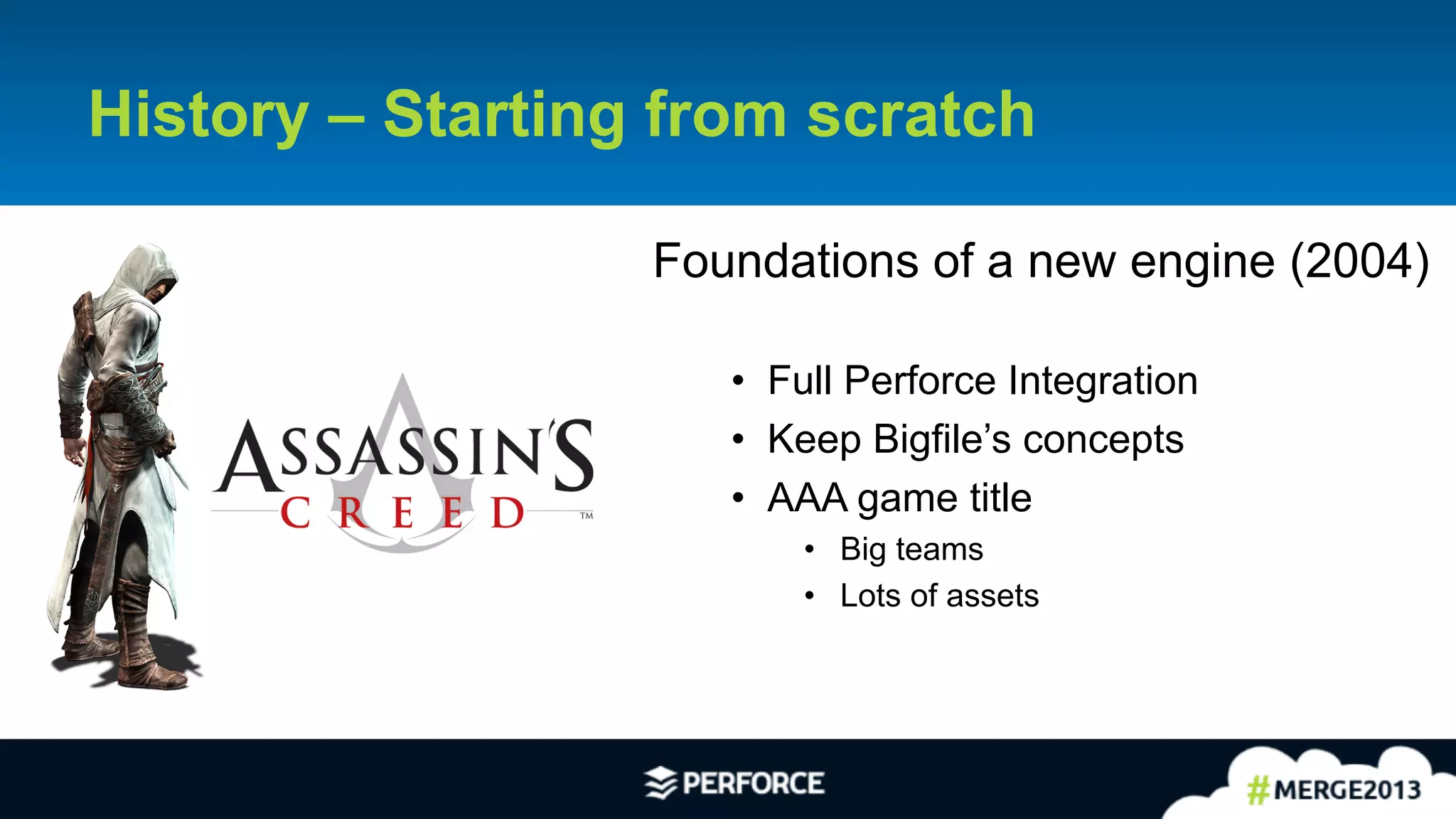
History – Starting from scratch
Foundations of a new engine (2004)
•  Full Perforce Integration
•  Keep Bigfile’s concepts
•  AAA game title
•  Big teams
•  Lots of assets
5	
  
Game Production Workflow
Creating a AAA game
6	
  
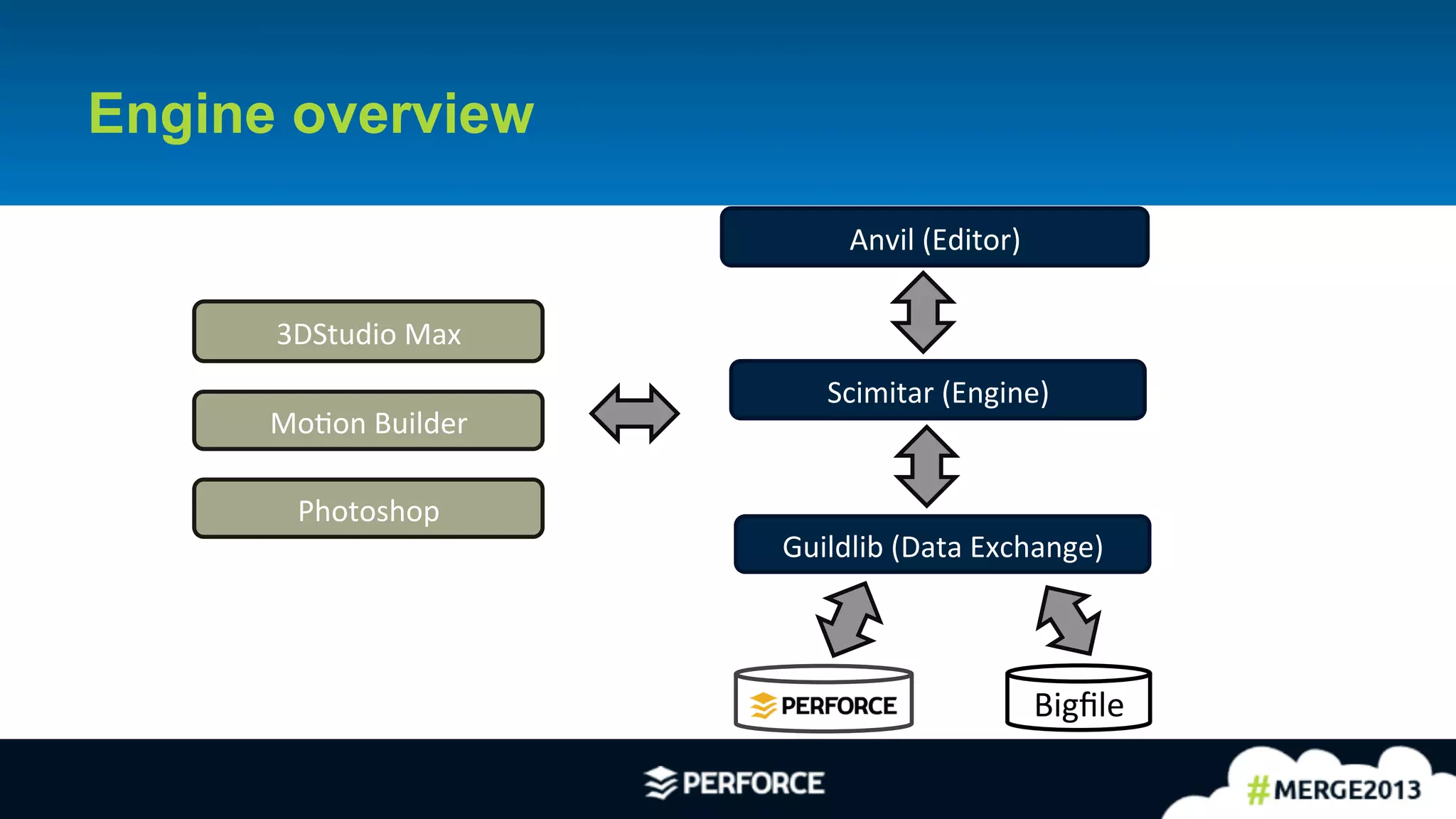
Engine overview
Guildlib	
  (Data	
  Exchange)	
  
Scimitar	
  (Engine)	
  
Anvil	
  (Editor)	
  
3DStudio	
  Max	
  
MoAon	
  Builder	
  
P4	
  
Photoshop	
  
Bigfile	
  
7	
  
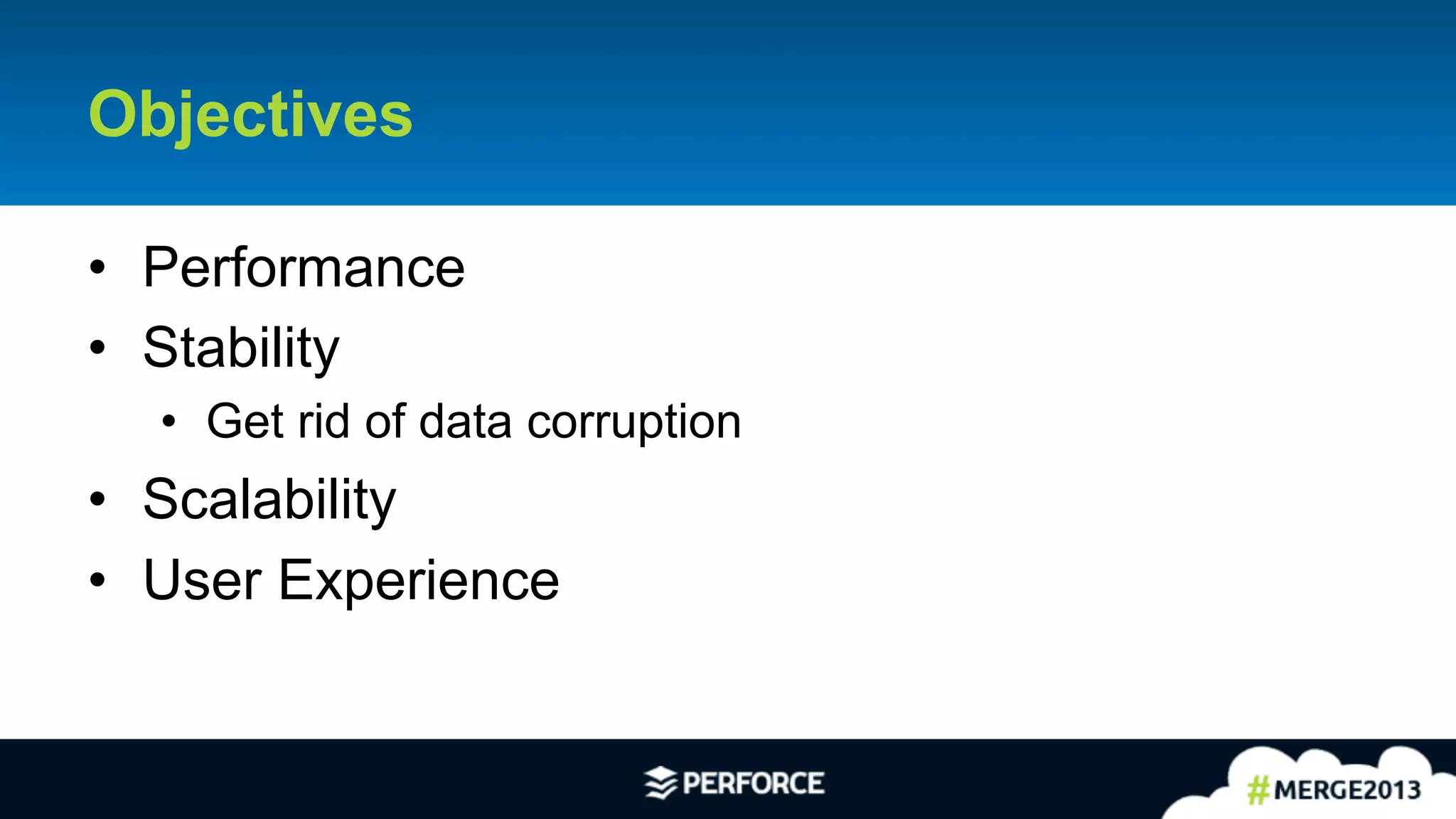
Objectives
•  Performance
•  Stability
•  Get rid of data corruption
•  Scalability
•  User Experience
8	
  
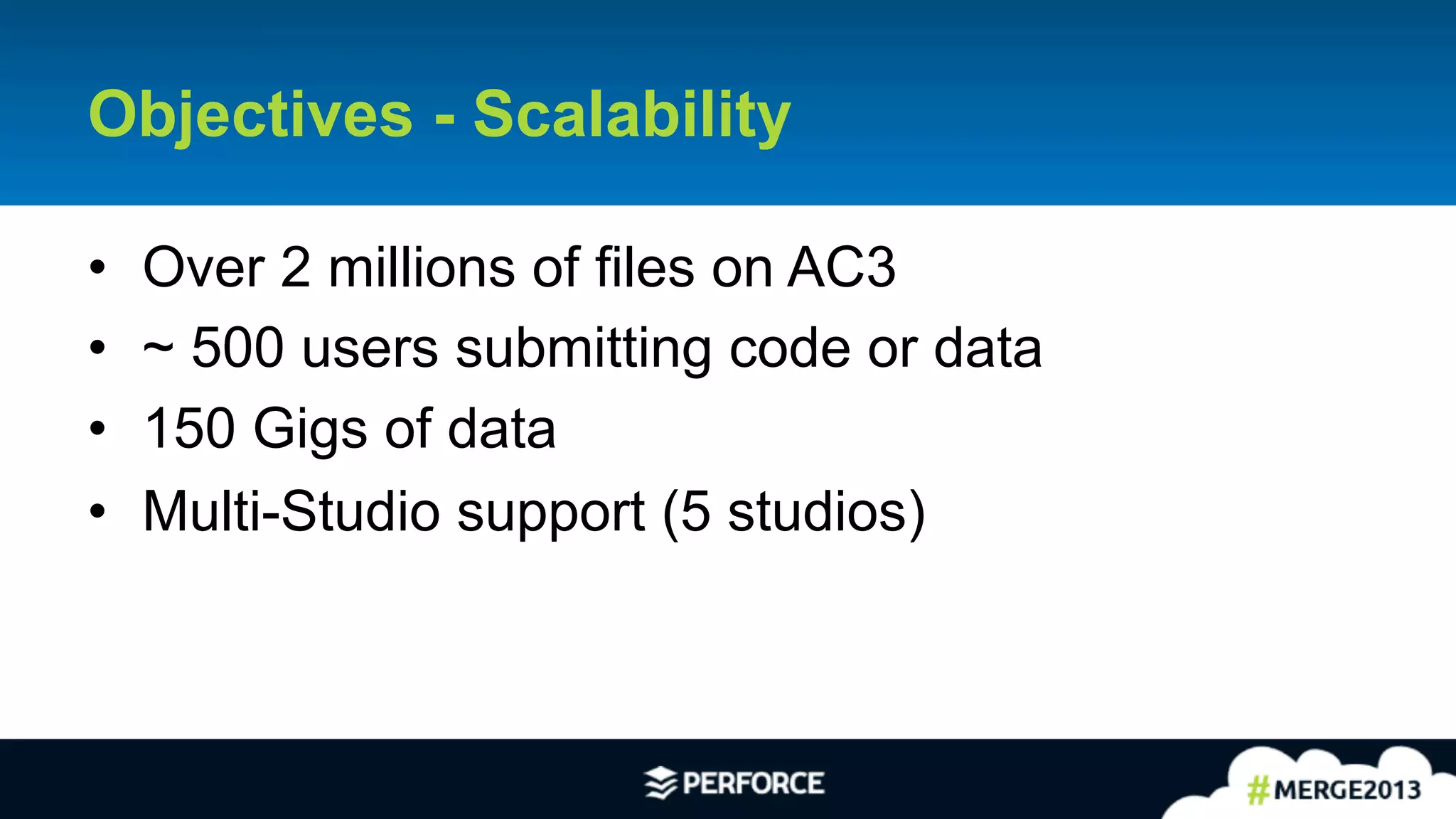
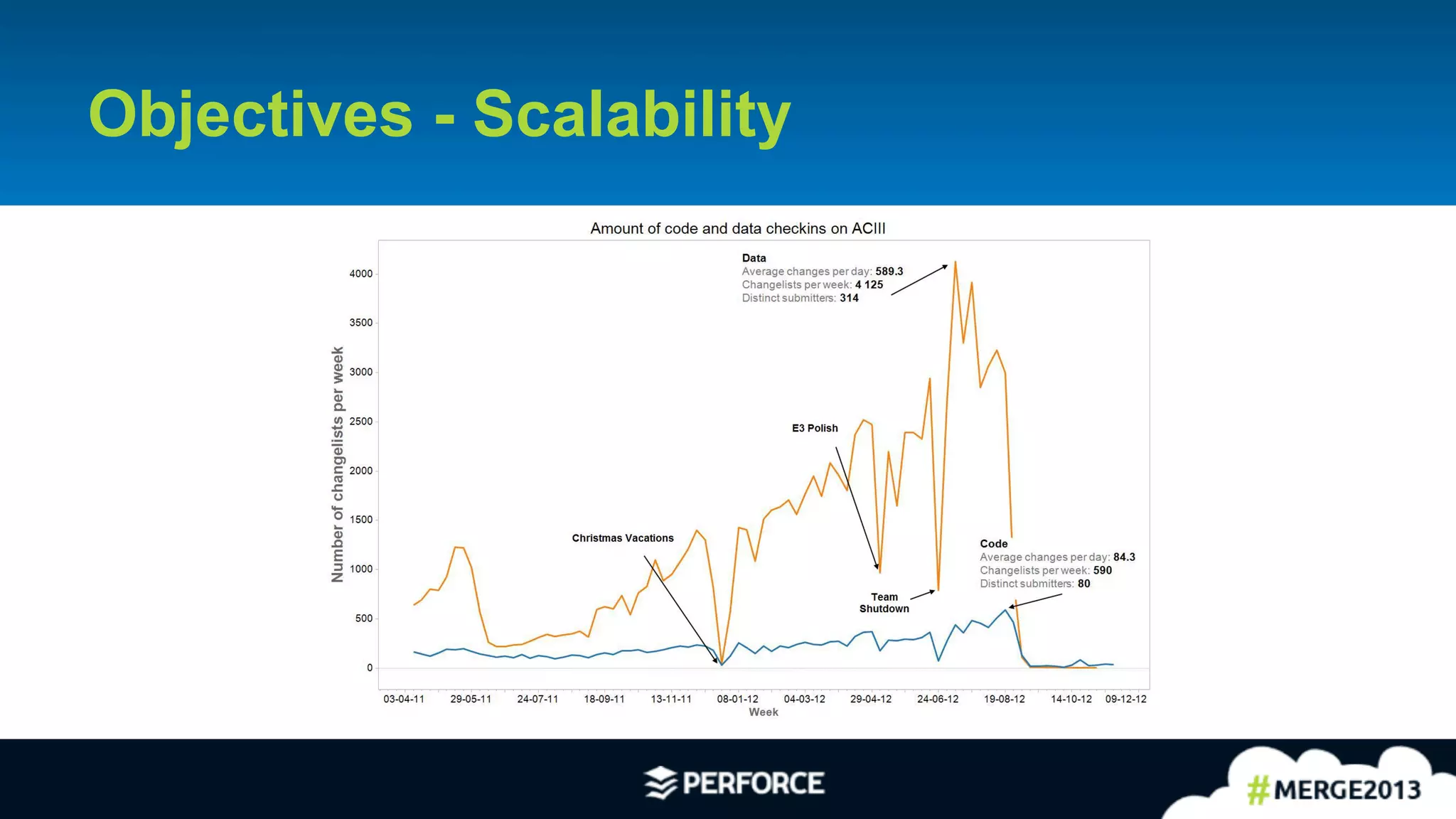
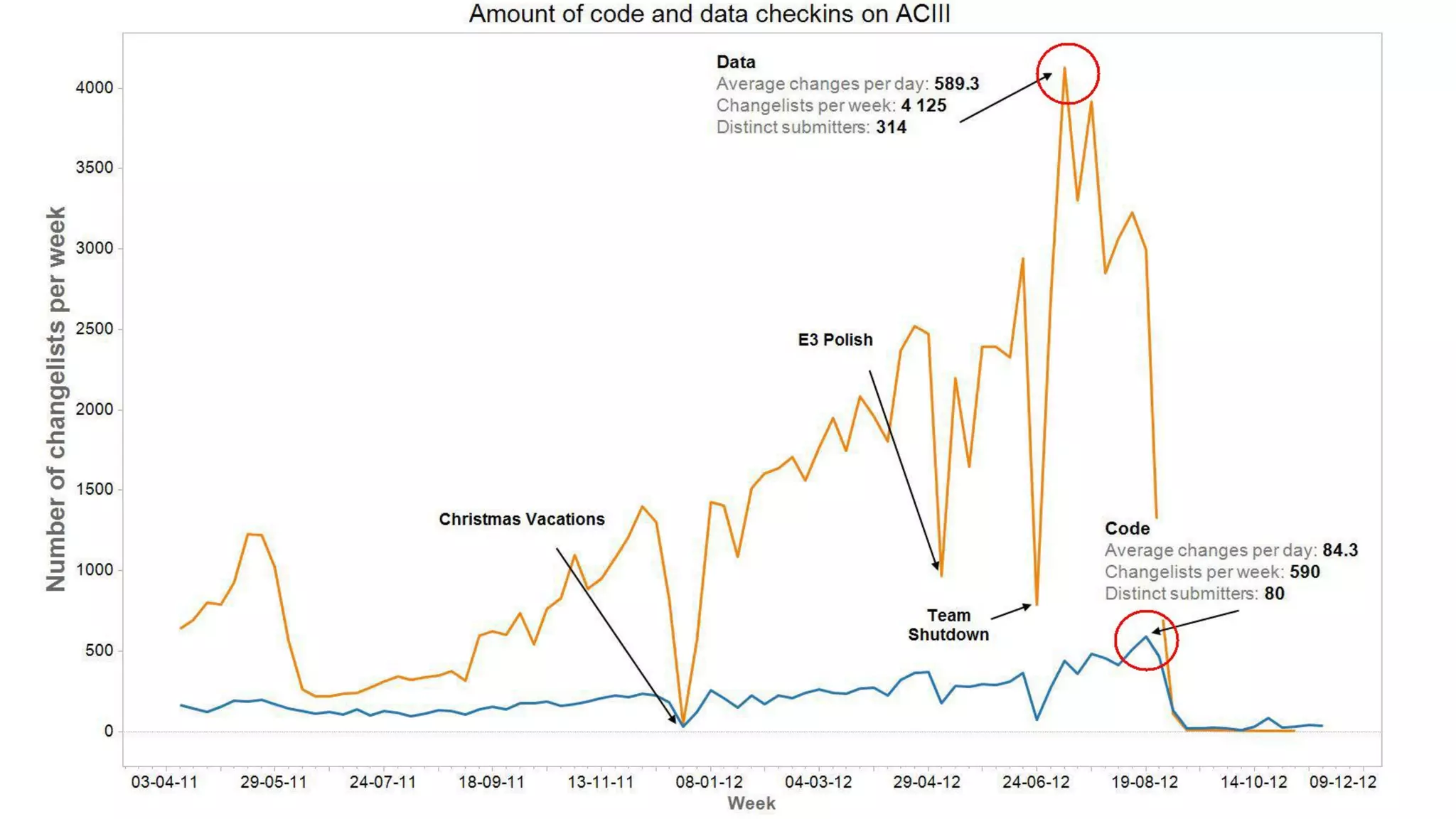
Objectives - Scalability
•  Over 2 millions of files on AC3
•  ~ 500 users submitting code or data
•  150 Gigs of data
•  Multi-Studio support (5 studios)
9	
  
Objectives - Scalability
11	
  
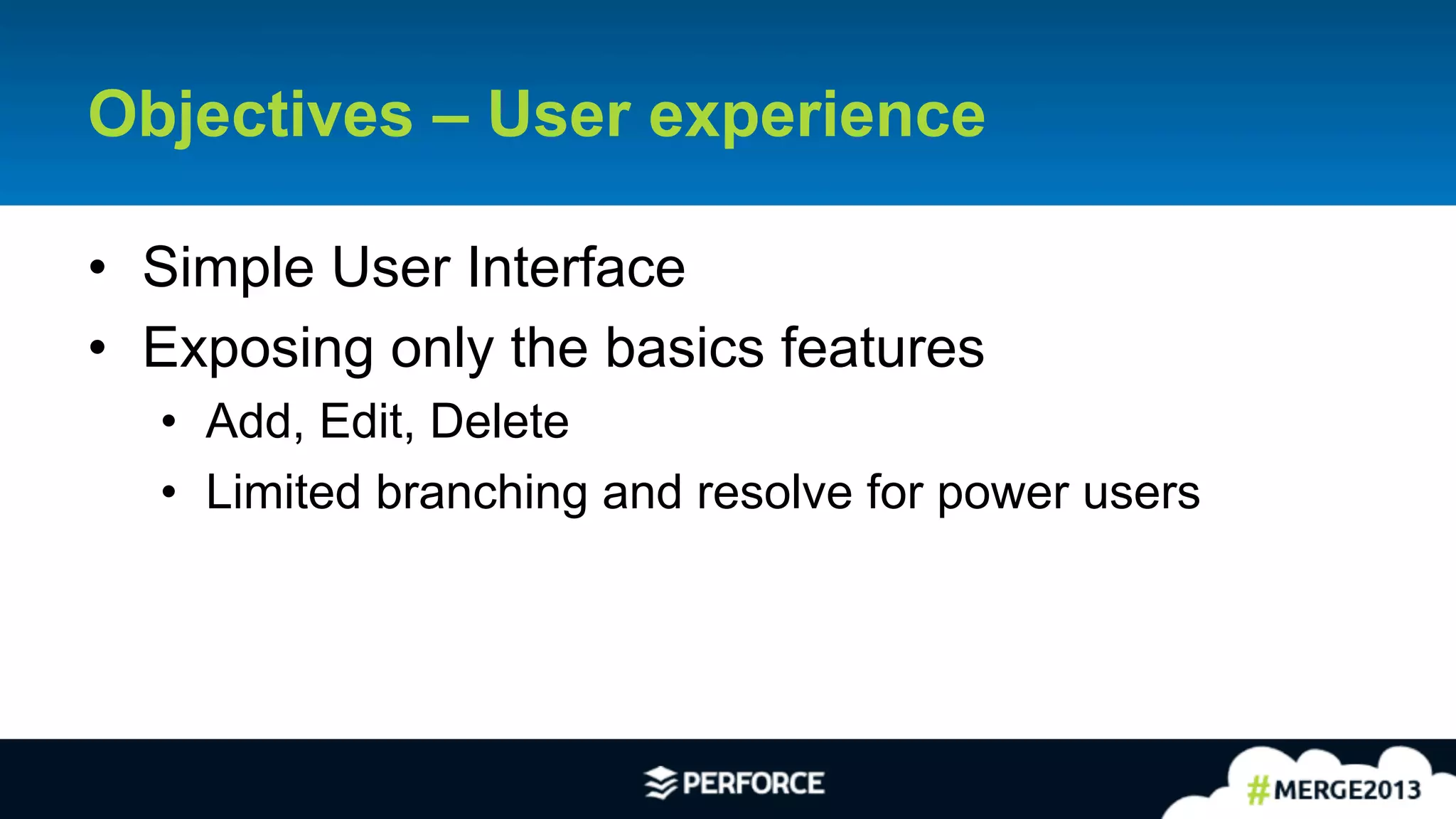
Objectives – User experience
•  Simple User Interface
•  Exposing only the basics features
•  Add, Edit, Delete
•  Limited branching and resolve for power users
12	
  
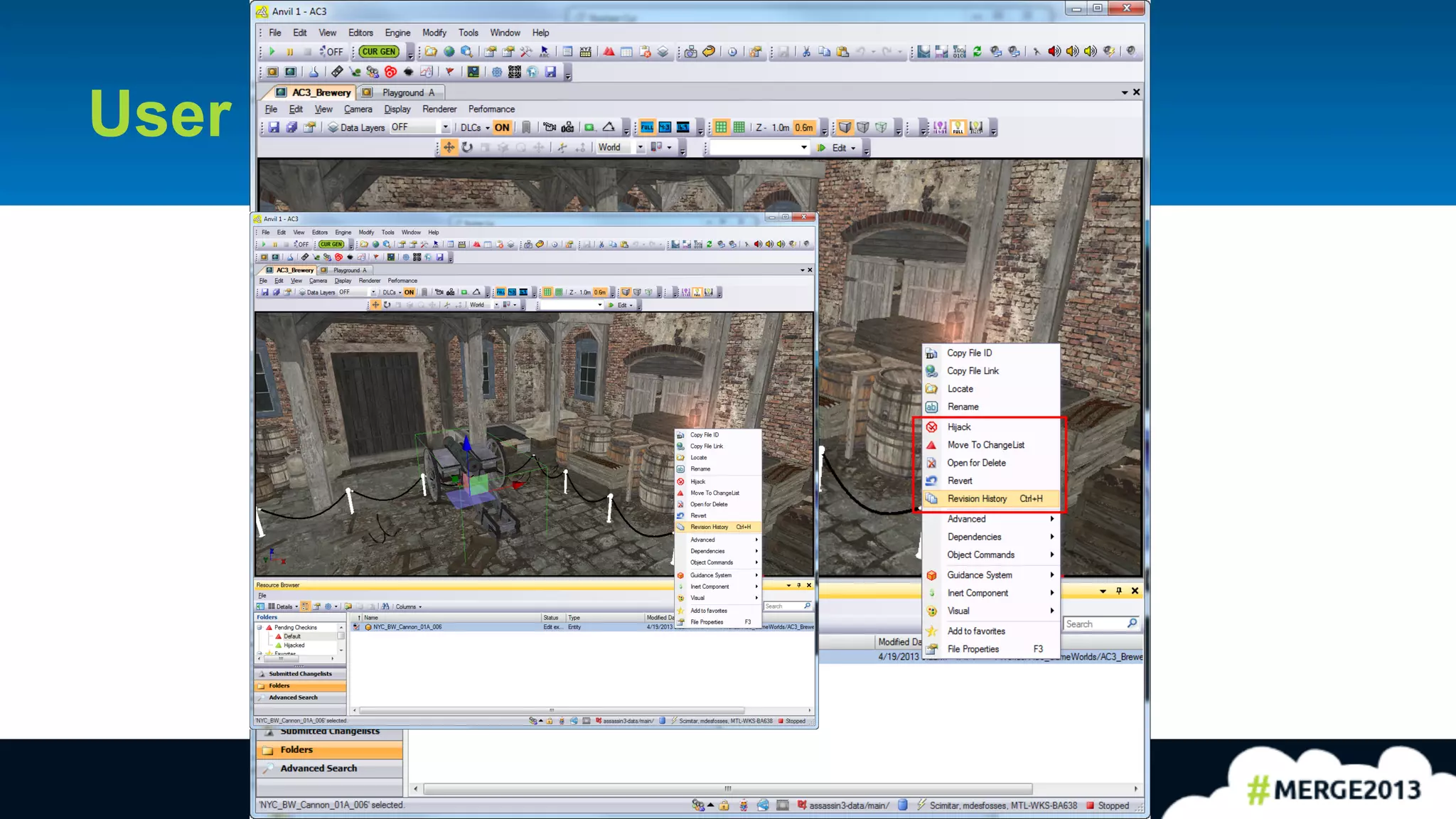
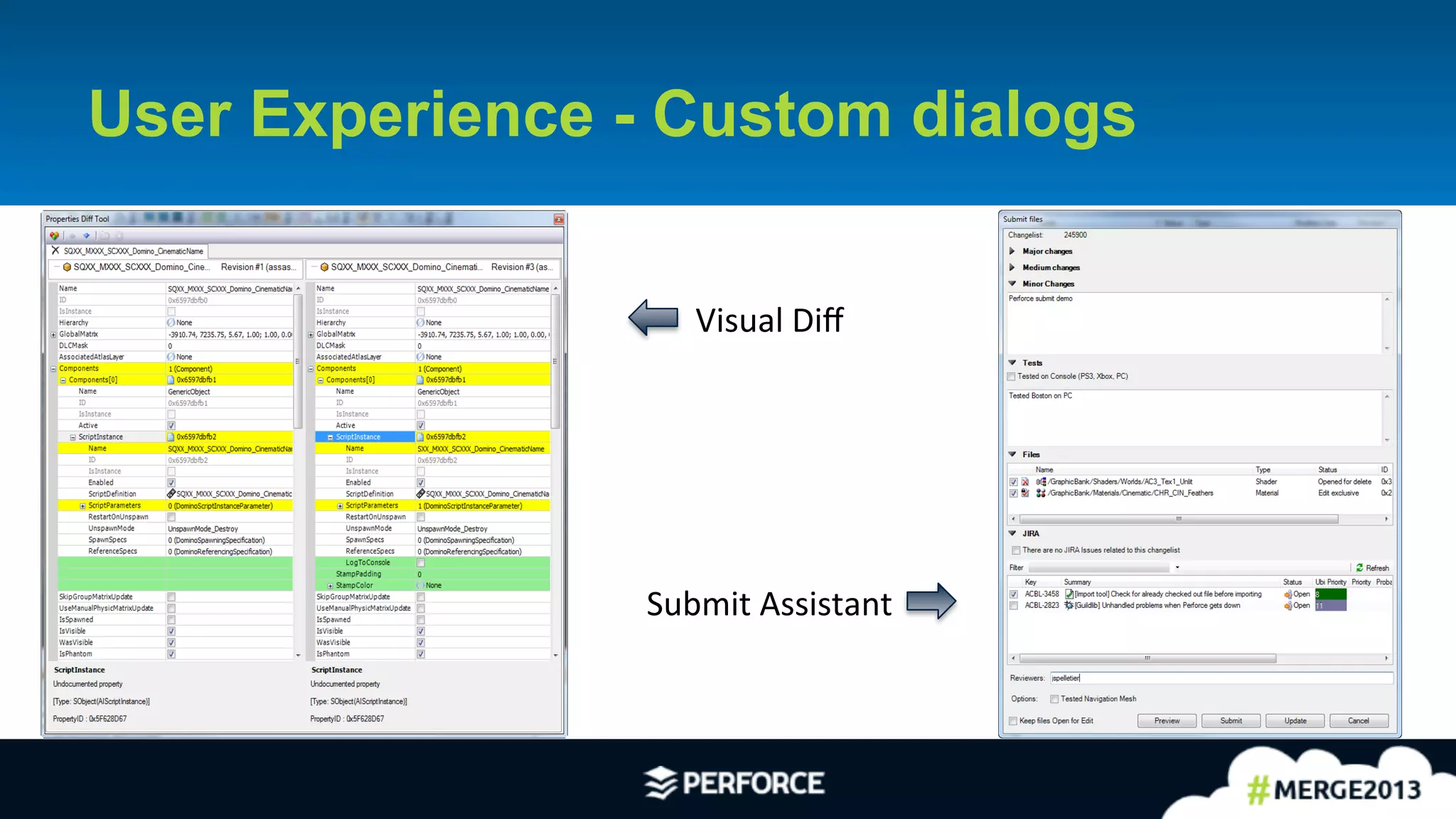
User Experience - Custom dialogs
Anvil	
  Editor	
  
13	
  
User Experience - Custom dialogs
Visual	
  Diff	
  
Submit	
  Assistant	
  
14	
  
Architecture
Leveraging the C++ API
15	
  
Architecture – The Bigfile
•  File system embedded in ONE file similar to a zip file.
•  Database driven
•  Transactions
•  It contains relationships between all game objects
•  Source control metadata for each file stored in FAT
•  Revision number
•  File status
16	
  
Architecture – Clientview Sync Process
-  Mirror bigfile and its associated perforce client
-  Run commands such as fstat, flush, edit, revert, delete,
add.
-  Once this is completed we can run any Perforce
command.
17	
  
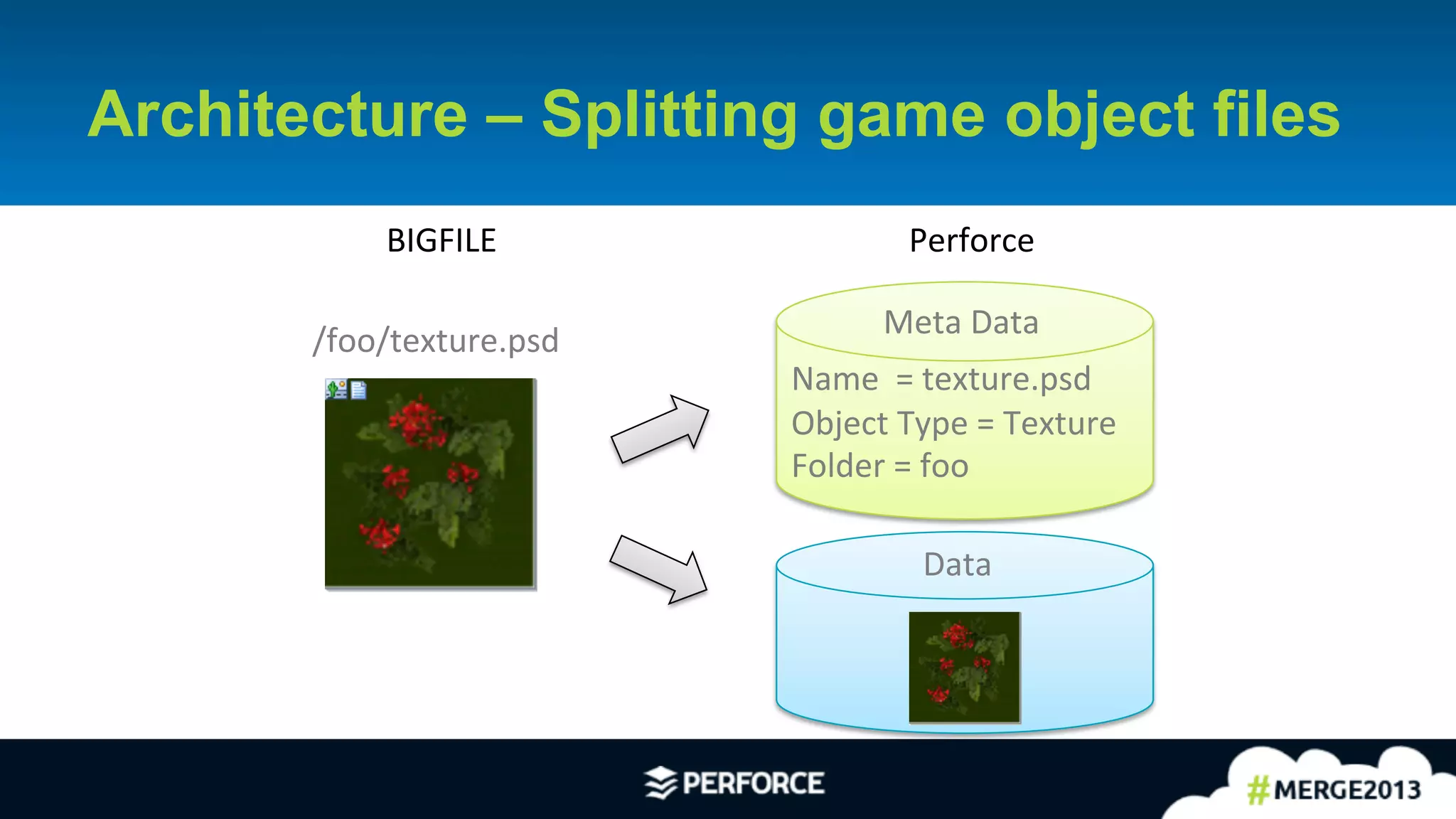
Architecture – Splitting game object files
	
  
Name	
  	
  =	
  texture.psd	
  
Object	
  Type	
  =	
  Texture	
  
Folder	
  =	
  foo	


Meta	
  Data	
  
Data	
  
/foo/texture.psd	
  
BIGFILE	
   Perforce	
  
18	
  
Architecture – Splitting game object files
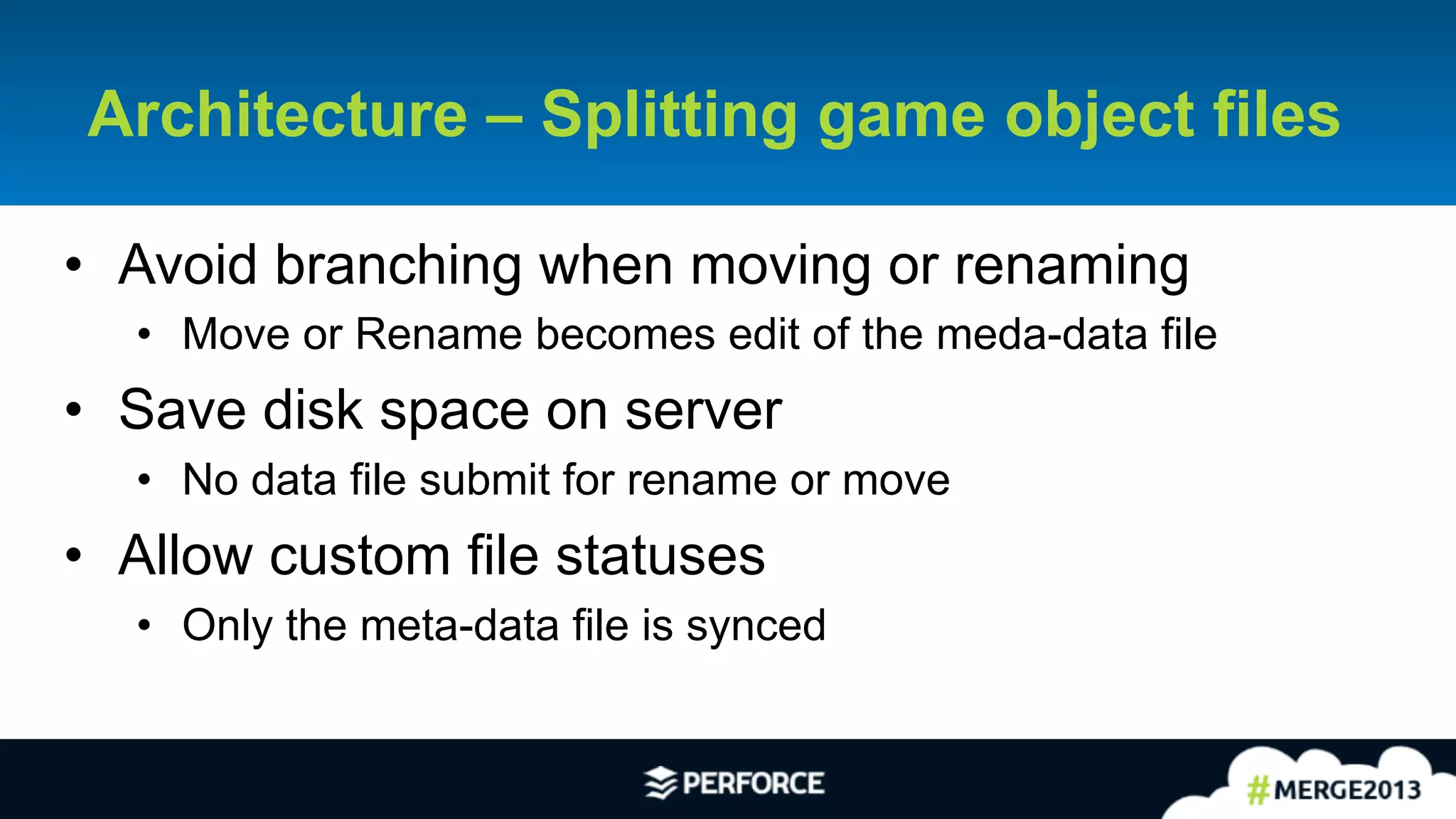
•  Avoid branching when moving or renaming
•  Move or Rename becomes edit of the meda-data file
•  Save disk space on server
•  No data file submit for rename or move
•  Allow custom file statuses
•  Only the meta-data file is synced
19	
  
Architecture – File Mapping
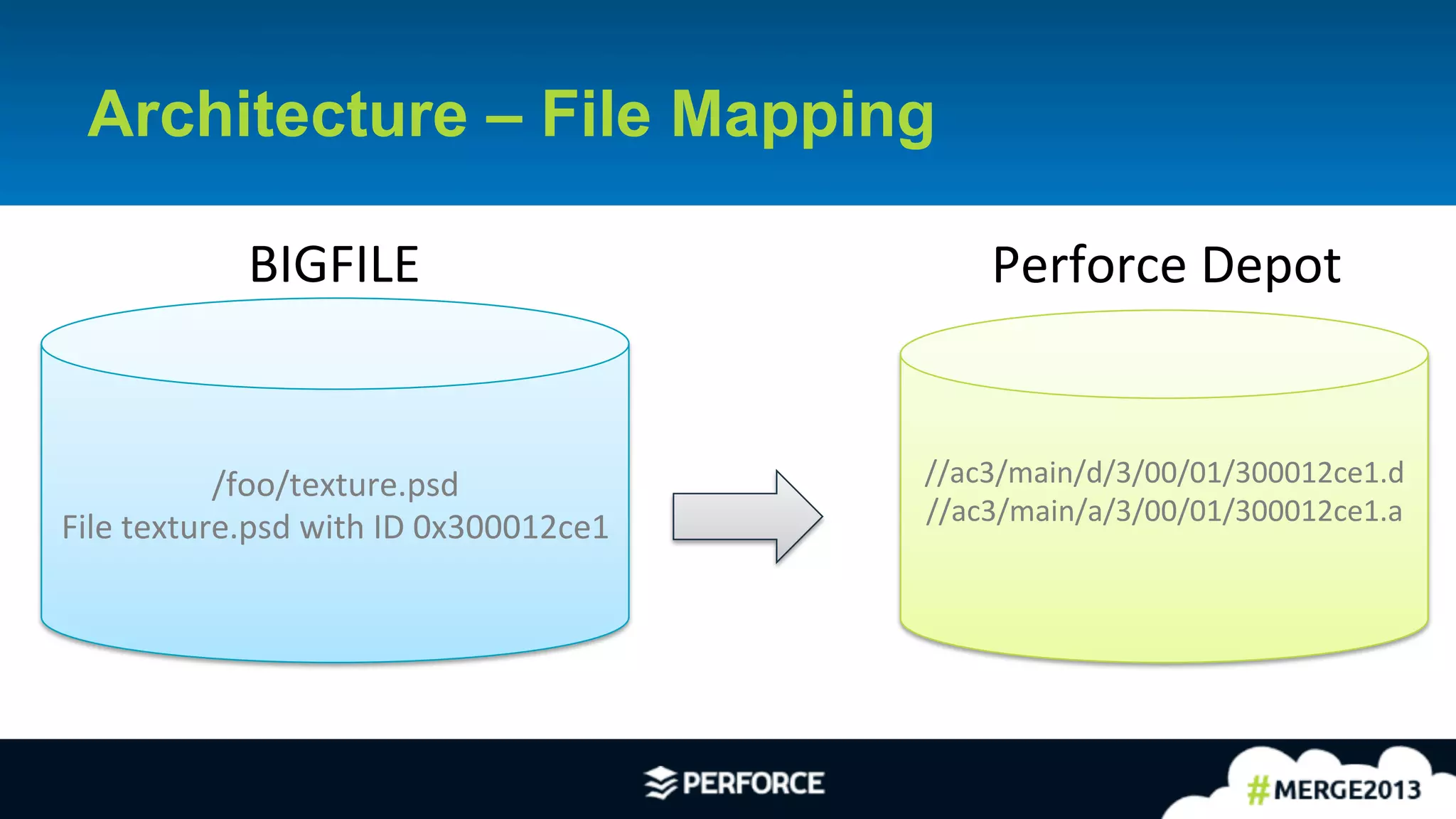
//ac3/main/d/3/00/01/300012ce1.d	
  
//ac3/main/a/3/00/01/300012ce1.a	


/foo/texture.psd	
  
File	
  texture.psd	
  with	
  ID	
  0x300012ce1	
  
Perforce	
  Depot	
  BIGFILE	
  
20	
  
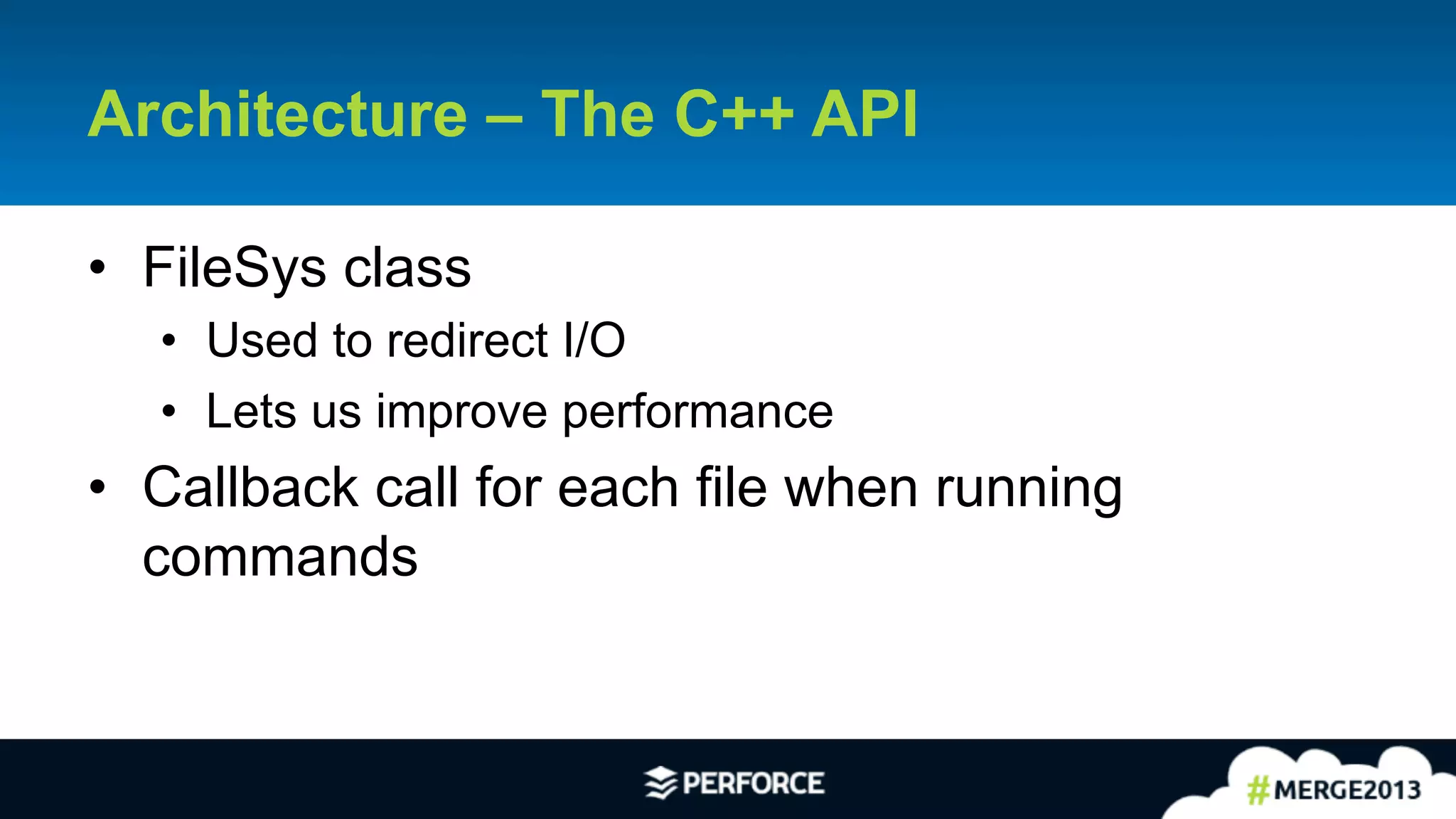
•  FileSys class
•  Used to redirect I/O
•  Lets us improve performance
•  Callback call for each file when running
commands
Architecture – The C++ API
21	
  
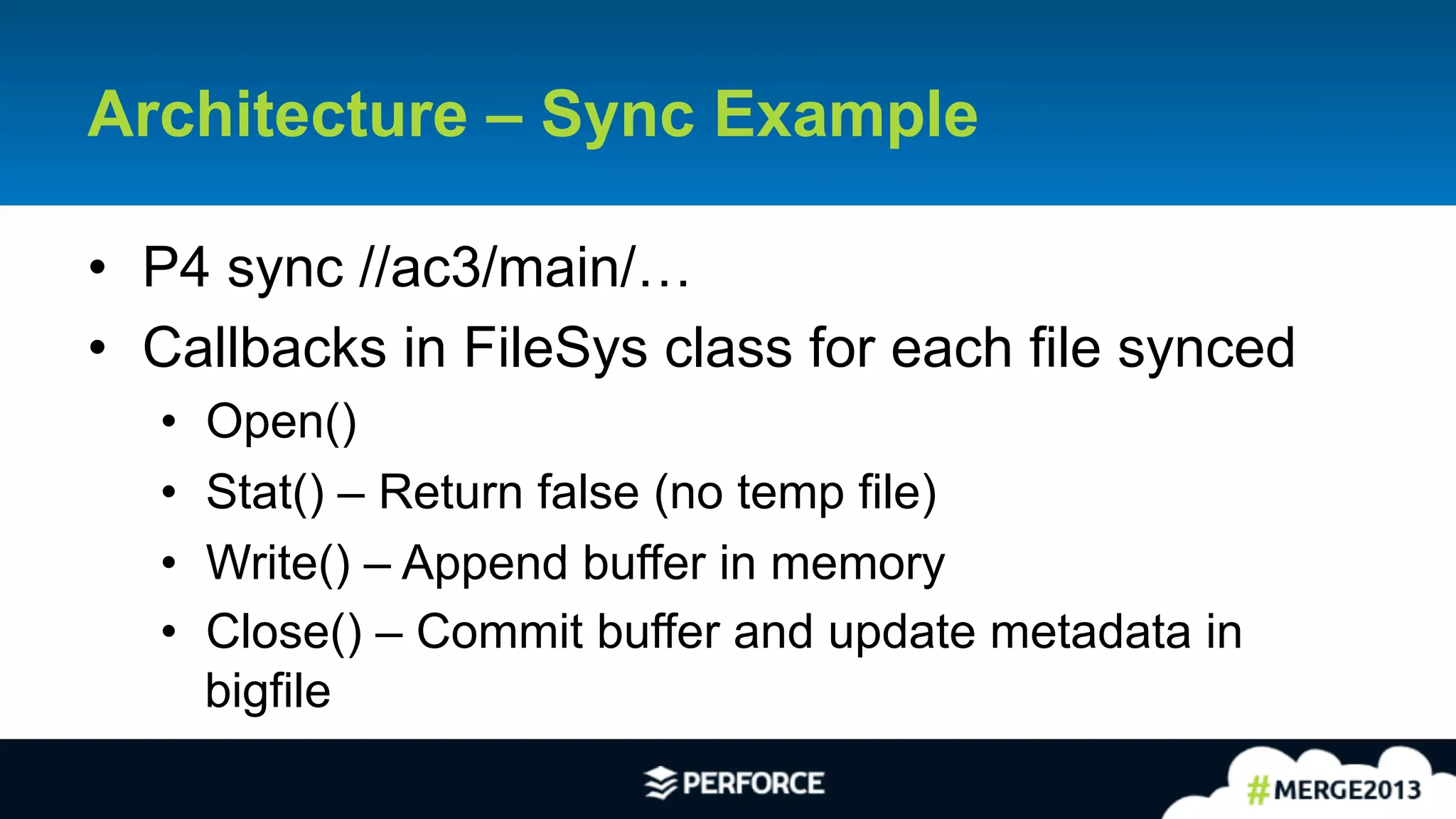
•  P4 sync //ac3/main/…
•  Callbacks in FileSys class for each file synced
•  Open()
•  Stat() – Return false (no temp file)
•  Write() – Append buffer in memory
•  Close() – Commit buffer and update metadata in
bigfile
Architecture – Sync Example
22	
  
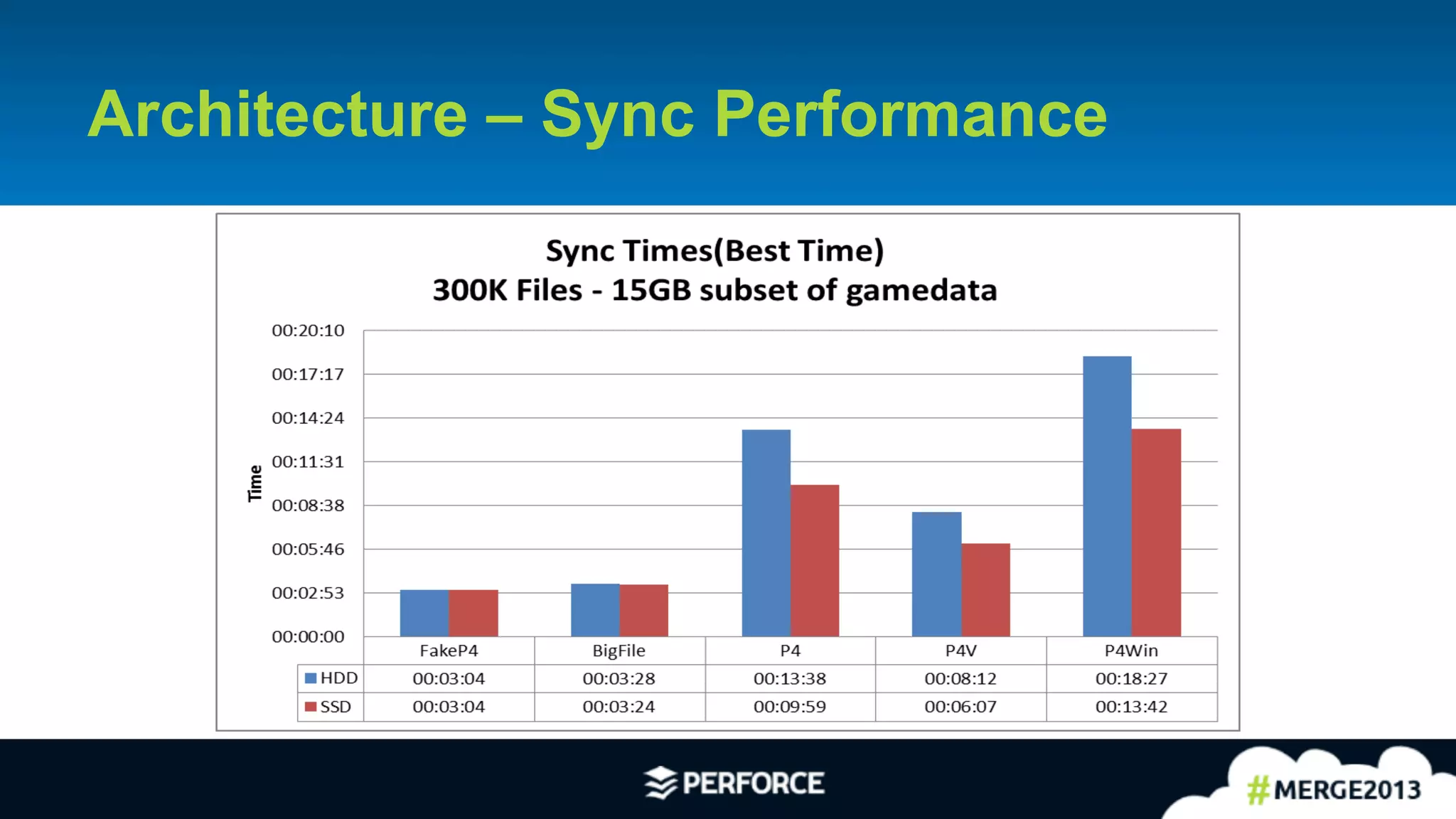
Architecture – Sync Performance
23	
  
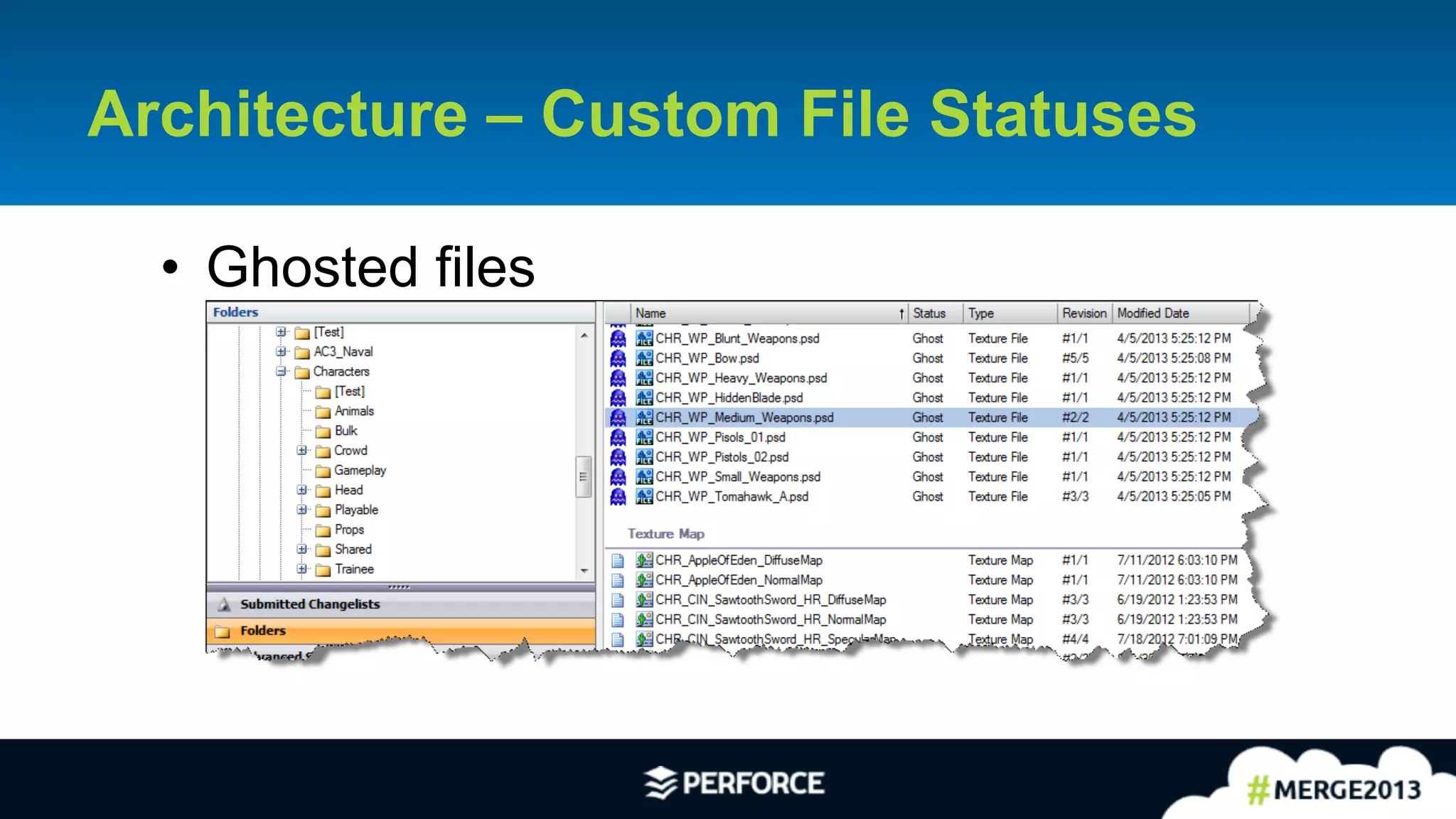
Architecture – Custom File Statuses
•  Ghosted files
24	
  
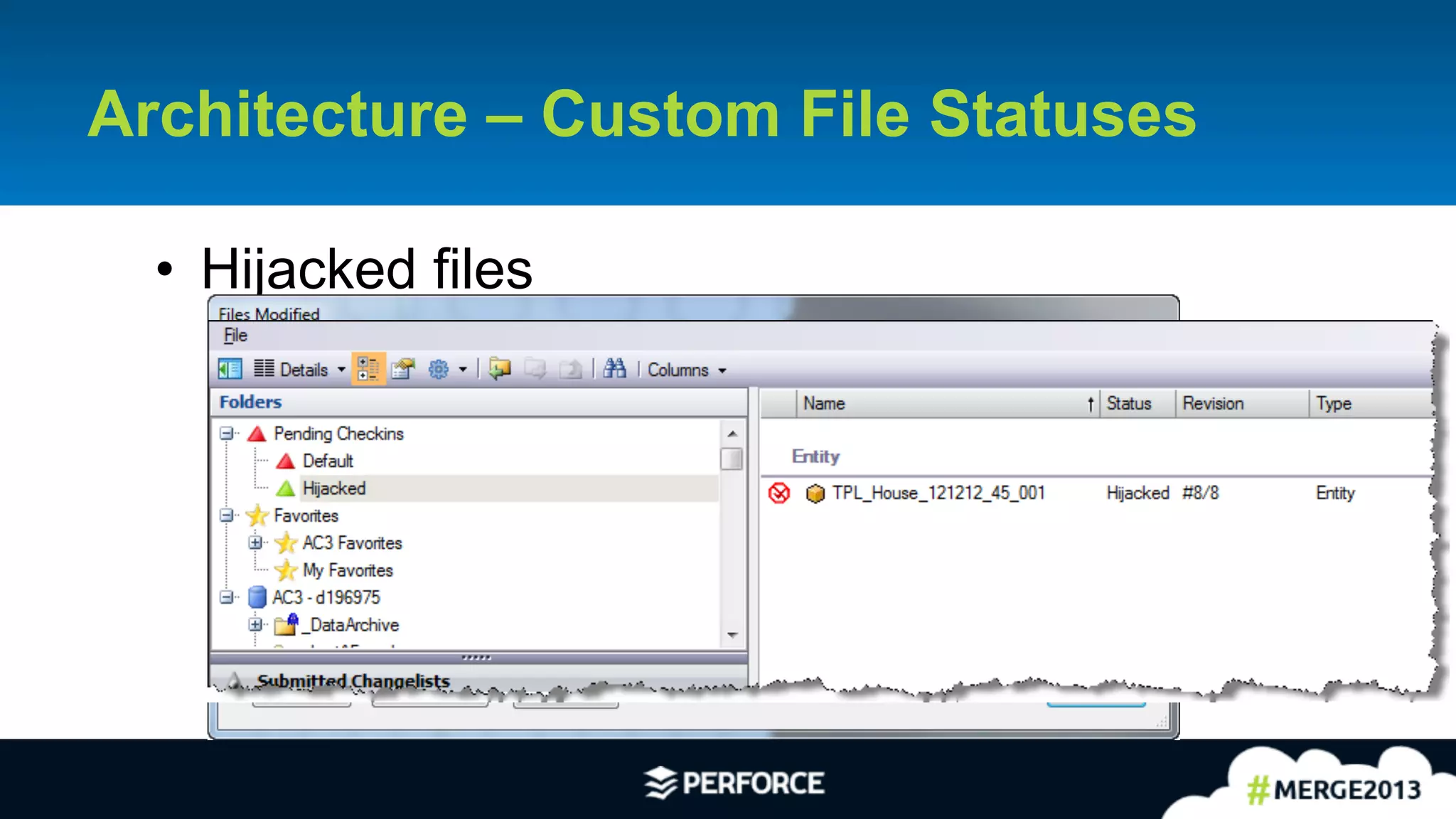
Architecture – Custom File Statuses
•  Hijacked files
•  Clobbered files that can be reverted
•  Skipped during sync
•  Contained in a special changelist
25	
  
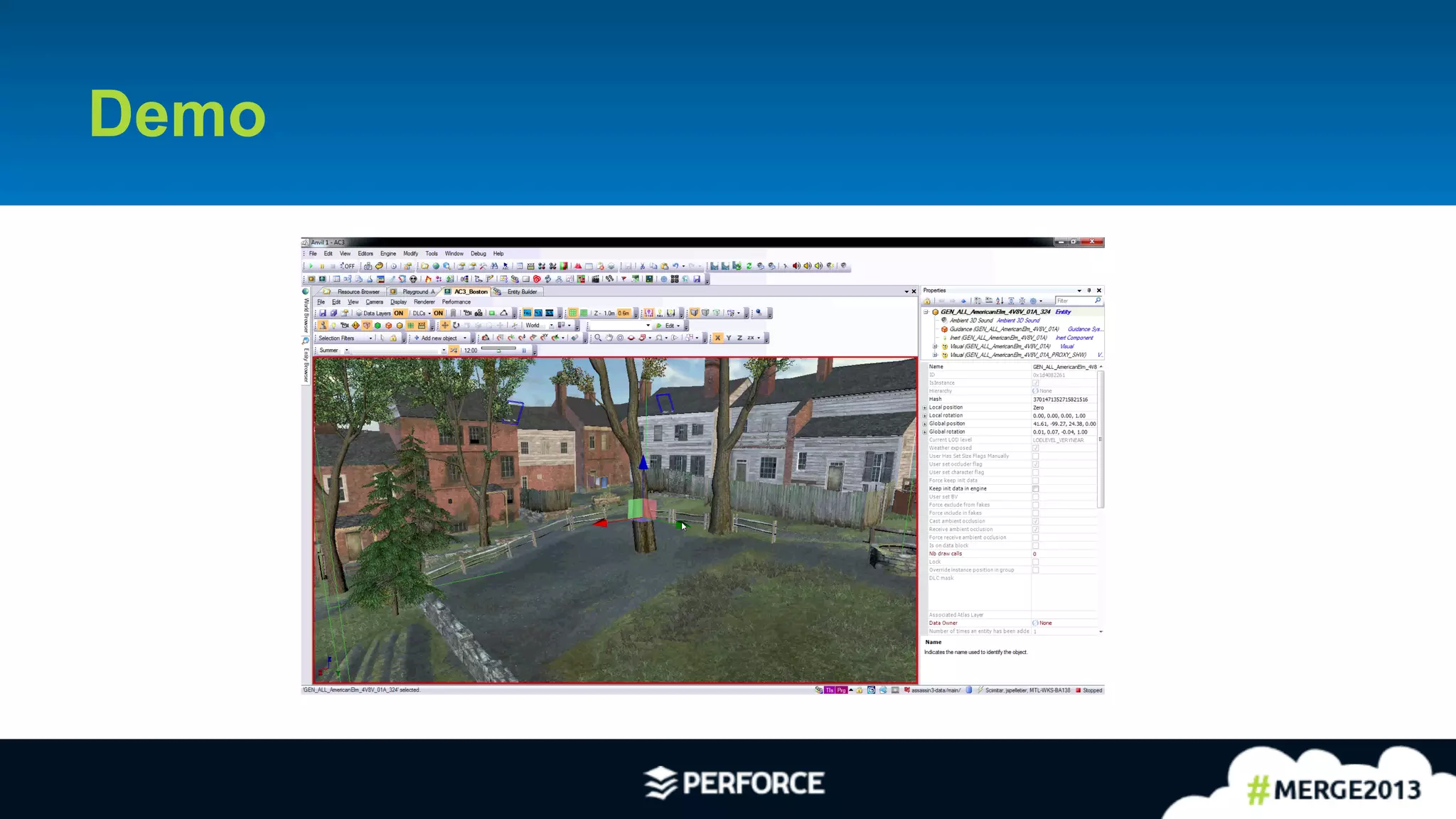
Demo
26	
  
Benefits vs Costs
Is it really worth it ?
27	
  
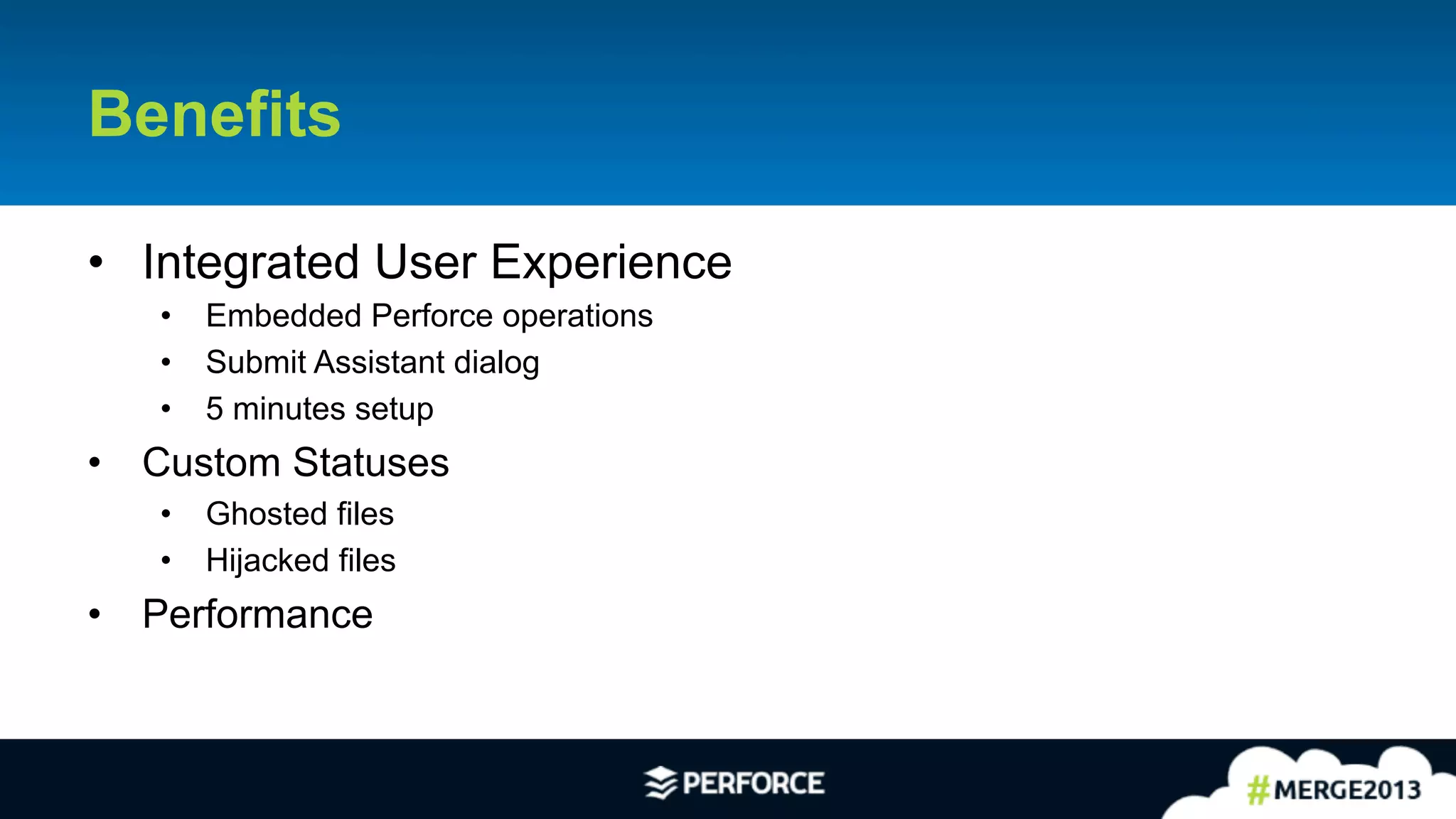
Benefits
•  Integrated User Experience
•  Embedded Perforce operations
•  Submit Assistant dialog
•  5 minutes setup
•  Custom Statuses
•  Ghosted files
•  Hijacked files
•  Performance
28	
  
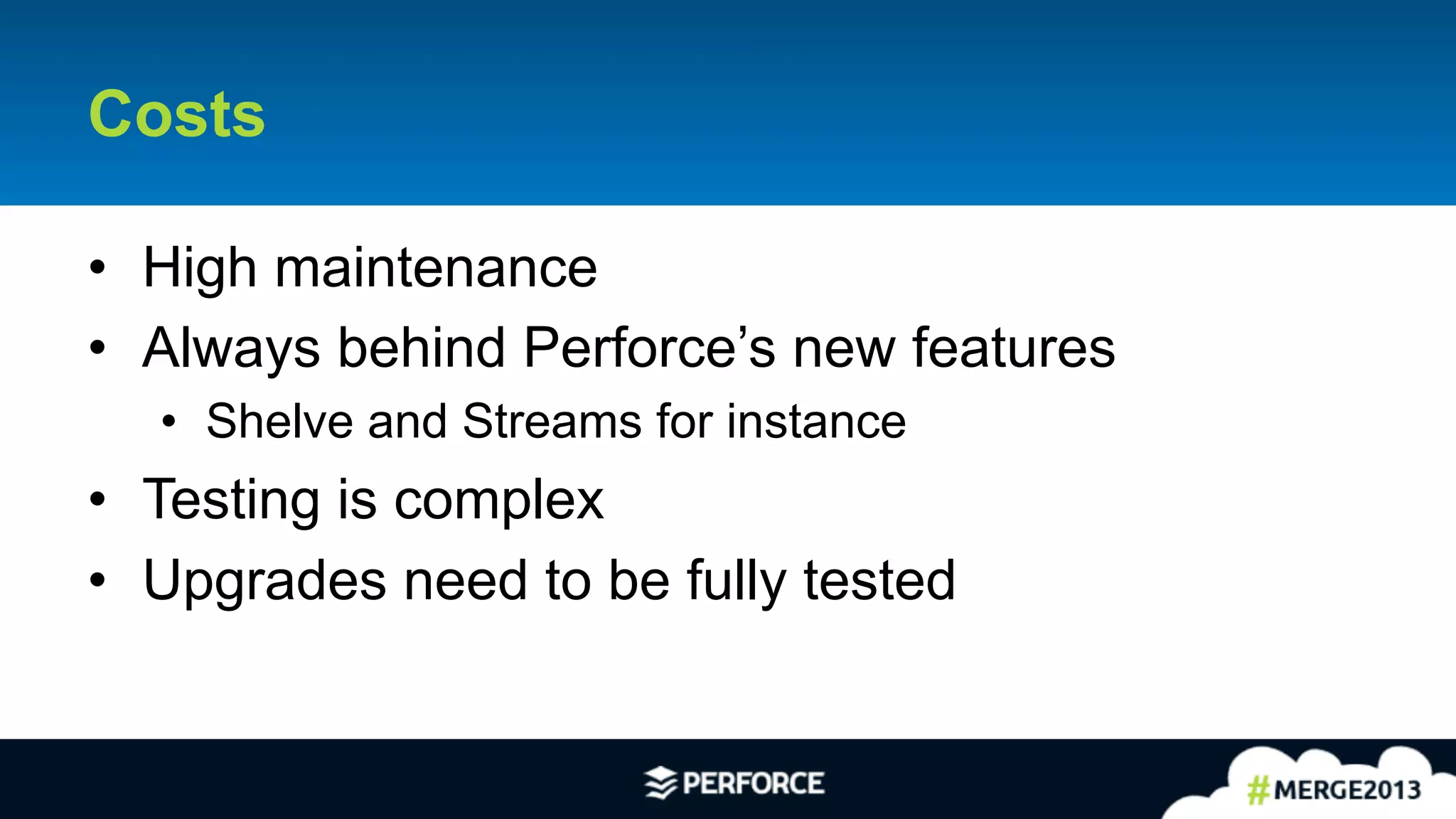
Costs
•  High maintenance
•  Always behind Perforce’s new features
•  Shelve and Streams for instance
•  Testing is complex
•  Upgrades need to be fully tested
29	
  
Final words
30	
  
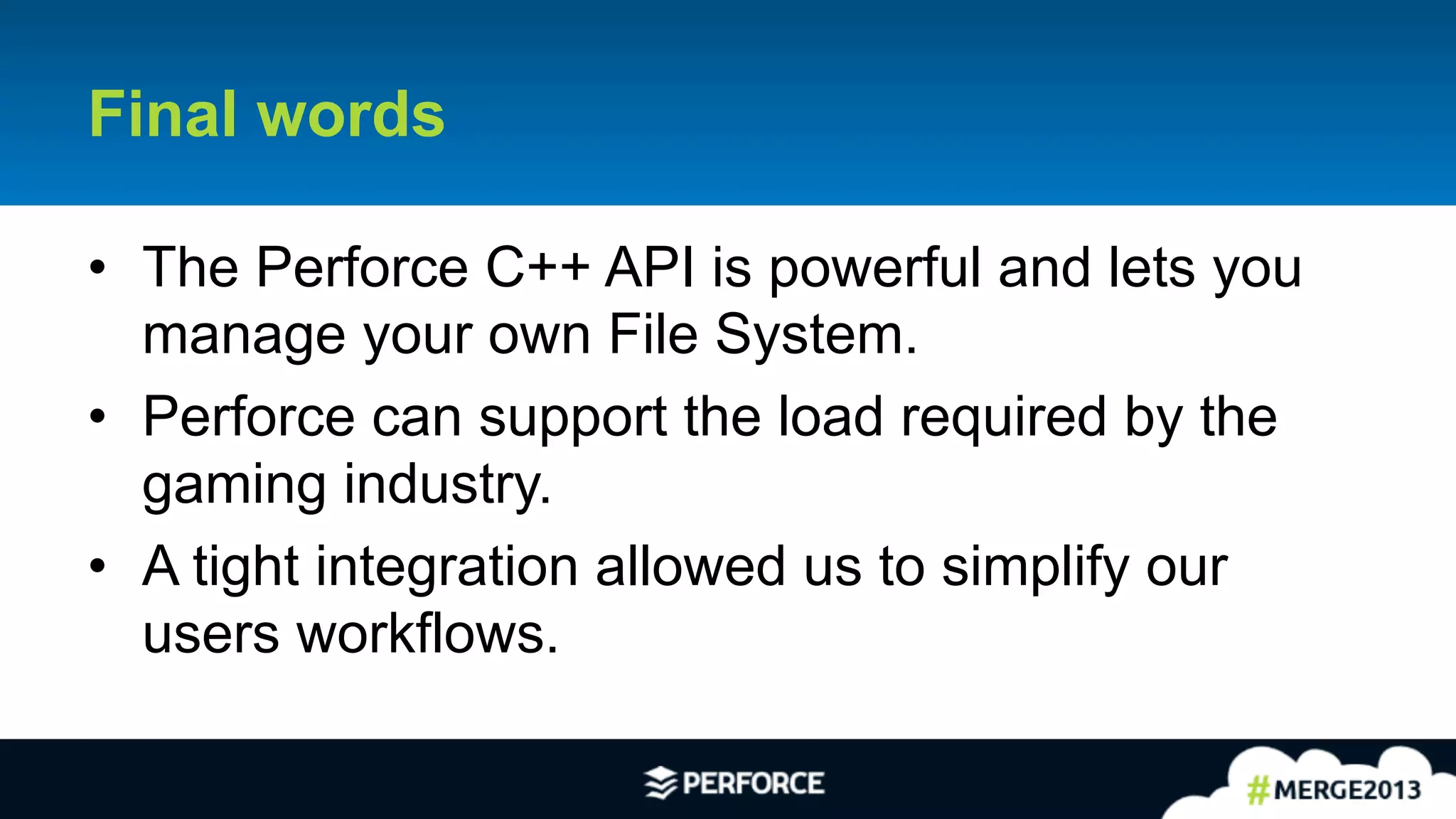
Final words
•  The Perforce C++ API is powerful and lets you
manage your own File System.
•  Perforce can support the load required by the
gaming industry.
•  A tight integration allowed us to simplify our
users workflows.
31	
  
Questions ?

[Ubisoft] Perforce Integration in a AAA Game Engine

  • 1.
    1   Perforce integrationin a AAA game engine The Strength of the C++ API Marc Desfossés Lead Tools Programmer Jean-Sébastien Pelletier Technical Lead Perforce integration in a AAA game engine Ubisoft Entertainment
  • 2.
    2   Introduction The organizedchaos of the game industry
  • 3.
    3   History –Prince of Persia •  How it worked on Prince of Persia (2003) •  In-house source control •  What we loved •  Bigfile: File system stored in a single file •  Integrated in editor •  What did not work •  Data corruption •  Not scalable : No submit queue
  • 4.
    4   History –Starting from scratch Foundations of a new engine (2004) •  Full Perforce Integration •  Keep Bigfile’s concepts •  AAA game title •  Big teams •  Lots of assets
  • 5.
    5   Game ProductionWorkflow Creating a AAA game
  • 6.
    6   Engine overview Guildlib  (Data  Exchange)   Scimitar  (Engine)   Anvil  (Editor)   3DStudio  Max   MoAon  Builder   P4   Photoshop   Bigfile  
  • 7.
    7   Objectives •  Performance • Stability •  Get rid of data corruption •  Scalability •  User Experience
  • 8.
    8   Objectives -Scalability •  Over 2 millions of files on AC3 •  ~ 500 users submitting code or data •  150 Gigs of data •  Multi-Studio support (5 studios)
  • 9.
    9   Objectives -Scalability
  • 11.
    11   Objectives –User experience •  Simple User Interface •  Exposing only the basics features •  Add, Edit, Delete •  Limited branching and resolve for power users
  • 12.
    12   User Experience- Custom dialogs Anvil  Editor  
  • 13.
    13   User Experience- Custom dialogs Visual  Diff   Submit  Assistant  
  • 14.
  • 15.
    15   Architecture –The Bigfile •  File system embedded in ONE file similar to a zip file. •  Database driven •  Transactions •  It contains relationships between all game objects •  Source control metadata for each file stored in FAT •  Revision number •  File status
  • 16.
    16   Architecture –Clientview Sync Process -  Mirror bigfile and its associated perforce client -  Run commands such as fstat, flush, edit, revert, delete, add. -  Once this is completed we can run any Perforce command.
  • 17.
    17   Architecture –Splitting game object files   Name    =  texture.psd   Object  Type  =  Texture   Folder  =  foo     Meta  Data   Data   /foo/texture.psd   BIGFILE   Perforce  
  • 18.
    18   Architecture –Splitting game object files •  Avoid branching when moving or renaming •  Move or Rename becomes edit of the meda-data file •  Save disk space on server •  No data file submit for rename or move •  Allow custom file statuses •  Only the meta-data file is synced
  • 19.
    19   Architecture –File Mapping //ac3/main/d/3/00/01/300012ce1.d   //ac3/main/a/3/00/01/300012ce1.a       /foo/texture.psd   File  texture.psd  with  ID  0x300012ce1   Perforce  Depot  BIGFILE  
  • 20.
    20   •  FileSysclass •  Used to redirect I/O •  Lets us improve performance •  Callback call for each file when running commands Architecture – The C++ API
  • 21.
    21   •  P4sync //ac3/main/… •  Callbacks in FileSys class for each file synced •  Open() •  Stat() – Return false (no temp file) •  Write() – Append buffer in memory •  Close() – Commit buffer and update metadata in bigfile Architecture – Sync Example
  • 22.
    22   Architecture –Sync Performance
  • 23.
    23   Architecture –Custom File Statuses •  Ghosted files
  • 24.
    24   Architecture –Custom File Statuses •  Hijacked files •  Clobbered files that can be reverted •  Skipped during sync •  Contained in a special changelist
  • 25.
  • 26.
    26   Benefits vsCosts Is it really worth it ?
  • 27.
    27   Benefits •  IntegratedUser Experience •  Embedded Perforce operations •  Submit Assistant dialog •  5 minutes setup •  Custom Statuses •  Ghosted files •  Hijacked files •  Performance
  • 28.
    28   Costs •  Highmaintenance •  Always behind Perforce’s new features •  Shelve and Streams for instance •  Testing is complex •  Upgrades need to be fully tested
  • 29.
  • 30.
    30   Final words • The Perforce C++ API is powerful and lets you manage your own File System. •  Perforce can support the load required by the gaming industry. •  A tight integration allowed us to simplify our users workflows.
  • 31.