Helix ALM by Perforce © 2019 Perforce Software, Inc.
Free Yourself!
From the MS Office Prison
PRESENTED BY GERHARD KRÜGER
Free Yourself!
From the MS Office Prison
perforce.com3 | Helix ALM by Perforce © 2019 Perforce Software, Inc.
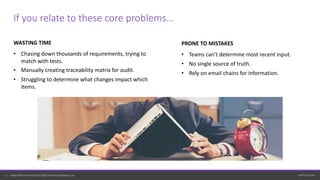
If you relate to these core problems…
PRONE TO MISTAKES
• Teams can’t determine most recent input.
• No single source of truth.
• Rely on email chains for information.
WASTING TIME
• Chasing down thousands of requirements, trying to
match with tests.
• Manually creating traceability matrix for audit.
• Struggling to determine what changes impact which
items.
perforce.com4 | Helix ALM by Perforce © 2019 Perforce Software, Inc.
Changing your ALM strategy can create drastic improvements!
OVERVIEW
Current approaches that interfere with productivity
Requirements, issues, and other tracking for
traceability kept in Word, Excel.
How these approaches hinder processes
Disjointed toolchains.
Modern ALM
Core elements, benefits.
perforce.com5 | Helix ALM by Perforce © 2019 Perforce Software, Inc.
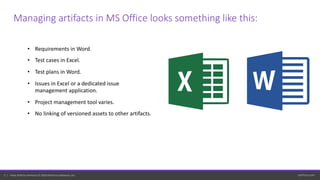
• Requirements in Word.
• Test cases in Excel.
• Test plans in Word.
• Issues in Excel or a dedicated issue
management application.
• Project management tool varies.
• No linking of versioned assets to other artifacts.
Managing artifacts in MS Office looks something like this:
perforce.com6 | Helix ALM by Perforce © 2019 Perforce Software, Inc.
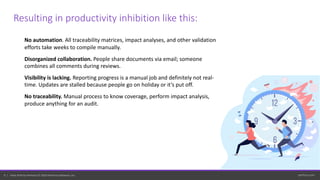
No automation. All traceability matrices, impact analyses, and other validation
efforts take weeks to compile manually.
Disorganized collaboration. People share documents via email; someone
combines all comments during reviews.
Visibility is lacking. Reporting progress is a manual job and definitely not real-
time. Updates are stalled because people go on holiday or it’s put off.
No traceability. Manual process to know coverage, perform impact analysis,
produce anything for an audit.
Resulting in productivity inhibition like this:
perforce.com7 | Helix ALM by Perforce © 2019 Perforce Software, Inc.
Modern ALM tools solve these problems
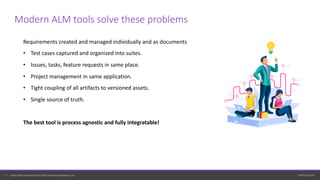
Requirements created and managed individually and as documents
• Test cases captured and organized into suites.
• Issues, tasks, feature requests in same place.
• Project management in same application.
• Tight coupling of all artifacts to versioned assets.
• Single source of truth.
The best tool is process agnostic and fully integratable!
perforce.com8 | Helix ALM by Perforce © 2019 Perforce Software, Inc.
Which means
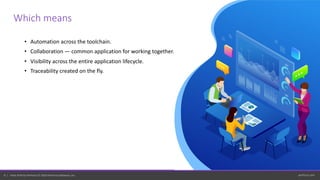
• Automation across the toolchain.
• Collaboration — common application for working together.
• Visibility across the entire application lifecycle.
• Traceability created on the fly.
perforce.com9 | Helix ALM by Perforce © 2019 Perforce Software, Inc.
And companies gain improvements like:
• Natural workflow that manages dev process from
requirements through test.
• Quality improvements by focusing development on
fulfilling requirements.
• Efficiency and quality improvements by knowingly
focusing testing on new code.
• Dev team efficiency through 360-degree visibility of
requirements, history and test cases.
• Early visibility into risks through end-to-end workflow
tracking.
• Instant audit evidence.
Questions?

Free Yourself From the MS Office Prison

  • 1.
    Helix ALM byPerforce © 2019 Perforce Software, Inc. Free Yourself! From the MS Office Prison PRESENTED BY GERHARD KRÜGER
  • 2.
    Free Yourself! From theMS Office Prison
  • 3.
    perforce.com3 | HelixALM by Perforce © 2019 Perforce Software, Inc. If you relate to these core problems… PRONE TO MISTAKES • Teams can’t determine most recent input. • No single source of truth. • Rely on email chains for information. WASTING TIME • Chasing down thousands of requirements, trying to match with tests. • Manually creating traceability matrix for audit. • Struggling to determine what changes impact which items.
  • 4.
    perforce.com4 | HelixALM by Perforce © 2019 Perforce Software, Inc. Changing your ALM strategy can create drastic improvements! OVERVIEW Current approaches that interfere with productivity Requirements, issues, and other tracking for traceability kept in Word, Excel. How these approaches hinder processes Disjointed toolchains. Modern ALM Core elements, benefits.
  • 5.
    perforce.com5 | HelixALM by Perforce © 2019 Perforce Software, Inc. • Requirements in Word. • Test cases in Excel. • Test plans in Word. • Issues in Excel or a dedicated issue management application. • Project management tool varies. • No linking of versioned assets to other artifacts. Managing artifacts in MS Office looks something like this:
  • 6.
    perforce.com6 | HelixALM by Perforce © 2019 Perforce Software, Inc. No automation. All traceability matrices, impact analyses, and other validation efforts take weeks to compile manually. Disorganized collaboration. People share documents via email; someone combines all comments during reviews. Visibility is lacking. Reporting progress is a manual job and definitely not real- time. Updates are stalled because people go on holiday or it’s put off. No traceability. Manual process to know coverage, perform impact analysis, produce anything for an audit. Resulting in productivity inhibition like this:
  • 7.
    perforce.com7 | HelixALM by Perforce © 2019 Perforce Software, Inc. Modern ALM tools solve these problems Requirements created and managed individually and as documents • Test cases captured and organized into suites. • Issues, tasks, feature requests in same place. • Project management in same application. • Tight coupling of all artifacts to versioned assets. • Single source of truth. The best tool is process agnostic and fully integratable!
  • 8.
    perforce.com8 | HelixALM by Perforce © 2019 Perforce Software, Inc. Which means • Automation across the toolchain. • Collaboration — common application for working together. • Visibility across the entire application lifecycle. • Traceability created on the fly.
  • 9.
    perforce.com9 | HelixALM by Perforce © 2019 Perforce Software, Inc. And companies gain improvements like: • Natural workflow that manages dev process from requirements through test. • Quality improvements by focusing development on fulfilling requirements. • Efficiency and quality improvements by knowingly focusing testing on new code. • Dev team efficiency through 360-degree visibility of requirements, history and test cases. • Early visibility into risks through end-to-end workflow tracking. • Instant audit evidence.
  • 10.