1	
  
Game Studio Perforce Architecture
Ryan Mensching
Senior Network Administrator
NetherRealm Studios/WB Games Logo area
2	
  
The Setup
•  Established Studio with track record
•  Mortal Kombat (1992 – 2011)
•  DC Comics – Injustice (2013), Arkham City Lockdown
•  AAA Games on multiple platforms
•  360
•  PS3
•  WiiU
•  Vita
•  iOS
3	
  
Historical Perspective
•  Team has been making games for 20 plus years.
•  “Things will get done.”
•  Outages cost money, ship dates, and sanity.
•  “Crunch” is a reality.
•  Multi-Year development cycle, two years
•  Used other tools in the past, Source Safe
4	
  
Statistics
•  Games are Code and Binary Art Assets
•  Textures
•  Animations
•  Cinematics
•  Lighting
•  Sync of current project at head is 20G
•  Sync of source art assets is 545G
5	
  
Visuals
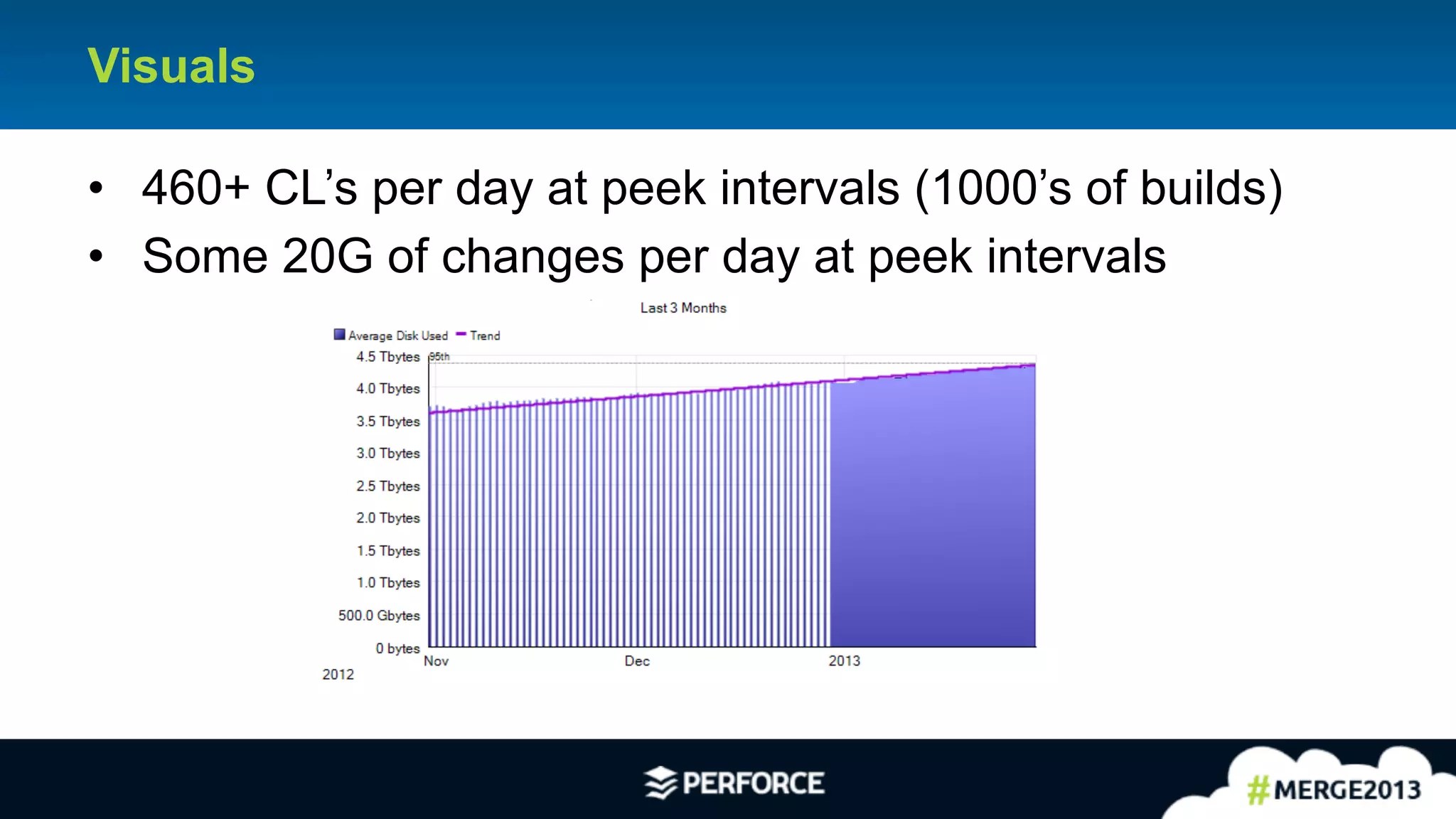
•  460+ CL’s per day at peek intervals (1000’s of builds)
•  Some 20G of changes per day at peek intervals
6	
  
Products
•  As a studio we have 3 software products that are
being produced at any given time.
•  Engine
•  Games
•  Art Tool/Game Editor
7	
  
Challenges
•  As IT we had several hurdles to overcome
•  Aging Hardware
•  Aging processes
•  Management woes
•  Insight into systems
•  Lack of agility to meet business demand
8	
  
Strategic Goals
9	
  
Strategic Goals
•  Game development support is a balancing of
immediate gratification and resources.
•  IT business driven goals/pillars
•  Space
•  Speed
•  Flexibility
•  Reliability
•  Management
10	
  
Space
•  Available, can’t be used if its locked up, i.e. thin
provisioning
•  Abstraction, array layer should not need
configuration to allocate space and at volume
layer should not require reconfig for volume
expansion.
11	
  
Speed
•  Entire VM platform, OS, and mass storage.
•  Performance needs to be maintained in relation
to consumption.
12	
  
Flexibility
•  Works in conjunction with other pillars.
•  Stands alone as a goal in games environment.
•  Freedom of protocol choices.
•  Ease of VM and hardware additions.
13	
  
Reliability
•  Redundancy should be inherent.
•  Should not require special plans or procedures.
•  If the reliability path is to complex issues will
arise.
14	
  
Management
•  IT Glue
•  Proper management makes all the pillars come
together.
•  Self documenting
15	
  
Solutions
How as an IT organization do we accomplish these goals and
vision?
16	
  
Solutions
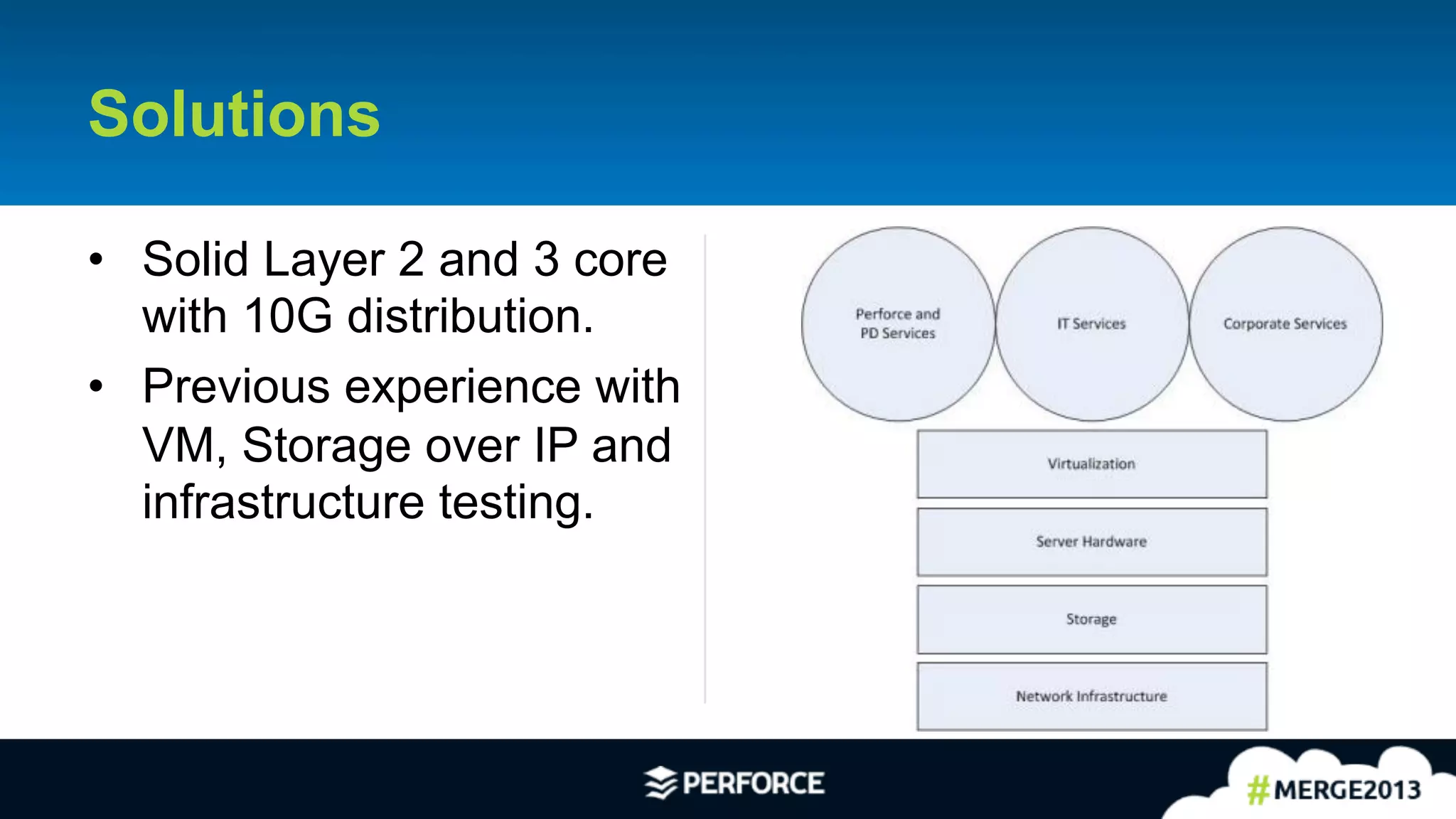
•  Solid Layer 2 and 3 core
with 10G distribution.
•  Previous experience with
VM, Storage over IP and
infrastructure testing.
17	
  
Research
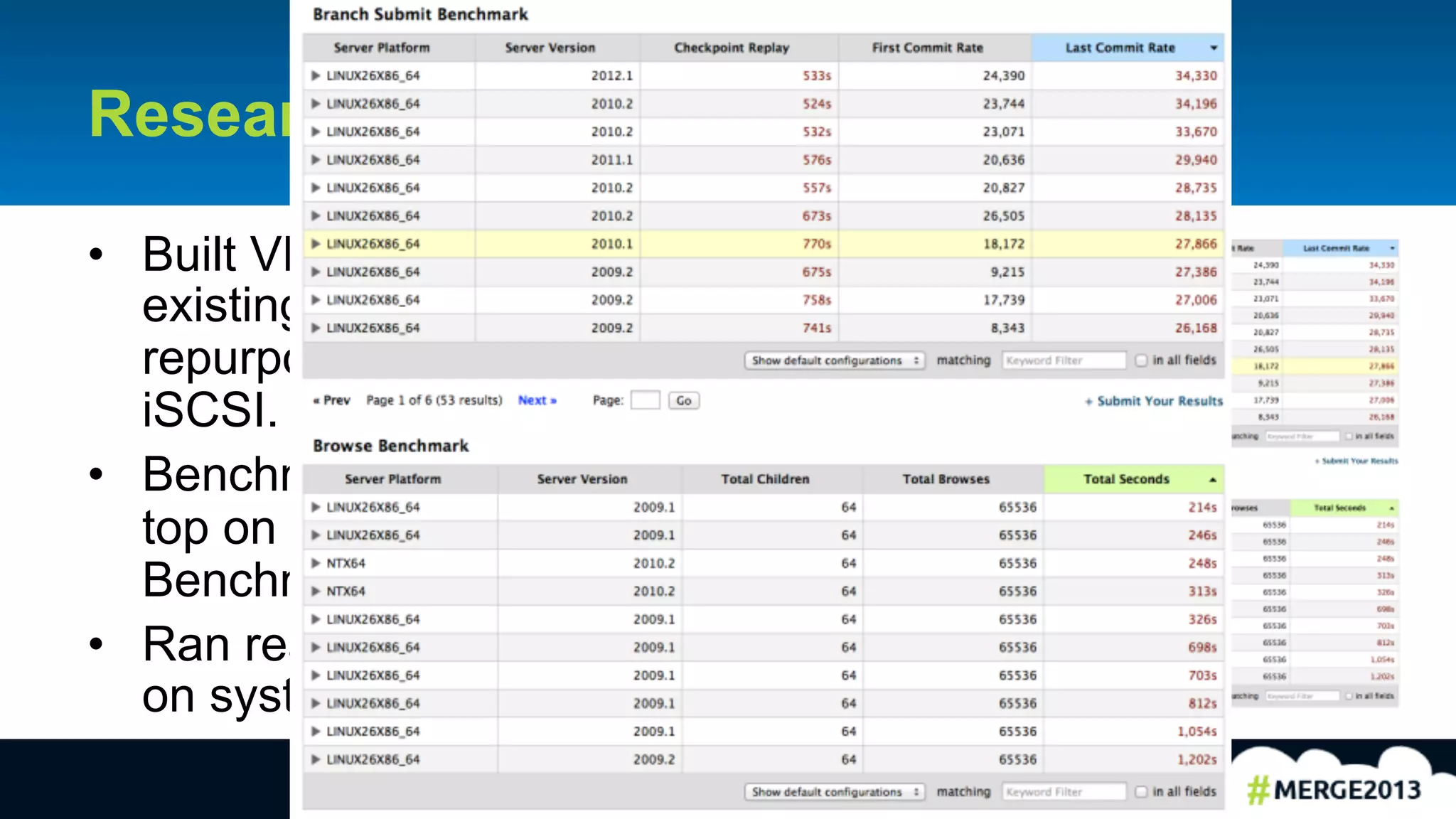
•  Built VM farm with
existing hardware and
repurposed array for
iSCSI.
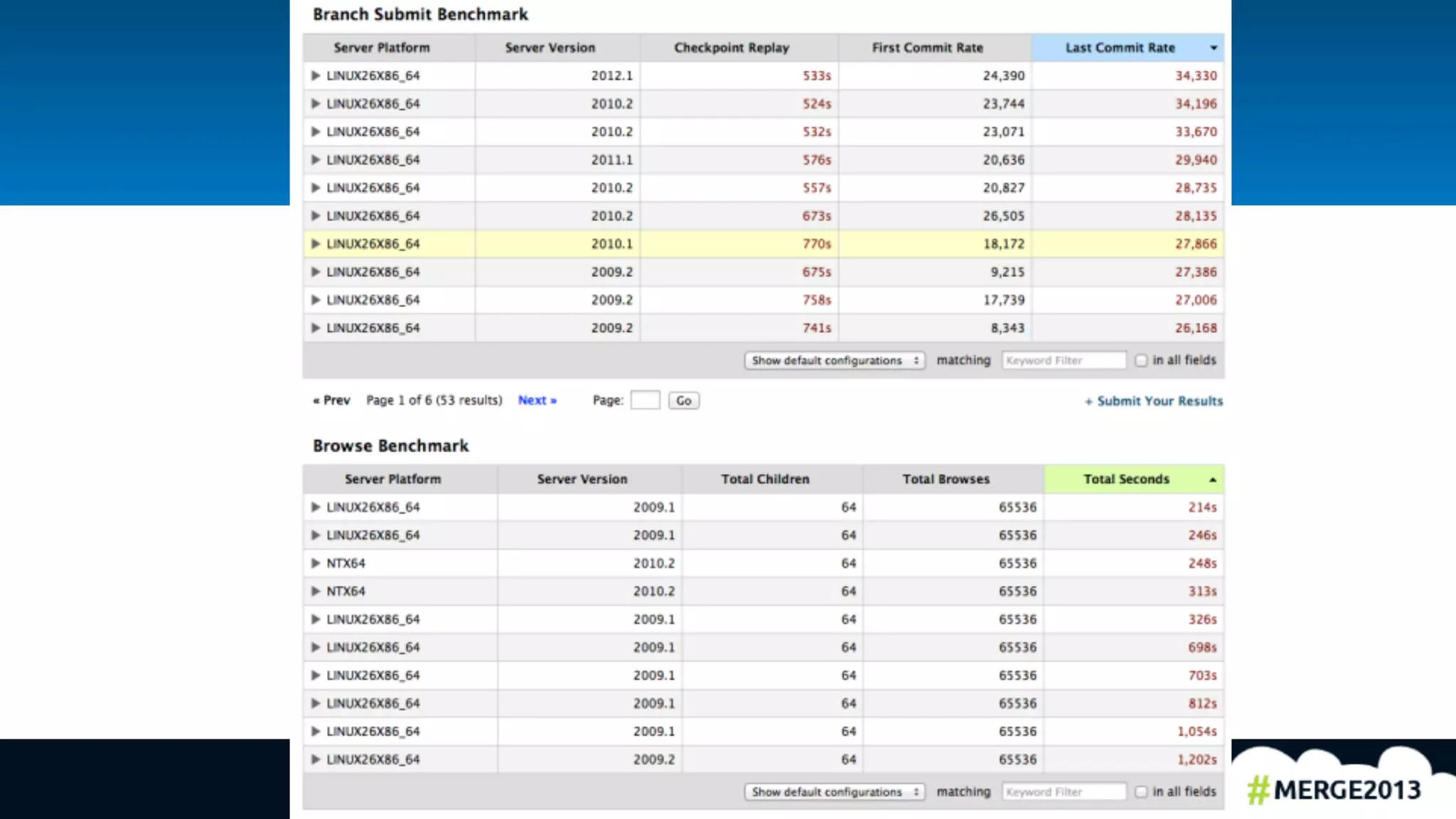
•  Benchmarks were in the
top on the Perforce
Benchmark DB.
•  Ran real world project
on systems.
18	
  
19	
  
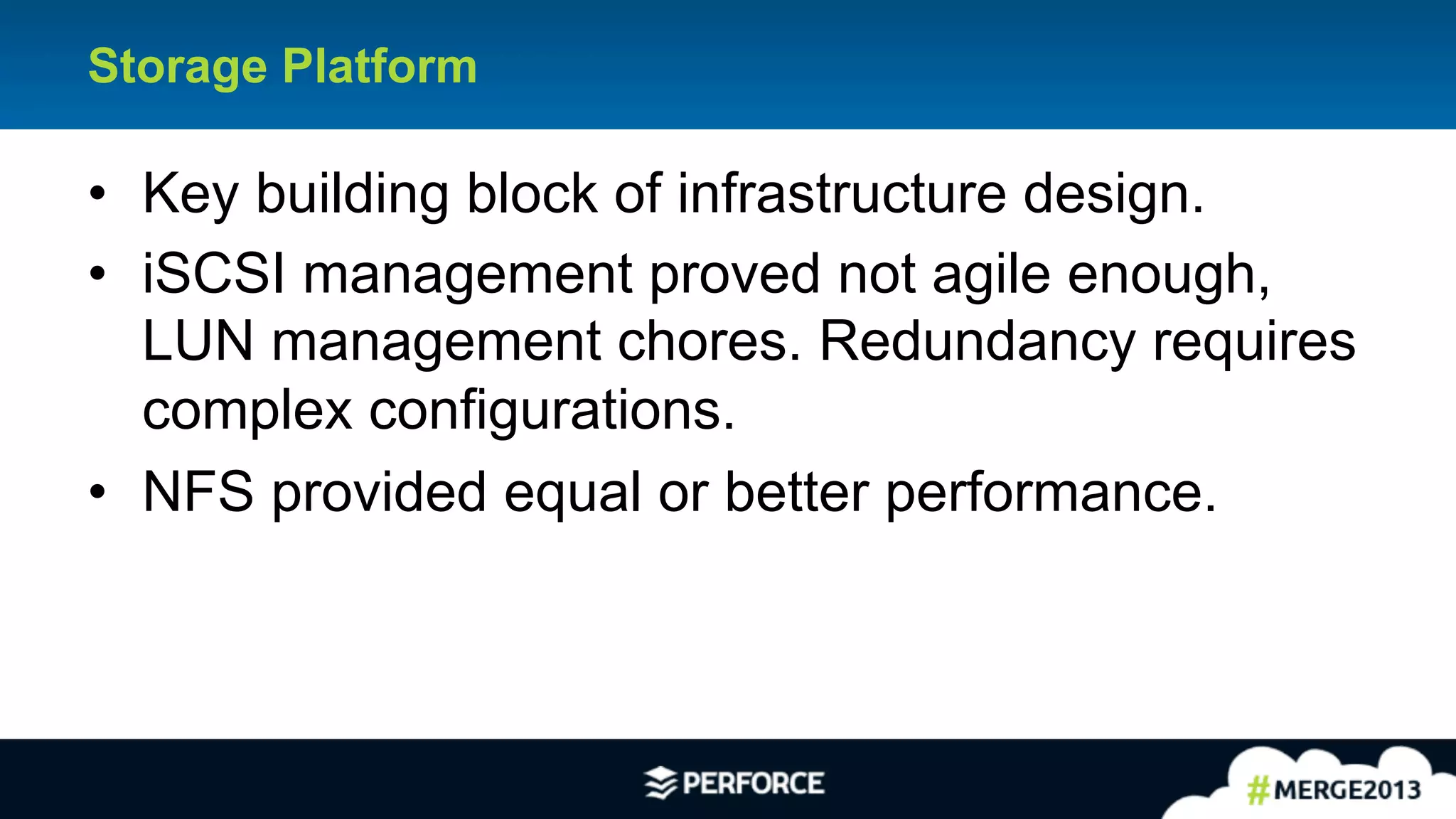
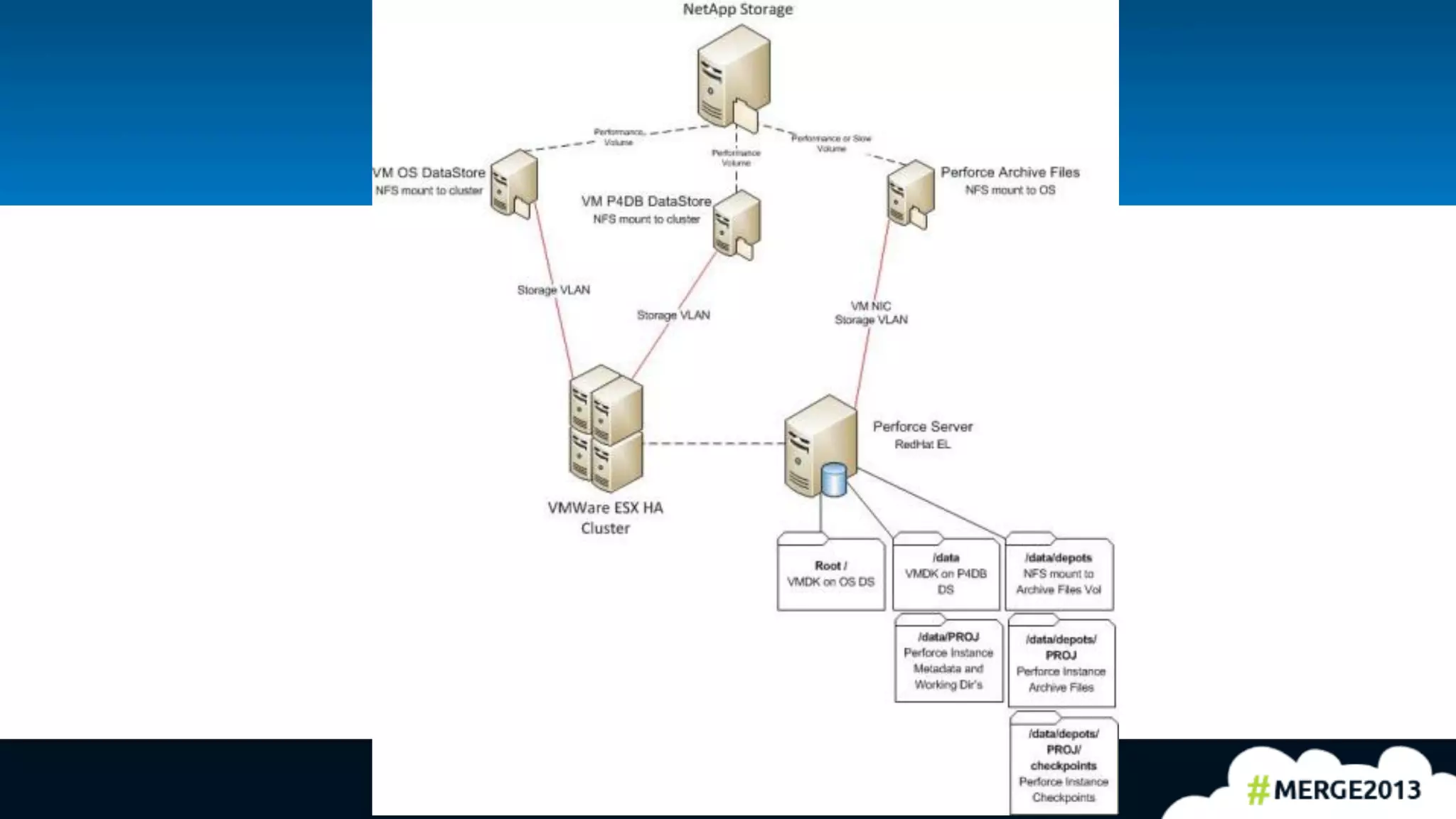
Storage Platform
•  Key building block of infrastructure design.
•  iSCSI management proved not agile enough,
LUN management chores. Redundancy requires
complex configurations.
•  NFS provided equal or better performance.
20	
  
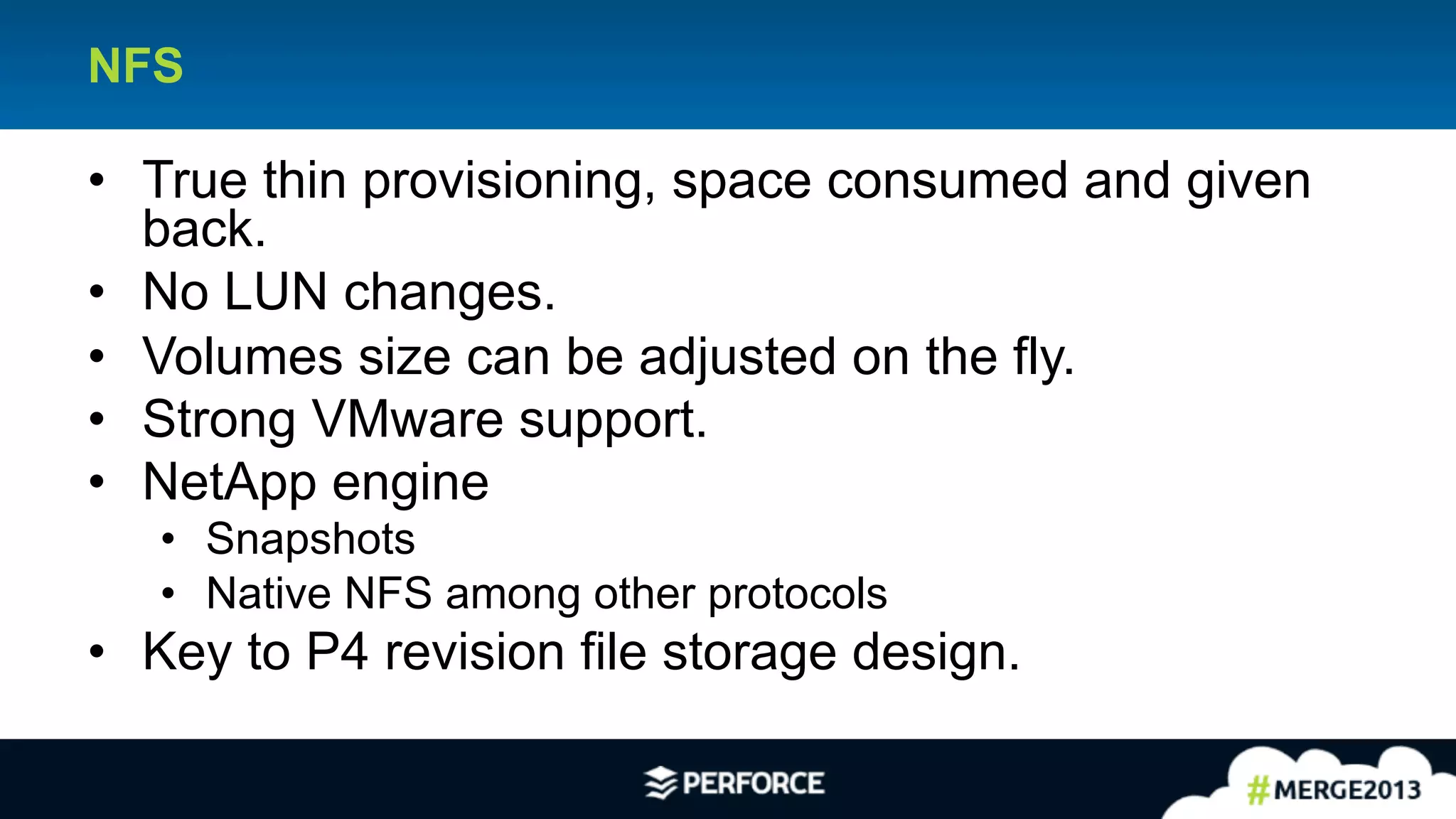
NFS
•  True thin provisioning, space consumed and given
back.
•  No LUN changes.
•  Volumes size can be adjusted on the fly.
•  Strong VMware support.
•  NetApp engine
•  Snapshots
•  Native NFS among other protocols
•  Key to P4 revision file storage design.
21	
  
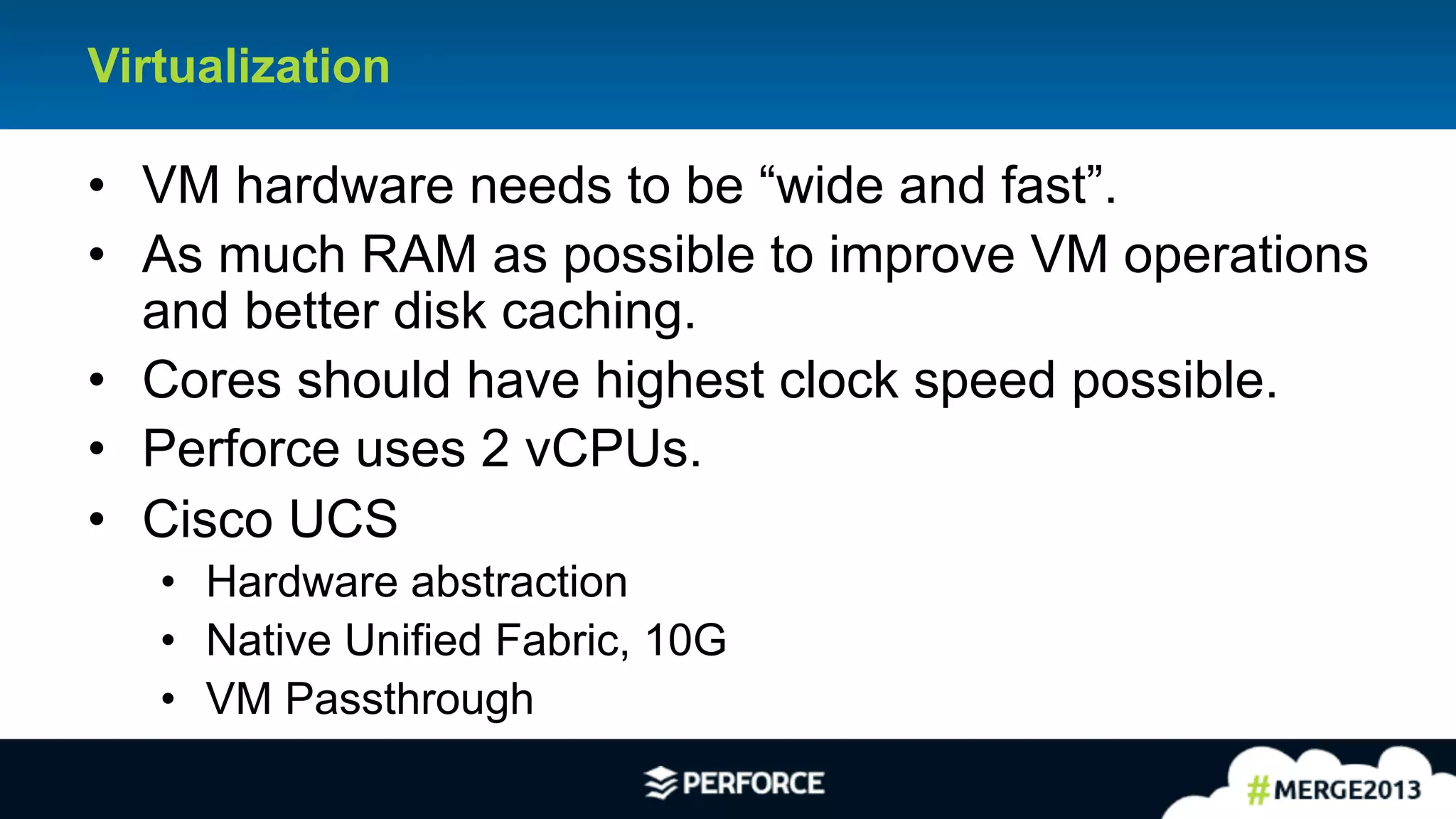
Virtualization
•  VM hardware needs to be “wide and fast”.
•  As much RAM as possible to improve VM operations
and better disk caching.
•  Cores should have highest clock speed possible.
•  Perforce uses 2 vCPUs.
•  Cisco UCS
•  Hardware abstraction
•  Native Unified Fabric, 10G
•  VM Passthrough
22	
  
OS
•  RHEL for all Perforce servers and many
applications.
•  Linux provides best usage of resources for VM’s
and disk caching.
•  Current project Perforce servers have 32GB of
RAM.
•  Able to achieve 440+Mb sustained transfer to p4
clients.
23	
  
Reliability
•  Redundancy at array level with NetApp SnapMirror.
•  Volume and VM level snapshots.
•  Provides ability to single file restore directly back to
depots/servers.
•  UCS blades multi-homed to core; dual chassis
uplinks, dual fabric uplinks, dual core switches.
•  VMware HA clustering
•  Perforce uses proxies for load balancing and
checkpoints for integrity.
•  Moving to replicas.
24	
  
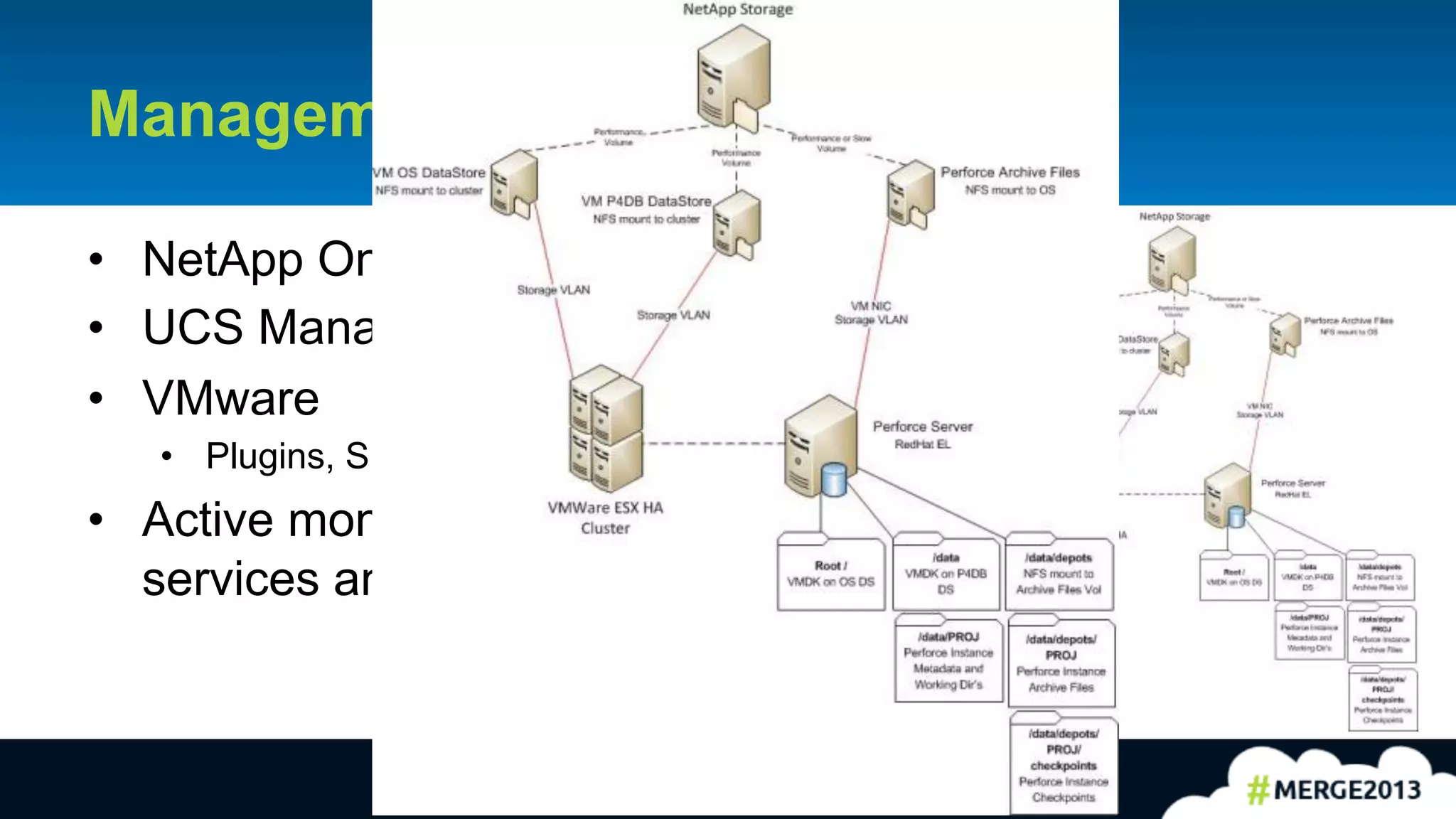
Management Tools
•  NetApp OnCommand
•  UCS Manager
•  VMware
•  Plugins, SMVI
•  Active monitoring of P4
services and disk health.
25	
  
26	
  
Conclusion
•  Perforce is very capable of scaling to speed and
data intense development.
•  Requires investments in engineering and
infrastructure.
•  Each environment is different, but can share
philosophies.
•  Abstraction, abstraction, abstraction
27	
  
Thank you
Questions?
Ryan Mensching
rmensching@wbgames.com

[NetherRealm Studios] Game Studio Perforce Architecture

  • 1.
    1   Game StudioPerforce Architecture Ryan Mensching Senior Network Administrator NetherRealm Studios/WB Games Logo area
  • 2.
    2   The Setup • Established Studio with track record •  Mortal Kombat (1992 – 2011) •  DC Comics – Injustice (2013), Arkham City Lockdown •  AAA Games on multiple platforms •  360 •  PS3 •  WiiU •  Vita •  iOS
  • 3.
    3   Historical Perspective • Team has been making games for 20 plus years. •  “Things will get done.” •  Outages cost money, ship dates, and sanity. •  “Crunch” is a reality. •  Multi-Year development cycle, two years •  Used other tools in the past, Source Safe
  • 4.
    4   Statistics •  Gamesare Code and Binary Art Assets •  Textures •  Animations •  Cinematics •  Lighting •  Sync of current project at head is 20G •  Sync of source art assets is 545G
  • 5.
    5   Visuals •  460+CL’s per day at peek intervals (1000’s of builds) •  Some 20G of changes per day at peek intervals
  • 6.
    6   Products •  Asa studio we have 3 software products that are being produced at any given time. •  Engine •  Games •  Art Tool/Game Editor
  • 7.
    7   Challenges •  AsIT we had several hurdles to overcome •  Aging Hardware •  Aging processes •  Management woes •  Insight into systems •  Lack of agility to meet business demand
  • 8.
  • 9.
    9   Strategic Goals • Game development support is a balancing of immediate gratification and resources. •  IT business driven goals/pillars •  Space •  Speed •  Flexibility •  Reliability •  Management
  • 10.
    10   Space •  Available,can’t be used if its locked up, i.e. thin provisioning •  Abstraction, array layer should not need configuration to allocate space and at volume layer should not require reconfig for volume expansion.
  • 11.
    11   Speed •  EntireVM platform, OS, and mass storage. •  Performance needs to be maintained in relation to consumption.
  • 12.
    12   Flexibility •  Worksin conjunction with other pillars. •  Stands alone as a goal in games environment. •  Freedom of protocol choices. •  Ease of VM and hardware additions.
  • 13.
    13   Reliability •  Redundancyshould be inherent. •  Should not require special plans or procedures. •  If the reliability path is to complex issues will arise.
  • 14.
    14   Management •  ITGlue •  Proper management makes all the pillars come together. •  Self documenting
  • 15.
    15   Solutions How asan IT organization do we accomplish these goals and vision?
  • 16.
    16   Solutions •  SolidLayer 2 and 3 core with 10G distribution. •  Previous experience with VM, Storage over IP and infrastructure testing.
  • 17.
    17   Research •  BuiltVM farm with existing hardware and repurposed array for iSCSI. •  Benchmarks were in the top on the Perforce Benchmark DB. •  Ran real world project on systems.
  • 18.
  • 19.
    19   Storage Platform • Key building block of infrastructure design. •  iSCSI management proved not agile enough, LUN management chores. Redundancy requires complex configurations. •  NFS provided equal or better performance.
  • 20.
    20   NFS •  Truethin provisioning, space consumed and given back. •  No LUN changes. •  Volumes size can be adjusted on the fly. •  Strong VMware support. •  NetApp engine •  Snapshots •  Native NFS among other protocols •  Key to P4 revision file storage design.
  • 21.
    21   Virtualization •  VMhardware needs to be “wide and fast”. •  As much RAM as possible to improve VM operations and better disk caching. •  Cores should have highest clock speed possible. •  Perforce uses 2 vCPUs. •  Cisco UCS •  Hardware abstraction •  Native Unified Fabric, 10G •  VM Passthrough
  • 22.
    22   OS •  RHELfor all Perforce servers and many applications. •  Linux provides best usage of resources for VM’s and disk caching. •  Current project Perforce servers have 32GB of RAM. •  Able to achieve 440+Mb sustained transfer to p4 clients.
  • 23.
    23   Reliability •  Redundancyat array level with NetApp SnapMirror. •  Volume and VM level snapshots. •  Provides ability to single file restore directly back to depots/servers. •  UCS blades multi-homed to core; dual chassis uplinks, dual fabric uplinks, dual core switches. •  VMware HA clustering •  Perforce uses proxies for load balancing and checkpoints for integrity. •  Moving to replicas.
  • 24.
    24   Management Tools • NetApp OnCommand •  UCS Manager •  VMware •  Plugins, SMVI •  Active monitoring of P4 services and disk health.
  • 25.
  • 26.
    26   Conclusion •  Perforceis very capable of scaling to speed and data intense development. •  Requires investments in engineering and infrastructure. •  Each environment is different, but can share philosophies. •  Abstraction, abstraction, abstraction
  • 27.
    27   Thank you Questions? RyanMensching rmensching@wbgames.com