Submitted To:
Dr.Shafqat Bukhari
Submitted By:
Mohammad Arif
Saad Mazhar
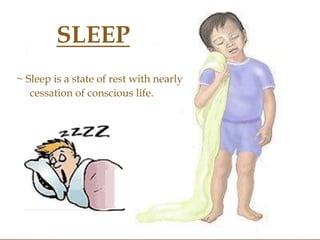
SLEEP
~ Sleep is a state of rest with nearly
cessation of conscious life.
SLEEP WALKING
~ COMMON NAME
“sleepwalking”
~ FORMAL
“ Sleep Disorder”
~ MEDICAL
“somnambulism, noctambulism”
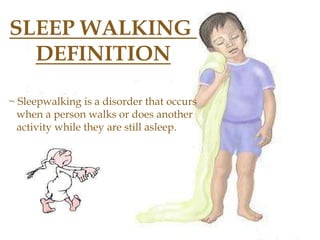
SLEEP WALKING
DEFINITION
~ Sleepwalking is a disorder that occurs
when a person walks or does another
activity while they are still asleep.
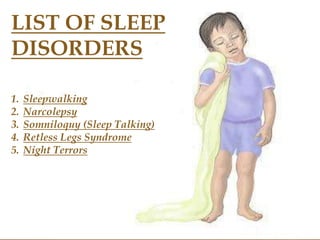
LIST OF SLEEP
DISORDERS
1. Sleepwalking
2. Narcolepsy
3. Somniloquy (Sleep Talking)
4. Retless Legs Syndrome
5. Night Terrors
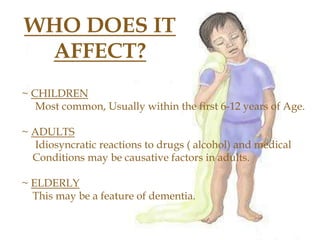
WHO DOES IT
AFFECT?
~ CHILDREN
Most common, Usually within the first 6-12 years of Age.
~ ADULTS
Idiosyncratic reactions to drugs ( alcohol) and medical
Conditions may be causative factors in adults.
~ ELDERLY
This may be a feature of dementia.
in children
 fatigue
 Lack of sleep
 Anxeity
In adults
 Acohol
 Drugs
 Other medication
 Mental disorder
In elders
 May be sympton of an orgqnic
brain syndrom
 REM behaviour disorder
 Can be genetic
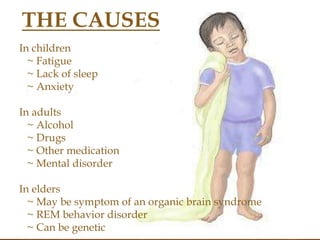
In children
~ Fatigue
~ Lack of sleep
~ Anxiety
In adults
~ Alcohol
~ Drugs
~ Other medication
~ Mental disorder
In elders
~ May be symptom of an organic brain syndrome
~ REM behavior disorder
~ Can be genetic
THE CAUSES
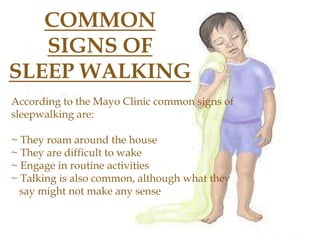
COMMON
SIGNS OF
SLEEP WALKING
According to the Mayo Clinic common signs of
sleepwalking are:
~ They roam around the house
~ They are difficult to wake
~ Engage in routine activities
~ Talking is also common, although what they
say might not make any sense
DIAGNOSIS
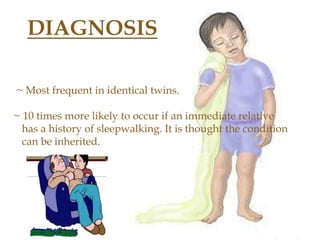
~ Most frequent in identical twins.
~ 10 times more likely to occur if an immediate relative
has a history of sleepwalking. It is thought the condition
can be inherited.
TREATMENTS
~ Medication
~ Relaxation.
~ Anticipatory Awakenings
~ Waking the child or person approximately
15-20 minutes before the usual time of an
event, and then keeping them awake
through the time during which the episodes
usually occur.
COMMON
MISCONCEPTION
~ A sleepwalker won’t die or have a heart attack
if woken.
HOW TO
PREVENT
~ Limit stress
~ Meditate or do relaxation exercises.
~ Avoid getting too tired, and try to prevent
insomnia, because this can trigger a sleep
walking episode.
~ Avoid or minimize stress, anxiety, and conflict
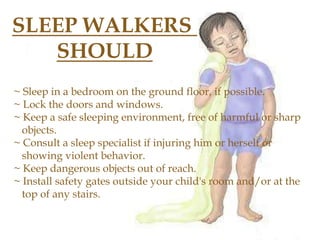
SLEEP WALKERS
SHOULD
~ Sleep in a bedroom on the ground floor, if possible.
~ Lock the doors and windows.
~ Keep a safe sleeping environment, free of harmful or sharp
objects.
~ Consult a sleep specialist if injuring him or herself or
showing violent behavior.
~ Keep dangerous objects out of reach.
~ Install safety gates outside your child's room and/or at the
top of any stairs.
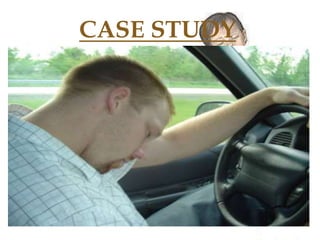
CASE STUDY

 Kenneth Parks, a 23-year-old Toronto man with a wife and
infant daughter, was suffering from severe insomnia caused by
joblessness and gambling debts.
 Early in the morning of May 23, 1987 he awoke, got in his car
and drove 23 kilometers to his in-laws' home.
 He stabbed to death his mother-in-law, whom he loved and
who had once referred to him as "a gentle giant." Parks also
assaulted his father in law, who survived the attack.
 He then drove to the police and said "I think I have killed some
people... my hands," only then realizing he had severely cut his
own hands.
 Because he could not remember anything about the murder and
assault, had no motive for the crime whatsoever, and did have a
history of sleepwalking, his team of defense experts (psychiatrists,
a psychologist, a neurologist and a sleep specialist) concluded Ken
Parks was 'asleep' when he committed the crime, and therefore
unaware of his actions.
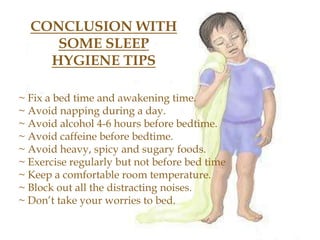
CONCLUSION WITH
SOME SLEEP
HYGIENE TIPS
~ Fix a bed time and awakening time.
~ Avoid napping during a day.
~ Avoid alcohol 4-6 hours before bedtime.
~ Avoid caffeine before bedtime.
~ Avoid heavy, spicy and sugary foods.
~ Exercise regularly but not before bed time
~ Keep a comfortable room temperature.
~ Block out all the distracting noises.
~ Don’t take your worries to bed.

THANK YOU

Sleep Walking

  • 1.
    Submitted To: Dr.Shafqat Bukhari SubmittedBy: Mohammad Arif Saad Mazhar
  • 2.
    SLEEP ~ Sleep isa state of rest with nearly cessation of conscious life.
  • 3.
    SLEEP WALKING ~ COMMONNAME “sleepwalking” ~ FORMAL “ Sleep Disorder” ~ MEDICAL “somnambulism, noctambulism”
  • 4.
    SLEEP WALKING DEFINITION ~ Sleepwalkingis a disorder that occurs when a person walks or does another activity while they are still asleep.
  • 5.
    LIST OF SLEEP DISORDERS 1.Sleepwalking 2. Narcolepsy 3. Somniloquy (Sleep Talking) 4. Retless Legs Syndrome 5. Night Terrors
  • 6.
    WHO DOES IT AFFECT? ~CHILDREN Most common, Usually within the first 6-12 years of Age. ~ ADULTS Idiosyncratic reactions to drugs ( alcohol) and medical Conditions may be causative factors in adults. ~ ELDERLY This may be a feature of dementia.
  • 7.
    in children  fatigue Lack of sleep  Anxeity In adults  Acohol  Drugs  Other medication  Mental disorder In elders  May be sympton of an orgqnic brain syndrom  REM behaviour disorder  Can be genetic In children ~ Fatigue ~ Lack of sleep ~ Anxiety In adults ~ Alcohol ~ Drugs ~ Other medication ~ Mental disorder In elders ~ May be symptom of an organic brain syndrome ~ REM behavior disorder ~ Can be genetic THE CAUSES
  • 8.
    COMMON SIGNS OF SLEEP WALKING Accordingto the Mayo Clinic common signs of sleepwalking are: ~ They roam around the house ~ They are difficult to wake ~ Engage in routine activities ~ Talking is also common, although what they say might not make any sense
  • 9.
    DIAGNOSIS ~ Most frequentin identical twins. ~ 10 times more likely to occur if an immediate relative has a history of sleepwalking. It is thought the condition can be inherited.
  • 10.
    TREATMENTS ~ Medication ~ Relaxation. ~Anticipatory Awakenings ~ Waking the child or person approximately 15-20 minutes before the usual time of an event, and then keeping them awake through the time during which the episodes usually occur.
  • 11.
    COMMON MISCONCEPTION ~ A sleepwalkerwon’t die or have a heart attack if woken.
  • 12.
    HOW TO PREVENT ~ Limitstress ~ Meditate or do relaxation exercises. ~ Avoid getting too tired, and try to prevent insomnia, because this can trigger a sleep walking episode. ~ Avoid or minimize stress, anxiety, and conflict
  • 13.
    SLEEP WALKERS SHOULD ~ Sleepin a bedroom on the ground floor, if possible. ~ Lock the doors and windows. ~ Keep a safe sleeping environment, free of harmful or sharp objects. ~ Consult a sleep specialist if injuring him or herself or showing violent behavior. ~ Keep dangerous objects out of reach. ~ Install safety gates outside your child's room and/or at the top of any stairs.
  • 14.
  • 15.
      Kenneth Parks,a 23-year-old Toronto man with a wife and infant daughter, was suffering from severe insomnia caused by joblessness and gambling debts.  Early in the morning of May 23, 1987 he awoke, got in his car and drove 23 kilometers to his in-laws' home.  He stabbed to death his mother-in-law, whom he loved and who had once referred to him as "a gentle giant." Parks also assaulted his father in law, who survived the attack.  He then drove to the police and said "I think I have killed some people... my hands," only then realizing he had severely cut his own hands.  Because he could not remember anything about the murder and assault, had no motive for the crime whatsoever, and did have a history of sleepwalking, his team of defense experts (psychiatrists, a psychologist, a neurologist and a sleep specialist) concluded Ken Parks was 'asleep' when he committed the crime, and therefore unaware of his actions.
  • 16.
    CONCLUSION WITH SOME SLEEP HYGIENETIPS ~ Fix a bed time and awakening time. ~ Avoid napping during a day. ~ Avoid alcohol 4-6 hours before bedtime. ~ Avoid caffeine before bedtime. ~ Avoid heavy, spicy and sugary foods. ~ Exercise regularly but not before bed time ~ Keep a comfortable room temperature. ~ Block out all the distracting noises. ~ Don’t take your worries to bed.
  • 17.