UNIT 3
The Sick Child
INTRODUCTION:
 The sick child is different from a sick adult.
 The differences of illness in children and adult are based
on anatomic, physiological and psychological differences
between the immature child and the mature adult.
 The older the child becomes, the greater the chances of
survival.
 The risk of mortality is greater in young infants.
 The parents can usually recognize the early features of
illness in their children.
PEDIATRIC UNIT IN A HOSPITAL
 The pediatric unit must have the facilities for adequate
provision of care of the children and protection for
physical dangers, i.e. accidents and infections along with
protection for physical dangers, i.e. accidents and
infections along with protection from psychologically
threatening environment.
HOSPITALIZATION OF THE SICK CHILD
 ADMISSION
 Introduce primary nurse to child and family.
 Orient child and family to inpatient facilities, to assigned
room and unit.
 A pediatric unit should be happy and attractive place
with cheerful home like surroundings.
 It should have colorful walls with suitable pictures.
 Furniture should be of attractive and colorful without any
poisonous paints , any projections and sharp edges.
 Floor should not be slippery and safety measures to be
maintained.
CONT…
 A pediatric unit should have facilities of separate areas
for different types of ill child, treatment room,
examination room, play room, dinning room and pantry,
waiting room for visitors and parents, consultation room,
teaching room for visitors, store room, bathroom for
children's and adults, nurses station, doctors room etc.
 The pediatric unit must meet the needs of children's and
their parents.
 The physical environment of pediatric unit should be
pleasing by maintenance of cleanliness and orderliness of
furniture and equipment.
CONCEPTS TO MINIMIZE EMOTIONAL TRAUMA
IN CHILDREN'S AND PARENTS:
 Family integrity and child's relationship should be
maintained.
 The sick child should be supported and guided to learn to
handle new experiences and feelings by family
participation to provide love and security during illness
and hospital stay.
 Needs of each child are different , assessment of these
needs as well as those of family members forms the basis
of nursing interventions.
 The pediatric nurse seeks to promote , maintain and
restore health in both children and their parents by health
counseling and teaching about the needs.
CHILDS REACTION TO
HOSPITALISATION AND ILLNESS:
1. Reactions of neonates:
 Hospitalization and prolonged illness in neonatal period
interrupts in the early stages of development of a healthy
mother-child relationship and family integration.
 Impairment of bonding and trusting relationship
,inability of the parents to love and care for the baby and
inability of the baby to respond to parents and family
members.
CONT…
2. REACTION OF INFANTS:
 Infants reaction are mainly separation anxiety and disturbance
of development of basic trust , when the infant is separated
from mother and when illness and hospitalization .
 Emotional withdrawal and depression are found in the infants
of 4 to 8 months of age , interference of growth and delayed
developments also found.
 Older infants 8 to 12 months of age may have limited
tolerance due to separation anxiety which is found as fear of
strangers , excessive crying , clinging and overdependence on
mother .
 The major stress from middle infancy throughout the
preschool years , especially for children ages 6 to 30 months ,
is separation anxiety .
CONT…
 STAGE OF PROTEST: Children's react aggressively to
the separation from the parent. They cry and scream for
their parents ,refuse the attention of anyone else and are
inconsolable in their grief.
 STAGE OF DESPAIR ; The crying stops , and
depression is evident , the child is less active , is
uninterested in play or food , and withdraws from others.
 STAGE OF DETACHMENT OR DENIAL ;
Superficially , it appears that the child has finally
adjusted to the loss. The child become more interested in
the surroundings , plays with others and seems to form
new relationships.
CONT…
3. REACTIONS OF TODDLERS:
 The toddlers PROTESTS by frequent crying , shaking crib,
rejecting nurses attention , urgent desire to find mother and
showing signs of distrust with anger and tears ,especially
when with mothers.
 In DESPAIR , the toddler becomes hopeless , apathetic ,
anorectic , listless ,looks sad , cry continuously or
intermittently and use comfort measures like thumb sucking ,
fingering lip and tightly clutching a toy.
 In DENIAL ,the child reacts by accepting care without protest
and represses all feelings. The child does not cry in the
absence of mothers and may seem more attached to nurses.
 The toddler may react by REGRESSION in an attempt to
regain control of a stressful situation. They are found to stop
using newly acquired skills and may return to the behaviour of
an infant during illness and hospitalization.
CONT…
4. REACTIONS OF PRESCHOOL CHILD:
 The preschool children adopt various mental
mechanisms (defense mechanisms) to adjust with the
stressful experiences of hospitalization and prolonged
illness.
 They react by exhibiting regression, repression,
projection, replacement, identification, aggression,
denial, withdrawal and fantasy.
 The stage of PROTEST in preschool children is usually
less aggressive and direct .
CONT…
5. REACTIONS OF SCHOOL AGED CHILDREN’S:
 The school age children are concerned with fear, worry,
mutilation, fantasies, modesty, and privacy.
 They react with defense mechanisms like regression ,
separation anxiety , negativism , depression , phobia ,
unrealistic fear , suppression or denial of symptoms and
conscious attempts of mature behaviour.
CONT…
6. REACTIONS OF ADOLESCENTS:
Adolescents are concerned with lack of privacy , separation
from peers or family and school , interference with body
image or independence or self concept and sexuality.
 They react with anxiety related to loss of control and
insecurity in strange environment.
 They may show anger and demanding or un co-operative
behaviour or increased dependency on mothers and staff.
 They may adopt mental mechanism like
intellectualization about disease , rejection of treatment ,
depression ,denial or withdrawal.
EFFECTS OF HOSPITALISATION ON THE
FAMILY:
 Break in the unity of family.
 Separation from the children.
 Feeling of inadequacy as others care for their children.
 They feel anxiety, anger, fear, disappointment , self blame,
and possible guilt feeling due to lack of confidence and
competence for caring the child in illness and wellness.
 Parental anxiety related to;
 Strange environment in the hospital.
 Unknown events and outcome
 Spread of infections of other members from the family
 Society will look upon the illness as a reflection of something
wrong with the parents.
ROLE OF NURSE TO HELP TO COPE WITH
HOSPITALISATION OF CHILDREN:
 The nurse should earn sufficient confidence to develop
positive relationship with the children and their parents.
 Nurse should have patience, tenderness and emotional
strength in times of stress.
 Provide family centered care with different approach to
specific age group.
1. IN NEONATE: Rooming in and sensory motor
stimulation.
2. IN INFANTS: Encourage mother to balance her
responsibilities and minimize separation , mother can
be allowed during procedure , providing toys to relieve
tension.
CONT…
3. IN TODDLERS : Rooming in , unlimited visiting hours
to express child's feelings, no punishment to the child,
home routines can be continued , allow play , encourage
independence , encourage family interaction.
4. IN PRESCHOOLER: Provide parental participation in
care, plan to shorten the hospital stay, careful reparation for
all procedures by privacy and explanation, encourage the
child to participate in the self-care and hygiene, remove
fear , reassure the child.
CONT…
5. IN SCHOOLCHILDREN :Help the parent to prepare
child for elective hospitalization , provide privacy ,
thorough nursing history should be obtained for plan of
care , explain the procedures and its purpose , encourage
play , self care and continue schoolwork, ensure parents to
cope with their own anxieties, introduce to other parents in
the same unit and consistent visiting pattern.
6. IN ADOLESCENTS: Prepare the parents for planned
hospital admission , available hospital facilities should be
explained soon after admission, respect the personal
preference on self-care and food habit , explain all
procedure, provide opportunities for recreation , peer
relationships, interaction with other adolescent patients and
expression of feelings.
NURSING INTERVENTIONS AND ADAPTATION IN
NURSING CARE OF SICK CHILD :
 Psychological stress
 Physiological stress
 Environmental stress
 Biological stress
 Chemical stress
STRATEGIES FOR ADAPTATION IN
NURSING CARE:
 Welcome the child and parents during each nursing
intervention.
 Call by name and touch the gently with love.
 Explain the intervention in simple sentence according to the
level of understanding.
 Ask for cooperation and its benefits.
 Encourage to express the feelings.
 Demonstrate the interest and empathy to the child and family
members.
 Explain and reason out any unpleasant experience of the past
which will reduce anxiety level and help to obtain co-
operation.
 Allow parents or significant other during any treatment or
nursing procedures.
CONT…
 Maintain privacy , minimize ,exposure and gentle handling of
the child during nursing care
 Provide physical comfort by appropriate positioning ,warmth,
bladder evacuation etc. before and during the interventions.
 Take opinion of the parents and the child during any decision
making regarding the treatment plan, diagnostic procedures
and nursing intervention.
 Maintain eyelevel contact during conversation.
 Diverts the child's attention by toys or telling story.
 Protect the child from physical injury and infections.
 Assure about confidentiality of the information whenever
required especially for older children.
 Praise the child for cooperation, never threat or blame the
child for non cooperation
CONCLUSION:
 Nurse play vital role for improved care and better
outcome of hospitalized child.in the care of sick child
pediatric nurses are responsible to maintain legal and
ethical aspects .
 Nurse also need to anticipate the anxiety of the parents
and family members.
 Family centered care, parental participation and more
psychological approach should be emphasized during
comprehensive care of sick child
PEDIATRIC PROCEDURE:
PEDIATRIC NURSING HISTORY:
 Obtaining history is an important aspect of health
assessment and to evaluate the health status of an
individual.
 History regarding the child's health condition can be
collected from the parents or significant others or from
grown up child.
 The purposes of health history of a child are to obtain
data to help in diagnosis and treatment and to formulate
individualized plan for care.
 It helps to establish relationship with the child and family
and to assess the understanding of the family members
about their child's health.
HISTORY COLLECTION:
 Identifying information: Child's name, age, sex, address, name of
the informant and relation with the child, date and time of history
collection and in case of hospitalized child, name of unit, bed
numbers, registration number, date and time of admission to the
hospital, etc.
 Chief complaints: Reasons for hospital admission or seeking
medical care along with duration of complaints and any treatment
taken prior to hospitalization for the present problems.
 History of present illness: Quality, quantity and severity of
complaints, time sequence, degree of symptoms, aggravating and
alleviating factors, associated symptoms.
 Past history of illness: Medical illness and surgical illness other
than the present illness, accidents and injuries, hospitalization and
operations (with date, indications, complications and reactions),
medications, blood transfusion, radiation, allergy and diagnostic
screening procedures..
CONT…
 Birth history: Details of prenatal, intranatal, perinatal,
neonatal/postnatal information.
 History of growth and development: Previous weights, lengths,
dentition, important developmental milestones, toilet training, social
behavior, language, motor skills and sexual development.
 Immunization history: Complete or incomplete schedule, defaulter.
 Dietary history: Duration of breastfeeding, weaning, feeding
problems, dietary pattern (frequency and content of meal), weight
gain, amount of food consumption, food preferences, allergies, etc.
 Personal history: Hygiene, sleep, eliminations habit, exercise and
rest, play, hobbies, special talents, relationship with others (sibling
and parent), expressions of emotions (temper tantrum), behavioral
problems (thumb sucking, nail biting, pica, etc.) and schooling (age
of school admission, performance, school behavior).
CONT…
 Family history of illness: Any history of illness in the
family members, presence of hereditary diseases and
congenital anomalies.
 Socioeconomic history: Residence (rural, urban or
slum), housing (type, location), water supply, waste
disposal, communication facilities, recreational facilities,
General financial condition with family income, source
of income, total number of family members, family
relationship, cultural belief especially regarding child
care, etc
HEAD TO TOE EXAMINATION:
 Head: Headache, head trauma, dizziness.
 Eyes: Vision, corrective lenses, strabismus, lacrimation,
discharge, itching, redness, photophobia.
 Ears: Hearing, infection, drainage, pain.
 Nose: Cold, running nose, infection, drainage.
 Teeth: Hygiene, cavities, malocclusions.
 Throat: Sore throat, tonsillitis, difficulty in swallowing.
 Speech: Change in voice, hoarseness, stammering.
CONT…
 Respiratory: Breathing difficulty, shortness of breath,
chestpain, cough, wheezing, pneumonia, tuberculosis.
 Cardiovascular: Cyanosis, fainting, exercise intolerance,
palpitations.
 Hematologic: Pallor, anemia, bruises, bleeding.
 Gastrointestinal: Appetite, nausea, vomiting, abdominal pain
and abnormal size, bowel habit, nature of stools, passage of
parasite, encopresis, colic, etc.
 Genitourinary: Age of toilet training, frequency of urination,
dysuria, hematuria, previous urinary tract infection, enuresis,
urethral or vaginal discharge, menstruation in adolescents.
 Musculoskeletal system: Deformities, fracture, sprains, joint
pain or swelling, limitation of motion, abnormality of nails.
 Neurologic: Weakness or clumsiness, coordination, balance,
gait, tremor, convulsions, personality changes.
PHYSICAL EXAMINATION OF CHILDREN:
 Pediatric nurse plays an important role in carrying out
the physical examination of the child in hospital and
community . Head-to-foot examination is done along
with examination of different system to evaluate the
general condition of the child and to exclude the
presence of any abnormality. It also includes
anthropometric examination of the child.
 Physical examination is done by inspection,
manipulation, percussion, palpation and auscultation.
GENERAL PRINCIPLES:
 Examination should be done according to the needs of the
patient in an orderly manner.
 Gentle handling of the child with minimum exposure is very
important.
 Examination should be done informally with a friendly
approach, appreciating the cooperation and assistance.
 Attempt to develop rapport with the child should be made
from the moment of first meet.
 Explanation about the procedure should be useful in older
children for gaining cooperation.
 Restraints should be used only whenever necessary.
 Remember that the safest place for a young child is on parent's
lap.
CONT…
 Privacy and warmth to be maintained, as much as
possible.
 Positioning of the child to be done according to the body
parts to be examined. For examination of the back, the
child should be placed in prone position. For
examination of chest and abdomen, supine position with
modified mummy restraint can be used exposing the
parts as necessary.
APPROACH TO THE CHILD:
 The older child can be asked to choice to be examined on
parent's lap or special examination table.
 The chest is a good part of the body to begin the examination,
then already exposed parts can be examined, i.e. hands, legs,
etc..
 Head-to-toes examination should be done thoroughly and
systematically but strict sequence may not be followed.
 The child's clothing should be removed gradually and
observing the parts carefully during examination.
 Show the procedure to the child by demonstrating on the doll
or parent before the procedure..
 Some children are less frightened, if allowed to hold the
examining equipment first.
 Diaper area of the infants and genital area of the older
children should be examined until last.
CONT…
 Uncomfortable and irritating procedures such as
examination of throat, ear and rectum should be left
towards the end.
 The sequence of examination depends upon the
cooperation received from the child. No rigid sequence
may be followed.
 In irritated and panicky child, prolonged examination to
be avoided.
 Useful distractions to be adopted to gain cooperation
during physical examination, e.g. talking with the infants
or giving toys or having the parents play with them.
 Obtain as much information as possible while the child is
calm and not feeling threatened.
TECHNIQUE OF PHYSICAL EXAMINATION:
 Vital signs: Obtain temperature, pulses, heart sound,
respiration and blood pressure, as often as thought
necessary, based on child's condition.
 Anthropometry: Record anthropometric measurements,
i.e. child's weight, length/height, head circumference,
chest circumference mid-upper arm circumference, skin-
fold thickness, etc. growth chart to be maintained by
plotting the findings especially weight.
 General appearance: Observe general appearance like-
body position, posture, evidence of pain, crying, hygiene,
nutritional status, mental alertness, restlessness, behavior
pattern, presence of developmental abnormalities, or any
abnormal features
CONT…
 Lymph nodes: Observe and palpate for lymph node
enlargement in lymph chain areas, i.e. neck, axilla, inguinal
region, etc.
 Hair: Observe color and distribution of hair on head and any
other parts of the body.
 Head and neck: Examine head for shape and size, fontanelle,
sutures, hair color and texture, presence of infection or any
lesions, dandruff or lice, movement of head, head holding,
webbing of neck, enlarged thyroid or neck swelling etc.
 Face: Examine face for expression, asymmetry, paralysis,
nose bridge, size of maxilla and mandible, tenderness over ,
etc.
 Eyes: Observe eyes for infection, peri-orbital photophobia,
distance between the eyes, distribution of eyebrows.
Ophthalmoscopic examination also can be done.
CONT…
 Ears: Examine ears for shape, size, position, low-set ear,
deformities, discharge, tenderness over mastoid bone, and
hearing abilities. Otoscopic examination can be done to
inspect the condition of eardrum.
 Nose: Examine nose for patency, discharge, bleeding, deviated
septum, depressed nasal bridge, nasal polyp, foreign body,
flaring of nostrils, condition of nasal mucous membrane, etc.
Paranasal sinuses should be examined for tenderness and
order of development.
 Mouth and throat: Examine the color of lips, lesions at the
corners of mouth, cleft lip or cleft palate, number of teeth,
evidence of dental caries, staining on the teeth, malocclusion
and extra or missing teeth, gum bleeding, swelling and lesions
of buccal mucosa, tongue and pharynx, presence of any
infections, tonsillitis, presence of any spot, ulcer and swelling,
tongue tie or short tongue, etc.
CONT…
 Chest: Observe the size, shape and symmetry of chest,
presence of chest retractions (suprasternal, sub sternal,
intercostal, subcostal, supraclavicular), pigeon chest
deformity, funnel chest, rachitic rosary, condition of
breast and nipples, breath sounds, heart sounds, etc.
 Abdomen: Examine abdomen for size and shape,
distension, any swelling or enlargement, presence of
infection or scar, cleanliness, condition of umbilical cord
in neonate, presence of any congenital anomalies or
development problems (hernias). Limbs: Limbs to be
examined for any deformity, asymmetry, hemi-
hypertrophy, bow legs, knock-knees, edema, any
swelling or limitations of the joints, paralysis, clubbing
of fingers, number of fingers and toes.
CONT…
 Female genitalia to be observed for hypertrophy of clitoris, labia majora
and minora, vaginal and urethral openings, any vaginal discharge,
cleanliness, infections, swelling of peri-urethral or greater vestibular
(Bartholin's) glands in adolescents.
 Anus and rectum: Observe for patency of anus, presence of fissures or
fistula, rectal prolapse, perianal erythema, etc.
 Neurological examination: Note characteristics of cry, posture of head,
neck and extremities, neurological reflexes (like sucking and
swallowing reflex, grasp reflex, blinking reflex, stepping reflex) motor
coordination, muscle tone, sense of touch or pain, presence of
meningeal irritation, paresis or paralysis, etc.
 Behavioral pattern: Note the behavior of the child (whether irritable,
depressed, nervous, apathetic, excited, aggressive and disobedient)
ability to respond, aptitude to the situation, attitude towards health team
members, habit disorders, emotional problems, and mental status.
 Abnormal signs and symptoms: Examine for presence of cough and
cold, bleeding from any site, vomitus, loose motion, lack of hygiene,
convulsions, oliguria, full bladder, anemia, edema, wound, ulcer, etc.
SAFETY MEASURES DURING PEDIATRIC
TECHNIQUES:
 Adequate explanation and informed consent for child care.
 Safety precautions to be adopted in the hospitals for
prevention of accidents.
 The restraint of children is necessary for the safety.
 Aseptic techniques to be followed to prevent transmission of
infections.
 Prevention of aspiration.
 Safety measures in the administration of drugs.
 Recording of all procedures.
 Constant supervision.
 Gentle approach.
 Guidelines
PROTECTION OF THE CHILD FROM ACCIDENTS
IN HOSPITAL:
 Buildings: The pediatric unit should be well-ventilated
without draught or suffocation. Windows should be
protected with net or bar. Varandahs should not be open
and wire netting should be provided for protection.
Doors should open one way. Staircase should be railed
and grilled. Floor should not be slippery. Toilets and
bathroom should be cleaned daily and not slippery. No
cats and dogs should be allowed inside the ward.
 Furniture: All furniture in the pediatric unit should be
cleaned and without poisonous painting. The cribs
should be removable with easily operable side rails.
CONT…
 Electrical appliances: Electric points in the walls should be
high enough for the children reach. Electrical equipment must
be kept unplugged when not in use. Electrical extension cords
should not remain lying across the floor. Electrical Restraints
appliances should be checked at regular interval for working
condition without any leakage.
 Medicine cabinets: Medicine cabinets must be locked when
not in use and medications should never be given without
adequate identification of child. Oil based medications should
never be given orally when the child is crying because of the
danger of aspiration. Medicines should never left on the
bedside table.
 Instruments and solutions: These things should be kept in
cabinets or on shelves where children cannot reach them.
Utility and procedure room doors should be kept closed and
children should not be allowed in those areas.
CONT…
 Toys: Play materials should be unbreakable, washable
and without any sharp edges or small removable parts or
poisonous painting. Toys should never be left on the
floor. The children should not allow running in the wards
because of danger of falling. Supervision should be made
during play to prevent any hazards.
 Disposal of waste: Empty containers, bottles, broken
glass syringes, needles, tubing, etc. should be out of
reach of the children. Any spillage of blood or body
fluids or solutions on the floor should be immediately
cleaned to prevent fall. Cleanliness to be maintained to
prevent flies, mosquitos, cockroaches and bed bugs.
CONT…
 Clothing: Clothing should not be too long that can cause
a child to slip and fall. Safety pins should be closed at
once when taken from a child's clothing and should be
put out of reach.
 Feeding: Small children should be fed with precautions
to prevent aspirations. Forced feeding must be avoided.
Children to be taught to chew food well, before
swallowing. Warmth of the food should to be checked,
before putting it in the child's mouth.
 Nursing care
RESTRAINTS
Restraints are protective measures to limit movements. There can
be a short-term restraint to facilitate examination and minimize
the child's discomfort during special tests, procedures and
specimen collections. Restraints can also be used for a longer
period of time to maintain the child's safety and protection from
injury.
GENERAL PRINCIPLES FOR USE OF
RESTRAINTS:
 Appropriate, safe and comfortable restraints should be selected.
 Restraints should be loose as possible, tight restraint prevents normal
circulation.
 Nurse should talk soothingly to the child to provide stimulation and
diversion and to relieve the sense of helplessness and loneliness of
the child.
 Sufficient padding must be used for extremity restraints to prevent
skin irritation.
 Restraints must be checked every 15 to 30 minutes for constrictions
or any hazards. It can be removed periodically, at least every 2
hours, when used for long time. It should be removed one at a time
and reapplied so that the child can gain some degree of activity,
especially when all extremities are restrained. Before reapplication
of restraints, the child's position needs to be changed to improve
physiological functioning.
CONT…
 Child's comfort and body alignment to be maintained. Any
required knots should be tied in a manner that permits their
quick release.
 Provide range of motion and skin care routinely. When one
arm is restrained, another arm and legs should be moved.
 Do not secure the restraints to the side rails which may cause
traction on the restraint or injury to the child, when the side
rail raised or lowered .
 Proper documentation is required when restraints are in use.
 Application of restraint can be demonstrated first on the
child's doll, to get cooperation of the child and to prevent
emotional trauma.
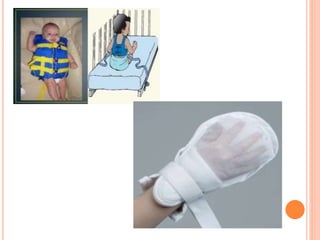
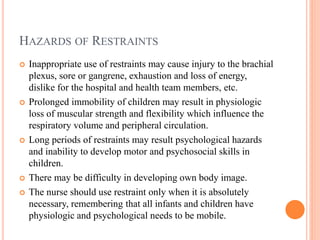
TYPES OF RESTRAINTS:
Commonly used restraints for children are mummy restraint,
elbow restraint, extremity restraint, abdominal restraint, jacket
restraint, finger restraint, crib-top restraint, etc.
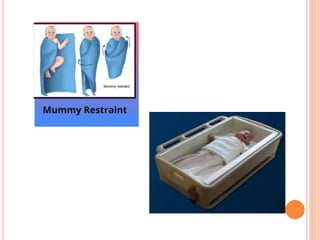
 Mummy restraint: It is a short-term type of restraint used on
infants and small children during examinations and treatment
of head and neck. It is used to immobilize the arms and legs of
the child for a brief period of time. A modified mummy
restraint may be used when the child's chest and abdomen are
to be examined.
 Abdominal restraint: This restraint helps to hold infant in a
supine position on the bed. It should be applied with
precautions so that respiratory movements of the abdomen are
not inhibited. It operates exactly like the restraints of
extremity. The strip of material is wider and has only one wide
flap for fastening around the child's abdomen.
CONT…
 Elbow restraint: This restraint is used to prevent flexion of the
elbow and to hold the elbow in an extended position so that
the infant cannot reach the face. It is especially useful for
infants receiving scalp vein infusion, nasogastric tube feeding,
surgery of face or head, repair of cleft lip or cleft palate or
having eczema or other skin disorders in those areas.
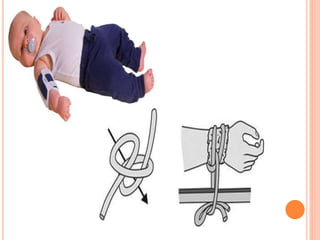
 Extremity restraint: This may be used to restraint infants and
young children for the procedures such as IV therapies and
urine collection. It is used to immobilize one or more
extremities. One type of extremity restraint is clove-hitch
restraint which is done with gauze strip (2 inches wide)
making figure-of-eight. The end of the gauze can be tied to
the frame of the crib. This restraint should be used with
padding of wrist or ankle.
CONT…
 Jacket restraint: It can be used to help the child remain flat in
bed in a supine position or to prevent the child from falling
from crib, highchair, wheelchair or other conveyance. The
jacket is put on with the strings and opening in the back and
tied securely. The long tapes are secured appropriately, i.e. to
the frame of the crib, or arm supports of a chair or around the
back of the wheelchair or highchair. The child should be
observed frequently to make certain that strangulation does
not occur, and restraint has not slipped out of place.
 Mitten or finger restraint: Mitts are used for infants to prevent
self-injury by hands in case of burns, facial injury or
operations, eczema of the face or body. Mitten can be made
wrapping the child's hands in gauze or with a little bag putting
over the baby's hand and tie it on at the wrist.
HAZARDS OF RESTRAINTS
 Inappropriate use of restraints may cause injury to the brachial
plexus, sore or gangrene, exhaustion and loss of energy,
dislike for the hospital and health team members, etc.
 Prolonged immobility of children may result in physiologic
loss of muscular strength and flexibility which influence the
respiratory volume and peripheral circulation.
 Long periods of restraints may result psychological hazards
and inability to develop motor and psychosocial skills in
children.
 There may be difficulty in developing own body image.
 The nurse should use restraint only when it is absolutely
necessary, remembering that all infants and children have
physiologic and psychological needs to be mobile.
IMPORTANCE OF PLAY FOR HOSPITALIZED
CHILDREN:
Play in hospital helps the child and health team members or
caregivers as follows:
It helps the child-
 To enhance coping abilities in hospital environment.
 To express fear, anxiety, tension, anger and fantasies.
 To understand and comprehend the hospital procedures.
 To communicate with others and to reduce emotional trauma
due to hospital experiences.
 To continue growth and development in physical,
psychological, social, moral and educational aspects.
 To get rid of boredom due to prolong illness and to release
hostile feelings.
.
CONT…
It helps the health team members
 To gain cooperation and trusting relationship of the
hospitalized children and their family members.
 To diagnose the child's feeling and behavior, and planfor
psychological approach during care.
 To find out and correct the misconceptions and beliefs
regarding hospitalized care.
 To reassure the anxious parent and to promote their
participation in child care during illness and wellness
TYPES OF PLAY FOR HOSPITALIZED CHILDREN:
Therapeutic play differs from normative play in its design and intent.
Specialized techniques, strategies and play environment are created for
sick children by the health team members to enhance emotional and
physical well-being. It can be of three types:
1. Emotional outlet or dramatic play: It is used to express the child's
anxiety, to solve conflict and as a diagnostic tool to identify child's
concern about the illness and hospitalization, e.g. playing with doll
being a nurse and caring sick doll with expression of own feeling,
storytelling, etc.
2. Instructional play: Instruction is given for therapeutic play to the
children according to their past experiences, coping abilities and
physiological status. Instructional play should be well-planned, e.g.
use of color in drawing, drawing in blank paper, learning the
instructions on health habit from TV or teaching films, etc.
3. Physiological enhancing play: It is used to maintain and improve
physical health and body functions. It can be selected to treat
pathological condition, e.g. breathing exercise to treat respiratory
problems by blowing bubbles, whistling and laughing. Squeezing the
bath sponge or ball improves neurological functions.
NURSING RESPONSIBILITIES FOR THERAPEUTIC
PLAY:
 Organize play facilities for the sick children. Every pediatric unit should have some space
for play or play room with facilities for storage of play materials. Age- appropriate play
things to be arranged for the children in adequate numbers. Individual play materials can
also be of play for hospitalized children. Any time should be play them. permitted. There
should not be any fixed period of time.
 Involve other members of health team, social worker , play therapist (play lady), parents
and other family members for play in the hospital or at home and communicate with all
members.
 Interact during play and help the child to express feelings. Then interpret, analyze and
handle the emotional and physical needs to provide necessary support and care.
 Observe and record the child's behavior and the interaction patterns during playing .
 Protect children if their play becomes too aggressive and guide them into less destructive
types of play activities.
 Encourage all children to participate in all planned play programs. Nurses may also have an
opportunity to participate with the children during play.
 Teach the parents and other family members about the importance of play for therapeutic
value, recreational value and all round development of personality.
 Nurse should serve as an advocate, a spokesman, a diagnostic observer, source of support,
planner and teacher to promote play for the children at hospital and home.
PREPARATION OF CHILD FOR DIAGNOSTIC
TESTS:
For the psychological preparation of parents and children the following
guidelines can assist the nurse:
 Emphasis on the positive outcome of the procedure, its importance
and purposes.
 Timing of the preparation should be settled. The initial preparation
for certain procedures can be done by the parents at home. In
hospital, nurse can prepare the parents and child prior to the
procedure. Preparation should be done, if possible, when the child is
rested and alert.
 Verbal preparation to be done with the use of specific words to
explain the procedure. Parents and child should understand the
explanation rather than confusion. Explanation must be given
according to the level of maturity and understanding and past
experience with medical care and discomfort. Non threatening
terminology is used to reduce anxiety. Information need to be given
about sensations during procedures, which is more important than
that about where and how the procedures will be done. Anxiety-
producing information should be given at the end of the preparation.
CONT…
 Use of visual aids is important to make the verbal explanation
more concrete. The nurse, parents and child can play out the
procedure to be done using the materials like intravenous (IV)
equipment, syringe, stethoscope, etc. thro dramatic play. A
doll can be used by the nurse to demonstrate the procedure..
 Role-playing of the procedure to be done in which the child
will take an active part. For example, the diabetic child who
requires insulin injections can role-play by giving an injection
to a doll initially.
 Evaluation of the preparation can be done through the verbal
explanations of parents and children or the use of teaching
aids. The knowledge of parents and child concerning the
procedure should be evaluated. The process may stimulate
further questions that the nurse can then answer. The physical
preparation of the child varies from one procedure to others.
The major aspects are positioning, privacy, asepsis, restraint,
etc. should be done accordingly
COLLECTION OF SPECIMENS FOR LABORATORY
EXAMINATION:
During hospitalization of children, the nurse may carry out or assist in
certain diagnostic procedures, including collection of specimens of urine,
stool, sputum, throat swab, blood and cerebrospinal fluid.
 Collection of Urine Specimens:
1. Urine specimens for laboratory examinations can be collected as
routine urine specimen, clean-catch specimen and catheterized
specimen for culture. Children who are not toilet trained pose the
greatest problem to obtain urine specimen.
 Routine urine specimen collection from older children, who can
cooperate with the nurse or the mother is relatively easy, but is more
difficult from infants. Pediatric urine collection bag is used for infants.
 The nurse should wash own hands thoroughly before the application of
the urine collection bag. After the external genitalia of the child has
been cleaned and thoroughly dried, the collection bag is attached to the
perineum in the girls.
 For boys, the penis and scrotum are inserted into the opening of the bag.
The infant or toddler is placed in semi-Fowler position and a diaper is
placed in position to prevent the displacement of bag.
CONT…
 The nurse must check the bag frequently to prevent the
urine from leaking and to obtain a fresh specimen for
laboratory testing. When the child voids, the bag is
removed and the specimen sent to the laboratory.
2. Urine can be collected as midstream specimen, but it is
difficult to obtain from small children. If able to
cooperate, the child voids a small amount into an
unsterile container and then voids into a sterile
container. Twenty-four hours urine collection may be
needed in some children.
CONT…
3. Collection of Stool Specimens: A stool specimen is
collected by using spatula or spoon to transfer a freshly
passed stool to a clean covered specimen container. The
specimen should not be contaminated by urine. If a stool
specimen cannot be obtained, a rectal swab may be taken
by gently inserting a swab as far into the rectum as a
thermometer is placed and twisting when removing it.
Stool specimens and rectal swabs must be sent to the
laboratory promptly, especially when it is examined for
ova, parasites and cysts.
CONT…
 Collection of Blood Specimens: Blood specimens may
be collected by laboratory technicians, physician or
nurses. Nurse's responsibility is to prepare sterile articles
and collection tubes or containers. The preparation of
child for cooperation is very important. The older
children are able to cooperate after an explanation of the
procedures. Peripheral capillary blood samples are taken
from children by earlobe stab or finger stick methods.
Peripheral blood samples are taken from infants by a heel
stick.
CONT…
 Collection of Throat Swab: Collection of throat swab is an
uncomfortable procedure. A sterile swab is used to obtain for
throat culture. During collection of throat swab, the nurse
should not permit it to touch the lips or tongue on entering or
being removed from the mouth. The swab should touch only
the most inflamed areas of the throat and tonsils. A tongue
blade may be used to depress the tongue, so that the swab can
be taken easily. The swab is then placed in a sterile container
(test tube) to prevent it from drying prior to examination.
Outside of the container should be kept clean to protect
persons handling them. Special instructions, like not to wash
mouth in the morning, before collection of swab, to be
explained. Parents should assist during collection of swab to
hold the child and to immobilize the child's head, which
should be slightly tilt backward to obtain throat swab. The
specimen must be sent to the laboratory promptly.
CONT…
 Collection of Sputum: The sputum specimen from a
child who is too young to cough productively is difficult
to collect. A suction device called mucus trap is used to
obtain such specimen from trachea or bronchi. Children
who are old enough to cough deeply and productively
may be instructed to do so to collect the sputum
specimens. Sputum to be collected with adequate
instruction and should not mix with saliva or material
from the throat. It can be collected most easily early in
the morning before the child has had an opportunity to
cough and swallow what was produced overnight
ADMINISTRATION OF MEDICATIONS:
 Administration of medication is the most important nursing
responsibility. The need for accuracy in preparing and giving
medications to children is greater than that of adult. Since the
pediatric dose is often relatively small in comparison with the
adult dose, a slight mistake in the amount of a administered
drug represents a greater error.
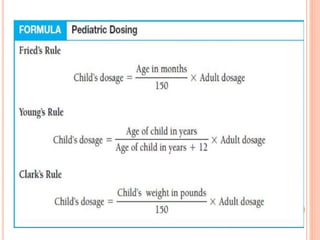
 Calculation of Drug Dosage Although most medications are
supplied by the pharmaceutical companies in a convenient
form or strength for a standard adult dose and children dose,
but often children dosages are calculated as fractions of the
adult dose. Dosages based on the child's body surface area,
give the most accurate results. The formula for determining a
child's dose of medication based on body surface area is as
follows:
OXYGEN THERAPY:
 Oxygen is used as a drug to change the concentration of
inspired air in the conditions of deficiency of oxygen. It
is one of the most common procedures carried out in the
management of children with respiratory diseases and
other illnesses.
 Purpose of Oxygen Therapy:
Oxygen is administered to achieve satisfactory level of
PaO2, range between 60 and 80 or 90 mm Hg. It is used as
temporary measures to relieve hypoxemia and hypoxia, but
does not replace definite treatment of underlying cause of
these conditions.
THE GENERAL PURPOSES OF OXYGEN THERAPY
ARE:
 To correct hypoxemia and hypoxia.
 To increase oxygen tension of blood plasma.
 To restore the oxyhemoglobin in red blood
 To maintain the ability of body cells to carry on normal
metabolic functions.
ASSESSMENT OF NEED FOR OXYGEN
THERAPY:
 Oxygen administration is indicated in numbers of
medical and surgical conditions. The need for oxygen is
assessed by the followings:
 Observing symptoms of respiratory distress and hypoxia,
i.e. inadequate breathing pattern, labored respiration
dysrhythmias, cyanosis, change of activity like
restlessness, lethargic and unresponsiveness, change in
level of consciousness, hypothermia, etc. Analysis of
arterial blood gases (ABGs) for PaO2, PaCO2, pH,
HCO3, etc. Pulse oximetry. Measuring of inspired 0,
concentration (FiO2)
METHODS OF OXYGEN ADMINISTRATION:
 Oxygen therapy can be given continuous or intermittent.
It can be dispensed from a cylinder, piped-in-system,
liquid oxygen reservoir or oxygen concentrator. Oxygen
can be administered by following methods:
 Noninvasive method-by (a) oxygen mask which can be
simple face mask, venturi mask or partial rebreathing
mask, (b) oxygen hood or face tent (c) oxygen tent or
canopy and (d) isolette incubator or other closed
incubator.
 Invasive method, by (a) orotracheal or nasotracheal or
tracheostomy route and (b) nasopharyngeal catheter or
nasal cannula or nasal prong.
COMPLICATION PULMONARY:
 Complications are pulmonary congestion, bronchiolar
edema, broncho-pulmonary dysplasia (in neonates),
respiratory depression, necrotizing bronchiolitis, etc.
Long-term complications due to oxygen toxicity are
chronic pulmonary diseases, seizure disorders and
epilepsy.
 Oxygen acts as a drug-it must be prescribed and
administered in specific dose in terms of rate,
concentration and duration.
TECHNIQUES OF FEEDING:
 Maintenance of fluid and nutrition is vitally important for the sick
child. An ill child can be given fluid and nutritional support to avoid
the problems of severe depletion. These are given in several ways,
i.e. oral feeding, gavage feeding, gastrostomy feeding, IV and SC
infusion and hyper-alimentation.
1. Oral Feeding: Feeding by mouth is preferable from physiologic
stand point to other methods of feeding.
 Oral feeding utilizes normal gastrointestinal metabolic processes and
maintains intestinal mucosal integrity and function.
 Infants and young toddlers are encouraged to take adequate amounts
of feeding at frequent intervals.
 Older children should offer feeding that they enjoy based on their
likes and dislikes.
 Nurse can involve the children for planning of diet along with their
parents and should keep record of fluid and food taken by the
children.
CONT…
2. Gavage Feeding: When the sick infant or child cannot
take food by mouth, feeding can be given by gavage, i.e.
administration of liquid intermittently or continuously.
nourishment through a stomach tube. It can be given,
 The preterm baby who is unable to suck or swallow or
who becomes fatigued with the effort of feeding should
be fed by gavage.
 Infants or children having congenital anomalies of the
throat or esophagus, difficulty in swallowing, respiratory
distress or unconsciousness may be fed by gavage.
CONT…
3. Gastrostomy Feeding: If the sick child has an
upper gastrointestinal tract anatomic abnormality or
requires prolonged gavage feeding or has side effects from
gavage feeding, then feeding can be given by gastrostomy
or jejunostomy. Gastrostomy feeding is more preferable to
jejunostomy feeding because digestion that normally
occurs in the stomach is by-passed when jejunostomy is
used.
4. Intravenous Infusion: Intravenous infusion of fluid
is the most frequently used therapeutic measures in the care
of children. The nurse has an important role and
responsibility in monitoring this type of therapy.
CONT…
5. Total Parenteral Nutrition or Hyper-
alimentation: Total parenteral nutrition (TPN) or IV
alimentation is used to fulfill the total nutritional needs of
those who cannot receive feedings by way of
gastrointestinal tract.
 It is administered in small preterm infants, infants who
have severe gastrointestinal anomalies and infants or
children having intractable diarrhea or vomiting,
extensive burns, inflammatory bowel disease or chronic
bowel obstruction.
PROCEDURES RELATED TO ELIMINATION:
 Constipation may be an indication of illness and the sick
children many times become constipated during periods
of hospitalization.
1. Enemas: These are given to encourage the expulsion
of feces and flatus, to soften stools, or to soothe mucous
membranes.
 The reason for giving the enema determines the type of
fluid to be used and the kind of enema to be given.
 The procedure for giving enema to children is similar
with adults but some alterations are necessitated by the
anatomy and physiology of the child.
PROCEDURE:
 The catheter size should be 10 to 12 French and should be
inserted only 2 to 4 inches into the rectum depending upon the
size of the child.
 Temperature of the solution should be 105 °F or 40.5 °C. An
isotonic solution or physiologic saline is used. Tap water alone
is not used because of the danger of a fluid shift and overload.
 The amount of fluid given depends on the size of the child.
Infants are given 150 to 250 mL, young child 250 to 350 mL,
older child 300 to 350 mL and adolescent 500 to 750 mL.
 The infant or young child is positioned by placing pillow
under the head and back. The buttocks are places upon the bed
pan, which has been covered with soft pad under the lower
lumbar area.
 Pillows also can be arranged beneath the older child's back for
comfort, when the bedpan is used.
CONT…
 The enema can should not be held more than 18 inches above
the level of the child's hips so that solution may run slowly by
gravity and without pressure into the bowel.
 For infants and young children, 50 mL syringe barrel attached
to a catheter may be used instead of enema can.
 Parents or nurse must hold the buttocks together to help the
child retain the fluid, especially in infants and young children.
 The older children need explanation for co-operation. The
results of enema should be recorded carefully.
 For an oil retention enema, a funnel or syringe may be used. It
is given with 100°F (37.7°C) temperature and 75 80 150 mL
amount.
 Pressure over the anus should be given after retention enema
so that it will not be immediately expelled.
 Commercially prepared disposable pediatric enemas may be
used only when specially prescribed
CONT…
2. Ostomies: The formation of an ostomy for the
purpose of elimination is usually done in the infants and
children having ano-rectal malformations and
Hirschsprung's disease or congenital mega colon. The
surgical creation of a new opening on the surface of the
body (abdominal wall) into the colon is a colostomy and
into the ileum is an ileostomy. An ileal conduit is formed
when the surgeon makes a short segment of small intestine
into a conduit or pipeline for urine. The ureters are joined
to one end of the intestinal conduit and the other end is
made into a stoma on the skin surface.
BASIC CARE OF CHILDREN UNDERGOING
SURGERY:
 The infant and children have different types of surgical
problems than that of adults. Especially the congenital
malformations are the important causes of surgical
interventions in children. Another common surgical problem
in children is acute abdomen.
Surgery can be planned or unplanned, i.e. elective or
emergency:
Preparation of children for surgery is an important aspect and
should be based on child's age, developmental stage, level of
personality and past experience. It should begin with preparation
for admission to the hospital. In emergency surgical
interventions, preparation should be done in modified ways but
basic approach should be same. For daycare surgery, which is
usually a minor procedure, preparation should be done according
to the type of operation.
PRE-OPERATIVE NURSING MANAGEMENT
OF CHILDREN:
 Preoperative nursing management for children include
psychological preparation, physical preparation,
protective measures and preoperative teaching.
 Details nursing history and physical assessment are done
as for other pediatric admissions to the hospital.
 The nurse should give special attention to the history of
other surgical interventions the child has had and the
reactions of the child to those experiences.
 Necessary laboratory and radiological investigations
should be performed as required.
PSYCHOLOGICAL PREPARATION:
 During preoperative period the nurse should develop
trusting relationship with the child and parents.
 These interventions include: Explain about the
preoperative medication which can cause discomfort.
 Discuss about anesthesia and operating room set up and
transportation to OT.
 Explain about the limitation of diet, nothing per mouth at
least 4 to 6 hours prior to surgery or as directed the
anesthesiologist.
 Discuss about the type of surgery. Explain the
information to the child and parents. .
CONT…
 Demonstrate the equipment to be used postoperatively
such as oxygen mask, IV fluid set, urinary catheter, etc.
 Describe the postoperative discomfort and pain which
may be relieved by medications.
 Explain about the recovery room care and set up.
Demonstrate the procedures to prevent postoperative
complications such as deep-breathing and coughing
exercise.
 Do not remove favorite toys and other objects to prevent
loss of security. Encourage child to play with cap, gown,
mask and gloves with the dressed doll.
 Assure the child that the parent will be nearby and
waiting for him or her.
NURSING CARE:
 Nurse play vital role for improved care and better
outcome of hospitalized child. In the care of sick child,
pediatric nurses are responsible to maintain legal and
ethical aspects.
 Negligence and malpractice are possible involving all
areas of pediatric nursing practice. Intelligent and expert
nursing care help to handle the problems related to child
health care.
NEBULIZATION:
 A nebulizer is a special device that warms or otherwise
changes a liquid solution into a fine mist that’s easy to
inhale.
 Nebulizers are useful in treating certain respiratory
conditions.
 Doctors often use them for babies. They allow infants to
take in medication while breathing as they normally
would.
 When a baby breathes in the mist from a nebulizer, the
medicine can go deep into their lungs where it can work
to make breathing easier.
CONT…
Indications:
 Croup: Croup is the result of one of the viruses that causes the
common cold. It causes airway swelling that leads a child to develop
a barking cough, runny nose, or fever.
 Cystic fibrosis: This genetic disease can cause thick mucus to build
up in the airways, clogging them and making it harder to breathe.
 Epiglottitis: This rare condition is a result of the Haemophilus
Influenzae type B bacteria that can cause pneumonia. It causes
severe airway swelling that leads to an abnormal, high-pitched
sound when breathing.
 Pneumonia: Pneumonia is a severe illness involving inflamed
lungs. It usually requires hospitalization in babies. Symptoms
include fever, shortness of breath, and changes in a baby’s alertness.
 Respiratory syncytial virus (RSV). RSV is a condition that often
causes mild, cold like symptoms. While severe symptoms aren’t
common in older children, infants can develop inflammation of the
small airways (bronchiolitis).
CONT…
Types of medications:
Doctors may prescribe different medications that a nebulizer can
deliver. Examples of these medications include:
 Inhaled antibiotics. Some antibiotics are available via
nebulizer treatment. An example is TOBI. It’s a form of
tobramycin used to treat certain bacterial infections.
 Inhaled beta-agonists. These medications include albuterol
or levoalbuterol. They’re used to relax the airways and make
breathing easier.
 Inhaled corticosteroids. These can treat inflammation due to
asthma.
 Dornase alfa (Pulmozyme). This medication helps treat
cystic fibrosis by loosening thick mucus in the airways.
CONT…
Step-by-step guide:
 Collect the medication for the nebulizer. Some are available in liquid
form that have the medicine added. Others are a liquid or powder that
must be mixed with sterile water or saline solution. Read the directions
carefully before pouring the medication in the cup.
 Connect one end of the tubing to the cup of medication and the other to
the nebulizer.
 Connect the mask or pacifier to the cup.
 Hold the mask to your child’s face. While many of the infant masks
come with strings to put around a baby’s head, most babies don’t
tolerate these strings very well. It may be easier to gently hold the mask
touching the child’s face and cover their nose and mouth.
 Turn the nebulizer on.
 Hold the mask to your child’s face while the treatment bubbles and
creates a mist inside the mask.
 You’ll know when the treatment is complete when the mist becomes less
noticeable and the little cup appears almost dry.
 Clean the mask and nebulizer after each use.
CONT…
Tips for using with babies:
 Use the nebulizer at times your baby is more likely to be
sleepy and tolerate treatments better. This includes after
meals, before a nap, or at bedtime.
 If noise seems to bother your baby, place the nebulizer
on a towel or rug to reduce noise from the vibrations.
Using longer tubing can also help, because the noisiest
part isn’t close to your baby.
 Hold your child upright in your lap during the treatment.
Sitting upright helps deliver more medication throughout
the lungs because they can breathe more deeply.
 Swaddle your baby if they’re more comfortable that way
during treatment.
PAEDIATRIC RESUSCITATION:
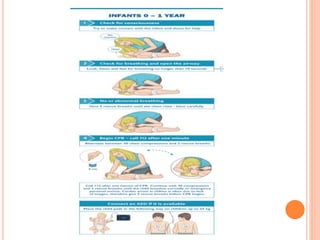
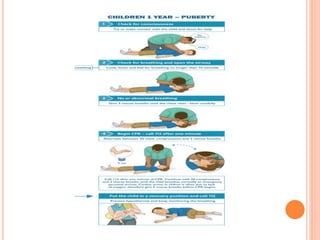
1. Check to see if the child is conscious
 Make sure you and the child are in safe surroundings.
 Tap the child gently.
 Shout, “Are you OK?"
 Look quickly to see if the child has any injuries,
bleeding, or medical problems.
2. Check breathing
 Place your ear near the child’s mouth and nose. Is there
breath on your cheek? Is the child’s chest moving?
3. Begin chest compressions
 If the child doesn’t respond and isn’t breathing:
CONT…
 Carefully place the child on their back. For a baby, be careful
not to tilt the head back too far. If you suspect a neck or head
injury, roll the baby over, moving their entire body at once.
 For a baby, place two fingers on breastbone. For a child, place
heel of one hand on center of chest at nipple line. You also can
push with one hand on top of the other.
 For a child, press down about 2 inches. Make sure not to press
on ribs, as they are fragile and prone to fracture.
 For a baby, press down about 1 1/2 inches, about 1/3 to 1/2 the
depth of chest. Make sure not to press on the end of the
breastbone.
 Do 30 chest compressions, at the rate of 100 per minute. Let
the chest rise completely between pushes.
 Check to see if the child has started breathing.
 Continue CPR until emergency help arrives.
CONT…
4. Do rescue breathing
 To open the airway, lift the child’s chin up with one
hand. At the same time, tilt the head back by pushing
down on the forehead with the other hand. Do not tilt the
head back if the child is suspected of having a neck or
head injury.
 For a child, cover their mouth tightly with yours. Pinch
the nose closed and give breaths.
 For a baby, cover the mouth and nose with your mouth
and give breaths.
 Give the child two breaths, watching for the chest to rise
each time. Each breath should take one second.
CONT…
5. Repeat compressions and rescue breathing if the
child is still not breathing
 Two breaths can be given after every 30 chest
compressions. If someone else is helping you, you
should give 15 compressions, then 2 breaths.
 Continue this cycle of 30 compressions and 2 breaths
until the child starts breathing or emergency help arrives.
 If you are alone with the child and have done 2 minutes
of CPR (about 5 cycles of compressions and breathing),
call for emergency and find an AED (defibrilator).
CONT…
6. Use an AED as soon as one is available
 For children age 9 and under, use a pediatric automated
external defibrillator (AED), if available. If a pediatric
AED is not available, or for children age 1 and older, use
a standard AED.
 Turn on the AED.
 Wipe the chest dry and attach the pads.
 The AED will give you step-by-step instructions.
 Continue compressions and follow AED prompts until
emergency help arrives or the child starts breathing.

Unit 3 The Sick Child.pptx

  • 1.
  • 2.
    INTRODUCTION:  The sickchild is different from a sick adult.  The differences of illness in children and adult are based on anatomic, physiological and psychological differences between the immature child and the mature adult.  The older the child becomes, the greater the chances of survival.  The risk of mortality is greater in young infants.  The parents can usually recognize the early features of illness in their children.
  • 3.
    PEDIATRIC UNIT INA HOSPITAL  The pediatric unit must have the facilities for adequate provision of care of the children and protection for physical dangers, i.e. accidents and infections along with protection for physical dangers, i.e. accidents and infections along with protection from psychologically threatening environment.
  • 4.
    HOSPITALIZATION OF THESICK CHILD  ADMISSION  Introduce primary nurse to child and family.  Orient child and family to inpatient facilities, to assigned room and unit.  A pediatric unit should be happy and attractive place with cheerful home like surroundings.  It should have colorful walls with suitable pictures.  Furniture should be of attractive and colorful without any poisonous paints , any projections and sharp edges.  Floor should not be slippery and safety measures to be maintained.
  • 5.
    CONT…  A pediatricunit should have facilities of separate areas for different types of ill child, treatment room, examination room, play room, dinning room and pantry, waiting room for visitors and parents, consultation room, teaching room for visitors, store room, bathroom for children's and adults, nurses station, doctors room etc.  The pediatric unit must meet the needs of children's and their parents.  The physical environment of pediatric unit should be pleasing by maintenance of cleanliness and orderliness of furniture and equipment.
  • 6.
    CONCEPTS TO MINIMIZEEMOTIONAL TRAUMA IN CHILDREN'S AND PARENTS:  Family integrity and child's relationship should be maintained.  The sick child should be supported and guided to learn to handle new experiences and feelings by family participation to provide love and security during illness and hospital stay.  Needs of each child are different , assessment of these needs as well as those of family members forms the basis of nursing interventions.  The pediatric nurse seeks to promote , maintain and restore health in both children and their parents by health counseling and teaching about the needs.
  • 7.
    CHILDS REACTION TO HOSPITALISATIONAND ILLNESS: 1. Reactions of neonates:  Hospitalization and prolonged illness in neonatal period interrupts in the early stages of development of a healthy mother-child relationship and family integration.  Impairment of bonding and trusting relationship ,inability of the parents to love and care for the baby and inability of the baby to respond to parents and family members.
  • 8.
    CONT… 2. REACTION OFINFANTS:  Infants reaction are mainly separation anxiety and disturbance of development of basic trust , when the infant is separated from mother and when illness and hospitalization .  Emotional withdrawal and depression are found in the infants of 4 to 8 months of age , interference of growth and delayed developments also found.  Older infants 8 to 12 months of age may have limited tolerance due to separation anxiety which is found as fear of strangers , excessive crying , clinging and overdependence on mother .  The major stress from middle infancy throughout the preschool years , especially for children ages 6 to 30 months , is separation anxiety .
  • 9.
    CONT…  STAGE OFPROTEST: Children's react aggressively to the separation from the parent. They cry and scream for their parents ,refuse the attention of anyone else and are inconsolable in their grief.  STAGE OF DESPAIR ; The crying stops , and depression is evident , the child is less active , is uninterested in play or food , and withdraws from others.  STAGE OF DETACHMENT OR DENIAL ; Superficially , it appears that the child has finally adjusted to the loss. The child become more interested in the surroundings , plays with others and seems to form new relationships.
  • 10.
    CONT… 3. REACTIONS OFTODDLERS:  The toddlers PROTESTS by frequent crying , shaking crib, rejecting nurses attention , urgent desire to find mother and showing signs of distrust with anger and tears ,especially when with mothers.  In DESPAIR , the toddler becomes hopeless , apathetic , anorectic , listless ,looks sad , cry continuously or intermittently and use comfort measures like thumb sucking , fingering lip and tightly clutching a toy.  In DENIAL ,the child reacts by accepting care without protest and represses all feelings. The child does not cry in the absence of mothers and may seem more attached to nurses.  The toddler may react by REGRESSION in an attempt to regain control of a stressful situation. They are found to stop using newly acquired skills and may return to the behaviour of an infant during illness and hospitalization.
  • 11.
    CONT… 4. REACTIONS OFPRESCHOOL CHILD:  The preschool children adopt various mental mechanisms (defense mechanisms) to adjust with the stressful experiences of hospitalization and prolonged illness.  They react by exhibiting regression, repression, projection, replacement, identification, aggression, denial, withdrawal and fantasy.  The stage of PROTEST in preschool children is usually less aggressive and direct .
  • 12.
    CONT… 5. REACTIONS OFSCHOOL AGED CHILDREN’S:  The school age children are concerned with fear, worry, mutilation, fantasies, modesty, and privacy.  They react with defense mechanisms like regression , separation anxiety , negativism , depression , phobia , unrealistic fear , suppression or denial of symptoms and conscious attempts of mature behaviour.
  • 13.
    CONT… 6. REACTIONS OFADOLESCENTS: Adolescents are concerned with lack of privacy , separation from peers or family and school , interference with body image or independence or self concept and sexuality.  They react with anxiety related to loss of control and insecurity in strange environment.  They may show anger and demanding or un co-operative behaviour or increased dependency on mothers and staff.  They may adopt mental mechanism like intellectualization about disease , rejection of treatment , depression ,denial or withdrawal.
  • 14.
    EFFECTS OF HOSPITALISATIONON THE FAMILY:  Break in the unity of family.  Separation from the children.  Feeling of inadequacy as others care for their children.  They feel anxiety, anger, fear, disappointment , self blame, and possible guilt feeling due to lack of confidence and competence for caring the child in illness and wellness.  Parental anxiety related to;  Strange environment in the hospital.  Unknown events and outcome  Spread of infections of other members from the family  Society will look upon the illness as a reflection of something wrong with the parents.
  • 15.
    ROLE OF NURSETO HELP TO COPE WITH HOSPITALISATION OF CHILDREN:  The nurse should earn sufficient confidence to develop positive relationship with the children and their parents.  Nurse should have patience, tenderness and emotional strength in times of stress.  Provide family centered care with different approach to specific age group. 1. IN NEONATE: Rooming in and sensory motor stimulation. 2. IN INFANTS: Encourage mother to balance her responsibilities and minimize separation , mother can be allowed during procedure , providing toys to relieve tension.
  • 16.
    CONT… 3. IN TODDLERS: Rooming in , unlimited visiting hours to express child's feelings, no punishment to the child, home routines can be continued , allow play , encourage independence , encourage family interaction. 4. IN PRESCHOOLER: Provide parental participation in care, plan to shorten the hospital stay, careful reparation for all procedures by privacy and explanation, encourage the child to participate in the self-care and hygiene, remove fear , reassure the child.
  • 17.
    CONT… 5. IN SCHOOLCHILDREN:Help the parent to prepare child for elective hospitalization , provide privacy , thorough nursing history should be obtained for plan of care , explain the procedures and its purpose , encourage play , self care and continue schoolwork, ensure parents to cope with their own anxieties, introduce to other parents in the same unit and consistent visiting pattern. 6. IN ADOLESCENTS: Prepare the parents for planned hospital admission , available hospital facilities should be explained soon after admission, respect the personal preference on self-care and food habit , explain all procedure, provide opportunities for recreation , peer relationships, interaction with other adolescent patients and expression of feelings.
  • 18.
    NURSING INTERVENTIONS ANDADAPTATION IN NURSING CARE OF SICK CHILD :  Psychological stress  Physiological stress  Environmental stress  Biological stress  Chemical stress
  • 19.
    STRATEGIES FOR ADAPTATIONIN NURSING CARE:  Welcome the child and parents during each nursing intervention.  Call by name and touch the gently with love.  Explain the intervention in simple sentence according to the level of understanding.  Ask for cooperation and its benefits.  Encourage to express the feelings.  Demonstrate the interest and empathy to the child and family members.  Explain and reason out any unpleasant experience of the past which will reduce anxiety level and help to obtain co- operation.  Allow parents or significant other during any treatment or nursing procedures.
  • 20.
    CONT…  Maintain privacy, minimize ,exposure and gentle handling of the child during nursing care  Provide physical comfort by appropriate positioning ,warmth, bladder evacuation etc. before and during the interventions.  Take opinion of the parents and the child during any decision making regarding the treatment plan, diagnostic procedures and nursing intervention.  Maintain eyelevel contact during conversation.  Diverts the child's attention by toys or telling story.  Protect the child from physical injury and infections.  Assure about confidentiality of the information whenever required especially for older children.  Praise the child for cooperation, never threat or blame the child for non cooperation
  • 21.
    CONCLUSION:  Nurse playvital role for improved care and better outcome of hospitalized child.in the care of sick child pediatric nurses are responsible to maintain legal and ethical aspects .  Nurse also need to anticipate the anxiety of the parents and family members.  Family centered care, parental participation and more psychological approach should be emphasized during comprehensive care of sick child
  • 22.
  • 23.
    PEDIATRIC NURSING HISTORY: Obtaining history is an important aspect of health assessment and to evaluate the health status of an individual.  History regarding the child's health condition can be collected from the parents or significant others or from grown up child.  The purposes of health history of a child are to obtain data to help in diagnosis and treatment and to formulate individualized plan for care.  It helps to establish relationship with the child and family and to assess the understanding of the family members about their child's health.
  • 24.
    HISTORY COLLECTION:  Identifyinginformation: Child's name, age, sex, address, name of the informant and relation with the child, date and time of history collection and in case of hospitalized child, name of unit, bed numbers, registration number, date and time of admission to the hospital, etc.  Chief complaints: Reasons for hospital admission or seeking medical care along with duration of complaints and any treatment taken prior to hospitalization for the present problems.  History of present illness: Quality, quantity and severity of complaints, time sequence, degree of symptoms, aggravating and alleviating factors, associated symptoms.  Past history of illness: Medical illness and surgical illness other than the present illness, accidents and injuries, hospitalization and operations (with date, indications, complications and reactions), medications, blood transfusion, radiation, allergy and diagnostic screening procedures..
  • 25.
    CONT…  Birth history:Details of prenatal, intranatal, perinatal, neonatal/postnatal information.  History of growth and development: Previous weights, lengths, dentition, important developmental milestones, toilet training, social behavior, language, motor skills and sexual development.  Immunization history: Complete or incomplete schedule, defaulter.  Dietary history: Duration of breastfeeding, weaning, feeding problems, dietary pattern (frequency and content of meal), weight gain, amount of food consumption, food preferences, allergies, etc.  Personal history: Hygiene, sleep, eliminations habit, exercise and rest, play, hobbies, special talents, relationship with others (sibling and parent), expressions of emotions (temper tantrum), behavioral problems (thumb sucking, nail biting, pica, etc.) and schooling (age of school admission, performance, school behavior).
  • 26.
    CONT…  Family historyof illness: Any history of illness in the family members, presence of hereditary diseases and congenital anomalies.  Socioeconomic history: Residence (rural, urban or slum), housing (type, location), water supply, waste disposal, communication facilities, recreational facilities, General financial condition with family income, source of income, total number of family members, family relationship, cultural belief especially regarding child care, etc
  • 27.
    HEAD TO TOEEXAMINATION:  Head: Headache, head trauma, dizziness.  Eyes: Vision, corrective lenses, strabismus, lacrimation, discharge, itching, redness, photophobia.  Ears: Hearing, infection, drainage, pain.  Nose: Cold, running nose, infection, drainage.  Teeth: Hygiene, cavities, malocclusions.  Throat: Sore throat, tonsillitis, difficulty in swallowing.  Speech: Change in voice, hoarseness, stammering.
  • 28.
    CONT…  Respiratory: Breathingdifficulty, shortness of breath, chestpain, cough, wheezing, pneumonia, tuberculosis.  Cardiovascular: Cyanosis, fainting, exercise intolerance, palpitations.  Hematologic: Pallor, anemia, bruises, bleeding.  Gastrointestinal: Appetite, nausea, vomiting, abdominal pain and abnormal size, bowel habit, nature of stools, passage of parasite, encopresis, colic, etc.  Genitourinary: Age of toilet training, frequency of urination, dysuria, hematuria, previous urinary tract infection, enuresis, urethral or vaginal discharge, menstruation in adolescents.  Musculoskeletal system: Deformities, fracture, sprains, joint pain or swelling, limitation of motion, abnormality of nails.  Neurologic: Weakness or clumsiness, coordination, balance, gait, tremor, convulsions, personality changes.
  • 29.
    PHYSICAL EXAMINATION OFCHILDREN:  Pediatric nurse plays an important role in carrying out the physical examination of the child in hospital and community . Head-to-foot examination is done along with examination of different system to evaluate the general condition of the child and to exclude the presence of any abnormality. It also includes anthropometric examination of the child.  Physical examination is done by inspection, manipulation, percussion, palpation and auscultation.
  • 30.
    GENERAL PRINCIPLES:  Examinationshould be done according to the needs of the patient in an orderly manner.  Gentle handling of the child with minimum exposure is very important.  Examination should be done informally with a friendly approach, appreciating the cooperation and assistance.  Attempt to develop rapport with the child should be made from the moment of first meet.  Explanation about the procedure should be useful in older children for gaining cooperation.  Restraints should be used only whenever necessary.  Remember that the safest place for a young child is on parent's lap.
  • 31.
    CONT…  Privacy andwarmth to be maintained, as much as possible.  Positioning of the child to be done according to the body parts to be examined. For examination of the back, the child should be placed in prone position. For examination of chest and abdomen, supine position with modified mummy restraint can be used exposing the parts as necessary.
  • 32.
    APPROACH TO THECHILD:  The older child can be asked to choice to be examined on parent's lap or special examination table.  The chest is a good part of the body to begin the examination, then already exposed parts can be examined, i.e. hands, legs, etc..  Head-to-toes examination should be done thoroughly and systematically but strict sequence may not be followed.  The child's clothing should be removed gradually and observing the parts carefully during examination.  Show the procedure to the child by demonstrating on the doll or parent before the procedure..  Some children are less frightened, if allowed to hold the examining equipment first.  Diaper area of the infants and genital area of the older children should be examined until last.
  • 33.
    CONT…  Uncomfortable andirritating procedures such as examination of throat, ear and rectum should be left towards the end.  The sequence of examination depends upon the cooperation received from the child. No rigid sequence may be followed.  In irritated and panicky child, prolonged examination to be avoided.  Useful distractions to be adopted to gain cooperation during physical examination, e.g. talking with the infants or giving toys or having the parents play with them.  Obtain as much information as possible while the child is calm and not feeling threatened.
  • 34.
    TECHNIQUE OF PHYSICALEXAMINATION:  Vital signs: Obtain temperature, pulses, heart sound, respiration and blood pressure, as often as thought necessary, based on child's condition.  Anthropometry: Record anthropometric measurements, i.e. child's weight, length/height, head circumference, chest circumference mid-upper arm circumference, skin- fold thickness, etc. growth chart to be maintained by plotting the findings especially weight.  General appearance: Observe general appearance like- body position, posture, evidence of pain, crying, hygiene, nutritional status, mental alertness, restlessness, behavior pattern, presence of developmental abnormalities, or any abnormal features
  • 35.
    CONT…  Lymph nodes:Observe and palpate for lymph node enlargement in lymph chain areas, i.e. neck, axilla, inguinal region, etc.  Hair: Observe color and distribution of hair on head and any other parts of the body.  Head and neck: Examine head for shape and size, fontanelle, sutures, hair color and texture, presence of infection or any lesions, dandruff or lice, movement of head, head holding, webbing of neck, enlarged thyroid or neck swelling etc.  Face: Examine face for expression, asymmetry, paralysis, nose bridge, size of maxilla and mandible, tenderness over , etc.  Eyes: Observe eyes for infection, peri-orbital photophobia, distance between the eyes, distribution of eyebrows. Ophthalmoscopic examination also can be done.
  • 36.
    CONT…  Ears: Examineears for shape, size, position, low-set ear, deformities, discharge, tenderness over mastoid bone, and hearing abilities. Otoscopic examination can be done to inspect the condition of eardrum.  Nose: Examine nose for patency, discharge, bleeding, deviated septum, depressed nasal bridge, nasal polyp, foreign body, flaring of nostrils, condition of nasal mucous membrane, etc. Paranasal sinuses should be examined for tenderness and order of development.  Mouth and throat: Examine the color of lips, lesions at the corners of mouth, cleft lip or cleft palate, number of teeth, evidence of dental caries, staining on the teeth, malocclusion and extra or missing teeth, gum bleeding, swelling and lesions of buccal mucosa, tongue and pharynx, presence of any infections, tonsillitis, presence of any spot, ulcer and swelling, tongue tie or short tongue, etc.
  • 37.
    CONT…  Chest: Observethe size, shape and symmetry of chest, presence of chest retractions (suprasternal, sub sternal, intercostal, subcostal, supraclavicular), pigeon chest deformity, funnel chest, rachitic rosary, condition of breast and nipples, breath sounds, heart sounds, etc.  Abdomen: Examine abdomen for size and shape, distension, any swelling or enlargement, presence of infection or scar, cleanliness, condition of umbilical cord in neonate, presence of any congenital anomalies or development problems (hernias). Limbs: Limbs to be examined for any deformity, asymmetry, hemi- hypertrophy, bow legs, knock-knees, edema, any swelling or limitations of the joints, paralysis, clubbing of fingers, number of fingers and toes.
  • 38.
    CONT…  Female genitaliato be observed for hypertrophy of clitoris, labia majora and minora, vaginal and urethral openings, any vaginal discharge, cleanliness, infections, swelling of peri-urethral or greater vestibular (Bartholin's) glands in adolescents.  Anus and rectum: Observe for patency of anus, presence of fissures or fistula, rectal prolapse, perianal erythema, etc.  Neurological examination: Note characteristics of cry, posture of head, neck and extremities, neurological reflexes (like sucking and swallowing reflex, grasp reflex, blinking reflex, stepping reflex) motor coordination, muscle tone, sense of touch or pain, presence of meningeal irritation, paresis or paralysis, etc.  Behavioral pattern: Note the behavior of the child (whether irritable, depressed, nervous, apathetic, excited, aggressive and disobedient) ability to respond, aptitude to the situation, attitude towards health team members, habit disorders, emotional problems, and mental status.  Abnormal signs and symptoms: Examine for presence of cough and cold, bleeding from any site, vomitus, loose motion, lack of hygiene, convulsions, oliguria, full bladder, anemia, edema, wound, ulcer, etc.
  • 39.
    SAFETY MEASURES DURINGPEDIATRIC TECHNIQUES:  Adequate explanation and informed consent for child care.  Safety precautions to be adopted in the hospitals for prevention of accidents.  The restraint of children is necessary for the safety.  Aseptic techniques to be followed to prevent transmission of infections.  Prevention of aspiration.  Safety measures in the administration of drugs.  Recording of all procedures.  Constant supervision.  Gentle approach.  Guidelines
  • 40.
    PROTECTION OF THECHILD FROM ACCIDENTS IN HOSPITAL:  Buildings: The pediatric unit should be well-ventilated without draught or suffocation. Windows should be protected with net or bar. Varandahs should not be open and wire netting should be provided for protection. Doors should open one way. Staircase should be railed and grilled. Floor should not be slippery. Toilets and bathroom should be cleaned daily and not slippery. No cats and dogs should be allowed inside the ward.  Furniture: All furniture in the pediatric unit should be cleaned and without poisonous painting. The cribs should be removable with easily operable side rails.
  • 41.
    CONT…  Electrical appliances:Electric points in the walls should be high enough for the children reach. Electrical equipment must be kept unplugged when not in use. Electrical extension cords should not remain lying across the floor. Electrical Restraints appliances should be checked at regular interval for working condition without any leakage.  Medicine cabinets: Medicine cabinets must be locked when not in use and medications should never be given without adequate identification of child. Oil based medications should never be given orally when the child is crying because of the danger of aspiration. Medicines should never left on the bedside table.  Instruments and solutions: These things should be kept in cabinets or on shelves where children cannot reach them. Utility and procedure room doors should be kept closed and children should not be allowed in those areas.
  • 42.
    CONT…  Toys: Playmaterials should be unbreakable, washable and without any sharp edges or small removable parts or poisonous painting. Toys should never be left on the floor. The children should not allow running in the wards because of danger of falling. Supervision should be made during play to prevent any hazards.  Disposal of waste: Empty containers, bottles, broken glass syringes, needles, tubing, etc. should be out of reach of the children. Any spillage of blood or body fluids or solutions on the floor should be immediately cleaned to prevent fall. Cleanliness to be maintained to prevent flies, mosquitos, cockroaches and bed bugs.
  • 43.
    CONT…  Clothing: Clothingshould not be too long that can cause a child to slip and fall. Safety pins should be closed at once when taken from a child's clothing and should be put out of reach.  Feeding: Small children should be fed with precautions to prevent aspirations. Forced feeding must be avoided. Children to be taught to chew food well, before swallowing. Warmth of the food should to be checked, before putting it in the child's mouth.  Nursing care
  • 44.
    RESTRAINTS Restraints are protectivemeasures to limit movements. There can be a short-term restraint to facilitate examination and minimize the child's discomfort during special tests, procedures and specimen collections. Restraints can also be used for a longer period of time to maintain the child's safety and protection from injury.
  • 45.
    GENERAL PRINCIPLES FORUSE OF RESTRAINTS:  Appropriate, safe and comfortable restraints should be selected.  Restraints should be loose as possible, tight restraint prevents normal circulation.  Nurse should talk soothingly to the child to provide stimulation and diversion and to relieve the sense of helplessness and loneliness of the child.  Sufficient padding must be used for extremity restraints to prevent skin irritation.  Restraints must be checked every 15 to 30 minutes for constrictions or any hazards. It can be removed periodically, at least every 2 hours, when used for long time. It should be removed one at a time and reapplied so that the child can gain some degree of activity, especially when all extremities are restrained. Before reapplication of restraints, the child's position needs to be changed to improve physiological functioning.
  • 46.
    CONT…  Child's comfortand body alignment to be maintained. Any required knots should be tied in a manner that permits their quick release.  Provide range of motion and skin care routinely. When one arm is restrained, another arm and legs should be moved.  Do not secure the restraints to the side rails which may cause traction on the restraint or injury to the child, when the side rail raised or lowered .  Proper documentation is required when restraints are in use.  Application of restraint can be demonstrated first on the child's doll, to get cooperation of the child and to prevent emotional trauma.
  • 47.
    TYPES OF RESTRAINTS: Commonlyused restraints for children are mummy restraint, elbow restraint, extremity restraint, abdominal restraint, jacket restraint, finger restraint, crib-top restraint, etc.  Mummy restraint: It is a short-term type of restraint used on infants and small children during examinations and treatment of head and neck. It is used to immobilize the arms and legs of the child for a brief period of time. A modified mummy restraint may be used when the child's chest and abdomen are to be examined.  Abdominal restraint: This restraint helps to hold infant in a supine position on the bed. It should be applied with precautions so that respiratory movements of the abdomen are not inhibited. It operates exactly like the restraints of extremity. The strip of material is wider and has only one wide flap for fastening around the child's abdomen.
  • 49.
    CONT…  Elbow restraint:This restraint is used to prevent flexion of the elbow and to hold the elbow in an extended position so that the infant cannot reach the face. It is especially useful for infants receiving scalp vein infusion, nasogastric tube feeding, surgery of face or head, repair of cleft lip or cleft palate or having eczema or other skin disorders in those areas.  Extremity restraint: This may be used to restraint infants and young children for the procedures such as IV therapies and urine collection. It is used to immobilize one or more extremities. One type of extremity restraint is clove-hitch restraint which is done with gauze strip (2 inches wide) making figure-of-eight. The end of the gauze can be tied to the frame of the crib. This restraint should be used with padding of wrist or ankle.
  • 51.
    CONT…  Jacket restraint:It can be used to help the child remain flat in bed in a supine position or to prevent the child from falling from crib, highchair, wheelchair or other conveyance. The jacket is put on with the strings and opening in the back and tied securely. The long tapes are secured appropriately, i.e. to the frame of the crib, or arm supports of a chair or around the back of the wheelchair or highchair. The child should be observed frequently to make certain that strangulation does not occur, and restraint has not slipped out of place.  Mitten or finger restraint: Mitts are used for infants to prevent self-injury by hands in case of burns, facial injury or operations, eczema of the face or body. Mitten can be made wrapping the child's hands in gauze or with a little bag putting over the baby's hand and tie it on at the wrist.
  • 53.
    HAZARDS OF RESTRAINTS Inappropriate use of restraints may cause injury to the brachial plexus, sore or gangrene, exhaustion and loss of energy, dislike for the hospital and health team members, etc.  Prolonged immobility of children may result in physiologic loss of muscular strength and flexibility which influence the respiratory volume and peripheral circulation.  Long periods of restraints may result psychological hazards and inability to develop motor and psychosocial skills in children.  There may be difficulty in developing own body image.  The nurse should use restraint only when it is absolutely necessary, remembering that all infants and children have physiologic and psychological needs to be mobile.
  • 54.
    IMPORTANCE OF PLAYFOR HOSPITALIZED CHILDREN: Play in hospital helps the child and health team members or caregivers as follows: It helps the child-  To enhance coping abilities in hospital environment.  To express fear, anxiety, tension, anger and fantasies.  To understand and comprehend the hospital procedures.  To communicate with others and to reduce emotional trauma due to hospital experiences.  To continue growth and development in physical, psychological, social, moral and educational aspects.  To get rid of boredom due to prolong illness and to release hostile feelings. .
  • 55.
    CONT… It helps thehealth team members  To gain cooperation and trusting relationship of the hospitalized children and their family members.  To diagnose the child's feeling and behavior, and planfor psychological approach during care.  To find out and correct the misconceptions and beliefs regarding hospitalized care.  To reassure the anxious parent and to promote their participation in child care during illness and wellness
  • 56.
    TYPES OF PLAYFOR HOSPITALIZED CHILDREN: Therapeutic play differs from normative play in its design and intent. Specialized techniques, strategies and play environment are created for sick children by the health team members to enhance emotional and physical well-being. It can be of three types: 1. Emotional outlet or dramatic play: It is used to express the child's anxiety, to solve conflict and as a diagnostic tool to identify child's concern about the illness and hospitalization, e.g. playing with doll being a nurse and caring sick doll with expression of own feeling, storytelling, etc. 2. Instructional play: Instruction is given for therapeutic play to the children according to their past experiences, coping abilities and physiological status. Instructional play should be well-planned, e.g. use of color in drawing, drawing in blank paper, learning the instructions on health habit from TV or teaching films, etc. 3. Physiological enhancing play: It is used to maintain and improve physical health and body functions. It can be selected to treat pathological condition, e.g. breathing exercise to treat respiratory problems by blowing bubbles, whistling and laughing. Squeezing the bath sponge or ball improves neurological functions.
  • 57.
    NURSING RESPONSIBILITIES FORTHERAPEUTIC PLAY:  Organize play facilities for the sick children. Every pediatric unit should have some space for play or play room with facilities for storage of play materials. Age- appropriate play things to be arranged for the children in adequate numbers. Individual play materials can also be of play for hospitalized children. Any time should be play them. permitted. There should not be any fixed period of time.  Involve other members of health team, social worker , play therapist (play lady), parents and other family members for play in the hospital or at home and communicate with all members.  Interact during play and help the child to express feelings. Then interpret, analyze and handle the emotional and physical needs to provide necessary support and care.  Observe and record the child's behavior and the interaction patterns during playing .  Protect children if their play becomes too aggressive and guide them into less destructive types of play activities.  Encourage all children to participate in all planned play programs. Nurses may also have an opportunity to participate with the children during play.  Teach the parents and other family members about the importance of play for therapeutic value, recreational value and all round development of personality.  Nurse should serve as an advocate, a spokesman, a diagnostic observer, source of support, planner and teacher to promote play for the children at hospital and home.
  • 58.
    PREPARATION OF CHILDFOR DIAGNOSTIC TESTS: For the psychological preparation of parents and children the following guidelines can assist the nurse:  Emphasis on the positive outcome of the procedure, its importance and purposes.  Timing of the preparation should be settled. The initial preparation for certain procedures can be done by the parents at home. In hospital, nurse can prepare the parents and child prior to the procedure. Preparation should be done, if possible, when the child is rested and alert.  Verbal preparation to be done with the use of specific words to explain the procedure. Parents and child should understand the explanation rather than confusion. Explanation must be given according to the level of maturity and understanding and past experience with medical care and discomfort. Non threatening terminology is used to reduce anxiety. Information need to be given about sensations during procedures, which is more important than that about where and how the procedures will be done. Anxiety- producing information should be given at the end of the preparation.
  • 59.
    CONT…  Use ofvisual aids is important to make the verbal explanation more concrete. The nurse, parents and child can play out the procedure to be done using the materials like intravenous (IV) equipment, syringe, stethoscope, etc. thro dramatic play. A doll can be used by the nurse to demonstrate the procedure..  Role-playing of the procedure to be done in which the child will take an active part. For example, the diabetic child who requires insulin injections can role-play by giving an injection to a doll initially.  Evaluation of the preparation can be done through the verbal explanations of parents and children or the use of teaching aids. The knowledge of parents and child concerning the procedure should be evaluated. The process may stimulate further questions that the nurse can then answer. The physical preparation of the child varies from one procedure to others. The major aspects are positioning, privacy, asepsis, restraint, etc. should be done accordingly
  • 60.
    COLLECTION OF SPECIMENSFOR LABORATORY EXAMINATION: During hospitalization of children, the nurse may carry out or assist in certain diagnostic procedures, including collection of specimens of urine, stool, sputum, throat swab, blood and cerebrospinal fluid.  Collection of Urine Specimens: 1. Urine specimens for laboratory examinations can be collected as routine urine specimen, clean-catch specimen and catheterized specimen for culture. Children who are not toilet trained pose the greatest problem to obtain urine specimen.  Routine urine specimen collection from older children, who can cooperate with the nurse or the mother is relatively easy, but is more difficult from infants. Pediatric urine collection bag is used for infants.  The nurse should wash own hands thoroughly before the application of the urine collection bag. After the external genitalia of the child has been cleaned and thoroughly dried, the collection bag is attached to the perineum in the girls.  For boys, the penis and scrotum are inserted into the opening of the bag. The infant or toddler is placed in semi-Fowler position and a diaper is placed in position to prevent the displacement of bag.
  • 61.
    CONT…  The nursemust check the bag frequently to prevent the urine from leaking and to obtain a fresh specimen for laboratory testing. When the child voids, the bag is removed and the specimen sent to the laboratory. 2. Urine can be collected as midstream specimen, but it is difficult to obtain from small children. If able to cooperate, the child voids a small amount into an unsterile container and then voids into a sterile container. Twenty-four hours urine collection may be needed in some children.
  • 62.
    CONT… 3. Collection ofStool Specimens: A stool specimen is collected by using spatula or spoon to transfer a freshly passed stool to a clean covered specimen container. The specimen should not be contaminated by urine. If a stool specimen cannot be obtained, a rectal swab may be taken by gently inserting a swab as far into the rectum as a thermometer is placed and twisting when removing it. Stool specimens and rectal swabs must be sent to the laboratory promptly, especially when it is examined for ova, parasites and cysts.
  • 63.
    CONT…  Collection ofBlood Specimens: Blood specimens may be collected by laboratory technicians, physician or nurses. Nurse's responsibility is to prepare sterile articles and collection tubes or containers. The preparation of child for cooperation is very important. The older children are able to cooperate after an explanation of the procedures. Peripheral capillary blood samples are taken from children by earlobe stab or finger stick methods. Peripheral blood samples are taken from infants by a heel stick.
  • 64.
    CONT…  Collection ofThroat Swab: Collection of throat swab is an uncomfortable procedure. A sterile swab is used to obtain for throat culture. During collection of throat swab, the nurse should not permit it to touch the lips or tongue on entering or being removed from the mouth. The swab should touch only the most inflamed areas of the throat and tonsils. A tongue blade may be used to depress the tongue, so that the swab can be taken easily. The swab is then placed in a sterile container (test tube) to prevent it from drying prior to examination. Outside of the container should be kept clean to protect persons handling them. Special instructions, like not to wash mouth in the morning, before collection of swab, to be explained. Parents should assist during collection of swab to hold the child and to immobilize the child's head, which should be slightly tilt backward to obtain throat swab. The specimen must be sent to the laboratory promptly.
  • 65.
    CONT…  Collection ofSputum: The sputum specimen from a child who is too young to cough productively is difficult to collect. A suction device called mucus trap is used to obtain such specimen from trachea or bronchi. Children who are old enough to cough deeply and productively may be instructed to do so to collect the sputum specimens. Sputum to be collected with adequate instruction and should not mix with saliva or material from the throat. It can be collected most easily early in the morning before the child has had an opportunity to cough and swallow what was produced overnight
  • 66.
    ADMINISTRATION OF MEDICATIONS: Administration of medication is the most important nursing responsibility. The need for accuracy in preparing and giving medications to children is greater than that of adult. Since the pediatric dose is often relatively small in comparison with the adult dose, a slight mistake in the amount of a administered drug represents a greater error.  Calculation of Drug Dosage Although most medications are supplied by the pharmaceutical companies in a convenient form or strength for a standard adult dose and children dose, but often children dosages are calculated as fractions of the adult dose. Dosages based on the child's body surface area, give the most accurate results. The formula for determining a child's dose of medication based on body surface area is as follows:
  • 68.
    OXYGEN THERAPY:  Oxygenis used as a drug to change the concentration of inspired air in the conditions of deficiency of oxygen. It is one of the most common procedures carried out in the management of children with respiratory diseases and other illnesses.  Purpose of Oxygen Therapy: Oxygen is administered to achieve satisfactory level of PaO2, range between 60 and 80 or 90 mm Hg. It is used as temporary measures to relieve hypoxemia and hypoxia, but does not replace definite treatment of underlying cause of these conditions.
  • 69.
    THE GENERAL PURPOSESOF OXYGEN THERAPY ARE:  To correct hypoxemia and hypoxia.  To increase oxygen tension of blood plasma.  To restore the oxyhemoglobin in red blood  To maintain the ability of body cells to carry on normal metabolic functions.
  • 70.
    ASSESSMENT OF NEEDFOR OXYGEN THERAPY:  Oxygen administration is indicated in numbers of medical and surgical conditions. The need for oxygen is assessed by the followings:  Observing symptoms of respiratory distress and hypoxia, i.e. inadequate breathing pattern, labored respiration dysrhythmias, cyanosis, change of activity like restlessness, lethargic and unresponsiveness, change in level of consciousness, hypothermia, etc. Analysis of arterial blood gases (ABGs) for PaO2, PaCO2, pH, HCO3, etc. Pulse oximetry. Measuring of inspired 0, concentration (FiO2)
  • 71.
    METHODS OF OXYGENADMINISTRATION:  Oxygen therapy can be given continuous or intermittent. It can be dispensed from a cylinder, piped-in-system, liquid oxygen reservoir or oxygen concentrator. Oxygen can be administered by following methods:  Noninvasive method-by (a) oxygen mask which can be simple face mask, venturi mask or partial rebreathing mask, (b) oxygen hood or face tent (c) oxygen tent or canopy and (d) isolette incubator or other closed incubator.  Invasive method, by (a) orotracheal or nasotracheal or tracheostomy route and (b) nasopharyngeal catheter or nasal cannula or nasal prong.
  • 72.
    COMPLICATION PULMONARY:  Complicationsare pulmonary congestion, bronchiolar edema, broncho-pulmonary dysplasia (in neonates), respiratory depression, necrotizing bronchiolitis, etc. Long-term complications due to oxygen toxicity are chronic pulmonary diseases, seizure disorders and epilepsy.  Oxygen acts as a drug-it must be prescribed and administered in specific dose in terms of rate, concentration and duration.
  • 73.
    TECHNIQUES OF FEEDING: Maintenance of fluid and nutrition is vitally important for the sick child. An ill child can be given fluid and nutritional support to avoid the problems of severe depletion. These are given in several ways, i.e. oral feeding, gavage feeding, gastrostomy feeding, IV and SC infusion and hyper-alimentation. 1. Oral Feeding: Feeding by mouth is preferable from physiologic stand point to other methods of feeding.  Oral feeding utilizes normal gastrointestinal metabolic processes and maintains intestinal mucosal integrity and function.  Infants and young toddlers are encouraged to take adequate amounts of feeding at frequent intervals.  Older children should offer feeding that they enjoy based on their likes and dislikes.  Nurse can involve the children for planning of diet along with their parents and should keep record of fluid and food taken by the children.
  • 74.
    CONT… 2. Gavage Feeding:When the sick infant or child cannot take food by mouth, feeding can be given by gavage, i.e. administration of liquid intermittently or continuously. nourishment through a stomach tube. It can be given,  The preterm baby who is unable to suck or swallow or who becomes fatigued with the effort of feeding should be fed by gavage.  Infants or children having congenital anomalies of the throat or esophagus, difficulty in swallowing, respiratory distress or unconsciousness may be fed by gavage.
  • 75.
    CONT… 3. Gastrostomy Feeding:If the sick child has an upper gastrointestinal tract anatomic abnormality or requires prolonged gavage feeding or has side effects from gavage feeding, then feeding can be given by gastrostomy or jejunostomy. Gastrostomy feeding is more preferable to jejunostomy feeding because digestion that normally occurs in the stomach is by-passed when jejunostomy is used. 4. Intravenous Infusion: Intravenous infusion of fluid is the most frequently used therapeutic measures in the care of children. The nurse has an important role and responsibility in monitoring this type of therapy.
  • 76.
    CONT… 5. Total ParenteralNutrition or Hyper- alimentation: Total parenteral nutrition (TPN) or IV alimentation is used to fulfill the total nutritional needs of those who cannot receive feedings by way of gastrointestinal tract.  It is administered in small preterm infants, infants who have severe gastrointestinal anomalies and infants or children having intractable diarrhea or vomiting, extensive burns, inflammatory bowel disease or chronic bowel obstruction.
  • 77.
    PROCEDURES RELATED TOELIMINATION:  Constipation may be an indication of illness and the sick children many times become constipated during periods of hospitalization. 1. Enemas: These are given to encourage the expulsion of feces and flatus, to soften stools, or to soothe mucous membranes.  The reason for giving the enema determines the type of fluid to be used and the kind of enema to be given.  The procedure for giving enema to children is similar with adults but some alterations are necessitated by the anatomy and physiology of the child.
  • 78.
    PROCEDURE:  The cathetersize should be 10 to 12 French and should be inserted only 2 to 4 inches into the rectum depending upon the size of the child.  Temperature of the solution should be 105 °F or 40.5 °C. An isotonic solution or physiologic saline is used. Tap water alone is not used because of the danger of a fluid shift and overload.  The amount of fluid given depends on the size of the child. Infants are given 150 to 250 mL, young child 250 to 350 mL, older child 300 to 350 mL and adolescent 500 to 750 mL.  The infant or young child is positioned by placing pillow under the head and back. The buttocks are places upon the bed pan, which has been covered with soft pad under the lower lumbar area.  Pillows also can be arranged beneath the older child's back for comfort, when the bedpan is used.
  • 79.
    CONT…  The enemacan should not be held more than 18 inches above the level of the child's hips so that solution may run slowly by gravity and without pressure into the bowel.  For infants and young children, 50 mL syringe barrel attached to a catheter may be used instead of enema can.  Parents or nurse must hold the buttocks together to help the child retain the fluid, especially in infants and young children.  The older children need explanation for co-operation. The results of enema should be recorded carefully.  For an oil retention enema, a funnel or syringe may be used. It is given with 100°F (37.7°C) temperature and 75 80 150 mL amount.  Pressure over the anus should be given after retention enema so that it will not be immediately expelled.  Commercially prepared disposable pediatric enemas may be used only when specially prescribed
  • 80.
    CONT… 2. Ostomies: Theformation of an ostomy for the purpose of elimination is usually done in the infants and children having ano-rectal malformations and Hirschsprung's disease or congenital mega colon. The surgical creation of a new opening on the surface of the body (abdominal wall) into the colon is a colostomy and into the ileum is an ileostomy. An ileal conduit is formed when the surgeon makes a short segment of small intestine into a conduit or pipeline for urine. The ureters are joined to one end of the intestinal conduit and the other end is made into a stoma on the skin surface.
  • 81.
    BASIC CARE OFCHILDREN UNDERGOING SURGERY:  The infant and children have different types of surgical problems than that of adults. Especially the congenital malformations are the important causes of surgical interventions in children. Another common surgical problem in children is acute abdomen. Surgery can be planned or unplanned, i.e. elective or emergency: Preparation of children for surgery is an important aspect and should be based on child's age, developmental stage, level of personality and past experience. It should begin with preparation for admission to the hospital. In emergency surgical interventions, preparation should be done in modified ways but basic approach should be same. For daycare surgery, which is usually a minor procedure, preparation should be done according to the type of operation.
  • 82.
    PRE-OPERATIVE NURSING MANAGEMENT OFCHILDREN:  Preoperative nursing management for children include psychological preparation, physical preparation, protective measures and preoperative teaching.  Details nursing history and physical assessment are done as for other pediatric admissions to the hospital.  The nurse should give special attention to the history of other surgical interventions the child has had and the reactions of the child to those experiences.  Necessary laboratory and radiological investigations should be performed as required.
  • 83.
    PSYCHOLOGICAL PREPARATION:  Duringpreoperative period the nurse should develop trusting relationship with the child and parents.  These interventions include: Explain about the preoperative medication which can cause discomfort.  Discuss about anesthesia and operating room set up and transportation to OT.  Explain about the limitation of diet, nothing per mouth at least 4 to 6 hours prior to surgery or as directed the anesthesiologist.  Discuss about the type of surgery. Explain the information to the child and parents. .
  • 84.
    CONT…  Demonstrate theequipment to be used postoperatively such as oxygen mask, IV fluid set, urinary catheter, etc.  Describe the postoperative discomfort and pain which may be relieved by medications.  Explain about the recovery room care and set up. Demonstrate the procedures to prevent postoperative complications such as deep-breathing and coughing exercise.  Do not remove favorite toys and other objects to prevent loss of security. Encourage child to play with cap, gown, mask and gloves with the dressed doll.  Assure the child that the parent will be nearby and waiting for him or her.
  • 85.
    NURSING CARE:  Nurseplay vital role for improved care and better outcome of hospitalized child. In the care of sick child, pediatric nurses are responsible to maintain legal and ethical aspects.  Negligence and malpractice are possible involving all areas of pediatric nursing practice. Intelligent and expert nursing care help to handle the problems related to child health care.
  • 86.
    NEBULIZATION:  A nebulizeris a special device that warms or otherwise changes a liquid solution into a fine mist that’s easy to inhale.  Nebulizers are useful in treating certain respiratory conditions.  Doctors often use them for babies. They allow infants to take in medication while breathing as they normally would.  When a baby breathes in the mist from a nebulizer, the medicine can go deep into their lungs where it can work to make breathing easier.
  • 87.
    CONT… Indications:  Croup: Croupis the result of one of the viruses that causes the common cold. It causes airway swelling that leads a child to develop a barking cough, runny nose, or fever.  Cystic fibrosis: This genetic disease can cause thick mucus to build up in the airways, clogging them and making it harder to breathe.  Epiglottitis: This rare condition is a result of the Haemophilus Influenzae type B bacteria that can cause pneumonia. It causes severe airway swelling that leads to an abnormal, high-pitched sound when breathing.  Pneumonia: Pneumonia is a severe illness involving inflamed lungs. It usually requires hospitalization in babies. Symptoms include fever, shortness of breath, and changes in a baby’s alertness.  Respiratory syncytial virus (RSV). RSV is a condition that often causes mild, cold like symptoms. While severe symptoms aren’t common in older children, infants can develop inflammation of the small airways (bronchiolitis).
  • 88.
    CONT… Types of medications: Doctorsmay prescribe different medications that a nebulizer can deliver. Examples of these medications include:  Inhaled antibiotics. Some antibiotics are available via nebulizer treatment. An example is TOBI. It’s a form of tobramycin used to treat certain bacterial infections.  Inhaled beta-agonists. These medications include albuterol or levoalbuterol. They’re used to relax the airways and make breathing easier.  Inhaled corticosteroids. These can treat inflammation due to asthma.  Dornase alfa (Pulmozyme). This medication helps treat cystic fibrosis by loosening thick mucus in the airways.
  • 89.
    CONT… Step-by-step guide:  Collectthe medication for the nebulizer. Some are available in liquid form that have the medicine added. Others are a liquid or powder that must be mixed with sterile water or saline solution. Read the directions carefully before pouring the medication in the cup.  Connect one end of the tubing to the cup of medication and the other to the nebulizer.  Connect the mask or pacifier to the cup.  Hold the mask to your child’s face. While many of the infant masks come with strings to put around a baby’s head, most babies don’t tolerate these strings very well. It may be easier to gently hold the mask touching the child’s face and cover their nose and mouth.  Turn the nebulizer on.  Hold the mask to your child’s face while the treatment bubbles and creates a mist inside the mask.  You’ll know when the treatment is complete when the mist becomes less noticeable and the little cup appears almost dry.  Clean the mask and nebulizer after each use.
  • 90.
    CONT… Tips for usingwith babies:  Use the nebulizer at times your baby is more likely to be sleepy and tolerate treatments better. This includes after meals, before a nap, or at bedtime.  If noise seems to bother your baby, place the nebulizer on a towel or rug to reduce noise from the vibrations. Using longer tubing can also help, because the noisiest part isn’t close to your baby.  Hold your child upright in your lap during the treatment. Sitting upright helps deliver more medication throughout the lungs because they can breathe more deeply.  Swaddle your baby if they’re more comfortable that way during treatment.
  • 91.
    PAEDIATRIC RESUSCITATION: 1. Checkto see if the child is conscious  Make sure you and the child are in safe surroundings.  Tap the child gently.  Shout, “Are you OK?"  Look quickly to see if the child has any injuries, bleeding, or medical problems. 2. Check breathing  Place your ear near the child’s mouth and nose. Is there breath on your cheek? Is the child’s chest moving? 3. Begin chest compressions  If the child doesn’t respond and isn’t breathing:
  • 94.
    CONT…  Carefully placethe child on their back. For a baby, be careful not to tilt the head back too far. If you suspect a neck or head injury, roll the baby over, moving their entire body at once.  For a baby, place two fingers on breastbone. For a child, place heel of one hand on center of chest at nipple line. You also can push with one hand on top of the other.  For a child, press down about 2 inches. Make sure not to press on ribs, as they are fragile and prone to fracture.  For a baby, press down about 1 1/2 inches, about 1/3 to 1/2 the depth of chest. Make sure not to press on the end of the breastbone.  Do 30 chest compressions, at the rate of 100 per minute. Let the chest rise completely between pushes.  Check to see if the child has started breathing.  Continue CPR until emergency help arrives.
  • 95.
    CONT… 4. Do rescuebreathing  To open the airway, lift the child’s chin up with one hand. At the same time, tilt the head back by pushing down on the forehead with the other hand. Do not tilt the head back if the child is suspected of having a neck or head injury.  For a child, cover their mouth tightly with yours. Pinch the nose closed and give breaths.  For a baby, cover the mouth and nose with your mouth and give breaths.  Give the child two breaths, watching for the chest to rise each time. Each breath should take one second.
  • 96.
    CONT… 5. Repeat compressionsand rescue breathing if the child is still not breathing  Two breaths can be given after every 30 chest compressions. If someone else is helping you, you should give 15 compressions, then 2 breaths.  Continue this cycle of 30 compressions and 2 breaths until the child starts breathing or emergency help arrives.  If you are alone with the child and have done 2 minutes of CPR (about 5 cycles of compressions and breathing), call for emergency and find an AED (defibrilator).
  • 97.
    CONT… 6. Use anAED as soon as one is available  For children age 9 and under, use a pediatric automated external defibrillator (AED), if available. If a pediatric AED is not available, or for children age 1 and older, use a standard AED.  Turn on the AED.  Wipe the chest dry and attach the pads.  The AED will give you step-by-step instructions.  Continue compressions and follow AED prompts until emergency help arrives or the child starts breathing.