FACTORS AFFECTING
POPULATION CHANGE
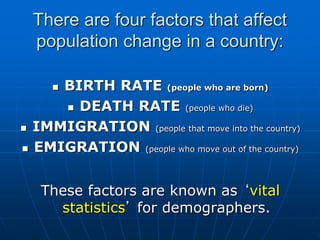
There are four factors that affect
population change in a country:
 BIRTH RATE (people who are born)
 DEATH RATE (people who die)
 IMMIGRATION (people that move into the country)
 EMIGRATION (people who move out of the country)
These factors are known as ‘vital
statistics’ for demographers.
Birth Rate
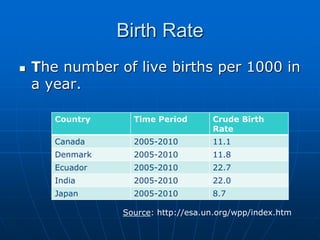
 The number of live births per 1000 in
a year.
Country Time Period Crude Birth
Rate
Canada 2005-2010 11.1
Denmark 2005-2010 11.8
Ecuador 2005-2010 22.7
India 2005-2010 22.0
Japan 2005-2010 8.7
Source: http://esa.un.org/wpp/index.htm
Birth Rates - 2008
https://www.cia.gov/library/publications/the-world-
factbook/rankorder/2054rank.html
Factors influencing birth rates
 The number of women in the
total population,
 Range of ages of female
population (15-49),
 Education levels
• Societies where women are
not treated equally – receive
less education = less
influence
• More education = more time
in school, job outside of
home = fewer children
 government policies,
• Population control programs
 the availability of contraception,
 Economic status
• Low income families – have
more children to bring more
income into the family
• No money for birth control
 Medical conditions and general
level of health care in country
• More infant and early
childhood deaths
• Have many children in
hopes that some will survive
to reach maturity
 culture & religion
• Promotion of larger or
smaller families
British Birth Rates on the rise
 http://www.independent.co.uk/news/
uk/home-news/british-birth-rate-
leaps-by-18-in-a-decade-
9107483.html
New baby boom?
 http://www.foxnews.com/health/2014/0
1/29/new-baby-boom-how-global-
birthrates-could-bounce-back/
DEATH RATE
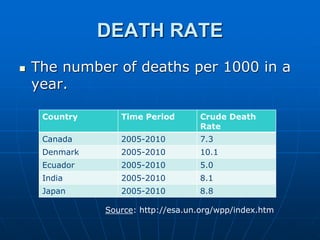
 The number of deaths per 1000 in a
year.
Country Time Period Crude Death
Rate
Canada 2005-2010 7.3
Denmark 2005-2010 10.1
Ecuador 2005-2010 5.0
India 2005-2010 8.1
Japan 2005-2010 8.8
Source: http://esa.un.org/wpp/index.htm
Death Rates - 2009
http://en.wikipedia.org/wiki/File:Death_rate_world
_map_CIA_2009.PNG
Factors influencing death rates
 Development of new and advance medical knowledge and better
trained doctors.
• Cost of services
 Improved sanitation or vaccination programs – members of MEDCs
play this role in LEDCs
 Education- Knowledge about balanced diet
• Help maintain their children’s health as well as their own
• Women in particular (usually the principal caregivers)
 Availability of food and clean water which are essential for good
health.
 Level of Economic development- wealthier areas are able to afford
good diets and healthy lifestyles hence less death rates.
 War and environmental disasters
 The country’s fertility rate
• Large population may increase the general death rates.
Case Studies (Groups of 3-4)
 1. A Woman’s Life in Mali (Page 170)
• What conditions affect the number of
children Sow has?
 2. Russia’s increasing death rate
(Page 172)
• What changes within Russian society
caused the dramatic changes in life
expectancy in that country?
IMMIGRATION
 The number of people moving into
a country.
 Pull factors-characteristics of a
place that attracts people to it.
EMIGRATION
 The number of people leaving a
country
 Push Factors-characteristics of a
place that causes people to leave.
 Refugees- people who are forced to
leave their country due to war, life-
threatening discrimination, famine, or
natural disasters.
Replacement Level
 Replacement Level – The number
of children required to keep the
population of a country constant, not
taking migration into
consideration. This is about 2.1
children per female in MDCs and 2.5
children per female in LDCs.
Total Fertility Rate
 Total Fertility Rate – The average
number of children a woman has in
her lifetime in a country.
 Factors:
• Religion
• Culture
• Social values and economic status
…Tends to be higher in less developed
countries.
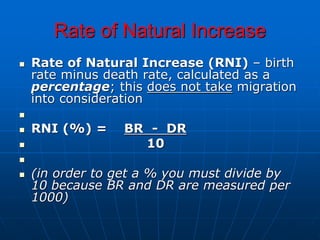
Rate of Natural Increase
 Rate of Natural Increase (RNI) – birth
rate minus death rate, calculated as a
percentage; this does not take migration
into consideration

 RNI (%) = BR - DR
 10

 (in order to get a % you must divide by
10 because BR and DR are measured per
1000)
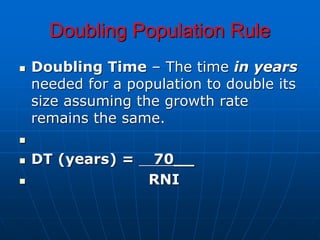
Doubling Population Rule
 Doubling Time – The time in years
needed for a population to double its
size assuming the growth rate
remains the same.

 DT (years) = 70__
 RNI
Infant Mortality Rate (<1year)
 based upon the number of live births that do
not reach their first birthday (per 1000 births)
 Underlying cause of about half of infant deaths
• Malnutrition
Child Mortality Rate (1-5 years)
 based upon the number of children that die
between their 1st and 5th birthdays (per 1000
births)

factors_affecting_population_growth.ppt

  • 1.
  • 2.
    There are fourfactors that affect population change in a country:  BIRTH RATE (people who are born)  DEATH RATE (people who die)  IMMIGRATION (people that move into the country)  EMIGRATION (people who move out of the country) These factors are known as ‘vital statistics’ for demographers.
  • 3.
    Birth Rate  Thenumber of live births per 1000 in a year. Country Time Period Crude Birth Rate Canada 2005-2010 11.1 Denmark 2005-2010 11.8 Ecuador 2005-2010 22.7 India 2005-2010 22.0 Japan 2005-2010 8.7 Source: http://esa.un.org/wpp/index.htm
  • 5.
    Birth Rates -2008 https://www.cia.gov/library/publications/the-world- factbook/rankorder/2054rank.html
  • 6.
    Factors influencing birthrates  The number of women in the total population,  Range of ages of female population (15-49),  Education levels • Societies where women are not treated equally – receive less education = less influence • More education = more time in school, job outside of home = fewer children  government policies, • Population control programs  the availability of contraception,  Economic status • Low income families – have more children to bring more income into the family • No money for birth control  Medical conditions and general level of health care in country • More infant and early childhood deaths • Have many children in hopes that some will survive to reach maturity  culture & religion • Promotion of larger or smaller families
  • 7.
    British Birth Rateson the rise  http://www.independent.co.uk/news/ uk/home-news/british-birth-rate- leaps-by-18-in-a-decade- 9107483.html
  • 8.
    New baby boom? http://www.foxnews.com/health/2014/0 1/29/new-baby-boom-how-global- birthrates-could-bounce-back/
  • 9.
    DEATH RATE  Thenumber of deaths per 1000 in a year. Country Time Period Crude Death Rate Canada 2005-2010 7.3 Denmark 2005-2010 10.1 Ecuador 2005-2010 5.0 India 2005-2010 8.1 Japan 2005-2010 8.8 Source: http://esa.un.org/wpp/index.htm
  • 11.
    Death Rates -2009 http://en.wikipedia.org/wiki/File:Death_rate_world _map_CIA_2009.PNG
  • 12.
    Factors influencing deathrates  Development of new and advance medical knowledge and better trained doctors. • Cost of services  Improved sanitation or vaccination programs – members of MEDCs play this role in LEDCs  Education- Knowledge about balanced diet • Help maintain their children’s health as well as their own • Women in particular (usually the principal caregivers)  Availability of food and clean water which are essential for good health.  Level of Economic development- wealthier areas are able to afford good diets and healthy lifestyles hence less death rates.  War and environmental disasters  The country’s fertility rate • Large population may increase the general death rates.
  • 13.
    Case Studies (Groupsof 3-4)  1. A Woman’s Life in Mali (Page 170) • What conditions affect the number of children Sow has?  2. Russia’s increasing death rate (Page 172) • What changes within Russian society caused the dramatic changes in life expectancy in that country?
  • 14.
    IMMIGRATION  The numberof people moving into a country.  Pull factors-characteristics of a place that attracts people to it.
  • 15.
    EMIGRATION  The numberof people leaving a country  Push Factors-characteristics of a place that causes people to leave.  Refugees- people who are forced to leave their country due to war, life- threatening discrimination, famine, or natural disasters.
  • 16.
    Replacement Level  ReplacementLevel – The number of children required to keep the population of a country constant, not taking migration into consideration. This is about 2.1 children per female in MDCs and 2.5 children per female in LDCs.
  • 17.
    Total Fertility Rate Total Fertility Rate – The average number of children a woman has in her lifetime in a country.  Factors: • Religion • Culture • Social values and economic status …Tends to be higher in less developed countries.
  • 18.
    Rate of NaturalIncrease  Rate of Natural Increase (RNI) – birth rate minus death rate, calculated as a percentage; this does not take migration into consideration   RNI (%) = BR - DR  10   (in order to get a % you must divide by 10 because BR and DR are measured per 1000)
  • 19.
    Doubling Population Rule Doubling Time – The time in years needed for a population to double its size assuming the growth rate remains the same.   DT (years) = 70__  RNI
  • 20.
    Infant Mortality Rate(<1year)  based upon the number of live births that do not reach their first birthday (per 1000 births)  Underlying cause of about half of infant deaths • Malnutrition
  • 21.
    Child Mortality Rate(1-5 years)  based upon the number of children that die between their 1st and 5th birthdays (per 1000 births)

Editor's Notes

  • #5 https://www.cia.gov/library/publications/the-world-factbook/rankorder/2054rank.html