

Analyzing Theories of
Second Language
Acquisition
Input from: E. Platt, M. Beatriz-Mendoza, & T. Lucas
Designed by: J. Govoni

@ESOLinHigherEd. LLC
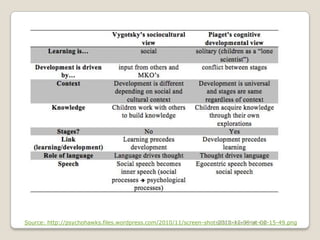
Source: http://psychohawks.files.wordpress.com/2010/11/screen-shot-2010-12-09-at-00-15-49.png
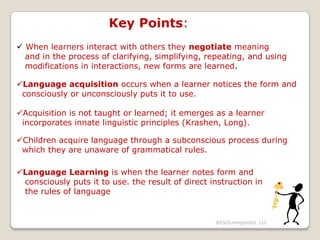
Key Points:
 When learners interact with others they negotiate meaning
and in the process of clarifying, simplifying, repeating, and using
modifications in interactions, new forms are learned.

Language acquisition occurs when a learner notices the form and
consciously or unconsciously puts it to use.
Acquisition is not taught or learned; it emerges as a learner
incorporates innate linguistic principles (Krashen, Long).
Children acquire language through a subconscious process during
which they are unaware of grammatical rules.
Language Learning is when the learner notes form and
consciously puts it to use. the result of direct instruction in
the rules of language

@ESOLinHigherEd. LLC
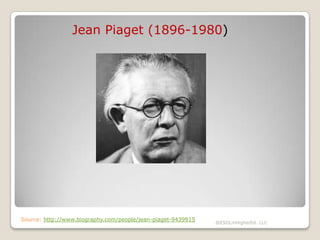
Jean Piaget (1896-1980)

Source: http://www.biography.com/people/jean-piaget-9439915

@ESOLinHigherEd. LLC
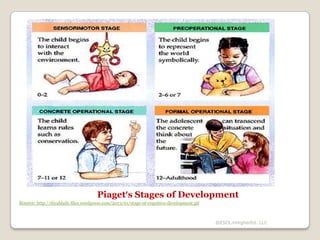
Piaget’s Stages of Development
Source: http://diyahlaily.files.wordpress.com/2013/01/stage-of-cognitive-development.gif

@ESOLinHigherEd. LLC
YouTube: Piaget’s Developmental Theory: An Overview
http://youtu.be/lEam9lpa6TQ

Piaget
Source: http://www.simplypsychology.org/piaget.html
@ESOLinHigherEd. LLC


Culture is the primary determinant of
cognitive development.

Source: http://media.photobucket.com/user/startapper04/media/Random%20stuff/vygotsky.jpg.
html?filters[term]=vygotsky&filters[primary]=images&filters[secondary]=videos&sort=1&o=1

Lev S. Vygotsky (1896-1934)
@ESOLinHigherEd. LLC
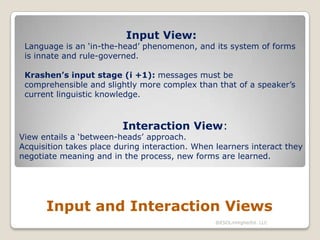
Input View:

Language is an ‘in-the-head’ phenomenon, and its system of forms
is innate and rule-governed.
Krashen’s input stage (i +1): messages must be
comprehensible and slightly more complex than that of a speaker’s
current linguistic knowledge.

Interaction View:

View entails a ‘between-heads’ approach.
Acquisition takes place during interaction. When learners interact they
negotiate meaning and in the process, new forms are learned.

Input and Interaction Views
@ESOLinHigherEd. LLC
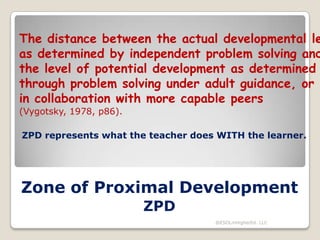
The distance between the actual developmental le
as determined by independent problem solving and
the level of potential development as determined
through problem solving under adult guidance, or
in collaboration with more capable peers
(Vygotsky, 1978, p86).

ZPD represents what the teacher does WITH the learner.

Zone of Proximal Development
ZPD
@ESOLinHigherEd. LLC
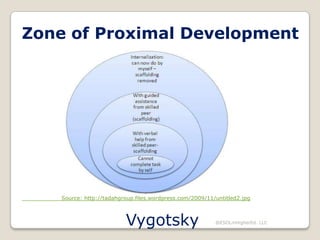
Zone of Proximal Development

Source: http://tadahgroup.files.wordpress.com/2009/11/untitled2.jpg

Vygotsky

@ESOLinHigherEd. LLC
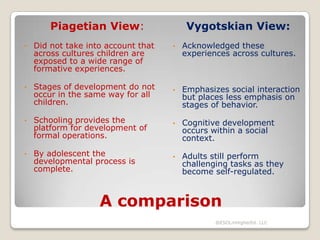
Piagetian View:
•

Did not take into account that
across cultures children are
exposed to a wide range of
formative experiences.

•

Stages of development do not
occur in the same way for all
children.

•

Schooling provides the
platform for development of
formal operations.

•

By adolescent the
developmental process is
complete.

Vygotskian View:
•

Acknowledged these
experiences across cultures.

•

Emphasizes social interaction
but places less emphasis on
stages of behavior.

•

Cognitive development
occurs within a social
context.

•

Adults still perform
challenging tasks as they
become self-regulated.

A comparison
@ESOLinHigherEd. LLC
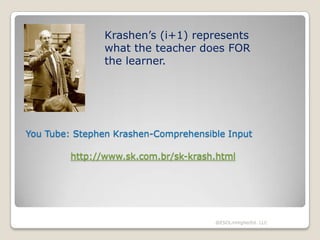
Krashen’s (i+1) represents
what the teacher does FOR
the learner.

You Tube: Stephen Krashen-Comprehensible Input
http://www.sk.com.br/sk-krash.html

@ESOLinHigherEd. LLC
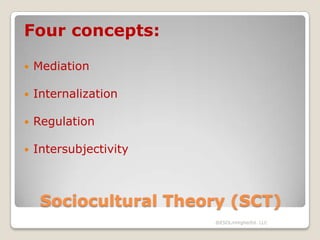
Four concepts:


Mediation



Internalization



Regulation



Intersubjectivity

Sociocultural Theory (SCT)
@ESOLinHigherEd. LLC
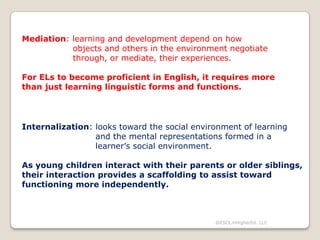
Mediation: learning and development depend on how
objects and others in the environment negotiate
through, or mediate, their experiences.
For ELs to become proficient in English, it requires more
than just learning linguistic forms and functions.

Internalization: looks toward the social environment of learning
and the mental representations formed in a
learner’s social environment.
As young children interact with their parents or older siblings,
their interaction provides a scaffolding to assist toward
functioning more independently.

@ESOLinHigherEd. LLC
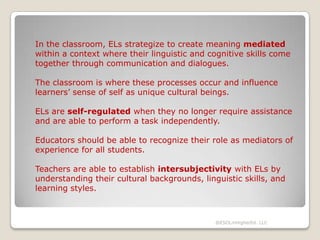
In the classroom, ELs strategize to create meaning mediated
within a context where their linguistic and cognitive skills come
together through communication and dialogues.

The classroom is where these processes occur and influence
learners’ sense of self as unique cultural beings.
ELs are self-regulated when they no longer require assistance
and are able to perform a task independently.
Educators should be able to recognize their role as mediators of
experience for all students.
Teachers are able to establish intersubjectivity with ELs by
understanding their cultural backgrounds, linguistic skills, and
learning styles.

@ESOLinHigherEd. LLC

SLA Theories-Chapter 6

  • 1.
    Analyzing Theories of SecondLanguage Acquisition Input from: E. Platt, M. Beatriz-Mendoza, & T. Lucas Designed by: J. Govoni @ESOLinHigherEd. LLC
  • 2.
  • 3.
    Key Points:  Whenlearners interact with others they negotiate meaning and in the process of clarifying, simplifying, repeating, and using modifications in interactions, new forms are learned. Language acquisition occurs when a learner notices the form and consciously or unconsciously puts it to use. Acquisition is not taught or learned; it emerges as a learner incorporates innate linguistic principles (Krashen, Long). Children acquire language through a subconscious process during which they are unaware of grammatical rules. Language Learning is when the learner notes form and consciously puts it to use. the result of direct instruction in the rules of language @ESOLinHigherEd. LLC
  • 4.
    Jean Piaget (1896-1980) Source:http://www.biography.com/people/jean-piaget-9439915 @ESOLinHigherEd. LLC
  • 5.
    Piaget’s Stages ofDevelopment Source: http://diyahlaily.files.wordpress.com/2013/01/stage-of-cognitive-development.gif @ESOLinHigherEd. LLC
  • 6.
    YouTube: Piaget’s DevelopmentalTheory: An Overview http://youtu.be/lEam9lpa6TQ Piaget Source: http://www.simplypsychology.org/piaget.html @ESOLinHigherEd. LLC
  • 7.
     Culture is theprimary determinant of cognitive development. Source: http://media.photobucket.com/user/startapper04/media/Random%20stuff/vygotsky.jpg. html?filters[term]=vygotsky&filters[primary]=images&filters[secondary]=videos&sort=1&o=1 Lev S. Vygotsky (1896-1934) @ESOLinHigherEd. LLC
  • 8.
    Input View: Language isan ‘in-the-head’ phenomenon, and its system of forms is innate and rule-governed. Krashen’s input stage (i +1): messages must be comprehensible and slightly more complex than that of a speaker’s current linguistic knowledge. Interaction View: View entails a ‘between-heads’ approach. Acquisition takes place during interaction. When learners interact they negotiate meaning and in the process, new forms are learned. Input and Interaction Views @ESOLinHigherEd. LLC
  • 9.
    The distance betweenthe actual developmental le as determined by independent problem solving and the level of potential development as determined through problem solving under adult guidance, or in collaboration with more capable peers (Vygotsky, 1978, p86). ZPD represents what the teacher does WITH the learner. Zone of Proximal Development ZPD @ESOLinHigherEd. LLC
  • 10.
    Zone of ProximalDevelopment Source: http://tadahgroup.files.wordpress.com/2009/11/untitled2.jpg Vygotsky @ESOLinHigherEd. LLC
  • 11.
    Piagetian View: • Did nottake into account that across cultures children are exposed to a wide range of formative experiences. • Stages of development do not occur in the same way for all children. • Schooling provides the platform for development of formal operations. • By adolescent the developmental process is complete. Vygotskian View: • Acknowledged these experiences across cultures. • Emphasizes social interaction but places less emphasis on stages of behavior. • Cognitive development occurs within a social context. • Adults still perform challenging tasks as they become self-regulated. A comparison @ESOLinHigherEd. LLC
  • 12.
    Krashen’s (i+1) represents whatthe teacher does FOR the learner. You Tube: Stephen Krashen-Comprehensible Input http://www.sk.com.br/sk-krash.html @ESOLinHigherEd. LLC
  • 13.
  • 14.
    Mediation: learning anddevelopment depend on how objects and others in the environment negotiate through, or mediate, their experiences. For ELs to become proficient in English, it requires more than just learning linguistic forms and functions. Internalization: looks toward the social environment of learning and the mental representations formed in a learner’s social environment. As young children interact with their parents or older siblings, their interaction provides a scaffolding to assist toward functioning more independently. @ESOLinHigherEd. LLC
  • 15.
    In the classroom,ELs strategize to create meaning mediated within a context where their linguistic and cognitive skills come together through communication and dialogues. The classroom is where these processes occur and influence learners’ sense of self as unique cultural beings. ELs are self-regulated when they no longer require assistance and are able to perform a task independently. Educators should be able to recognize their role as mediators of experience for all students. Teachers are able to establish intersubjectivity with ELs by understanding their cultural backgrounds, linguistic skills, and learning styles. @ESOLinHigherEd. LLC
  • 16.