VIVEKANANDA COLLEGE OF NURSING
Seminar
PRESENTED BY:- APURVA DWIVEDI [M.Sc. Nursing 1ST Yr.]
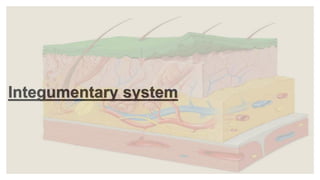
Integumentary system
Review Of Anatomy And
Physiology Of Skin.
Definition :-
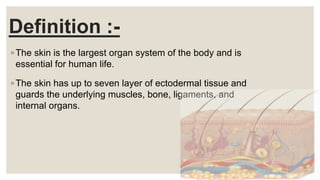
◦ The skin is the largest organ system of the body and is
essential for human life.
◦ The skin has up to seven layer of ectodermal tissue and
guards the underlying muscles, bone, ligaments, and
internal organs.
Function of skin
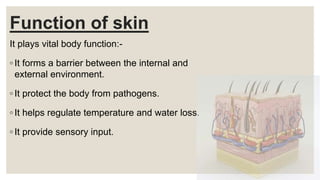
It plays vital body function:-
◦ It forms a barrier between the internal and
external environment.
◦ It protect the body from pathogens.
◦ It helps regulate temperature and water loss.
◦ It provide sensory input.
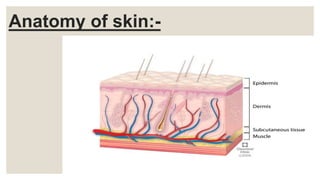
Anatomy of skin:-
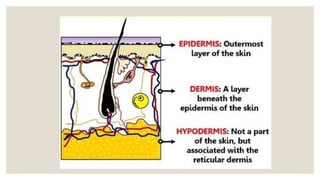
Epidermis:-
◦ It is an outmost layer of stratified epithelial cell.
◦ It ranges in thickness from about 0.05mm on the eyelids to 1.5mm on
palm hand and soles of feet.
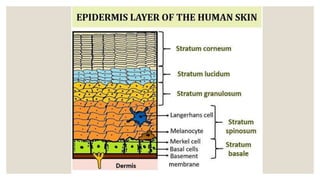
◦ The layers which is compose of epidermis from innermost to outermost
are:-
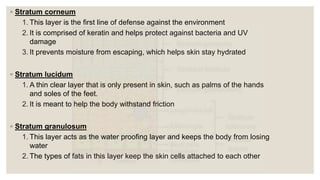
◦ Stratum corneum
1. This layer is the first line of defense against the environment
2. It is comprised of keratin and helps protect against bacteria and UV
damage
3. It prevents moisture from escaping, which helps skin stay hydrated
◦ Stratum lucidum
1. A thin clear layer that is only present in skin, such as palms of the hands
and soles of the feet.
2. It is meant to help the body withstand friction
◦ Stratum granulosum
1. This layer acts as the water proofing layer and keeps the body from losing
water
2. The types of fats in this layer keep the skin cells attached to each other
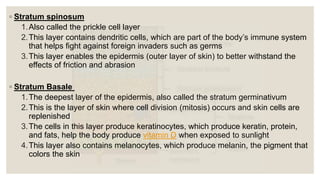
◦ Stratum spinosum
1.Also called the prickle cell layer
2.This layer contains dendritic cells, which are part of the body’s immune system
that helps fight against foreign invaders such as germs
3.This layer enables the epidermis (outer layer of skin) to better withstand the
effects of friction and abrasion
◦ Stratum Basale
1.The deepest layer of the epidermis, also called the stratum germinativum
2.This is the layer of skin where cell division (mitosis) occurs and skin cells are
replenished
3.The cells in this layer produce keratinocytes, which produce keratin, protein,
and fats, help the body produce vitamin D when exposed to sunlight
4.This layer also contains melanocytes, which produce melanin, the pigment that
colors the skin
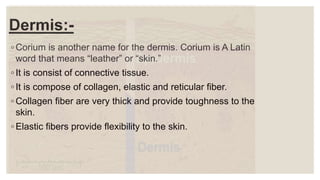
Dermis:-
◦ Corium is another name for the dermis. Corium is A Latin
word that means “leather” or “skin.”
◦ It is consist of connective tissue.
◦ It is compose of collagen, elastic and reticular fiber.
◦ Collagen fiber are very thick and provide toughness to the
skin.
◦ Elastic fibers provide flexibility to the skin.
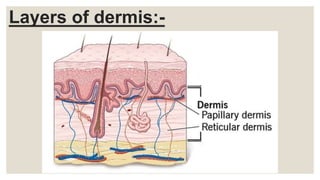
Layers of dermis:-
◦ Papillary layer
1.This layer connects the dermis to the epidermis
2.It contains capillaries that bring nutrients to the skin and increase or
decrease blood flow to the skin which helps regulate temperature
3.It also contains sensory neurons that help sense heat, cold, touch, pain,
and pressure
4.This is the layer of skin that is responsible for fingerprints
◦ Reticular layer
1.The deepest level of the dermis
2.A thick layer composed of dense connective tissue
3.This layer contains hair follicles, sweat glands, and oil-producing glands
(sebaceous glands)
4.The main functions are strengthening the skin and providing elasticity to
the skin
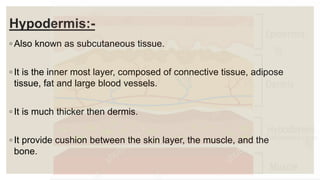
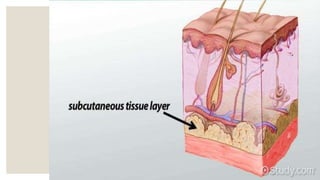
Hypodermis:-
◦ Also known as subcutaneous tissue.
◦ It is the inner most layer, composed of connective tissue, adipose
tissue, fat and large blood vessels.
◦ It is much thicker then dermis.
◦ It provide cushion between the skin layer, the muscle, and the
bone.
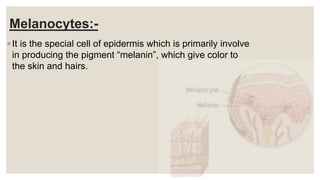
Melanocytes:-
◦ It is the special cell of epidermis which is primarily involve
in producing the pigment “melanin”, which give color to
the skin and hairs.
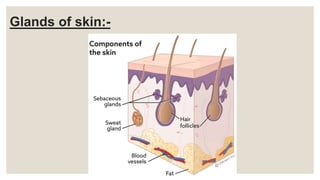
Glands of skin:-
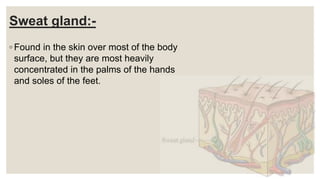
Sweat gland:-
◦ Found in the skin over most of the body
surface, but they are most heavily
concentrated in the palms of the hands
and soles of the feet.
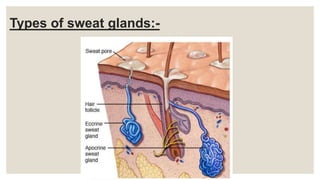
Types of sweat glands:-
Conti.
◦ Eccrine - The most numerous type that are found all
over the body, particularly on the palms of the hands,
soles of the feet fore head. Are active from birth.
◦ Apocrine - Mostly confined to the arm pits (axillae)
and the anal-genital area. Apocrine glands become
only at puberty.
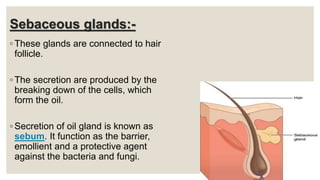
Sebaceous glands:-
◦ These glands are connected to hair
follicle.
◦ The secretion are produced by the
breaking down of the cells, which
form the oil.
◦ Secretion of oil gland is known as
sebum. It function as the barrier,
emollient and a protective agent
against the bacteria and fungi.
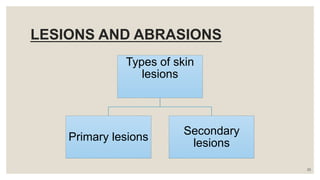
LESIONS AND ABRASIONS
Types of skin
lesions
Primary lesions
Secondary
lesions
23
Primary lesions
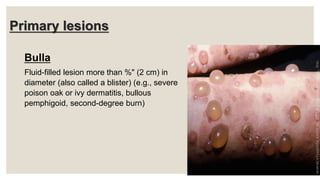
Bulla
Fluid-filled lesion more than %" (2 cm) in
diameter (also called a blister) (e.g., severe
poison oak or ivy dermatitis, bullous
pemphigoid, second-degree burn)
24
Comedo
Plugged pilosebaceous duct,
exfoliative, formed from sebum
and keratin (e.g., blackhead
[open comedo], whitehead
[closed comedo])
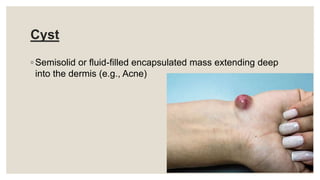
Cyst
◦ Semisolid or fluid-filled encapsulated mass extending deep
into the dermis (e.g., Acne)
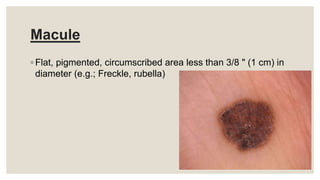
Macule
◦ Flat, pigmented, circumscribed area less than 3/8 " (1 cm) in
diameter (e.g.; Freckle, rubella)
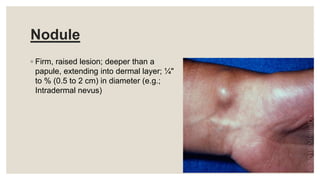
Nodule
◦ Firm, raised lesion; deeper than a
papule, extending into dermal layer; Âź"
to % (0.5 to 2 cm) in diameter (e.g.;
Intradermal nevus)
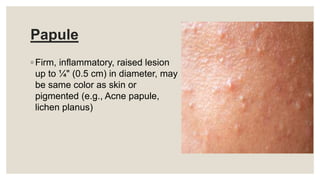
Papule
◦ Firm, inflammatory, raised lesion
up to Âź" (0.5 cm) in diameter, may
be same color as skin or
pigmented (e.g., Acne papule,
lichen planus)
Patch
◦ Flat, pigmented, circumscribed
area more than " (1 cm) in
diameter (e.g.; Herald patch
[pityriasis rosea])
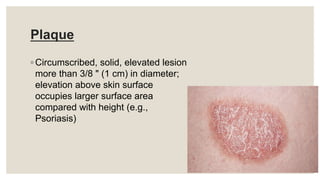
Plaque
◦ Circumscribed, solid, elevated lesion
more than 3/8 " (1 cm) in diameter;
elevation above skin surface
occupies larger surface area
compared with height (e.g.,
Psoriasis)
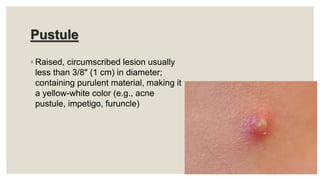
Pustule
◦ Raised, circumscribed lesion usually
less than 3/8" (1 cm) in diameter;
containing purulent material, making it
a yellow-white color (e.g., acne
pustule, impetigo, furuncle)
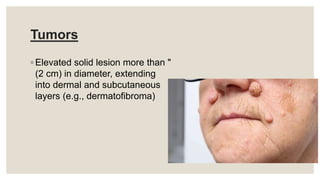
Tumors
◦ Elevated solid lesion more than "
(2 cm) in diameter, extending
into dermal and subcutaneous
layers (e.g., dermatofibroma)
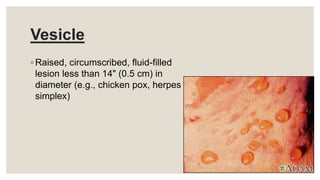
Vesicle
◦ Raised, circumscribed, fluid-filled
lesion less than 14" (0.5 cm) in
diameter (e.g., chicken pox, herpes
simplex)
Wheal
◦ Raised, firm lesion with intense
localized skin edema, varying in
size and shape; color ranging from
pale pink to red, disappears in
hours (e.g., hive [urticaria], insect
bite)
Secondary lesions
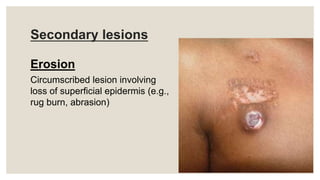
Erosion
Circumscribed lesion involving
loss of superficial epidermis (e.g.,
rug burn, abrasion)
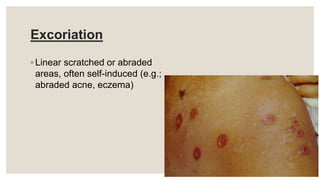
Excoriation
◦ Linear scratched or abraded
areas, often self-induced (e.g.;
abraded acne, eczema)
Fissure
◦ Linear cracking of the skin
extending into the dermal layer
(e.g.; hand dermatitis [chapped
skin]).
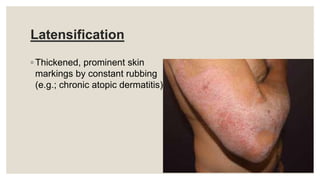
Latensification
◦ Thickened, prominent skin
markings by constant rubbing
(e.g.; chronic atopic dermatitis)
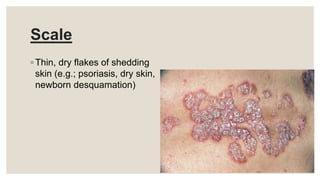
Scale
◦ Thin, dry flakes of shedding
skin (e.g.; psoriasis, dry skin,
newborn desquamation)
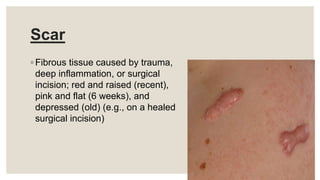
Scar
◦ Fibrous tissue caused by trauma,
deep inflammation, or surgical
incision; red and raised (recent),
pink and flat (6 weeks), and
depressed (old) (e.g., on a healed
surgical incision)
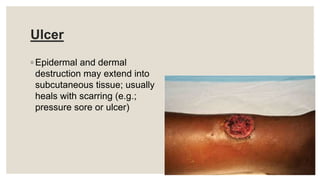
Ulcer
◦ Epidermal and dermal
destruction may extend into
subcutaneous tissue; usually
heals with scarring (e.g.;
pressure sore or ulcer)
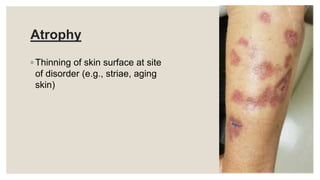
Atrophy
◦ Thinning of skin surface at site
of disorder (e.g., striae, aging
skin)
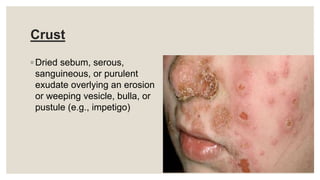
Crust
◦ Dried sebum, serous,
sanguineous, or purulent
exudate overlying an erosion
or weeping vesicle, bulla, or
pustule (e.g., impetigo)
Infection and infestations; dermatitis
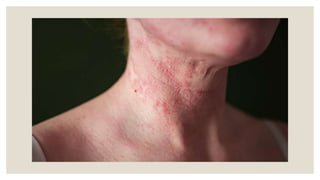
Atopic dermatitis
◦ Atopic (allergic) dermatitis (also called atopic or infantile eczema) is a chronic or
recurrent inflammatory response often associated with other atopic diseases, such as
bronchial asthma and allergic rhinitis.
◦ It usually develops in infants and toddlers between ages 1 month and 1 year,
usually in those with a strong family history of atopic disease.
◦ These children often develop other atopic disorders as they grow older.
◦ Typically, this form of dermatitis flares and subsides repeatedly before finally
resolving during adolescence, but it can persist into adulthood.
Incidence
◦ Atopic dermatitis affects about 9 of
every 1,000 persons.
Causes
Possible causes of atopic dermatitis
include:-
◦ food allergy
◦ Infection
◦ irritating chemicals
◦ extremes of temperature and humidity
◦ psychological stress or strong emotions
(flare ups).
These causes may be exacerbated by
genetic predisposition.
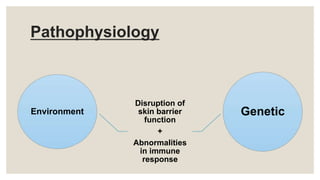
Pathophysiology
Environment
Disruption of
skin barrier
function
+
Abnormalities
in immune
response
Genetic
Signs and symptoms
◦ Excessively dry skin; in children, typically on the
forehead, cheeks, and extensor surfaces of the arms
and legs; in adults, at flexion points (antecubital fossa,
popliteal area, and neck).
◦ Edema, crusting, and scaling due to pruritus and
scratching.
◦ Multiple areas of dry, scaly skin, with white
dermatographia, blanching, and latensification with
chronic atrophic lesions.
Conti.
◦ Pink pigmentation and swelling of upper eyelid with a double
fold under the lower lid (Morgan's, denier's, or Mongolian
fold) due to severe pruritus.
◦ Viral, fungal, or bacterial infections and ocular disorders
(common secondary conditions).
◦ Serum IgE levels (often elevated but not diagnostic).
Diagnostic evaluation
◦ Family history of atopic disorders (helpful in
diagnosis).
◦ Typical distribution of skin lesions.
◦ Ruling out other inflammatory skin lesions, such
as diaper rash (lesions confined to the diapered
area), seborrheic.
◦ Dermatitis (moist or greasy scaling with yellow-
crusted patches), and chronic contact dermatitis
(lesions affect hands and forearms, not
antecubital and popliteal areas).
◦ Serum IgE levels (often elevated but not
diagnostic).
Management
◦ Eliminating allergens and avoiding irritants (strong soaps,
cleansers, and other chemicals), extreme temperature.
◦ Changes, and other precipitating factors.
◦ Preventing excessive dryness of the skin (critical to
successful therapy).
◦ Topical application of a corticosteroid ointment, especially
after bathing, to alleviate inflammation (moisturizing cream
between steroid doses to help retain moisture); systemic
antihistamines, such as Benadryl (diphenhydramine).
Conti..
◦ Administering systemic corticosteroid
therapy (during extreme exacerbations).
◦ Applying weak tar preparations and
ultraviolet B light therapy to increase
thickness of stratum corneum.
◦ Administering antibiotics (for positive culture
for bacterial agent).
Complications
◦ Cataracts developing between ages 20 and 40.
◦ Kaposi's varicelliform eruption (eczema
herpeticum), a potentially serious widespread
cutaneous viral infection (may develop if the
patient comes in contact with a person infected
with herpes simplex).
◦ Subclinical (not requiring treatment) skin
infection that may progress to cellulitis.
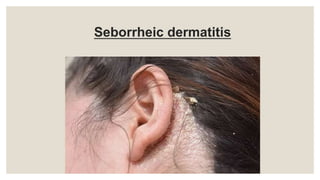
Seborrheic dermatitis
◦ It is chronic inflammation disease of the skin with predilection
for areas that are wall supplied with sebaceous gland.
◦ A subacute skin disease affecting the scalp, face, and
occasionally other areas that's characterized by lesions
covered with yellow or brownish-gray scales.
Causes
◦ Unknown
◦ Stress
◦ Immunodeficiency
◦ neurologic conditions may be predisposing factors; related to
the yeast Pittosporum ovals (normal flora).
Clinical manifestation
◦ Eruptions in areas with many sebaceous glands (usually
scalp, face, chest, axillae, and groin) and in skin folds .
itching, redness, and
◦ Inflammation of affected areas; lesions may appear greasy;
fissures may occur.
◦ Indistinct, occasionally yellowish scaly patches from excess
stratum corneum (dandruff may be a mild seborrheic
dermatitis).
Diagnostic evaluation
◦ History collection and physical examination.
Management
◦ Frequent washing and shampooing with
selenium sulfide suspension (most effective),
Zinc pyrithione, or tar and salicylic acid
shampoo.
◦ Application of topical corticosteroids and
antifungals to involved area.
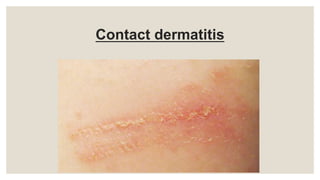
Contact dermatitis
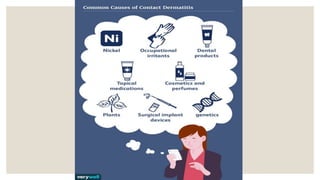
◦ A skin rash caused by contact with a certain substance.
◦ The substance might irritate the skin or trigger an allergic
reaction.
◦ Some common culprits include soap, cosmetics, fragrances,
jewelry and poison ivy.
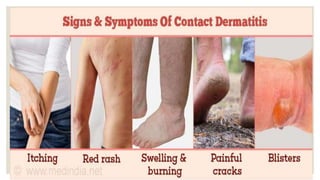
Signs and symptoms
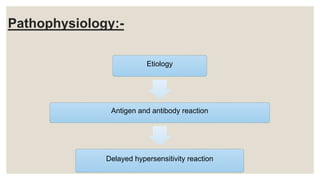
Pathophysiology:-
Etiology
Antigen and antibody reaction
Delayed hypersensitivity reaction
Prevention
• Identification of possible cutaneous irritants and allergens.
• To avoid skin exposure, use appropriate control measures or chemical
substitutes.
• Personal protection can be achieved by the use of protective clothes or
barrier creams.
• Maintenance of personal and environmental hygiene.
Conti.
• Use of harmful irritants in the workplace should be regulated
• Efforts to raise knowledge of potential allergies and irritants
through education
• promoting safe working conditions and practices
• health screenings before and after employment and on a
regular basis.
Treatment
Self-care
• If blistering develops, cold moist
compresses applied for 30 minutes, 3 times
a day can offer relief.
• Calamine lotion may relieve itching.
• Oral antihistamines such
as diphenhydramine (Benadryl, ben-
allergen) can relieve itching.
• Avoid scratching.
Conti.
• Immediately after exposure to a known allergen
or irritant, wash with soap and cool water to
remove or inactivate most of the offending
substance.
• For mild cases that cover a relatively small
area, hydrocortisone cream in nonprescription
strength may be sufficient.
• Weak acid solutions (lemon juice, vinegar) can be
used to counteract the effects of dermatitis
contracted by exposure to basic irritants.
• A barrier cream, such as those containing zinc
oxide (e.g., Desitin, etc.), May help protect the
skin and retain moisture.
Medical care
If the rash does not improve or continues to spread after 2–3 of days of self-care, or
if the itching and/or pain is severe, the patient should contact a dermatologist or
other physician. Medical treatment usually consists of lotions, creams, or oral
medications.
• Corticosteroids. A corticosteroid medication like hydrocortisone may be prescribed to
combat inflammation in a localized area. It may be applied to the skin as a cream or
ointment. If the reaction covers a relatively large portion of the skin or is severe, a
corticosteroid in pill or injection form may be prescribed.
◦ In severe cases, a stronger medicine like Ulobetasol may be prescribed by a
dermatologist.
• Antihistamines. Prescription antihistamines may be given if non-prescription
strengths are inadequate.
Nursing Management
Nursing management of a patient with contact dermatitis
involves the following:
Nursing Assessment
◦ Skin assessment should be the focus in a patient with
contact dermatitis.
◦ Skin characteristics. Assess skin, noting color, moisture,
texture, and temperature.
◦ Lesions. Note erythema, edema, tenderness, presence of
erosions, excoriations, fissures, and thickening.
◦ Appearance. Assess the patient’s perception of and
behavior related to changed appearance.
Conti.
◦ Nursing interventions appropriate for the patient
include:
◦ Skin care. Encourage the patient to bathe in
warm water using a mild soap, then air dry the
skin and gently pat to dry.
◦ Topical application. Usual application of topical
steroid creams and ointments is twice a day,
spread thinly and sparingly.
Conti..
◦ Acknowledge patient’s feelings. Allow patient to
verbalize feelings regarding their skin condition.
◦ Proper hygiene. Encourage the patient to keep
the skin clean, dry, and well lubricated to reduce
skin trauma and risk for infection.
◦ Phototherapy preparation. Prepare the patient
for phototherapy, because this method uses
ultraviolet A or B light waves to promote healing
of the skin.
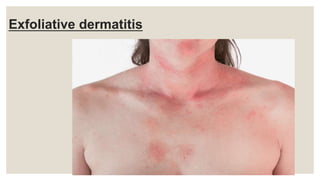
Exfoliative dermatitis
◦ Severe skin inflammation
characterized by redness and
widespread erythema and scaling,
covering virtually the entire skin
surface.
◦ It is a severe inflammation of the
entire skin surface. This is due to a
reaction to certain medicines, a pre-
existing skin condition, and
sometimes cancer. In approximately
25% of people, there is no identifiable
cause.
Causes.
◦ Preexisting skin lesions progressing to
exfoliative stage, such as in contact
dermatitis, drug reaction, lymphoma,
leukemia, or atopic dermatitis..
◦ May be idiopathic.
Clinical manifestation
◦ Generalized dermatitis, with acute loss of
stratum corneum, erythema, and scaling.
◦ Sensation of tight skin.
◦ Hair loss Possible fever, sensitivity to cold,
shivering, gynecomastia, and
lymphadenopathy.
Management
◦ Hospitalization, with protective isolation and
hygienic measures to prevent secondary
bacterial infection.
◦ Open wet dressings, with colloidal baths.
◦ Bland lotions over topical corticosteroids.
◦ Maintenance of constant environmental prevent
chilling or over heating temperature to Careful
monitoring of renal and cardiac status.
◦ Systemic antibiotics and steroids.
◦ Same as for atopic dermatitis.
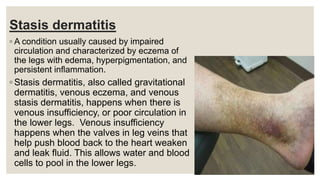
Stasis dermatitis
◦ A condition usually caused by impaired
circulation and characterized by eczema of
the legs with edema, hyperpigmentation, and
persistent inflammation.
◦ Stasis dermatitis, also called gravitational
dermatitis, venous eczema, and venous
stasis dermatitis, happens when there is
venous insufficiency, or poor circulation in
the lower legs. Venous insufficiency
happens when the valves in leg veins that
help push blood back to the heart weaken
and leak fluid. This allows water and blood
cells to pool in the lower legs.
Causes
◦ Secondary to peripheral vascular
diseases affecting the legs, such as
recurrent thrombophlebitis and resultant
chronic venous insufficiency.
Clinical manifestation
◦ Varicosities and edema common, but obvious
vascular in sufficiency not always present.
◦ Usually affects the lower leg just above internal
malleolus or sites of trauma or irritation.
◦ Early signs: dusky-red deposits of hemosiderin
in skin, with itching and dimpling of
subcutaneous tissue.
◦ Later signs: edema, redness, and scaling of
large areas of legs.
◦ Possible fissures, crusts, and ulcers.
Management
◦ Measures to prevent venous stasis: avoidance of
prolonged sitting or standing, use of support
stockings, weight reduction in obesity, and leg
elevation.
◦ Corrective surgery for underlying cause.
◦ After ulcer develops, encourage rest periods with
legs elevated, open wet dressings, Unna's boot
(zinc gelatin dressing provides continuous
pressure to affected areas), and antibiotics for
secondary infection after wound culture.
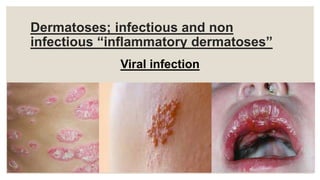
Dermatoses; infectious and non
infectious “inflammatory dermatoses”
Viral infection
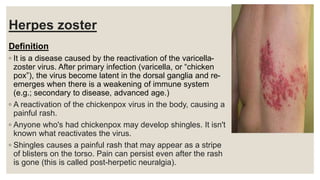
Herpes zoster
Definition
◦ It is a disease caused by the reactivation of the varicella-
zoster virus. After primary infection (varicella, or “chicken
pox”), the virus become latent in the dorsal ganglia and re-
emerges when there is a weakening of immune system
(e.g.; secondary to disease, advanced age.)
◦ A reactivation of the chickenpox virus in the body, causing a
painful rash.
◦ Anyone who's had chickenpox may develop shingles. It isn't
known what reactivates the virus.
◦ Shingles causes a painful rash that may appear as a stripe
of blisters on the torso. Pain can persist even after the rash
is gone (this is called post-herpetic neuralgia).
Clinical manifestation
◦ Early symptoms of shingles may include:
• Fever.
• Chills.
• Headache.
• Feeling tired.
• Sensitivity to light.
• Stomach upset.
Conti.
◦ Other signs and symptoms that appear a few days after the early
symptoms include:
• An itching, tingling or burning feeling in an area of your skin.
• Redness on your skin in the affected area.
• Raised rash in a small area of your skin.
• Fluid-filled blisters that break open then scab over.
• Mild to severe pain in the area of skin affected.
Treatments
There is no cure for shingles but there are treatments for
managing the symptoms.
◦ Antiviral medications
◦ These drugs may ease the discomfort and make the
symptoms stop sooner, particularly if you start them within
72 hours of the first sign of shingles. They may also help
prevent the pain that can happen months and years later,
called postherpetic neuralgia. These medications include:
• Acyclovir (Zovirax®).
• Famciclovir (Famvir®).
• Valacyclovir (Valtrex®).
Over-the-counter pain medications
These medications include the following and may
be effective in relieving pain:
• Acetaminophen (Tylenol®).
• Ibuprofen (Motrin®, Advil®).
Other medications
◦ Antibacterial drugs may be prescribed if
you develop a bacterial infection due to
the shingles rash.
◦ Anti-inflammatory drugs like prednisone
may be prescribed if shingles affects
your eyes or other parts of your face.
Nursing management
◦ The patient and family members are instructed about the
importance of taking antiviral agents as prescribed and in
keeping follow-up appointments with the health care
provider.
◦ The nurse assesses the patient’s discomfort and response
to medication and collaborates with the physician to make
necessary adjustments to the treatment regimen.
◦ The patient is taught how to apply wet dressings or
medication to the lesions and to follow proper hand
hygiene techniques to avoid spreading the virus.
Conti.
◦ Diversionary activities and relaxation techniques
are encouraged to ensure restful sleep and to
alleviate discomfort.
◦ A caregiver may be required to assist with
dressings, particularly if the patient is elderly and
unable to apply them.
◦ Food preparation for patients who cannot care for
themselves or prepare nourishing meals must be
arranged.
Herpes simplex
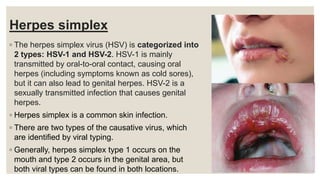
◦ The herpes simplex virus (HSV) is categorized into
2 types: HSV-1 and HSV-2. HSV-1 is mainly
transmitted by oral-to-oral contact, causing oral
herpes (including symptoms known as cold sores),
but it can also lead to genital herpes. HSV-2 is a
sexually transmitted infection that causes genital
herpes.
◦ Herpes simplex is a common skin infection.
◦ There are two types of the causative virus, which
are identified by viral typing.
◦ Generally, herpes simplex type 1 occurs on the
mouth and type 2 occurs in the genital area, but
both viral types can be found in both locations.
Conti.
◦ About 85% of adults worldwide are seropositive for herpes type
1.
◦ The prevalence of type 2 is lower; type 2 usually appears at the
onset of sexual activity. Serologic testing shows that many
more people are infected than have a history of clinical
disease.
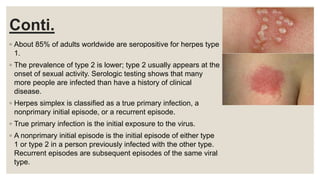
◦ Herpes simplex is classified as a true primary infection, a
nonprimary initial episode, or a recurrent episode.
◦ True primary infection is the initial exposure to the virus.
◦ A nonprimary initial episode is the initial episode of either type
1 or type 2 in a person previously infected with the other type.
Recurrent episodes are subsequent episodes of the same viral
type.
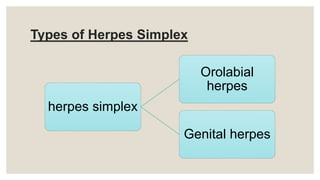
Types of Herpes Simplex
herpes simplex
Orolabial
herpes
Genital herpes
Orolabial herpes
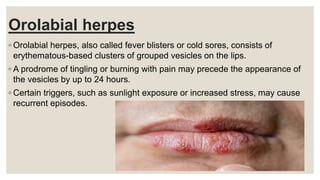
◦ Orolabial herpes, also called fever blisters or cold sores, consists of
erythematous-based clusters of grouped vesicles on the lips.
◦ A prodrome of tingling or burning with pain may precede the appearance of
the vesicles by up to 24 hours.
◦ Certain triggers, such as sunlight exposure or increased stress, may cause
recurrent episodes.
Conti..
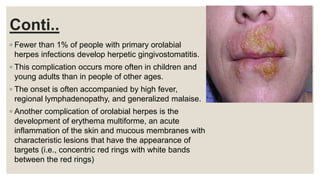
◦ Fewer than 1% of people with primary orolabial
herpes infections develop herpetic gingivostomatitis.
◦ This complication occurs more often in children and
young adults than in people of other ages.
◦ The onset is often accompanied by high fever,
regional lymphadenopathy, and generalized malaise.
◦ Another complication of orolabial herpes is the
development of erythema multiforme, an acute
inflammation of the skin and mucous membranes with
characteristic lesions that have the appearance of
targets (i.e., concentric red rings with white bands
between the red rings)
Genital herpes
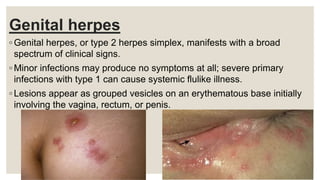
◦ Genital herpes, or type 2 herpes simplex, manifests with a broad
spectrum of clinical signs.
◦ Minor infections may produce no symptoms at all; severe primary
infections with type 1 can cause systemic flulike illness.
◦ Lesions appear as grouped vesicles on an erythematous base initially
involving the vagina, rectum, or penis.
Conti.
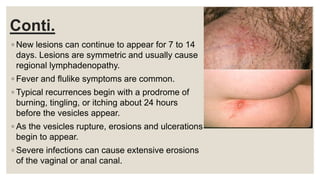
◦ New lesions can continue to appear for 7 to 14
days. Lesions are symmetric and usually cause
regional lymphadenopathy.
◦ Fever and flulike symptoms are common.
◦ Typical recurrences begin with a prodrome of
burning, tingling, or itching about 24 hours
before the vesicles appear.
◦ As the vesicles rupture, erosions and ulcerations
begin to appear.
◦ Severe infections can cause extensive erosions
of the vaginal or anal canal.
Sign and symptoms
Primary HSV
◦ Symptoms of a primary infection, or first episode, will
generally appear anywhere from a few days to a few
weeks after exposure to the virus.
◦ Primary episodes often include flu-like symptoms,
such as:
i. fever
ii. swollen lymph nodes
iii. body aches and pains, including headache
iv. unusual tiredness or fatigue
v. lack of appetite
vi. shooting pain at the site of the infection
Conti.
◦ You may notice some tingling, burning, or itching
at the site of the infection before small, painful
blisters appear. There could be one blister or a
small cluster. These blisters will eventually burst
and crust over before they begin to heal.
◦ The blisters that develop during a primary
infection may take up to 6 to fully heal. These
blisters can still transmit the virus until they’ve
healed completely.
◦ Sores often itch, and genital sores may
cause pain during urination.
Recurrent HSV symptoms
◦ Some people who live with HSV only ever have one
episode, while others continue to have occasional
episodes every several months or so.
◦ Since your body begins to produce antibodies for the
virus, recurrent episodes often become less frequent with
time. They also tend to involve less severe symptoms
that improve more rapidly:
i. Blisters that appear during a recurrent episode may
completely heal within several days rather than several
weeks.
ii. Blisters may be less noticeable or painful during
recurrent episodes.
Conti.
If you’ve had a few episodes, you may begin to notice early
signs at the site of the infection. These signs, which
generally show up a few hours or days before blisters
appear, can include:
• pain
• itching
• burning
• tingling
◦ Taking antiviral medication as soon as you notice
symptoms could help prevent or shorten the episode.
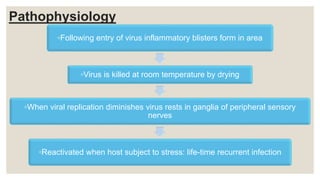
Pathophysiology
◦Following entry of virus inflammatory blisters form in area
◦Virus is killed at room temperature by drying
◦When viral replication diminishes virus rests in ganglia of peripheral sensory
nerves
◦Reactivated when host subject to stress: life-time recurrent infection
Complication
◦ Aseptic meningitis
◦ Lower neuron damage
◦ High risk of transmission in pregnancy
◦ High risk of transmission even when no symptoms
◦ Risk of vertical transmission to newborn
◦ Severe emotional stress from diagnosis
◦ Rarely extra-genital spread to buttocks, eyes, aseptic meningitis
◦ Increased risk of HIV infection and other sexually transmitted disease
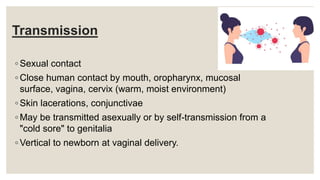
Transmission
◦ Sexual contact
◦ Close human contact by mouth, oropharynx, mucosal
surface, vagina, cervix (warm, moist environment)
◦ Skin lacerations, conjunctivae
◦ May be transmitted asexually or by self-transmission from a
"cold sore" to genitalia
◦ Vertical to newborn at vaginal delivery.
Medical Management
Blisters typically improve on their own, without medical treatment. But if you
experience severe or frequent outbreaks, a doctor or clinician can prescribe antiviral
medications. Antivirals can help reduce the number of episodes you experience and
ease the severity of your symptoms.
acyclovir
famciclovir
valacyclovir
foscarnet or cidofovir for HSV infections that resist other medications
◦ Antiviral medications can also help lower your chances of transmitting the virus
during an episode or shedding it when you don’t have symptoms.
◦ These medications generally come in the form of pills and creams.
◦ Injectables are also prescribed to treat severe symptoms.
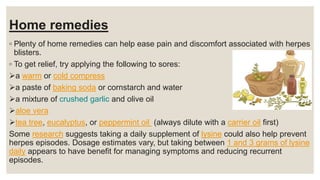
Home remedies
◦ Plenty of home remedies can help ease pain and discomfort associated with herpes
blisters.
◦ To get relief, try applying the following to sores:
a warm or cold compress
a paste of baking soda or cornstarch and water
a mixture of crushed garlic and olive oil
aloe vera
tea tree, eucalyptus, or peppermint oil (always dilute with a carrier oil first)
Some research suggests taking a daily supplement of lysine could also help prevent
herpes episodes. Dosage estimates vary, but taking between 1 and 3 grams of lysine
daily appears to have benefit for managing symptoms and reducing recurrent
episodes.
Potential complications
◦ Once you acquire HSV, the virus lives in your nerve cells permanently.
◦ It mostly remains dormant, but it can reactivate from time to time and cause
symptoms.
◦ For some people, certain triggers can lead to an episode, such as:
• stress
• menstrual periods
• fever or illness
• sun exposure or sunburn
Conti..
◦ While many people living with HSV only have one primary
episode, or none at all, others experience symptoms every few
months. You might have more episodes during your first year
living with HSV, but the frequency tends to decrease over time.
◦ Much of the time, HSV doesn’t pose a major cause for concern,
and symptoms will improve without medical treatment.
◦ That said, the virus can cause complications for certain groups
of people, including:
• newborns
• immunocompromised people
• people living with chronic health conditions, like cancer or HIV
◦ It’s also possible to develop herpes in the eyes. This condition,
known as herpes keratitis, can develop if you touch a herpes
sore and then touch your eye.
Conti..
◦ Symptoms of herpes keratitis include:
• eye pain and redness
• discharge or excess tears in the eye
• blurred vision
• sensitivity to light
• a gritty feeling in the eye
◦ If you’re living HSV and notice these symptoms, contact a doctor or eye
doctor as soon as possible. Prompt treatment can help prevent
complications, including corneal scarring and vision loss.
Living with HSV
◦ In general, HSV isn’t considered a serious health concern, though it is a
lifelong condition.
◦ Herpes blisters can cause some pain and discomfort, but home remedies
can help ease these symptoms and may help sores heal more quickly.
◦ Antiviral medication can also lower your chances of experiencing recurrent
episodes and reduce the risk of transmitting the virus to others.
◦ While HSV can’t be cured, many people living with the virus go years
without having an episode. In other words, the virus may not affect daily life
all that much.
◦ All the same, it’s essential to have a conversation about HSV with your
sexual partners before any sexual activity takes place. These tips can help
you start the conversation.
Conti..
◦ A few preventive steps can also help lower your chances of transmitting
HSV:
• Avoid sharing a razor or toothbrush.
• If you’re living with oral HSV, avoid oral sex and kissing from the time
you notice early symptoms until the sores have completely healed.
• If you’re living with genital HSV, avoid all skin-to-genital contact from the
time you notice early symptoms until the sores have completely healed.
• Wash your hands thoroughly after touching sores or applying medicine
to them.
• Apply medication with cotton swabs to reduce your contact with the
sores.
◦ Wondering what a recent diagnosis means for your sex life in the
future? Get more insight on dating with herpes here.
Nursing management
◦ Emotional support for distressing condition
◦ Health education related to transmission of
the virus
◦ Lifestyle, sexual behaviors, antiviral
medications
◦ Importance of hand-washing
◦ Advice about relief of symptoms:
Analgesics, good hygiene, Sitz baths,
loose clothing (avoid creams which prevent
drying of lesions)
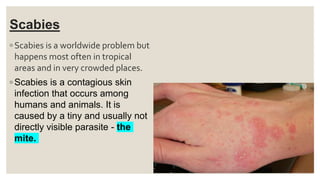
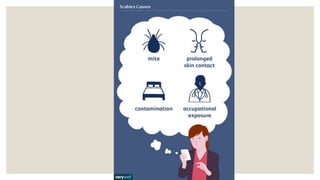
Scabies
◦ Scabies is a worldwide problem but
happens most often in tropical
areas and in very crowded places.
◦ Scabies is a contagious skin
infection that occurs among
humans and animals. It is
caused by a tiny and usually not
directly visible parasite - the
mite.
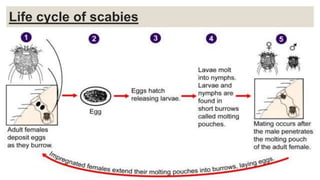
Causes
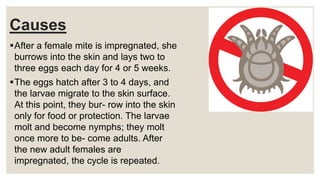
After a female mite is impregnated, she
burrows into the skin and lays two to
three eggs each day for 4 or 5 weeks.
The eggs hatch after 3 to 4 days, and
the larvae migrate to the skin surface.
At this point, they bur- row into the skin
only for food or protection. The larvae
molt and become nymphs; they molt
once more to be- come adults. After
the new adult females are
impregnated, the cycle is repeated.
Clinical manifestation
• Itching, often severe and usually worse at night
• Thin, irregular burrow tracks made up of tiny blisters or bumps
on your skin
◦ The burrows or tracks typically appear in folds of skin. Though
almost any part of the body may be involved, in adults and older
children scabies is most often found:
• Between the fingers
• In the armpits
• Around the waist
• Along the insides of the wrists
• On the inner elbows
• On the soles of the feet
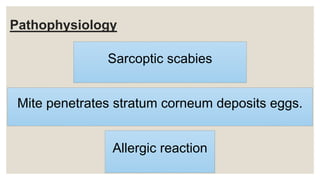
Pathophysiology
Sarcoptic scabies
Mite penetrates stratum corneum deposits eggs.
Allergic reaction
Mode of transmission
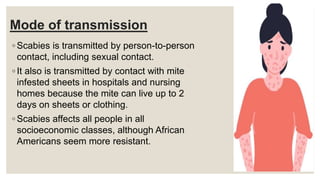
◦ Scabies is transmitted by person-to-person
contact, including sexual contact.
◦ It also is transmitted by contact with mite
infested sheets in hospitals and nursing
homes because the mite can live up to 2
days on sheets or clothing.
◦ Scabies affects all people in all
socioeconomic classes, although African
Americans seem more resistant.
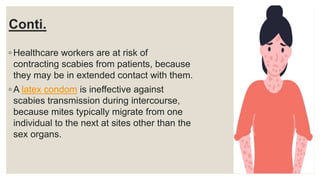
Conti.
◦ Healthcare workers are at risk of
contracting scabies from patients, because
they may be in extended contact with them.
◦ A latex condom is ineffective against
scabies transmission during intercourse,
because mites typically migrate from one
individual to the next at sites other than the
sex organs.
Life cycle of scabies
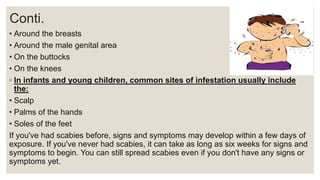
Conti.
• Around the breasts
• Around the male genital area
• On the buttocks
• On the knees
◦ In infants and young children, common sites of infestation usually include
the:
• Scalp
• Palms of the hands
• Soles of the feet
If you've had scabies before, signs and symptoms may develop within a few days of
exposure. If you've never had scabies, it can take as long as six weeks for signs and
symptoms to begin. You can still spread scabies even if you don't have any signs or
symptoms yet.
Diagnostic evaluation
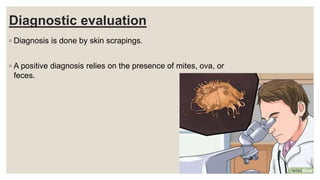
◦ Diagnosis is done by skin scrapings.
◦ A positive diagnosis relies on the presence of mites, ova, or
feces.
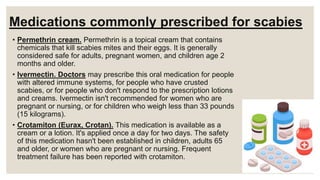
Medications commonly prescribed for scabies
• Permethrin cream. Permethrin is a topical cream that contains
chemicals that kill scabies mites and their eggs. It is generally
considered safe for adults, pregnant women, and children age 2
months and older.
• Ivermectin. Doctors may prescribe this oral medication for people
with altered immune systems, for people who have crusted
scabies, or for people who don't respond to the prescription lotions
and creams. Ivermectin isn't recommended for women who are
pregnant or nursing, or for children who weigh less than 33 pounds
(15 kilograms).
• Crotamiton (Eurax, Crotan). This medication is available as a
cream or a lotion. It's applied once a day for two days. The safety
of this medication hasn't been established in children, adults 65
and older, or women who are pregnant or nursing. Frequent
treatment failure has been reported with crotamiton.
Management
◦ The treatment is simple and curative. After bathing, permethrin,
malathion, or other effective mite-killing agents are applied over
the entire skin surface for 12 hours.
◦ Repeated applications may be recommended in certain cases,
but one treatment usually is sufficient.
◦ Care must be taken to ensure that close contacts are treated.
◦ Clothes and towels are disinfected with hot water and
detergent, or they can be isolated for 2 weeks.
◦ If symptoms persist after treatment, the patient should be
advised not to retreat the condition without consulting a health
care provider.
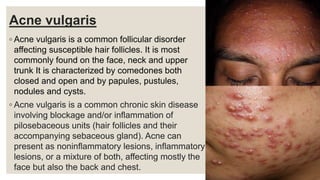
Acne vulgaris
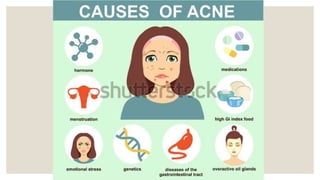
◦ Acne vulgaris is a common follicular disorder
affecting susceptible hair follicles. It is most
commonly found on the face, neck and upper
trunk It is characterized by comedones both
closed and open and by papules, pustules,
nodules and cysts.
◦ Acne vulgaris is a common chronic skin disease
involving blockage and/or inflammation of
pilosebaceous units (hair follicles and their
accompanying sebaceous gland). Acne can
present as noninflammatory lesions, inflammatory
lesions, or a mixture of both, affecting mostly the
face but also the back and chest.
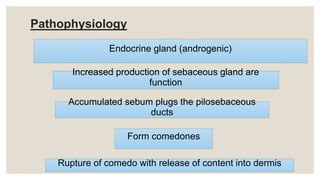
Pathophysiology
Endocrine gland (androgenic)
Accumulated sebum plugs the pilosebaceous
ducts
Increased production of sebaceous gland are
function
Form comedones
Rupture of comedo with release of content into dermis
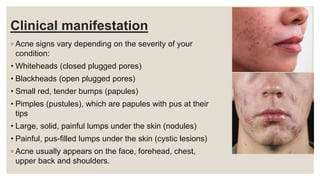
Clinical manifestation
◦ Acne signs vary depending on the severity of your
condition:
• Whiteheads (closed plugged pores)
• Blackheads (open plugged pores)
• Small red, tender bumps (papules)
• Pimples (pustules), which are papules with pus at their
tips
• Large, solid, painful lumps under the skin (nodules)
• Painful, pus-filled lumps under the skin (cystic lesions)
◦ Acne usually appears on the face, forehead, chest,
upper back and shoulders.
Complications
◦ People with darker skin types are more likely than
are people with lighter skin to experience these
acne complications:
• Scars. Pitted skin (acne scars) and thick scars
(keloids) can remain long-term after acne has
healed.
• Skin changes. After acne has cleared, the affected
skin may be darker (hyperpigmented) or lighter
(hypopigmented) than before the condition
occurred.
Risk factors
• Age. People of all ages can get acne, but it's most common in
teenagers.
• Hormonal changes. Such changes are common during
puberty or pregnancy.
• Family history. Genetics plays a role in acne. If both of your
parents had acne, you're likely to develop it too.
• Greasy or oily substances. You may develop acne where
your skin comes into contact with oil or oily lotions and creams.
• Friction or pressure on your skin. This can be caused by
items such as telephones, cellphones, helmets, tight collars
and backpacks.
Diagnostic evaluation
◦ History collection.
◦ Physical examination
◦ Biopsy
The goals of management
◦ To reduce bacterial colonies
◦ To decrease sebaceous gland activity
◦ To prevent the follicles from becoming plugged
◦ To reduce inflammation to combat secondary infection
◦ To minimize scarring
◦ To eliminate factors that predispose the person to acne
Medical management
◦ Nutritional hygiene therapy: elimination of specific food
such as, chocolate cola fried foods and milk products.
◦ Topical pharmacologic therapy: Benzoyl peroxide.
◦ Systemic antibiotics such as doxycycline.
◦ Oral isotretinoin (Accutane) to inhibit sebaceous gland
function and abnormal keratinization (16- to 20-week
course of isotretinoin limited to patients with severe
papulopustular or cystic acne not responding to
conventional therapy due to its severe adverse effects).
◦ Hormonal therapy: Estrogen therapy (including
progesterone estrogen preparation) suppress sebum
production.
Surgical management
◦ Comedo extraction: injection of corticosteroids into the
inflamed lesion and incision and drainage of lesions.
◦ Cryotherapy: freezing with liquid nitrogen may be
used for nodular cystic forms of acne.
◦ Comedones may be removed with a comedo
extractor. The site is first cleaned with alcohol. The
opening of the extractor is then placed over the
lesion, and direct pressure is applied to cause
extrusion of the plug through the extractor. Removal
of comedones leads to erythema, which may take
several weeks to subside. Recurrence of
comedones after extraction is common.
Nursing Management Nursing
Care of patients with acne consists largely of monitoring and
managing potential complications of skin treatments. Major nursing
activities include
◦ Patient education
◦ Proper skin care techniques
◦ Managing potential problems related to the skin disorder or
therapy.
◦ Providing positive reassurance
Complications of acne
◦ Acne conglobate.
◦ Scarring (when acne is severe).
◦ Impaired self-esteem (mostly adolescents afflicted).
Psoriasis
◦ Considered one of the most common skin diseases, psoriasis affects
approximately 2% of the population, appearing more often in people of
European ancestry.
◦ It is thought that this chronic disease stems from a hereditary defect that
causes over production of keratin.
◦ Onset may occur at any age, but psoriasis is most common in people
between 15 and 35 years of age.
◦ Psoriasis has a tendency to improve and then recur periodically throughout
life (Porth & Matlin, 2009)
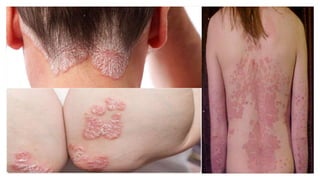
◦ Psoriasis is a chronic skin disorder characterized by excessive proliferation
of keratinocytes, resulting in the formation of thickened scaly plaques, itching,
and inflammatory changes of the epidermis and dermis. The various forms of
psoriasis include guttate, pustular, and arthritis variants.
Causes
◦ Genetically determined tendency to develop
psoriasis.
◦ Possible immune disorder, as shown by in the HLA
type in families.
◦ Environmental factors.
◦ Isomorphic effect or Koebner's phenomenon, in
which lesions develop at sites of injury due to
trauma.
◦ Flare-Up of guttate (drop-shaped) lesions due to
infections, especially beta-hemolytic streptococci.
Pathophysiology
Etiologic factors
The skin in the patches of psoriasis is growing much faster than
normal skin.
Rapid production of cells which does not allow the cells to manufacture a keratin that gives its
hard surface
Flaking and patches of skin
Clinical manifestation
• A patchy rash that varies widely in how it looks from person to person, ranging from
spots of dandruff-like scaling to major eruptions over much of the body
• Rashes that vary in color, tending to be shades of purple with gray scale on brown
or Black skin and pink or red with silver scale on white skin
• Small scaling spots (commonly seen in children)
• Dry, cracked skin that may bleed
• Itching, burning or soreness
• Cyclic rashes that flare for a few weeks or months and then subside.
Types of psoriasis
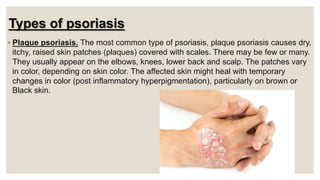
◦ Plaque psoriasis. The most common type of psoriasis, plaque psoriasis causes dry,
itchy, raised skin patches (plaques) covered with scales. There may be few or many.
They usually appear on the elbows, knees, lower back and scalp. The patches vary
in color, depending on skin color. The affected skin might heal with temporary
changes in color (post inflammatory hyperpigmentation), particularly on brown or
Black skin.
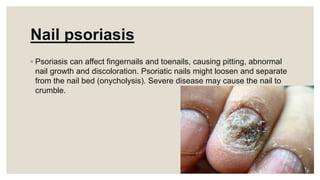
Nail psoriasis
◦ Psoriasis can affect fingernails and toenails, causing pitting, abnormal
nail growth and discoloration. Psoriatic nails might loosen and separate
from the nail bed (onycholysis). Severe disease may cause the nail to
crumble.
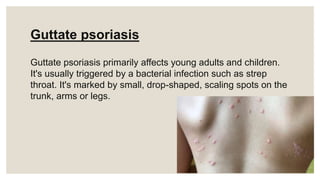
Guttate psoriasis
Guttate psoriasis primarily affects young adults and children.
It's usually triggered by a bacterial infection such as strep
throat. It's marked by small, drop-shaped, scaling spots on the
trunk, arms or legs.
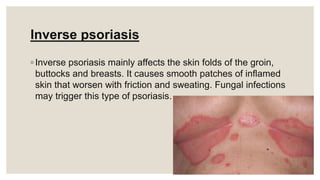
Inverse psoriasis
◦ Inverse psoriasis mainly affects the skin folds of the groin,
buttocks and breasts. It causes smooth patches of inflamed
skin that worsen with friction and sweating. Fungal infections
may trigger this type of psoriasis.
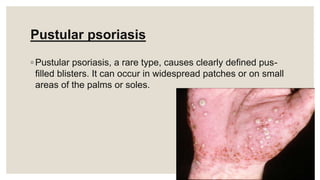
Pustular psoriasis
◦ Pustular psoriasis, a rare type, causes clearly defined pus-
filled blisters. It can occur in widespread patches or on small
areas of the palms or soles.
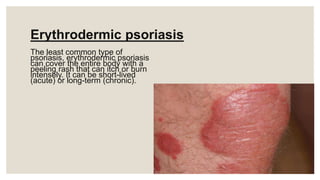
Erythrodermic psoriasis
The least common type of
psoriasis, erythrodermic psoriasis
can cover the entire body with a
peeling rash that can itch or burn
intensely. It can be short-lived
(acute) or long-term (chronic).
Diagnostic evaluation
◦ Patient history
◦ appearance of the lesions
◦ skin biopsy
◦ Serum uric acid level (usually elevated in severe cases due
to accelerated nucleic acid degradation)
◦ but without indications of gout HLA-Cw6, -B13, and -Bw57
(may be present in early-on set familial psoriasis).
Treatment
◦ Psoriasis treatments aim to stop skin cells from growing
so quickly and to remove scales.
◦ Options include creams and ointments (topical therapy),
light therapy (phototherapy), and oral or injected
medications.
◦ Whatever treatments you use depends on how severe the
psoriasis is and how responsive it has been to previous
treatment and self-care measures.
◦ You might need to try different drugs or a combination of
treatments before you find an approach that works.
Topical therapy
Corticosteroids
 These drugs are the most frequently prescribed medications for
treating mild to moderate psoriasis.
 They are available as oils, ointments, creams, lotions, gels, foams,
sprays and shampoos.
 Mild corticosteroid ointments (hydrocortisone) are usually
recommended for sensitive areas, such as the face or skin folds,
and for treating widespread patches.
 Topical corticosteroids might be applied once a day during flares,
and on alternate days or weekends during remission.
◦ Your health care provider may prescribe a stronger
corticosteroid cream or ointment — triamcinolone (Trianex) or
clobetasol (Cormax, Temovate, others) — for smaller, less-
sensitive or tougher-to-treat areas.
◦ Long-term use or overuse of strong corticosteroids can thin the
skin. Over time, topical corticosteroids may stop working.
Vitamin D analogues
◦ Synthetic forms of vitamin D such as calcipotriene (Dovonex,
Sorilux) and calcitriol (Vectical) slow skin cell growth.
◦ This type of drug may be used alone or with topical
corticosteroids.
◦ Calcitriol may cause less irritation in sensitive areas.
◦ Calcipotriene and calcitriol are usually more expensive than
topical corticosteroids.
Retinoids
◦ Tazarotene (Tazorac, Avage, others) is available as a gel or cream. It's
applied once or twice daily. The most common side effects are skin
irritation and increased sensitivity to light.
◦ Tazarotene isn't recommended when you're pregnant or breastfeeding
or if you intend to become pregnant.
Calcineurin inhibitors
Calcineurin inhibitors — such as tacrolimus (Protopic) and
pimecrolimus (Elidel) — calm the rash and reduce scaly
buildup. They can be especially helpful in areas of thin skin,
such as around the eyes, where steroid creams or retinoids are
irritating or harmful.
◦ Calcineurin inhibitors aren't recommended when you're
pregnant or breastfeeding or if you intend to become pregnant.
This drug is also not intended for long-term use because of a
potential increased risk of skin cancer and lymphoma.
Salicylic acid
◦ Salicylic acid shampoos and scalp solutions
reduce the scaling of scalp psoriasis. They are
available in nonprescription or prescription
strengths. This type of product may be used
alone or with other topical therapy, as it prepares
the scalp to absorb the medication more easily.
Coal tar
 Coal tar reduces scaling, itching and
inflammation. It's available in nonprescription
and prescription strengths. It comes in
various forms, such as shampoo, cream and
oil. These products can irritate the skin.
They're also messy, stain clothing and
bedding, and can have a strong odor.
 Coal tar treatment isn't recommended when
you're pregnant or breastfeeding.
Anthralin
◦ Anthralin is a tar cream that slows skin cell growth. It can also
remove scales and make skin smoother. It's not intended for use
on the face or genitals. Anthralin can irritate skin, and it stains
almost anything it touches. It's usually applied for a short time and
then washed off.
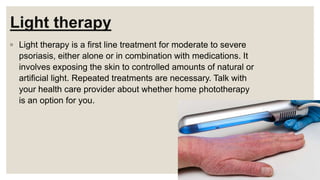
Light therapy
◦ Light therapy is a first line treatment for moderate to severe
psoriasis, either alone or in combination with medications. It
involves exposing the skin to controlled amounts of natural or
artificial light. Repeated treatments are necessary. Talk with
your health care provider about whether home phototherapy
is an option for you.
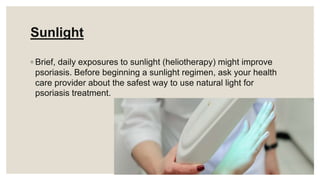
Sunlight
◦ Brief, daily exposures to sunlight (heliotherapy) might improve
psoriasis. Before beginning a sunlight regimen, ask your health
care provider about the safest way to use natural light for
psoriasis treatment.
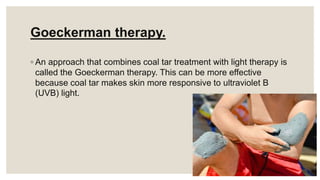
Goeckerman therapy.
◦ An approach that combines coal tar treatment with light therapy is
called the Goeckerman therapy. This can be more effective
because coal tar makes skin more responsive to ultraviolet B
(UVB) light.
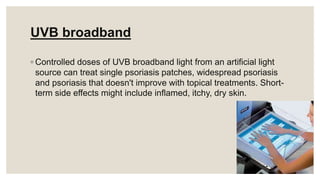
UVB broadband
◦ Controlled doses of UVB broadband light from an artificial light
source can treat single psoriasis patches, widespread psoriasis
and psoriasis that doesn't improve with topical treatments. Short-
term side effects might include inflamed, itchy, dry skin.
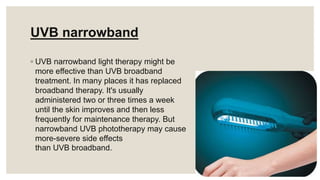
UVB narrowband
◦ UVB narrowband light therapy might be
more effective than UVB broadband
treatment. In many places it has replaced
broadband therapy. It's usually
administered two or three times a week
until the skin improves and then less
frequently for maintenance therapy. But
narrowband UVB phototherapy may cause
more-severe side effects
than UVB broadband.
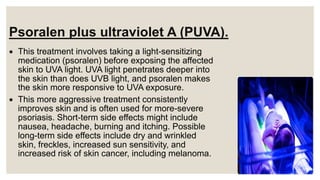
Psoralen plus ultraviolet A (PUVA).
 This treatment involves taking a light-sensitizing
medication (psoralen) before exposing the affected
skin to UVA light. UVA light penetrates deeper into
the skin than does UVB light, and psoralen makes
the skin more responsive to UVA exposure.
 This more aggressive treatment consistently
improves skin and is often used for more-severe
psoriasis. Short-term side effects might include
nausea, headache, burning and itching. Possible
long-term side effects include dry and wrinkled
skin, freckles, increased sun sensitivity, and
increased risk of skin cancer, including melanoma.
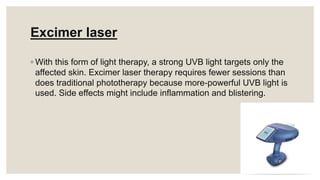
Excimer laser
◦ With this form of light therapy, a strong UVB light targets only the
affected skin. Excimer laser therapy requires fewer sessions than
does traditional phototherapy because more-powerful UVB light is
used. Side effects might include inflammation and blistering.
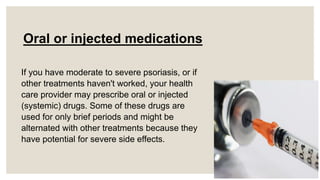
Oral or injected medications
If you have moderate to severe psoriasis, or if
other treatments haven't worked, your health
care provider may prescribe oral or injected
(systemic) drugs. Some of these drugs are
used for only brief periods and might be
alternated with other treatments because they
have potential for severe side effects.
Steroids
 If you have a few small, persistent psoriasis
patches, your health care provider might
suggest an injection of triamcinolone right into
them.
Retinoids
◦ Acitretin and other retinoids are pills
used to reduce the production of skin
cells. Side effects might include dry
skin and muscle soreness. These
drugs are not recommended when
you're pregnant or breastfeeding or if
you intend to become pregnant.
Biologics
◦ These drugs, usually administered by injection, alter the immune system
in a way that disrupts the disease cycle and improves symptoms and
signs of disease within weeks. Several of these drugs are approved for
the treatment of moderate to severe psoriasis in people who haven't
responded to first line therapies.
◦ Options include apremilast (Otezla), etanercept (Enbrel), infliximab
(Remicade), adalimumab (Humira), ustekinumab (Stelara), secukinumab
(Cosentyx), ixekizumab (Taltz), guselkumab (Tremfya), tildrakizumab
(Ilumya) and certolizumab (Cimzia).
◦ Three of them — etanercept, ixekizumab and ustekinumab — are
approved for children. These types of drugs are expensive and may or
may not be covered by health insurance plans.
◦ Biologics must be used with caution because they carry the risk of
suppressing the immune system in ways that increase the risk of serious
infections. People taking these treatments must be screened for
tuberculosis.
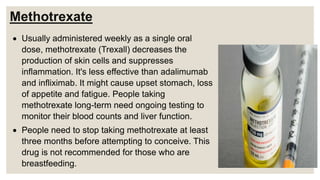
Methotrexate
 Usually administered weekly as a single oral
dose, methotrexate (Trexall) decreases the
production of skin cells and suppresses
inflammation. It's less effective than adalimumab
and infliximab. It might cause upset stomach, loss
of appetite and fatigue. People taking
methotrexate long-term need ongoing testing to
monitor their blood counts and liver function.
 People need to stop taking methotrexate at least
three months before attempting to conceive. This
drug is not recommended for those who are
breastfeeding.
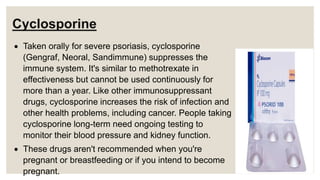
Cyclosporine
 Taken orally for severe psoriasis, cyclosporine
(Gengraf, Neoral, Sandimmune) suppresses the
immune system. It's similar to methotrexate in
effectiveness but cannot be used continuously for
more than a year. Like other immunosuppressant
drugs, cyclosporine increases the risk of infection and
other health problems, including cancer. People taking
cyclosporine long-term need ongoing testing to
monitor their blood pressure and kidney function.
 These drugs aren't recommended when you're
pregnant or breastfeeding or if you intend to become
pregnant.
Other medications
◦ Thioguanine (Tabloid) and hydroxyurea (Droxia, Hydrea) are
medications that can be used when you can't take other drugs.
Talk with your health care provider about possible side effects of
these drugs.
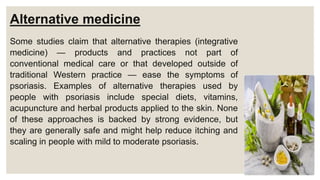
Alternative medicine
Some studies claim that alternative therapies (integrative
medicine) — products and practices not part of
conventional medical care or that developed outside of
traditional Western practice — ease the symptoms of
psoriasis. Examples of alternative therapies used by
people with psoriasis include special diets, vitamins,
acupuncture and herbal products applied to the skin. None
of these approaches is backed by strong evidence, but
they are generally safe and might help reduce itching and
scaling in people with mild to moderate psoriasis.
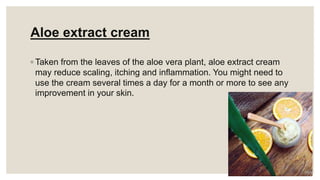
Aloe extract cream
◦ Taken from the leaves of the aloe vera plant, aloe extract cream
may reduce scaling, itching and inflammation. You might need to
use the cream several times a day for a month or more to see any
improvement in your skin.
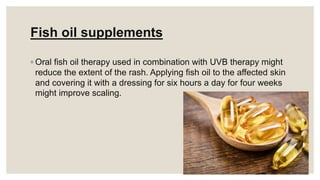
Fish oil supplements
◦ Oral fish oil therapy used in combination with UVB therapy might
reduce the extent of the rash. Applying fish oil to the affected skin
and covering it with a dressing for six hours a day for four weeks
might improve scaling.
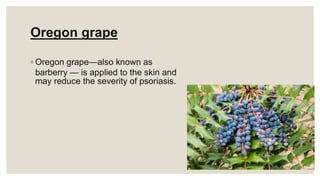
Oregon grape
◦ Oregon grape—also known as
barberry — is applied to the skin and
may reduce the severity of psoriasis.
Lifestyle and home remedies
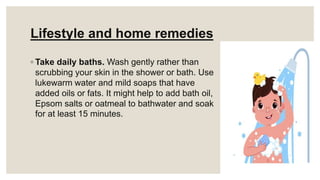
◦ Take daily baths. Wash gently rather than
scrubbing your skin in the shower or bath. Use
lukewarm water and mild soaps that have
added oils or fats. It might help to add bath oil,
Epsom salts or oatmeal to bathwater and soak
for at least 15 minutes.
Keep your skin moist
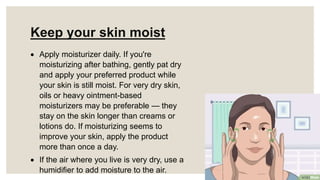
 Apply moisturizer daily. If you're
moisturizing after bathing, gently pat dry
and apply your preferred product while
your skin is still moist. For very dry skin,
oils or heavy ointment-based
moisturizers may be preferable — they
stay on the skin longer than creams or
lotions do. If moisturizing seems to
improve your skin, apply the product
more than once a day.
 If the air where you live is very dry, use a
humidifier to add moisture to the air.
Cover the affected areas overnight
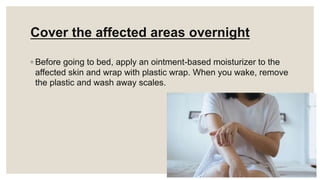
◦ Before going to bed, apply an ointment-based moisturizer to the
affected skin and wrap with plastic wrap. When you wake, remove
the plastic and wash away scales.
Expose your skin to small amounts of sunlight
◦ Ask your health care provider about the best way to use natural sunlight to
treat your skin. A controlled amount of sunlight can improve psoriasis, but
too much sun can trigger or worsen outbreaks and increase the risk of skin
cancer. Log your time in the sun, and protect skin that isn't affected by
psoriasis with a hat, clothing or sunscreen with a sun protection factor (SPF)
of at least 30.
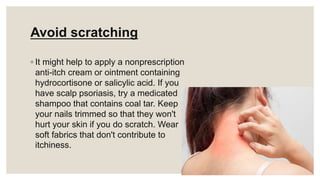
Avoid scratching
◦ It might help to apply a nonprescription
anti-itch cream or ointment containing
hydrocortisone or salicylic acid. If you
have scalp psoriasis, try a medicated
shampoo that contains coal tar. Keep
your nails trimmed so that they won't
hurt your skin if you do scratch. Wear
soft fabrics that don't contribute to
itchiness.
Avoid psoriasis triggers
◦ Notice what triggers your psoriasis, and take
steps to prevent or avoid it. Infections,
injuries to your skin, smoking and intense
sun exposure can all worsen psoriasis.
Stay cool
◦ Being too hot can make your skin feel
itchy. Wear light clothing if you're
outside on hot days. If you have air
conditioning, use it on hot days to
keep cool. Keep cold packs in your
freezer and apply them to itchy spots
for a few minutes of relief. You might
try storing your moisturizing lotion in
the refrigerator to add a cooling effect
when you apply it.
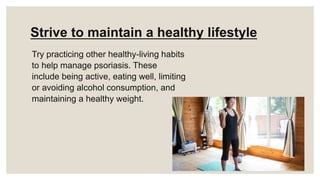
Strive to maintain a healthy lifestyle
Try practicing other healthy-living habits
to help manage psoriasis. These
include being active, eating well, limiting
or avoiding alcohol consumption, and
maintaining a healthy weight.
Complications
Possible complications of psoriasis include:
◦ Spread to fingernails, producing small indentations or pits and yellow or
brown discoloration (about 60% of patients).
◦ Accumulation of thick, crumbly debris under the nail, causingit to separate
from the nailbed (onycholysis).
Rarely, psoriasis becomes pustular, taking
one of two forms:
◦ Localized pustular psoriasis, with pustules on the
palms and soles that remain sterile until opened.
◦ Generalized pustular (Von Zumbusch) psoriasis,
often occurring with fever, leukocytosis, and
malaise, with groups of pustules coalescing to
form lakes of pus on red skin (also remain sterile
until opened), commonly involving the tongue and
oral mucosa.
◦ Arthritic symptoms, usually in one or more joints
of the fingers or toes, the larger joints, or
sometimes the sacroiliac joints, which may
progress to spondylitis, and morning stiffness
(some patients).
Nursing Management
1.Administer prescribed medications, which may include coal tar therapy, and
topical corticosteroids.
2.Discuss and assist with the administration of additional medical treatments,
which may include coal tar shampoos, intralesional therapy (i.e. injection of
medication directly into lesion), systemic cytotoxic medication,
photochemotherapy, occlusive dressing.
3.Enhance skin integrity
4.Prevent infection.
5. Provide client and family teaching.
◦ Advise the client receiving systemic cytotoxic (e.g.
methotrexate) therapy, which inhibits deoxyribonucleic
acid synthesis in epidermal cells to speed the
replacement of psoriatic cells, to continue taking the
medication even if nausea and vomiting occur, to
increase fluid intake to prevent nephrotoxicity, and to
avoid alcoholic beverages.
◦ Instruct the client to avoid sun exposure during
photochemotherapy. This regimen of phototherapy
with ultraviolet A (PUVA) light decreases cellular
proliferation. PUVA therapy results in photosensitivity
and the client should avoid exposure to sunlight during
this time.
◦ Be knowledgeable about treatment, and give the client
written instructions.
Skin tumors
◦ There has been an alarming increase in skin cancers over the past several
decades.
◦ Since the 1970s, the incidence rate of malignant melanoma, the most
serious form of skin cancer, has increased significantly, on average 6% per
year, from 1973 until the early 1980s. Since 1981, the rate has slowed to
roughly 3% per year.
◦ In 2003, there were approximately 54,200 new cases and 7,600 deaths from
melanoma.
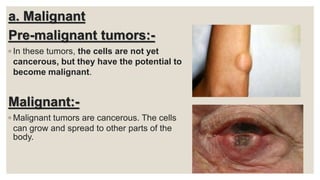
◦ Skin cancers are cancers that arise from the skin.
◦ They are due to the development of abnormal cells that have the ability
to invade or spread to other parts of the body.
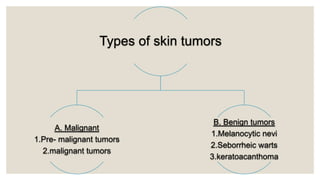
◦ There are three main types of skin cancers:
basal-cell skin cancer (BCC),
squamous-cell skin cancer (SCC)
Melanoma
Basal-cell skin cancer (BCC)
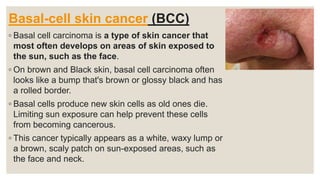
◦ Basal cell carcinoma is a type of skin cancer that
most often develops on areas of skin exposed to
the sun, such as the face.
◦ On brown and Black skin, basal cell carcinoma often
looks like a bump that's brown or glossy black and has
a rolled border.
◦ Basal cells produce new skin cells as old ones die.
Limiting sun exposure can help prevent these cells
from becoming cancerous.
◦ This cancer typically appears as a white, waxy lump or
a brown, scaly patch on sun-exposed areas, such as
the face and neck.
Clinical manifestation
• Lumps or nodules on the skin that look shiny or
that have visible blood vessels.The lumps can
get bigger over time.
• Areas on the skin that look like scars
• Itchy patches
• Areas of red or patchy skin that look like
eczema
• Sores that look crusty, have a depression in the
middle, or bleed often
Cause
• Exposure to the ultraviolet rays in sunlight is a
main cause.
• BCC is often found on the areas of the body
reached by the sun, such as the face, hands and
neck.
• Exposure to radiation and/or arsenic may also be
a cause.
• It is possible that you might inherit a tendency for
basal cell carcinomas.
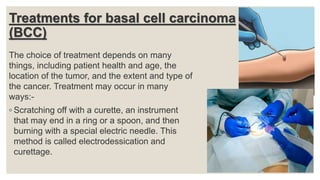
Treatments for basal cell carcinoma
(BCC)
The choice of treatment depends on many
things, including patient health and age, the
location of the tumor, and the extent and type of
the cancer. Treatment may occur in many
ways:-
◦ Scratching off with a curette, an instrument
that may end in a ring or a spoon, and then
burning with a special electric needle. This
method is called electrodessication and
curettage.
Surgical management
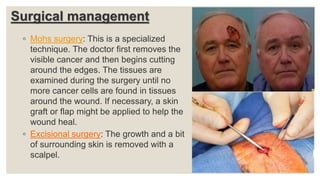
◦ Mohs surgery: This is a specialized
technique. The doctor first removes the
visible cancer and then begins cutting
around the edges. The tissues are
examined during the surgery until no
more cancer cells are found in tissues
around the wound. If necessary, a skin
graft or flap might be applied to help the
wound heal.
◦ Excisional surgery: The growth and a bit
of surrounding skin is removed with a
scalpel.
Other management
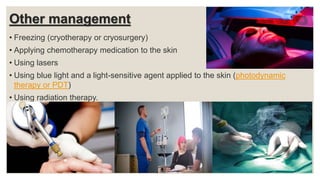
• Freezing (cryotherapy or cryosurgery)
• Applying chemotherapy medication to the skin
• Using lasers
• Using blue light and a light-sensitive agent applied to the skin (photodynamic
therapy or PDT)
• Using radiation therapy.
If the BCC has advanced locally or spread (metastasized) to another location,
which is very rare for BCC, the FDA has approved two medicines:
◦ vismodegib (Eviredge™)
◦ sonidegib (Odomzo®).
These drugs are of a class called hedgehog inhibitors.
Prevention of basal cell carcinoma (BCC)
• Avoid being in the sun from 10 am to 4 pm.
• Avoid tanning beds.
• Use a broad spectrum sunscreen with an SPF of 15 or higher each day. If you will
be outside for longer periods of time, use a broad spectrum sunscreen that is
water-resistant and has an SPF of 30 or higher.
• Put the sunscreen on 30 minutes before going outside. Put sunscreen on again
every two hours, or more frequently if you have been swimming or sweating a lot.
• Use protective clothing that has built-in sun protection, which is measured in UPF.
Also, use broad-brimmed hats and sunglasses.
• Do your own skin self-exam about once per month and see a dermatologist about
one time per year for a professional skin exam.
• Have any skin changes examined as soon as possible by a healthcare provider.
Complications
Complications of basal cell carcinoma can
include:
• A risk of recurrence. Basal cell carcinomas
commonly recur, even after successful
treatment.
• An increased risk of other types of skin
cancer. A history of basal cell carcinoma may
also increase the chance of developing other
types of skin cancer, such as squamous cell
carcinoma.
• Cancer that spreads beyond the skin. Very
rarely, basal cell carcinoma can spread
(metastasize) to nearby lymph nodes and other
areas of the body, such as the bones and lungs.
Nursing management:-
◦ Teach patients that sunscreens are rated in strength from 4 (weakest) to 50
(strongest). The solar protection factor, or SPF, indicates how much longer a
person can stay in the sun before the skin begins to redden. For example, if
the person can normally stay in the sun for 10 minutes before reddening
begins, an SPF of 4 will protect the person from reddening for about 40
minutes.
◦ Remind patients that up to 50% of ultraviolet rays can penetrate loosely
woven clothing.
◦ Remind patients that ultraviolet light can penetrate cloud cover, and a
sunburn can still occur.
Conti.
◦ Reapply water-resistant sunscreens after swimming, if heavily sweating,
and every 2 to 3 hours during prolonged periods of sun exposure.
◦ Avoid applying oils before or during sun exposure (oils do not protect
against sunlight or sun damage).
◦ Use a lip balm that contains a sunscreen with an SPF of 15 or higher.
◦ Wear protective clothing, such as a broad-brimmed hat and long sleeves.
◦ Avoid using sun lamps for indoor tanning, and avoid commercial tanning
booths
Conti.
◦ Teach children to avoid all but modest sun exposure and to use a sunscreen
regularly for lifelong protection.
◦ Advise patients to Avoid tanning if their skin burns easily, never tans, or tans
poorly.
◦ Avoid unnecessary exposure to the sun, especially during the time of day
when ultraviolet radiation (sunlight) is most intense (10 AM to 3 PM).
◦ Avoid sunburns, Apply a sunscreen daily to block harmful sun rays.
◦ Use a sunscreen with an SPF of 15 or higher that protects against both
ultraviolet-A (UVA) and ultraviolet-B (UVB) light.
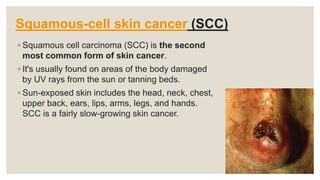
Squamous-cell skin cancer (SCC)
◦ Squamous cell carcinoma (SCC) is the second
most common form of skin cancer.
◦ It's usually found on areas of the body damaged
by UV rays from the sun or tanning beds.
◦ Sun-exposed skin includes the head, neck, chest,
upper back, ears, lips, arms, legs, and hands.
SCC is a fairly slow-growing skin cancer.
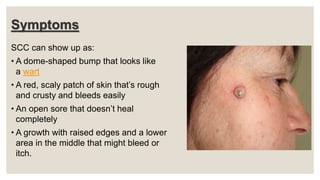
Symptoms
SCC can show up as:
• A dome-shaped bump that looks like
a wart
• A red, scaly patch of skin that’s rough
and crusty and bleeds easily
• An open sore that doesn’t heal
completely
• A growth with raised edges and a lower
area in the middle that might bleed or
itch.
Cause
◦ Exposure to ultraviolet (UV) rays, like the ones from the sun or a tanning
bed, affects the cells in the middle and outer layers of your skin and can
cause them to make too many cells and not die off as they should.
◦ This can lead to out-of-control growth of these cells, which can lead to
squamous cell carcinoma.
◦ Other things can contribute to this kind of overgrowth, too, like
conditions that affect your immune system.
Squamous Cell Carcinoma Risk
Factors
• Older age
• Fair-skinned
• Blue, green, or gray eyes
• Blonde or red hair
• Spend time outside, exposed to the sun's UV Rays
• History of sunburns, precancerous spots on your skin, or skin cancer
• Tanning beds and bulbs
• Long-term exposure to chemicals such as arsenic in the water
• Bowen’s disease, HPV, HIV, or AIDS
• Exposed to radiation
• Inherited DNA condition
• Weakened immune system
Treatment
◦ Squamous cell carcinoma can usually be treated with minor surgery that can
be done in a doctor’s office or hospital clinic.
◦ Depending on the size and location of the SCC, your doctor may choose
different techniques to remove it.
◦ For small skin cancers:
• Curettage and electrodessication (C and E): removing the top layer of the
skin cancer then using an electronic needle to kill cancer cells
• Laser therapy: an intense light destroys the growth
• Photodynamic therapy: a photosensitizing solution applied to your skin
then activated with a light or daylight, or sometimes with intense pulsed light
• Cryosurgery: freezing of the spot using liquid nitrogen.
For larger skin cancers:
• Excision: cutting out the cancer spot and some healthy
skin around it, then stitching up the wound
• Mohs surgery: excision and then inspecting the excised skin
using a microscope; this requires stitching up the wound
• Superficial radiation therapy
For cancers that spread beyond your skin
• Lymph node surgery: remove a piece of the lymph node;
uses general anesthesia
• Topical chemotherapy : a gel or cream applied to the skin,
sometimes with micro needling
• Targeted drug treatment
• Ablative and non ablative lasers, or chemical peels
Nursing Management
◦ Promoting Home and Community-Based Care
Teaching Patients Self-Care
i. The wound is usually covered with a dressing to protect the site from
physical trauma, external irritants, and contaminants.
ii. The patient is advised when to report for a dressing change or is
given written and verbal information on how to change dressings,
including the type of dressing to purchase, how to remove dressings
and apply fresh ones, and the importance of hand hygiene before
and after the procedure.
iii. The patient is advised to watch for excessive bleeding and tight
dressings that compromise circulation.
iv. If the lesion is in the perioral area, the patient is instructed to drink
liquids through a straw and limit talking and facial movement.
v. Dental work should be avoided until the area is completely heal
Conti..
◦ After the sutures are removed, an emollient cream may be used to help reduce
dryness.
◦ Applying a sunscreen over the wound is advised to prevent postoperative
hyperpigmentation if the patient spends time outdoors.
◦ Follow-up examinations should be at regular intervals, usually every 3 months for a
year, and should include palpation of the adjacent lymph nodes.
◦ The patient should also be instructed to seek treatment for any moles that are
subject to repeated friction and irritation and to watch for indications of potential
malignancy in moles as described previously.
◦ The importance of lifelong follow-up evaluations is emphasized.
Teaching About Prevention
◦ Studies show that regular daily use of a sunscreen with a sun protection factor (SPF)
of at least 15 can reduce the recurrence of skin cancer by as much as 40%.
◦ The sunscreen should be applied to head, neck, arms, and hands every morning at
least 30 minutes before leaving the house and reapplied every 4 hours if the skin
perspires.
◦ Intermittent application of sunscreen only when exposure is anticipated has been
shown to be less effective than daily use.
◦ Research has shown that daily use of sunscreen on the hands and face reduces the
total incidence of solar keratoses (Barclay, 2007), which are precursors of SCC, but
has no effect on the overall incidence of BCC.
Conti.
◦ These data are inconsistent, but one theory is that people have a
false sense of security when wearing sunscreen and tend to stay
out in the sun for longer periods.
◦ This longer exposure is believed to contribute to the increasing
incidence of melanoma.
◦ Although the evidence is insufficient, nurses should discuss the
issues with patients who are at high risk of skin cancer.
Melanoma
◦ Melanoma is a form of skin cancer that
begins in the cells (melanocytes) that
control the pigment in your skin.
◦ This illustration shows melanoma cells
extending from the surface of the skin
into the deeper skin layers.
Signs of melanoma
◦ Early signs of melanoma are summarized by the mnemonic "ABCDEF":-
• Asymmetry
• Borders (irregular with edges and corners)
• Color (variegated)
• Diameter (greater than 6 mm (0.24 in), about the size of a pencil eraser)
• Evolving over time
◦ This classification does not apply to nodular melanoma, which has its own
classifications:
• Elevated above the skin surface
• Firm to the touch
• Growing
Cause
◦ UV radiation
◦ Genetics
Risk factors
• Fair skin.
•A history of sunburn.
•Excessive ultraviolet (UV) light exposure.
•Living closer to the equator or at a higher elevation.
•Having many moles or unusual moles.
•A family history of melanoma.
•Weakened immune system.
Treatment
• Surgery to remove affected lymph nodes.
• Immunotherapy.
• Targeted therapy.
• Radiation therapy.
• Chemotherapy.
Types of skin tumors
A. Malignant
1.Pre- malignant tumors
2.malignant tumors
B. Benign tumors
1.Melanocytic nevi
2.Seborrheic warts
3.keratoacanthoma
a. Malignant
Pre-malignant tumors:-
◦ In these tumors, the cells are not yet
cancerous, but they have the potential to
become malignant.
Malignant:-
◦ Malignant tumors are cancerous. The cells
can grow and spread to other parts of the
body.
b. Benign tumors
Melanocytic nevi
◦ Melanocytic nevi are benign neoplasms or hamartomas composed of
melanocytes, the pigment-producing cells that constitutively colonize the
epidermis are benign neoplasms or hamartomas composed of melanocytes,
the pigment-producing cells that constitutively colonize the epidermis.
Seborrheic warts
◦ A non-cancerous skin condition that appears as a waxy brown, black or tan
growth.
◦ A seborrheic keratosis is one of the most common non-cancerous skin
growths in older adults.
◦ While it's possible for one to appear on its own, multiple growths are more
common.
◦ Seborrheic keratosis often appears on the face, chest, shoulders or back. It
has a waxy, scaly, slightly elevated appearance.
Keratoacanthoma
◦ Keratoacanthoma (KA) is a low-grade, rapidly growing, 1 to 2 cm
dome-shaped skin tumor with a centralized keratinous plug.
◦ Over the past hundred years, this tumor has been reclassified and
reported differently throughout literature.
◦ Before 1917, keratoacanthoma were regarded as skin cancer.
Alopecia
◦ Alopecia areata: Alopecia is the medical
term for bald. Areata means patchy.
◦ Hair loss (alopecia) can affect just your
scalp or your entire body, and it can be
temporary or permanent. It can be the result
of heredity, hormonal changes, medical
conditions or a normal part of aging. Anyone
can lose hair on their head, but it's more
common in men.
◦ Alopecia areata is an autoimmune disorder
that causes your hair to come out, often in
clumps the size and shape of a quarter.
Types
Tinea capitis
Alopecia
areata
Androgenetic
alopecia
1. Tinea capitis
Etiology
◦ Fungal scalp infection; Anthropophilic, fungal infection such as microspore,
audouinli.
◦ From pet animal such as dog and cat
Management
◦ Oral terbinafine
◦ Antifungal shampoo
◦ Arachis oil
◦ Application of kerions
◦ Anti fungal therapy
◦ Oral steroids
2. Alopecia areata
Etiology
◦ Due to autoimmune disease
◦ Down's syndrome
Clinical manifestation
◦ Condition may affect the eyebrows, eyelashes
and beard
◦ Hair loss usually spontaneously in small bald
patches
◦ Alopecia totalis - complete loss of hair
Management
Alopecia areata cannot be cured; however, it can be treated and the hair
can grow back.
◦ In many cases, alopecia is treated with drugs that are used for other
conditions. Treatment options for alopecia areata include:
• Corticosteroids: anti-inflammatory drugs that are prescribed for
autoimmune diseases. Corticosteroids can be given as an injection
into the scalp or other areas, orally (as a pill), or applied topically
(rubbed into the skin) as an ointment, cream, or foam. Response to
therapy may be gradual.
Conti..
• Rogaine (minoxidil): this topical drug is already used as a
treatment for pattern baldness. It usually takes about 12 weeks of
treatment with Rogaine before hair begins to grow.
◦ Other drugs that are used for alopecia with varying degrees of
effectiveness include medications used to treat psoriasis and
topical sensitizers (drugs that are applied to the skin and cause an
allergic reaction that can cause hair growth).
3. Androgenic alopecia
◦ It is most common pattern baldness in
male in physiological in men over 20 year
old
◦ Rarely in female.
◦ Bi-temporal recession and then crown
involvement.
Diagnostic evaluation
◦ Complete blood count.
◦ LFT, thyroid function test.
◦ Scalp biopsy.
◦ Treponema pallidum hemagglutination
Medical Management
◦ Alopecia areata: intra lesioned steroid and 0.2ml triamcinolone
◦ Androgenic alopecia: topical 2% minoxidil solution.
◦ Antiandrogen therapy.
Surgical management
◦ Scalp surgery
◦ Autologous hair transplantation
Nursing Management:
1.Explain that alopecia areata and physiologic hair loss are usually only temporary and self-limiting.
2.For alopecia due to chemotherapy, assure the client that the hair will eventually grow back a few
months after the treatment.
3.Encourage the client to verbalize his/her fears and body-image concerns regarding alopecia,
especially if the client is a teenager or a young adult.
4.For females, encourage them to change their hairstyle or to wear head pieces or beautiful head
scarfs until their hair grows back.
5.Counsel male patients on the slow and limited effects of minoxidil and stress that when treatment is
stopped, the effects are reversed.
6.Encourage to eat a well-balanced diet, especially rich in protein and iron to promote hair growth.
7.Promote hair growth by encouraging them to be gentle with their remaining hair and to always keep
their scalp and hair clean.
Seminar integumetry system.pptx

Seminar integumetry system.pptx

  • 1.
    VIVEKANANDA COLLEGE OFNURSING Seminar PRESENTED BY:- APURVA DWIVEDI [M.Sc. Nursing 1ST Yr.]
  • 2.
  • 3.
    Review Of AnatomyAnd Physiology Of Skin.
  • 4.
    Definition :- ◦ Theskin is the largest organ system of the body and is essential for human life. ◦ The skin has up to seven layer of ectodermal tissue and guards the underlying muscles, bone, ligaments, and internal organs.
  • 5.
    Function of skin Itplays vital body function:- ◦ It forms a barrier between the internal and external environment. ◦ It protect the body from pathogens. ◦ It helps regulate temperature and water loss. ◦ It provide sensory input.
  • 6.
  • 8.
    Epidermis:- ◦ It isan outmost layer of stratified epithelial cell. ◦ It ranges in thickness from about 0.05mm on the eyelids to 1.5mm on palm hand and soles of feet. ◦ The layers which is compose of epidermis from innermost to outermost are:-
  • 10.
    ◦ Stratum corneum 1.This layer is the first line of defense against the environment 2. It is comprised of keratin and helps protect against bacteria and UV damage 3. It prevents moisture from escaping, which helps skin stay hydrated ◦ Stratum lucidum 1. A thin clear layer that is only present in skin, such as palms of the hands and soles of the feet. 2. It is meant to help the body withstand friction ◦ Stratum granulosum 1. This layer acts as the water proofing layer and keeps the body from losing water 2. The types of fats in this layer keep the skin cells attached to each other
  • 11.
    ◦ Stratum spinosum 1.Alsocalled the prickle cell layer 2.This layer contains dendritic cells, which are part of the body’s immune system that helps fight against foreign invaders such as germs 3.This layer enables the epidermis (outer layer of skin) to better withstand the effects of friction and abrasion ◦ Stratum Basale 1.The deepest layer of the epidermis, also called the stratum germinativum 2.This is the layer of skin where cell division (mitosis) occurs and skin cells are replenished 3.The cells in this layer produce keratinocytes, which produce keratin, protein, and fats, help the body produce vitamin D when exposed to sunlight 4.This layer also contains melanocytes, which produce melanin, the pigment that colors the skin
  • 12.
    Dermis:- ◦ Corium isanother name for the dermis. Corium is A Latin word that means “leather” or “skin.” ◦ It is consist of connective tissue. ◦ It is compose of collagen, elastic and reticular fiber. ◦ Collagen fiber are very thick and provide toughness to the skin. ◦ Elastic fibers provide flexibility to the skin.
  • 13.
  • 14.
    ◦ Papillary layer 1.Thislayer connects the dermis to the epidermis 2.It contains capillaries that bring nutrients to the skin and increase or decrease blood flow to the skin which helps regulate temperature 3.It also contains sensory neurons that help sense heat, cold, touch, pain, and pressure 4.This is the layer of skin that is responsible for fingerprints ◦ Reticular layer 1.The deepest level of the dermis 2.A thick layer composed of dense connective tissue 3.This layer contains hair follicles, sweat glands, and oil-producing glands (sebaceous glands) 4.The main functions are strengthening the skin and providing elasticity to the skin
  • 15.
    Hypodermis:- ◦ Also knownas subcutaneous tissue. ◦ It is the inner most layer, composed of connective tissue, adipose tissue, fat and large blood vessels. ◦ It is much thicker then dermis. ◦ It provide cushion between the skin layer, the muscle, and the bone.
  • 17.
    Melanocytes:- ◦ It isthe special cell of epidermis which is primarily involve in producing the pigment “melanin”, which give color to the skin and hairs.
  • 18.
  • 19.
    Sweat gland:- ◦ Foundin the skin over most of the body surface, but they are most heavily concentrated in the palms of the hands and soles of the feet.
  • 20.
  • 21.
    Conti. ◦ Eccrine -The most numerous type that are found all over the body, particularly on the palms of the hands, soles of the feet fore head. Are active from birth. ◦ Apocrine - Mostly confined to the arm pits (axillae) and the anal-genital area. Apocrine glands become only at puberty.
  • 22.
    Sebaceous glands:- ◦ Theseglands are connected to hair follicle. ◦ The secretion are produced by the breaking down of the cells, which form the oil. ◦ Secretion of oil gland is known as sebum. It function as the barrier, emollient and a protective agent against the bacteria and fungi.
  • 23.
    LESIONS AND ABRASIONS Typesof skin lesions Primary lesions Secondary lesions 23
  • 24.
    Primary lesions Bulla Fluid-filled lesionmore than %" (2 cm) in diameter (also called a blister) (e.g., severe poison oak or ivy dermatitis, bullous pemphigoid, second-degree burn) 24
  • 25.
    Comedo Plugged pilosebaceous duct, exfoliative,formed from sebum and keratin (e.g., blackhead [open comedo], whitehead [closed comedo])
  • 26.
    Cyst ◦ Semisolid orfluid-filled encapsulated mass extending deep into the dermis (e.g., Acne)
  • 27.
    Macule ◦ Flat, pigmented,circumscribed area less than 3/8 " (1 cm) in diameter (e.g.; Freckle, rubella)
  • 28.
    Nodule ◦ Firm, raisedlesion; deeper than a papule, extending into dermal layer; ¼" to % (0.5 to 2 cm) in diameter (e.g.; Intradermal nevus)
  • 29.
    Papule ◦ Firm, inflammatory,raised lesion up to ¼" (0.5 cm) in diameter, may be same color as skin or pigmented (e.g., Acne papule, lichen planus)
  • 30.
    Patch ◦ Flat, pigmented,circumscribed area more than " (1 cm) in diameter (e.g.; Herald patch [pityriasis rosea])
  • 31.
    Plaque ◦ Circumscribed, solid,elevated lesion more than 3/8 " (1 cm) in diameter; elevation above skin surface occupies larger surface area compared with height (e.g., Psoriasis)
  • 32.
    Pustule ◦ Raised, circumscribedlesion usually less than 3/8" (1 cm) in diameter; containing purulent material, making it a yellow-white color (e.g., acne pustule, impetigo, furuncle)
  • 33.
    Tumors ◦ Elevated solidlesion more than " (2 cm) in diameter, extending into dermal and subcutaneous layers (e.g., dermatofibroma)
  • 34.
    Vesicle ◦ Raised, circumscribed,fluid-filled lesion less than 14" (0.5 cm) in diameter (e.g., chicken pox, herpes simplex)
  • 35.
    Wheal ◦ Raised, firmlesion with intense localized skin edema, varying in size and shape; color ranging from pale pink to red, disappears in hours (e.g., hive [urticaria], insect bite)
  • 36.
    Secondary lesions Erosion Circumscribed lesioninvolving loss of superficial epidermis (e.g., rug burn, abrasion)
  • 37.
    Excoriation ◦ Linear scratchedor abraded areas, often self-induced (e.g.; abraded acne, eczema)
  • 38.
    Fissure ◦ Linear crackingof the skin extending into the dermal layer (e.g.; hand dermatitis [chapped skin]).
  • 39.
    Latensification ◦ Thickened, prominentskin markings by constant rubbing (e.g.; chronic atopic dermatitis)
  • 40.
    Scale ◦ Thin, dryflakes of shedding skin (e.g.; psoriasis, dry skin, newborn desquamation)
  • 41.
    Scar ◦ Fibrous tissuecaused by trauma, deep inflammation, or surgical incision; red and raised (recent), pink and flat (6 weeks), and depressed (old) (e.g., on a healed surgical incision)
  • 42.
    Ulcer ◦ Epidermal anddermal destruction may extend into subcutaneous tissue; usually heals with scarring (e.g.; pressure sore or ulcer)
  • 43.
    Atrophy ◦ Thinning ofskin surface at site of disorder (e.g., striae, aging skin)
  • 44.
    Crust ◦ Dried sebum,serous, sanguineous, or purulent exudate overlying an erosion or weeping vesicle, bulla, or pustule (e.g., impetigo)
  • 45.
    Infection and infestations;dermatitis Atopic dermatitis ◦ Atopic (allergic) dermatitis (also called atopic or infantile eczema) is a chronic or recurrent inflammatory response often associated with other atopic diseases, such as bronchial asthma and allergic rhinitis. ◦ It usually develops in infants and toddlers between ages 1 month and 1 year, usually in those with a strong family history of atopic disease. ◦ These children often develop other atopic disorders as they grow older. ◦ Typically, this form of dermatitis flares and subsides repeatedly before finally resolving during adolescence, but it can persist into adulthood.
  • 47.
    Incidence ◦ Atopic dermatitisaffects about 9 of every 1,000 persons.
  • 48.
    Causes Possible causes ofatopic dermatitis include:- ◦ food allergy ◦ Infection ◦ irritating chemicals ◦ extremes of temperature and humidity ◦ psychological stress or strong emotions (flare ups). These causes may be exacerbated by genetic predisposition.
  • 49.
  • 50.
    Signs and symptoms ◦Excessively dry skin; in children, typically on the forehead, cheeks, and extensor surfaces of the arms and legs; in adults, at flexion points (antecubital fossa, popliteal area, and neck). ◦ Edema, crusting, and scaling due to pruritus and scratching. ◦ Multiple areas of dry, scaly skin, with white dermatographia, blanching, and latensification with chronic atrophic lesions.
  • 51.
    Conti. ◦ Pink pigmentationand swelling of upper eyelid with a double fold under the lower lid (Morgan's, denier's, or Mongolian fold) due to severe pruritus. ◦ Viral, fungal, or bacterial infections and ocular disorders (common secondary conditions). ◦ Serum IgE levels (often elevated but not diagnostic).
  • 52.
    Diagnostic evaluation ◦ Familyhistory of atopic disorders (helpful in diagnosis). ◦ Typical distribution of skin lesions. ◦ Ruling out other inflammatory skin lesions, such as diaper rash (lesions confined to the diapered area), seborrheic. ◦ Dermatitis (moist or greasy scaling with yellow- crusted patches), and chronic contact dermatitis (lesions affect hands and forearms, not antecubital and popliteal areas). ◦ Serum IgE levels (often elevated but not diagnostic).
  • 53.
    Management ◦ Eliminating allergensand avoiding irritants (strong soaps, cleansers, and other chemicals), extreme temperature. ◦ Changes, and other precipitating factors. ◦ Preventing excessive dryness of the skin (critical to successful therapy). ◦ Topical application of a corticosteroid ointment, especially after bathing, to alleviate inflammation (moisturizing cream between steroid doses to help retain moisture); systemic antihistamines, such as Benadryl (diphenhydramine).
  • 54.
    Conti.. ◦ Administering systemiccorticosteroid therapy (during extreme exacerbations). ◦ Applying weak tar preparations and ultraviolet B light therapy to increase thickness of stratum corneum. ◦ Administering antibiotics (for positive culture for bacterial agent).
  • 55.
    Complications ◦ Cataracts developingbetween ages 20 and 40. ◦ Kaposi's varicelliform eruption (eczema herpeticum), a potentially serious widespread cutaneous viral infection (may develop if the patient comes in contact with a person infected with herpes simplex). ◦ Subclinical (not requiring treatment) skin infection that may progress to cellulitis.
  • 56.
  • 57.
    ◦ It ischronic inflammation disease of the skin with predilection for areas that are wall supplied with sebaceous gland. ◦ A subacute skin disease affecting the scalp, face, and occasionally other areas that's characterized by lesions covered with yellow or brownish-gray scales.
  • 58.
    Causes ◦ Unknown ◦ Stress ◦Immunodeficiency ◦ neurologic conditions may be predisposing factors; related to the yeast Pittosporum ovals (normal flora).
  • 59.
    Clinical manifestation ◦ Eruptionsin areas with many sebaceous glands (usually scalp, face, chest, axillae, and groin) and in skin folds . itching, redness, and ◦ Inflammation of affected areas; lesions may appear greasy; fissures may occur. ◦ Indistinct, occasionally yellowish scaly patches from excess stratum corneum (dandruff may be a mild seborrheic dermatitis).
  • 60.
    Diagnostic evaluation ◦ Historycollection and physical examination.
  • 61.
    Management ◦ Frequent washingand shampooing with selenium sulfide suspension (most effective), Zinc pyrithione, or tar and salicylic acid shampoo. ◦ Application of topical corticosteroids and antifungals to involved area.
  • 62.
  • 63.
    ◦ A skinrash caused by contact with a certain substance. ◦ The substance might irritate the skin or trigger an allergic reaction. ◦ Some common culprits include soap, cosmetics, fragrances, jewelry and poison ivy.
  • 64.
  • 66.
    Pathophysiology:- Etiology Antigen and antibodyreaction Delayed hypersensitivity reaction
  • 67.
    Prevention • Identification ofpossible cutaneous irritants and allergens. • To avoid skin exposure, use appropriate control measures or chemical substitutes. • Personal protection can be achieved by the use of protective clothes or barrier creams. • Maintenance of personal and environmental hygiene.
  • 68.
    Conti. • Use ofharmful irritants in the workplace should be regulated • Efforts to raise knowledge of potential allergies and irritants through education • promoting safe working conditions and practices • health screenings before and after employment and on a regular basis.
  • 69.
    Treatment Self-care • If blisteringdevelops, cold moist compresses applied for 30 minutes, 3 times a day can offer relief. • Calamine lotion may relieve itching. • Oral antihistamines such as diphenhydramine (Benadryl, ben- allergen) can relieve itching. • Avoid scratching.
  • 70.
    Conti. • Immediately afterexposure to a known allergen or irritant, wash with soap and cool water to remove or inactivate most of the offending substance. • For mild cases that cover a relatively small area, hydrocortisone cream in nonprescription strength may be sufficient. • Weak acid solutions (lemon juice, vinegar) can be used to counteract the effects of dermatitis contracted by exposure to basic irritants. • A barrier cream, such as those containing zinc oxide (e.g., Desitin, etc.), May help protect the skin and retain moisture.
  • 71.
    Medical care If therash does not improve or continues to spread after 2–3 of days of self-care, or if the itching and/or pain is severe, the patient should contact a dermatologist or other physician. Medical treatment usually consists of lotions, creams, or oral medications. • Corticosteroids. A corticosteroid medication like hydrocortisone may be prescribed to combat inflammation in a localized area. It may be applied to the skin as a cream or ointment. If the reaction covers a relatively large portion of the skin or is severe, a corticosteroid in pill or injection form may be prescribed. ◦ In severe cases, a stronger medicine like Ulobetasol may be prescribed by a dermatologist. • Antihistamines. Prescription antihistamines may be given if non-prescription strengths are inadequate.
  • 72.
    Nursing Management Nursing managementof a patient with contact dermatitis involves the following: Nursing Assessment ◦ Skin assessment should be the focus in a patient with contact dermatitis. ◦ Skin characteristics. Assess skin, noting color, moisture, texture, and temperature. ◦ Lesions. Note erythema, edema, tenderness, presence of erosions, excoriations, fissures, and thickening. ◦ Appearance. Assess the patient’s perception of and behavior related to changed appearance.
  • 73.
    Conti. ◦ Nursing interventionsappropriate for the patient include: ◦ Skin care. Encourage the patient to bathe in warm water using a mild soap, then air dry the skin and gently pat to dry. ◦ Topical application. Usual application of topical steroid creams and ointments is twice a day, spread thinly and sparingly.
  • 74.
    Conti.. ◦ Acknowledge patient’sfeelings. Allow patient to verbalize feelings regarding their skin condition. ◦ Proper hygiene. Encourage the patient to keep the skin clean, dry, and well lubricated to reduce skin trauma and risk for infection. ◦ Phototherapy preparation. Prepare the patient for phototherapy, because this method uses ultraviolet A or B light waves to promote healing of the skin.
  • 75.
  • 76.
    ◦ Severe skininflammation characterized by redness and widespread erythema and scaling, covering virtually the entire skin surface. ◦ It is a severe inflammation of the entire skin surface. This is due to a reaction to certain medicines, a pre- existing skin condition, and sometimes cancer. In approximately 25% of people, there is no identifiable cause.
  • 77.
    Causes. ◦ Preexisting skinlesions progressing to exfoliative stage, such as in contact dermatitis, drug reaction, lymphoma, leukemia, or atopic dermatitis.. ◦ May be idiopathic.
  • 78.
    Clinical manifestation ◦ Generalizeddermatitis, with acute loss of stratum corneum, erythema, and scaling. ◦ Sensation of tight skin. ◦ Hair loss Possible fever, sensitivity to cold, shivering, gynecomastia, and lymphadenopathy.
  • 79.
    Management ◦ Hospitalization, withprotective isolation and hygienic measures to prevent secondary bacterial infection. ◦ Open wet dressings, with colloidal baths. ◦ Bland lotions over topical corticosteroids. ◦ Maintenance of constant environmental prevent chilling or over heating temperature to Careful monitoring of renal and cardiac status. ◦ Systemic antibiotics and steroids. ◦ Same as for atopic dermatitis.
  • 80.
    Stasis dermatitis ◦ Acondition usually caused by impaired circulation and characterized by eczema of the legs with edema, hyperpigmentation, and persistent inflammation. ◦ Stasis dermatitis, also called gravitational dermatitis, venous eczema, and venous stasis dermatitis, happens when there is venous insufficiency, or poor circulation in the lower legs. Venous insufficiency happens when the valves in leg veins that help push blood back to the heart weaken and leak fluid. This allows water and blood cells to pool in the lower legs.
  • 81.
    Causes ◦ Secondary toperipheral vascular diseases affecting the legs, such as recurrent thrombophlebitis and resultant chronic venous insufficiency.
  • 82.
    Clinical manifestation ◦ Varicositiesand edema common, but obvious vascular in sufficiency not always present. ◦ Usually affects the lower leg just above internal malleolus or sites of trauma or irritation. ◦ Early signs: dusky-red deposits of hemosiderin in skin, with itching and dimpling of subcutaneous tissue. ◦ Later signs: edema, redness, and scaling of large areas of legs. ◦ Possible fissures, crusts, and ulcers.
  • 83.
    Management ◦ Measures toprevent venous stasis: avoidance of prolonged sitting or standing, use of support stockings, weight reduction in obesity, and leg elevation. ◦ Corrective surgery for underlying cause. ◦ After ulcer develops, encourage rest periods with legs elevated, open wet dressings, Unna's boot (zinc gelatin dressing provides continuous pressure to affected areas), and antibiotics for secondary infection after wound culture.
  • 84.
    Dermatoses; infectious andnon infectious “inflammatory dermatoses” Viral infection
  • 85.
    Herpes zoster Definition ◦ Itis a disease caused by the reactivation of the varicella- zoster virus. After primary infection (varicella, or “chicken pox”), the virus become latent in the dorsal ganglia and re- emerges when there is a weakening of immune system (e.g.; secondary to disease, advanced age.) ◦ A reactivation of the chickenpox virus in the body, causing a painful rash. ◦ Anyone who's had chickenpox may develop shingles. It isn't known what reactivates the virus. ◦ Shingles causes a painful rash that may appear as a stripe of blisters on the torso. Pain can persist even after the rash is gone (this is called post-herpetic neuralgia).
  • 86.
    Clinical manifestation ◦ Earlysymptoms of shingles may include: • Fever. • Chills. • Headache. • Feeling tired. • Sensitivity to light. • Stomach upset.
  • 87.
    Conti. ◦ Other signsand symptoms that appear a few days after the early symptoms include: • An itching, tingling or burning feeling in an area of your skin. • Redness on your skin in the affected area. • Raised rash in a small area of your skin. • Fluid-filled blisters that break open then scab over. • Mild to severe pain in the area of skin affected.
  • 88.
    Treatments There is nocure for shingles but there are treatments for managing the symptoms. ◦ Antiviral medications ◦ These drugs may ease the discomfort and make the symptoms stop sooner, particularly if you start them within 72 hours of the first sign of shingles. They may also help prevent the pain that can happen months and years later, called postherpetic neuralgia. These medications include: • Acyclovir (Zovirax®). • Famciclovir (Famvir®). • Valacyclovir (Valtrex®).
  • 89.
    Over-the-counter pain medications Thesemedications include the following and may be effective in relieving pain: • Acetaminophen (Tylenol®). • Ibuprofen (Motrin®, Advil®).
  • 90.
    Other medications ◦ Antibacterialdrugs may be prescribed if you develop a bacterial infection due to the shingles rash. ◦ Anti-inflammatory drugs like prednisone may be prescribed if shingles affects your eyes or other parts of your face.
  • 91.
    Nursing management ◦ Thepatient and family members are instructed about the importance of taking antiviral agents as prescribed and in keeping follow-up appointments with the health care provider. ◦ The nurse assesses the patient’s discomfort and response to medication and collaborates with the physician to make necessary adjustments to the treatment regimen. ◦ The patient is taught how to apply wet dressings or medication to the lesions and to follow proper hand hygiene techniques to avoid spreading the virus.
  • 92.
    Conti. ◦ Diversionary activitiesand relaxation techniques are encouraged to ensure restful sleep and to alleviate discomfort. ◦ A caregiver may be required to assist with dressings, particularly if the patient is elderly and unable to apply them. ◦ Food preparation for patients who cannot care for themselves or prepare nourishing meals must be arranged.
  • 93.
    Herpes simplex ◦ Theherpes simplex virus (HSV) is categorized into 2 types: HSV-1 and HSV-2. HSV-1 is mainly transmitted by oral-to-oral contact, causing oral herpes (including symptoms known as cold sores), but it can also lead to genital herpes. HSV-2 is a sexually transmitted infection that causes genital herpes. ◦ Herpes simplex is a common skin infection. ◦ There are two types of the causative virus, which are identified by viral typing. ◦ Generally, herpes simplex type 1 occurs on the mouth and type 2 occurs in the genital area, but both viral types can be found in both locations.
  • 94.
    Conti. ◦ About 85%of adults worldwide are seropositive for herpes type 1. ◦ The prevalence of type 2 is lower; type 2 usually appears at the onset of sexual activity. Serologic testing shows that many more people are infected than have a history of clinical disease. ◦ Herpes simplex is classified as a true primary infection, a nonprimary initial episode, or a recurrent episode. ◦ True primary infection is the initial exposure to the virus. ◦ A nonprimary initial episode is the initial episode of either type 1 or type 2 in a person previously infected with the other type. Recurrent episodes are subsequent episodes of the same viral type.
  • 95.
    Types of HerpesSimplex herpes simplex Orolabial herpes Genital herpes
  • 96.
    Orolabial herpes ◦ Orolabialherpes, also called fever blisters or cold sores, consists of erythematous-based clusters of grouped vesicles on the lips. ◦ A prodrome of tingling or burning with pain may precede the appearance of the vesicles by up to 24 hours. ◦ Certain triggers, such as sunlight exposure or increased stress, may cause recurrent episodes.
  • 97.
    Conti.. ◦ Fewer than1% of people with primary orolabial herpes infections develop herpetic gingivostomatitis. ◦ This complication occurs more often in children and young adults than in people of other ages. ◦ The onset is often accompanied by high fever, regional lymphadenopathy, and generalized malaise. ◦ Another complication of orolabial herpes is the development of erythema multiforme, an acute inflammation of the skin and mucous membranes with characteristic lesions that have the appearance of targets (i.e., concentric red rings with white bands between the red rings)
  • 98.
    Genital herpes ◦ Genitalherpes, or type 2 herpes simplex, manifests with a broad spectrum of clinical signs. ◦ Minor infections may produce no symptoms at all; severe primary infections with type 1 can cause systemic flulike illness. ◦ Lesions appear as grouped vesicles on an erythematous base initially involving the vagina, rectum, or penis.
  • 99.
    Conti. ◦ New lesionscan continue to appear for 7 to 14 days. Lesions are symmetric and usually cause regional lymphadenopathy. ◦ Fever and flulike symptoms are common. ◦ Typical recurrences begin with a prodrome of burning, tingling, or itching about 24 hours before the vesicles appear. ◦ As the vesicles rupture, erosions and ulcerations begin to appear. ◦ Severe infections can cause extensive erosions of the vaginal or anal canal.
  • 100.
    Sign and symptoms PrimaryHSV ◦ Symptoms of a primary infection, or first episode, will generally appear anywhere from a few days to a few weeks after exposure to the virus. ◦ Primary episodes often include flu-like symptoms, such as: i. fever ii. swollen lymph nodes iii. body aches and pains, including headache iv. unusual tiredness or fatigue v. lack of appetite vi. shooting pain at the site of the infection
  • 101.
    Conti. ◦ You maynotice some tingling, burning, or itching at the site of the infection before small, painful blisters appear. There could be one blister or a small cluster. These blisters will eventually burst and crust over before they begin to heal. ◦ The blisters that develop during a primary infection may take up to 6 to fully heal. These blisters can still transmit the virus until they’ve healed completely. ◦ Sores often itch, and genital sores may cause pain during urination.
  • 102.
    Recurrent HSV symptoms ◦Some people who live with HSV only ever have one episode, while others continue to have occasional episodes every several months or so. ◦ Since your body begins to produce antibodies for the virus, recurrent episodes often become less frequent with time. They also tend to involve less severe symptoms that improve more rapidly: i. Blisters that appear during a recurrent episode may completely heal within several days rather than several weeks. ii. Blisters may be less noticeable or painful during recurrent episodes.
  • 103.
    Conti. If you’ve hada few episodes, you may begin to notice early signs at the site of the infection. These signs, which generally show up a few hours or days before blisters appear, can include: • pain • itching • burning • tingling ◦ Taking antiviral medication as soon as you notice symptoms could help prevent or shorten the episode.
  • 104.
    Pathophysiology ◦Following entry ofvirus inflammatory blisters form in area ◦Virus is killed at room temperature by drying ◦When viral replication diminishes virus rests in ganglia of peripheral sensory nerves ◦Reactivated when host subject to stress: life-time recurrent infection
  • 105.
    Complication ◦ Aseptic meningitis ◦Lower neuron damage ◦ High risk of transmission in pregnancy ◦ High risk of transmission even when no symptoms ◦ Risk of vertical transmission to newborn ◦ Severe emotional stress from diagnosis ◦ Rarely extra-genital spread to buttocks, eyes, aseptic meningitis ◦ Increased risk of HIV infection and other sexually transmitted disease
  • 106.
    Transmission ◦ Sexual contact ◦Close human contact by mouth, oropharynx, mucosal surface, vagina, cervix (warm, moist environment) ◦ Skin lacerations, conjunctivae ◦ May be transmitted asexually or by self-transmission from a "cold sore" to genitalia ◦ Vertical to newborn at vaginal delivery.
  • 107.
    Medical Management Blisters typicallyimprove on their own, without medical treatment. But if you experience severe or frequent outbreaks, a doctor or clinician can prescribe antiviral medications. Antivirals can help reduce the number of episodes you experience and ease the severity of your symptoms. acyclovir famciclovir valacyclovir foscarnet or cidofovir for HSV infections that resist other medications ◦ Antiviral medications can also help lower your chances of transmitting the virus during an episode or shedding it when you don’t have symptoms. ◦ These medications generally come in the form of pills and creams. ◦ Injectables are also prescribed to treat severe symptoms.
  • 108.
    Home remedies ◦ Plentyof home remedies can help ease pain and discomfort associated with herpes blisters. ◦ To get relief, try applying the following to sores: a warm or cold compress a paste of baking soda or cornstarch and water a mixture of crushed garlic and olive oil aloe vera tea tree, eucalyptus, or peppermint oil (always dilute with a carrier oil first) Some research suggests taking a daily supplement of lysine could also help prevent herpes episodes. Dosage estimates vary, but taking between 1 and 3 grams of lysine daily appears to have benefit for managing symptoms and reducing recurrent episodes.
  • 109.
    Potential complications ◦ Onceyou acquire HSV, the virus lives in your nerve cells permanently. ◦ It mostly remains dormant, but it can reactivate from time to time and cause symptoms. ◦ For some people, certain triggers can lead to an episode, such as: • stress • menstrual periods • fever or illness • sun exposure or sunburn
  • 110.
    Conti.. ◦ While manypeople living with HSV only have one primary episode, or none at all, others experience symptoms every few months. You might have more episodes during your first year living with HSV, but the frequency tends to decrease over time. ◦ Much of the time, HSV doesn’t pose a major cause for concern, and symptoms will improve without medical treatment. ◦ That said, the virus can cause complications for certain groups of people, including: • newborns • immunocompromised people • people living with chronic health conditions, like cancer or HIV ◦ It’s also possible to develop herpes in the eyes. This condition, known as herpes keratitis, can develop if you touch a herpes sore and then touch your eye.
  • 111.
    Conti.. ◦ Symptoms ofherpes keratitis include: • eye pain and redness • discharge or excess tears in the eye • blurred vision • sensitivity to light • a gritty feeling in the eye ◦ If you’re living HSV and notice these symptoms, contact a doctor or eye doctor as soon as possible. Prompt treatment can help prevent complications, including corneal scarring and vision loss.
  • 112.
    Living with HSV ◦In general, HSV isn’t considered a serious health concern, though it is a lifelong condition. ◦ Herpes blisters can cause some pain and discomfort, but home remedies can help ease these symptoms and may help sores heal more quickly. ◦ Antiviral medication can also lower your chances of experiencing recurrent episodes and reduce the risk of transmitting the virus to others. ◦ While HSV can’t be cured, many people living with the virus go years without having an episode. In other words, the virus may not affect daily life all that much. ◦ All the same, it’s essential to have a conversation about HSV with your sexual partners before any sexual activity takes place. These tips can help you start the conversation.
  • 113.
    Conti.. ◦ A fewpreventive steps can also help lower your chances of transmitting HSV: • Avoid sharing a razor or toothbrush. • If you’re living with oral HSV, avoid oral sex and kissing from the time you notice early symptoms until the sores have completely healed. • If you’re living with genital HSV, avoid all skin-to-genital contact from the time you notice early symptoms until the sores have completely healed. • Wash your hands thoroughly after touching sores or applying medicine to them. • Apply medication with cotton swabs to reduce your contact with the sores. ◦ Wondering what a recent diagnosis means for your sex life in the future? Get more insight on dating with herpes here.
  • 114.
    Nursing management ◦ Emotionalsupport for distressing condition ◦ Health education related to transmission of the virus ◦ Lifestyle, sexual behaviors, antiviral medications ◦ Importance of hand-washing ◦ Advice about relief of symptoms: Analgesics, good hygiene, Sitz baths, loose clothing (avoid creams which prevent drying of lesions)
  • 115.
    Scabies ◦ Scabies isa worldwide problem but happens most often in tropical areas and in very crowded places. ◦ Scabies is a contagious skin infection that occurs among humans and animals. It is caused by a tiny and usually not directly visible parasite - the mite.
  • 117.
    Causes After a femalemite is impregnated, she burrows into the skin and lays two to three eggs each day for 4 or 5 weeks. The eggs hatch after 3 to 4 days, and the larvae migrate to the skin surface. At this point, they bur- row into the skin only for food or protection. The larvae molt and become nymphs; they molt once more to be- come adults. After the new adult females are impregnated, the cycle is repeated.
  • 118.
    Clinical manifestation • Itching,often severe and usually worse at night • Thin, irregular burrow tracks made up of tiny blisters or bumps on your skin ◦ The burrows or tracks typically appear in folds of skin. Though almost any part of the body may be involved, in adults and older children scabies is most often found: • Between the fingers • In the armpits • Around the waist • Along the insides of the wrists • On the inner elbows • On the soles of the feet
  • 119.
    Pathophysiology Sarcoptic scabies Mite penetratesstratum corneum deposits eggs. Allergic reaction
  • 120.
    Mode of transmission ◦Scabies is transmitted by person-to-person contact, including sexual contact. ◦ It also is transmitted by contact with mite infested sheets in hospitals and nursing homes because the mite can live up to 2 days on sheets or clothing. ◦ Scabies affects all people in all socioeconomic classes, although African Americans seem more resistant.
  • 121.
    Conti. ◦ Healthcare workersare at risk of contracting scabies from patients, because they may be in extended contact with them. ◦ A latex condom is ineffective against scabies transmission during intercourse, because mites typically migrate from one individual to the next at sites other than the sex organs.
  • 122.
  • 123.
    Conti. • Around thebreasts • Around the male genital area • On the buttocks • On the knees ◦ In infants and young children, common sites of infestation usually include the: • Scalp • Palms of the hands • Soles of the feet If you've had scabies before, signs and symptoms may develop within a few days of exposure. If you've never had scabies, it can take as long as six weeks for signs and symptoms to begin. You can still spread scabies even if you don't have any signs or symptoms yet.
  • 124.
    Diagnostic evaluation ◦ Diagnosisis done by skin scrapings. ◦ A positive diagnosis relies on the presence of mites, ova, or feces.
  • 125.
    Medications commonly prescribedfor scabies • Permethrin cream. Permethrin is a topical cream that contains chemicals that kill scabies mites and their eggs. It is generally considered safe for adults, pregnant women, and children age 2 months and older. • Ivermectin. Doctors may prescribe this oral medication for people with altered immune systems, for people who have crusted scabies, or for people who don't respond to the prescription lotions and creams. Ivermectin isn't recommended for women who are pregnant or nursing, or for children who weigh less than 33 pounds (15 kilograms). • Crotamiton (Eurax, Crotan). This medication is available as a cream or a lotion. It's applied once a day for two days. The safety of this medication hasn't been established in children, adults 65 and older, or women who are pregnant or nursing. Frequent treatment failure has been reported with crotamiton.
  • 126.
    Management ◦ The treatmentis simple and curative. After bathing, permethrin, malathion, or other effective mite-killing agents are applied over the entire skin surface for 12 hours. ◦ Repeated applications may be recommended in certain cases, but one treatment usually is sufficient. ◦ Care must be taken to ensure that close contacts are treated. ◦ Clothes and towels are disinfected with hot water and detergent, or they can be isolated for 2 weeks. ◦ If symptoms persist after treatment, the patient should be advised not to retreat the condition without consulting a health care provider.
  • 127.
    Acne vulgaris ◦ Acnevulgaris is a common follicular disorder affecting susceptible hair follicles. It is most commonly found on the face, neck and upper trunk It is characterized by comedones both closed and open and by papules, pustules, nodules and cysts. ◦ Acne vulgaris is a common chronic skin disease involving blockage and/or inflammation of pilosebaceous units (hair follicles and their accompanying sebaceous gland). Acne can present as noninflammatory lesions, inflammatory lesions, or a mixture of both, affecting mostly the face but also the back and chest.
  • 129.
    Pathophysiology Endocrine gland (androgenic) Accumulatedsebum plugs the pilosebaceous ducts Increased production of sebaceous gland are function Form comedones Rupture of comedo with release of content into dermis
  • 130.
    Clinical manifestation ◦ Acnesigns vary depending on the severity of your condition: • Whiteheads (closed plugged pores) • Blackheads (open plugged pores) • Small red, tender bumps (papules) • Pimples (pustules), which are papules with pus at their tips • Large, solid, painful lumps under the skin (nodules) • Painful, pus-filled lumps under the skin (cystic lesions) ◦ Acne usually appears on the face, forehead, chest, upper back and shoulders.
  • 131.
    Complications ◦ People withdarker skin types are more likely than are people with lighter skin to experience these acne complications: • Scars. Pitted skin (acne scars) and thick scars (keloids) can remain long-term after acne has healed. • Skin changes. After acne has cleared, the affected skin may be darker (hyperpigmented) or lighter (hypopigmented) than before the condition occurred.
  • 132.
    Risk factors • Age.People of all ages can get acne, but it's most common in teenagers. • Hormonal changes. Such changes are common during puberty or pregnancy. • Family history. Genetics plays a role in acne. If both of your parents had acne, you're likely to develop it too. • Greasy or oily substances. You may develop acne where your skin comes into contact with oil or oily lotions and creams. • Friction or pressure on your skin. This can be caused by items such as telephones, cellphones, helmets, tight collars and backpacks.
  • 133.
    Diagnostic evaluation ◦ Historycollection. ◦ Physical examination ◦ Biopsy
  • 134.
    The goals ofmanagement ◦ To reduce bacterial colonies ◦ To decrease sebaceous gland activity ◦ To prevent the follicles from becoming plugged ◦ To reduce inflammation to combat secondary infection ◦ To minimize scarring ◦ To eliminate factors that predispose the person to acne
  • 135.
    Medical management ◦ Nutritionalhygiene therapy: elimination of specific food such as, chocolate cola fried foods and milk products. ◦ Topical pharmacologic therapy: Benzoyl peroxide. ◦ Systemic antibiotics such as doxycycline. ◦ Oral isotretinoin (Accutane) to inhibit sebaceous gland function and abnormal keratinization (16- to 20-week course of isotretinoin limited to patients with severe papulopustular or cystic acne not responding to conventional therapy due to its severe adverse effects). ◦ Hormonal therapy: Estrogen therapy (including progesterone estrogen preparation) suppress sebum production.
  • 136.
    Surgical management ◦ Comedoextraction: injection of corticosteroids into the inflamed lesion and incision and drainage of lesions. ◦ Cryotherapy: freezing with liquid nitrogen may be used for nodular cystic forms of acne. ◦ Comedones may be removed with a comedo extractor. The site is first cleaned with alcohol. The opening of the extractor is then placed over the lesion, and direct pressure is applied to cause extrusion of the plug through the extractor. Removal of comedones leads to erythema, which may take several weeks to subside. Recurrence of comedones after extraction is common.
  • 137.
    Nursing Management Nursing Careof patients with acne consists largely of monitoring and managing potential complications of skin treatments. Major nursing activities include ◦ Patient education ◦ Proper skin care techniques ◦ Managing potential problems related to the skin disorder or therapy. ◦ Providing positive reassurance
  • 138.
    Complications of acne ◦Acne conglobate. ◦ Scarring (when acne is severe). ◦ Impaired self-esteem (mostly adolescents afflicted).
  • 139.
    Psoriasis ◦ Considered oneof the most common skin diseases, psoriasis affects approximately 2% of the population, appearing more often in people of European ancestry. ◦ It is thought that this chronic disease stems from a hereditary defect that causes over production of keratin. ◦ Onset may occur at any age, but psoriasis is most common in people between 15 and 35 years of age. ◦ Psoriasis has a tendency to improve and then recur periodically throughout life (Porth & Matlin, 2009) ◦ Psoriasis is a chronic skin disorder characterized by excessive proliferation of keratinocytes, resulting in the formation of thickened scaly plaques, itching, and inflammatory changes of the epidermis and dermis. The various forms of psoriasis include guttate, pustular, and arthritis variants.
  • 141.
    Causes ◦ Genetically determinedtendency to develop psoriasis. ◦ Possible immune disorder, as shown by in the HLA type in families. ◦ Environmental factors. ◦ Isomorphic effect or Koebner's phenomenon, in which lesions develop at sites of injury due to trauma. ◦ Flare-Up of guttate (drop-shaped) lesions due to infections, especially beta-hemolytic streptococci.
  • 142.
    Pathophysiology Etiologic factors The skinin the patches of psoriasis is growing much faster than normal skin. Rapid production of cells which does not allow the cells to manufacture a keratin that gives its hard surface Flaking and patches of skin
  • 143.
    Clinical manifestation • Apatchy rash that varies widely in how it looks from person to person, ranging from spots of dandruff-like scaling to major eruptions over much of the body • Rashes that vary in color, tending to be shades of purple with gray scale on brown or Black skin and pink or red with silver scale on white skin • Small scaling spots (commonly seen in children) • Dry, cracked skin that may bleed • Itching, burning or soreness • Cyclic rashes that flare for a few weeks or months and then subside.
  • 144.
    Types of psoriasis ◦Plaque psoriasis. The most common type of psoriasis, plaque psoriasis causes dry, itchy, raised skin patches (plaques) covered with scales. There may be few or many. They usually appear on the elbows, knees, lower back and scalp. The patches vary in color, depending on skin color. The affected skin might heal with temporary changes in color (post inflammatory hyperpigmentation), particularly on brown or Black skin.
  • 145.
    Nail psoriasis ◦ Psoriasiscan affect fingernails and toenails, causing pitting, abnormal nail growth and discoloration. Psoriatic nails might loosen and separate from the nail bed (onycholysis). Severe disease may cause the nail to crumble.
  • 146.
    Guttate psoriasis Guttate psoriasisprimarily affects young adults and children. It's usually triggered by a bacterial infection such as strep throat. It's marked by small, drop-shaped, scaling spots on the trunk, arms or legs.
  • 147.
    Inverse psoriasis ◦ Inversepsoriasis mainly affects the skin folds of the groin, buttocks and breasts. It causes smooth patches of inflamed skin that worsen with friction and sweating. Fungal infections may trigger this type of psoriasis.
  • 148.
    Pustular psoriasis ◦ Pustularpsoriasis, a rare type, causes clearly defined pus- filled blisters. It can occur in widespread patches or on small areas of the palms or soles.
  • 149.
    Erythrodermic psoriasis The leastcommon type of psoriasis, erythrodermic psoriasis can cover the entire body with a peeling rash that can itch or burn intensely. It can be short-lived (acute) or long-term (chronic).
  • 150.
    Diagnostic evaluation ◦ Patienthistory ◦ appearance of the lesions ◦ skin biopsy ◦ Serum uric acid level (usually elevated in severe cases due to accelerated nucleic acid degradation) ◦ but without indications of gout HLA-Cw6, -B13, and -Bw57 (may be present in early-on set familial psoriasis).
  • 151.
    Treatment ◦ Psoriasis treatmentsaim to stop skin cells from growing so quickly and to remove scales. ◦ Options include creams and ointments (topical therapy), light therapy (phototherapy), and oral or injected medications. ◦ Whatever treatments you use depends on how severe the psoriasis is and how responsive it has been to previous treatment and self-care measures. ◦ You might need to try different drugs or a combination of treatments before you find an approach that works.
  • 152.
    Topical therapy Corticosteroids  Thesedrugs are the most frequently prescribed medications for treating mild to moderate psoriasis.  They are available as oils, ointments, creams, lotions, gels, foams, sprays and shampoos.  Mild corticosteroid ointments (hydrocortisone) are usually recommended for sensitive areas, such as the face or skin folds, and for treating widespread patches.  Topical corticosteroids might be applied once a day during flares, and on alternate days or weekends during remission. ◦ Your health care provider may prescribe a stronger corticosteroid cream or ointment — triamcinolone (Trianex) or clobetasol (Cormax, Temovate, others) — for smaller, less- sensitive or tougher-to-treat areas. ◦ Long-term use or overuse of strong corticosteroids can thin the skin. Over time, topical corticosteroids may stop working.
  • 153.
    Vitamin D analogues ◦Synthetic forms of vitamin D such as calcipotriene (Dovonex, Sorilux) and calcitriol (Vectical) slow skin cell growth. ◦ This type of drug may be used alone or with topical corticosteroids. ◦ Calcitriol may cause less irritation in sensitive areas. ◦ Calcipotriene and calcitriol are usually more expensive than topical corticosteroids.
  • 154.
    Retinoids ◦ Tazarotene (Tazorac,Avage, others) is available as a gel or cream. It's applied once or twice daily. The most common side effects are skin irritation and increased sensitivity to light. ◦ Tazarotene isn't recommended when you're pregnant or breastfeeding or if you intend to become pregnant.
  • 155.
    Calcineurin inhibitors Calcineurin inhibitors— such as tacrolimus (Protopic) and pimecrolimus (Elidel) — calm the rash and reduce scaly buildup. They can be especially helpful in areas of thin skin, such as around the eyes, where steroid creams or retinoids are irritating or harmful. ◦ Calcineurin inhibitors aren't recommended when you're pregnant or breastfeeding or if you intend to become pregnant. This drug is also not intended for long-term use because of a potential increased risk of skin cancer and lymphoma.
  • 156.
    Salicylic acid ◦ Salicylicacid shampoos and scalp solutions reduce the scaling of scalp psoriasis. They are available in nonprescription or prescription strengths. This type of product may be used alone or with other topical therapy, as it prepares the scalp to absorb the medication more easily.
  • 157.
    Coal tar  Coaltar reduces scaling, itching and inflammation. It's available in nonprescription and prescription strengths. It comes in various forms, such as shampoo, cream and oil. These products can irritate the skin. They're also messy, stain clothing and bedding, and can have a strong odor.  Coal tar treatment isn't recommended when you're pregnant or breastfeeding.
  • 158.
    Anthralin ◦ Anthralin isa tar cream that slows skin cell growth. It can also remove scales and make skin smoother. It's not intended for use on the face or genitals. Anthralin can irritate skin, and it stains almost anything it touches. It's usually applied for a short time and then washed off.
  • 159.
    Light therapy ◦ Lighttherapy is a first line treatment for moderate to severe psoriasis, either alone or in combination with medications. It involves exposing the skin to controlled amounts of natural or artificial light. Repeated treatments are necessary. Talk with your health care provider about whether home phototherapy is an option for you.
  • 160.
    Sunlight ◦ Brief, dailyexposures to sunlight (heliotherapy) might improve psoriasis. Before beginning a sunlight regimen, ask your health care provider about the safest way to use natural light for psoriasis treatment.
  • 161.
    Goeckerman therapy. ◦ Anapproach that combines coal tar treatment with light therapy is called the Goeckerman therapy. This can be more effective because coal tar makes skin more responsive to ultraviolet B (UVB) light.
  • 162.
    UVB broadband ◦ Controlleddoses of UVB broadband light from an artificial light source can treat single psoriasis patches, widespread psoriasis and psoriasis that doesn't improve with topical treatments. Short- term side effects might include inflamed, itchy, dry skin.
  • 163.
    UVB narrowband ◦ UVBnarrowband light therapy might be more effective than UVB broadband treatment. In many places it has replaced broadband therapy. It's usually administered two or three times a week until the skin improves and then less frequently for maintenance therapy. But narrowband UVB phototherapy may cause more-severe side effects than UVB broadband.
  • 164.
    Psoralen plus ultravioletA (PUVA).  This treatment involves taking a light-sensitizing medication (psoralen) before exposing the affected skin to UVA light. UVA light penetrates deeper into the skin than does UVB light, and psoralen makes the skin more responsive to UVA exposure.  This more aggressive treatment consistently improves skin and is often used for more-severe psoriasis. Short-term side effects might include nausea, headache, burning and itching. Possible long-term side effects include dry and wrinkled skin, freckles, increased sun sensitivity, and increased risk of skin cancer, including melanoma.
  • 165.
    Excimer laser ◦ Withthis form of light therapy, a strong UVB light targets only the affected skin. Excimer laser therapy requires fewer sessions than does traditional phototherapy because more-powerful UVB light is used. Side effects might include inflammation and blistering.
  • 166.
    Oral or injectedmedications If you have moderate to severe psoriasis, or if other treatments haven't worked, your health care provider may prescribe oral or injected (systemic) drugs. Some of these drugs are used for only brief periods and might be alternated with other treatments because they have potential for severe side effects.
  • 167.
    Steroids  If youhave a few small, persistent psoriasis patches, your health care provider might suggest an injection of triamcinolone right into them.
  • 168.
    Retinoids ◦ Acitretin andother retinoids are pills used to reduce the production of skin cells. Side effects might include dry skin and muscle soreness. These drugs are not recommended when you're pregnant or breastfeeding or if you intend to become pregnant.
  • 169.
    Biologics ◦ These drugs,usually administered by injection, alter the immune system in a way that disrupts the disease cycle and improves symptoms and signs of disease within weeks. Several of these drugs are approved for the treatment of moderate to severe psoriasis in people who haven't responded to first line therapies. ◦ Options include apremilast (Otezla), etanercept (Enbrel), infliximab (Remicade), adalimumab (Humira), ustekinumab (Stelara), secukinumab (Cosentyx), ixekizumab (Taltz), guselkumab (Tremfya), tildrakizumab (Ilumya) and certolizumab (Cimzia). ◦ Three of them — etanercept, ixekizumab and ustekinumab — are approved for children. These types of drugs are expensive and may or may not be covered by health insurance plans. ◦ Biologics must be used with caution because they carry the risk of suppressing the immune system in ways that increase the risk of serious infections. People taking these treatments must be screened for tuberculosis.
  • 170.
    Methotrexate  Usually administeredweekly as a single oral dose, methotrexate (Trexall) decreases the production of skin cells and suppresses inflammation. It's less effective than adalimumab and infliximab. It might cause upset stomach, loss of appetite and fatigue. People taking methotrexate long-term need ongoing testing to monitor their blood counts and liver function.  People need to stop taking methotrexate at least three months before attempting to conceive. This drug is not recommended for those who are breastfeeding.
  • 171.
    Cyclosporine  Taken orallyfor severe psoriasis, cyclosporine (Gengraf, Neoral, Sandimmune) suppresses the immune system. It's similar to methotrexate in effectiveness but cannot be used continuously for more than a year. Like other immunosuppressant drugs, cyclosporine increases the risk of infection and other health problems, including cancer. People taking cyclosporine long-term need ongoing testing to monitor their blood pressure and kidney function.  These drugs aren't recommended when you're pregnant or breastfeeding or if you intend to become pregnant.
  • 172.
    Other medications ◦ Thioguanine(Tabloid) and hydroxyurea (Droxia, Hydrea) are medications that can be used when you can't take other drugs. Talk with your health care provider about possible side effects of these drugs.
  • 173.
    Alternative medicine Some studiesclaim that alternative therapies (integrative medicine) — products and practices not part of conventional medical care or that developed outside of traditional Western practice — ease the symptoms of psoriasis. Examples of alternative therapies used by people with psoriasis include special diets, vitamins, acupuncture and herbal products applied to the skin. None of these approaches is backed by strong evidence, but they are generally safe and might help reduce itching and scaling in people with mild to moderate psoriasis.
  • 174.
    Aloe extract cream ◦Taken from the leaves of the aloe vera plant, aloe extract cream may reduce scaling, itching and inflammation. You might need to use the cream several times a day for a month or more to see any improvement in your skin.
  • 175.
    Fish oil supplements ◦Oral fish oil therapy used in combination with UVB therapy might reduce the extent of the rash. Applying fish oil to the affected skin and covering it with a dressing for six hours a day for four weeks might improve scaling.
  • 176.
    Oregon grape ◦ Oregongrape—also known as barberry — is applied to the skin and may reduce the severity of psoriasis.
  • 177.
    Lifestyle and homeremedies ◦ Take daily baths. Wash gently rather than scrubbing your skin in the shower or bath. Use lukewarm water and mild soaps that have added oils or fats. It might help to add bath oil, Epsom salts or oatmeal to bathwater and soak for at least 15 minutes.
  • 178.
    Keep your skinmoist  Apply moisturizer daily. If you're moisturizing after bathing, gently pat dry and apply your preferred product while your skin is still moist. For very dry skin, oils or heavy ointment-based moisturizers may be preferable — they stay on the skin longer than creams or lotions do. If moisturizing seems to improve your skin, apply the product more than once a day.  If the air where you live is very dry, use a humidifier to add moisture to the air.
  • 179.
    Cover the affectedareas overnight ◦ Before going to bed, apply an ointment-based moisturizer to the affected skin and wrap with plastic wrap. When you wake, remove the plastic and wash away scales.
  • 180.
    Expose your skinto small amounts of sunlight ◦ Ask your health care provider about the best way to use natural sunlight to treat your skin. A controlled amount of sunlight can improve psoriasis, but too much sun can trigger or worsen outbreaks and increase the risk of skin cancer. Log your time in the sun, and protect skin that isn't affected by psoriasis with a hat, clothing or sunscreen with a sun protection factor (SPF) of at least 30.
  • 181.
    Avoid scratching ◦ Itmight help to apply a nonprescription anti-itch cream or ointment containing hydrocortisone or salicylic acid. If you have scalp psoriasis, try a medicated shampoo that contains coal tar. Keep your nails trimmed so that they won't hurt your skin if you do scratch. Wear soft fabrics that don't contribute to itchiness.
  • 182.
    Avoid psoriasis triggers ◦Notice what triggers your psoriasis, and take steps to prevent or avoid it. Infections, injuries to your skin, smoking and intense sun exposure can all worsen psoriasis.
  • 183.
    Stay cool ◦ Beingtoo hot can make your skin feel itchy. Wear light clothing if you're outside on hot days. If you have air conditioning, use it on hot days to keep cool. Keep cold packs in your freezer and apply them to itchy spots for a few minutes of relief. You might try storing your moisturizing lotion in the refrigerator to add a cooling effect when you apply it.
  • 184.
    Strive to maintaina healthy lifestyle Try practicing other healthy-living habits to help manage psoriasis. These include being active, eating well, limiting or avoiding alcohol consumption, and maintaining a healthy weight.
  • 185.
    Complications Possible complications ofpsoriasis include: ◦ Spread to fingernails, producing small indentations or pits and yellow or brown discoloration (about 60% of patients). ◦ Accumulation of thick, crumbly debris under the nail, causingit to separate from the nailbed (onycholysis).
  • 186.
    Rarely, psoriasis becomespustular, taking one of two forms: ◦ Localized pustular psoriasis, with pustules on the palms and soles that remain sterile until opened. ◦ Generalized pustular (Von Zumbusch) psoriasis, often occurring with fever, leukocytosis, and malaise, with groups of pustules coalescing to form lakes of pus on red skin (also remain sterile until opened), commonly involving the tongue and oral mucosa. ◦ Arthritic symptoms, usually in one or more joints of the fingers or toes, the larger joints, or sometimes the sacroiliac joints, which may progress to spondylitis, and morning stiffness (some patients).
  • 187.
    Nursing Management 1.Administer prescribedmedications, which may include coal tar therapy, and topical corticosteroids. 2.Discuss and assist with the administration of additional medical treatments, which may include coal tar shampoos, intralesional therapy (i.e. injection of medication directly into lesion), systemic cytotoxic medication, photochemotherapy, occlusive dressing. 3.Enhance skin integrity 4.Prevent infection.
  • 188.
    5. Provide clientand family teaching. ◦ Advise the client receiving systemic cytotoxic (e.g. methotrexate) therapy, which inhibits deoxyribonucleic acid synthesis in epidermal cells to speed the replacement of psoriatic cells, to continue taking the medication even if nausea and vomiting occur, to increase fluid intake to prevent nephrotoxicity, and to avoid alcoholic beverages. ◦ Instruct the client to avoid sun exposure during photochemotherapy. This regimen of phototherapy with ultraviolet A (PUVA) light decreases cellular proliferation. PUVA therapy results in photosensitivity and the client should avoid exposure to sunlight during this time. ◦ Be knowledgeable about treatment, and give the client written instructions.
  • 189.
    Skin tumors ◦ Therehas been an alarming increase in skin cancers over the past several decades. ◦ Since the 1970s, the incidence rate of malignant melanoma, the most serious form of skin cancer, has increased significantly, on average 6% per year, from 1973 until the early 1980s. Since 1981, the rate has slowed to roughly 3% per year. ◦ In 2003, there were approximately 54,200 new cases and 7,600 deaths from melanoma. ◦ Skin cancers are cancers that arise from the skin. ◦ They are due to the development of abnormal cells that have the ability to invade or spread to other parts of the body.
  • 190.
    ◦ There arethree main types of skin cancers: basal-cell skin cancer (BCC), squamous-cell skin cancer (SCC) Melanoma
  • 191.
    Basal-cell skin cancer(BCC) ◦ Basal cell carcinoma is a type of skin cancer that most often develops on areas of skin exposed to the sun, such as the face. ◦ On brown and Black skin, basal cell carcinoma often looks like a bump that's brown or glossy black and has a rolled border. ◦ Basal cells produce new skin cells as old ones die. Limiting sun exposure can help prevent these cells from becoming cancerous. ◦ This cancer typically appears as a white, waxy lump or a brown, scaly patch on sun-exposed areas, such as the face and neck.
  • 192.
    Clinical manifestation • Lumpsor nodules on the skin that look shiny or that have visible blood vessels.The lumps can get bigger over time. • Areas on the skin that look like scars • Itchy patches • Areas of red or patchy skin that look like eczema • Sores that look crusty, have a depression in the middle, or bleed often
  • 193.
    Cause • Exposure tothe ultraviolet rays in sunlight is a main cause. • BCC is often found on the areas of the body reached by the sun, such as the face, hands and neck. • Exposure to radiation and/or arsenic may also be a cause. • It is possible that you might inherit a tendency for basal cell carcinomas.
  • 194.
    Treatments for basalcell carcinoma (BCC) The choice of treatment depends on many things, including patient health and age, the location of the tumor, and the extent and type of the cancer. Treatment may occur in many ways:- ◦ Scratching off with a curette, an instrument that may end in a ring or a spoon, and then burning with a special electric needle. This method is called electrodessication and curettage.
  • 195.
    Surgical management ◦ Mohssurgery: This is a specialized technique. The doctor first removes the visible cancer and then begins cutting around the edges. The tissues are examined during the surgery until no more cancer cells are found in tissues around the wound. If necessary, a skin graft or flap might be applied to help the wound heal. ◦ Excisional surgery: The growth and a bit of surrounding skin is removed with a scalpel.
  • 196.
    Other management • Freezing(cryotherapy or cryosurgery) • Applying chemotherapy medication to the skin • Using lasers • Using blue light and a light-sensitive agent applied to the skin (photodynamic therapy or PDT) • Using radiation therapy.
  • 197.
    If the BCChas advanced locally or spread (metastasized) to another location, which is very rare for BCC, the FDA has approved two medicines: ◦ vismodegib (Eviredge™) ◦ sonidegib (Odomzo®). These drugs are of a class called hedgehog inhibitors.
  • 198.
    Prevention of basalcell carcinoma (BCC) • Avoid being in the sun from 10 am to 4 pm. • Avoid tanning beds. • Use a broad spectrum sunscreen with an SPF of 15 or higher each day. If you will be outside for longer periods of time, use a broad spectrum sunscreen that is water-resistant and has an SPF of 30 or higher. • Put the sunscreen on 30 minutes before going outside. Put sunscreen on again every two hours, or more frequently if you have been swimming or sweating a lot. • Use protective clothing that has built-in sun protection, which is measured in UPF. Also, use broad-brimmed hats and sunglasses. • Do your own skin self-exam about once per month and see a dermatologist about one time per year for a professional skin exam. • Have any skin changes examined as soon as possible by a healthcare provider.
  • 199.
    Complications Complications of basalcell carcinoma can include: • A risk of recurrence. Basal cell carcinomas commonly recur, even after successful treatment. • An increased risk of other types of skin cancer. A history of basal cell carcinoma may also increase the chance of developing other types of skin cancer, such as squamous cell carcinoma. • Cancer that spreads beyond the skin. Very rarely, basal cell carcinoma can spread (metastasize) to nearby lymph nodes and other areas of the body, such as the bones and lungs.
  • 200.
    Nursing management:- ◦ Teachpatients that sunscreens are rated in strength from 4 (weakest) to 50 (strongest). The solar protection factor, or SPF, indicates how much longer a person can stay in the sun before the skin begins to redden. For example, if the person can normally stay in the sun for 10 minutes before reddening begins, an SPF of 4 will protect the person from reddening for about 40 minutes. ◦ Remind patients that up to 50% of ultraviolet rays can penetrate loosely woven clothing. ◦ Remind patients that ultraviolet light can penetrate cloud cover, and a sunburn can still occur.
  • 201.
    Conti. ◦ Reapply water-resistantsunscreens after swimming, if heavily sweating, and every 2 to 3 hours during prolonged periods of sun exposure. ◦ Avoid applying oils before or during sun exposure (oils do not protect against sunlight or sun damage). ◦ Use a lip balm that contains a sunscreen with an SPF of 15 or higher. ◦ Wear protective clothing, such as a broad-brimmed hat and long sleeves. ◦ Avoid using sun lamps for indoor tanning, and avoid commercial tanning booths
  • 202.
    Conti. ◦ Teach childrento avoid all but modest sun exposure and to use a sunscreen regularly for lifelong protection. ◦ Advise patients to Avoid tanning if their skin burns easily, never tans, or tans poorly. ◦ Avoid unnecessary exposure to the sun, especially during the time of day when ultraviolet radiation (sunlight) is most intense (10 AM to 3 PM). ◦ Avoid sunburns, Apply a sunscreen daily to block harmful sun rays. ◦ Use a sunscreen with an SPF of 15 or higher that protects against both ultraviolet-A (UVA) and ultraviolet-B (UVB) light.
  • 203.
    Squamous-cell skin cancer(SCC) ◦ Squamous cell carcinoma (SCC) is the second most common form of skin cancer. ◦ It's usually found on areas of the body damaged by UV rays from the sun or tanning beds. ◦ Sun-exposed skin includes the head, neck, chest, upper back, ears, lips, arms, legs, and hands. SCC is a fairly slow-growing skin cancer.
  • 204.
    Symptoms SCC can showup as: • A dome-shaped bump that looks like a wart • A red, scaly patch of skin that’s rough and crusty and bleeds easily • An open sore that doesn’t heal completely • A growth with raised edges and a lower area in the middle that might bleed or itch.
  • 205.
    Cause ◦ Exposure toultraviolet (UV) rays, like the ones from the sun or a tanning bed, affects the cells in the middle and outer layers of your skin and can cause them to make too many cells and not die off as they should. ◦ This can lead to out-of-control growth of these cells, which can lead to squamous cell carcinoma. ◦ Other things can contribute to this kind of overgrowth, too, like conditions that affect your immune system.
  • 206.
    Squamous Cell CarcinomaRisk Factors • Older age • Fair-skinned • Blue, green, or gray eyes • Blonde or red hair • Spend time outside, exposed to the sun's UV Rays • History of sunburns, precancerous spots on your skin, or skin cancer • Tanning beds and bulbs • Long-term exposure to chemicals such as arsenic in the water • Bowen’s disease, HPV, HIV, or AIDS • Exposed to radiation • Inherited DNA condition • Weakened immune system
  • 207.
    Treatment ◦ Squamous cellcarcinoma can usually be treated with minor surgery that can be done in a doctor’s office or hospital clinic. ◦ Depending on the size and location of the SCC, your doctor may choose different techniques to remove it. ◦ For small skin cancers: • Curettage and electrodessication (C and E): removing the top layer of the skin cancer then using an electronic needle to kill cancer cells • Laser therapy: an intense light destroys the growth • Photodynamic therapy: a photosensitizing solution applied to your skin then activated with a light or daylight, or sometimes with intense pulsed light • Cryosurgery: freezing of the spot using liquid nitrogen.
  • 208.
    For larger skincancers: • Excision: cutting out the cancer spot and some healthy skin around it, then stitching up the wound • Mohs surgery: excision and then inspecting the excised skin using a microscope; this requires stitching up the wound • Superficial radiation therapy
  • 209.
    For cancers thatspread beyond your skin • Lymph node surgery: remove a piece of the lymph node; uses general anesthesia • Topical chemotherapy : a gel or cream applied to the skin, sometimes with micro needling • Targeted drug treatment • Ablative and non ablative lasers, or chemical peels
  • 210.
    Nursing Management ◦ PromotingHome and Community-Based Care Teaching Patients Self-Care i. The wound is usually covered with a dressing to protect the site from physical trauma, external irritants, and contaminants. ii. The patient is advised when to report for a dressing change or is given written and verbal information on how to change dressings, including the type of dressing to purchase, how to remove dressings and apply fresh ones, and the importance of hand hygiene before and after the procedure. iii. The patient is advised to watch for excessive bleeding and tight dressings that compromise circulation. iv. If the lesion is in the perioral area, the patient is instructed to drink liquids through a straw and limit talking and facial movement. v. Dental work should be avoided until the area is completely heal
  • 211.
    Conti.. ◦ After thesutures are removed, an emollient cream may be used to help reduce dryness. ◦ Applying a sunscreen over the wound is advised to prevent postoperative hyperpigmentation if the patient spends time outdoors. ◦ Follow-up examinations should be at regular intervals, usually every 3 months for a year, and should include palpation of the adjacent lymph nodes. ◦ The patient should also be instructed to seek treatment for any moles that are subject to repeated friction and irritation and to watch for indications of potential malignancy in moles as described previously. ◦ The importance of lifelong follow-up evaluations is emphasized.
  • 212.
    Teaching About Prevention ◦Studies show that regular daily use of a sunscreen with a sun protection factor (SPF) of at least 15 can reduce the recurrence of skin cancer by as much as 40%. ◦ The sunscreen should be applied to head, neck, arms, and hands every morning at least 30 minutes before leaving the house and reapplied every 4 hours if the skin perspires. ◦ Intermittent application of sunscreen only when exposure is anticipated has been shown to be less effective than daily use. ◦ Research has shown that daily use of sunscreen on the hands and face reduces the total incidence of solar keratoses (Barclay, 2007), which are precursors of SCC, but has no effect on the overall incidence of BCC.
  • 213.
    Conti. ◦ These dataare inconsistent, but one theory is that people have a false sense of security when wearing sunscreen and tend to stay out in the sun for longer periods. ◦ This longer exposure is believed to contribute to the increasing incidence of melanoma. ◦ Although the evidence is insufficient, nurses should discuss the issues with patients who are at high risk of skin cancer.
  • 214.
    Melanoma ◦ Melanoma isa form of skin cancer that begins in the cells (melanocytes) that control the pigment in your skin. ◦ This illustration shows melanoma cells extending from the surface of the skin into the deeper skin layers.
  • 215.
    Signs of melanoma ◦Early signs of melanoma are summarized by the mnemonic "ABCDEF":- • Asymmetry • Borders (irregular with edges and corners) • Color (variegated) • Diameter (greater than 6 mm (0.24 in), about the size of a pencil eraser) • Evolving over time ◦ This classification does not apply to nodular melanoma, which has its own classifications: • Elevated above the skin surface • Firm to the touch • Growing
  • 216.
  • 217.
    Risk factors • Fairskin. •A history of sunburn. •Excessive ultraviolet (UV) light exposure. •Living closer to the equator or at a higher elevation. •Having many moles or unusual moles. •A family history of melanoma. •Weakened immune system.
  • 218.
    Treatment • Surgery toremove affected lymph nodes. • Immunotherapy. • Targeted therapy. • Radiation therapy. • Chemotherapy.
  • 219.
    Types of skintumors A. Malignant 1.Pre- malignant tumors 2.malignant tumors B. Benign tumors 1.Melanocytic nevi 2.Seborrheic warts 3.keratoacanthoma
  • 220.
    a. Malignant Pre-malignant tumors:- ◦In these tumors, the cells are not yet cancerous, but they have the potential to become malignant. Malignant:- ◦ Malignant tumors are cancerous. The cells can grow and spread to other parts of the body.
  • 221.
    b. Benign tumors Melanocyticnevi ◦ Melanocytic nevi are benign neoplasms or hamartomas composed of melanocytes, the pigment-producing cells that constitutively colonize the epidermis are benign neoplasms or hamartomas composed of melanocytes, the pigment-producing cells that constitutively colonize the epidermis.
  • 222.
    Seborrheic warts ◦ Anon-cancerous skin condition that appears as a waxy brown, black or tan growth. ◦ A seborrheic keratosis is one of the most common non-cancerous skin growths in older adults. ◦ While it's possible for one to appear on its own, multiple growths are more common. ◦ Seborrheic keratosis often appears on the face, chest, shoulders or back. It has a waxy, scaly, slightly elevated appearance.
  • 223.
    Keratoacanthoma ◦ Keratoacanthoma (KA)is a low-grade, rapidly growing, 1 to 2 cm dome-shaped skin tumor with a centralized keratinous plug. ◦ Over the past hundred years, this tumor has been reclassified and reported differently throughout literature. ◦ Before 1917, keratoacanthoma were regarded as skin cancer.
  • 224.
    Alopecia ◦ Alopecia areata:Alopecia is the medical term for bald. Areata means patchy. ◦ Hair loss (alopecia) can affect just your scalp or your entire body, and it can be temporary or permanent. It can be the result of heredity, hormonal changes, medical conditions or a normal part of aging. Anyone can lose hair on their head, but it's more common in men. ◦ Alopecia areata is an autoimmune disorder that causes your hair to come out, often in clumps the size and shape of a quarter.
  • 225.
  • 226.
    1. Tinea capitis Etiology ◦Fungal scalp infection; Anthropophilic, fungal infection such as microspore, audouinli. ◦ From pet animal such as dog and cat Management ◦ Oral terbinafine ◦ Antifungal shampoo ◦ Arachis oil ◦ Application of kerions ◦ Anti fungal therapy ◦ Oral steroids
  • 227.
    2. Alopecia areata Etiology ◦Due to autoimmune disease ◦ Down's syndrome Clinical manifestation ◦ Condition may affect the eyebrows, eyelashes and beard ◦ Hair loss usually spontaneously in small bald patches ◦ Alopecia totalis - complete loss of hair
  • 228.
    Management Alopecia areata cannotbe cured; however, it can be treated and the hair can grow back. ◦ In many cases, alopecia is treated with drugs that are used for other conditions. Treatment options for alopecia areata include: • Corticosteroids: anti-inflammatory drugs that are prescribed for autoimmune diseases. Corticosteroids can be given as an injection into the scalp or other areas, orally (as a pill), or applied topically (rubbed into the skin) as an ointment, cream, or foam. Response to therapy may be gradual.
  • 229.
    Conti.. • Rogaine (minoxidil):this topical drug is already used as a treatment for pattern baldness. It usually takes about 12 weeks of treatment with Rogaine before hair begins to grow. ◦ Other drugs that are used for alopecia with varying degrees of effectiveness include medications used to treat psoriasis and topical sensitizers (drugs that are applied to the skin and cause an allergic reaction that can cause hair growth).
  • 230.
    3. Androgenic alopecia ◦It is most common pattern baldness in male in physiological in men over 20 year old ◦ Rarely in female. ◦ Bi-temporal recession and then crown involvement.
  • 231.
    Diagnostic evaluation ◦ Completeblood count. ◦ LFT, thyroid function test. ◦ Scalp biopsy. ◦ Treponema pallidum hemagglutination
  • 232.
    Medical Management ◦ Alopeciaareata: intra lesioned steroid and 0.2ml triamcinolone ◦ Androgenic alopecia: topical 2% minoxidil solution. ◦ Antiandrogen therapy.
  • 233.
    Surgical management ◦ Scalpsurgery ◦ Autologous hair transplantation
  • 234.
    Nursing Management: 1.Explain thatalopecia areata and physiologic hair loss are usually only temporary and self-limiting. 2.For alopecia due to chemotherapy, assure the client that the hair will eventually grow back a few months after the treatment. 3.Encourage the client to verbalize his/her fears and body-image concerns regarding alopecia, especially if the client is a teenager or a young adult. 4.For females, encourage them to change their hairstyle or to wear head pieces or beautiful head scarfs until their hair grows back. 5.Counsel male patients on the slow and limited effects of minoxidil and stress that when treatment is stopped, the effects are reversed. 6.Encourage to eat a well-balanced diet, especially rich in protein and iron to promote hair growth. 7.Promote hair growth by encouraging them to be gentle with their remaining hair and to always keep their scalp and hair clean.