ECZEMA
AND
SCABIES
ECZEMA
• Eczema is also called dermatitis.
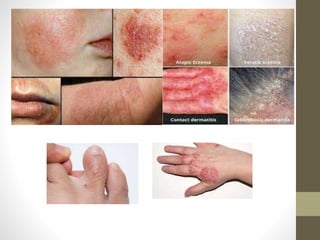
• Eczema is a group of conditions that make your skin inflamed
or irritated.
• Most types cause dry, itchy skin and rashes on the face, inside
the elbows and behind the knees, and on the hands and feet.
Scratching the skin can cause it to turn red, and to swell and
itch even more.
EPIDEMIOLOGY
• Eczema affects about 10% to 20% of infants and about 3% of
adults and children in the U.S. Most children outgrow it by
their 10th birthday. Some people continue to have symptoms
on and off for life.
• There’s no cure, but most people can manage their symptoms
by getting treatment and by avoiding irritants. Eczema isn’t
contagious, so you can’t spread it to another person.
SYMPTOMS
• Eczema looks different for everyone. And your flare-ups won’t
always happen in the same area.
• No matter which part of your skin is affected, eczema is
almost always itchy. The itching sometimes starts before the
rash. Your skin may also be:
• Red
• Dry
• Cracked
• Leathery
TYPES OF ECZEMA
• There are seven different types of eczema:
• Atopic dermatitis.
• Contact dermatitis.
• Neurodermatitis.
• Dyshidrotic eczema.
• Nummular eczema.
• Seborrheic dermatitis.
• Stasis dermatitis.
Atopic dermatitis
• Atopic dermatitis is the most common form of eczema. It
usually starts in childhood, and often gets milder or goes away
by adulthood. Atopic dermatitis is part of what doctors call the
atopic triad. “Triad” means three. The other two diseases in
the triad are asthma and hay fever. Many people with atopic
dermatitis have all three conditions.
• In atopic dermatitis:
• the rash often forms in the creases of your elbows or knees
• skin in areas where the rash appears may turn lighter or
darker, or get thicker
• small bumps may appear and leak fluid if you scratch them
• babies often get the rash on their scalp and cheeks
• your skin can get infected if you scratch it
• Causes
• Atopic dermatitis happens when your skin’s natural barrier
against the elements is weakened. This means your skin is less
able to protect you against irritants and allergens. Atopic
dermatitis is likely caused by a combination of factors such as:
• genes
• dry skin
• an immune system problem
• triggers in the environment
CONTACT DERMATITIS
• Contact dermatitis is an inflammatory reaction of the skin to
physical, chemical or biological agents.
• The epidermis is damaged by repeated physical and chemical
irritations
• Contact dermatitis may be due to irritants or allergens
• Constitute 80% of dermatitis cases
• Mostly industrial
• Usually on hands& forearms
• Acute reaction elicited after brief contact
• Commonly by detergents, alkali, solvents
Dyshidrotic eczema
• Dyshidrotic eczema causes small blisters to form on your
hands and feet. It’s more common in women than men.
Hand eczema
• Eczema that only affects your hands is called hand eczema.
You may get this type if you work in a job like hairdressing or
cleaning, where you regularly use chemicals that irritate the
skin.
Neurodermatitis
• Neurodermatitis is similar to atopic dermatitis. It causes thick,
scaly patches to pop up on your skin.
Nummular eczema
• This type of eczema causes round, coin-shaped spots to form
on your skin. The word “nummular” means coin in Latin.
Nummular eczema looks very different from other types of
eczema, and it can itch a lot.
Stasis dermatitis
• Stasis dermatitis happens when fluid leaks out of weakened
veins into your skin. This fluid causes swelling, redness,
itching, and pain.
Eczema Triggers
• Some people have flare-ups of the itchy rash in response to
things like:
• Rough or coarse fabric
• Feeling too hot or cold
• Household products like soap or detergent
• Animal dander
• Respiratory infections or colds
• Stress
• Sweat
TREATMENT
• The aim of eczema treatment is easing and preventing itching,
which can lead to infection.
• Home remedies
• Colloidal oatmeal. Add this finely ground oatmeal to a
lukewarm bath.
• Wet wraps. When your eczema’s flaring, soak some gauze,
bandages, or pieces of soft clothing in cool water and put
them on your skin. The coolness will relieve itching, and the
moisture will help creams or lotions work even better.
Carefully cover the area with a dry layer (such as pajamas) and
leave in place for several hours or overnight.
• Coal tar. Your doctor may suggest a product with coal tar.
Extract of crude tar has treated eczema and other skin
problems for more than 2,000 years. Although it’s messy and
many people don’t like the strong smell, it may help soothe
your skin.
• Calamine lotion (zinc oxide, ferric oxide) can be put in the
refrigerator and helps relieve itching quickly.
• Relaxation techniques. There’s a strong link between stress
and your skin. Plus, you’re prone to scratch more when your
emotions are running high.
• Moisturizers. Because your skin is dry and itchy, your doctor
will recommend lotions and creams to keep it moist. Creams
and ointments ease inflammation and put water back in your
skin to help it heal. Put them on several times a day, including
right after you bathe or shower. Petroleum jelly and mineral
oil work well because they form a thick barrier over your skin.
• Products with glycerin, lactic acid, and urea may also help
because they help pull water into your skin. You’ll use these
when your skin is damp, such as after bathing, to help hold in
moisture.
• Hydrocortisone creams and antihistamines. Over-the-counter
products like hydrocortisone cream and antihistamines can
also help. Hydrocortisone is a steroid that helps keep redness,
itching, and swelling at bay. You can buy low-strength creams
and lotions at the store. If those don’t help, your doctor may
prescribe something stronger.
• It’s safe to put hydrocortisone on most body parts as many as
four times a day for up to 7 days, as long as you’re not
pregnant or breastfeeding. Keep it away from your eyes,
rectum, and genitals.
Medications
• Your doctor may also prescribe creams and ointments with
corticosteroids to ease inflammation. If the area becomes infected,
you’ll probably need antibiotics.
• Other options include tar treatments (chemicals that reduce itching),
phototherapy (using ultraviolet light), and the drug cyclosporine.
• The FDA has approved two medications called topical
immunomodulators (TIMs) for mild to moderate eczema. Elidel cream
and Protopic ointment work by changing your immune system response
to prevent flare-ups.
• The FDA has warned doctors to use caution with Elidel and Protopic
because of concerns over a cancer risk. The two products also carry the
FDA's "black box" warning on their packaging to alert doctors and
patients to these potential risks. The warning advises doctors to
prescribe Elidel and Protopic for only a short time after other eczema
treatments have failed in adults and children over the age of 2. It should
not be used in kids under age 2.
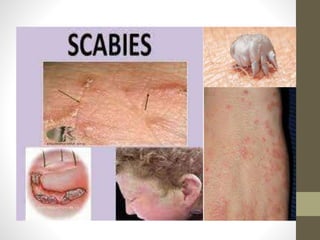
SCABIES
• Scabies is an itchy skin condition caused by a tiny burrowing
mite called Sarcoptes scabiei.
• Scabies is contagious and can spread quickly through close
physical contact in a family, child care group, school class,
nursing home or prison. Because scabies is so contagious,
doctors often recommend treatment for entire families or
contact groups.
CAUSES
• Close physical contact and, less often, the sharing of clothing
or bedding with an infected person can spread the mites.
• Animals and humans all are affected by their own distinct
species of mites. Each species prefers one specific type of host
and doesn't live long away from that preferred host.
• Humans may have a temporary skin reaction from contact
with the animal scabies mite. But people generally can't
develop full-blown scabies from this source, as they might
from contact with the human scabies mite.
• The eight-legged mite that causes scabies in humans is
microscopic. The female mite burrows just beneath your skin
and makes a tunnel where it deposits eggs.
• The eggs hatch, and the mite larvae work their way to the
surface of your skin, where they mature and can spread to
other areas of your skin or to the skin of other people. The
itching of scabies results from your body's allergic reaction to
the mites, their eggs and their waste.
SYMPTOMS
• Scabies signs and symptoms include:
• Itching, often severe and usually worse at night
• Thin, irregular burrow tracks made up of tiny blisters or bumps
on your skin
• In infants and young children, common sites of infestation
usually include the:
• Scalp
• Palms of the hands
• Soles of the feet
TEST AND DIAGNOSIS
• To diagnose scabies, doctor examines skin, looking for of
mites, including the characteristic burrow.
• When doctor locates a mite burrow , he or she may take a
scraping from that area of skin to examine under a
microscope. The microscopic examination can determine the
presence of mites or their eggs.
TREATMENT
• Most people can be cured with a medicine that they apply to
their skin. These medicines are often applied to all skin from
the neck down. Infants and young children often need
treatment for their scalp and face, too. A dermatologist will
provide specific instructions to follow.
• Most medicine is applied at bedtime. The medicine is then
washed off when the patient wakes up. You may need to
repeat this process one week later.
• It is important to follow your dermatologist’s instructions.
Treating the skin more often than instructed can worsen the
rash and itching.
• Medicines that may be prescribed include:
• 5% permethrin cream: This is the most common treatment for
scabies. It is used to treat patients 2 months of age and older
and women who are pregnant.
• 10% crotamiton cream
• 25% benzyl benzoate lotion
• Sulfur (5%-10%) ointment
• 1% lindane lotion
• Some patients need other treatment, too. Your dermatologist
may prescribe:
• Antihistamine: To control the itch and help you sleep.
• Pramoxine lotion: To control the itch.
• Antibiotic: To wipe out an infection.
• Steroid cream: To ease the redness, swelling, and itch.
PREVENTION
• To prevent re-infestation and to prevent the mites from
spreading to other people, take these steps:
• Clean all clothes and linen. Use hot, soapy water to wash all
clothing, towels and bedding used within three days before
beginning treatment. Dry with high heat. Dry-clean items you
can't wash at home.
• Starve the mites. Consider placing items you can't wash in a
sealed plastic bag and leaving it in an out-of-the-way place,
such as in your garage, for a couple of weeks. Mites die after a
few days without food.
THANK YOU

Eczema and scabies

  • 1.
  • 2.
    ECZEMA • Eczema isalso called dermatitis. • Eczema is a group of conditions that make your skin inflamed or irritated. • Most types cause dry, itchy skin and rashes on the face, inside the elbows and behind the knees, and on the hands and feet. Scratching the skin can cause it to turn red, and to swell and itch even more.
  • 4.
    EPIDEMIOLOGY • Eczema affectsabout 10% to 20% of infants and about 3% of adults and children in the U.S. Most children outgrow it by their 10th birthday. Some people continue to have symptoms on and off for life. • There’s no cure, but most people can manage their symptoms by getting treatment and by avoiding irritants. Eczema isn’t contagious, so you can’t spread it to another person.
  • 5.
    SYMPTOMS • Eczema looksdifferent for everyone. And your flare-ups won’t always happen in the same area. • No matter which part of your skin is affected, eczema is almost always itchy. The itching sometimes starts before the rash. Your skin may also be: • Red • Dry • Cracked • Leathery
  • 6.
    TYPES OF ECZEMA •There are seven different types of eczema: • Atopic dermatitis. • Contact dermatitis. • Neurodermatitis. • Dyshidrotic eczema. • Nummular eczema. • Seborrheic dermatitis. • Stasis dermatitis.
  • 7.
    Atopic dermatitis • Atopicdermatitis is the most common form of eczema. It usually starts in childhood, and often gets milder or goes away by adulthood. Atopic dermatitis is part of what doctors call the atopic triad. “Triad” means three. The other two diseases in the triad are asthma and hay fever. Many people with atopic dermatitis have all three conditions. • In atopic dermatitis: • the rash often forms in the creases of your elbows or knees • skin in areas where the rash appears may turn lighter or darker, or get thicker • small bumps may appear and leak fluid if you scratch them • babies often get the rash on their scalp and cheeks • your skin can get infected if you scratch it
  • 8.
    • Causes • Atopicdermatitis happens when your skin’s natural barrier against the elements is weakened. This means your skin is less able to protect you against irritants and allergens. Atopic dermatitis is likely caused by a combination of factors such as: • genes • dry skin • an immune system problem • triggers in the environment
  • 9.
    CONTACT DERMATITIS • Contactdermatitis is an inflammatory reaction of the skin to physical, chemical or biological agents. • The epidermis is damaged by repeated physical and chemical irritations • Contact dermatitis may be due to irritants or allergens • Constitute 80% of dermatitis cases • Mostly industrial • Usually on hands& forearms • Acute reaction elicited after brief contact • Commonly by detergents, alkali, solvents
  • 10.
    Dyshidrotic eczema • Dyshidroticeczema causes small blisters to form on your hands and feet. It’s more common in women than men. Hand eczema • Eczema that only affects your hands is called hand eczema. You may get this type if you work in a job like hairdressing or cleaning, where you regularly use chemicals that irritate the skin. Neurodermatitis • Neurodermatitis is similar to atopic dermatitis. It causes thick, scaly patches to pop up on your skin. Nummular eczema • This type of eczema causes round, coin-shaped spots to form on your skin. The word “nummular” means coin in Latin. Nummular eczema looks very different from other types of eczema, and it can itch a lot.
  • 11.
    Stasis dermatitis • Stasisdermatitis happens when fluid leaks out of weakened veins into your skin. This fluid causes swelling, redness, itching, and pain.
  • 12.
    Eczema Triggers • Somepeople have flare-ups of the itchy rash in response to things like: • Rough or coarse fabric • Feeling too hot or cold • Household products like soap or detergent • Animal dander • Respiratory infections or colds • Stress • Sweat
  • 13.
    TREATMENT • The aimof eczema treatment is easing and preventing itching, which can lead to infection. • Home remedies • Colloidal oatmeal. Add this finely ground oatmeal to a lukewarm bath. • Wet wraps. When your eczema’s flaring, soak some gauze, bandages, or pieces of soft clothing in cool water and put them on your skin. The coolness will relieve itching, and the moisture will help creams or lotions work even better. Carefully cover the area with a dry layer (such as pajamas) and leave in place for several hours or overnight.
  • 14.
    • Coal tar.Your doctor may suggest a product with coal tar. Extract of crude tar has treated eczema and other skin problems for more than 2,000 years. Although it’s messy and many people don’t like the strong smell, it may help soothe your skin. • Calamine lotion (zinc oxide, ferric oxide) can be put in the refrigerator and helps relieve itching quickly. • Relaxation techniques. There’s a strong link between stress and your skin. Plus, you’re prone to scratch more when your emotions are running high. • Moisturizers. Because your skin is dry and itchy, your doctor will recommend lotions and creams to keep it moist. Creams and ointments ease inflammation and put water back in your skin to help it heal. Put them on several times a day, including right after you bathe or shower. Petroleum jelly and mineral oil work well because they form a thick barrier over your skin.
  • 15.
    • Products withglycerin, lactic acid, and urea may also help because they help pull water into your skin. You’ll use these when your skin is damp, such as after bathing, to help hold in moisture. • Hydrocortisone creams and antihistamines. Over-the-counter products like hydrocortisone cream and antihistamines can also help. Hydrocortisone is a steroid that helps keep redness, itching, and swelling at bay. You can buy low-strength creams and lotions at the store. If those don’t help, your doctor may prescribe something stronger. • It’s safe to put hydrocortisone on most body parts as many as four times a day for up to 7 days, as long as you’re not pregnant or breastfeeding. Keep it away from your eyes, rectum, and genitals.
  • 16.
    Medications • Your doctormay also prescribe creams and ointments with corticosteroids to ease inflammation. If the area becomes infected, you’ll probably need antibiotics. • Other options include tar treatments (chemicals that reduce itching), phototherapy (using ultraviolet light), and the drug cyclosporine. • The FDA has approved two medications called topical immunomodulators (TIMs) for mild to moderate eczema. Elidel cream and Protopic ointment work by changing your immune system response to prevent flare-ups. • The FDA has warned doctors to use caution with Elidel and Protopic because of concerns over a cancer risk. The two products also carry the FDA's "black box" warning on their packaging to alert doctors and patients to these potential risks. The warning advises doctors to prescribe Elidel and Protopic for only a short time after other eczema treatments have failed in adults and children over the age of 2. It should not be used in kids under age 2.
  • 17.
    SCABIES • Scabies isan itchy skin condition caused by a tiny burrowing mite called Sarcoptes scabiei. • Scabies is contagious and can spread quickly through close physical contact in a family, child care group, school class, nursing home or prison. Because scabies is so contagious, doctors often recommend treatment for entire families or contact groups.
  • 19.
    CAUSES • Close physicalcontact and, less often, the sharing of clothing or bedding with an infected person can spread the mites. • Animals and humans all are affected by their own distinct species of mites. Each species prefers one specific type of host and doesn't live long away from that preferred host. • Humans may have a temporary skin reaction from contact with the animal scabies mite. But people generally can't develop full-blown scabies from this source, as they might from contact with the human scabies mite.
  • 20.
    • The eight-leggedmite that causes scabies in humans is microscopic. The female mite burrows just beneath your skin and makes a tunnel where it deposits eggs. • The eggs hatch, and the mite larvae work their way to the surface of your skin, where they mature and can spread to other areas of your skin or to the skin of other people. The itching of scabies results from your body's allergic reaction to the mites, their eggs and their waste.
  • 21.
    SYMPTOMS • Scabies signsand symptoms include: • Itching, often severe and usually worse at night • Thin, irregular burrow tracks made up of tiny blisters or bumps on your skin • In infants and young children, common sites of infestation usually include the: • Scalp • Palms of the hands • Soles of the feet
  • 23.
    TEST AND DIAGNOSIS •To diagnose scabies, doctor examines skin, looking for of mites, including the characteristic burrow. • When doctor locates a mite burrow , he or she may take a scraping from that area of skin to examine under a microscope. The microscopic examination can determine the presence of mites or their eggs.
  • 24.
    TREATMENT • Most peoplecan be cured with a medicine that they apply to their skin. These medicines are often applied to all skin from the neck down. Infants and young children often need treatment for their scalp and face, too. A dermatologist will provide specific instructions to follow. • Most medicine is applied at bedtime. The medicine is then washed off when the patient wakes up. You may need to repeat this process one week later. • It is important to follow your dermatologist’s instructions. Treating the skin more often than instructed can worsen the rash and itching.
  • 25.
    • Medicines thatmay be prescribed include: • 5% permethrin cream: This is the most common treatment for scabies. It is used to treat patients 2 months of age and older and women who are pregnant. • 10% crotamiton cream • 25% benzyl benzoate lotion • Sulfur (5%-10%) ointment • 1% lindane lotion
  • 26.
    • Some patientsneed other treatment, too. Your dermatologist may prescribe: • Antihistamine: To control the itch and help you sleep. • Pramoxine lotion: To control the itch. • Antibiotic: To wipe out an infection. • Steroid cream: To ease the redness, swelling, and itch.
  • 27.
    PREVENTION • To preventre-infestation and to prevent the mites from spreading to other people, take these steps: • Clean all clothes and linen. Use hot, soapy water to wash all clothing, towels and bedding used within three days before beginning treatment. Dry with high heat. Dry-clean items you can't wash at home. • Starve the mites. Consider placing items you can't wash in a sealed plastic bag and leaving it in an out-of-the-way place, such as in your garage, for a couple of weeks. Mites die after a few days without food.
  • 28.