ACNE
By Anjita Khadka
Masters in Clinical Pharmacy
2nd semester
ACNE
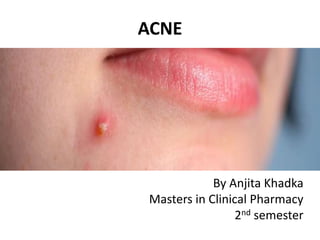
• a skin condition that occurs when your hair
follicles become plugged with oil and dead
skin cells.
• often causes:
– whiteheads
– blackheads or pimples, and
– usually appears on the face, forehead, chest,
upper back and shoulders
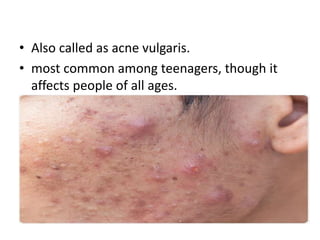
• Also called as acne vulgaris.
• most common among teenagers, though it
affects people of all ages.
PREVALENCE
• As high as 95% with a 20 % to 35% prevalence
of moderate to severe acne.
• Most prevalent in USA, UK, and Australia.
• Estimates reveal a 30 % increase in the
number of people turning towards
homeopathy for the treatment of their Acne
vulgaris and other skin problems globally.
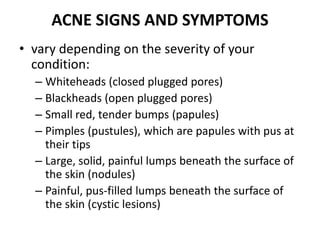
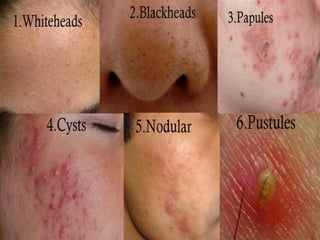
ACNE SIGNS AND SYMPTOMS
• vary depending on the severity of your
condition:
– Whiteheads (closed plugged pores)
– Blackheads (open plugged pores)
– Small red, tender bumps (papules)
– Pimples (pustules), which are papules with pus at
their tips
– Large, solid, painful lumps beneath the surface of
the skin (nodules)
– Painful, pus-filled lumps beneath the surface of
the skin (cystic lesions)
CAUSES
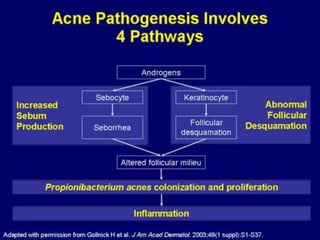
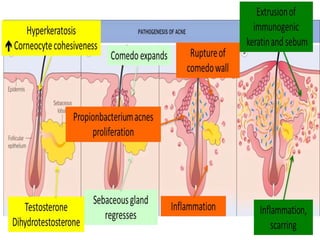
• Excess oil production
• Hair follicles clogged by oil and dead skin cells
• Bacterial infection (Propionibacterium acnes)
• Excess activity of a type of hormone
(androgens)
RISK FACTORS
• Genetic
• Obesity: hyperandrogenism
• A significant positive family history of acne has
been demonstrated especially when acne is
found in:
– Twins
– Mother
– First degree relative
– Multiple family members
AGGRAVATING FACTORS
• Smoking
• Stress
• Facial therapy or, salon facial massage
• High glycemic loads diet
• Milk and milk products
• Tight cloths/ head bands
TYPES OF ACNE
• Acne conglobata
• Occupational acne
• Cosmetic acne
• Drug-induced acne
• Infantile acne
• Late onset acne
• Acne excoriee
• Acne fulminans
• Post-facial massage acne
Types of acne
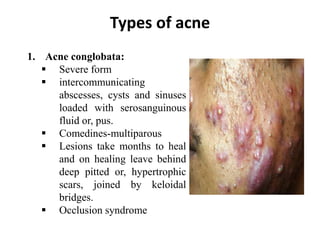
1. Acne conglobata:
 Severe form
 intercommunicating
abscesses, cysts and sinuses
loaded with serosanguinous
fluid or, pus.
 Comedines-multiparous
 Lesions take months to heal
and on healing leave behind
deep pitted or, hypertrophic
scars, joined by keloidal
bridges.
 Occlusion syndrome
Types of acne
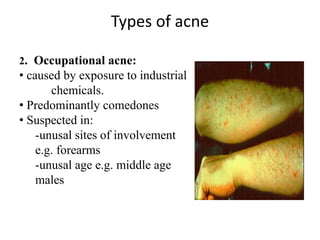
2. Occupational acne:
• caused by exposure to industrial
chemicals.
• Predominantly comedones
• Suspected in:
-unusal sites of involvement
e.g. forearms
-unusal age e.g. middle age
males
Types of acne
3. Cosmetic acne:
• Eruption seen in women using
cosmetics,especially oil based ones.
• Almost always comedones
• Lesion frequently on the chin
4. Drug –induced acne:
• steroids, androgens, anabolic steroids,
OCPs, anti-TB drugs,iodides, bromides and
anticonvulsant can cause acneiform
eruption.
• lesions- monomorphic, consisting of
papules and pustules.
• Trunk especially back and face may be
involved.
Types of acne
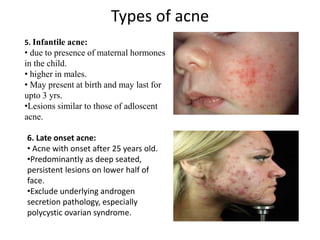
5. Infantile acne:
• due to presence of maternal hormones
in the child.
• higher in males.
• May present at birth and may last for
upto 3 yrs.
•Lesions similar to those of adloscent
acne.
6. Late onset acne:
• Acne with onset after 25 years old.
•Predominantly as deep seated,
persistent lesions on lower half of
face.
•Exclude underlying androgen
secretion pathology, especially
polycystic ovarian syndrome.
Types of acne
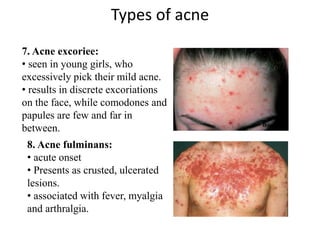
7. Acne excoriee:
• seen in young girls, who
excessively pick their mild acne.
• results in discrete excoriations
on the face, while comodones and
papules are few and far in
between.
8. Acne fulminans:
• acute onset
• Presents as crusted, ulcerated
lesions.
• associated with fever, myalgia
and arthralgia.
Types of acne
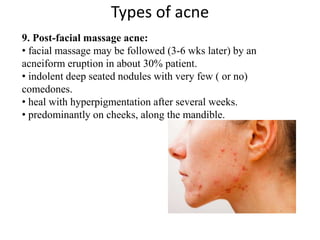
9. Post-facial massage acne:
• facial massage may be followed (3-6 wks later) by an
acneiform eruption in about 30% patient.
• indolent deep seated nodules with very few ( or no)
comedones.
• heal with hyperpigmentation after several weeks.
• predominantly on cheeks, along the mandible.
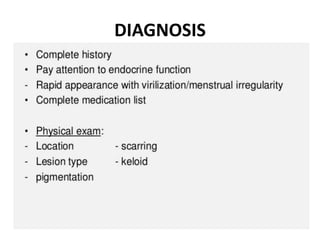
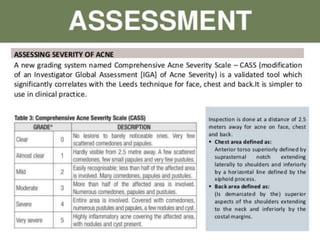
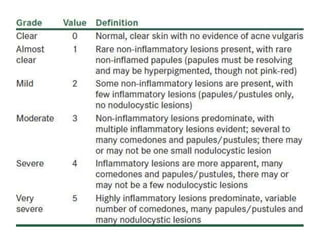
DIAGNOSIS
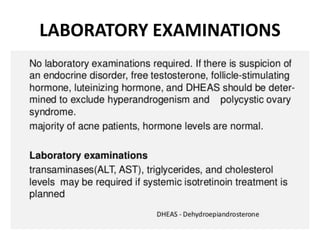
LABORATORY EXAMINATIONS
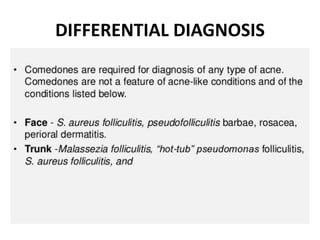
DIFFERENTIAL DIAGNOSIS
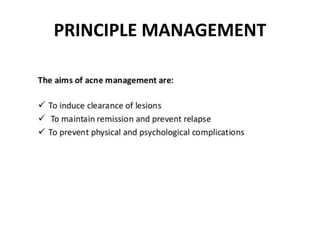
PRINCIPLE MANAGEMENT
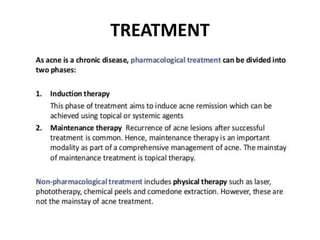
TREATMENT
PHARMACOLOGICAL TREATMENT
• Comedonal acne:
– 1st line treatment: Topical retinoid
– Usually, initiated with the lowest strength retenoid
to minimize redness and dryness.
– Strength may be increased if needed.
– Alternative therapies: Benzoyl peroxide, azeleic
acid or, salicylic acid.
• Papular/pustular Acne:
– Mild disease:
• 1st line therapy: a topical retinoid + topical antibiotic,
Benzoyl peroxide may be added.
• Alternative therapy: Azaleic acid
– Moderate to severe disease:
• same 1st line therapy as mild disease.
– Severe disease:
• 1st line therapy: oral antibiotics+ a topical retinoid +
Benzoyl peroxide gel or wash.
• Alternative therapy: switching to another type of
topical retinoid + another type of antibiotic + Benzoyl
peroxide.
• Nodular acne:
– 1st line therapy:
• oral antibiotics + topical retinoid + Benzoyl peroxide
– If still persistant, may need a referral to use of oral
Isotretinoin therapy.
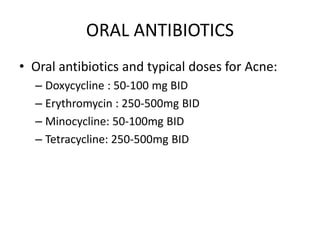
ORAL ANTIBIOTICS
• Oral antibiotics and typical doses for Acne:
– Doxycycline : 50-100 mg BID
– Erythromycin : 250-500mg BID
– Minocycline: 50-100mg BID
– Tetracycline: 250-500mg BID
Acne
Acne
Acne

Acne

  • 1.
    ACNE By Anjita Khadka Mastersin Clinical Pharmacy 2nd semester
  • 2.
    ACNE • a skincondition that occurs when your hair follicles become plugged with oil and dead skin cells. • often causes: – whiteheads – blackheads or pimples, and – usually appears on the face, forehead, chest, upper back and shoulders
  • 3.
    • Also calledas acne vulgaris. • most common among teenagers, though it affects people of all ages.
  • 4.
    PREVALENCE • As highas 95% with a 20 % to 35% prevalence of moderate to severe acne. • Most prevalent in USA, UK, and Australia. • Estimates reveal a 30 % increase in the number of people turning towards homeopathy for the treatment of their Acne vulgaris and other skin problems globally.
  • 5.
    ACNE SIGNS ANDSYMPTOMS • vary depending on the severity of your condition: – Whiteheads (closed plugged pores) – Blackheads (open plugged pores) – Small red, tender bumps (papules) – Pimples (pustules), which are papules with pus at their tips – Large, solid, painful lumps beneath the surface of the skin (nodules) – Painful, pus-filled lumps beneath the surface of the skin (cystic lesions)
  • 7.
    CAUSES • Excess oilproduction • Hair follicles clogged by oil and dead skin cells • Bacterial infection (Propionibacterium acnes) • Excess activity of a type of hormone (androgens)
  • 8.
    RISK FACTORS • Genetic •Obesity: hyperandrogenism • A significant positive family history of acne has been demonstrated especially when acne is found in: – Twins – Mother – First degree relative – Multiple family members
  • 9.
    AGGRAVATING FACTORS • Smoking •Stress • Facial therapy or, salon facial massage • High glycemic loads diet • Milk and milk products • Tight cloths/ head bands
  • 12.
    TYPES OF ACNE •Acne conglobata • Occupational acne • Cosmetic acne • Drug-induced acne • Infantile acne • Late onset acne • Acne excoriee • Acne fulminans • Post-facial massage acne
  • 13.
    Types of acne 1.Acne conglobata:  Severe form  intercommunicating abscesses, cysts and sinuses loaded with serosanguinous fluid or, pus.  Comedines-multiparous  Lesions take months to heal and on healing leave behind deep pitted or, hypertrophic scars, joined by keloidal bridges.  Occlusion syndrome
  • 14.
    Types of acne 2.Occupational acne: • caused by exposure to industrial chemicals. • Predominantly comedones • Suspected in: -unusal sites of involvement e.g. forearms -unusal age e.g. middle age males
  • 15.
    Types of acne 3.Cosmetic acne: • Eruption seen in women using cosmetics,especially oil based ones. • Almost always comedones • Lesion frequently on the chin 4. Drug –induced acne: • steroids, androgens, anabolic steroids, OCPs, anti-TB drugs,iodides, bromides and anticonvulsant can cause acneiform eruption. • lesions- monomorphic, consisting of papules and pustules. • Trunk especially back and face may be involved.
  • 16.
    Types of acne 5.Infantile acne: • due to presence of maternal hormones in the child. • higher in males. • May present at birth and may last for upto 3 yrs. •Lesions similar to those of adloscent acne. 6. Late onset acne: • Acne with onset after 25 years old. •Predominantly as deep seated, persistent lesions on lower half of face. •Exclude underlying androgen secretion pathology, especially polycystic ovarian syndrome.
  • 17.
    Types of acne 7.Acne excoriee: • seen in young girls, who excessively pick their mild acne. • results in discrete excoriations on the face, while comodones and papules are few and far in between. 8. Acne fulminans: • acute onset • Presents as crusted, ulcerated lesions. • associated with fever, myalgia and arthralgia.
  • 18.
    Types of acne 9.Post-facial massage acne: • facial massage may be followed (3-6 wks later) by an acneiform eruption in about 30% patient. • indolent deep seated nodules with very few ( or no) comedones. • heal with hyperpigmentation after several weeks. • predominantly on cheeks, along the mandible.
  • 19.
  • 20.
  • 21.
  • 24.
  • 25.
  • 26.
    PHARMACOLOGICAL TREATMENT • Comedonalacne: – 1st line treatment: Topical retinoid – Usually, initiated with the lowest strength retenoid to minimize redness and dryness. – Strength may be increased if needed. – Alternative therapies: Benzoyl peroxide, azeleic acid or, salicylic acid.
  • 27.
    • Papular/pustular Acne: –Mild disease: • 1st line therapy: a topical retinoid + topical antibiotic, Benzoyl peroxide may be added. • Alternative therapy: Azaleic acid – Moderate to severe disease: • same 1st line therapy as mild disease. – Severe disease: • 1st line therapy: oral antibiotics+ a topical retinoid + Benzoyl peroxide gel or wash. • Alternative therapy: switching to another type of topical retinoid + another type of antibiotic + Benzoyl peroxide.
  • 28.
    • Nodular acne: –1st line therapy: • oral antibiotics + topical retinoid + Benzoyl peroxide – If still persistant, may need a referral to use of oral Isotretinoin therapy.
  • 31.
    ORAL ANTIBIOTICS • Oralantibiotics and typical doses for Acne: – Doxycycline : 50-100 mg BID – Erythromycin : 250-500mg BID – Minocycline: 50-100mg BID – Tetracycline: 250-500mg BID