Development
Plan
NAXALISM
• PM says- The most dangerous security India ever
faced
• 180 districts across 9 states
• Has assumed a shape beyond a normal law and order
problem
• Forms vicious cycle of
poverty,unawareness,Exploitation,Insecurity,poor
development,corruption,Backwardness and conflicts
among various classes of society
Naxalislm- three distinct stages
I.Naxalism-initial stage
-Atrocities on downtrodden and exploitation of
socially and economically backward people
-Agitation against opperessors through violent methods
II.Naxalism-Rapid growth with mass support
-spread to various regions were explotation was visible
Naxalism-stages -contd…-
affected people openly supported the movement.
-Low intensity violence and no indiscriminate violence
III.Naxalism-rapid growth without mass support
-spread new and non traditional areas like dense
forested hilly terrains,economically important areas
mining belts forcefully
-compelling public to support through fear pshycosis
Failure of present Naxalism
tackling approaches
Lack of proper coordination between security
operation and developmental approaches
No distinct approaches t0 different areas like Most
affected, medium affected and less affected areas
General neglegience of area in all points of view like
personnel and infrastructure wise.
Fear pschycosis-strategy of Naxals
The fear pschycosis-base of the success of naxalism
Punishing the people who opposes their ideology
through Jan Adalat
Saranda is the most affected place in Jharkhand
Over a hundred police personnel have been killed in
the last 10 years.
Target the most critical
corridor(MCC) of the naxal affected
areas
Wiping out the fear pshycosis
The most strongest presence of naxals felt in saranda
Forbidden place for government machinaries
SARANDA DEVELOPMENT PLAN
• Literally means ‘seven hundred hills’
• location:In the trijunction of West
Singhbhum,keonjharh,Sundargarh districts of
Jharkhand and Orissa
• 30% of India’s known Iron ore reserve
• 2 nd most important palce for naxals after Bastar
• Served as eastern india’s regional headquarters for
CPI(Maoists) with permanent training camps
• Asia’s largest deposit of Iron ore and densest sal forest
Initiative-Priorities
• To solve the problem through active participation in
implementation of the schemes in a secured and safe
atmosphere
• Deliver the positive result in the shorter period
• Visible impact upon the problem
• Major priority to security of various stakeholders .
• Abduction of senior officials by naxals-Strategy
• Our strategy-security should not be compromised
eventhough the initiative is implemented slowly
Clear ,Hold and Own(CHO) concept
• Clearing the area
-6 panchayats,56 villages,36215 people,7210 families-
identified as Most Critical corridor(MCC)area
-salwajudum model was completely avoided
-Involved 4000 police personnel in the rainy season of
2011
-one of the largest and longest operation in India
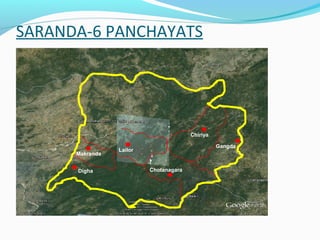
SARANDA-6 PANCHAYATS
Digha
Makranda
Lailor
Chiriya
Gangda
Chotanagara
Clear and hold concept
• Holding the area is more important than clearing the
area
• Creation of trust and confidence-Basic objective
• Public were not at all involved in the process of
information collection,fighting against naxals
• 8 security camps were established in saranda area
Clear,Hold and Own (CHO)concept
• Owning the area is the most critical stage of the strategy
• Deficit of trust between the people and government
functionaries
• Involvement of local educated youths,panchayat
representatives,Traditional village heads
• Regular public contact through Janata Darbar,Prashasan
apke dwar,special camps of various departments
• Opening of District collector’s camp office in saranda
• Night stay of officials in villages
Development plan
• A model plan worth of 240 crores prepared
• Approved by MoRD
• Minister Mr.Jairam Ramesh was keen interested
• Planning and monitoring committee with the help of
Panchayat representatives,traditional village
heads,social activists,educated youths
• Short term ,medium term and long term goals were
setup
• Plan is implemented through the PPPP(political
will,protection,progress,public will)
Goals of the initiative
I.Short term goal
-solar lantern ,Bicycles,Transistors
In Saranda -No electricity connection
All the 7210 families were given solar lanterns,Bicycles
and Transistors
Bicycles-Improved the connectivity between
Governmentoffices and general public.
Transistors-Instant connectivity with the outside world.
Medium term goals
1. Road connectivity
-All the 56 villages to have pucca,RCC road connectivity
-will withstand mild landmineblasts
2.Integrated Watershed Management programme
-6 Integrated watersheds were identified
-Projects worth of 45 crores sanctioned
3.MGNREGANo saranda locals are in Government system.
Saranda-low level literacy rate even rozgar shewaks of
NREGA were outsidersSpecial relaxation –educational
criteria to appoint locals as rozgar shewaks
The most literate person of the village-appointed as
rozgar shewak of the village
Rozgar shewak appointed at village level instead of
panchayat ( 56 rozgar shewak insteadof 6)
BPL resurvey
Many villages –left out from BPL survey
Difficult to give government benefits
Special relaxation was given By rural development
department
Special resurvey was conducted
4.IAY
IAY sanctioned to all the eligible families as per new
survey
Medium term goals –contd…,
5.Food security
All the eligible families were given with ADDITIONAL
BPL ration card scheme of state government
6.Ambulance cum free transportation vehicles
SAIL and private companies CSR ambulance cum free
transportation vehicles in different routes
Medium term goals-contd…
7.Free medical camps
8.Forest rights patta
process completed in the entire saranda region
9.Integrated Development centres
All panchayat level government functionaries under one
roof –Residential cum office complexes
Long term goals
Self sufficient and self employed
1.National Rural livelihood mission
2.Setting up a GURUKUl for saranda with the help of
PARFI for skill development of the youths
3.Special skill development training centre by IL&FS
Development Initatives Taken to Tackle the Naxal Issue in Saranda, Jharkhand.

Development Initatives Taken to Tackle the Naxal Issue in Saranda, Jharkhand.

  • 1.
  • 2.
    NAXALISM • PM says-The most dangerous security India ever faced • 180 districts across 9 states • Has assumed a shape beyond a normal law and order problem • Forms vicious cycle of poverty,unawareness,Exploitation,Insecurity,poor development,corruption,Backwardness and conflicts among various classes of society
  • 3.
    Naxalislm- three distinctstages I.Naxalism-initial stage -Atrocities on downtrodden and exploitation of socially and economically backward people -Agitation against opperessors through violent methods II.Naxalism-Rapid growth with mass support -spread to various regions were explotation was visible
  • 4.
    Naxalism-stages -contd…- affected peopleopenly supported the movement. -Low intensity violence and no indiscriminate violence III.Naxalism-rapid growth without mass support -spread new and non traditional areas like dense forested hilly terrains,economically important areas mining belts forcefully -compelling public to support through fear pshycosis
  • 5.
    Failure of presentNaxalism tackling approaches Lack of proper coordination between security operation and developmental approaches No distinct approaches t0 different areas like Most affected, medium affected and less affected areas General neglegience of area in all points of view like personnel and infrastructure wise.
  • 6.
    Fear pschycosis-strategy ofNaxals The fear pschycosis-base of the success of naxalism Punishing the people who opposes their ideology through Jan Adalat Saranda is the most affected place in Jharkhand Over a hundred police personnel have been killed in the last 10 years.
  • 7.
    Target the mostcritical corridor(MCC) of the naxal affected areas Wiping out the fear pshycosis The most strongest presence of naxals felt in saranda Forbidden place for government machinaries
  • 8.
    SARANDA DEVELOPMENT PLAN •Literally means ‘seven hundred hills’ • location:In the trijunction of West Singhbhum,keonjharh,Sundargarh districts of Jharkhand and Orissa • 30% of India’s known Iron ore reserve • 2 nd most important palce for naxals after Bastar • Served as eastern india’s regional headquarters for CPI(Maoists) with permanent training camps • Asia’s largest deposit of Iron ore and densest sal forest
  • 9.
    Initiative-Priorities • To solvethe problem through active participation in implementation of the schemes in a secured and safe atmosphere • Deliver the positive result in the shorter period • Visible impact upon the problem • Major priority to security of various stakeholders . • Abduction of senior officials by naxals-Strategy • Our strategy-security should not be compromised eventhough the initiative is implemented slowly
  • 10.
    Clear ,Hold andOwn(CHO) concept • Clearing the area -6 panchayats,56 villages,36215 people,7210 families- identified as Most Critical corridor(MCC)area -salwajudum model was completely avoided -Involved 4000 police personnel in the rainy season of 2011 -one of the largest and longest operation in India
  • 11.
  • 12.
    Clear and holdconcept • Holding the area is more important than clearing the area • Creation of trust and confidence-Basic objective • Public were not at all involved in the process of information collection,fighting against naxals • 8 security camps were established in saranda area
  • 13.
    Clear,Hold and Own(CHO)concept • Owning the area is the most critical stage of the strategy • Deficit of trust between the people and government functionaries • Involvement of local educated youths,panchayat representatives,Traditional village heads • Regular public contact through Janata Darbar,Prashasan apke dwar,special camps of various departments • Opening of District collector’s camp office in saranda • Night stay of officials in villages
  • 14.
    Development plan • Amodel plan worth of 240 crores prepared • Approved by MoRD • Minister Mr.Jairam Ramesh was keen interested • Planning and monitoring committee with the help of Panchayat representatives,traditional village heads,social activists,educated youths • Short term ,medium term and long term goals were setup • Plan is implemented through the PPPP(political will,protection,progress,public will)
  • 15.
    Goals of theinitiative I.Short term goal -solar lantern ,Bicycles,Transistors In Saranda -No electricity connection All the 7210 families were given solar lanterns,Bicycles and Transistors Bicycles-Improved the connectivity between Governmentoffices and general public. Transistors-Instant connectivity with the outside world.
  • 16.
    Medium term goals 1.Road connectivity -All the 56 villages to have pucca,RCC road connectivity -will withstand mild landmineblasts 2.Integrated Watershed Management programme -6 Integrated watersheds were identified -Projects worth of 45 crores sanctioned
  • 17.
    3.MGNREGANo saranda localsare in Government system. Saranda-low level literacy rate even rozgar shewaks of NREGA were outsidersSpecial relaxation –educational criteria to appoint locals as rozgar shewaks The most literate person of the village-appointed as rozgar shewak of the village Rozgar shewak appointed at village level instead of panchayat ( 56 rozgar shewak insteadof 6)
  • 18.
    BPL resurvey Many villages–left out from BPL survey Difficult to give government benefits Special relaxation was given By rural development department Special resurvey was conducted 4.IAY IAY sanctioned to all the eligible families as per new survey
  • 19.
    Medium term goals–contd…, 5.Food security All the eligible families were given with ADDITIONAL BPL ration card scheme of state government 6.Ambulance cum free transportation vehicles SAIL and private companies CSR ambulance cum free transportation vehicles in different routes
  • 20.
    Medium term goals-contd… 7.Freemedical camps 8.Forest rights patta process completed in the entire saranda region 9.Integrated Development centres All panchayat level government functionaries under one roof –Residential cum office complexes
  • 21.
    Long term goals Selfsufficient and self employed 1.National Rural livelihood mission 2.Setting up a GURUKUl for saranda with the help of PARFI for skill development of the youths 3.Special skill development training centre by IL&FS