Skills Development Strategy


     Together we are getting the SKILLS
     DEVELOPMENT show on the road

               National Skills Authority &
                   Department of Labour
Why do we need a Skill Strategy?

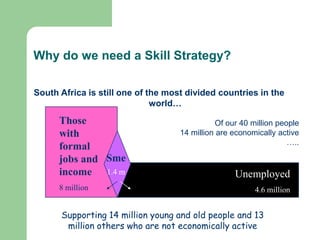
South Africa is still one of the most divided countries in the
                              world…
      Those                                   Of our 40 million people
      with                          14 million are economically active
                                                                   …..
      formal
      jobs and Sme
      income 1.4 m                                 Unemployed
      8 million                                          4.6 million


      Supporting 14 million young and old people and 13
       million others who are not economically active
Why do we need a Skill Strategy?


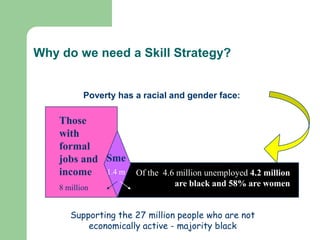
           Poverty has a racial and gender face:

    Those
    with
    formal
    jobs and Sme
    income 1.4 m Of the 4.6 million unemployed 4.2 million
    8 million                   are black and 58% are women


       Supporting the 27 million people who are not
           economically active - majority black
Why do we need a Skill Strategy?

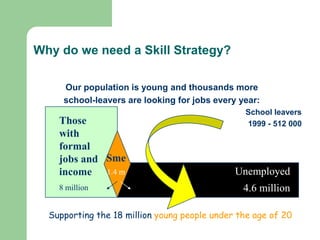
     Our population is young and thousands more
     school-leavers are looking for jobs every year:
                                                School leavers
    Those                                       1999 - 512 000
    with
    formal
    jobs and Sme
    income 1.4 m                              Unemployed
    8 million                                   4.6 million

  Supporting the 18 million young people under the age of 20
Why do we need a Skill Strategy?

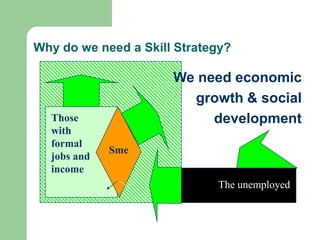
                      We need economic
                        growth & social
  Those                    development
  with
  formal
             Sme
  jobs and
  income
                             The unemployed
Why do we need a Skill Strategy?


We need a Skill Strategy
to support Economic and
 Employment Growth and
   Social Development!
Economic & employment growth and social
development?

The formal sector must grow by
becoming more productive, competitive and
overall generating more jobs.

The SME sector must grow

Development sector initiatives must
support improved subsistence as well as lay
the basis for SME and formal sector growth
Growth in the
                                   Formal Sector?

1.   Attract new direct investment for new jobs - both South African as well as
     foreign.

2.   Find and exploit new markets and new technologies for new jobs.

3.   Promote labour-intensive sectors for more jobs.

4.   Increase productivity and competitiveness across the board to secure
     and expand jobs.

5.   Support innovation, research and development as a source of ideas for
     new jobs.

6.   State to stimulate investment by enhancing infrastructure and supporting
     entrepreneurs.
Skills for growth in the
                       Formal Sector?
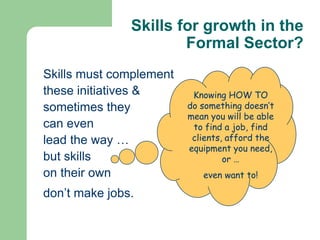
Skills must complement
these initiatives &       Knowing HOW TO
sometimes they           do something doesn’t
                         mean you will be able
can even                  to find a job, find
lead the way …            clients, afford the
                         equipment you need,
but skills                        or …
on their own                even want to!

don’t make jobs.
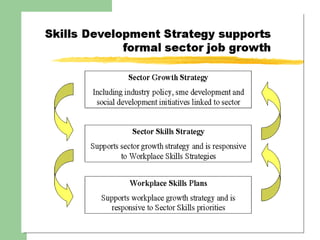
Skills Development Strategy supports formal sector
                                        job growth
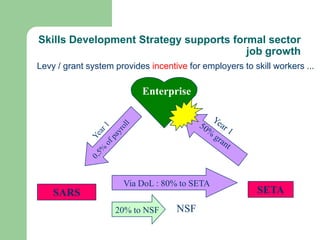
Levy / grant system provides incentive for employers to skill workers ...

                           Enterprise


                      Via DoL : 80% to SETA
    SARS                                                 SETA
                    20% to NSF      NSF
Skills Development Strategy supports workplace
growth strategy

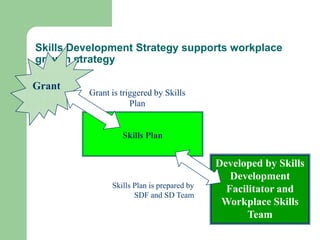
Grant
          Grant is triggered by Skills
                      Plan


                   Skills Plan


                                             Developed by Skills
                                                Development
                Skills Plan is prepared by
                                               Facilitator and
                       SDF and SD Team
                                              Workplace Skills
                                                    Team
Skills Development Strategy also supports formal sector
                                    employment equity

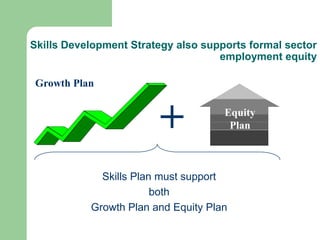
Growth Plan


                        +            Equity
                                      Plan


             Skills Plan must support
                        both
           Growth Plan and Equity Plan
Skills for job growth in the
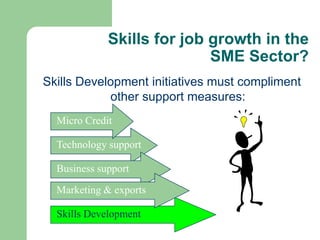
                            SME Sector?
Skills Development initiatives must compliment
            other support measures:
  Micro Credit

  Technology support

  Business support

  Marketing & exports

  Skills Development
Job growth in the
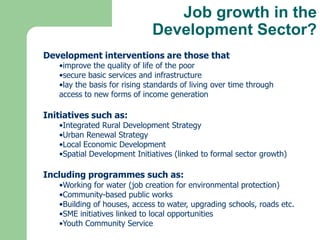
                              Development Sector?
Development interventions are those that
   •improve the quality of life of the poor
   •secure basic services and infrastructure
   •lay the basis for rising standards of living over time through
   access to new forms of income generation

Initiatives such as:
   •Integrated Rural Development Strategy
   •Urban Renewal Strategy
   •Local Economic Development
   •Spatial Development Initiatives (linked to formal sector growth)

Including programmes such as:
   •Working for water (job creation for environmental protection)
   •Community-based public works
   •Building of houses, access to water, upgrading schools, roads etc.
   •SME initiatives linked to local opportunities
   •Youth Community Service
Skills for job growth in the
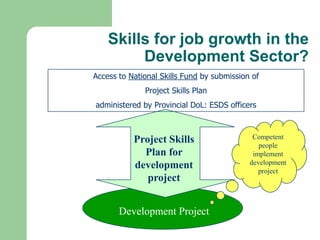
         Development Sector?
Access to National Skills Fund by submission of
              Project Skills Plan
administered by Provincial DoL: ESDS officers


           Project Skills                    Competent
                                               people
             Plan for                        implement
           development                      development
                                               project
              project


       Development Project
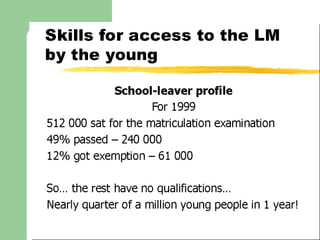
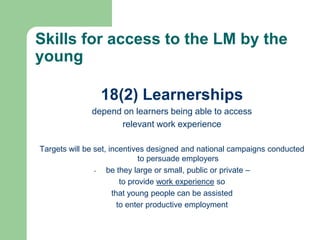
Skills for access to the LM by the
young

                18(2) Learnerships
              depend on learners being able to access
                    relevant work experience

Targets will be set, incentives designed and national campaigns conducted
                               to persuade employers
                -   be they large or small, public or private –
                         to provide work experience so
                      that young people can be assisted
                        to enter productive employment
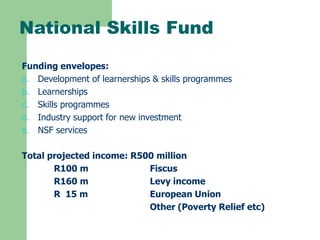
National Skills Fund
Funding envelopes:
a. Development of learnerships & skills programmes
b. Learnerships
c. Skills programmes
d. Industry support for new investment
e. NSF services

Total projected income: R500 million
       R100 m              Fiscus
       R160 m              Levy income
       R 15 m              European Union
                           Other (Poverty Relief etc)
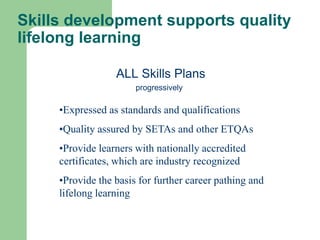
Skills development supports quality
lifelong learning

                  ALL Skills Plans
                       progressively

     •Expressed as standards and qualifications
     •Quality assured by SETAs and other ETQAs
     •Provide learners with nationally accredited
     certificates, which are industry recognized
     •Provide the basis for further career pathing and
     lifelong learning
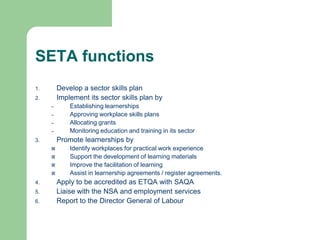
SETA functions
1.       Develop a sector skills plan
2.       Implement its sector skills plan by
     –       Establishing learnerships
     –       Approving workplace skills plans
     –       Allocating grants
     –       Monitoring education and training in its sector
3.       Promote learnerships by
            Identify workplaces for practical work experience
            Support the development of learning materials
            Improve the facilitation of learning
            Assist in learnership agreements / register agreements.
4.       Apply to be accredited as ETQA with SAQA
5.       Liaise with the NSA and employment services
6.       Report to the Director General of Labour
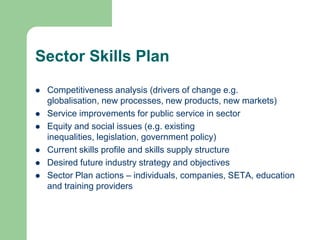
Sector Skills Plan
   Competitiveness analysis (drivers of change e.g.
    globalisation, new processes, new products, new markets)
   Service improvements for public service in sector
   Equity and social issues (e.g. existing
    inequalities, legislation, government policy)
   Current skills profile and skills supply structure
   Desired future industry strategy and objectives
   Sector Plan actions – individuals, companies, SETA, education
    and training providers
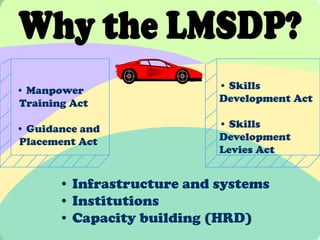
• Manpower                  • Skills
Training Act                Development Act

• Guidance and              • Skills
Placement Act               Development
                            Levies Act


       • Infrastructure and systems
       • Institutions
       • Capacity building (HRD)
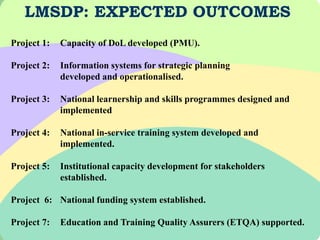
LMSDP: EXPECTED OUTCOMES
Project 1:   Capacity of DoL developed (PMU).

Project 2:   Information systems for strategic planning
             developed and operationalised.

Project 3:   National learnership and skills programmes designed and
             implemented

Project 4:   National in-service training system developed and
             implemented.

Project 5:   Institutional capacity development for stakeholders
             established.

Project 6: National funding system established.

Project 7:   Education and Training Quality Assurers (ETQA) supported.
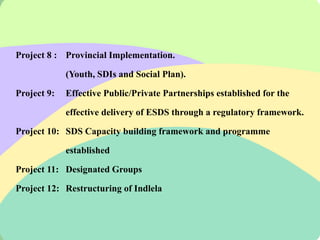
Project 8 : Provincial Implementation.

             (Youth, SDIs and Social Plan).

Project 9:   Effective Public/Private Partnerships established for the

             effective delivery of ESDS through a regulatory framework.

Project 10: SDS Capacity building framework and programme

             established

Project 11: Designated Groups

Project 12: Restructuring of Indlela
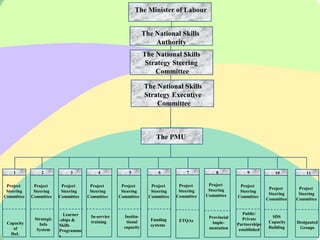
The Minister of Labour


                                                                The National Skills
                                                                    Authority
                                                                The National Skills
                                                                 Strategy Steering
                                                                    Committee

                                                                The National Skills
                                                                Strategy Executive
                                                                    Committee


                                                                     The PMU


    1           2             3          4             5              6           7           8              9             10          11

 Project     Project      Project     Project       Project        Project     Project     Project       Project
                                                                                           Steering                     Project     Project
 Steering    Steering     Steering    Steering      Steering       Steering    Steering                  Steering
                                                                                          Committee                     Steering    Steering
Committee   Committee    Committee   Committee     Committee      Committee   Committee                 Committee
                                                                                                                       Committee   Committee


                           Learner                                                                         Public/
                                      In-service     Institu-                              Provincial                    SDS
             Strategic   -ships &                                  Funding     ETQAs                       Private
 Capacity                             training        tional                                 imple-                     Capacity   Designated
               Info      Skills                                    systems                              Partnerships
    of                                               capacity                              mentation                    Building    Groups
              System     Programme                                                                       established
   DoL                   s
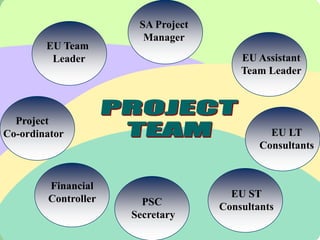
SA Project
                       Manager
        EU Team
         Leader                        EU Assistant
                                       Team Leader


  Project
Co-ordinator                                 EU LT
                                           Consultants


        Financial
        Controller                   EU ST
                       PSC         Consultants
                     Secretary
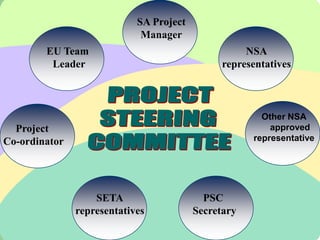
SA Project
                             Manager
       EU Team                              NSA
      Project
        Leader
                   Steering      Committees
                                       representatives


                                                       Other NSA
  Project                                                approved
Co-ordinator                                         representative


                   SETA                    PSC
               representatives           Secretary
EU


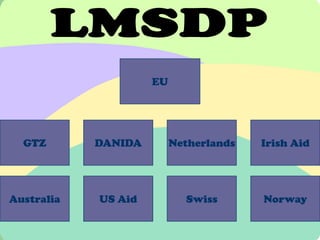
  GTZ       DANIDA        Netherlands   Irish Aid


Australia   US Aid          Swiss       Norway
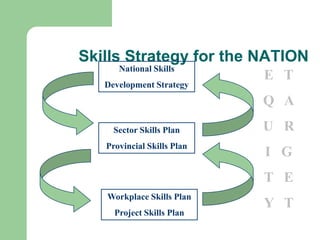
Skills Strategy for the NATION
      National Skills
                            E T
   Development Strategy
                            Q A
     Sector Skills Plan     U R
   Provincial Skills Plan
                            I G
                            T E
   Workplace Skills Plan
                            Y T
     Project Skills Plan

Sector skills

  • 1.
    Skills Development Strategy Together we are getting the SKILLS DEVELOPMENT show on the road National Skills Authority & Department of Labour
  • 2.
    Why do weneed a Skill Strategy? South Africa is still one of the most divided countries in the world… Those Of our 40 million people with 14 million are economically active ….. formal jobs and Sme income 1.4 m Unemployed 8 million 4.6 million Supporting 14 million young and old people and 13 million others who are not economically active
  • 3.
    Why do weneed a Skill Strategy? Poverty has a racial and gender face: Those with formal jobs and Sme income 1.4 m Of the 4.6 million unemployed 4.2 million 8 million are black and 58% are women Supporting the 27 million people who are not economically active - majority black
  • 4.
    Why do weneed a Skill Strategy? Our population is young and thousands more school-leavers are looking for jobs every year: School leavers Those 1999 - 512 000 with formal jobs and Sme income 1.4 m Unemployed 8 million 4.6 million Supporting the 18 million young people under the age of 20
  • 5.
    Why do weneed a Skill Strategy? We need economic growth & social Those development with formal Sme jobs and income The unemployed
  • 6.
    Why do weneed a Skill Strategy? We need a Skill Strategy to support Economic and Employment Growth and Social Development!
  • 7.
    Economic & employmentgrowth and social development? The formal sector must grow by becoming more productive, competitive and overall generating more jobs. The SME sector must grow Development sector initiatives must support improved subsistence as well as lay the basis for SME and formal sector growth
  • 8.
    Growth in the Formal Sector? 1. Attract new direct investment for new jobs - both South African as well as foreign. 2. Find and exploit new markets and new technologies for new jobs. 3. Promote labour-intensive sectors for more jobs. 4. Increase productivity and competitiveness across the board to secure and expand jobs. 5. Support innovation, research and development as a source of ideas for new jobs. 6. State to stimulate investment by enhancing infrastructure and supporting entrepreneurs.
  • 9.
    Skills for growthin the Formal Sector? Skills must complement these initiatives & Knowing HOW TO sometimes they do something doesn’t mean you will be able can even to find a job, find lead the way … clients, afford the equipment you need, but skills or … on their own even want to! don’t make jobs.
  • 10.
    Skills Development Strategysupports formal sector job growth Levy / grant system provides incentive for employers to skill workers ... Enterprise Via DoL : 80% to SETA SARS SETA 20% to NSF NSF
  • 11.
    Skills Development Strategysupports workplace growth strategy Grant Grant is triggered by Skills Plan Skills Plan Developed by Skills Development Skills Plan is prepared by Facilitator and SDF and SD Team Workplace Skills Team
  • 12.
    Skills Development Strategyalso supports formal sector employment equity Growth Plan + Equity Plan Skills Plan must support both Growth Plan and Equity Plan
  • 13.
    Skills for jobgrowth in the SME Sector? Skills Development initiatives must compliment other support measures: Micro Credit Technology support Business support Marketing & exports Skills Development
  • 14.
    Job growth inthe Development Sector? Development interventions are those that •improve the quality of life of the poor •secure basic services and infrastructure •lay the basis for rising standards of living over time through access to new forms of income generation Initiatives such as: •Integrated Rural Development Strategy •Urban Renewal Strategy •Local Economic Development •Spatial Development Initiatives (linked to formal sector growth) Including programmes such as: •Working for water (job creation for environmental protection) •Community-based public works •Building of houses, access to water, upgrading schools, roads etc. •SME initiatives linked to local opportunities •Youth Community Service
  • 15.
    Skills for jobgrowth in the Development Sector? Access to National Skills Fund by submission of Project Skills Plan administered by Provincial DoL: ESDS officers Project Skills Competent people Plan for implement development development project project Development Project
  • 17.
    Skills for accessto the LM by the young 18(2) Learnerships depend on learners being able to access relevant work experience Targets will be set, incentives designed and national campaigns conducted to persuade employers - be they large or small, public or private – to provide work experience so that young people can be assisted to enter productive employment
  • 18.
    National Skills Fund Fundingenvelopes: a. Development of learnerships & skills programmes b. Learnerships c. Skills programmes d. Industry support for new investment e. NSF services Total projected income: R500 million R100 m Fiscus R160 m Levy income R 15 m European Union Other (Poverty Relief etc)
  • 20.
    Skills development supportsquality lifelong learning ALL Skills Plans progressively •Expressed as standards and qualifications •Quality assured by SETAs and other ETQAs •Provide learners with nationally accredited certificates, which are industry recognized •Provide the basis for further career pathing and lifelong learning
  • 21.
    SETA functions 1. Develop a sector skills plan 2. Implement its sector skills plan by – Establishing learnerships – Approving workplace skills plans – Allocating grants – Monitoring education and training in its sector 3. Promote learnerships by  Identify workplaces for practical work experience  Support the development of learning materials  Improve the facilitation of learning  Assist in learnership agreements / register agreements. 4. Apply to be accredited as ETQA with SAQA 5. Liaise with the NSA and employment services 6. Report to the Director General of Labour
  • 22.
    Sector Skills Plan  Competitiveness analysis (drivers of change e.g. globalisation, new processes, new products, new markets)  Service improvements for public service in sector  Equity and social issues (e.g. existing inequalities, legislation, government policy)  Current skills profile and skills supply structure  Desired future industry strategy and objectives  Sector Plan actions – individuals, companies, SETA, education and training providers
  • 23.
    • Manpower • Skills Training Act Development Act • Guidance and • Skills Placement Act Development Levies Act • Infrastructure and systems • Institutions • Capacity building (HRD)
  • 24.
    LMSDP: EXPECTED OUTCOMES Project1: Capacity of DoL developed (PMU). Project 2: Information systems for strategic planning developed and operationalised. Project 3: National learnership and skills programmes designed and implemented Project 4: National in-service training system developed and implemented. Project 5: Institutional capacity development for stakeholders established. Project 6: National funding system established. Project 7: Education and Training Quality Assurers (ETQA) supported.
  • 25.
    Project 8 :Provincial Implementation. (Youth, SDIs and Social Plan). Project 9: Effective Public/Private Partnerships established for the effective delivery of ESDS through a regulatory framework. Project 10: SDS Capacity building framework and programme established Project 11: Designated Groups Project 12: Restructuring of Indlela
  • 26.
    The Minister ofLabour The National Skills Authority The National Skills Strategy Steering Committee The National Skills Strategy Executive Committee The PMU 1 2 3 4 5 6 7 8 9 10 11 Project Project Project Project Project Project Project Project Project Steering Project Project Steering Steering Steering Steering Steering Steering Steering Steering Committee Steering Steering Committee Committee Committee Committee Committee Committee Committee Committee Committee Committee Learner Public/ In-service Institu- Provincial SDS Strategic -ships & Funding ETQAs Private Capacity training tional imple- Capacity Designated Info Skills systems Partnerships of capacity mentation Building Groups System Programme established DoL s
  • 27.
    SA Project Manager EU Team Leader EU Assistant Team Leader Project Co-ordinator EU LT Consultants Financial Controller EU ST PSC Consultants Secretary
  • 28.
    SA Project Manager EU Team NSA Project Leader Steering Committees representatives Other NSA Project approved Co-ordinator representative SETA PSC representatives Secretary
  • 29.
    EU GTZ DANIDA Netherlands Irish Aid Australia US Aid Swiss Norway
  • 30.
    Skills Strategy forthe NATION National Skills E T Development Strategy Q A Sector Skills Plan U R Provincial Skills Plan I G T E Workplace Skills Plan Y T Project Skills Plan