LEC:3.3
Hepatic Elimination:
FIRST PASS EFFECT
First Pass Effect
DEFINITION
EVIDENCE OF FIRST-PASS EFFECT
LIVER EXTRACTION RATIOS
DETERMINATION OF EXTRACTION RATIO 2
Definition 3
 The rapid metabolism of an orally administered drug before
reaching the general circulation is termed first-pass effect or
presystemic elimination
Drugs that are highly metabolized by the liver or by the intestinal
mucosal cells demonstrate poor systemic availability when given
orally
4
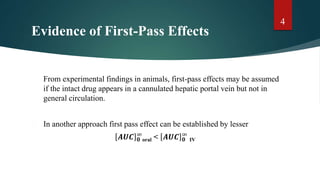
Evidence of First-Pass Effects
1. From experimental findings in animals, first-pass effects may be assumed
if the intact drug appears in a cannulated hepatic portal vein but not in
general circulation.
2. In another approach first pass effect can be established by lesser
𝑨𝑼𝑪 𝟎
∞
oral < 𝑨𝑼𝑪 𝟎
∞
IV
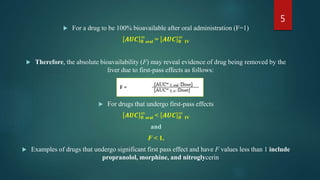
 For a drug to be 100% bioavailable after oral administration (F=1)
𝑨𝑼𝑪 𝟎
∞
oral = 𝑨𝑼𝑪 𝟎
∞
IV
 Therefore, the absolute bioavailability (F) may reveal evidence of drug being removed by the
liver due to first-pass effects as follows:
 For drugs that undergo first-pass effects
𝑨𝑼𝑪 𝟎
∞
oral < 𝑨𝑼𝑪 𝟎
∞
IV
and
F < 1.
 Examples of drugs that undergo significant first pass effect and have F values less than 1 include
propranolol, morphine, and nitroglycerin
5
Liver Extraction Ratio
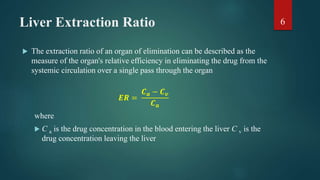
 The extraction ratio of an organ of elimination can be described as the
measure of the organ's relative efficiency in eliminating the drug from the
systemic circulation over a single pass through the organ
𝑬𝑹 =
𝑪 𝒂 − 𝑪 𝒗
𝑪 𝒂
where
 C a is the drug concentration in the blood entering the liver C v is the
drug concentration leaving the liver
6
7
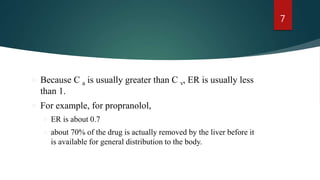
 Because C a is usually greater than C v, ER is usually less
than 1.
 For example, for propranolol,
 ER is about 0.7
 about 70% of the drug is actually removed by the liver before it
is available for general distribution to the body.
Determination of Extraction Ratio 8
Liver ER provides a
measurement of liver
extraction of a drug orally
administered.
Unfortunately, sampling of drug
from the hepatic portal vein and
artery is difficult and performed
mainly in animals.
Animal ER values may be
quite different from those
in humans.
9
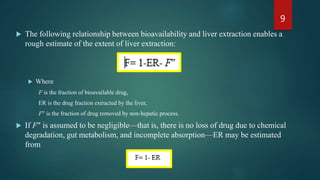
 The following relationship between bioavailability and liver extraction enables a
rough estimate of the extent of liver extraction:
 Where
F is the fraction of bioavailable drug,
ER is the drug fraction extracted by the liver,
F″ is the fraction of drug removed by non-hepatic process.
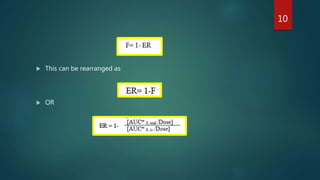
 If F″ is assumed to be negligible—that is, there is no loss of drug due to chemical
degradation, gut metabolism, and incomplete absorption—ER may be estimated
from
 This can be rearranged as
 OR
10
11
 ER is a rough estimation of liver extraction for a drug.
 Many other factors may alter this estimation:
 the size of the dose
 the formulation of the drug
 the pathophysiologic condition of the patient
12
Liver ER provides valuable information in determining the oral dose of a drug
when the intravenous dose is known.
 For example,
Propranolol requires a much higher oral dose compared to an IV dose to
produce equivalent therapeutic blood levels,
 Because liver extraction is affected by blood flow to the liver, dosing of drug
with extensive liver metabolism may produce erratic plasma drug levels.
 Formulation of this drug into an oral dosage form requires extensive, careful
testing.
13

Lec 3.3-hepatic elimination( first pass effect)

  • 1.
  • 2.
    First Pass Effect DEFINITION EVIDENCEOF FIRST-PASS EFFECT LIVER EXTRACTION RATIOS DETERMINATION OF EXTRACTION RATIO 2
  • 3.
    Definition 3  Therapid metabolism of an orally administered drug before reaching the general circulation is termed first-pass effect or presystemic elimination Drugs that are highly metabolized by the liver or by the intestinal mucosal cells demonstrate poor systemic availability when given orally
  • 4.
    4 Evidence of First-PassEffects 1. From experimental findings in animals, first-pass effects may be assumed if the intact drug appears in a cannulated hepatic portal vein but not in general circulation. 2. In another approach first pass effect can be established by lesser 𝑨𝑼𝑪 𝟎 ∞ oral < 𝑨𝑼𝑪 𝟎 ∞ IV
  • 5.
     For adrug to be 100% bioavailable after oral administration (F=1) 𝑨𝑼𝑪 𝟎 ∞ oral = 𝑨𝑼𝑪 𝟎 ∞ IV  Therefore, the absolute bioavailability (F) may reveal evidence of drug being removed by the liver due to first-pass effects as follows:  For drugs that undergo first-pass effects 𝑨𝑼𝑪 𝟎 ∞ oral < 𝑨𝑼𝑪 𝟎 ∞ IV and F < 1.  Examples of drugs that undergo significant first pass effect and have F values less than 1 include propranolol, morphine, and nitroglycerin 5
  • 6.
    Liver Extraction Ratio The extraction ratio of an organ of elimination can be described as the measure of the organ's relative efficiency in eliminating the drug from the systemic circulation over a single pass through the organ 𝑬𝑹 = 𝑪 𝒂 − 𝑪 𝒗 𝑪 𝒂 where  C a is the drug concentration in the blood entering the liver C v is the drug concentration leaving the liver 6
  • 7.
    7  Because Ca is usually greater than C v, ER is usually less than 1.  For example, for propranolol,  ER is about 0.7  about 70% of the drug is actually removed by the liver before it is available for general distribution to the body.
  • 8.
    Determination of ExtractionRatio 8 Liver ER provides a measurement of liver extraction of a drug orally administered. Unfortunately, sampling of drug from the hepatic portal vein and artery is difficult and performed mainly in animals. Animal ER values may be quite different from those in humans.
  • 9.
    9  The followingrelationship between bioavailability and liver extraction enables a rough estimate of the extent of liver extraction:  Where F is the fraction of bioavailable drug, ER is the drug fraction extracted by the liver, F″ is the fraction of drug removed by non-hepatic process.  If F″ is assumed to be negligible—that is, there is no loss of drug due to chemical degradation, gut metabolism, and incomplete absorption—ER may be estimated from
  • 10.
     This canbe rearranged as  OR 10
  • 11.
    11  ER isa rough estimation of liver extraction for a drug.  Many other factors may alter this estimation:  the size of the dose  the formulation of the drug  the pathophysiologic condition of the patient
  • 12.
    12 Liver ER providesvaluable information in determining the oral dose of a drug when the intravenous dose is known.  For example, Propranolol requires a much higher oral dose compared to an IV dose to produce equivalent therapeutic blood levels,  Because liver extraction is affected by blood flow to the liver, dosing of drug with extensive liver metabolism may produce erratic plasma drug levels.  Formulation of this drug into an oral dosage form requires extensive, careful testing.
  • 13.