PARALLEL
SIMULATION
BSA – 5
S.Y. 2016-2017
NDMU
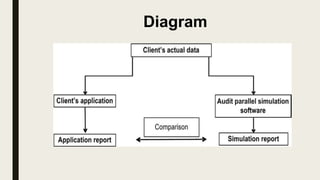
-involves the auditor writing a computer
program that replicates some part of a client’s
application system, processes actual client
data through an auditor’s generalized audit
software program and compares the output
obtained with output obtained from the client.
The method verifies processing of actual
transactions and allows the auditor to verify
actual client results.
Parallel simulation
Generalized Audit Software
(GAS)
■ an off-the-shelf package that can provide a
means to gain access to and interrogate
data maintained on computer storage
media.
■ one of the tools IT Auditors utilize to obtain
evidence directly on the quality of the
records produced and maintained by
application systems.
■Auditor writes or obtains a copy of the
program that simulates key features or
processes to be reviewed / tested
■Auditor gains a thorough understanding
of the application under review
■Auditor identifies those processes and
controls critical to the application
Procedure
 Auditor creates the simulation using
program or Generalized Audit Software
(GAS)
 Auditor runs the simulated program using
selected data and files
 Auditor evaluates results and reconciles
differences
 Out of date approach
■To facilitate the substantive testing of
client account balances.
■To provide evidences on the controls
used in the client’s application
programs.
■Parallel simulation is the best technique
for verification of calculations
(depreciation, interest, taxes, payroll
Functions
■ The auditor can verify the transactions.
■ The size of the sample can be greatly expanded
at relatively little additional cost.
■ The auditor can independently run the test.
■ To emphasize exception helps auditor to focus
on items where there are differences.
■ Enables the valuation of effects of nonexistent
control procedures.
Advantages
■ Time consuming
■ Incompatibility between auditor and client
software
■ Tracing differences between the two sets of
outputs to differences in the programs may
be difficult
■ significant cost of audit programming if
written uniquely for one client
Disadvantages
 the auditor may need special training to
understand the client’s program and develop
a program that simulates the client’s program.
 The auditor must also take care to determine
that the data selected for simulations are
representative of actual client transactions.
Diagram
(2008, June 12). Retrieved from
https://opencourseware.kfupm.edu.sa/colleges/cim/acctmis/acct303/files%5
C2-Lecture_Notes_Chapter7-CAATTs.pdf
Accounting Financial and Tax. (2009). Techniques and Technology used in
Auditing.
Management Information Systems. (n.d.).
QUIZ! QUIZ!
QUIZ!
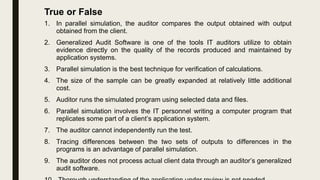
1. In parallel simulation, the auditor compares the output obtained with output
obtained from the client.
2. Generalized Audit Software is one of the tools IT auditors utilize to obtain
evidence directly on the quality of the records produced and maintained by
application systems.
3. Parallel simulation is the best technique for verification of calculations.
4. The size of the sample can be greatly expanded at relatively little additional
cost.
5. Auditor runs the simulated program using selected data and files.
6. Parallel simulation involves the IT personnel writing a computer program that
replicates some part of a client’s application system.
7. The auditor cannot independently run the test.
8. Tracing differences between the two sets of outputs to differences in the
programs is an advantage of parallel simulation.
9. The auditor does not process actual client data through an auditor’s generalized
audit software.
True or False

Parallel simulation

  • 1.
  • 2.
    -involves the auditorwriting a computer program that replicates some part of a client’s application system, processes actual client data through an auditor’s generalized audit software program and compares the output obtained with output obtained from the client. The method verifies processing of actual transactions and allows the auditor to verify actual client results. Parallel simulation
  • 3.
    Generalized Audit Software (GAS) ■an off-the-shelf package that can provide a means to gain access to and interrogate data maintained on computer storage media. ■ one of the tools IT Auditors utilize to obtain evidence directly on the quality of the records produced and maintained by application systems.
  • 4.
    ■Auditor writes orobtains a copy of the program that simulates key features or processes to be reviewed / tested ■Auditor gains a thorough understanding of the application under review ■Auditor identifies those processes and controls critical to the application Procedure
  • 5.
     Auditor createsthe simulation using program or Generalized Audit Software (GAS)  Auditor runs the simulated program using selected data and files  Auditor evaluates results and reconciles differences  Out of date approach
  • 6.
    ■To facilitate thesubstantive testing of client account balances. ■To provide evidences on the controls used in the client’s application programs. ■Parallel simulation is the best technique for verification of calculations (depreciation, interest, taxes, payroll Functions
  • 7.
    ■ The auditorcan verify the transactions. ■ The size of the sample can be greatly expanded at relatively little additional cost. ■ The auditor can independently run the test. ■ To emphasize exception helps auditor to focus on items where there are differences. ■ Enables the valuation of effects of nonexistent control procedures. Advantages
  • 8.
    ■ Time consuming ■Incompatibility between auditor and client software ■ Tracing differences between the two sets of outputs to differences in the programs may be difficult ■ significant cost of audit programming if written uniquely for one client Disadvantages
  • 9.
     the auditormay need special training to understand the client’s program and develop a program that simulates the client’s program.  The auditor must also take care to determine that the data selected for simulations are representative of actual client transactions.
  • 10.
  • 11.
    (2008, June 12).Retrieved from https://opencourseware.kfupm.edu.sa/colleges/cim/acctmis/acct303/files%5 C2-Lecture_Notes_Chapter7-CAATTs.pdf Accounting Financial and Tax. (2009). Techniques and Technology used in Auditing. Management Information Systems. (n.d.).
  • 12.
  • 13.
    1. In parallelsimulation, the auditor compares the output obtained with output obtained from the client. 2. Generalized Audit Software is one of the tools IT auditors utilize to obtain evidence directly on the quality of the records produced and maintained by application systems. 3. Parallel simulation is the best technique for verification of calculations. 4. The size of the sample can be greatly expanded at relatively little additional cost. 5. Auditor runs the simulated program using selected data and files. 6. Parallel simulation involves the IT personnel writing a computer program that replicates some part of a client’s application system. 7. The auditor cannot independently run the test. 8. Tracing differences between the two sets of outputs to differences in the programs is an advantage of parallel simulation. 9. The auditor does not process actual client data through an auditor’s generalized audit software. True or False