Introduction to Pharmacopoeia
Ms. S. B. Gaurkar
Assistant Professor,
DRGIOP, Amravati
Unit-I : Chapter-I : Pharmaceutics-I
What is a Pharmacopoeia?
•Definition:
A Pharmacopoeia is an official, legally recognized collection of
standards and specifications for the quality, strength, and
purity of medicines and their ingredients.
•Purpose:
To ensure the safety, efficacy, and quality of drugs and their
formulations.
•Example:
United States Pharmacopeia (USP), Indian Pharmacopoeia (IP),
British Pharmacopoeia (BP), etc.
Unit-I : Chapter-I : Pharmaceutics-I
Historical Background
•Early Development:
Ancient civilizations had their own pharmacopoeia (e.g., Egyptian
and Chinese).
•First Modern Pharmacopoeia:
16th century Europe, with the German Pharmacopoeia (DAB)
(Deutsches Arzneibuch) .
•Growth:
The first official pharmacopoeia in the U.S. was published in
1820—The United States Pharmacopeia (USP).
Unit-I : Chapter-I : Pharmaceutics-I
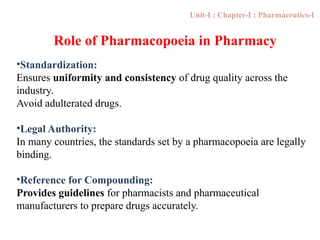
Role of Pharmacopoeia in Pharmacy
•Standardization:
Ensures uniformity and consistency of drug quality across the
industry.
Avoid adulterated drugs.
•Legal Authority:
In many countries, the standards set by a pharmacopoeia are legally
binding.
•Reference for Compounding:
Provides guidelines for pharmacists and pharmaceutical
manufacturers to prepare drugs accurately.
Unit-I : Chapter-I : Pharmaceutics-I
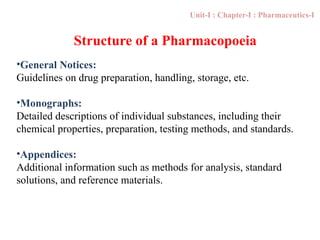
Structure of a Pharmacopoeia
•General Notices:
Guidelines on drug preparation, handling, storage, etc.
•Monographs:
Detailed descriptions of individual substances, including their
chemical properties, preparation, testing methods, and standards.
•Appendices:
Additional information such as methods for analysis, standard
solutions, and reference materials.
Unit-I : Chapter-I : Pharmaceutics-I
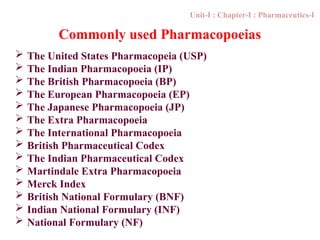
Commonly used Pharmacopoeias
 The United States Pharmacopeia (USP)
 The Indian Pharmacopoeia (IP)
 The British Pharmacopoeia (BP)
 The European Pharmacopoeia (EP)
 The Japanese Pharmacopoeia (JP)
 The Extra Pharmacopoeia
 The International Pharmacopoeia
 British Pharmaceutical Codex
 The Indian Pharmaceutical Codex
 Martindale Extra Pharmacopoeia
 Merck Index
 British National Formulary (BNF)
 Indian National Formulary (INF)
 National Formulary (NF)
Unit-I : Chapter-I : Pharmaceutics-I
Examples of Well-Known Pharmacopoeias
United States Pharmacopeia (USP)
•Widely used in the United States.
•Establishes drug quality standards, testing methods, and
regulations.
Indian Pharmacopoeia (IP)
•The official pharmacopoeia for India.
•Sets standards for drugs in India, including both synthetic and
herbal medicines.
British Pharmacopoeia (BP)
•Used in the UK and some Commonwealth nations.
•Similar to USP but tailored to British standards.
European Pharmacopoeia (EP)
•Common standard used by European Union countries.
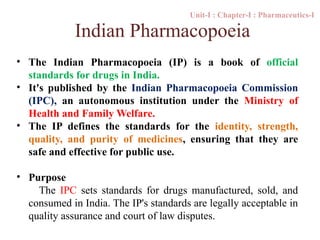
Indian Pharmacopoeia
• The Indian Pharmacopoeia (IP) is a book of official
standards for drugs in India.
• It's published by the Indian Pharmacopoeia Commission
(IPC), an autonomous institution under the Ministry of
Health and Family Welfare.
• The IP defines the standards for the identity, strength,
quality, and purity of medicines, ensuring that they are
safe and effective for public use.
• Purpose
The IPC sets standards for drugs manufactured, sold, and
consumed in India. The IP's standards are legally acceptable in
quality assurance and court of law disputes.
Unit-I : Chapter-I : Pharmaceutics-I
Contents of the Indian Pharmacopoeia:
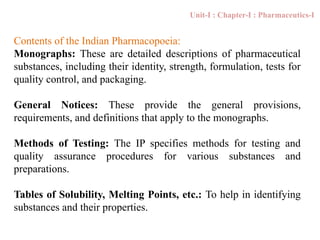
Monographs: These are detailed descriptions of pharmaceutical
substances, including their identity, strength, formulation, tests for
quality control, and packaging.
General Notices: These provide the general provisions,
requirements, and definitions that apply to the monographs.
Methods of Testing: The IP specifies methods for testing and
quality assurance procedures for various substances and
preparations.
Tables of Solubility, Melting Points, etc.: To help in identifying
substances and their properties.
Unit-I : Chapter-I : Pharmaceutics-I
Post-Independence and the Formation of the Indian
Pharmacopoeia (1955)
Indian Pharmacopoeia Commission (IPC):
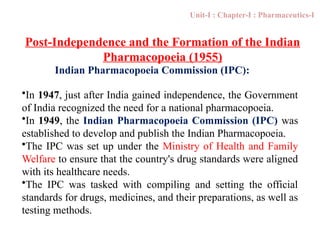
•In 1947, just after India gained independence, the Government
of India recognized the need for a national pharmacopoeia.
•In 1949, the Indian Pharmacopoeia Commission (IPC) was
established to develop and publish the Indian Pharmacopoeia.
•The IPC was set up under the Ministry of Health and Family
Welfare to ensure that the country's drug standards were aligned
with its healthcare needs.
•The IPC was tasked with compiling and setting the official
standards for drugs, medicines, and their preparations, as well as
testing methods.
Unit-I : Chapter-I : Pharmaceutics-I
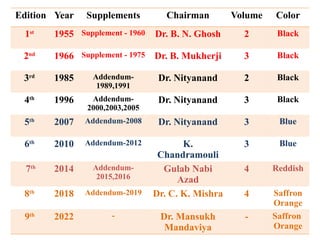
Edition Year Supplements Chairman Volume Color
1st
1955 Supplement - 1960 Dr. B. N. Ghosh 2 Black
2nd
1966 Supplement - 1975 Dr. B. Mukherji 3 Black
3rd
1985 Addendum-
1989,1991
Dr. Nityanand 2 Black
4th
1996 Addendum-
2000,2003,2005
Dr. Nityanand 3 Black
5th
2007 Addendum-2008 Dr. Nityanand 3 Blue
6th
2010 Addendum-2012 K.
Chandramouli
3 Blue
7th
2014 Addendum-
2015,2016
Gulab Nabi
Azad
4 Reddish
8th
2018 Addendum-2019 Dr. C. K. Mishra 4 Saffron
Orange
9th
2022 - Dr. Mansukh
Mandaviya
- Saffron
Orange
Unit-I : Chapter-I : Pharmaceutics-I
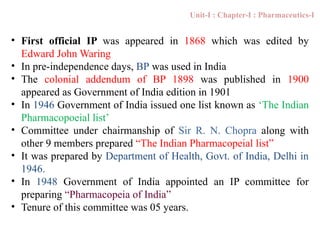
• First official IP was appeared in 1868 which was edited by
Edward John Waring
• In pre-independence days, BP was used in India
• The colonial addendum of BP 1898 was published in 1900
appeared as Government of India edition in 1901
• In 1946 Government of India issued one list known as ‘The Indian
Pharmacopoeial list’
• Committee under chairmanship of Sir R. N. Chopra along with
other 9 members prepared “The Indian Pharmacopeial list”
• It was prepared by Department of Health, Govt. of India, Delhi in
1946.
• In 1948 Government of India appointed an IP committee for
preparing “Pharmacopeia of India”
• Tenure of this committee was 05 years.
Unit-I : Chapter-I : Pharmaceutics-I
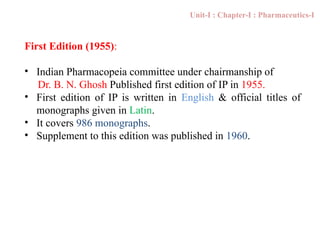
First Edition (1955):
• Indian Pharmacopeia committee under chairmanship of
Dr. B. N. Ghosh Published first edition of IP in 1955.
• First edition of IP is written in English & official titles of
monographs given in Latin.
• It covers 986 monographs.
• Supplement to this edition was published in 1960.
Unit-I : Chapter-I : Pharmaceutics-I
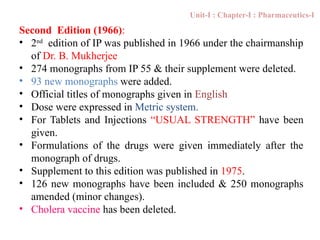
Second Edition (1966):
• 2nd
edition of IP was published in 1966 under the chairmanship
of Dr. B. Mukherjee
• 274 monographs from IP 55 & their supplement were deleted.
• 93 new monographs were added.
• Official titles of monographs given in English
• Dose were expressed in Metric system.
• For Tablets and Injections “USUAL STRENGTH” have been
given.
• Formulations of the drugs were given immediately after the
monograph of drugs.
• Supplement to this edition was published in 1975.
• 126 new monographs have been included & 250 monographs
amended (minor changes).
• Cholera vaccine has been deleted.
Unit-I : Chapter-I : Pharmaceutics-I
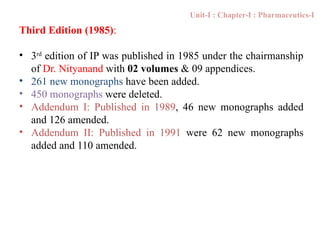
Third Edition (1985):
• 3rd
edition of IP was published in 1985 under the chairmanship
of Dr. Nityanand with 02 volumes & 09 appendices.
• 261 new monographs have been added.
• 450 monographs were deleted.
• Addendum I: Published in 1989, 46 new monographs added
and 126 amended.
• Addendum II: Published in 1991 were 62 new monographs
added and 110 amended.
Unit-I : Chapter-I : Pharmaceutics-I
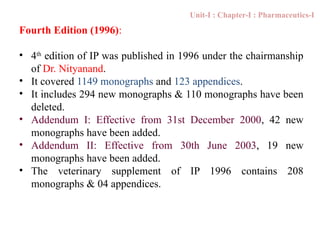
Fourth Edition (1996):
• 4th
edition of IP was published in 1996 under the chairmanship
of Dr. Nityanand.
• It covered 1149 monographs and 123 appendices.
• It includes 294 new monographs & 110 monographs have been
deleted.
• Addendum I: Effective from 31st December 2000, 42 new
monographs have been added.
• Addendum II: Effective from 30th June 2003, 19 new
monographs have been added.
• The veterinary supplement of IP 1996 contains 208
monographs & 04 appendices.
Unit-I : Chapter-I : Pharmaceutics-I
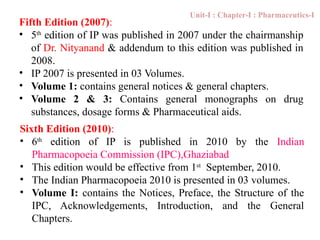
Fifth Edition (2007):
• 5th
edition of IP was published in 2007 under the chairmanship
of Dr. Nityanand & addendum to this edition was published in
2008.
• IP 2007 is presented in 03 Volumes.
• Volume 1: contains general notices & general chapters.
• Volume 2 & 3: Contains general monographs on drug
substances, dosage forms & Pharmaceutical aids.
Sixth Edition (2010):
• 6th
edition of IP is published in 2010 by the Indian
Pharmacopoeia Commission (IPC),Ghaziabad
• This edition would be effective from 1st
September, 2010.
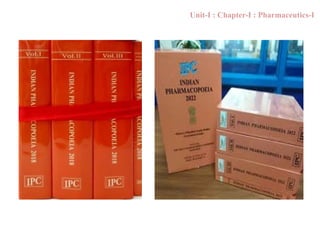
• The Indian Pharmacopoeia 2010 is presented in 03 volumes.
• Volume I: contains the Notices, Preface, the Structure of the
IPC, Acknowledgements, Introduction, and the General
Chapters.
Unit-I : Chapter-I : Pharmaceutics-I
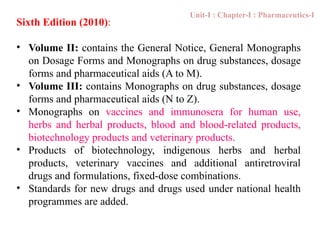
Sixth Edition (2010):
• Volume II: contains the General Notice, General Monographs
on Dosage Forms and Monographs on drug substances, dosage
forms and pharmaceutical aids (A to M).
• Volume III: contains Monographs on drug substances, dosage
forms and pharmaceutical aids (N to Z).
• Monographs on vaccines and immunosera for human use,
herbs and herbal products, blood and blood-related products,
biotechnology products and veterinary products.
• Products of biotechnology, indigenous herbs and herbal
products, veterinary vaccines and additional antiretroviral
drugs and formulations, fixed-dose combinations.
• Standards for new drugs and drugs used under national health
programmes are added.
Unit-I : Chapter-I : Pharmaceutics-I
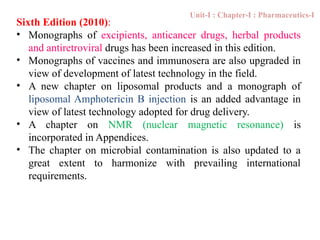
Sixth Edition (2010):
• Monographs of excipients, anticancer drugs, herbal products
and antiretroviral drugs has been increased in this edition.
• Monographs of vaccines and immunosera are also upgraded in
view of development of latest technology in the field.
• A new chapter on liposomal products and a monograph of
liposomal Amphotericin B injection is an added advantage in
view of latest technology adopted for drug delivery.
• A chapter on NMR (nuclear magnetic resonance) is
incorporated in Appendices.
• The chapter on microbial contamination is also updated to a
great extent to harmonize with prevailing international
requirements.
Unit-I : Chapter-I : Pharmaceutics-I
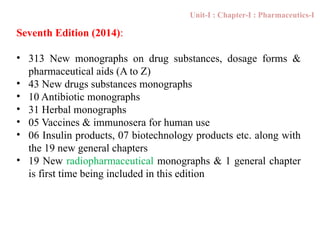
Seventh Edition (2014):
• 313 New monographs on drug substances, dosage forms &
pharmaceutical aids (A to Z)
• 43 New drugs substances monographs
• 10 Antibiotic monographs
• 31 Herbal monographs
• 05 Vaccines & immunosera for human use
• 06 Insulin products, 07 biotechnology products etc. along with
the 19 new general chapters
• 19 New radiopharmaceutical monographs & 1 general chapter
is first time being included in this edition
Unit-I : Chapter-I : Pharmaceutics-I
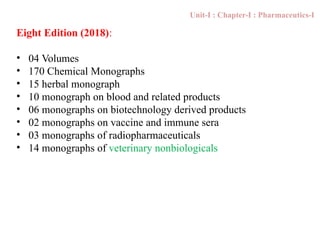
Eight Edition (2018):
• 04 Volumes
• 170 Chemical Monographs
• 15 herbal monograph
• 10 monograph on blood and related products
• 06 monographs on biotechnology derived products
• 02 monographs on vaccine and immune sera
• 03 monographs of radiopharmaceuticals
• 14 monographs of veterinary nonbiologicals
Unit-I : Chapter-I : Pharmaceutics-I
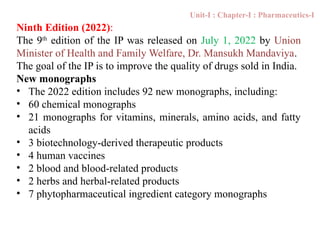
Ninth Edition (2022):
The 9th
edition of the IP was released on July 1, 2022 by Union
Minister of Health and Family Welfare, Dr. Mansukh Mandaviya.
The goal of the IP is to improve the quality of drugs sold in India.
New monographs
• The 2022 edition includes 92 new monographs, including:
• 60 chemical monographs
• 21 monographs for vitamins, minerals, amino acids, and fatty
acids
• 3 biotechnology-derived therapeutic products
• 4 human vaccines
• 2 blood and blood-related products
• 2 herbs and herbal-related products
• 7 phytopharmaceutical ingredient category monographs
Unit-I : Chapter-I : Pharmaceutics-I
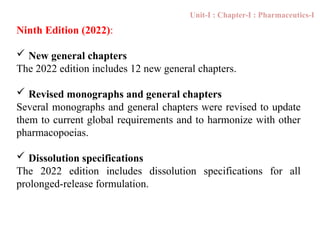
Ninth Edition (2022):
 New general chapters
The 2022 edition includes 12 new general chapters.
 Revised monographs and general chapters
Several monographs and general chapters were revised to update
them to current global requirements and to harmonize with other
pharmacopoeias.
 Dissolution specifications
The 2022 edition includes dissolution specifications for all
prolonged-release formulation.
Unit-I : Chapter-I : Pharmaceutics-I
British Pharmacopoeia
Unit-I : Chapter-I : Pharmaceutics-I
British Pharmacopoeia
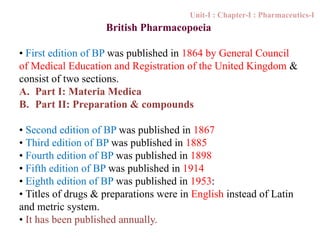
• First edition of BP was published in 1864 by General Council
of Medical Education and Registration of the United Kingdom &
consist of two sections.
A. Part I: Materia Medica
B. Part II: Preparation & compounds
• Second edition of BP was published in 1867
• Third edition of BP was published in 1885
• Fourth edition of BP was published in 1898
• Fifth edition of BP was published in 1914
• Eighth edition of BP was published in 1953:
• Titles of drugs & preparations were in English instead of Latin
and metric system.
• It has been published annually.
Unit-I : Chapter-I : Pharmaceutics-I
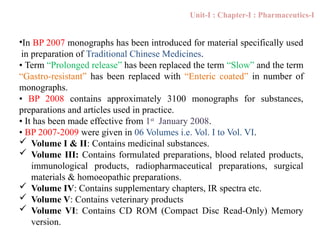
•In BP 2007 monographs has been introduced for material specifically used
in preparation of Traditional Chinese Medicines.
• Term “Prolonged release” has been replaced the term “Slow” and the term
“Gastro-resistant” has been replaced with “Enteric coated” in number of
monographs.
• BP 2008 contains approximately 3100 monographs for substances,
preparations and articles used in practice.
• It has been made effective from 1st
January 2008.
• BP 2007-2009 were given in 06 Volumes i.e. Vol. I to Vol. VI.
 Volume I & II: Contains medicinal substances.
 Volume III: Contains formulated preparations, blood related products,
immunological products, radiopharmaceutical preparations, surgical
materials & homoeopathic preparations.
 Volume IV: Contains supplementary chapters, IR spectra etc.
 Volume V: Contains veterinary products
 Volume VI: Contains CD ROM (Compact Disc Read-Only) Memory
version.
Unit-I : Chapter-I : Pharmaceutics-I
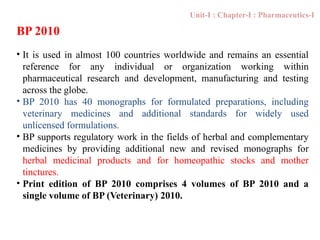
BP 2010
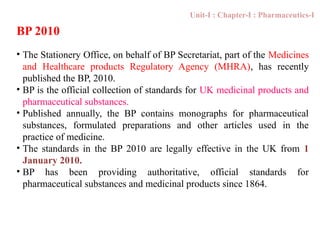
• The Stationery Office, on behalf of BP Secretariat, part of the Medicines
and Healthcare products Regulatory Agency (MHRA), has recently
published the BP, 2010.
• BP is the official collection of standards for UK medicinal products and
pharmaceutical substances.
• Published annually, the BP contains monographs for pharmaceutical
substances, formulated preparations and other articles used in the
practice of medicine.
• The standards in the BP 2010 are legally effective in the UK from 1
January 2010.
• BP has been providing authoritative, official standards for
pharmaceutical substances and medicinal products since 1864.
Unit-I : Chapter-I : Pharmaceutics-I
BP 2010
• It is used in almost 100 countries worldwide and remains an essential
reference for any individual or organization working within
pharmaceutical research and development, manufacturing and testing
across the globe.
• BP 2010 has 40 monographs for formulated preparations, including
veterinary medicines and additional standards for widely used
unlicensed formulations.
• BP supports regulatory work in the fields of herbal and complementary
medicines by providing additional new and revised monographs for
herbal medicinal products and for homeopathic stocks and mother
tinctures.
• Print edition of BP 2010 comprises 4 volumes of BP 2010 and a
single volume of BP (Veterinary) 2010.
Unit-I : Chapter-I : Pharmaceutics-I
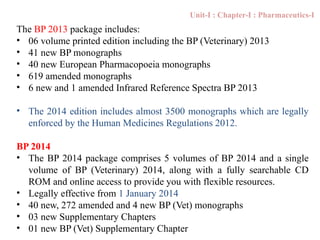
The BP 2013 package includes:
• 06 volume printed edition including the BP (Veterinary) 2013
• 41 new BP monographs
• 40 new European Pharmacopoeia monographs
• 619 amended monographs
• 6 new and 1 amended Infrared Reference Spectra BP 2013
• The 2014 edition includes almost 3500 monographs which are legally
enforced by the Human Medicines Regulations 2012.
BP 2014
• The BP 2014 package comprises 5 volumes of BP 2014 and a single
volume of BP (Veterinary) 2014, along with a fully searchable CD
ROM and online access to provide you with flexible resources.
• Legally effective from 1 January 2014
• 40 new, 272 amended and 4 new BP (Vet) monographs
• 03 new Supplementary Chapters
• 01 new BP (Vet) Supplementary Chapter
Unit-I : Chapter-I : Pharmaceutics-I
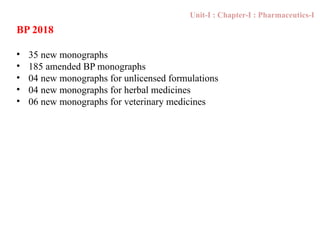
BP 2018
• 35 new monographs
• 185 amended BP monographs
• 04 new monographs for unlicensed formulations
• 04 new monographs for herbal medicines
• 06 new monographs for veterinary medicines
Unit-I : Chapter-I : Pharmaceutics-I
United State Pharmacopoeia (USP)
Unit-I : Chapter-I : Pharmaceutics-I
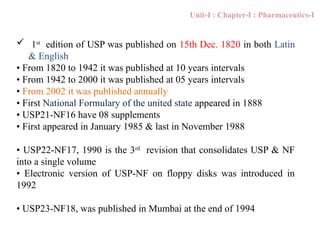
 1st
edition of USP was published on 15th Dec. 1820 in both Latin
& English
• From 1820 to 1942 it was published at 10 years intervals
• From 1942 to 2000 it was published at 05 years intervals
• From 2002 it was published annually
• First National Formulary of the united state appeared in 1888
• USP21-NF16 have 08 supplements
• First appeared in January 1985 & last in November 1988
• USP22-NF17, 1990 is the 3rd
revision that consolidates USP & NF
into a single volume
• Electronic version of USP-NF on floppy disks was introduced in
1992
• USP23-NF18, was published in Mumbai at the end of 1994
Unit-I : Chapter-I : Pharmaceutics-I
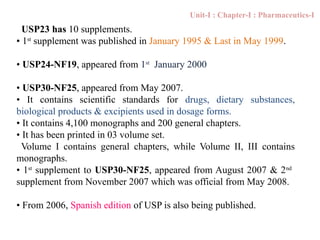
USP23 has 10 supplements.
• 1st
supplement was published in January 1995 & Last in May 1999.
• USP24-NF19, appeared from 1st
January 2000
• USP30-NF25, appeared from May 2007.
• It contains scientific standards for drugs, dietary substances,
biological products & excipients used in dosage forms.
• It contains 4,100 monographs and 200 general chapters.
• It has been printed in 03 volume set.
Volume I contains general chapters, while Volume II, III contains
monographs.
• 1st
supplement to USP30-NF25, appeared from August 2007 & 2nd
supplement from November 2007 which was official from May 2008.
• From 2006, Spanish edition of USP is also being published.
Unit-I : Chapter-I : Pharmaceutics-I
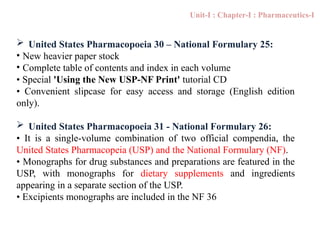
 United States Pharmacopoeia 30 – National Formulary 25:
• New heavier paper stock
• Complete table of contents and index in each volume
• Special 'Using the New USP-NF Print' tutorial CD
• Convenient slipcase for easy access and storage (English edition
only).
 United States Pharmacopoeia 31 - National Formulary 26:
• It is a single-volume combination of two official compendia, the
United States Pharmacopeia (USP) and the National Formulary (NF).
• Monographs for drug substances and preparations are featured in the
USP, with monographs for dietary supplements and ingredients
appearing in a separate section of the USP.
• Excipients monographs are included in the NF 36
Unit-I : Chapter-I : Pharmaceutics-I
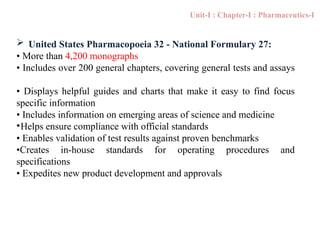
 United States Pharmacopoeia 32 - National Formulary 27:
• More than 4,200 monographs
• Includes over 200 general chapters, covering general tests and assays
• Displays helpful guides and charts that make it easy to find focus
specific information
• Includes information on emerging areas of science and medicine
•Helps ensure compliance with official standards
• Enables validation of test results against proven benchmarks
•Creates in-house standards for operating procedures and
specifications
• Expedites new product development and approvals
Unit-I : Chapter-I : Pharmaceutics-I
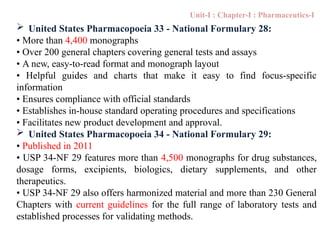
 United States Pharmacopoeia 33 - National Formulary 28:
• More than 4,400 monographs
• Over 200 general chapters covering general tests and assays
• A new, easy-to-read format and monograph layout
• Helpful guides and charts that make it easy to find focus-specific
information
• Ensures compliance with official standards
• Establishes in-house standard operating procedures and specifications
• Facilitates new product development and approval.
 United States Pharmacopoeia 34 - National Formulary 29:
• Published in 2011
• USP 34-NF 29 features more than 4,500 monographs for drug substances,
dosage forms, excipients, biologics, dietary supplements, and other
therapeutics.
• USP 34-NF 29 also offers harmonized material and more than 230 General
Chapters with current guidelines for the full range of laboratory tests and
established processes for validating methods.
Unit-I : Chapter-I : Pharmaceutics-I
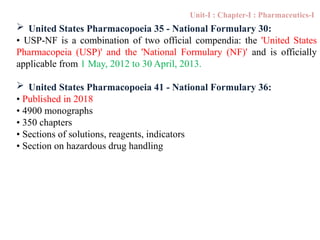
 United States Pharmacopoeia 35 - National Formulary 30:
• USP-NF is a combination of two official compendia: the 'United States
Pharmacopeia (USP)' and the 'National Formulary (NF)' and is officially
applicable from 1 May, 2012 to 30 April, 2013.
 United States Pharmacopoeia 41 - National Formulary 36:
• Published in 2018
• 4900 monographs
• 350 chapters
• Sections of solutions, reagents, indicators
• Section on hazardous drug handling
European Pharmacopeia
Unit-I : Chapter-I : Pharmaceutics-I
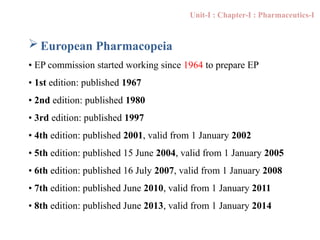
 European Pharmacopeia
• EP commission started working since 1964 to prepare EP
• 1st edition: published 1967
• 2nd edition: published 1980
• 3rd edition: published 1997
• 4th edition: published 2001, valid from 1 January 2002
• 5th edition: published 15 June 2004, valid from 1 January 2005
• 6th edition: published 16 July 2007, valid from 1 January 2008
• 7th edition: published June 2010, valid from 1 January 2011
• 8th edition: published June 2013, valid from 1 January 2014
Introduction to Pharmacopoeias B. Pharm 1st year.pptx