DR.MUMTAZ ALI NAREJO
KHAIRPUR MEDICAL COLLEGE
SINDH PAKISTAN
Aims
 Funtional unit of muscle
 Gross anatomy of muscle
 Molecular anatomy of muscle fibre
 Molecular anatomy of actin and myosin filament
 General mechanism of muscle contraction
 Molecuar mechanism of muscle contration
 Fenn effect
 Relation of tension with length of sarcomere
 Relation of velocity with load
 Energetics of muscle contraction
 Isotonic vs isometric muscle contraction
 Fast vs slow fibre
 Motoneuron
 Tetanization
SKELETAL MUSCLE FIBRE
 40% = skeletal muscle
 10% = smooth & cardiac muscle
 10 to 80 micrometers
 Sarcolemma
 myofibrils
 1500 myosin +3000 actin filaments
 Thick =myosin=dark band=A=anisotropic
 Thin = actin=light band =I=isotropic
 Myosin projections =bridges
 Actin ends =z disk
 Sacromere = b/w two z disk
 H zone = b/w two dark bands
 Striated appearance
 sarcomere = 2micrometers
 Titin molecule = actin & myosin
 Largest protein molecule
 One end = z disk
 One end = myosin
 Sarcoplasm =intracellular
fluid b/w myofbril
K+ , Mg++ , protein,
Mitochondria=ATP
• Sarcoplasm reticulum :
Calcium storage
GENERAL MECHANISM OF
MUSCLE CONTRACTION
 action potential =>motor nerve to muscle fibers
 At each ending, nerve =>acetylcholine =>muscle fibre
membrane =>acetylcholine gated channels
 Muscle fibre membrane=>influx of Na+
=>depolarization=>action potential =>muscle fibre
membrane=>Sarcoplasmic reticulum=> Ca++
=>contractile process
MOLECULAR MECHANISM
OF MUSCLE CONTRACTION
 Siliding filament mechanism
 Crossbridges of myosin
 Action potential=>
 Sarcoplasmic reticulum=>
 Ca++=>contractile process
 ATP=>ADP
Myosin filament
 200 myosin=>myosin filament
 myosin filament=1.6 micrometer
 480,000
 6 chains
 2 heavy + 4 light
 Heavy =200000
 Light = 20000
 Tail+ 2 heads
 Tail =>body of filament
 Head + arm > crossbirdges
 Flexibal part => hinges
 Head =>ATPase activity
Actin filament
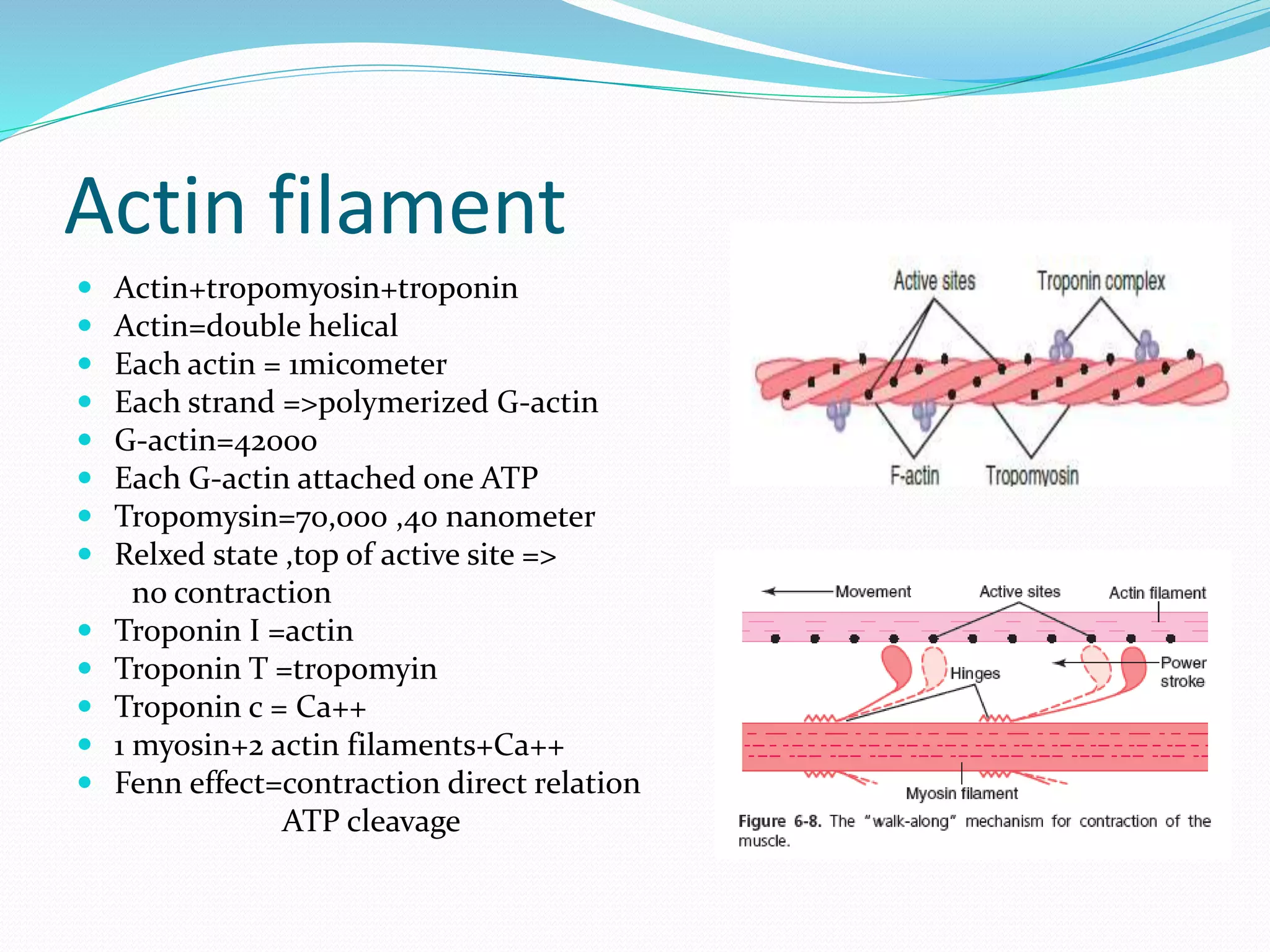
 Actin+tropomyosin+troponin
 Actin=double helical
 Each actin = 1micometer
 Each strand =>polymerized G-actin
 G-actin=42000
 Each G-actin attached one ATP
 Tropomysin=70,000 ,40 nanometer
 Relxed state ,top of active site =>
no contraction
 Troponin I =actin
 Troponin T =tropomyin
 Troponin c = Ca++
 1 myosin+2 actin filaments+Ca++
 Fenn effect=contraction direct relation
ATP cleavage
 V=0.1 sec
Energetic of muscle contraction
 W = L ×D
 percentage of energy input that is converted into work
instead of heat
 Maximum efficiency = moderate velocity
 walk-along mechanism
 pumping Ca++
 pumping Na+ & K+
 Muscle fibre = 4 mosm ATP (1-2 sec)
 Phosphocreatinine
 Glycogen => pyruvic acid + lactic acid + ATP
 Oxidative metabolism= 95% energy
Charcteristics of muscle
contraction
Fast vs slow muscle fibre
Type 1 ,slow fibre , red
muscle
Type 2 ,fast fibre .white
muscle
 Smaller
 Smller nerve fibre
 Extensive blood supply &
capillaries
 Inc mitochondria
 myoglobin
 Large
 Large nerve fibre
 Extensive sarcoplasmic
reticulum
 Large amount of glycotic
enzymes
refrences
 Gyton text book of physiology 13th edition
 Netter atlas of physiology
THANKYOU

Skeletal muscle contraction by dr.mumtaz ali

  • 1.
    DR.MUMTAZ ALI NAREJO KHAIRPURMEDICAL COLLEGE SINDH PAKISTAN
  • 2.
    Aims  Funtional unitof muscle  Gross anatomy of muscle  Molecular anatomy of muscle fibre  Molecular anatomy of actin and myosin filament  General mechanism of muscle contraction  Molecuar mechanism of muscle contration  Fenn effect  Relation of tension with length of sarcomere  Relation of velocity with load  Energetics of muscle contraction  Isotonic vs isometric muscle contraction  Fast vs slow fibre  Motoneuron  Tetanization
  • 3.
    SKELETAL MUSCLE FIBRE 40% = skeletal muscle  10% = smooth & cardiac muscle  10 to 80 micrometers  Sarcolemma  myofibrils  1500 myosin +3000 actin filaments  Thick =myosin=dark band=A=anisotropic  Thin = actin=light band =I=isotropic  Myosin projections =bridges  Actin ends =z disk  Sacromere = b/w two z disk  H zone = b/w two dark bands  Striated appearance  sarcomere = 2micrometers
  • 6.
     Titin molecule= actin & myosin  Largest protein molecule  One end = z disk  One end = myosin  Sarcoplasm =intracellular fluid b/w myofbril K+ , Mg++ , protein, Mitochondria=ATP • Sarcoplasm reticulum : Calcium storage
  • 7.
    GENERAL MECHANISM OF MUSCLECONTRACTION  action potential =>motor nerve to muscle fibers  At each ending, nerve =>acetylcholine =>muscle fibre membrane =>acetylcholine gated channels  Muscle fibre membrane=>influx of Na+ =>depolarization=>action potential =>muscle fibre membrane=>Sarcoplasmic reticulum=> Ca++ =>contractile process
  • 8.
    MOLECULAR MECHANISM OF MUSCLECONTRACTION  Siliding filament mechanism  Crossbridges of myosin  Action potential=>  Sarcoplasmic reticulum=>  Ca++=>contractile process  ATP=>ADP
  • 11.
    Myosin filament  200myosin=>myosin filament  myosin filament=1.6 micrometer  480,000  6 chains  2 heavy + 4 light  Heavy =200000  Light = 20000  Tail+ 2 heads  Tail =>body of filament  Head + arm > crossbirdges  Flexibal part => hinges  Head =>ATPase activity
  • 12.
    Actin filament  Actin+tropomyosin+troponin Actin=double helical  Each actin = 1micometer  Each strand =>polymerized G-actin  G-actin=42000  Each G-actin attached one ATP  Tropomysin=70,000 ,40 nanometer  Relxed state ,top of active site => no contraction  Troponin I =actin  Troponin T =tropomyin  Troponin c = Ca++  1 myosin+2 actin filaments+Ca++  Fenn effect=contraction direct relation ATP cleavage
  • 15.
  • 16.
    Energetic of musclecontraction  W = L ×D  percentage of energy input that is converted into work instead of heat  Maximum efficiency = moderate velocity  walk-along mechanism  pumping Ca++  pumping Na+ & K+  Muscle fibre = 4 mosm ATP (1-2 sec)  Phosphocreatinine  Glycogen => pyruvic acid + lactic acid + ATP  Oxidative metabolism= 95% energy
  • 17.
  • 18.
    Fast vs slowmuscle fibre Type 1 ,slow fibre , red muscle Type 2 ,fast fibre .white muscle  Smaller  Smller nerve fibre  Extensive blood supply & capillaries  Inc mitochondria  myoglobin  Large  Large nerve fibre  Extensive sarcoplasmic reticulum  Large amount of glycotic enzymes
  • 20.
    refrences  Gyton textbook of physiology 13th edition  Netter atlas of physiology
  • 21.