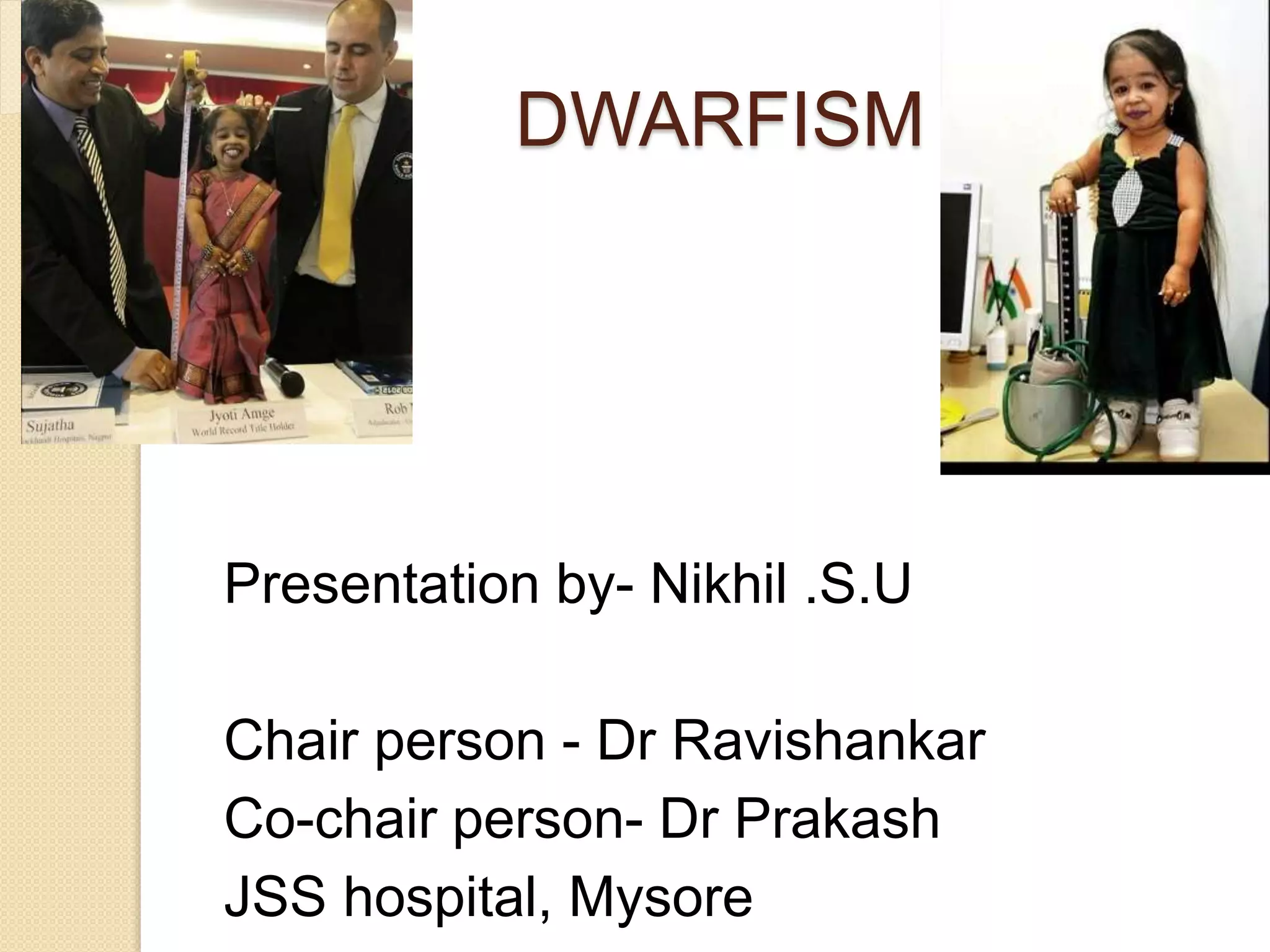
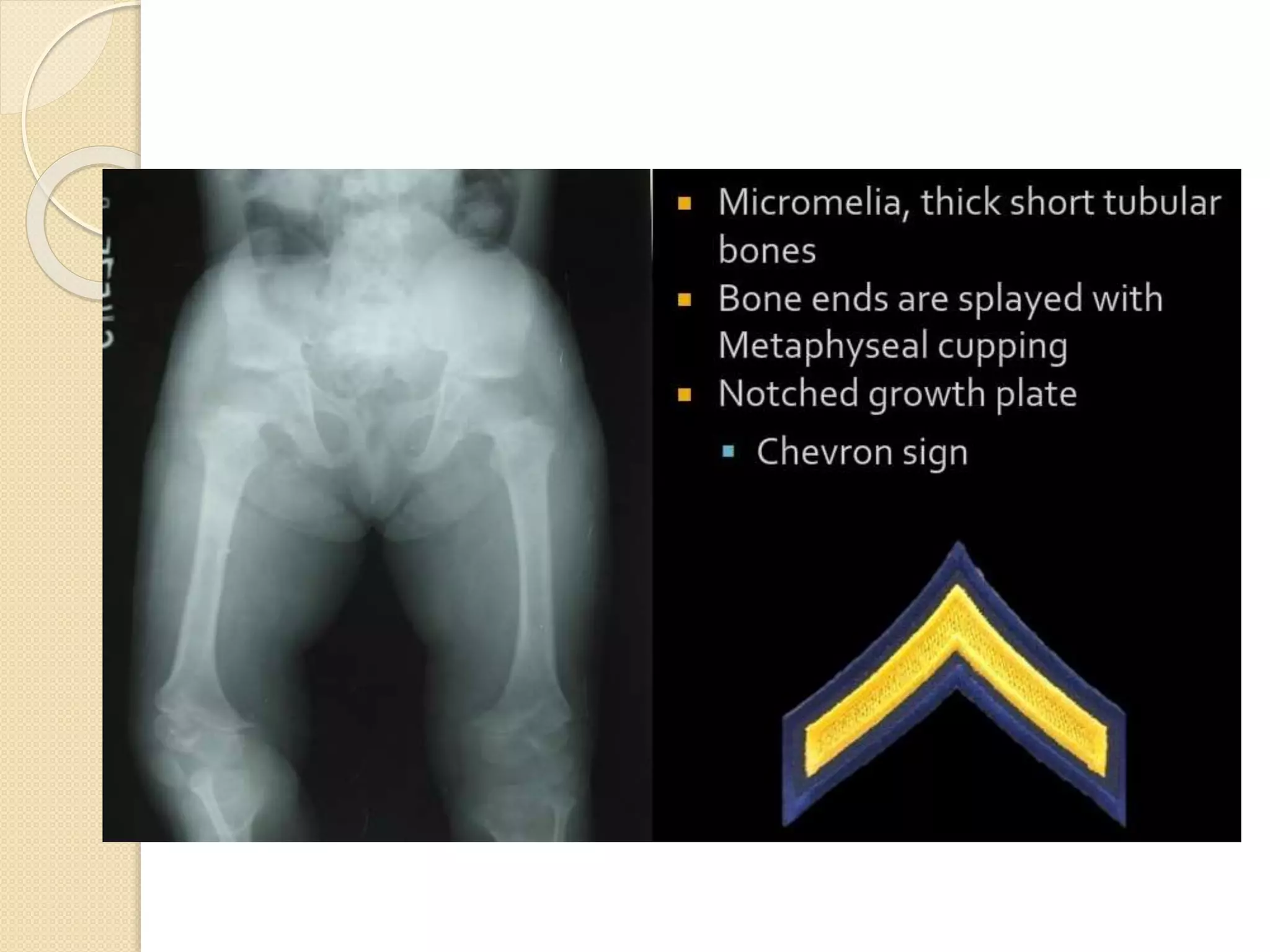
DWARFISM 
Presentation by- Nikhil .S.U 
Chair person - Dr Ravishankar 
Co-chair person- Dr Prakash 
JSS hospital, Mysore
Introduction 
 Bone dysplasias ( Dwarfism) 
 Greek word – Dys- disordered 
Plasia – development 
 Shortening of the growing bones in 
different proportions due to multiple gene 
defects 
 >200 disorders, abnormal growth of 
bones and cartilage 
 Height less than 147cms, <3rd percentile
Classification 
 Proportion 
 Proportionate- symmetric decrease in 
both trunk and limb length. eg-constitutional, 
familial, endocrinopathies, 
mucopolysaccharidoses. 
 Disproportionate dwarfism:- 
1. Short-trunk variety (e.g., Kniest 
syndrome–spondyloepiphyseal) 
2. Short-limb variety (e.g., 
achondroplasia, diastrophic dysplasia)
 Based on location in short limb variety 
rhizomelic = root, e.g., bones of the arm 
or thigh 
mesomelic = middle, e.g., bones of the 
forearm or leg 
acromelic = end, e.g., bones of hands 
and feet. 
micromelic = entire limbs are shortened
 Source 
chondro = of cartilage 
osteo = of bone 
spondylo = of the vertebrae
 Lethal 
Achondrogenesis 
Thanatophoric dysplsia 
Asphyxiating thoracic dysplasia(ATD) 
Dysplasia epiphysealis punctata 
Osteogenesis imperfecta 
 Non leathal 
Majority of dysplasia
Achondroplasia 
 Syn; chondrodystrophia fetalis 
 Most common form of disproportionate 
dwarfism 
 AD 
 Incidence - 1.5 per 10,000 live births. 
 GENETICS 
 Spontaneous mutation in Fibroblast Growth 
Factor Receptor 3(FGFR 3) 
 There is failure in the cartilaginous 
proliferative zone of physis- quantitative 
defect 
 Associated with advanced paternal age
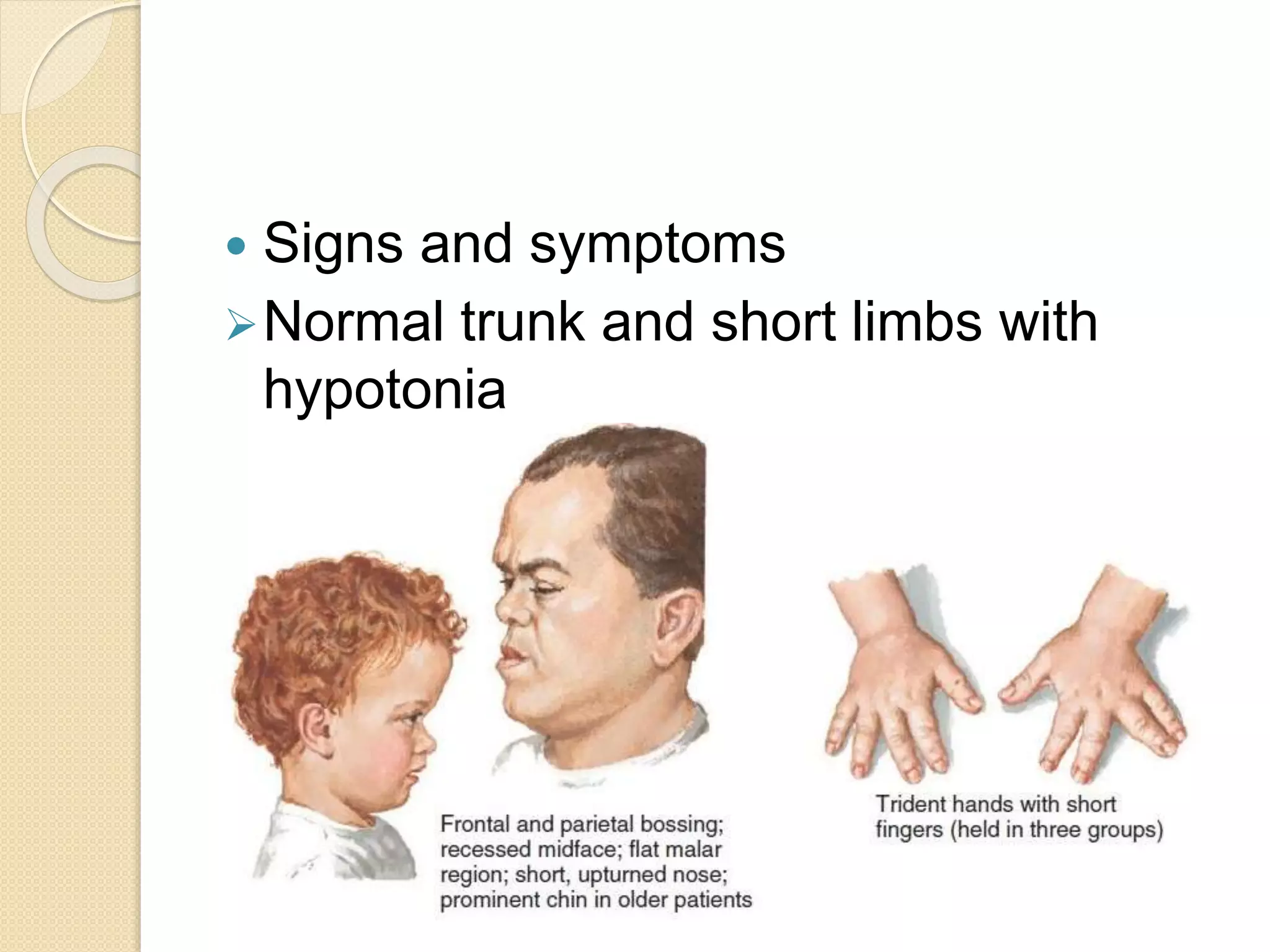
 Signs and symptoms 
Normal trunk and short limbs with 
hypotonia
 Lumbar stenosis & excessive lordosis 
with spinal cord / nerve root 
compression 
 Radial head subluxation 
 Normal intelligence but delayed motor 
milestones
Radiographic findings 
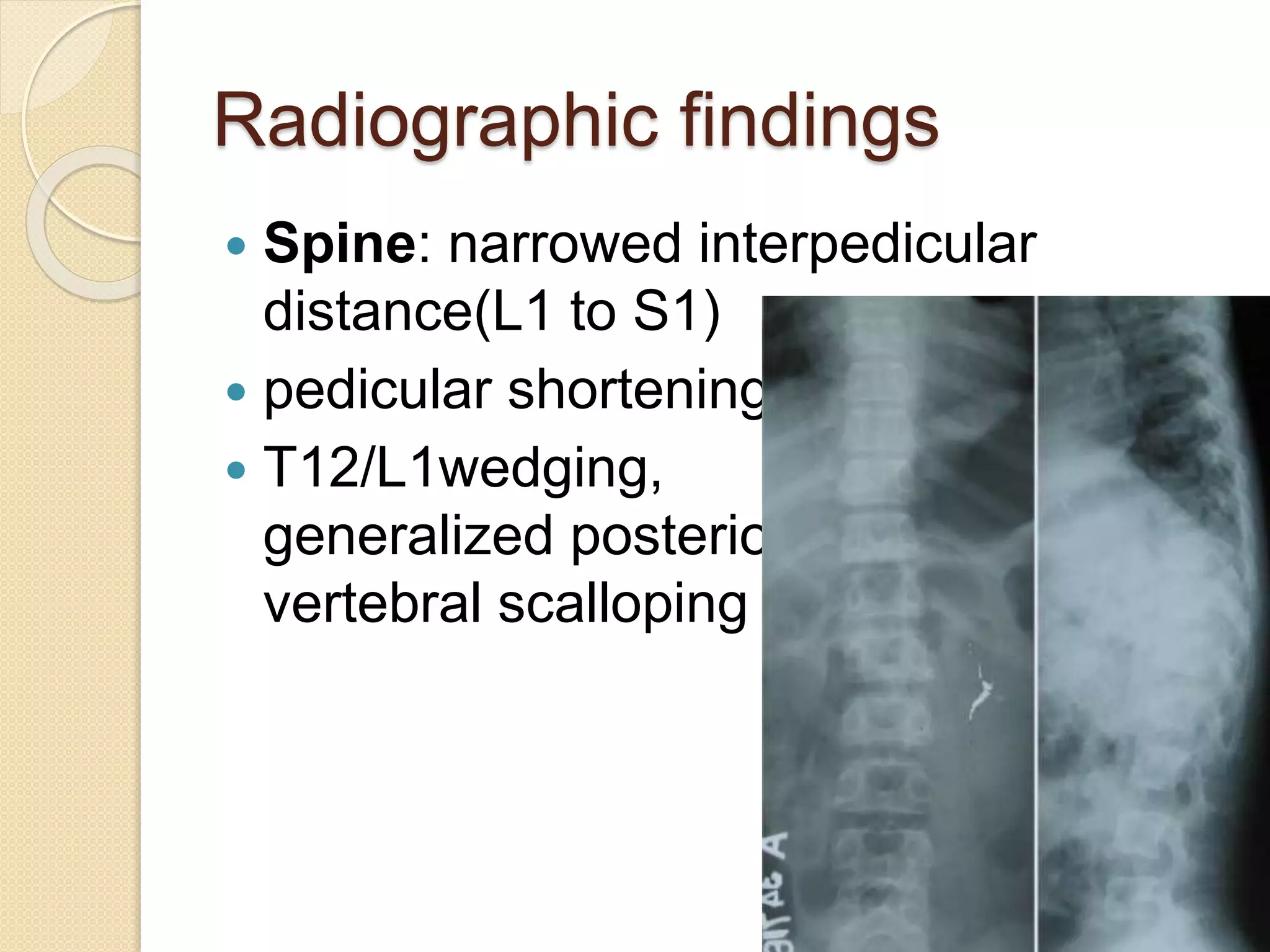
 Spine: narrowed interpedicular 
distance(L1 to S1) 
 pedicular shortening 
 T12/L1wedging, 
generalized posterior 
vertebral scalloping
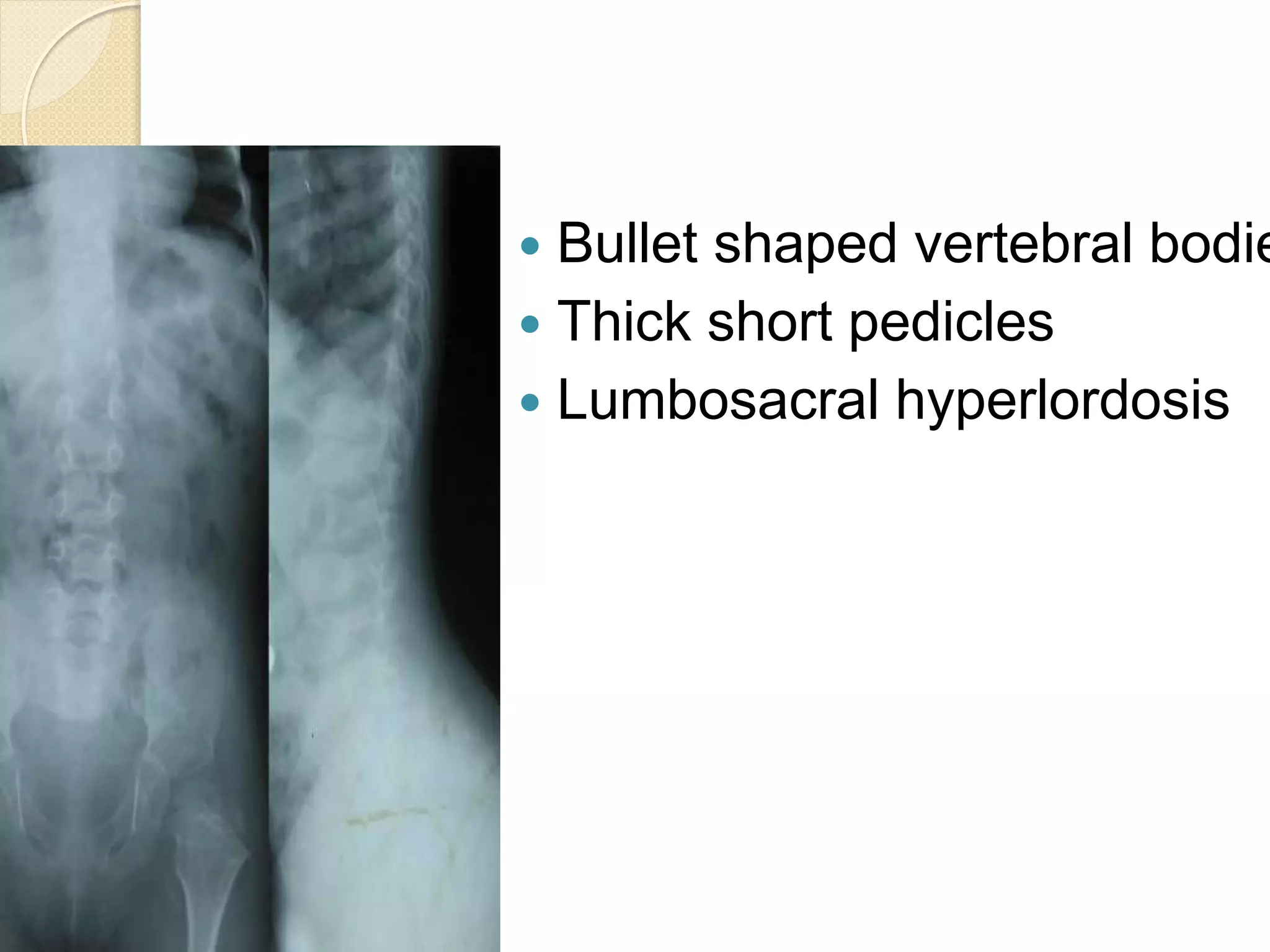
 Bullet shaped vertebral bodies 
 Thick short pedicles 
 Lumbosacral hyperlordosis
Treatment 
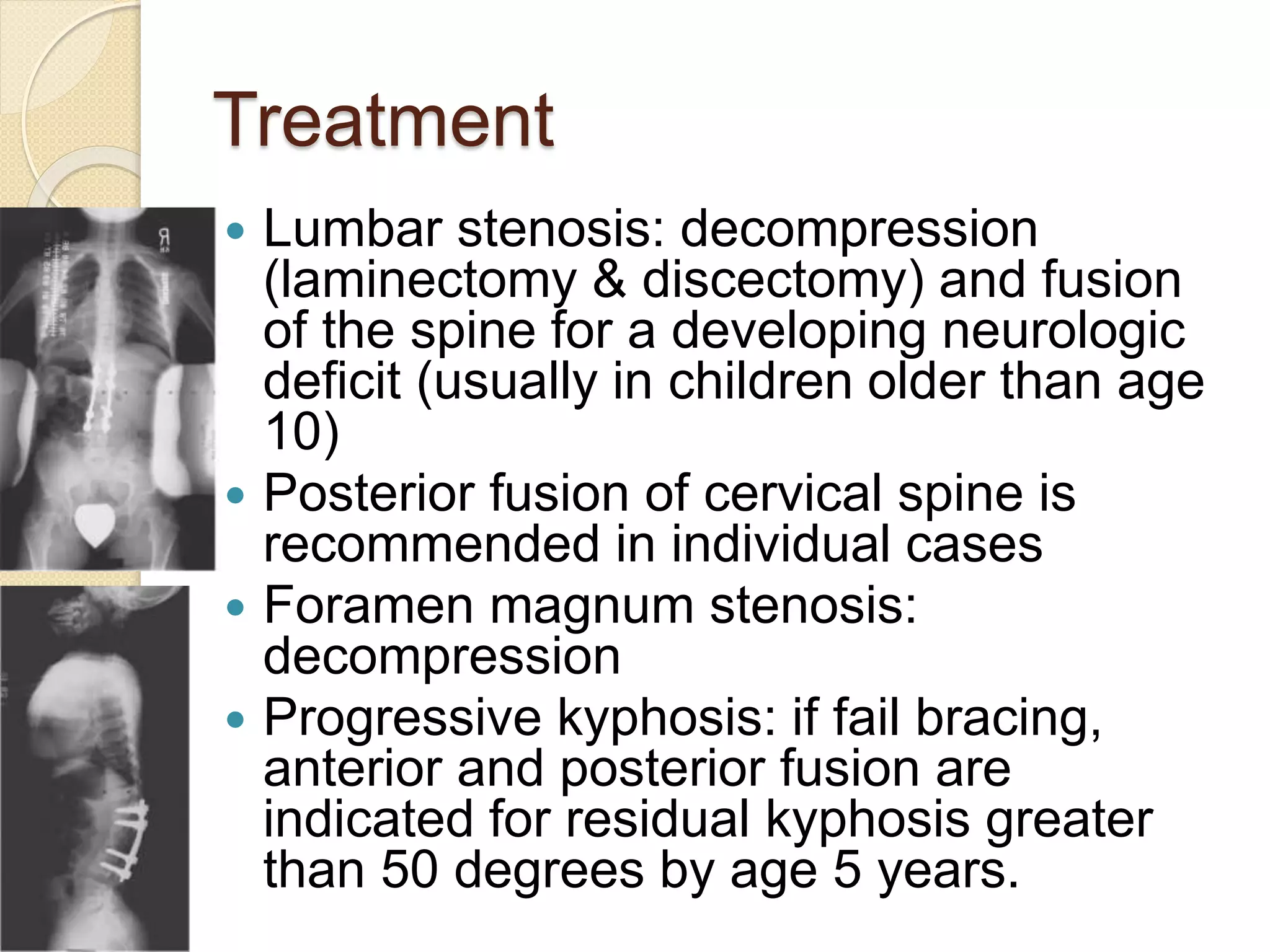
 Lumbar stenosis: decompression 
(laminectomy & discectomy) and fusion 
of the spine for a developing neurologic 
deficit (usually in children older than age 
10) 
 Posterior fusion of cervical spine is 
recommended in individual cases 
 Foramen magnum stenosis: 
decompression 
 Progressive kyphosis: if fail bracing, 
anterior and posterior fusion are 
indicated for residual kyphosis greater 
than 50 degrees by age 5 years.
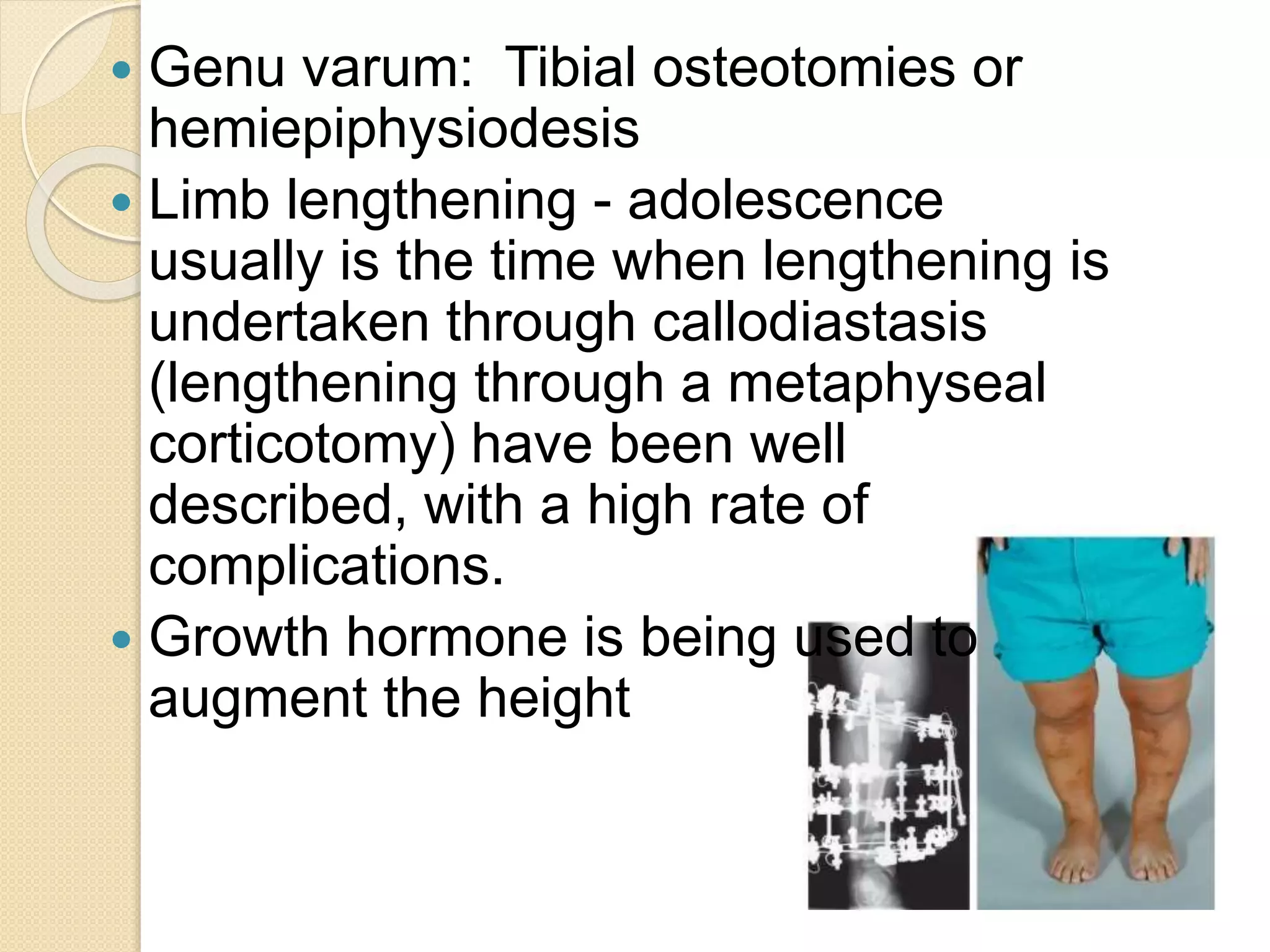
 Genu varum: Tibial osteotomies or 
hemiepiphysiodesis 
 Limb lengthening - adolescence 
usually is the time when lengthening is 
undertaken through callodiastasis 
(lengthening through a metaphyseal 
corticotomy) have been well 
described, with a high rate of 
complications. 
 Growth hormone is being used to 
augment the height
SPONDYLOEPIPHYSEAL 
DYSPLASIA 
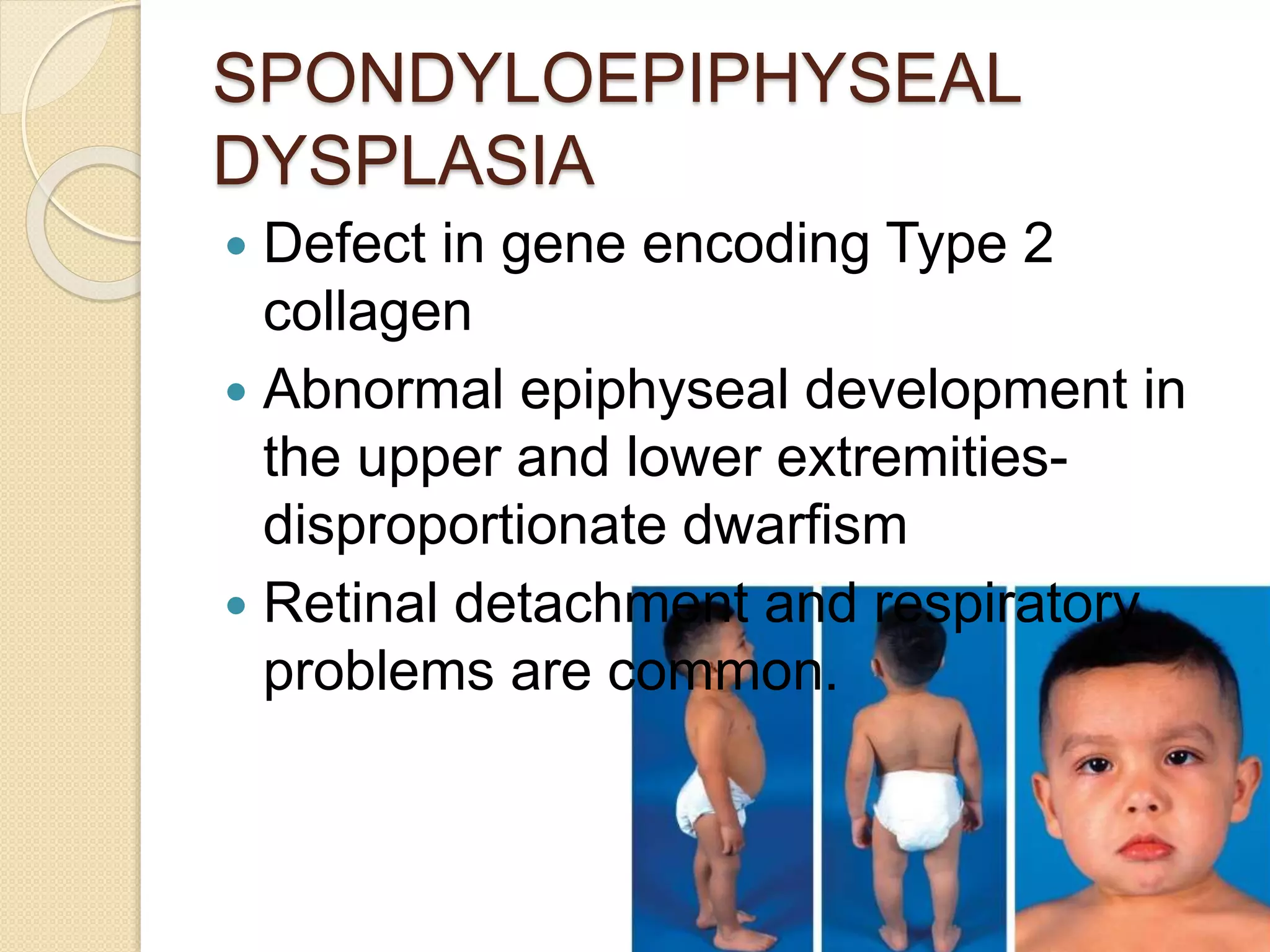
 Defect in gene encoding Type 2 
collagen 
 Abnormal epiphyseal development in 
the upper and lower extremities-disproportionate 
dwarfism 
 Retinal detachment and respiratory 
problems are common.
 Eyes are wide-set, the neck is short, 
and the chest appears barrel shaped. 
 Genu valgum, is common. 
 Lumbar lordosis may be accentuated 
and is usually due to hip flexion 
contractures. The lordosis gives the 
abdomen a protuberant appearance. 
 A waddling gait is produced by the 
coxa vara
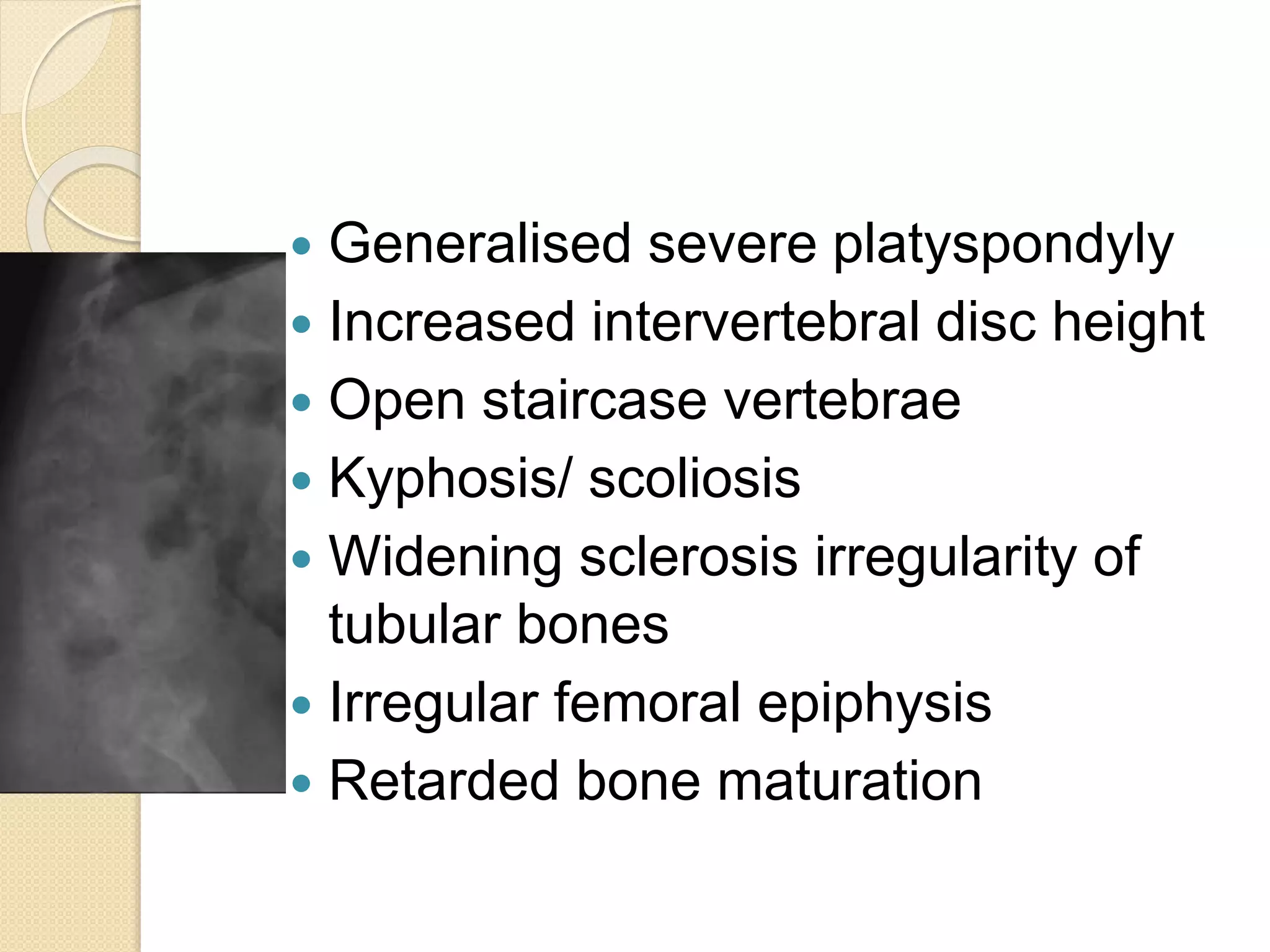
 Generalised severe platyspondyly 
 Increased intervertebral disc height 
 Open staircase vertebrae 
 Kyphosis/ scoliosis 
 Widening sclerosis irregularity of 
tubular bones 
 Irregular femoral epiphysis 
 Retarded bone maturation
Treatment 
 In case of cervical instability- posterior 
cervical fusion from the occiput or C1 
to C2 with halo vest immobilization is 
necessary 
 When the scoliosis exceeds 50 
degrees or is associated with 
significant kyphosis, fusion with 
standard instrumentation is effective
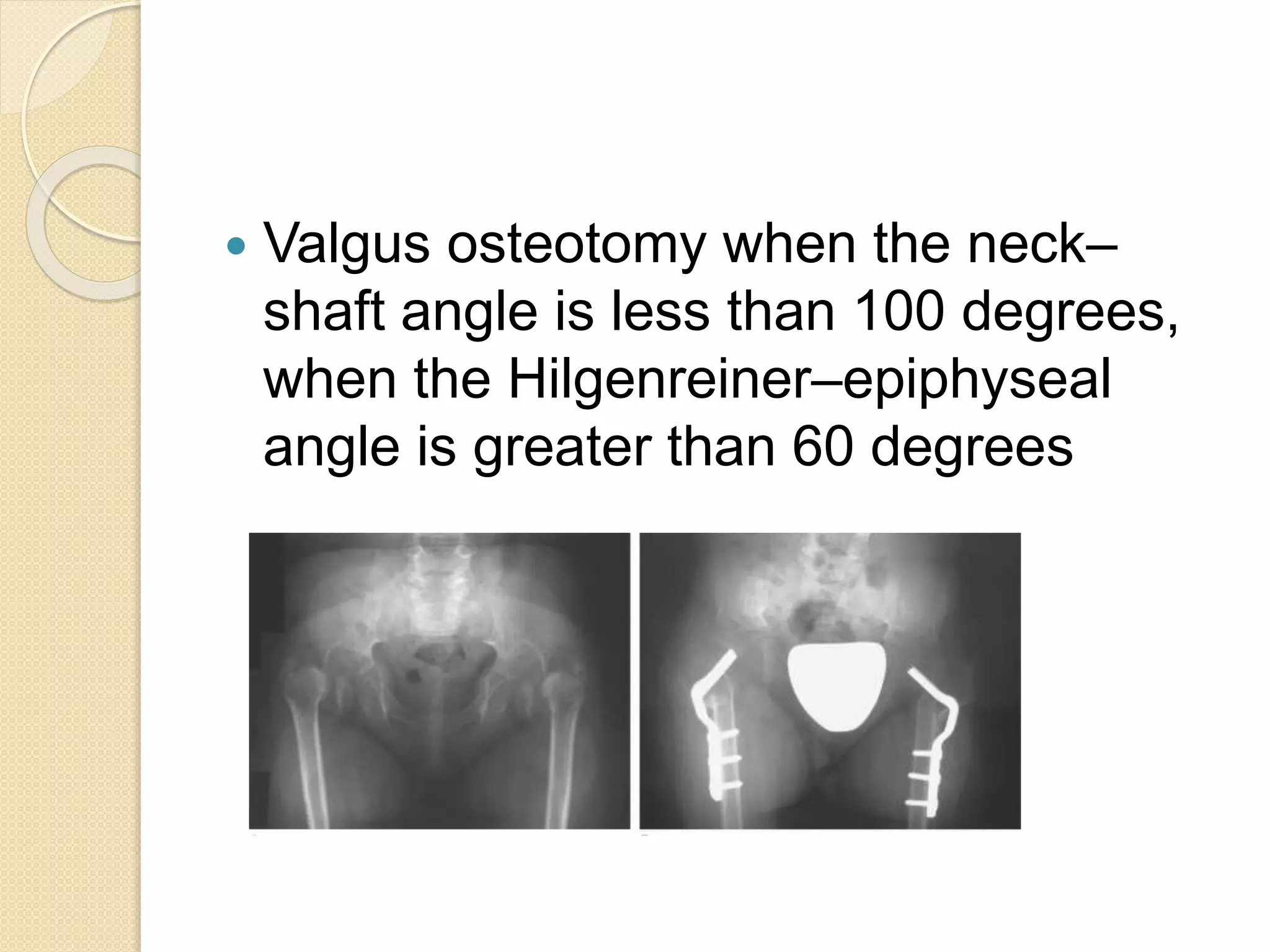
 Valgus osteotomy when the neck– 
shaft angle is less than 100 degrees, 
when the Hilgenreiner–epiphyseal 
angle is greater than 60 degrees
CHONDRODYSPLASIA 
PUNCTATA 
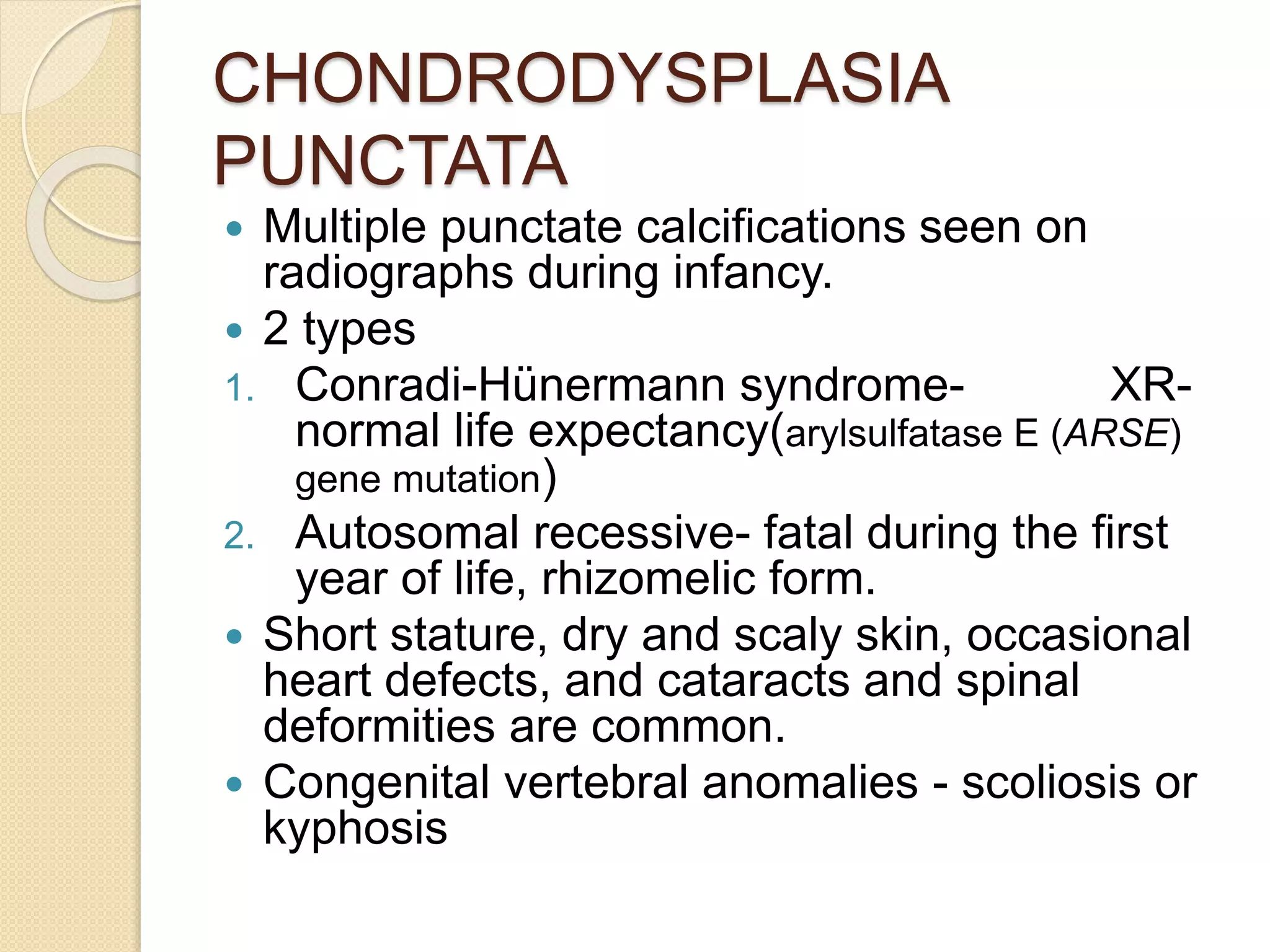
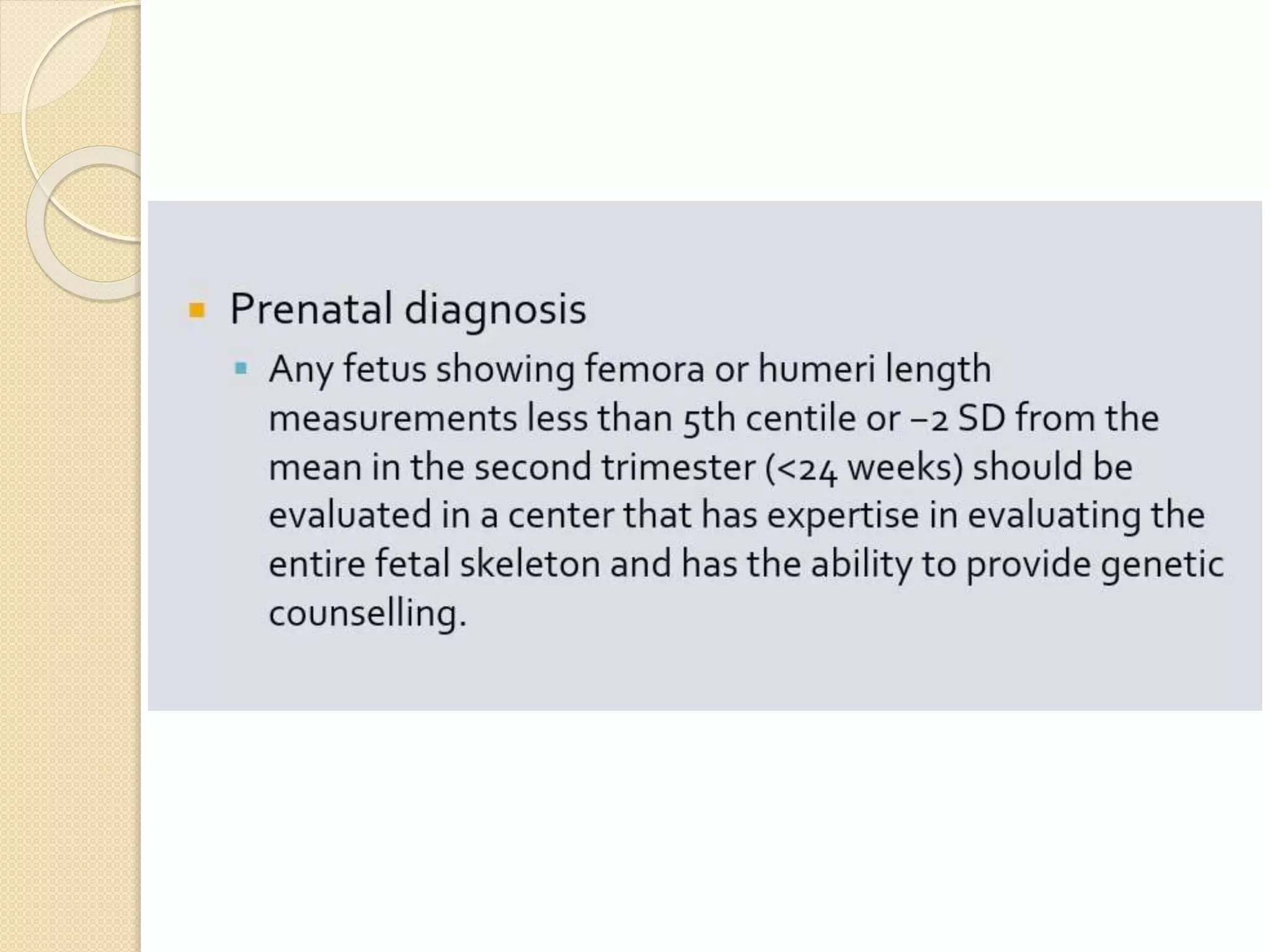
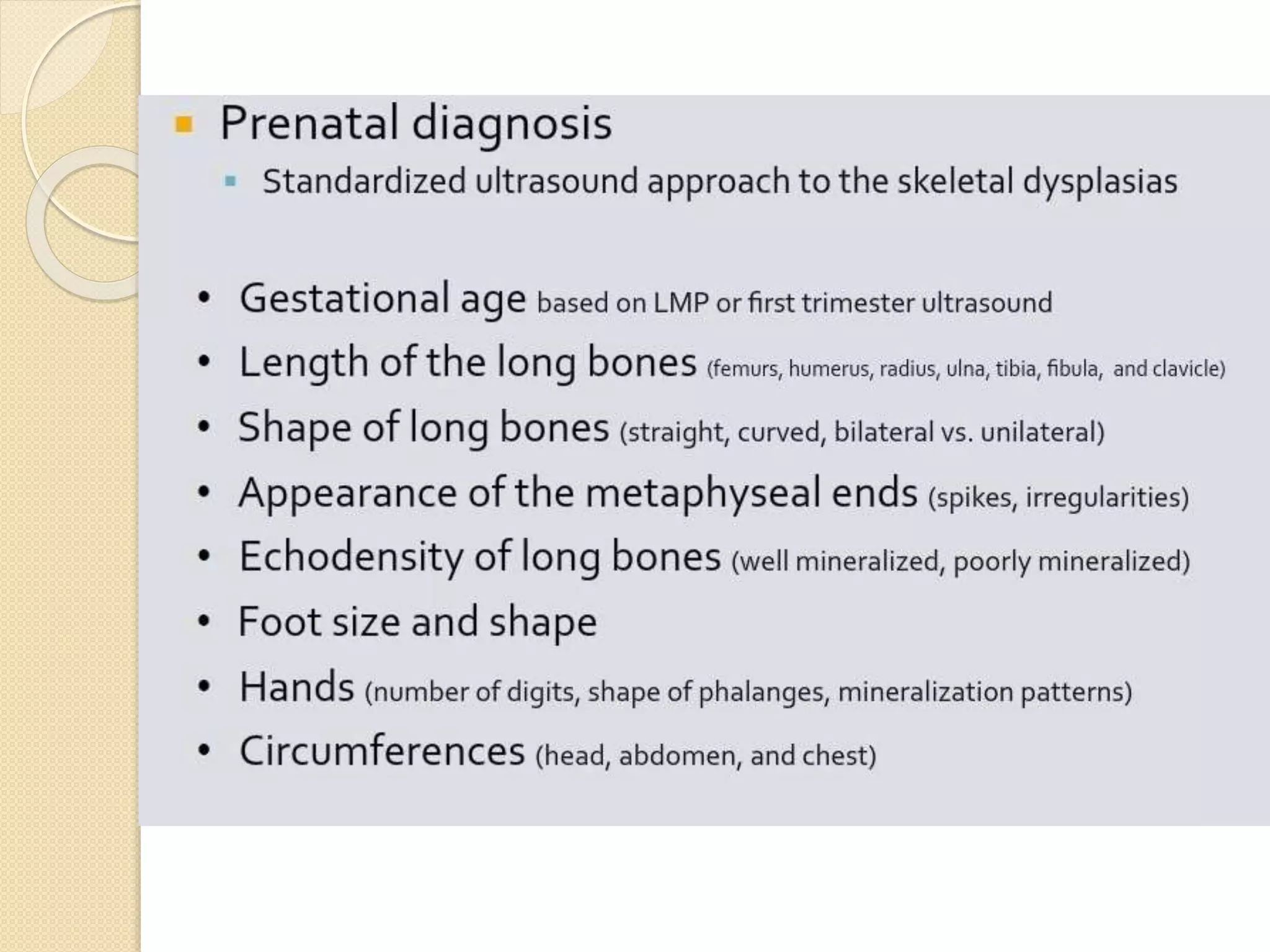
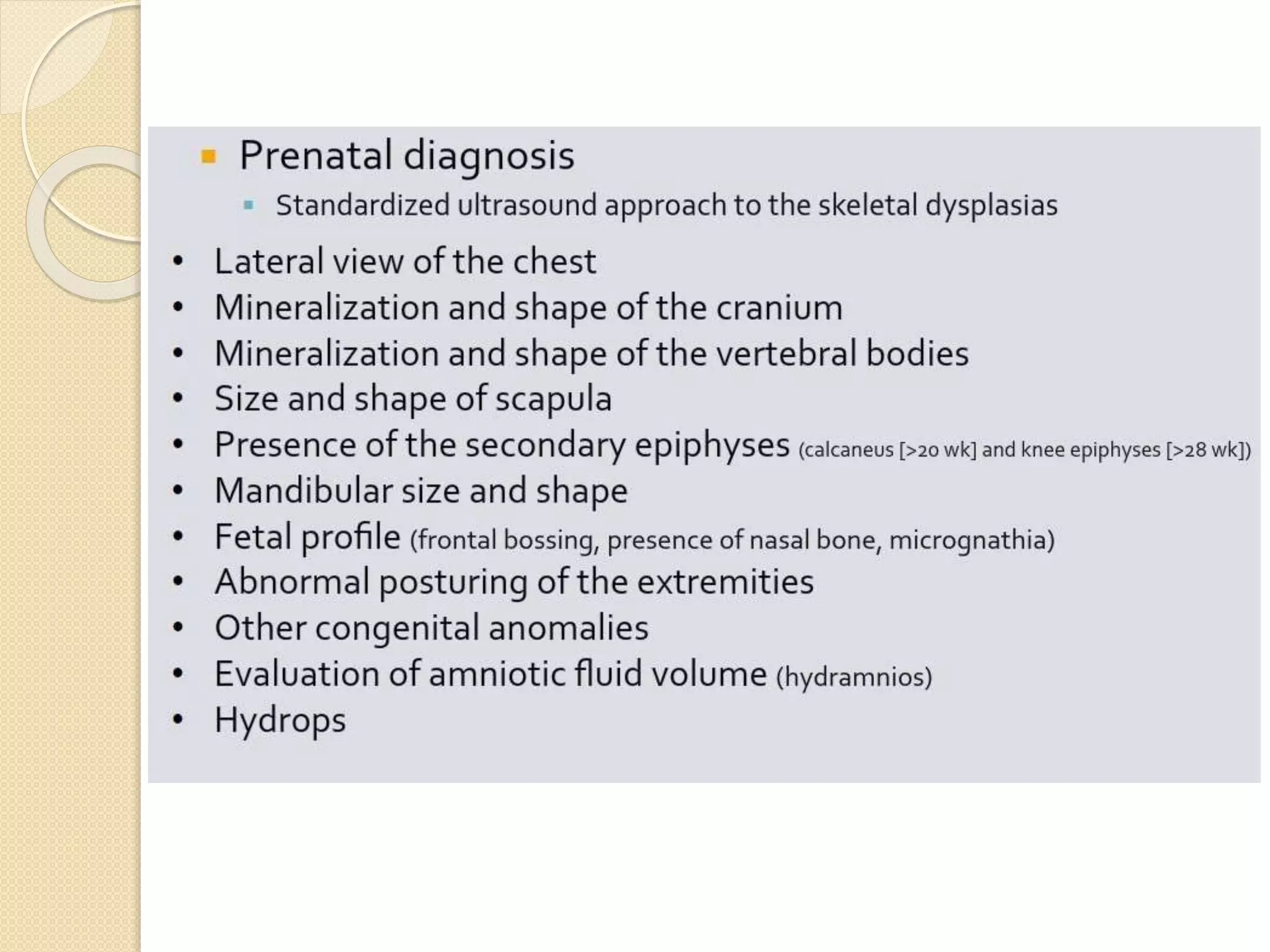
 Multiple punctate calcifications seen on 
radiographs during infancy. 
 2 types 
1. Conradi-Hünermann syndrome- XR-normal 
life expectancy(arylsulfatase E (ARSE) 
gene mutation) 
2. Autosomal recessive- fatal during the first 
year of life, rhizomelic form. 
 Short stature, dry and scaly skin, occasional 
heart defects, and cataracts and spinal 
deformities are common. 
 Congenital vertebral anomalies - scoliosis or 
kyphosis
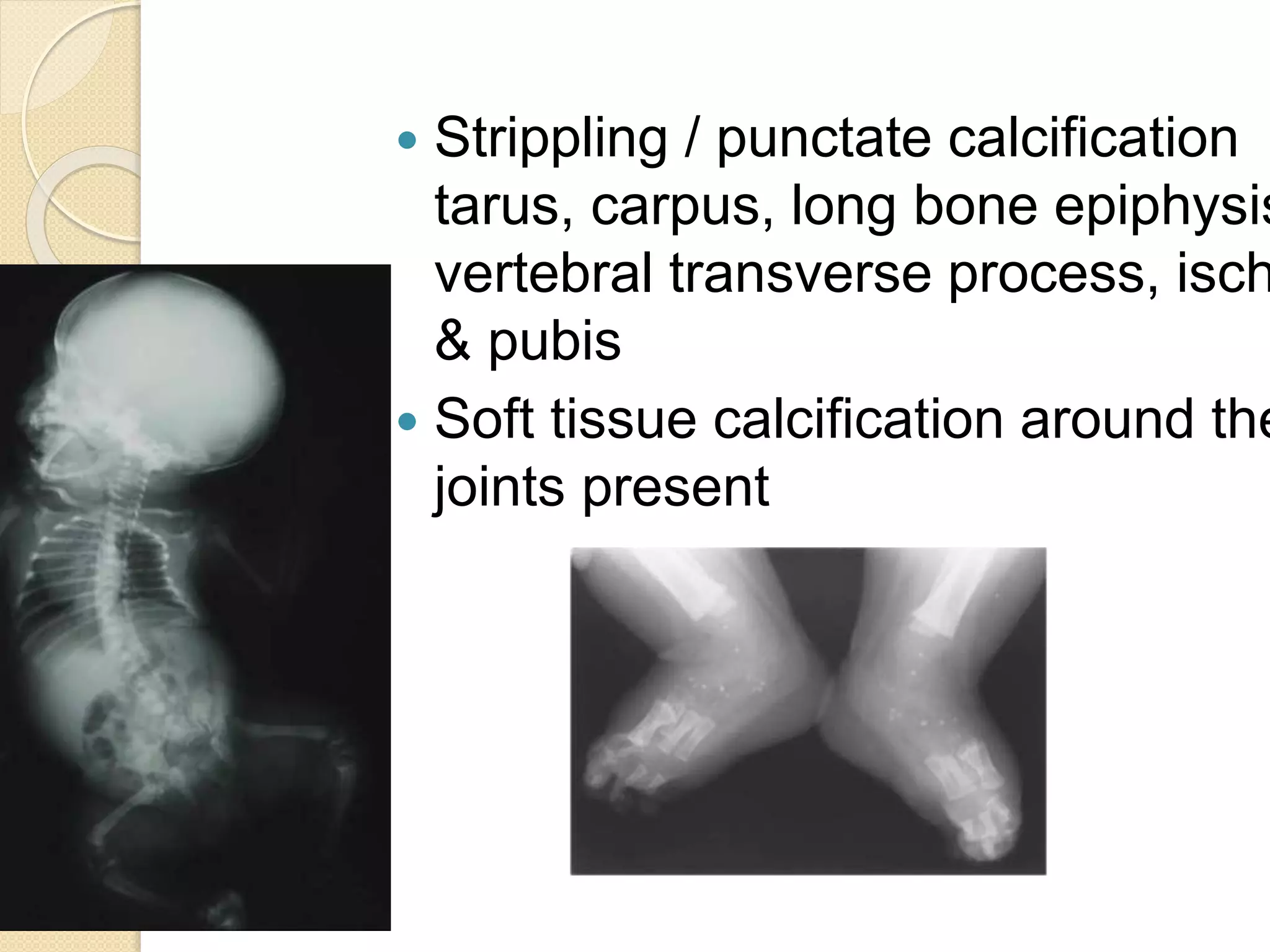
 Strippling / punctate calcification 
tarus, carpus, long bone epiphysis, 
vertebral transverse process, ischium 
& pubis 
 Soft tissue calcification around the 
joints present
Treatment 
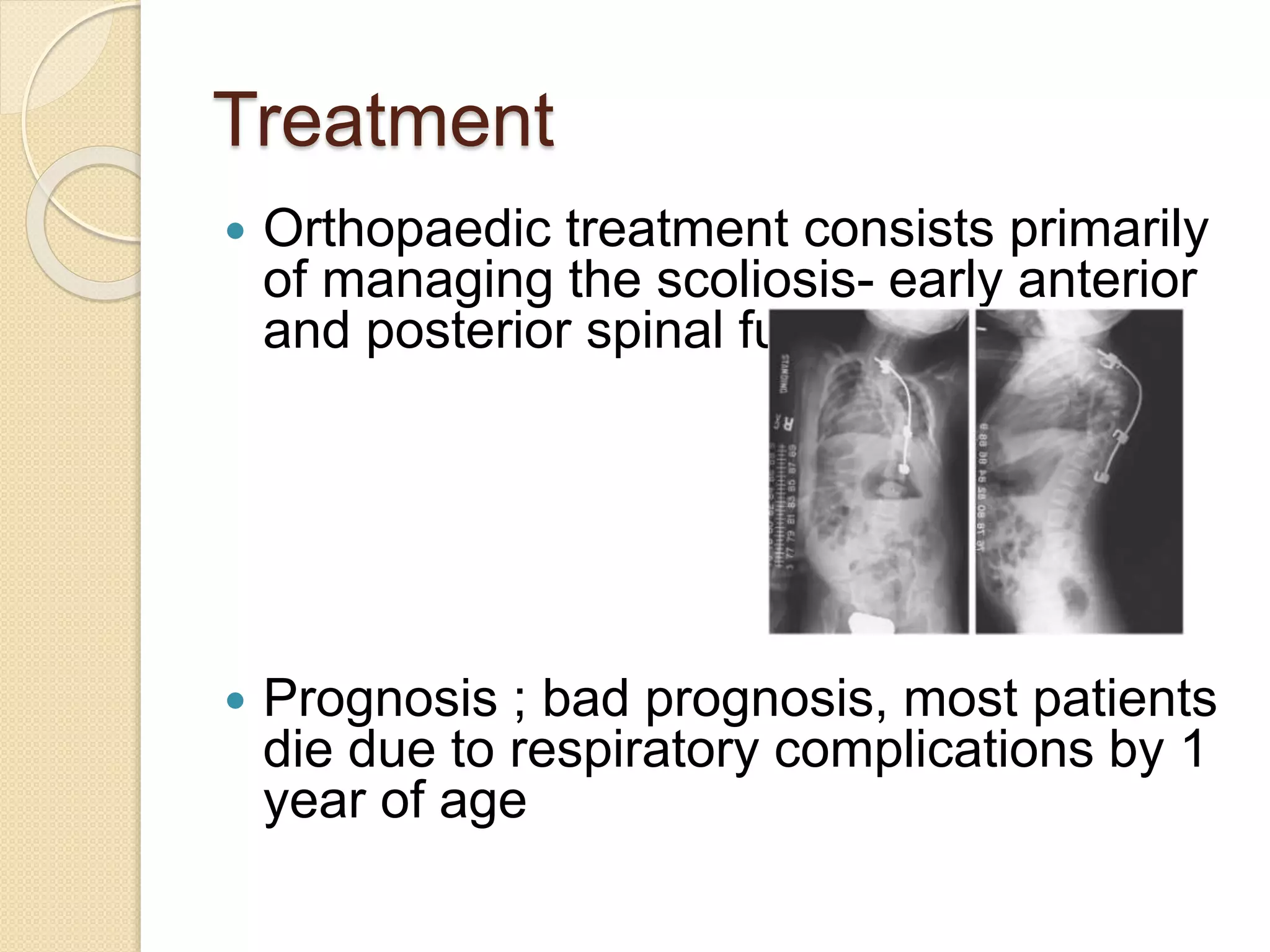
 Orthopaedic treatment consists primarily 
of managing the scoliosis- early anterior 
and posterior spinal fusion 
 Prognosis ; bad prognosis, most patients 
die due to respiratory complications by 1 
year of age
KNIEST SYNDROME 
 Defect in COL2A1 gene 
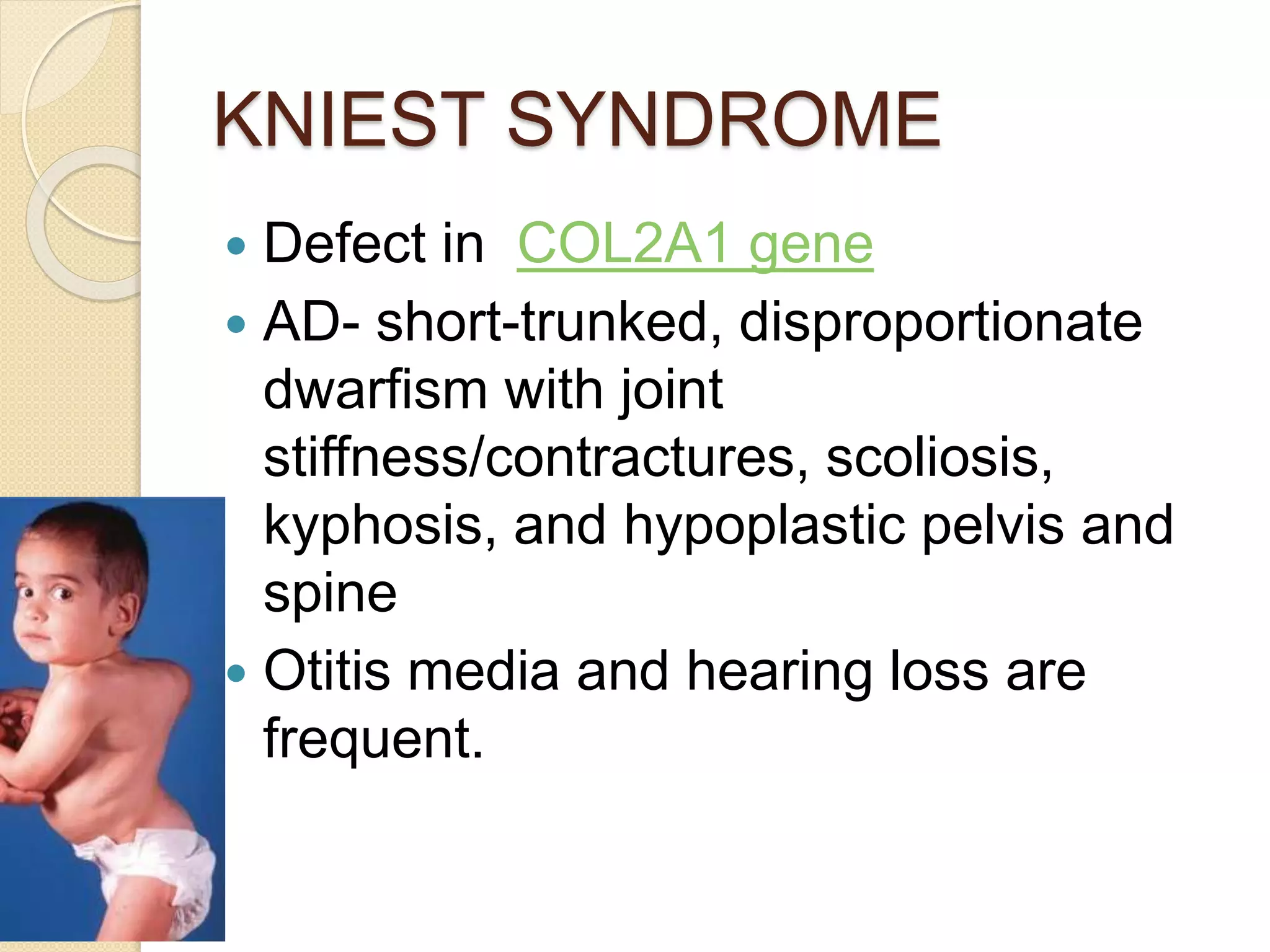
 AD- short-trunked, disproportionate 
dwarfism with joint 
stiffness/contractures, scoliosis, 
kyphosis, and hypoplastic pelvis and 
spine 
 Otitis media and hearing loss are 
frequent.
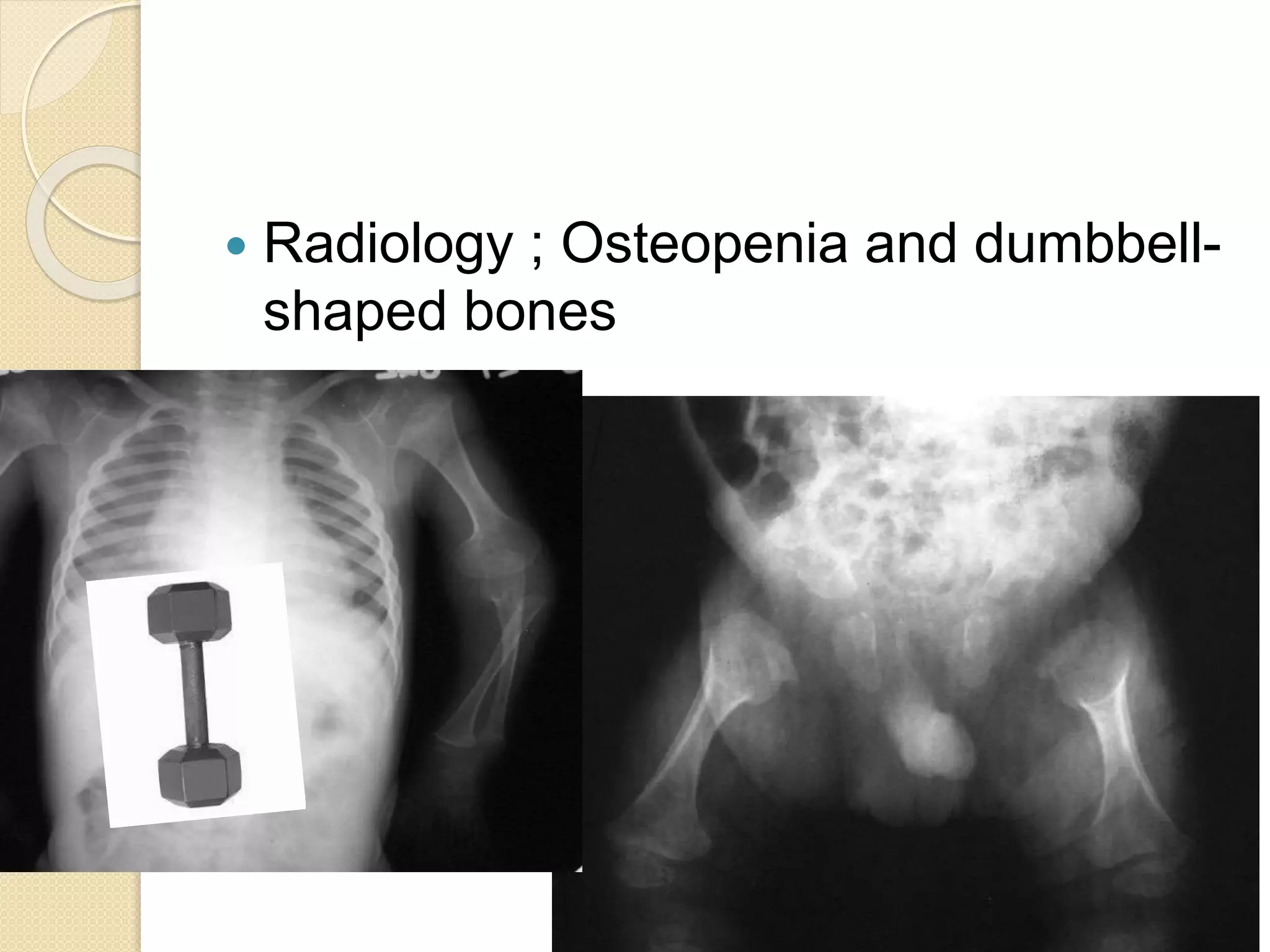
 Radiology ; Osteopenia and dumbbell-shaped 
bones
 Treatment ; 
Early therapy for joint contractures, 
Reconstructive procedures for early 
hip degenerative arthritis 
Correction of the spinal deformity
METAPHYSEAL 
CHONDRODYSPLASIA 
 Heterogeneous group of disorders 
characterized by metaphyseal 
changes of tubular bones with normal 
epiphyses 
 Defect in the proliferative and 
hypertrophic zones of the physis
Types
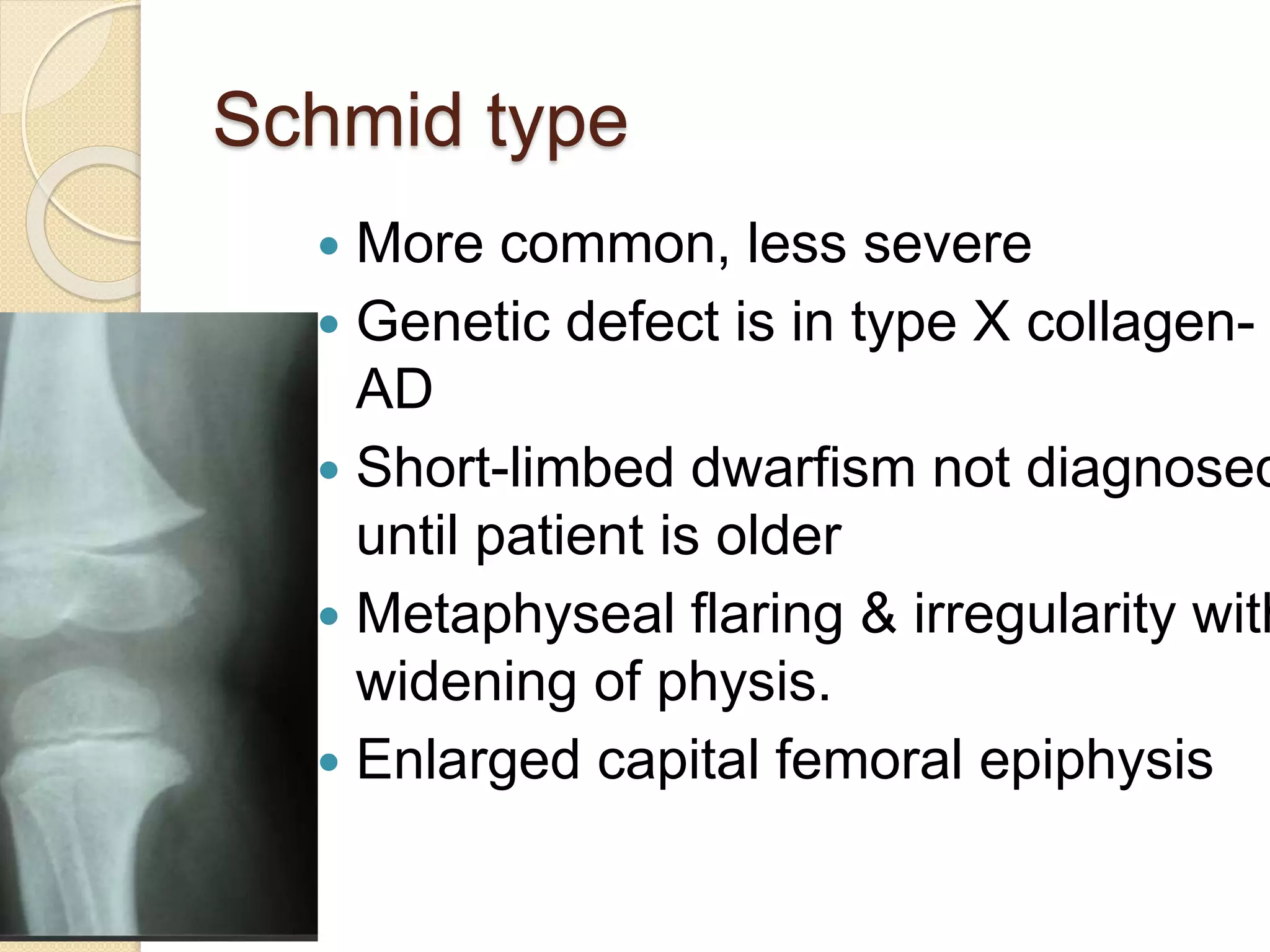
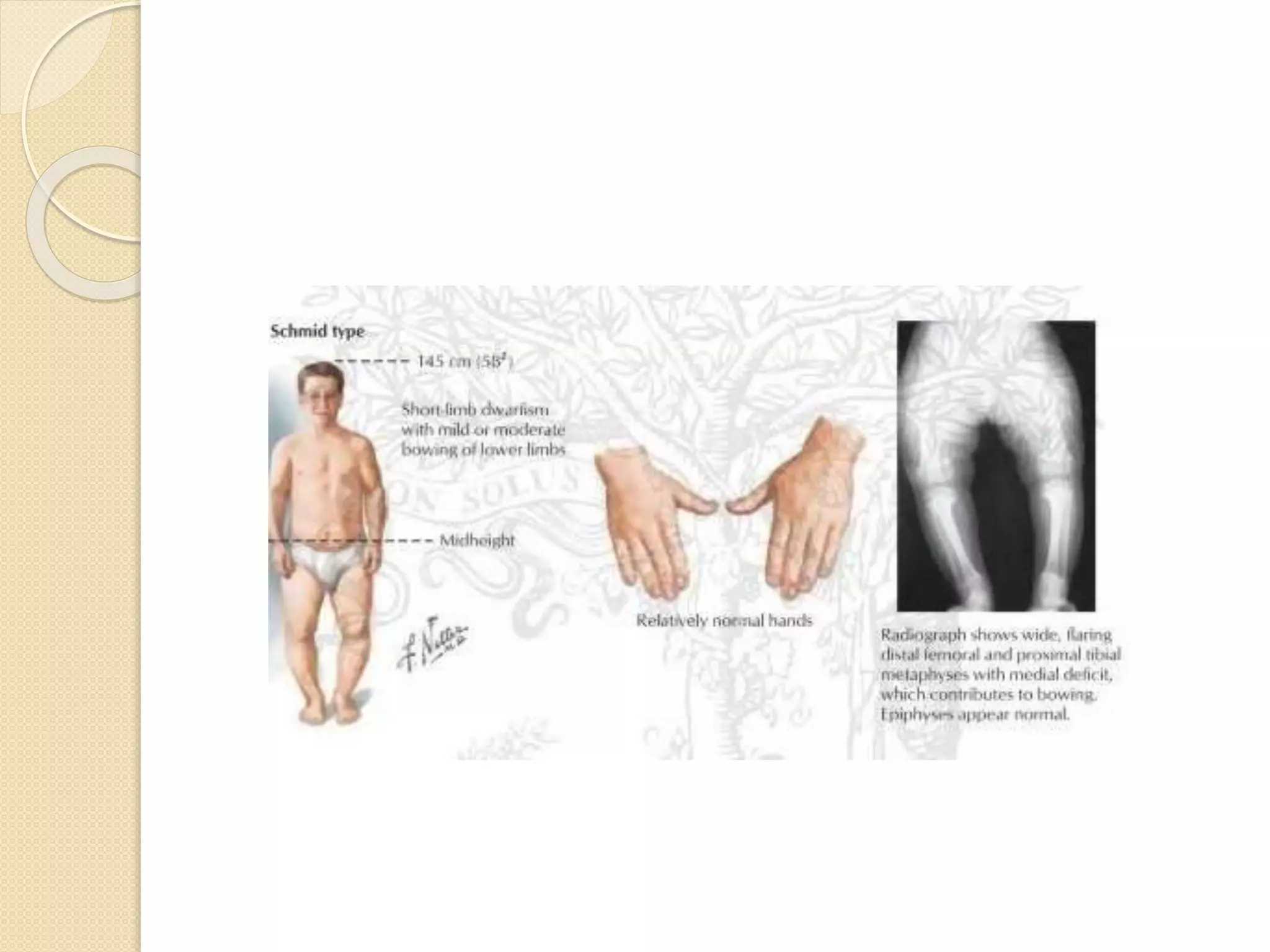
Schmid type 
 More common, less severe 
 Genetic defect is in type X collagen- 
AD 
 Short-limbed dwarfism not diagnosed 
until patient is older 
 Metaphyseal flaring & irregularity with 
widening of physis. 
 Enlarged capital femoral epiphysis
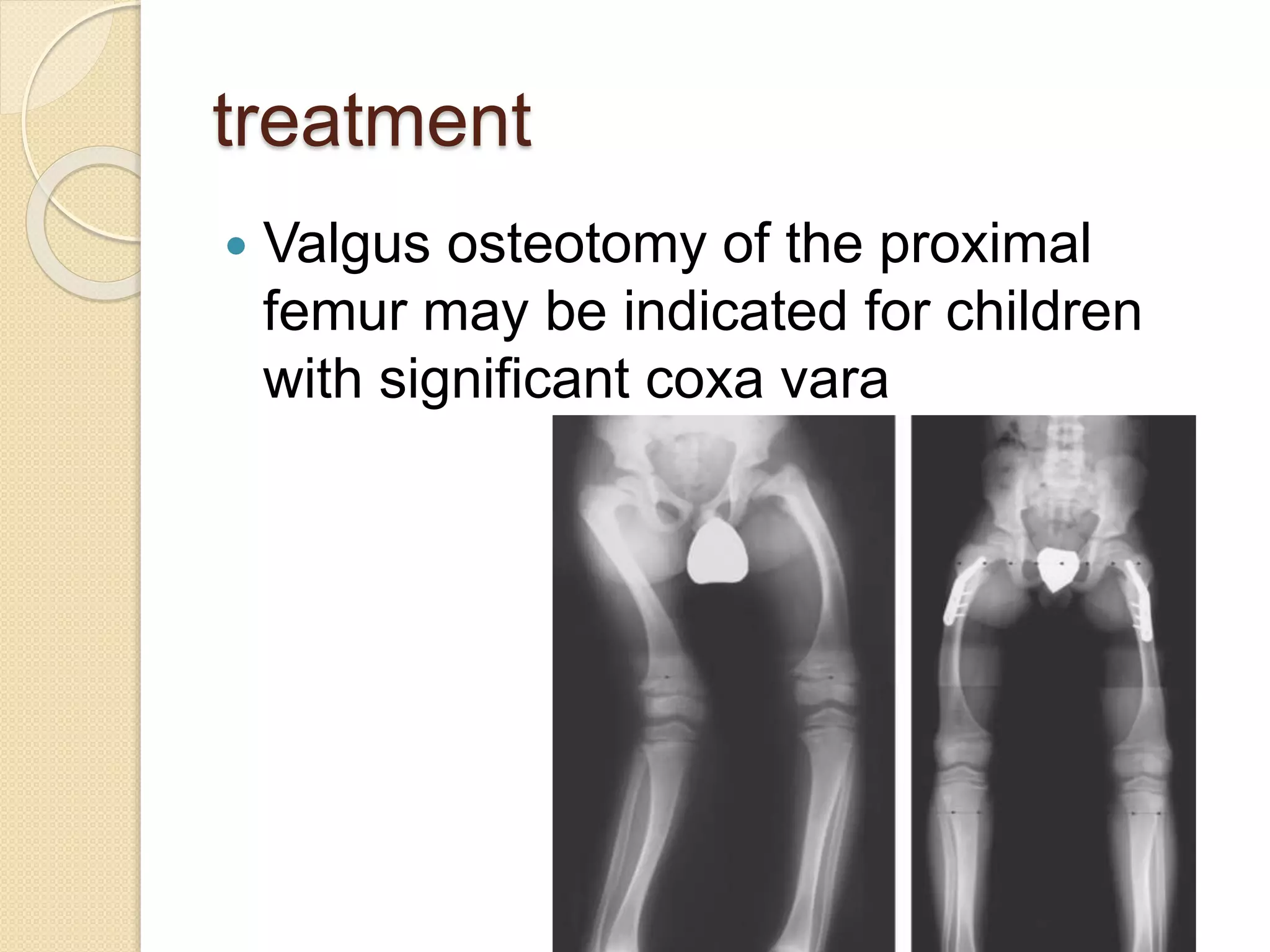
treatment 
 Valgus osteotomy of the proximal 
femur may be indicated for children 
with significant coxa vara
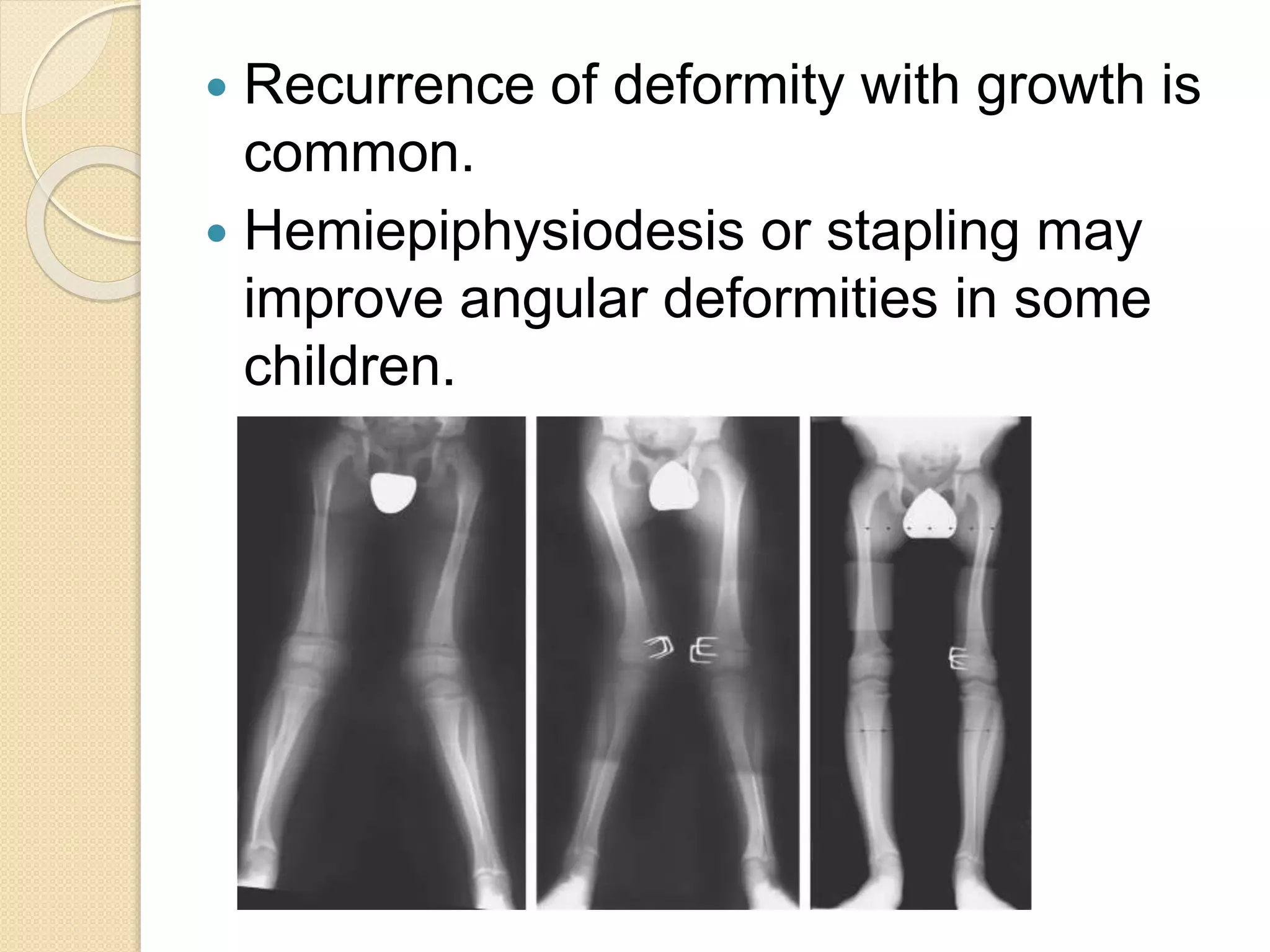
 Recurrence of deformity with growth is 
common. 
 Hemiepiphysiodesis or stapling may 
improve angular deformities in some 
children.
Jansen type 
 Rare and most severe- AD 
 Genetic defect in parathyroid 
hormone–related peptide 
 Retardation, markedly short-limbed 
dwarfism with wide eyes, monkey-like 
stance, and hypercalcemia 
 x ray shows triking bulbous 
metaphyseal expansion of long bones
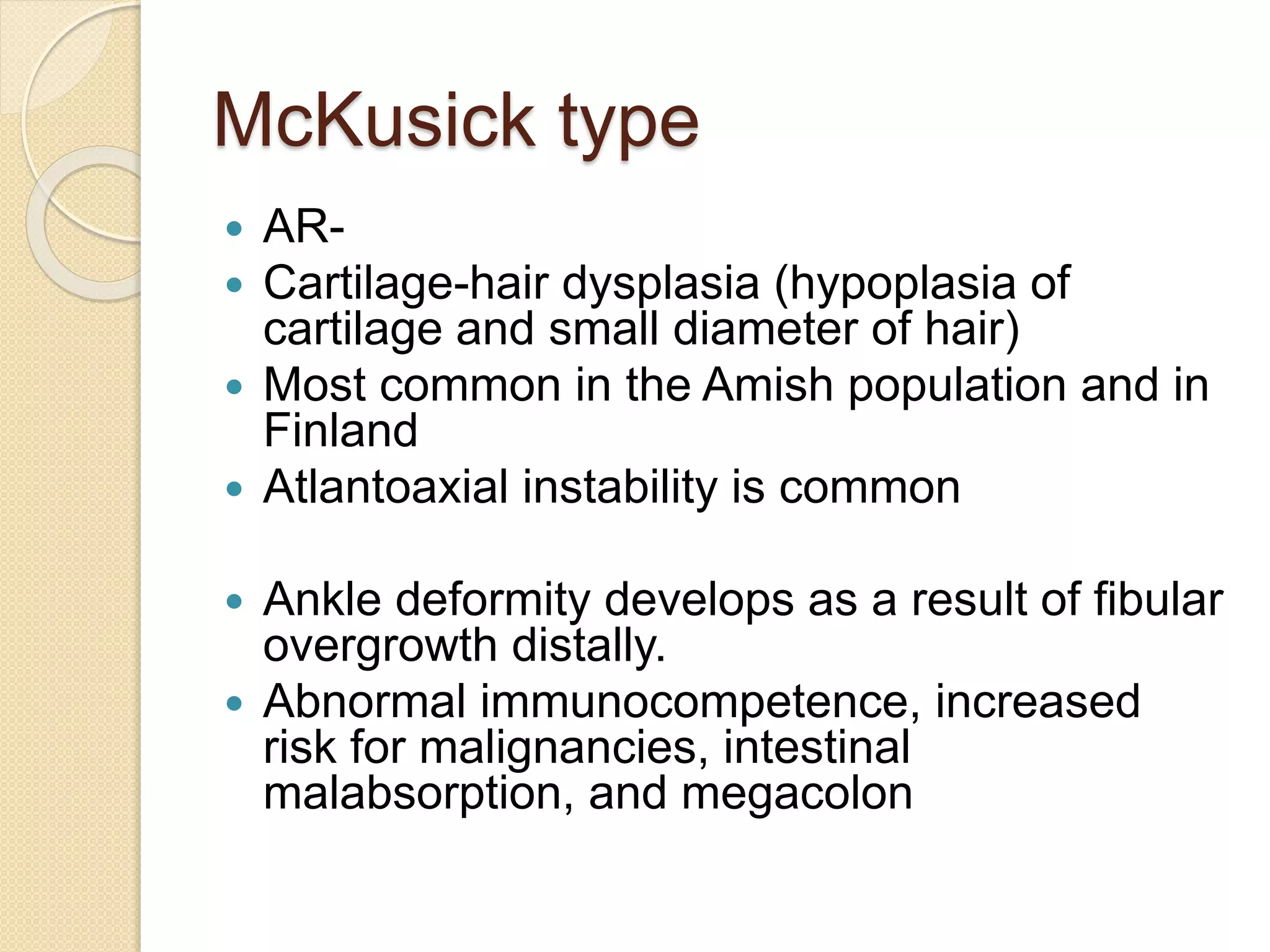
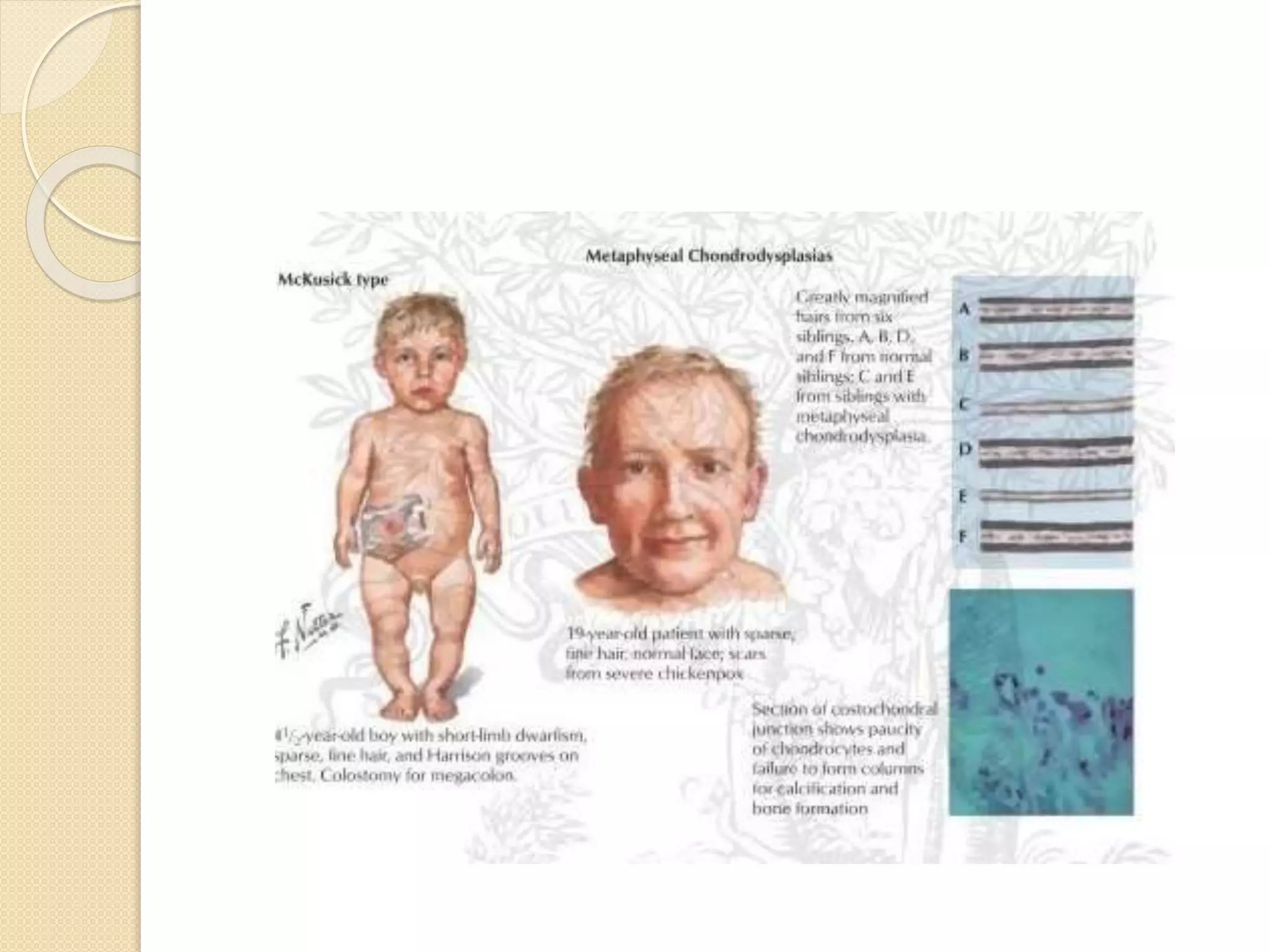
McKusick type 
 AR- 
 Cartilage-hair dysplasia (hypoplasia of 
cartilage and small diameter of hair) 
 Most common in the Amish population and in 
Finland 
 Atlantoaxial instability is common 
 Ankle deformity develops as a result of fibular 
overgrowth distally. 
 Abnormal immunocompetence, increased 
risk for malignancies, intestinal 
malabsorption, and megacolon
treatment 
 Orthopaedic treatment is usually 
directed toward the ankle and foot-calcaneal 
sliding osteotomy as 
treatment for hindfoot varus 
 Growth hormone has recently been 
used
MULTIPLE EPIPHYSEAL 
DYSPLASIA 
 COMP gene mutation(Cartilage 
oligomeric matrix protein ) 
 Prevalence of MED was 9 per 100,000 
 Short-limbed, disproportionate 
dwarfism often not manifested until 
between the ages of 5 and 14. 
 A mild form (Ribbing) and a more 
severe form (Fairbanks) exist 
 Waddling gait, and early hip arthritis 
are common
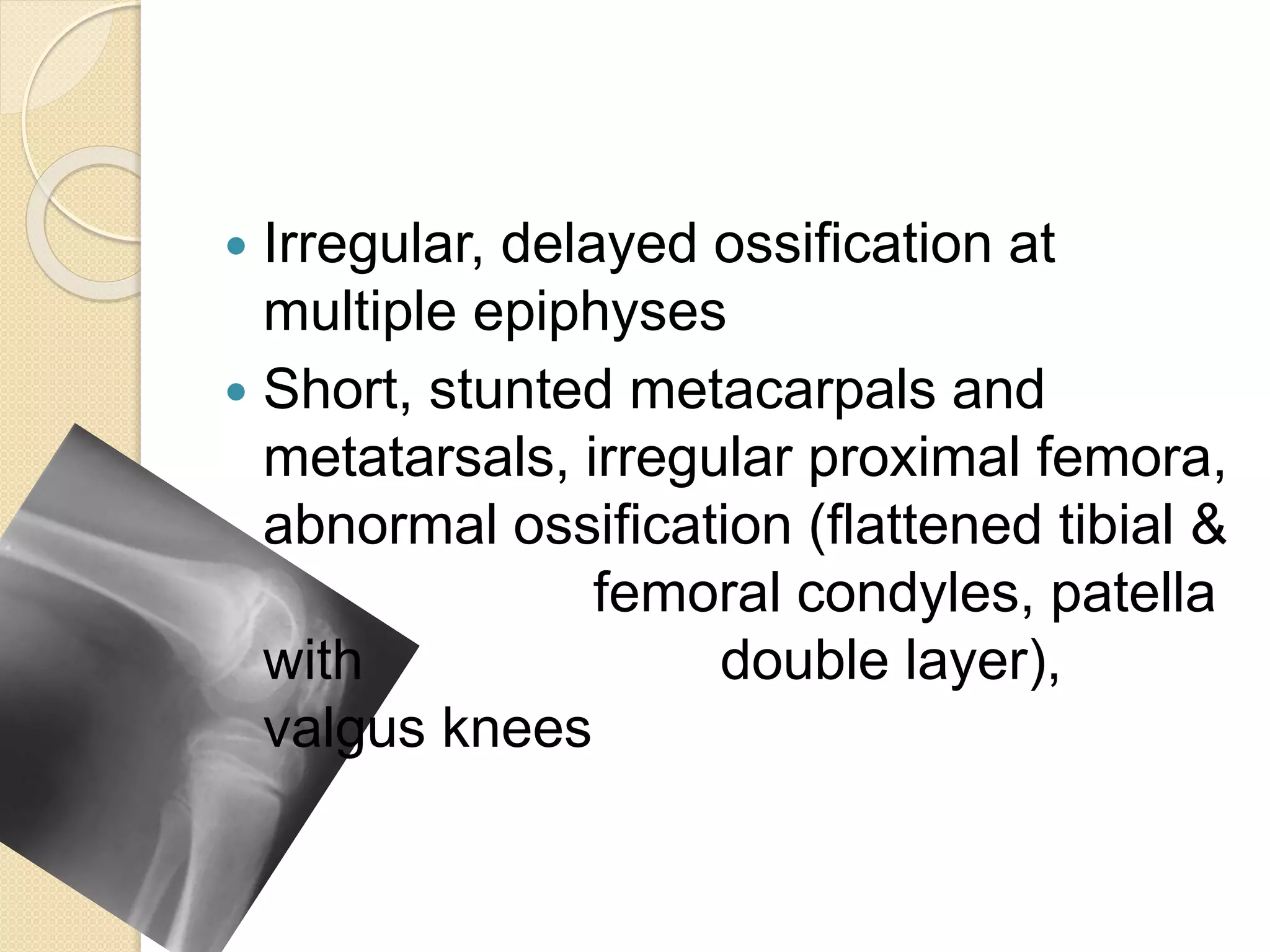
 Irregular, delayed ossification at 
multiple epiphyses 
 Short, stunted metacarpals and 
metatarsals, irregular proximal femora, 
abnormal ossification (flattened tibial & 
femoral condyles, patella 
with double layer), 
valgus knees
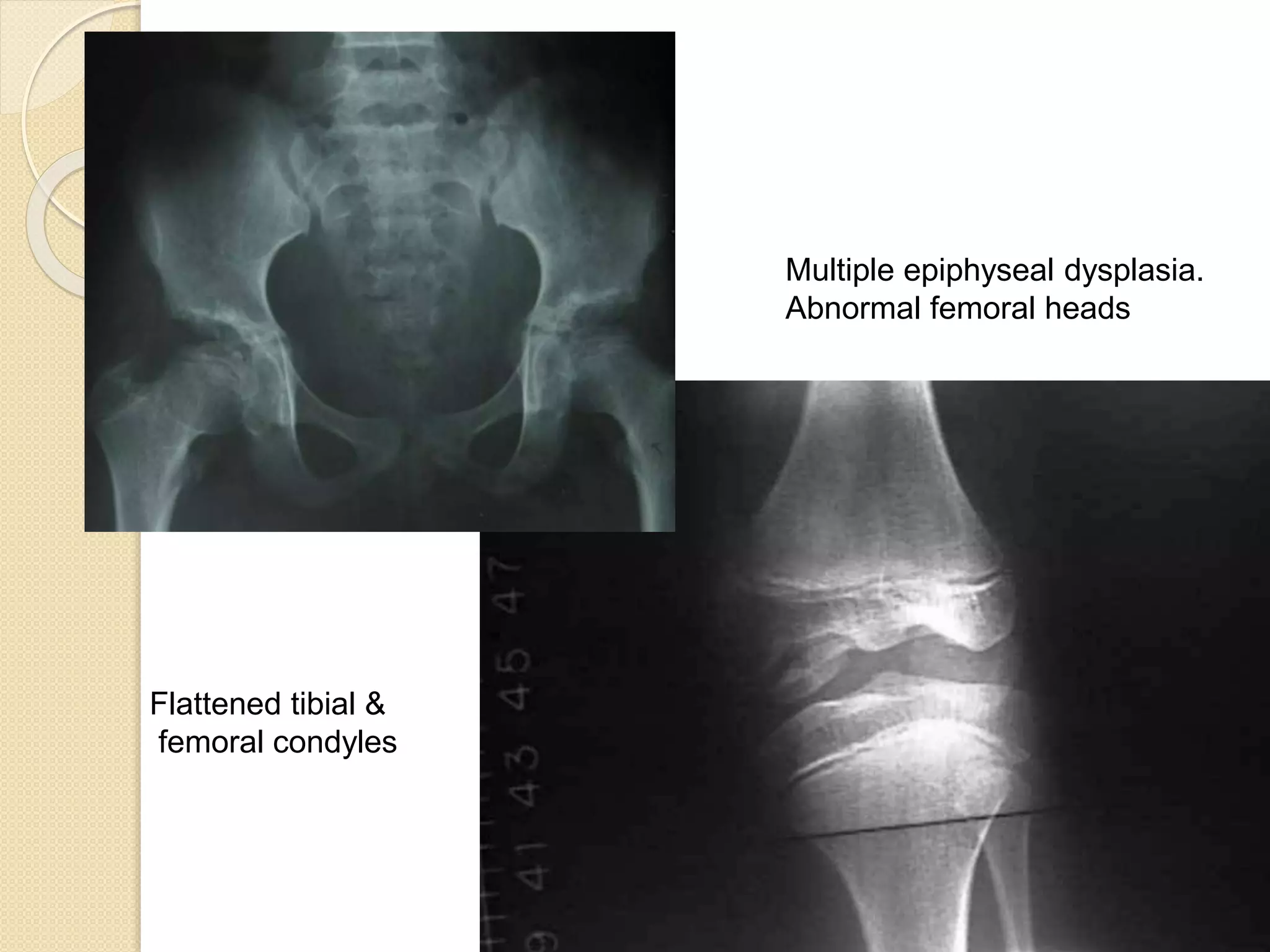
Multiple epiphyseal dysplasia. 
Abnormal femoral heads 
Flattened tibial & 
femoral condyles
 Treatment : 
 Caution regarding weight gain 
 Treat limb alignment and perform 
early joint replacement 
 Shelf acetabular augmentation in 
some patients - to improve coverage 
of the misshapen femoral head 
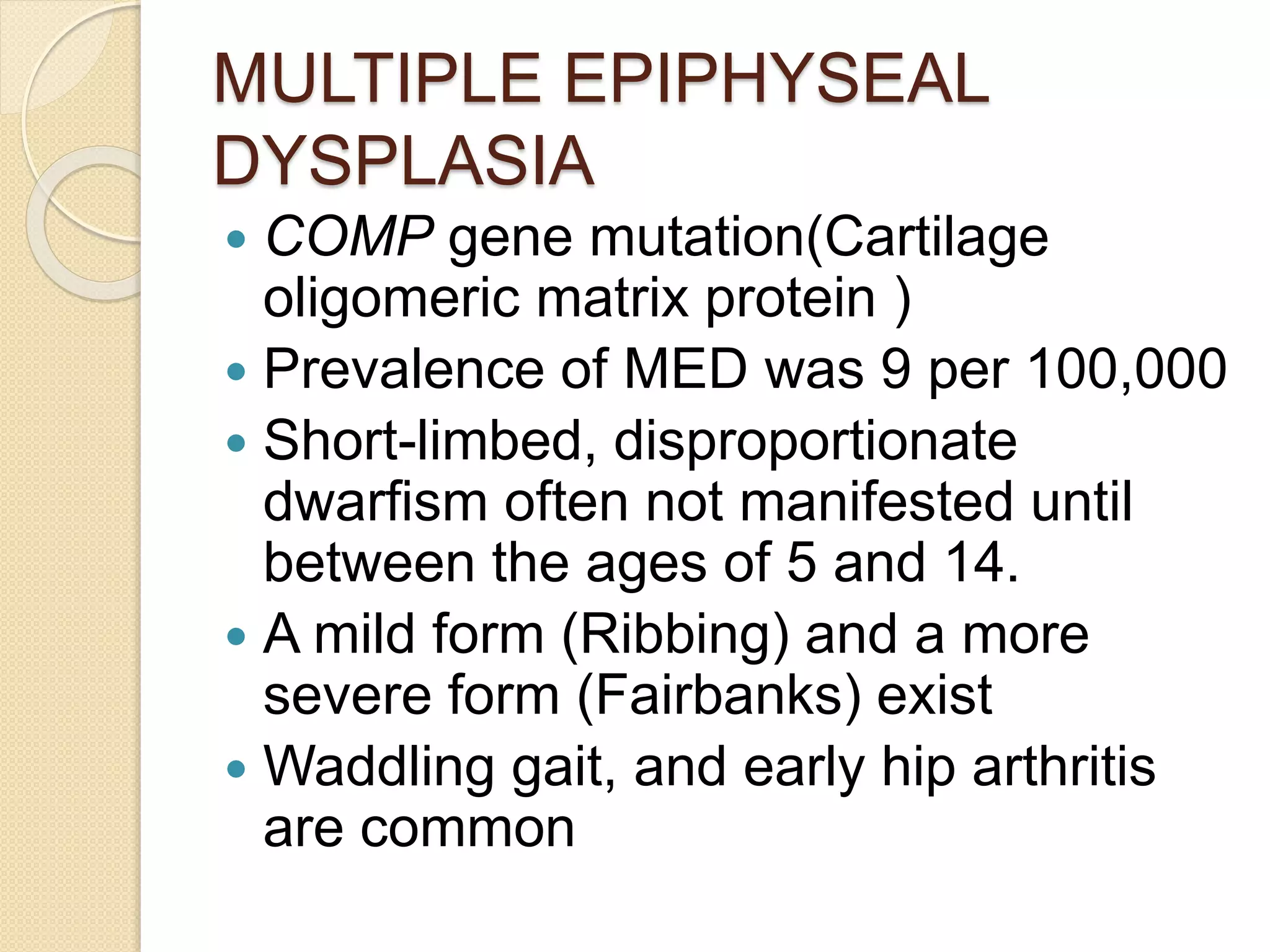
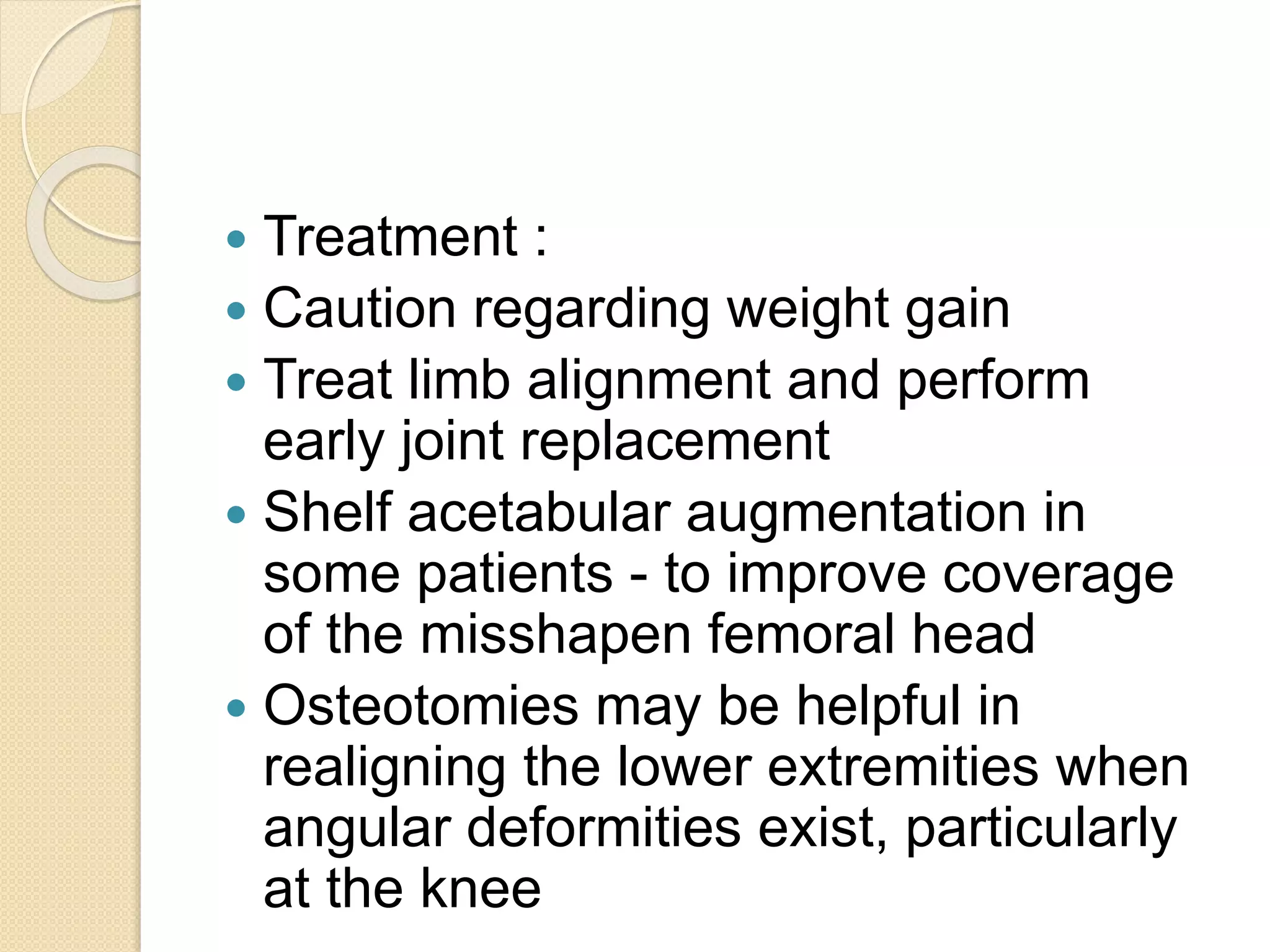
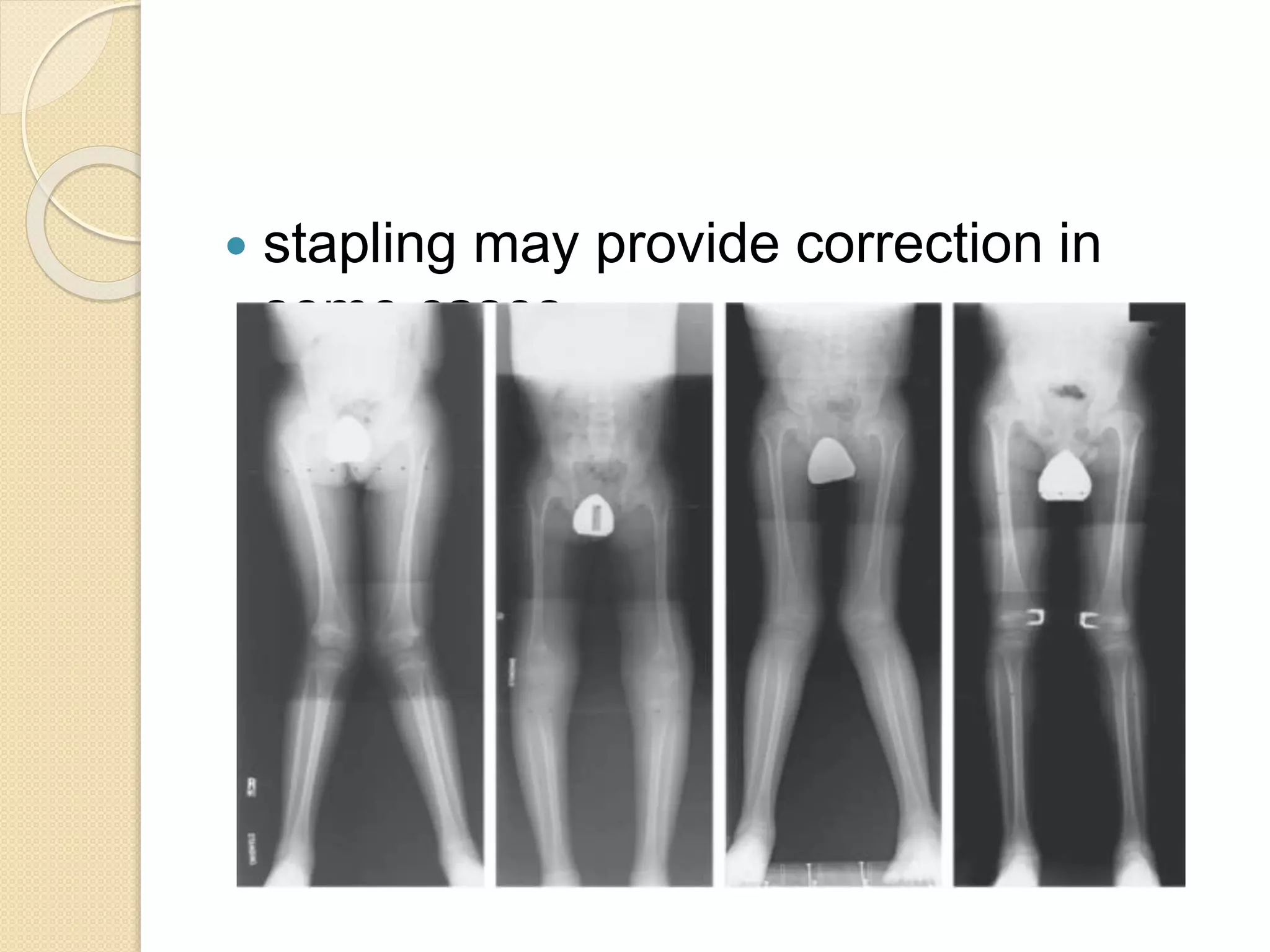
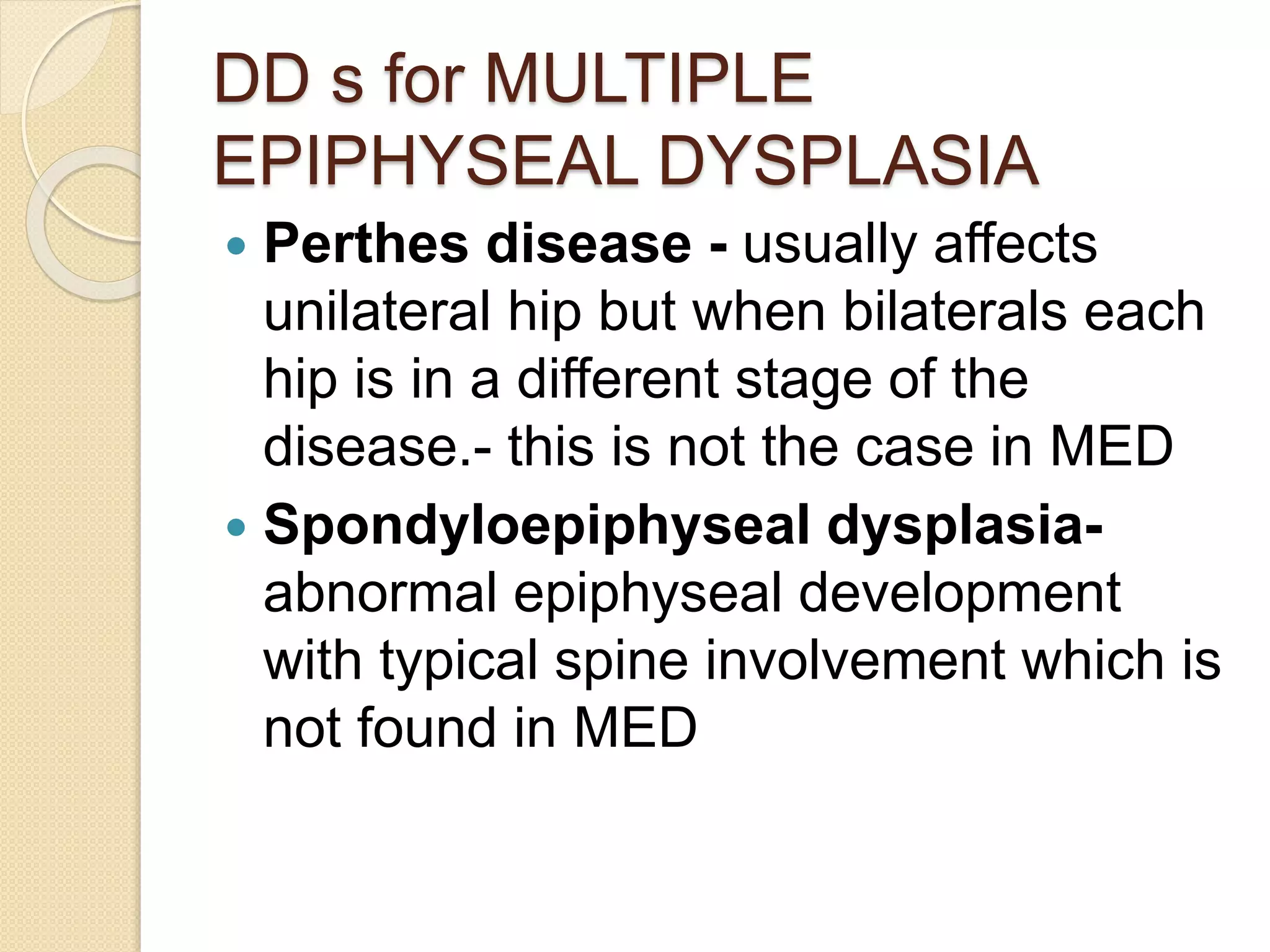
 Osteotomies may be helpful in 
realigning the lower extremities when 
angular deformities exist, particularly 
at the knee
 stapling may provide correction in 
some cases
DD s for MULTIPLE 
EPIPHYSEAL DYSPLASIA 
 Perthes disease - usually affects 
unilateral hip but when bilaterals each 
hip is in a different stage of the 
disease.- this is not the case in MED 
 Spondyloepiphyseal dysplasia-abnormal 
epiphyseal development 
with typical spine involvement which is 
not found in MED
MUCOPOLYSACCHARIDOSIS 
 Due to hydrolase(lysosomal storage 
disorder) enzyme deficiency-mucopolysaccharides 
accumulate in 
the body & produce proportionate 
dwarfism. 
 Normal mucopolysaccharide excretion 
in urine <15mg/24 hrs 
 It wil be >100mg/24hrs
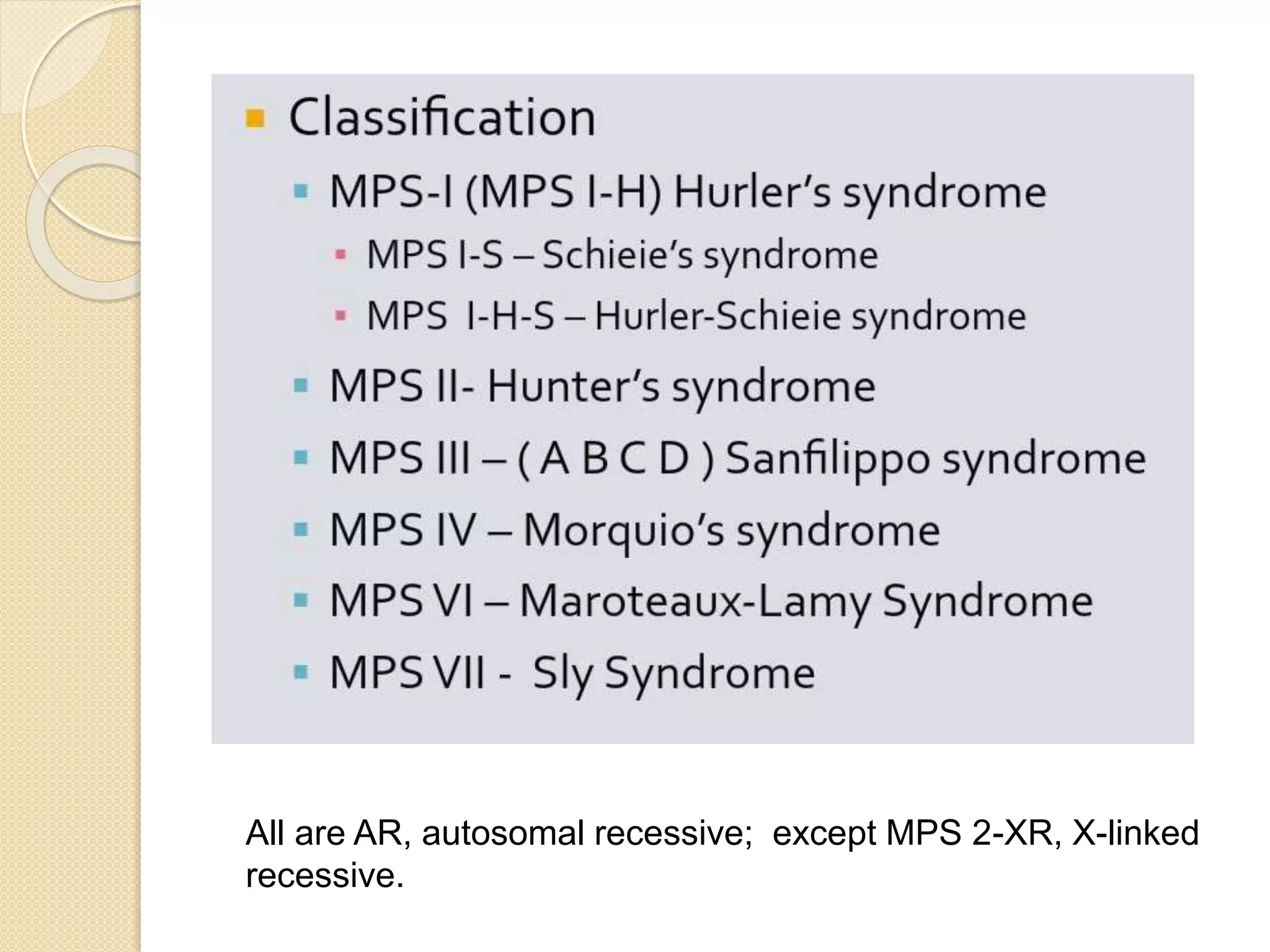
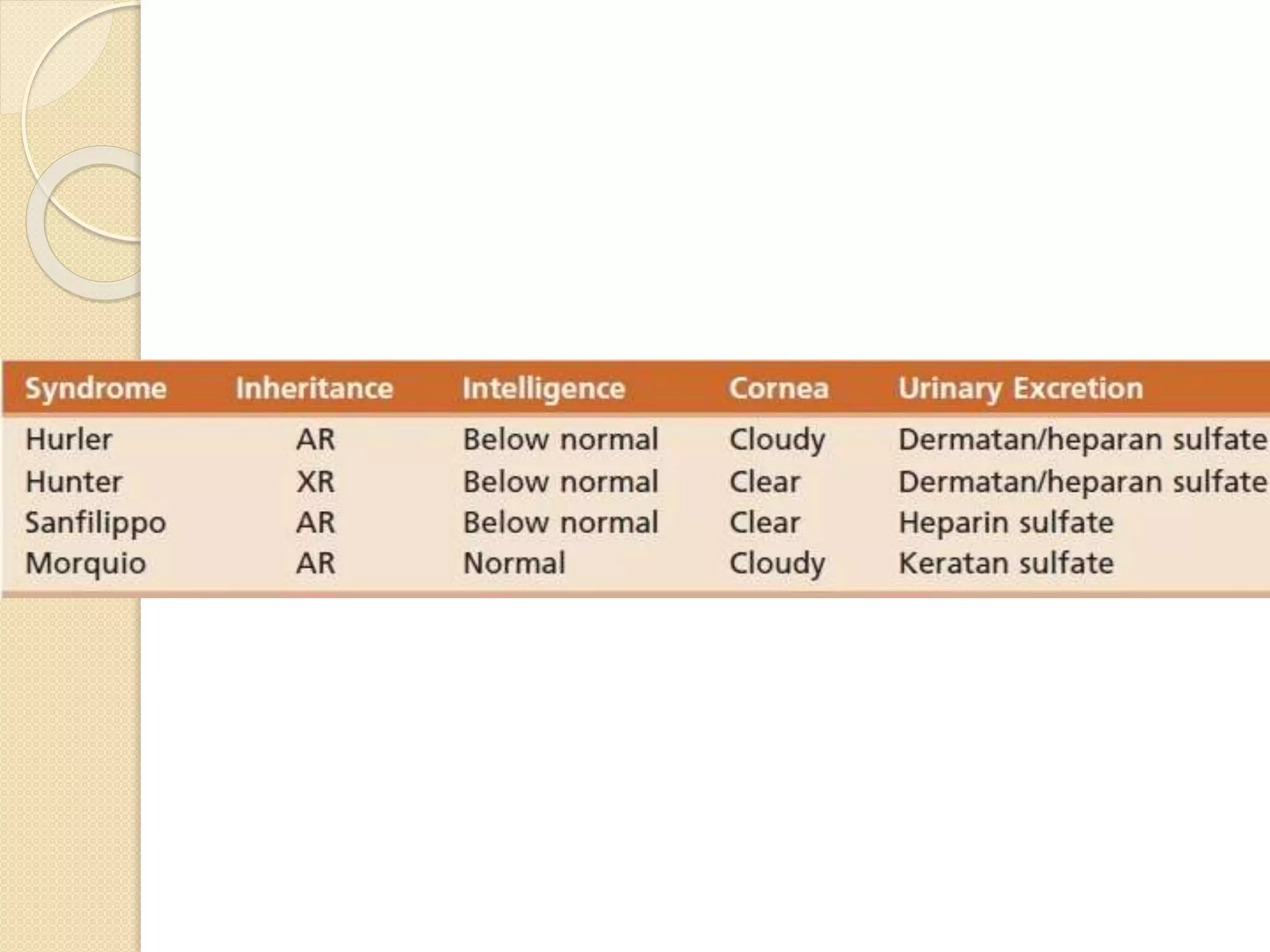
All are AR, autosomal recessive; except MPS 2-XR, X-linked 
recessive.
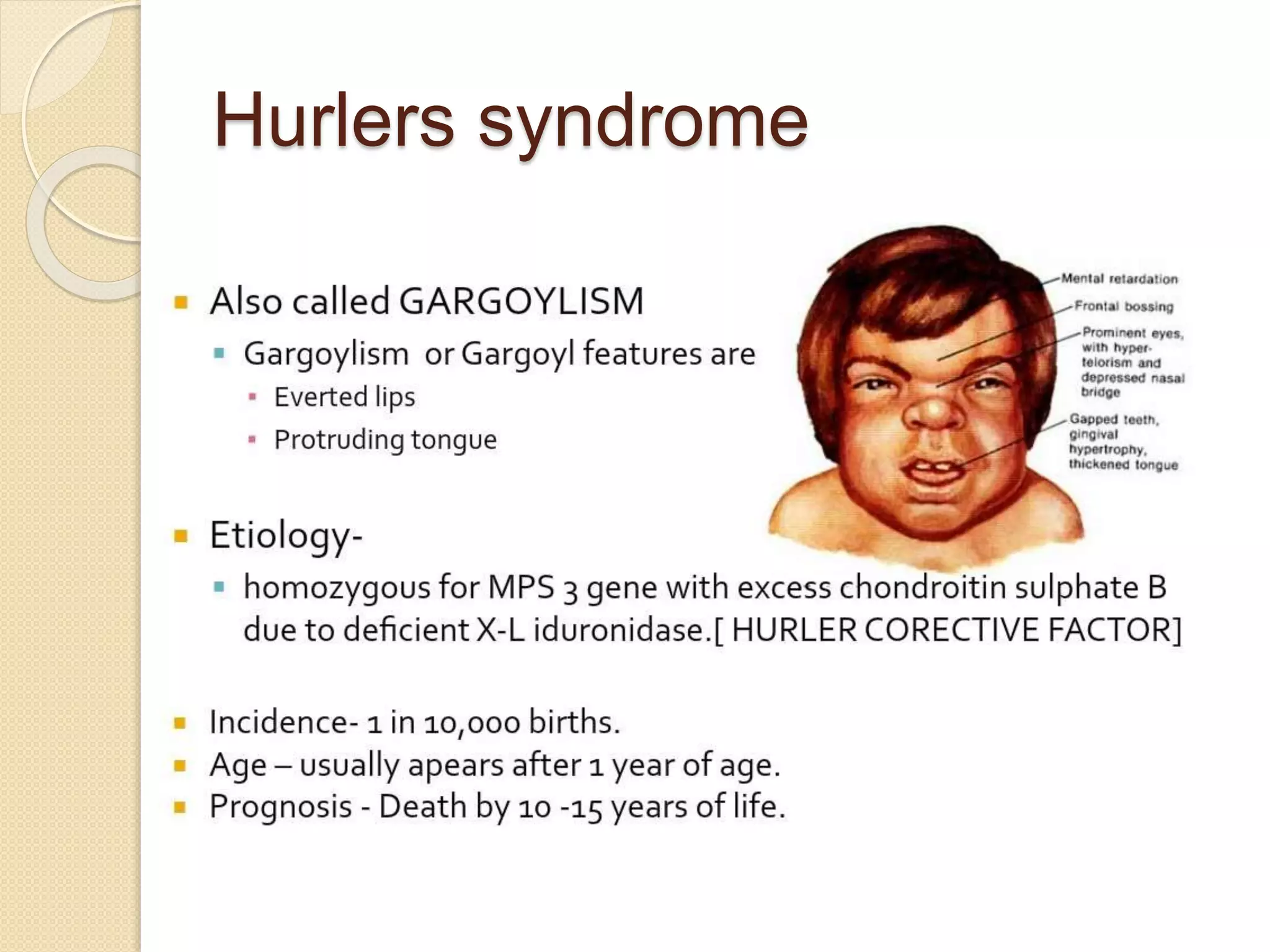
Hurlers syndrome
 The facies coarse and heavy. 
 The head is enlarged, and hydrocephalus-meningeal 
deposits. 
 The skull is abnormally shaped, and the forehead is low. 
 Premature closure of the sagittal and metopic sutures of the 
skull leads to a prominent longitudinal ridge that may cross 
the forehead. 
 The ears are low and the eyes are wide-set. 
 The teeth are poorly formed and widespread. 
 The nostrils are wide, and the nose has a depressed bridge 
and broad tip. 
 The lips are everted, the tongue is enlarged, and the mouth 
is open. “Chronic rhinitis” with noisy mouth-breathing is 
always present and is due to narrowing of the nasopharynx 
by enlarged adenoids and mucosal deposits. 
 This, combined with the presence of hernias, may be the 
presenting sign of the disease 
 Clouding of the cornea is a universal feature of the disease
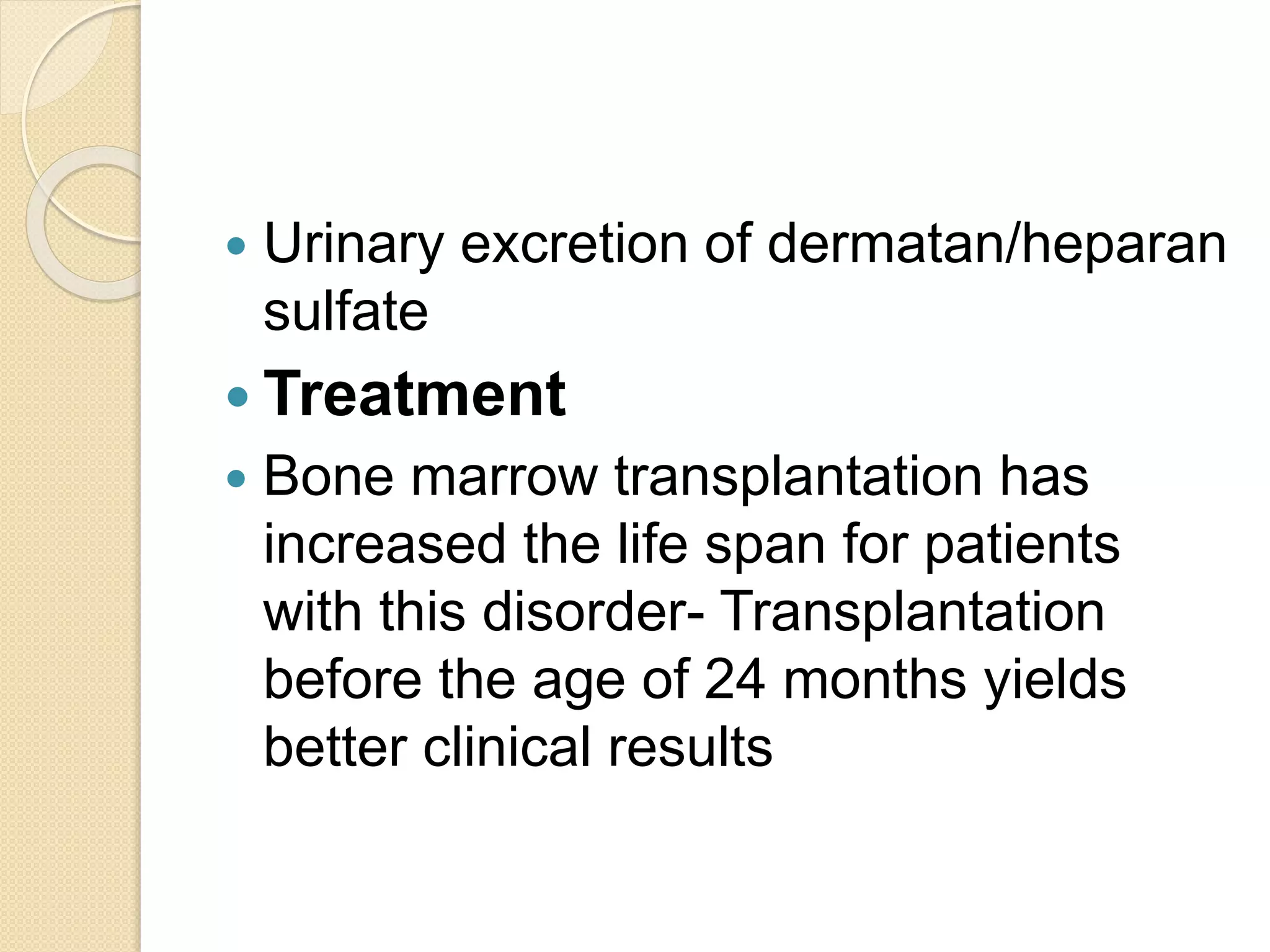
 Urinary excretion of dermatan/heparan 
sulfate 
 Treatment 
 Bone marrow transplantation has 
increased the life span for patients 
with this disorder- Transplantation 
before the age of 24 months yields 
better clinical results
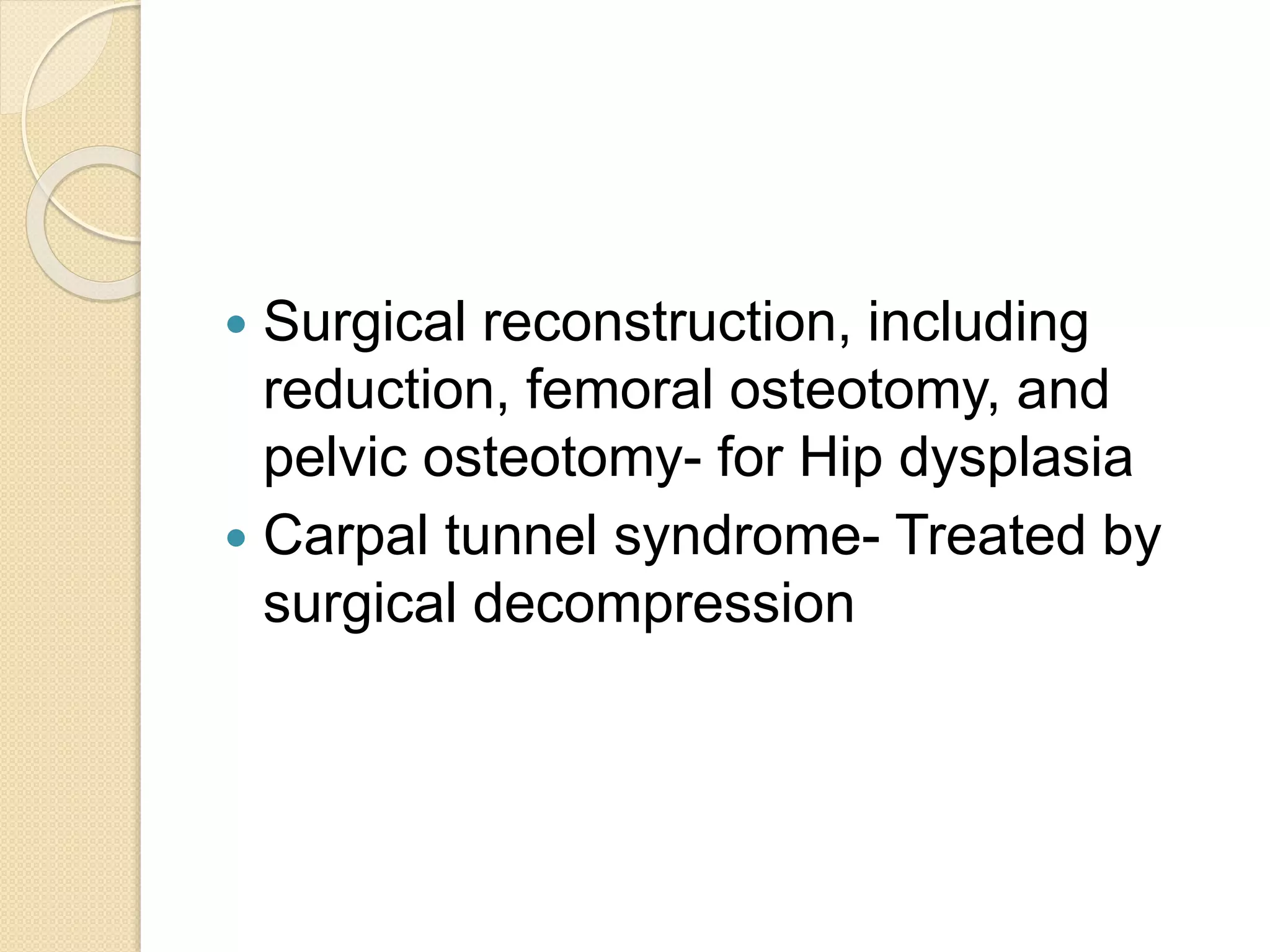
 Surgical reconstruction, including 
reduction, femoral osteotomy, and 
pelvic osteotomy- for Hip dysplasia 
 Carpal tunnel syndrome- Treated by 
surgical decompression
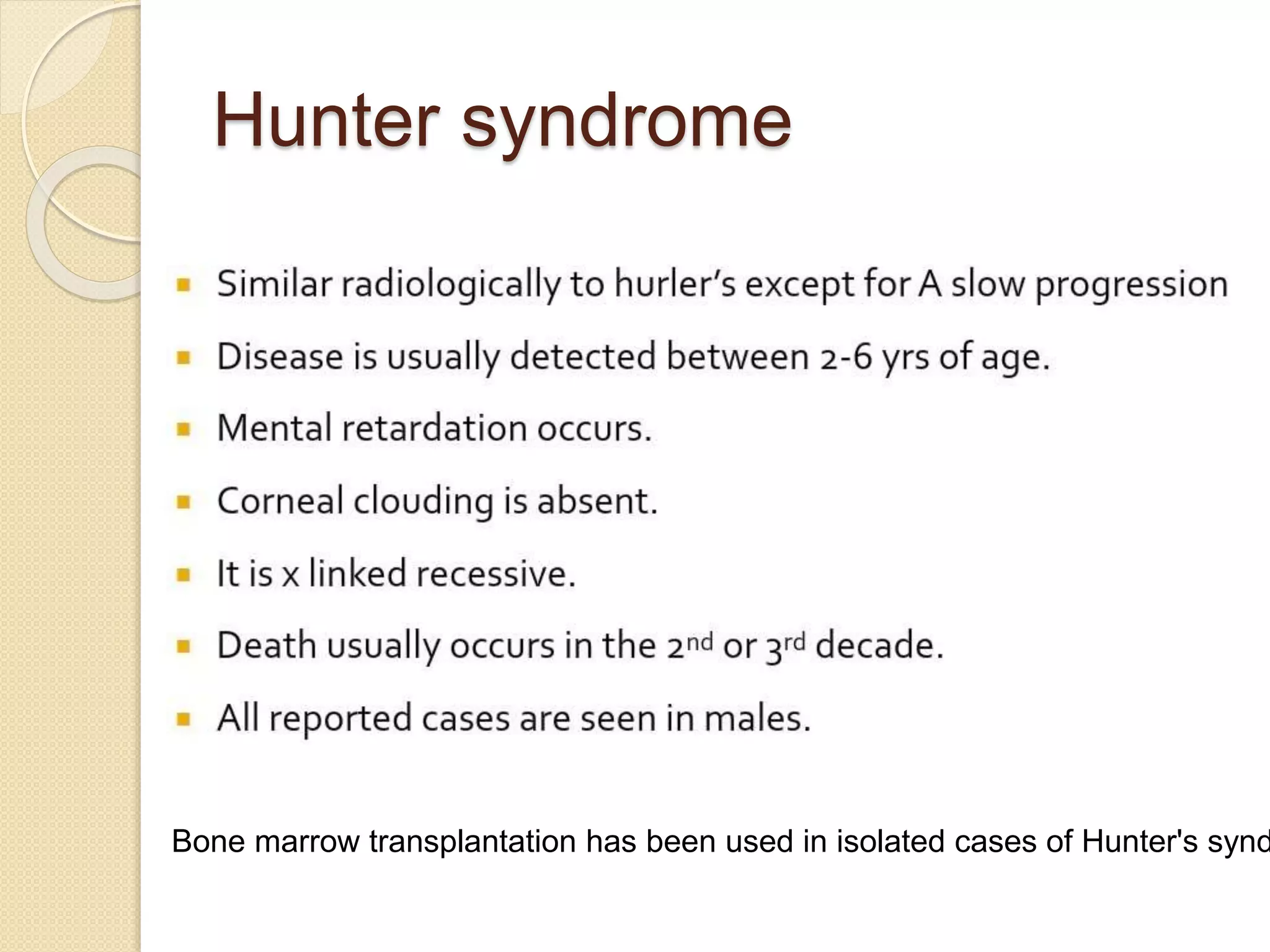
Hunter syndrome 
Bone marrow transplantation has been used in isolated cases of Hunter's syndrome
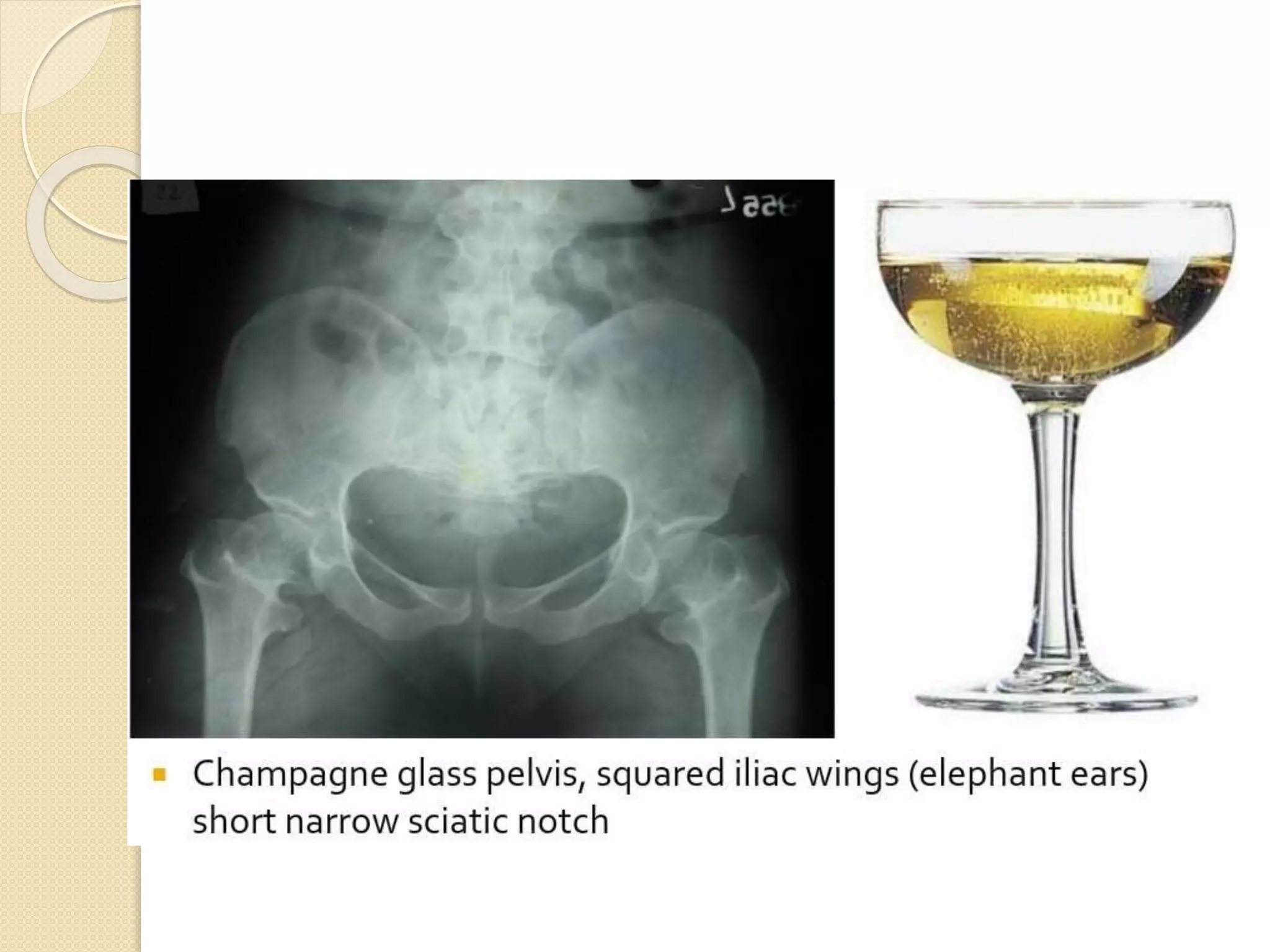
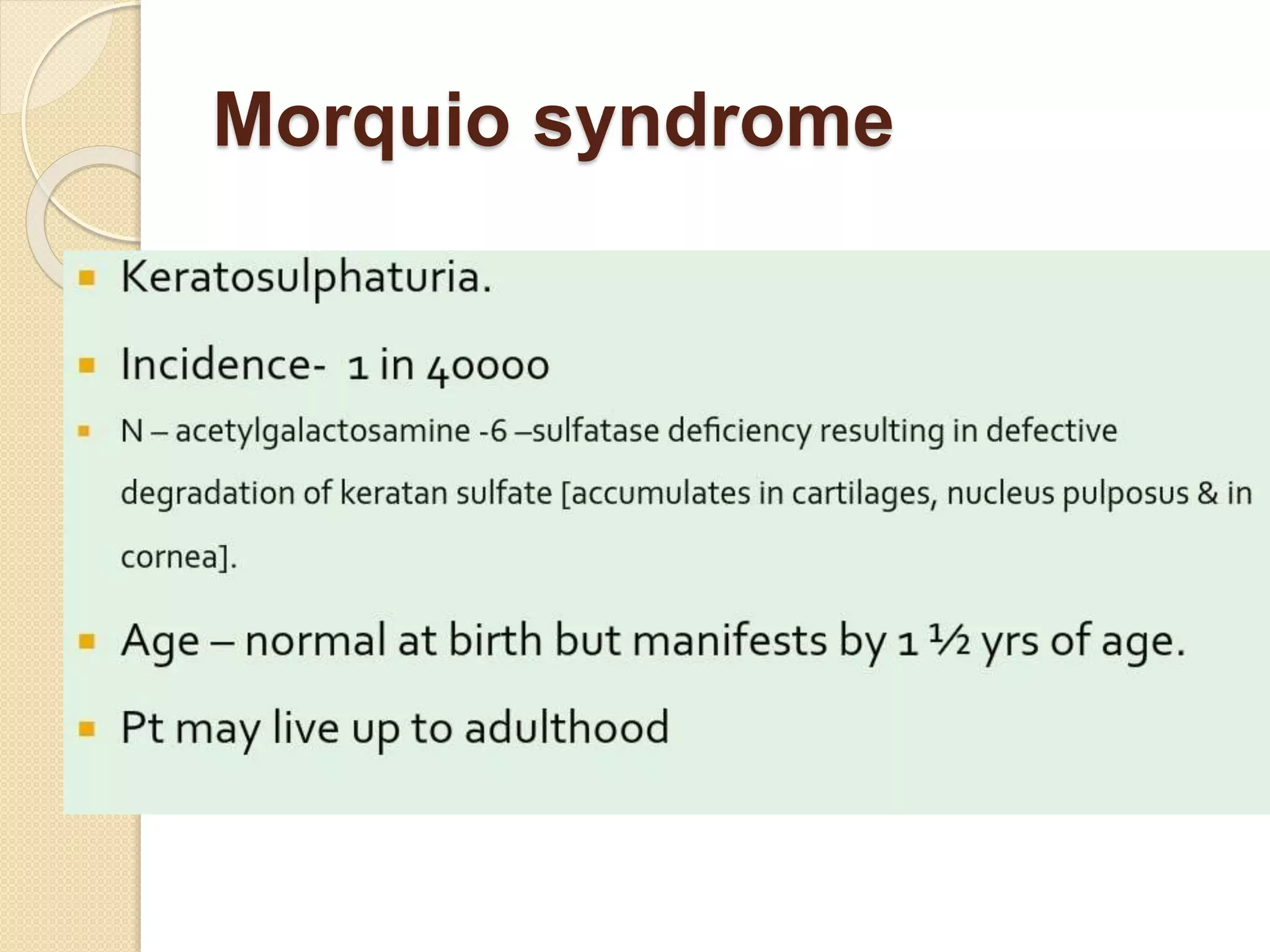
Morquio syndrome
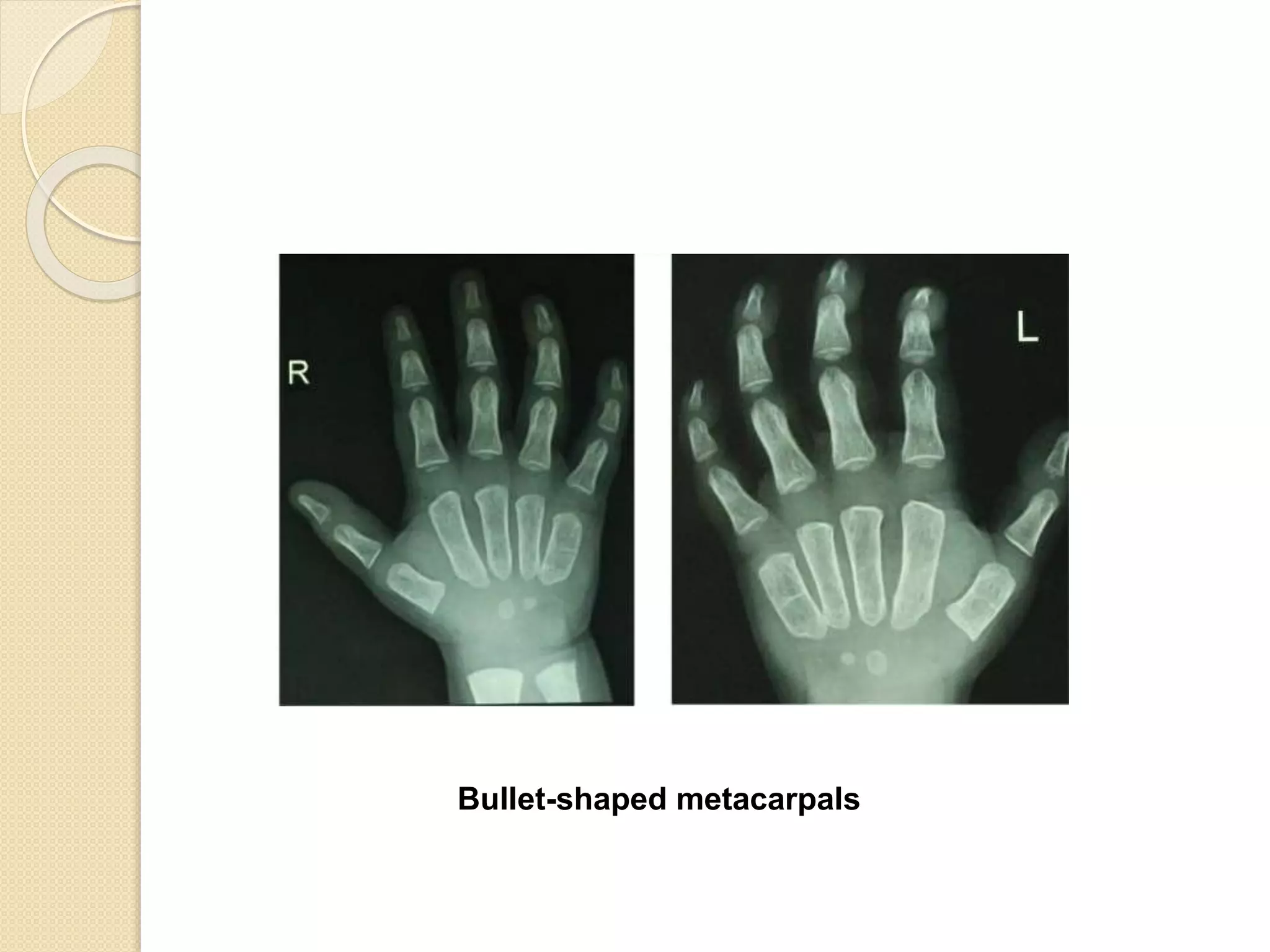
Bullet-shaped metacarpals
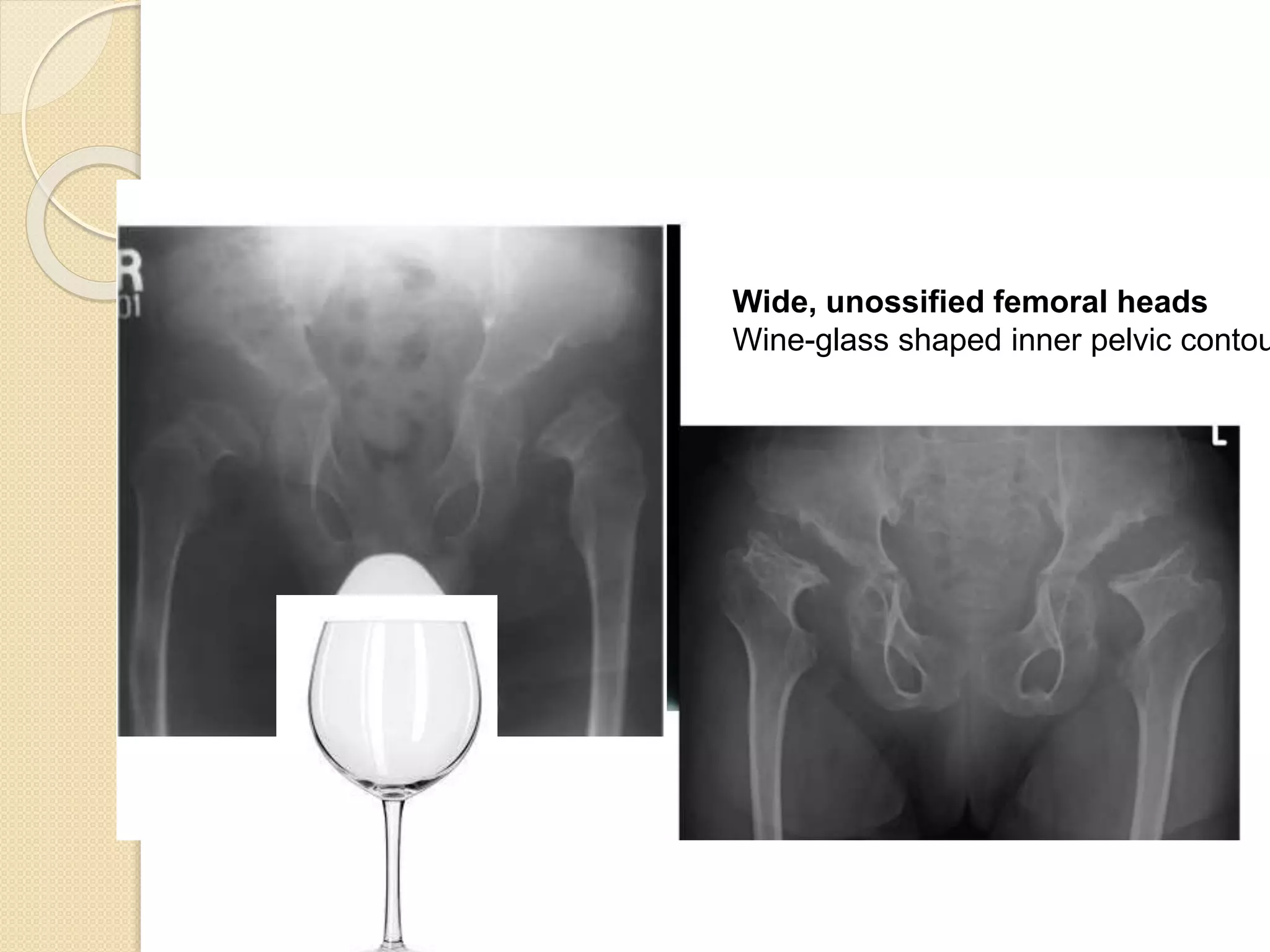
Wide, unossified femoral heads 
Wine-glass shaped inner pelvic contour
treatment 
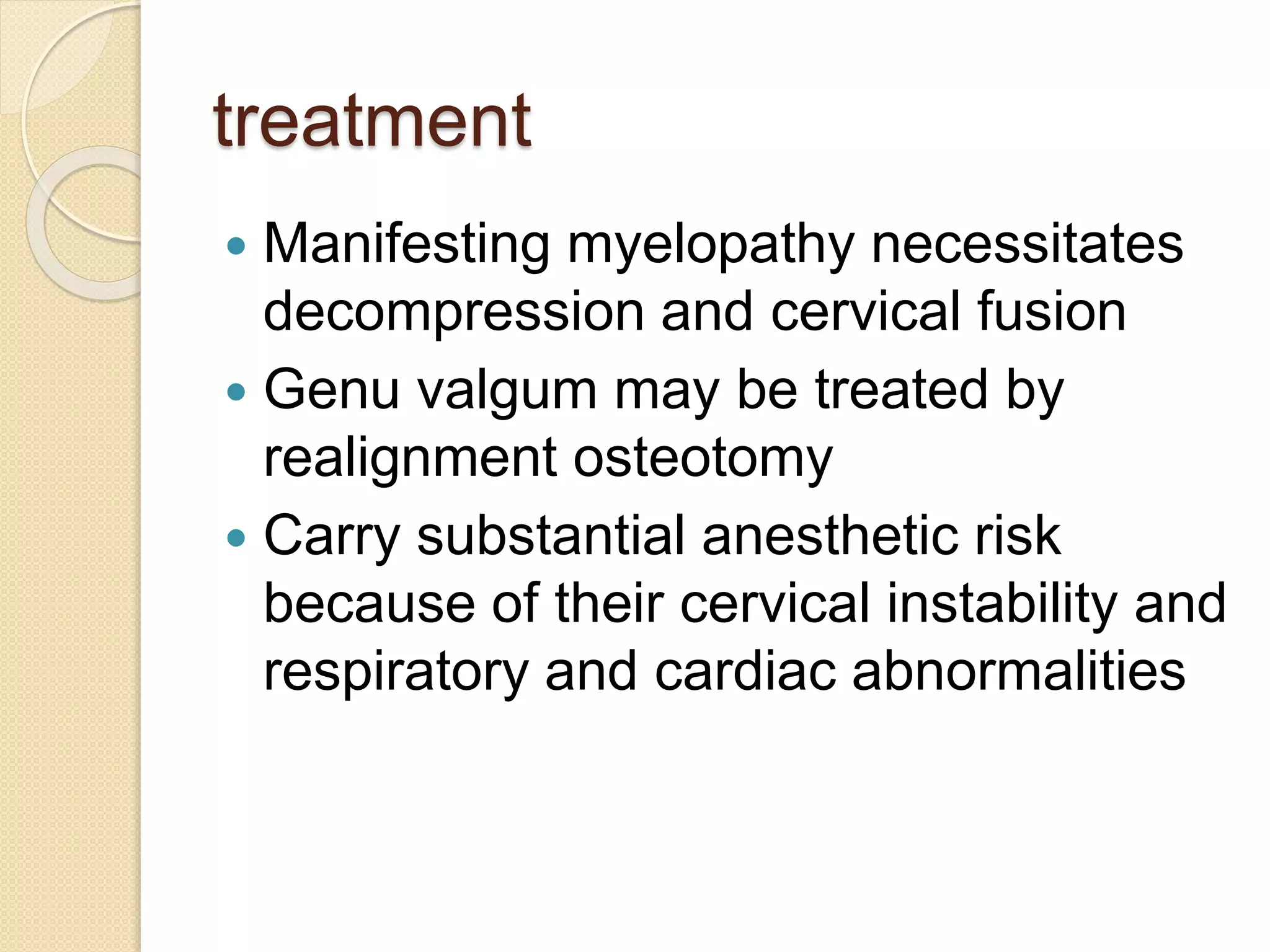
 Manifesting myelopathy necessitates 
decompression and cervical fusion 
 Genu valgum may be treated by 
realignment osteotomy 
 Carry substantial anesthetic risk 
because of their cervical instability and 
respiratory and cardiac abnormalities
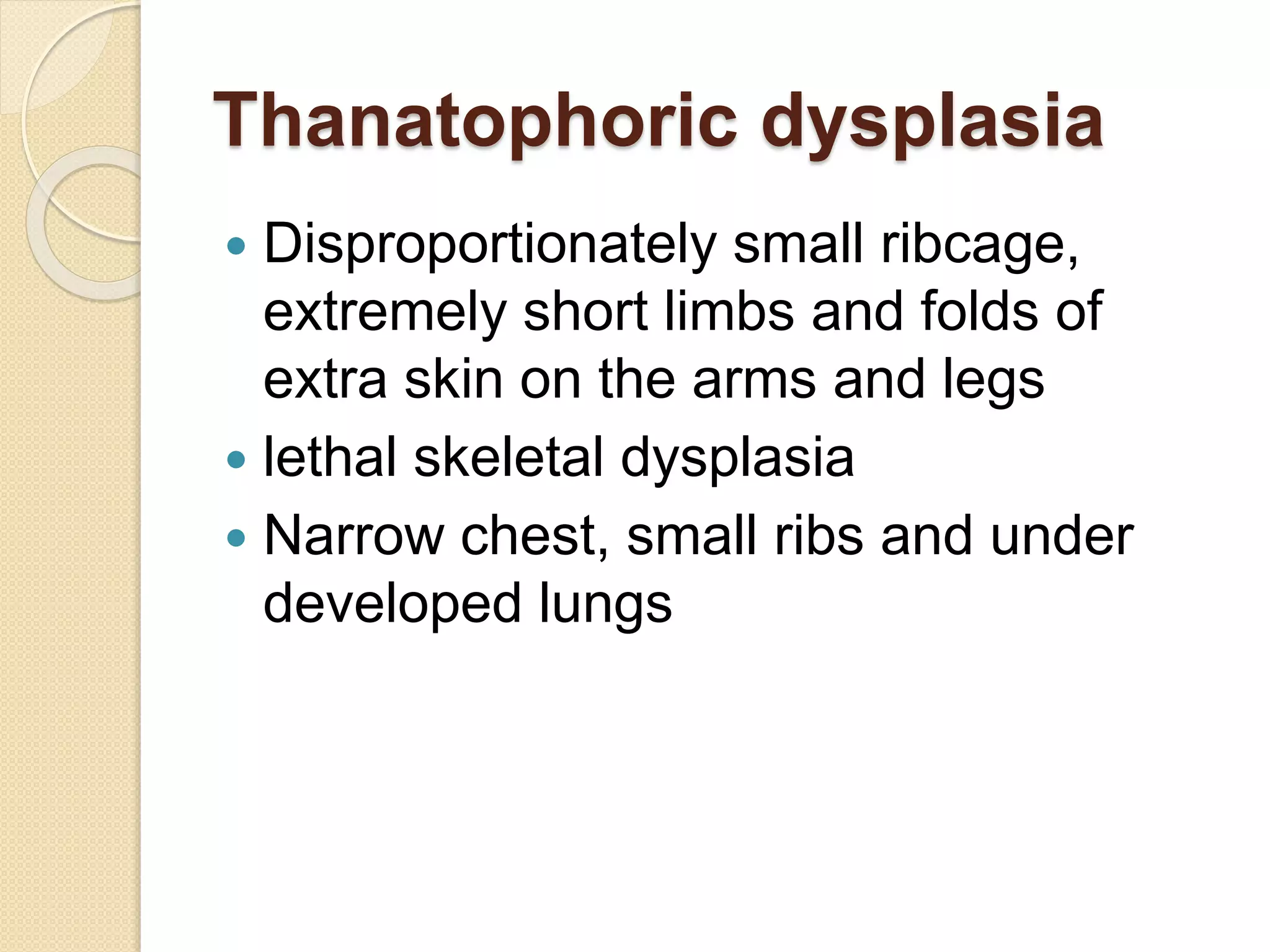
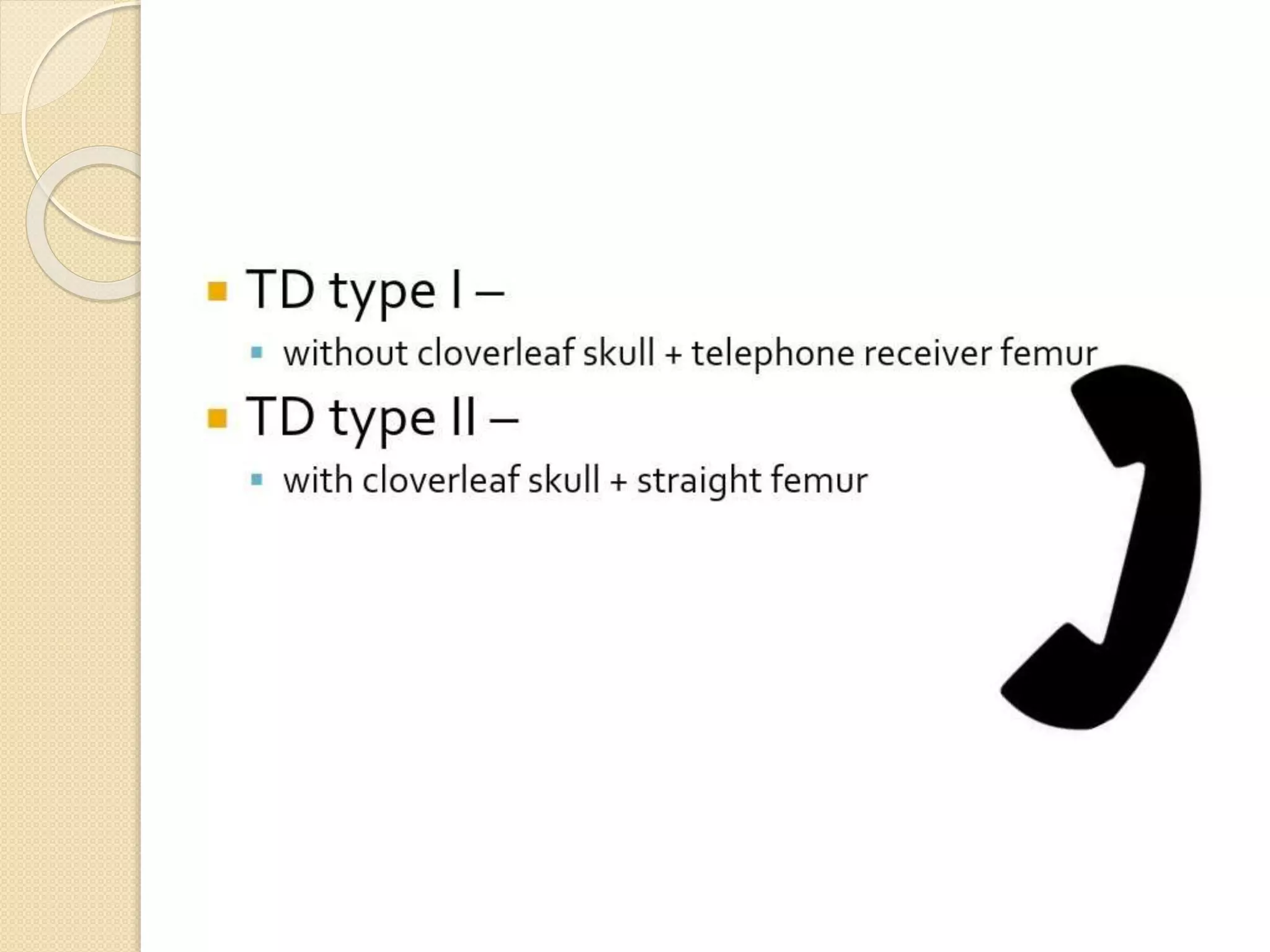
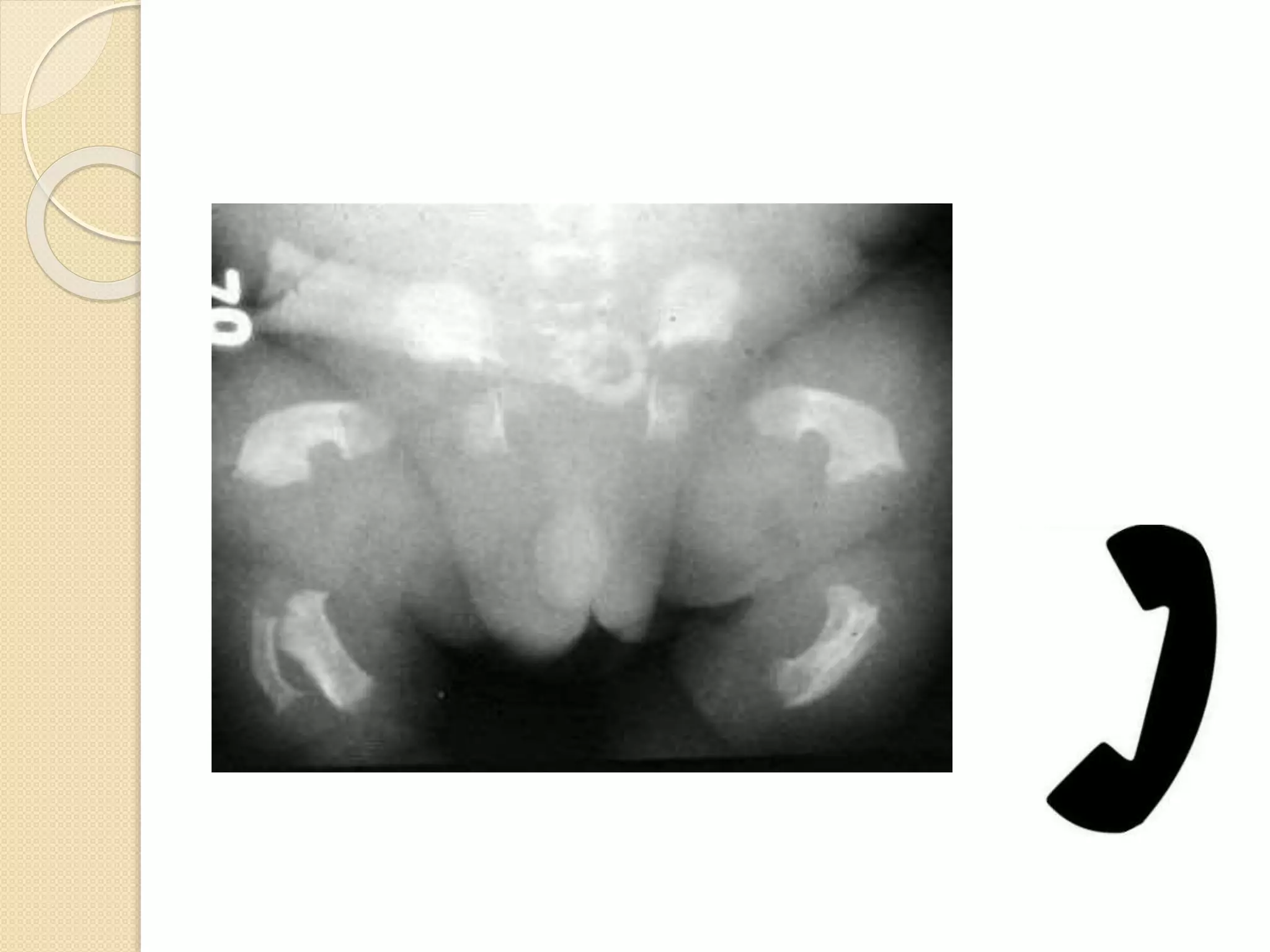
Thanatophoric dysplasia 
 Disproportionately small ribcage, 
extremely short limbs and folds of 
extra skin on the arms and legs 
 lethal skeletal dysplasia 
 Narrow chest, small ribs and under 
developed lungs
 Children with this condition are usually 
stillborn or die shortly after birth from 
respiratory failure 
 Survivors have difficulty breathing on 
their own and require respiratory 
support
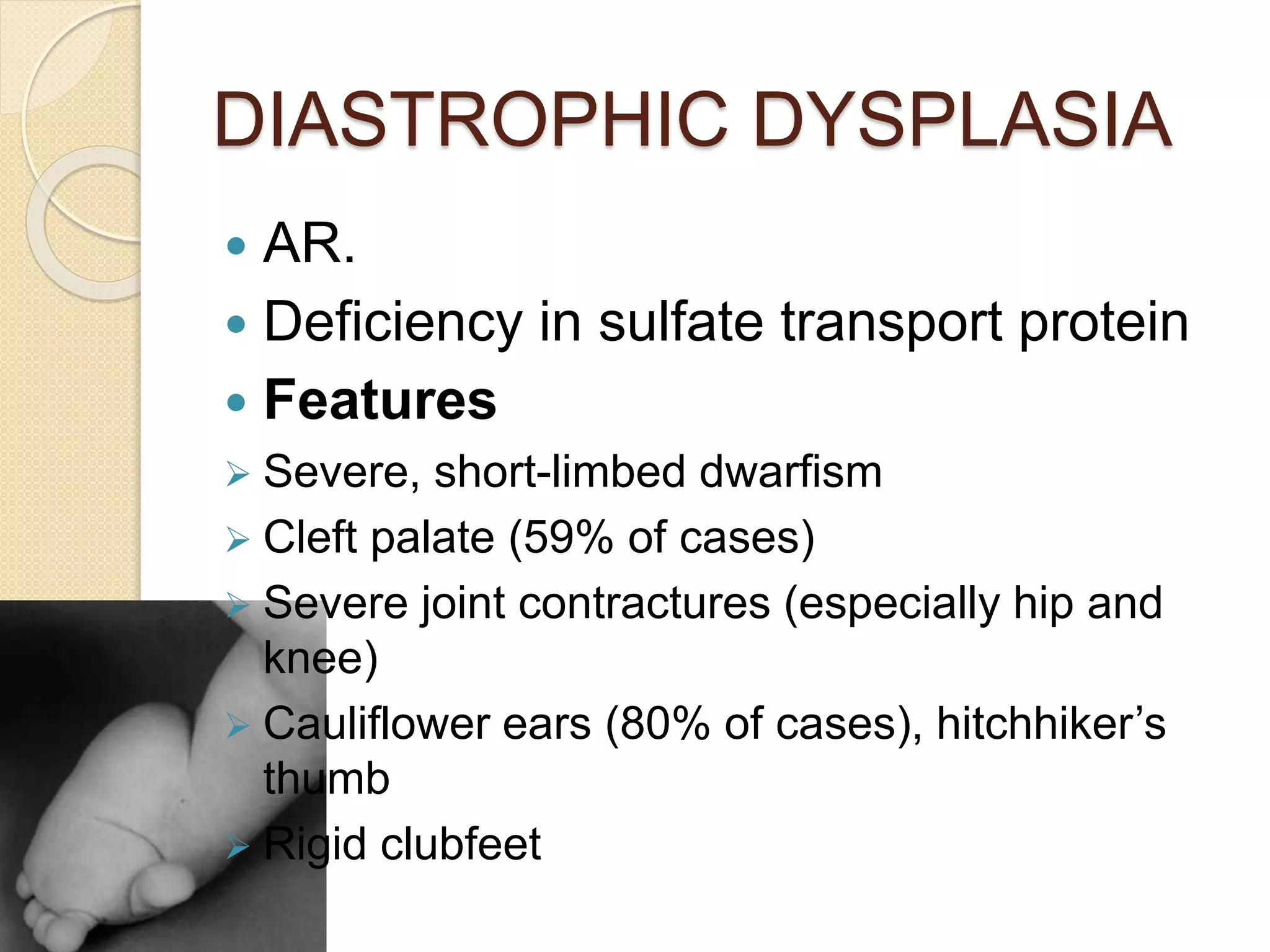
DIASTROPHIC DYSPLASIA 
 AR. 
 Deficiency in sulfate transport protein 
 Features 
 Severe, short-limbed dwarfism 
 Cleft palate (59% of cases) 
 Severe joint contractures (especially hip and 
knee) 
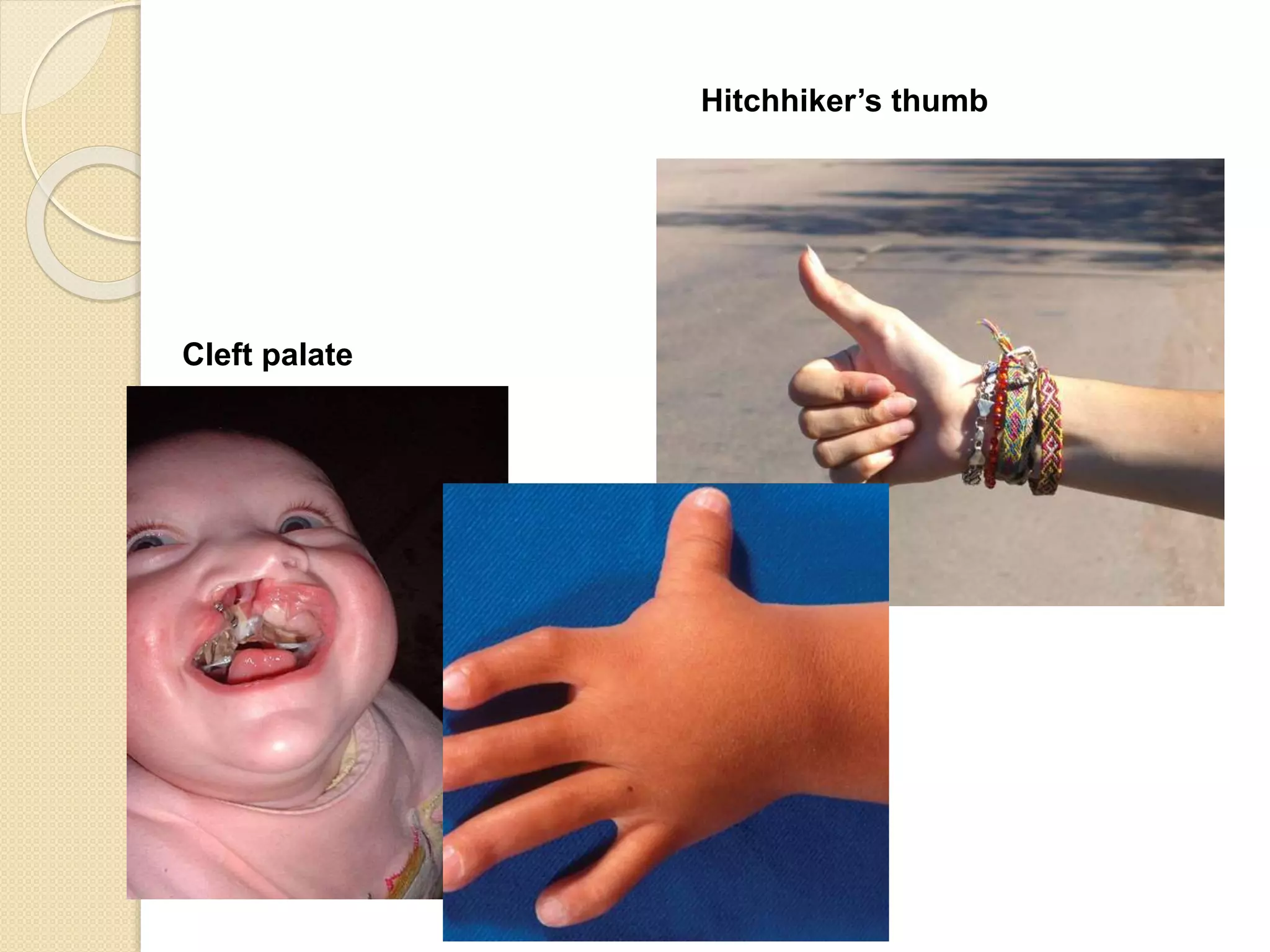
 Cauliflower ears (80% of cases), hitchhiker’s 
thumb 
 Rigid clubfeet
Hitchhiker’s thumb 
Cleft palate
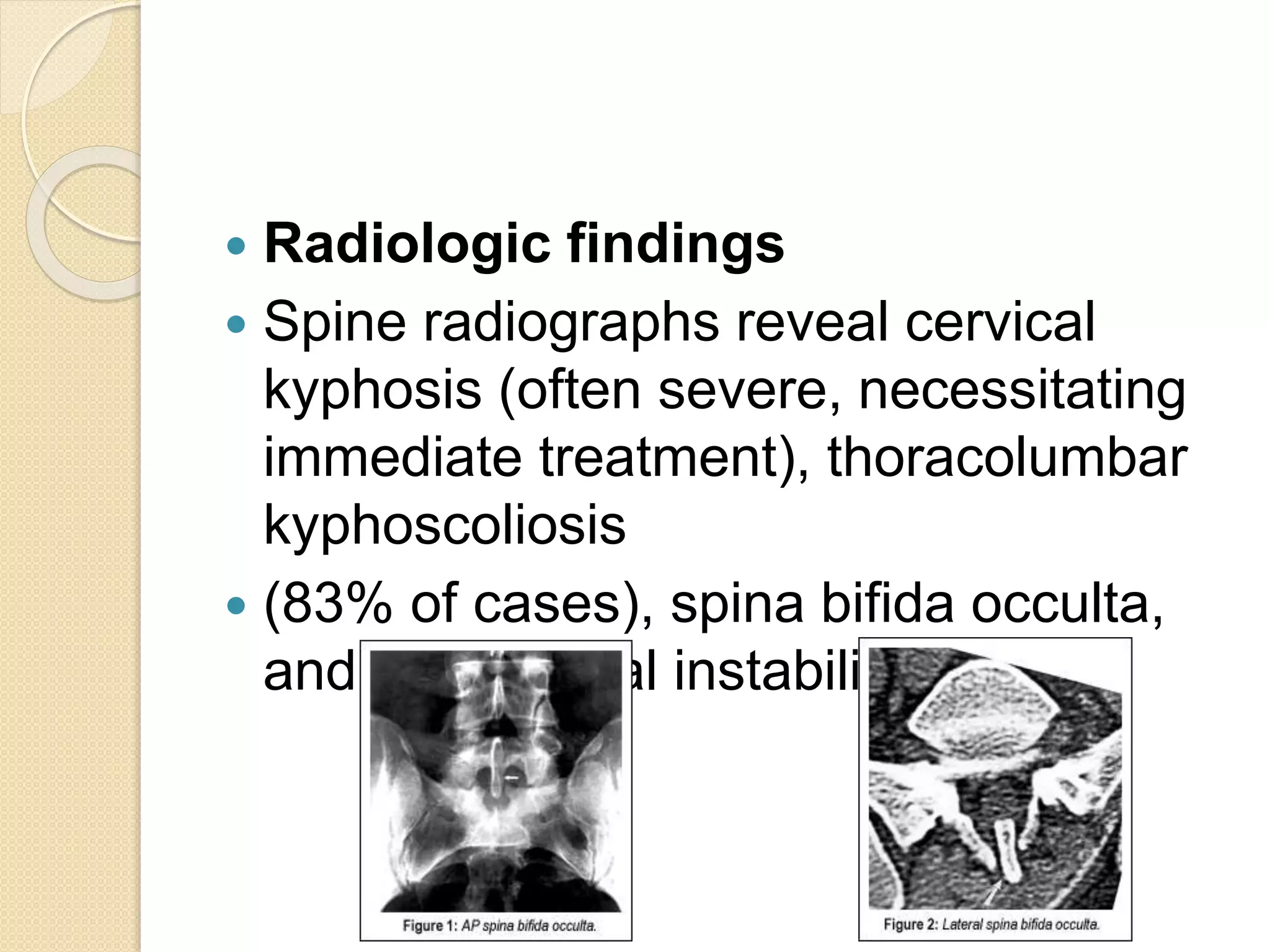
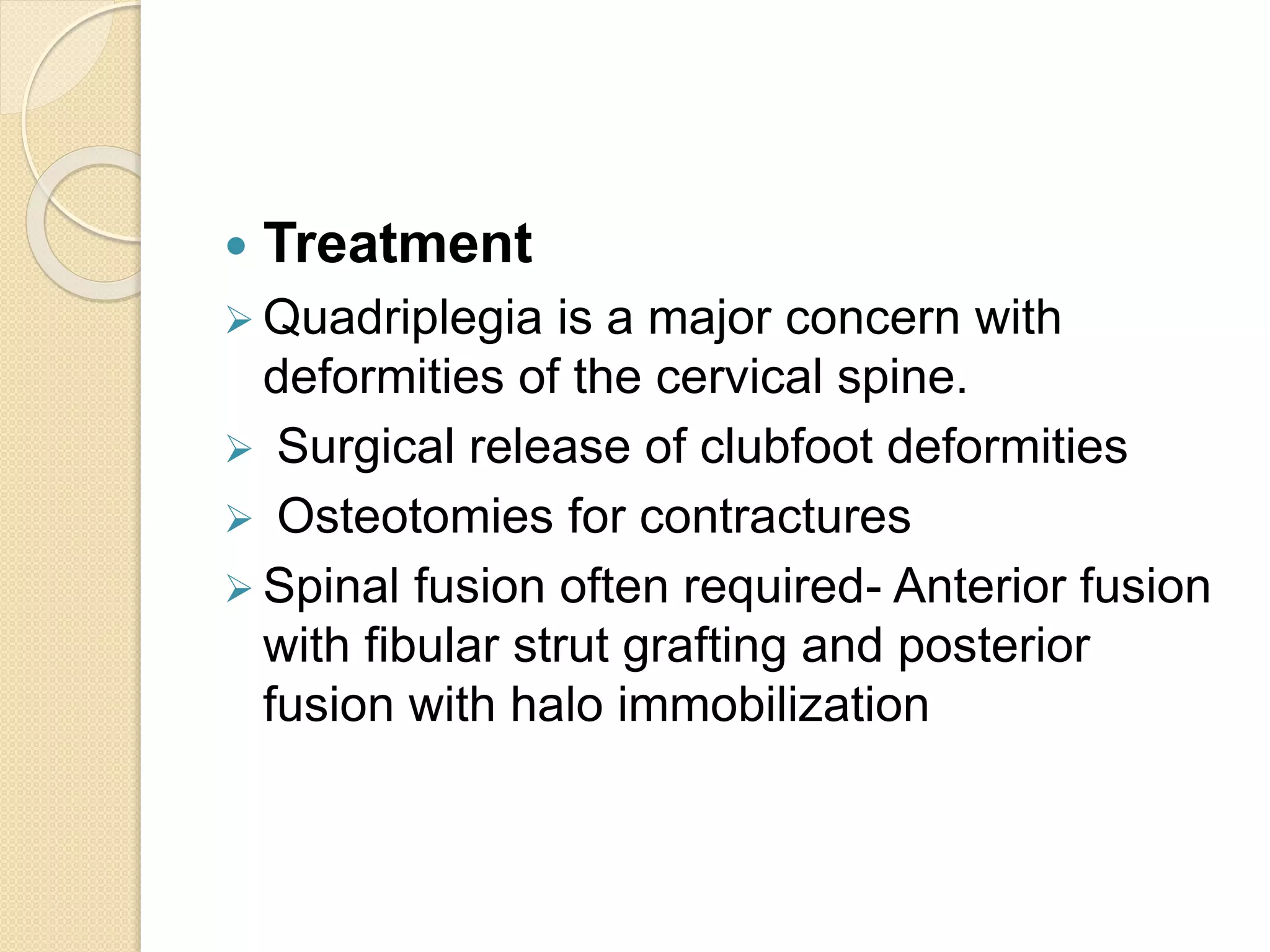
 Radiologic findings 
 Spine radiographs reveal cervical 
kyphosis (often severe, necessitating 
immediate treatment), thoracolumbar 
kyphoscoliosis 
 (83% of cases), spina bifida occulta, 
and atlantoaxial instability.
 Treatment 
 Quadriplegia is a major concern with 
deformities of the cervical spine. 
 Surgical release of clubfoot deformities 
 Osteotomies for contractures 
 Spinal fusion often required- Anterior fusion 
with fibular strut grafting and posterior 
fusion with halo immobilization
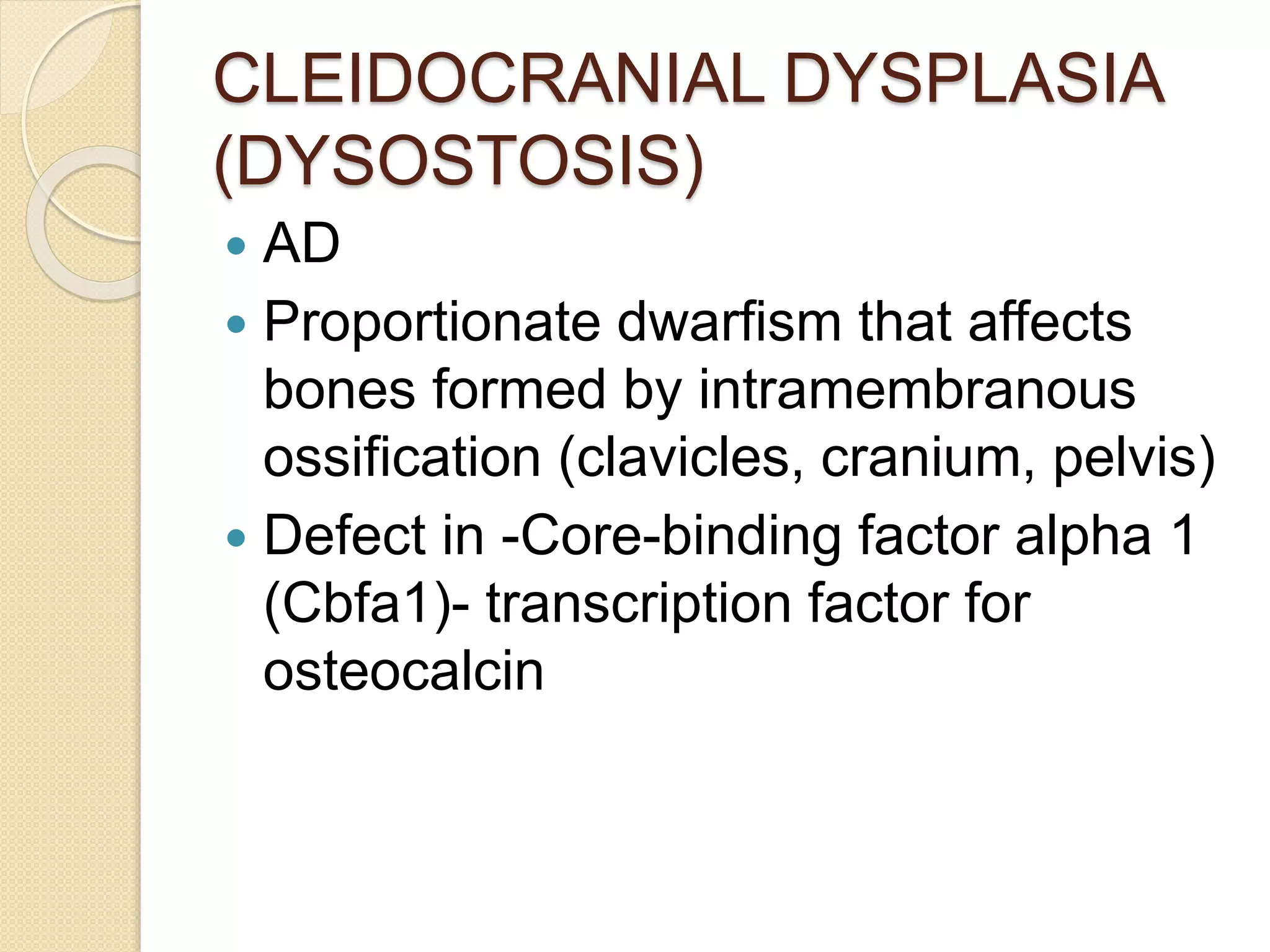
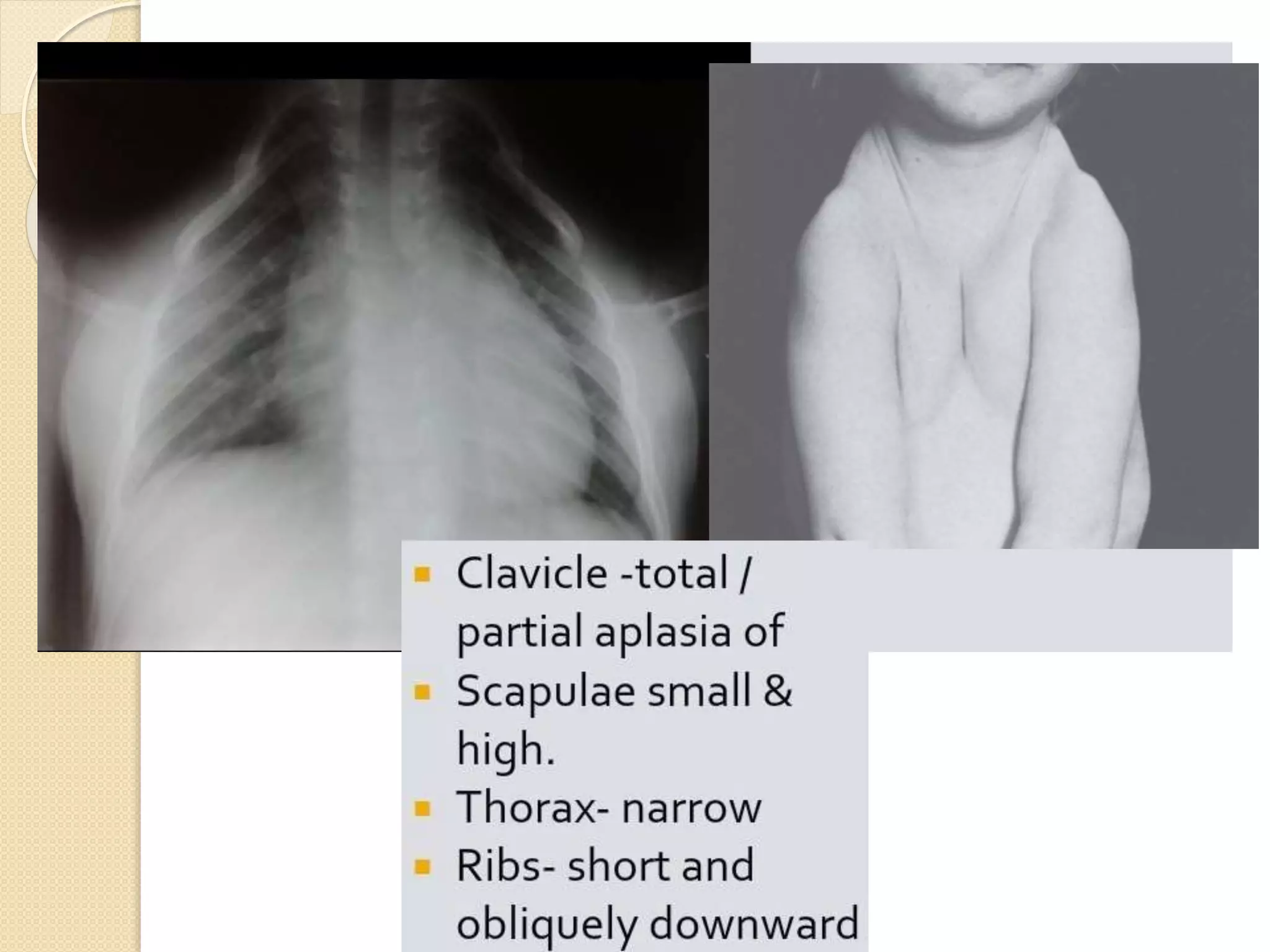
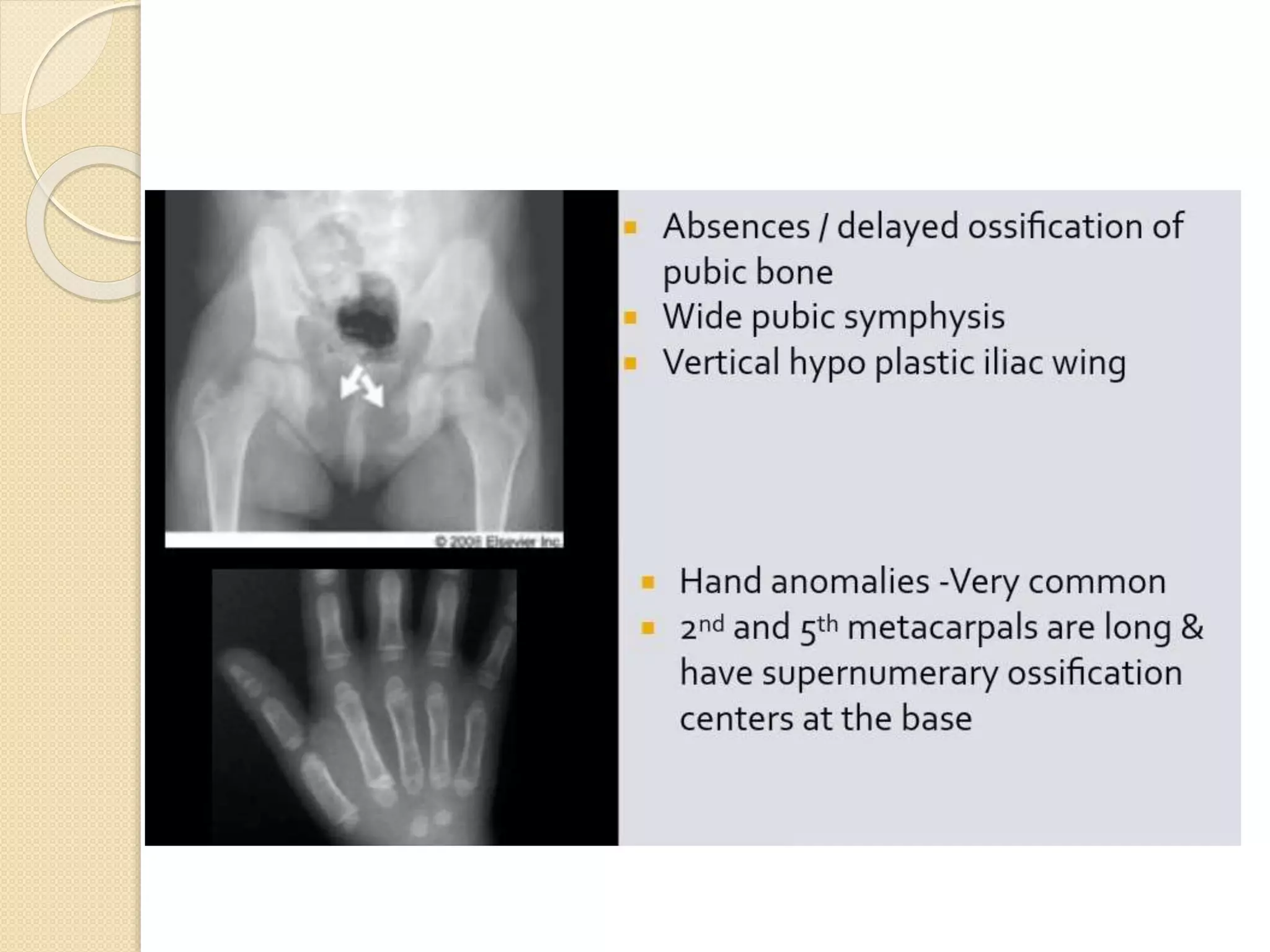
CLEIDOCRANIAL DYSPLASIA 
(DYSOSTOSIS) 
 AD 
 Proportionate dwarfism that affects 
bones formed by intramembranous 
ossification (clavicles, cranium, pelvis) 
 Defect in -Core-binding factor alpha 1 
(Cbfa1)- transcription factor for 
osteocalcin
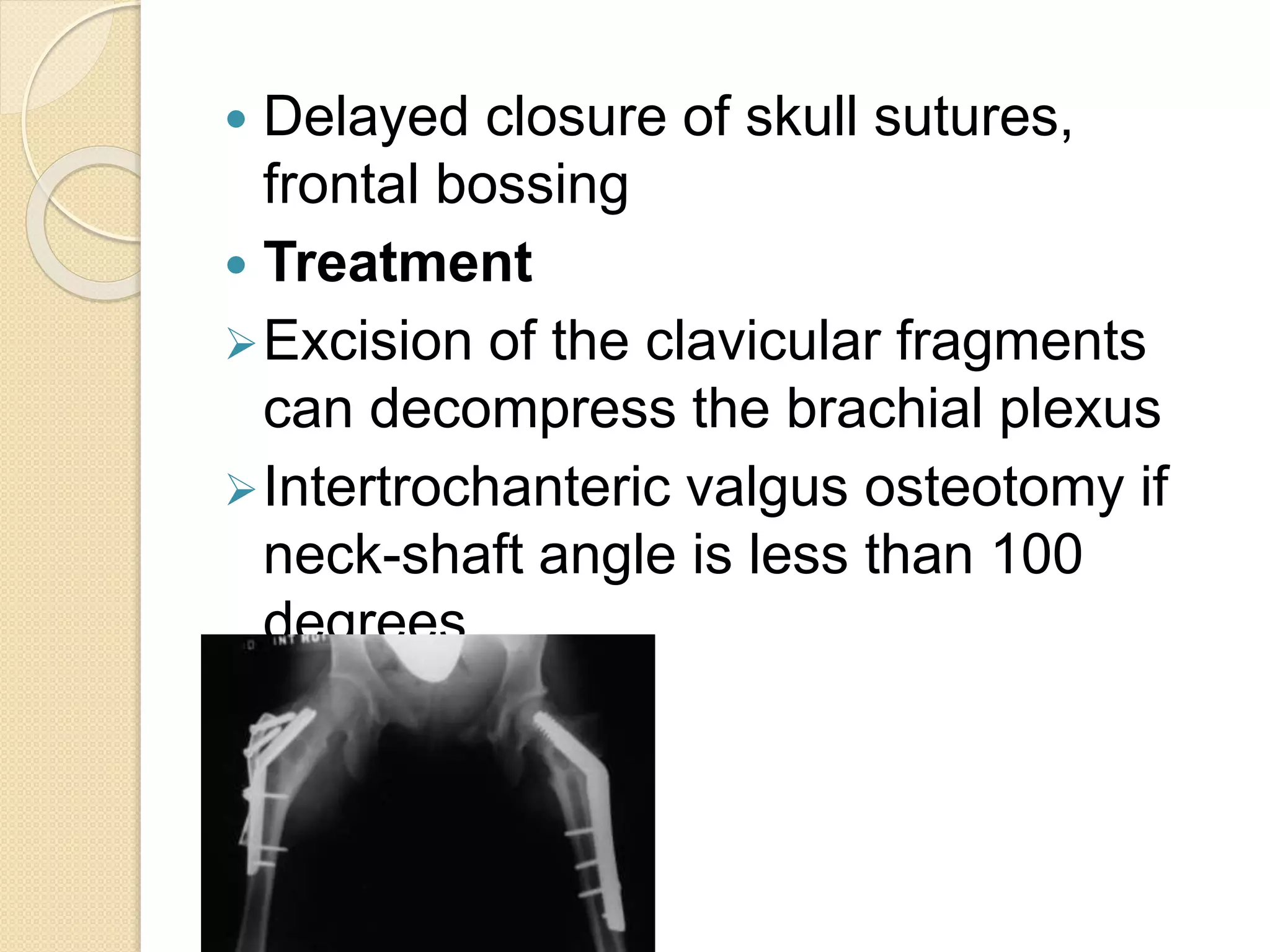
 Delayed closure of skull sutures, 
frontal bossing 
 Treatment 
Excision of the clavicular fragments 
can decompress the brachial plexus 
Intertrochanteric valgus osteotomy if 
neck-shaft angle is less than 100 
degrees
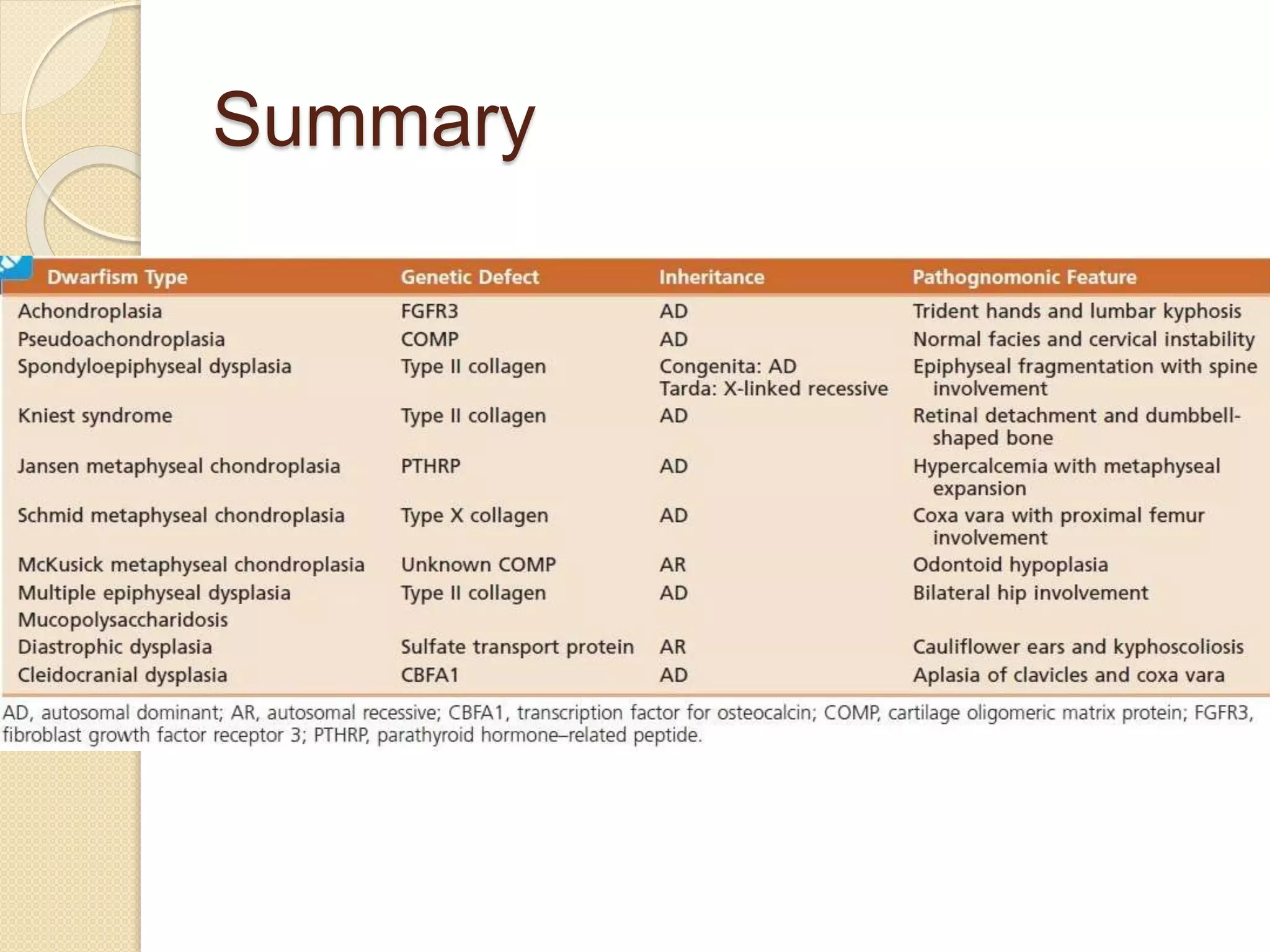
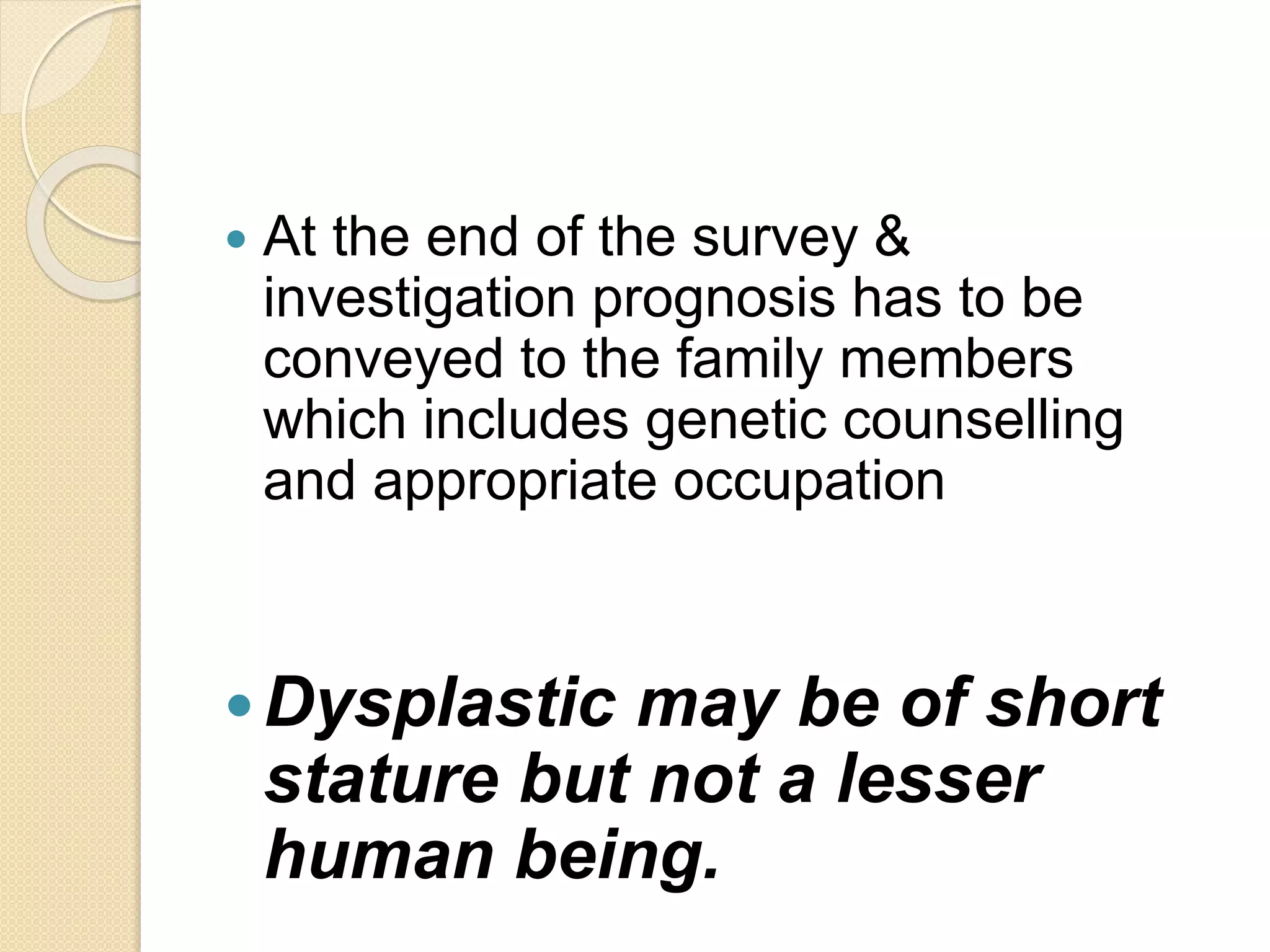
Summary
 At the end of the survey & 
investigation prognosis has to be 
conveyed to the family members 
which includes genetic counselling 
and appropriate occupation 
Dysplastic may be of short 
stature but not a lesser 
human being.
References 
 Tachdjian's Pediatric Orthopaedics 
 Review of Orthopaedics- Miller 
 Radiology of syndromes, metabolic 
disorders & skeletal dysplasia- Taybi & 
Lachman’s 
 Essentials of skeletal radiology- Yochum 
& Rowe’s 
 Turek s orthopaedics 
 Campbell's Operative Orthopaedics 
 Wikipedia
Thank you

Dwarfism, bonydysplasia

  • 1.
    DWARFISM Presentation by-Nikhil .S.U Chair person - Dr Ravishankar Co-chair person- Dr Prakash JSS hospital, Mysore
  • 2.
    Introduction  Bonedysplasias ( Dwarfism)  Greek word – Dys- disordered Plasia – development  Shortening of the growing bones in different proportions due to multiple gene defects  >200 disorders, abnormal growth of bones and cartilage  Height less than 147cms, <3rd percentile
  • 3.
    Classification  Proportion  Proportionate- symmetric decrease in both trunk and limb length. eg-constitutional, familial, endocrinopathies, mucopolysaccharidoses.  Disproportionate dwarfism:- 1. Short-trunk variety (e.g., Kniest syndrome–spondyloepiphyseal) 2. Short-limb variety (e.g., achondroplasia, diastrophic dysplasia)
  • 4.
     Based onlocation in short limb variety rhizomelic = root, e.g., bones of the arm or thigh mesomelic = middle, e.g., bones of the forearm or leg acromelic = end, e.g., bones of hands and feet. micromelic = entire limbs are shortened
  • 5.
     Source chondro= of cartilage osteo = of bone spondylo = of the vertebrae
  • 6.
     Lethal Achondrogenesis Thanatophoric dysplsia Asphyxiating thoracic dysplasia(ATD) Dysplasia epiphysealis punctata Osteogenesis imperfecta  Non leathal Majority of dysplasia
  • 7.
    Achondroplasia  Syn;chondrodystrophia fetalis  Most common form of disproportionate dwarfism  AD  Incidence - 1.5 per 10,000 live births.  GENETICS  Spontaneous mutation in Fibroblast Growth Factor Receptor 3(FGFR 3)  There is failure in the cartilaginous proliferative zone of physis- quantitative defect  Associated with advanced paternal age
  • 8.
     Signs andsymptoms Normal trunk and short limbs with hypotonia
  • 9.
     Lumbar stenosis& excessive lordosis with spinal cord / nerve root compression  Radial head subluxation  Normal intelligence but delayed motor milestones
  • 10.
    Radiographic findings Spine: narrowed interpedicular distance(L1 to S1)  pedicular shortening  T12/L1wedging, generalized posterior vertebral scalloping
  • 11.
     Bullet shapedvertebral bodies  Thick short pedicles  Lumbosacral hyperlordosis
  • 14.
    Treatment  Lumbarstenosis: decompression (laminectomy & discectomy) and fusion of the spine for a developing neurologic deficit (usually in children older than age 10)  Posterior fusion of cervical spine is recommended in individual cases  Foramen magnum stenosis: decompression  Progressive kyphosis: if fail bracing, anterior and posterior fusion are indicated for residual kyphosis greater than 50 degrees by age 5 years.
  • 15.
     Genu varum:Tibial osteotomies or hemiepiphysiodesis  Limb lengthening - adolescence usually is the time when lengthening is undertaken through callodiastasis (lengthening through a metaphyseal corticotomy) have been well described, with a high rate of complications.  Growth hormone is being used to augment the height
  • 16.
    SPONDYLOEPIPHYSEAL DYSPLASIA Defect in gene encoding Type 2 collagen  Abnormal epiphyseal development in the upper and lower extremities-disproportionate dwarfism  Retinal detachment and respiratory problems are common.
  • 17.
     Eyes arewide-set, the neck is short, and the chest appears barrel shaped.  Genu valgum, is common.  Lumbar lordosis may be accentuated and is usually due to hip flexion contractures. The lordosis gives the abdomen a protuberant appearance.  A waddling gait is produced by the coxa vara
  • 18.
     Generalised severeplatyspondyly  Increased intervertebral disc height  Open staircase vertebrae  Kyphosis/ scoliosis  Widening sclerosis irregularity of tubular bones  Irregular femoral epiphysis  Retarded bone maturation
  • 19.
    Treatment  Incase of cervical instability- posterior cervical fusion from the occiput or C1 to C2 with halo vest immobilization is necessary  When the scoliosis exceeds 50 degrees or is associated with significant kyphosis, fusion with standard instrumentation is effective
  • 20.
     Valgus osteotomywhen the neck– shaft angle is less than 100 degrees, when the Hilgenreiner–epiphyseal angle is greater than 60 degrees
  • 21.
    CHONDRODYSPLASIA PUNCTATA Multiple punctate calcifications seen on radiographs during infancy.  2 types 1. Conradi-Hünermann syndrome- XR-normal life expectancy(arylsulfatase E (ARSE) gene mutation) 2. Autosomal recessive- fatal during the first year of life, rhizomelic form.  Short stature, dry and scaly skin, occasional heart defects, and cataracts and spinal deformities are common.  Congenital vertebral anomalies - scoliosis or kyphosis
  • 22.
     Strippling /punctate calcification tarus, carpus, long bone epiphysis, vertebral transverse process, ischium & pubis  Soft tissue calcification around the joints present
  • 23.
    Treatment  Orthopaedictreatment consists primarily of managing the scoliosis- early anterior and posterior spinal fusion  Prognosis ; bad prognosis, most patients die due to respiratory complications by 1 year of age
  • 24.
    KNIEST SYNDROME Defect in COL2A1 gene  AD- short-trunked, disproportionate dwarfism with joint stiffness/contractures, scoliosis, kyphosis, and hypoplastic pelvis and spine  Otitis media and hearing loss are frequent.
  • 25.
     Radiology ;Osteopenia and dumbbell-shaped bones
  • 26.
     Treatment ; Early therapy for joint contractures, Reconstructive procedures for early hip degenerative arthritis Correction of the spinal deformity
  • 27.
    METAPHYSEAL CHONDRODYSPLASIA Heterogeneous group of disorders characterized by metaphyseal changes of tubular bones with normal epiphyses  Defect in the proliferative and hypertrophic zones of the physis
  • 28.
  • 29.
    Schmid type More common, less severe  Genetic defect is in type X collagen- AD  Short-limbed dwarfism not diagnosed until patient is older  Metaphyseal flaring & irregularity with widening of physis.  Enlarged capital femoral epiphysis
  • 31.
    treatment  Valgusosteotomy of the proximal femur may be indicated for children with significant coxa vara
  • 32.
     Recurrence ofdeformity with growth is common.  Hemiepiphysiodesis or stapling may improve angular deformities in some children.
  • 33.
    Jansen type Rare and most severe- AD  Genetic defect in parathyroid hormone–related peptide  Retardation, markedly short-limbed dwarfism with wide eyes, monkey-like stance, and hypercalcemia  x ray shows triking bulbous metaphyseal expansion of long bones
  • 34.
    McKusick type AR-  Cartilage-hair dysplasia (hypoplasia of cartilage and small diameter of hair)  Most common in the Amish population and in Finland  Atlantoaxial instability is common  Ankle deformity develops as a result of fibular overgrowth distally.  Abnormal immunocompetence, increased risk for malignancies, intestinal malabsorption, and megacolon
  • 36.
    treatment  Orthopaedictreatment is usually directed toward the ankle and foot-calcaneal sliding osteotomy as treatment for hindfoot varus  Growth hormone has recently been used
  • 37.
    MULTIPLE EPIPHYSEAL DYSPLASIA  COMP gene mutation(Cartilage oligomeric matrix protein )  Prevalence of MED was 9 per 100,000  Short-limbed, disproportionate dwarfism often not manifested until between the ages of 5 and 14.  A mild form (Ribbing) and a more severe form (Fairbanks) exist  Waddling gait, and early hip arthritis are common
  • 38.
     Irregular, delayedossification at multiple epiphyses  Short, stunted metacarpals and metatarsals, irregular proximal femora, abnormal ossification (flattened tibial & femoral condyles, patella with double layer), valgus knees
  • 39.
    Multiple epiphyseal dysplasia. Abnormal femoral heads Flattened tibial & femoral condyles
  • 40.
     Treatment :  Caution regarding weight gain  Treat limb alignment and perform early joint replacement  Shelf acetabular augmentation in some patients - to improve coverage of the misshapen femoral head  Osteotomies may be helpful in realigning the lower extremities when angular deformities exist, particularly at the knee
  • 41.
     stapling mayprovide correction in some cases
  • 42.
    DD s forMULTIPLE EPIPHYSEAL DYSPLASIA  Perthes disease - usually affects unilateral hip but when bilaterals each hip is in a different stage of the disease.- this is not the case in MED  Spondyloepiphyseal dysplasia-abnormal epiphyseal development with typical spine involvement which is not found in MED
  • 43.
    MUCOPOLYSACCHARIDOSIS  Dueto hydrolase(lysosomal storage disorder) enzyme deficiency-mucopolysaccharides accumulate in the body & produce proportionate dwarfism.  Normal mucopolysaccharide excretion in urine <15mg/24 hrs  It wil be >100mg/24hrs
  • 44.
    All are AR,autosomal recessive; except MPS 2-XR, X-linked recessive.
  • 45.
  • 46.
     The faciescoarse and heavy.  The head is enlarged, and hydrocephalus-meningeal deposits.  The skull is abnormally shaped, and the forehead is low.  Premature closure of the sagittal and metopic sutures of the skull leads to a prominent longitudinal ridge that may cross the forehead.  The ears are low and the eyes are wide-set.  The teeth are poorly formed and widespread.  The nostrils are wide, and the nose has a depressed bridge and broad tip.  The lips are everted, the tongue is enlarged, and the mouth is open. “Chronic rhinitis” with noisy mouth-breathing is always present and is due to narrowing of the nasopharynx by enlarged adenoids and mucosal deposits.  This, combined with the presence of hernias, may be the presenting sign of the disease  Clouding of the cornea is a universal feature of the disease
  • 47.
     Urinary excretionof dermatan/heparan sulfate  Treatment  Bone marrow transplantation has increased the life span for patients with this disorder- Transplantation before the age of 24 months yields better clinical results
  • 48.
     Surgical reconstruction,including reduction, femoral osteotomy, and pelvic osteotomy- for Hip dysplasia  Carpal tunnel syndrome- Treated by surgical decompression
  • 49.
    Hunter syndrome Bonemarrow transplantation has been used in isolated cases of Hunter's syndrome
  • 50.
  • 53.
  • 54.
    Wide, unossified femoralheads Wine-glass shaped inner pelvic contour
  • 55.
    treatment  Manifestingmyelopathy necessitates decompression and cervical fusion  Genu valgum may be treated by realignment osteotomy  Carry substantial anesthetic risk because of their cervical instability and respiratory and cardiac abnormalities
  • 57.
    Thanatophoric dysplasia Disproportionately small ribcage, extremely short limbs and folds of extra skin on the arms and legs  lethal skeletal dysplasia  Narrow chest, small ribs and under developed lungs
  • 60.
     Children withthis condition are usually stillborn or die shortly after birth from respiratory failure  Survivors have difficulty breathing on their own and require respiratory support
  • 61.
    DIASTROPHIC DYSPLASIA AR.  Deficiency in sulfate transport protein  Features  Severe, short-limbed dwarfism  Cleft palate (59% of cases)  Severe joint contractures (especially hip and knee)  Cauliflower ears (80% of cases), hitchhiker’s thumb  Rigid clubfeet
  • 62.
  • 63.
     Radiologic findings  Spine radiographs reveal cervical kyphosis (often severe, necessitating immediate treatment), thoracolumbar kyphoscoliosis  (83% of cases), spina bifida occulta, and atlantoaxial instability.
  • 64.
     Treatment Quadriplegia is a major concern with deformities of the cervical spine.  Surgical release of clubfoot deformities  Osteotomies for contractures  Spinal fusion often required- Anterior fusion with fibular strut grafting and posterior fusion with halo immobilization
  • 65.
    CLEIDOCRANIAL DYSPLASIA (DYSOSTOSIS)  AD  Proportionate dwarfism that affects bones formed by intramembranous ossification (clavicles, cranium, pelvis)  Defect in -Core-binding factor alpha 1 (Cbfa1)- transcription factor for osteocalcin
  • 68.
     Delayed closureof skull sutures, frontal bossing  Treatment Excision of the clavicular fragments can decompress the brachial plexus Intertrochanteric valgus osteotomy if neck-shaft angle is less than 100 degrees
  • 69.
  • 74.
     At theend of the survey & investigation prognosis has to be conveyed to the family members which includes genetic counselling and appropriate occupation Dysplastic may be of short stature but not a lesser human being.
  • 75.
    References  Tachdjian'sPediatric Orthopaedics  Review of Orthopaedics- Miller  Radiology of syndromes, metabolic disorders & skeletal dysplasia- Taybi & Lachman’s  Essentials of skeletal radiology- Yochum & Rowe’s  Turek s orthopaedics  Campbell's Operative Orthopaedics  Wikipedia
  • 76.