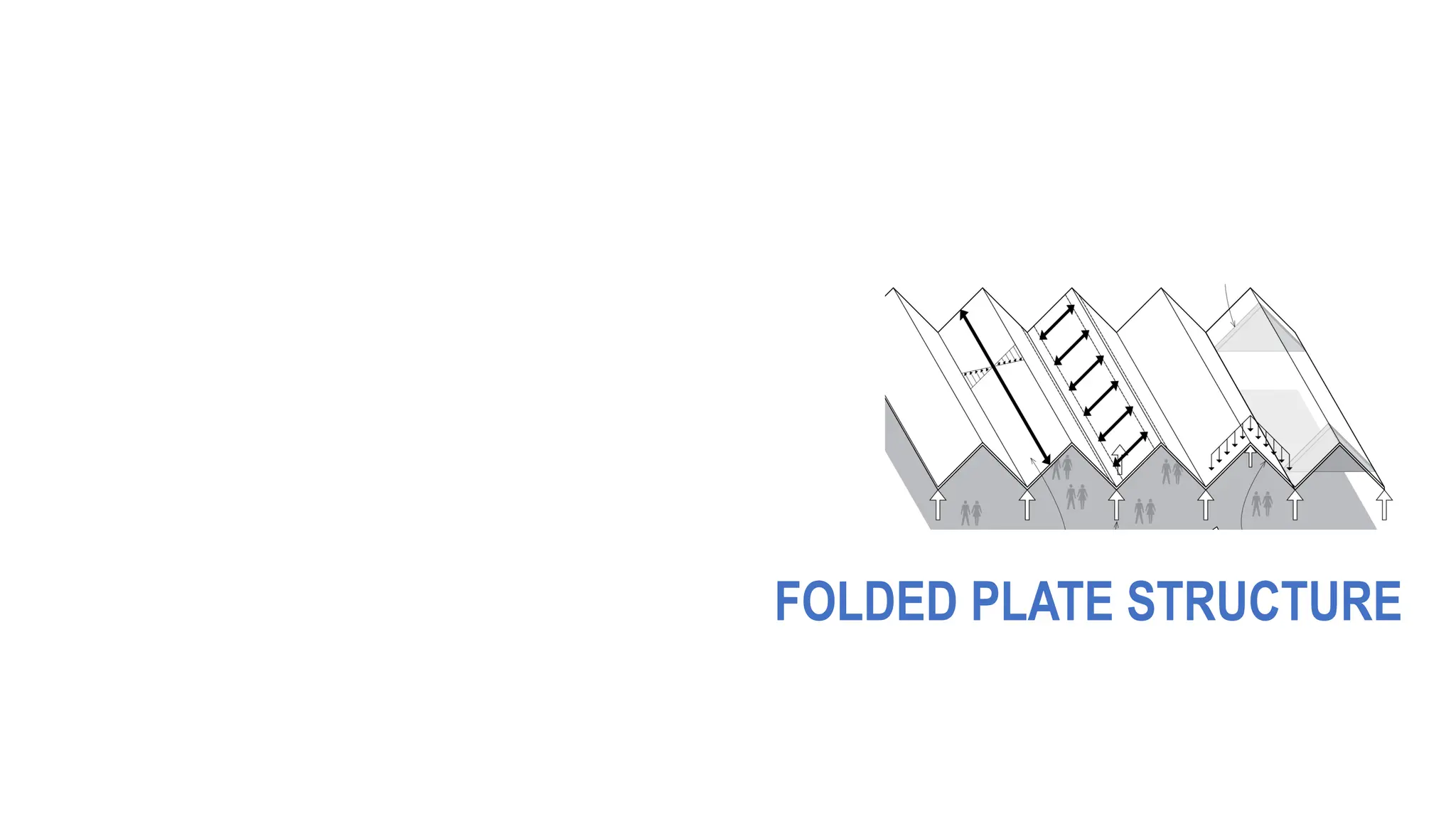
FOLDED PLATE STRUCTURE
Outline
o Definition
o Folding Systems in Nature
o The Principle of Folding
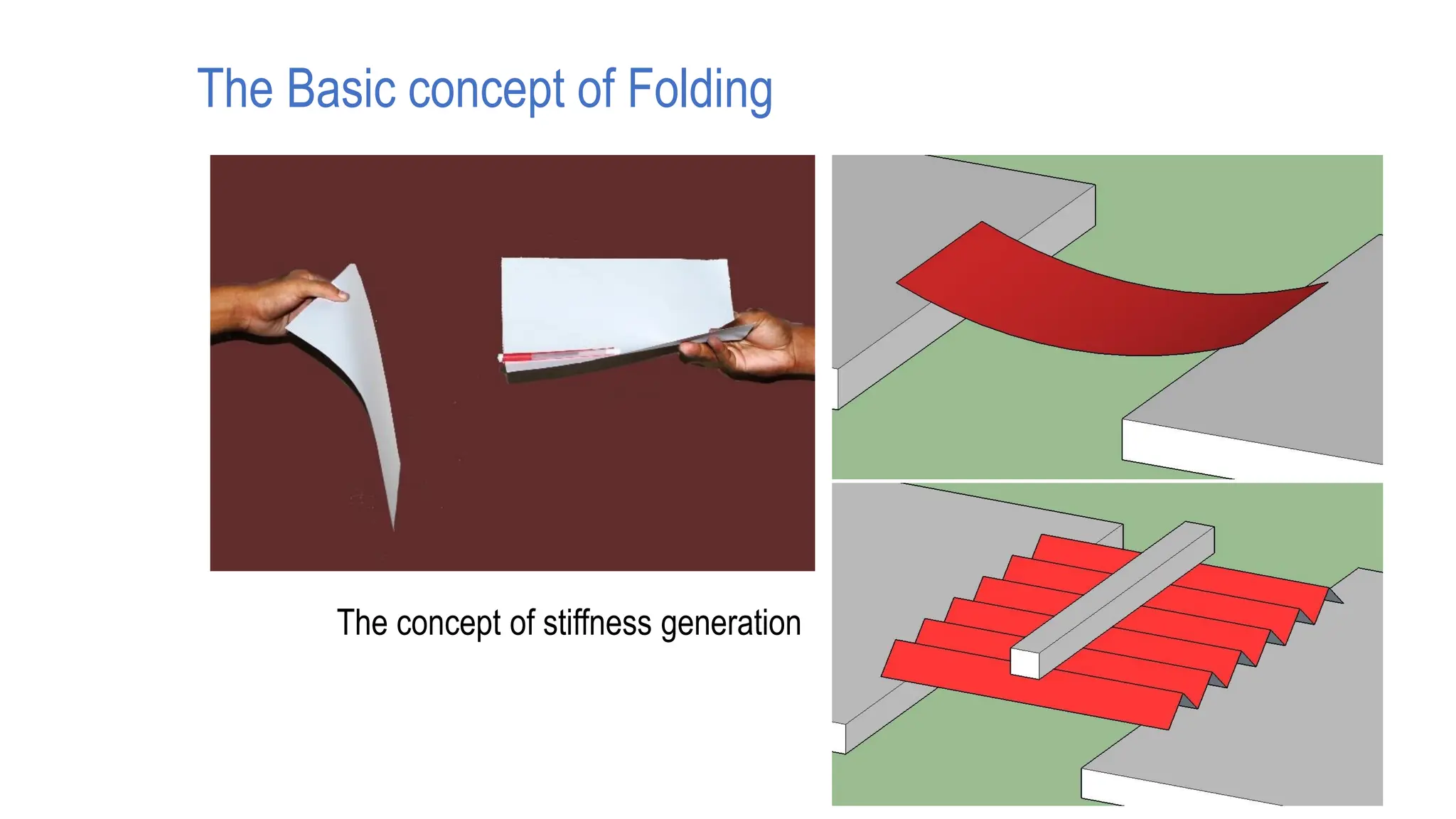
o The Basic concept of Folding
o Structural Behavior of Folding
o Types of Folded Structure
o The Application of Folded Structures
o Advantages and Disadvantages of Folded-Plate Structure
o Some Real Life Examples of Folded Plate Structure
Definition
Folded plates are assemblies of flat plates rigidly connected together along
their edges in such a way that the structural system capable of carrying loads
without the need for additional supporting beams along mutual edges.
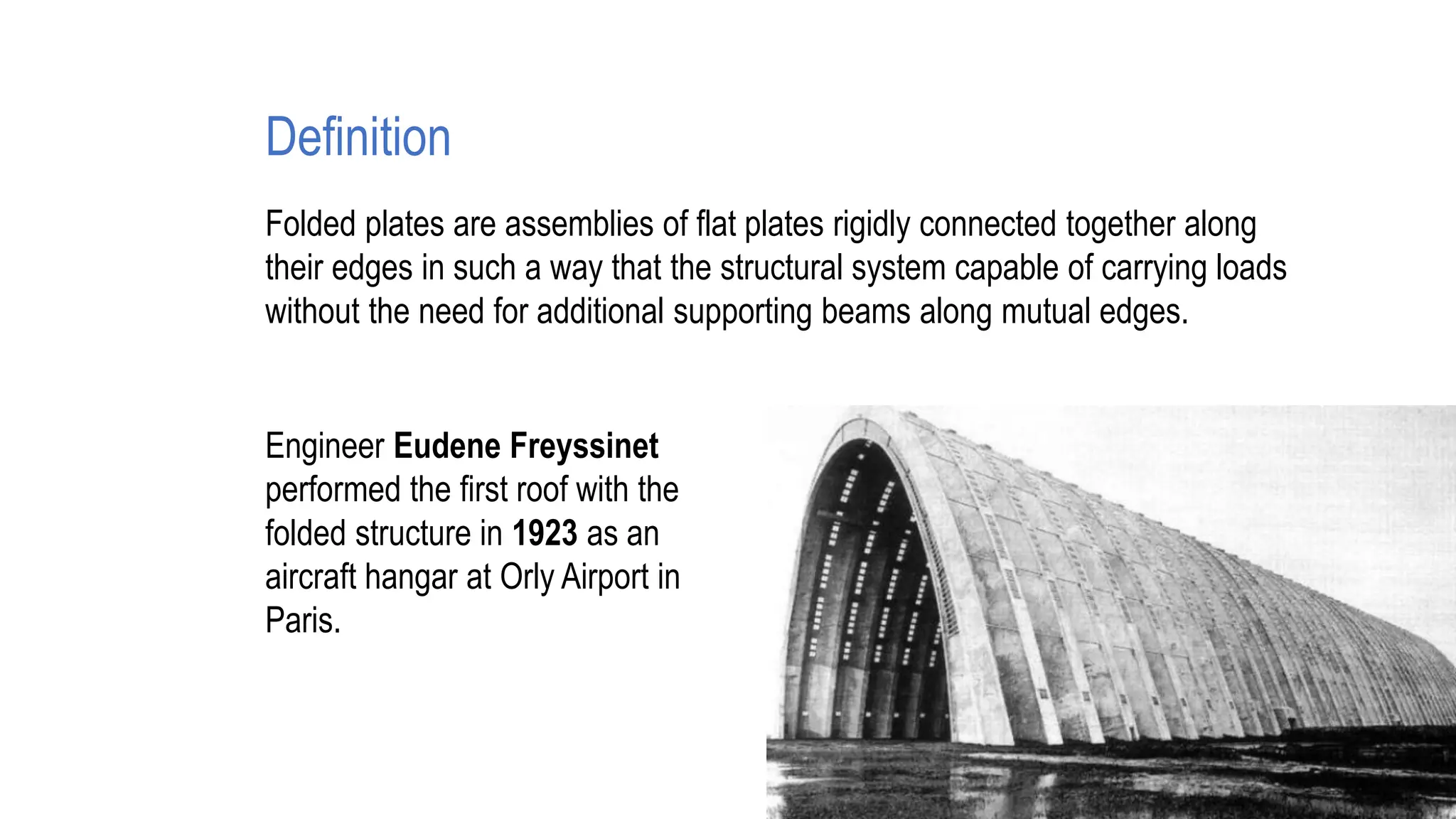
Engineer Eudene Freyssinet
performed the first roof with the
folded structure in 1923 as an
aircraft hangar at Orly Airport in
Paris.
Folding Systems in Nature
The principle of folding as a tool to develop a general structural shape has
been known for a long time. Folded structure systems which are analogous to
several biological systems such as found at broadleaf-tree leaves, petals and
foldable insect wings, are adopted to be employed in a new, technical way.
Leaf of Palm Tree Beetle Insect With Foldable
Wings
Seashell
The Principle of Folding
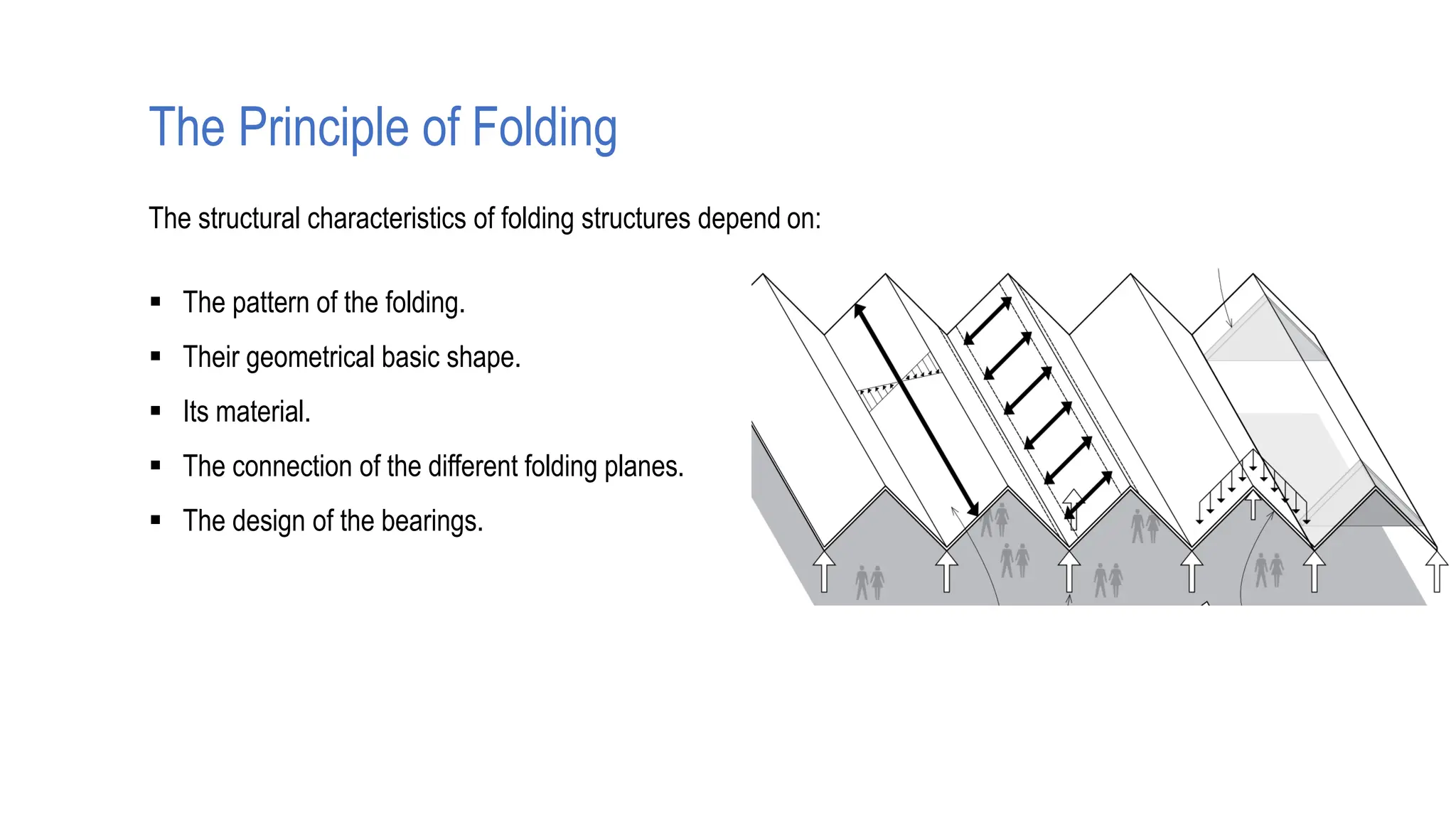
The structural characteristics of folding structures depend on:
▪ The pattern of the folding.
▪ Their geometrical basic shape.
▪ Its material.
▪ The connection of the different folding planes.
▪ The design of the bearings.
The Basic concept of Folding
The concept of stiffness generation
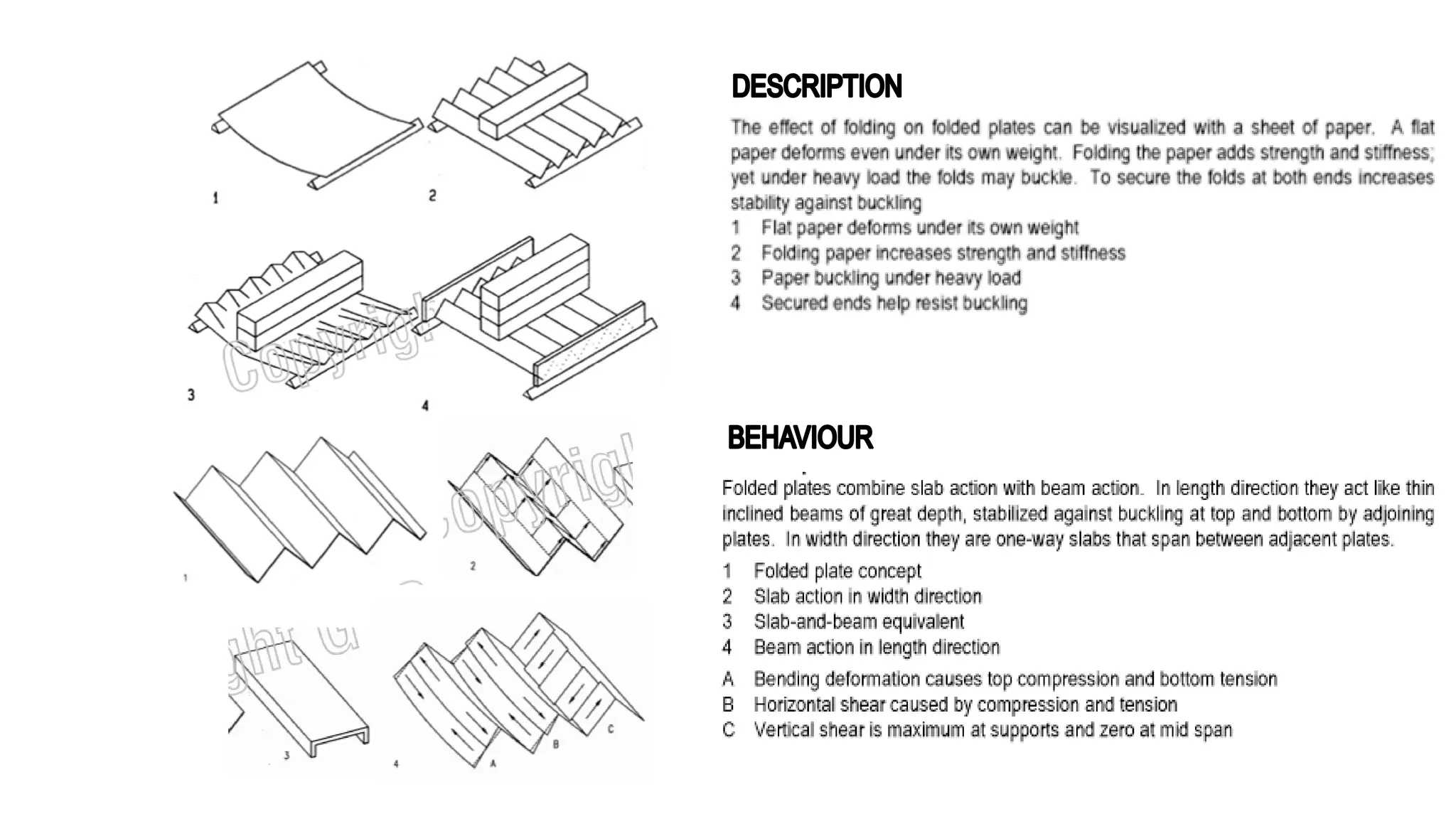
DESCRIPTION
BEHAVIOUR
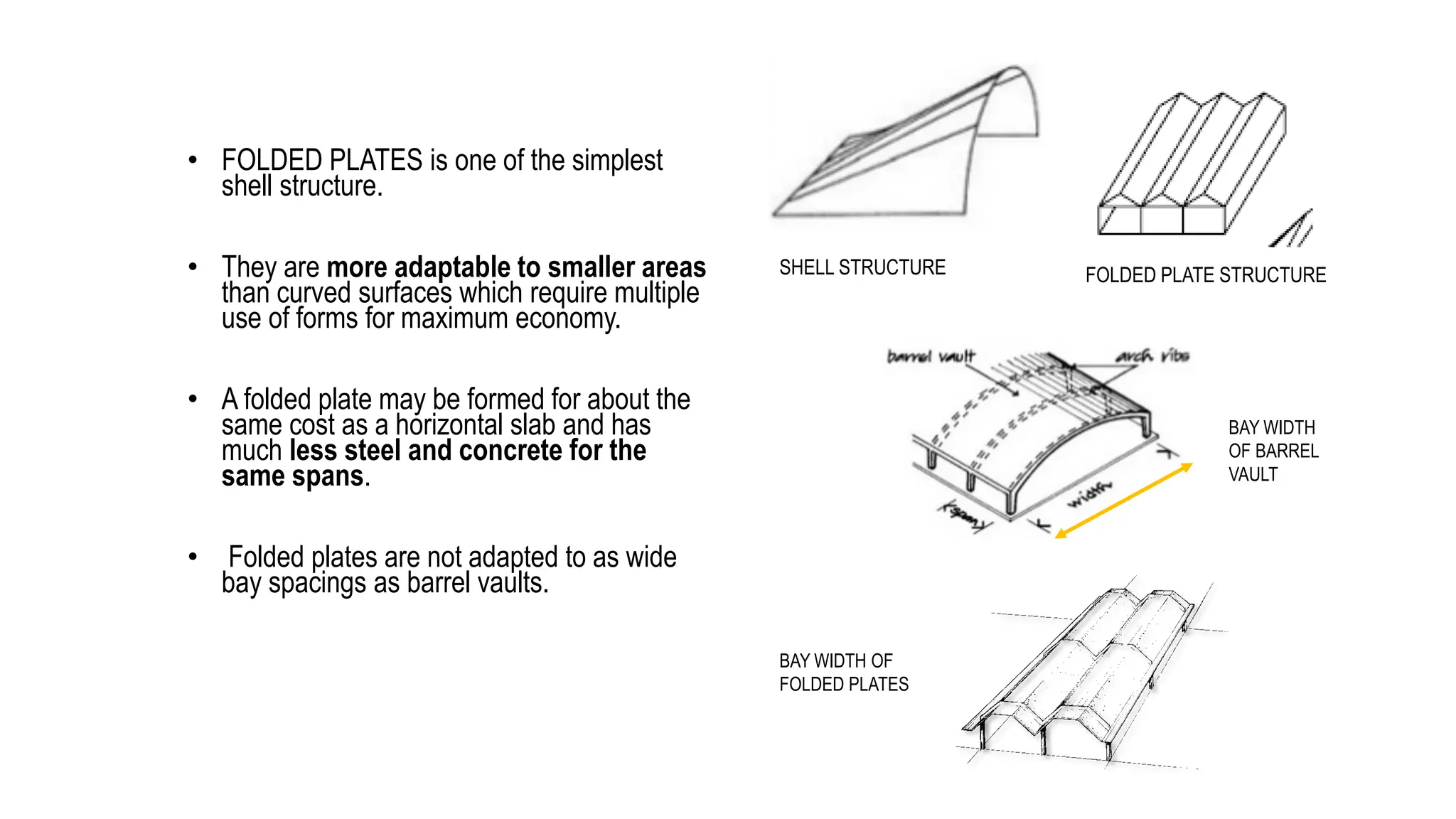
• FOLDED PLATES is one of the simplest
shell structure.
• They are more adaptable to smaller areas
than curved surfaces which require multiple
use of forms for maximum economy.
• A folded plate may be formed for about the
same cost as a horizontal slab and has
much less steel and concrete for the
same spans.
• Folded plates are not adapted to as wide
bay spacings as barrel vaults.
SHELL STRUCTURE FOLDED PLATE STRUCTURE
BAY WIDTH OF
FOLDED PLATES
BAY WIDTH
OF BARREL
VAULT
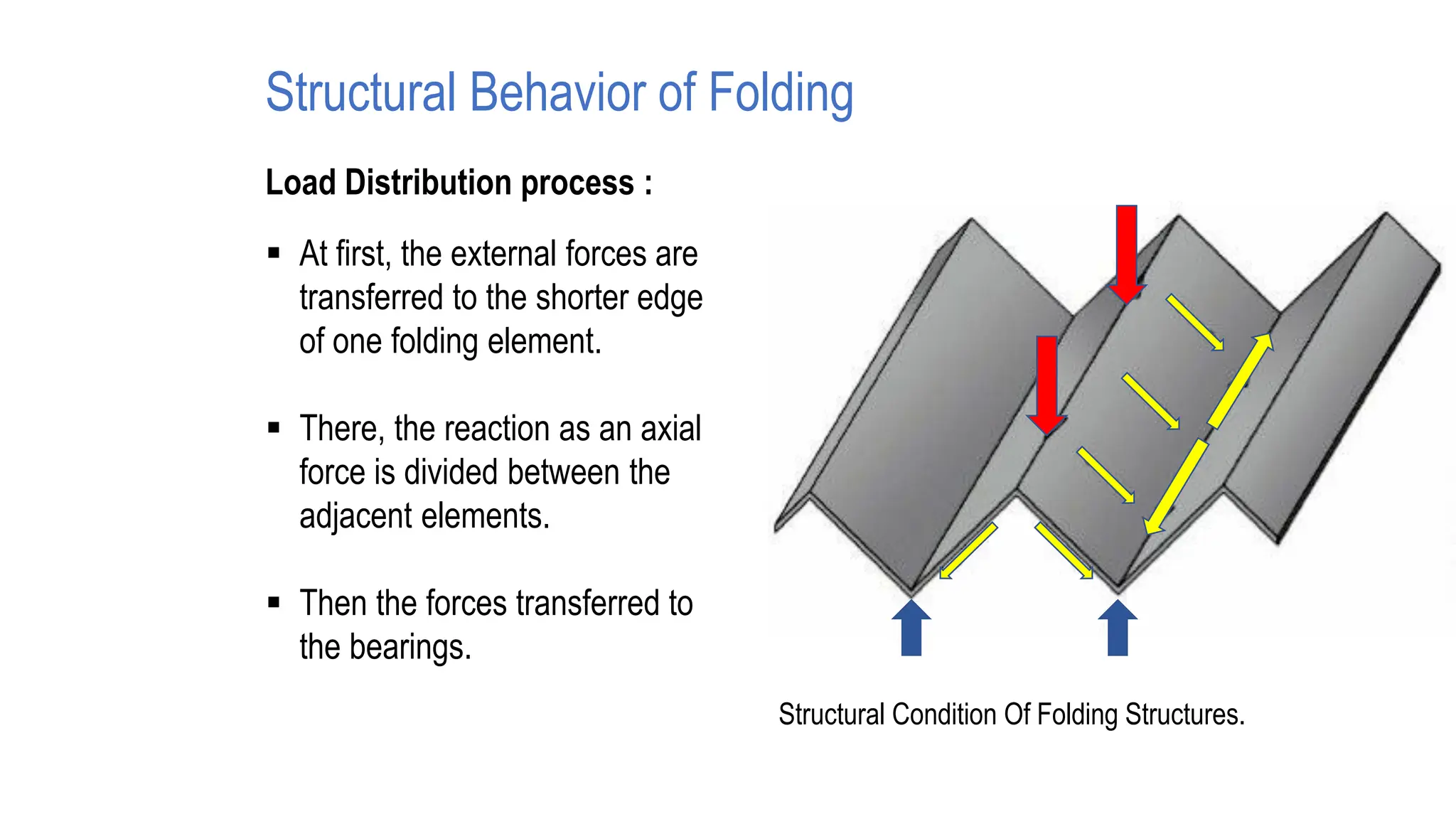
Structural Behavior of Folding
Structural Condition Of Folding Structures.
Load Distribution process :
▪ At first, the external forces are
transferred to the shorter edge
of one folding element.
▪ There, the reaction as an axial
force is divided between the
adjacent elements.
▪ Then the forces transferred to
the bearings.
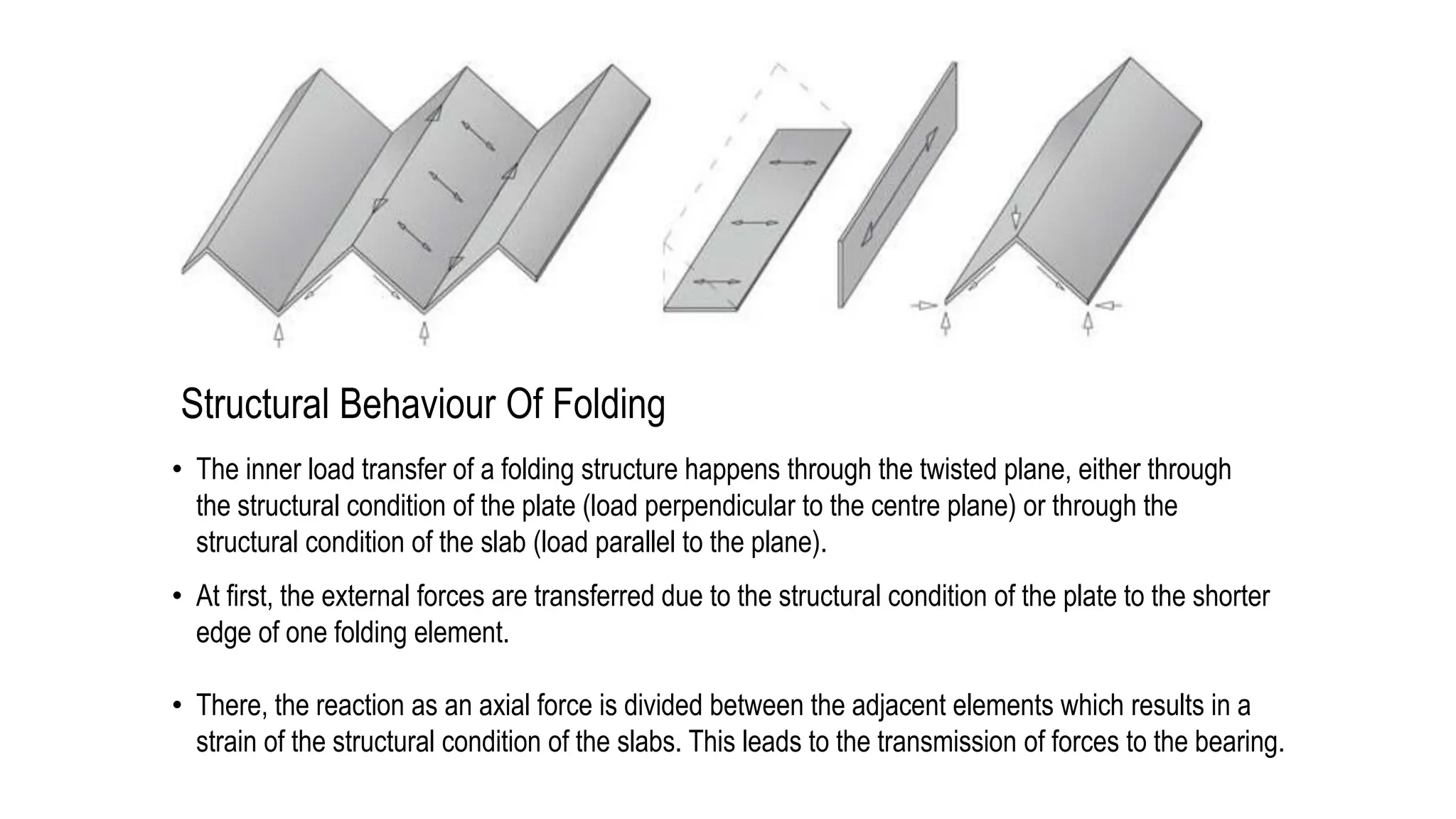
Structural Behaviour Of Folding
• The inner load transfer of a folding structure happens through the twisted plane, either through
the structural condition of the plate (load perpendicular to the centre plane) or through the
structural condition of the slab (load parallel to the plane).
• At first, the external forces are transferred due to the structural condition of the plate to the shorter
edge of one folding element.
• There, the reaction as an axial force is divided between the adjacent elements which results in a
strain of the structural condition of the slabs. This leads to the transmission of forces to the bearing.
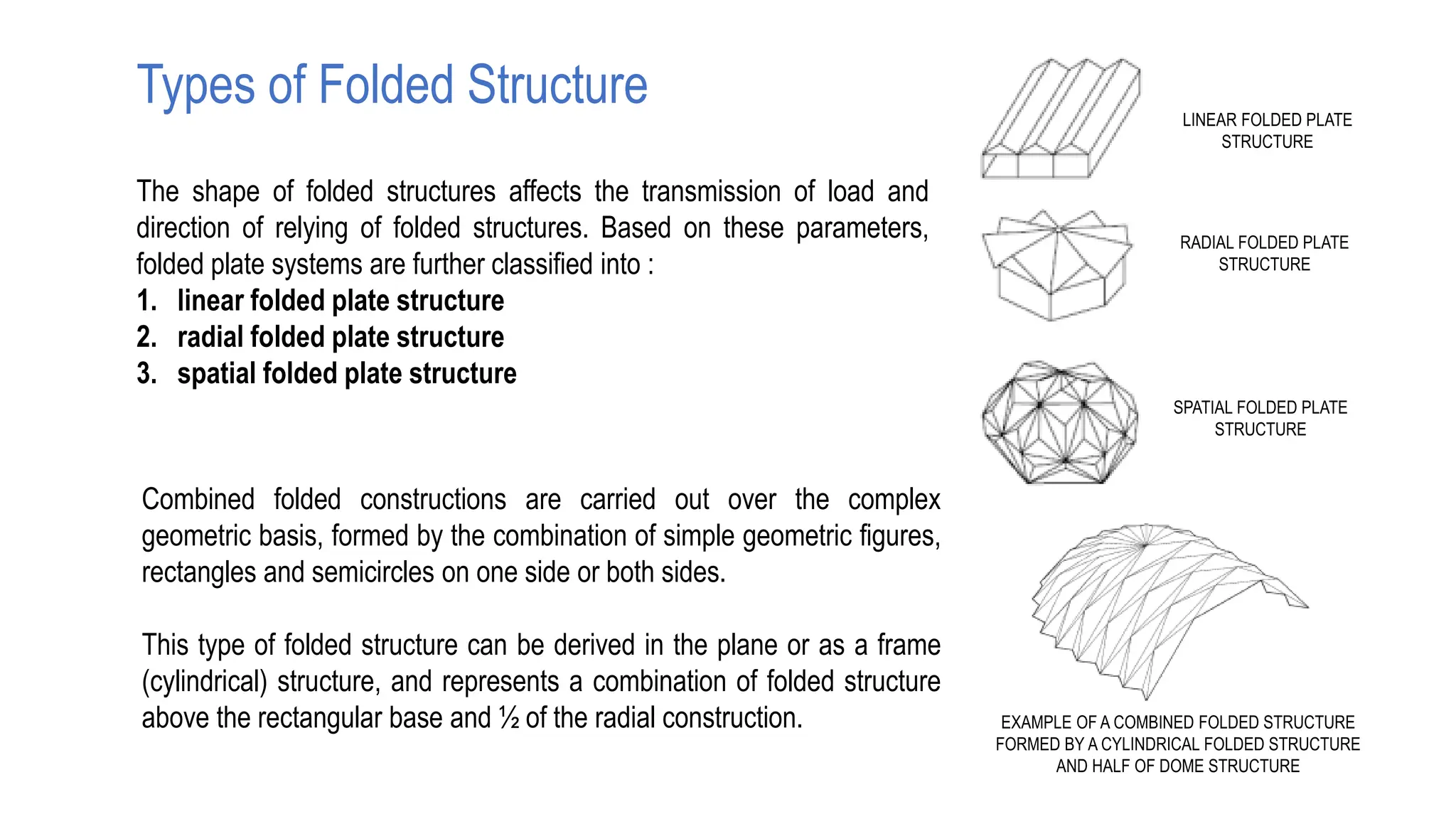
Types of Folded Structure
The shape of folded structures affects the transmission of load and
direction of relying of folded structures. Based on these parameters,
folded plate systems are further classified into :
1. linear folded plate structure
2. radial folded plate structure
3. spatial folded plate structure
Combined folded constructions are carried out over the complex
geometric basis, formed by the combination of simple geometric figures,
rectangles and semicircles on one side or both sides.
This type of folded structure can be derived in the plane or as a frame
(cylindrical) structure, and represents a combination of folded structure
above the rectangular base and ½ of the radial construction.
LINEAR FOLDED PLATE
STRUCTURE
RADIAL FOLDED PLATE
STRUCTURE
SPATIAL FOLDED PLATE
STRUCTURE
EXAMPLE OF A COMBINED FOLDED STRUCTURE
FORMED BY A CYLINDRICAL FOLDED STRUCTURE
AND HALF OF DOME STRUCTURE
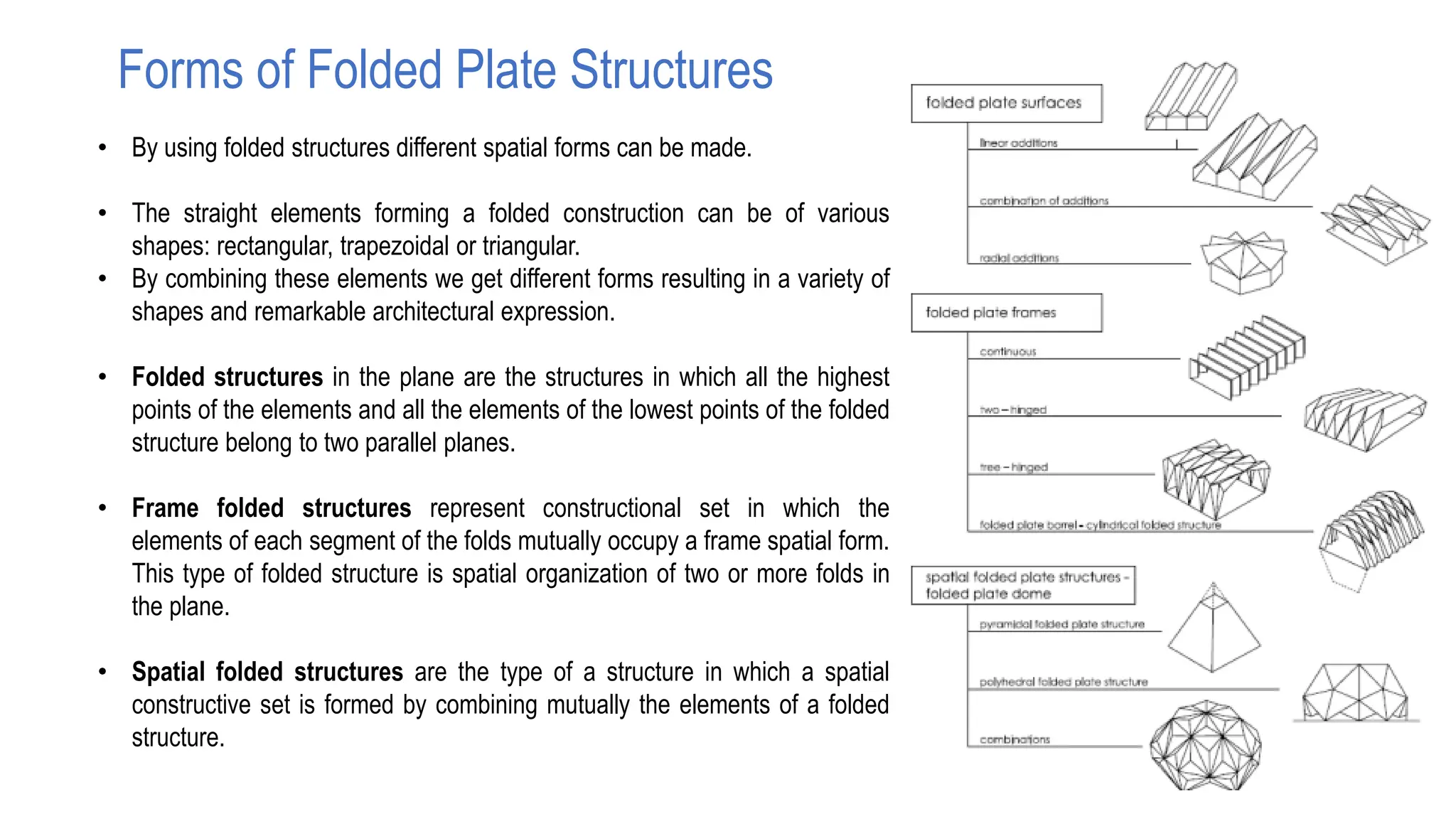
Forms of Folded Plate Structures
• By using folded structures different spatial forms can be made.
• The straight elements forming a folded construction can be of various
shapes: rectangular, trapezoidal or triangular.
• By combining these elements we get different forms resulting in a variety of
shapes and remarkable architectural expression.
• Folded structures in the plane are the structures in which all the highest
points of the elements and all the elements of the lowest points of the folded
structure belong to two parallel planes.
• Frame folded structures represent constructional set in which the
elements of each segment of the folds mutually occupy a frame spatial form.
This type of folded structure is spatial organization of two or more folds in
the plane.
• Spatial folded structures are the type of a structure in which a spatial
constructive set is formed by combining mutually the elements of a folded
structure.
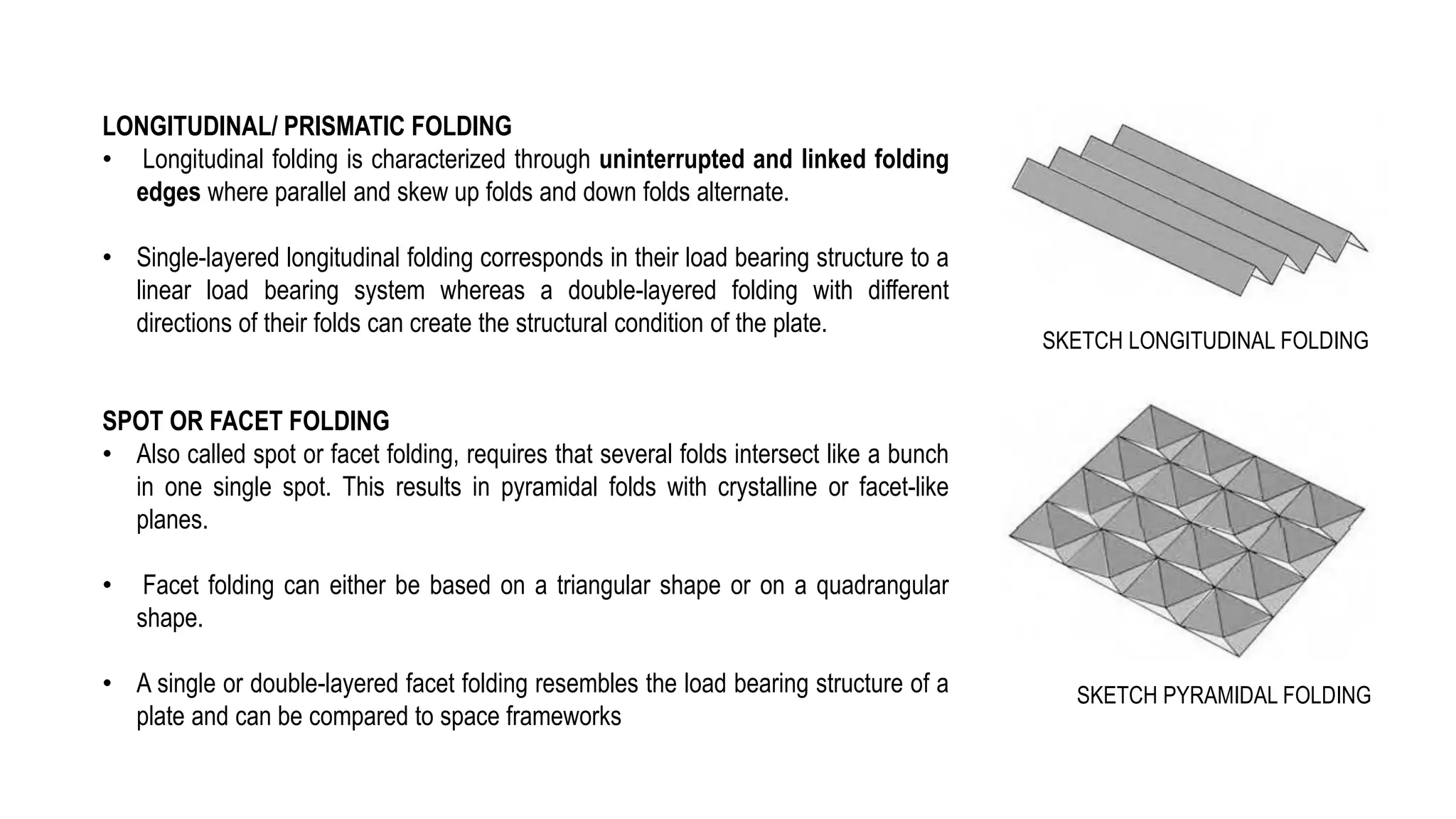
LONGITUDINAL/ PRISMATIC FOLDING
• Longitudinal folding is characterized through uninterrupted and linked folding
edges where parallel and skew up folds and down folds alternate.
• Single-layered longitudinal folding corresponds in their load bearing structure to a
linear load bearing system whereas a double-layered folding with different
directions of their folds can create the structural condition of the plate.
SPOT OR FACET FOLDING
• Also called spot or facet folding, requires that several folds intersect like a bunch
in one single spot. This results in pyramidal folds with crystalline or facet-like
planes.
• Facet folding can either be based on a triangular shape or on a quadrangular
shape.
• A single or double-layered facet folding resembles the load bearing structure of a
plate and can be compared to space frameworks
SKETCH PYRAMIDAL FOLDING
SKETCH LONGITUDINAL FOLDING
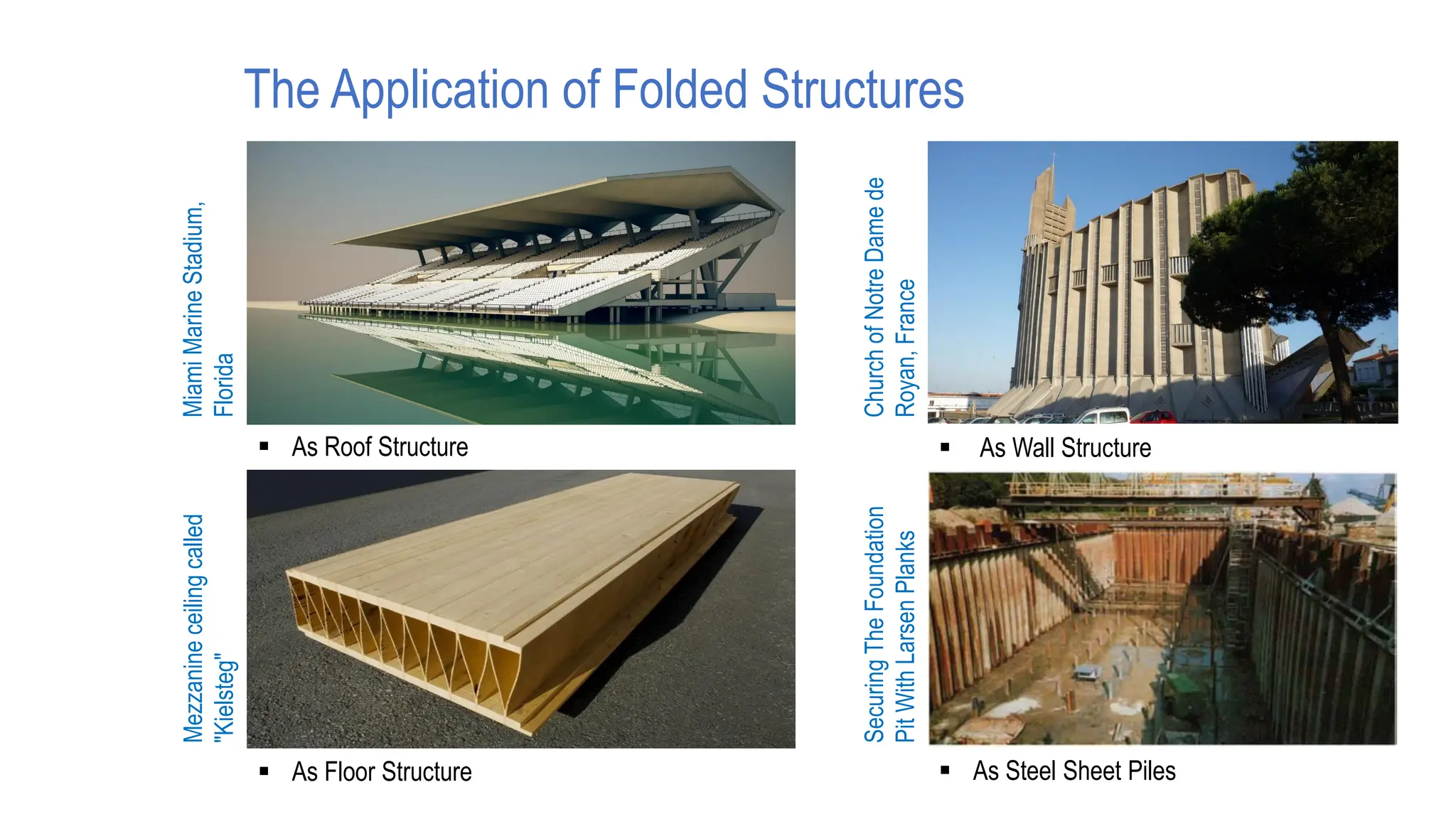
The Application of Folded Structures
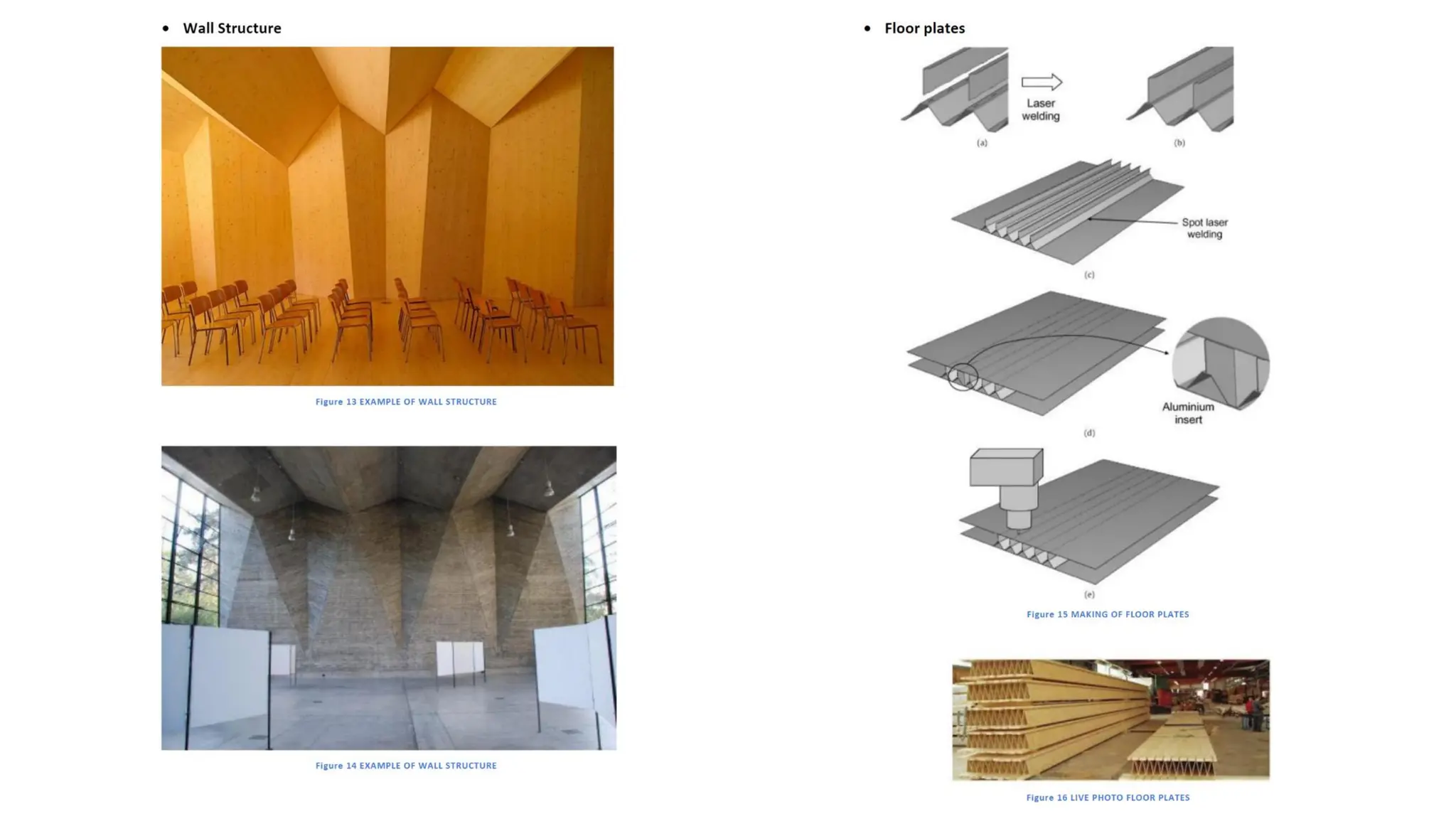
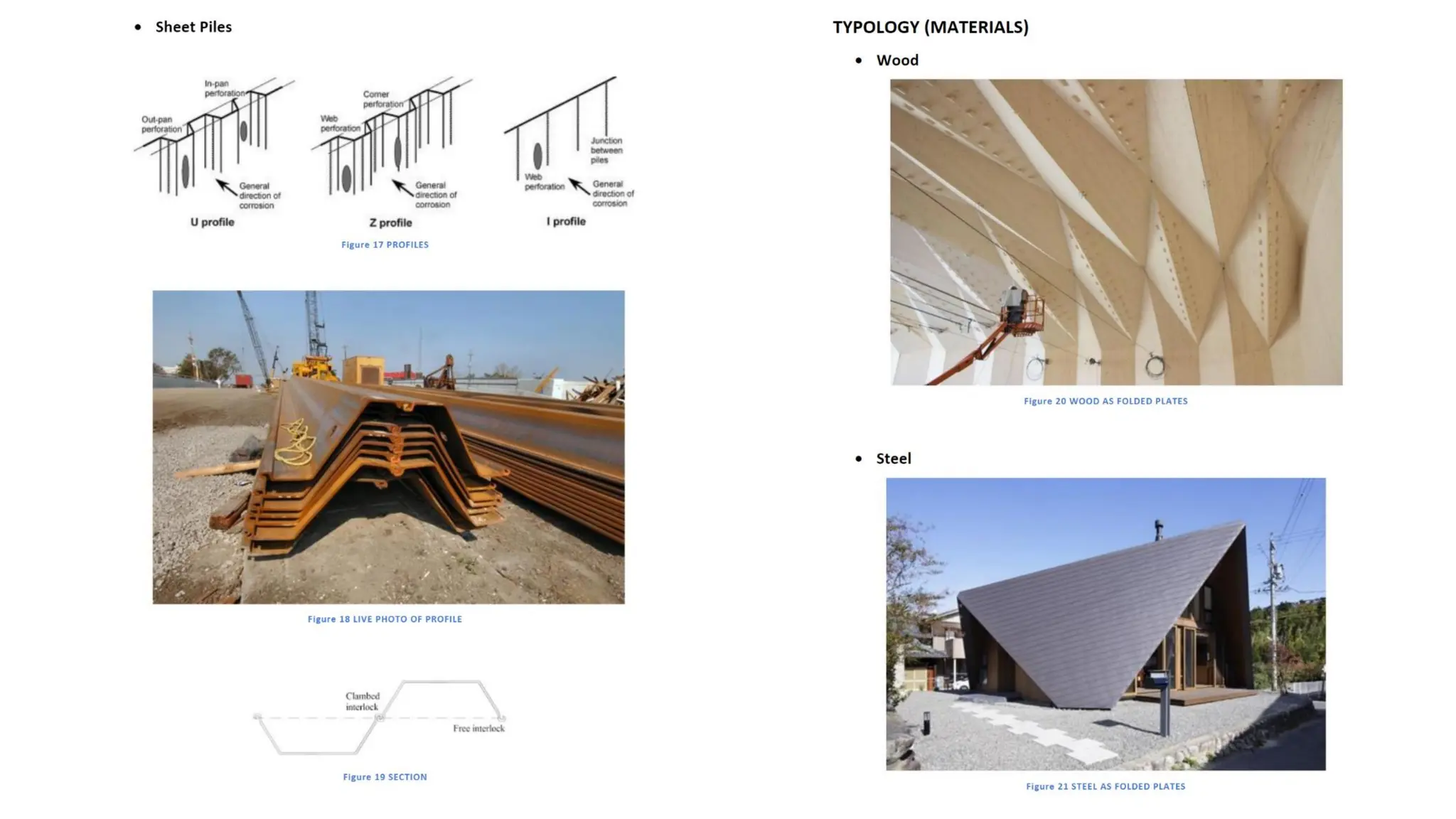
▪ As Roof Structure ▪ As Wall Structure
▪ As Steel Sheet Piles
▪ As Floor Structure
Miami
Marine
Stadium,
Florida
Church
of
Notre
Dame
de
Royan,
France
Mezzanine
ceiling
called
"Kielsteg"
Securing
The
Foundation
Pit
With
Larsen
Planks
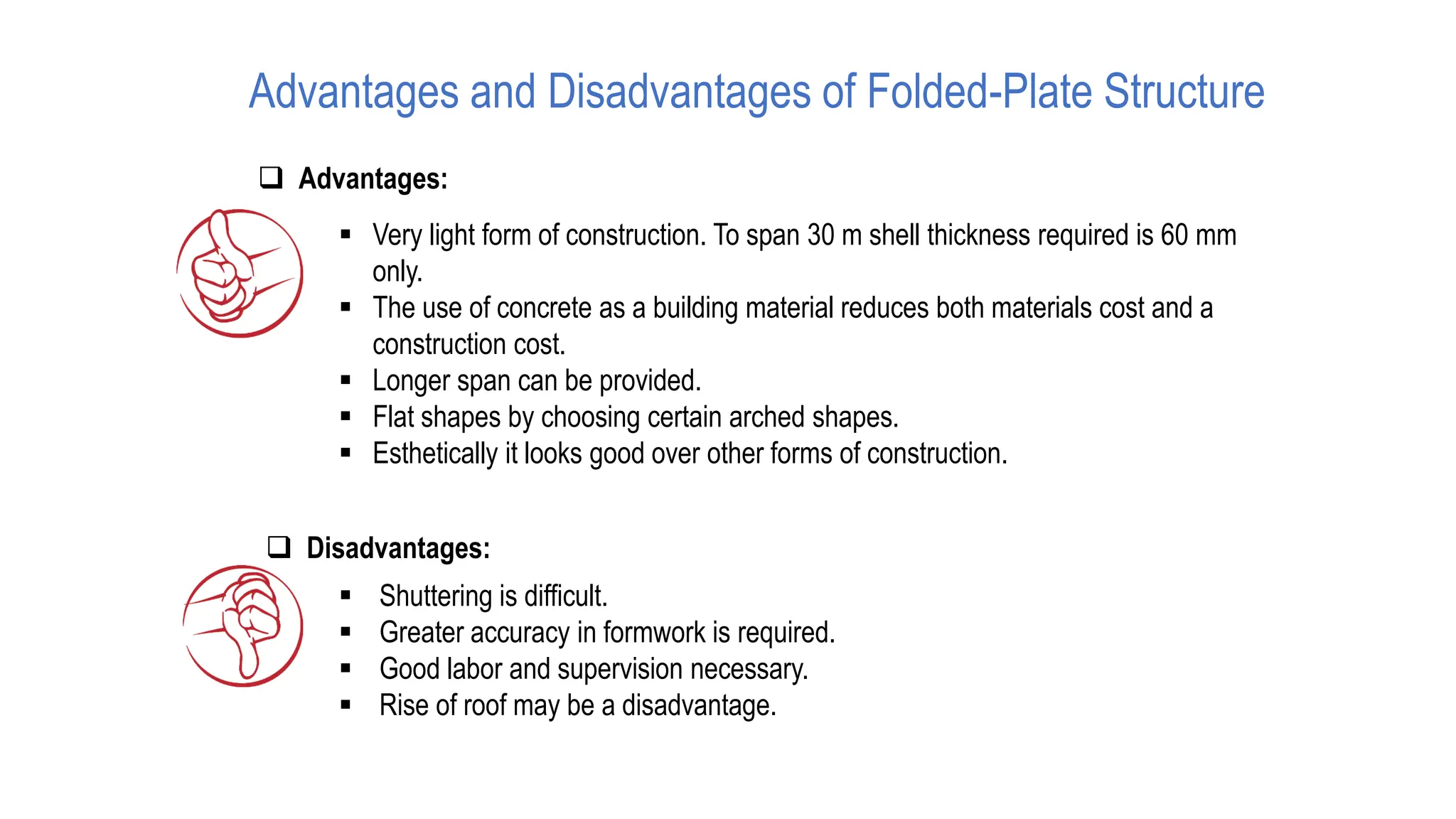
Advantages and Disadvantages of Folded-Plate Structure
❑ Advantages:
▪ Very light form of construction. To span 30 m shell thickness required is 60 mm
only.
▪ The use of concrete as a building material reduces both materials cost and a
construction cost.
▪ Longer span can be provided.
▪ Flat shapes by choosing certain arched shapes.
▪ Esthetically it looks good over other forms of construction.
❑ Disadvantages:
▪ Shuttering is difficult.
▪ Greater accuracy in formwork is required.
▪ Good labor and supervision necessary.
▪ Rise of roof may be a disadvantage.
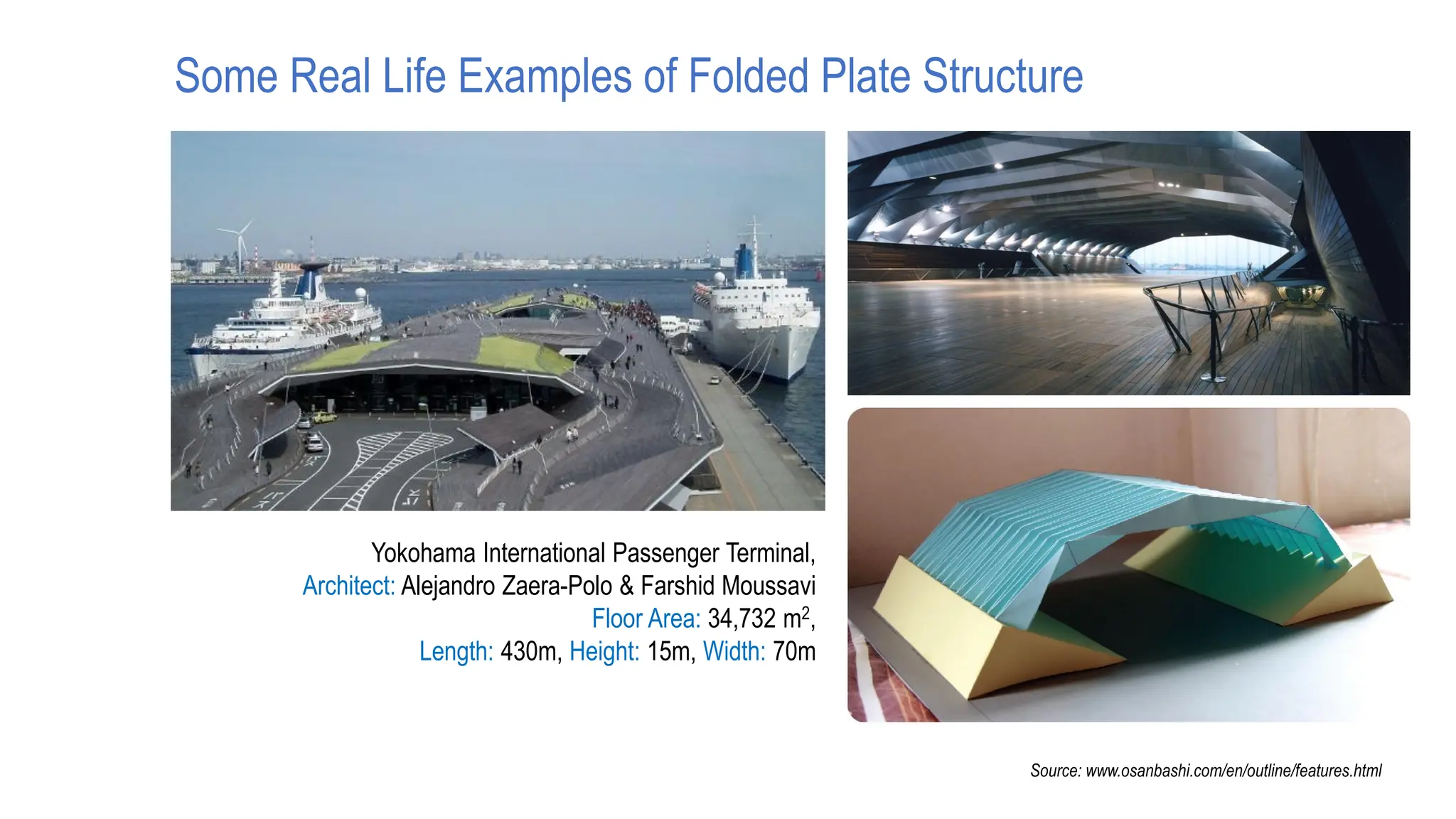
Yokohama International Passenger Terminal,
Architect: Alejandro Zaera-Polo & Farshid Moussavi
Floor Area: 34,732 m2,
Length: 430m, Height: 15m, Width: 70m
Source: www.osanbashi.com/en/outline/features.html
Some Real Life Examples of Folded Plate Structure
Thank you

SK IV 2023 - Folded plate structure.pdfq

  • 1.
  • 2.
    Outline o Definition o FoldingSystems in Nature o The Principle of Folding o The Basic concept of Folding o Structural Behavior of Folding o Types of Folded Structure o The Application of Folded Structures o Advantages and Disadvantages of Folded-Plate Structure o Some Real Life Examples of Folded Plate Structure
  • 3.
    Definition Folded plates areassemblies of flat plates rigidly connected together along their edges in such a way that the structural system capable of carrying loads without the need for additional supporting beams along mutual edges. Engineer Eudene Freyssinet performed the first roof with the folded structure in 1923 as an aircraft hangar at Orly Airport in Paris.
  • 4.
    Folding Systems inNature The principle of folding as a tool to develop a general structural shape has been known for a long time. Folded structure systems which are analogous to several biological systems such as found at broadleaf-tree leaves, petals and foldable insect wings, are adopted to be employed in a new, technical way. Leaf of Palm Tree Beetle Insect With Foldable Wings Seashell
  • 5.
    The Principle ofFolding The structural characteristics of folding structures depend on: ▪ The pattern of the folding. ▪ Their geometrical basic shape. ▪ Its material. ▪ The connection of the different folding planes. ▪ The design of the bearings.
  • 6.
    The Basic conceptof Folding The concept of stiffness generation
  • 7.
  • 8.
    • FOLDED PLATESis one of the simplest shell structure. • They are more adaptable to smaller areas than curved surfaces which require multiple use of forms for maximum economy. • A folded plate may be formed for about the same cost as a horizontal slab and has much less steel and concrete for the same spans. • Folded plates are not adapted to as wide bay spacings as barrel vaults. SHELL STRUCTURE FOLDED PLATE STRUCTURE BAY WIDTH OF FOLDED PLATES BAY WIDTH OF BARREL VAULT
  • 9.
    Structural Behavior ofFolding Structural Condition Of Folding Structures. Load Distribution process : ▪ At first, the external forces are transferred to the shorter edge of one folding element. ▪ There, the reaction as an axial force is divided between the adjacent elements. ▪ Then the forces transferred to the bearings.
  • 10.
    Structural Behaviour OfFolding • The inner load transfer of a folding structure happens through the twisted plane, either through the structural condition of the plate (load perpendicular to the centre plane) or through the structural condition of the slab (load parallel to the plane). • At first, the external forces are transferred due to the structural condition of the plate to the shorter edge of one folding element. • There, the reaction as an axial force is divided between the adjacent elements which results in a strain of the structural condition of the slabs. This leads to the transmission of forces to the bearing.
  • 11.
    Types of FoldedStructure The shape of folded structures affects the transmission of load and direction of relying of folded structures. Based on these parameters, folded plate systems are further classified into : 1. linear folded plate structure 2. radial folded plate structure 3. spatial folded plate structure Combined folded constructions are carried out over the complex geometric basis, formed by the combination of simple geometric figures, rectangles and semicircles on one side or both sides. This type of folded structure can be derived in the plane or as a frame (cylindrical) structure, and represents a combination of folded structure above the rectangular base and ½ of the radial construction. LINEAR FOLDED PLATE STRUCTURE RADIAL FOLDED PLATE STRUCTURE SPATIAL FOLDED PLATE STRUCTURE EXAMPLE OF A COMBINED FOLDED STRUCTURE FORMED BY A CYLINDRICAL FOLDED STRUCTURE AND HALF OF DOME STRUCTURE
  • 12.
    Forms of FoldedPlate Structures • By using folded structures different spatial forms can be made. • The straight elements forming a folded construction can be of various shapes: rectangular, trapezoidal or triangular. • By combining these elements we get different forms resulting in a variety of shapes and remarkable architectural expression. • Folded structures in the plane are the structures in which all the highest points of the elements and all the elements of the lowest points of the folded structure belong to two parallel planes. • Frame folded structures represent constructional set in which the elements of each segment of the folds mutually occupy a frame spatial form. This type of folded structure is spatial organization of two or more folds in the plane. • Spatial folded structures are the type of a structure in which a spatial constructive set is formed by combining mutually the elements of a folded structure.
  • 13.
    LONGITUDINAL/ PRISMATIC FOLDING •Longitudinal folding is characterized through uninterrupted and linked folding edges where parallel and skew up folds and down folds alternate. • Single-layered longitudinal folding corresponds in their load bearing structure to a linear load bearing system whereas a double-layered folding with different directions of their folds can create the structural condition of the plate. SPOT OR FACET FOLDING • Also called spot or facet folding, requires that several folds intersect like a bunch in one single spot. This results in pyramidal folds with crystalline or facet-like planes. • Facet folding can either be based on a triangular shape or on a quadrangular shape. • A single or double-layered facet folding resembles the load bearing structure of a plate and can be compared to space frameworks SKETCH PYRAMIDAL FOLDING SKETCH LONGITUDINAL FOLDING
  • 14.
    The Application ofFolded Structures ▪ As Roof Structure ▪ As Wall Structure ▪ As Steel Sheet Piles ▪ As Floor Structure Miami Marine Stadium, Florida Church of Notre Dame de Royan, France Mezzanine ceiling called "Kielsteg" Securing The Foundation Pit With Larsen Planks
  • 15.
    Advantages and Disadvantagesof Folded-Plate Structure ❑ Advantages: ▪ Very light form of construction. To span 30 m shell thickness required is 60 mm only. ▪ The use of concrete as a building material reduces both materials cost and a construction cost. ▪ Longer span can be provided. ▪ Flat shapes by choosing certain arched shapes. ▪ Esthetically it looks good over other forms of construction. ❑ Disadvantages: ▪ Shuttering is difficult. ▪ Greater accuracy in formwork is required. ▪ Good labor and supervision necessary. ▪ Rise of roof may be a disadvantage.
  • 16.
    Yokohama International PassengerTerminal, Architect: Alejandro Zaera-Polo & Farshid Moussavi Floor Area: 34,732 m2, Length: 430m, Height: 15m, Width: 70m Source: www.osanbashi.com/en/outline/features.html Some Real Life Examples of Folded Plate Structure
  • 23.