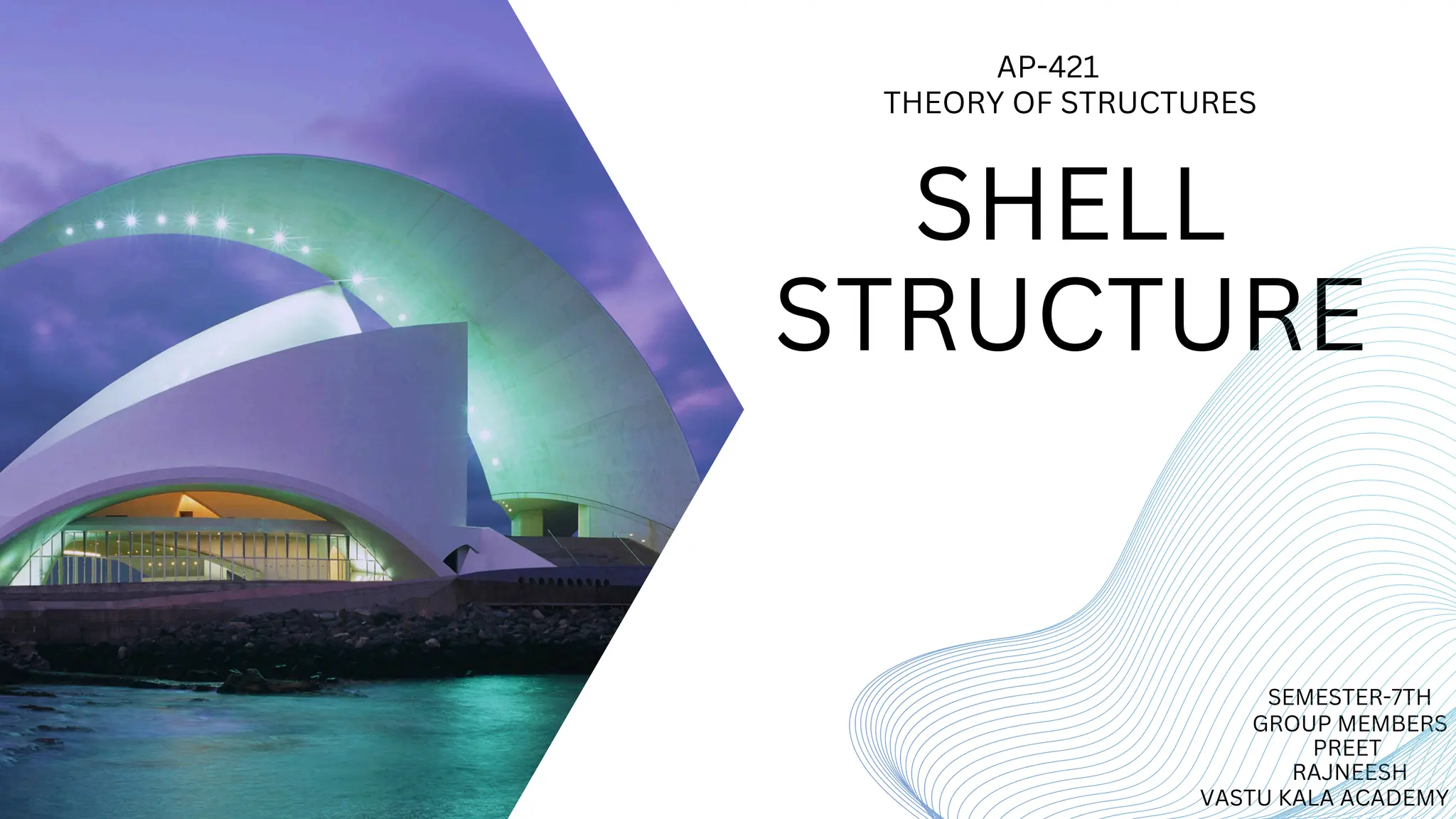
SHELL
STRUCTURE
AP-421
GROUP MEMBERS
PREET
RAJNEESH
SEMESTER-7TH
THEORY OF STRUCTURES
VASTU KALA ACADEMY
WHAT IS A SHELL STRUCTURE?
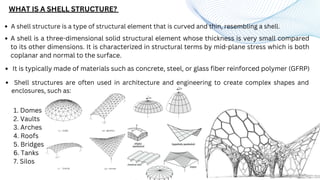
A shell structure is a type of structural element that is curved and thin, resembling a shell.
Shell structures are often used in architecture and engineering to create complex shapes and
enclosures, such as:
1. Domes
2. Vaults
3. Arches
4. Roofs
5. Bridges
6. Tanks
7. Silos
A shell is a three-dimensional solid structural element whose thickness is very small compared
to its other dimensions. It is characterized in structural terms by mid-plane stress which is both
coplanar and normal to the surface.
It is typically made of materials such as concrete, steel, or glass fiber reinforced polymer (GFRP)
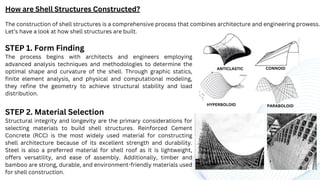
STEP 1. Form Finding
The process begins with architects and engineers employing
advanced analysis techniques and methodologies to determine the
optimal shape and curvature of the shell. Through graphic statics,
finite element analysis, and physical and computational modeling,
they refine the geometry to achieve structural stability and load
distribution.
HYPERBOLOID
ANTICLASTIC
STEP 2. Material Selection
Structural integrity and longevity are the primary considerations for
selecting materials to build shell structures. Reinforced Cement
Concrete (RCC) is the most widely used material for constructing
shell architecture because of its excellent strength and durability.
Steel is also a preferred material for shell roof as it is lightweight,
offers versatility, and ease of assembly. Additionally, timber and
bamboo are strong, durable, and environment-friendly materials used
for shell construction.
How are Shell Structures Constructed?
The construction of shell structures is a comprehensive process that combines architecture and engineering prowess.
Let’s have a look at how shell structures are built.
PARABOLOID
CONNOID
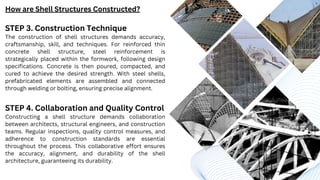
STEP 3. Construction Technique
The construction of shell structures demands accuracy,
craftsmanship, skill, and techniques. For reinforced thin
concrete shell structure, steel reinforcement is
strategically placed within the formwork, following design
specifications. Concrete is then poured, compacted, and
cured to achieve the desired strength. With steel shells,
prefabricated elements are assembled and connected
through welding or bolting, ensuring precise alignment.
STEP 4. Collaboration and Quality Control
Constructing a shell structure demands collaboration
between architects, structural engineers, and construction
teams. Regular inspections, quality control measures, and
adherence to construction standards are essential
throughout the process. This collaborative effort ensures
the accuracy, alignment, and durability of the shell
architecture, guaranteeing its durability.
How are Shell Structures Constructed?
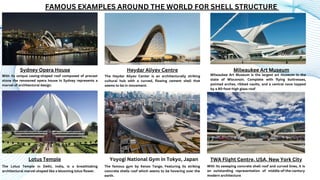
FAMOUS EXAMPLES AROUND THE WORLD FOR SHELL STRUCTURE
Sydney Opera House Heydar Aliyev Centre
Yoyogi National Gym in Tokyo, Japan TWA Flight Centre, USA, New York City
Milwaukee Art Museum
Lotus Temple
With its unique casing-shaped roof composed of precast
stone the renowned opera house in Sydney represents a
marvel of architectural design.
The Lotus Temple in Delhi, India, is a breathtaking
architectural marvel shaped like a blooming lotus flower.
The famous gym by Kenzo Tange, Featuring its striking
concrete shells roof which seems to be hovering over the
earth.
With its sweeping concrete shell roof and curved lines, it is
an outstanding representation of middle-of-the-century
modern architecture
The Heydar Aliyev Center is an architecturally striking
cultural hub with a curved, flowing cement shell that
seems to be in movement.
Milwaukee Art Museum is the largest art museum in the
state of Wisconsin. Complete with flying buttresses,
pointed arches, ribbed vaults, and a central nave topped
by a 90-foot-high glass roof
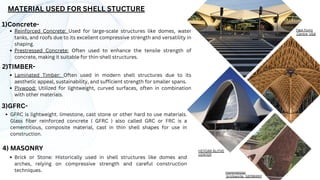
MATERIAL USED FOR SHELL STUCTURE
1)Concrete-
Reinforced Concrete: Used for large-scale structures like domes, water
tanks, and roofs due to its excellent compressive strength and versatility in
shaping.
Prestressed Concrete: Often used to enhance the tensile strength of
concrete, making it suitable for thin-shell structures.
HEYDAR ALIYVE
CENTER
Hagemeister
brickworks ,GERMANY
TWA Flight
Centre, USA
Laminated Timber: Often used in modern shell structures due to its
aesthetic appeal, sustainability, and sufficient strength for smaller spans.
Plywood: Utilized for lightweight, curved surfaces, often in combination
with other materials.
GFRC is lightweight. limestone, cast stone or other hard to use materials.
Glass fiber reinforced concrete ( GFRC ) also called GRC or FRC is a
cementitious, composite material, cast in thin shell shapes for use in
construction.
2)TIMBER-
3)GFRC-
4) MASONRY
Brick or Stone: Historically used in shell structures like domes and
arches, relying on compressive strength and careful construction
techniques.
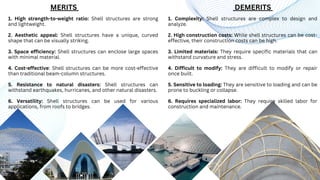
1. High strength-to-weight ratio: Shell structures are strong
and lightweight.
2. Aesthetic appeal: Shell structures have a unique, curved
shape that can be visually striking.
3. Space efficiency: Shell structures can enclose large spaces
with minimal material.
4. Cost-effective: Shell structures can be more cost-effective
than traditional beam-column structures.
5. Resistance to natural disasters: Shell structures can
withstand earthquakes, hurricanes, and other natural disasters.
6. Versatility: Shell structures can be used for various
applications, from roofs to bridges.
1. Complexity: Shell structures are complex to design and
analyze.
2. High construction costs: While shell structures can be cost-
effective, their construction costs can be high.
3. Limited materials: They require specific materials that can
withstand curvature and stress.
4. Difficult to modify: They are difficult to modify or repair
once built.
5. Sensitive to loading: They are sensitive to loading and can be
prone to buckling or collapse.
6. Requires specialized labor: They require skilled labor for
construction and maintenance.
MERITS DEMERITS
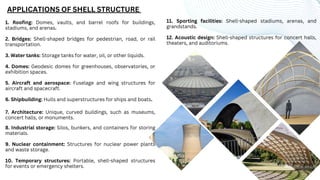
APPLICATIONS OF SHELL STRUCTURE
1. Roofing: Domes, vaults, and barrel roofs for buildings,
stadiums, and arenas.
2. Bridges: Shell-shaped bridges for pedestrian, road, or rail
transportation.
3. Water tanks: Storage tanks for water, oil, or other liquids.
4. Domes: Geodesic domes for greenhouses, observatories, or
exhibition spaces.
5. Aircraft and aerospace: Fuselage and wing structures for
aircraft and spacecraft.
6. Shipbuilding: Hulls and superstructures for ships and boats.
8. Industrial storage: Silos, bunkers, and containers for storing
materials.
9. Nuclear containment: Structures for nuclear power plants
and waste storage.
10. Temporary structures: Portable, shell-shaped structures
for events or emergency shelters.
11. Sporting facilities: Shell-shaped stadiums, arenas, and
grandstands.
12. Acoustic design: Shell-shaped structures for concert halls,
theaters, and auditoriums.
7. Architecture: Unique, curved buildings, such as museums,
concert halls, or monuments.

Shell Structures : Design & Efficiency!!

  • 1.
  • 2.
    WHAT IS ASHELL STRUCTURE? A shell structure is a type of structural element that is curved and thin, resembling a shell. Shell structures are often used in architecture and engineering to create complex shapes and enclosures, such as: 1. Domes 2. Vaults 3. Arches 4. Roofs 5. Bridges 6. Tanks 7. Silos A shell is a three-dimensional solid structural element whose thickness is very small compared to its other dimensions. It is characterized in structural terms by mid-plane stress which is both coplanar and normal to the surface. It is typically made of materials such as concrete, steel, or glass fiber reinforced polymer (GFRP)
  • 3.
    STEP 1. FormFinding The process begins with architects and engineers employing advanced analysis techniques and methodologies to determine the optimal shape and curvature of the shell. Through graphic statics, finite element analysis, and physical and computational modeling, they refine the geometry to achieve structural stability and load distribution. HYPERBOLOID ANTICLASTIC STEP 2. Material Selection Structural integrity and longevity are the primary considerations for selecting materials to build shell structures. Reinforced Cement Concrete (RCC) is the most widely used material for constructing shell architecture because of its excellent strength and durability. Steel is also a preferred material for shell roof as it is lightweight, offers versatility, and ease of assembly. Additionally, timber and bamboo are strong, durable, and environment-friendly materials used for shell construction. How are Shell Structures Constructed? The construction of shell structures is a comprehensive process that combines architecture and engineering prowess. Let’s have a look at how shell structures are built. PARABOLOID CONNOID
  • 4.
    STEP 3. ConstructionTechnique The construction of shell structures demands accuracy, craftsmanship, skill, and techniques. For reinforced thin concrete shell structure, steel reinforcement is strategically placed within the formwork, following design specifications. Concrete is then poured, compacted, and cured to achieve the desired strength. With steel shells, prefabricated elements are assembled and connected through welding or bolting, ensuring precise alignment. STEP 4. Collaboration and Quality Control Constructing a shell structure demands collaboration between architects, structural engineers, and construction teams. Regular inspections, quality control measures, and adherence to construction standards are essential throughout the process. This collaborative effort ensures the accuracy, alignment, and durability of the shell architecture, guaranteeing its durability. How are Shell Structures Constructed?
  • 5.
    FAMOUS EXAMPLES AROUNDTHE WORLD FOR SHELL STRUCTURE Sydney Opera House Heydar Aliyev Centre Yoyogi National Gym in Tokyo, Japan TWA Flight Centre, USA, New York City Milwaukee Art Museum Lotus Temple With its unique casing-shaped roof composed of precast stone the renowned opera house in Sydney represents a marvel of architectural design. The Lotus Temple in Delhi, India, is a breathtaking architectural marvel shaped like a blooming lotus flower. The famous gym by Kenzo Tange, Featuring its striking concrete shells roof which seems to be hovering over the earth. With its sweeping concrete shell roof and curved lines, it is an outstanding representation of middle-of-the-century modern architecture The Heydar Aliyev Center is an architecturally striking cultural hub with a curved, flowing cement shell that seems to be in movement. Milwaukee Art Museum is the largest art museum in the state of Wisconsin. Complete with flying buttresses, pointed arches, ribbed vaults, and a central nave topped by a 90-foot-high glass roof
  • 6.
    MATERIAL USED FORSHELL STUCTURE 1)Concrete- Reinforced Concrete: Used for large-scale structures like domes, water tanks, and roofs due to its excellent compressive strength and versatility in shaping. Prestressed Concrete: Often used to enhance the tensile strength of concrete, making it suitable for thin-shell structures. HEYDAR ALIYVE CENTER Hagemeister brickworks ,GERMANY TWA Flight Centre, USA Laminated Timber: Often used in modern shell structures due to its aesthetic appeal, sustainability, and sufficient strength for smaller spans. Plywood: Utilized for lightweight, curved surfaces, often in combination with other materials. GFRC is lightweight. limestone, cast stone or other hard to use materials. Glass fiber reinforced concrete ( GFRC ) also called GRC or FRC is a cementitious, composite material, cast in thin shell shapes for use in construction. 2)TIMBER- 3)GFRC- 4) MASONRY Brick or Stone: Historically used in shell structures like domes and arches, relying on compressive strength and careful construction techniques.
  • 7.
    1. High strength-to-weightratio: Shell structures are strong and lightweight. 2. Aesthetic appeal: Shell structures have a unique, curved shape that can be visually striking. 3. Space efficiency: Shell structures can enclose large spaces with minimal material. 4. Cost-effective: Shell structures can be more cost-effective than traditional beam-column structures. 5. Resistance to natural disasters: Shell structures can withstand earthquakes, hurricanes, and other natural disasters. 6. Versatility: Shell structures can be used for various applications, from roofs to bridges. 1. Complexity: Shell structures are complex to design and analyze. 2. High construction costs: While shell structures can be cost- effective, their construction costs can be high. 3. Limited materials: They require specific materials that can withstand curvature and stress. 4. Difficult to modify: They are difficult to modify or repair once built. 5. Sensitive to loading: They are sensitive to loading and can be prone to buckling or collapse. 6. Requires specialized labor: They require skilled labor for construction and maintenance. MERITS DEMERITS
  • 8.
    APPLICATIONS OF SHELLSTRUCTURE 1. Roofing: Domes, vaults, and barrel roofs for buildings, stadiums, and arenas. 2. Bridges: Shell-shaped bridges for pedestrian, road, or rail transportation. 3. Water tanks: Storage tanks for water, oil, or other liquids. 4. Domes: Geodesic domes for greenhouses, observatories, or exhibition spaces. 5. Aircraft and aerospace: Fuselage and wing structures for aircraft and spacecraft. 6. Shipbuilding: Hulls and superstructures for ships and boats. 8. Industrial storage: Silos, bunkers, and containers for storing materials. 9. Nuclear containment: Structures for nuclear power plants and waste storage. 10. Temporary structures: Portable, shell-shaped structures for events or emergency shelters. 11. Sporting facilities: Shell-shaped stadiums, arenas, and grandstands. 12. Acoustic design: Shell-shaped structures for concert halls, theaters, and auditoriums. 7. Architecture: Unique, curved buildings, such as museums, concert halls, or monuments.