SPACE STRUCTURE
STRUCTURE VI
PRESENTED BY: PAYAL KARAVADRA
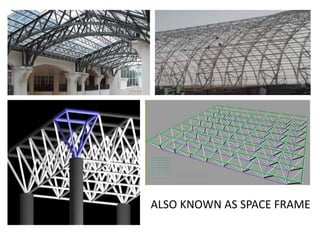
ALSO KNOWN AS SPACE FRAME
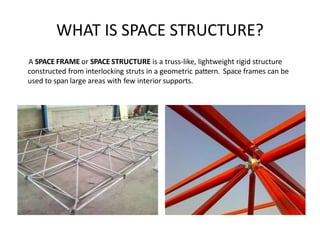
WHAT IS SPACE STRUCTURE?
A SPACE FRAME or SPACE STRUCTURE is a truss-like, lightweight rigid structure
constructed from interlocking struts in a geometric pattern. Space frames can be
used to span large areas with few interior supports.
HISTORY OF SPACE FRAME
• Space frames were independently developed by Alexander Graham Bell around
1900 and Buckminster Fuller in the 1950s Buckminster Fuller's focus was architectural
structures; his work had greater influence.
• It was developed in California during the 1960s and introduced to the South
African market in 1982, specifically developed for unstable soil conditions, the panels
form a monolithic structure offering superior wall strength in which no cracking will
occur.
MATERIALS
Materials which are used for these space frames:
Steel:
This steel material which is used for the space frames sustain more load and carry tones
ofweight. This steel is mostly used in now-a-days in a longspan structures and has to be
maintained properly.
Timber:
This timber material is also used in the 19th century and by using this material the
maintenance level is becomingvery high.
LOAD DISTRIBUTION
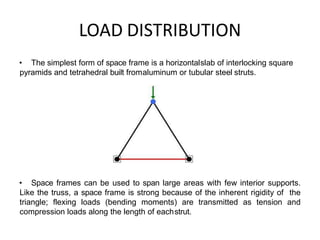
• The simplest form of space frame is a horizontalslab of interlocking square
pyramids and tetrahedral built fromaluminum or tubular steel struts.
• Space frames can be used to span large areas with few interior supports.
Like the truss, a space frame is strong because of the inherent rigidity of the
triangle; flexing loads (bending moments) are transmitted as tension and
compression loads along the length of eachstrut.
TYPES OF SPACE FRAME
1. Curvature classification
Space Plane Covers
Barrel Vaults
Spherical Domes
2.Classification by the arrangement of its elements
Single Layer Grid
Double Layer Grid
Triple Layer Grid
CURVATURE CLASSIFICATION
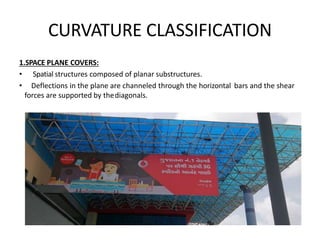
1.SPACE PLANE COVERS:
• Spatial structures composed of planar substructures.
• Deflections in the plane are channeled through the horizontal bars and the shear
forces are supported by thediagonals.
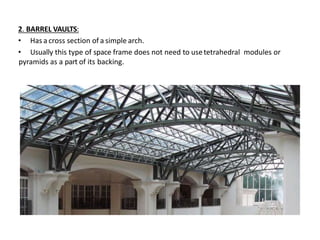
2. BARREL VAULTS:
• Has a cross section of a simple arch.
• Usually this type of space frame does not need to usetetrahedral modules or
pyramids as a part of its backing.
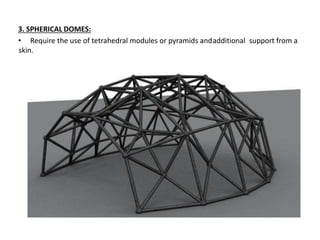
3. SPHERICAL DOMES:
• Require the use of tetrahedral modules or pyramids andadditional support from a
skin.
CLASSIFICATION BY THE
ARRANGMENT OF ITS ELEMENTS
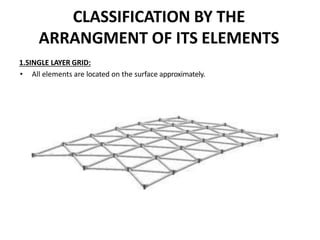
1.SINGLE LAYER GRID:
• All elements are located on the surface approximately.
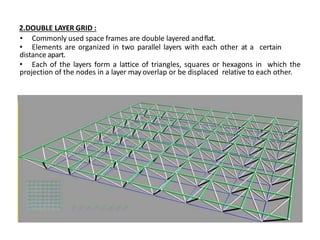
2.DOUBLE LAYER GRID :
• Commonly used space frames are double layered andflat.
• Elements are organized in two parallel layers with each other at a certain
distance apart.
• Each of the layers form a lattice of triangles, squares or hexagons in which the
projection of the nodes in a layer may overlap or be displaced relative to each other.
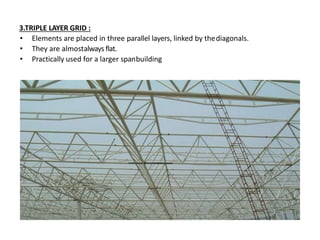
3.TRIPLE LAYER GRID :
• Elements are placed in three parallel layers, linked by thediagonals.
• They are almostalways flat.
• Practically used for a larger spanbuilding
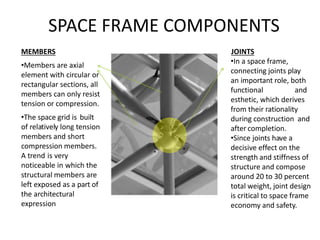
SPACE FRAME COMPONENTS
MEMBERS
•Members are axial
element with circular or
rectangular sections, all
members can only resist
tension or compression.
•The space grid is built
of relatively long tension
members and short
compression members.
A trend is very
noticeable in which the
structural members are
left exposed as a part of
the architectural
expression
JOINTS
•In a space frame,
connecting joints play
an important role, both
functional and
esthetic, which derives
from their rationality
during construction and
after completion.
•Since joints have a
decisive effect on the
strength and stiffness of
structure and compose
around 20 to 30 percent
total weight, joint design
is critical to space frame
economy and safety.
DESIGN METHOD
• Space frames are typically designed using a rigidity matrix. The special
characteristic of the stiffness matrix in an architectural space frameis the
independence of the angularfactors.
• If the joints are sufficiently rigid, the angular deflections can be
neglected, simplifying the calculations.
• Members are fixed using connectors .
• Different types of connectors are:
1. Nodus Connector
2. Triodetic Connector
3. Tuball Node Connector
4. Hemispherical Dome Connector
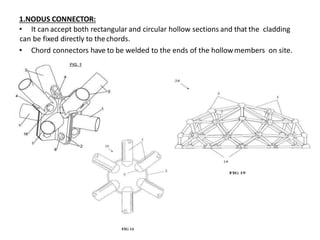
1.NODUS CONNECTOR:
• It can accept both rectangular and circular hollow sections and that the cladding
can be fixed directly to thechords.
• Chord connectors have to be welded to the ends of the hollowmembers on site.
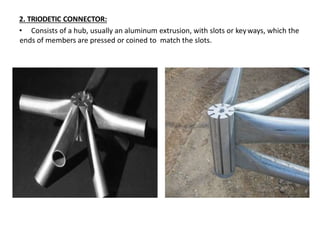
2. TRIODETIC CONNECTOR:
• Consists of a hub, usually an aluminum extrusion, with slots or keyways, which the
ends of members are pressed or coined to match the slots.
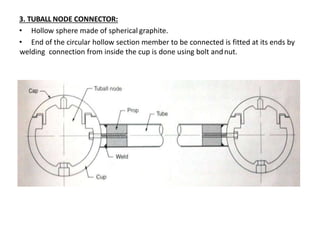
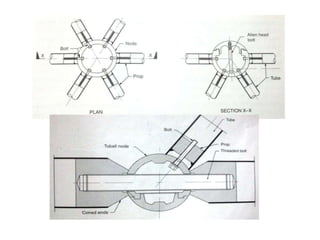
3. TUBALL NODE CONNECTOR:
• Hollow sphere made of spherical graphite.
• End of the circular hollow section member to be connected is fitted at its ends by
welding connection from inside the cup is done using bolt andnut.
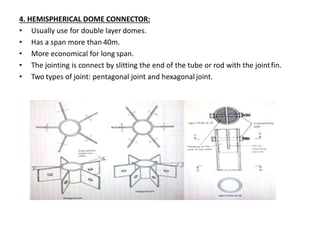
4. HEMISPHERICAL DOME CONNECTOR:
• Usually use for double layer domes.
• Has a span more than 40m.
• More economical for long span.
• The jointing is connect by slitting the end of the tube or rod with the jointfin.
• Two types of joint: pentagonal joint and hexagonal joint.
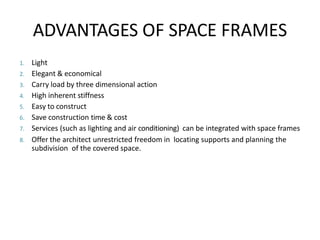
ADVANTAGES OF SPACE FRAMES
1. Light
2. Elegant & economical
3. Carry load by three dimensional action
4. High inherent stiffness
5. Easy to construct
6. Save construction time & cost
7. Services (such as lighting and air conditioning) can be integrated with space frames
8. Offer the architect unrestricted freedom in locating supports and planning the
subdivision of the covered space.
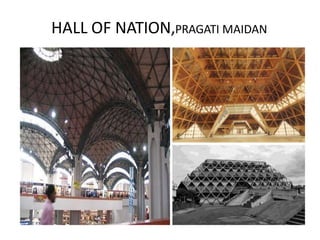
HALL OF NATION,PRAGATI MAIDAN
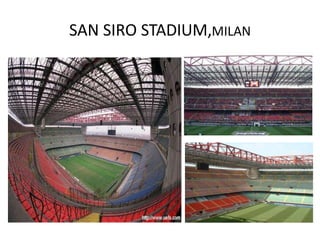
SAN SIRO STADIUM,MILAN
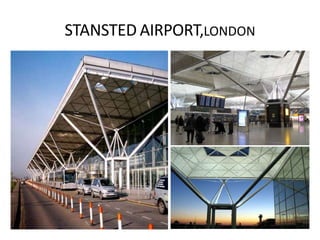
STANSTED AIRPORT,LONDON

Space structure

  • 1.
  • 2.
    ALSO KNOWN ASSPACE FRAME
  • 3.
    WHAT IS SPACESTRUCTURE? A SPACE FRAME or SPACE STRUCTURE is a truss-like, lightweight rigid structure constructed from interlocking struts in a geometric pattern. Space frames can be used to span large areas with few interior supports.
  • 4.
    HISTORY OF SPACEFRAME • Space frames were independently developed by Alexander Graham Bell around 1900 and Buckminster Fuller in the 1950s Buckminster Fuller's focus was architectural structures; his work had greater influence. • It was developed in California during the 1960s and introduced to the South African market in 1982, specifically developed for unstable soil conditions, the panels form a monolithic structure offering superior wall strength in which no cracking will occur. MATERIALS Materials which are used for these space frames: Steel: This steel material which is used for the space frames sustain more load and carry tones ofweight. This steel is mostly used in now-a-days in a longspan structures and has to be maintained properly. Timber: This timber material is also used in the 19th century and by using this material the maintenance level is becomingvery high.
  • 5.
    LOAD DISTRIBUTION • Thesimplest form of space frame is a horizontalslab of interlocking square pyramids and tetrahedral built fromaluminum or tubular steel struts. • Space frames can be used to span large areas with few interior supports. Like the truss, a space frame is strong because of the inherent rigidity of the triangle; flexing loads (bending moments) are transmitted as tension and compression loads along the length of eachstrut.
  • 6.
    TYPES OF SPACEFRAME 1. Curvature classification Space Plane Covers Barrel Vaults Spherical Domes 2.Classification by the arrangement of its elements Single Layer Grid Double Layer Grid Triple Layer Grid
  • 7.
    CURVATURE CLASSIFICATION 1.SPACE PLANECOVERS: • Spatial structures composed of planar substructures. • Deflections in the plane are channeled through the horizontal bars and the shear forces are supported by thediagonals.
  • 8.
    2. BARREL VAULTS: •Has a cross section of a simple arch. • Usually this type of space frame does not need to usetetrahedral modules or pyramids as a part of its backing.
  • 9.
    3. SPHERICAL DOMES: •Require the use of tetrahedral modules or pyramids andadditional support from a skin.
  • 10.
    CLASSIFICATION BY THE ARRANGMENTOF ITS ELEMENTS 1.SINGLE LAYER GRID: • All elements are located on the surface approximately.
  • 11.
    2.DOUBLE LAYER GRID: • Commonly used space frames are double layered andflat. • Elements are organized in two parallel layers with each other at a certain distance apart. • Each of the layers form a lattice of triangles, squares or hexagons in which the projection of the nodes in a layer may overlap or be displaced relative to each other.
  • 12.
    3.TRIPLE LAYER GRID: • Elements are placed in three parallel layers, linked by thediagonals. • They are almostalways flat. • Practically used for a larger spanbuilding
  • 13.
    SPACE FRAME COMPONENTS MEMBERS •Membersare axial element with circular or rectangular sections, all members can only resist tension or compression. •The space grid is built of relatively long tension members and short compression members. A trend is very noticeable in which the structural members are left exposed as a part of the architectural expression JOINTS •In a space frame, connecting joints play an important role, both functional and esthetic, which derives from their rationality during construction and after completion. •Since joints have a decisive effect on the strength and stiffness of structure and compose around 20 to 30 percent total weight, joint design is critical to space frame economy and safety.
  • 14.
    DESIGN METHOD • Spaceframes are typically designed using a rigidity matrix. The special characteristic of the stiffness matrix in an architectural space frameis the independence of the angularfactors. • If the joints are sufficiently rigid, the angular deflections can be neglected, simplifying the calculations. • Members are fixed using connectors . • Different types of connectors are: 1. Nodus Connector 2. Triodetic Connector 3. Tuball Node Connector 4. Hemispherical Dome Connector
  • 15.
    1.NODUS CONNECTOR: • Itcan accept both rectangular and circular hollow sections and that the cladding can be fixed directly to thechords. • Chord connectors have to be welded to the ends of the hollowmembers on site.
  • 16.
    2. TRIODETIC CONNECTOR: •Consists of a hub, usually an aluminum extrusion, with slots or keyways, which the ends of members are pressed or coined to match the slots.
  • 17.
    3. TUBALL NODECONNECTOR: • Hollow sphere made of spherical graphite. • End of the circular hollow section member to be connected is fitted at its ends by welding connection from inside the cup is done using bolt andnut.
  • 19.
    4. HEMISPHERICAL DOMECONNECTOR: • Usually use for double layer domes. • Has a span more than 40m. • More economical for long span. • The jointing is connect by slitting the end of the tube or rod with the jointfin. • Two types of joint: pentagonal joint and hexagonal joint.
  • 20.
    ADVANTAGES OF SPACEFRAMES 1. Light 2. Elegant & economical 3. Carry load by three dimensional action 4. High inherent stiffness 5. Easy to construct 6. Save construction time & cost 7. Services (such as lighting and air conditioning) can be integrated with space frames 8. Offer the architect unrestricted freedom in locating supports and planning the subdivision of the covered space.
  • 21.
  • 22.
  • 23.