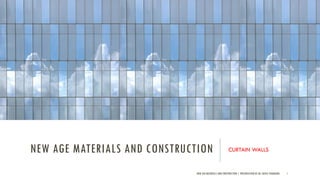
NEW AGE MATERIALS AND CONSTRUCTION CURTAIN WALLS
NEW AGE MATERIALS AND CONSTRUCTION | PRESENTATION BY AR. GEEVA CHANDANA 1
19ARE618T | NEW AGE MATERIALS AND CONSTRUCTION
1.CURTAINWALLS
Introduction
Advantage/
Disadvantage
Materials: Glass, Steel
Cladding, Aluminium
Cladding, Ribbed metal
cladding, modern
materials.
Construction Techniques,
Technologies
Maintenance and
Application
1.CURTAINWALLS
Shapes: Sloping and
curved glass curtain
walls
Steel plate shear curtain
walls
Metallic cladding for
roofs
Construction Techniques,
Technologies
Maintenance and
Application
NEW AGE MATERIALS AND CONSTRUCTION | PRESENTATION BY AR. GEEVA CHANDANA 2
CURTAIN WALLS
NEW AGE MATERIALS AND CONSTRUCTION | PRESENTATION BY AR. GEEVA CHANDANA 3
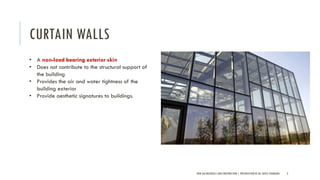
• A non-load bearing exterior skin
• Does not contribute to the structural support of
the building
• Provides the air and water tightness of the
building exterior
• Provide aesthetic signatures to buildings.
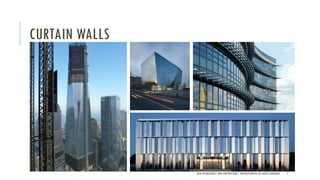
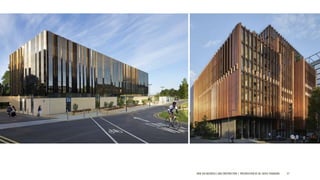
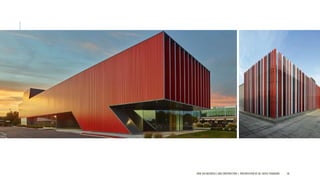
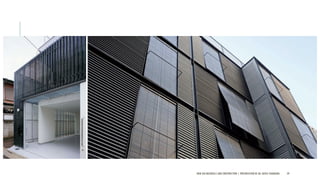
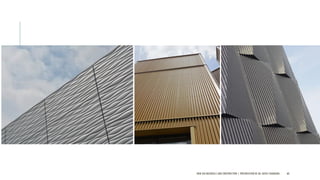
CURTAIN WALLS
NEW AGE MATERIALS AND CONSTRUCTION | PRESENTATION BY AR. GEEVA CHANDANA 4
CURTAIN WALLS
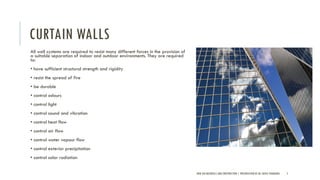
All wall systems are required to resist many different forces in the provision of
a suitable separation of indoor and outdoor environments. They are required
to:
• have sufficient structural strength and rigidity
• resist the spread of fire
• be durable
• control odours
• control light
• control sound and vibration
• control heat flow
• control air flow
• control water vapour flow
• control exterior precipitation
• control solar radiation
NEW AGE MATERIALS AND CONSTRUCTION | PRESENTATION BY AR. GEEVA CHANDANA 5
CURTAIN WALLS : HISTORY
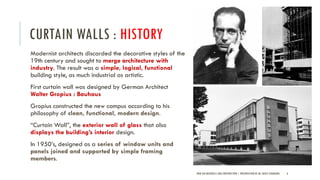
Modernist architects discarded the decorative styles of the
19th century and sought to merge architecture with
industry. The result was a simple, logical, functional
building style, as much industrial as artistic.
First curtain wall was designed by German Architect
Walter Gropius : Bauhaus
Gropius constructed the new campus according to his
philosophy of clean, functional, modern design.
“Curtain Wall”, the exterior wall of glass that also
displays the building’s interior design.
In 1950’s, designed as a series of window units and
panels joined and supported by simple framing
members.
NEW AGE MATERIALS AND CONSTRUCTION | PRESENTATION BY AR. GEEVA CHANDANA 6
CURTAIN WALLS : COMPONENTS
NEW AGE MATERIALS AND CONSTRUCTION | PRESENTATION BY AR. GEEVA CHANDANA 7
CURTAIN WALLS : COMPONENTS
NEW AGE MATERIALS AND CONSTRUCTION | PRESENTATION BY AR. GEEVA CHANDANA 8
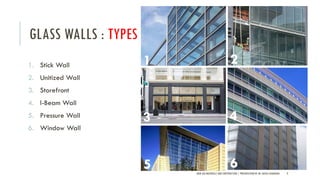
GLASS WALLS : TYPES
1. Stick Wall
2. Unitized Wall
3. Storefront
4. I-Beam Wall
5. Pressure Wall
6. Window Wall
NEW AGE MATERIALS AND CONSTRUCTION | PRESENTATION BY AR. GEEVA CHANDANA 9
1 2
3 4
5 6
STICK SYSTEM
NEW AGE MATERIALS AND CONSTRUCTION | PRESENTATION BY AR. GEEVA CHANDANA 10
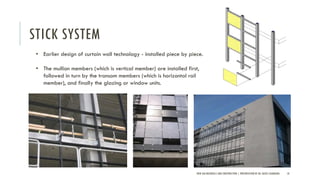
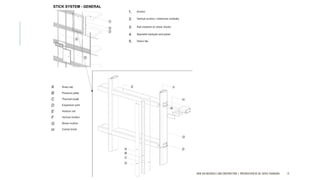
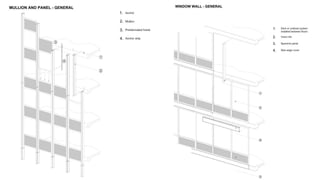
• Earlier design of curtain wall technology - installed piece by piece.
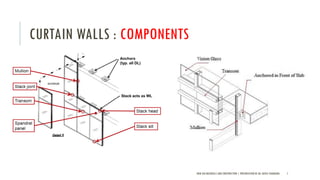
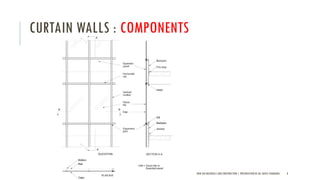
• The mullion members (which is vertical member) are installed first,
followed in turn by the transom members (which is horizontal rail
member), and finally the glazing or window units.
STICK SYSTEM
NEW AGE MATERIALS AND CONSTRUCTION | PRESENTATION BY AR. GEEVA CHANDANA 11
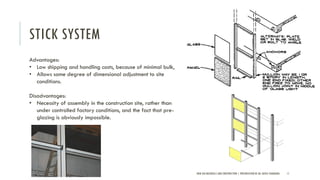
Advantages:
• Low shipping and handling costs, because of minimal bulk,
• Allows some degree of dimensional adjustment to site
conditions.
Disadvantages:
• Necessity of assembly in the construction site, rather than
under controlled factory conditions, and the fact that pre-
glazing is obviously impossible.
NEW AGE MATERIALS AND CONSTRUCTION | PRESENTATION BY AR. GEEVA CHANDANA 12
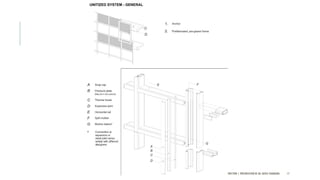
UNITIZED SYSTEM
NEW AGE MATERIALS AND CONSTRUCTION | PRESENTATION BY AR. GEEVA CHANDANA 13
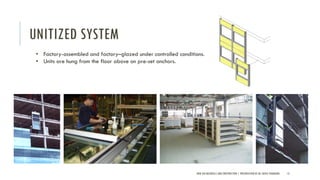
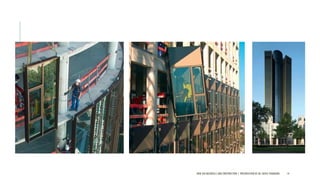
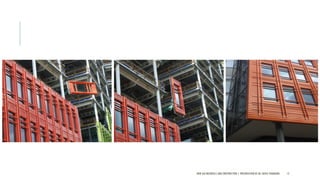
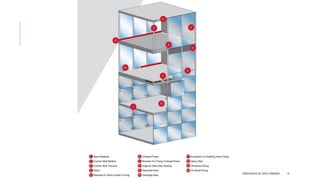
• Factory-assembled and factory–glazed under controlled conditions.
• Units are hung from the floor above on pre-set anchors.
NEW AGE MATERIALS AND CONSTRUCTION | PRESENTATION BY AR. GEEVA CHANDANA 14
NEW AGE MATERIALS AND CONSTRUCTION | PRESENTATION BY AR. GEEVA CHANDANA 15
NEW AGE MATERIALS AND CONSTRUCTION | PRESENTATION BY AR. GEEVA CHANDANA 16
NEW AGE MATERIALS AND CONSTRUCTION | PRESENTATION BY AR. GEEVA CHANDANA 17
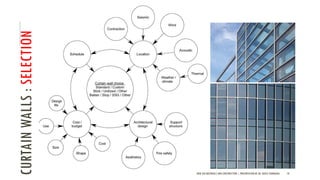
CURTAINWALLS:SELECTION
NEW AGE MATERIALS AND CONSTRUCTION | PRESENTATION BY AR. GEEVA CHANDANA 18
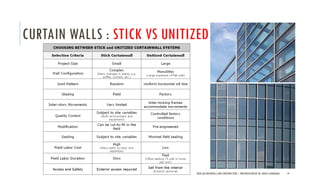
CURTAIN WALLS : STICK VS UNITIZED
NEW AGE MATERIALS AND CONSTRUCTION | PRESENTATION BY AR. GEEVA CHANDANA 19
NEW AGE MATERIALS AND CONSTRUCTION | PRESENTATION BY AR. GEEVA CHANDANA 20
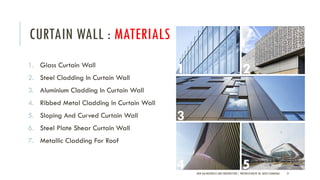
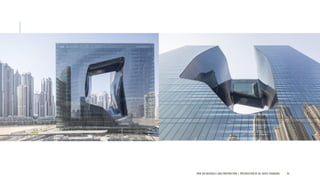
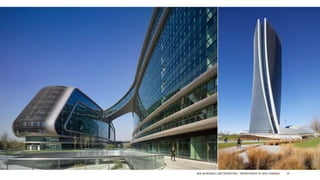
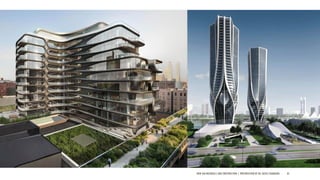
CURTAIN WALL : MATERIALS
1. Glass Curtain Wall
2. Steel Cladding In Curtain Wall
3. Aluminium Cladding In Curtain Wall
4. Ribbed Metal Cladding In Curtain Wall
5. Sloping And Curved Curtain Wall
6. Steel Plate Shear Curtain Wall
7. Metallic Cladding For Roof
NEW AGE MATERIALS AND CONSTRUCTION | PRESENTATION BY AR. GEEVA CHANDANA 21
1 2
3
4 5
NEW AGE MATERIALS AND CONSTRUCTION | PRESENTATION BY AR. GEEVA CHANDANA 22
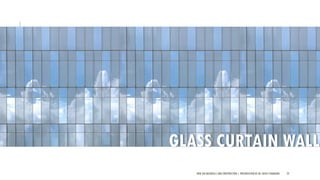
GLASS CURTAIN WALL
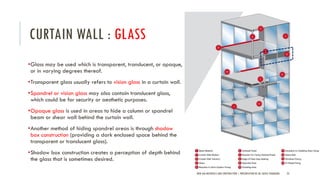
CURTAIN WALL : GLASS
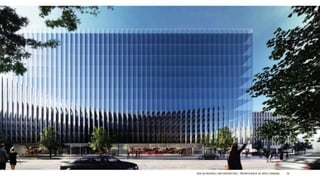
•Glass may be used which is transparent, translucent, or opaque,
or in varying degrees thereof.
•Transparent glass usually refers to vision glass in a curtain wall.
•Spandrel or vision glass may also contain translucent glass,
which could be for security or aesthetic purposes.
•Opaque glass is used in areas to hide a column or spandrel
beam or shear wall behind the curtain wall.
•Another method of hiding spandrel areas is through shadow
box construction (providing a dark enclosed space behind the
transparent or translucent glass).
•Shadow box construction creates a perception of depth behind
the glass that is sometimes desired.
NEW AGE MATERIALS AND CONSTRUCTION | PRESENTATION BY AR. GEEVA CHANDANA 23
NEW AGE MATERIALS AND CONSTRUCTION | PRESENTATION BY AR. GEEVA CHANDANA 24
CURTAIN WALL : GLASS - SIZES
FOR COMMERCIAL CONSTRUCTION,
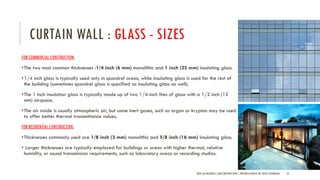
•The two most common thicknesses :1/4 inch (6 mm) monolithic and 1 inch (25 mm) insulating glass.
•1/4 inch glass is typically used only in spandrel areas, while insulating glass is used for the rest of
the building (sometimes spandrel glass is specified as insulating glass as well).
•The 1 inch insulation glass is typically made up of two 1/4-inch lites of glass with a 1/2 inch (12
mm) airspace.
•The air inside is usually atmospheric air, but some inert gases, such as argon or krypton may be used
to offer better thermal transmittance values.
FOR RESIDENTIAL CONSTRUCTION,
•Thicknesses commonly used are 1/8 inch (3 mm) monolithic and 5/8 inch (16 mm) insulating glass.
• Larger thicknesses are typically employed for buildings or areas with higher thermal, relative
humidity, or sound transmission requirements, such as laboratory areas or recording studios.
NEW AGE MATERIALS AND CONSTRUCTION | PRESENTATION BY AR. GEEVA CHANDANA 25
NEW AGE MATERIALS AND CONSTRUCTION | PRESENTATION BY AR. GEEVA CHANDANA 26
NEW AGE MATERIALS AND CONSTRUCTION | PRESENTATION BY AR. GEEVA CHANDANA 27
NEW AGE MATERIALS AND CONSTRUCTION | PRESENTATION BY AR. GEEVA CHANDANA 28
NEW AGE MATERIALS AND CONSTRUCTION | PRESENTATION BY AR. GEEVA CHANDANA 29
NEW AGE MATERIALS AND CONSTRUCTION | PRESENTATION BY AR. GEEVA CHANDANA 30
NEW AGE MATERIALS AND CONSTRUCTION | PRESENTATION BY AR. GEEVA CHANDANA 31
NEW AGE MATERIALS AND CONSTRUCTION | PRESENTATION BY AR. GEEVA CHANDANA 32
NEW AGE MATERIALS AND CONSTRUCTION | PRESENTATION BY AR. GEEVA CHANDANA 33
NEW AGE MATERIALS AND CONSTRUCTION | PRESENTATION BY AR. GEEVA CHANDANA 34
NEW AGE MATERIALS AND CONSTRUCTION | PRESENTATION BY AR. GEEVA CHANDANA 35
NEW AGE MATERIALS AND CONSTRUCTION | PRESENTATION BY AR. GEEVA CHANDANA 36
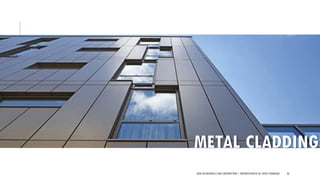
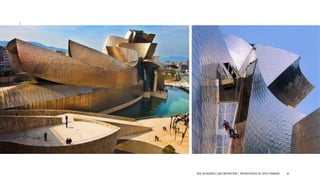
METAL CLADDING
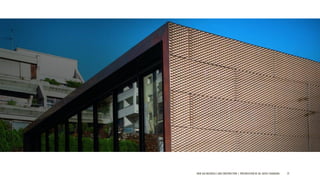
CURTAIN WALL : METAL CLADDING
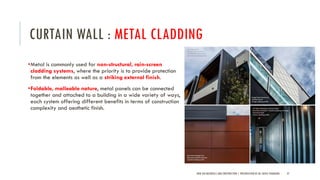
•Metal is commonly used for non-structural, rain-screen
cladding systems, where the priority is to provide protection
from the elements as well as a striking external finish.
•Foldable, malleable nature, metal panels can be connected
together and attached to a building in a wide variety of ways,
each system offering different benefits in terms of construction
complexity and aesthetic finish.
NEW AGE MATERIALS AND CONSTRUCTION | PRESENTATION BY AR. GEEVA CHANDANA 37
CURTAIN WALL : METAL CLADDING
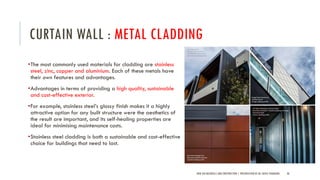
•The most commonly used materials for cladding are stainless
steel, zinc, copper and aluminium. Each of these metals have
their own features and advantages.
•Advantages in terms of providing a high quality, sustainable
and cost-effective exterior.
•For example, stainless steel’s glossy finish makes it a highly
attractive option for any built structure were the aesthetics of
the result are important, and its self-healing properties are
ideal for minimising maintenance costs.
•Stainless steel cladding is both a sustainable and cost-effective
choice for buildings that need to last.
NEW AGE MATERIALS AND CONSTRUCTION | PRESENTATION BY AR. GEEVA CHANDANA 38
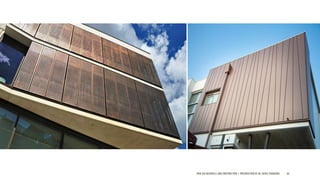
METAL CLADDING: ALUMINIUM
Aluminum is naturally resistant to rusting or blistering, making it a popular cladding
choice for contemporary projects.
It also possesses an excellent strength-to-weight ratio, meaning aluminum façade
attachment systems can be less bulky than those for steel panels.
That said, the material is prone to denting and scratches, and may corrode under
certain environmental conditions without proper care.
NEW AGE MATERIALS AND CONSTRUCTION | PRESENTATION BY AR. GEEVA CHANDANA 39
ALUMINIUM CLADDING : ADVANTAGES
1. ALUMINIUM IS A VERY LIGHT WEIGHT METAL
Aluminium weighs in at about the third of the weight of steel. On average it weighs
around 2,7g/cm3. This is a big reason many architects consider using aluminium when
cladding. The process of installing the aluminium panels, aluminium louvres or
aluminium facade systems will be much easier due to the weight.
2. ALUMINIUM IS VERY RESISTANT TO CORROSION
Corrosion does not affect aluminium due to its protective oxide coating. Unlike
copper, the weather conditions don’t influence aluminium. It won’t rust and corrode
over time.
NEW AGE MATERIALS AND CONSTRUCTION | PRESENTATION BY AR. GEEVA CHANDANA 40
ALUMINIUM CLADDING : ADVANTAGES
3. ALUMINIUM IS FLEXIBLE
Aluminium is one of the easiest metals to melt and bent. The melting point of
aluminium is very low making it easy to shape. Because it is also flexible, aluminium is
used widely by architects for special designs that require curved or uncommon
shapes.
4. ALUMINIUM IS COMPLETELY RECYCLABLE
Aluminium cladding is sustainable. Aluminium is recyclable and won’t lose any of its
quality in the process. Aluminium is remelted all the time and the process takes little
energy.
NEW AGE MATERIALS AND CONSTRUCTION | PRESENTATION BY AR. GEEVA CHANDANA 41
METAL CLADDING: STAINLESS STEEL
Steel coated in a thin layer of chromium oxide is commonly referred to as stainless
steel.
The chromium helps prevent the oxidization process of corrosion occurring, so the
material is resistant to rusting. Stainless steel is also popular for its clean, polished
finish.
NEW AGE MATERIALS AND CONSTRUCTION | PRESENTATION BY AR. GEEVA CHANDANA 42
STEEL CLADDING : ADVANTAGES
1. STAINLESS STEEL IS AESTHETICALLY APPEALING
Compared to zinc, stainless steel is a material with a glossy, more polished finish. Due
to this aesthetically beneficial quality, it is commonly used for wall cladding in a
decorative manner. Stainless steel has a unique aesthetic advantage to any
construction or building.
2. STAINLESS STEEL IS DURABLE
Stainless steel has a high durability: the metal panels will not change in appearance
for several decades. This is in contrast with copper, which colour will change over
time.
NEW AGE MATERIALS AND CONSTRUCTION | PRESENTATION BY AR. GEEVA CHANDANA 43
STEEL CLADDING : ADVANTAGES
3. STAINLESS STEEL HAS RESISTANCE TO CORROSION
Stainless steel has an incredibly high resistance for corrosion, due to its ‘self-healing’
quality. When the metal is scratched or is starting to wear due to abrasion, an
invisible layer of chromo(III) oxide (Cr2O3 on the periodic table) will form when
oxygen is available. This thin layer protects the metal underneath it, and will make
the material polished, smooth and lustrous again.
4. STAINLESS STEEL IS COMPLETELY RECYCLABLE
Stainless steel is completely recyclable. The larger part of the stainless steel
production nowadays is even being fabricated with recycled parts of the material.
This shows that the metal can very easily be re-used, and makes it even more durable
besides its long life span.
NEW AGE MATERIALS AND CONSTRUCTION | PRESENTATION BY AR. GEEVA CHANDANA 44
NEW AGE MATERIALS AND CONSTRUCTION | PRESENTATION BY AR. GEEVA CHANDANA 45
NEW AGE MATERIALS AND CONSTRUCTION | PRESENTATION BY AR. GEEVA CHANDANA 46
NEW AGE MATERIALS AND CONSTRUCTION | PRESENTATION BY AR. GEEVA CHANDANA 47
NEW AGE MATERIALS AND CONSTRUCTION | PRESENTATION BY AR. GEEVA CHANDANA 48
CURTAIN WALL : METAL CLADDING
NEW AGE MATERIALS AND CONSTRUCTION | PRESENTATION BY AR. GEEVA CHANDANA 49
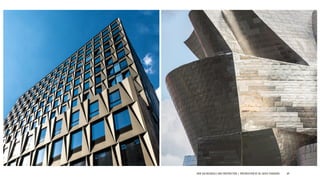
STAINLESS STEEL CLADDING ALUMINIUM CLADDING
Sustainable and cost-effective choice glossy finish - highly
attractive option -were the aesthetics are important - ideal
for minimizing maintenance costs.
Aluminium cladding generally has a neoprene core, making
it the ideal choice for buildings where energy efficiency is
of prime importance.
Strength, durability, large glazing portions Lighter weight
Architects commonly use steel large curtain walls to improve
day lighting - wide spans and heights up to more than 15
meters.
Architects prefer aluminium for skyscrapers with glass
panels - price advantage and the design flexibility.
Finishes: Brush finish, satin polish finish, mirror polish. Finishes: Brush or polish aluminium for glossy and appealing
Corrosion resistant - must be treated against corrosion, like
zinc coating or painting. Possible scratches might result in
rusty zones if not.
Corrosion resistance unless the environment is highly acidic.
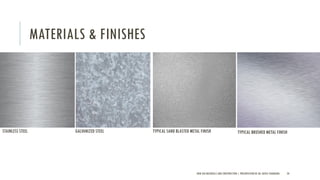
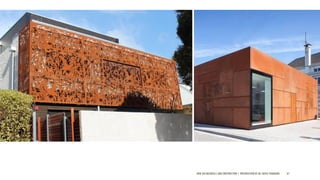
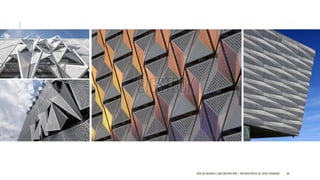
MATERIALS & FINISHES
NEW AGE MATERIALS AND CONSTRUCTION | PRESENTATION BY AR. GEEVA CHANDANA 50
STAINLESS STEEL GALVANIZED STEEL TYPICAL SAND BLASTED METAL FINISH TYPICAL BRUSHED METAL FINISH
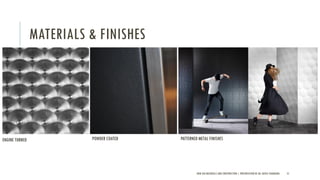
MATERIALS & FINISHES
NEW AGE MATERIALS AND CONSTRUCTION | PRESENTATION BY AR. GEEVA CHANDANA 51
ENGINE TURNED POWDER COATED PATTERNED METAL FINISHES
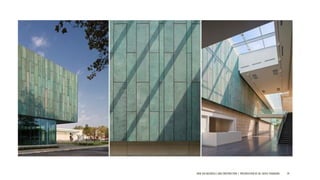
METAL CLADDING: COPPER
Lightweight cladding option, copper is very durable compared to other materials,
and at the end of the building life is also 100% recyclable.
Its subtly reflective appearance evolves over time due to oxidization, turning the
metal a distinctive green color.
NEW AGE MATERIALS AND CONSTRUCTION | PRESENTATION BY AR. GEEVA CHANDANA 52
NEW AGE MATERIALS AND CONSTRUCTION | PRESENTATION BY AR. GEEVA CHANDANA 53
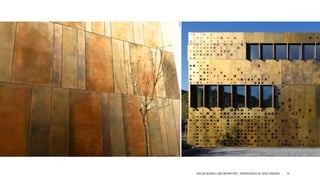
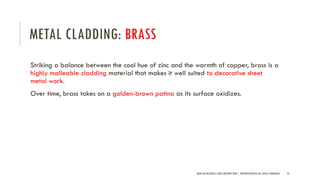
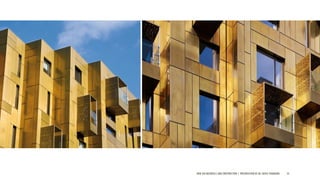
METAL CLADDING: BRASS
Striking a balance between the cool hue of zinc and the warmth of copper, brass is a
highly malleable cladding material that makes it well suited to decorative sheet
metal work.
Over time, brass takes on a golden-brown patina as its surface oxidizes.
NEW AGE MATERIALS AND CONSTRUCTION | PRESENTATION BY AR. GEEVA CHANDANA 54
NEW AGE MATERIALS AND CONSTRUCTION | PRESENTATION BY AR. GEEVA CHANDANA 55
NEW AGE MATERIALS AND CONSTRUCTION | PRESENTATION BY AR. GEEVA CHANDANA 56
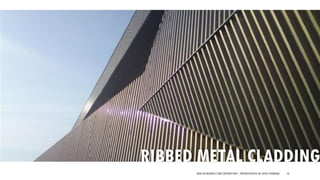
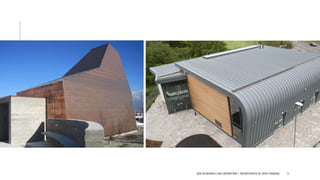
RIBBED METAL CLADDING
NEW AGE MATERIALS AND CONSTRUCTION | PRESENTATION BY AR. GEEVA CHANDANA 57
NEW AGE MATERIALS AND CONSTRUCTION | PRESENTATION BY AR. GEEVA CHANDANA 58
NEW AGE MATERIALS AND CONSTRUCTION | PRESENTATION BY AR. GEEVA CHANDANA 59
NEW AGE MATERIALS AND CONSTRUCTION | PRESENTATION BY AR. GEEVA CHANDANA 60
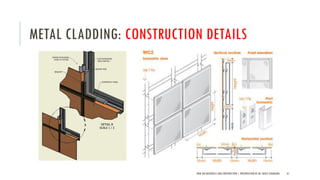
METAL CLADDING: CONSTRUCTION DETAILS
NEW AGE MATERIALS AND CONSTRUCTION | PRESENTATION BY AR. GEEVA CHANDANA 61
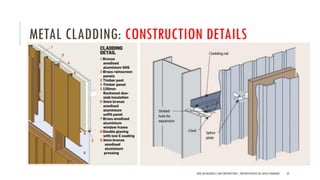
METAL CLADDING: CONSTRUCTION DETAILS
NEW AGE MATERIALS AND CONSTRUCTION | PRESENTATION BY AR. GEEVA CHANDANA 62
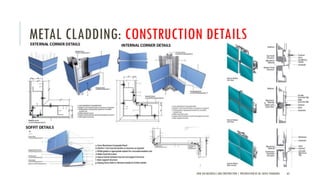
METAL CLADDING: CONSTRUCTION DETAILS
NEW AGE MATERIALS AND CONSTRUCTION | PRESENTATION BY AR. GEEVA CHANDANA 63
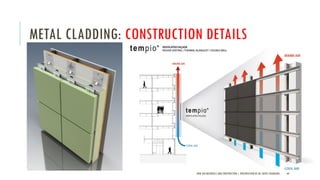
METAL CLADDING: CONSTRUCTION DETAILS
NEW AGE MATERIALS AND CONSTRUCTION | PRESENTATION BY AR. GEEVA CHANDANA 64
NEW AGE MATERIALS AND CONSTRUCTION | PRESENTATION BY AR. GEEVA CHANDANA 65
NEW AGE MATERIALS AND CONSTRUCTION | PRESENTATION BY AR. GEEVA CHANDANA 66
NEW AGE MATERIALS AND CONSTRUCTION | PRESENTATION BY AR. GEEVA CHANDANA 67
NEW AGE MATERIALS AND CONSTRUCTION | PRESENTATION BY AR. GEEVA CHANDANA 68
NEW AGE MATERIALS AND CONSTRUCTION | PRESENTATION BY AR. GEEVA CHANDANA 69
NEW AGE MATERIALS AND CONSTRUCTION | PRESENTATION BY AR. GEEVA CHANDANA 70
NEW AGE MATERIALS AND CONSTRUCTION | PRESENTATION BY AR. GEEVA CHANDANA 71
NEW AGE MATERIALS AND CONSTRUCTION | PRESENTATION BY AR. GEEVA CHANDANA 72
NEW AGE MATERIALS AND CONSTRUCTION | PRESENTATION BY AR. GEEVA CHANDANA 73
NEW AGE MATERIALS AND CONSTRUCTION | PRESENTATION BY AR. GEEVA CHANDANA 74

Curtain walls - As construction material

  • 1.
    NEW AGE MATERIALSAND CONSTRUCTION CURTAIN WALLS NEW AGE MATERIALS AND CONSTRUCTION | PRESENTATION BY AR. GEEVA CHANDANA 1
  • 2.
    19ARE618T | NEWAGE MATERIALS AND CONSTRUCTION 1.CURTAINWALLS Introduction Advantage/ Disadvantage Materials: Glass, Steel Cladding, Aluminium Cladding, Ribbed metal cladding, modern materials. Construction Techniques, Technologies Maintenance and Application 1.CURTAINWALLS Shapes: Sloping and curved glass curtain walls Steel plate shear curtain walls Metallic cladding for roofs Construction Techniques, Technologies Maintenance and Application NEW AGE MATERIALS AND CONSTRUCTION | PRESENTATION BY AR. GEEVA CHANDANA 2
  • 3.
    CURTAIN WALLS NEW AGEMATERIALS AND CONSTRUCTION | PRESENTATION BY AR. GEEVA CHANDANA 3 • A non-load bearing exterior skin • Does not contribute to the structural support of the building • Provides the air and water tightness of the building exterior • Provide aesthetic signatures to buildings.
  • 4.
    CURTAIN WALLS NEW AGEMATERIALS AND CONSTRUCTION | PRESENTATION BY AR. GEEVA CHANDANA 4
  • 5.
    CURTAIN WALLS All wallsystems are required to resist many different forces in the provision of a suitable separation of indoor and outdoor environments. They are required to: • have sufficient structural strength and rigidity • resist the spread of fire • be durable • control odours • control light • control sound and vibration • control heat flow • control air flow • control water vapour flow • control exterior precipitation • control solar radiation NEW AGE MATERIALS AND CONSTRUCTION | PRESENTATION BY AR. GEEVA CHANDANA 5
  • 6.
    CURTAIN WALLS :HISTORY Modernist architects discarded the decorative styles of the 19th century and sought to merge architecture with industry. The result was a simple, logical, functional building style, as much industrial as artistic. First curtain wall was designed by German Architect Walter Gropius : Bauhaus Gropius constructed the new campus according to his philosophy of clean, functional, modern design. “Curtain Wall”, the exterior wall of glass that also displays the building’s interior design. In 1950’s, designed as a series of window units and panels joined and supported by simple framing members. NEW AGE MATERIALS AND CONSTRUCTION | PRESENTATION BY AR. GEEVA CHANDANA 6
  • 7.
    CURTAIN WALLS :COMPONENTS NEW AGE MATERIALS AND CONSTRUCTION | PRESENTATION BY AR. GEEVA CHANDANA 7
  • 8.
    CURTAIN WALLS :COMPONENTS NEW AGE MATERIALS AND CONSTRUCTION | PRESENTATION BY AR. GEEVA CHANDANA 8
  • 9.
    GLASS WALLS :TYPES 1. Stick Wall 2. Unitized Wall 3. Storefront 4. I-Beam Wall 5. Pressure Wall 6. Window Wall NEW AGE MATERIALS AND CONSTRUCTION | PRESENTATION BY AR. GEEVA CHANDANA 9 1 2 3 4 5 6
  • 10.
    STICK SYSTEM NEW AGEMATERIALS AND CONSTRUCTION | PRESENTATION BY AR. GEEVA CHANDANA 10 • Earlier design of curtain wall technology - installed piece by piece. • The mullion members (which is vertical member) are installed first, followed in turn by the transom members (which is horizontal rail member), and finally the glazing or window units.
  • 11.
    STICK SYSTEM NEW AGEMATERIALS AND CONSTRUCTION | PRESENTATION BY AR. GEEVA CHANDANA 11 Advantages: • Low shipping and handling costs, because of minimal bulk, • Allows some degree of dimensional adjustment to site conditions. Disadvantages: • Necessity of assembly in the construction site, rather than under controlled factory conditions, and the fact that pre- glazing is obviously impossible.
  • 12.
    NEW AGE MATERIALSAND CONSTRUCTION | PRESENTATION BY AR. GEEVA CHANDANA 12
  • 13.
    UNITIZED SYSTEM NEW AGEMATERIALS AND CONSTRUCTION | PRESENTATION BY AR. GEEVA CHANDANA 13 • Factory-assembled and factory–glazed under controlled conditions. • Units are hung from the floor above on pre-set anchors.
  • 14.
    NEW AGE MATERIALSAND CONSTRUCTION | PRESENTATION BY AR. GEEVA CHANDANA 14
  • 15.
    NEW AGE MATERIALSAND CONSTRUCTION | PRESENTATION BY AR. GEEVA CHANDANA 15
  • 16.
    NEW AGE MATERIALSAND CONSTRUCTION | PRESENTATION BY AR. GEEVA CHANDANA 16
  • 17.
    NEW AGE MATERIALSAND CONSTRUCTION | PRESENTATION BY AR. GEEVA CHANDANA 17
  • 18.
    CURTAINWALLS:SELECTION NEW AGE MATERIALSAND CONSTRUCTION | PRESENTATION BY AR. GEEVA CHANDANA 18
  • 19.
    CURTAIN WALLS :STICK VS UNITIZED NEW AGE MATERIALS AND CONSTRUCTION | PRESENTATION BY AR. GEEVA CHANDANA 19
  • 20.
    NEW AGE MATERIALSAND CONSTRUCTION | PRESENTATION BY AR. GEEVA CHANDANA 20
  • 21.
    CURTAIN WALL :MATERIALS 1. Glass Curtain Wall 2. Steel Cladding In Curtain Wall 3. Aluminium Cladding In Curtain Wall 4. Ribbed Metal Cladding In Curtain Wall 5. Sloping And Curved Curtain Wall 6. Steel Plate Shear Curtain Wall 7. Metallic Cladding For Roof NEW AGE MATERIALS AND CONSTRUCTION | PRESENTATION BY AR. GEEVA CHANDANA 21 1 2 3 4 5
  • 22.
    NEW AGE MATERIALSAND CONSTRUCTION | PRESENTATION BY AR. GEEVA CHANDANA 22 GLASS CURTAIN WALL
  • 23.
    CURTAIN WALL :GLASS •Glass may be used which is transparent, translucent, or opaque, or in varying degrees thereof. •Transparent glass usually refers to vision glass in a curtain wall. •Spandrel or vision glass may also contain translucent glass, which could be for security or aesthetic purposes. •Opaque glass is used in areas to hide a column or spandrel beam or shear wall behind the curtain wall. •Another method of hiding spandrel areas is through shadow box construction (providing a dark enclosed space behind the transparent or translucent glass). •Shadow box construction creates a perception of depth behind the glass that is sometimes desired. NEW AGE MATERIALS AND CONSTRUCTION | PRESENTATION BY AR. GEEVA CHANDANA 23
  • 24.
    NEW AGE MATERIALSAND CONSTRUCTION | PRESENTATION BY AR. GEEVA CHANDANA 24
  • 25.
    CURTAIN WALL :GLASS - SIZES FOR COMMERCIAL CONSTRUCTION, •The two most common thicknesses :1/4 inch (6 mm) monolithic and 1 inch (25 mm) insulating glass. •1/4 inch glass is typically used only in spandrel areas, while insulating glass is used for the rest of the building (sometimes spandrel glass is specified as insulating glass as well). •The 1 inch insulation glass is typically made up of two 1/4-inch lites of glass with a 1/2 inch (12 mm) airspace. •The air inside is usually atmospheric air, but some inert gases, such as argon or krypton may be used to offer better thermal transmittance values. FOR RESIDENTIAL CONSTRUCTION, •Thicknesses commonly used are 1/8 inch (3 mm) monolithic and 5/8 inch (16 mm) insulating glass. • Larger thicknesses are typically employed for buildings or areas with higher thermal, relative humidity, or sound transmission requirements, such as laboratory areas or recording studios. NEW AGE MATERIALS AND CONSTRUCTION | PRESENTATION BY AR. GEEVA CHANDANA 25
  • 26.
    NEW AGE MATERIALSAND CONSTRUCTION | PRESENTATION BY AR. GEEVA CHANDANA 26
  • 27.
    NEW AGE MATERIALSAND CONSTRUCTION | PRESENTATION BY AR. GEEVA CHANDANA 27
  • 28.
    NEW AGE MATERIALSAND CONSTRUCTION | PRESENTATION BY AR. GEEVA CHANDANA 28
  • 29.
    NEW AGE MATERIALSAND CONSTRUCTION | PRESENTATION BY AR. GEEVA CHANDANA 29
  • 30.
    NEW AGE MATERIALSAND CONSTRUCTION | PRESENTATION BY AR. GEEVA CHANDANA 30
  • 31.
    NEW AGE MATERIALSAND CONSTRUCTION | PRESENTATION BY AR. GEEVA CHANDANA 31
  • 32.
    NEW AGE MATERIALSAND CONSTRUCTION | PRESENTATION BY AR. GEEVA CHANDANA 32
  • 33.
    NEW AGE MATERIALSAND CONSTRUCTION | PRESENTATION BY AR. GEEVA CHANDANA 33
  • 34.
    NEW AGE MATERIALSAND CONSTRUCTION | PRESENTATION BY AR. GEEVA CHANDANA 34
  • 35.
    NEW AGE MATERIALSAND CONSTRUCTION | PRESENTATION BY AR. GEEVA CHANDANA 35
  • 36.
    NEW AGE MATERIALSAND CONSTRUCTION | PRESENTATION BY AR. GEEVA CHANDANA 36 METAL CLADDING
  • 37.
    CURTAIN WALL :METAL CLADDING •Metal is commonly used for non-structural, rain-screen cladding systems, where the priority is to provide protection from the elements as well as a striking external finish. •Foldable, malleable nature, metal panels can be connected together and attached to a building in a wide variety of ways, each system offering different benefits in terms of construction complexity and aesthetic finish. NEW AGE MATERIALS AND CONSTRUCTION | PRESENTATION BY AR. GEEVA CHANDANA 37
  • 38.
    CURTAIN WALL :METAL CLADDING •The most commonly used materials for cladding are stainless steel, zinc, copper and aluminium. Each of these metals have their own features and advantages. •Advantages in terms of providing a high quality, sustainable and cost-effective exterior. •For example, stainless steel’s glossy finish makes it a highly attractive option for any built structure were the aesthetics of the result are important, and its self-healing properties are ideal for minimising maintenance costs. •Stainless steel cladding is both a sustainable and cost-effective choice for buildings that need to last. NEW AGE MATERIALS AND CONSTRUCTION | PRESENTATION BY AR. GEEVA CHANDANA 38
  • 39.
    METAL CLADDING: ALUMINIUM Aluminumis naturally resistant to rusting or blistering, making it a popular cladding choice for contemporary projects. It also possesses an excellent strength-to-weight ratio, meaning aluminum façade attachment systems can be less bulky than those for steel panels. That said, the material is prone to denting and scratches, and may corrode under certain environmental conditions without proper care. NEW AGE MATERIALS AND CONSTRUCTION | PRESENTATION BY AR. GEEVA CHANDANA 39
  • 40.
    ALUMINIUM CLADDING :ADVANTAGES 1. ALUMINIUM IS A VERY LIGHT WEIGHT METAL Aluminium weighs in at about the third of the weight of steel. On average it weighs around 2,7g/cm3. This is a big reason many architects consider using aluminium when cladding. The process of installing the aluminium panels, aluminium louvres or aluminium facade systems will be much easier due to the weight. 2. ALUMINIUM IS VERY RESISTANT TO CORROSION Corrosion does not affect aluminium due to its protective oxide coating. Unlike copper, the weather conditions don’t influence aluminium. It won’t rust and corrode over time. NEW AGE MATERIALS AND CONSTRUCTION | PRESENTATION BY AR. GEEVA CHANDANA 40
  • 41.
    ALUMINIUM CLADDING :ADVANTAGES 3. ALUMINIUM IS FLEXIBLE Aluminium is one of the easiest metals to melt and bent. The melting point of aluminium is very low making it easy to shape. Because it is also flexible, aluminium is used widely by architects for special designs that require curved or uncommon shapes. 4. ALUMINIUM IS COMPLETELY RECYCLABLE Aluminium cladding is sustainable. Aluminium is recyclable and won’t lose any of its quality in the process. Aluminium is remelted all the time and the process takes little energy. NEW AGE MATERIALS AND CONSTRUCTION | PRESENTATION BY AR. GEEVA CHANDANA 41
  • 42.
    METAL CLADDING: STAINLESSSTEEL Steel coated in a thin layer of chromium oxide is commonly referred to as stainless steel. The chromium helps prevent the oxidization process of corrosion occurring, so the material is resistant to rusting. Stainless steel is also popular for its clean, polished finish. NEW AGE MATERIALS AND CONSTRUCTION | PRESENTATION BY AR. GEEVA CHANDANA 42
  • 43.
    STEEL CLADDING :ADVANTAGES 1. STAINLESS STEEL IS AESTHETICALLY APPEALING Compared to zinc, stainless steel is a material with a glossy, more polished finish. Due to this aesthetically beneficial quality, it is commonly used for wall cladding in a decorative manner. Stainless steel has a unique aesthetic advantage to any construction or building. 2. STAINLESS STEEL IS DURABLE Stainless steel has a high durability: the metal panels will not change in appearance for several decades. This is in contrast with copper, which colour will change over time. NEW AGE MATERIALS AND CONSTRUCTION | PRESENTATION BY AR. GEEVA CHANDANA 43
  • 44.
    STEEL CLADDING :ADVANTAGES 3. STAINLESS STEEL HAS RESISTANCE TO CORROSION Stainless steel has an incredibly high resistance for corrosion, due to its ‘self-healing’ quality. When the metal is scratched or is starting to wear due to abrasion, an invisible layer of chromo(III) oxide (Cr2O3 on the periodic table) will form when oxygen is available. This thin layer protects the metal underneath it, and will make the material polished, smooth and lustrous again. 4. STAINLESS STEEL IS COMPLETELY RECYCLABLE Stainless steel is completely recyclable. The larger part of the stainless steel production nowadays is even being fabricated with recycled parts of the material. This shows that the metal can very easily be re-used, and makes it even more durable besides its long life span. NEW AGE MATERIALS AND CONSTRUCTION | PRESENTATION BY AR. GEEVA CHANDANA 44
  • 45.
    NEW AGE MATERIALSAND CONSTRUCTION | PRESENTATION BY AR. GEEVA CHANDANA 45
  • 46.
    NEW AGE MATERIALSAND CONSTRUCTION | PRESENTATION BY AR. GEEVA CHANDANA 46
  • 47.
    NEW AGE MATERIALSAND CONSTRUCTION | PRESENTATION BY AR. GEEVA CHANDANA 47
  • 48.
    NEW AGE MATERIALSAND CONSTRUCTION | PRESENTATION BY AR. GEEVA CHANDANA 48
  • 49.
    CURTAIN WALL :METAL CLADDING NEW AGE MATERIALS AND CONSTRUCTION | PRESENTATION BY AR. GEEVA CHANDANA 49 STAINLESS STEEL CLADDING ALUMINIUM CLADDING Sustainable and cost-effective choice glossy finish - highly attractive option -were the aesthetics are important - ideal for minimizing maintenance costs. Aluminium cladding generally has a neoprene core, making it the ideal choice for buildings where energy efficiency is of prime importance. Strength, durability, large glazing portions Lighter weight Architects commonly use steel large curtain walls to improve day lighting - wide spans and heights up to more than 15 meters. Architects prefer aluminium for skyscrapers with glass panels - price advantage and the design flexibility. Finishes: Brush finish, satin polish finish, mirror polish. Finishes: Brush or polish aluminium for glossy and appealing Corrosion resistant - must be treated against corrosion, like zinc coating or painting. Possible scratches might result in rusty zones if not. Corrosion resistance unless the environment is highly acidic.
  • 50.
    MATERIALS & FINISHES NEWAGE MATERIALS AND CONSTRUCTION | PRESENTATION BY AR. GEEVA CHANDANA 50 STAINLESS STEEL GALVANIZED STEEL TYPICAL SAND BLASTED METAL FINISH TYPICAL BRUSHED METAL FINISH
  • 51.
    MATERIALS & FINISHES NEWAGE MATERIALS AND CONSTRUCTION | PRESENTATION BY AR. GEEVA CHANDANA 51 ENGINE TURNED POWDER COATED PATTERNED METAL FINISHES
  • 52.
    METAL CLADDING: COPPER Lightweightcladding option, copper is very durable compared to other materials, and at the end of the building life is also 100% recyclable. Its subtly reflective appearance evolves over time due to oxidization, turning the metal a distinctive green color. NEW AGE MATERIALS AND CONSTRUCTION | PRESENTATION BY AR. GEEVA CHANDANA 52
  • 53.
    NEW AGE MATERIALSAND CONSTRUCTION | PRESENTATION BY AR. GEEVA CHANDANA 53
  • 54.
    METAL CLADDING: BRASS Strikinga balance between the cool hue of zinc and the warmth of copper, brass is a highly malleable cladding material that makes it well suited to decorative sheet metal work. Over time, brass takes on a golden-brown patina as its surface oxidizes. NEW AGE MATERIALS AND CONSTRUCTION | PRESENTATION BY AR. GEEVA CHANDANA 54
  • 55.
    NEW AGE MATERIALSAND CONSTRUCTION | PRESENTATION BY AR. GEEVA CHANDANA 55
  • 56.
    NEW AGE MATERIALSAND CONSTRUCTION | PRESENTATION BY AR. GEEVA CHANDANA 56 RIBBED METAL CLADDING
  • 57.
    NEW AGE MATERIALSAND CONSTRUCTION | PRESENTATION BY AR. GEEVA CHANDANA 57
  • 58.
    NEW AGE MATERIALSAND CONSTRUCTION | PRESENTATION BY AR. GEEVA CHANDANA 58
  • 59.
    NEW AGE MATERIALSAND CONSTRUCTION | PRESENTATION BY AR. GEEVA CHANDANA 59
  • 60.
    NEW AGE MATERIALSAND CONSTRUCTION | PRESENTATION BY AR. GEEVA CHANDANA 60
  • 61.
    METAL CLADDING: CONSTRUCTIONDETAILS NEW AGE MATERIALS AND CONSTRUCTION | PRESENTATION BY AR. GEEVA CHANDANA 61
  • 62.
    METAL CLADDING: CONSTRUCTIONDETAILS NEW AGE MATERIALS AND CONSTRUCTION | PRESENTATION BY AR. GEEVA CHANDANA 62
  • 63.
    METAL CLADDING: CONSTRUCTIONDETAILS NEW AGE MATERIALS AND CONSTRUCTION | PRESENTATION BY AR. GEEVA CHANDANA 63
  • 64.
    METAL CLADDING: CONSTRUCTIONDETAILS NEW AGE MATERIALS AND CONSTRUCTION | PRESENTATION BY AR. GEEVA CHANDANA 64
  • 65.
    NEW AGE MATERIALSAND CONSTRUCTION | PRESENTATION BY AR. GEEVA CHANDANA 65
  • 66.
    NEW AGE MATERIALSAND CONSTRUCTION | PRESENTATION BY AR. GEEVA CHANDANA 66
  • 67.
    NEW AGE MATERIALSAND CONSTRUCTION | PRESENTATION BY AR. GEEVA CHANDANA 67
  • 68.
    NEW AGE MATERIALSAND CONSTRUCTION | PRESENTATION BY AR. GEEVA CHANDANA 68
  • 69.
    NEW AGE MATERIALSAND CONSTRUCTION | PRESENTATION BY AR. GEEVA CHANDANA 69
  • 70.
    NEW AGE MATERIALSAND CONSTRUCTION | PRESENTATION BY AR. GEEVA CHANDANA 70
  • 71.
    NEW AGE MATERIALSAND CONSTRUCTION | PRESENTATION BY AR. GEEVA CHANDANA 71
  • 72.
    NEW AGE MATERIALSAND CONSTRUCTION | PRESENTATION BY AR. GEEVA CHANDANA 72
  • 73.
    NEW AGE MATERIALSAND CONSTRUCTION | PRESENTATION BY AR. GEEVA CHANDANA 73
  • 74.
    NEW AGE MATERIALSAND CONSTRUCTION | PRESENTATION BY AR. GEEVA CHANDANA 74