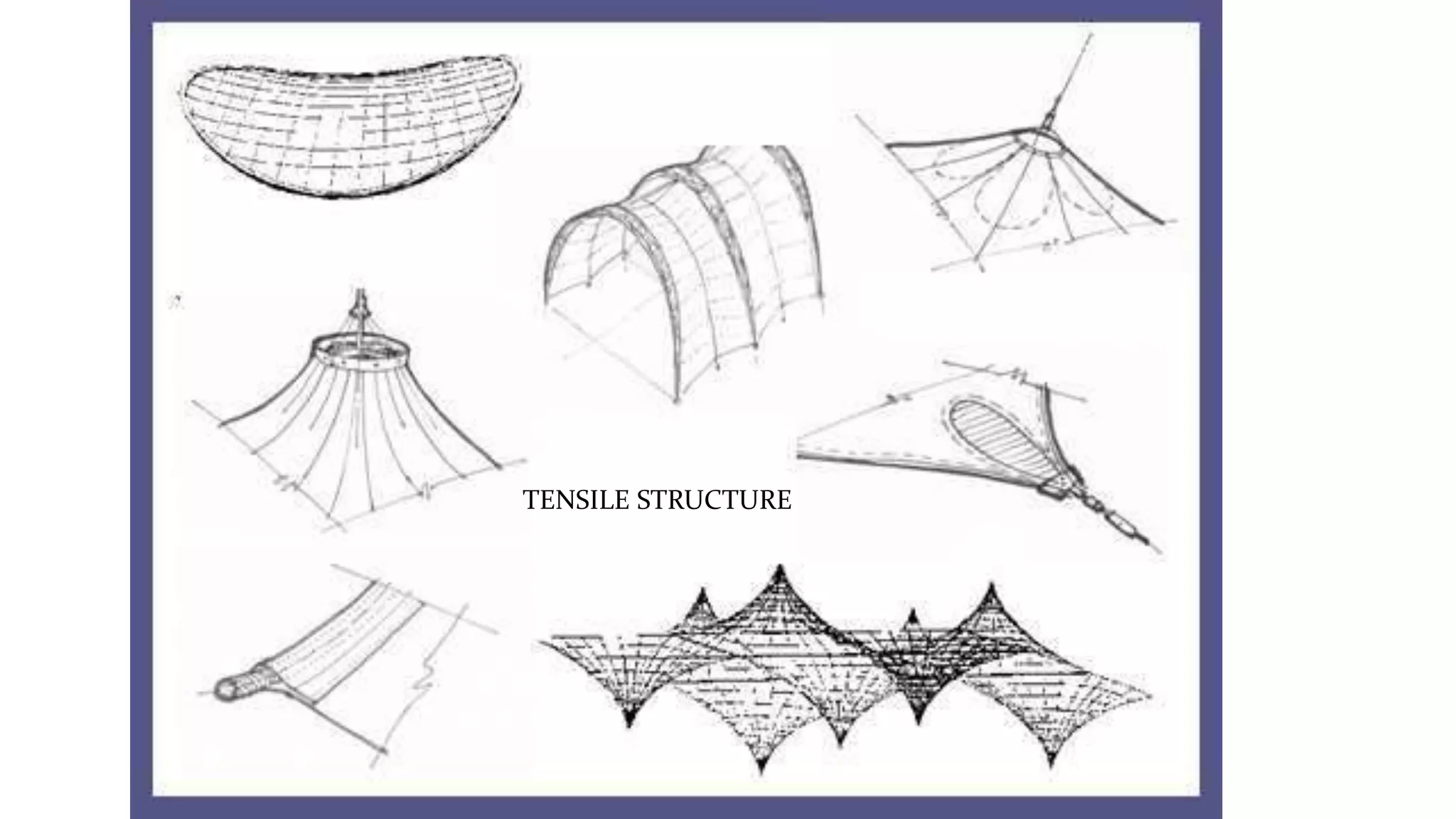
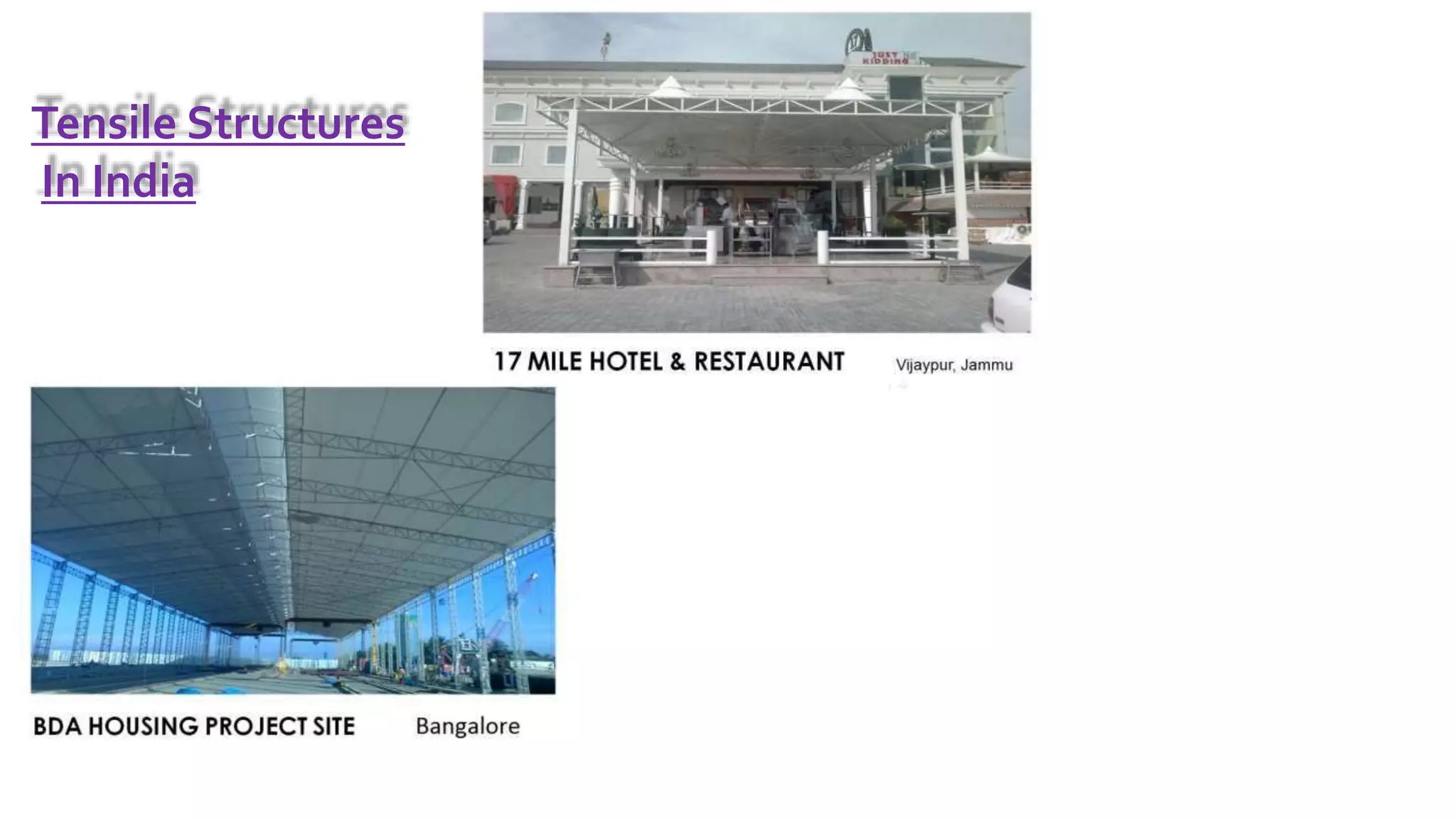
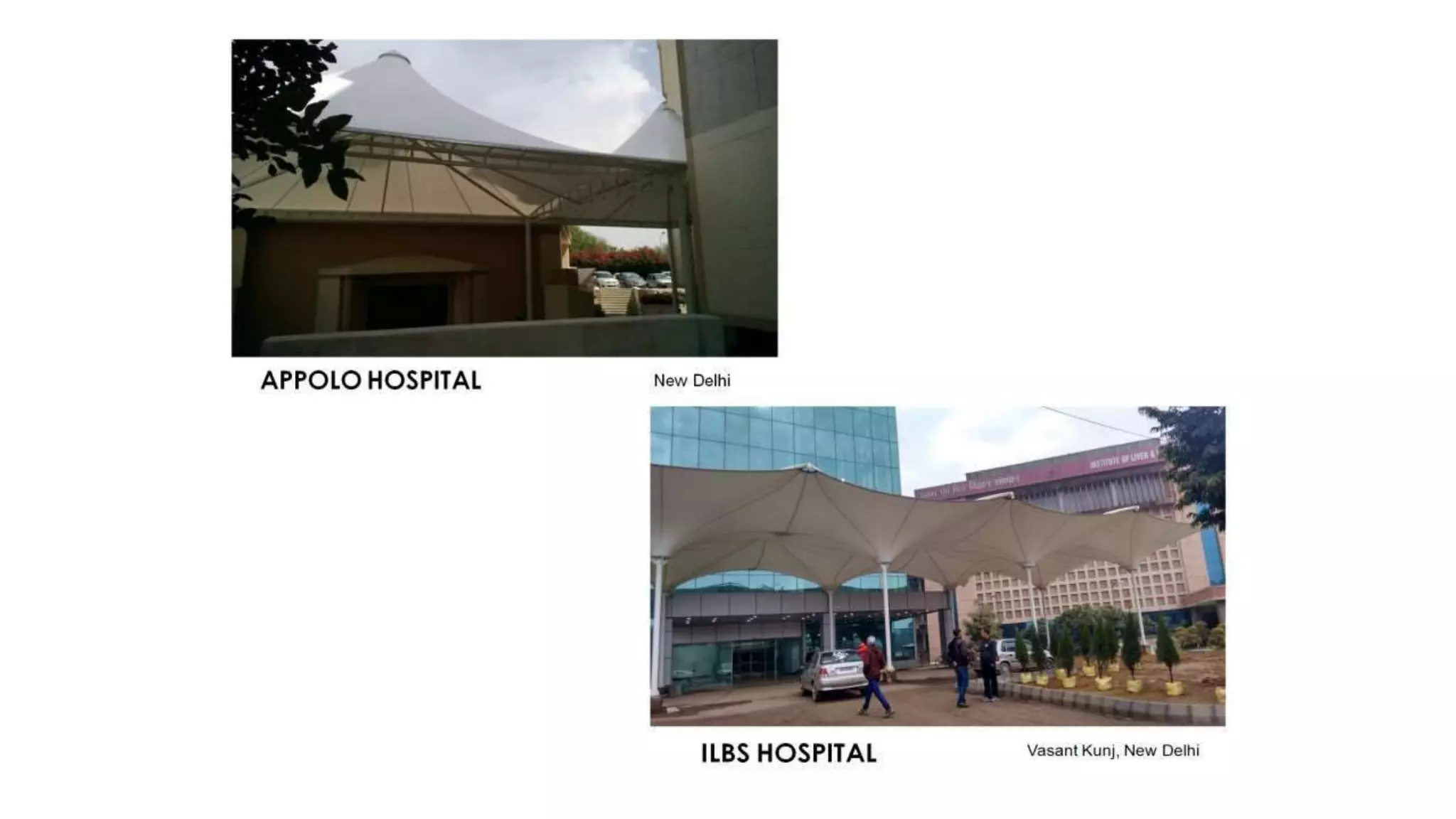
A tensile structure is a construction where load bearing capacity is achieved through tension stress in components like cables, fabrics, or foils. Tension structures include boundary tensioned membranes, pneumatic structures, and pre-stressed cable nets and beams. Tensile membrane structures are often used as roofs as they can economically span large distances. Common types include saddle roofs supported by high and low points, mast-supported structures with fabric attached to interior masts, and structures stabilized by cables in tension like suspension bridges. Tensile structures provide benefits like unique designs, natural lighting, low maintenance, and cost efficiency.
Overview of tensile structures, defined by tension elements. Key aspects include load-bearing capacity and types such as fabrics and cables.
Tensile membranes are primarily used for roofs due to their ability to span large spaces economically. They offer flexibility, aesthetics, translucency, and durability.
Discusses various types of tensile structures like saddle roofs, mast-supported designs, and anticlastic shapes. Describes advantages such as lightweight and unique designs, along with some disadvantages.
Tensile membranes are primarily used for roofs due to their ability to span large spaces economically. They offer flexibility, aesthetics, translucency, and durability. Highlights flexible design, low maintenance, cost benefits, and energy efficiency of tensile membrane structures, showcasing their effectiveness in modern architecture.
Discusses various types of tensile structures like saddle roofs, mast-supported designs, and anticlastic shapes. Describes advantages such as lightweight and unique designs, along with some disadvantages.
TENSILE IS ATYPE OF FORCE APPLIED ON A MATERIAL.
IT IS A CAPABILITY OF MATERIAL OF BEING
STRETCH OUT
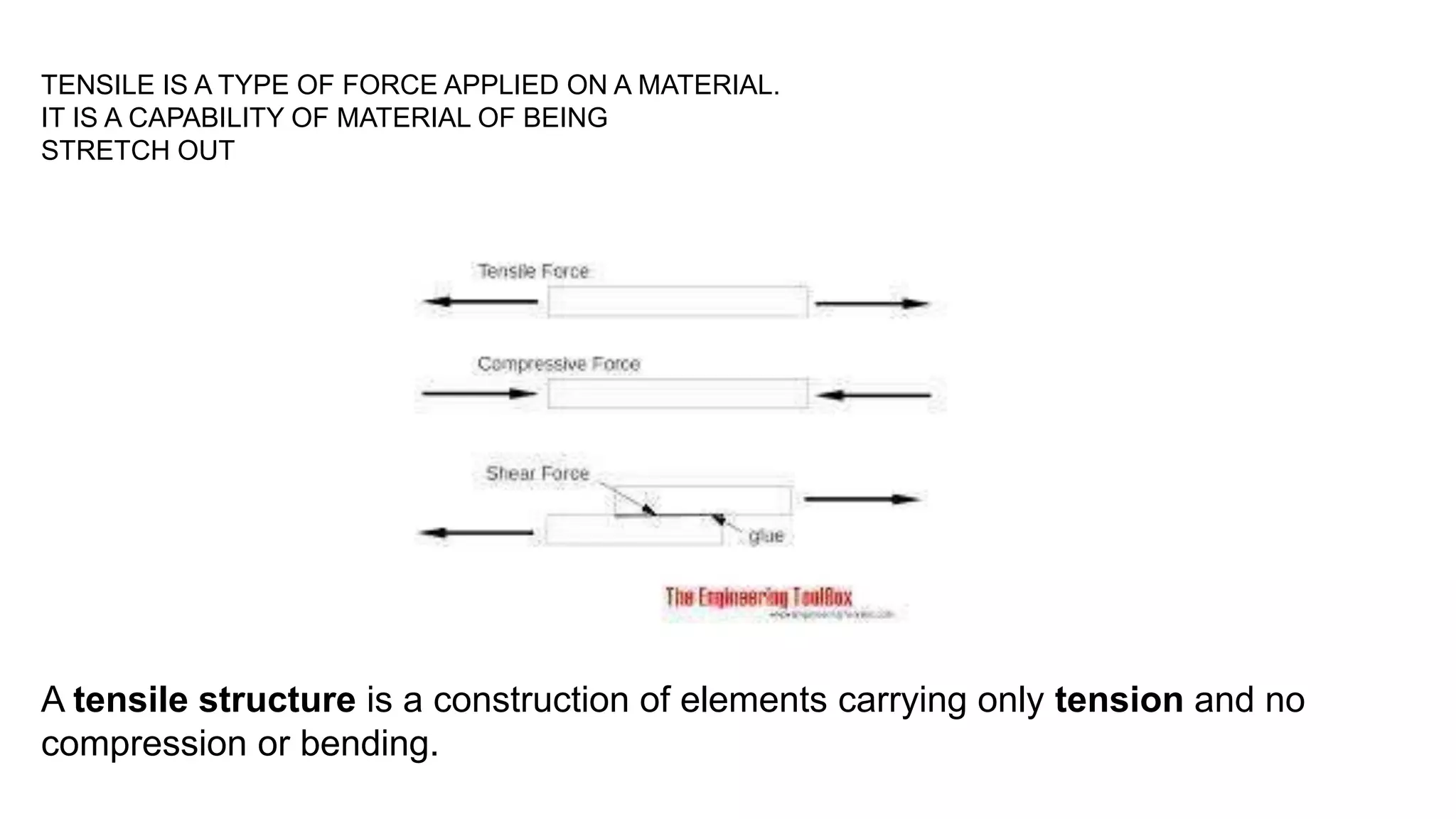
A tensile structure is a construction of elements carrying only tension and no
compression or bending.
3.
Definition
•The term tensilestructures describes the category of buildings in which the load bearing
capacity is achieved through tension stress in the majority of the components, such as
cables, technical fabrics or foils.
•It can also be defined as a structure where the exterior shell is a fabric material spread
over a framework. The fabric is maintained in tension in all directions to provide stability.
•The only exception is represented by rigid boundaries and structural members which are
generally subjected to compression and bending.
•Tension structures are commonly subdivided in boundary tensioned membranes,
pneumatic structures and pre-stressed cable nets and beams (Lewis 2003).
5.
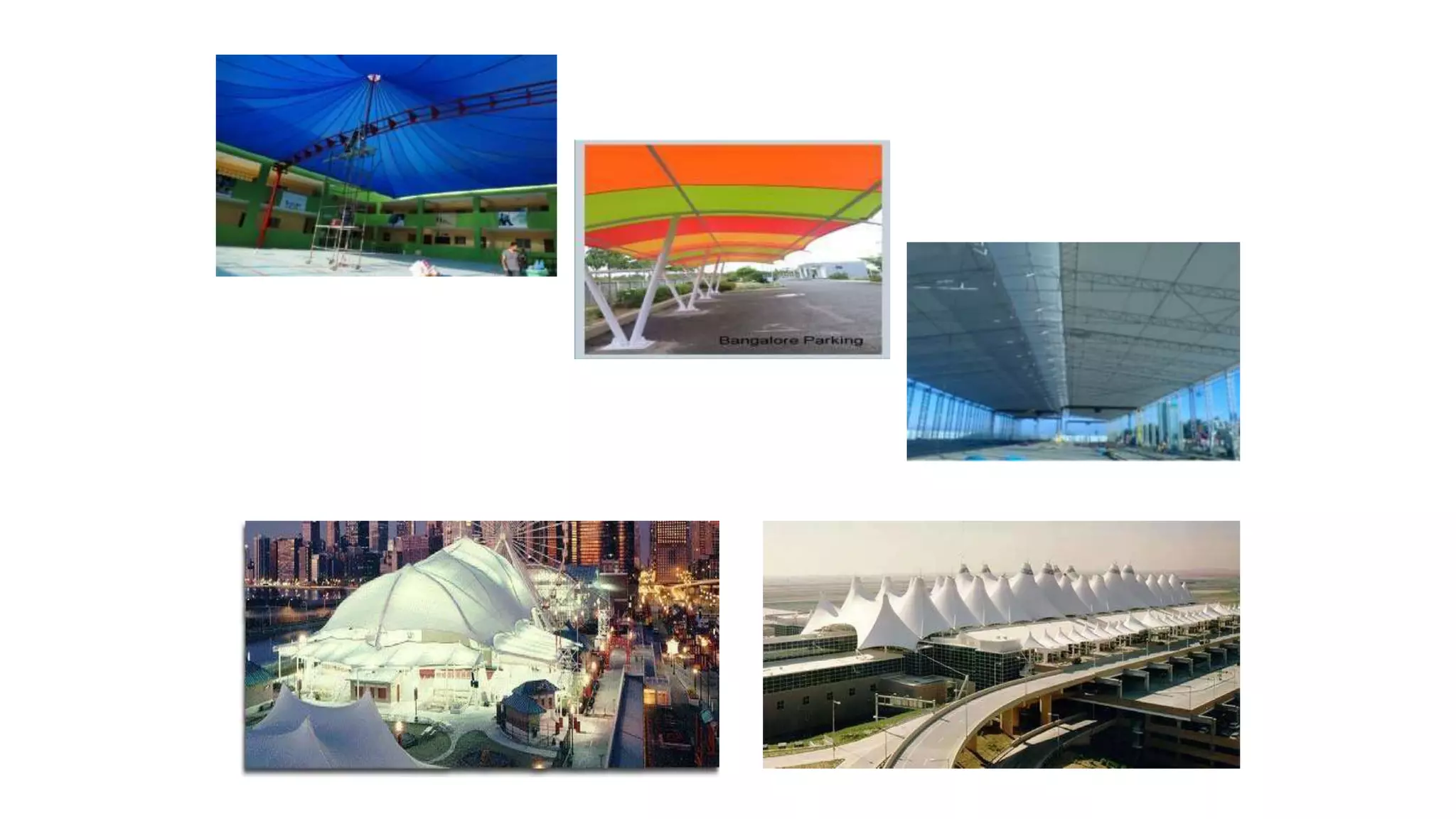
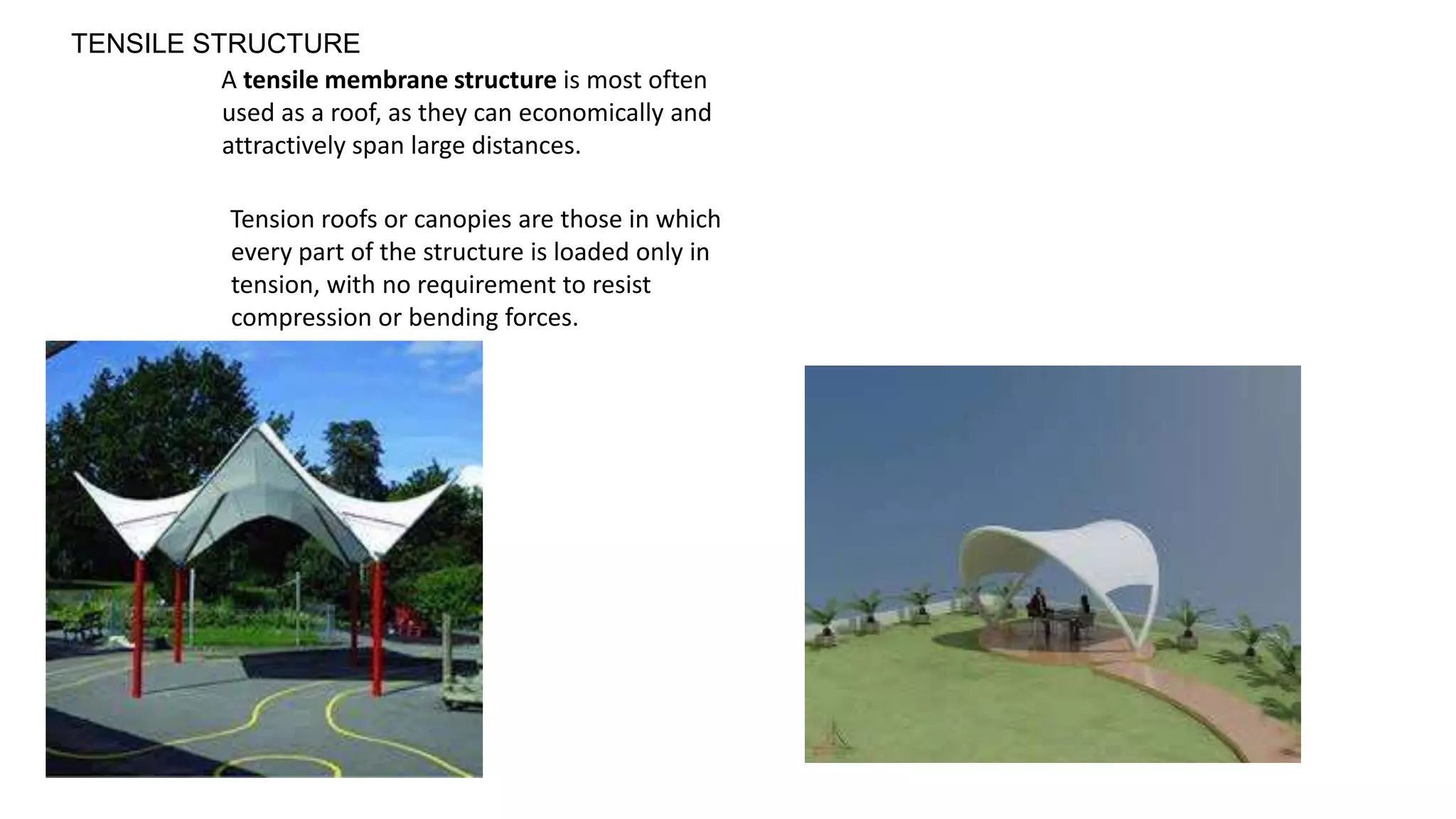
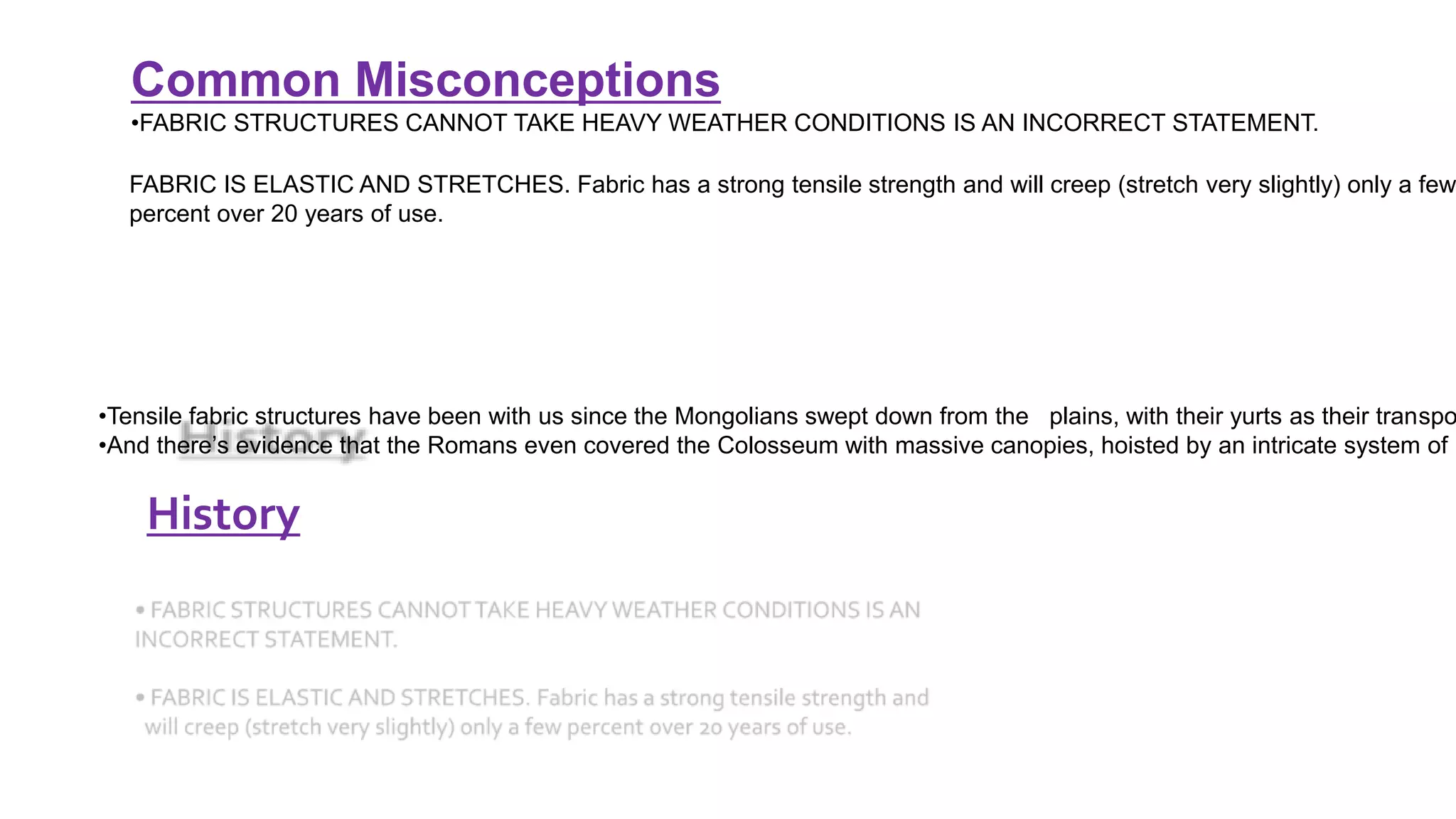
A tensile membranestructure is most often
used as a roof, as they can economically and
attractively span large distances.
Tension roofs or canopies are those in which
every part of the structure is loaded only in
tension, with no requirement to resist
compression or bending forces.
TENSILE STRUCTURE
6.
History
Common Misconceptions
•FABRIC STRUCTURESCANNOT TAKE HEAVY WEATHER CONDITIONS IS AN INCORRECT STATEMENT.
FABRIC IS ELASTIC AND STRETCHES. Fabric has a strong tensile strength and will creep (stretch very slightly) only a few
percent over 20 years of use.
•Tensile fabric structures have been with us since the Mongolians swept down from the plains, with their yurts as their transpo
•And there’s evidence that the Romans even covered the Colosseum with massive canopies, hoisted by an intricate system of p
7.
•But they reallycame into their own in the last half of the 20th century, when designs like this by Germany’s Frei Otto.
Frei Otto Olympic Stadium Colosseum roof
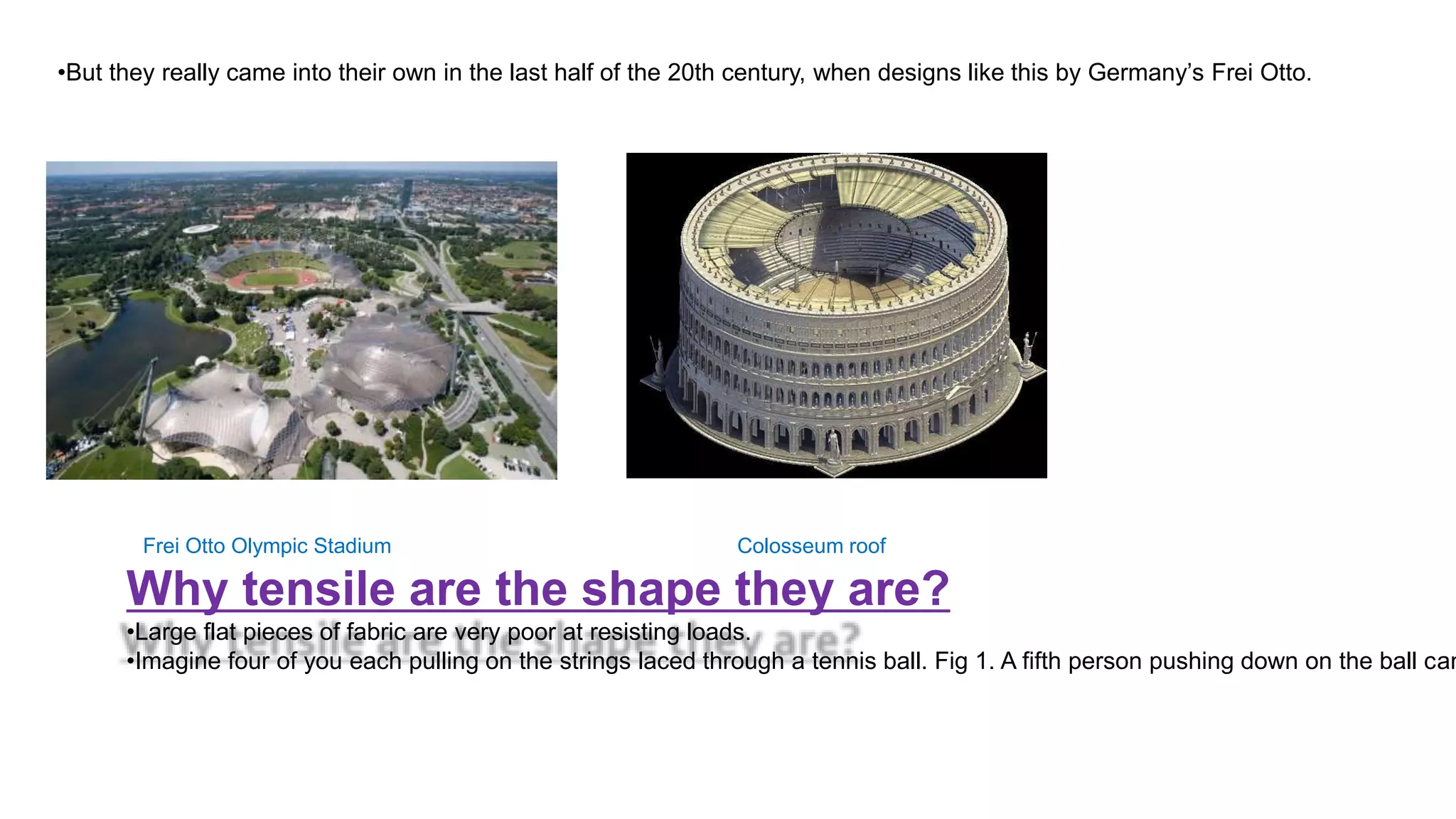
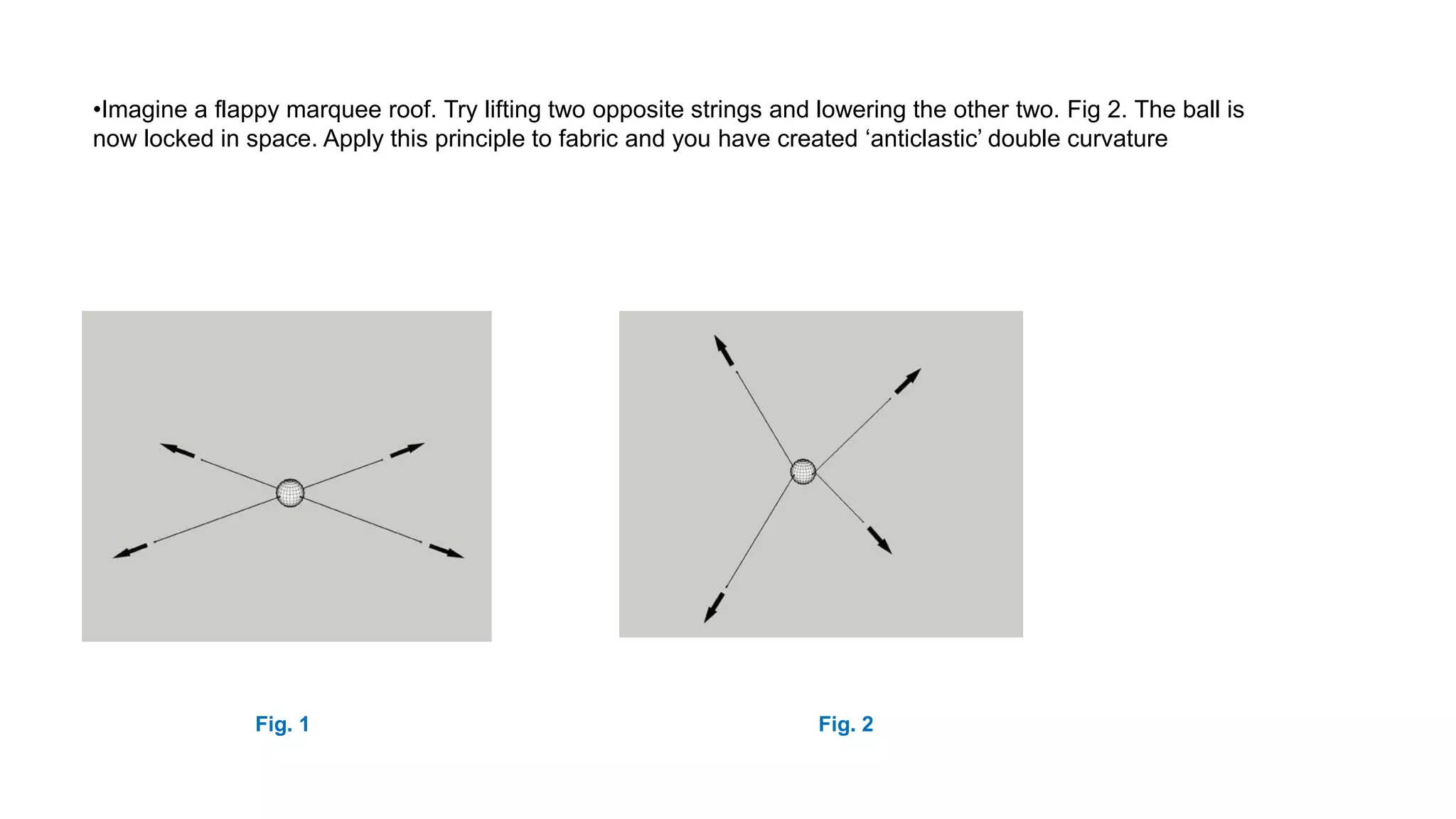
Why tensile are the shape they are?
•Large flat pieces of fabric are very poor at resisting loads.
•Imagine four of you each pulling on the strings laced through a tennis ball. Fig 1. A fifth person pushing down on the ball can
8.
•Imagine a flappymarquee roof. Try lifting two opposite strings and lowering the other two. Fig 2. The ball is
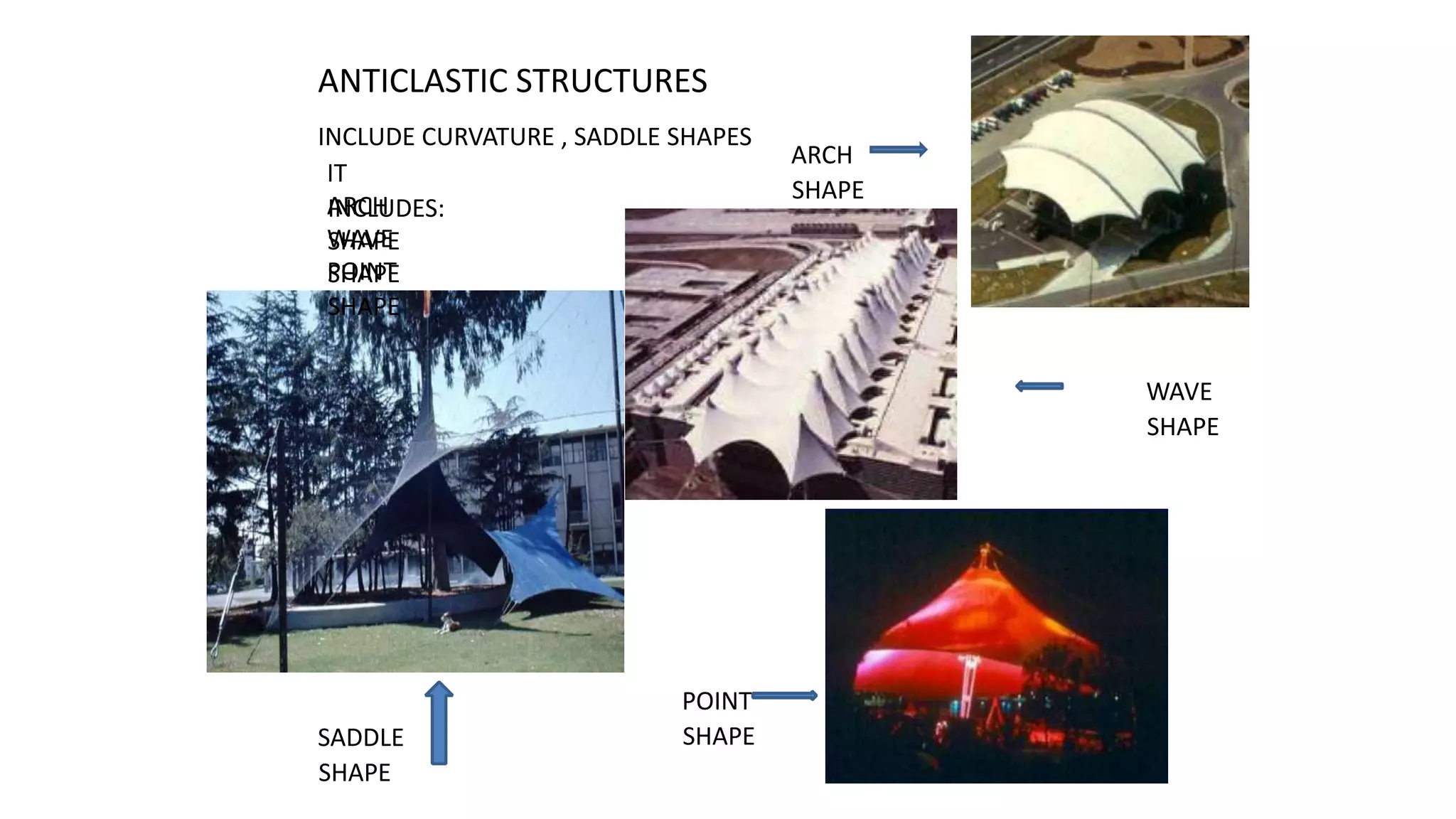
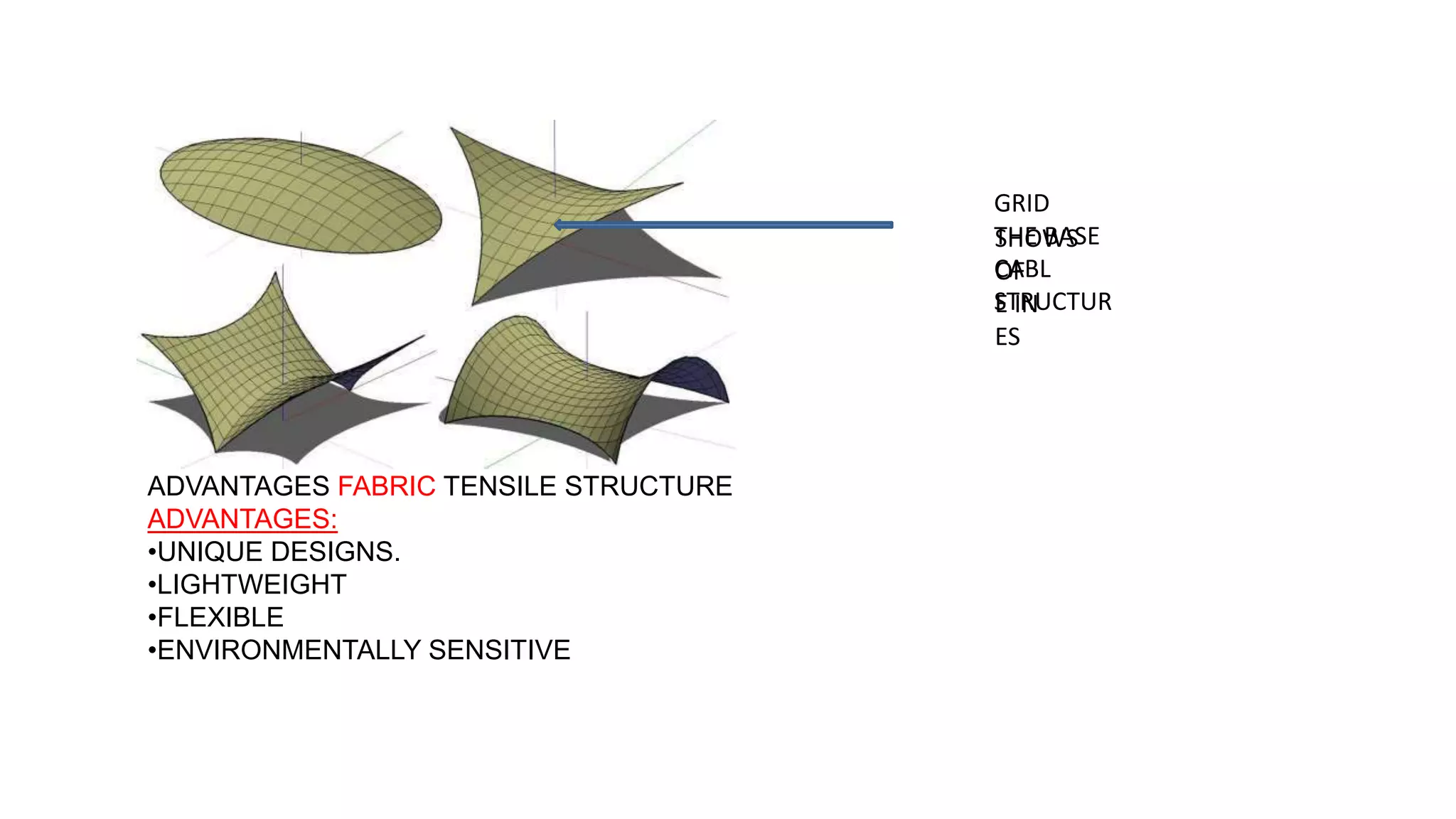
now locked in space. Apply this principle to fabric and you have created ‘anticlastic’ double curvature
Fig. 1 Fig. 2
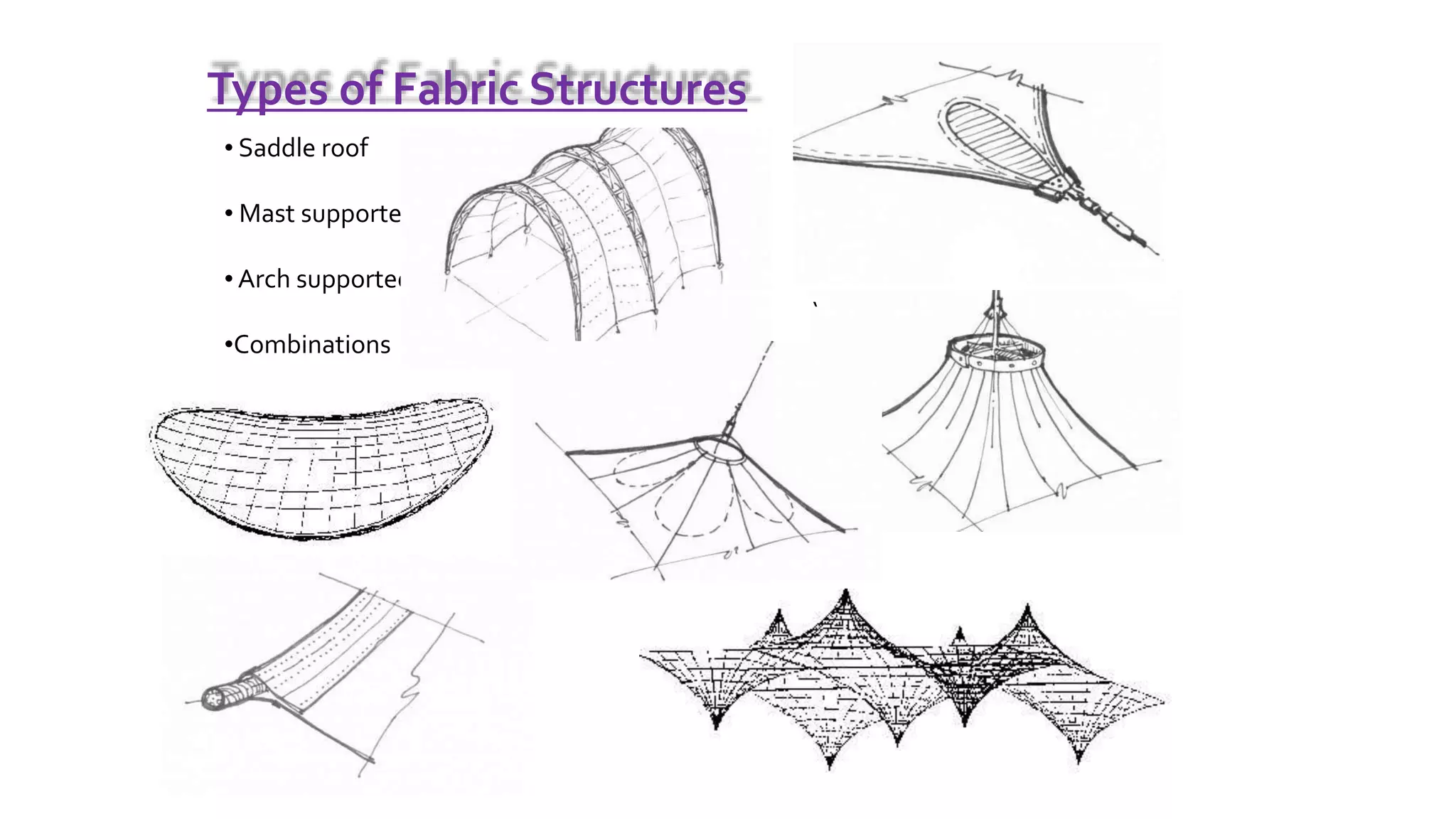
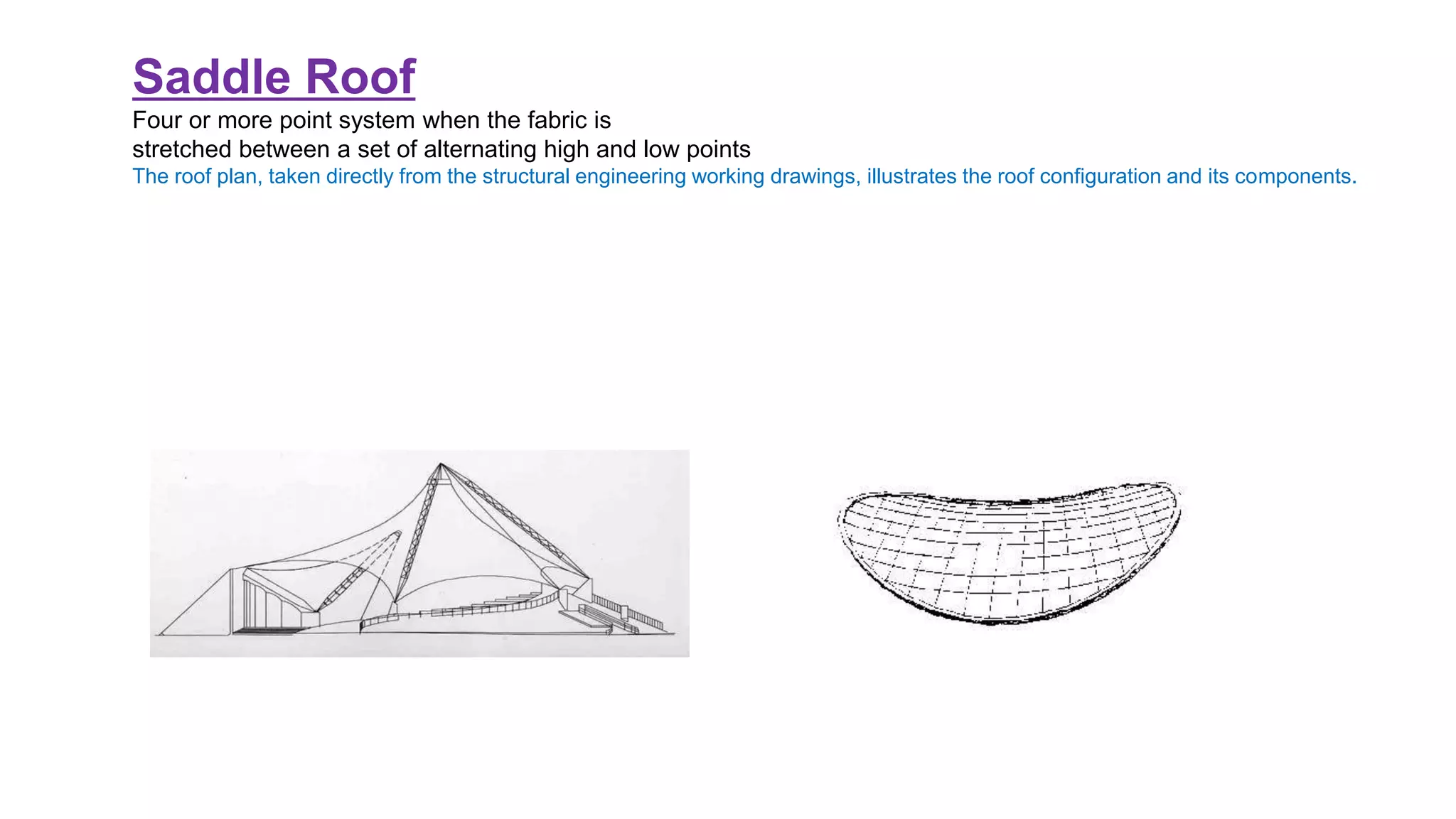
Saddle Roof
Four ormore point system when the fabric is
stretched between a set of alternating high and low points
The roof plan, taken directly from the structural engineering working drawings, illustrates the roof configuration and its components.
11.
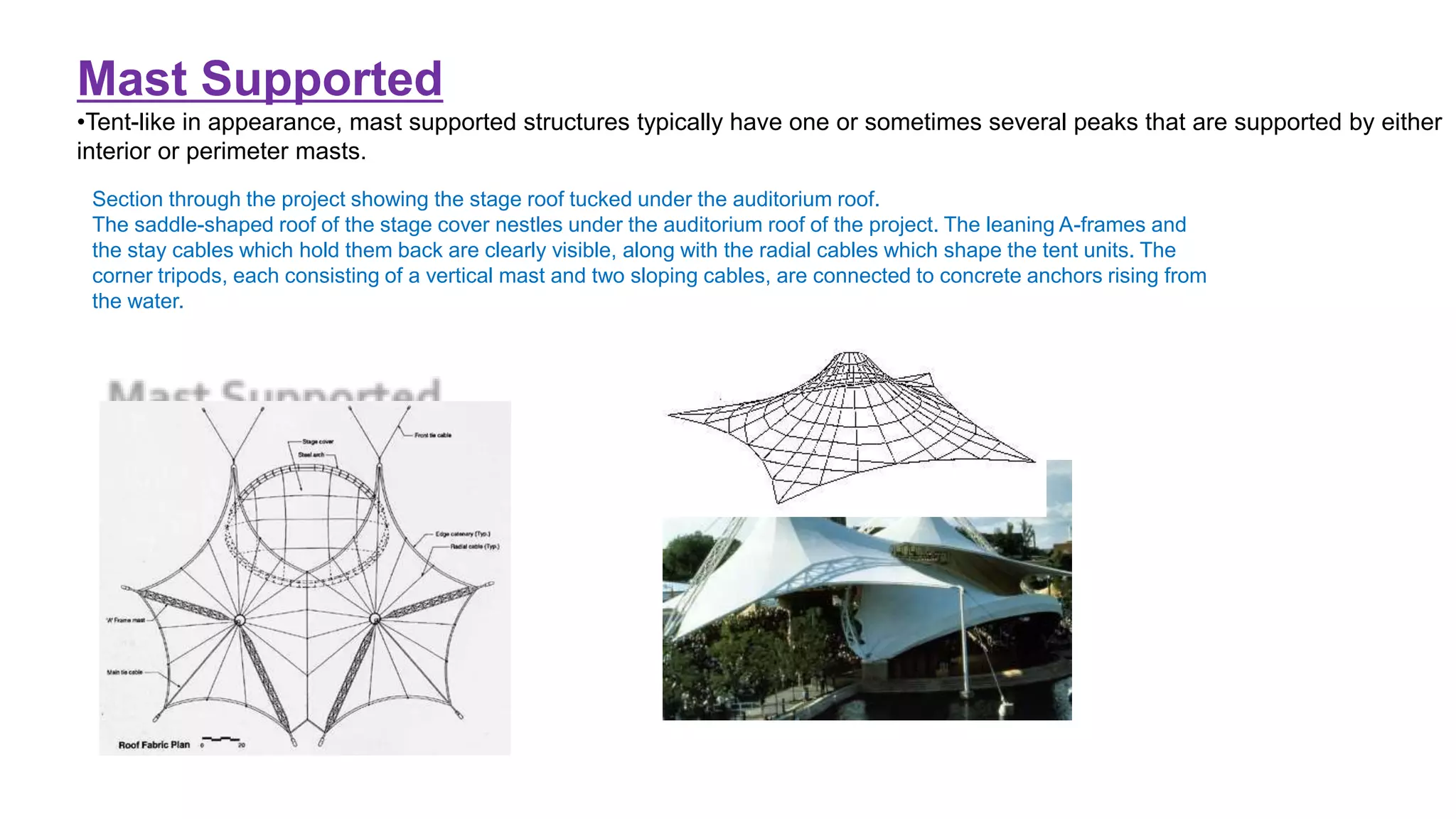
Section through theproject showing the stage roof tucked under the auditorium roof.
The saddle-shaped roof of the stage cover nestles under the auditorium roof of the project. The leaning A-frames and
the stay cables which hold them back are clearly visible, along with the radial cables which shape the tent units. The
corner tripods, each consisting of a vertical mast and two sloping cables, are connected to concrete anchors rising from
the water.
Mast Supported
•Tent-like in appearance, mast supported structures typically have one or sometimes several peaks that are supported by either
interior or perimeter masts.
12.
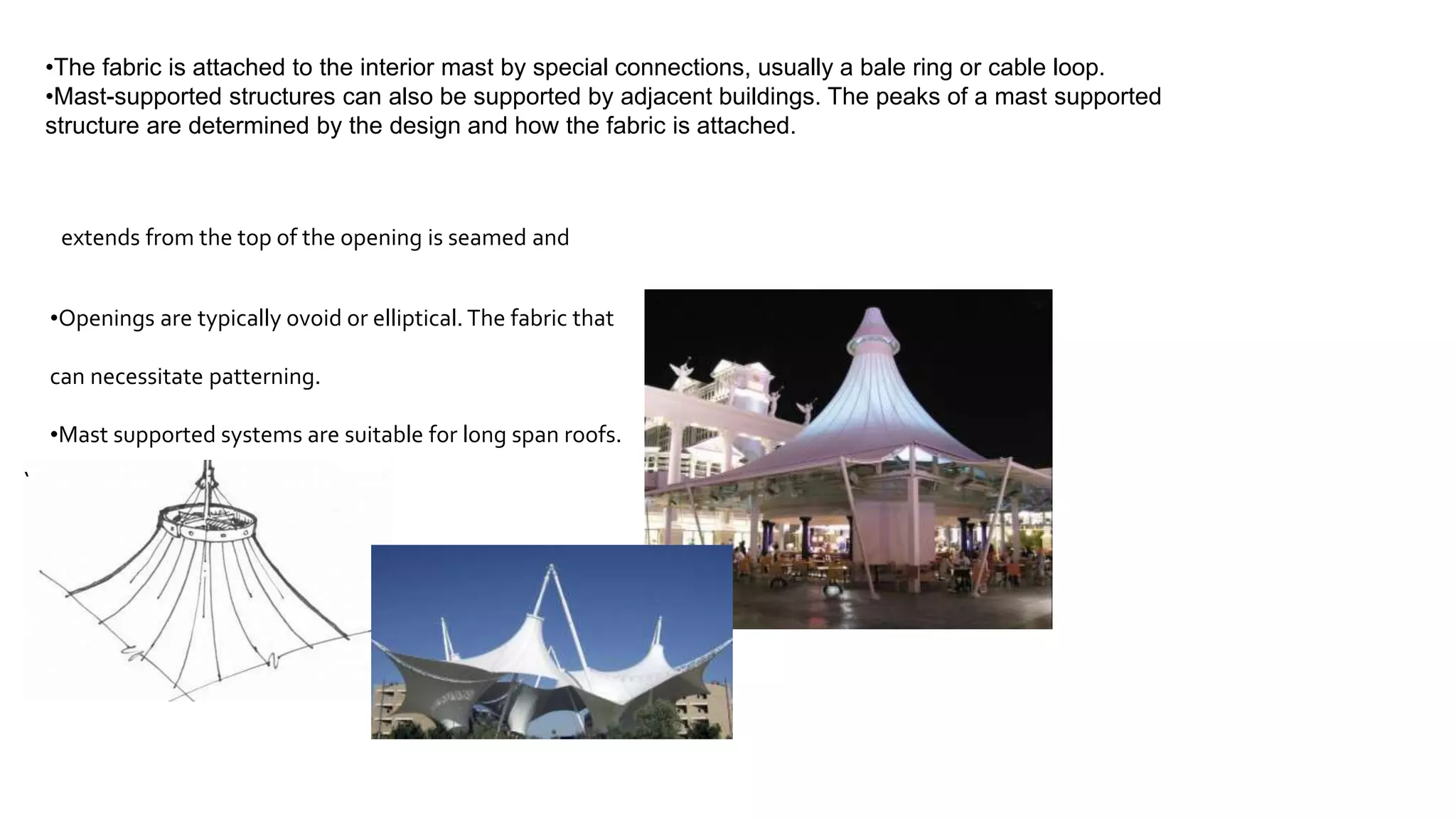
•The fabric isattached to the interior mast by special connections, usually a bale ring or cable loop.
•Mast-supported structures can also be supported by adjacent buildings. The peaks of a mast supported
structure are determined by the design and how the fabric is attached.
•Openings are typically ovoid or elliptical. The fabric that
extends from the top of the opening is seamed and
can necessitate patterning.
•Mast supported systems are suitable for long span roofs.
`
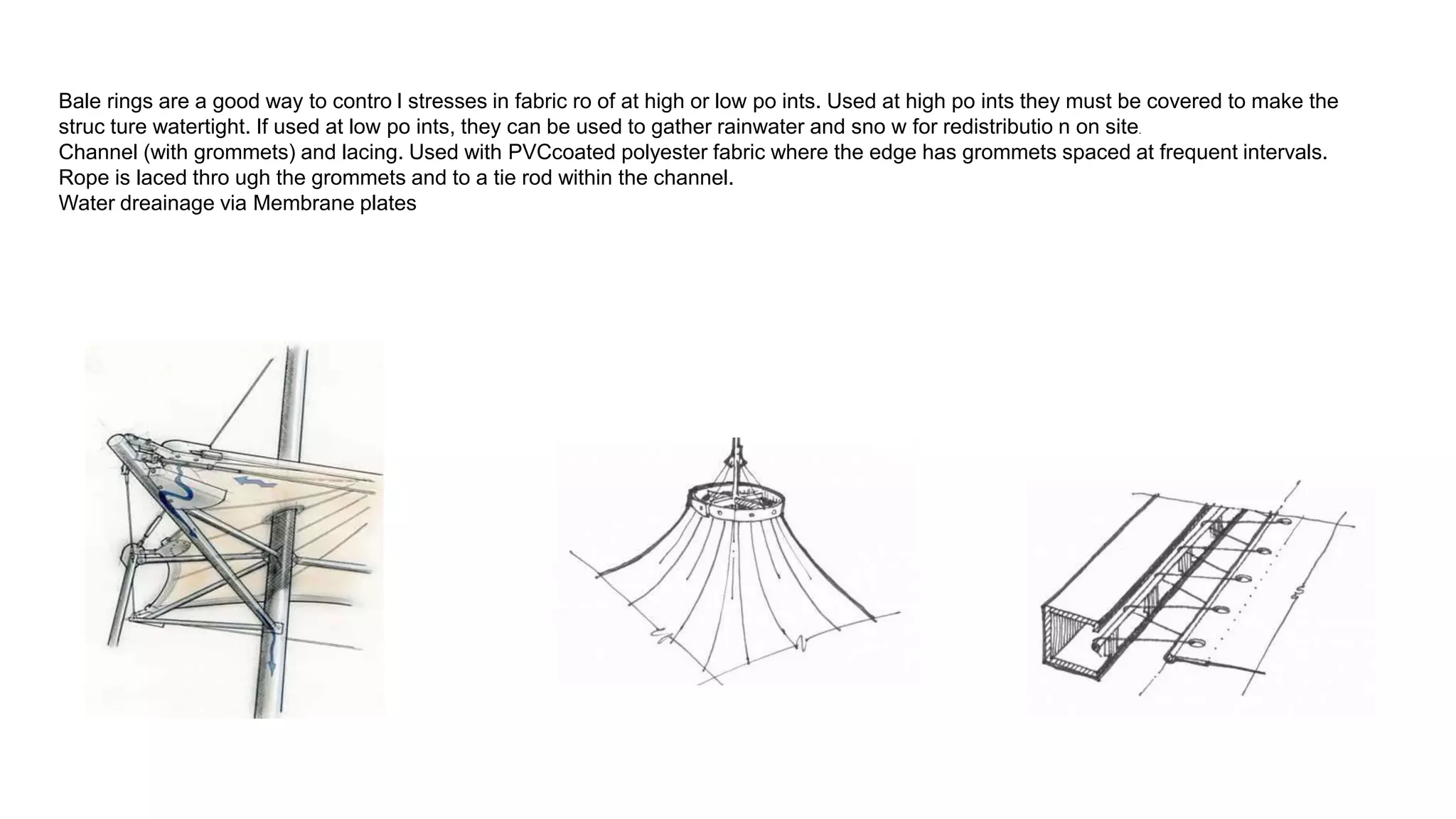
Bale rings area good way to contro l stresses in fabric ro of at high or low po ints. Used at high po ints they must be covered to make the
struc ture watertight. If used at low po ints, they can be used to gather rainwater and sno w for redistributio n on site.
Channel (with grommets) and lacing. Used with PVCcoated polyester fabric where the edge has grommets spaced at frequent intervals.
Rope is laced thro ugh the grommets and to a tie rod within the channel.
Water dreainage via Membrane plates
16.
There are manygreat advantages and functional benefits of tensile membrane structures and here are few
reasons why:
Flexible Design Aesthetics - Tensile membrane structures provide virtually unlimited designs of distinctive
elegant forms that can be realized because of the unique flexible characteristics of membrane resulting in an
iconic and unique structure or feature for any building owner, city or even region.
Outstanding Translucency – In daylight, fabric membrane translucency offers soft diffused naturally lit spaces
reducing the interior lighting costs while at night, artificial lighting creates an ambient exterior luminescence.
Excellent Durability – With several different membranes in the market place such as PTFE fiberglass, ETFE
film, PVC, and ePTFE, the durability and longevity of tensile membrane structures have been proven.
Lightweight Nature - The lightweight nature of membrane is a cost effective solution that requires less
structural steel to support the roof compared to conventional building materials, enabling long spans of
column-free space.
17.
Low Maintenance –Tensile membrane systems are somewhat unique in that they require minimal
maintenance when compared to an equivalent-sized conventional building.
Cost Benefits – Most tensile membrane structures have high sun reflectivity and low absorption of
sunlight, thus resulting in less energy used within a building and ultimately reducing electrical energy
costs.
Types of structures:
•Stayed
•Suspended
• Anticlastic
• Pneumatic
•Trussed
18.
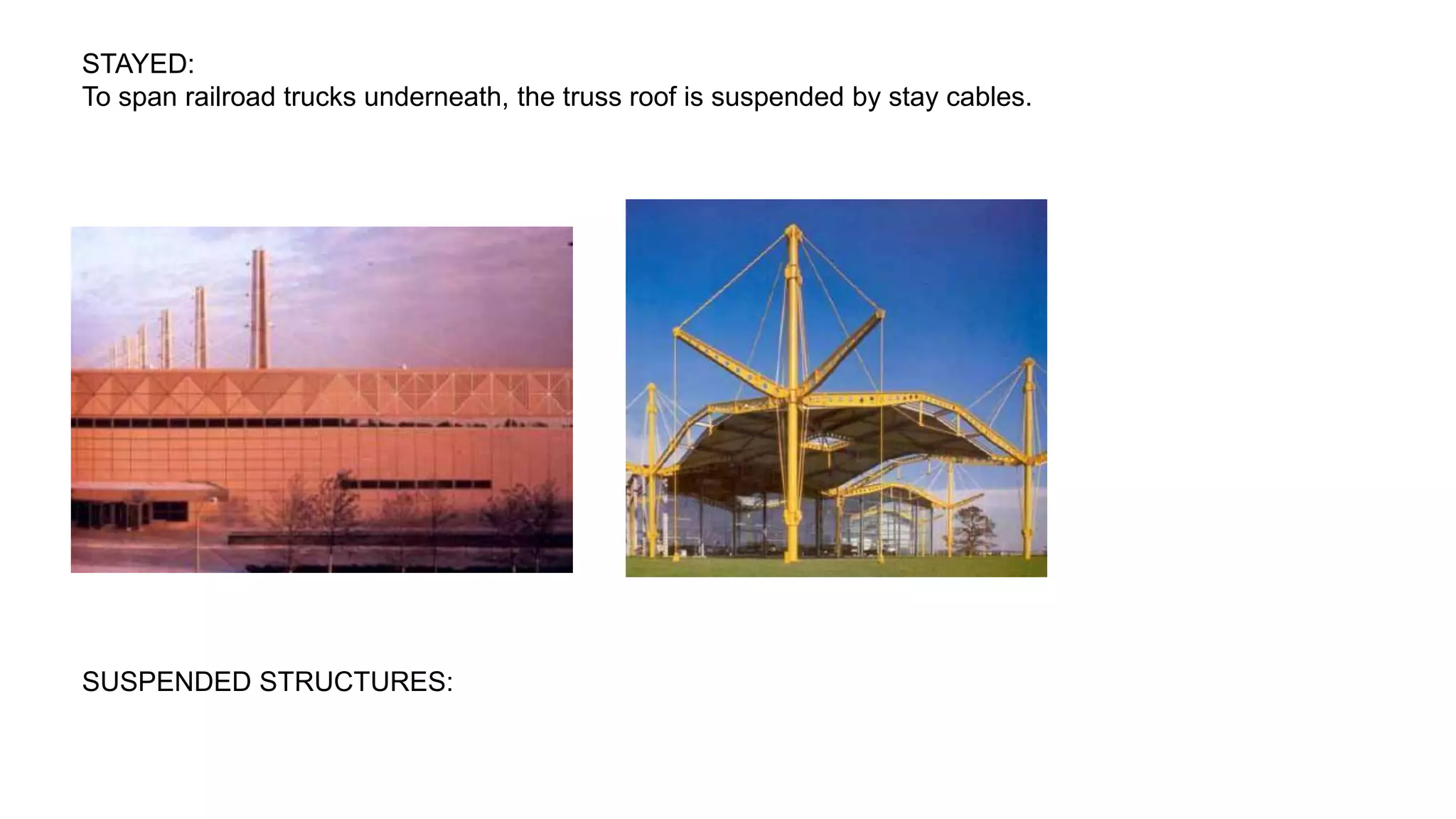
STAYED:
To span railroadtrucks underneath, the truss roof is suspended by stay cables.
SUSPENDED STRUCTURES:
DISADVANTAGES :
•NO RIGIDITY.
•LOSSOF TENSION IS
DANGEROUS FOR STABILITY.
ADVANTAGES FABRIC TENSILE STRUCTURE
One of the main advantages of fabric structure is that you can install it rapidly and easily.
Tension fabric buildings provide abundant daytime lighting that is bright and natural, the interior of a fabric structure is an
inviting environment that people, plants and animals thrive in.
Fabric buildings are Acoustics exceptional; no sounds of pelting rain.
Fabric buildings have Low cost per square foot, Initial investment is low.
Fabric buildings are self cleaning; never needs painting; dust, dirt, pollutants wash off with Water no rotting parts to
replace.
Fabric structures are durable, corrosion resistance. salt, fertilizer and other corrosive materials have virtually no effect on
polyethylene fabric.
Flexibility, when a large clearspan building with tall overhead clearances is needed, a fabric structure is an
economical solution.