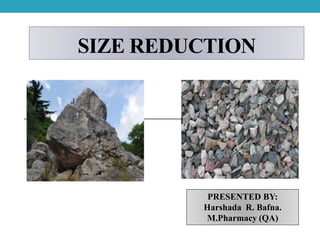
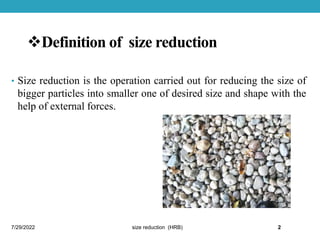
SIZE REDUCTION
PRESENTED BY:
Harshada R. Bafna.
M.Pharmacy (QA)
Definition of size reduction
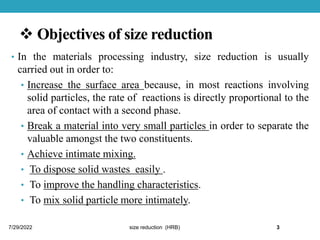
• Size reduction is the operation carried out for reducing the size of
bigger particles into smaller one of desired size and shape with the
help of external forces.
7/29/2022 size reduction (HRB)
2
2
2
 Objectives of size reduction
• In the materials processing industry, size reduction is usually
carried out in order to:
• Increase the surface area because, in most reactions involving
solid particles, the rate of reactions is directly proportional to the
area of contact with a second phase.
• Break a material into very small particles in order to separate the
valuable amongst the two constituents.
• Achieve intimate mixing.
• To dispose solid wastes easily .
• To improve the handling characteristics.
• To mix solid particle more intimately.
7/29/2022 size reduction (HRB) 3
Advantages of size reduction
• Content uniformity
• Uniform flow
• Effective drying
• Increases surface area or viscosity
• Uniform mixing and drying
• Improve rate of absorption . Smaller the particles greater is
absorption.
• Improve dissolution rate.
7/29/2022 size reduction (HRB) 4
Disadvantages of size reduction
• Drug degradation
• Contamination
7/29/2022
size reduction (HRB) 5
Factors affecting size reduction
• Hardness.
• Toughness.
• Stickiness.
• Material structure.
• Moisture content.
• Softening temperature.
• Purity required.
• Physiological effect.
• Ratio of feed size to product size.
• Bulk density.
7/29/2022 size reduction (HRB) 6
Mechanism of size reduction
1. Cutting .
2. Impact - Particle concussion by a single rigid force .
3. Compression- Particle disintegration by two rigid forces .
4. Attrition - Arising from particles scraping against one another
or against a rigid surface .
5. Combined impact and attrition .
7/29/2022 size reduction (HRB)
7
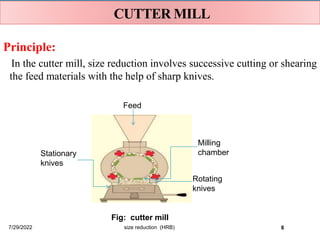
CUTTER MILL
Principle:
In the cutter mill, size reduction involves successive cutting or shearing
the feed materials with the help of sharp knives.
7/29/2022 size reduction (HRB) 8
Feed
Milling
chamber
Stationary
knives
Rotating
knives
Fig: cutter mill
Uses:
 Size reduction of tough and fibrous material.
 Ex. Medicinal plant, plant parts and animal tissue.
 It also used in manufacture of rubber, plastics, recycling of paper
waste and plastic material.
7/29/2022 size reduction (HRB) 9
Working:
 Rotor disc rotate at 200-900 revolution per min.
 Feed material loaded through hopper.
 Material is cut between rotating & stationary knives in small
pieces, therefore particle pass through the screen product is collected
into receiver.
ROLLER MILL
Principle:
The material is crushed (compressed) by the application of
stress. The stress is applied by rotator wheels, rollers.
7/29/2022 size reduction (HRB) 10
Fig: Roller mill.
Feed
Hopper
Rollers
10
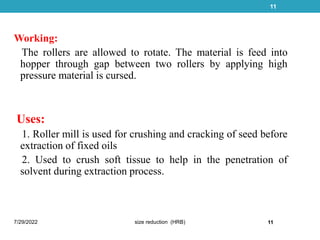
Working:
The rollers are allowed to rotate. The material is feed into
hopper through gap between two rollers by applying high
pressure material is cursed.
Uses:
1. Roller mill is used for crushing and cracking of seed before
extraction of fixed oils
2. Used to crush soft tissue to help in the penetration of
solvent during extraction process.
7/29/2022 size reduction (HRB) 11
11
HAMMER MILL
Principle:
The hammer mill operates on the principle of impact between
rapidly moving hammer mounted on a rotor and the powder
material.
7/29/2022 size reduction (HRB)
Fig: Hammer mill 12
12
Working: The hammers are allowed to be in continuous motion(8000-
15000 rpm) the feed material is placed into the hopper, whiles hammers
are in continuous motion.
Uses:
 Particle size obtained from 10-400mm.
 Also used to mill dry, wet and filter press cakes materials.
Advantage:
 Easy to setup and clean up.
 Occupies small space.
Disadvantage:
 Heat buildup during milling is more , therefore, product
degradation is possible.
 Not suitable for milling of soft, tacky and fibrous materials.
7/29/2022 size reduction (HRB) 13
13
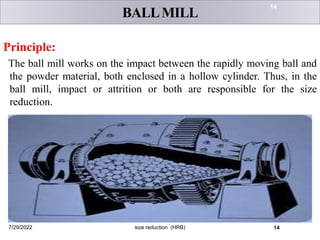
BALLMILL
Principle:
The ball mill works on the impact between the rapidly moving ball and
the powder material, both enclosed in a hollow cylinder. Thus, in the
ball mill, impact or attrition or both are responsible for the size
reduction.
Fig: Ball mill
7/29/2022 size reduction (HRB) 14
14
Working:
The drug is filled into cylinder 60% of the volume.
A fixed number of ball introduced and cylinder is close.
Uses:
Fine grinding with a particle size of 100-5 mm or less
can be obtained.
7/29/2022
size reduction (HRB)
15
15
 Very fine powder produce.
 Suitable for both wet and dry grinding processes.
 Close system, sterility can be achieved.
Disadvantage:
 Very noisy machine.
 Not suitable for milling of soft, tacky and fibrous materials.
7/29/2022 size reduction (HRB)
Advantage:
16
16
Fluid Energy Mill
Principle:
Fluid energy mill operates on the principle of impact and attrition the
feed stock is suspended with in a high velocity air stream.
7/29/2022 size reduction (HRB)
Fig: Fluid energy mill 17
17
Working:
Powder is introduced through the inlet of venture. Air introduce through
the grinding nozzles transport the powder in the circular track of the
mill. The turbulent air stream break the particles colloids with each
other and break. Particles are carried out to outlet and the coarse
particle undergo recirculation.
Uses:
 Fluid energy mill is used to reduce the particle size(10-325mesh) of
most of the drugs such as antibiotics and vitamins.
 Ultrafine grinding can be achieved moderately hard material can be
processed for size reduction.
7/29/2022 size reduction (HRB) 18
18
Advantages:
Contamination is not possible.
Disadvantage:
Not suitable for milling of soft, tacky and fibrous materials.
7/29/2022 size reduction (HRB) 19
19
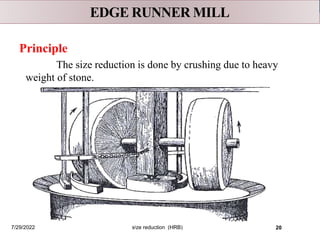
EDGE RUNNER MILL
Principle
The size reduction is done by crushing due to heavy
weight of stone.
7/29/2022 size reduction (HRB) 20
Fig : Edge runner mill
20
Working:
Material to be ground is placed on the bed at the same time travel
around the shallow stone bed so the size reduction is achieved by sharing as
well as crushing.
Uses:
Grinding tough material to fine powder.
Advantages:
Does not require attention during operation.
Disadvantages:
More space than other mill, Contamination, Time consuming, Not use
for sticky materials.
7/29/2022 size reduction (HRB) 21 21
References -
• R. M. Mehta, Pharmaceutics-I 6Th edition,Vallabh Prakashan,
2002, 104-115.
• www.google.com.
22
7/29/2022 size reduction (HRB) 22
23
7/29/2022 size reduction (HRB)

size reduction.pptx

  • 1.
    SIZE REDUCTION PRESENTED BY: HarshadaR. Bafna. M.Pharmacy (QA)
  • 2.
    Definition of sizereduction • Size reduction is the operation carried out for reducing the size of bigger particles into smaller one of desired size and shape with the help of external forces. 7/29/2022 size reduction (HRB) 2 2 2
  • 3.
     Objectives ofsize reduction • In the materials processing industry, size reduction is usually carried out in order to: • Increase the surface area because, in most reactions involving solid particles, the rate of reactions is directly proportional to the area of contact with a second phase. • Break a material into very small particles in order to separate the valuable amongst the two constituents. • Achieve intimate mixing. • To dispose solid wastes easily . • To improve the handling characteristics. • To mix solid particle more intimately. 7/29/2022 size reduction (HRB) 3
  • 4.
    Advantages of sizereduction • Content uniformity • Uniform flow • Effective drying • Increases surface area or viscosity • Uniform mixing and drying • Improve rate of absorption . Smaller the particles greater is absorption. • Improve dissolution rate. 7/29/2022 size reduction (HRB) 4
  • 5.
    Disadvantages of sizereduction • Drug degradation • Contamination 7/29/2022 size reduction (HRB) 5
  • 6.
    Factors affecting sizereduction • Hardness. • Toughness. • Stickiness. • Material structure. • Moisture content. • Softening temperature. • Purity required. • Physiological effect. • Ratio of feed size to product size. • Bulk density. 7/29/2022 size reduction (HRB) 6
  • 7.
    Mechanism of sizereduction 1. Cutting . 2. Impact - Particle concussion by a single rigid force . 3. Compression- Particle disintegration by two rigid forces . 4. Attrition - Arising from particles scraping against one another or against a rigid surface . 5. Combined impact and attrition . 7/29/2022 size reduction (HRB) 7
  • 8.
    CUTTER MILL Principle: In thecutter mill, size reduction involves successive cutting or shearing the feed materials with the help of sharp knives. 7/29/2022 size reduction (HRB) 8 Feed Milling chamber Stationary knives Rotating knives Fig: cutter mill
  • 9.
    Uses:  Size reductionof tough and fibrous material.  Ex. Medicinal plant, plant parts and animal tissue.  It also used in manufacture of rubber, plastics, recycling of paper waste and plastic material. 7/29/2022 size reduction (HRB) 9 Working:  Rotor disc rotate at 200-900 revolution per min.  Feed material loaded through hopper.  Material is cut between rotating & stationary knives in small pieces, therefore particle pass through the screen product is collected into receiver.
  • 10.
    ROLLER MILL Principle: The materialis crushed (compressed) by the application of stress. The stress is applied by rotator wheels, rollers. 7/29/2022 size reduction (HRB) 10 Fig: Roller mill. Feed Hopper Rollers 10
  • 11.
    Working: The rollers areallowed to rotate. The material is feed into hopper through gap between two rollers by applying high pressure material is cursed. Uses: 1. Roller mill is used for crushing and cracking of seed before extraction of fixed oils 2. Used to crush soft tissue to help in the penetration of solvent during extraction process. 7/29/2022 size reduction (HRB) 11 11
  • 12.
    HAMMER MILL Principle: The hammermill operates on the principle of impact between rapidly moving hammer mounted on a rotor and the powder material. 7/29/2022 size reduction (HRB) Fig: Hammer mill 12 12
  • 13.
    Working: The hammersare allowed to be in continuous motion(8000- 15000 rpm) the feed material is placed into the hopper, whiles hammers are in continuous motion. Uses:  Particle size obtained from 10-400mm.  Also used to mill dry, wet and filter press cakes materials. Advantage:  Easy to setup and clean up.  Occupies small space. Disadvantage:  Heat buildup during milling is more , therefore, product degradation is possible.  Not suitable for milling of soft, tacky and fibrous materials. 7/29/2022 size reduction (HRB) 13 13
  • 14.
    BALLMILL Principle: The ball millworks on the impact between the rapidly moving ball and the powder material, both enclosed in a hollow cylinder. Thus, in the ball mill, impact or attrition or both are responsible for the size reduction. Fig: Ball mill 7/29/2022 size reduction (HRB) 14 14
  • 15.
    Working: The drug isfilled into cylinder 60% of the volume. A fixed number of ball introduced and cylinder is close. Uses: Fine grinding with a particle size of 100-5 mm or less can be obtained. 7/29/2022 size reduction (HRB) 15 15
  • 16.
     Very finepowder produce.  Suitable for both wet and dry grinding processes.  Close system, sterility can be achieved. Disadvantage:  Very noisy machine.  Not suitable for milling of soft, tacky and fibrous materials. 7/29/2022 size reduction (HRB) Advantage: 16 16
  • 17.
    Fluid Energy Mill Principle: Fluidenergy mill operates on the principle of impact and attrition the feed stock is suspended with in a high velocity air stream. 7/29/2022 size reduction (HRB) Fig: Fluid energy mill 17 17
  • 18.
    Working: Powder is introducedthrough the inlet of venture. Air introduce through the grinding nozzles transport the powder in the circular track of the mill. The turbulent air stream break the particles colloids with each other and break. Particles are carried out to outlet and the coarse particle undergo recirculation. Uses:  Fluid energy mill is used to reduce the particle size(10-325mesh) of most of the drugs such as antibiotics and vitamins.  Ultrafine grinding can be achieved moderately hard material can be processed for size reduction. 7/29/2022 size reduction (HRB) 18 18
  • 19.
    Advantages: Contamination is notpossible. Disadvantage: Not suitable for milling of soft, tacky and fibrous materials. 7/29/2022 size reduction (HRB) 19 19
  • 20.
    EDGE RUNNER MILL Principle Thesize reduction is done by crushing due to heavy weight of stone. 7/29/2022 size reduction (HRB) 20 Fig : Edge runner mill 20
  • 21.
    Working: Material to beground is placed on the bed at the same time travel around the shallow stone bed so the size reduction is achieved by sharing as well as crushing. Uses: Grinding tough material to fine powder. Advantages: Does not require attention during operation. Disadvantages: More space than other mill, Contamination, Time consuming, Not use for sticky materials. 7/29/2022 size reduction (HRB) 21 21
  • 22.
    References - • R.M. Mehta, Pharmaceutics-I 6Th edition,Vallabh Prakashan, 2002, 104-115. • www.google.com. 22 7/29/2022 size reduction (HRB) 22
  • 23.