Pharmaceutical Engineering
Unit-1
Size Reduction
B.Pharma (2nd year- 3rd Semester)
Prepared by:
Ms. Harshita Singh
Size reduction
● Size reduction or Comminution or pulverization is the process of reducing large
substances into smaller particles.
● For Solid materials, grinding and cutting are used as a size mediation process,
while emulsification or atomization for liquid materials.
● For pharmaceutical purpose, nano size particles are best for use.
Advantages:
1. Effective mixing of uniform size particles.
2. Improves rate of dissolution.
3. For better tablet compression
4. Extraction of active constituent.
5. Effective drying.
Disadvantages:
● Thermolabile substances get decomposed during Size reduction, due to heat
produced during milling.
● Chances of contamination during milling and grinding.
Objective of size reduction:
● Increase surface area.
● Ease of mixing.
● Stability of suspension and emulsion.
● Dosage forms.
● Reduces irritation.
● Increase absorption.
● Appearance.
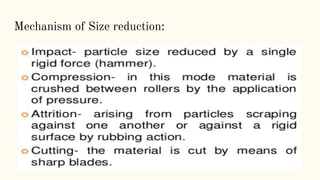
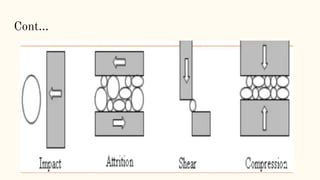
Mechanism of Size reduction:
Cont...
Factors affecting Size Reduction:
1. Hardness: The harder the material the more difficult it is to reduce in size.
2. Toughness: Soft but tough material may present more problems in reducing size
than a hard but brittle substance. Ex: it is difficult to break the rubber than a
blackboard chalk stick.
3. Abrasiveness: Property of hard material. Final product contains 0.1% grinding
mill’s worn metal.
4. Stickiness: Process become difficult as material acts as a lubricants and
decreases the efficiency of grinding surfaces.
5. Softening temperature: Production of heat during process causes some
substances to soften,
6. Slipperiness: Materialacts as lubricant and decreases the efficiency of grinding
surfaces.
Theories of Size Reduction:
1. Kick’s law: Energy required to reduce size of particle is proportional to ratio of initial size of typical dimension to
the final size of that dimension.
Where, E= Energy required per mass of feed
KK= Kick’s constant
d1= avg. initial size of pieces (m)
d2= avg. size of ground particles (m)
Application: Gives reasonably good results for coarse grinding
(Small increase in size)
d1/d2= Size reduction ratio
2.Rittinger’s Law:
3. Bond’s Law:
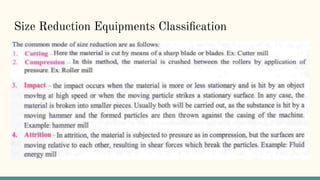
Size Reduction Equipments Classification
1. Fluid Energy Mill:
Cont...
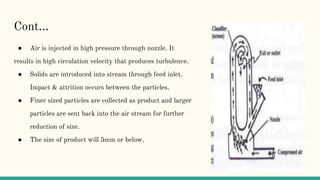
● Air is injected in high pressure through nozzle. It
results in high circulation velocity that produces turbulence.
● Solids are introduced into stream through feed inlet.
Impact & attrition occurs between the particles.
● Finer sized particles are collected as product and larger
particles are sent back into the air stream for further
reduction of size.
● The size of product will 5mm or below.
Cont...
Advantages: Suitable for thermoliable substance because no heat is produced.
● Particle size is smaller when compared to other methods.
● No contamination of product.
Disadvantages: Not suitable for soft & fibrous materials and expensive process.
Application: This method is used where fine powders are required like micronization
of griseofulvin (antifungal drugs), antibiotics, etc.
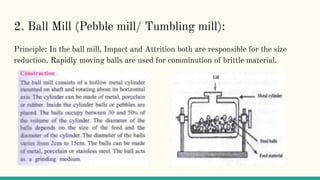
2. Ball Mill (Pebble mill/ Tumbling mill):
Principle: In the ball mill, Impact and Attrition both are responsible for the size
reduction. Rapidly moving balls are used for comminution of brittle material.
Working:
1. 60% of the vol. Is filled with material to be grounded.
2. Fixed number of balls are placed in the cylinder and then cylinder is closed.
3. Mill is allowed to rotate. Speed of rotation is important point of consideration.
4. Max. size reduction is obtained by impact of the particles between the balls and
by the attrition between the balls.
5. It is usually 0.5 cycles per second (cps)
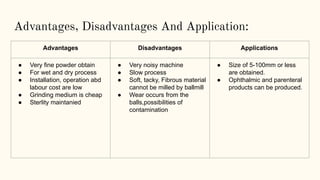
Advantages, Disadvantages And Application:
Advantages Disadvantages Applications
● Very fine powder obtain
● For wet and dry process
● Installation, operation abd
labour cost are low
● Grinding medium is cheap
● Sterlity maintanied
● Very noisy machine
● Slow process
● Soft, tacky, Fibrous material
cannot be milled by ballmill
● Wear occurs from the
balls,possibilities of
contamination
● Size of 5-100mm or less
are obtained.
● Ophthalmic and parenteral
products can be produced.
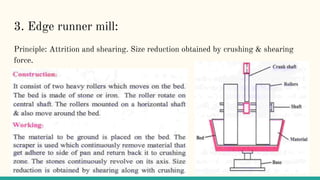
3. Edge runner mill:
Principle: Attrition and shearing. Size reduction obtained by crushing & shearing
force.
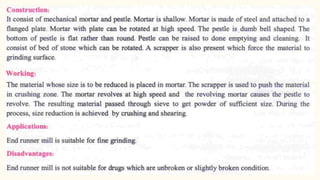
4. End Runner mill:
5.Hammer Mill:
Principle: Impact.
Construction: Consist of housing frame, enclosing a central
shaft with 4 of more hammers are attached.
● Hammer are made of stainless steel. The lower part of
casing consist of screen through which materials can pass
after size reduction.
● Unit is enclosed in chamber.
Working: Feed material is transferred through hopper.
Continuous motion of hammer at 8000 to 15000 revolutions per
minute.
● Material breaks down into smaller pieces and then passes
through the screen.
Size Reduction.pdf
Size Reduction.pdf

Size Reduction.pdf

  • 1.
    Pharmaceutical Engineering Unit-1 Size Reduction B.Pharma(2nd year- 3rd Semester) Prepared by: Ms. Harshita Singh
  • 2.
    Size reduction ● Sizereduction or Comminution or pulverization is the process of reducing large substances into smaller particles. ● For Solid materials, grinding and cutting are used as a size mediation process, while emulsification or atomization for liquid materials. ● For pharmaceutical purpose, nano size particles are best for use. Advantages: 1. Effective mixing of uniform size particles. 2. Improves rate of dissolution. 3. For better tablet compression 4. Extraction of active constituent. 5. Effective drying.
  • 3.
    Disadvantages: ● Thermolabile substancesget decomposed during Size reduction, due to heat produced during milling. ● Chances of contamination during milling and grinding. Objective of size reduction: ● Increase surface area. ● Ease of mixing. ● Stability of suspension and emulsion. ● Dosage forms. ● Reduces irritation. ● Increase absorption. ● Appearance.
  • 4.
  • 5.
  • 6.
    Factors affecting SizeReduction: 1. Hardness: The harder the material the more difficult it is to reduce in size. 2. Toughness: Soft but tough material may present more problems in reducing size than a hard but brittle substance. Ex: it is difficult to break the rubber than a blackboard chalk stick. 3. Abrasiveness: Property of hard material. Final product contains 0.1% grinding mill’s worn metal. 4. Stickiness: Process become difficult as material acts as a lubricants and decreases the efficiency of grinding surfaces. 5. Softening temperature: Production of heat during process causes some substances to soften, 6. Slipperiness: Materialacts as lubricant and decreases the efficiency of grinding surfaces.
  • 7.
    Theories of SizeReduction: 1. Kick’s law: Energy required to reduce size of particle is proportional to ratio of initial size of typical dimension to the final size of that dimension. Where, E= Energy required per mass of feed KK= Kick’s constant d1= avg. initial size of pieces (m) d2= avg. size of ground particles (m) Application: Gives reasonably good results for coarse grinding (Small increase in size) d1/d2= Size reduction ratio
  • 8.
  • 9.
  • 10.
  • 11.
  • 12.
    Cont... ● Air isinjected in high pressure through nozzle. It results in high circulation velocity that produces turbulence. ● Solids are introduced into stream through feed inlet. Impact & attrition occurs between the particles. ● Finer sized particles are collected as product and larger particles are sent back into the air stream for further reduction of size. ● The size of product will 5mm or below.
  • 13.
    Cont... Advantages: Suitable forthermoliable substance because no heat is produced. ● Particle size is smaller when compared to other methods. ● No contamination of product. Disadvantages: Not suitable for soft & fibrous materials and expensive process. Application: This method is used where fine powders are required like micronization of griseofulvin (antifungal drugs), antibiotics, etc.
  • 14.
    2. Ball Mill(Pebble mill/ Tumbling mill): Principle: In the ball mill, Impact and Attrition both are responsible for the size reduction. Rapidly moving balls are used for comminution of brittle material.
  • 15.
    Working: 1. 60% ofthe vol. Is filled with material to be grounded. 2. Fixed number of balls are placed in the cylinder and then cylinder is closed. 3. Mill is allowed to rotate. Speed of rotation is important point of consideration. 4. Max. size reduction is obtained by impact of the particles between the balls and by the attrition between the balls. 5. It is usually 0.5 cycles per second (cps)
  • 16.
    Advantages, Disadvantages AndApplication: Advantages Disadvantages Applications ● Very fine powder obtain ● For wet and dry process ● Installation, operation abd labour cost are low ● Grinding medium is cheap ● Sterlity maintanied ● Very noisy machine ● Slow process ● Soft, tacky, Fibrous material cannot be milled by ballmill ● Wear occurs from the balls,possibilities of contamination ● Size of 5-100mm or less are obtained. ● Ophthalmic and parenteral products can be produced.
  • 17.
    3. Edge runnermill: Principle: Attrition and shearing. Size reduction obtained by crushing & shearing force.
  • 19.
  • 21.
    5.Hammer Mill: Principle: Impact. Construction:Consist of housing frame, enclosing a central shaft with 4 of more hammers are attached. ● Hammer are made of stainless steel. The lower part of casing consist of screen through which materials can pass after size reduction. ● Unit is enclosed in chamber. Working: Feed material is transferred through hopper. Continuous motion of hammer at 8000 to 15000 revolutions per minute. ● Material breaks down into smaller pieces and then passes through the screen.