PHARM-47011_Pharmaceutical Engineering-ll
Compiled By: Abdul Aziz_P221019_B.Pharm_IIUC
MILLING/SIZE REDUCTION
Size reduction is a process of reducing large-solid-units masses
(vegetables/chemical substances) into small-unit-masses.
i.e Coarse particle/fine particles
> Pharmaceutical powder are Polydisperse(consisting particles of different sizes)
> its also termed as ---- Comminution/Diminution/Pulverisation
Milling when the particle size of solids is reduced by mechanical means its called
milling.
Process of Size-reduction
1. Precipitation method : the substances is dissolved in an Solvent – and
its finely ppt by another solvent – then causing it reduced size.
Eg. • Production of raw materials and bulk drugs
• inorganic chemicals like -- CaCO3, MgCO3, Yellow Hg-oxide
2. Mechanical method : the substances is subjected to mechanical forces
(grinding, cutting, compression, impact and attrition) to reduce particle
size.
Eg. • Dry grinding/ milling is used for tablet production
• Wet grinding used for preparation of suspension, emulsion,
ointments.
Objectives of Size reduction
1. Increase the surface area bcz, is most reactions involving solid particles, the
rate of reactions is directly proportional to the area of contact with the
second phase.
2. Break the material into very small particles in order to separate the
constituents.
3. Achieve intimate mixing.
4. To dispose solid wastes easily.
5. To mix the solid particles more intimately.
PHARM-47011_Pharmaceutical Engineering-ll
Compiled By: Abdul Aziz_P221019_B.Pharm_IIUC
Advantages
• Content uniformity: Smaller and uniform particle size in a mixture of
ingredients ensures better distribution and consistent dosage in
pharmaceutical formulations.
• Uniform flow: Smaller particle size and controlled size distribution
promote consistent powder flow into dies during capsule compression.
• Effective extraction of drugs: Smaller particles facilitate faster and more
complete extraction of medicinal components from plant or animal
tissues.
• Effective drying: Granular masses with small and uniform particle sizes
dry more quickly and evenly.
• Powder fineness: Normally, fine powders are preferred for compound
powders and tinctures, while moderately coarse powders are used for
preparing tinctures, and coarse powders are used in percolation
processes.
• Improved physical stability: Finer particles in suspensions and
emulsions lead to less sedimentation.
• Improved dissolution rate: Smaller particle size increases surface area,
enhancing contact with body fluids and improving drug absorption.
• Improved bioavailability: Faster dissolution often leads to quicker and
more complete drug absorption.
• Improved uniformity: Smaller particles allow for more consistent mixing
and dosage.
Disadvantages of Size Reduction:
• Drug degradation: Heat generated during milling can decompose heat-
sensitive drugs. Increased surface area also makes drugs more
susceptible to degradation.
• Poor mixing: Very small particles can aggregate due to cohesive forces,
hindering effective blending with other ingredients.
• Contamination: Grinding equipment can shed particles, contaminating
the drug product.
• Changes in Drug form: Size reduction can alter the physical and chemical
form of the drug, potentially impacting the stability and performance.
• Issues with flowability: in some cases, size reduction can negatively
affect flowability, making it difficult to handle and process the material.
• Agglomeration: Very small particles can agglomerate due to static charge
, reducing dissolution rates.
PHARM-47011_Pharmaceutical Engineering-ll
Compiled By: Abdul Aziz_P221019_B.Pharm_IIUC
Mechanism Of Size Reduction
••• Mechanism of size reduction vary with the nature of the material. Each drug
may require a separate treatment.
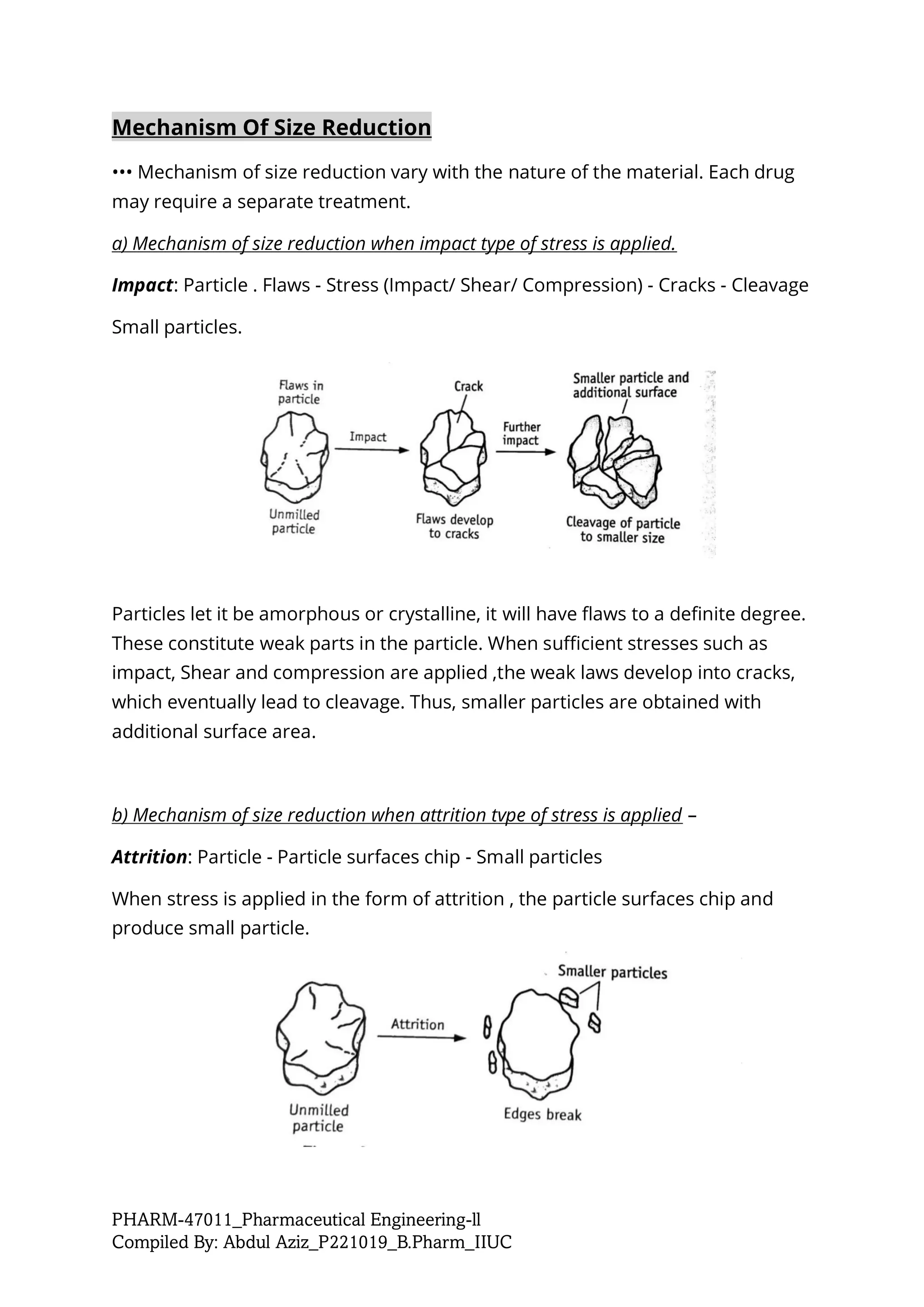
a) Mechanism of size reduction when impact type of stress is applied.
Impact: Particle . Flaws - Stress (Impact/ Shear/ Compression) - Cracks - Cleavage
Small particles.
Particles let it be amorphous or crystalline, it will have flaws to a definite degree.
These constitute weak parts in the particle. When sufficient stresses such as
impact, Shear and compression are applied ,the weak laws develop into cracks,
which eventually lead to cleavage. Thus, smaller particles are obtained with
additional surface area.
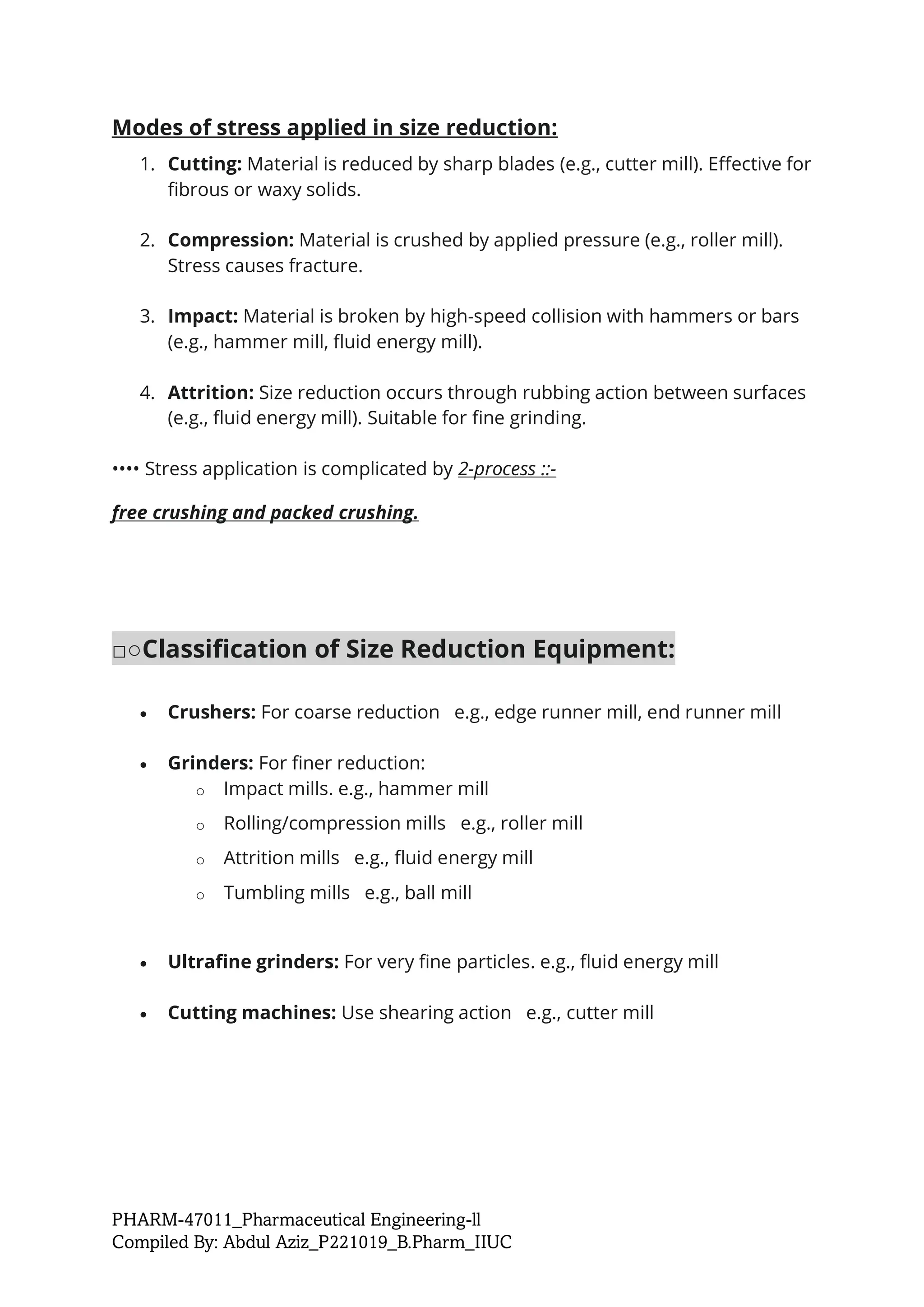
b) Mechanism of size reduction when attrition tvpe of stress is applied –
Attrition: Particle - Particle surfaces chip - Small particles
When stress is applied in the form of attrition , the particle surfaces chip and
produce small particle.
PHARM-47011_Pharmaceutical Engineering-ll
Compiled By: Abdul Aziz_P221019_B.Pharm_IIUC
Modes of stress applied in size reduction:
1. Cutting: Material is reduced by sharp blades (e.g., cutter mill). Effective for
fibrous or waxy solids.
2. Compression: Material is crushed by applied pressure (e.g., roller mill).
Stress causes fracture.
3. Impact: Material is broken by high-speed collision with hammers or bars
(e.g., hammer mill, fluid energy mill).
4. Attrition: Size reduction occurs through rubbing action between surfaces
(e.g., fluid energy mill). Suitable for fine grinding.
•••• Stress application is complicated by 2-process ::-
free crushing and packed crushing.
□○Classification of Size Reduction Equipment:
• Crushers: For coarse reduction e.g., edge runner mill, end runner mill
• Grinders: For finer reduction:
o Impact mills. e.g., hammer mill
o Rolling/compression mills e.g., roller mill
o Attrition mills e.g., fluid energy mill
o Tumbling mills e.g., ball mill
• Ultrafine grinders: For very fine particles. e.g., fluid energy mill
• Cutting machines: Use shearing action e.g., cutter mill
PHARM-47011_Pharmaceutical Engineering-ll
Compiled By: Abdul Aziz_P221019_B.Pharm_IIUC
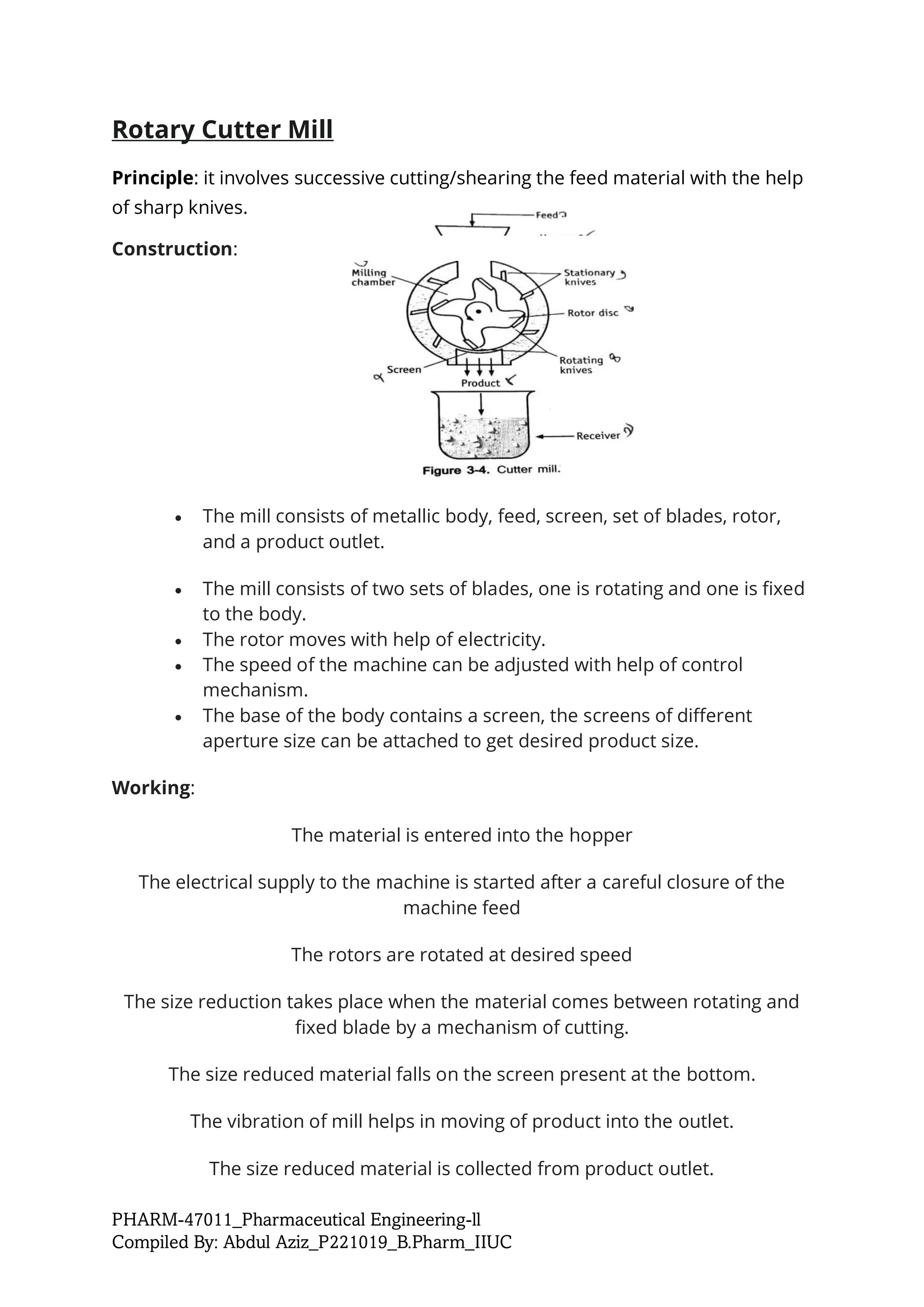
Rotary Cutter Mill
Principle: it involves successive cutting/shearing the feed material with the help
of sharp knives.
Construction:
• The mill consists of metallic body, feed, screen, set of blades, rotor,
and a product outlet.
• The mill consists of two sets of blades, one is rotating and one is fixed
to the body.
• The rotor moves with help of electricity.
• The speed of the machine can be adjusted with help of control
mechanism.
• The base of the body contains a screen, the screens of different
aperture size can be attached to get desired product size.
Working:
The material is entered into the hopper
The electrical supply to the machine is started after a careful closure of the
machine feed
The rotors are rotated at desired speed
The size reduction takes place when the material comes between rotating and
fixed blade by a mechanism of cutting.
The size reduced material falls on the screen present at the bottom.
The vibration of mill helps in moving of product into the outlet.
The size reduced material is collected from product outlet.
PHARM-47011_Pharmaceutical Engineering-ll
Compiled By: Abdul Aziz_P221019_B.Pharm_IIUC
Advantages:
• Suitable for drugs of plant origin.
• Application of screen ensures the product of desired size range.
Disadvantages:
• Not suitable for sticky products.
• Produces heat hence not suitable for thermolabile substances.
Applications:
• For size reduction of crude drugs of plant origin.
Roller Mill:
Principle: Material is crushed (compressed) by rotating heavy wheels or rollers.
Stress is applied by rotating heavy feed.
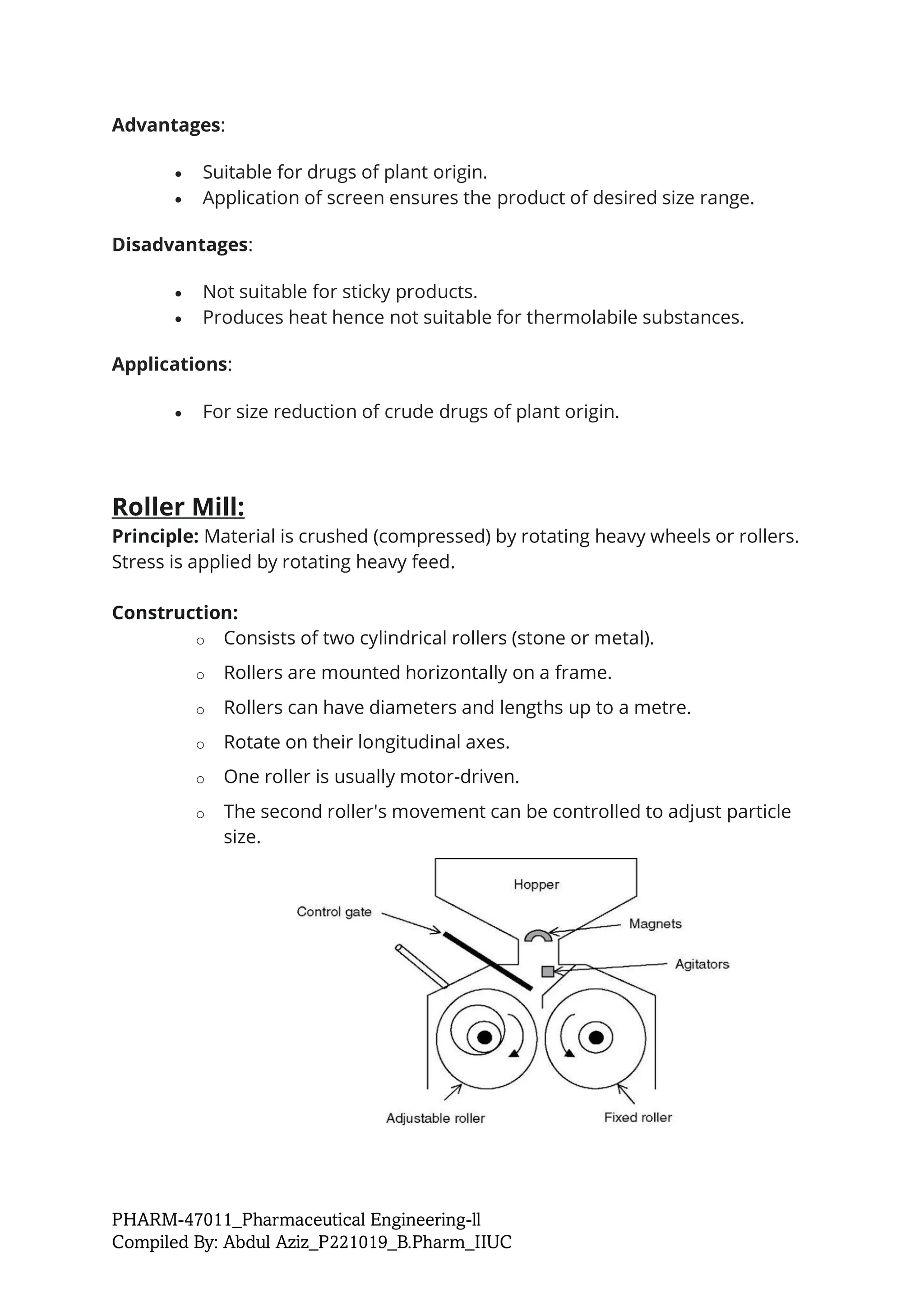
Construction:
o Consists of two cylindrical rollers (stone or metal).
o Rollers are mounted horizontally on a frame.
o Rollers can have diameters and lengths up to a metre.
o Rotate on their longitudinal axes.
o One roller is usually motor-driven.
o The second roller's movement can be controlled to adjust particle
size.
PHARM-47011_Pharmaceutical Engineering-ll
Compiled By: Abdul Aziz_P221019_B.Pharm_IIUC
Working:
Rollers are allowed to rotate.
Material is fed from the hopper into the gap between the two rollers.
Material is crushed while passing through the rollers under high
pressure.
The gap (clearance) between rollers is adjustable to control size
reduction.
Processed product is collected in a receiver.
Uses:
o Crushing and cracking seeds before oil extraction.
o Crushing soft tissue to aid solvent penetration during extraction.
Hammer Mill:
Principle: it Operates on the principle of impact between rapidly moving
hammers mounted on a rotor and the powder material.
Construction:
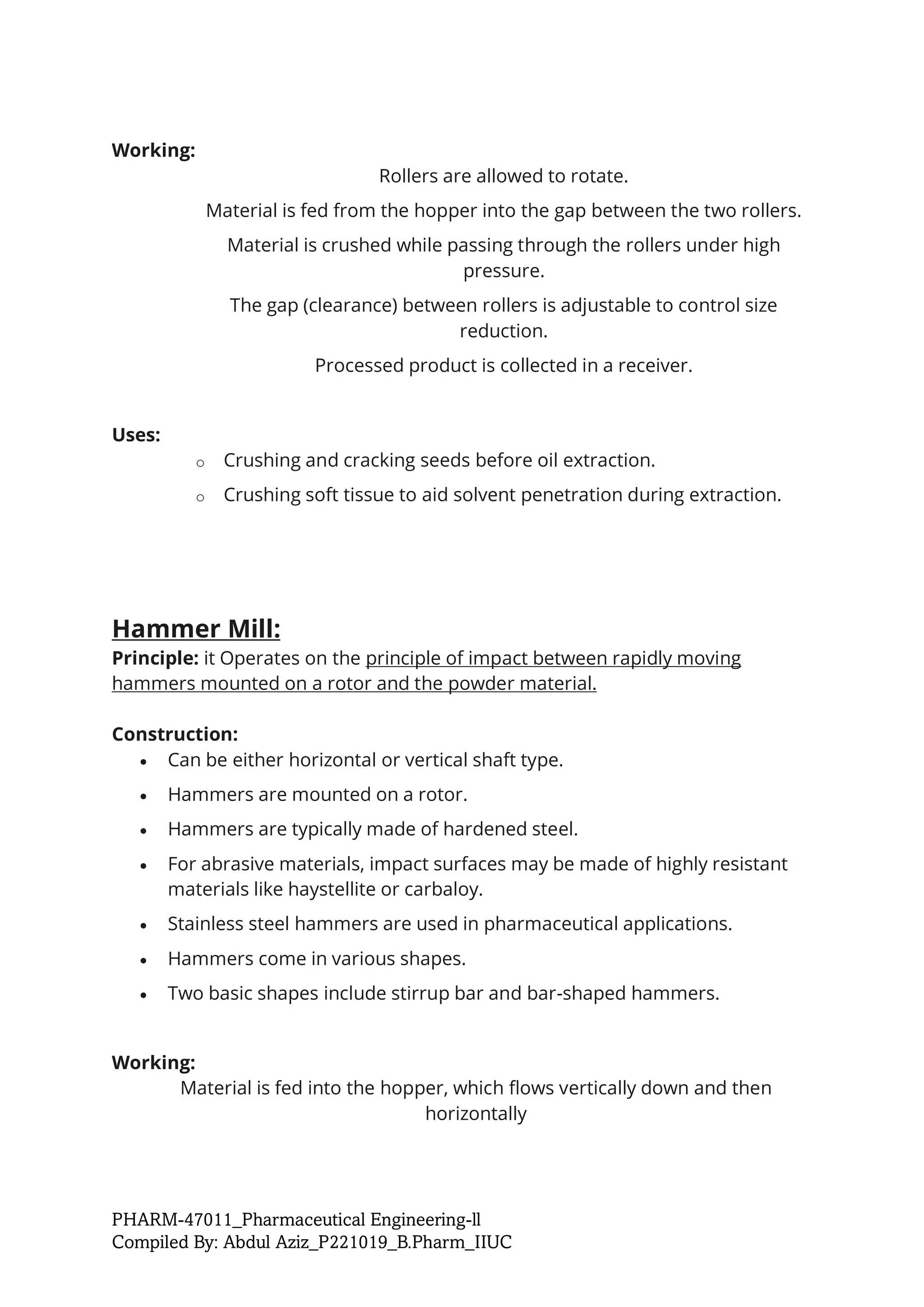
• Can be either horizontal or vertical shaft type.
• Hammers are mounted on a rotor.
• Hammers are typically made of hardened steel.
• For abrasive materials, impact surfaces may be made of highly resistant
materials like haystellite or carbaloy.
• Stainless steel hammers are used in pharmaceutical applications.
• Hammers come in various shapes.
• Two basic shapes include stirrup bar and bar-shaped hammers.
Working:
Material is fed into the hopper, which flows vertically down and then
horizontally
PHARM-47011_Pharmaceutical Engineering-ll
Compiled By: Abdul Aziz_P221019_B.Pharm_IIUC
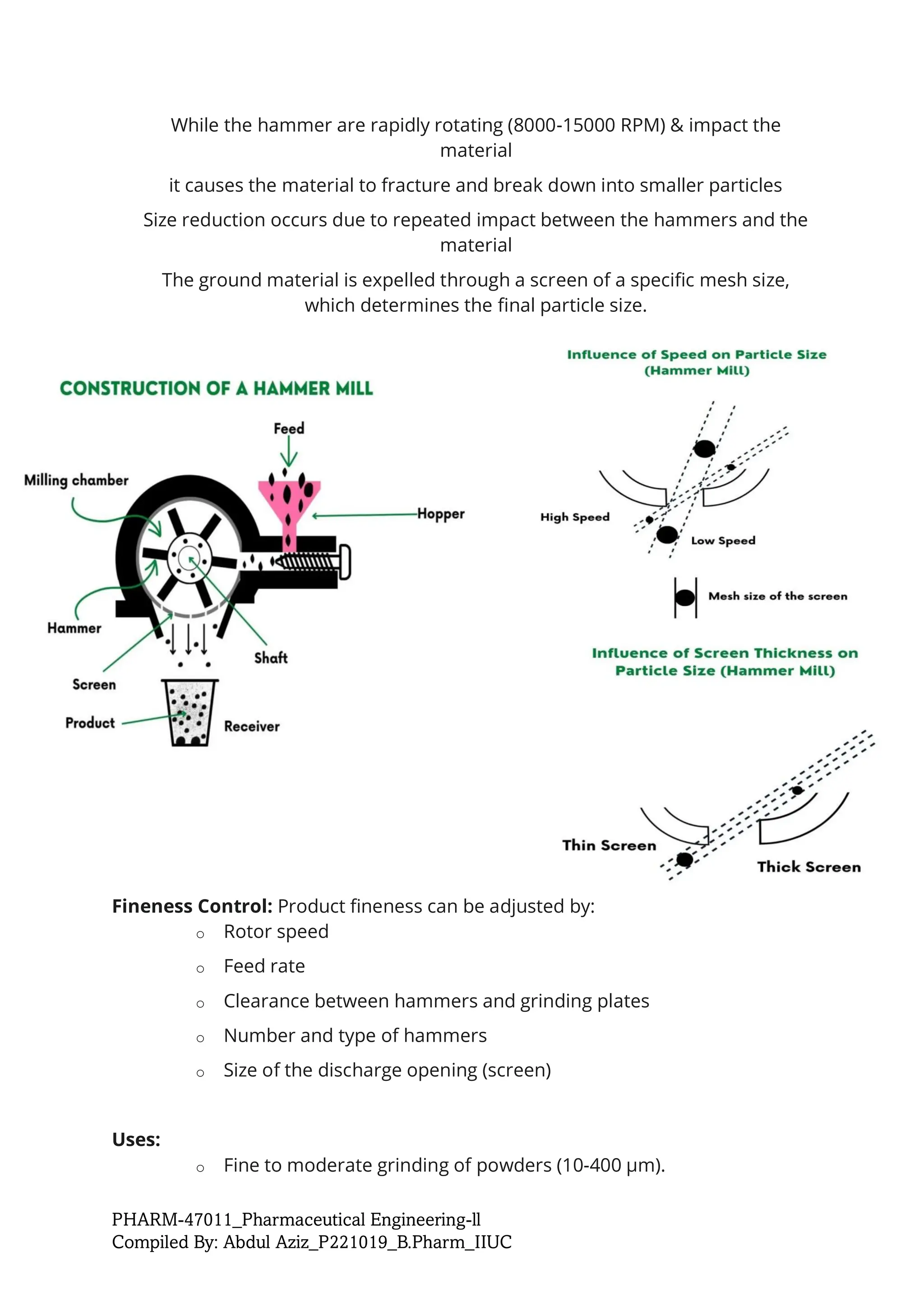
While the hammer are rapidly rotating (8000-15000 RPM) & impact the
material
it causes the material to fracture and break down into smaller particles
Size reduction occurs due to repeated impact between the hammers and the
material
The ground material is expelled through a screen of a specific mesh size,
which determines the final particle size.
Fineness Control: Product fineness can be adjusted by:
o Rotor speed
o Feed rate
o Clearance between hammers and grinding plates
o Number and type of hammers
o Size of the discharge opening (screen)
Uses:
o Fine to moderate grinding of powders (10-400 µm).
PHARM-47011_Pharmaceutical Engineering-ll
Compiled By: Abdul Aziz_P221019_B.Pharm_IIUC
o Good for brittle materials (fractured by impact).
o Used to mill dry materials, filter press cakes, ointments, slurries,
etc.
Advantages:
o Easy to set up, dismantle, and clean.
o Scale-up problems are minimal.
o Can handle various feed stock sizes with different screens.
o Occupies small space.
o Versatile; speed and screen can be changed quickly.
o Operation in a closed environment reduces dust and explosion
hazards.
Disadvantages:
o Screens may get clogged.
o Heat build-up during milling can cause product degradation.
o Wear of mill and screen is more with abrasive materials.
o Not suitable for sticky, fibrous, and hard materials.
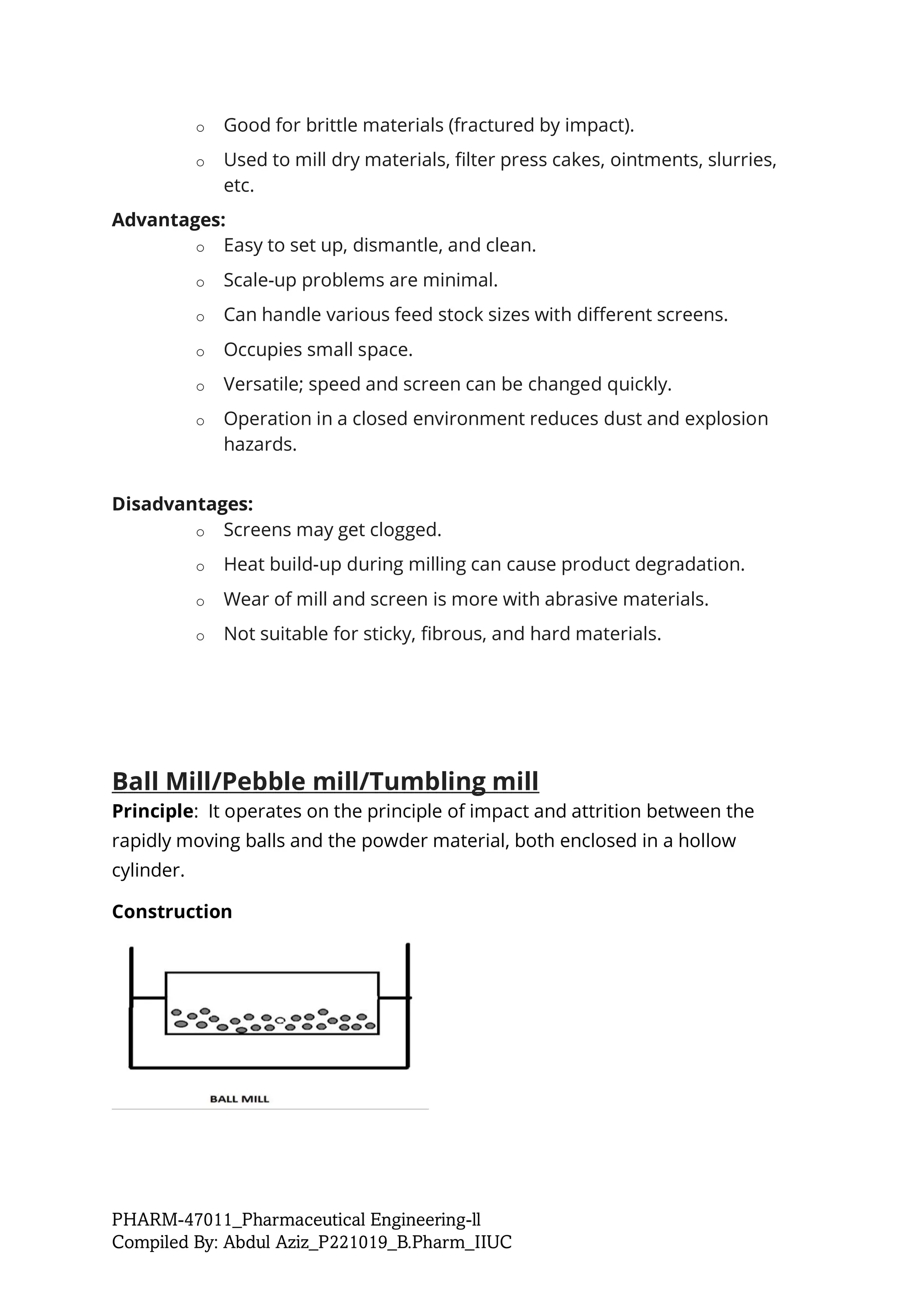
Ball Mill/Pebble mill/Tumbling mill
Principle: It operates on the principle of impact and attrition between the
rapidly moving balls and the powder material, both enclosed in a hollow
cylinder.
Construction
PHARM-47011_Pharmaceutical Engineering-ll
Compiled By: Abdul Aziz_P221019_B.Pharm_IIUC
• The mill consist of a hollow cylinder fixed on metallic frame in such a
way that it can rotate around its horizontal axis.
• The cylinder contains metallic balls occupying around 30 to 50% of
total capacity.
• The balls are usually made up of rubber, porcelain or metal.
• The metallic balls are coated with chrome.
• The weight of balls is kept constant and size of balls depends upon
the size of feed and mill.
Working:
The material to be size reduced is entered into the machine through
a hopper.
The electrical supply to the machine is started after a careful closure of
the machine feed.
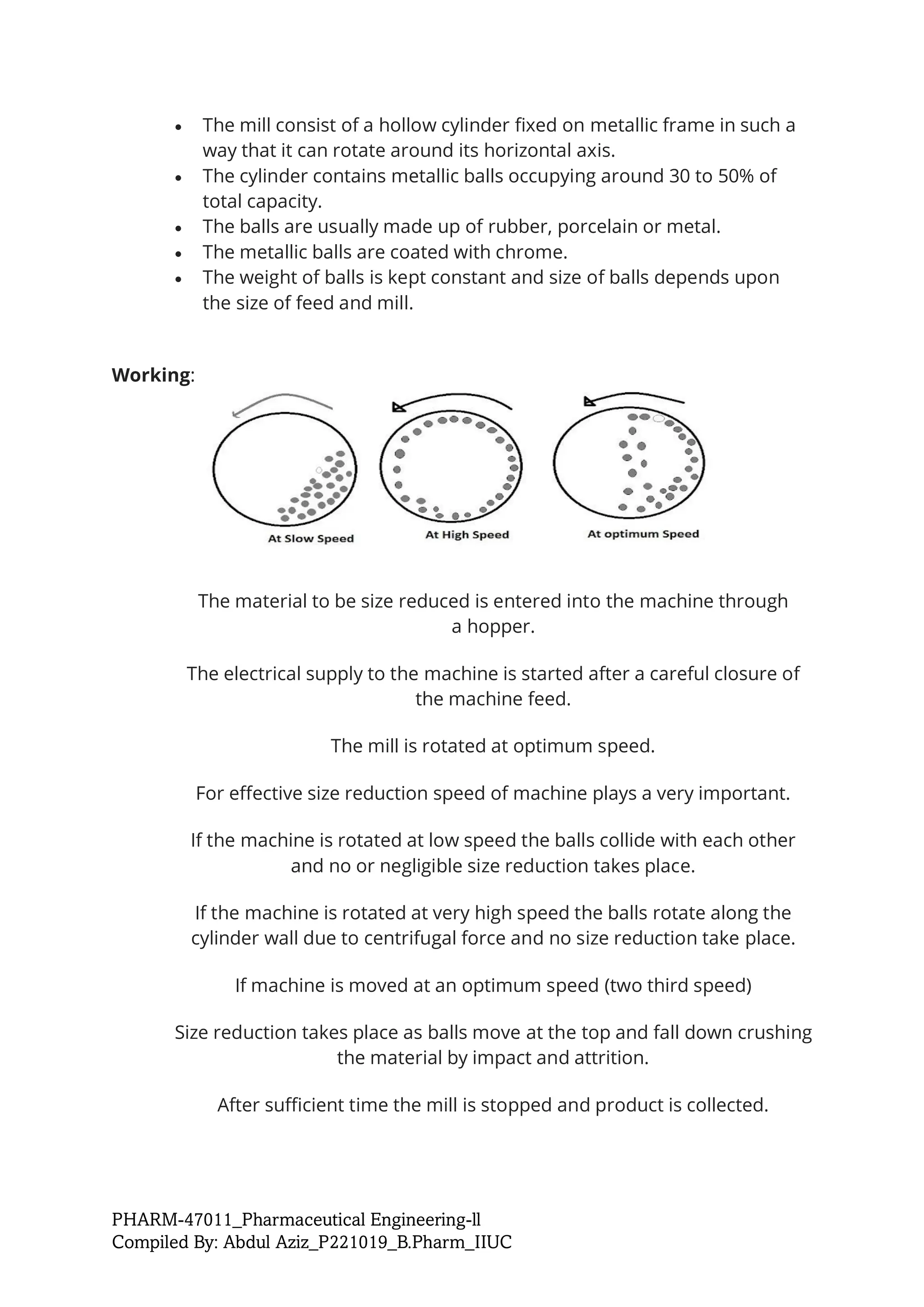
The mill is rotated at optimum speed.
For effective size reduction speed of machine plays a very important.
If the machine is rotated at low speed the balls collide with each other
and no or negligible size reduction takes place.
If the machine is rotated at very high speed the balls rotate along the
cylinder wall due to centrifugal force and no size reduction take place.
If machine is moved at an optimum speed (two third speed)
Size reduction takes place as balls move at the top and fall down crushing
the material by impact and attrition.
After sufficient time the mill is stopped and product is collected.
PHARM-47011_Pharmaceutical Engineering-ll
Compiled By: Abdul Aziz_P221019_B.Pharm_IIUC
Advantages:
• One of the most efficient mills can produce very fine powders.
• Suitable for both wet and dry grinding.
• As operation takes place in a closed environment the mill is useful for
potent materials.
• The mill after some modifications is useful for continuous operation.
Disadvantages:
• Not suitable for sticky products.
• Very noisy.
• Balls and casing material may wear off and can compromise
the purity of product.
Applications:
• Useful for a variety of materials to produce fine powders.
Fluid Energy Mill /Jet Mill/ Micronizer/Ultrafine Grinders
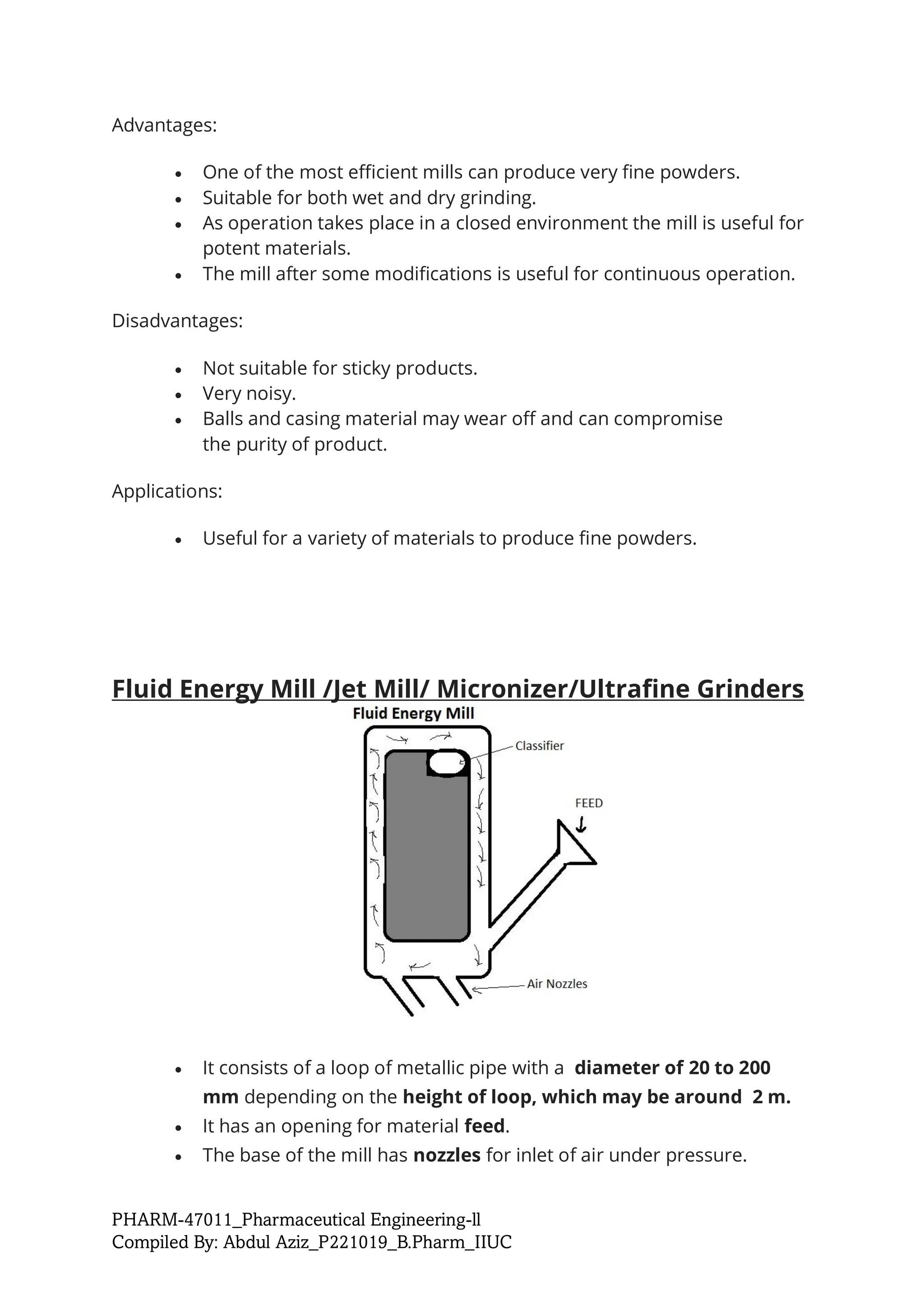
• It consists of a loop of metallic pipe with a diameter of 20 to 200
mm depending on the height of loop, which may be around 2 m.
• It has an opening for material feed.
• The base of the mill has nozzles for inlet of air under pressure.
PHARM-47011_Pharmaceutical Engineering-ll
Compiled By: Abdul Aziz_P221019_B.Pharm_IIUC
• The mill at the top has an opening with a classifier which acts as a
product outlet.
• Most of the time the outlet is connected with Cyclone Separator for
size separation of particles.
Working:
The material to be size reduced is entered in the machine through
the feed.
The nozzles at base introduce the air under pressure at high velocity
which pushes the particles towards the wall.
The material moves in an elliptical path creating turbulence.
The size reduction takes place due to the impact of particles on the wall
and inter-particulate friction.
The smaller particles are carried away with air at the top while the larger
particles due to centrifugal force are throw at the bottom and again get
thrown away till becomes small in size.
Other inert gasses can be used as per requirement of material.
The expanding and moving of air also cools down the heat generated by
the mill.
The particles of desired size range get separated by classifier while others
continue their journey with air flow.
Fluid energy mill is considered as one of the most efficient mills as it can
produce particles up to 1 to 20-micron size.
Advantages:
• Produces very fine particles.
• Useful for heat sensitive materials.
• Classifier provides desired size product.
• Continuous operation is possible.
• No wear and tear: no contamination.
• Verity of size is available as per the need of industry.
PHARM-47011_Pharmaceutical Engineering-ll
Compiled By: Abdul Aziz_P221019_B.Pharm_IIUC
Disadvantages:
• Not suitable for sticky products.
Applications:
• To produce very fine particle at a large scale.
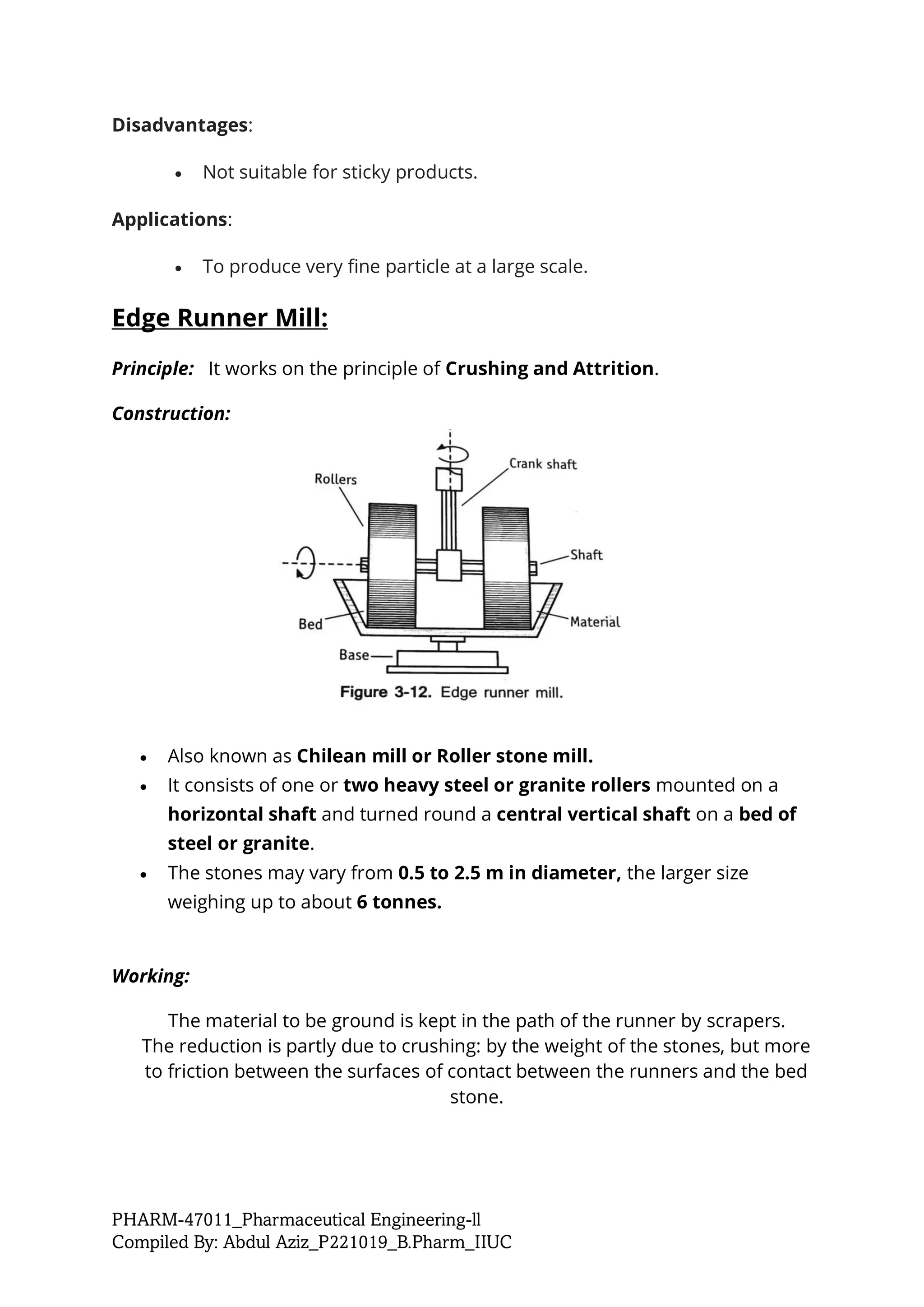
Edge Runner Mill:
Principle: It works on the principle of Crushing and Attrition.
Construction:
• Also known as Chilean mill or Roller stone mill.
• It consists of one or two heavy steel or granite rollers mounted on a
horizontal shaft and turned round a central vertical shaft on a bed of
steel or granite.
• The stones may vary from 0.5 to 2.5 m in diameter, the larger size
weighing up to about 6 tonnes.
Working:
The material to be ground is kept in the path of the runner by scrapers.
The reduction is partly due to crushing: by the weight of the stones, but more
to friction between the surfaces of contact between the runners and the bed
stone.
PHARM-47011_Pharmaceutical Engineering-ll
Compiled By: Abdul Aziz_P221019_B.Pharm_IIUC
Application:
• Edge runner mills are gradually being replaced by more sophisticated
machines.
• Used particularly for reducing extremely tough and fibrous materials –
roots and barks to the form of powder.
Selection of a MILL
••• detailed breakdown of factors to consider:
1. Nature of the Raw Material:
Abrasiveness:
Consider how abrasive the material is, which can affect the type of grinding
media and mill design.
Hardness:
A hard material may require a more robust mill and potentially a higher
speed of grinding.
Elasticity/Brittle:
Elastic materials might need a different approach to milling than brittle ones.
Heat Sensitivity:
Some materials can be damaged by heat during milling, so the mill should be
designed to minimize heat generation or cooling measures should be
implemented.
Moisture Content:
The presence of moisture can affect the milling process and may require a
wet grinding method.
Particle Size Distribution:
The desired particle size range will influence the selection of mill type and
grinding media.
PHARM-47011_Pharmaceutical Engineering-ll
Compiled By: Abdul Aziz_P221019_B.Pharm_IIUC
2.Grinding Media:
• The type of grinding media (e.g., balls, beads, hammers) will affect the
efficiency and final particle size.
• The size and shape of the grinding media also influence the grinding
process.
3.Mill Type:
Grinding Mills:
Various types of mills exist, including ball mills, hammer mills, pin mills, and
turbo mills, each with different characteristics and applications.
Machining Mills:
Consider factors like the size of the workpiece, the type of material, and the
desired accuracy when selecting a machining mill (e.g., CNC mill).
4.Capacity: The capacity of the mill should be sufficient to handle the required
throughput.
5.Other Considerations:
Chemical and Physical Requirements:
Ensure the mill can meet the specific chemical and physical requirements for
the final product.
Safety:
Properly guarded rotating parts and access interlocks are crucial for safety.
Cleaning:
Consider the ease of cleaning for mills that require frequent product
changes.
PHARM-47011_Pharmaceutical Engineering-ll
Compiled By: Abdul Aziz_P221019_B.Pharm_IIUC

Milling/Size reduction_Pharmaceutical Engineering-ll.pdf

  • 1.
    PHARM-47011_Pharmaceutical Engineering-ll Compiled By:Abdul Aziz_P221019_B.Pharm_IIUC MILLING/SIZE REDUCTION Size reduction is a process of reducing large-solid-units masses (vegetables/chemical substances) into small-unit-masses. i.e Coarse particle/fine particles > Pharmaceutical powder are Polydisperse(consisting particles of different sizes) > its also termed as ---- Comminution/Diminution/Pulverisation Milling when the particle size of solids is reduced by mechanical means its called milling. Process of Size-reduction 1. Precipitation method : the substances is dissolved in an Solvent – and its finely ppt by another solvent – then causing it reduced size. Eg. • Production of raw materials and bulk drugs • inorganic chemicals like -- CaCO3, MgCO3, Yellow Hg-oxide 2. Mechanical method : the substances is subjected to mechanical forces (grinding, cutting, compression, impact and attrition) to reduce particle size. Eg. • Dry grinding/ milling is used for tablet production • Wet grinding used for preparation of suspension, emulsion, ointments. Objectives of Size reduction 1. Increase the surface area bcz, is most reactions involving solid particles, the rate of reactions is directly proportional to the area of contact with the second phase. 2. Break the material into very small particles in order to separate the constituents. 3. Achieve intimate mixing. 4. To dispose solid wastes easily. 5. To mix the solid particles more intimately.
  • 2.
    PHARM-47011_Pharmaceutical Engineering-ll Compiled By:Abdul Aziz_P221019_B.Pharm_IIUC Advantages • Content uniformity: Smaller and uniform particle size in a mixture of ingredients ensures better distribution and consistent dosage in pharmaceutical formulations. • Uniform flow: Smaller particle size and controlled size distribution promote consistent powder flow into dies during capsule compression. • Effective extraction of drugs: Smaller particles facilitate faster and more complete extraction of medicinal components from plant or animal tissues. • Effective drying: Granular masses with small and uniform particle sizes dry more quickly and evenly. • Powder fineness: Normally, fine powders are preferred for compound powders and tinctures, while moderately coarse powders are used for preparing tinctures, and coarse powders are used in percolation processes. • Improved physical stability: Finer particles in suspensions and emulsions lead to less sedimentation. • Improved dissolution rate: Smaller particle size increases surface area, enhancing contact with body fluids and improving drug absorption. • Improved bioavailability: Faster dissolution often leads to quicker and more complete drug absorption. • Improved uniformity: Smaller particles allow for more consistent mixing and dosage. Disadvantages of Size Reduction: • Drug degradation: Heat generated during milling can decompose heat- sensitive drugs. Increased surface area also makes drugs more susceptible to degradation. • Poor mixing: Very small particles can aggregate due to cohesive forces, hindering effective blending with other ingredients. • Contamination: Grinding equipment can shed particles, contaminating the drug product. • Changes in Drug form: Size reduction can alter the physical and chemical form of the drug, potentially impacting the stability and performance. • Issues with flowability: in some cases, size reduction can negatively affect flowability, making it difficult to handle and process the material. • Agglomeration: Very small particles can agglomerate due to static charge , reducing dissolution rates.
  • 3.
    PHARM-47011_Pharmaceutical Engineering-ll Compiled By:Abdul Aziz_P221019_B.Pharm_IIUC Mechanism Of Size Reduction ••• Mechanism of size reduction vary with the nature of the material. Each drug may require a separate treatment. a) Mechanism of size reduction when impact type of stress is applied. Impact: Particle . Flaws - Stress (Impact/ Shear/ Compression) - Cracks - Cleavage Small particles. Particles let it be amorphous or crystalline, it will have flaws to a definite degree. These constitute weak parts in the particle. When sufficient stresses such as impact, Shear and compression are applied ,the weak laws develop into cracks, which eventually lead to cleavage. Thus, smaller particles are obtained with additional surface area. b) Mechanism of size reduction when attrition tvpe of stress is applied – Attrition: Particle - Particle surfaces chip - Small particles When stress is applied in the form of attrition , the particle surfaces chip and produce small particle.
  • 4.
    PHARM-47011_Pharmaceutical Engineering-ll Compiled By:Abdul Aziz_P221019_B.Pharm_IIUC Modes of stress applied in size reduction: 1. Cutting: Material is reduced by sharp blades (e.g., cutter mill). Effective for fibrous or waxy solids. 2. Compression: Material is crushed by applied pressure (e.g., roller mill). Stress causes fracture. 3. Impact: Material is broken by high-speed collision with hammers or bars (e.g., hammer mill, fluid energy mill). 4. Attrition: Size reduction occurs through rubbing action between surfaces (e.g., fluid energy mill). Suitable for fine grinding. •••• Stress application is complicated by 2-process ::- free crushing and packed crushing. □○Classification of Size Reduction Equipment: • Crushers: For coarse reduction e.g., edge runner mill, end runner mill • Grinders: For finer reduction: o Impact mills. e.g., hammer mill o Rolling/compression mills e.g., roller mill o Attrition mills e.g., fluid energy mill o Tumbling mills e.g., ball mill • Ultrafine grinders: For very fine particles. e.g., fluid energy mill • Cutting machines: Use shearing action e.g., cutter mill
  • 5.
    PHARM-47011_Pharmaceutical Engineering-ll Compiled By:Abdul Aziz_P221019_B.Pharm_IIUC Rotary Cutter Mill Principle: it involves successive cutting/shearing the feed material with the help of sharp knives. Construction: • The mill consists of metallic body, feed, screen, set of blades, rotor, and a product outlet. • The mill consists of two sets of blades, one is rotating and one is fixed to the body. • The rotor moves with help of electricity. • The speed of the machine can be adjusted with help of control mechanism. • The base of the body contains a screen, the screens of different aperture size can be attached to get desired product size. Working: The material is entered into the hopper The electrical supply to the machine is started after a careful closure of the machine feed The rotors are rotated at desired speed The size reduction takes place when the material comes between rotating and fixed blade by a mechanism of cutting. The size reduced material falls on the screen present at the bottom. The vibration of mill helps in moving of product into the outlet. The size reduced material is collected from product outlet.
  • 6.
    PHARM-47011_Pharmaceutical Engineering-ll Compiled By:Abdul Aziz_P221019_B.Pharm_IIUC Advantages: • Suitable for drugs of plant origin. • Application of screen ensures the product of desired size range. Disadvantages: • Not suitable for sticky products. • Produces heat hence not suitable for thermolabile substances. Applications: • For size reduction of crude drugs of plant origin. Roller Mill: Principle: Material is crushed (compressed) by rotating heavy wheels or rollers. Stress is applied by rotating heavy feed. Construction: o Consists of two cylindrical rollers (stone or metal). o Rollers are mounted horizontally on a frame. o Rollers can have diameters and lengths up to a metre. o Rotate on their longitudinal axes. o One roller is usually motor-driven. o The second roller's movement can be controlled to adjust particle size.
  • 7.
    PHARM-47011_Pharmaceutical Engineering-ll Compiled By:Abdul Aziz_P221019_B.Pharm_IIUC Working: Rollers are allowed to rotate. Material is fed from the hopper into the gap between the two rollers. Material is crushed while passing through the rollers under high pressure. The gap (clearance) between rollers is adjustable to control size reduction. Processed product is collected in a receiver. Uses: o Crushing and cracking seeds before oil extraction. o Crushing soft tissue to aid solvent penetration during extraction. Hammer Mill: Principle: it Operates on the principle of impact between rapidly moving hammers mounted on a rotor and the powder material. Construction: • Can be either horizontal or vertical shaft type. • Hammers are mounted on a rotor. • Hammers are typically made of hardened steel. • For abrasive materials, impact surfaces may be made of highly resistant materials like haystellite or carbaloy. • Stainless steel hammers are used in pharmaceutical applications. • Hammers come in various shapes. • Two basic shapes include stirrup bar and bar-shaped hammers. Working: Material is fed into the hopper, which flows vertically down and then horizontally
  • 8.
    PHARM-47011_Pharmaceutical Engineering-ll Compiled By:Abdul Aziz_P221019_B.Pharm_IIUC While the hammer are rapidly rotating (8000-15000 RPM) & impact the material it causes the material to fracture and break down into smaller particles Size reduction occurs due to repeated impact between the hammers and the material The ground material is expelled through a screen of a specific mesh size, which determines the final particle size. Fineness Control: Product fineness can be adjusted by: o Rotor speed o Feed rate o Clearance between hammers and grinding plates o Number and type of hammers o Size of the discharge opening (screen) Uses: o Fine to moderate grinding of powders (10-400 µm).
  • 9.
    PHARM-47011_Pharmaceutical Engineering-ll Compiled By:Abdul Aziz_P221019_B.Pharm_IIUC o Good for brittle materials (fractured by impact). o Used to mill dry materials, filter press cakes, ointments, slurries, etc. Advantages: o Easy to set up, dismantle, and clean. o Scale-up problems are minimal. o Can handle various feed stock sizes with different screens. o Occupies small space. o Versatile; speed and screen can be changed quickly. o Operation in a closed environment reduces dust and explosion hazards. Disadvantages: o Screens may get clogged. o Heat build-up during milling can cause product degradation. o Wear of mill and screen is more with abrasive materials. o Not suitable for sticky, fibrous, and hard materials. Ball Mill/Pebble mill/Tumbling mill Principle: It operates on the principle of impact and attrition between the rapidly moving balls and the powder material, both enclosed in a hollow cylinder. Construction
  • 10.
    PHARM-47011_Pharmaceutical Engineering-ll Compiled By:Abdul Aziz_P221019_B.Pharm_IIUC • The mill consist of a hollow cylinder fixed on metallic frame in such a way that it can rotate around its horizontal axis. • The cylinder contains metallic balls occupying around 30 to 50% of total capacity. • The balls are usually made up of rubber, porcelain or metal. • The metallic balls are coated with chrome. • The weight of balls is kept constant and size of balls depends upon the size of feed and mill. Working: The material to be size reduced is entered into the machine through a hopper. The electrical supply to the machine is started after a careful closure of the machine feed. The mill is rotated at optimum speed. For effective size reduction speed of machine plays a very important. If the machine is rotated at low speed the balls collide with each other and no or negligible size reduction takes place. If the machine is rotated at very high speed the balls rotate along the cylinder wall due to centrifugal force and no size reduction take place. If machine is moved at an optimum speed (two third speed) Size reduction takes place as balls move at the top and fall down crushing the material by impact and attrition. After sufficient time the mill is stopped and product is collected.
  • 11.
    PHARM-47011_Pharmaceutical Engineering-ll Compiled By:Abdul Aziz_P221019_B.Pharm_IIUC Advantages: • One of the most efficient mills can produce very fine powders. • Suitable for both wet and dry grinding. • As operation takes place in a closed environment the mill is useful for potent materials. • The mill after some modifications is useful for continuous operation. Disadvantages: • Not suitable for sticky products. • Very noisy. • Balls and casing material may wear off and can compromise the purity of product. Applications: • Useful for a variety of materials to produce fine powders. Fluid Energy Mill /Jet Mill/ Micronizer/Ultrafine Grinders • It consists of a loop of metallic pipe with a diameter of 20 to 200 mm depending on the height of loop, which may be around 2 m. • It has an opening for material feed. • The base of the mill has nozzles for inlet of air under pressure.
  • 12.
    PHARM-47011_Pharmaceutical Engineering-ll Compiled By:Abdul Aziz_P221019_B.Pharm_IIUC • The mill at the top has an opening with a classifier which acts as a product outlet. • Most of the time the outlet is connected with Cyclone Separator for size separation of particles. Working: The material to be size reduced is entered in the machine through the feed. The nozzles at base introduce the air under pressure at high velocity which pushes the particles towards the wall. The material moves in an elliptical path creating turbulence. The size reduction takes place due to the impact of particles on the wall and inter-particulate friction. The smaller particles are carried away with air at the top while the larger particles due to centrifugal force are throw at the bottom and again get thrown away till becomes small in size. Other inert gasses can be used as per requirement of material. The expanding and moving of air also cools down the heat generated by the mill. The particles of desired size range get separated by classifier while others continue their journey with air flow. Fluid energy mill is considered as one of the most efficient mills as it can produce particles up to 1 to 20-micron size. Advantages: • Produces very fine particles. • Useful for heat sensitive materials. • Classifier provides desired size product. • Continuous operation is possible. • No wear and tear: no contamination. • Verity of size is available as per the need of industry.
  • 13.
    PHARM-47011_Pharmaceutical Engineering-ll Compiled By:Abdul Aziz_P221019_B.Pharm_IIUC Disadvantages: • Not suitable for sticky products. Applications: • To produce very fine particle at a large scale. Edge Runner Mill: Principle: It works on the principle of Crushing and Attrition. Construction: • Also known as Chilean mill or Roller stone mill. • It consists of one or two heavy steel or granite rollers mounted on a horizontal shaft and turned round a central vertical shaft on a bed of steel or granite. • The stones may vary from 0.5 to 2.5 m in diameter, the larger size weighing up to about 6 tonnes. Working: The material to be ground is kept in the path of the runner by scrapers. The reduction is partly due to crushing: by the weight of the stones, but more to friction between the surfaces of contact between the runners and the bed stone.
  • 14.
    PHARM-47011_Pharmaceutical Engineering-ll Compiled By:Abdul Aziz_P221019_B.Pharm_IIUC Application: • Edge runner mills are gradually being replaced by more sophisticated machines. • Used particularly for reducing extremely tough and fibrous materials – roots and barks to the form of powder. Selection of a MILL ••• detailed breakdown of factors to consider: 1. Nature of the Raw Material: Abrasiveness: Consider how abrasive the material is, which can affect the type of grinding media and mill design. Hardness: A hard material may require a more robust mill and potentially a higher speed of grinding. Elasticity/Brittle: Elastic materials might need a different approach to milling than brittle ones. Heat Sensitivity: Some materials can be damaged by heat during milling, so the mill should be designed to minimize heat generation or cooling measures should be implemented. Moisture Content: The presence of moisture can affect the milling process and may require a wet grinding method. Particle Size Distribution: The desired particle size range will influence the selection of mill type and grinding media.
  • 15.
    PHARM-47011_Pharmaceutical Engineering-ll Compiled By:Abdul Aziz_P221019_B.Pharm_IIUC 2.Grinding Media: • The type of grinding media (e.g., balls, beads, hammers) will affect the efficiency and final particle size. • The size and shape of the grinding media also influence the grinding process. 3.Mill Type: Grinding Mills: Various types of mills exist, including ball mills, hammer mills, pin mills, and turbo mills, each with different characteristics and applications. Machining Mills: Consider factors like the size of the workpiece, the type of material, and the desired accuracy when selecting a machining mill (e.g., CNC mill). 4.Capacity: The capacity of the mill should be sufficient to handle the required throughput. 5.Other Considerations: Chemical and Physical Requirements: Ensure the mill can meet the specific chemical and physical requirements for the final product. Safety: Properly guarded rotating parts and access interlocks are crucial for safety. Cleaning: Consider the ease of cleaning for mills that require frequent product changes.
  • 16.