Approach and implementation of single sourcing Group 6: Abhirup Das (09BM8002) Debesh Majumdar (09BM8016) Devdut Saha (09BM8083) Sujeeth Ungratwar (09BM8097)
Contents Sourcing  Single Sourcing Identification of materials Selection criteria for single source Hindrances Characteristics of single source From multiple to single source Risk Benefit Assessment
Sourcing Sole Sourcing Single Sourcing Multiple Sourcing 4 th  point of Deming’s 14 points for management: Single sourcing India: Default Risk
Single Sourcing Advantages Better pricing through higher volumes Better quality through continuous improvements Build stronger and long-term relationship Inventory and Scheduling Disadvantages Price Escalation Default Risk
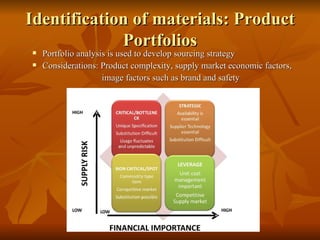
Identification of materials: Product Portfolios Portfolio analysis is used to develop sourcing strategy Considerations: Product complexity, supply market economic factors,  image factors such as brand and safety
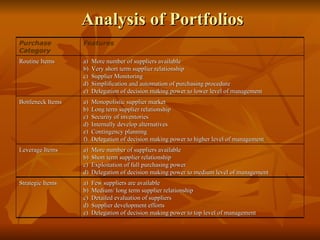
Analysis of Portfolios Purchase Category Features Routine Items More number of suppliers available Very short term supplier relationship Supplier Monitoring  Simplification and automation of purchasing procedure Delegation of decision making power to lower level of management Bottleneck Items Monopolistic supplier market Long term supplier relationship Security of inventories Internally develop alternatives Contingency planning Delegation of decision making power to higher level of management Leverage Items More number of suppliers available Short term supplier relationship Exploitation of full purchasing power Delegation of decision making power to medium level of management Strategic Items Few suppliers are available Medium/ long term supplier relationship Detailed evaluation of suppliers Supplier development efforts Delegation of decision making power to top level of management
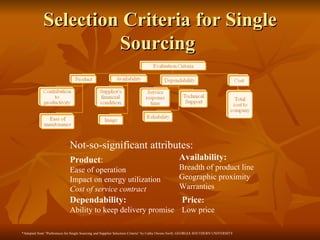
Selection Criteria for Single Sourcing  Not-so-significant attributes: Product : Ease of operation Impact on energy utilization Cost of service contract Availability: Breadth of product line Geographic proximity Warranties Dependability: Ability to keep delivery promise Price : Low price *Adopted from “Preferences for Single Sourcing and Supplier Selection Criteria” by Cathy Owens Swift, GEORGIA SOUTHERN UNIVERSITY
Selection Criteria for Single Sourcing Selection criteria must fulfill objective business decisions  (e.g. leveraged volume purchase contracts, standardization programs/systems, parts/service provided by an "original equipment manufacturer", consistency of quality/batch control, "just in time" delivery requirements etc).  Another objective  can be developing a "co-maker" relationship, or one in which the supplier is considered an upstream extension of the customer's business. Quality aspect(Deming’s 4 th   point): "End the practice of awarding business on price tag alone. Instead, minimize total cost by working with a single supplier.”  Single source selection based purely on personal preference or subjective rationale will not be sanctioned.
Hindrances  May lead to corruption Requires large purchase volume High skill requirement of supplier Long time required for vendor development Total reliance on the supplier. Supplier setbacks can affect the purchaser
Characteristics of single source Motivated & committed Flexibility in production Innovation capabilities Should be capable of taking the manufacturing of other parts Should be able to reduce the cost of production continuously over time
From multiple source to single source Identification of materials to single source Identification of the vendors Present capability Future potential Vendor development Technical competitiveness Support to the vendor Emotional/handholding Information/know how Financial Technical Market
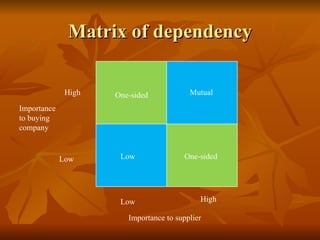
Matrix of dependency Importance to buying company High Low Importance to supplier Low High One-sided Mutual Low One-sided
Risk/Benefit Categories Disruption of supply Price escalation Inventory and scheduling Technology access Quality
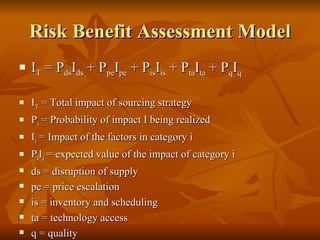
Risk Benefit Assessment Model I T  = P ds I ds  + P pe I pe  + P is I is  + P ta I ta  + P q I q I T  = Total impact of sourcing strategy P i  = Probability of impact I being realized I i  = Impact of the factors in category i P i I i  = expected value of the impact of category i ds = disruption of supply  pe = price escalation is = inventory and scheduling ta = technology access q = quality
References Wilson, Scott and Pyman, “The extent of single sourcing and attendant corruption risk in defense procurement” http://www.purchasing-procurement-center.com/single-source-procurement.html http:// www.defenceagainstcorruption.org /diagnosis/single-source   Constantine Blome, Michael Henke, “Single sourcing vs multiple sourcing” Mark Treleven, Sharon Bergman, “A risk/benefit analysis of sourcing strategies”
Thank You

Single Sourcing

  • 1.
    Approach and implementationof single sourcing Group 6: Abhirup Das (09BM8002) Debesh Majumdar (09BM8016) Devdut Saha (09BM8083) Sujeeth Ungratwar (09BM8097)
  • 2.
    Contents Sourcing Single Sourcing Identification of materials Selection criteria for single source Hindrances Characteristics of single source From multiple to single source Risk Benefit Assessment
  • 3.
    Sourcing Sole SourcingSingle Sourcing Multiple Sourcing 4 th point of Deming’s 14 points for management: Single sourcing India: Default Risk
  • 4.
    Single Sourcing AdvantagesBetter pricing through higher volumes Better quality through continuous improvements Build stronger and long-term relationship Inventory and Scheduling Disadvantages Price Escalation Default Risk
  • 5.
    Identification of materials:Product Portfolios Portfolio analysis is used to develop sourcing strategy Considerations: Product complexity, supply market economic factors, image factors such as brand and safety
  • 6.
    Analysis of PortfoliosPurchase Category Features Routine Items More number of suppliers available Very short term supplier relationship Supplier Monitoring Simplification and automation of purchasing procedure Delegation of decision making power to lower level of management Bottleneck Items Monopolistic supplier market Long term supplier relationship Security of inventories Internally develop alternatives Contingency planning Delegation of decision making power to higher level of management Leverage Items More number of suppliers available Short term supplier relationship Exploitation of full purchasing power Delegation of decision making power to medium level of management Strategic Items Few suppliers are available Medium/ long term supplier relationship Detailed evaluation of suppliers Supplier development efforts Delegation of decision making power to top level of management
  • 7.
    Selection Criteria forSingle Sourcing Not-so-significant attributes: Product : Ease of operation Impact on energy utilization Cost of service contract Availability: Breadth of product line Geographic proximity Warranties Dependability: Ability to keep delivery promise Price : Low price *Adopted from “Preferences for Single Sourcing and Supplier Selection Criteria” by Cathy Owens Swift, GEORGIA SOUTHERN UNIVERSITY
  • 8.
    Selection Criteria forSingle Sourcing Selection criteria must fulfill objective business decisions (e.g. leveraged volume purchase contracts, standardization programs/systems, parts/service provided by an "original equipment manufacturer", consistency of quality/batch control, "just in time" delivery requirements etc). Another objective can be developing a "co-maker" relationship, or one in which the supplier is considered an upstream extension of the customer's business. Quality aspect(Deming’s 4 th point): "End the practice of awarding business on price tag alone. Instead, minimize total cost by working with a single supplier.” Single source selection based purely on personal preference or subjective rationale will not be sanctioned.
  • 9.
    Hindrances Maylead to corruption Requires large purchase volume High skill requirement of supplier Long time required for vendor development Total reliance on the supplier. Supplier setbacks can affect the purchaser
  • 10.
    Characteristics of singlesource Motivated & committed Flexibility in production Innovation capabilities Should be capable of taking the manufacturing of other parts Should be able to reduce the cost of production continuously over time
  • 11.
    From multiple sourceto single source Identification of materials to single source Identification of the vendors Present capability Future potential Vendor development Technical competitiveness Support to the vendor Emotional/handholding Information/know how Financial Technical Market
  • 12.
    Matrix of dependencyImportance to buying company High Low Importance to supplier Low High One-sided Mutual Low One-sided
  • 13.
    Risk/Benefit Categories Disruptionof supply Price escalation Inventory and scheduling Technology access Quality
  • 14.
    Risk Benefit AssessmentModel I T = P ds I ds + P pe I pe + P is I is + P ta I ta + P q I q I T = Total impact of sourcing strategy P i = Probability of impact I being realized I i = Impact of the factors in category i P i I i = expected value of the impact of category i ds = disruption of supply pe = price escalation is = inventory and scheduling ta = technology access q = quality
  • 15.
    References Wilson, Scottand Pyman, “The extent of single sourcing and attendant corruption risk in defense procurement” http://www.purchasing-procurement-center.com/single-source-procurement.html http:// www.defenceagainstcorruption.org /diagnosis/single-source Constantine Blome, Michael Henke, “Single sourcing vs multiple sourcing” Mark Treleven, Sharon Bergman, “A risk/benefit analysis of sourcing strategies”
  • 16.