STRATEGIC SOURCING
A System-wide, Collaborative
Purchasing Process
To develop and implement an effective
system-wide, collaborative purchasing
process designed to maintain or increase
customer satisfaction (by enhancing product
quality and service levels) and significantly
lowering total cost by coordinating and
leveraging common purchases across the
UC system.
MISSION
Strategic Sourcing
Complete Customer Satisfaction.
Continuous Improvement of Internal
Service Levels and Product Quality.
Process Excellence.
 Significant Total Cost Reduction
(5%-15% Target).
Goals
Strategic Sourcing
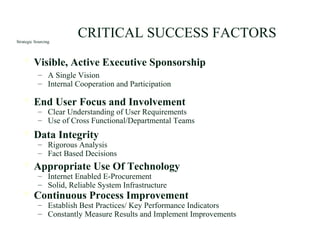
 Visible, Active Executive Sponsorship
– A Single Vision
– Internal Cooperation and Participation
 End User Focus and Involvement
– Clear Understanding of User Requirements
– Use of Cross Functional/Departmental Teams
 Data Integrity
– Rigorous Analysis
– Fact Based Decisions
 Appropriate Use Of Technology
– Internet Enabled E-Procurement
– Solid, Reliable System Infrastructure
 Continuous Process Improvement
– Establish Best Practices/ Key Performance Indicators
– Constantly Measure Results and Implement Improvements
CRITICAL SUCCESS FACTORS
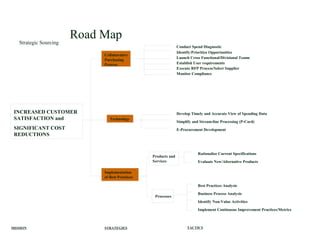
Road Map
INCREASED CUSTOMER
SATISFACTION and
SIGNIFICANT COST
REDUCTIONS
Technology
Implementation
of Best Practices
Identify/Prioritize Opportunities
Establish User requirements
Execute RFP Process/Select Supplier
Develop Timely and Accurate View of Spending Data
Simplify and Stream-line Processing (P-Card)
E-Procurement Development
Strategic Sourcing
Products and
Services
Processes
Rationalize Current Specifications
Evaluate New/Alternative Products
Identify Non-Value Activities
Best Practices Analysis
Business Process Analysis
Implement Continuous Improvement Practices/Metrics
Conduct Spend Diagnostic
Launch Cross Functional/Divisional Teams
MISSION STRATEGIES TACTICS
Monitor Compliance
Collaborative
Purchasing
Process
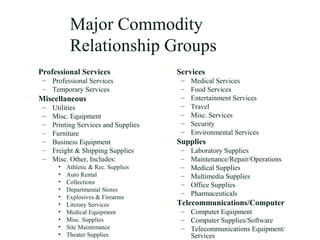
Major Commodity
Relationship Groups
 Professional Services
– Professional Services
– Temporary Services
 Miscellaneous
– Utilities
– Misc. Equipment
– Printing Services and Supplies
– Furniture
– Business Equipment
– Freight & Shipping Supplies
– Misc. Other, Includes:
• Athletic & Rec. Supplies
• Auto Rental
• Collections
• Departmental Stores
• Explosives & Firearms
• Literary Services
• Medical Equipment
• Misc. Supplies
• Site Maintenance
• Theater Supplies
 Services
– Medical Services
– Food Services
– Entertainment Services
– Travel
– Misc. Services
– Security
– Environmental Services
 Supplies
– Laboratory Supplies
– Maintenance/Repair/Operations
– Medical Supplies
– Multimedia Supplies
– Office Supplies
– Pharmaceuticals
 Telecommunications/Computer
– Computer Equipment
– Computer Supplies/Software
– Telecommunications Equipment/
Services
Strategic Global Sourcing
 A business model related decision on thetrade-off between:
 o Full Costs
 o Quality
 o Potential for Commoditisation
 o Lead Time
 o Delivery reliability
 o Product Innovation
 o Capabilities of Supplier
 o Public Security and Safety Risk
 o In-company focus

 Global Sourcing ExcellenceFrom Fringe to Core
 • Sourcing as integral part of the business model
 • Securing Business Buy-In
 • From potential costsavings to monitoring thereal
benefits
 • From low cost to highquality sourcing
 • Managing the SourcingBusiness Processes –
recallmanagement
 • End-User Involvement

Strategic Sourcing
An analytical acquisition approach to
achieve best value through standardization and
leverage that results in significant savings and
fulfillment of socio-economic and
environmental requirements.
Strategic Sourcing --Strategic Sourcing -- thethe collaborativecollaborative andand
structuredstructured process of critically analyzing anprocess of critically analyzing an
organization’s spending and using thisorganization’s spending and using this
informationinformation to make business decisionsto make business decisions
about acquiring commodities and servicesabout acquiring commodities and services
more effectively and efficientlymore effectively and efficiently
Strategic Sourcing is…
A Disciplined Analysis of Purchases, Markets and
Suppliers
To Identify Opportunities for Savings
By Negotiating Contracts and Employing New Tools
and Practices
That Lowers Costs and/or Adds Value
While Maintaining Goods and Services
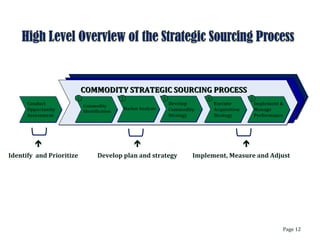
Page 12
Conduct
Opportunity
Assessment
Market Analysis
Develop
Commodity
Strategy
Execute
Acquisition
Strategy
Implement &
Manage
Performance
2 3 4 5
Profile
Commodity
COMMODITY STRATEGIC SOURCING PROCESSCOMMODITY STRATEGIC SOURCING PROCESS
1
Commodity
Identification
Identify and Prioritize Develop plan and strategy Implement, Measure and Adjust
  
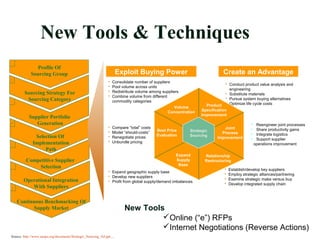
New Tools & Techniques
 Conduct product value analysis and
engineering
 Substitute materials
 Pursue system buying alternatives
 Optimize life cycle costs
• Reengineer joint processes
• Share productivity gains
• Integrate logistics
• Support supplier
operations improvement
 Establish/develop key suppliers
 Employ strategic alliances/partnering
 Examine strategic make versus buy
 Develop integrated supply chain
 Expand geographic supply base
 Develop new suppliers
 Profit from global supply/demand imbalances
 Compare “total” costs
 Model “should-costs”
 Renegotiate prices
 Unbundle pricing
 Consolidate number of suppliers
 Pool volume across units
 Redistribute volume among suppliers
 Combine volume from different
commodity categories
Exploit Buying Power Create an Advantage
Expand
Supply
Base
Best Price
Evaluation
Volume
Concentration
Product
Specification
Improvement
Joint
Process
Improvement
Relationship
Restructuring
Strategic
Sourcing
Profile Of
Sourcing Group
Sourcing Strategy For
Sourcing Category
Supplier Portfolio
Generation
Competitive Supplier
Selection
Operational Integration
With Suppliers
Continuous Benchmarking Of
Supply Market
Selection Of
Implementation
Path
4
1
2
3
5
6
7
Online (“e”) RFPs
Internet Negotiations (Reverse Actions)
New Tools
Source: http://www.naspo.org/documents/Strategic_Sourcing_All.ppt....
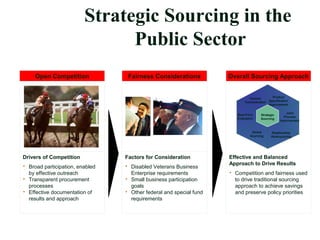
Strategic Sourcing in the
Public Sector
Overall Sourcing ApproachFairness ConsiderationsOpen Competition
Drivers of Competition
 Broad participation, enabled
by effective outreach
 Transparent procurement
processes
 Effective documentation of
results and approach
Factors for Consideration
 Disabled Veterans Business
Enterprise requirements
 Small business participation
goals
 Other federal and special fund
requirements
Effective and Balanced
Approach to Drive Results
 Competition and fairness used
to drive traditional sourcing
approach to achieve savings
and preserve policy priorities
Global
Sourcing
Best Price
Evaluation
Volume
Concentration
Product
Specification
Improvement
Joint
Process
Improvement
Relationship
Restructuring
Strategic
Sourcing
Sourcing Activities
Training
Savings Administration
Change Management
Major Project Components
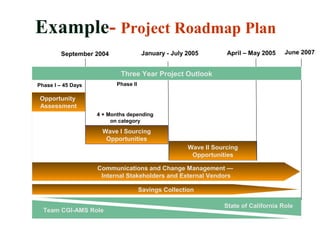
State of California Role
Team CGI-AMS Role
Communications and Change Management —
Internal Stakeholders and External Vendors
Phase I – 45 Days Phase II
September 2004
Opportunity
Assessment
Wave I Sourcing
Opportunities
Wave II Sourcing
Opportunities
January - July 2005 April – May 2005 June 2007
Example- Project Roadmap Plan
4 + Months depending
on category
Savings Collection
Three Year Project Outlook
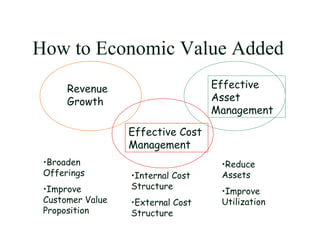
Revenue
Growth
Effective Cost
Management
Effective
Asset
Management
•Broaden
Offerings
•Improve
Customer Value
Proposition
•Internal Cost
Structure
•External Cost
Structure
•Reduce
Assets
•Improve
Utilization
How to Economic Value Added
The Key Players
 Internal Customers
 Suppliers
 Subcontractors
 Contract Admin
 Legal
 Finance
 Quality
 Others
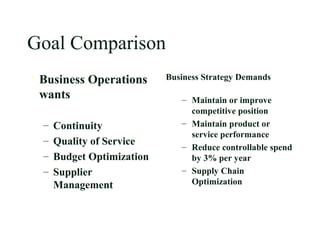
Goal Comparison
 Business Operations
wants
– Continuity
– Quality of Service
– Budget Optimization
– Supplier
Management
Business Strategy Demands
– Maintain or improve
competitive position
– Maintain product or
service performance
– Reduce controllable spend
by 3% per year
– Supply Chain
Optimization
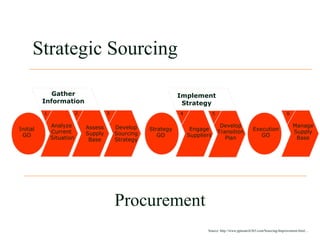
Analyze
Current
Situation
Initial
GO
1 2 43
Assess
Supply
Base
Develop
Sourcing
Strategy
Strategy
GO
Engage
Suppliers
Execution
GO
5
Develop
Transition
Plan
Gather
Information
Implement
Strategy
6
Manage
Supply
Base
Strategic Sourcing
Procurement
Source: http://www.pptsearch365.com/Sourcing-Improvement.html....
Critical Elements
Identification
Analysis
Total Cost Modeling
– Process redesign
– Supplier reduction
– Leverage
– Disintermediation
Supplier Management
• What is the $$spend
• Who are the users
• Who are the suppliers
• What is service level
• What is value-added
• How many transactions are involved
• What is the impact on cash flow
• How long do they take
• How much inventory exists
• Where does inventory exist
• Is this asset intensive
Establish Baseline Metrics
Additional Baseline
 What is the labor cost
 How does technology fit
 Who will lead the team
 What skills are needed
 What resources are available to the team
 What is the scope
 What are the boundaries
 How will we secure commitment
 How will we maintain commitment
 What are the incentives
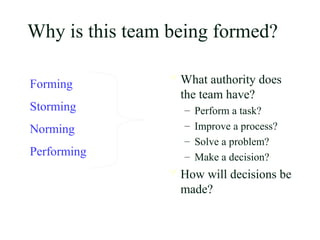
Why is this team being formed?
 What authority does
the team have?
– Perform a task?
– Improve a process?
– Solve a problem?
– Make a decision?
 How will decisions be
made?
Forming
Storming
Norming
Performing
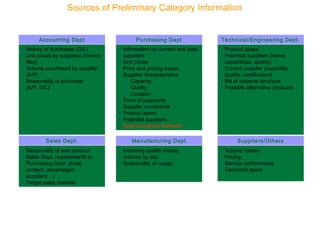
• History of purchases (G/L)
• Unit prices by suppliers (invoice
files)
• Volume purchased by supplier
(A/P)
• Seasonality of purchase
(A/P, G/L)
• Information on current and past
suppliers
• Unit prices
• Price and pricing bases
• Supplier characteristics
— Capacity
— Quality
— Location
• Term of payments
• Supplier constraints
• Product specs
• Potential suppliers
• Spend Analysis Software
• Product specs
• Potential suppliers (name,
capabilities, quality)
• Current supplier (capability,
quality, certification)
• Bill of material structure
• Possible alternative products
• Seasonality of end product
• Sales Dept. requirements to
Purchasing Dept. (local,
content, advantaged
suppliers…)
• Target sales markets
• Incoming quality history
• Volume by site
• Seasonality of usage
• Volume history
• Pricing
• Service performance
• Technical specs
Sales Dept. Manufacturing Dept Suppliers/Others
Accounting Dept Purchasing Dept Technical/Engineering Dept.
Sources of Preliminary Category Information
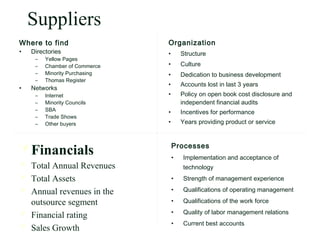
Suppliers
Financials
 Total Annual Revenues
 Total Assets
 Annual revenues in the
outsource segment
 Financial rating
 Sales Growth
Processes
• Implementation and acceptance of
technology
• Strength of management experience
• Qualifications of operating management
• Qualifications of the work force
• Quality of labor management relations
• Current best accounts
Organization
• Structure
• Culture
• Dedication to business development
• Accounts lost in last 3 years
• Policy on open book cost disclosure and
independent financial audits
• Incentives for performance
• Years providing product or service
Where to find
• Directories
– Yellow Pages
– Chamber of Commerce
– Minority Purchasing
– Thomas Register
• Networks
– Internet
– Minority Councils
– SBA
– Trade Shows
– Other buyers
What is Outsourcing?
Outsourcing -
“the strategic use of outside resources to perform
activities traditionally handled by internal staff and
resources” Dave Griffiths
Why Outsource?
Provide services that are scalable, secure, and efficient,
while improving overall service and reducing costs
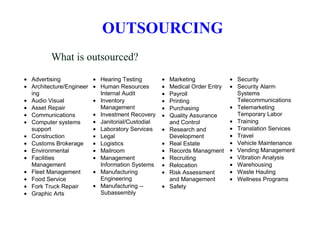
What is outsourced?
• Advertising
• Architecture/Engineer
ing
• Audio Visual
• Asset Repair
• Communications
• Computer systems
support
• Construction
• Customs Brokerage
• Environmental
• Facilities
Management
• Fleet Management
• Food Service
• Fork Truck Repair
• Graphic Arts
• Hearing Testing
• Human Resources
Internal Audit
• Inventory
Management
• Investment Recovery
• Janitorial/Custodial
• Laboratory Services
• Legal
• Logistics
• Mailroom
• Management
Information Systems
• Manufacturing
Engineering
• Manufacturing --
Subassembly
• Marketing
• Medical Order Entry
• Payroll
• Printing
• Purchasing
• Quality Assurance
and Control
• Research and
Development
• Real Estate
• Records Managment
• Recruiting
• Relocation
• Risk Assessment
and Management
• Safety
• Security
• Security Alarm
Systems
Telecommunications
• Telemarketing
Temporary Labor
• Training
• Translation Services
• Travel
• Vehicle Maintenance
• Vending Management
• Vibration Analysis
• Warehousing
• Waste Hauling
• Wellness Programs
OUTSOURCING
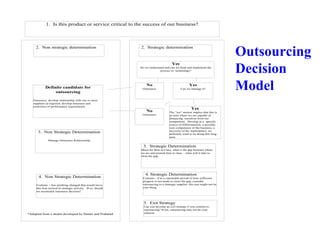
Outsourcing
Decision
Model
1. Is this product or service critical to the success of our business?
Definite candidate for
outsourcing
Outsource, develop relationship with one or more
suppliers as required, develop measures and
awareness of performance requirements.
Yes
Do we understand and can we fund and implement the
process or technology?
Yes
Can we manage it?
No
Outsource
No
Outsource
Yes
The “yes” answer implies that this is
an area where we are capable of
distancing ourselves from our
competition. Develop as a specific
source of differentiation, a possible
core competency of the business, a
necessity of the marketplace; we
definitely want to be doing this long
term.
3. Non Strategic Determination
Manage Outsource Relationship
2. Non strategic determination 2. Strategic determination
3. Strategic Determination
Shoot for Best in Class, what is the gap between where
we are and present best in class - what will it take to
close the gap,
4. Non Strategic Determination
Evaluate -- has anything changed that would move
this fron tactical to strategic activity. If so, should
we reconsider outsource decision?
4. Strategic Determination
Evaluate - if in a reasonable period of time sufficient
progress is not made to close the gap, consider
outsourcing to a strategic supplier, this just might not be
your thing.
5. Exit Strategy
Can you develop an exit strategy if you commit to
outsourcing? If not, outsourcing may not be your
solution.*Adapted from a model developed by Hamel and Prahalad
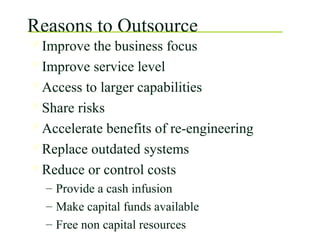
Reasons to Outsource
Improve the business focus
Improve service level
Access to larger capabilities
Share risks
Accelerate benefits of re-engineering
Replace outdated systems
Reduce or control costs
– Provide a cash infusion
– Make capital funds available
– Free non capital resources
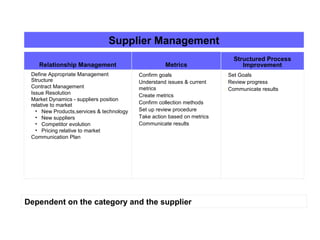
Dependent on the category and the supplier
• Define Appropriate Management
Structure
• Contract Management
• Issue Resolution
• Market Dynamics - suppliers position
relative to market
• New Products,services & technology
• New suppliers
• Competitor evolution
• Pricing relative to market
• Communication Plan
• Confirm goals
• Understand issues & current
metrics
• Create metrics
• Confirm collection methods
• Set up review procedure
• Take action based on metrics
• Communicate results
Supplier Management
• Set Goals
• Review progress
• Communicate results
Structured Process
ImprovementRelationship Management Metrics
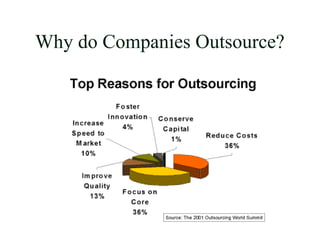
Why do Companies Outsource?
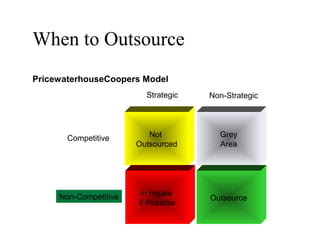
When to Outsource
Grey
Area
Not
Outsourced
In House
if Possible
Outsource
Competitive
Strategic Non-Strategic
Non-Competitive
PricewaterhouseCoopers Model
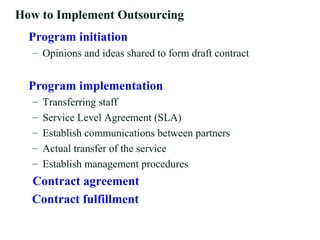
How to Implement Outsourcing
 Program initiation
– Opinions and ideas shared to form draft contract
 Program implementation
– Transferring staff
– Service Level Agreement (SLA)
– Establish communications between partners
– Actual transfer of the service
– Establish management procedures
Contract agreement
Contract fulfillment
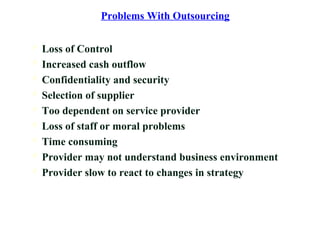
Problems With Outsourcing
 Loss of Control
 Increased cash outflow
 Confidentiality and security
 Selection of supplier
 Too dependent on service provider
 Loss of staff or moral problems
 Time consuming
 Provider may not understand business environment
 Provider slow to react to changes in strategy
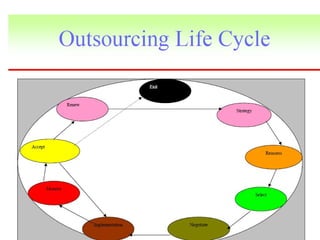
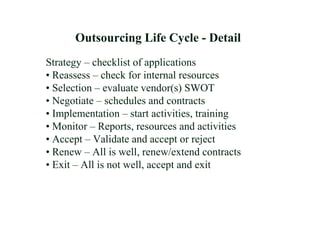
Strategy – checklist of applications
• Reassess – check for internal resources
• Selection – evaluate vendor(s) SWOT
• Negotiate – schedules and contracts
• Implementation – start activities, training
• Monitor – Reports, resources and activities
• Accept – Validate and accept or reject
• Renew – All is well, renew/extend contracts
• Exit – All is not well, accept and exit
Outsourcing Life Cycle - Detail
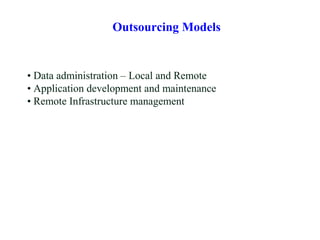
Outsourcing Models
• Data administration – Local and Remote
• Application development and maintenance
• Remote Infrastructure management
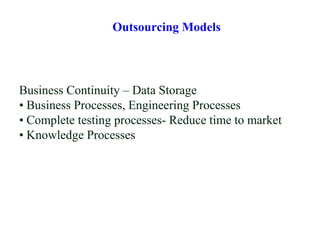
Business Continuity – Data Storage
• Business Processes, Engineering Processes
• Complete testing processes- Reduce time to market
• Knowledge Processes
Outsourcing Models

Ise511 text8

  • 1.
    STRATEGIC SOURCING A System-wide,Collaborative Purchasing Process
  • 2.
    To develop andimplement an effective system-wide, collaborative purchasing process designed to maintain or increase customer satisfaction (by enhancing product quality and service levels) and significantly lowering total cost by coordinating and leveraging common purchases across the UC system. MISSION
  • 3.
    Strategic Sourcing Complete CustomerSatisfaction. Continuous Improvement of Internal Service Levels and Product Quality. Process Excellence.  Significant Total Cost Reduction (5%-15% Target). Goals
  • 4.
    Strategic Sourcing  Visible,Active Executive Sponsorship – A Single Vision – Internal Cooperation and Participation  End User Focus and Involvement – Clear Understanding of User Requirements – Use of Cross Functional/Departmental Teams  Data Integrity – Rigorous Analysis – Fact Based Decisions  Appropriate Use Of Technology – Internet Enabled E-Procurement – Solid, Reliable System Infrastructure  Continuous Process Improvement – Establish Best Practices/ Key Performance Indicators – Constantly Measure Results and Implement Improvements CRITICAL SUCCESS FACTORS
  • 5.
    Road Map INCREASED CUSTOMER SATISFACTIONand SIGNIFICANT COST REDUCTIONS Technology Implementation of Best Practices Identify/Prioritize Opportunities Establish User requirements Execute RFP Process/Select Supplier Develop Timely and Accurate View of Spending Data Simplify and Stream-line Processing (P-Card) E-Procurement Development Strategic Sourcing Products and Services Processes Rationalize Current Specifications Evaluate New/Alternative Products Identify Non-Value Activities Best Practices Analysis Business Process Analysis Implement Continuous Improvement Practices/Metrics Conduct Spend Diagnostic Launch Cross Functional/Divisional Teams MISSION STRATEGIES TACTICS Monitor Compliance Collaborative Purchasing Process
  • 6.
    Major Commodity Relationship Groups Professional Services – Professional Services – Temporary Services  Miscellaneous – Utilities – Misc. Equipment – Printing Services and Supplies – Furniture – Business Equipment – Freight & Shipping Supplies – Misc. Other, Includes: • Athletic & Rec. Supplies • Auto Rental • Collections • Departmental Stores • Explosives & Firearms • Literary Services • Medical Equipment • Misc. Supplies • Site Maintenance • Theater Supplies  Services – Medical Services – Food Services – Entertainment Services – Travel – Misc. Services – Security – Environmental Services  Supplies – Laboratory Supplies – Maintenance/Repair/Operations – Medical Supplies – Multimedia Supplies – Office Supplies – Pharmaceuticals  Telecommunications/Computer – Computer Equipment – Computer Supplies/Software – Telecommunications Equipment/ Services
  • 7.
    Strategic Global Sourcing A business model related decision on thetrade-off between:  o Full Costs  o Quality  o Potential for Commoditisation  o Lead Time  o Delivery reliability  o Product Innovation  o Capabilities of Supplier  o Public Security and Safety Risk  o In-company focus 
  • 8.
     Global SourcingExcellenceFrom Fringe to Core  • Sourcing as integral part of the business model  • Securing Business Buy-In  • From potential costsavings to monitoring thereal benefits  • From low cost to highquality sourcing  • Managing the SourcingBusiness Processes – recallmanagement  • End-User Involvement 
  • 9.
    Strategic Sourcing An analyticalacquisition approach to achieve best value through standardization and leverage that results in significant savings and fulfillment of socio-economic and environmental requirements.
  • 10.
    Strategic Sourcing --StrategicSourcing -- thethe collaborativecollaborative andand structuredstructured process of critically analyzing anprocess of critically analyzing an organization’s spending and using thisorganization’s spending and using this informationinformation to make business decisionsto make business decisions about acquiring commodities and servicesabout acquiring commodities and services more effectively and efficientlymore effectively and efficiently
  • 11.
    Strategic Sourcing is… ADisciplined Analysis of Purchases, Markets and Suppliers To Identify Opportunities for Savings By Negotiating Contracts and Employing New Tools and Practices That Lowers Costs and/or Adds Value While Maintaining Goods and Services
  • 12.
    Page 12 Conduct Opportunity Assessment Market Analysis Develop Commodity Strategy Execute Acquisition Strategy Implement& Manage Performance 2 3 4 5 Profile Commodity COMMODITY STRATEGIC SOURCING PROCESSCOMMODITY STRATEGIC SOURCING PROCESS 1 Commodity Identification Identify and Prioritize Develop plan and strategy Implement, Measure and Adjust   
  • 13.
    New Tools &Techniques  Conduct product value analysis and engineering  Substitute materials  Pursue system buying alternatives  Optimize life cycle costs • Reengineer joint processes • Share productivity gains • Integrate logistics • Support supplier operations improvement  Establish/develop key suppliers  Employ strategic alliances/partnering  Examine strategic make versus buy  Develop integrated supply chain  Expand geographic supply base  Develop new suppliers  Profit from global supply/demand imbalances  Compare “total” costs  Model “should-costs”  Renegotiate prices  Unbundle pricing  Consolidate number of suppliers  Pool volume across units  Redistribute volume among suppliers  Combine volume from different commodity categories Exploit Buying Power Create an Advantage Expand Supply Base Best Price Evaluation Volume Concentration Product Specification Improvement Joint Process Improvement Relationship Restructuring Strategic Sourcing Profile Of Sourcing Group Sourcing Strategy For Sourcing Category Supplier Portfolio Generation Competitive Supplier Selection Operational Integration With Suppliers Continuous Benchmarking Of Supply Market Selection Of Implementation Path 4 1 2 3 5 6 7 Online (“e”) RFPs Internet Negotiations (Reverse Actions) New Tools Source: http://www.naspo.org/documents/Strategic_Sourcing_All.ppt....
  • 14.
    Strategic Sourcing inthe Public Sector Overall Sourcing ApproachFairness ConsiderationsOpen Competition Drivers of Competition  Broad participation, enabled by effective outreach  Transparent procurement processes  Effective documentation of results and approach Factors for Consideration  Disabled Veterans Business Enterprise requirements  Small business participation goals  Other federal and special fund requirements Effective and Balanced Approach to Drive Results  Competition and fairness used to drive traditional sourcing approach to achieve savings and preserve policy priorities Global Sourcing Best Price Evaluation Volume Concentration Product Specification Improvement Joint Process Improvement Relationship Restructuring Strategic Sourcing
  • 15.
  • 16.
    State of CaliforniaRole Team CGI-AMS Role Communications and Change Management — Internal Stakeholders and External Vendors Phase I – 45 Days Phase II September 2004 Opportunity Assessment Wave I Sourcing Opportunities Wave II Sourcing Opportunities January - July 2005 April – May 2005 June 2007 Example- Project Roadmap Plan 4 + Months depending on category Savings Collection Three Year Project Outlook
  • 17.
    Revenue Growth Effective Cost Management Effective Asset Management •Broaden Offerings •Improve Customer Value Proposition •InternalCost Structure •External Cost Structure •Reduce Assets •Improve Utilization How to Economic Value Added
  • 18.
    The Key Players Internal Customers  Suppliers  Subcontractors  Contract Admin  Legal  Finance  Quality  Others
  • 19.
    Goal Comparison  BusinessOperations wants – Continuity – Quality of Service – Budget Optimization – Supplier Management Business Strategy Demands – Maintain or improve competitive position – Maintain product or service performance – Reduce controllable spend by 3% per year – Supply Chain Optimization
  • 20.
  • 21.
    Critical Elements Identification Analysis Total CostModeling – Process redesign – Supplier reduction – Leverage – Disintermediation Supplier Management
  • 22.
    • What isthe $$spend • Who are the users • Who are the suppliers • What is service level • What is value-added • How many transactions are involved • What is the impact on cash flow • How long do they take • How much inventory exists • Where does inventory exist • Is this asset intensive Establish Baseline Metrics
  • 23.
    Additional Baseline  Whatis the labor cost  How does technology fit  Who will lead the team  What skills are needed  What resources are available to the team  What is the scope  What are the boundaries  How will we secure commitment  How will we maintain commitment  What are the incentives
  • 24.
    Why is thisteam being formed?  What authority does the team have? – Perform a task? – Improve a process? – Solve a problem? – Make a decision?  How will decisions be made? Forming Storming Norming Performing
  • 25.
    • History ofpurchases (G/L) • Unit prices by suppliers (invoice files) • Volume purchased by supplier (A/P) • Seasonality of purchase (A/P, G/L) • Information on current and past suppliers • Unit prices • Price and pricing bases • Supplier characteristics — Capacity — Quality — Location • Term of payments • Supplier constraints • Product specs • Potential suppliers • Spend Analysis Software • Product specs • Potential suppliers (name, capabilities, quality) • Current supplier (capability, quality, certification) • Bill of material structure • Possible alternative products • Seasonality of end product • Sales Dept. requirements to Purchasing Dept. (local, content, advantaged suppliers…) • Target sales markets • Incoming quality history • Volume by site • Seasonality of usage • Volume history • Pricing • Service performance • Technical specs Sales Dept. Manufacturing Dept Suppliers/Others Accounting Dept Purchasing Dept Technical/Engineering Dept. Sources of Preliminary Category Information
  • 26.
    Suppliers Financials  Total AnnualRevenues  Total Assets  Annual revenues in the outsource segment  Financial rating  Sales Growth Processes • Implementation and acceptance of technology • Strength of management experience • Qualifications of operating management • Qualifications of the work force • Quality of labor management relations • Current best accounts Organization • Structure • Culture • Dedication to business development • Accounts lost in last 3 years • Policy on open book cost disclosure and independent financial audits • Incentives for performance • Years providing product or service Where to find • Directories – Yellow Pages – Chamber of Commerce – Minority Purchasing – Thomas Register • Networks – Internet – Minority Councils – SBA – Trade Shows – Other buyers
  • 27.
    What is Outsourcing? Outsourcing- “the strategic use of outside resources to perform activities traditionally handled by internal staff and resources” Dave Griffiths Why Outsource? Provide services that are scalable, secure, and efficient, while improving overall service and reducing costs
  • 28.
    What is outsourced? •Advertising • Architecture/Engineer ing • Audio Visual • Asset Repair • Communications • Computer systems support • Construction • Customs Brokerage • Environmental • Facilities Management • Fleet Management • Food Service • Fork Truck Repair • Graphic Arts • Hearing Testing • Human Resources Internal Audit • Inventory Management • Investment Recovery • Janitorial/Custodial • Laboratory Services • Legal • Logistics • Mailroom • Management Information Systems • Manufacturing Engineering • Manufacturing -- Subassembly • Marketing • Medical Order Entry • Payroll • Printing • Purchasing • Quality Assurance and Control • Research and Development • Real Estate • Records Managment • Recruiting • Relocation • Risk Assessment and Management • Safety • Security • Security Alarm Systems Telecommunications • Telemarketing Temporary Labor • Training • Translation Services • Travel • Vehicle Maintenance • Vending Management • Vibration Analysis • Warehousing • Waste Hauling • Wellness Programs OUTSOURCING
  • 29.
    Outsourcing Decision Model 1. Is thisproduct or service critical to the success of our business? Definite candidate for outsourcing Outsource, develop relationship with one or more suppliers as required, develop measures and awareness of performance requirements. Yes Do we understand and can we fund and implement the process or technology? Yes Can we manage it? No Outsource No Outsource Yes The “yes” answer implies that this is an area where we are capable of distancing ourselves from our competition. Develop as a specific source of differentiation, a possible core competency of the business, a necessity of the marketplace; we definitely want to be doing this long term. 3. Non Strategic Determination Manage Outsource Relationship 2. Non strategic determination 2. Strategic determination 3. Strategic Determination Shoot for Best in Class, what is the gap between where we are and present best in class - what will it take to close the gap, 4. Non Strategic Determination Evaluate -- has anything changed that would move this fron tactical to strategic activity. If so, should we reconsider outsource decision? 4. Strategic Determination Evaluate - if in a reasonable period of time sufficient progress is not made to close the gap, consider outsourcing to a strategic supplier, this just might not be your thing. 5. Exit Strategy Can you develop an exit strategy if you commit to outsourcing? If not, outsourcing may not be your solution.*Adapted from a model developed by Hamel and Prahalad
  • 30.
    Reasons to Outsource Improvethe business focus Improve service level Access to larger capabilities Share risks Accelerate benefits of re-engineering Replace outdated systems Reduce or control costs – Provide a cash infusion – Make capital funds available – Free non capital resources
  • 31.
    Dependent on thecategory and the supplier • Define Appropriate Management Structure • Contract Management • Issue Resolution • Market Dynamics - suppliers position relative to market • New Products,services & technology • New suppliers • Competitor evolution • Pricing relative to market • Communication Plan • Confirm goals • Understand issues & current metrics • Create metrics • Confirm collection methods • Set up review procedure • Take action based on metrics • Communicate results Supplier Management • Set Goals • Review progress • Communicate results Structured Process ImprovementRelationship Management Metrics
  • 32.
    Why do CompaniesOutsource?
  • 33.
    When to Outsource Grey Area Not Outsourced InHouse if Possible Outsource Competitive Strategic Non-Strategic Non-Competitive PricewaterhouseCoopers Model
  • 34.
    How to ImplementOutsourcing  Program initiation – Opinions and ideas shared to form draft contract  Program implementation – Transferring staff – Service Level Agreement (SLA) – Establish communications between partners – Actual transfer of the service – Establish management procedures Contract agreement Contract fulfillment
  • 35.
    Problems With Outsourcing Loss of Control  Increased cash outflow  Confidentiality and security  Selection of supplier  Too dependent on service provider  Loss of staff or moral problems  Time consuming  Provider may not understand business environment  Provider slow to react to changes in strategy
  • 37.
    Strategy – checklistof applications • Reassess – check for internal resources • Selection – evaluate vendor(s) SWOT • Negotiate – schedules and contracts • Implementation – start activities, training • Monitor – Reports, resources and activities • Accept – Validate and accept or reject • Renew – All is well, renew/extend contracts • Exit – All is not well, accept and exit Outsourcing Life Cycle - Detail
  • 38.
    Outsourcing Models • Dataadministration – Local and Remote • Application development and maintenance • Remote Infrastructure management
  • 39.
    Business Continuity –Data Storage • Business Processes, Engineering Processes • Complete testing processes- Reduce time to market • Knowledge Processes Outsourcing Models