Ariba Knowle dge Nuggets

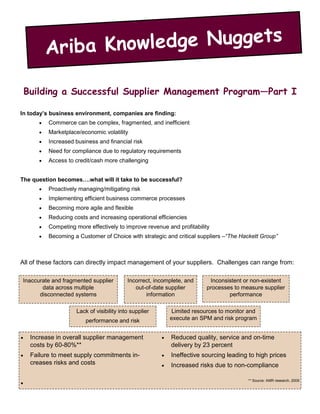
    Building a Successful Supplier Management Program—Part I

In today’s business environment, companies are finding:
        •   Commerce can be complex, fragmented, and inefficient
        •   Marketplace/economic volatility
        •   Increased business and financial risk
        •   Need for compliance due to regulatory requirements
        •   Access to credit/cash more challenging


The question becomes….what will it take to be successful?
        •   Proactively managing/mitigating risk
        •   Implementing efficient business commerce processes
        •   Becoming more agile and flexible
        •   Reducing costs and increasing operational efficiencies
        •   Competing more effectively to improve revenue and profitability
        •   Becoming a Customer of Choice with strategic and critical suppliers –“The Hackett Group”


All of these factors can directly impact management of your suppliers. Challenges can range from:

Inaccurate and fragmented supplier          Incorrect, incomplete, and     Inconsistent or non-existent
       data across multiple                    out-of-date supplier       processes to measure supplier
      disconnected systems                         information                    performance

                      Lack of visibility into supplier        Limited resources to monitor and
                          performance and risk               execute an SPM and risk program


•    Increase in overall supplier management             •   Reduced quality, service and on-time
     costs by 60-80%**                                       delivery by 23 percent
•    Failure to meet supply commitments in-              •   Ineffective sourcing leading to high prices
     creases risks and costs                             •   Increased risks due to non-compliance

                                                                                          ** Source: AMR research, 2009
•
What is Procurement’s Role in Managing Supply Chain Risk?
    According to Aberdeen Research
       “The CPO’s Agenda 2009”

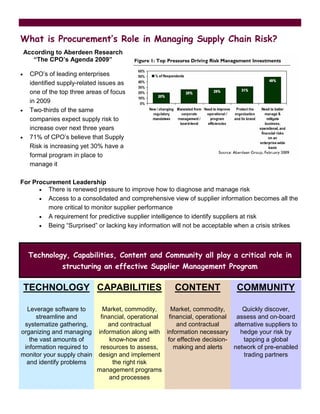
•    CPO’s of leading enterprises
     identified supply-related issues as
     one of the top three areas of focus
     in 2009
•    Two-thirds of the same
     companies expect supply risk to
     increase over next three years
•    71% of CPO’s believe that Supply
     Risk is increasing yet 30% have a
     formal program in place to
     manage it

For Procurement Leadership
      • There is renewed pressure to improve how to diagnose and manage risk
      • Access to a consolidated and comprehensive view of supplier information becomes all the
         more critical to monitor supplier performance
      • A requirement for predictive supplier intelligence to identify suppliers at risk
      • Being “Surprised” or lacking key information will not be acceptable when a crisis strikes


     Technology, Capabilities, Content and Community all play a critical role in
                structuring an effective Supplier Management Program

    TECHNOLOGY CAPABILITIES                             CONTENT                COMMUNITY

  Leverage software to         Market, commodity,     Market, commodity,         Quickly discover,
     streamline and           financial, operational financial, operational   assess and on-board
 systematize gathering,          and contractual        and contractual      alternative suppliers to
organizing and managing      information along with information necessary       hedge your risk by
   the vast amounts of            know-how and       for effective decision-     tapping a global
 information required to      resources to assess,     making and alerts     network of pre-enabled
monitor your supply chain    design and implement                                trading partners
  and identify problems            the right risk
                             management programs
                                  and processes
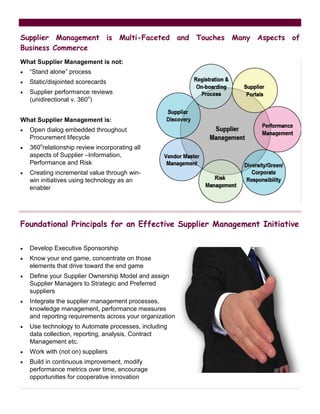
Supplier Management is Multi-Faceted and Touches Many Aspects of
Business Commerce
What Supplier Management is not:
•   “Stand alone” process
•   Static/disjointed scorecards
•   Supplier performance reviews
    (unidirectional v. 360o)


What Supplier Management is:
•   Open dialog embedded throughout
    Procurement lifecycle
•   360orelationship review incorporating all
    aspects of Supplier –Information,
    Performance and Risk
•   Creating incremental value through win-
    win initiatives using technology as an
    enabler


Foundational Principals for an Effective Supplier Management Initiative

•   Develop Executive Sponsorship
•   Know your end game, concentrate on those
    elements that drive toward the end game
•   Define your Supplier Ownership Model and assign
    Supplier Managers to Strategic and Preferred
    suppliers
•   Integrate the supplier management processes,
    knowledge management, performance measures
    and reporting requirements across your organization
•   Use technology to Automate processes, including
    data collection, reporting, analysis, Contract
    Management etc.
•   Work with (not on) suppliers
•   Build in continuous improvement, modify
    performance metrics over time, encourage
    opportunities for cooperative innovation

Ariba Knowledge Nuggets: Supplier Management Challenges

  • 1.
    Ariba Knowle dgeNuggets Building a Successful Supplier Management Program—Part I In today’s business environment, companies are finding: • Commerce can be complex, fragmented, and inefficient • Marketplace/economic volatility • Increased business and financial risk • Need for compliance due to regulatory requirements • Access to credit/cash more challenging The question becomes….what will it take to be successful? • Proactively managing/mitigating risk • Implementing efficient business commerce processes • Becoming more agile and flexible • Reducing costs and increasing operational efficiencies • Competing more effectively to improve revenue and profitability • Becoming a Customer of Choice with strategic and critical suppliers –“The Hackett Group” All of these factors can directly impact management of your suppliers. Challenges can range from: Inaccurate and fragmented supplier Incorrect, incomplete, and Inconsistent or non-existent data across multiple out-of-date supplier processes to measure supplier disconnected systems information performance Lack of visibility into supplier Limited resources to monitor and performance and risk execute an SPM and risk program • Increase in overall supplier management • Reduced quality, service and on-time costs by 60-80%** delivery by 23 percent • Failure to meet supply commitments in- • Ineffective sourcing leading to high prices creases risks and costs • Increased risks due to non-compliance ** Source: AMR research, 2009 •
  • 2.
    What is Procurement’sRole in Managing Supply Chain Risk? According to Aberdeen Research “The CPO’s Agenda 2009” • CPO’s of leading enterprises identified supply-related issues as one of the top three areas of focus in 2009 • Two-thirds of the same companies expect supply risk to increase over next three years • 71% of CPO’s believe that Supply Risk is increasing yet 30% have a formal program in place to manage it For Procurement Leadership • There is renewed pressure to improve how to diagnose and manage risk • Access to a consolidated and comprehensive view of supplier information becomes all the more critical to monitor supplier performance • A requirement for predictive supplier intelligence to identify suppliers at risk • Being “Surprised” or lacking key information will not be acceptable when a crisis strikes Technology, Capabilities, Content and Community all play a critical role in structuring an effective Supplier Management Program TECHNOLOGY CAPABILITIES CONTENT COMMUNITY Leverage software to Market, commodity, Market, commodity, Quickly discover, streamline and financial, operational financial, operational assess and on-board systematize gathering, and contractual and contractual alternative suppliers to organizing and managing information along with information necessary hedge your risk by the vast amounts of know-how and for effective decision- tapping a global information required to resources to assess, making and alerts network of pre-enabled monitor your supply chain design and implement trading partners and identify problems the right risk management programs and processes
  • 3.
    Supplier Management isMulti-Faceted and Touches Many Aspects of Business Commerce What Supplier Management is not: • “Stand alone” process • Static/disjointed scorecards • Supplier performance reviews (unidirectional v. 360o) What Supplier Management is: • Open dialog embedded throughout Procurement lifecycle • 360orelationship review incorporating all aspects of Supplier –Information, Performance and Risk • Creating incremental value through win- win initiatives using technology as an enabler Foundational Principals for an Effective Supplier Management Initiative • Develop Executive Sponsorship • Know your end game, concentrate on those elements that drive toward the end game • Define your Supplier Ownership Model and assign Supplier Managers to Strategic and Preferred suppliers • Integrate the supplier management processes, knowledge management, performance measures and reporting requirements across your organization • Use technology to Automate processes, including data collection, reporting, analysis, Contract Management etc. • Work with (not on) suppliers • Build in continuous improvement, modify performance metrics over time, encourage opportunities for cooperative innovation