Supply Chain Strategy Proposal  Development of Agreements  and/or Alliances with Suppliers Thursday, December 11, 2008
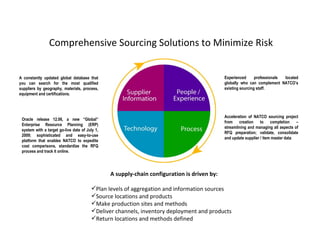
Comprehensive Sourcing Solutions to Minimize Risk Experienced professionals located globally who can complement NATCO’s existing sourcing staff. Acceleration of NATCO sourcing project from creation to completion – streamlining and managing all aspects of RFQ preparation; validate, consolidate and update supplier / item master data Oracle release 12.06, a new “Global” Enterprise Resource Planning (ERP) system with a target go-live date of July 1, 2009; sophisticated and easy-to-use platform that enables NATCO to expedite cost comparisons, standardize the RFQ process and track it online.  A constantly updated global database that you can search for the most qualified suppliers by geography, materials, process, equipment and certifications. A supply-chain configuration is driven by: Plan levels of aggregation and information sources Source locations and products Make production sites and methods Deliver channels, inventory deployment and products Return locations and methods defined
Change Management  Define team Define decision process  Develop communication plan  Prepare stakeholder analysis  Develop “Push” Strategies for Strategic Sourcing  Develop “Pull” Strategies for Strategic Sourcing
Launch Effort  Establish governance structure Identify owners for categories Develop detailed work plans  Determine resource requirements for each category  Notify Legal, A/P, Risk Mgmt of project timeline
Scope  Demand/Supply Planning and Management Balance resources with requirements to establish and communicate plans to align the supply chain supplier development plan with corporate financial objectives:  Management of business rules / stage gate process  Supply chain performance objectives Data collection requirements Logistics & transportation  Planning configuration Regulatory requirements and compliance Sourcing Stocked, Make-to-Order, and Engineer-to-Order Product Manage inventory, capital assets, incoming product, supplier network, import/export requirements, and supplier agreements:  Schedule deliveries; receive, verify, and transfer product; and authorize supplier payments Identify and select supply sources when not predetermined, as for engineer-to-order product Manage business rules, assess supplier performance, and maintain data
Scope Make-to-Stock, Make-to-Order, and Engineer-to-Order Production Execution Schedule production activities, issue product, produce and test, package, stage product, and release product to deliver All order management steps from processing customer inquiries and quotes to routing shipments and selecting carriers. Manage rules, performance, data, in-process products (WIP), equipment and facilities, transportation, production network, and regulatory compliance for production Finalize engineering for engineer-to-order product Return of Raw Materials and Receipt of Returns of Finished Goods Identify product condition, disposition product, request product return authorization, schedule product shipment, and return defective product  deliver – authorized product return, schedule return receipt, receive product, and transfer defective product All Return Defective Product steps from source All Return Maintenance, Repair, and Overhaul product steps from source All Return Excess Product steps from source
Objectives  Reduce supplier risk and disruption within supply chain  Increase key suppliers capacity  Improve forecasting and capacity load planning Drive process improvement & standardization Establish strategic partnerships with suppliers Drive cost reductions for procured material  Establish sourcing agreements Vendor Managed Inventory (VMI) Stocking Programs  Preferred pricing  Turnkey Solutions  Maintain corporate alignment with Global counterparts Develop strategies for global commodities Identifying opportunities to aggregate spend and negotiate superior contracts  Improving procurement operations and supplier performance
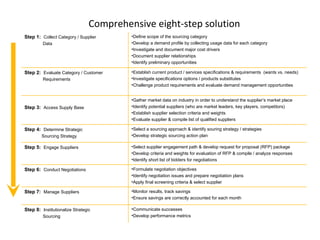
Comprehensive eight-step solution Step 1:   Collect Category / Supplier  Data Define scope of the sourcing category  Develop a demand profile by collecting usage data for each category  Investigate and document major cost drivers  Document supplier relationships  Identify preliminary opportunities  Step 2:   Evaluate Category / Customer  Requirements  Establish current product / services specifications & requirements  (wants vs. needs) Investigate specifications options / products substitutes  Challenge product requirements and evaluate demand management opportunities  Step 3:   Access Supply Base  Gather market data on industry in order to understand the supplier’s market place  Identify potential suppliers (who are market leaders, key players, competitors)  Establish supplier selection criteria and weights  Evaluate supplier & compile list of qualified suppliers Step 4:   Determine Strategic  Sourcing Strategy  Select a sourcing approach & identify souring strategy / strategies  Develop strategic sourcing action plan  Step 5:   Engage Suppliers  Select supplier engagement path & develop request for proposal (RFP) package  Develop criteria and weights for evaluation of RFP & compile / analyze responses  Identify short list of bidders for negotiations  Step 6:   Conduct Negotiations Formulate negotiation objectives  Identify negotiation issues and prepare negotiation plans  Apply final screening criteria & select supplier  Step 7:   Manage Suppliers  Monitor results, track savings  Ensure savings are correctly accounted for each month  Step 8:   Institutionalize Strategic  Sourcing  Communicate successes  Develop performance metrics
Supplier Development Strategy This opportunity will exist across all locations. Steps in this project include: Identify suppliers unique to locations and define classes/commodities purchased. Examine classes/commodities purchased vs. capabilities of multi-site suppliers for same product classes.  Evaluate if local, unique supplier is justified (i.e. geographic constraints, shipping costs). Identify redundant suppliers and establish preferred supplier list. Establish supplier selection policy, procedures, governance and accountability. Define training and change management requirements. Implement supplier consolidation plan. Identify low dollar value commodities with frequent use. Identify high dollar value commodities with infrequent use Evaluate supplier and NATCO capability for VMI programs.  Determine if VMI, zone stores, regional stores or other management approaches are applicable apply. Evaluate risks and impacts of a change in procurement, logistics, and handling. Define policies, process, procedures and metrics for supplier governance  Implement solution(s) Determine the risks and impacts of the change(s) of alternative strategies. Decision review by team and management (buy in by plants impacted) Identify policy, process and procedural issues addressing alternative strategies.
Potential Supplier Profile Factors  Technology  Product or process innovation ERP Systems compatibility  Research & Development  Patents & Awards Financial  Provide cost advantage for project deliverables Capture expenditure requirements  Market price volatility Performance Product launch integration  Frequent design change flexibility  Continuous improvement programs On time delivery  accuracy  Geography Logistics/ transportation cost Local / Intl. market regulations Tariffs / Taxes  Multi-platform sourcing  Quality  Health, Safety, & Environmental (HSE) Manufacturing complexity / simplicity Potential warranty cost
Conclusion Q&A

Strategic Sourcing And Supplier Development Strategy

  • 1.
  • 2.
    Supply Chain StrategyProposal Development of Agreements and/or Alliances with Suppliers Thursday, December 11, 2008
  • 3.
    Comprehensive Sourcing Solutionsto Minimize Risk Experienced professionals located globally who can complement NATCO’s existing sourcing staff. Acceleration of NATCO sourcing project from creation to completion – streamlining and managing all aspects of RFQ preparation; validate, consolidate and update supplier / item master data Oracle release 12.06, a new “Global” Enterprise Resource Planning (ERP) system with a target go-live date of July 1, 2009; sophisticated and easy-to-use platform that enables NATCO to expedite cost comparisons, standardize the RFQ process and track it online. A constantly updated global database that you can search for the most qualified suppliers by geography, materials, process, equipment and certifications. A supply-chain configuration is driven by: Plan levels of aggregation and information sources Source locations and products Make production sites and methods Deliver channels, inventory deployment and products Return locations and methods defined
  • 4.
    Change Management Define team Define decision process Develop communication plan Prepare stakeholder analysis Develop “Push” Strategies for Strategic Sourcing Develop “Pull” Strategies for Strategic Sourcing
  • 5.
    Launch Effort Establish governance structure Identify owners for categories Develop detailed work plans Determine resource requirements for each category Notify Legal, A/P, Risk Mgmt of project timeline
  • 6.
    Scope Demand/SupplyPlanning and Management Balance resources with requirements to establish and communicate plans to align the supply chain supplier development plan with corporate financial objectives: Management of business rules / stage gate process Supply chain performance objectives Data collection requirements Logistics & transportation Planning configuration Regulatory requirements and compliance Sourcing Stocked, Make-to-Order, and Engineer-to-Order Product Manage inventory, capital assets, incoming product, supplier network, import/export requirements, and supplier agreements: Schedule deliveries; receive, verify, and transfer product; and authorize supplier payments Identify and select supply sources when not predetermined, as for engineer-to-order product Manage business rules, assess supplier performance, and maintain data
  • 7.
    Scope Make-to-Stock, Make-to-Order,and Engineer-to-Order Production Execution Schedule production activities, issue product, produce and test, package, stage product, and release product to deliver All order management steps from processing customer inquiries and quotes to routing shipments and selecting carriers. Manage rules, performance, data, in-process products (WIP), equipment and facilities, transportation, production network, and regulatory compliance for production Finalize engineering for engineer-to-order product Return of Raw Materials and Receipt of Returns of Finished Goods Identify product condition, disposition product, request product return authorization, schedule product shipment, and return defective product deliver – authorized product return, schedule return receipt, receive product, and transfer defective product All Return Defective Product steps from source All Return Maintenance, Repair, and Overhaul product steps from source All Return Excess Product steps from source
  • 8.
    Objectives Reducesupplier risk and disruption within supply chain Increase key suppliers capacity Improve forecasting and capacity load planning Drive process improvement & standardization Establish strategic partnerships with suppliers Drive cost reductions for procured material Establish sourcing agreements Vendor Managed Inventory (VMI) Stocking Programs Preferred pricing Turnkey Solutions Maintain corporate alignment with Global counterparts Develop strategies for global commodities Identifying opportunities to aggregate spend and negotiate superior contracts Improving procurement operations and supplier performance
  • 9.
    Comprehensive eight-step solutionStep 1: Collect Category / Supplier Data Define scope of the sourcing category Develop a demand profile by collecting usage data for each category Investigate and document major cost drivers Document supplier relationships Identify preliminary opportunities Step 2: Evaluate Category / Customer Requirements Establish current product / services specifications & requirements (wants vs. needs) Investigate specifications options / products substitutes Challenge product requirements and evaluate demand management opportunities Step 3: Access Supply Base Gather market data on industry in order to understand the supplier’s market place Identify potential suppliers (who are market leaders, key players, competitors) Establish supplier selection criteria and weights Evaluate supplier & compile list of qualified suppliers Step 4: Determine Strategic Sourcing Strategy Select a sourcing approach & identify souring strategy / strategies Develop strategic sourcing action plan Step 5: Engage Suppliers Select supplier engagement path & develop request for proposal (RFP) package Develop criteria and weights for evaluation of RFP & compile / analyze responses Identify short list of bidders for negotiations Step 6: Conduct Negotiations Formulate negotiation objectives Identify negotiation issues and prepare negotiation plans Apply final screening criteria & select supplier Step 7: Manage Suppliers Monitor results, track savings Ensure savings are correctly accounted for each month Step 8: Institutionalize Strategic Sourcing Communicate successes Develop performance metrics
  • 10.
    Supplier Development StrategyThis opportunity will exist across all locations. Steps in this project include: Identify suppliers unique to locations and define classes/commodities purchased. Examine classes/commodities purchased vs. capabilities of multi-site suppliers for same product classes. Evaluate if local, unique supplier is justified (i.e. geographic constraints, shipping costs). Identify redundant suppliers and establish preferred supplier list. Establish supplier selection policy, procedures, governance and accountability. Define training and change management requirements. Implement supplier consolidation plan. Identify low dollar value commodities with frequent use. Identify high dollar value commodities with infrequent use Evaluate supplier and NATCO capability for VMI programs. Determine if VMI, zone stores, regional stores or other management approaches are applicable apply. Evaluate risks and impacts of a change in procurement, logistics, and handling. Define policies, process, procedures and metrics for supplier governance Implement solution(s) Determine the risks and impacts of the change(s) of alternative strategies. Decision review by team and management (buy in by plants impacted) Identify policy, process and procedural issues addressing alternative strategies.
  • 11.
    Potential Supplier ProfileFactors Technology Product or process innovation ERP Systems compatibility Research & Development Patents & Awards Financial Provide cost advantage for project deliverables Capture expenditure requirements Market price volatility Performance Product launch integration Frequent design change flexibility Continuous improvement programs On time delivery accuracy Geography Logistics/ transportation cost Local / Intl. market regulations Tariffs / Taxes Multi-platform sourcing Quality Health, Safety, & Environmental (HSE) Manufacturing complexity / simplicity Potential warranty cost
  • 12.