Simple Stress
and Strain
By Mr.Milind K.Chavan
M.E. Structure
SIT Polytechnic,Ichalkaranji
Concept of Elastic, Plastic and
Rigid Body
1. Elastic Body: A body which possesses the
property of elasticity is called as an Elastic body.
2. Plastic Body: A body which does not regain its
original size and shape on removal of external
load is called Plastic body.
3. Rigid Body: If there is no effect of external force
on body then that body is known as Rigid body.
• No body is Rigid body in this world.
• It is only theoretical concept.
Types of Loads/ Force
1. Tensile Force: The force which acts away from
the point of application is called tensile force,
pulling force or pull.
Types of Loads/Force
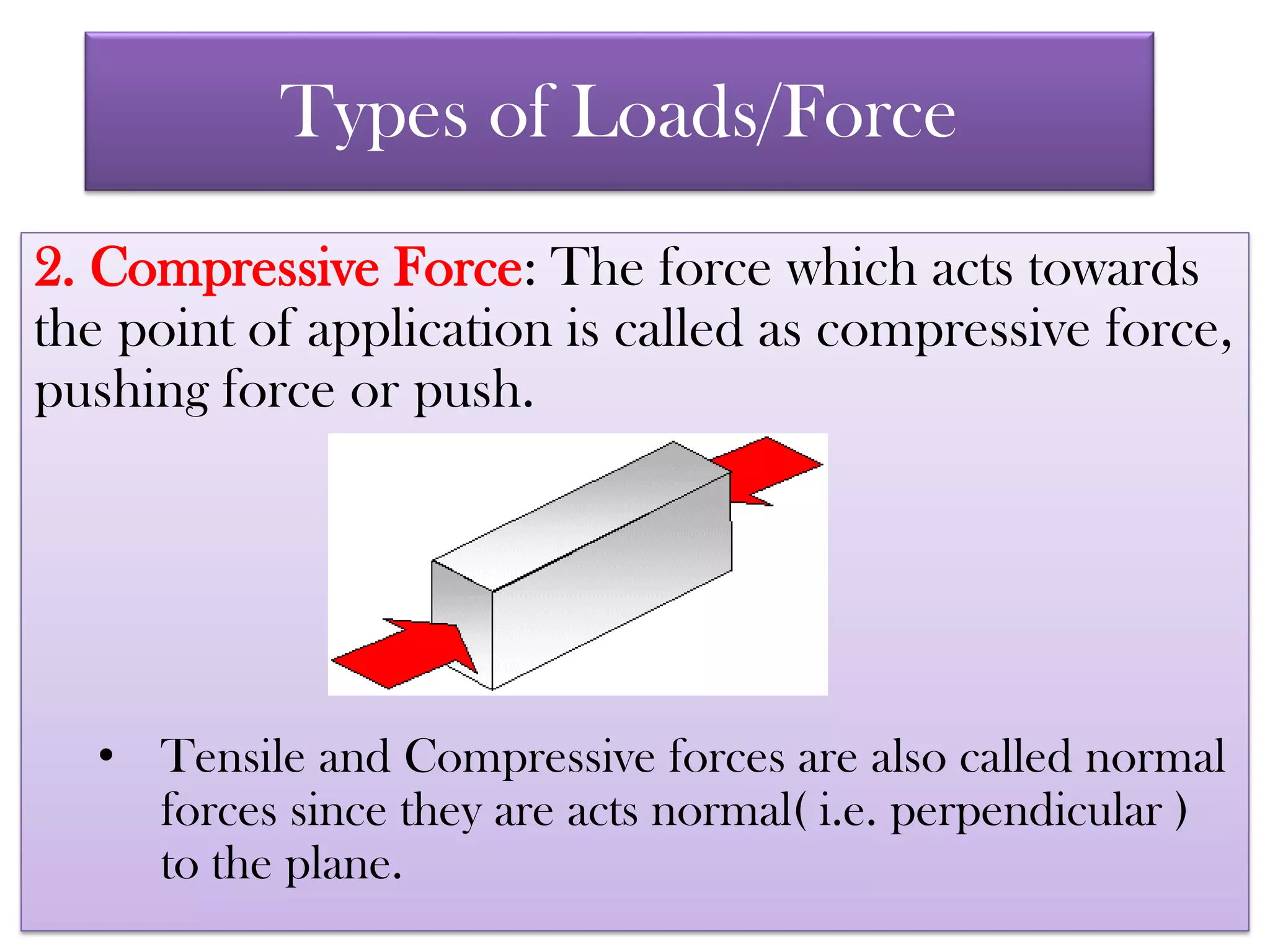
2. Compressive Force: The force which acts towards
the point of application is called as compressive force,
pushing force or push.
• Tensile and Compressive forces are also called normal
forces since they are acts normal( i.e. perpendicular )
to the plane.
Types of Loads/Force
3. Shear Force: The force which acts parallel or
tangential to the plane is called as Shear forces.
Types of Loads/Force
Concept of Axial Loading
• Axial Loading: A load whose line of action
coincide with the axis of a member, is called an
axial load.
• An axial load may be either tensile (pull) or
compressive load.
Concept of Stress
• If an external load is applied on body then body will
deform means its length – width will change.
• Before that the theory, is if external load is applied on
body then there is a resistive force will resist that force due
to that the body get balanced.
• Means it‟s the Newton's law if There is action there will be
reaction.
• To satisfy equilibrium condition of body there should be
Resistive force must be equal to external force.
Concept of Stress
Stress:
Concept of Stress
• Stress: The ratio of internal resistive force ( R )
per unit cross section area ( A ) is called as Stress.
OR
• Stress: The ratio of force acting on body ( P ) per
unit cross section area ( A ) is called as Stress.
• It is denoted by the symbol „σ‟ (Sigma).
• Stress (σ) =
𝑹𝒆𝒔𝒊𝒔𝒕𝒊𝒏𝒈 𝒇𝒐𝒓𝒄𝒆
𝑪𝒓𝒐𝒔𝒔 𝑺𝒆𝒄𝒕𝒊𝒐𝒏𝒂𝒍 𝑨𝒓𝒆𝒂
=
𝑹
𝑨
OR
• Stress (σ) =
𝑨𝒑𝒑𝒍𝒊𝒆𝒅 𝒇𝒐𝒓𝒄𝒆
𝑪𝒓𝒐𝒔𝒔 𝑺𝒆𝒄𝒕𝒊𝒐𝒏𝒂𝒍 𝑨𝒓𝒆𝒂
=
𝑷
𝑨
S.I. Unit of Stress
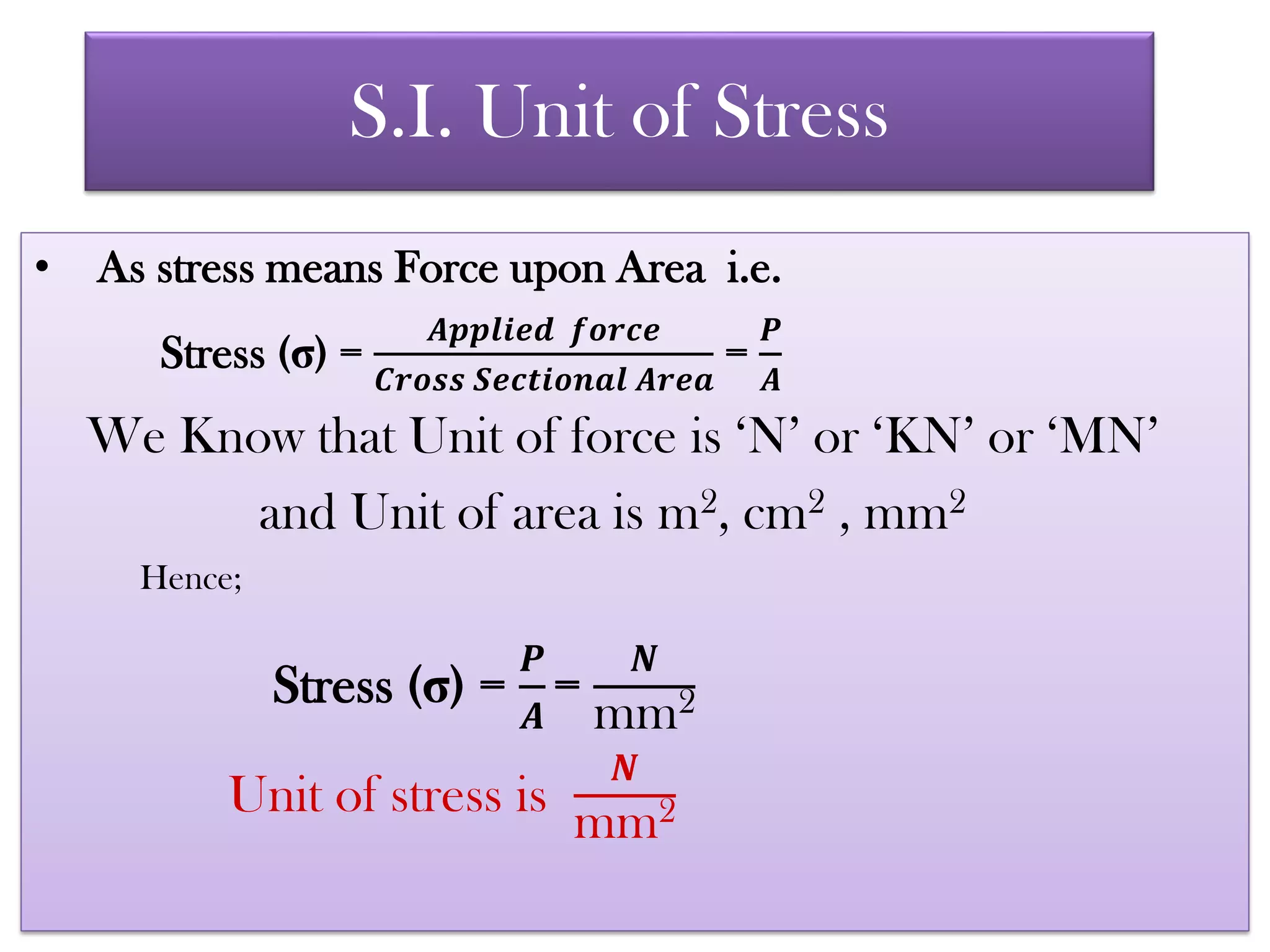
• As stress means Force upon Area i.e.
Stress (σ) =
𝑨𝒑𝒑𝒍𝒊𝒆𝒅 𝒇𝒐𝒓𝒄𝒆
𝑪𝒓𝒐𝒔𝒔 𝑺𝒆𝒄𝒕𝒊𝒐𝒏𝒂𝒍 𝑨𝒓𝒆𝒂
=
𝑷
𝑨
We Know that Unit of force is „N‟ or „KN‟ or „MN‟
and Unit of area is m2, cm2 , mm2
Hence;
Stress (σ) =
𝑷
𝑨
=
𝑵
mm2
Unit of stress is
𝑵
mm2
𝑵
mm2 is called as Pascal & denoted by „Pa‟
therefore SI unit of stress is Pascal.
1Pa = 1
𝑵
m2
Other Unit of stress are Kilo Pascal (KPa), = 103 Pa
Mega Pascal ( Mpa) = 106 Pa
Gega Pascal ( GPa) = 109 Pa
1KPa = 103 Pa = 103 N/m2
1Mpa = 106 Pa = 106 N/m2 =
106
106 N/mm2
1Mpa = 1 N/mm2
1GPa = 109 Pa = 109 N/m2 =
109
106 N/mm2
1GPa = 103 N/mm2
Concept of Strain
• If the load is applied on body then length and width of
body will change;
• If tensile load is applied then body‟s length will increase
and width will decrease and
• If compressive force is applied then length decrease and
width will increase.
• Strain: The strain is defined as the ratio of change in
dimension of body to the original dimension of body.
• It is denoted by „e‟ or „𝜖‟ (Epson).
Concept of Strain
Strain:
Concept of Strain
• Then Strain =
𝐶𝑕𝑎𝑛𝑔𝑒 𝑖𝑛 𝑑𝑖𝑚𝑒𝑛𝑠𝑖𝑜𝑛 𝑜𝑓 𝑏𝑜𝑑𝑦
𝑂𝑟𝑖𝑔𝑖𝑛𝑎𝑙 𝑑𝑖𝑚𝑒𝑛𝑠𝑖𝑜𝑛 𝑜𝑓 𝑏𝑜𝑑𝑦
• Dimension in which length, width etc.
Strain =
𝛿𝑙
𝐿
=
𝐶𝑕𝑎𝑛𝑔𝑒 𝑖𝑛 𝑙𝑒𝑛𝑔𝑡𝑕 𝑜𝑓 𝑏𝑜𝑑𝑦
𝑂𝑟𝑖𝑔𝑖𝑛𝑎𝑙 𝑙𝑒𝑛𝑔𝑡𝑕 𝑜𝑓 𝑏𝑜𝑑𝑦
• Unit: It is unit less quantity.
Concept of Stress And Strain
Types of Stresses & Strain
Tensile Stress
& Strain
Compressive
Stress & Strain
Shear Stress &
Strain
Types Stress & Strain
 Tensile Stress: When two equal and apposite pulls to a
body tend to elongate it, the body is said to be under
tension and the stresses induced in it is called as Tensile
Stress.
• And the Corresponding strain is called Tensile strain.
• Tensile Stress (σt) =
𝑷
𝑨
Strain =
𝛿𝑙
𝐿
Types Stress & Strain
 Compressive Stress: When two equal and apposite
pushes applied to a body tend to compress it, the body is
said to be under compression and the stresses induced in
it is called as Compressive Stress.
• And the Corresponding strain is called Compressive
strain.
• Tensile Stress (σc) =
𝑷
𝑨
Strain =
𝛿𝑙
𝐿
Types Stress & Strain
 Shear Stress: The force which acts parallel or tangential to
the plane due to this the body will slide or one plane of
body will slide over other then the stress is produced in it
is called as shear stress.
• And the Corresponding strain is called shear strain.
Elastic Limit
 For Every material there is limiting (maximum)
value of load for a given resisting section up to and
within which the strain (deformation) entirely on
the disappears on removal of load.
 The value of intensity of stress corresponding to
the limiting load is known as Elastic Limit.
Hooks Law
• It states that, “ When a material is loaded within elastic
limit, then the stress is directly proportional to the strain”
Mathematically, Stress ∝ Strain
𝛔 ∝ e
𝛔 = 𝑬 e
E = Young‟s Modulus.
Modulus of Elasticity
Definition: The ratio of stress and strain which is
constant within elastic limit, is called as modulus of
elasticity or Young's Modulus.
• It is Denoted by „E”
• Young‟s Modulus E =
𝑆𝑡𝑟𝑒𝑠𝑠
𝑆𝑡𝑟𝑎𝑖𝑛
• E = 𝜎
e
Deformation of Body due to Axial Load
 Change in Length of body due to force action on it
We know that Stress (σ c) =
𝑷
𝑨
Strain =
𝛿𝑙
𝐿
Young‟s Modulus E = 𝜎
e
Substituting the value of σ and e in above equation,
E =
𝑃
𝐴
𝛿𝑙
𝐿
𝐸 =
𝑃
𝐴
𝑋
𝐿
𝛿𝑙
𝛿𝑙 =
𝑃𝐿
𝐴𝐸
Problems
 Problems on Stress-Strain, Young‟s Modulus and
Deflection:
Formulae's:
1. Stress 𝜎 =
𝑃
𝐴
2. Strain e =
𝛿𝑙
𝐿
3. Young‟s Modulus E =
𝜎
𝑒
4. Deflection =
𝑃𝐿
𝐴𝐸
Q.1 A steel rod is subjected to an axial pull of 25 kN. Find maximum
diameter if the stress is not exceed 100N/mm2. The length of rod is
2000mm and take E= 2.1x 10⁵ N/mm2 . (Summer 2019 -4 Marks)
Answer: Given data:
Pull P = 25KN= 25 x 103 N. Stress 𝜎 = 110N/mm2
L = 2000mm and E = 2.1 x 10⁵ N/mm2.
Find out: Diameter D = ?
As we Know that,
Stress 𝜎 =
𝑃
𝐴
Area A =
𝜋
4
x D2
Using value of stress and Load
110 =
25 x 103
𝐴
A =
25 x 103
110
A = 227.27 mm2.
A =
𝜋
4
x D2
227.27 =
𝜋
4
x D2
D2 = 289.6
D = 17.01 mm……..ANS
Q.2 A bar of cross section area 200mm2 is axially pulled by a force „P‟
KN. If the maximum stress induced in the bar is 30MPa, determine „P‟.
If elongation of 1.2mm is observed over a gauge length 3m. Determine
Young‟s modulus. (S-16, 4 Marks)
Answer: Given data: Area A = 200mm2; Stress 𝜎 = 30Mpa = 30N/mm2
Elongation 𝛿𝑙 = 1.2 mm Length = 3m = 3 x 103 mm
Find: Force P = ? And E = ?
Deflection 𝛿𝑙 =
𝑃𝐿
𝐴𝐸
Stress 𝜎 =
𝑃
𝐴
30 =
𝑃
200
P = 6000 N…..ANS
Deflection 𝛿𝑙 =
𝑃𝐿
𝐴𝐸
𝛿𝑙 = 1.2 mm ; L = 3 x 10³ and A= 200mm2
Use above value in formula of deflection
𝛿𝑙 =
𝑃𝐿
𝐴𝐸
1.2 =
6000 𝑋3 x 10³
200 𝑋 𝐸
E =
6000 𝑋3 x 10³
200 𝑋 1.2
E = 75 x 103 N/mm2………Ans
Q.3 Find the diameter of a circular rod 2.4m long when subjected to an
axial pull 15KN, shows an elongation of 1mm. Take E = 205 KN/mm2.
(S-17 4 marks)
Answer: Given data: Length L= 2.4m = 2.4 x 10 3 mm,
P = 15KN = 15 x 10 3 N,
Elongation 𝛿𝑙 = 1mm E = 205 KN/mm2.
Find: Dia. of bar D= ?
We know that
Deflection 𝛿𝑙 =
𝑃𝐿
𝐴𝐸
1 =
15 𝑋10 3𝑋2.4 x 10 3
𝐴 x 205 𝑋10 3
𝐴 =
15 𝑋10 3𝑋2.4 x 10 3
1 𝑥205 𝑋10 3
𝐴 =
15 𝑋10 3𝑋2.4 x 10 3
1 𝑥205 𝑋10 3
A = 175.61 mm2
but A =
𝜋
4
x D2
Then 175.61 =
𝜋
4
x D2
D2 = 223.59
D = 14.95 mm ……. ANS
Q.4 A load of 6 kN is to be raised with the help of steel cable.
Determine the minimum diameter of steel cable if stress is not to
exceed 110 N/mm2. (W-18) 4 Marks.
ANS: Given Data : P = 6kN = 6 x 10 3 N , Stress 𝜎 = 110N /mm2.
Find: Min Dia. D = ?
Max Stress 𝜎 =
𝑃𝑚𝑎𝑥
𝐴𝑚𝑖𝑛
Amin=
𝑃𝑚𝑎𝑥
Max Stress 𝜎
Amin=
6 x 10 3
110
Amin = 54.55 mm2
but Amin =
𝜋
4
x D2
54.55 =
𝜋
4
x D2
D2 = 69.44
D = 8.33 mm…….ANS
Thank You…..!

Concept of Simple Stress & Strain

  • 1.
    Simple Stress and Strain ByMr.Milind K.Chavan M.E. Structure SIT Polytechnic,Ichalkaranji
  • 2.
    Concept of Elastic,Plastic and Rigid Body 1. Elastic Body: A body which possesses the property of elasticity is called as an Elastic body. 2. Plastic Body: A body which does not regain its original size and shape on removal of external load is called Plastic body. 3. Rigid Body: If there is no effect of external force on body then that body is known as Rigid body. • No body is Rigid body in this world. • It is only theoretical concept.
  • 3.
    Types of Loads/Force 1. Tensile Force: The force which acts away from the point of application is called tensile force, pulling force or pull.
  • 4.
    Types of Loads/Force 2.Compressive Force: The force which acts towards the point of application is called as compressive force, pushing force or push. • Tensile and Compressive forces are also called normal forces since they are acts normal( i.e. perpendicular ) to the plane.
  • 5.
    Types of Loads/Force 3.Shear Force: The force which acts parallel or tangential to the plane is called as Shear forces.
  • 6.
  • 7.
    Concept of AxialLoading • Axial Loading: A load whose line of action coincide with the axis of a member, is called an axial load. • An axial load may be either tensile (pull) or compressive load.
  • 8.
    Concept of Stress •If an external load is applied on body then body will deform means its length – width will change. • Before that the theory, is if external load is applied on body then there is a resistive force will resist that force due to that the body get balanced. • Means it‟s the Newton's law if There is action there will be reaction. • To satisfy equilibrium condition of body there should be Resistive force must be equal to external force.
  • 9.
  • 10.
    Concept of Stress •Stress: The ratio of internal resistive force ( R ) per unit cross section area ( A ) is called as Stress. OR • Stress: The ratio of force acting on body ( P ) per unit cross section area ( A ) is called as Stress. • It is denoted by the symbol „σ‟ (Sigma). • Stress (σ) = 𝑹𝒆𝒔𝒊𝒔𝒕𝒊𝒏𝒈 𝒇𝒐𝒓𝒄𝒆 𝑪𝒓𝒐𝒔𝒔 𝑺𝒆𝒄𝒕𝒊𝒐𝒏𝒂𝒍 𝑨𝒓𝒆𝒂 = 𝑹 𝑨 OR • Stress (σ) = 𝑨𝒑𝒑𝒍𝒊𝒆𝒅 𝒇𝒐𝒓𝒄𝒆 𝑪𝒓𝒐𝒔𝒔 𝑺𝒆𝒄𝒕𝒊𝒐𝒏𝒂𝒍 𝑨𝒓𝒆𝒂 = 𝑷 𝑨
  • 11.
    S.I. Unit ofStress • As stress means Force upon Area i.e. Stress (σ) = 𝑨𝒑𝒑𝒍𝒊𝒆𝒅 𝒇𝒐𝒓𝒄𝒆 𝑪𝒓𝒐𝒔𝒔 𝑺𝒆𝒄𝒕𝒊𝒐𝒏𝒂𝒍 𝑨𝒓𝒆𝒂 = 𝑷 𝑨 We Know that Unit of force is „N‟ or „KN‟ or „MN‟ and Unit of area is m2, cm2 , mm2 Hence; Stress (σ) = 𝑷 𝑨 = 𝑵 mm2 Unit of stress is 𝑵 mm2
  • 12.
    𝑵 mm2 is calledas Pascal & denoted by „Pa‟ therefore SI unit of stress is Pascal. 1Pa = 1 𝑵 m2 Other Unit of stress are Kilo Pascal (KPa), = 103 Pa Mega Pascal ( Mpa) = 106 Pa Gega Pascal ( GPa) = 109 Pa 1KPa = 103 Pa = 103 N/m2 1Mpa = 106 Pa = 106 N/m2 = 106 106 N/mm2 1Mpa = 1 N/mm2 1GPa = 109 Pa = 109 N/m2 = 109 106 N/mm2 1GPa = 103 N/mm2
  • 13.
    Concept of Strain •If the load is applied on body then length and width of body will change; • If tensile load is applied then body‟s length will increase and width will decrease and • If compressive force is applied then length decrease and width will increase. • Strain: The strain is defined as the ratio of change in dimension of body to the original dimension of body. • It is denoted by „e‟ or „𝜖‟ (Epson).
  • 14.
  • 15.
    Concept of Strain •Then Strain = 𝐶𝑕𝑎𝑛𝑔𝑒 𝑖𝑛 𝑑𝑖𝑚𝑒𝑛𝑠𝑖𝑜𝑛 𝑜𝑓 𝑏𝑜𝑑𝑦 𝑂𝑟𝑖𝑔𝑖𝑛𝑎𝑙 𝑑𝑖𝑚𝑒𝑛𝑠𝑖𝑜𝑛 𝑜𝑓 𝑏𝑜𝑑𝑦 • Dimension in which length, width etc. Strain = 𝛿𝑙 𝐿 = 𝐶𝑕𝑎𝑛𝑔𝑒 𝑖𝑛 𝑙𝑒𝑛𝑔𝑡𝑕 𝑜𝑓 𝑏𝑜𝑑𝑦 𝑂𝑟𝑖𝑔𝑖𝑛𝑎𝑙 𝑙𝑒𝑛𝑔𝑡𝑕 𝑜𝑓 𝑏𝑜𝑑𝑦 • Unit: It is unit less quantity.
  • 16.
  • 17.
    Types of Stresses& Strain Tensile Stress & Strain Compressive Stress & Strain Shear Stress & Strain
  • 18.
    Types Stress &Strain  Tensile Stress: When two equal and apposite pulls to a body tend to elongate it, the body is said to be under tension and the stresses induced in it is called as Tensile Stress. • And the Corresponding strain is called Tensile strain. • Tensile Stress (σt) = 𝑷 𝑨 Strain = 𝛿𝑙 𝐿
  • 19.
    Types Stress &Strain  Compressive Stress: When two equal and apposite pushes applied to a body tend to compress it, the body is said to be under compression and the stresses induced in it is called as Compressive Stress. • And the Corresponding strain is called Compressive strain. • Tensile Stress (σc) = 𝑷 𝑨 Strain = 𝛿𝑙 𝐿
  • 20.
    Types Stress &Strain  Shear Stress: The force which acts parallel or tangential to the plane due to this the body will slide or one plane of body will slide over other then the stress is produced in it is called as shear stress. • And the Corresponding strain is called shear strain.
  • 21.
    Elastic Limit  ForEvery material there is limiting (maximum) value of load for a given resisting section up to and within which the strain (deformation) entirely on the disappears on removal of load.  The value of intensity of stress corresponding to the limiting load is known as Elastic Limit.
  • 22.
    Hooks Law • Itstates that, “ When a material is loaded within elastic limit, then the stress is directly proportional to the strain” Mathematically, Stress ∝ Strain 𝛔 ∝ e 𝛔 = 𝑬 e E = Young‟s Modulus.
  • 23.
    Modulus of Elasticity Definition:The ratio of stress and strain which is constant within elastic limit, is called as modulus of elasticity or Young's Modulus. • It is Denoted by „E” • Young‟s Modulus E = 𝑆𝑡𝑟𝑒𝑠𝑠 𝑆𝑡𝑟𝑎𝑖𝑛 • E = 𝜎 e
  • 24.
    Deformation of Bodydue to Axial Load  Change in Length of body due to force action on it We know that Stress (σ c) = 𝑷 𝑨 Strain = 𝛿𝑙 𝐿 Young‟s Modulus E = 𝜎 e Substituting the value of σ and e in above equation, E = 𝑃 𝐴 𝛿𝑙 𝐿 𝐸 = 𝑃 𝐴 𝑋 𝐿 𝛿𝑙 𝛿𝑙 = 𝑃𝐿 𝐴𝐸
  • 25.
    Problems  Problems onStress-Strain, Young‟s Modulus and Deflection: Formulae's: 1. Stress 𝜎 = 𝑃 𝐴 2. Strain e = 𝛿𝑙 𝐿 3. Young‟s Modulus E = 𝜎 𝑒 4. Deflection = 𝑃𝐿 𝐴𝐸
  • 26.
    Q.1 A steelrod is subjected to an axial pull of 25 kN. Find maximum diameter if the stress is not exceed 100N/mm2. The length of rod is 2000mm and take E= 2.1x 10⁵ N/mm2 . (Summer 2019 -4 Marks) Answer: Given data: Pull P = 25KN= 25 x 103 N. Stress 𝜎 = 110N/mm2 L = 2000mm and E = 2.1 x 10⁵ N/mm2. Find out: Diameter D = ? As we Know that, Stress 𝜎 = 𝑃 𝐴 Area A = 𝜋 4 x D2 Using value of stress and Load 110 = 25 x 103 𝐴
  • 27.
    A = 25 x103 110 A = 227.27 mm2. A = 𝜋 4 x D2 227.27 = 𝜋 4 x D2 D2 = 289.6 D = 17.01 mm……..ANS
  • 28.
    Q.2 A barof cross section area 200mm2 is axially pulled by a force „P‟ KN. If the maximum stress induced in the bar is 30MPa, determine „P‟. If elongation of 1.2mm is observed over a gauge length 3m. Determine Young‟s modulus. (S-16, 4 Marks) Answer: Given data: Area A = 200mm2; Stress 𝜎 = 30Mpa = 30N/mm2 Elongation 𝛿𝑙 = 1.2 mm Length = 3m = 3 x 103 mm Find: Force P = ? And E = ? Deflection 𝛿𝑙 = 𝑃𝐿 𝐴𝐸 Stress 𝜎 = 𝑃 𝐴 30 = 𝑃 200 P = 6000 N…..ANS
  • 29.
    Deflection 𝛿𝑙 = 𝑃𝐿 𝐴𝐸 𝛿𝑙= 1.2 mm ; L = 3 x 10³ and A= 200mm2 Use above value in formula of deflection 𝛿𝑙 = 𝑃𝐿 𝐴𝐸 1.2 = 6000 𝑋3 x 10³ 200 𝑋 𝐸 E = 6000 𝑋3 x 10³ 200 𝑋 1.2 E = 75 x 103 N/mm2………Ans
  • 30.
    Q.3 Find thediameter of a circular rod 2.4m long when subjected to an axial pull 15KN, shows an elongation of 1mm. Take E = 205 KN/mm2. (S-17 4 marks) Answer: Given data: Length L= 2.4m = 2.4 x 10 3 mm, P = 15KN = 15 x 10 3 N, Elongation 𝛿𝑙 = 1mm E = 205 KN/mm2. Find: Dia. of bar D= ? We know that Deflection 𝛿𝑙 = 𝑃𝐿 𝐴𝐸 1 = 15 𝑋10 3𝑋2.4 x 10 3 𝐴 x 205 𝑋10 3 𝐴 = 15 𝑋10 3𝑋2.4 x 10 3 1 𝑥205 𝑋10 3
  • 31.
    𝐴 = 15 𝑋103𝑋2.4 x 10 3 1 𝑥205 𝑋10 3 A = 175.61 mm2 but A = 𝜋 4 x D2 Then 175.61 = 𝜋 4 x D2 D2 = 223.59 D = 14.95 mm ……. ANS
  • 32.
    Q.4 A loadof 6 kN is to be raised with the help of steel cable. Determine the minimum diameter of steel cable if stress is not to exceed 110 N/mm2. (W-18) 4 Marks. ANS: Given Data : P = 6kN = 6 x 10 3 N , Stress 𝜎 = 110N /mm2. Find: Min Dia. D = ? Max Stress 𝜎 = 𝑃𝑚𝑎𝑥 𝐴𝑚𝑖𝑛 Amin= 𝑃𝑚𝑎𝑥 Max Stress 𝜎 Amin= 6 x 10 3 110 Amin = 54.55 mm2 but Amin = 𝜋 4 x D2 54.55 = 𝜋 4 x D2
  • 33.
    D2 = 69.44 D= 8.33 mm…….ANS
  • 34.