- A circle is the set of all points in a plane that are equidistant from a fixed point called the center.
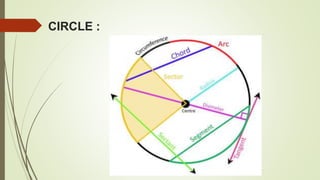
- Important terms related to circles include chord, diameter, arc, sector, minor/major segments.
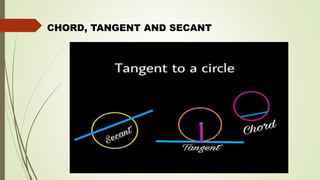
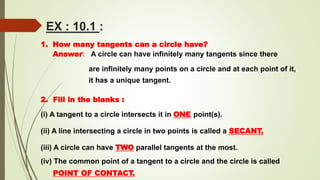
- A tangent touches the circle at one point, a secant intersects at two points, and there can be at most two parallel tangents for a given secant.
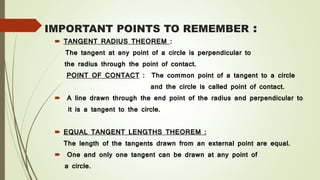
- The tangent radius theorem states that the tangent is perpendicular to the radius at the point of contact. The equal tangent lengths theorem says tangents from an external point are equal in length.

The concept of a circle, its definition, components like radius and circumference, and the method to draw it using a compass.
An overview of how circles are utilized in daily life, though specific applications are not detailed.
Important terms include chord, diameter, arc, segment, and sector of a circle, explaining their definitions and significance.
Understanding relationships between lines and circles, including tangents and secants, and their respective definitions.
Details on tangents, including conditions for drawing tangents, properties of tangents from points inside and outside circles.
Various theorems related to circles, including tangent-radius theorem and equal tangent lengths theorem, along with essential points.
A series of examples and proofs related to tangents, chords, angles, and properties involving circles and quadrilaterals, applying previous concepts to solve.
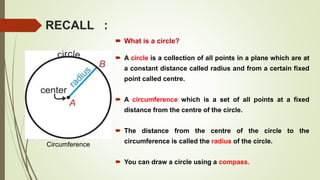
RECALL :
Whatis a circle?
A circle is a collection of all points in a plane which are at
a constant distance called radius and from a certain fixed
point called centre.
A circumference which is a set of all points at a fixed
distance from the centre of the circle.
The distance from the centre of the circle to the
circumference is called the radius of the circle.
You can draw a circle using a compass.
Circumference
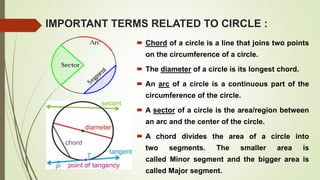
IMPORTANT TERMS RELATEDTO CIRCLE :
Chord of a circle is a line that joins two points
on the circumference of a circle.
The diameter of a circle is its longest chord.
An arc of a circle is a continuous part of the
circumference of the circle.
A sector of a circle is the area/region between
an arc and the center of the circle.
A chord divides the area of a circle into
two segments. The smaller area is
called Minor segment and the bigger area is
called Major segment.
6.
Introduction to Circles
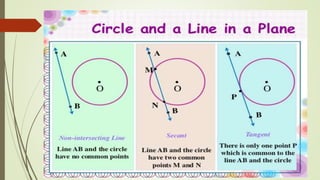
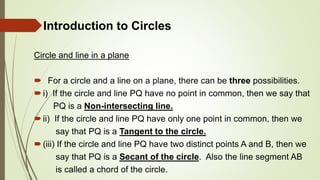
Circleand line in a plane
For a circle and a line on a plane, there can be three possibilities.
i) If the circle and line PQ have no point in common, then we say that
PQ is a Non-intersecting line.
ii) If the circle and line PQ have only one point in common, then we
say that PQ is a Tangent to the circle.
(iii) If the circle and line PQ have two distinct points A and B, then we
say that PQ is a Secant of the circle. Also the line segment AB
is called a chord of the circle.
7.
TANGENT :
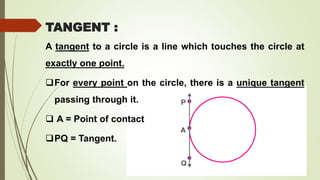
A tangentto a circle is a line which touches the circle at
exactly one point.
For every point on the circle, there is a unique tangent
passing through it.
A = Point of contact
PQ = Tangent.
8.
SECANT :
SECANT :
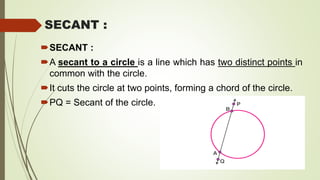
Asecant to a circle is a line which has two distinct points in
common with the circle.
It cuts the circle at two points, forming a chord of the circle.
PQ = Secant of the circle.
9.
TWO PARALLEL TANGENTSAT MOST FOR A GIVEN
SECANT :
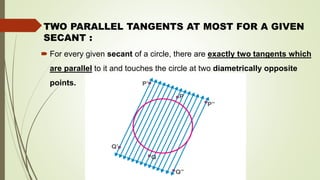
For every given secant of a circle, there are exactly two tangents which
are parallel to it and touches the circle at two diametrically opposite
points.
10.
IMPORTANT POINTS TOREMEMBER :
The number of tangents drawn from a given point.
i) If the point is in an interior region of the circle, any line
through that point will be a secant.
So, no tangent can be drawn to a circle which passes
through a point that lies inside it.
ii) When a point of tangency lies on the circle, there
is exactly one tangent to a circle that passes through it.
11.
TANGENT FROM ANEXTERNAL POINT
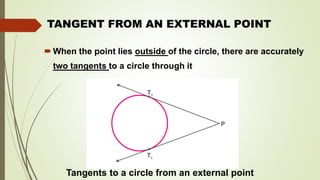
When the point lies outside of the circle, there are accurately
two tangents to a circle through it
Tangents to a circle from an external point
12.
LENGTH OF ATANGENT
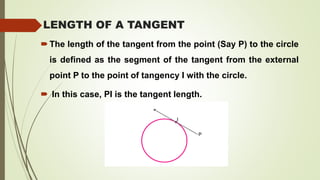
The length of the tangent from the point (Say P) to the circle
is defined as the segment of the tangent from the external
point P to the point of tangency I with the circle.
In this case, PI is the tangent length.
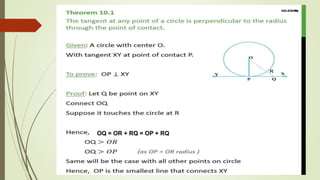
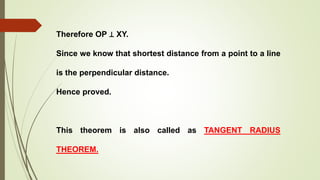
Therefore OP ⊥XY.
Since we know that shortest distance from a point to a line
is the perpendicular distance.
Hence proved.
This theorem is also called as TANGENT RADIUS
THEOREM.
IMPORTANT POINTS TOREMEMBER :
TANGENT RADIUS THEOREM :
The tangent at any point of a circle is perpendicular to
the radius through the point of contact.
POINT OF CONTACT : The common point of a tangent to a circle
and the circle is called point of contact.
A line drawn through the end point of the radius and perpendicular to
it is a tangent to the circle.
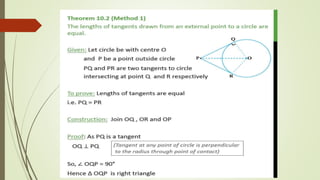
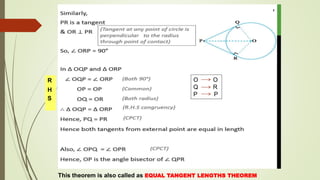
EQUAL TANGENT LENGTHS THEOREM :
The length of the tangents drawn from an external point are equal.
One and only one tangent can be drawn at any point of
a circle.
20.
EX : 10.1:
1. How many tangents can a circle have?
Answer: A circle can have infinitely many tangents since there
are infinitely many points on a circle and at each point of it,
it has a unique tangent.
2. Fill in the blanks :
(i) A tangent to a circle intersects it in ONE point(s).
(ii) A line intersecting a circle in two points is called a SECANT.
(iii) A circle can have TWO parallel tangents at the most.
(iv) The common point of a tangent to a circle and the circle is called
POINT OF CONTACT.
21.
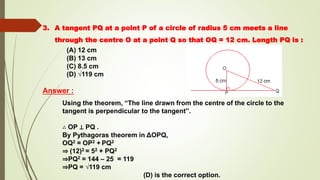
3. A tangentPQ at a point P of a circle of radius 5 cm meets a line
through the centre O at a point Q so that OQ = 12 cm. Length PQ is :
(A) 12 cm
(B) 13 cm
(C) 8.5 cm
(D) √119 cm
Answer :
Using the theorem, “The line drawn from the centre of the circle to the
tangent is perpendicular to the tangent”.
∴ OP ⊥ PQ .
By Pythagoras theorem in ΔOPQ,
OQ2 = OP2 + PQ2
⇒ (12)2 = 52 + PQ2
⇒PQ2 = 144 – 25 = 119
⇒PQ = √119 cm
(D) is the correct option.
22.
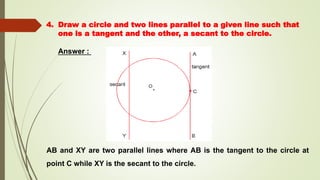
4. Draw acircle and two lines parallel to a given line such that
one is a tangent and the other, a secant to the circle.
Answer :
AB and XY are two parallel lines where AB is the tangent to the circle at
point C while XY is the secant to the circle.
23.
EX : 10.2
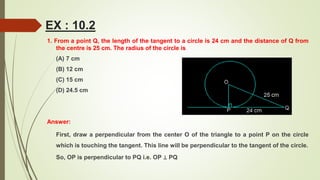
1.From a point Q, the length of the tangent to a circle is 24 cm and the distance of Q from
the centre is 25 cm. The radius of the circle is
(A) 7 cm
(B) 12 cm
(C) 15 cm
(D) 24.5 cm
Answer:
First, draw a perpendicular from the center O of the triangle to a point P on the circle
which is touching the tangent. This line will be perpendicular to the tangent of the circle.
So, OP is perpendicular to PQ i.e. OP ⊥ PQ
24.
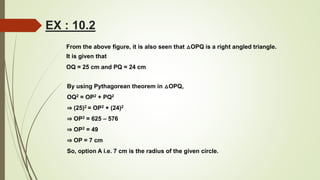
By using Pythagoreantheorem in △OPQ,
OQ2 = OP2 + PQ2
⇒ (25)2 = OP2 + (24)2
⇒ OP2 = 625 – 576
⇒ OP2 = 49
⇒ OP = 7 cm
So, option A i.e. 7 cm is the radius of the given circle.
EX : 10.2
From the above figure, it is also seen that △OPQ is a right angled triangle.
It is given that
OQ = 25 cm and PQ = 24 cm
25.
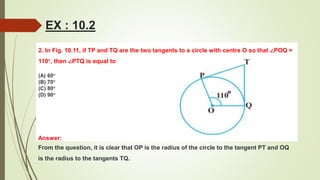
2. In Fig.10.11, if TP and TQ are the two tangents to a circle with centre O so that ∠POQ =
110°, then ∠PTQ is equal to
(A) 60°
(B) 70°
(C) 80°
(D) 90°
EX : 10.2
Answer:
From the question, it is clear that OP is the radius of the circle to the tangent PT and OQ
is the radius to the tangents TQ.
26.
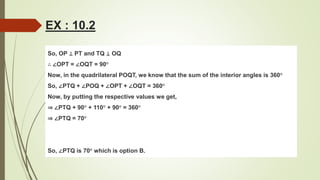
So, OP ⊥PT and TQ ⊥ OQ
∴ ∠OPT = ∠OQT = 90°
Now, in the quadrilateral POQT, we know that the sum of the interior angles is 360°
So, ∠PTQ + ∠POQ + ∠OPT + ∠OQT = 360°
Now, by putting the respective values we get,
⇒ ∠PTQ + 90° + 110° + 90° = 360°
⇒ ∠PTQ = 70°
So, ∠PTQ is 70° which is option B.
EX : 10.2
27.
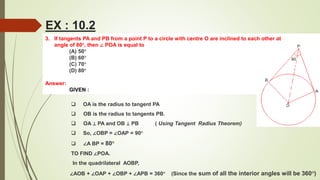
3. If tangentsPA and PB from a point P to a circle with centre O are inclined to each other at
angle of 80°, then ∠ POA is equal to
(A) 50°
(B) 60°
(C) 70°
(D) 80°
Answer:
GIVEN :
EX : 10.2
OA is the radius to tangent PA
OB is the radius to tangents PB.
OA ⊥ PA and OB ⊥ PB ( Using Tangent Radius Theorem)
So, ∠OBP = ∠OAP = 90°
∠A BP = 80°
TO FIND ∠POA.
In the quadrilateral AOBP,
∠AOB + ∠OAP + ∠OBP + ∠APB = 360° (Since the sum of all the interior angles will be 360°)
28.
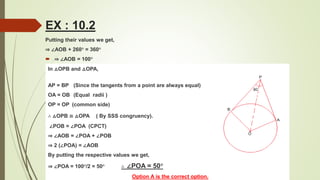
Putting their valueswe get,
⇒ ∠AOB + 260° = 360°
⇒ ∠AOB = 100°
In △OPB and △OPA,
AP = BP (Since the tangents from a point are always equal)
OA = OB (Equal radii )
OP = OP (common side)
∴ △OPB ≅ △OPA ( By SSS congruency).
∠POB = ∠POA (CPCT)
⇒ ∠AOB = ∠POA + ∠POB
⇒ 2 (∠POA) = ∠AOB
By putting the respective values we get,
⇒ ∠POA = 100°/2 = 50° ∴ ∠POA = 50°
Option A is the correct option.
EX : 10.2
29.
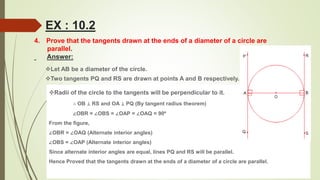
4. Prove thatthe tangents drawn at the ends of a diameter of a circle are
parallel.
Answer:
Radii of the circle to the tangents will be perpendicular to it.
∴ OB ⊥ RS and OA ⊥ PQ (By tangent radius theorem)
∠OBR = ∠OBS = ∠OAP = ∠OAQ = 90º
From the figure,
∠OBR = ∠OAQ (Alternate interior angles)
∠OBS = ∠OAP (Alternate interior angles)
Since alternate interior angles are equal, lines PQ and RS will be parallel.
Hence Proved that the tangents drawn at the ends of a diameter of a circle are parallel.
Let AB be a diameter of the circle.
Two tangents PQ and RS are drawn at points A and B respectively.
EX : 10.2
30.
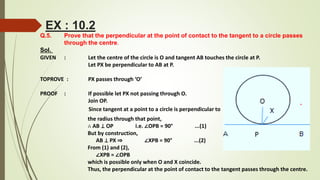
Q.5. Prove thatthe perpendicular at the point of contact to the tangent to a circle passes
through the centre.
Sol.
GIVEN : Let the centre of the circle is O and tangent AB touches the circle at P.
Let PX be perpendicular to AB at P.
TOPROVE : PX passes through ‘O’
PROOF : If possible let PX not passing through O.
Join OP.
Since tangent at a point to a circle is perpendicular to
the radius through that point,
∴ AB ⊥ OP i.e. ∠OPB = 90° ...(1)
But by construction,
AB ⊥ PX ⇒ ∠XPB = 90° ...(2)
From (1) and (2),
∠XPB = ∠OPB
which is possible only when O and X coincide.
Thus, the perpendicular at the point of contact to the tangent passes through the centre.
EX : 10.2
31.
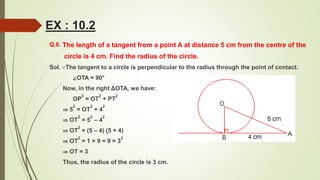
Q.6. The lengthof a tangent from a point A at distance 5 cm from the centre of the
circle is 4 cm. Find the radius of the circle.
Sol. ∵The tangent to a circle is perpendicular to the radius through the point of contact.
∠OTA = 90°
Now, in the right ΔOTA, we have:
OP
2
= OT
2
+ PT
2
⇒ 5
2
= OT
2
+ 4
2
⇒ OT
2
= 5
2
– 4
2
⇒ OT
2
= (5 – 4) (5 + 4)
⇒ OT
2
= 1 × 9 = 9 = 3
2
⇒ OT = 3
Thus, the radius of the circle is 3 cm.
EX : 10.2
32.
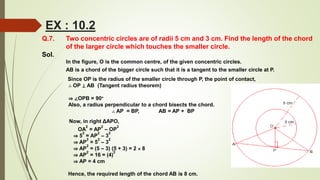
Q.7. Two concentriccircles are of radii 5 cm and 3 cm. Find the length of the chord
of the larger circle which touches the smaller circle.
Sol.
In the figure, O is the common centre, of the given concentric circles.
AB is a chord of the bigger circle such that it is a tangent to the smaller circle at P.
Since OP is the radius of the smaller circle through P, the point of contact,
∴ OP ⊥ AB (Tangent radius theorem)
⇒ ∠OPB = 90°
Also, a radius perpendicular to a chord bisects the chord.
∴ AP = BP, AB = AP + BP
Now, in right ΔAPO,
OA
2
= AP
2
– OP
2
⇒ 5
2
= AP
2
– 3
2
⇒ AP
2
= 5
2
– 3
2
⇒ AP
2
= (5 – 3) (5 + 3) = 2 × 8
⇒ AP
2
= 16 = (4)
2
⇒ AP = 4 cm
Hence, the required length of the chord AB is 8 cm.
EX : 10.2
33.
I
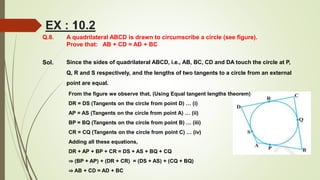
Q.8. A quadrilateralABCD is drawn to circumscribe a circle (see figure).
Prove that: AB + CD = AD + BC
Sol. Since the sides of quadrilateral ABCD, i.e., AB, BC, CD and DA touch the circle at P,
Q, R and S respectively, and the lengths of two tangents to a circle from an external
point are equal.
EX : 10.2
From the figure we observe that, (Using Equal tangent lengths theorem)
DR = DS (Tangents on the circle from point D) … (i)
AP = AS (Tangents on the circle from point A) … (ii)
BP = BQ (Tangents on the circle from point B) … (iii)
CR = CQ (Tangents on the circle from point C) … (iv)
Adding all these equations,
DR + AP + BP + CR = DS + AS + BQ + CQ
⇒ (BP + AP) + (DR + CR) = (DS + AS) + (CQ + BQ)
⇒ AB + CD = AD + BC
34.
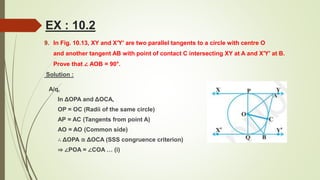
9. In Fig.10.13, XY and X′Y′ are two parallel tangents to a circle with centre O
and another tangent AB with point of contact C intersecting XY at A and X′Y′ at B.
Prove that ∠ AOB = 90°.
Solution :
EX : 10.2
A/q,
In ΔOPA and ΔOCA,
OP = OC (Radii of the same circle)
AP = AC (Tangents from point A)
AO = AO (Common side)
∴ ΔOPA ≅ ΔOCA (SSS congruence criterion)
⇒ ∠POA = ∠COA … (i)
35.
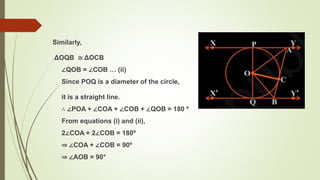
Similarly,
ΔOQB ≅ ΔOCB
∠QOB= ∠COB … (ii)
Since POQ is a diameter of the circle,
it is a straight line.
∴ ∠POA + ∠COA + ∠COB + ∠QOB = 180 º
From equations (i) and (ii),
2∠COA + 2∠COB = 180º
⇒ ∠COA + ∠COB = 90º
⇒ ∠AOB = 90°
36.
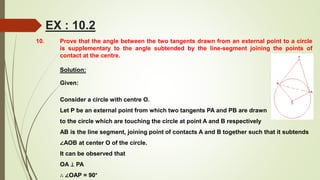
Given:
Consider a circlewith centre O.
Let P be an external point from which two tangents PA and PB are drawn
to the circle which are touching the circle at point A and B respectively
AB is the line segment, joining point of contacts A and B together such that it subtends
∠AOB at center O of the circle.
It can be observed that
OA ⊥ PA
∴ ∠OAP = 90°
10. Prove that the angle between the two tangents drawn from an external point to a circle
is supplementary to the angle subtended by the line-segment joining the points of
contact at the centre.
Solution:
EX : 10.2
37.
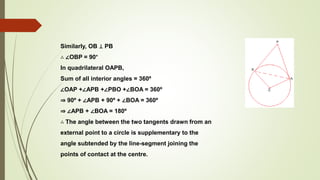
Similarly, OB ⊥PB
∴ ∠OBP = 90°
In quadrilateral OAPB,
Sum of all interior angles = 360º
∠OAP +∠APB +∠PBO +∠BOA = 360º
⇒ 90º + ∠APB + 90º + ∠BOA = 360º
⇒ ∠APB + ∠BOA = 180º
∴ The angle between the two tangents drawn from an
external point to a circle is supplementary to the
angle subtended by the line-segment joining the
points of contact at the centre.
38.
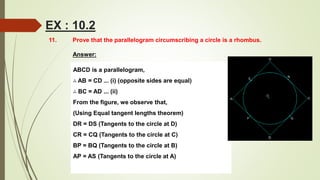
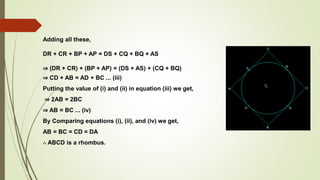
11. Prove thatthe parallelogram circumscribing a circle is a rhombus.
Answer:
ABCD is a parallelogram,
∴ AB = CD ... (i) (opposite sides are equal)
∴ BC = AD ... (ii)
From the figure, we observe that,
(Using Equal tangent lengths theorem)
DR = DS (Tangents to the circle at D)
CR = CQ (Tangents to the circle at C)
BP = BQ (Tangents to the circle at B)
AP = AS (Tangents to the circle at A)
EX : 10.2
39.
Adding all these,
DR+ CR + BP + AP = DS + CQ + BQ + AS
⇒ (DR + CR) + (BP + AP) = (DS + AS) + (CQ + BQ)
⇒ CD + AB = AD + BC ... (iii)
Putting the value of (i) and (ii) in equation (iii) we get,
⇒ 2AB = 2BC
⇒ AB = BC ... (iv)
By Comparing equations (i), (ii), and (iv) we get,
AB = BC = CD = DA
∴ ABCD is a rhombus.
40.
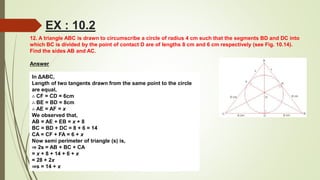
12. A triangleABC is drawn to circumscribe a circle of radius 4 cm such that the segments BD and DC into
which BC is divided by the point of contact D are of lengths 8 cm and 6 cm respectively (see Fig. 10.14).
Find the sides AB and AC.
Answer
In ΔABC,
Length of two tangents drawn from the same point to the circle
are equal,
∴ CF = CD = 6cm
∴ BE = BD = 8cm
∴ AE = AF = x
We observed that,
AB = AE + EB = x + 8
BC = BD + DC = 8 + 6 = 14
CA = CF + FA = 6 + x
Now semi perimeter of triangle (s) is,
⇒ 2s = AB + BC + CA
= x + 8 + 14 + 6 + x
= 28 + 2x
⇒s = 14 + x
EX : 10.2
41.
⇒
also, Area ofΔABC = 2×area of (ΔAOF + ΔCOD + ΔDOB)
= 2×[(1/2×OF×AF) + (1/2×CD×OD) + (1/2×DB×OD)]
= 2×1/2 (4x + 24 + 32) = 56 + 4x ... (ii)
Equating equation (i) and (ii) we get,
√(14 + x) 48 x = 56 + 4x
Squaring both sides,
48x (14 + x) = (56 + 4x)2
⇒ 48x = [4(14 + x)]2/(14 + x)
⇒ 48x = 16 (14 + x)
⇒ 48x = 224 + 16x
⇒ 32x = 224
⇒ x = 7 cm
Hence, AB = x + 8 = 7 + 8 = 15 cm
CA = 6 + x = 6 + 7 = 13 cm
Area of ΔABC = √s (s - a)(s - b)(s - c)
= √(14 + x) (14 + x - 14)(14 + x - x - 6)(14 + x - x - 8)
= √(14 + x) (x)(8)(6)
= √(14 + x) 48 x ... (i)
42.
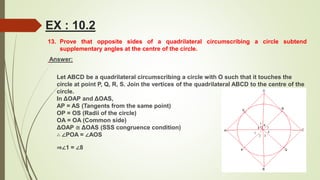
13. Prove thatopposite sides of a quadrilateral circumscribing a circle subtend
supplementary angles at the centre of the circle.
Answer:
Let ABCD be a quadrilateral circumscribing a circle with O such that it touches the
circle at point P, Q, R, S. Join the vertices of the quadrilateral ABCD to the centre of the
circle.
In ΔOAP and ΔOAS,
AP = AS (Tangents from the same point)
OP = OS (Radii of the circle)
OA = OA (Common side)
ΔOAP ≅ ΔOAS (SSS congruence condition)
∴ ∠POA = ∠AOS
⇒∠1 = ∠8
EX : 10.2
43.
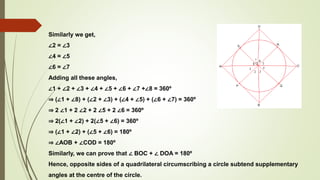
Similarly we get,
∠2= ∠3
∠4 = ∠5
∠6 = ∠7
Adding all these angles,
∠1 + ∠2 + ∠3 + ∠4 + ∠5 + ∠6 + ∠7 +∠8 = 360º
⇒ (∠1 + ∠8) + (∠2 + ∠3) + (∠4 + ∠5) + (∠6 + ∠7) = 360º
⇒ 2 ∠1 + 2 ∠2 + 2 ∠5 + 2 ∠6 = 360º
⇒ 2(∠1 + ∠2) + 2(∠5 + ∠6) = 360º
⇒ (∠1 + ∠2) + (∠5 + ∠6) = 180º
⇒ ∠AOB + ∠COD = 180º
Similarly, we can prove that ∠ BOC + ∠ DOA = 180º
Hence, opposite sides of a quadrilateral circumscribing a circle subtend supplementary
angles at the centre of the circle.