Circle Theorems
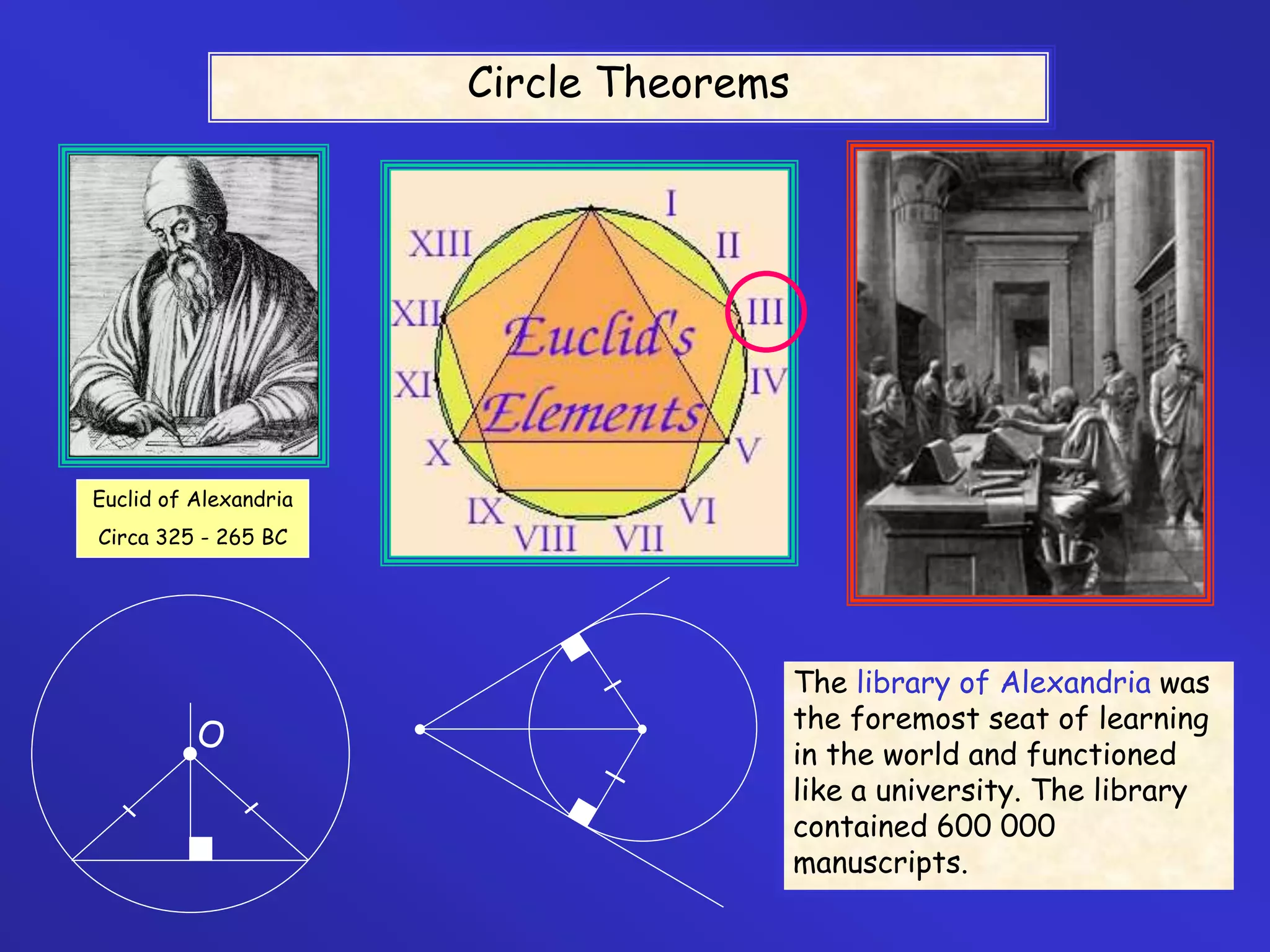
Euclid of Alexandria
Circa 325 - 265 BC
O
The library of Alexandria was
the foremost seat of learning
in the world and functioned
like a university. The library
contained 600 000
manuscripts.
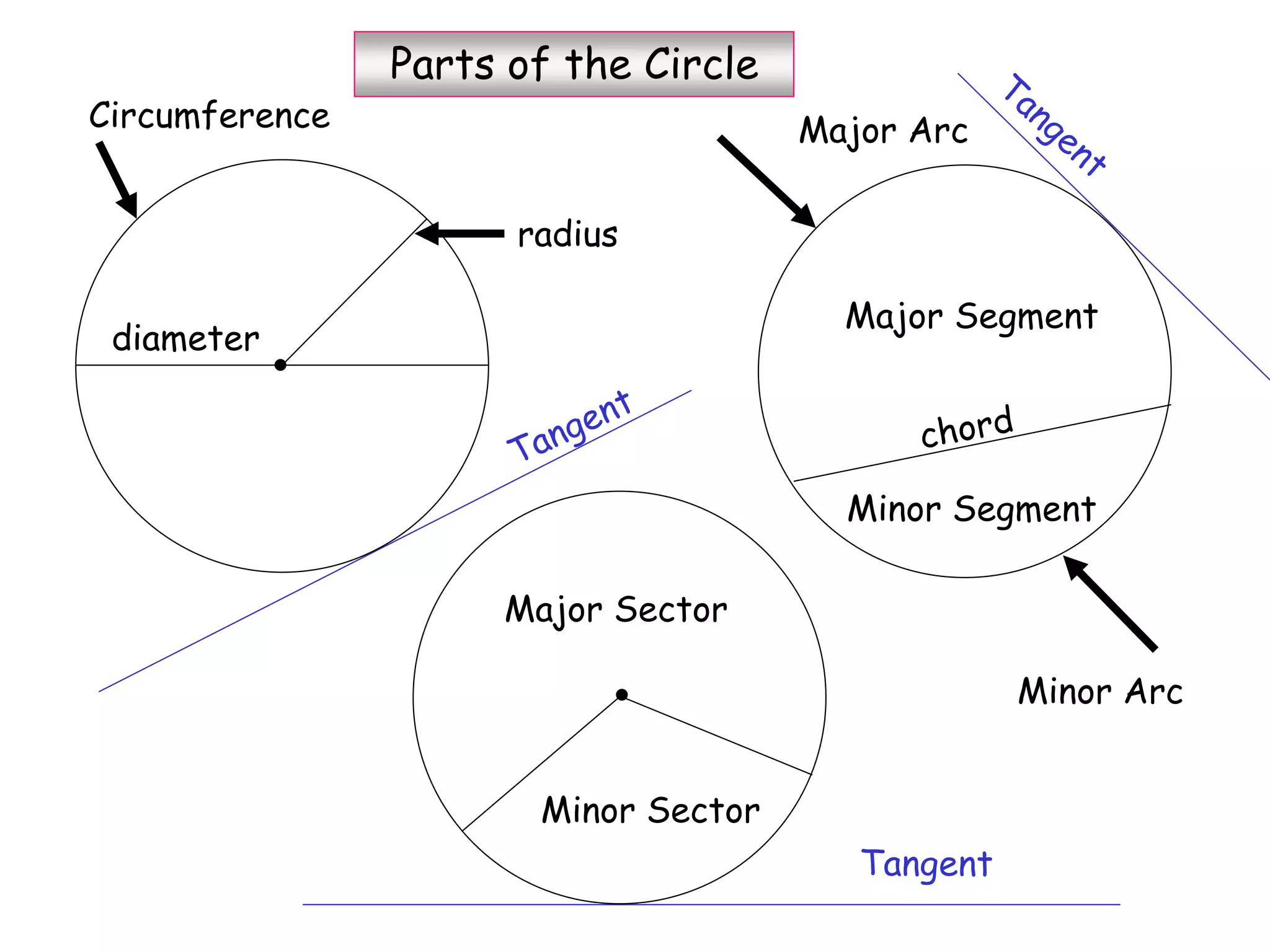
diameter
Circumference
radius
Major Segment
Minor Segment
Minor Arc
Major Arc
Minor Sector
Major Sector
Parts of the Circle
Parts
o
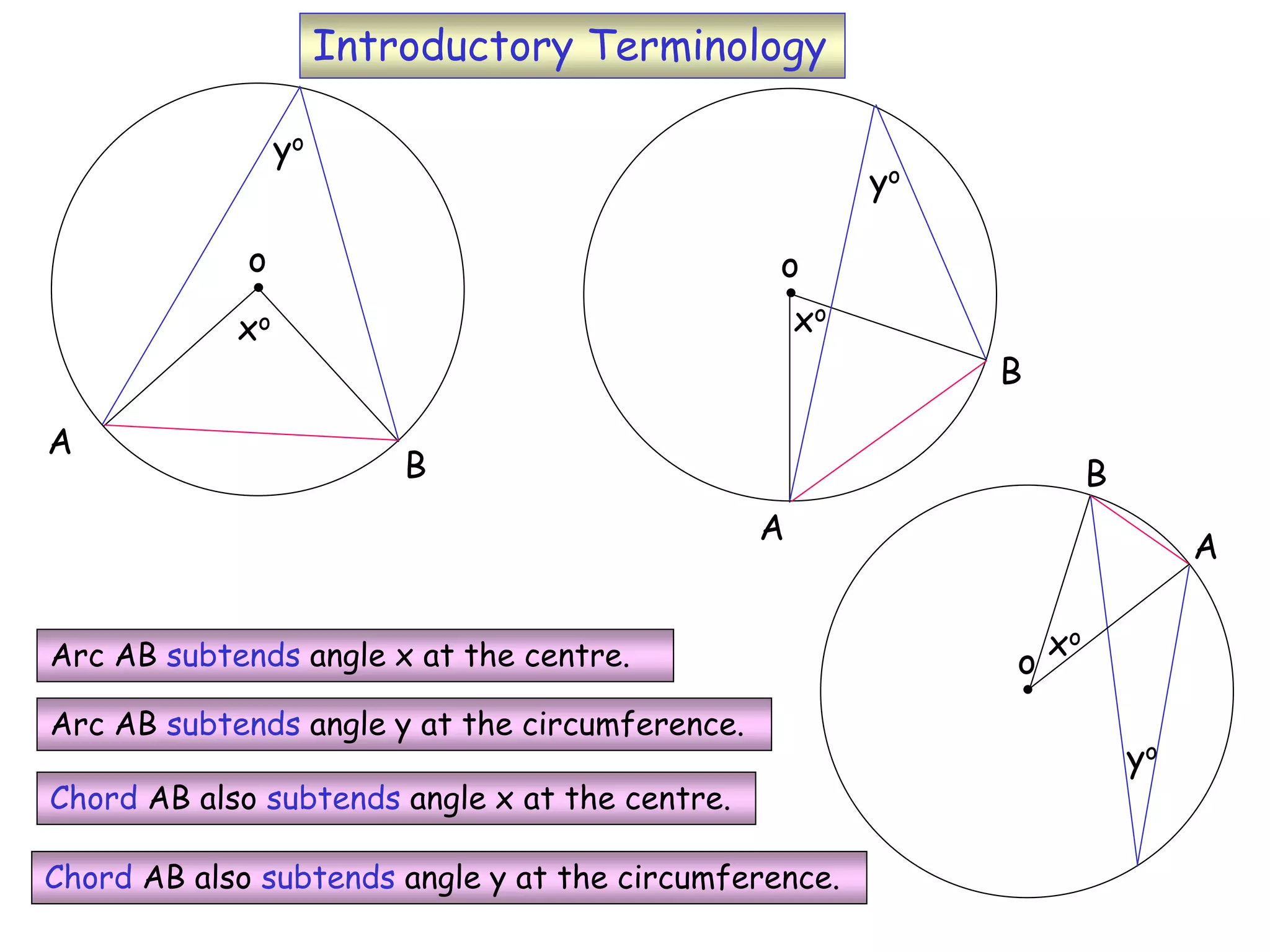
Arc AB subtends angle x at the centre.
A
B
xo
Arc AB subtends angle y at the circumference.
yo
Chord AB also subtends angle x at the centre.
Chord AB also subtends angle y at the circumference.
o
A
B
xo
yo
o
yo
xo
A
B
Introductory Terminology
Term’gy
Introductory Terminology
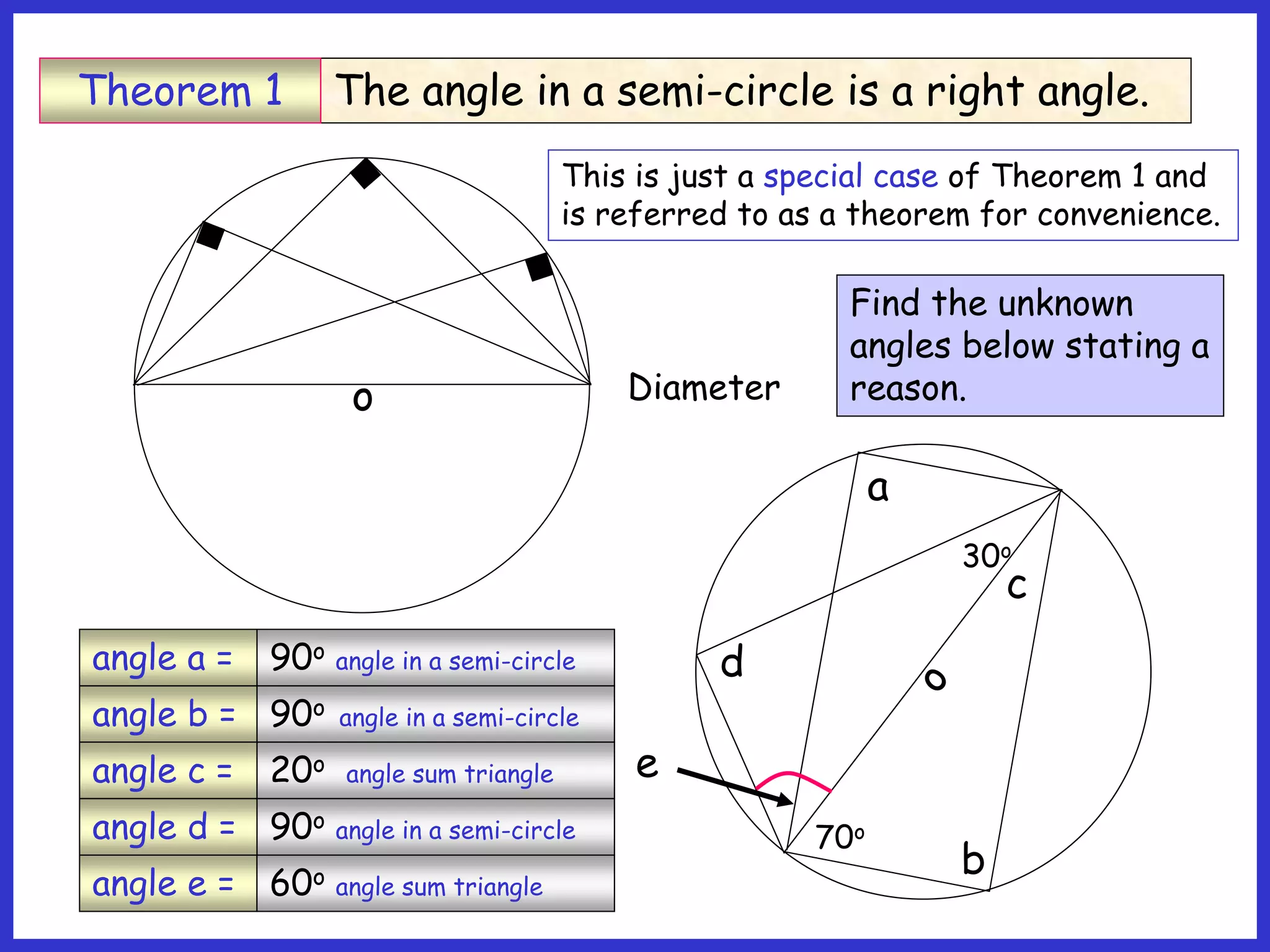
o Diameter
90o angle in a semi-circle
20o angle sum triangle
90o angle in a semi-circle
a
b
c
70o
d
30o
e
Find the unknown
angles below stating a
reason.
angle a =
angle b =
angle c =
angle d =
angle e = 60o angle sum triangle
The angle in a semi-circle is a right angle.
Theorem 1
This is just a special case of Theorem 1 and
is referred to as a theorem for convenience.
Th2
Theorem 2
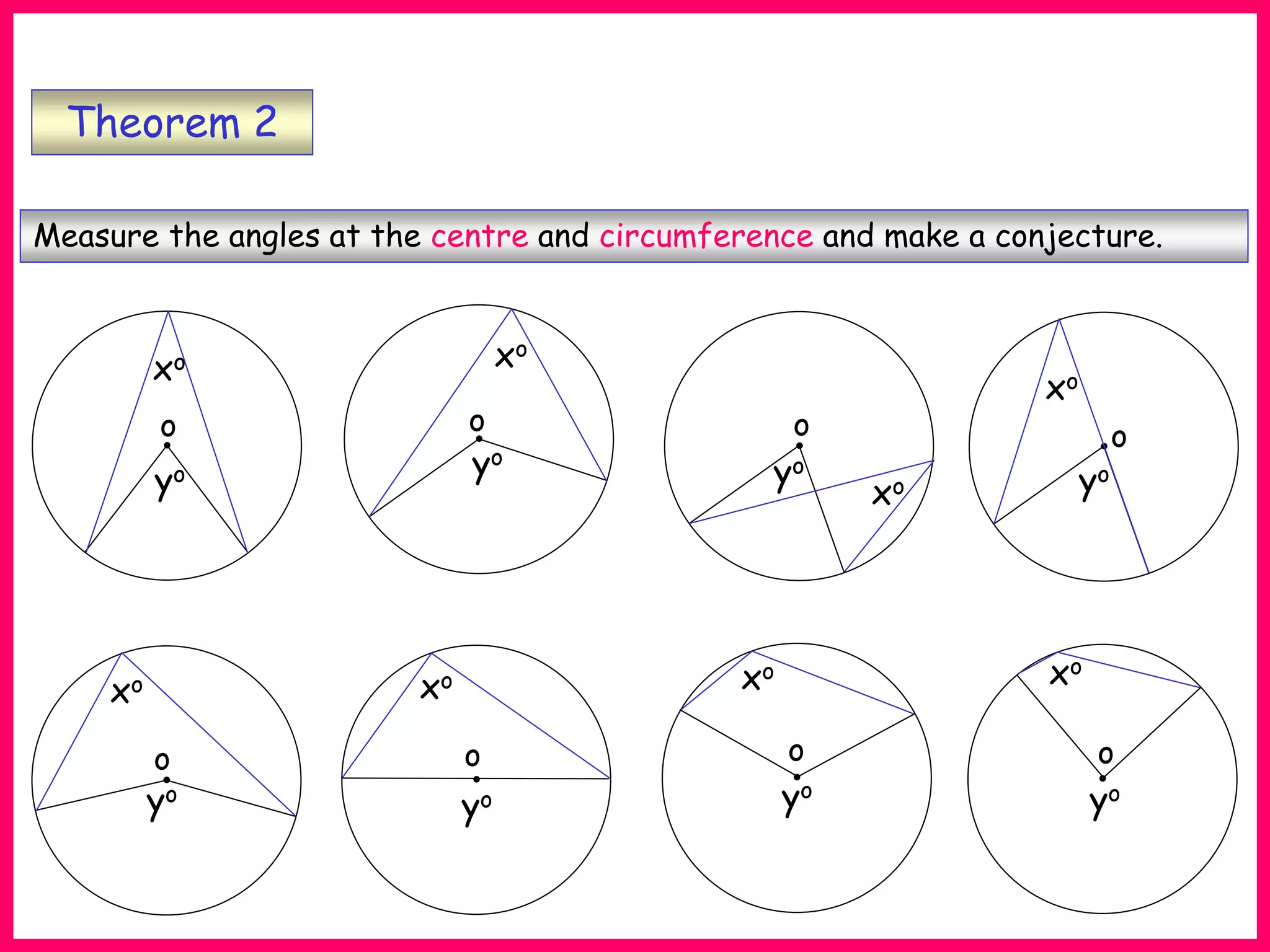
Measure the angles at the centre and circumference and make a conjecture.
xo
yo
xo
yo
xo
yo
xo
yo
xo
yo
xo
yo
xo
yo
xo
yo
o o o o
o o o o
Th1
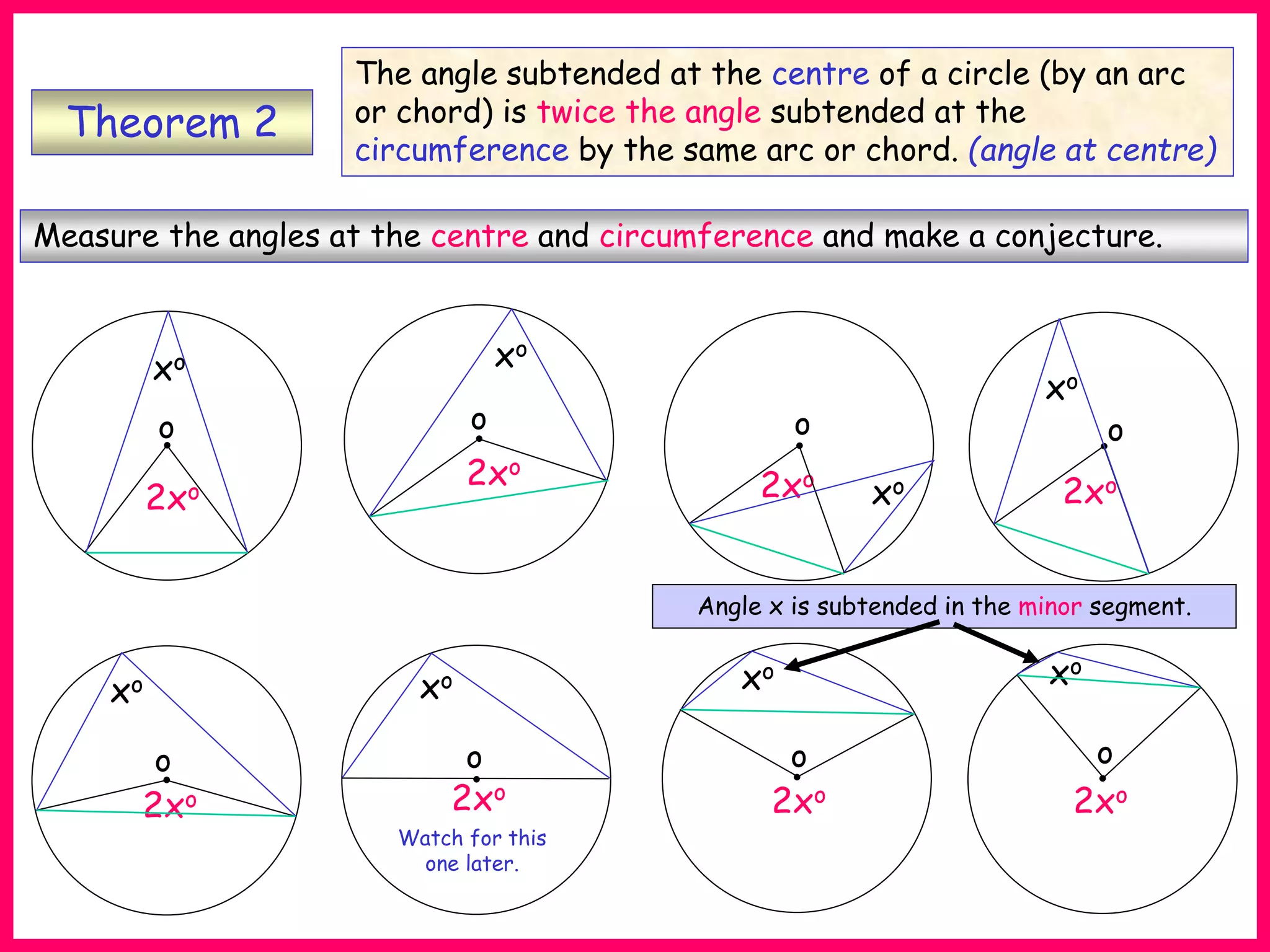
The angle subtended at the centre of a circle (by an arc
or chord) is twice the angle subtended at the
circumference by the same arc or chord. (angle at centre)
2xo
2xo 2xo
2xo
2xo 2xo
2xo 2xo
Theorem 2
Measure the angles at the centre and circumference and make a conjecture.
xo
xo
xo
xo
xo xo xo xo
o o
o o
o o o o
Angle x is subtended in the minor segment.
Watch for this
one later.
o
A
B
84o
xo
Example Questions
1
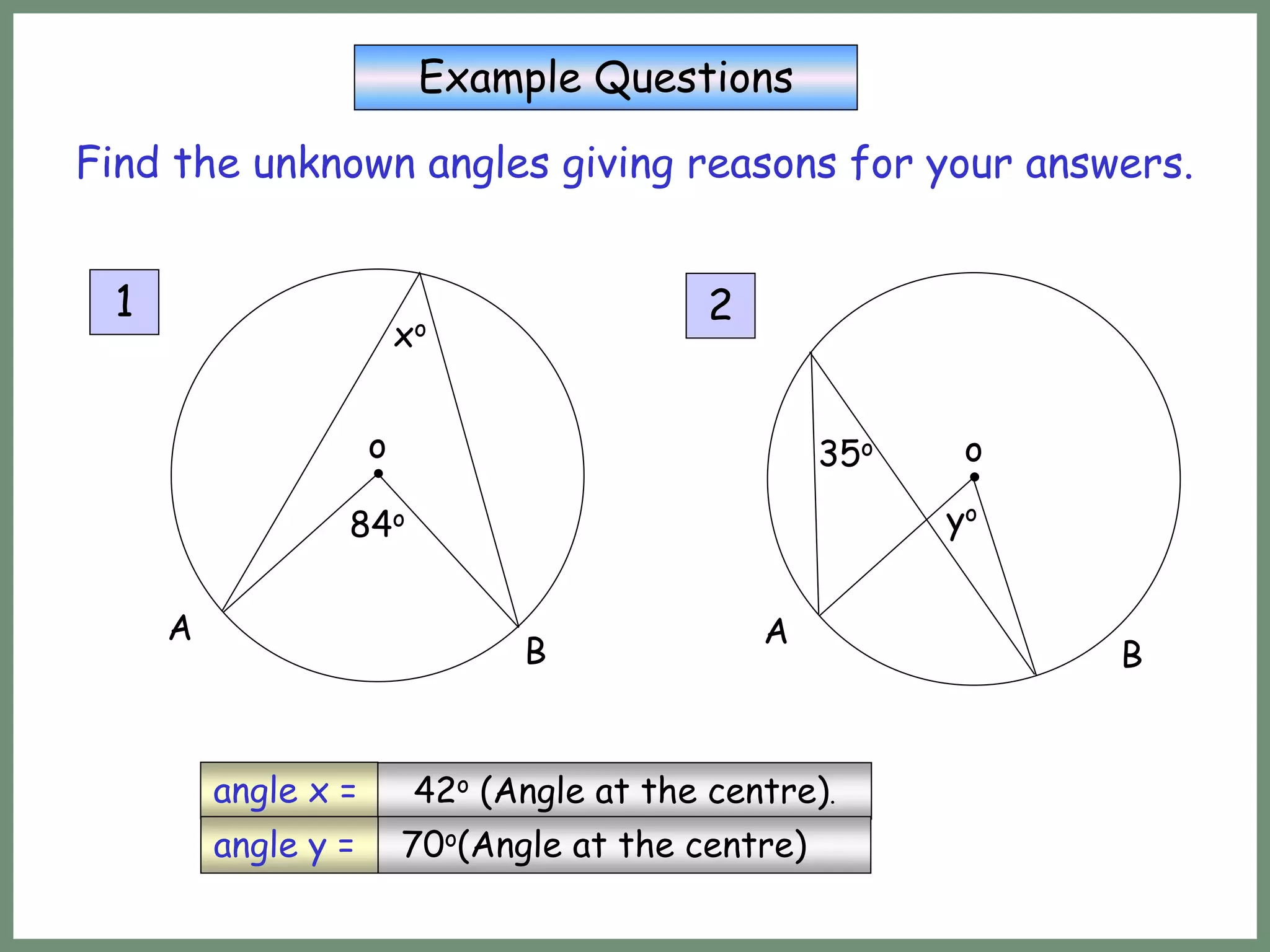
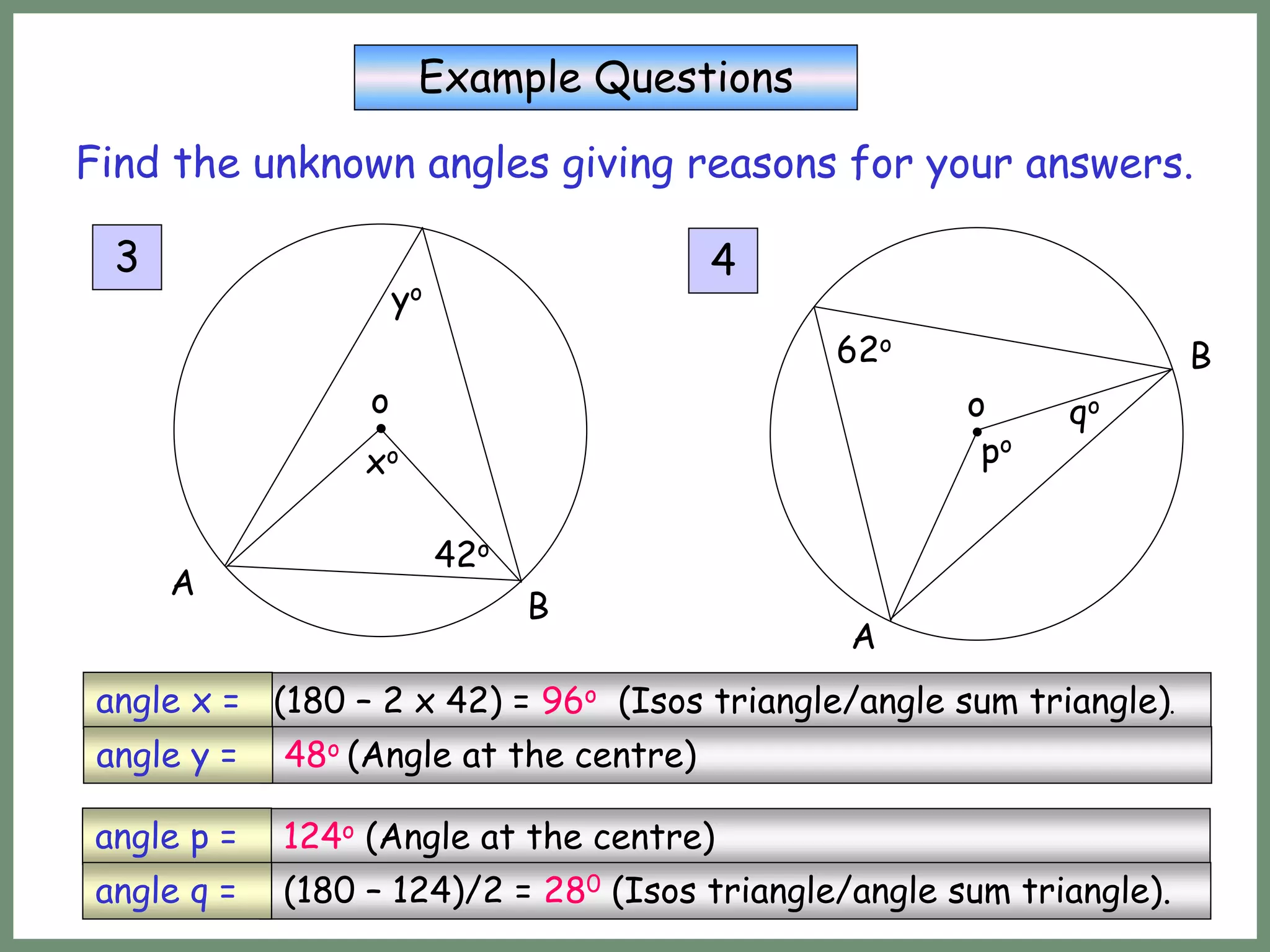
Find the unknown angles giving reasons for your answers.
o
A
B
yo
2
35o
42o (Angle at the centre).
70o(Angle at the centre)
angle x =
angle y =
(180 – 2 x 42) = 96o (Isos triangle/angle sum triangle).
48o (Angle at the centre)
angle x =
angle y =
o
A
B
42o
xo
Example Questions
3
Find the unknown angles giving reasons for your answers.
o
A
B
po
4
62o
yo
qo
124o (Angle at the centre)
(180 – 124)/2 = 280 (Isos triangle/angle sum triangle).
angle p =
angle q =
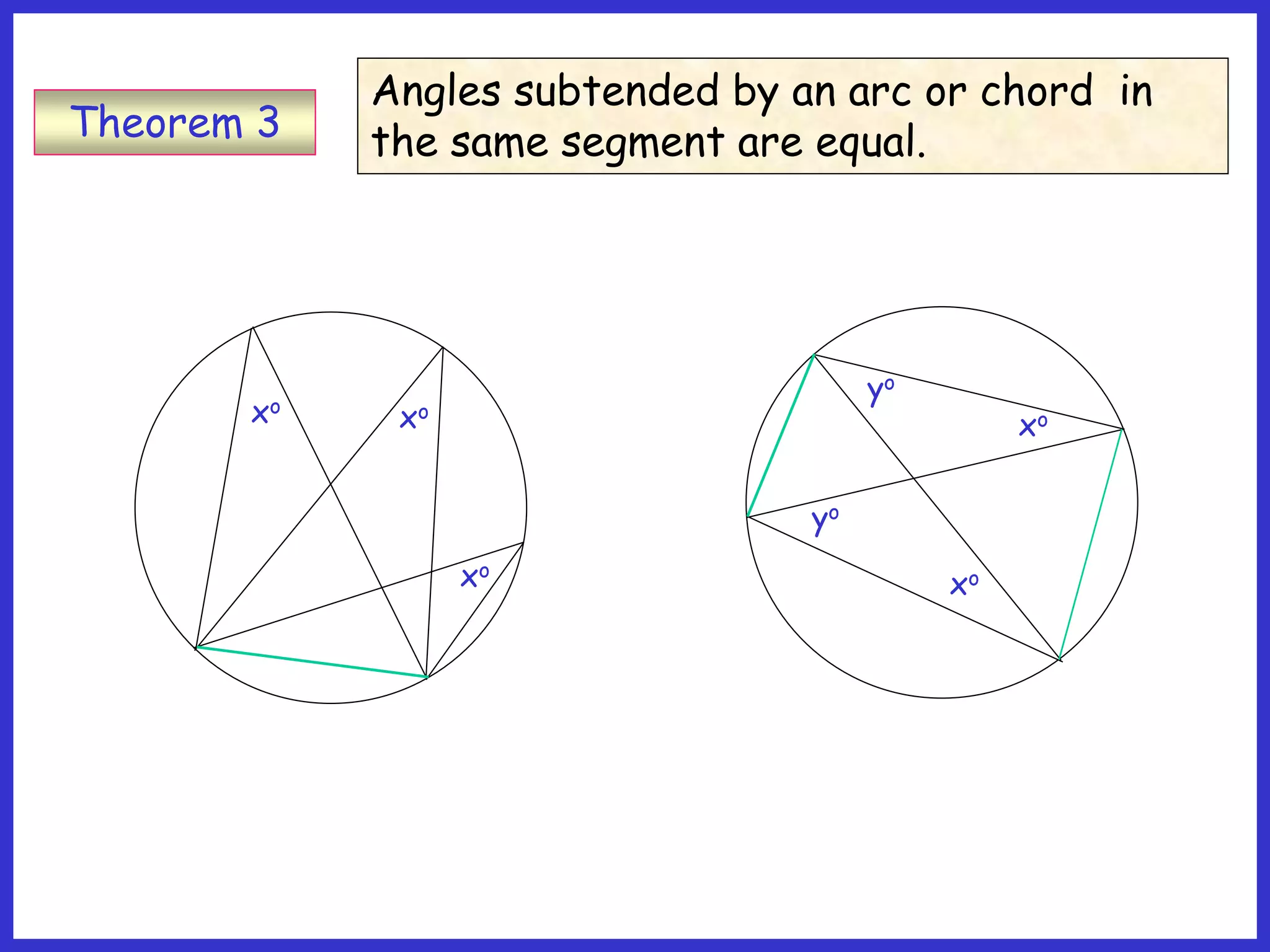
Angles subtended by an arc or chord in
the same segment are equal.
Theorem 3
xo
xo
xo
xo
xo
yo
yo
Th3
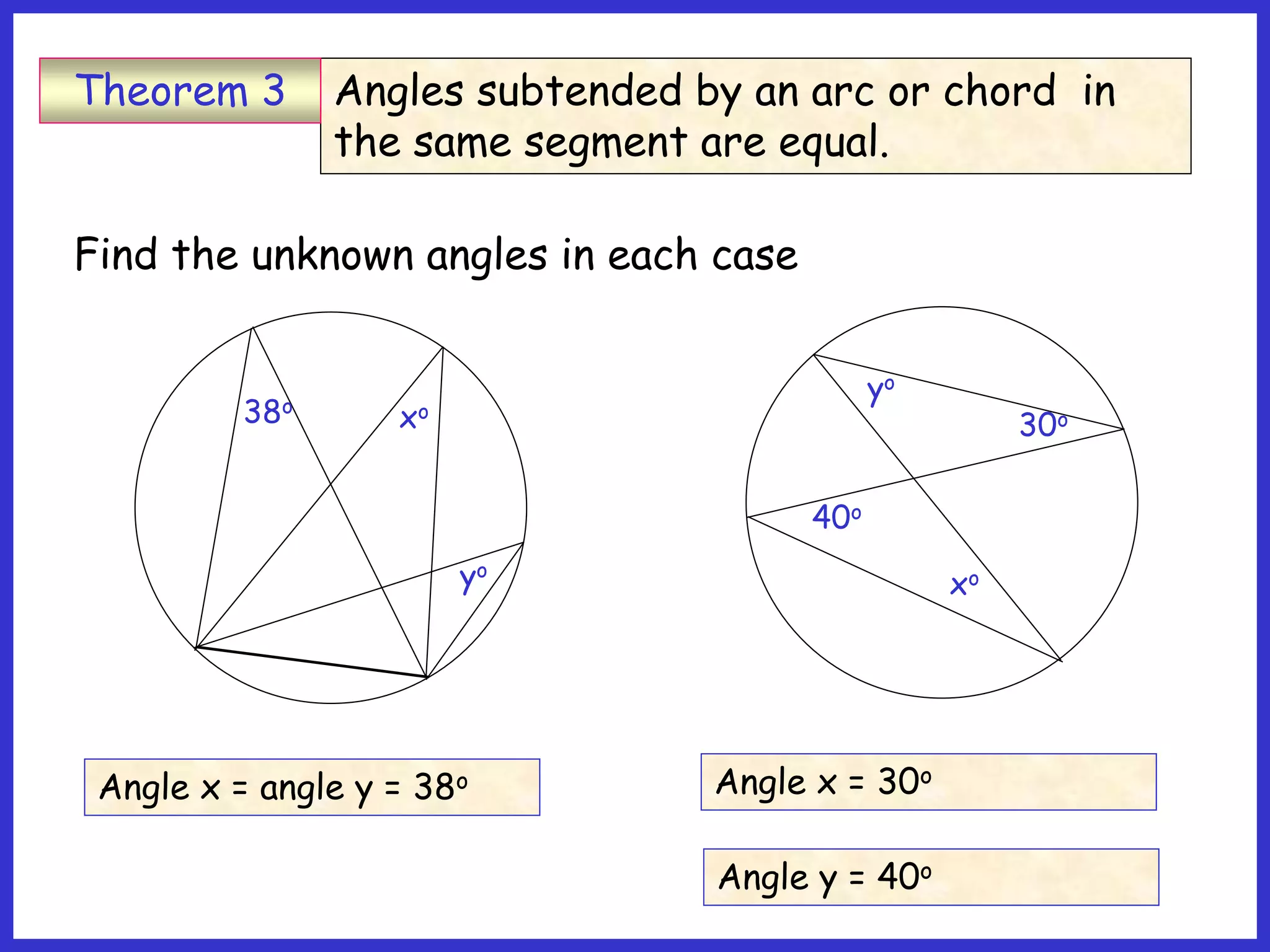
38o
xo
yo
30o
xo
yo
40o
Angles subtended by an arc or chord in
the same segment are equal.
Theorem 3
Find the unknown angles in each case
Angle x = angle y = 38o Angle x = 30o
Angle y = 40o
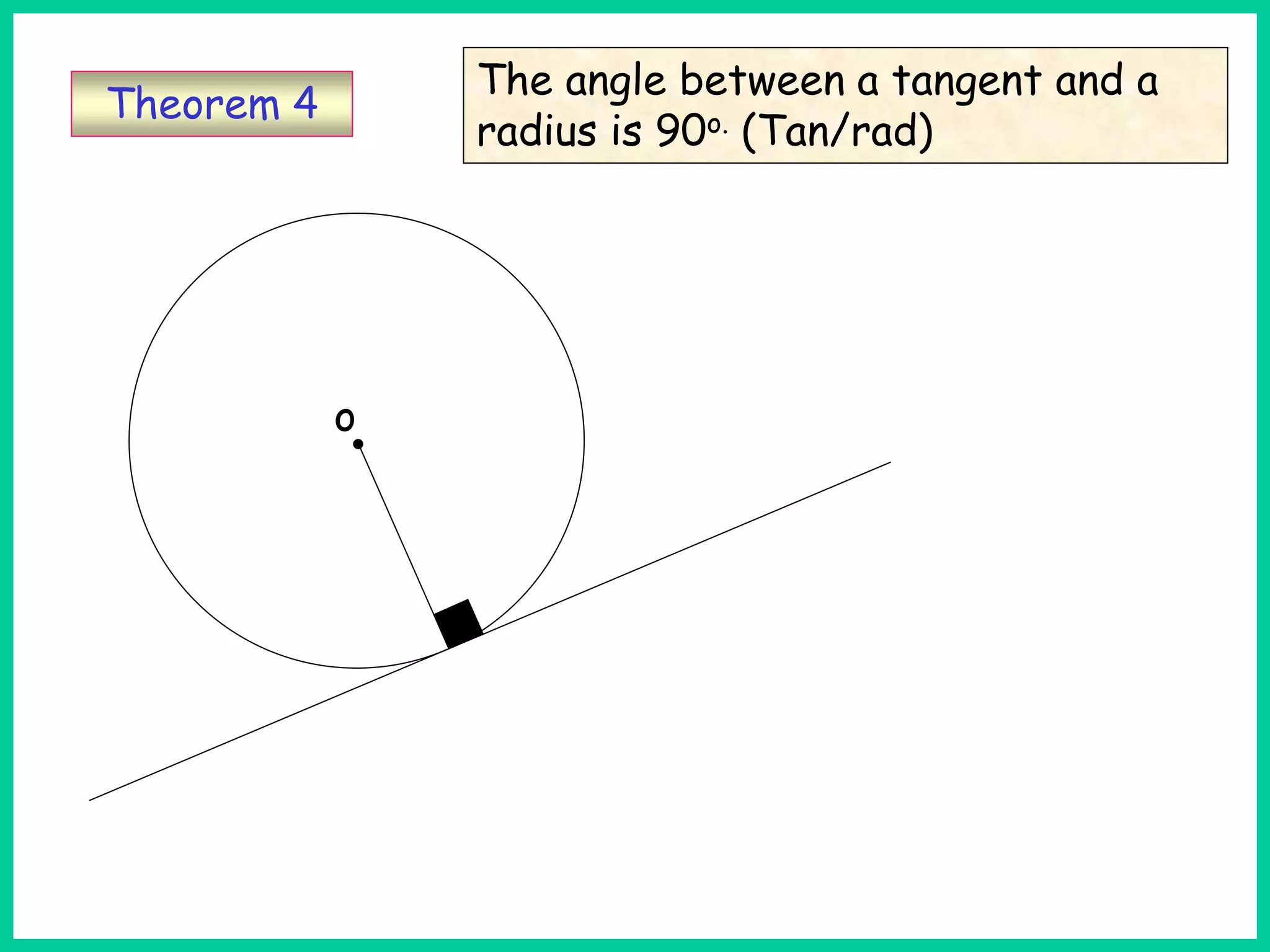
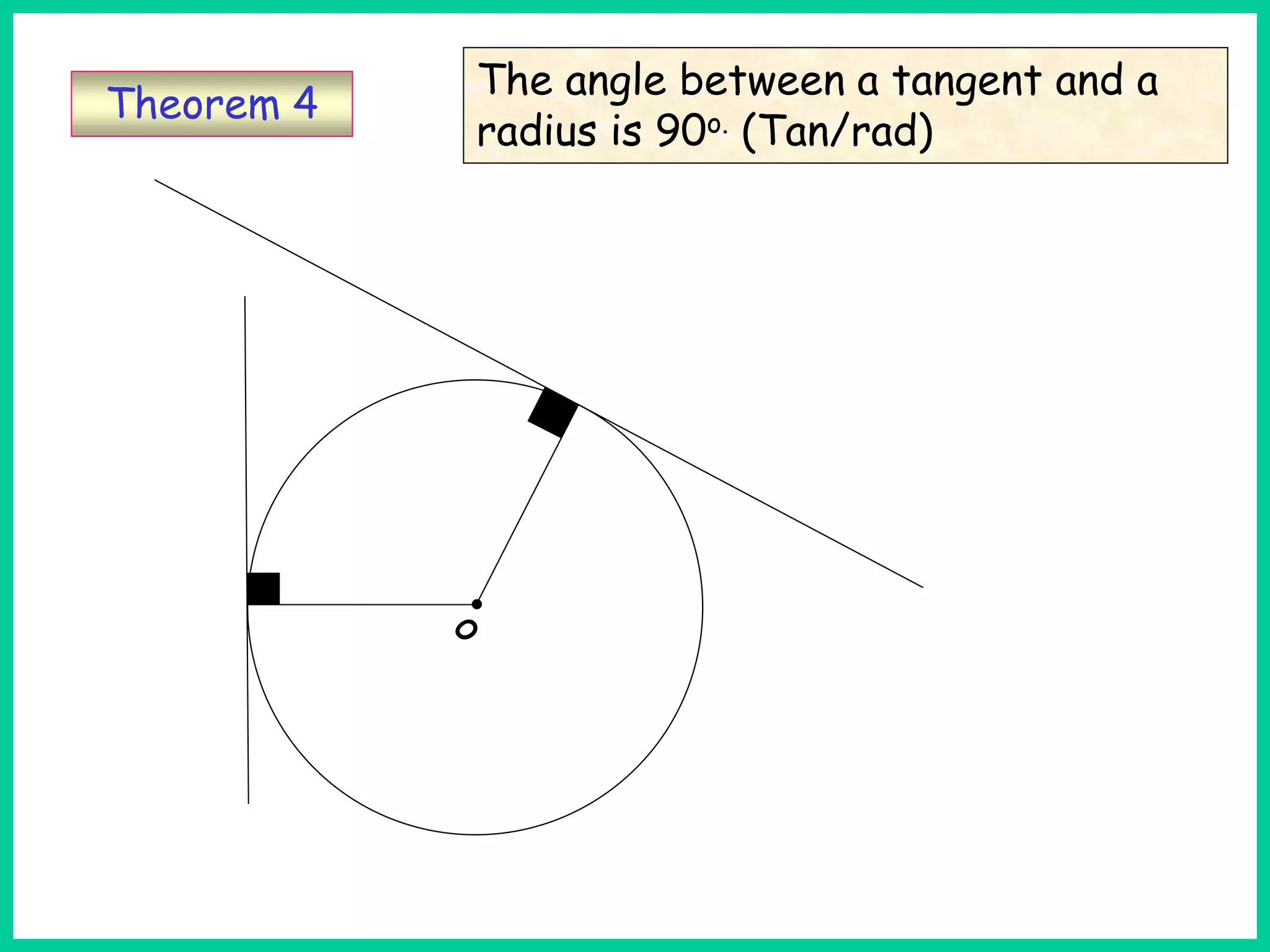
The angle between a tangent and a
radius is 90o. (Tan/rad)
Theorem 4
o
Th4
The angle between a tangent and a
radius is 90o. (Tan/rad)
Theorem 4
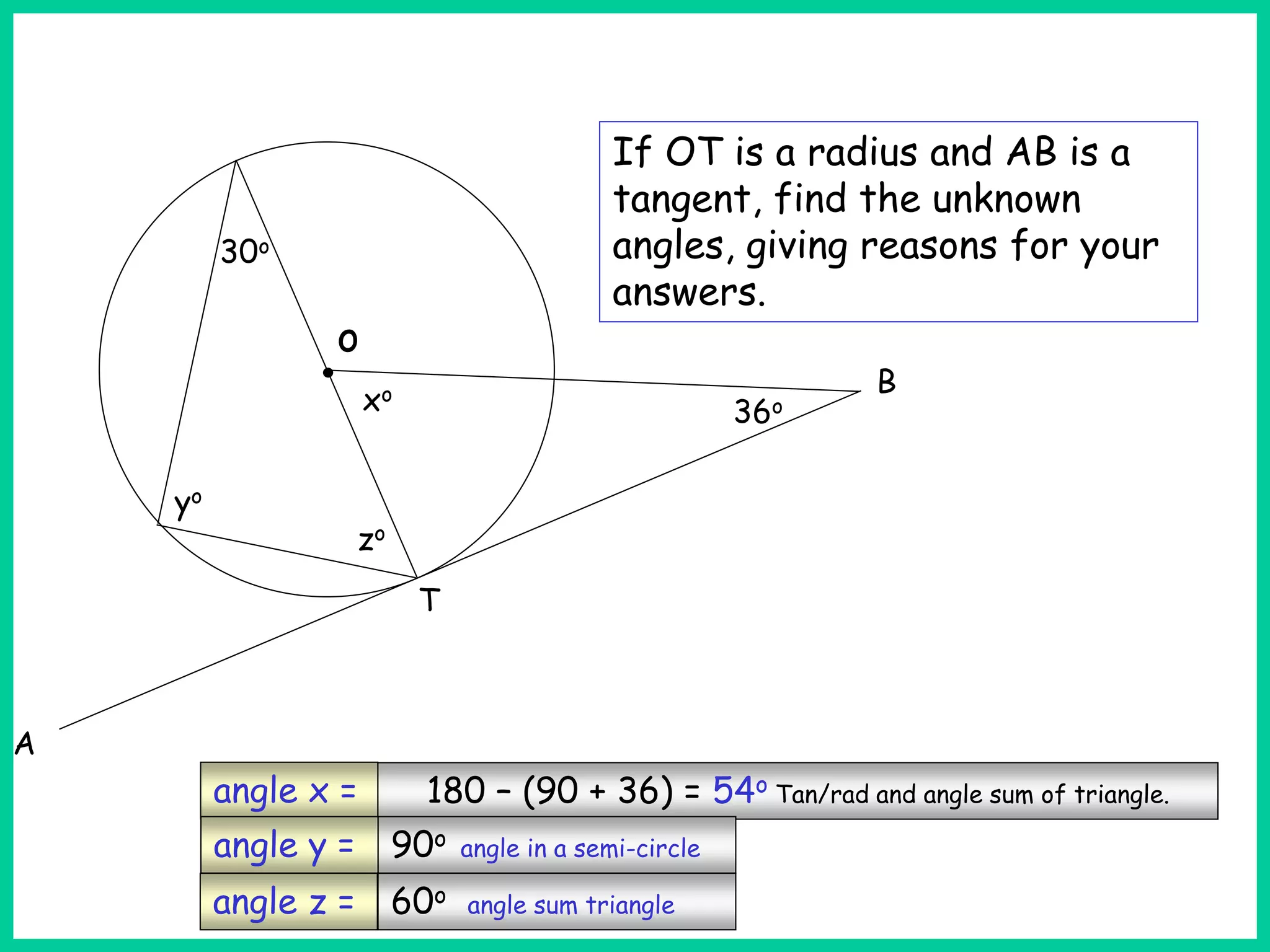
180 – (90 + 36) = 54o Tan/rad and angle sum of triangle.
90o angle in a semi-circle
60o angle sum triangle
angle x =
angle y =
angle z =
T
o
36o
xo
yo
zo
30o
A
B
If OT is a radius and AB is a
tangent, find the unknown
angles, giving reasons for your
answers.
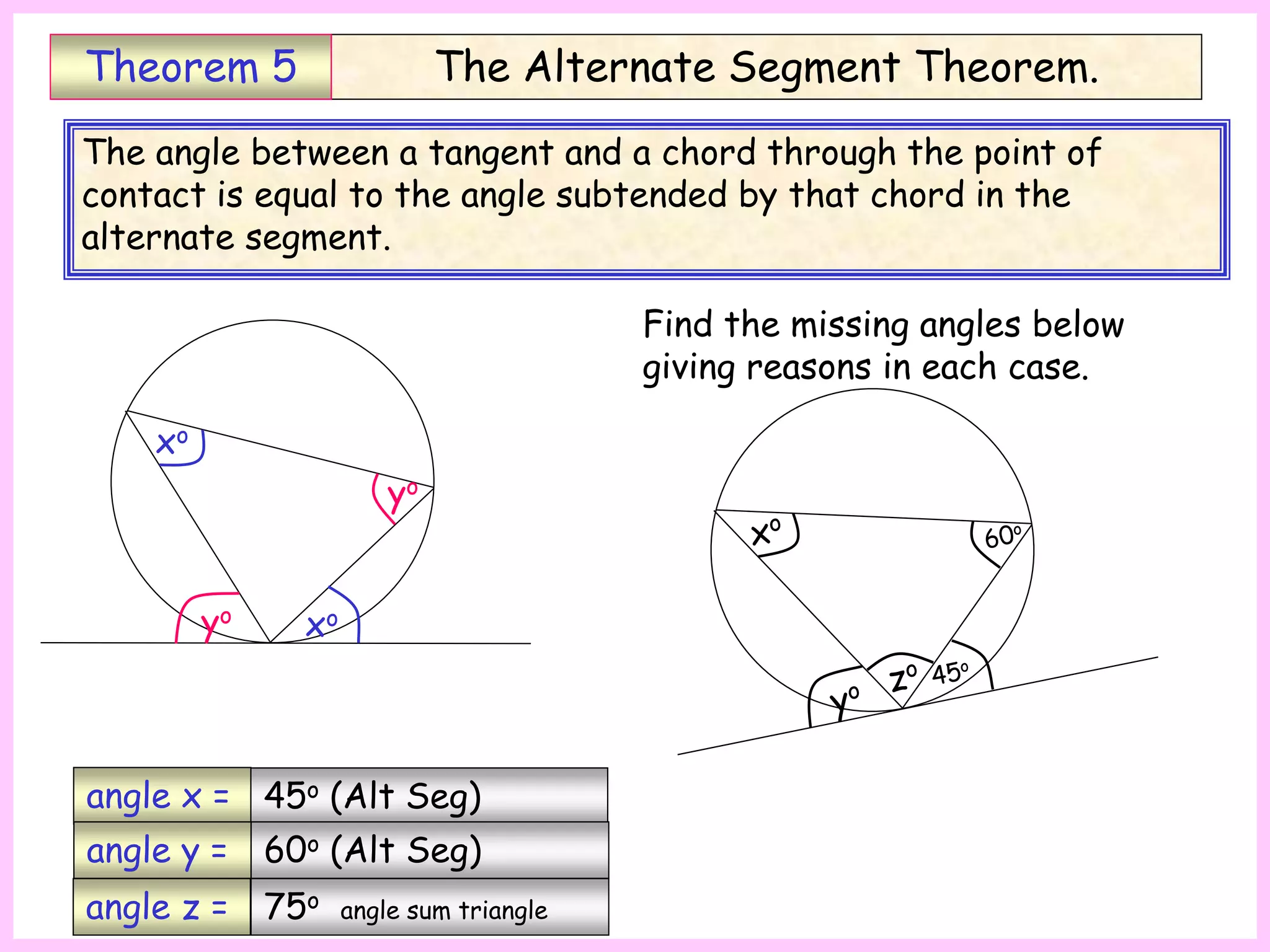
The Alternate Segment Theorem.
Theorem 5
The angle between a tangent and a chord through the point of
contact is equal to the angle subtended by that chord in the
alternate segment.
xo
xo
yo
yo
45o (Alt Seg)
60o (Alt Seg)
75o angle sum triangle
Find the missing angles below
giving reasons in each case.
angle x =
angle y =
angle z = Th5
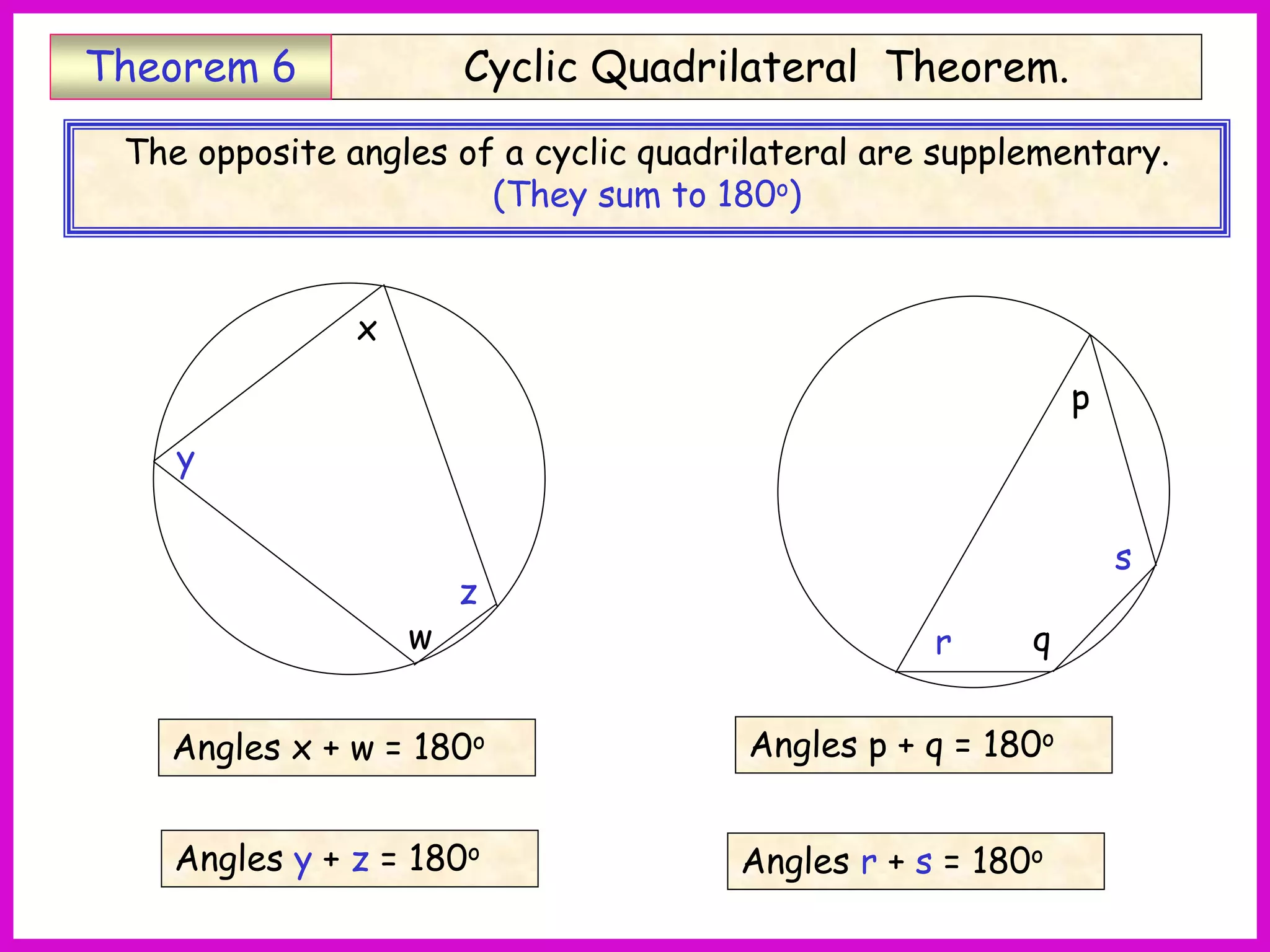
Cyclic Quadrilateral Theorem.
Theorem 6
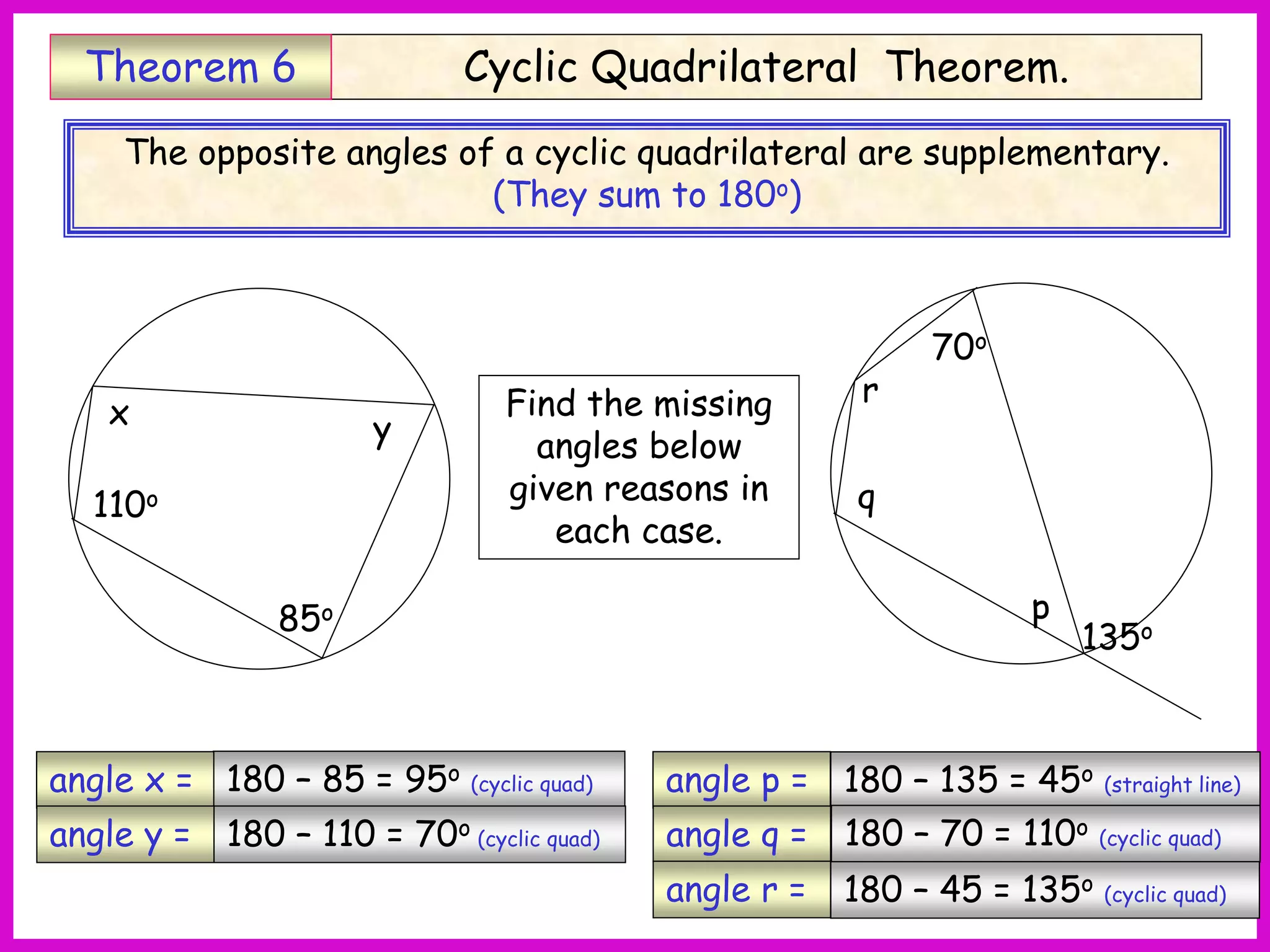
The opposite angles of a cyclic quadrilateral are supplementary.
(They sum to 180o)
w
x
y
z
Angles x + w = 180o
Angles y + z = 180o
q
p
r
s
Angles p + q = 180o
Angles r + s = 180o
Th6
180 – 85 = 95o (cyclic quad)
180 – 110 = 70o (cyclic quad)
Cyclic Quadrilateral Theorem.
Theorem 6
The opposite angles of a cyclic quadrilateral are supplementary.
(They sum to 180o)
85o
110o
x y
70o
135o
p
r
q
Find the missing
angles below
given reasons in
each case.
angle x =
angle y =
angle p =
angle q =
angle r =
180 – 135 = 45o (straight line)
180 – 70 = 110o (cyclic quad)
180 – 45 = 135o (cyclic quad)
Two Tangent Theorem.
Theorem 7
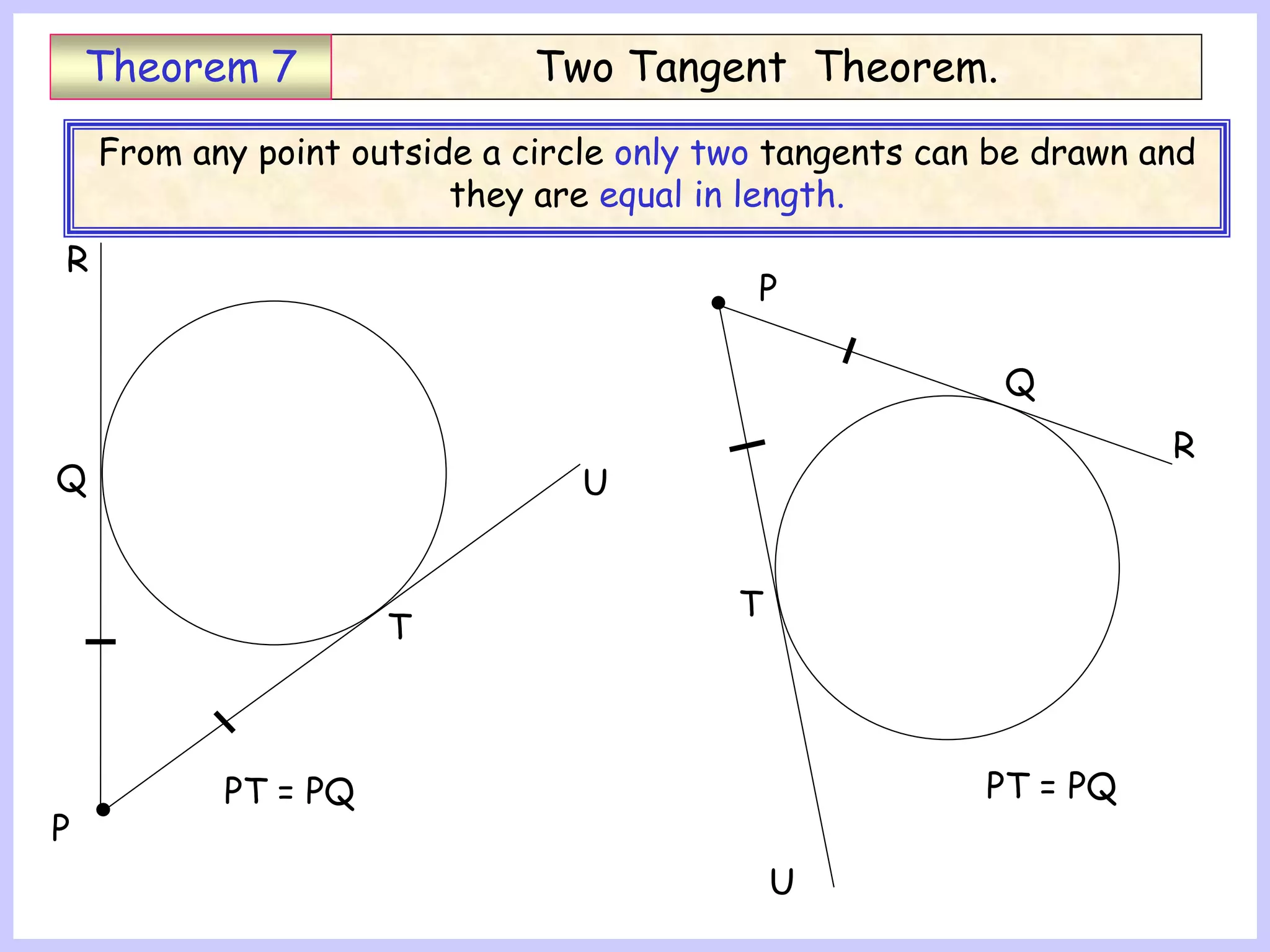
From any point outside a circle only two tangents can be drawn and
they are equal in length.
P
T
U
Q
R
PT = PQ
P
T
U
Q
R
PT = PQ
Th7
90o (tan/rad)
Two Tangent Theorem.
Theorem 7
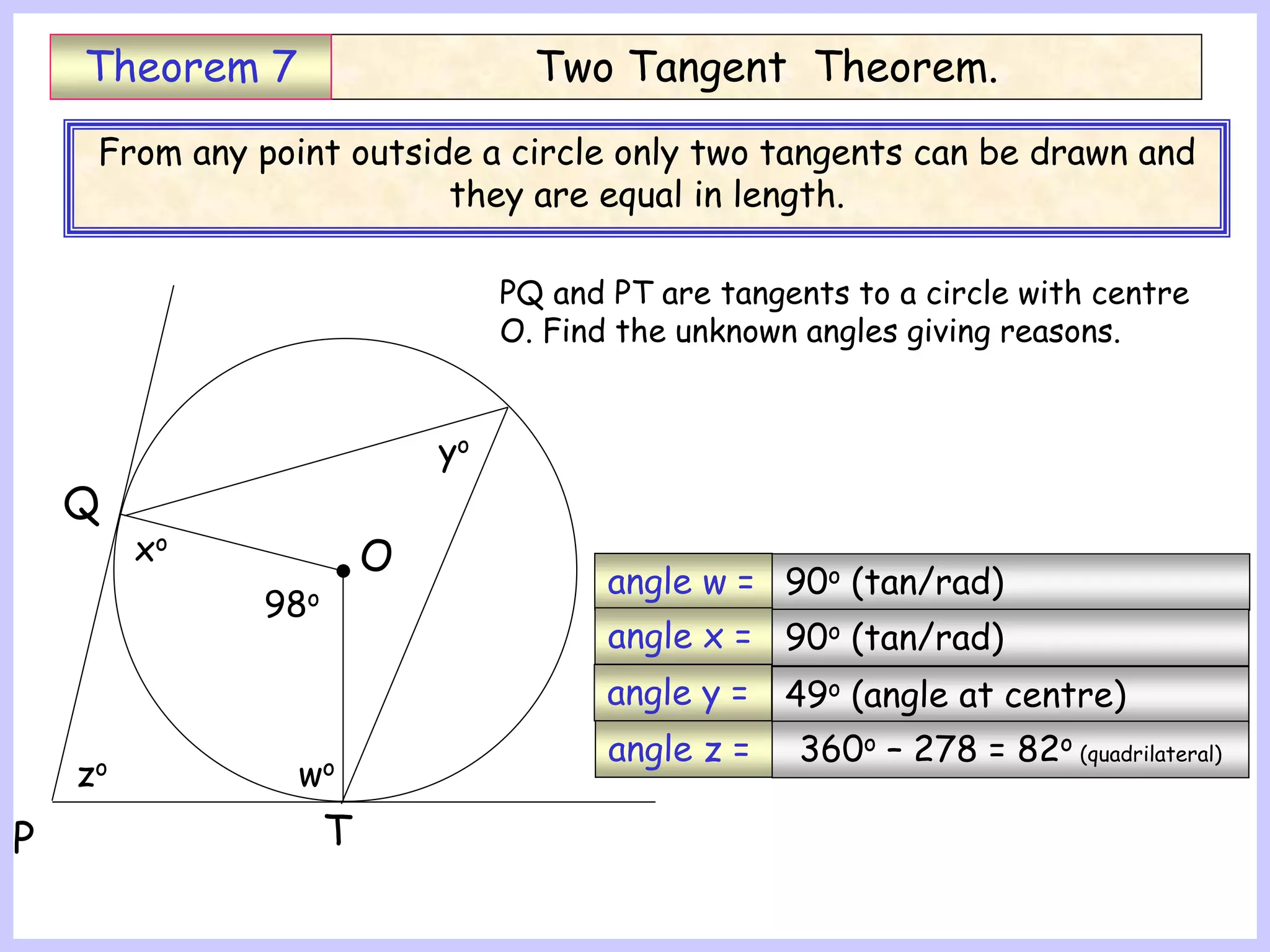
From any point outside a circle only two tangents can be drawn and
they are equal in length.
P T
Q
O
xo
wo
98o
yo
zo
PQ and PT are tangents to a circle with centre
O. Find the unknown angles giving reasons.
angle w =
angle x =
angle y =
angle z =
90o (tan/rad)
49o (angle at centre)
360o – 278 = 82o (quadrilateral)
90o (tan/rad)
Two Tangent Theorem.
Theorem 7
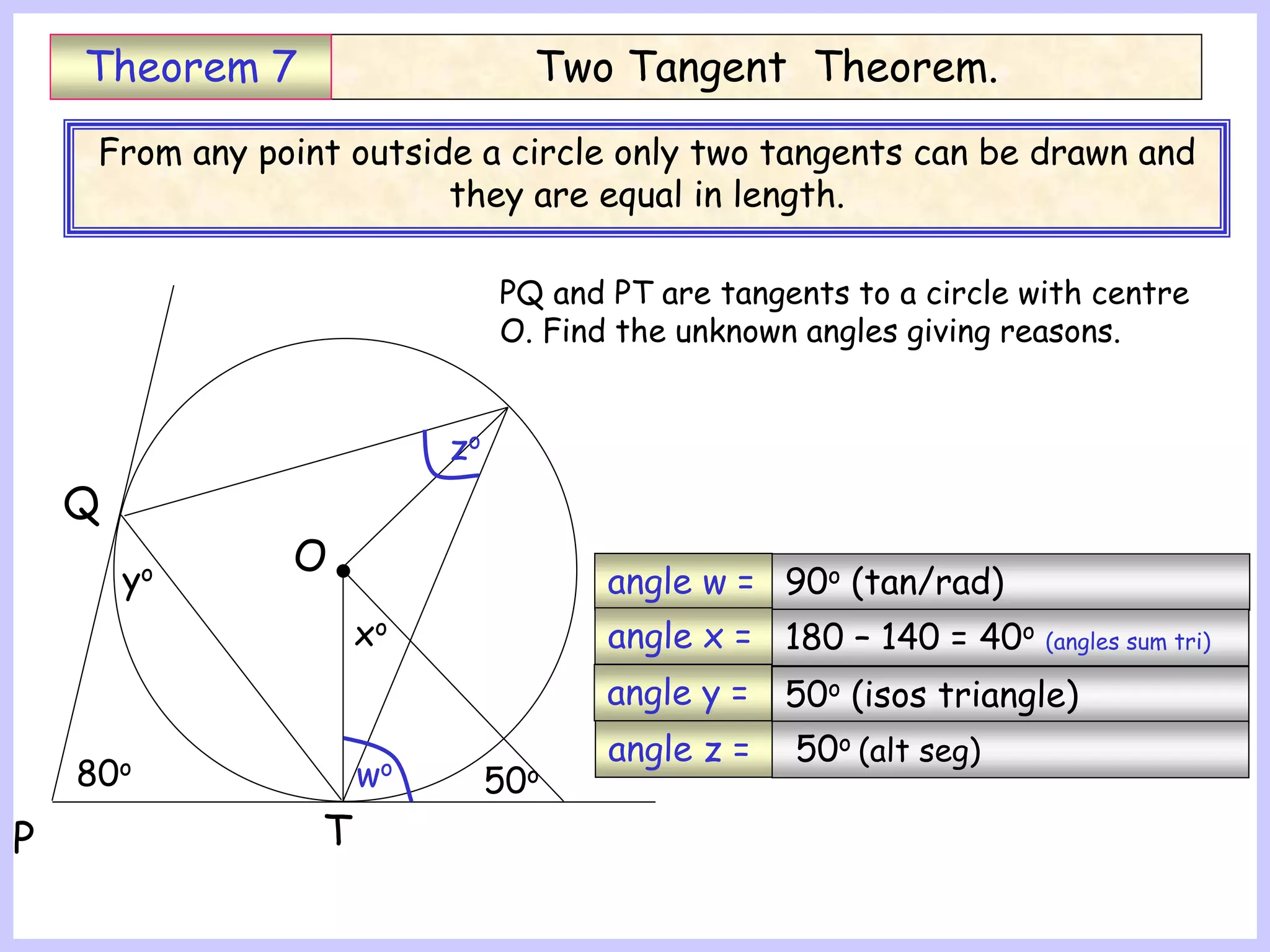
From any point outside a circle only two tangents can be drawn and
they are equal in length.
P T
Q
O
yo
50o
xo
80o
PQ and PT are tangents to a circle with centre
O. Find the unknown angles giving reasons.
angle w =
angle x =
angle y =
angle z =
180 – 140 = 40o (angles sum tri)
50o (isos triangle)
50o (alt seg)
wo
zo
O
S T
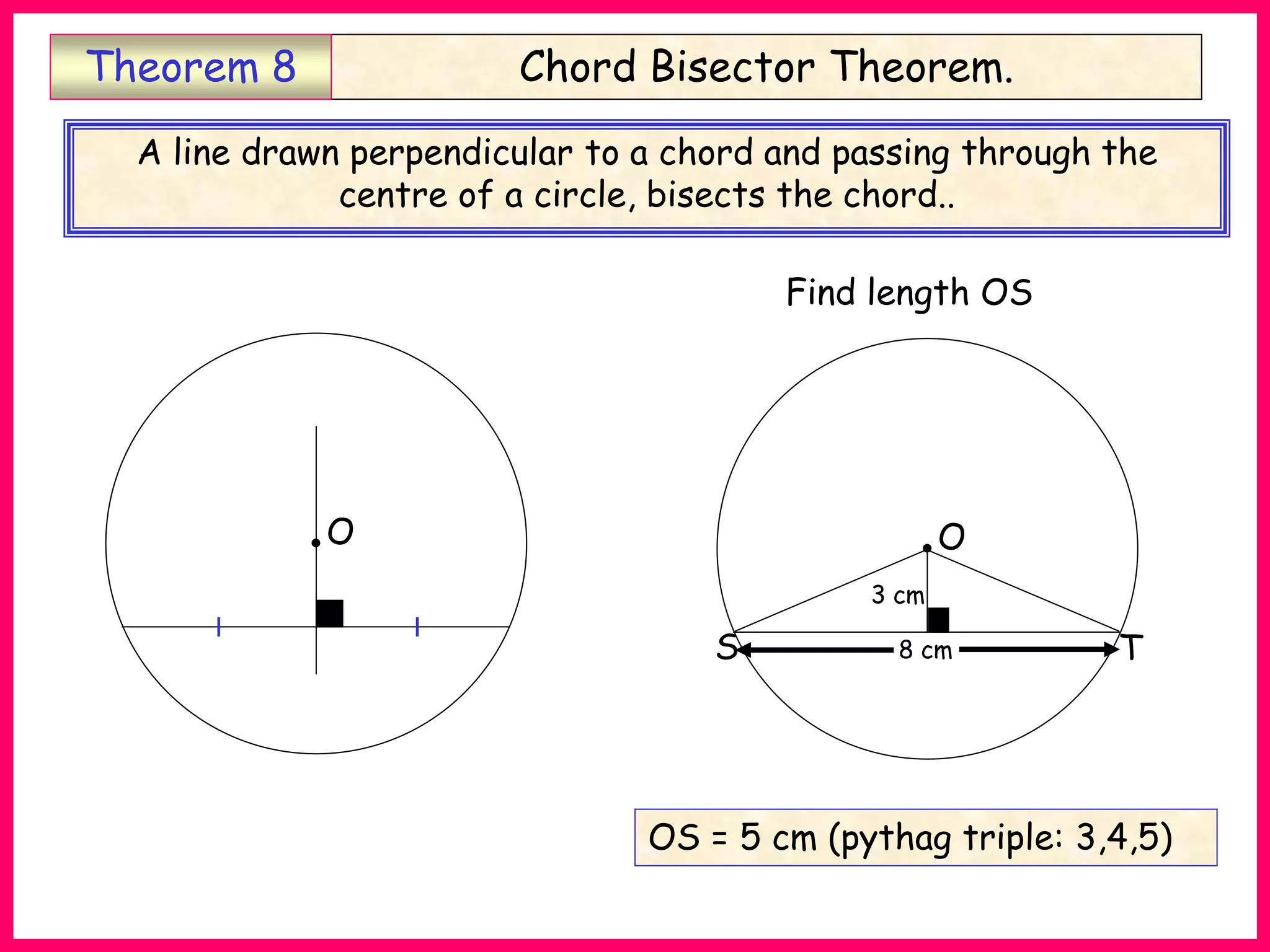
3 cm
8 cm
Find length OS
OS = 5 cm (pythag triple: 3,4,5)
Chord Bisector Theorem.
Theorem 8
A line drawn perpendicular to a chord and passing through the
centre of a circle, bisects the chord..
O
Th8
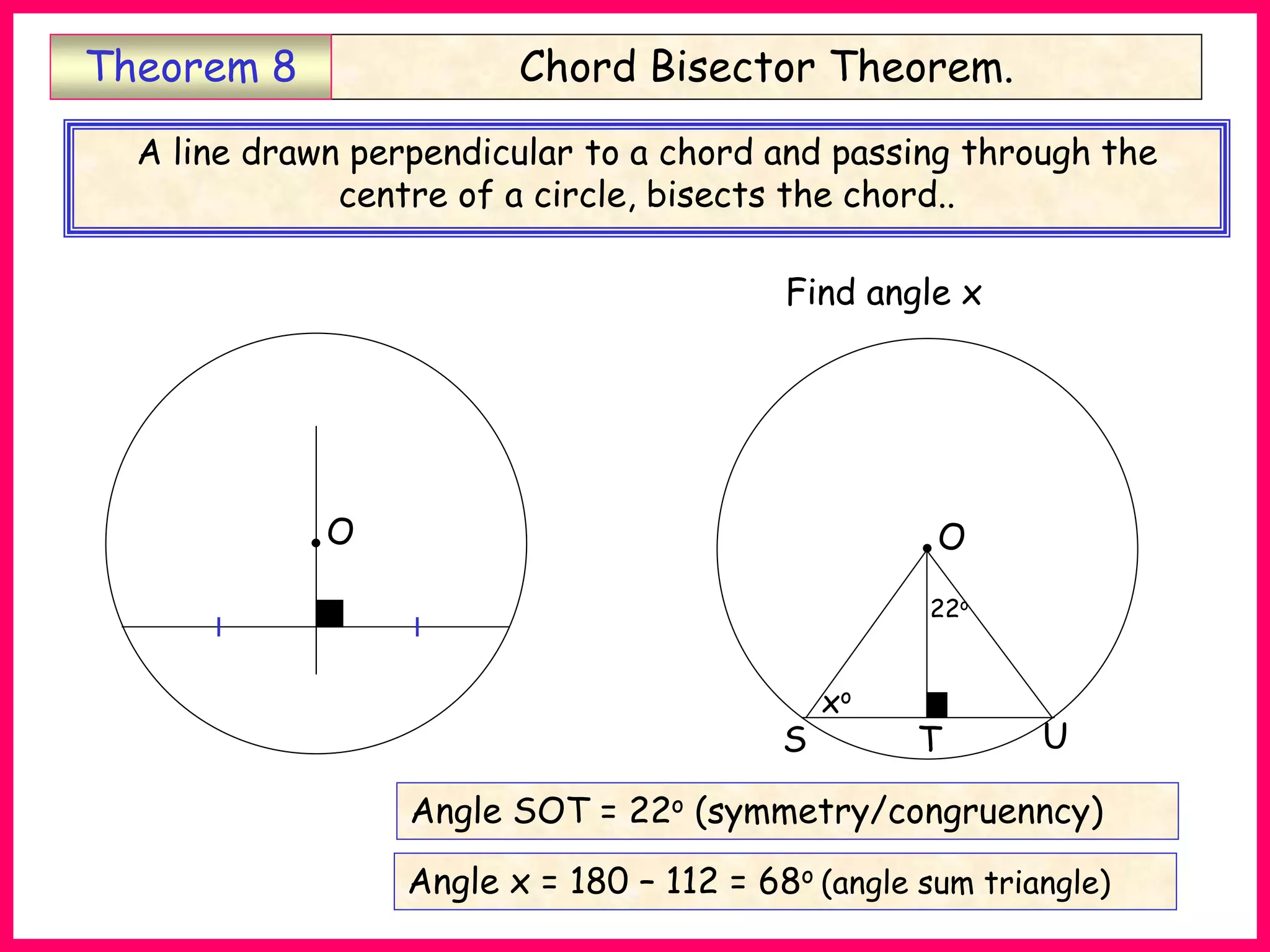
Angle SOT = 22o (symmetry/congruenncy)
Find angle x
O
S T
22o
xo
U
Angle x = 180 – 112 = 68o (angle sum triangle)
Chord Bisector Theorem.
Theorem 8
A line drawn perpendicular to a chord and passing through the
centre of a circle, bisects the chord..
O
O
S
T
65o
P
R
U
Mixed Questions
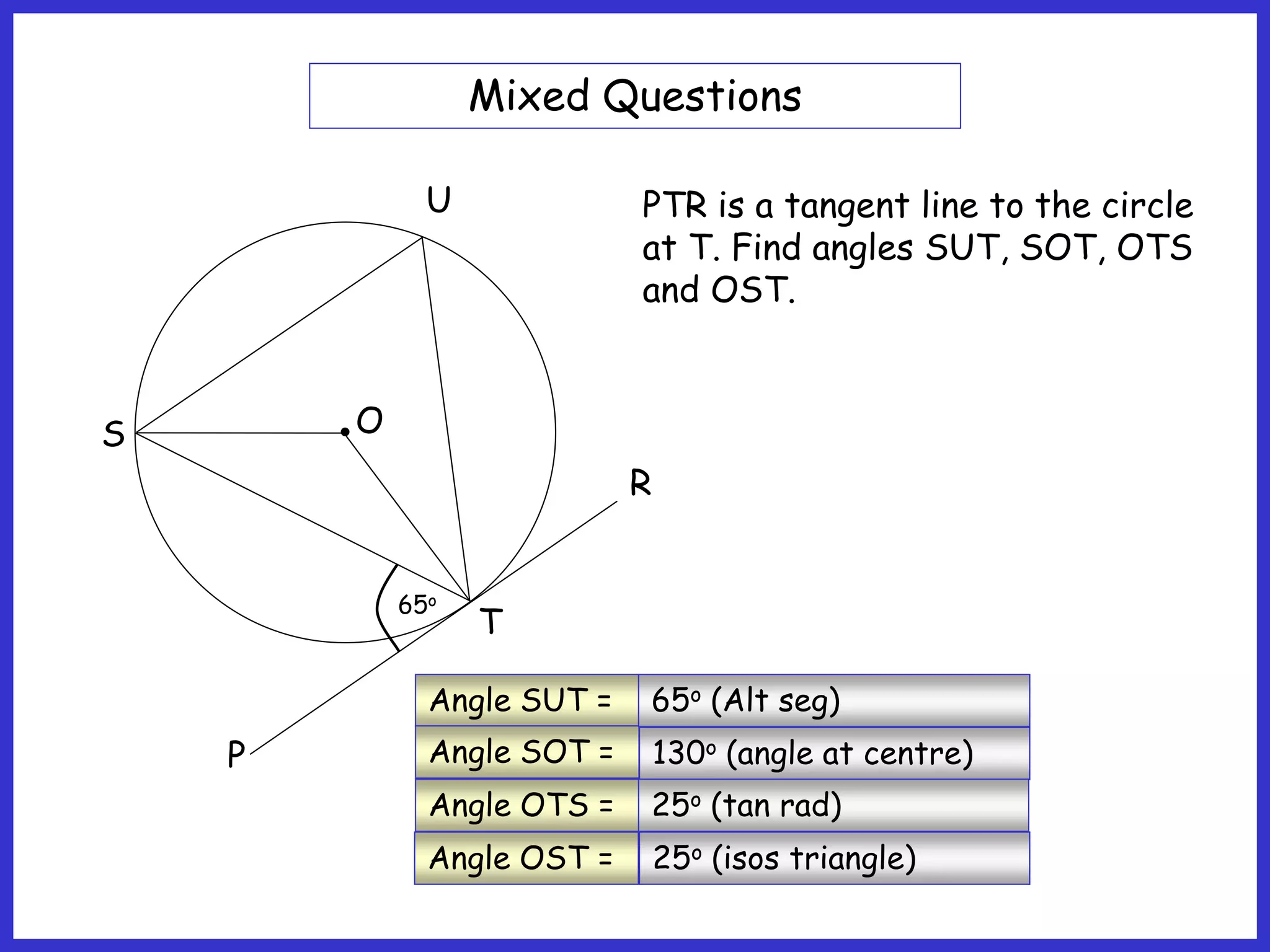
PTR is a tangent line to the circle
at T. Find angles SUT, SOT, OTS
and OST.
Angle SUT =
Angle SOT =
Angle OTS =
Angle OST =
65o (Alt seg)
130o (angle at centre)
25o (tan rad)
25o (isos triangle)
Mixed
Q 1
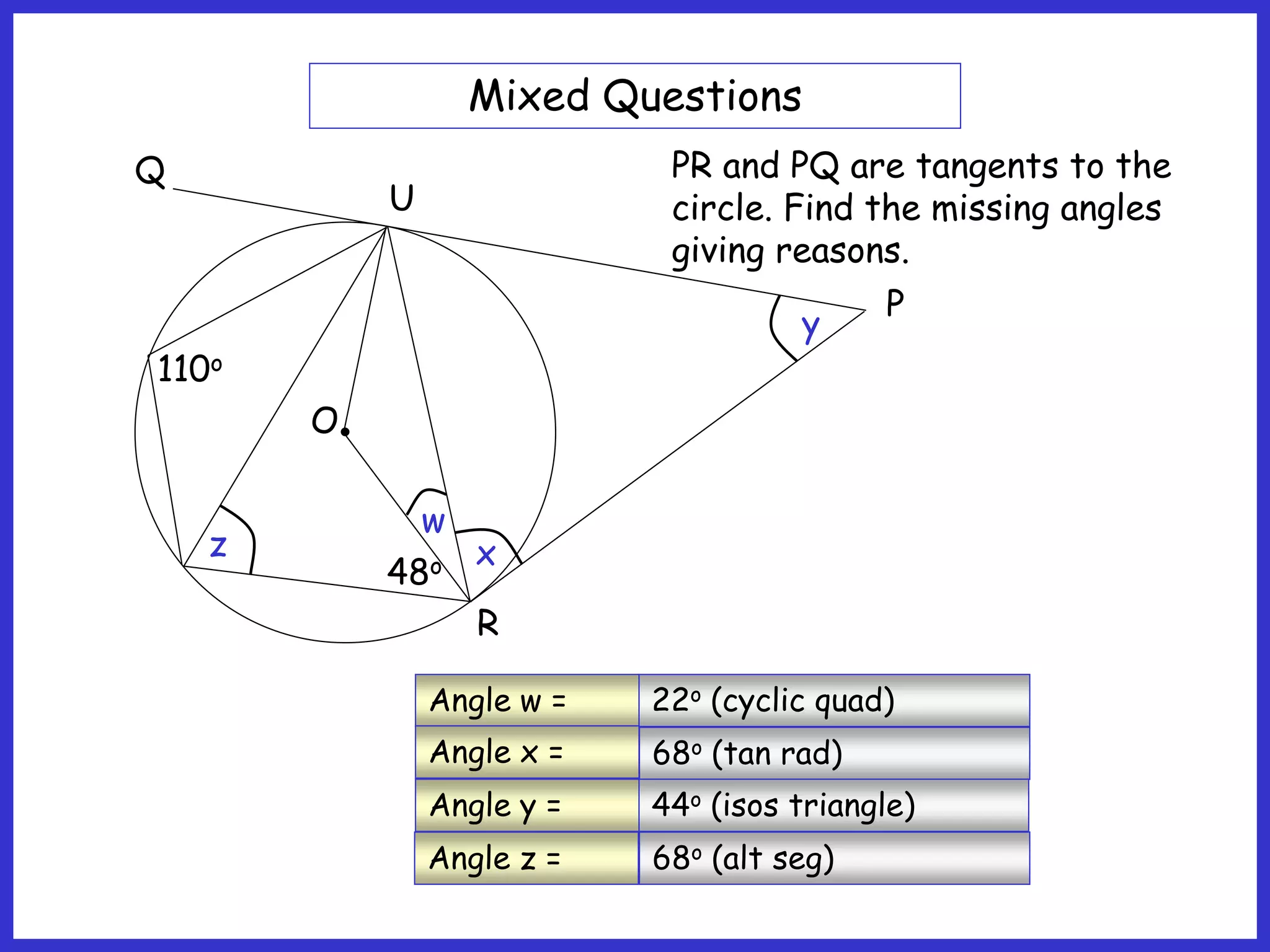
22o (cyclic quad)
68o (tan rad)
44o (isos triangle)
68o (alt seg)
Angle w =
Angle x =
Angle y =
Angle z =
O
w
y
48o
110o
U
Mixed Questions
PR and PQ are tangents to the
circle. Find the missing angles
giving reasons.
x
z
P
Q
R
Mixed Q 2
A
B
C
D
A B C D
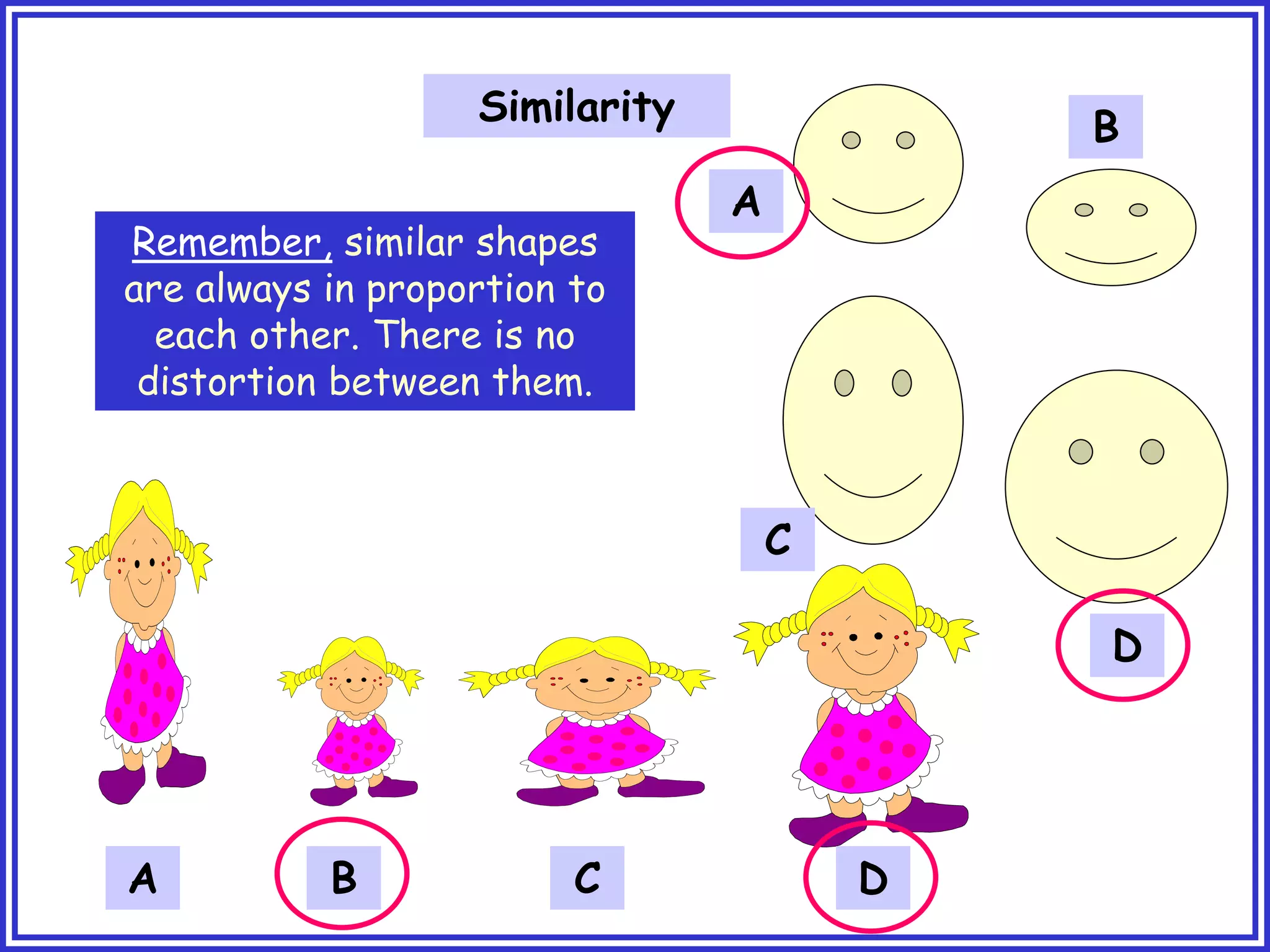
Similarity
Remember, similar shapes
are always in proportion to
each other. There is no
distortion between them.
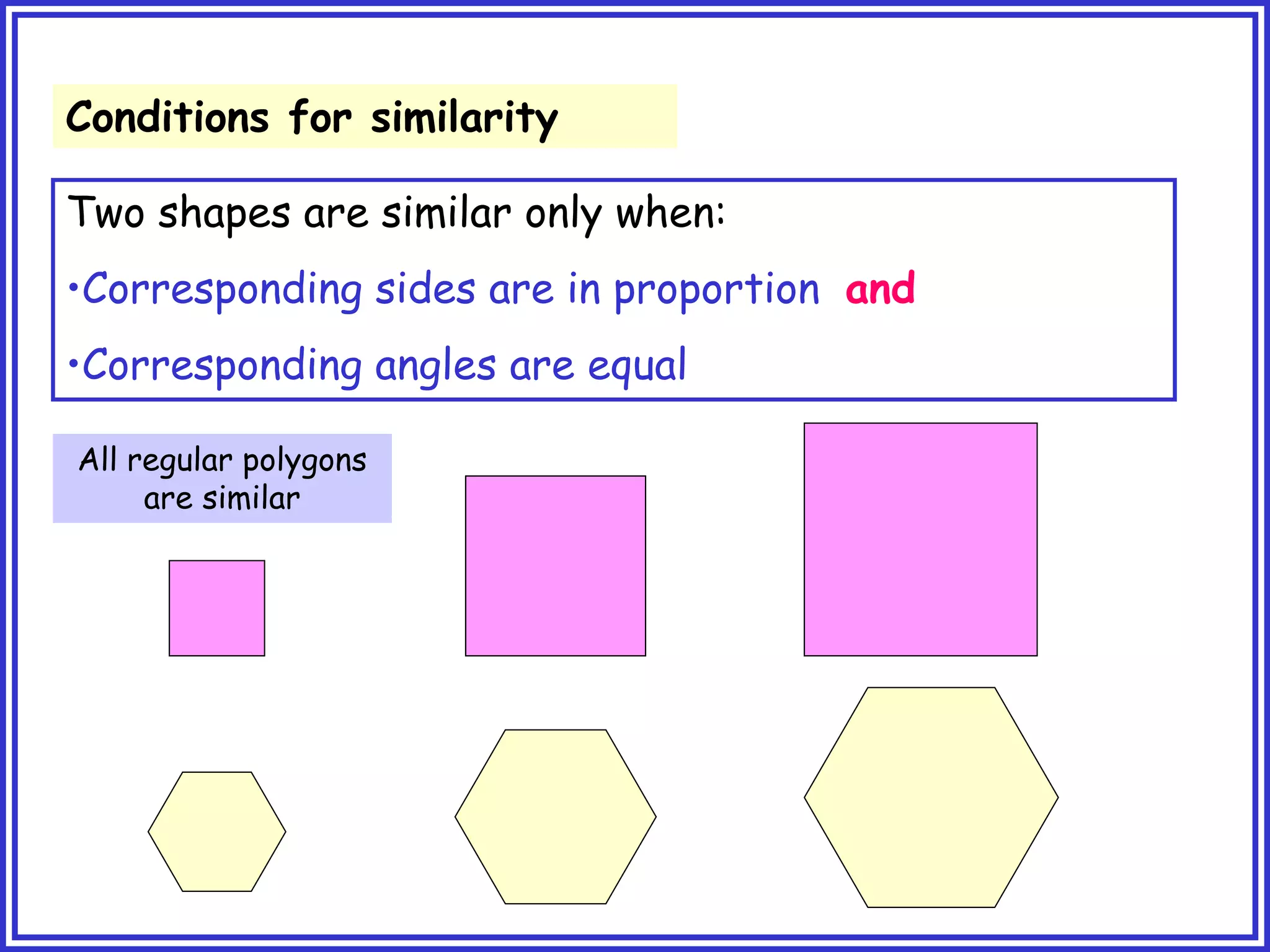
Conditions for similarity
Two shapes are similar only when:
•Corresponding sides are in proportion and
•Corresponding angles are equal
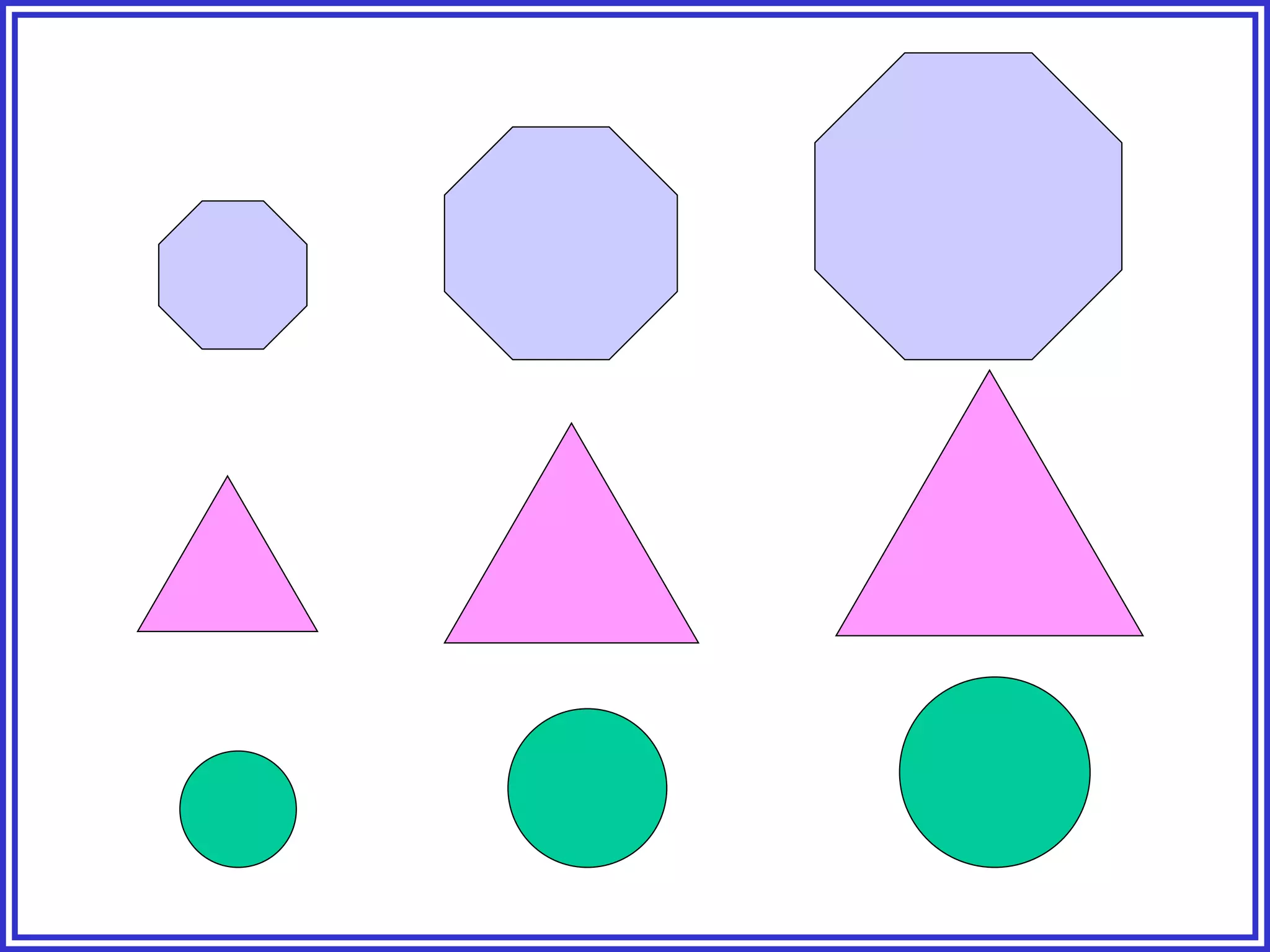
All regular polygons
are similar
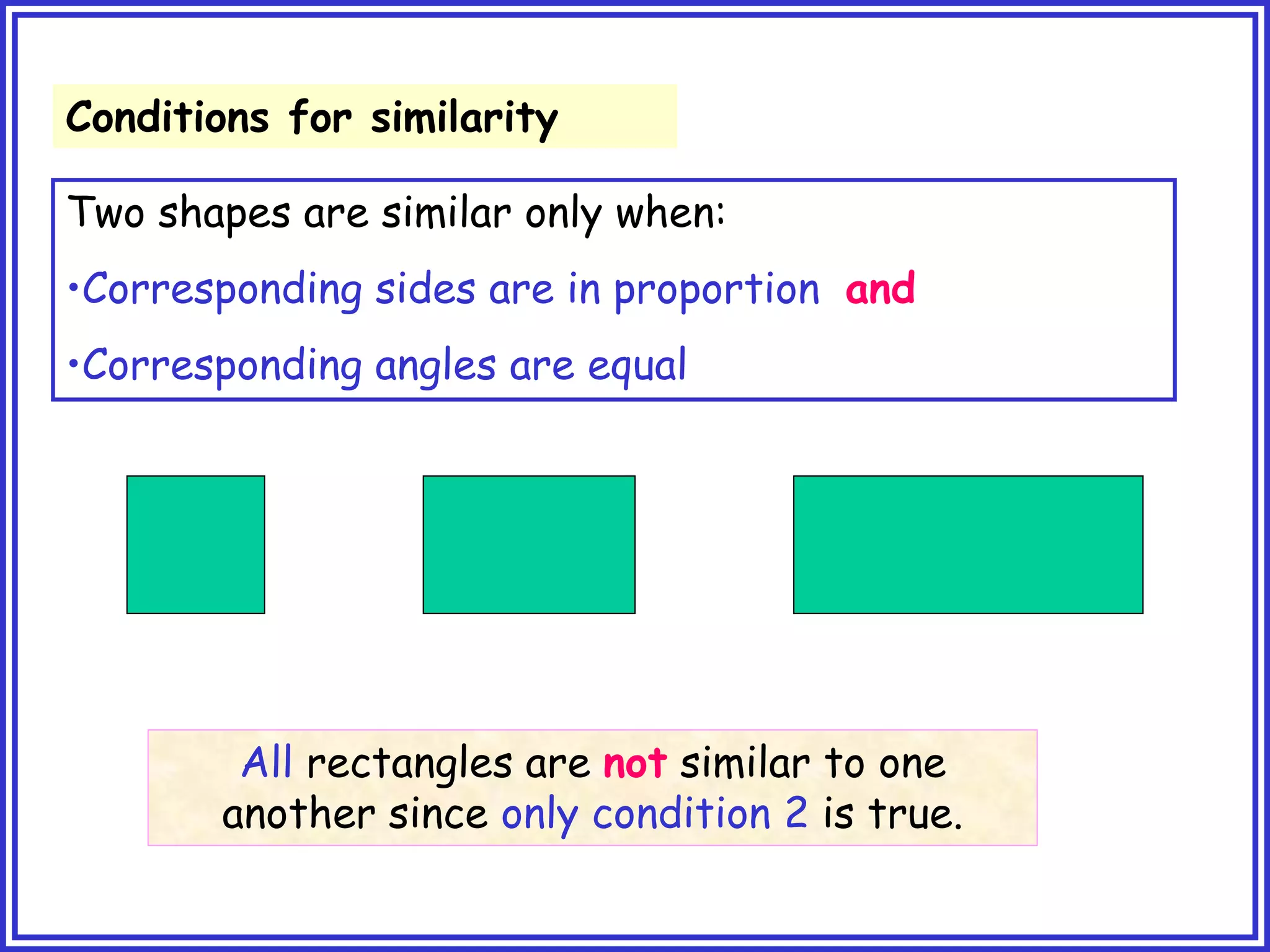
Conditions for similarity
Two shapes are similar only when:
•Corresponding sides are in proportion and
•Corresponding angles are equal
All rectangles are not similar to one
another since only condition 2 is true.
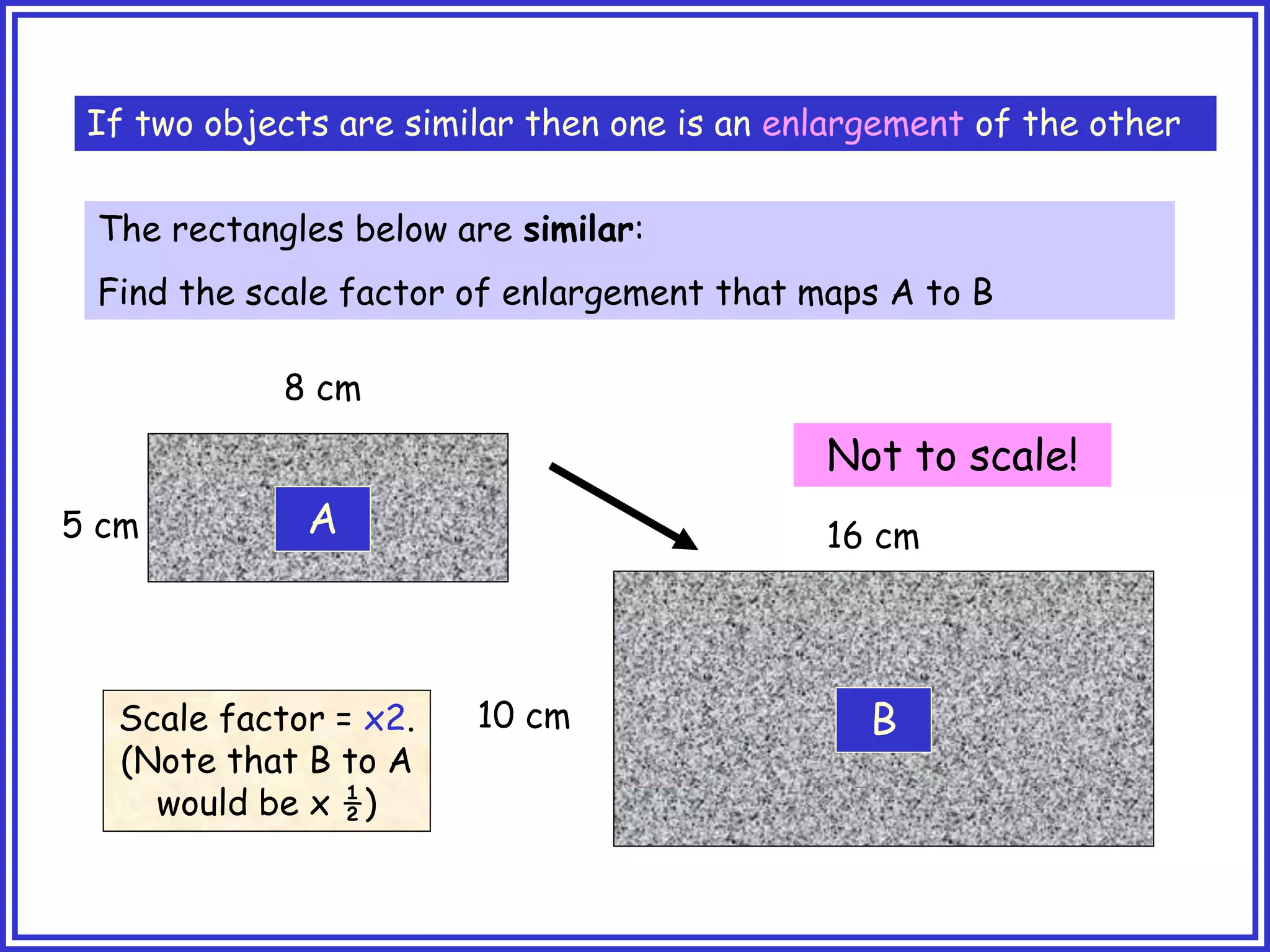
If two objects are similar then one is an enlargement of the other
The rectangles below are similar:
Find the scale factor of enlargement that maps A to B
A
B
8 cm
16 cm
5 cm
10 cm
Not to scale!
Scale factor = x2.
(Note that B to A
would be x ½)
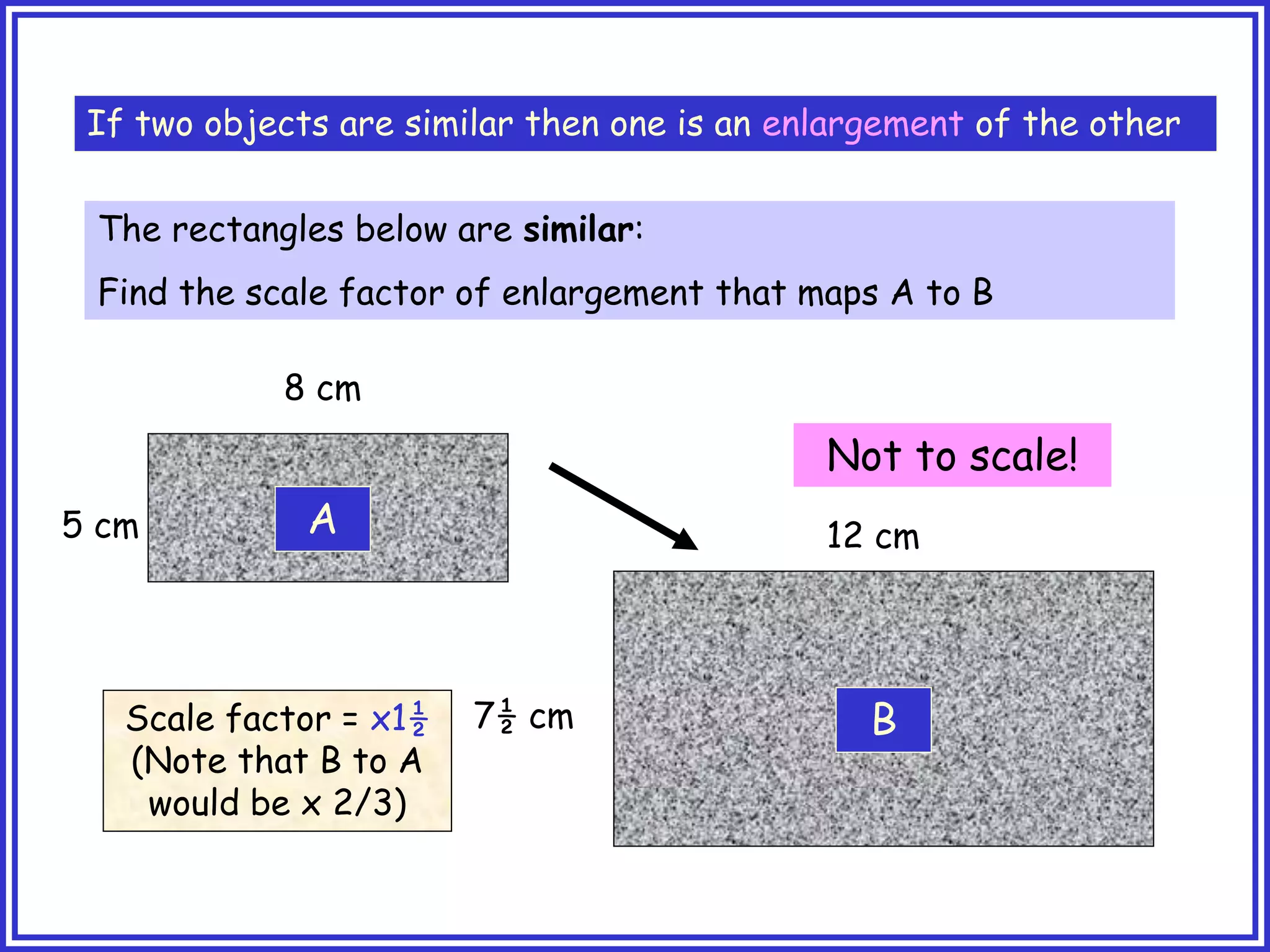
If two objects are similar then one is an enlargement of the other
The rectangles below are similar:
Find the scale factor of enlargement that maps A to B
A
B
8 cm
12 cm
5 cm
7½ cm
Not to scale!
Scale factor = x1½
(Note that B to A
would be x 2/3)
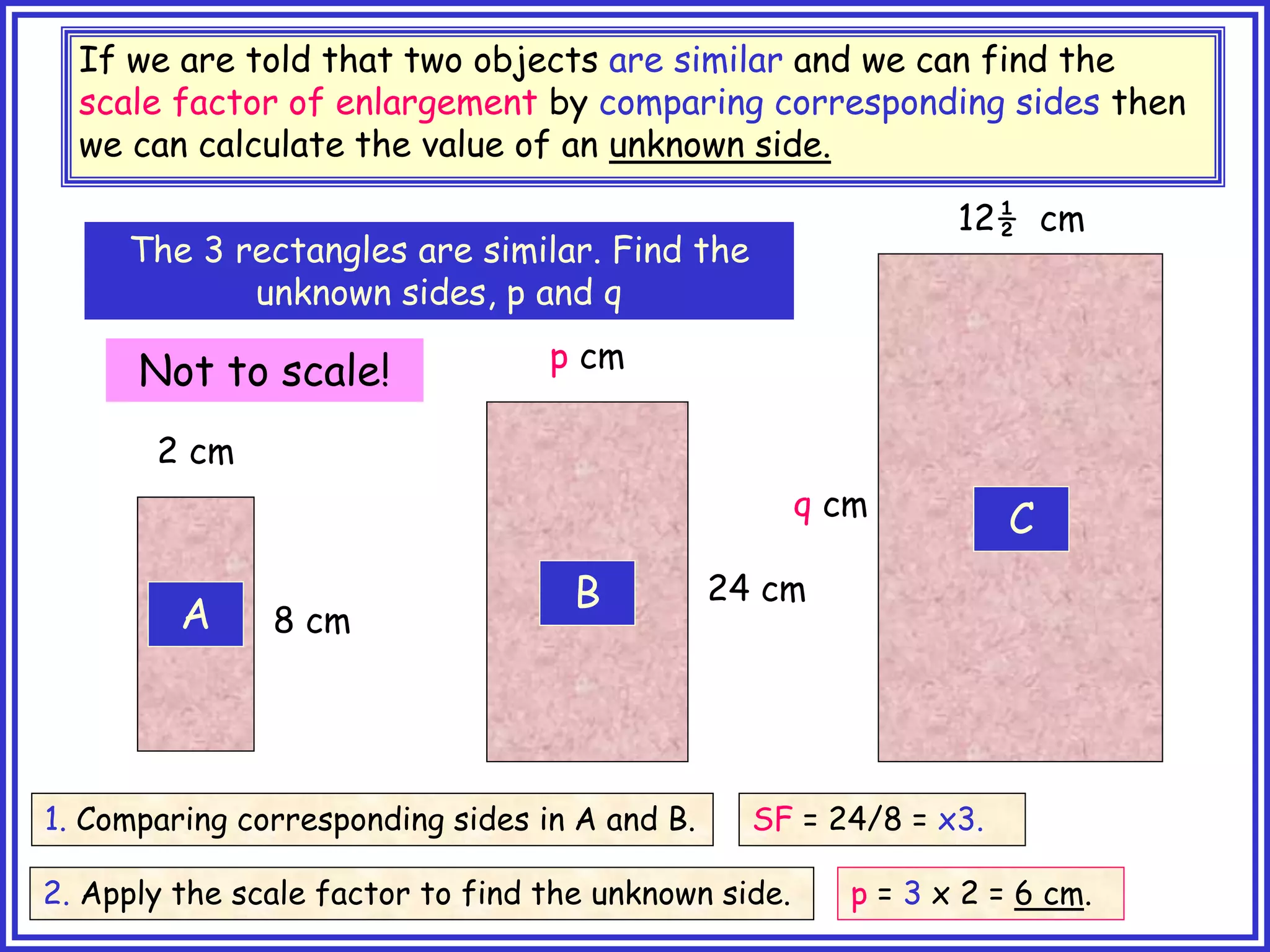
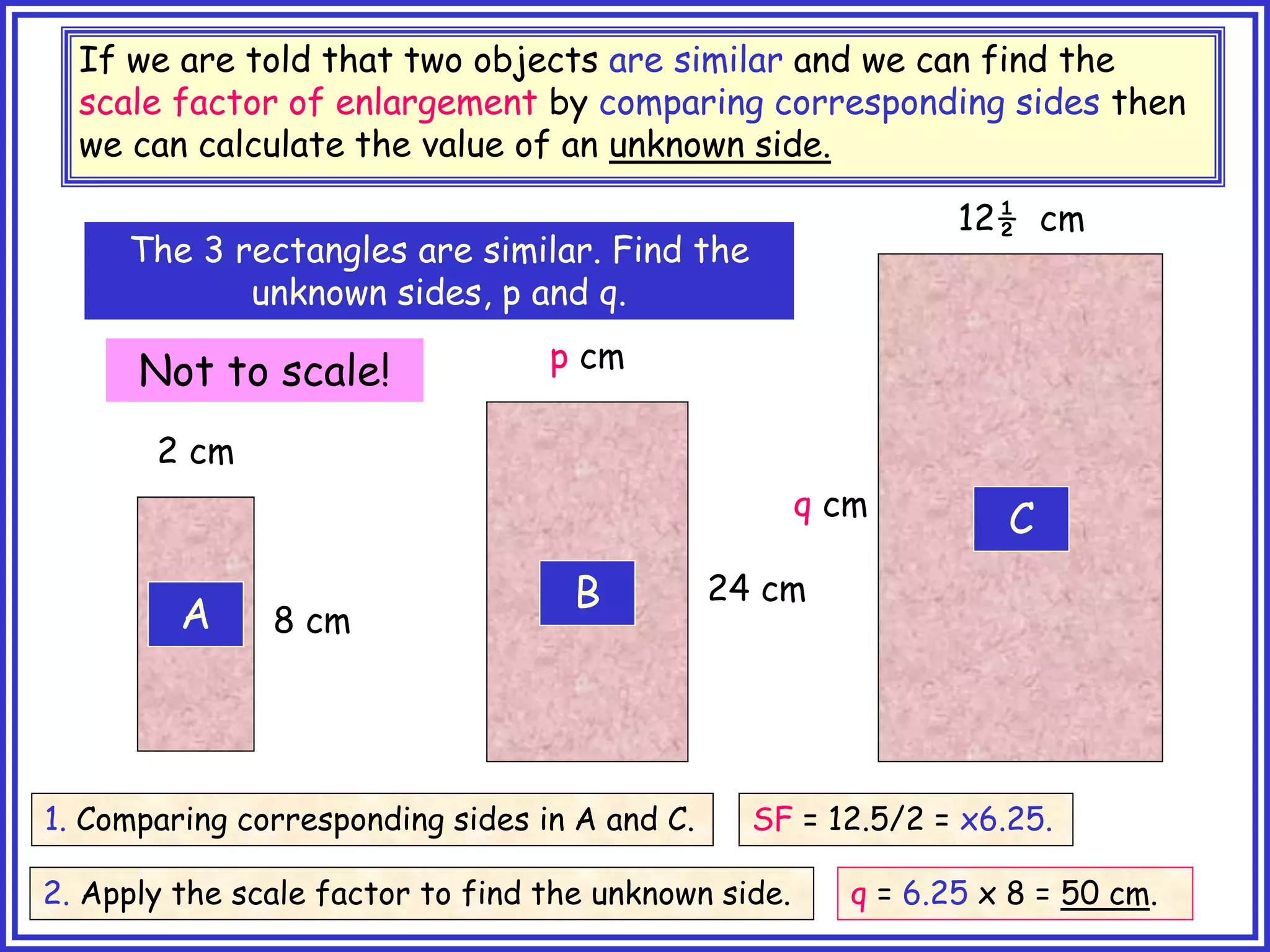
If we are told that two objects are similar and we can find the
scale factor of enlargement by comparing corresponding sides then
we can calculate the value of an unknown side.
8 cm
A
B
C
2 cm
Not to scale!
24 cm
p cm
q cm
12½ cm
The 3 rectangles are similar. Find the
unknown sides, p and q
1. Comparing corresponding sides in A and B. SF = 24/8 = x3.
2. Apply the scale factor to find the unknown side. p = 3 x 2 = 6 cm.
If we are told that two objects are similar and we can find the
scale factor of enlargement by comparing corresponding sides then
we can calculate the value of an unknown side.
8 cm
A
B
C
2 cm
Not to scale!
24 cm
p cm
q cm
12½ cm
The 3 rectangles are similar. Find the
unknown sides, p and q.
1. Comparing corresponding sides in A and C. SF = 12.5/2 = x6.25.
2. Apply the scale factor to find the unknown side. q = 6.25 x 8 = 50 cm.
5 cm
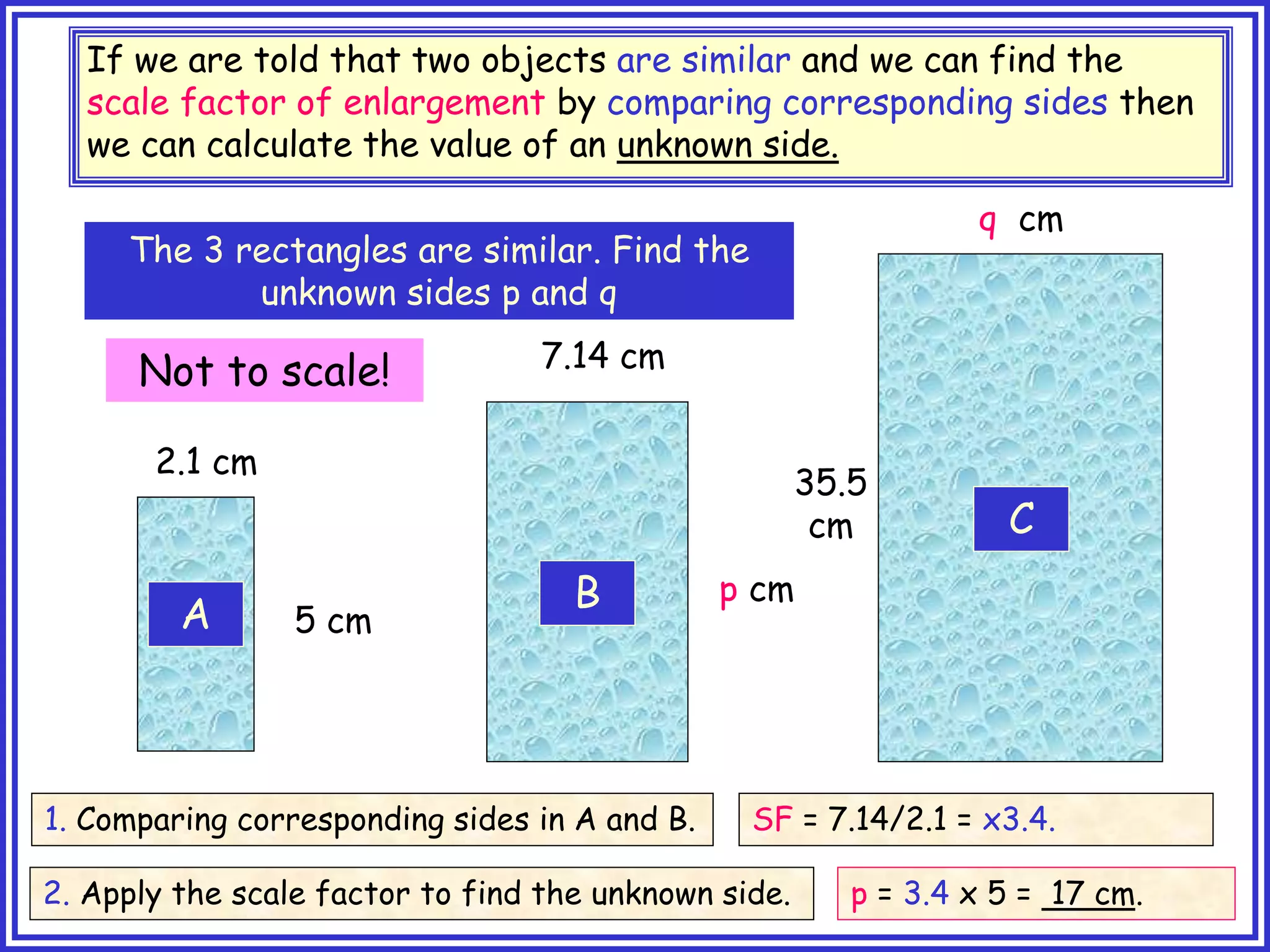
If we are told that two objects are similar and we can find the
scale factor of enlargement by comparing corresponding sides then
we can calculate the value of an unknown side.
A
B
C
2.1 cm
Not to scale!
p cm
7.14 cm
35.5
cm
q cm
The 3 rectangles are similar. Find the
unknown sides p and q
1. Comparing corresponding sides in A and B. SF = 7.14/2.1 = x3.4.
2. Apply the scale factor to find the unknown side. p = 3.4 x 5 = 17 cm.
5 cm
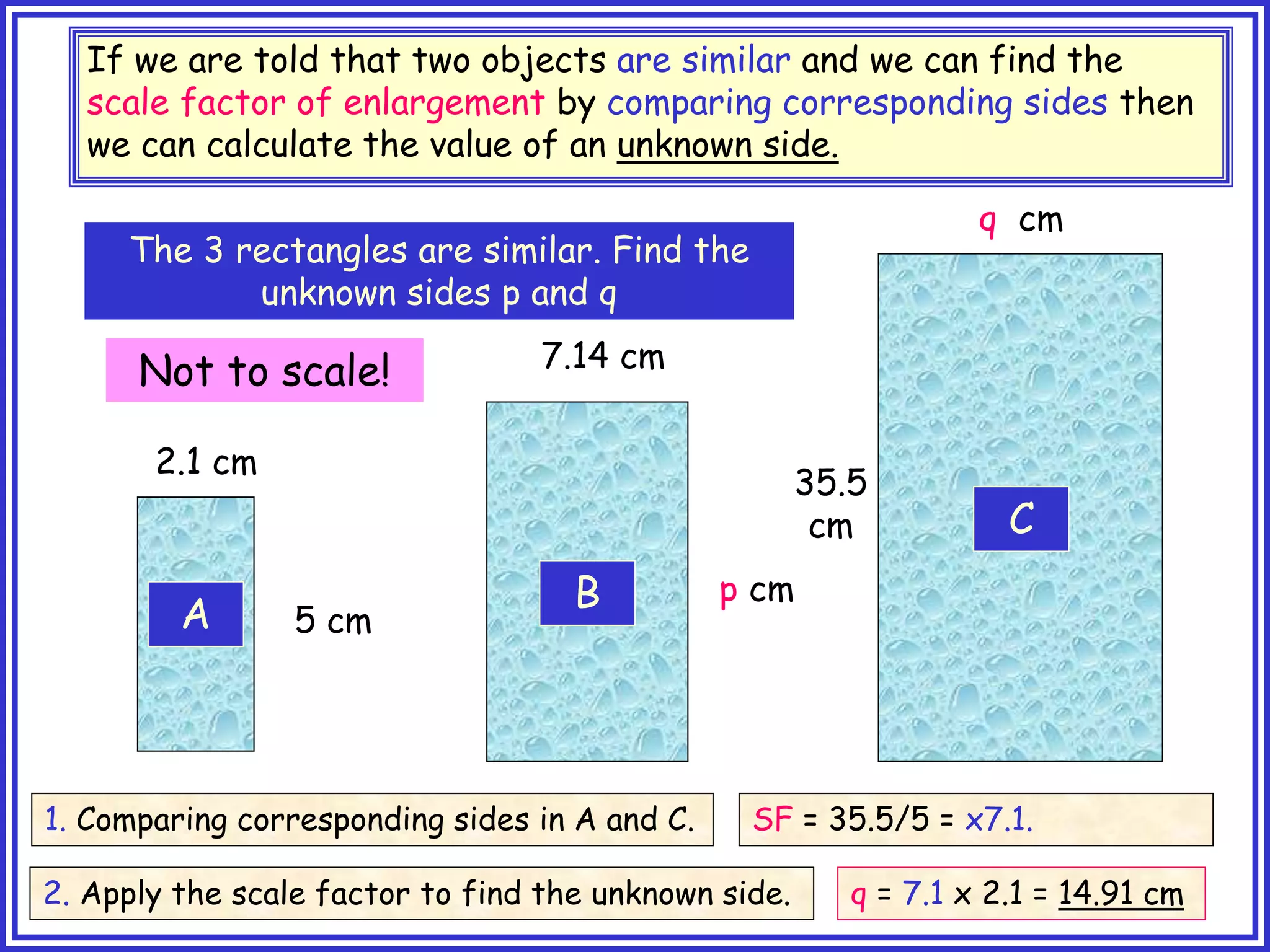
If we are told that two objects are similar and we can find the
scale factor of enlargement by comparing corresponding sides then
we can calculate the value of an unknown side.
A
B
C
2.1 cm
Not to scale!
p cm
7.14 cm
35.5
cm
q cm
The 3 rectangles are similar. Find the
unknown sides p and q
1. Comparing corresponding sides in A and C. SF = 35.5/5 = x7.1.
2. Apply the scale factor to find the unknown side. q = 7.1 x 2.1 = 14.91 cm
Similar Triangles
Similar triangles are important in mathematics and their
application can be used to solve a wide variety of problems.
The two conditions for similarity between shapes as
we have seen earlier are:
•Corresponding sides are in proportion and
•Corresponding angles are equal
Triangles are the exception to this rule.
Only the second condition is needed
Two triangles are similar if their
•Corresponding angles are equal
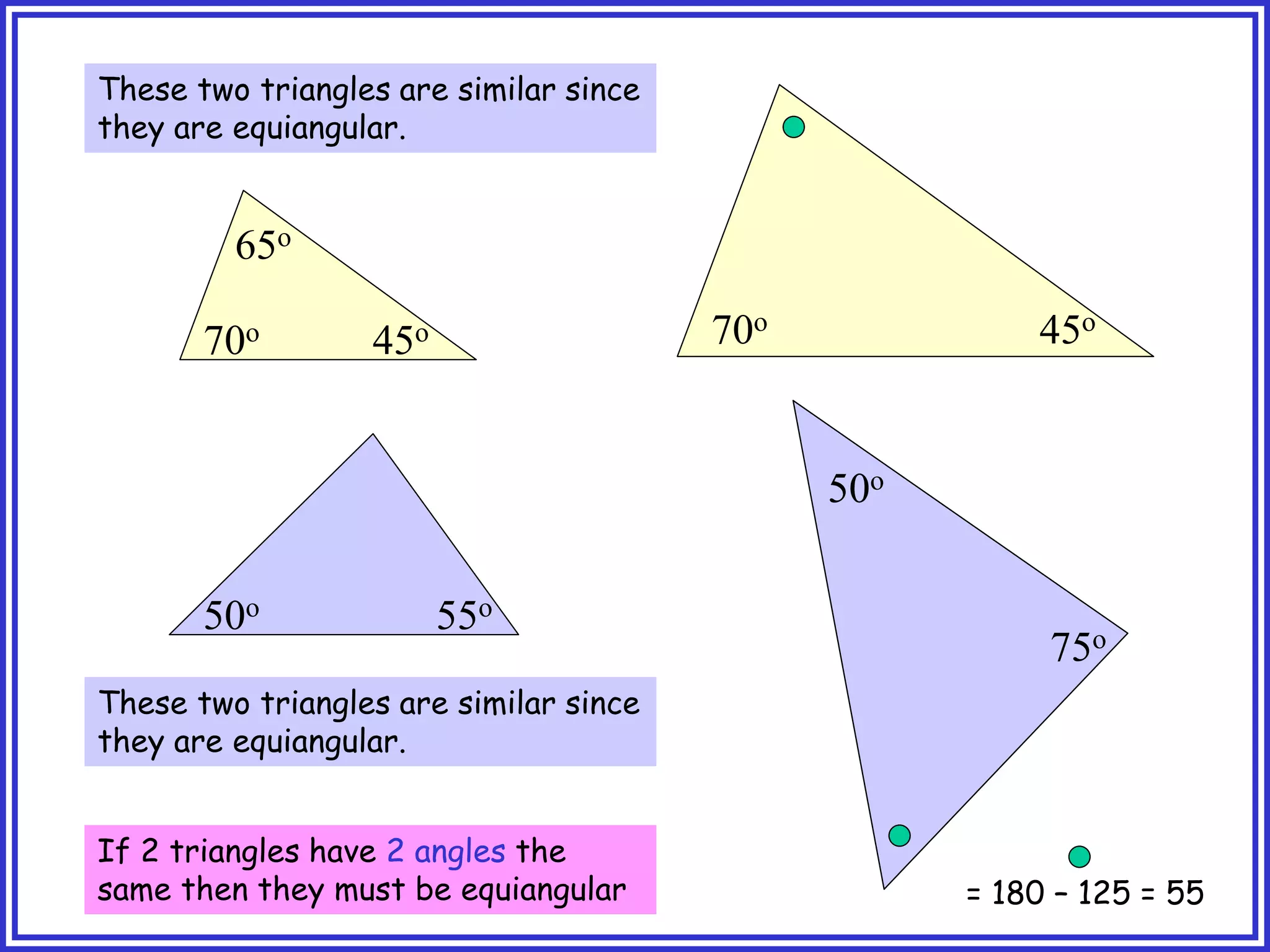
70o 70o
45o
65o
45o
These two triangles are similar since
they are equiangular.
50o 55o
75o
50o
These two triangles are similar since
they are equiangular.
If 2 triangles have 2 angles the
same then they must be equiangular = 180 – 125 = 55
Finding Unknown Sides
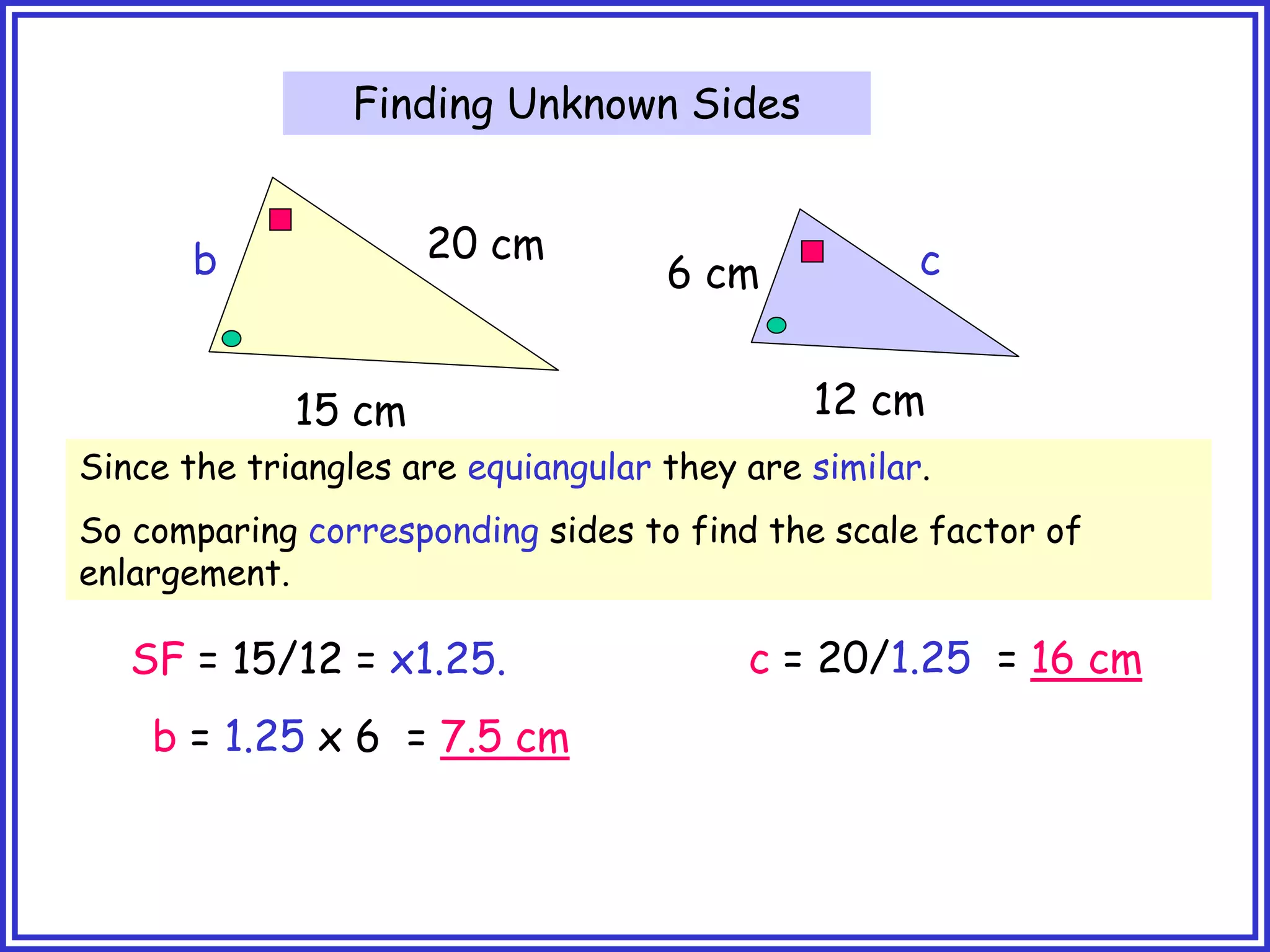
20 cm
15 cm 12 cm
6 cm
b c
Since the triangles are equiangular they are similar.
So comparing corresponding sides to find the scale factor of
enlargement.
SF = 15/12 = x1.25.
b = 1.25 x 6 = 7.5 cm
c = 20/1.25 = 16 cm
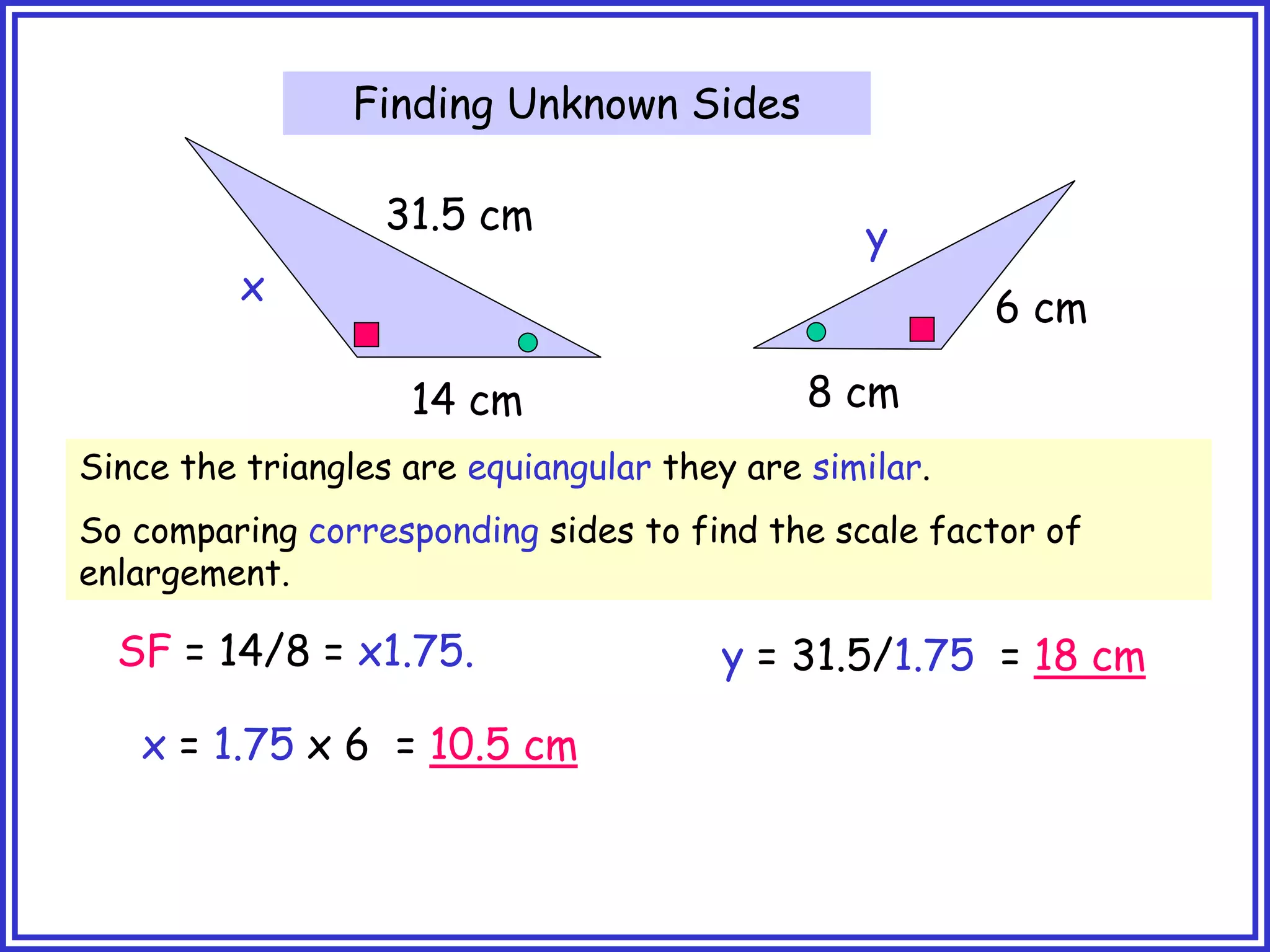
31.5 cm
14 cm 8 cm
6 cm
x
y
SF = 14/8 = x1.75.
x = 1.75 x 6 = 10.5 cm
y = 31.5/1.75 = 18 cm
Since the triangles are equiangular they are similar.
So comparing corresponding sides to find the scale factor of
enlargement.
Finding Unknown Sides
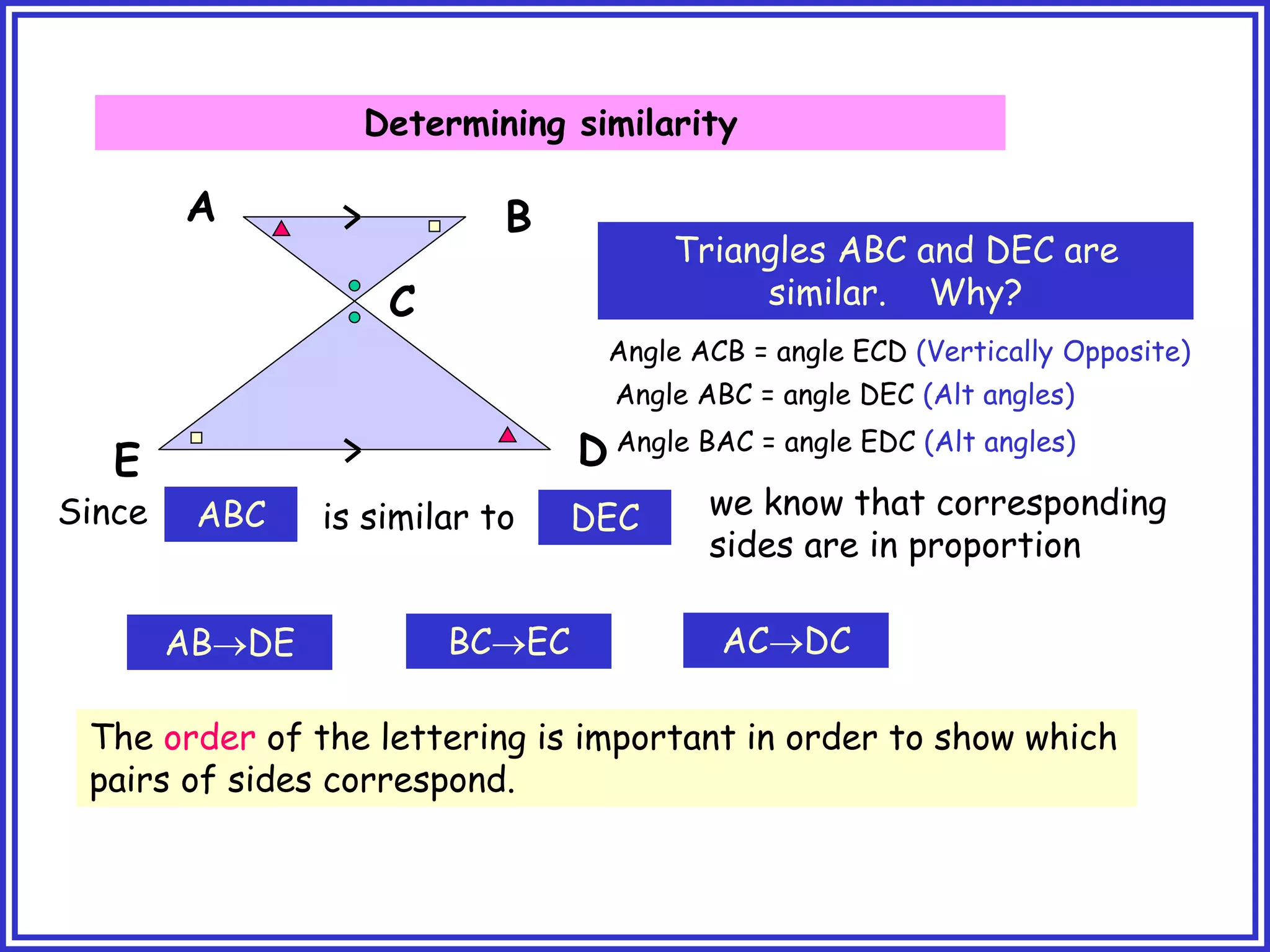
Determining similarity
A B
E D
Triangles ABC and DEC are
similar. Why?
C
Angle ACB = angle ECD (Vertically Opposite)
Angle ABC = angle DEC (Alt angles)
Angle BAC = angle EDC (Alt angles)
Since ABC is similar to DEC we know that corresponding
sides are in proportion
ABDE BCEC ACDC
The order of the lettering is important in order to show which
pairs of sides correspond.
A
B C
D E
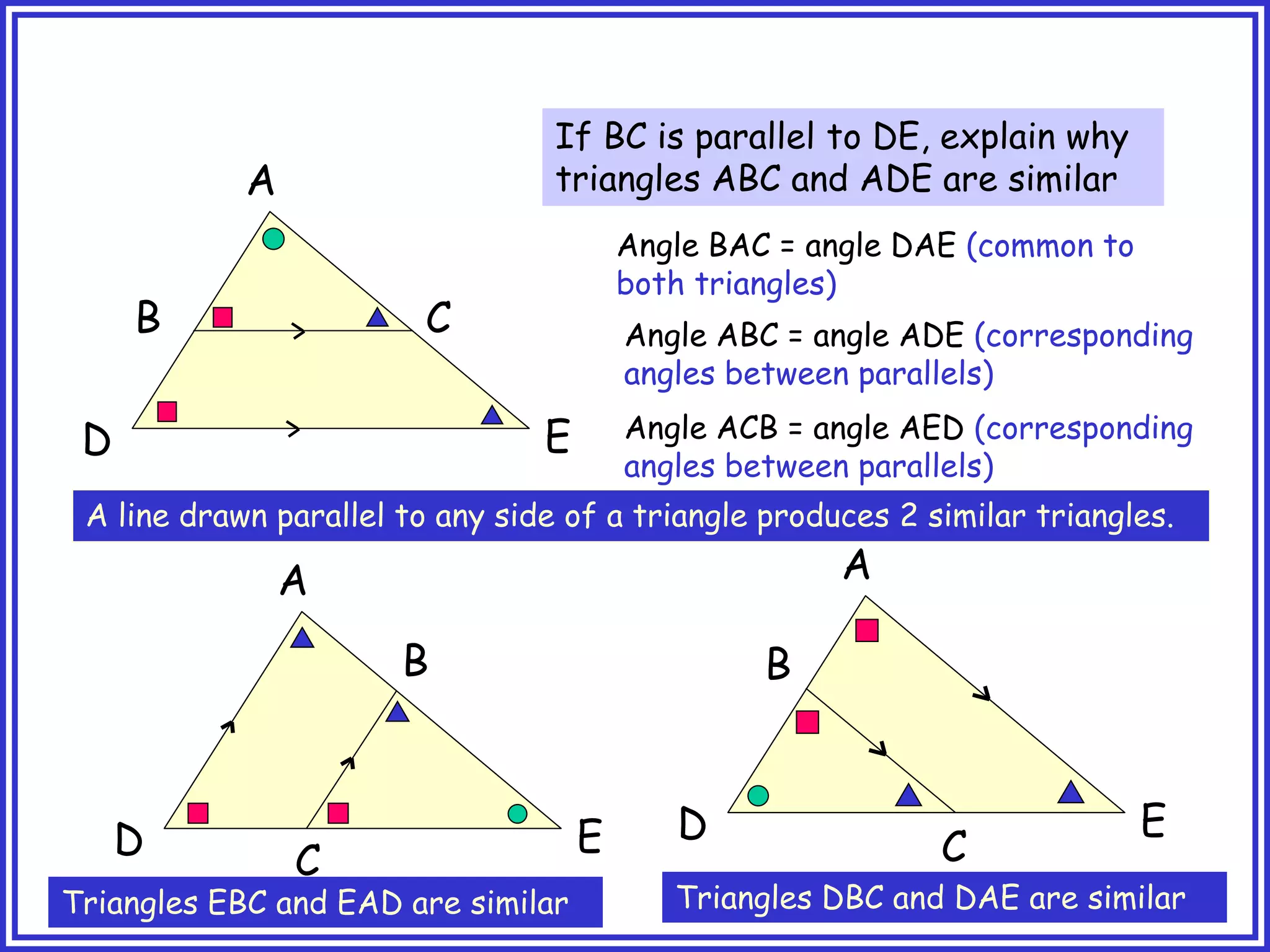
If BC is parallel to DE, explain why
triangles ABC and ADE are similar
Angle BAC = angle DAE (common to
both triangles)
Angle ABC = angle ADE (corresponding
angles between parallels)
Angle ACB = angle AED (corresponding
angles between parallels)
A
D E
A
D E
B
C
B
C
A line drawn parallel to any side of a triangle produces 2 similar triangles.
Triangles EBC and EAD are similar Triangles DBC and DAE are similar
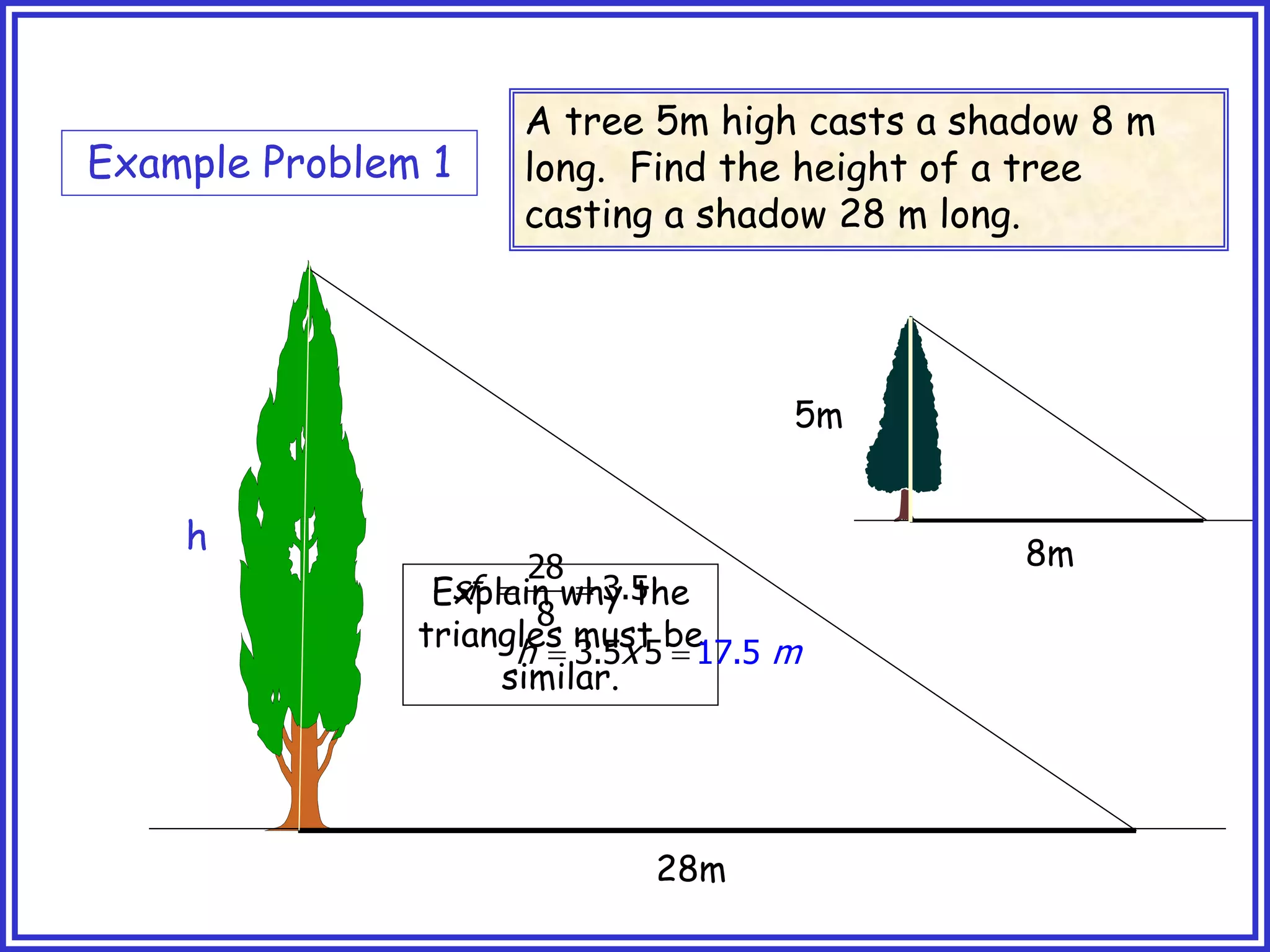
A tree 5m high casts a shadow 8 m
long. Find the height of a tree
casting a shadow 28 m long.
Example Problem 1
5m
8m
28m
h
Explain why the
triangles must be
similar.
 
28
3.5
8
sf
  1
3 7
.5 5
5 .
h x m
A
B
C
D
E
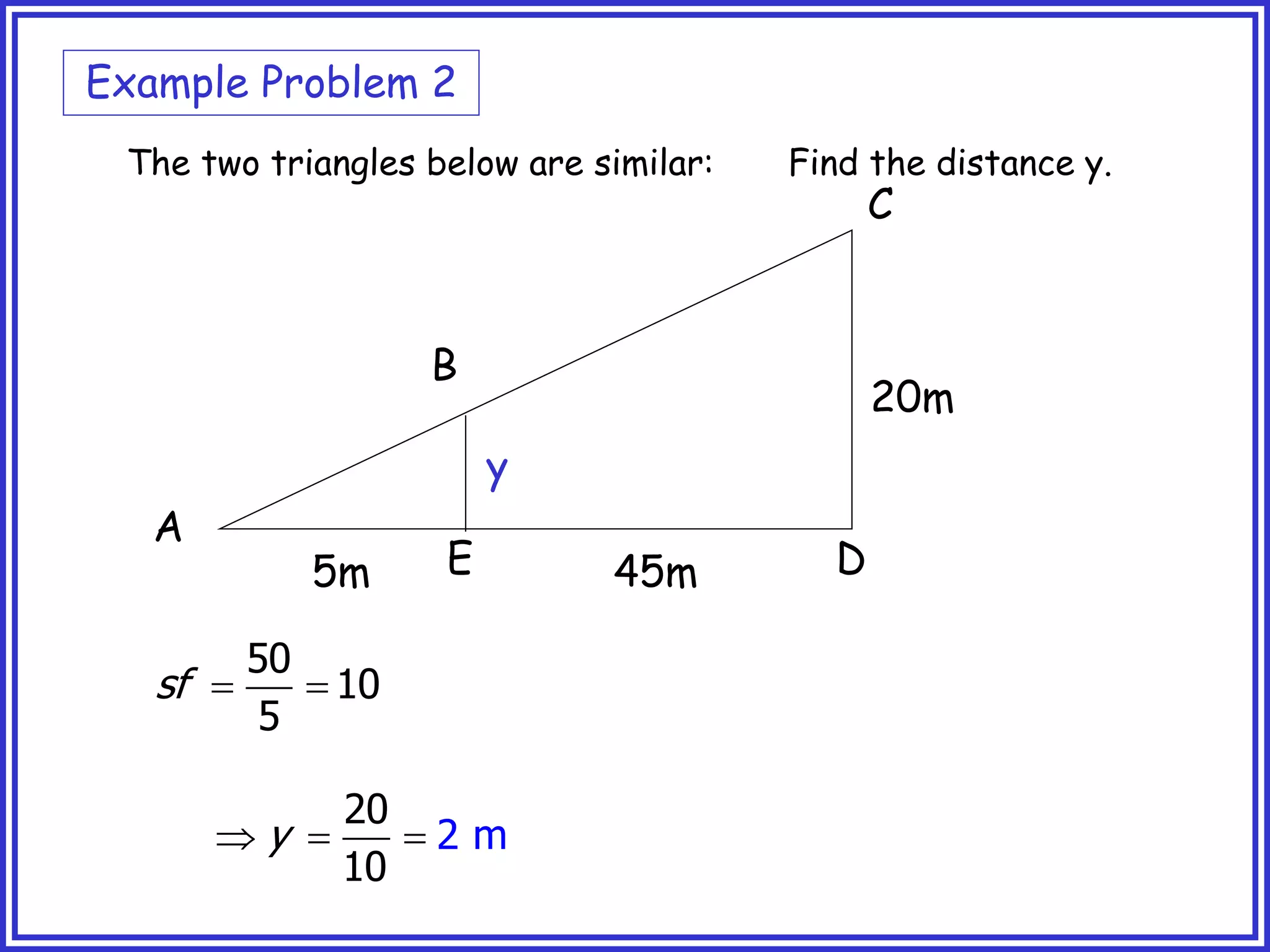
20m
45m
5m
y
The two triangles below are similar: Find the distance y.
 
50
10
5
sf
  
20
10
2 m
y
Example Problem 2
A
B
C D
E
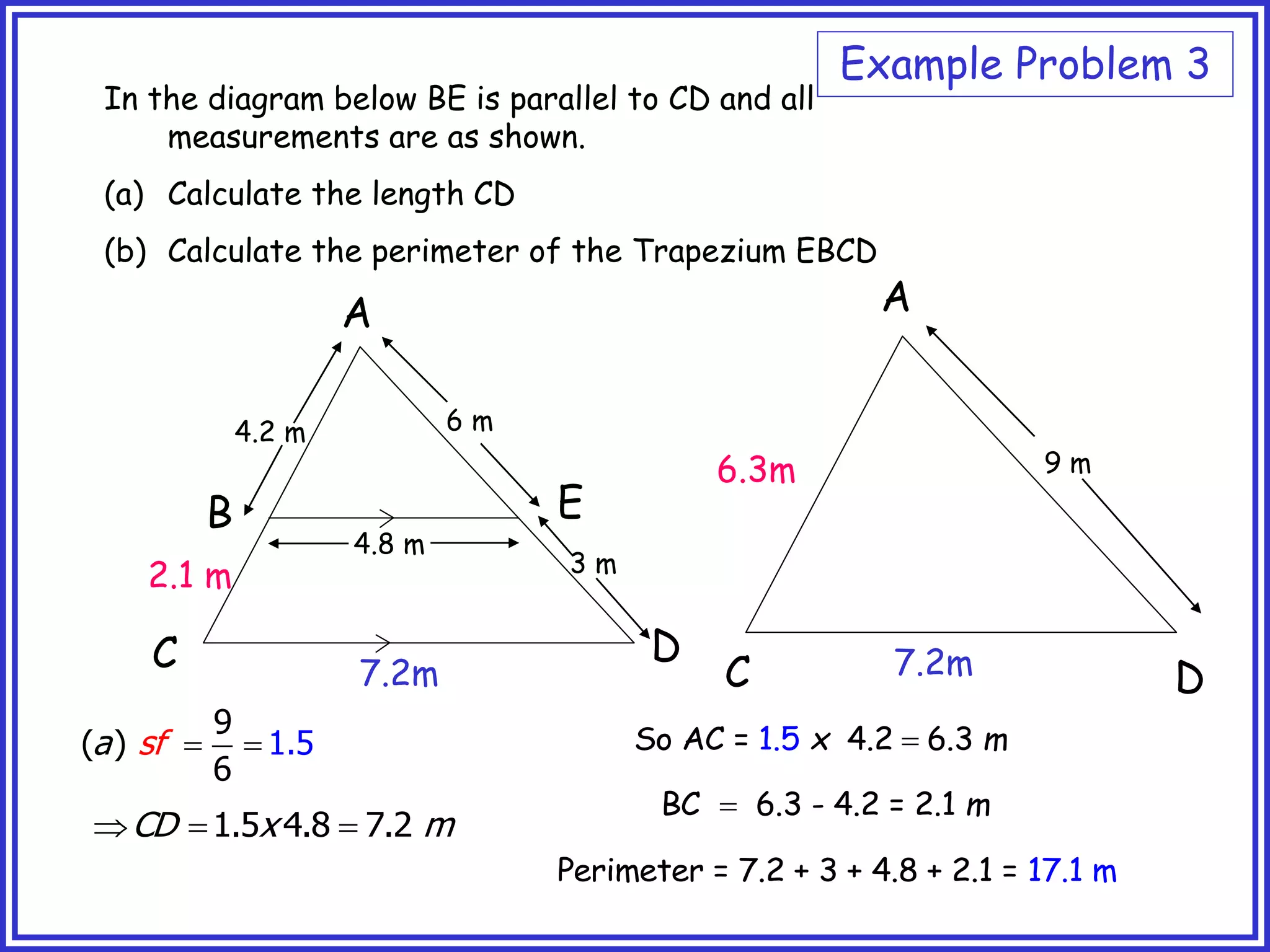
In the diagram below BE is parallel to CD and all
measurements are as shown.
(a) Calculate the length CD
(b) Calculate the perimeter of the Trapezium EBCD
4.8 m
6 m
3 m
4.2 m
9 m
A
C D
7.2m 7.2m
2.1 m
6.3m
 
9
( )
6
1.5
f
a s
  
1.5 4.8 7.2
CD x m
So AC = 4.2 6 3
.5
1 .
x m

BC 6.3 - 4.2 = 2.1 m

Perimeter = 7.2 + 3 + 4.8 + 2.1 17
= .1 m
Example Problem 3
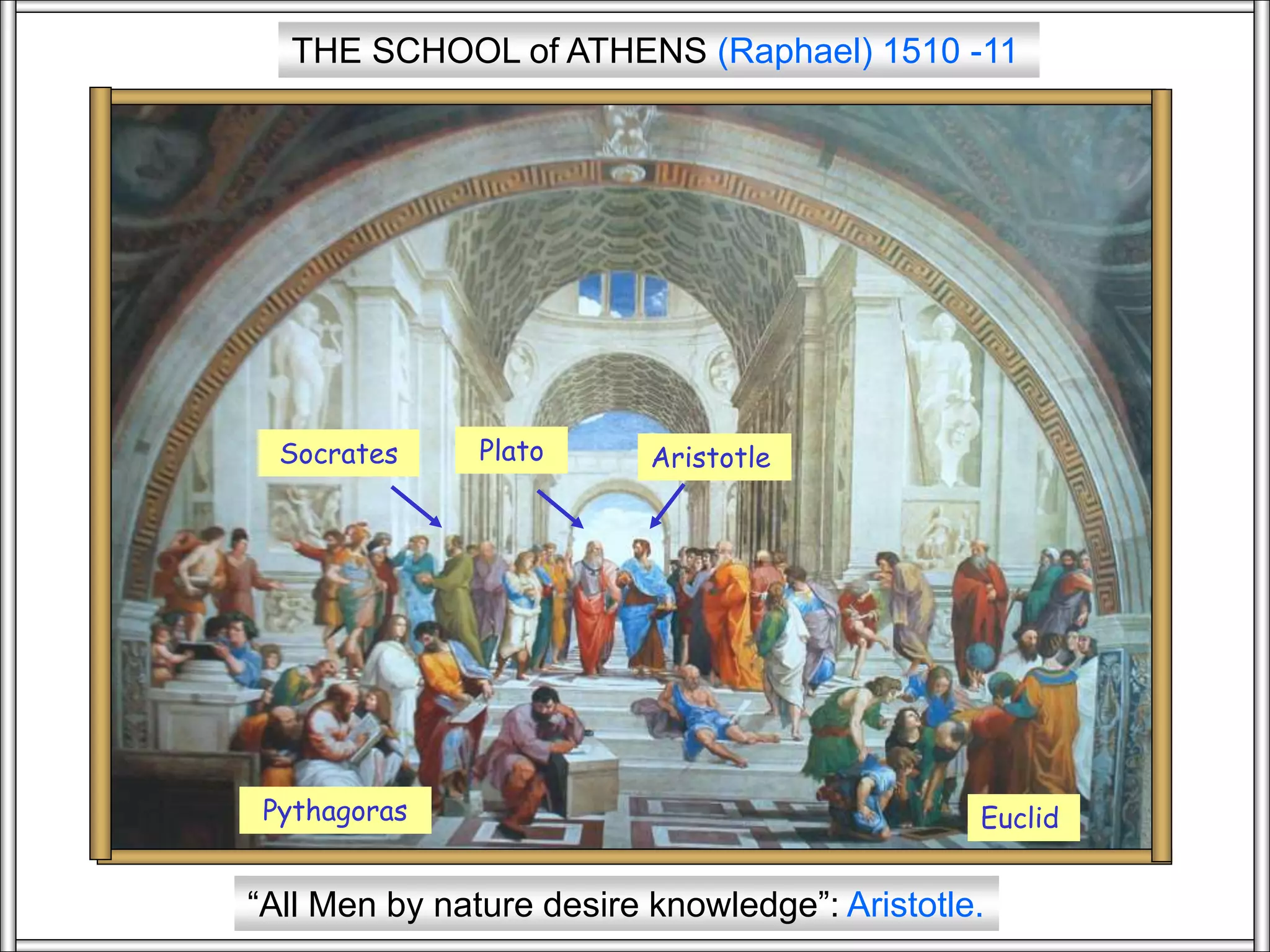
“All Men by nature desire knowledge”: Aristotle.
THE SCHOOL of ATHENS (Raphael) 1510 -11
Pythagoras Euclid
Plato Aristotle
Socrates
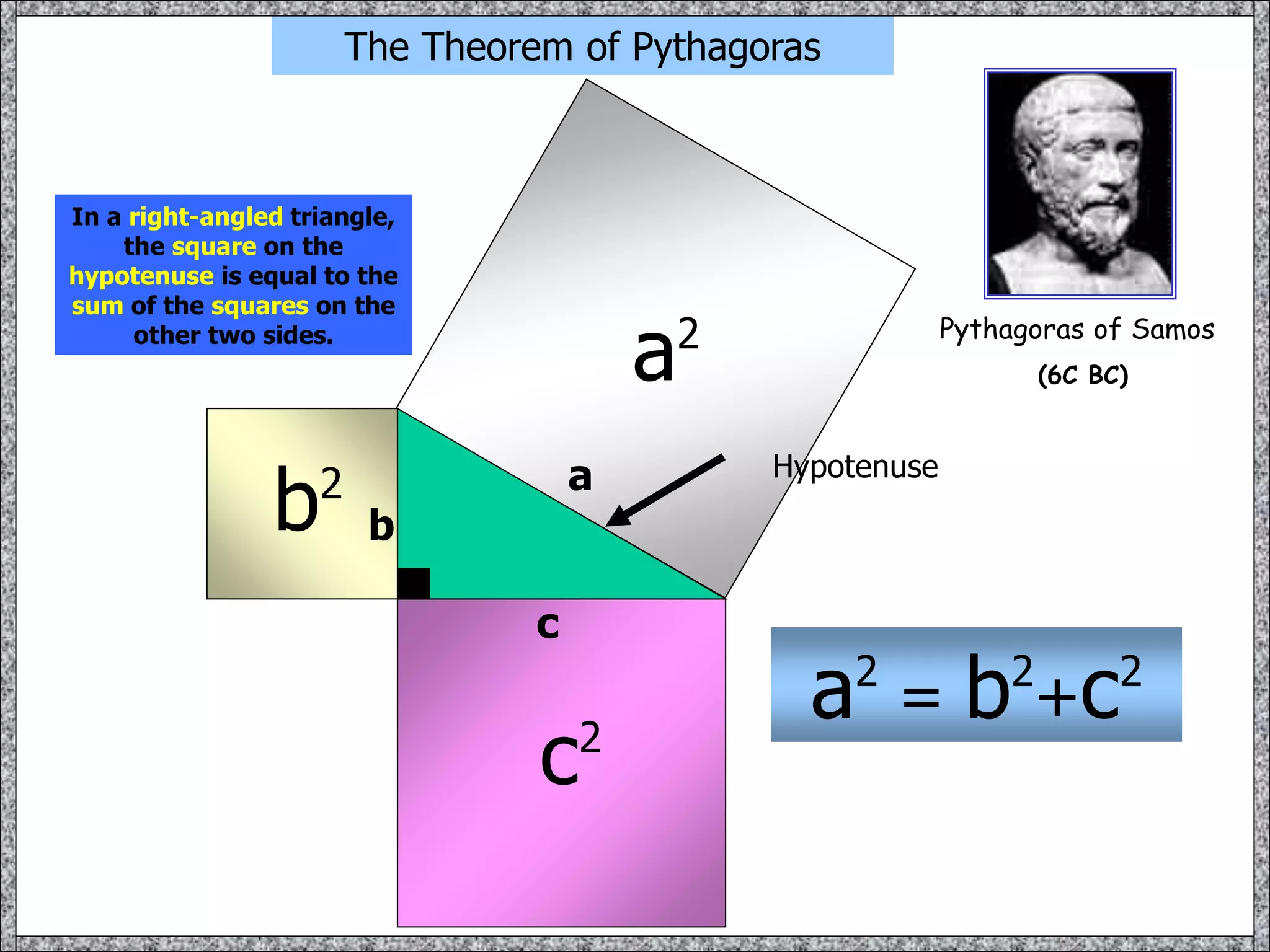
a2
b2
c2
a2
= b2
+c2
The Theorem of Pythagoras
b
c
a
In a right-angled triangle,
the square on the
hypotenuse is equal to the
sum of the squares on the
other two sides.
Hypotenuse
Pythagoras of Samos
(6C BC)
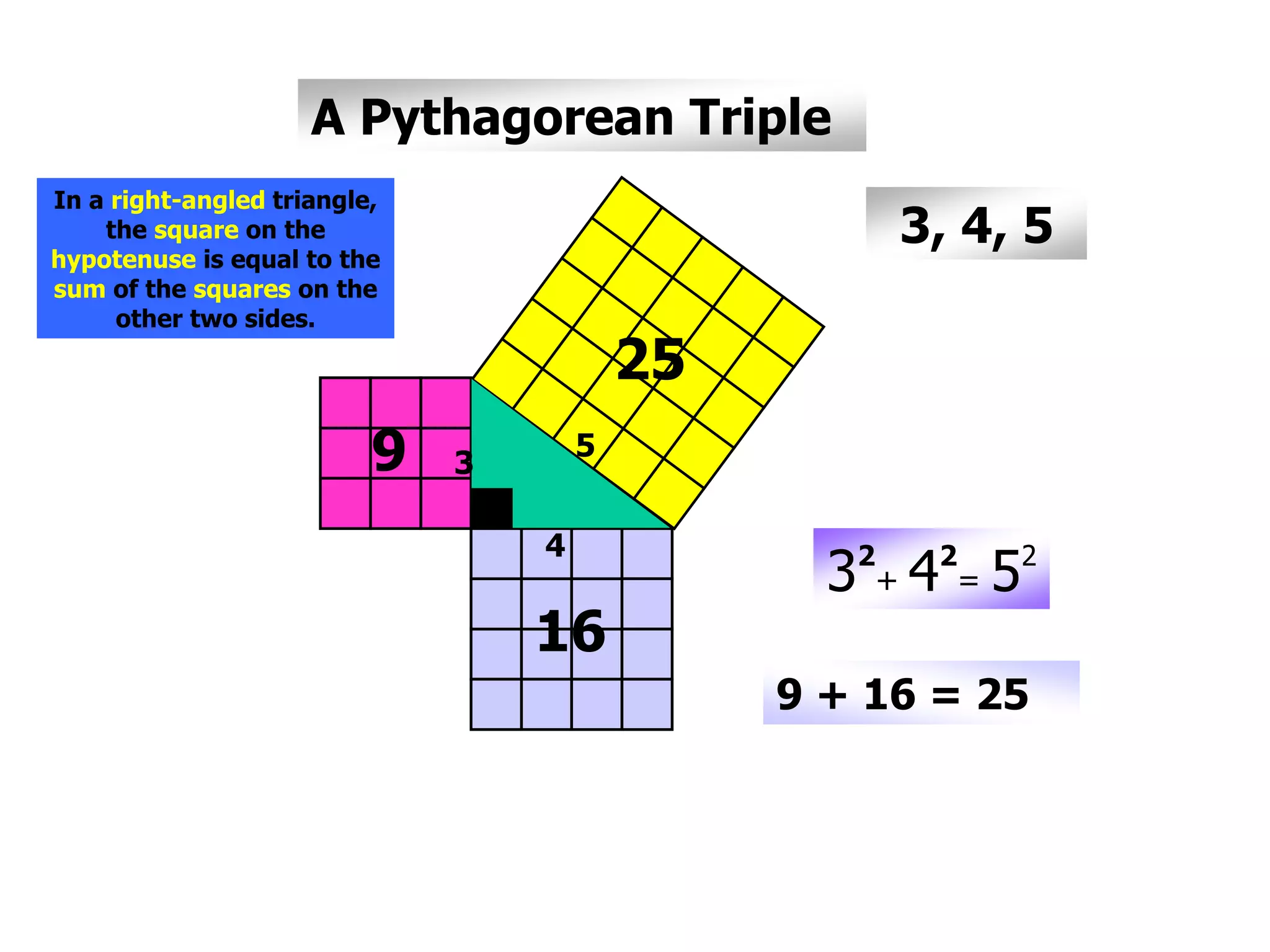
25
9
16
32
+ 42
= 52
9 + 16 = 25
A Pythagorean Triple
3
4
5
3, 4, 5
In a right-angled triangle,
the square on the
hypotenuse is equal to the
sum of the squares on the
other two sides.
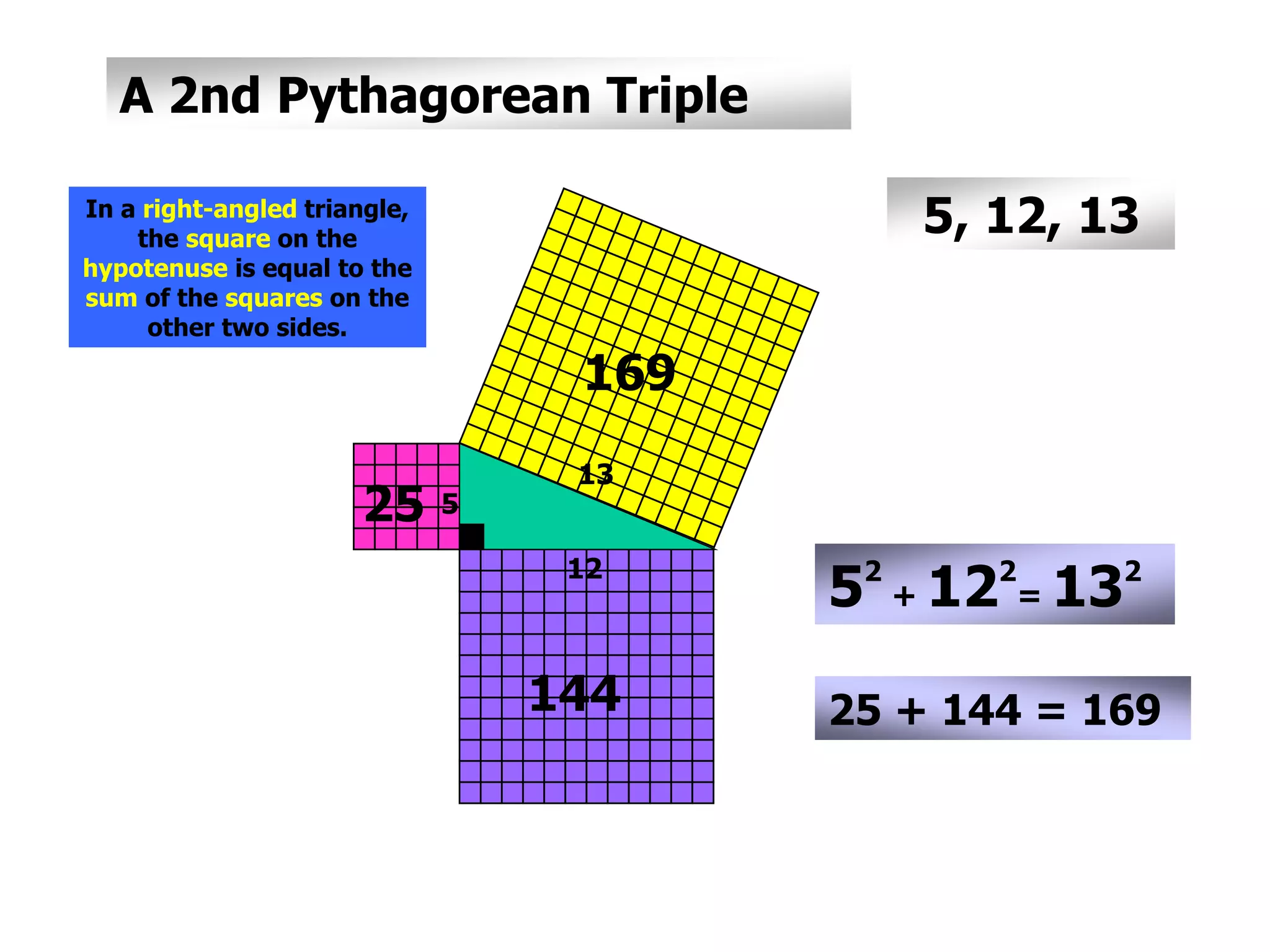
169
144
25
52
+ 122
= 132
25 + 144 = 169
A 2nd Pythagorean Triple
5, 12, 13
5
12
13
In a right-angled triangle,
the square on the
hypotenuse is equal to the
sum of the squares on the
other two sides.
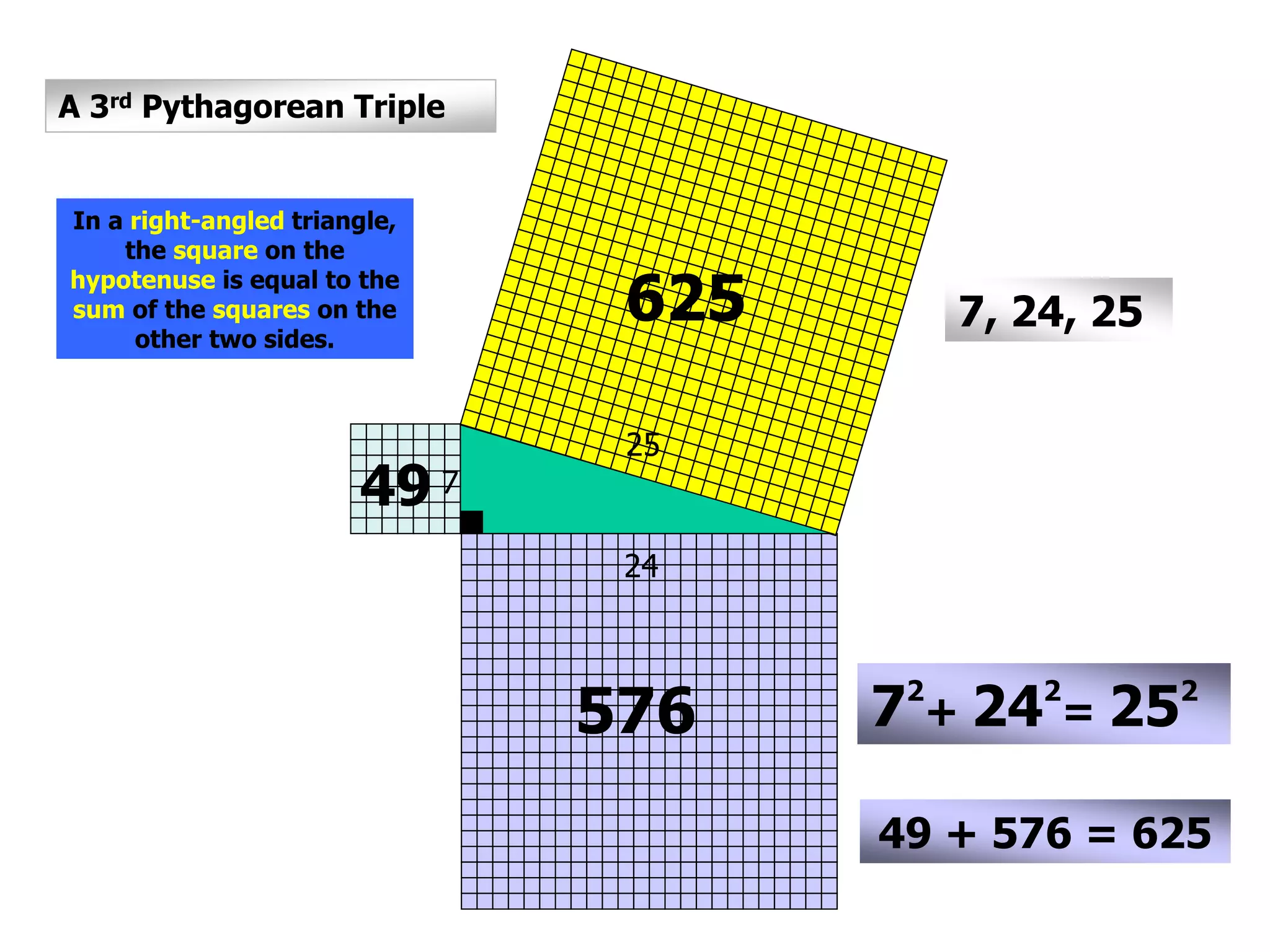
625
576
49
72
+ 242
= 252
49 + 576 = 625
7
24
25
A 3rd Pythagorean Triple
7, 24, 25
In a right-angled triangle,
the square on the
hypotenuse is equal to the
sum of the squares on the
other two sides.
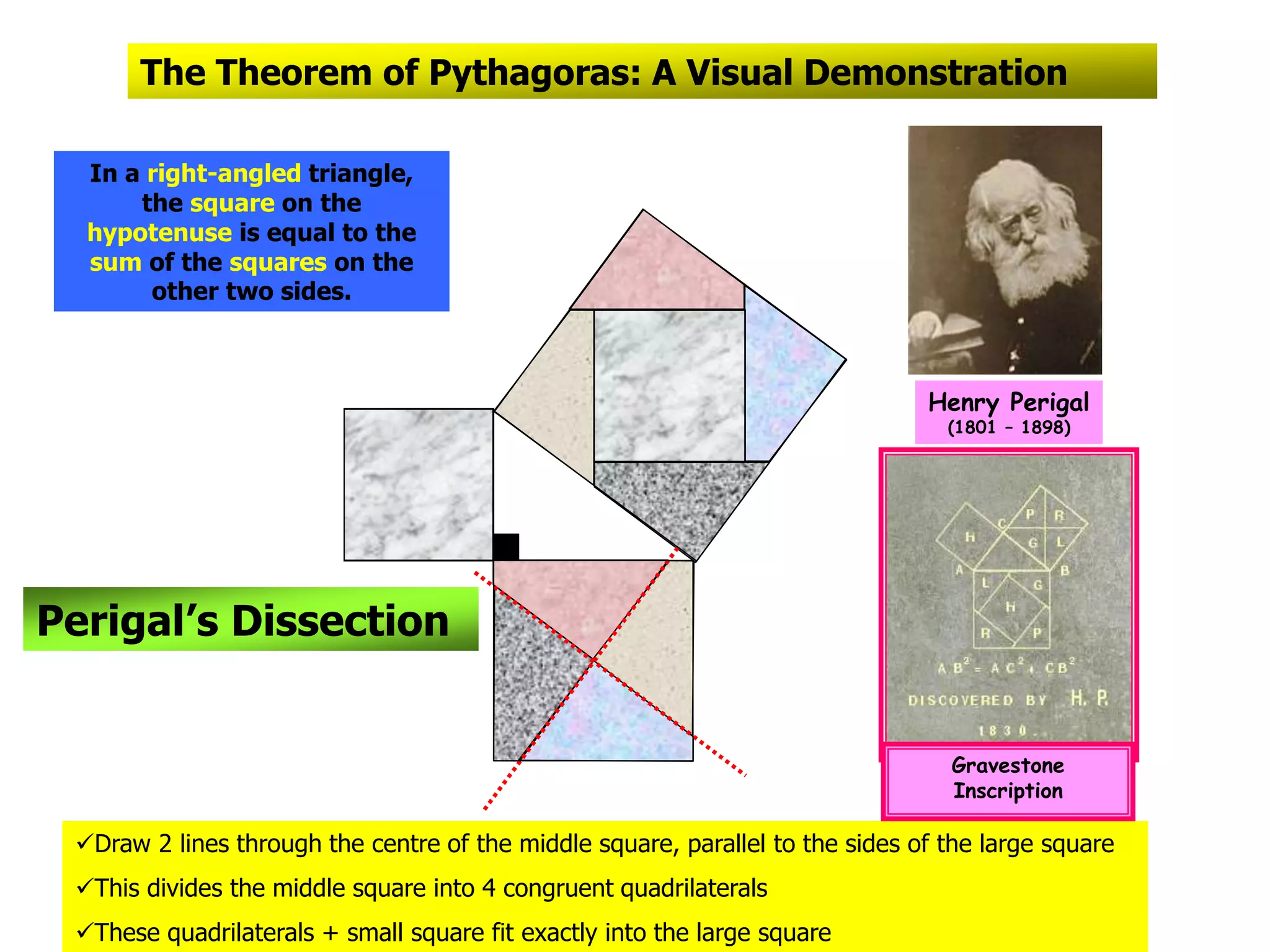
Perigal’s Dissection
The Theorem of Pythagoras: A Visual Demonstration
In a right-angled triangle,
the square on the
hypotenuse is equal to the
sum of the squares on the
other two sides.
Draw 2 lines through the centre of the middle square, parallel to the sides of the large square
This divides the middle square into 4 congruent quadrilaterals
These quadrilaterals + small square fit exactly into the large square
Henry Perigal
(1801 – 1898)
Gravestone
Inscription
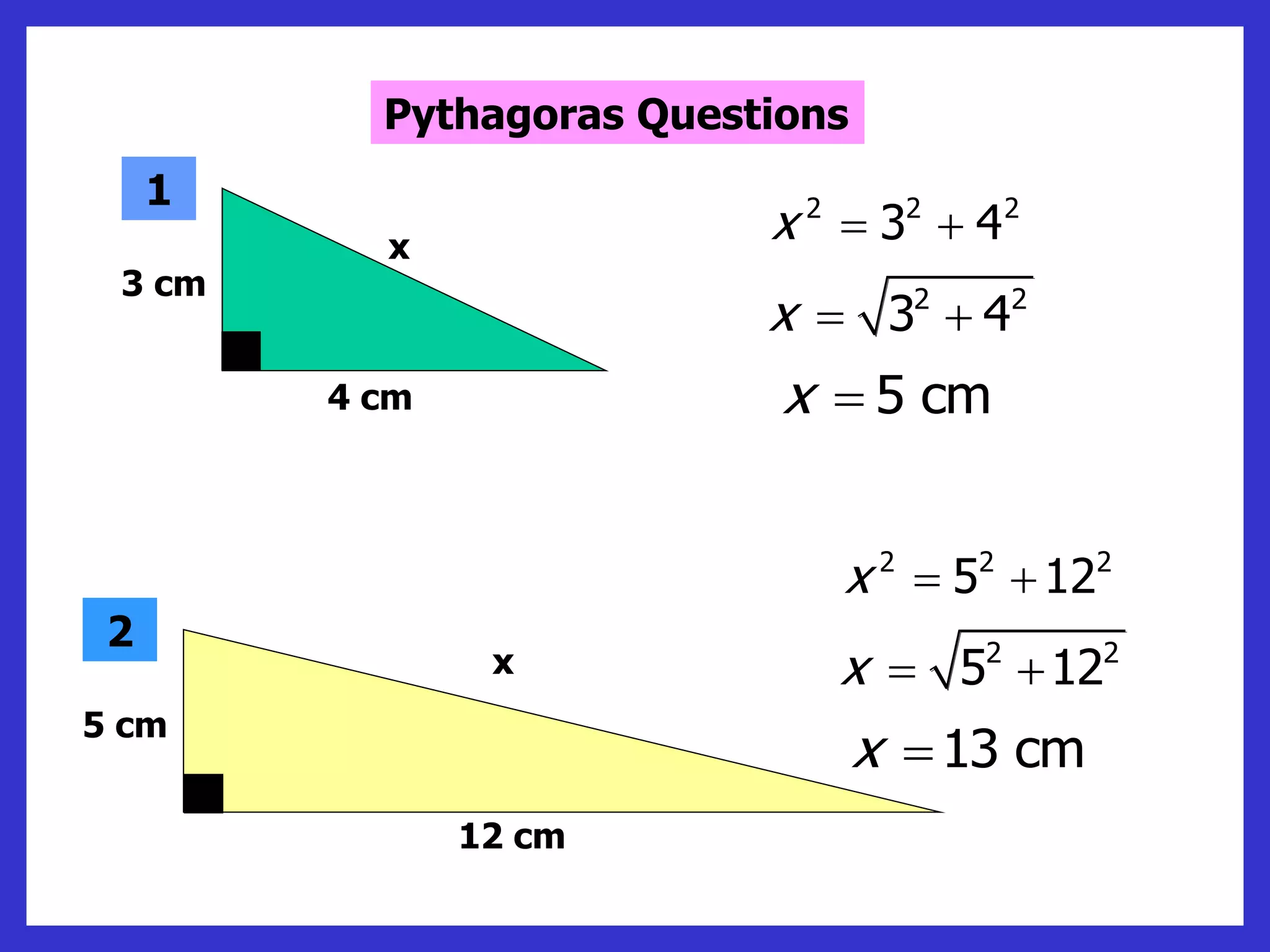
2 2 2
3 4
x  
2 2
3 4
x  
5 cm
x 
2 2 2
5 12
x  
2 2
5 12
x  
13 cm
x 
3 cm
4 cm
x
1
5 cm
12 cm
x
2
Pythagoras Questions
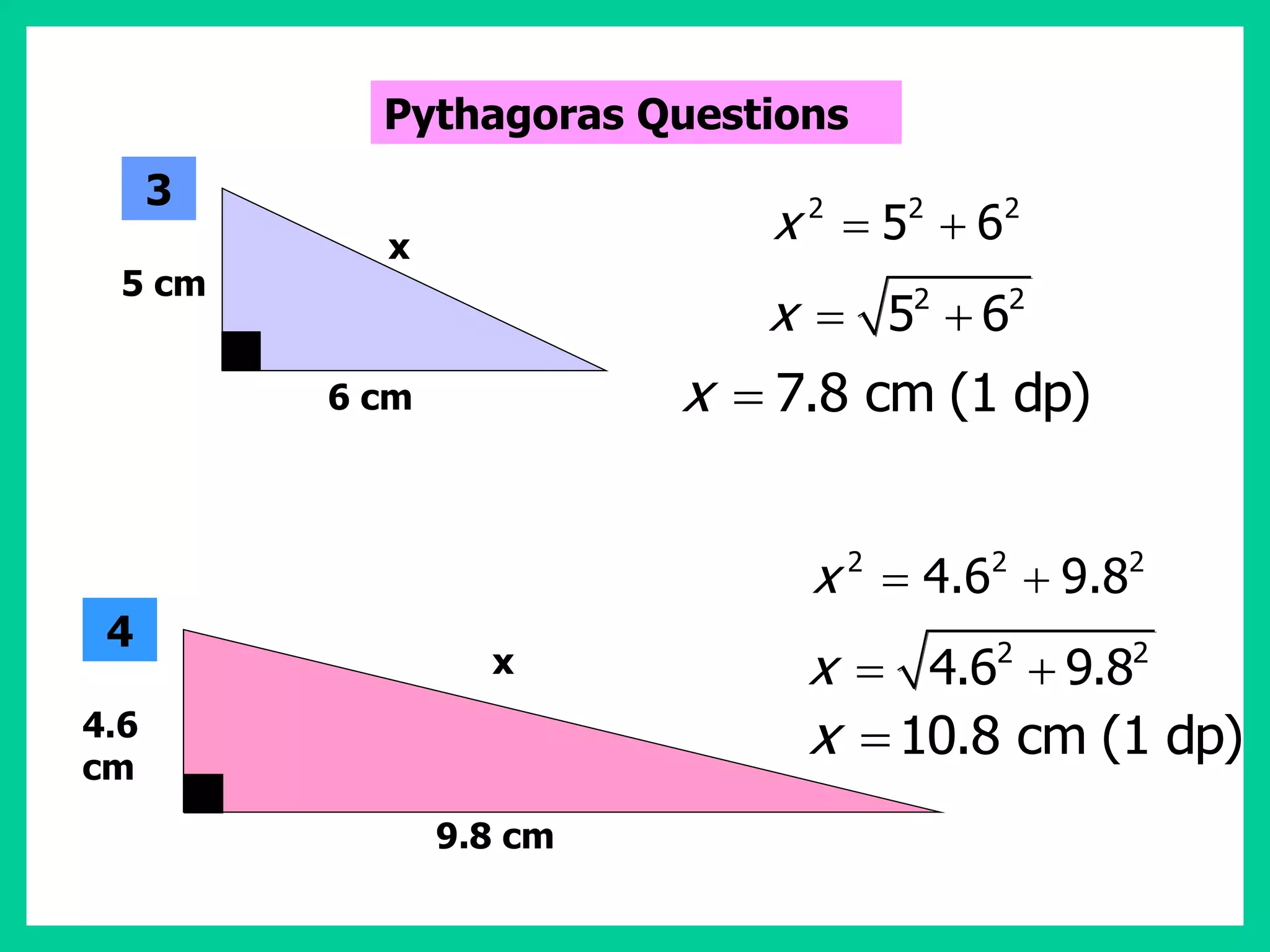
2 2 2
5 6
x  
2 2
5 6
x  
7.8 cm (1 dp)
x 
2 2 2
4.6 9.8
x  
2 2
4.6 9.8
x  
10.8 cm (1 dp)
x 
5 cm
6 cm
x
3
4.6
cm
9.8 cm
x
4
Pythagoras Questions
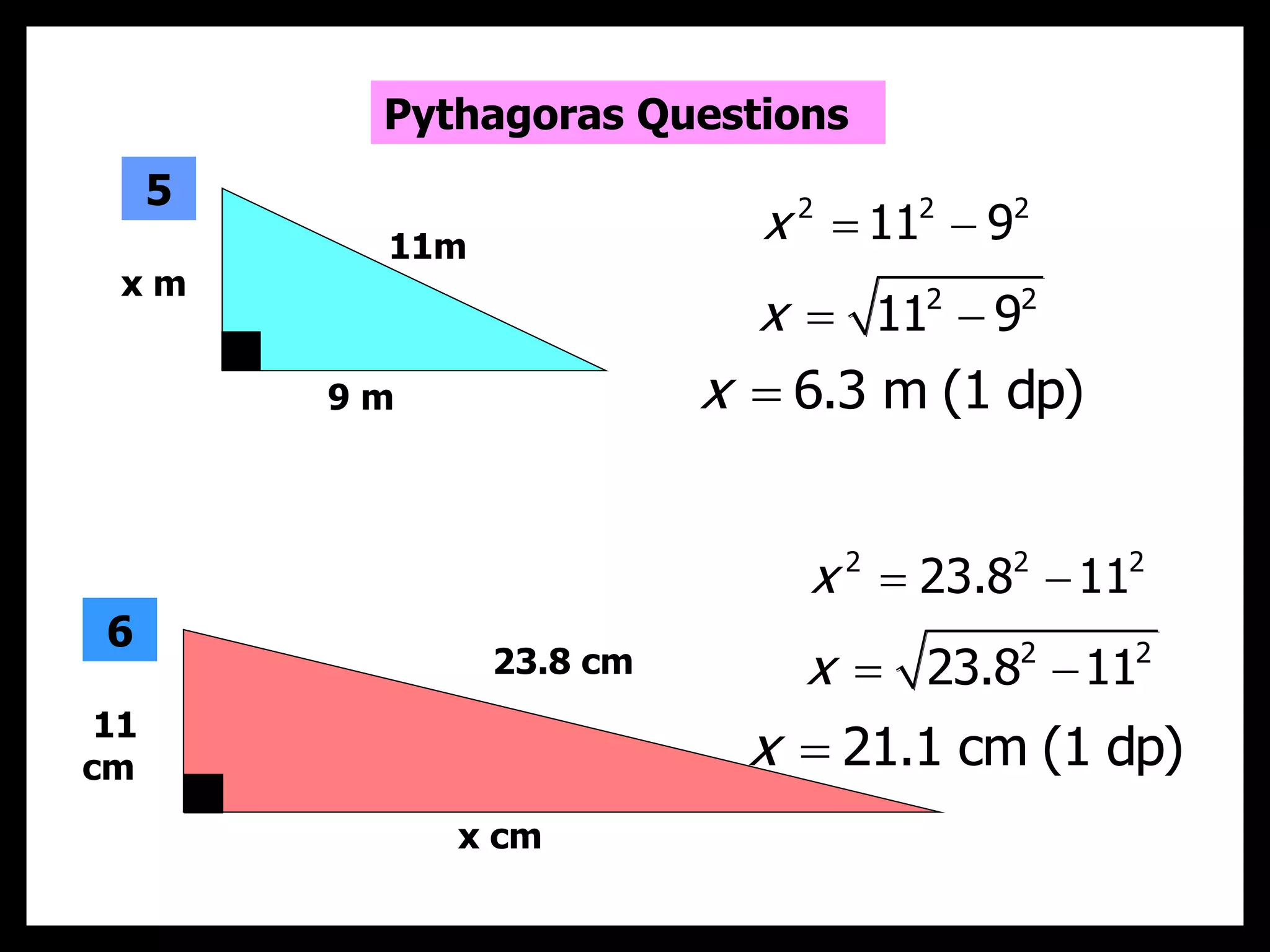
2 2 2
11 9
x  
2 2
11 9
x  
6.3 m (1 dp)
x 
2 2 2
23.8 11
x  
2 2
23.8 11
x  
21.1 cm (1 dp)
x 
x m
9 m
11m
5
11
cm
x cm
23.8 cm
6
Pythagoras Questions
2 2 2
7.1 3.4
x  
2 2
7.1 3.4
x  
7.9 cm (1 dp)
x 
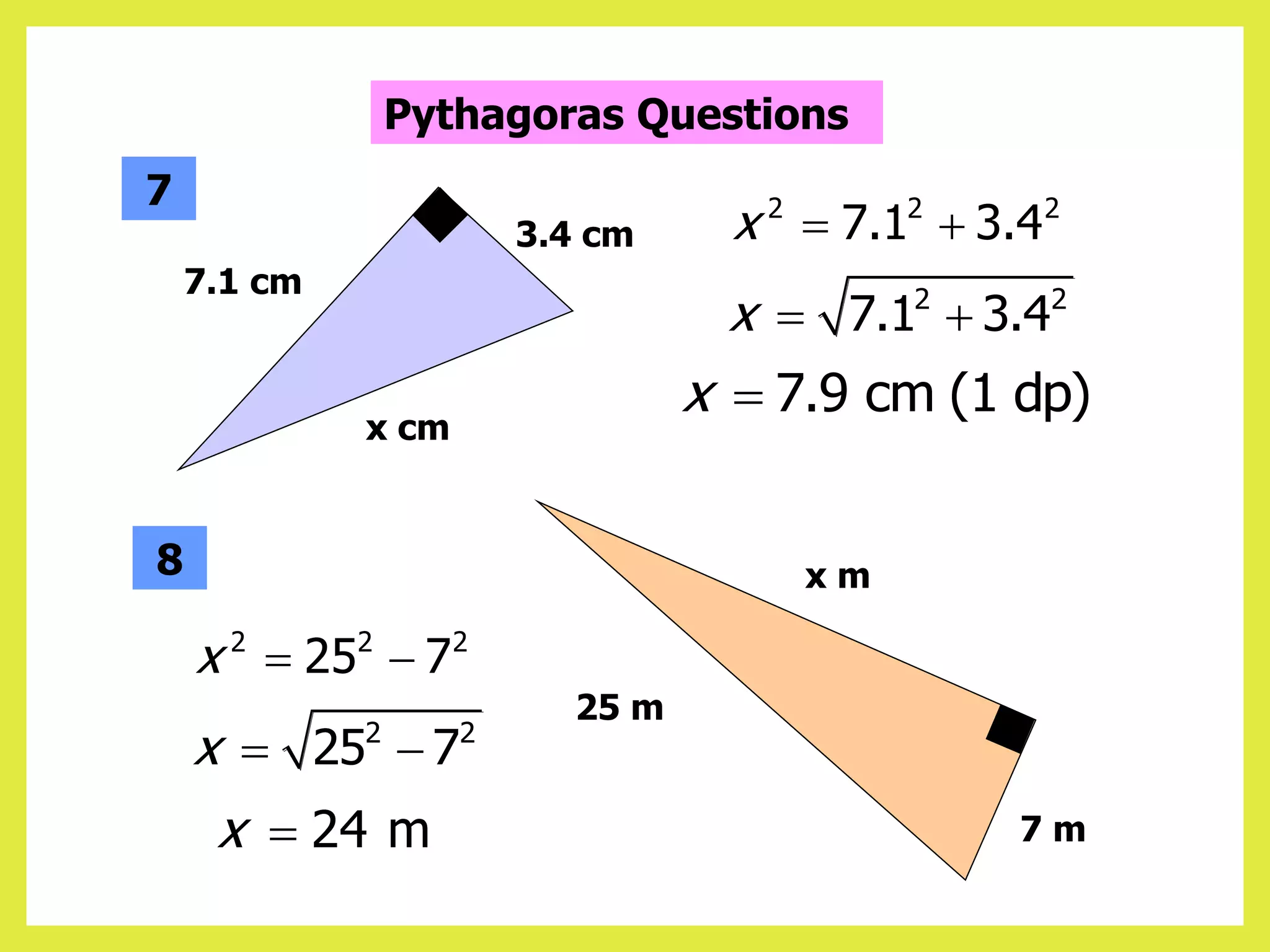
7.1 cm
x cm
3.4 cm
7
8
25 m
7 m
x m
2 2 2
25 7
x  
2 2
25 7
x  
24 m
x 
Pythagoras Questions
Applications of Pythagoras
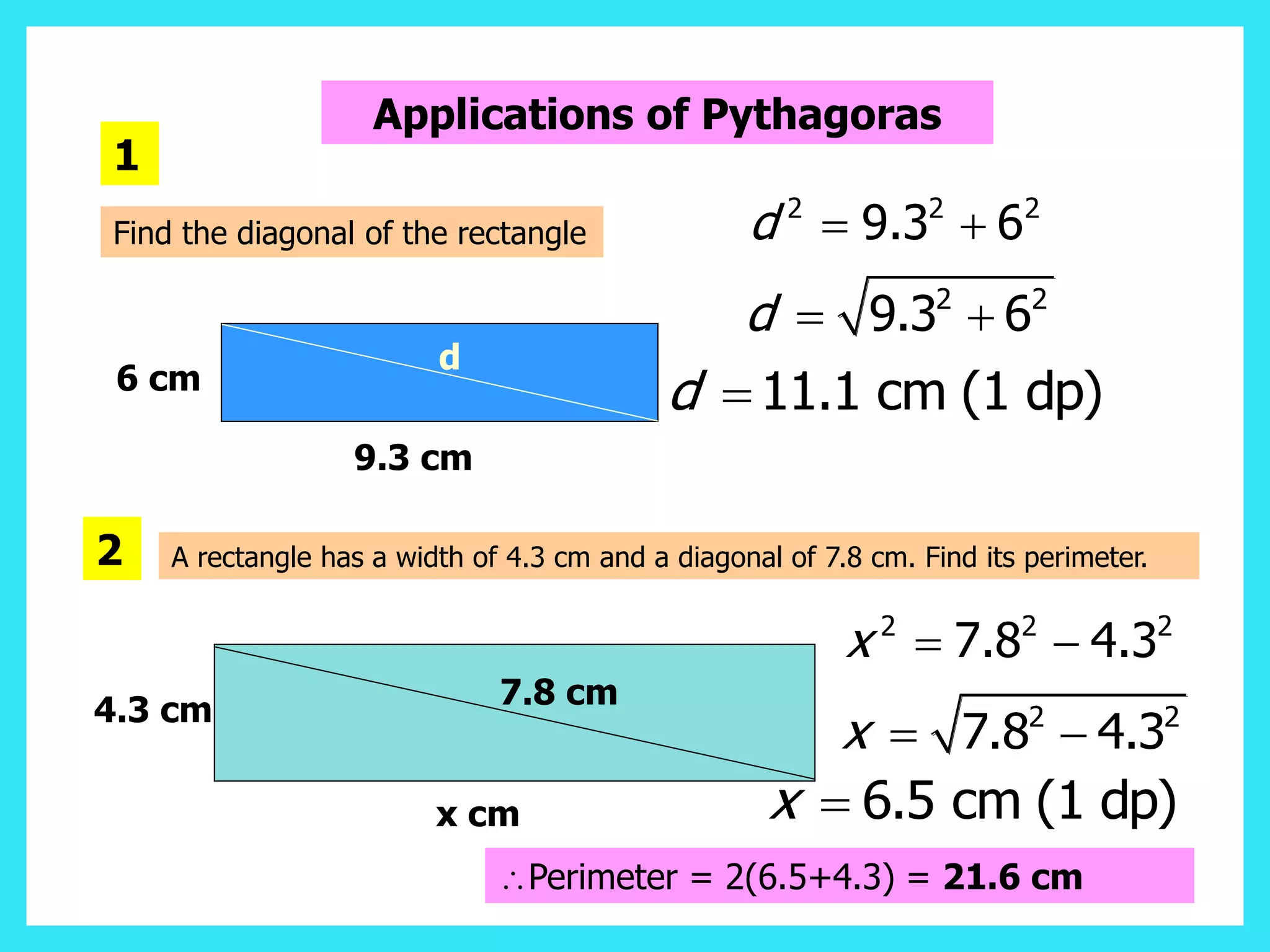
Find the diagonal of the rectangle
6 cm
9.3 cm
1
2 2 2
9.3 6
d  
2 2
9.3 6
d  
11.1 cm (1 dp)
d 
d
A rectangle has a width of 4.3 cm and a diagonal of 7.8 cm. Find its perimeter.
2
7.8 cm
4.3 cm
x cm
2 2 2
7.8 4.3
x  
2 2
7.8 4.3
x  
6.5 cm (1 dp)
x 
Perimeter = 2(6.5+4.3) = 21.6 cm
Applications of Pythagoras
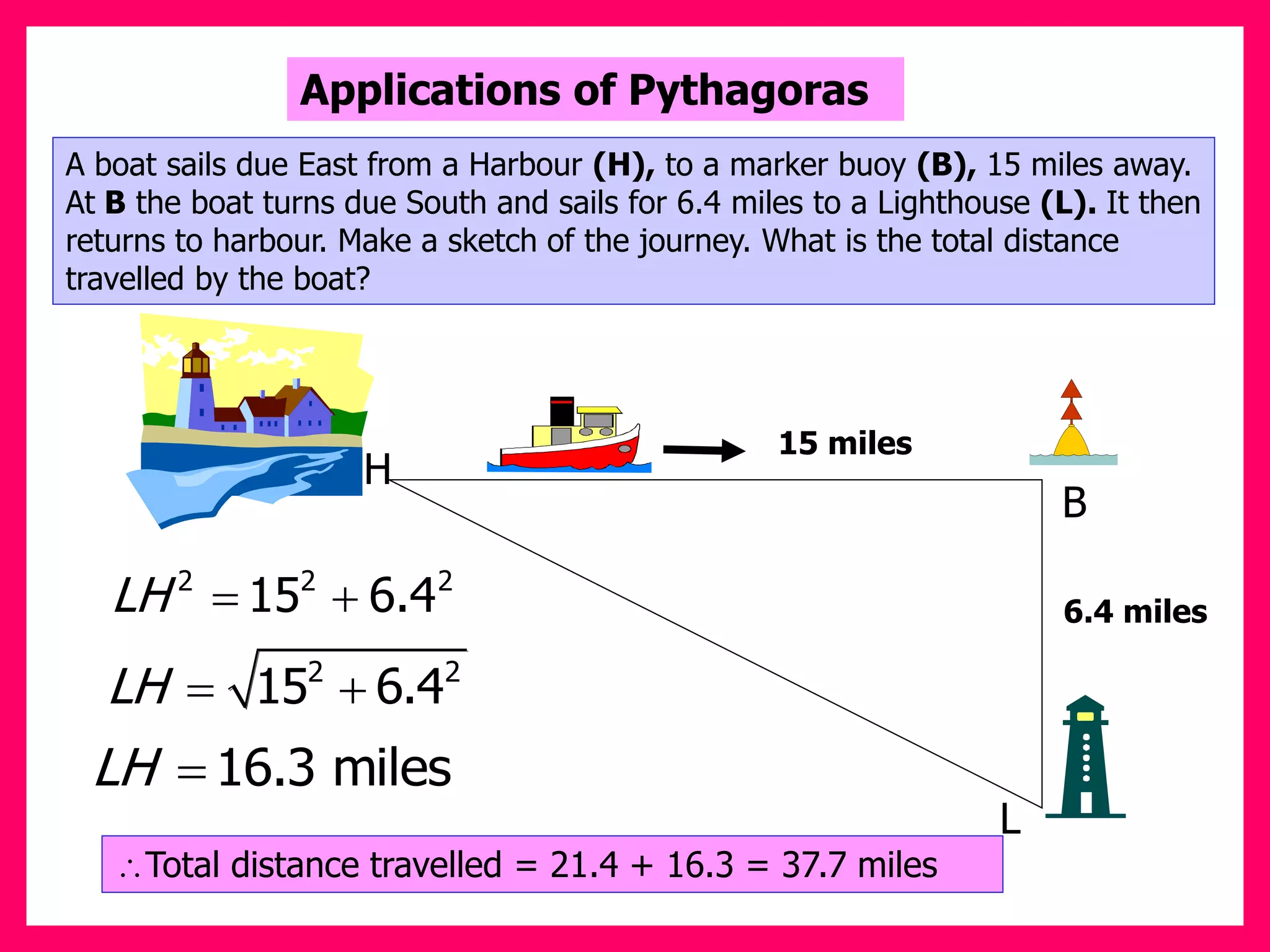
A boat sails due East from a Harbour (H), to a marker buoy (B), 15 miles away.
At B the boat turns due South and sails for 6.4 miles to a Lighthouse (L). It then
returns to harbour. Make a sketch of the journey. What is the total distance
travelled by the boat?
2 2 2
15 6.4
LH  
2 2
15 6.4
LH  
16.3 miles
LH 
Total distance travelled = 21.4 + 16.3 = 37.7 miles
H
B
L
15 miles
6.4 miles
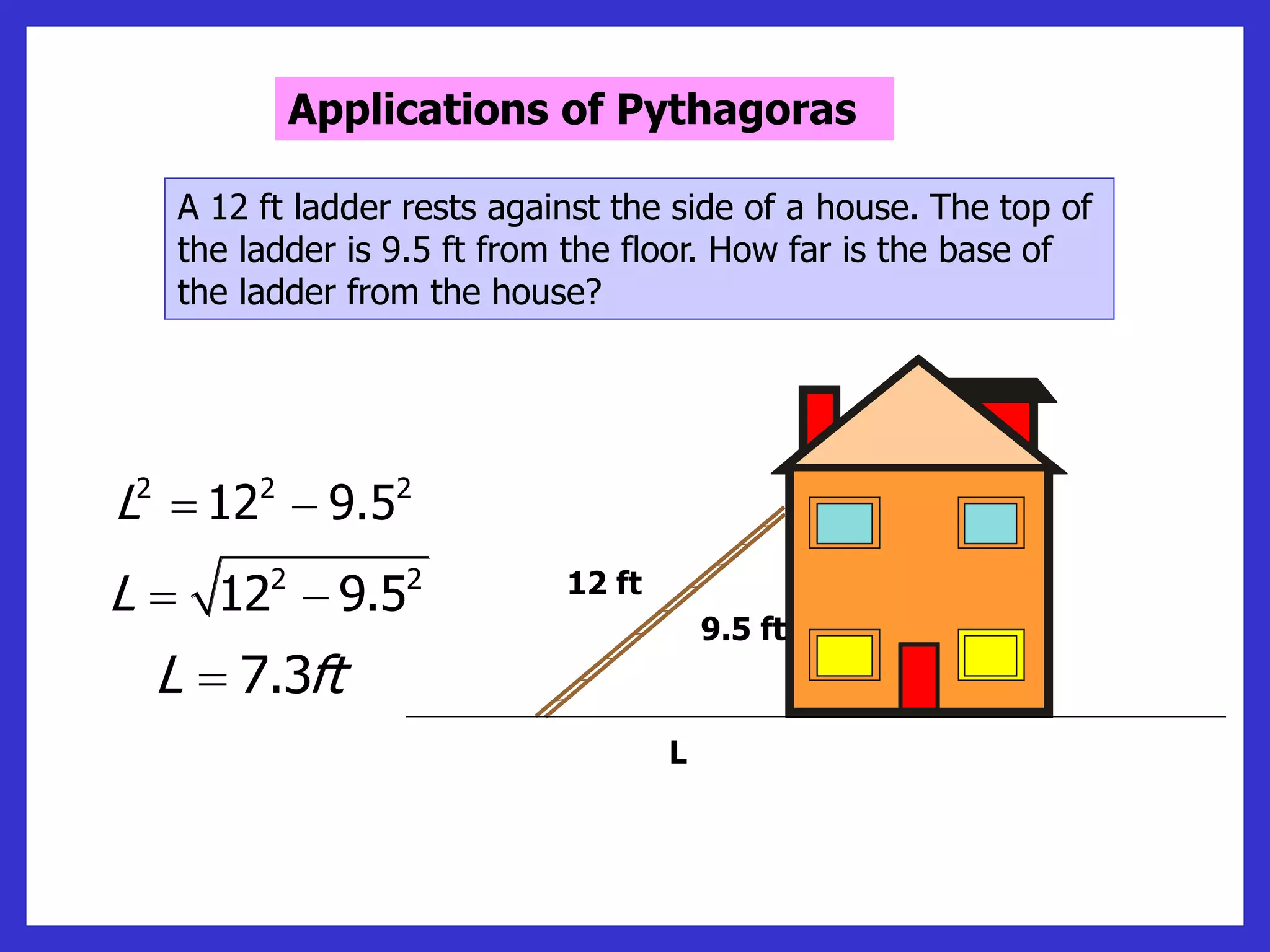
12 ft
9.5 ft
L
A 12 ft ladder rests against the side of a house. The top of
the ladder is 9.5 ft from the floor. How far is the base of
the ladder from the house?
Applications of Pythagoras
2 2 2
12 9.5
L  
2 2
12 9.5
L  
7.3
L ft

5 cm
12 cm
6 cm
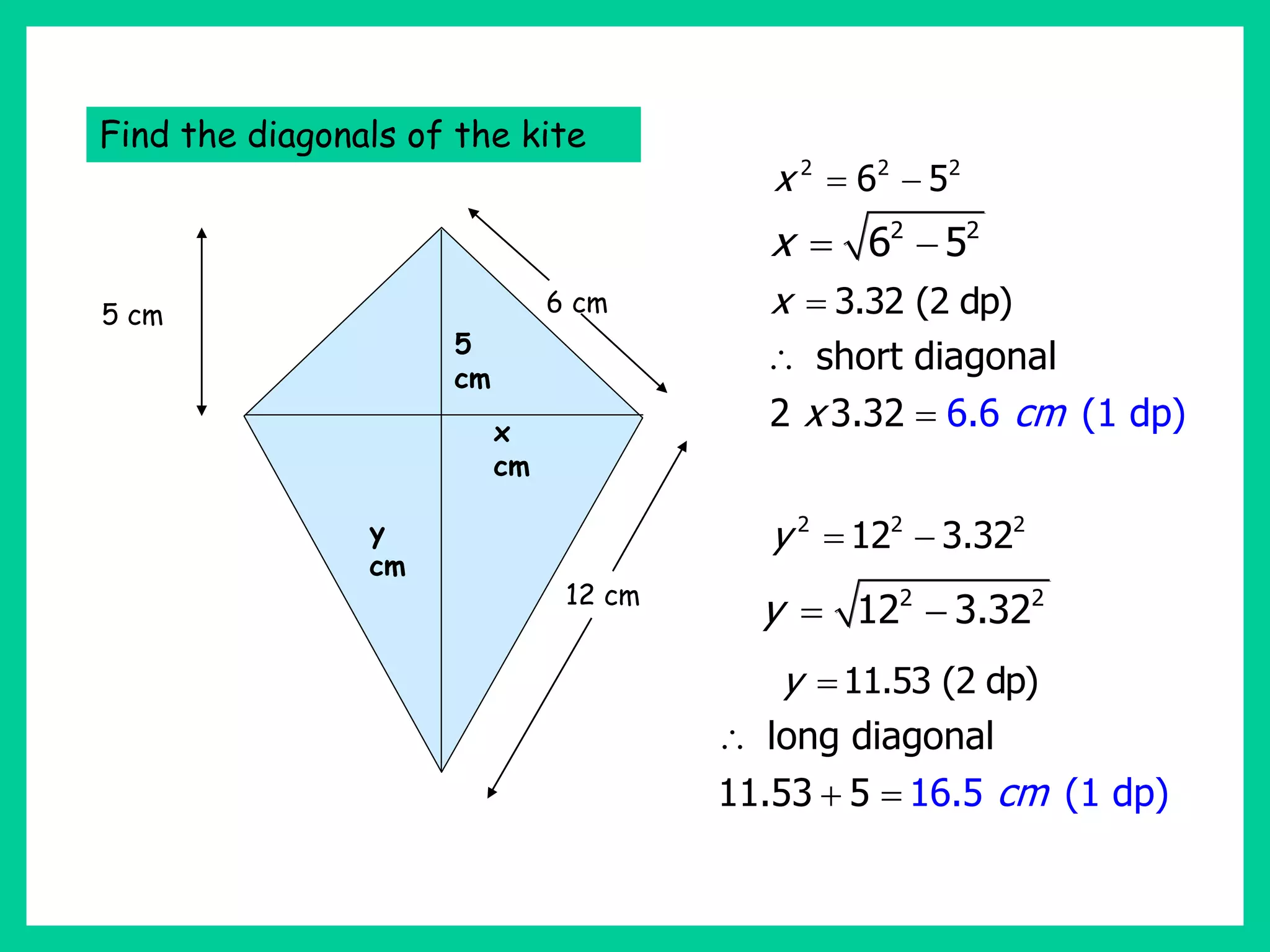
Find the diagonals of the kite
2 2 2
6 5
x  
5
cm
x
cm
y
cm
2 2
6 5
x  
3.32 (2 dp)
x 
short diagonal
2 6.6 (1
3.3 dp
2 )
x cm


2 2 2
12 3.32
y  
2 2
12 3.32
y  
11.53 (2 dp)
y 
long diagonal
11.5 16.5
3 5 (1 dp)
cm

 

Unit_4_-_S4 (1).ppt

  • 1.
    Circle Theorems Euclid ofAlexandria Circa 325 - 265 BC O The library of Alexandria was the foremost seat of learning in the world and functioned like a university. The library contained 600 000 manuscripts.
  • 2.
    diameter Circumference radius Major Segment Minor Segment MinorArc Major Arc Minor Sector Major Sector Parts of the Circle Parts
  • 3.
    o Arc AB subtendsangle x at the centre. A B xo Arc AB subtends angle y at the circumference. yo Chord AB also subtends angle x at the centre. Chord AB also subtends angle y at the circumference. o A B xo yo o yo xo A B Introductory Terminology Term’gy
  • 4.
  • 5.
    o Diameter 90o anglein a semi-circle 90o angle in a semi-circle 20o angle sum triangle 90o angle in a semi-circle a b c 70o d 30o e Find the unknown angles below stating a reason. angle a = angle b = angle c = angle d = angle e = 60o angle sum triangle The angle in a semi-circle is a right angle. Theorem 1 This is just a special case of Theorem 1 and is referred to as a theorem for convenience. Th2
  • 6.
    Theorem 2 Measure theangles at the centre and circumference and make a conjecture. xo yo xo yo xo yo xo yo xo yo xo yo xo yo xo yo o o o o o o o o Th1
  • 7.
    The angle subtendedat the centre of a circle (by an arc or chord) is twice the angle subtended at the circumference by the same arc or chord. (angle at centre) 2xo 2xo 2xo 2xo 2xo 2xo 2xo 2xo Theorem 2 Measure the angles at the centre and circumference and make a conjecture. xo xo xo xo xo xo xo xo o o o o o o o o Angle x is subtended in the minor segment. Watch for this one later.
  • 8.
    o A B 84o xo Example Questions 1 Find theunknown angles giving reasons for your answers. o A B yo 2 35o 42o (Angle at the centre). 70o(Angle at the centre) angle x = angle y =
  • 9.
    (180 – 2x 42) = 96o (Isos triangle/angle sum triangle). 48o (Angle at the centre) angle x = angle y = o A B 42o xo Example Questions 3 Find the unknown angles giving reasons for your answers. o A B po 4 62o yo qo 124o (Angle at the centre) (180 – 124)/2 = 280 (Isos triangle/angle sum triangle). angle p = angle q =
  • 10.
    Angles subtended byan arc or chord in the same segment are equal. Theorem 3 xo xo xo xo xo yo yo Th3
  • 11.
    38o xo yo 30o xo yo 40o Angles subtended byan arc or chord in the same segment are equal. Theorem 3 Find the unknown angles in each case Angle x = angle y = 38o Angle x = 30o Angle y = 40o
  • 12.
    The angle betweena tangent and a radius is 90o. (Tan/rad) Theorem 4 o Th4
  • 13.
    The angle betweena tangent and a radius is 90o. (Tan/rad) Theorem 4
  • 14.
    180 – (90+ 36) = 54o Tan/rad and angle sum of triangle. 90o angle in a semi-circle 60o angle sum triangle angle x = angle y = angle z = T o 36o xo yo zo 30o A B If OT is a radius and AB is a tangent, find the unknown angles, giving reasons for your answers.
  • 15.
    The Alternate SegmentTheorem. Theorem 5 The angle between a tangent and a chord through the point of contact is equal to the angle subtended by that chord in the alternate segment. xo xo yo yo 45o (Alt Seg) 60o (Alt Seg) 75o angle sum triangle Find the missing angles below giving reasons in each case. angle x = angle y = angle z = Th5
  • 16.
    Cyclic Quadrilateral Theorem. Theorem6 The opposite angles of a cyclic quadrilateral are supplementary. (They sum to 180o) w x y z Angles x + w = 180o Angles y + z = 180o q p r s Angles p + q = 180o Angles r + s = 180o Th6
  • 17.
    180 – 85= 95o (cyclic quad) 180 – 110 = 70o (cyclic quad) Cyclic Quadrilateral Theorem. Theorem 6 The opposite angles of a cyclic quadrilateral are supplementary. (They sum to 180o) 85o 110o x y 70o 135o p r q Find the missing angles below given reasons in each case. angle x = angle y = angle p = angle q = angle r = 180 – 135 = 45o (straight line) 180 – 70 = 110o (cyclic quad) 180 – 45 = 135o (cyclic quad)
  • 18.
    Two Tangent Theorem. Theorem7 From any point outside a circle only two tangents can be drawn and they are equal in length. P T U Q R PT = PQ P T U Q R PT = PQ Th7
  • 19.
    90o (tan/rad) Two TangentTheorem. Theorem 7 From any point outside a circle only two tangents can be drawn and they are equal in length. P T Q O xo wo 98o yo zo PQ and PT are tangents to a circle with centre O. Find the unknown angles giving reasons. angle w = angle x = angle y = angle z = 90o (tan/rad) 49o (angle at centre) 360o – 278 = 82o (quadrilateral)
  • 20.
    90o (tan/rad) Two TangentTheorem. Theorem 7 From any point outside a circle only two tangents can be drawn and they are equal in length. P T Q O yo 50o xo 80o PQ and PT are tangents to a circle with centre O. Find the unknown angles giving reasons. angle w = angle x = angle y = angle z = 180 – 140 = 40o (angles sum tri) 50o (isos triangle) 50o (alt seg) wo zo
  • 21.
    O S T 3 cm 8cm Find length OS OS = 5 cm (pythag triple: 3,4,5) Chord Bisector Theorem. Theorem 8 A line drawn perpendicular to a chord and passing through the centre of a circle, bisects the chord.. O Th8
  • 22.
    Angle SOT =22o (symmetry/congruenncy) Find angle x O S T 22o xo U Angle x = 180 – 112 = 68o (angle sum triangle) Chord Bisector Theorem. Theorem 8 A line drawn perpendicular to a chord and passing through the centre of a circle, bisects the chord.. O
  • 23.
    O S T 65o P R U Mixed Questions PTR isa tangent line to the circle at T. Find angles SUT, SOT, OTS and OST. Angle SUT = Angle SOT = Angle OTS = Angle OST = 65o (Alt seg) 130o (angle at centre) 25o (tan rad) 25o (isos triangle) Mixed Q 1
  • 24.
    22o (cyclic quad) 68o(tan rad) 44o (isos triangle) 68o (alt seg) Angle w = Angle x = Angle y = Angle z = O w y 48o 110o U Mixed Questions PR and PQ are tangents to the circle. Find the missing angles giving reasons. x z P Q R Mixed Q 2
  • 25.
    A B C D A B CD Similarity Remember, similar shapes are always in proportion to each other. There is no distortion between them.
  • 26.
    Conditions for similarity Twoshapes are similar only when: •Corresponding sides are in proportion and •Corresponding angles are equal All regular polygons are similar
  • 28.
    Conditions for similarity Twoshapes are similar only when: •Corresponding sides are in proportion and •Corresponding angles are equal All rectangles are not similar to one another since only condition 2 is true.
  • 29.
    If two objectsare similar then one is an enlargement of the other The rectangles below are similar: Find the scale factor of enlargement that maps A to B A B 8 cm 16 cm 5 cm 10 cm Not to scale! Scale factor = x2. (Note that B to A would be x ½)
  • 30.
    If two objectsare similar then one is an enlargement of the other The rectangles below are similar: Find the scale factor of enlargement that maps A to B A B 8 cm 12 cm 5 cm 7½ cm Not to scale! Scale factor = x1½ (Note that B to A would be x 2/3)
  • 31.
    If we aretold that two objects are similar and we can find the scale factor of enlargement by comparing corresponding sides then we can calculate the value of an unknown side. 8 cm A B C 2 cm Not to scale! 24 cm p cm q cm 12½ cm The 3 rectangles are similar. Find the unknown sides, p and q 1. Comparing corresponding sides in A and B. SF = 24/8 = x3. 2. Apply the scale factor to find the unknown side. p = 3 x 2 = 6 cm.
  • 32.
    If we aretold that two objects are similar and we can find the scale factor of enlargement by comparing corresponding sides then we can calculate the value of an unknown side. 8 cm A B C 2 cm Not to scale! 24 cm p cm q cm 12½ cm The 3 rectangles are similar. Find the unknown sides, p and q. 1. Comparing corresponding sides in A and C. SF = 12.5/2 = x6.25. 2. Apply the scale factor to find the unknown side. q = 6.25 x 8 = 50 cm.
  • 33.
    5 cm If weare told that two objects are similar and we can find the scale factor of enlargement by comparing corresponding sides then we can calculate the value of an unknown side. A B C 2.1 cm Not to scale! p cm 7.14 cm 35.5 cm q cm The 3 rectangles are similar. Find the unknown sides p and q 1. Comparing corresponding sides in A and B. SF = 7.14/2.1 = x3.4. 2. Apply the scale factor to find the unknown side. p = 3.4 x 5 = 17 cm.
  • 34.
    5 cm If weare told that two objects are similar and we can find the scale factor of enlargement by comparing corresponding sides then we can calculate the value of an unknown side. A B C 2.1 cm Not to scale! p cm 7.14 cm 35.5 cm q cm The 3 rectangles are similar. Find the unknown sides p and q 1. Comparing corresponding sides in A and C. SF = 35.5/5 = x7.1. 2. Apply the scale factor to find the unknown side. q = 7.1 x 2.1 = 14.91 cm
  • 35.
    Similar Triangles Similar trianglesare important in mathematics and their application can be used to solve a wide variety of problems. The two conditions for similarity between shapes as we have seen earlier are: •Corresponding sides are in proportion and •Corresponding angles are equal Triangles are the exception to this rule. Only the second condition is needed Two triangles are similar if their •Corresponding angles are equal
  • 36.
    70o 70o 45o 65o 45o These twotriangles are similar since they are equiangular. 50o 55o 75o 50o These two triangles are similar since they are equiangular. If 2 triangles have 2 angles the same then they must be equiangular = 180 – 125 = 55
  • 37.
    Finding Unknown Sides 20cm 15 cm 12 cm 6 cm b c Since the triangles are equiangular they are similar. So comparing corresponding sides to find the scale factor of enlargement. SF = 15/12 = x1.25. b = 1.25 x 6 = 7.5 cm c = 20/1.25 = 16 cm
  • 38.
    31.5 cm 14 cm8 cm 6 cm x y SF = 14/8 = x1.75. x = 1.75 x 6 = 10.5 cm y = 31.5/1.75 = 18 cm Since the triangles are equiangular they are similar. So comparing corresponding sides to find the scale factor of enlargement. Finding Unknown Sides
  • 39.
    Determining similarity A B ED Triangles ABC and DEC are similar. Why? C Angle ACB = angle ECD (Vertically Opposite) Angle ABC = angle DEC (Alt angles) Angle BAC = angle EDC (Alt angles) Since ABC is similar to DEC we know that corresponding sides are in proportion ABDE BCEC ACDC The order of the lettering is important in order to show which pairs of sides correspond.
  • 40.
    A B C D E IfBC is parallel to DE, explain why triangles ABC and ADE are similar Angle BAC = angle DAE (common to both triangles) Angle ABC = angle ADE (corresponding angles between parallels) Angle ACB = angle AED (corresponding angles between parallels) A D E A D E B C B C A line drawn parallel to any side of a triangle produces 2 similar triangles. Triangles EBC and EAD are similar Triangles DBC and DAE are similar
  • 41.
    A tree 5mhigh casts a shadow 8 m long. Find the height of a tree casting a shadow 28 m long. Example Problem 1 5m 8m 28m h Explain why the triangles must be similar.   28 3.5 8 sf   1 3 7 .5 5 5 . h x m
  • 42.
    A B C D E 20m 45m 5m y The two trianglesbelow are similar: Find the distance y.   50 10 5 sf    20 10 2 m y Example Problem 2
  • 43.
    A B C D E In thediagram below BE is parallel to CD and all measurements are as shown. (a) Calculate the length CD (b) Calculate the perimeter of the Trapezium EBCD 4.8 m 6 m 3 m 4.2 m 9 m A C D 7.2m 7.2m 2.1 m 6.3m   9 ( ) 6 1.5 f a s    1.5 4.8 7.2 CD x m So AC = 4.2 6 3 .5 1 . x m  BC 6.3 - 4.2 = 2.1 m  Perimeter = 7.2 + 3 + 4.8 + 2.1 17 = .1 m Example Problem 3
  • 44.
    “All Men bynature desire knowledge”: Aristotle. THE SCHOOL of ATHENS (Raphael) 1510 -11 Pythagoras Euclid Plato Aristotle Socrates
  • 45.
    a2 b2 c2 a2 = b2 +c2 The Theoremof Pythagoras b c a In a right-angled triangle, the square on the hypotenuse is equal to the sum of the squares on the other two sides. Hypotenuse Pythagoras of Samos (6C BC)
  • 46.
    25 9 16 32 + 42 = 52 9+ 16 = 25 A Pythagorean Triple 3 4 5 3, 4, 5 In a right-angled triangle, the square on the hypotenuse is equal to the sum of the squares on the other two sides.
  • 47.
    169 144 25 52 + 122 = 132 25+ 144 = 169 A 2nd Pythagorean Triple 5, 12, 13 5 12 13 In a right-angled triangle, the square on the hypotenuse is equal to the sum of the squares on the other two sides.
  • 48.
    625 576 49 72 + 242 = 252 49+ 576 = 625 7 24 25 A 3rd Pythagorean Triple 7, 24, 25 In a right-angled triangle, the square on the hypotenuse is equal to the sum of the squares on the other two sides.
  • 49.
    Perigal’s Dissection The Theoremof Pythagoras: A Visual Demonstration In a right-angled triangle, the square on the hypotenuse is equal to the sum of the squares on the other two sides. Draw 2 lines through the centre of the middle square, parallel to the sides of the large square This divides the middle square into 4 congruent quadrilaterals These quadrilaterals + small square fit exactly into the large square Henry Perigal (1801 – 1898) Gravestone Inscription
  • 50.
    2 2 2 34 x   2 2 3 4 x   5 cm x  2 2 2 5 12 x   2 2 5 12 x   13 cm x  3 cm 4 cm x 1 5 cm 12 cm x 2 Pythagoras Questions
  • 51.
    2 2 2 56 x   2 2 5 6 x   7.8 cm (1 dp) x  2 2 2 4.6 9.8 x   2 2 4.6 9.8 x   10.8 cm (1 dp) x  5 cm 6 cm x 3 4.6 cm 9.8 cm x 4 Pythagoras Questions
  • 52.
    2 2 2 119 x   2 2 11 9 x   6.3 m (1 dp) x  2 2 2 23.8 11 x   2 2 23.8 11 x   21.1 cm (1 dp) x  x m 9 m 11m 5 11 cm x cm 23.8 cm 6 Pythagoras Questions
  • 53.
    2 2 2 7.13.4 x   2 2 7.1 3.4 x   7.9 cm (1 dp) x  7.1 cm x cm 3.4 cm 7 8 25 m 7 m x m 2 2 2 25 7 x   2 2 25 7 x   24 m x  Pythagoras Questions
  • 54.
    Applications of Pythagoras Findthe diagonal of the rectangle 6 cm 9.3 cm 1 2 2 2 9.3 6 d   2 2 9.3 6 d   11.1 cm (1 dp) d  d A rectangle has a width of 4.3 cm and a diagonal of 7.8 cm. Find its perimeter. 2 7.8 cm 4.3 cm x cm 2 2 2 7.8 4.3 x   2 2 7.8 4.3 x   6.5 cm (1 dp) x  Perimeter = 2(6.5+4.3) = 21.6 cm
  • 55.
    Applications of Pythagoras Aboat sails due East from a Harbour (H), to a marker buoy (B), 15 miles away. At B the boat turns due South and sails for 6.4 miles to a Lighthouse (L). It then returns to harbour. Make a sketch of the journey. What is the total distance travelled by the boat? 2 2 2 15 6.4 LH   2 2 15 6.4 LH   16.3 miles LH  Total distance travelled = 21.4 + 16.3 = 37.7 miles H B L 15 miles 6.4 miles
  • 56.
    12 ft 9.5 ft L A12 ft ladder rests against the side of a house. The top of the ladder is 9.5 ft from the floor. How far is the base of the ladder from the house? Applications of Pythagoras 2 2 2 12 9.5 L   2 2 12 9.5 L   7.3 L ft 
  • 57.
    5 cm 12 cm 6cm Find the diagonals of the kite 2 2 2 6 5 x   5 cm x cm y cm 2 2 6 5 x   3.32 (2 dp) x  short diagonal 2 6.6 (1 3.3 dp 2 ) x cm   2 2 2 12 3.32 y   2 2 12 3.32 y   11.53 (2 dp) y  long diagonal 11.5 16.5 3 5 (1 dp) cm   