PARALLELOGRAM
■ Definitions
A parallelogram is a quadrilateral in which both pairs of opposite sides are
parallel.
A rectangle is a parallelogram all of whose angles are right angles.
A square is a rectangle all whose sides are congruent.
A rhombus is a parallelogram of whose sides are equal.
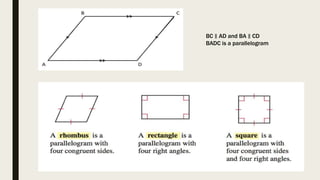
BC ∥ AD and BA ∥ CD
BADC is a parallelogram
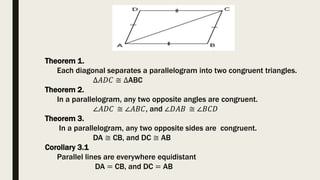
Theorem 1.
Each diagonal separates a parallelogram into two congruent triangles.
∆𝐴𝐷𝐶 ≅ ∆ABC
Theorem 2.
In a parallelogram, any two opposite angles are congruent.
∠𝐴𝐷𝐶 ≅ ∠𝐴𝐵𝐶, and ∠𝐷𝐴𝐵 ≅ ∠𝐵𝐶𝐷
Theorem 3.
In a parallelogram, any two opposite sides are congruent.
DA ≅ CB, and DC ≅ AB
Corollary 3.1
Parallel lines are everywhere equidistant
DA = CB, and DC = AB
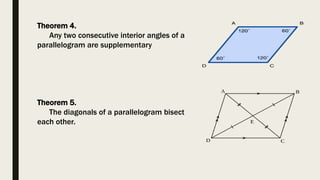
Theorem 4.
Any two consecutive interior angles of a
parallelogram are supplementary
Theorem 5.
The diagonals of a parallelogram bisect
each other.
Let’s Apply
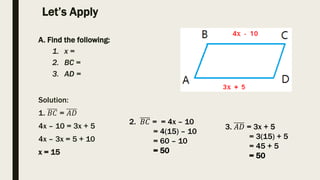
A. Find the following:
1. x =
2. BC =
3. AD =
Solution:
1. 𝐵𝐶 = 𝐴𝐷
4x – 10 = 3x + 5
4x – 3x = 5 + 10
x = 15
2. 𝐵𝐶 = = 4x – 10
= 4(15) – 10
= 60 – 10
= 50
3. 𝐴𝐷 = 3x + 5
= 3(15) + 5
= 45 + 5
= 50
Solution:
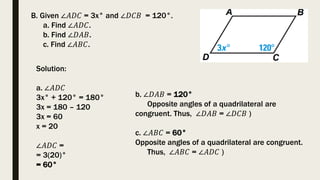
a. ∠𝐴𝐷𝐶
3x° + 120° = 180°
3x = 180 – 120
3x = 60
x = 20
∠𝐴𝐷𝐶 =
= 3(20)°
= 60°
B. Given ∠𝐴𝐷𝐶 = 3x° and ∠𝐷𝐶𝐵 = 120°.
a. Find ∠𝐴𝐷𝐶.
b. Find ∠𝐷𝐴𝐵.
c. Find ∠𝐴𝐵𝐶.
b. ∠𝐷𝐴𝐵 = 120°
Opposite angles of a quadrilateral are
congruent. Thus, ∠𝐷𝐴𝐵 = ∠𝐷𝐶𝐵 )
c. ∠𝐴𝐵𝐶 = 60°
Opposite angles of a quadrilateral are congruent.
Thus, ∠𝐴𝐵𝐶 = ∠𝐴𝐷𝐶 )

Parallelogram

  • 1.
  • 2.
    ■ Definitions A parallelogramis a quadrilateral in which both pairs of opposite sides are parallel. A rectangle is a parallelogram all of whose angles are right angles. A square is a rectangle all whose sides are congruent. A rhombus is a parallelogram of whose sides are equal.
  • 3.
    BC ∥ ADand BA ∥ CD BADC is a parallelogram
  • 4.
    Theorem 1. Each diagonalseparates a parallelogram into two congruent triangles. ∆𝐴𝐷𝐶 ≅ ∆ABC Theorem 2. In a parallelogram, any two opposite angles are congruent. ∠𝐴𝐷𝐶 ≅ ∠𝐴𝐵𝐶, and ∠𝐷𝐴𝐵 ≅ ∠𝐵𝐶𝐷 Theorem 3. In a parallelogram, any two opposite sides are congruent. DA ≅ CB, and DC ≅ AB Corollary 3.1 Parallel lines are everywhere equidistant DA = CB, and DC = AB
  • 5.
    Theorem 4. Any twoconsecutive interior angles of a parallelogram are supplementary Theorem 5. The diagonals of a parallelogram bisect each other.
  • 6.
    Let’s Apply A. Findthe following: 1. x = 2. BC = 3. AD = Solution: 1. 𝐵𝐶 = 𝐴𝐷 4x – 10 = 3x + 5 4x – 3x = 5 + 10 x = 15 2. 𝐵𝐶 = = 4x – 10 = 4(15) – 10 = 60 – 10 = 50 3. 𝐴𝐷 = 3x + 5 = 3(15) + 5 = 45 + 5 = 50
  • 7.
    Solution: a. ∠𝐴𝐷𝐶 3x° +120° = 180° 3x = 180 – 120 3x = 60 x = 20 ∠𝐴𝐷𝐶 = = 3(20)° = 60° B. Given ∠𝐴𝐷𝐶 = 3x° and ∠𝐷𝐶𝐵 = 120°. a. Find ∠𝐴𝐷𝐶. b. Find ∠𝐷𝐴𝐵. c. Find ∠𝐴𝐵𝐶. b. ∠𝐷𝐴𝐵 = 120° Opposite angles of a quadrilateral are congruent. Thus, ∠𝐷𝐴𝐵 = ∠𝐷𝐶𝐵 ) c. ∠𝐴𝐵𝐶 = 60° Opposite angles of a quadrilateral are congruent. Thus, ∠𝐴𝐵𝐶 = ∠𝐴𝐷𝐶 )