
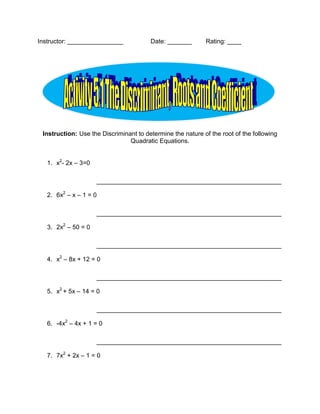
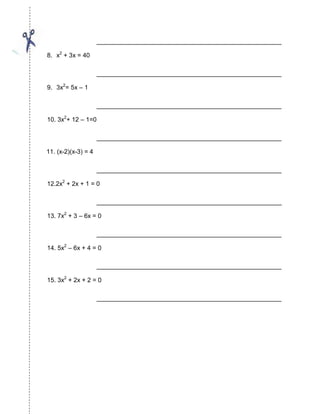
Chapter V<br />The discriminant gives additional information on the nature of the roots beyond simply whether there are any repeated roots: it also gives information on whether the roots are real or complex, and rational or irrational. More formally, it gives information on whether the roots are in the field over which the polynomial is defined, or are in an extension field, and hence whether the polynomial factors over the field of coefficients. This is most transparent and easily stated for quadratic and cubic polynomials; for polynomials of degree 4 or higher this is more difficult to state.<br />TARGET SKILLS:<br />At the end of this chapter, students are expected to:<br />• determine discriminant, roots and coefficient;<br />• discuss the relation the roots and coefficient;<br />• find the sum and product of the roots; and<br />• change quadratic equation to discriminant formula.<br />Lesson 13<br />The Discriminant and the roots of a<br />Quadratic Equation<br />OBJECTIVES:<br />At the end of this lesson, students are expected to:<br />determine discriminant and the roots;
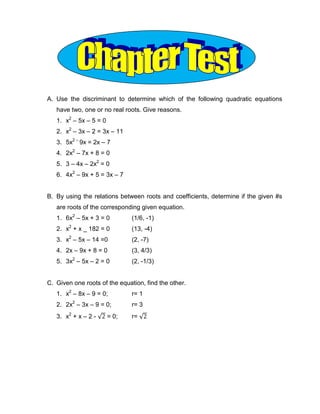
compare discriminant and the nature of the roots; and
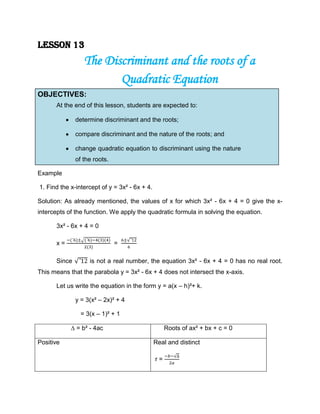
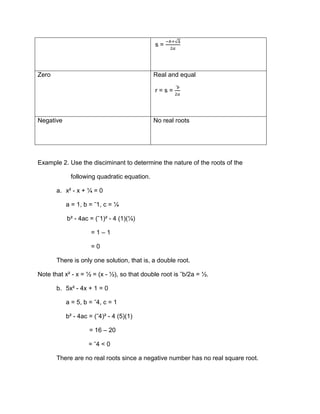
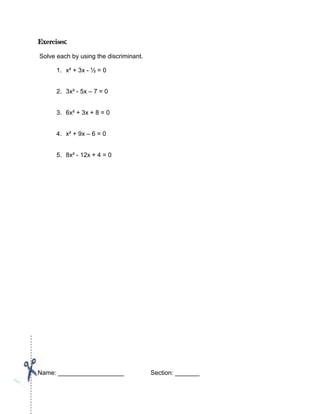
change quadratic equation to discriminant using the nature of the roots.Example<br /> 1. Find the x-intercept of y = 3x² - 6x + 4.<br />Solution: As already mentioned, the values of x for which 3x² - 6x + 4 = 0 give the x-intercepts of the function. We apply the quadratic formula in solving the equation.<br />3x² - 6x + 4 = 0<br />x = -(ˉ6)±(ˉ6)-4(3)(4)2(3)  =  6±ˉ126<br />Since ˉ12 is not a real number, the equation 3x² - 6x + 4 = 0 has no real root. This means that the parabola y = 3x² - 6x + 4 does not intersect the x-axis.<br />Let us write the equation in the form y = a(x – h)²+ k.<br />y = 3(x² – 2x)² + 4<br />   = 3(x – 1)² + 1<br />                   ∆ = b² - 4ac      Roots of ax² + bx + c = 0PositiveReal and distinct  r = -b-∆2a s = -b+∆2aZeroReal and equal r = s = ˉb2aNegativeNo real roots<br />Example 2. Use the disciminant to determine the nature of the roots of the <br />                   following quadratic equation.<br />x² - x + ¼ = 0<br />a = 1, b = ˉ1, c = ¼  <br />      b² - 4ac = (ˉ1)² - 4 (1)(¼)<br />         = 1 – 1<br />         = 0<br />There is only one solution, that is, a double root.<br />Note that x² - x = ½ = (x - ½), so that double root is ˉb/2a = ½. <br />5x² - 4x + 1 = 0<br />a = 5, b = ˉ4, c = 1<br />b² - 4ac = (ˉ4)² - 4 (5)(1)<br />        = 16 – 20<br />             = ˉ4 < 0<br />There are no real roots since a negative number has no real square root.<br />Exercises:<br /> Solve each by using the discriminant.<br />x² + 3x - ½ = 0<br />3x² - 5x – 7 = 0<br />6x² + 3x + 8 = 0<br />x² + 9x – 6 = 0<br />8x² - 12x + 4 = 0<br />-406401-414118Name: ___________________         Section: _______<br />Instructor: ________________     Date: _______        Rating: ____<br />Instruction: Use the Discriminant to determine the nature of the root of the following Quadratic Equations.<br />x2- 2x – 3=0
                       _____________________________________________________
6x2 – x – 1 = 0
                       _____________________________________________________
2x2 – 50 = 0
                       _____________________________________________________
x2 – 8x + 12 = 0
                       _____________________________________________________
x2 + 5x – 14 = 0
                       _____________________________________________________

0012 chapter v

  • 1.
    Chapter V<br />Thediscriminant gives additional information on the nature of the roots beyond simply whether there are any repeated roots: it also gives information on whether the roots are real or complex, and rational or irrational. More formally, it gives information on whether the roots are in the field over which the polynomial is defined, or are in an extension field, and hence whether the polynomial factors over the field of coefficients. This is most transparent and easily stated for quadratic and cubic polynomials; for polynomials of degree 4 or higher this is more difficult to state.<br />TARGET SKILLS:<br />At the end of this chapter, students are expected to:<br />• determine discriminant, roots and coefficient;<br />• discuss the relation the roots and coefficient;<br />• find the sum and product of the roots; and<br />• change quadratic equation to discriminant formula.<br />Lesson 13<br />The Discriminant and the roots of a<br />Quadratic Equation<br />OBJECTIVES:<br />At the end of this lesson, students are expected to:<br />determine discriminant and the roots;
  • 2.
    compare discriminant andthe nature of the roots; and
  • 3.
    change quadratic equationto discriminant using the nature of the roots.Example<br /> 1. Find the x-intercept of y = 3x² - 6x + 4.<br />Solution: As already mentioned, the values of x for which 3x² - 6x + 4 = 0 give the x-intercepts of the function. We apply the quadratic formula in solving the equation.<br />3x² - 6x + 4 = 0<br />x = -(ˉ6)±(ˉ6)-4(3)(4)2(3) = 6±ˉ126<br />Since ˉ12 is not a real number, the equation 3x² - 6x + 4 = 0 has no real root. This means that the parabola y = 3x² - 6x + 4 does not intersect the x-axis.<br />Let us write the equation in the form y = a(x – h)²+ k.<br />y = 3(x² – 2x)² + 4<br /> = 3(x – 1)² + 1<br /> ∆ = b² - 4ac Roots of ax² + bx + c = 0PositiveReal and distinct r = -b-∆2a s = -b+∆2aZeroReal and equal r = s = ˉb2aNegativeNo real roots<br />Example 2. Use the disciminant to determine the nature of the roots of the <br /> following quadratic equation.<br />x² - x + ¼ = 0<br />a = 1, b = ˉ1, c = ¼ <br /> b² - 4ac = (ˉ1)² - 4 (1)(¼)<br /> = 1 – 1<br /> = 0<br />There is only one solution, that is, a double root.<br />Note that x² - x = ½ = (x - ½), so that double root is ˉb/2a = ½. <br />5x² - 4x + 1 = 0<br />a = 5, b = ˉ4, c = 1<br />b² - 4ac = (ˉ4)² - 4 (5)(1)<br /> = 16 – 20<br /> = ˉ4 < 0<br />There are no real roots since a negative number has no real square root.<br />Exercises:<br /> Solve each by using the discriminant.<br />x² + 3x - ½ = 0<br />3x² - 5x – 7 = 0<br />6x² + 3x + 8 = 0<br />x² + 9x – 6 = 0<br />8x² - 12x + 4 = 0<br />-406401-414118Name: ___________________ Section: _______<br />Instructor: ________________ Date: _______ Rating: ____<br />Instruction: Use the Discriminant to determine the nature of the root of the following Quadratic Equations.<br />x2- 2x – 3=0
  • 4.
    _____________________________________________________
  • 5.
    6x2 – x– 1 = 0
  • 6.
    _____________________________________________________
  • 7.
  • 8.
    _____________________________________________________
  • 9.
    x2 – 8x+ 12 = 0
  • 10.
    _____________________________________________________
  • 11.
    x2 + 5x– 14 = 0
  • 12.
    _____________________________________________________