Challenges and Opportunities for Soil Carbon
Sequestration in Grazing land Ecosystems
Maria L. Silveira
Associate Professor, Soil and Water Science
University of Florida – Range Cattle Research and Education Center
• Globally, grazing lands (rangelands and pasture) cover ~ 3.5
billion ha (26% world land area and 70% world agricultural area).
In the USA, rangelands account for ~ 20-23% of total land area,
while pasturelands represent ~ 8-11%
• Carbon stored in grazing lands represents 10 to 30% of world’s
soil C stocks (Eswaran et al., 1993)
• Increase (or loss) of 1% of SOC sequestered in the top 10 cm of
grazing land soils is equivalent to the total US agriculture
emissions (Follett, 2001)
Importance
Maria Silveira, Soil and Water Science, UF/IFAS Range Cattle REC
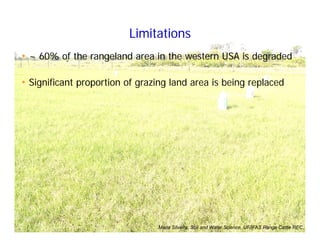
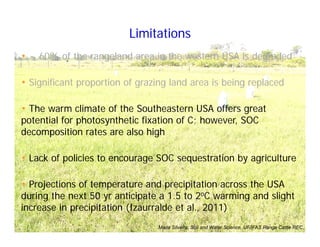
• ~ 60% of the rangeland area in the western USA is degraded
• Significant proportion of grazing land area is being replaced
Limitations
Maria Silveira, Soil and Water Science, UF/IFAS Range Cattle REC
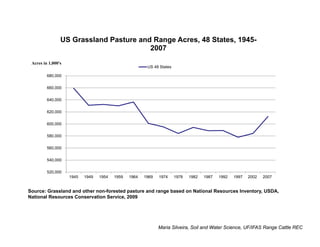
520,000
540,000
560,000
580,000
600,000
620,000
640,000
660,000
680,000
1945 1949 1954 1959 1964 1969 1974 1978 1982 1987 1992 1997 2002 2007
US Grassland Pasture and Range Acres, 48 States, 1945-
2007
US 48 States
Acres in 1,000's
Source: Grassland and other non-forested pasture and range based on National Resources Inventory, USDA,
National Resources Conservation Service, 2009
• ~ 60% of the rangeland area in the western USA is degraded
• Significant proportion of grazing land area is being replaced
• The warm climate of the Southeastern USA offers great
potential for photosynthetic fixation of C; however, SOC
decomposition rates are also high
• Lack of policies to encourage SOC sequestration by agriculture
• Projections of temperature and precipitation across the USA
during the next 50 yr anticipate a 1.5 to 2oC warming and slight
increase in precipitation (Izaurralde et al., 2011)
Limitations
Maria Silveira, Soil and Water Science, UF/IFAS Range Cattle REC
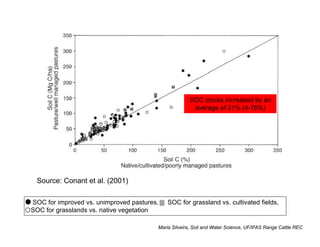
SOC for improved vs. unimproved pastures, SOC for grassland vs. cultivated fields,
SOC for grasslands vs. native vegetation
SOC stocks increased by an
average of 31% (4-76%)
Source: Conant et al. (2001)
Maria Silveira, Soil and Water Science, UF/IFAS Range Cattle REC
Fertilization
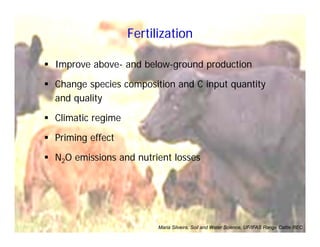
 Improve above- and below-ground production
 Change species composition and C input quantity
and quality
 Climatic regime
 Priming effect
 N2O emissions and nutrient losses
Maria Silveira, Soil and Water Science, UF/IFAS Range Cattle REC
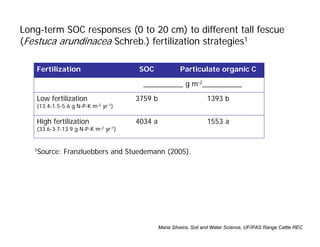
Long-term SOC responses (0 to 20 cm) to different tall fescue
(Festuca arundinacea Schreb.) fertilization strategies1
Fertilization SOC Particulate organic C
__________ g m-2__________
Low fertilization
(13.4-1.5-5.6 g N-P-K m-2 yr-1)
3759 b 1393 b
High fertilization
(33.6-3.7-13.9 g N-P-K m-2 yr-1)
4034 a 1553 a
1Source: Franzluebbers and Stuedemann (2005).
Maria Silveira, Soil and Water Science, UF/IFAS Range Cattle REC
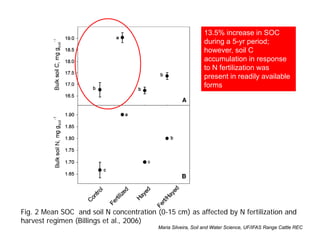
Fig. 2 Mean SOC and soil N concentration (0-15 cm) as affected by N fertilization and
harvest regimen (Billings et al., 2006)
13.5% increase in SOC
during a 5-yr period;
however, soil C
accumulation in response
to N fertilization was
present in readily available
forms
Maria Silveira, Soil and Water Science, UF/IFAS Range Cattle REC
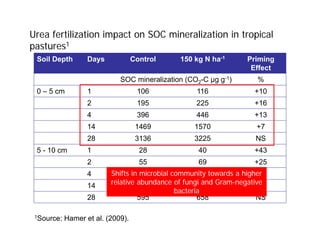
Urea fertilization impact on SOC mineralization in tropical
pastures1
Soil Depth Days Control 150 kg N ha-1 Priming
Effect
SOC mineralization (CO2-C µg g-1) %
0 – 5 cm 1 106 116 +10
2 195 225 +16
4 396 446 +13
14 1469 1570 +7
28 3136 3225 NS
5 - 10 cm 1 28 40 +43
2 55 69 +25
4 149 170 +14
14 335 372 +11
28 595 658 NS
1Source: Hamer et al. (2009).
Shifts in microbial community towards a higher
relative abundance of fungi and Gram-negative
bacteria
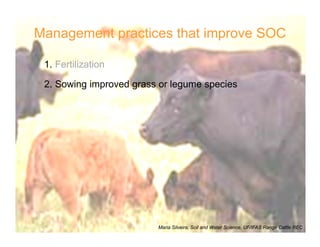
Management practices that improve SOC
1. Fertilization
2. Sowing improved grass or legume species
Maria Silveira, Soil and Water Science, UF/IFAS Range Cattle REC
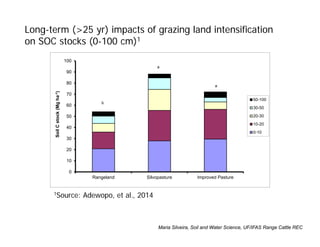
0
10
20
30
40
50
60
70
80
90
100
Rangeland Silvopasture Improved Pasture
SoilCstock(Mgha-1)
50-100
30-50
20-30
10-20
0-10
b
a
a
Long-term (>25 yr) impacts of grazing land intensification
on SOC stocks (0-100 cm)1
Maria Silveira, Soil and Water Science, UF/IFAS Range Cattle REC
1Source: Adewopo, et al., 2014
Maria Silveira, Soil and Water Science, UF/IFAS Range Cattle REC
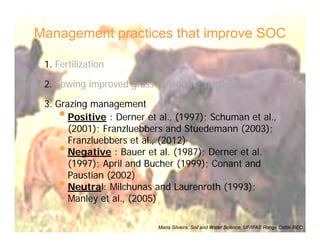
Management practices that improve SOC
1. Fertilization
2. Sowing improved grass or legume species
3. Grazing management
•Positive : Derner et al., (1997); Schuman et al.,
(2001); Franzluebbers and Stuedemann (2003);
Franzluebbers et al., (2012)
•Negative : Bauer et al. (1987); Derner et al.
(1997); April and Bucher (1999); Conant and
Paustian (2002)
•Neutral: Milchunas and Laurenroth (1993);
Manley et al., (2005)
Maria Silveira, Soil and Water Science, UF/IFAS Range Cattle REC
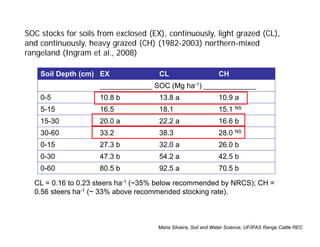
SOC stocks for soils from exclosed (EX), continuously, light grazed (CL),
and continuously, heavy grazed (CH) (1982-2003) northern-mixed
rangeland (Ingram et al., 2008)
Soil Depth (cm) EX CL CH
_____________ SOC (Mg ha-1) _____________
0-5 10.8 b 13.8 a 10.9 a
5-15 16.5 18.1 15.1 NS
15-30 20.0 a 22.2 a 16.6 b
30-60 33.2 38.3 28.0 NS
0-15 27.3 b 32.0 a 26.0 b
0-30 47.3 b 54.2 a 42.5 b
0-60 80.5 b 92.5 a 70.5 b
CL = 0.16 to 0.23 steers ha-1 (~35% below recommended by NRCS); CH =
0.56 steers ha-1 (~ 33% above recommended stocking rate).
Maria Silveira, Soil and Water Science, UF/IFAS Range Cattle REC
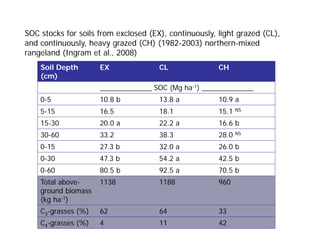
SOC stocks for soils from exclosed (EX), continuously, light grazed (CL),
and continuously, heavy grazed (CH) (1982-2003) northern-mixed
rangeland (Ingram et al., 2008)
Soil Depth
(cm)
EX CL CH
_____________ SOC (Mg ha-1) _____________
0-5 10.8 b 13.8 a 10.9 a
5-15 16.5 18.1 15.1 NS
15-30 20.0 a 22.2 a 16.6 b
30-60 33.2 38.3 28.0 NS
0-15 27.3 b 32.0 a 26.0 b
0-30 47.3 b 54.2 a 42.5 b
0-60 80.5 b 92.5 a 70.5 b
Total above-
ground biomass
(kg ha-1)
1138 1188 960
C3-grasses (%) 62 64 33
C4-grasses (%) 4 11 42
Stubble
Height†
Total C Total N Particulate C Litter OM
mass
Lignin/N
cm --------------- Mg ha-1 -------------- % total kg ha-1
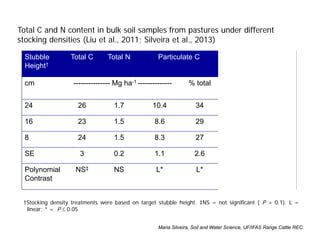
24 26 1.7 10.4 34 2510 7.8
16 23 1.5 8.6 29 2370 8.2
8 24 1.5 8.3 27 1725 9.2
SE 3 0.2 1.1 2.6 70 0.4
Polynomial
Contrast
NS‡ NS L* L* L** L*
Total C and N content in bulk soil samples from pastures under different
stocking densities (Liu et al., 2011; Silveira et al., 2013)
†Stocking density treatments were based on target stubble height. ‡NS = not significant ( P > 0.1). L =
linear; * = P  0.05
Maria Silveira, Soil and Water Science, UF/IFAS Range Cattle REC
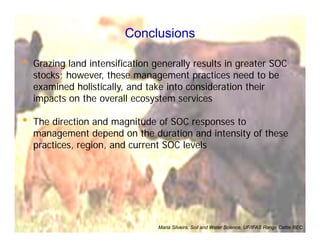
Conclusions
• Grazing land intensification generally results in greater SOC
stocks; however, these management practices need to be
examined holistically, and take into consideration their
impacts on the overall ecosystem services
• The direction and magnitude of SOC responses to
management depend on the duration and intensity of these
practices, region, and current SOC levels
Maria Silveira, Soil and Water Science, UF/IFAS Range Cattle REC
THANKS
Maria L. Silveira
Email: mlas@ufl.edu
Phone: (863) 735-1314

Silveira solutions to new challenges

  • 1.
    Challenges and Opportunitiesfor Soil Carbon Sequestration in Grazing land Ecosystems Maria L. Silveira Associate Professor, Soil and Water Science University of Florida – Range Cattle Research and Education Center
  • 2.
    • Globally, grazinglands (rangelands and pasture) cover ~ 3.5 billion ha (26% world land area and 70% world agricultural area). In the USA, rangelands account for ~ 20-23% of total land area, while pasturelands represent ~ 8-11% • Carbon stored in grazing lands represents 10 to 30% of world’s soil C stocks (Eswaran et al., 1993) • Increase (or loss) of 1% of SOC sequestered in the top 10 cm of grazing land soils is equivalent to the total US agriculture emissions (Follett, 2001) Importance Maria Silveira, Soil and Water Science, UF/IFAS Range Cattle REC
  • 3.
    • ~ 60%of the rangeland area in the western USA is degraded • Significant proportion of grazing land area is being replaced Limitations Maria Silveira, Soil and Water Science, UF/IFAS Range Cattle REC
  • 4.
    Maria Silveira, Soiland Water Science, UF/IFAS Range Cattle REC 520,000 540,000 560,000 580,000 600,000 620,000 640,000 660,000 680,000 1945 1949 1954 1959 1964 1969 1974 1978 1982 1987 1992 1997 2002 2007 US Grassland Pasture and Range Acres, 48 States, 1945- 2007 US 48 States Acres in 1,000's Source: Grassland and other non-forested pasture and range based on National Resources Inventory, USDA, National Resources Conservation Service, 2009
  • 5.
    • ~ 60%of the rangeland area in the western USA is degraded • Significant proportion of grazing land area is being replaced • The warm climate of the Southeastern USA offers great potential for photosynthetic fixation of C; however, SOC decomposition rates are also high • Lack of policies to encourage SOC sequestration by agriculture • Projections of temperature and precipitation across the USA during the next 50 yr anticipate a 1.5 to 2oC warming and slight increase in precipitation (Izaurralde et al., 2011) Limitations Maria Silveira, Soil and Water Science, UF/IFAS Range Cattle REC
  • 6.
    SOC for improvedvs. unimproved pastures, SOC for grassland vs. cultivated fields, SOC for grasslands vs. native vegetation SOC stocks increased by an average of 31% (4-76%) Source: Conant et al. (2001) Maria Silveira, Soil and Water Science, UF/IFAS Range Cattle REC
  • 7.
    Fertilization  Improve above-and below-ground production  Change species composition and C input quantity and quality  Climatic regime  Priming effect  N2O emissions and nutrient losses Maria Silveira, Soil and Water Science, UF/IFAS Range Cattle REC
  • 8.
    Long-term SOC responses(0 to 20 cm) to different tall fescue (Festuca arundinacea Schreb.) fertilization strategies1 Fertilization SOC Particulate organic C __________ g m-2__________ Low fertilization (13.4-1.5-5.6 g N-P-K m-2 yr-1) 3759 b 1393 b High fertilization (33.6-3.7-13.9 g N-P-K m-2 yr-1) 4034 a 1553 a 1Source: Franzluebbers and Stuedemann (2005). Maria Silveira, Soil and Water Science, UF/IFAS Range Cattle REC
  • 9.
    Fig. 2 MeanSOC and soil N concentration (0-15 cm) as affected by N fertilization and harvest regimen (Billings et al., 2006) 13.5% increase in SOC during a 5-yr period; however, soil C accumulation in response to N fertilization was present in readily available forms Maria Silveira, Soil and Water Science, UF/IFAS Range Cattle REC
  • 10.
    Urea fertilization impacton SOC mineralization in tropical pastures1 Soil Depth Days Control 150 kg N ha-1 Priming Effect SOC mineralization (CO2-C µg g-1) % 0 – 5 cm 1 106 116 +10 2 195 225 +16 4 396 446 +13 14 1469 1570 +7 28 3136 3225 NS 5 - 10 cm 1 28 40 +43 2 55 69 +25 4 149 170 +14 14 335 372 +11 28 595 658 NS 1Source: Hamer et al. (2009). Shifts in microbial community towards a higher relative abundance of fungi and Gram-negative bacteria
  • 11.
    Management practices thatimprove SOC 1. Fertilization 2. Sowing improved grass or legume species Maria Silveira, Soil and Water Science, UF/IFAS Range Cattle REC
  • 12.
    Maria Silveira, Soiland Water Science, UF/IFAS Range Cattle REC
  • 13.
    0 10 20 30 40 50 60 70 80 90 100 Rangeland Silvopasture ImprovedPasture SoilCstock(Mgha-1) 50-100 30-50 20-30 10-20 0-10 b a a Long-term (>25 yr) impacts of grazing land intensification on SOC stocks (0-100 cm)1 Maria Silveira, Soil and Water Science, UF/IFAS Range Cattle REC 1Source: Adewopo, et al., 2014 Maria Silveira, Soil and Water Science, UF/IFAS Range Cattle REC
  • 14.
    Management practices thatimprove SOC 1. Fertilization 2. Sowing improved grass or legume species 3. Grazing management •Positive : Derner et al., (1997); Schuman et al., (2001); Franzluebbers and Stuedemann (2003); Franzluebbers et al., (2012) •Negative : Bauer et al. (1987); Derner et al. (1997); April and Bucher (1999); Conant and Paustian (2002) •Neutral: Milchunas and Laurenroth (1993); Manley et al., (2005) Maria Silveira, Soil and Water Science, UF/IFAS Range Cattle REC
  • 15.
    SOC stocks forsoils from exclosed (EX), continuously, light grazed (CL), and continuously, heavy grazed (CH) (1982-2003) northern-mixed rangeland (Ingram et al., 2008) Soil Depth (cm) EX CL CH _____________ SOC (Mg ha-1) _____________ 0-5 10.8 b 13.8 a 10.9 a 5-15 16.5 18.1 15.1 NS 15-30 20.0 a 22.2 a 16.6 b 30-60 33.2 38.3 28.0 NS 0-15 27.3 b 32.0 a 26.0 b 0-30 47.3 b 54.2 a 42.5 b 0-60 80.5 b 92.5 a 70.5 b CL = 0.16 to 0.23 steers ha-1 (~35% below recommended by NRCS); CH = 0.56 steers ha-1 (~ 33% above recommended stocking rate). Maria Silveira, Soil and Water Science, UF/IFAS Range Cattle REC
  • 16.
    SOC stocks forsoils from exclosed (EX), continuously, light grazed (CL), and continuously, heavy grazed (CH) (1982-2003) northern-mixed rangeland (Ingram et al., 2008) Soil Depth (cm) EX CL CH _____________ SOC (Mg ha-1) _____________ 0-5 10.8 b 13.8 a 10.9 a 5-15 16.5 18.1 15.1 NS 15-30 20.0 a 22.2 a 16.6 b 30-60 33.2 38.3 28.0 NS 0-15 27.3 b 32.0 a 26.0 b 0-30 47.3 b 54.2 a 42.5 b 0-60 80.5 b 92.5 a 70.5 b Total above- ground biomass (kg ha-1) 1138 1188 960 C3-grasses (%) 62 64 33 C4-grasses (%) 4 11 42
  • 17.
    Stubble Height† Total C TotalN Particulate C Litter OM mass Lignin/N cm --------------- Mg ha-1 -------------- % total kg ha-1 24 26 1.7 10.4 34 2510 7.8 16 23 1.5 8.6 29 2370 8.2 8 24 1.5 8.3 27 1725 9.2 SE 3 0.2 1.1 2.6 70 0.4 Polynomial Contrast NS‡ NS L* L* L** L* Total C and N content in bulk soil samples from pastures under different stocking densities (Liu et al., 2011; Silveira et al., 2013) †Stocking density treatments were based on target stubble height. ‡NS = not significant ( P > 0.1). L = linear; * = P  0.05 Maria Silveira, Soil and Water Science, UF/IFAS Range Cattle REC
  • 18.
    Conclusions • Grazing landintensification generally results in greater SOC stocks; however, these management practices need to be examined holistically, and take into consideration their impacts on the overall ecosystem services • The direction and magnitude of SOC responses to management depend on the duration and intensity of these practices, region, and current SOC levels Maria Silveira, Soil and Water Science, UF/IFAS Range Cattle REC
  • 19.
    THANKS Maria L. Silveira Email:mlas@ufl.edu Phone: (863) 735-1314