Strategies for enhancing carbon sequestration and agricultural
productivity through cultural and nutrient management practices
Speaker
Mr. Rohit Yadav
Ph.D. Agronomy
Reg. No. 23-P-FP-06
Seminar Incharge
Dr. Hardev Ram
Senior Scientist
Agronomy section
ICAR – National Dairy Research Institute
Karnal, Haryana - 132001 1
OUTLINES
Ί Introduction
Ί Carbon sequestration
Ί Role of soil organic carbon in Agriculture
Ί Agro-techniques for improving SOC sequestration
Ί Case studies
Ί Conclusion
3
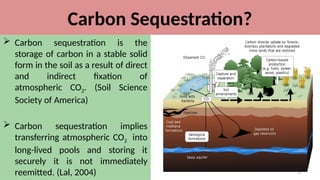
Carbon Sequestration?
 Carbon sequestration is the
storage of carbon in a stable solid
form in the soil as a result of direct
and indirect fixation of
atmospheric CO2. (Soil Science
Society of America)
 Carbon sequestration implies
transferring atmospheric CO2 into
long-lived pools and storing it
securely it is not immediately
reemitted. (Lal, 2004)
4
 CO2 is one of the main greenhouse gas that is causing global warming
 About 30% of the total GHGs emission alone contributed by intensive agriculture
practices it self (IPCC, 2013)
 Annual losses of 0.3–1.0 billions tons carbon through erosion of agricultural land
(Chappell et al., 2015)
 1.4 billions metric tons C could be stored annually in agricultural soils, i.e.
equivalent to an annual storage rate of 0.4 % in top soil [IPCC, 2014]
 80 % of this potential could be reached with an expenditure of 100 USD per ton of
CO2 (Smith et al., 2014)
SOIL CAROBON SEQUESTRATION: A MAJOR OPTION FOR TACKLING
CLIMATE CHANGE
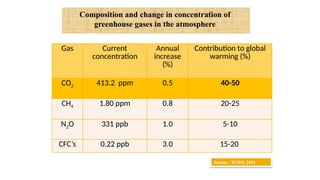
Gas Current
concentration
Annual
increase
(%)
Contribution to global
warming (%)
CO2 413.2 ppm 0.5 40-50
CH4 1.80 ppm 0.8 20-25
N2O 331 ppb 1.0 5-10
CFC’s 0.22 ppb 3.0 15-20
5
Source : WMO, 2021
Composition and change in concentration of
greenhouse gases in the atmosphere
S
h
a
r
e
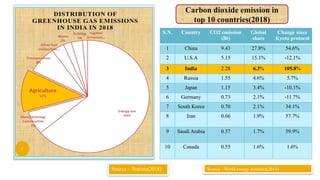
S.N. Country CO2 emission
(Bt)
Global
share
Change since
Kyoto protocol
1 China 9.43 27.8% 54.6%
2 U.S.A 5.15 15.1% -12.1%
3 India 2.28 6.3% 105.8%
4 Russia 1.55 4.6% 5.7%
5 Japan 1.15 3.4% -10.1%
6 Germany 0.73 2.1% -11.7%
7 South Korea 0.70 2.1% 34.1%
8 Iran 0.66 1.9% 57.7%
9 Saudi Arabia 0.57 1.7% 59.9%
10 Canada 0.55 1.6% 1.6%
Carbon dioxide emission in
top 10 countries(2018)
Source – Statista(2018) Source - World energy statistics(2019)
7
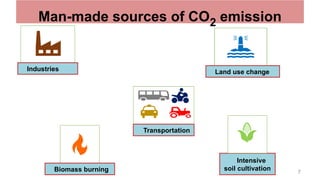
Man-made sources of CO2 emission
Industries Land use change
Intensive
soil cultivation
Transportation
Biomass burning
8
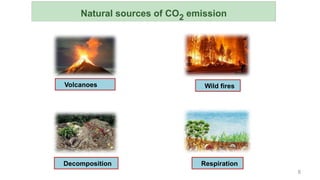
Natural sources of CO2 emission
Wild fires
Volcanoes
Respiration
Decomposition
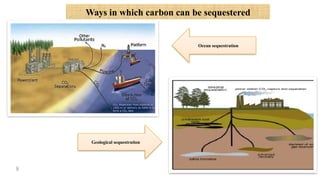
Ways in which carbon can be sequestered
9
Ocean sequestration
Geological sequestration
10
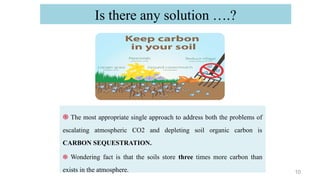
Is there any solution 
.?
֍ The most appropriate single approach to address both the problems of
escalating atmospheric CO2 and depleting soil organic carbon is
CARBON SEQUESTRATION.
֍ Wondering fact is that the soils store three times more carbon than
exists in the atmosphere.
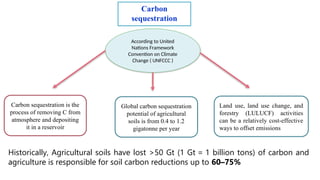
Historically, Agricultural soils have lost >50 Gt (1 Gt = 1 billion tons) of carbon and
agriculture is responsible for soil carbon reductions up to 60–75%
According to United
Nations Framework
Convention on Climate
Change ( UNFCCC )
Carbon sequestration is the
process of removing C from
atmosphere and depositing
it in a reservoir
Global carbon sequestration
potential of agricultural
soils is from 0.4 to 1.2
gigatonne per year
Land use, land use change, and
forestry (LULUCF) activities
can be a relatively cost-effective
ways to offset emissions
Carbon
sequestration
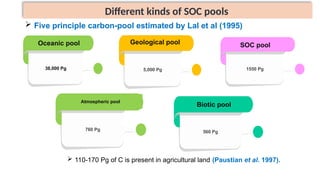
Different kinds of SOC pools
38,000 Pg
Oceanic pool
5,000 Pg
Geological pool
1550 Pg
SOC pool
560 Pg
Biotic pool
 Five principle carbon-pool estimated by Lal et al (1995)
 110-170 Pg of C is present in agricultural land (Paustian et al. 1997).
760 Pg
Atmospheric pool
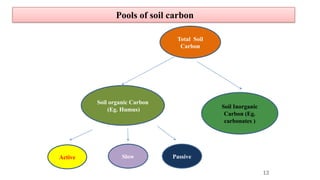
Total Soil
Carbon
Soil organic Carbon
(Eg. Humus) Soil Inorganic
Carbon (Eg.
carbonates )
Active Slow Passive
Pools of soil carbon
13
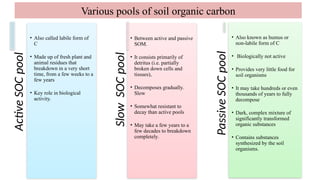
Active
SOC
pool
‱ Also called labile form of
C
‱ Made up of fresh plant and
animal residues that
breakdown in a very short
time, from a few weeks to a
few years
‱ Key role in biological
activity.
Slow
SOC
pool
‱ Between active and passive
SOM.
‱ It consists primarily of
detritus (i.e. partially
broken down cells and
tissues),
‱ Decomposes gradually.
Slow
‱ Somewhat resistant to
decay than active pools
‱ May take a few years to a
few decades to breakdown
completely.
Passive
SOC
pool
‱ Also known as humus or
non-labile form of C
‱ Biologically not active
‱ Provides very little food for
soil organisms
‱ It may take hundreds or even
thousands of years to fully
decompose
‱ Dark, complex mixture of
significantly transformed
organic substances
‱ Contains substances
synthesized by the soil
organisms.
Various pools of soil organic carbon
15
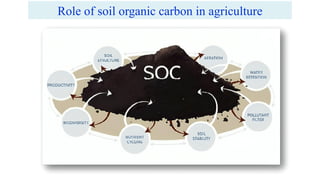
Role of soil organic carbon in agriculture
17
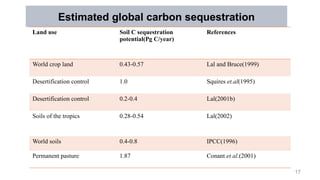
Estimated global carbon sequestration
Land use Soil C sequestration
potential(Pg C/year)
References
World crop land 0.43-0.57 Lal and Bruce(1999)
Desertification control 1.0 Squires et.al(1995)
Desertification control 0.2-0.4 Lal(2001b)
Soils of the tropics 0.28-0.54 Lal(2002)
World soils 0.4-0.8 IPCC(1996)
Permanent pasture 1.87 Conant et al.(2001)
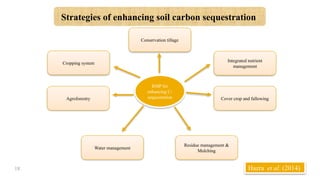
Strategies of enhancing soil carbon sequestration
18 Hazra et al. (2014)
Cropping system
Agroforestry
Water management
Residue management &
Mulching
Cover crop and fallowing
Conservation tillage
Integrated nutrient
management
RMP for
enhancing C-
sequestration
19
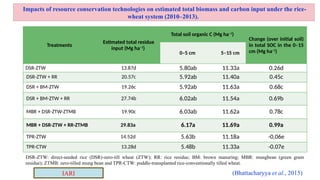
Treatments
Estimated total residue
input (Mg ha−1
)
Total soil organic C (Mg ha−1
)
Change (over initial soil)
in total SOC in the 0–15
cm (Mg ha−1
)
0–5 cm 5–15 cm
DSR-ZTW 13.87d 5.80ab 11.33a 0.26d
DSR-ZTW + RR 20.57c 5.92ab 11.40a 0.45c
DSR + BM-ZTW 19.26c 5.92ab 11.63a 0.68c
DSR + BM-ZTW + RR 27.74b 6.02ab 11.54a 0.69b
MBR + DSR-ZTW-ZTMB 19.90c 6.03ab 11.62a 0.78c
MBR + DSR-ZTW + RR-ZTMB 29.83a 6.17a 11.69a 0.99a
TPR-ZTW 14.52d 5.63b 11.18a -0.06e
TPR-CTW 13.28d 5.48b 11.33a -0.07e
DSR-ZTW: direct-seeded rice (DSR)-zero-till wheat (ZTW); RR: rice residue; BM: brown manuring; MBR: mungbean (green gram
residue); ZTMB: zero-tilled mung bean and TPR-CTW: puddle-transplanted rice-conventionally tilled wheat.
Impacts of resource conservation technologies on estimated total biomass and carbon input under the rice-
wheat system (2010–2013).
(Bhattacharyya et al., 2015)
IARI
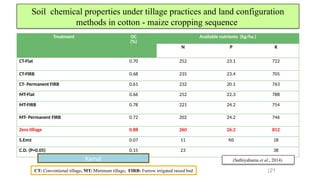
Soil chemical properties under tillage practices and land configuration
methods in cotton - maize cropping sequence
Treatment OC
(%)
Available nutrients (kg/ha )
N P K
CT-Flat 0.70 252 23.1 722
CT-FIRB 0.68 235 23.4 705
CT- Permanent FIRB 0.61 232 20.1 763
MT-Flat 0.66 252 22.3 788
MT-FIRB 0.78 221 24.2 754
MT- Permanent FIRB 0.72 202 24.2 746
Zero tillage 0.88 260 26.2 812
S.Em± 0.07 11 NS 18
C.D. (P=0.05) 0.15 23 38
(Sathiyabama et al., 2014)
CT: Conventional tillage, MT: Minimum tillage, FIRB: Furrow irrigated raised bed (21
Karnal
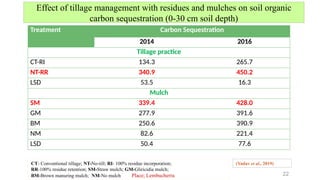
Effect of tillage management with residues and mulches on soil organic
carbon sequestration (0-30 cm soil depth)
Treatment Carbon Sequestration
2014 2016
Tillage practice
CT-RI 134.3 265.7
NT-RR 340.9 450.2
LSD 53.5 16.3
Mulch
SM 339.4 428.0
GM 277.9 391.6
BM 250.6 390.9
NM 82.6 221.4
LSD 50.4 77.6
(Yadav et al., 2019)
CT- Conventional tillage; NT-No-till; RI- 100% residue incorporation;
RR-100% residue retention; SM-Straw mulch; GM-Gliricidia mulch;
BM-Brown manuring mulch; NM-No mulch Place; Lembucherra 22
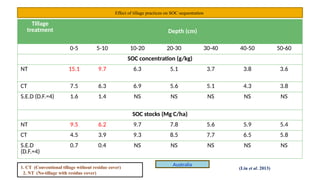
Tillage
treatment Depth (cm)
0-5 5-10 10-20 20-30 30-40 40-50 50-60
SOC concentration (g/kg)
NT 15.1 9.7 6.3 5.1 3.7 3.8 3.6
CT 7.5 6.3 6.9 5.6 5.1 4.3 3.8
S.E.D (D.F.=4) 1.6 1.4 NS NS NS NS NS
SOC stocks (Mg C/ha)
NT 9.5 6.2 9.7 7.8 5.6 5.9 5.4
CT 4.5 3.9 9.3 8.5 7.7 6.5 5.8
S.E.D
(D.F.=4)
0.7 0.4 NS NS NS NS NS
(Liu et al. 2013)
1. CT (Conventional tillage without residue cover)
2. NT (No-tillage with residue cover)
Effect of tillage practices on SOC sequestration
Australia
24
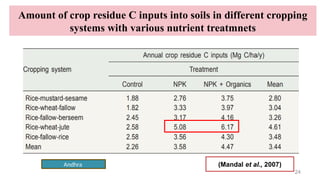
Amount of crop residue C inputs into soils in different cropping
systems with various nutrient treatmnets
(Mandal et al., 2007)
Andhra
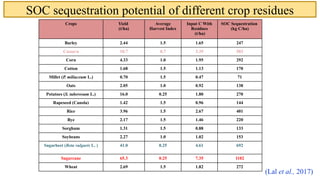
(Lal et al., 2017)
Crops Yield
(t/ha)
Average
Harvest Index
Input C With
Residues
(t/ha)
SOC Sequestration
(kg C/ha)
Barley 2.44 1.5 1.65 247
Cassava 10.7 0.7 3.35 503
Corn 4.33 1.0 1.95 292
Cotton 1.68 1.5 1.13 170
Millet (P. miliaceum L.) 0.70 1.5 0.47 71
Oats 2.05 1.0 0.92 138
Potatoes (S. tuberosum L.) 16.0 0.25 1.80 270
Rapeseed (Canola) 1.42 1.5 0.96 144
Rice 3.96 1.5 2.67 401
Rye 2.17 1.5 1.46 220
Sorghum 1.31 1.5 0.88 133
Soybeans 2.27 1.0 1.02 153
Sugarbeet (Beta vulgaris L. ) 41.0 0.25 4.61 692
Sugarcane 65.3 0.25 7.35 1102
Wheat 2.69 1.5 1.82 272
SOC sequestration potential of different crop residues
26
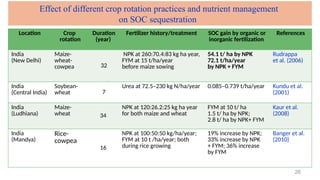
Location Crop
rotation
Duration
(year)
Fertilizer history/treatment SOC gain by organic or
inorganic fertilization
References
India
(New Delhi)
Maize-
wheat-
cowpea 32
NPK at 260:70.4:83 kg ha year,
FYM at 15 t/ha/year
before maize sowing
54.1 t/ ha by NPK
72.1 t/ha/year
by NPK + FYM
Rudrappa
et al. (2006)
India
(Central India)
Soybean-
wheat 7
Urea at 72.5–230 kg N/ha/year 0.085–0.739 t/ha/year Kundu et al.
(2001)
India
(Ludhiana)
Maize-
wheat 34
NPK at 120:26.2:25 kg ha year
for both maize and wheat
FYM at 10 t/ ha
1.5 t/ ha by NPK;
2.8 t/ ha by NPK+ FYM
Kaur et al.
(2008)
India
(Mandya)
Rice-
cowpea
16
NPK at 100:50:50 kg/ha/year;
FYM at 10 t /ha/year; both
during rice growing
19% increase by NPK;
33% increase by NPK
+ FYM; 36% increase
by FYM
Banger et al.
(2010)
Effect of different crop rotation practices and nutrient management
on SOC sequestration
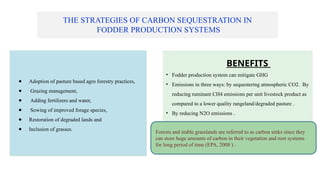
THE STRATEGIES OF CARBON SEQUESTRATION IN
FODDER PRODUCTION SYSTEMS
● Adoption of pasture based agro forestry practices,
● Grazing management,
● Adding fertilizers and water,
● Sowing of improved forage species,
● Restoration of degraded lands and
● Inclusion of grasses.
BENEFITS
‱ Fodder production system can mitigate GHG
‱ Emissions in three ways: by sequestering atmospheric CO2. By
reducing ruminant CH4 emissions per unit livestock product as
compared to a lower quality rangeland/degraded pasture .
‱ By reducing N2O emissions .
Forests and stable grasslands are referred to as carbon sinks since they
can store huge amounts of carbon in their vegetation and root systems
for long period of time (EPA, 2008 ) .
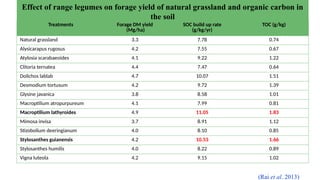
Treatments Forage DM yield
(Mg/ha)
SOC build up rate
(g/kg/yr)
TOC (g/kg)
Natural grassland 3.3 7.78 0.74
Alysicarapus rugosus 4.2 7.55 0.67
Atylosia scarabaeoides 4.1 9.22 1.22
Clitoria ternatea 4.4 7.47 0.64
Dolichos lablab 4.7 10.07 1.51
Desmodium tortusum 4.2 9.72 1.39
Glysine javanica 3.8 8.58 1.01
Macroptilium atropurpureum 4.1 7.99 0.81
Macroptilium lathyroides 4.9 11.05 1.83
Mimosa invisa 3.7 8.91 1.12
Stizobolium deeringianum 4.0 8.10 0.85
Stylosanthes guianensis 4.2 10.53 1.66
Stylosanthes humilis 4.0 8.22 0.89
Vigna luteola 4.2 9.15 1.02
Effect of range legumes on forage yield of natural grassland and organic carbon in
the soil
(Rai et al. 2013)
29
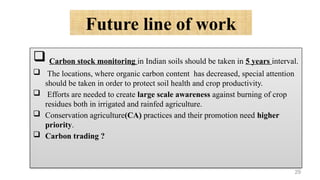
Future line of work
 Carbon stock monitoring in Indian soils should be taken in 5 years interval.
 The locations, where organic carbon content has decreased, special attention
should be taken in order to protect soil health and crop productivity.
 Efforts are needed to create large scale awareness against burning of crop
residues both in irrigated and rainfed agriculture.
 Conservation agriculture(CA) practices and their promotion need higher
priority.
 Carbon trading ?
30
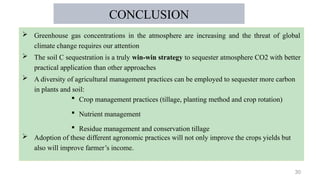
CONCLUSION
 Greenhouse gas concentrations in the atmosphere are increasing and the threat of global
climate change requires our attention
 The soil C sequestration is a truly win-win strategy to sequester atmosphere CO2 with better
practical application than other approaches
 A diversity of agricultural management practices can be employed to sequester more carbon
in plants and soil:
 Adoption of these different agronomic practices will not only improve the crops yields but
also will improve farmer’s income.
 Crop management practices (tillage, planting method and crop rotation)
 Nutrient management
 Residue management and conservation tillage
31

Strategies for enhancing Carbon sequestration

  • 1.
    Strategies for enhancingcarbon sequestration and agricultural productivity through cultural and nutrient management practices Speaker Mr. Rohit Yadav Ph.D. Agronomy Reg. No. 23-P-FP-06 Seminar Incharge Dr. Hardev Ram Senior Scientist Agronomy section ICAR – National Dairy Research Institute Karnal, Haryana - 132001 1
  • 2.
    OUTLINES Ί Introduction Ί Carbonsequestration Ί Role of soil organic carbon in Agriculture Ί Agro-techniques for improving SOC sequestration Ί Case studies Ί Conclusion
  • 3.
    3 Carbon Sequestration?  Carbonsequestration is the storage of carbon in a stable solid form in the soil as a result of direct and indirect fixation of atmospheric CO2. (Soil Science Society of America)  Carbon sequestration implies transferring atmospheric CO2 into long-lived pools and storing it securely it is not immediately reemitted. (Lal, 2004)
  • 4.
    4  CO2 isone of the main greenhouse gas that is causing global warming  About 30% of the total GHGs emission alone contributed by intensive agriculture practices it self (IPCC, 2013)  Annual losses of 0.3–1.0 billions tons carbon through erosion of agricultural land (Chappell et al., 2015)  1.4 billions metric tons C could be stored annually in agricultural soils, i.e. equivalent to an annual storage rate of 0.4 % in top soil [IPCC, 2014]  80 % of this potential could be reached with an expenditure of 100 USD per ton of CO2 (Smith et al., 2014) SOIL CAROBON SEQUESTRATION: A MAJOR OPTION FOR TACKLING CLIMATE CHANGE
  • 5.
    Gas Current concentration Annual increase (%) Contribution toglobal warming (%) CO2 413.2 ppm 0.5 40-50 CH4 1.80 ppm 0.8 20-25 N2O 331 ppb 1.0 5-10 CFC’s 0.22 ppb 3.0 15-20 5 Source : WMO, 2021 Composition and change in concentration of greenhouse gases in the atmosphere
  • 6.
    S h a r e S.N. Country CO2emission (Bt) Global share Change since Kyoto protocol 1 China 9.43 27.8% 54.6% 2 U.S.A 5.15 15.1% -12.1% 3 India 2.28 6.3% 105.8% 4 Russia 1.55 4.6% 5.7% 5 Japan 1.15 3.4% -10.1% 6 Germany 0.73 2.1% -11.7% 7 South Korea 0.70 2.1% 34.1% 8 Iran 0.66 1.9% 57.7% 9 Saudi Arabia 0.57 1.7% 59.9% 10 Canada 0.55 1.6% 1.6% Carbon dioxide emission in top 10 countries(2018) Source – Statista(2018) Source - World energy statistics(2019)
  • 7.
    7 Man-made sources ofCO2 emission Industries Land use change Intensive soil cultivation Transportation Biomass burning
  • 8.
    8 Natural sources ofCO2 emission Wild fires Volcanoes Respiration Decomposition
  • 9.
    Ways in whichcarbon can be sequestered 9 Ocean sequestration Geological sequestration
  • 10.
    10 Is there anysolution 
.? ֍ The most appropriate single approach to address both the problems of escalating atmospheric CO2 and depleting soil organic carbon is CARBON SEQUESTRATION. ֍ Wondering fact is that the soils store three times more carbon than exists in the atmosphere.
  • 11.
    Historically, Agricultural soilshave lost >50 Gt (1 Gt = 1 billion tons) of carbon and agriculture is responsible for soil carbon reductions up to 60–75% According to United Nations Framework Convention on Climate Change ( UNFCCC ) Carbon sequestration is the process of removing C from atmosphere and depositing it in a reservoir Global carbon sequestration potential of agricultural soils is from 0.4 to 1.2 gigatonne per year Land use, land use change, and forestry (LULUCF) activities can be a relatively cost-effective ways to offset emissions Carbon sequestration
  • 12.
    Different kinds ofSOC pools 38,000 Pg Oceanic pool 5,000 Pg Geological pool 1550 Pg SOC pool 560 Pg Biotic pool  Five principle carbon-pool estimated by Lal et al (1995)  110-170 Pg of C is present in agricultural land (Paustian et al. 1997). 760 Pg Atmospheric pool
  • 13.
    Total Soil Carbon Soil organicCarbon (Eg. Humus) Soil Inorganic Carbon (Eg. carbonates ) Active Slow Passive Pools of soil carbon 13
  • 14.
    Active SOC pool ‱ Also calledlabile form of C ‱ Made up of fresh plant and animal residues that breakdown in a very short time, from a few weeks to a few years ‱ Key role in biological activity. Slow SOC pool ‱ Between active and passive SOM. ‱ It consists primarily of detritus (i.e. partially broken down cells and tissues), ‱ Decomposes gradually. Slow ‱ Somewhat resistant to decay than active pools ‱ May take a few years to a few decades to breakdown completely. Passive SOC pool ‱ Also known as humus or non-labile form of C ‱ Biologically not active ‱ Provides very little food for soil organisms ‱ It may take hundreds or even thousands of years to fully decompose ‱ Dark, complex mixture of significantly transformed organic substances ‱ Contains substances synthesized by the soil organisms. Various pools of soil organic carbon
  • 15.
  • 16.
    Role of soilorganic carbon in agriculture
  • 17.
    17 Estimated global carbonsequestration Land use Soil C sequestration potential(Pg C/year) References World crop land 0.43-0.57 Lal and Bruce(1999) Desertification control 1.0 Squires et.al(1995) Desertification control 0.2-0.4 Lal(2001b) Soils of the tropics 0.28-0.54 Lal(2002) World soils 0.4-0.8 IPCC(1996) Permanent pasture 1.87 Conant et al.(2001)
  • 18.
    Strategies of enhancingsoil carbon sequestration 18 Hazra et al. (2014) Cropping system Agroforestry Water management Residue management & Mulching Cover crop and fallowing Conservation tillage Integrated nutrient management RMP for enhancing C- sequestration
  • 19.
  • 20.
    Treatments Estimated total residue input(Mg ha−1 ) Total soil organic C (Mg ha−1 ) Change (over initial soil) in total SOC in the 0–15 cm (Mg ha−1 ) 0–5 cm 5–15 cm DSR-ZTW 13.87d 5.80ab 11.33a 0.26d DSR-ZTW + RR 20.57c 5.92ab 11.40a 0.45c DSR + BM-ZTW 19.26c 5.92ab 11.63a 0.68c DSR + BM-ZTW + RR 27.74b 6.02ab 11.54a 0.69b MBR + DSR-ZTW-ZTMB 19.90c 6.03ab 11.62a 0.78c MBR + DSR-ZTW + RR-ZTMB 29.83a 6.17a 11.69a 0.99a TPR-ZTW 14.52d 5.63b 11.18a -0.06e TPR-CTW 13.28d 5.48b 11.33a -0.07e DSR-ZTW: direct-seeded rice (DSR)-zero-till wheat (ZTW); RR: rice residue; BM: brown manuring; MBR: mungbean (green gram residue); ZTMB: zero-tilled mung bean and TPR-CTW: puddle-transplanted rice-conventionally tilled wheat. Impacts of resource conservation technologies on estimated total biomass and carbon input under the rice- wheat system (2010–2013). (Bhattacharyya et al., 2015) IARI
  • 21.
    Soil chemical propertiesunder tillage practices and land configuration methods in cotton - maize cropping sequence Treatment OC (%) Available nutrients (kg/ha ) N P K CT-Flat 0.70 252 23.1 722 CT-FIRB 0.68 235 23.4 705 CT- Permanent FIRB 0.61 232 20.1 763 MT-Flat 0.66 252 22.3 788 MT-FIRB 0.78 221 24.2 754 MT- Permanent FIRB 0.72 202 24.2 746 Zero tillage 0.88 260 26.2 812 S.Em± 0.07 11 NS 18 C.D. (P=0.05) 0.15 23 38 (Sathiyabama et al., 2014) CT: Conventional tillage, MT: Minimum tillage, FIRB: Furrow irrigated raised bed (21 Karnal
  • 22.
    Effect of tillagemanagement with residues and mulches on soil organic carbon sequestration (0-30 cm soil depth) Treatment Carbon Sequestration 2014 2016 Tillage practice CT-RI 134.3 265.7 NT-RR 340.9 450.2 LSD 53.5 16.3 Mulch SM 339.4 428.0 GM 277.9 391.6 BM 250.6 390.9 NM 82.6 221.4 LSD 50.4 77.6 (Yadav et al., 2019) CT- Conventional tillage; NT-No-till; RI- 100% residue incorporation; RR-100% residue retention; SM-Straw mulch; GM-Gliricidia mulch; BM-Brown manuring mulch; NM-No mulch Place; Lembucherra 22
  • 23.
    Tillage treatment Depth (cm) 0-55-10 10-20 20-30 30-40 40-50 50-60 SOC concentration (g/kg) NT 15.1 9.7 6.3 5.1 3.7 3.8 3.6 CT 7.5 6.3 6.9 5.6 5.1 4.3 3.8 S.E.D (D.F.=4) 1.6 1.4 NS NS NS NS NS SOC stocks (Mg C/ha) NT 9.5 6.2 9.7 7.8 5.6 5.9 5.4 CT 4.5 3.9 9.3 8.5 7.7 6.5 5.8 S.E.D (D.F.=4) 0.7 0.4 NS NS NS NS NS (Liu et al. 2013) 1. CT (Conventional tillage without residue cover) 2. NT (No-tillage with residue cover) Effect of tillage practices on SOC sequestration Australia
  • 24.
    24 Amount of cropresidue C inputs into soils in different cropping systems with various nutrient treatmnets (Mandal et al., 2007) Andhra
  • 25.
    (Lal et al.,2017) Crops Yield (t/ha) Average Harvest Index Input C With Residues (t/ha) SOC Sequestration (kg C/ha) Barley 2.44 1.5 1.65 247 Cassava 10.7 0.7 3.35 503 Corn 4.33 1.0 1.95 292 Cotton 1.68 1.5 1.13 170 Millet (P. miliaceum L.) 0.70 1.5 0.47 71 Oats 2.05 1.0 0.92 138 Potatoes (S. tuberosum L.) 16.0 0.25 1.80 270 Rapeseed (Canola) 1.42 1.5 0.96 144 Rice 3.96 1.5 2.67 401 Rye 2.17 1.5 1.46 220 Sorghum 1.31 1.5 0.88 133 Soybeans 2.27 1.0 1.02 153 Sugarbeet (Beta vulgaris L. ) 41.0 0.25 4.61 692 Sugarcane 65.3 0.25 7.35 1102 Wheat 2.69 1.5 1.82 272 SOC sequestration potential of different crop residues
  • 26.
    26 Location Crop rotation Duration (year) Fertilizer history/treatmentSOC gain by organic or inorganic fertilization References India (New Delhi) Maize- wheat- cowpea 32 NPK at 260:70.4:83 kg ha year, FYM at 15 t/ha/year before maize sowing 54.1 t/ ha by NPK 72.1 t/ha/year by NPK + FYM Rudrappa et al. (2006) India (Central India) Soybean- wheat 7 Urea at 72.5–230 kg N/ha/year 0.085–0.739 t/ha/year Kundu et al. (2001) India (Ludhiana) Maize- wheat 34 NPK at 120:26.2:25 kg ha year for both maize and wheat FYM at 10 t/ ha 1.5 t/ ha by NPK; 2.8 t/ ha by NPK+ FYM Kaur et al. (2008) India (Mandya) Rice- cowpea 16 NPK at 100:50:50 kg/ha/year; FYM at 10 t /ha/year; both during rice growing 19% increase by NPK; 33% increase by NPK + FYM; 36% increase by FYM Banger et al. (2010) Effect of different crop rotation practices and nutrient management on SOC sequestration
  • 27.
    THE STRATEGIES OFCARBON SEQUESTRATION IN FODDER PRODUCTION SYSTEMS ● Adoption of pasture based agro forestry practices, ● Grazing management, ● Adding fertilizers and water, ● Sowing of improved forage species, ● Restoration of degraded lands and ● Inclusion of grasses. BENEFITS ‱ Fodder production system can mitigate GHG ‱ Emissions in three ways: by sequestering atmospheric CO2. By reducing ruminant CH4 emissions per unit livestock product as compared to a lower quality rangeland/degraded pasture . ‱ By reducing N2O emissions . Forests and stable grasslands are referred to as carbon sinks since they can store huge amounts of carbon in their vegetation and root systems for long period of time (EPA, 2008 ) .
  • 28.
    Treatments Forage DMyield (Mg/ha) SOC build up rate (g/kg/yr) TOC (g/kg) Natural grassland 3.3 7.78 0.74 Alysicarapus rugosus 4.2 7.55 0.67 Atylosia scarabaeoides 4.1 9.22 1.22 Clitoria ternatea 4.4 7.47 0.64 Dolichos lablab 4.7 10.07 1.51 Desmodium tortusum 4.2 9.72 1.39 Glysine javanica 3.8 8.58 1.01 Macroptilium atropurpureum 4.1 7.99 0.81 Macroptilium lathyroides 4.9 11.05 1.83 Mimosa invisa 3.7 8.91 1.12 Stizobolium deeringianum 4.0 8.10 0.85 Stylosanthes guianensis 4.2 10.53 1.66 Stylosanthes humilis 4.0 8.22 0.89 Vigna luteola 4.2 9.15 1.02 Effect of range legumes on forage yield of natural grassland and organic carbon in the soil (Rai et al. 2013)
  • 29.
    29 Future line ofwork  Carbon stock monitoring in Indian soils should be taken in 5 years interval.  The locations, where organic carbon content has decreased, special attention should be taken in order to protect soil health and crop productivity.  Efforts are needed to create large scale awareness against burning of crop residues both in irrigated and rainfed agriculture.  Conservation agriculture(CA) practices and their promotion need higher priority.  Carbon trading ?
  • 30.
    30 CONCLUSION  Greenhouse gasconcentrations in the atmosphere are increasing and the threat of global climate change requires our attention  The soil C sequestration is a truly win-win strategy to sequester atmosphere CO2 with better practical application than other approaches  A diversity of agricultural management practices can be employed to sequester more carbon in plants and soil:  Adoption of these different agronomic practices will not only improve the crops yields but also will improve farmer’s income.  Crop management practices (tillage, planting method and crop rotation)  Nutrient management  Residue management and conservation tillage
  • 31.

Editor's Notes