SUNIL KUMAR M
MBAL2027
INTRODUCTION
India is the second largest producer of raw silk after
China and the biggest consumer of raw silk and silk
fabrics.
Sericulture industry provides employment to
approximately 7.56 million persons in rural and semi-
urban areas in India.
India has the unique distinction of being the only
country producing all the five known commercial silks,
namely, mulberry, tropical tasar, oak tasar, eri and
muga, of which muga with its golden yellow glitter is
unique and prerogative of India.
HISTORY
Sericulture is both an art and science of raising
silkworms for silk production.
Silk as a weavable fiber was first discovered by the
Chinese empress Xi Ling Shi during 2,640 B.C. and its
culture and weaving was a guarded secret for more
than 2,500 years by the Chinese.
India has a rich and complex history in silk production
and its silk trade dates back to 15th century.
PRODUCTION OF RAW SILK
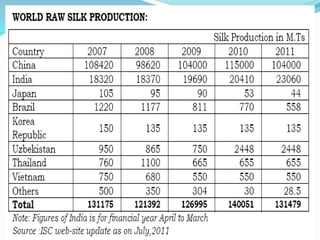
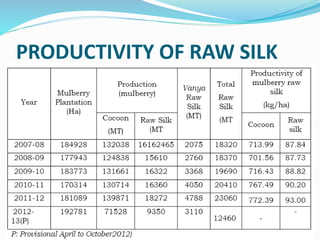
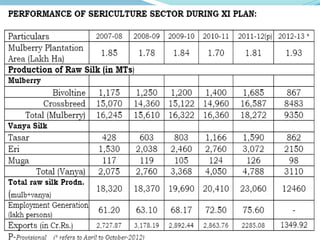
 Production of raw silk in India was 23,060 MT in 2011-
12, of which, mulberry raw silk output aggregated to
18,272 MT (79.24%). The remaining 4,788 MT
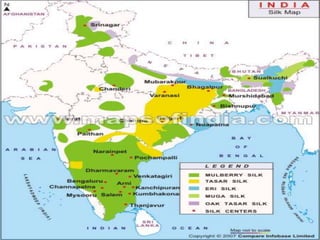
(20.76%) was Vanya silks. Mulberry sericulture is
mainly practiced in five states namely, Karnataka,
Andhra Pradesh, West Bengal, Tamil Nadu and Jammu
& Kashmir jointly account for about 97% of the total
mulberry silk production in the country.
DOMESTIC DEMAND FOR RAW
SILK
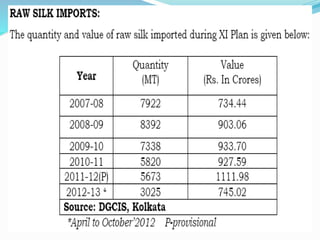
 India is the largest consumer of raw silk in the world.
As the consumption of raw silk (around 28,733 MT)
exceeds the production, the additional requirement of
around 5,700 MT of silk (particularly bivoltine
mulberry silk of international quality) is imported
mainly from China.
EXPORT POTENTIAL
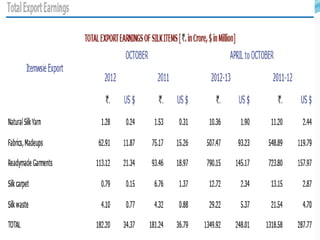
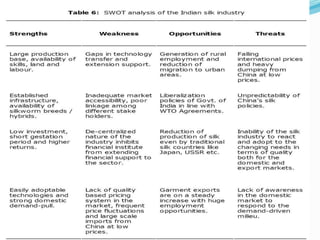
 Export potential of this sector is promising as silk
production in Japan is declining and that of China, the
largest silk producer the World, it is stagnant. The
present global scenario clearly indicates the enormous
opportunities for the Indian Silk Industry.
PRODUCTIVITY OF RAW SILK
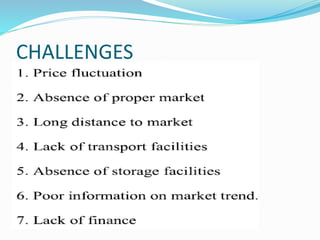
CHALLENGES
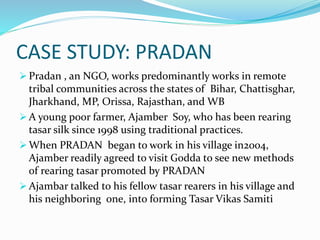
CASE STUDY: PRADAN
 Pradan , an NGO, works predominantly works in remote
tribal communities across the states of Bihar, Chattisghar,
Jharkhand, MP, Orissa, Rajasthan, and WB
 A young poor farmer, Ajamber Soy, who has been rearing
tasar silk since 1998 using traditional practices.
 When PRADAN began to work in his village in2004,
Ajamber readily agreed to visit Godda to see new methods
of rearing tasar promoted by PRADAN
 Ajambar talked to his fellow tasar rearers in his village and
his neighboring one, into forming Tasar Vikas Samiti
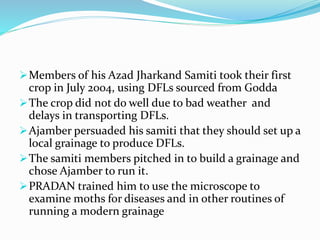
Members of his Azad Jharkand Samiti took their first
crop in July 2004, using DFLs sourced from Godda
The crop did not do well due to bad weather and
delays in transporting DFLs.
Ajamber persuaded his samiti that they should set up a
local grainage to produce DFLs.
The samiti members pitched in to build a grainage and
chose Ajamber to run it.
PRADAN trained him to use the microscope to
examine moths for diseases and in other routines of
running a modern grainage
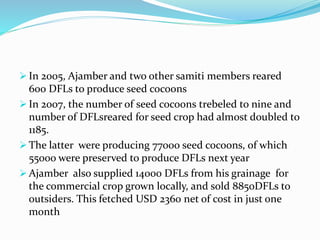
 In 2005, Ajamber and two other samiti members reared
600 DFLs to produce seed cocoons
 In 2007, the number of seed cocoons trebeled to nine and
number of DFLsreared for seed crop had almost doubled to
1185.
 The latter were producing 77000 seed cocoons, of which
55000 were preserved to produce DFLs next year
 Ajamber also supplied 14000 DFLs from his grainage for
the commercial crop grown locally, and sold 8850DFLs to
outsiders. This fetched USD 2360 net of cost in just one
month
All of his rearers produced 490,405 cocoons,
earningUSD 16767
Using this income 15 rearers bought pump sets and
two others bought power tillers.
CONCLUSION
India is the unique country in the world where all the
four varieties of silk are produced.
Export potential due to stagnated markets of china
and japan
REFERENCES
1. http://www.nistads.res.in/indiasnt2008/t6rural/t6ru
r0.htm
2. http://www.csb.gov.in/assets/Uploads/pdf-
files/NOTE-ON-SERI-31-12-12.pdf
3. http://www.mapsofindia.com/maps/india/india-
silk-map.htm
4. http://www.youtube.com/watch?v=eAkaFniaB2o

Silk industry in india 2013

  • 1.
  • 2.
    INTRODUCTION India is thesecond largest producer of raw silk after China and the biggest consumer of raw silk and silk fabrics. Sericulture industry provides employment to approximately 7.56 million persons in rural and semi- urban areas in India. India has the unique distinction of being the only country producing all the five known commercial silks, namely, mulberry, tropical tasar, oak tasar, eri and muga, of which muga with its golden yellow glitter is unique and prerogative of India.
  • 3.
    HISTORY Sericulture is bothan art and science of raising silkworms for silk production. Silk as a weavable fiber was first discovered by the Chinese empress Xi Ling Shi during 2,640 B.C. and its culture and weaving was a guarded secret for more than 2,500 years by the Chinese. India has a rich and complex history in silk production and its silk trade dates back to 15th century.
  • 4.
    PRODUCTION OF RAWSILK  Production of raw silk in India was 23,060 MT in 2011- 12, of which, mulberry raw silk output aggregated to 18,272 MT (79.24%). The remaining 4,788 MT (20.76%) was Vanya silks. Mulberry sericulture is mainly practiced in five states namely, Karnataka, Andhra Pradesh, West Bengal, Tamil Nadu and Jammu & Kashmir jointly account for about 97% of the total mulberry silk production in the country.
  • 5.
    DOMESTIC DEMAND FORRAW SILK  India is the largest consumer of raw silk in the world. As the consumption of raw silk (around 28,733 MT) exceeds the production, the additional requirement of around 5,700 MT of silk (particularly bivoltine mulberry silk of international quality) is imported mainly from China.
  • 6.
    EXPORT POTENTIAL  Exportpotential of this sector is promising as silk production in Japan is declining and that of China, the largest silk producer the World, it is stagnant. The present global scenario clearly indicates the enormous opportunities for the Indian Silk Industry.
  • 8.
  • 14.
  • 15.
    CASE STUDY: PRADAN Pradan , an NGO, works predominantly works in remote tribal communities across the states of Bihar, Chattisghar, Jharkhand, MP, Orissa, Rajasthan, and WB  A young poor farmer, Ajamber Soy, who has been rearing tasar silk since 1998 using traditional practices.  When PRADAN began to work in his village in2004, Ajamber readily agreed to visit Godda to see new methods of rearing tasar promoted by PRADAN  Ajambar talked to his fellow tasar rearers in his village and his neighboring one, into forming Tasar Vikas Samiti
  • 16.
    Members of hisAzad Jharkand Samiti took their first crop in July 2004, using DFLs sourced from Godda The crop did not do well due to bad weather and delays in transporting DFLs. Ajamber persuaded his samiti that they should set up a local grainage to produce DFLs. The samiti members pitched in to build a grainage and chose Ajamber to run it. PRADAN trained him to use the microscope to examine moths for diseases and in other routines of running a modern grainage
  • 17.
     In 2005,Ajamber and two other samiti members reared 600 DFLs to produce seed cocoons  In 2007, the number of seed cocoons trebeled to nine and number of DFLsreared for seed crop had almost doubled to 1185.  The latter were producing 77000 seed cocoons, of which 55000 were preserved to produce DFLs next year  Ajamber also supplied 14000 DFLs from his grainage for the commercial crop grown locally, and sold 8850DFLs to outsiders. This fetched USD 2360 net of cost in just one month
  • 18.
    All of hisrearers produced 490,405 cocoons, earningUSD 16767 Using this income 15 rearers bought pump sets and two others bought power tillers.
  • 19.
    CONCLUSION India is theunique country in the world where all the four varieties of silk are produced. Export potential due to stagnated markets of china and japan
  • 21.
    REFERENCES 1. http://www.nistads.res.in/indiasnt2008/t6rural/t6ru r0.htm 2. http://www.csb.gov.in/assets/Uploads/pdf- files/NOTE-ON-SERI-31-12-12.pdf 3.http://www.mapsofindia.com/maps/india/india- silk-map.htm 4. http://www.youtube.com/watch?v=eAkaFniaB2o