COCOON
PROCESSING
MAHAMAYA COLLEGE OF AGRICULTURE
SIYADEHI,DHAMTARI (C.G)
COMMERCIALSERICUTURE
AENT-5422
Munesh Kumar Sen
B.Sc (Ag.) 4th Year/2nd
Sem.
Mr. Umashankar kaushik
Dept. of Agril. Entomology
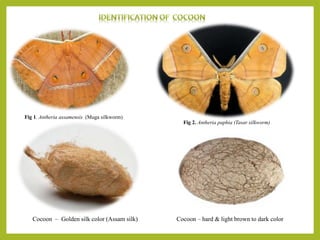
Fig 1. Antheria assamensis (Muga silkworm)
Fig 2. Antheria paphia (Tasar silkworm)
Cocoon – Golden silk color (Assam silk) Cocoon – hard & light brown to dark color
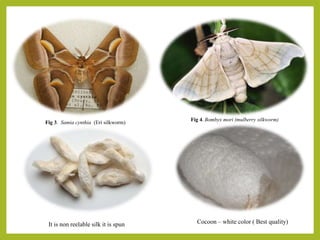
Fig 3. Samia cynthia (Eri silkworm)
Fig 4. Bombyx mori (mulberry silkworm)
It is non reelable silk it is spun Cocoon – white color ( Best quality)
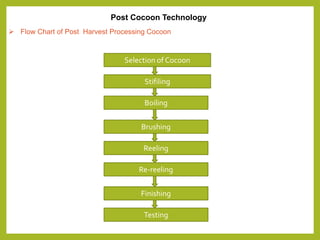
Post Cocoon Technology
Testing
Finishing
Reeling
Brushing
Boiling
Stifiling
Selection of Cocoon
 Flow Chart of Post Harvest Processing Cocoon
Re-reeling
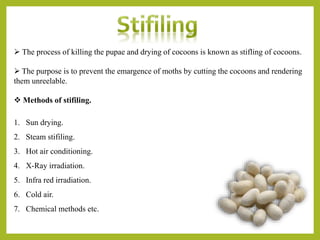
 The process of killing the pupae and drying of cocoons is known as stifling of cocoons.
 The purpose is to prevent the emargence of moths by cutting the cocoons and rendering
them unreelable.
 Methods of stifiling.
1. Sun drying.
2. Steam stifiling.
3. Hot air conditioning.
4. X-Ray irradiation.
5. Infra red irradiation.
6. Cold air.
7. Chemical methods etc.
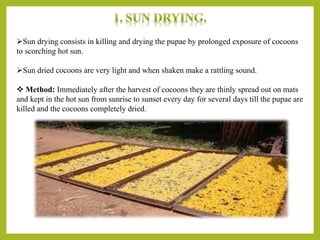
Sun drying consists in killing and drying the pupae by prolonged exposure of cocoons
to scorching hot sun.
Sun dried cocoons are very light and when shaken make a rattling sound.
 Method: Immediately after the harvest of cocoons they are thinly spread out on mats
and kept in the hot sun from sunrise to sunset every day for several days till the pupae are
killed and the cocoons completely dried.
 Killing the pupa in the cocoon by exposing the fresh cocoons to the direct action of
very hot wet steam for the required period.
 Steam stifling includes Basket steaming, Barrel Steaming and Chamber steaming.
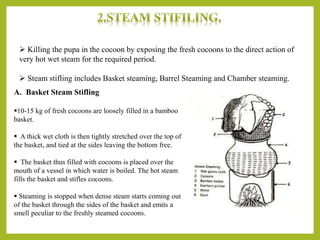
A. Basket Steam Stifling
10-15 kg of fresh cocoons are loosely filled in a bamboo
basket.
 A thick wet cloth is then tightly stretched over the top of
the basket, and tied at the sides leaving the bottom free.
 The basket thus filled with cocoons is placed over the
mouth of a vessel in which water is boiled. The hot steam
fills the basket and stifles cocoons.
 Steaming is stopped when dense steam starts coming out
of the basket through the sides of the basket and emits a
smell peculiar to the freshly steamed cocoons.
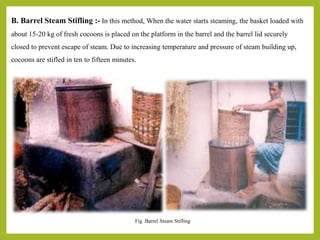
B. Barrel Steam Stifling :- In this method, When the water starts steaming, the basket loaded with
about 15-20 kg of fresh cocoons is placed on the platform in the barrel and the barrel lid securely
closed to prevent escape of steam. Due to increasing temperature and pressure of steam building up,
cocoons are stifled in ten to fifteen minutes.
Fig .Barrel Steam Stifling
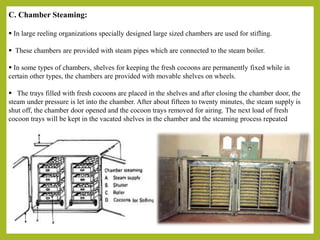
C. Chamber Steaming:
 In large reeling organizations specially designed large sized chambers are used for stifling.
 These chambers are provided with steam pipes which are connected to the steam boiler.
 In some types of chambers, shelves for keeping the fresh cocoons are permanently fixed while in
certain other types, the chambers are provided with movable shelves on wheels.
 The trays filled with fresh cocoons are placed in the shelves and after closing the chamber door, the
steam under pressure is let into the chamber. After about fifteen to twenty minutes, the steam supply is
shut off, the chamber door opened and the cocoon trays removed for airing. The next load of fresh
cocoon trays will be kept in the vacated shelves in the chamber and the steaming process repeated
 Preservation of Stifled Cocoons :-Since all the stifled cocoons cannot be
reeled immediately, they have to be preserved properly to protect them formats, ants and
pests attack.
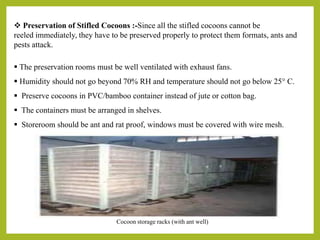
 The preservation rooms must be well ventilated with exhaust fans.
 Humidity should not go beyond 70% RH and temperature should not go below 25° C.
 Preserve cocoons in PVC/bamboo container instead of jute or cotton bag.
 The containers must be arranged in shelves.
 Storeroom should be ant and rat proof, windows must be covered with wire mesh.
Cocoon storage racks (with ant well)
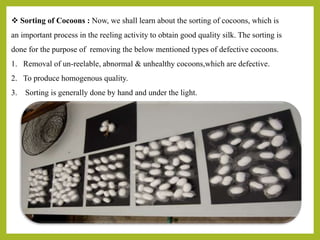
 Sorting of Cocoons : Now, we shall learn about the sorting of cocoons, which is
an important process in the reeling activity to obtain good quality silk. The sorting is
done for the purpose of removing the below mentioned types of defective cocoons.
1. Removal of un-reelable, abnormal & unhealthy cocoons,which are defective.
2. To produce homogenous quality.
3. Sorting is generally done by hand and under the light.
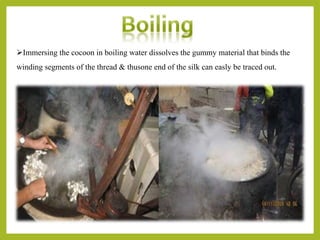
Immersing the cocoon in boiling water dissolves the gummy material that binds the
winding segments of the thread & thusone end of the silk can easly be traced out.
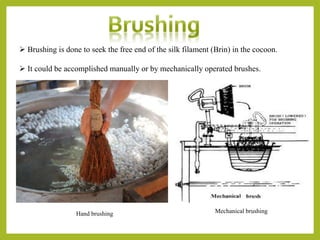
 Brushing is done to seek the free end of the silk filament (Brin) in the cocoon.
 It could be accomplished manually or by mechanically operated brushes.
Hand brushing Mechanical brushing
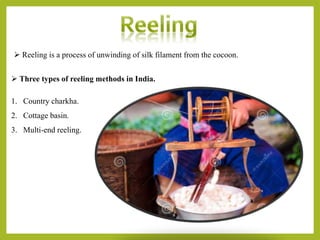
 Reeling is a process of unwinding of silk filament from the cocoon.
 Three types of reeling methods in India.
1. Country charkha.
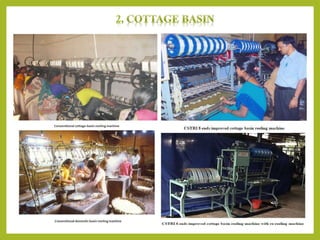
2. Cottage basin.
3. Multi-end reeling.
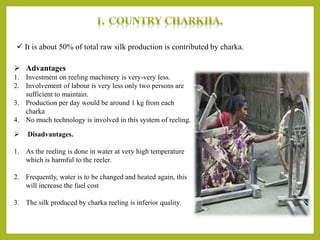
 It is about 50% of total raw silk production is contributed by charka.
 Advantages
1. Investment on reeling machinery is very-very less.
2. Involvement of labour is very less only two persons are
sufficient to maintain.
3. Production per day would be around 1 kg from each
charka
4. No much technology is involved in this system of reeling.
 Disadvantages.
1. As the reeling is done in water at very high temperature
which is harmful to the reeler.
2. Frequently, water is to be changed and heated again, this
will increase the fuel cost
3. The silk produced by charka reeling is inferior quality.
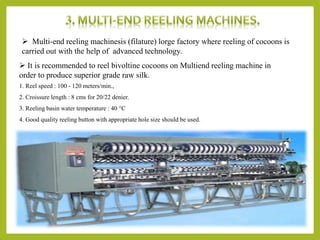
 Multi-end reeling machinesis (filature) lorge factory where reeling of cocoons is
carried out with the help of advanced technology.
 It is recommended to reel bivoltine cocoons on Multiend reeling machine in
order to produce superior grade raw silk.
1. Reel speed : 100 - 120 meters/min.,
2. Croissure length : 8 cms for 20/22 denier.
3. Reeling basin water temperature : 40 °C
4. Good quality reeling button with appropriate hole size should be used.
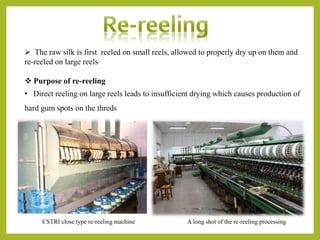
 The raw silk is first reeled on small reels, allowed to properly dry up on them and
re-reeled on large reels
 Purpose of re-reeling
• Direct reeling on large reels leads to insufficient drying which causes production of
hard gum spots on the threds
A long shot of the re-reeling processing
CSTRI close type re-reeling machine
 Finishing includes the removal of visible defects of the raw silk thread like oversize
knots, loos ends, etc.
 The raw silk is boiled, stretched, purified by acid or by fomentation & washed repeatedly
to bring out the characteristics luster of the silk.
 The thread are changed into bundles or skeins each having a diameter of 1.5m & weight
of 70 g.
 The skeins are made into books & books into bales of standard weights, which is 50 kg
in India as against 60 kg at international level.
Sericulture - Post Cocoon Technology / Processing of Cocoons

Sericulture - Post Cocoon Technology / Processing of Cocoons

  • 1.
    COCOON PROCESSING MAHAMAYA COLLEGE OFAGRICULTURE SIYADEHI,DHAMTARI (C.G) COMMERCIALSERICUTURE AENT-5422 Munesh Kumar Sen B.Sc (Ag.) 4th Year/2nd Sem. Mr. Umashankar kaushik Dept. of Agril. Entomology
  • 2.
    Fig 1. Antheriaassamensis (Muga silkworm) Fig 2. Antheria paphia (Tasar silkworm) Cocoon – Golden silk color (Assam silk) Cocoon – hard & light brown to dark color
  • 3.
    Fig 3. Samiacynthia (Eri silkworm) Fig 4. Bombyx mori (mulberry silkworm) It is non reelable silk it is spun Cocoon – white color ( Best quality)
  • 4.
    Post Cocoon Technology Testing Finishing Reeling Brushing Boiling Stifiling Selectionof Cocoon  Flow Chart of Post Harvest Processing Cocoon Re-reeling
  • 5.
     The processof killing the pupae and drying of cocoons is known as stifling of cocoons.  The purpose is to prevent the emargence of moths by cutting the cocoons and rendering them unreelable.  Methods of stifiling. 1. Sun drying. 2. Steam stifiling. 3. Hot air conditioning. 4. X-Ray irradiation. 5. Infra red irradiation. 6. Cold air. 7. Chemical methods etc.
  • 6.
    Sun drying consistsin killing and drying the pupae by prolonged exposure of cocoons to scorching hot sun. Sun dried cocoons are very light and when shaken make a rattling sound.  Method: Immediately after the harvest of cocoons they are thinly spread out on mats and kept in the hot sun from sunrise to sunset every day for several days till the pupae are killed and the cocoons completely dried.
  • 7.
     Killing thepupa in the cocoon by exposing the fresh cocoons to the direct action of very hot wet steam for the required period.  Steam stifling includes Basket steaming, Barrel Steaming and Chamber steaming. A. Basket Steam Stifling 10-15 kg of fresh cocoons are loosely filled in a bamboo basket.  A thick wet cloth is then tightly stretched over the top of the basket, and tied at the sides leaving the bottom free.  The basket thus filled with cocoons is placed over the mouth of a vessel in which water is boiled. The hot steam fills the basket and stifles cocoons.  Steaming is stopped when dense steam starts coming out of the basket through the sides of the basket and emits a smell peculiar to the freshly steamed cocoons.
  • 8.
    B. Barrel SteamStifling :- In this method, When the water starts steaming, the basket loaded with about 15-20 kg of fresh cocoons is placed on the platform in the barrel and the barrel lid securely closed to prevent escape of steam. Due to increasing temperature and pressure of steam building up, cocoons are stifled in ten to fifteen minutes. Fig .Barrel Steam Stifling
  • 9.
    C. Chamber Steaming: In large reeling organizations specially designed large sized chambers are used for stifling.  These chambers are provided with steam pipes which are connected to the steam boiler.  In some types of chambers, shelves for keeping the fresh cocoons are permanently fixed while in certain other types, the chambers are provided with movable shelves on wheels.  The trays filled with fresh cocoons are placed in the shelves and after closing the chamber door, the steam under pressure is let into the chamber. After about fifteen to twenty minutes, the steam supply is shut off, the chamber door opened and the cocoon trays removed for airing. The next load of fresh cocoon trays will be kept in the vacated shelves in the chamber and the steaming process repeated
  • 10.
     Preservation ofStifled Cocoons :-Since all the stifled cocoons cannot be reeled immediately, they have to be preserved properly to protect them formats, ants and pests attack.  The preservation rooms must be well ventilated with exhaust fans.  Humidity should not go beyond 70% RH and temperature should not go below 25° C.  Preserve cocoons in PVC/bamboo container instead of jute or cotton bag.  The containers must be arranged in shelves.  Storeroom should be ant and rat proof, windows must be covered with wire mesh. Cocoon storage racks (with ant well)
  • 11.
     Sorting ofCocoons : Now, we shall learn about the sorting of cocoons, which is an important process in the reeling activity to obtain good quality silk. The sorting is done for the purpose of removing the below mentioned types of defective cocoons. 1. Removal of un-reelable, abnormal & unhealthy cocoons,which are defective. 2. To produce homogenous quality. 3. Sorting is generally done by hand and under the light.
  • 12.
    Immersing the cocoonin boiling water dissolves the gummy material that binds the winding segments of the thread & thusone end of the silk can easly be traced out.
  • 13.
     Brushing isdone to seek the free end of the silk filament (Brin) in the cocoon.  It could be accomplished manually or by mechanically operated brushes. Hand brushing Mechanical brushing
  • 14.
     Reeling isa process of unwinding of silk filament from the cocoon.  Three types of reeling methods in India. 1. Country charkha. 2. Cottage basin. 3. Multi-end reeling.
  • 15.
     It isabout 50% of total raw silk production is contributed by charka.  Advantages 1. Investment on reeling machinery is very-very less. 2. Involvement of labour is very less only two persons are sufficient to maintain. 3. Production per day would be around 1 kg from each charka 4. No much technology is involved in this system of reeling.  Disadvantages. 1. As the reeling is done in water at very high temperature which is harmful to the reeler. 2. Frequently, water is to be changed and heated again, this will increase the fuel cost 3. The silk produced by charka reeling is inferior quality.
  • 17.
     Multi-end reelingmachinesis (filature) lorge factory where reeling of cocoons is carried out with the help of advanced technology.  It is recommended to reel bivoltine cocoons on Multiend reeling machine in order to produce superior grade raw silk. 1. Reel speed : 100 - 120 meters/min., 2. Croissure length : 8 cms for 20/22 denier. 3. Reeling basin water temperature : 40 °C 4. Good quality reeling button with appropriate hole size should be used.
  • 18.
     The rawsilk is first reeled on small reels, allowed to properly dry up on them and re-reeled on large reels  Purpose of re-reeling • Direct reeling on large reels leads to insufficient drying which causes production of hard gum spots on the threds A long shot of the re-reeling processing CSTRI close type re-reeling machine
  • 19.
     Finishing includesthe removal of visible defects of the raw silk thread like oversize knots, loos ends, etc.  The raw silk is boiled, stretched, purified by acid or by fomentation & washed repeatedly to bring out the characteristics luster of the silk.  The thread are changed into bundles or skeins each having a diameter of 1.5m & weight of 70 g.  The skeins are made into books & books into bales of standard weights, which is 50 kg in India as against 60 kg at international level.