
Prepared By
Md. Rubaiet Ibn Raihan
Department of Textile Engineering
www.linkedin.com/in/rubaiet-raihan-a1a57a12a
Introduction
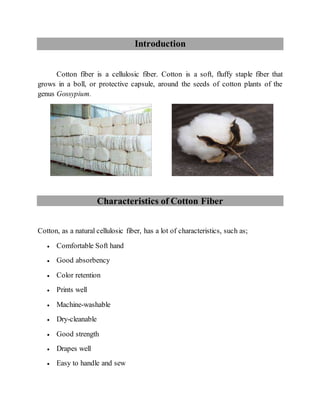
Cotton fiber is a cellulosic fiber. Cotton is a soft, fluffy staple fiber that
grows in a boll, or protective capsule, around the seeds of cotton plants of the
genus Gossypium.
Characteristics of Cotton Fiber
Cotton, as a natural cellulosic fiber, has a lot of characteristics, such as;
 Comfortable Soft hand
 Good absorbency
 Color retention
 Prints well
 Machine-washable
 Dry-cleanable
 Good strength
 Drapes well
 Easy to handle and sew
Classification
Botanically it is classified in the following order with length and color:
Name Plant Length Color
Gossypium hirsutum 6 feet Red
Gossypium barbadense 6 feet to 15 feet Yellow
Gossypium peruvianum No length No color
Gossypium herbaceum 3 feet to 6 feet Yellow
According to the quality and Country based, chronologically ordered:
1. Sea Island Cotton
2. Egyptian Cotton
3. South American Cotton
4. American Cotton
5. Indian Cotton
6. China Cotton
Reference to staple length:
Long Staple
Length 26 mm – 65 mm
Diameter 10 – 15 microns
Example Sea Island, Egyptian,
American Pima
Medium Staple
Length 12 mm – 33 mm
Diameter 12 – 17 microns
Example American Upland and
Peruvian
Long Staple
Length 9 mm – 26 mm
Diameter 13 – 22 microns
Example Indian and Asiatic
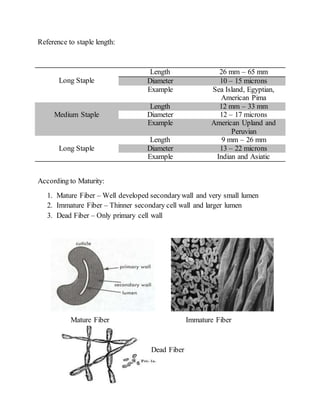
According to Maturity:
1. Mature Fiber – Well developed secondarywall and very small lumen
2. Immature Fiber – Thinner secondary cell wall and larger lumen
3. Dead Fiber – Only primary cell wall
Mature Fiber Immature Fiber
Dead Fiber
Cotton Cultivating Countries
1. India 6. China 11. Argentina
2. Russia 7. Mexico
3. Egypt 8. Pakistan
4. Brazil 9. Turkey
5. USSR 10. Peru
Most importantly USA produces almost one – fifth of the total crop in the world.
Atmosphere for cultivation
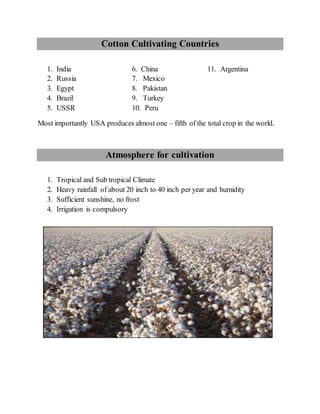
1. Tropical and Sub tropical Climate
2. Heavy rainfall of about 20 inch to 40 inch per year and humidity
3. Sufficient sunshine, no frost
4. Irrigation is compulsory
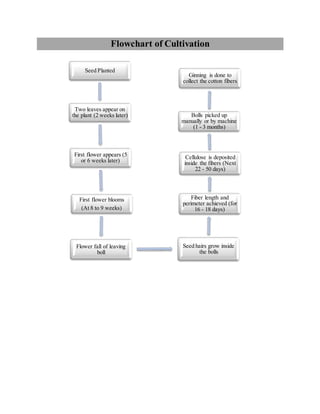
Flowchart of Cultivation
Seed Planted
Two leaves appear on
the plant (2 weeks later)
First flower appears (5
or 6 weeks later)
First flower blooms
(At 8 to 9 weeks)
Flower fall of leaving
boll
Seed hairs grow inside
the bolls
Fiber length and
perimeter achieved (for
16 - 18 days)
Cellulose is deposited
inside the fibers (Next
22 - 50 days)
Bolls picked up
manually or by machine
(1 - 3 months)
Ginning is done to
collect the cotton fibers
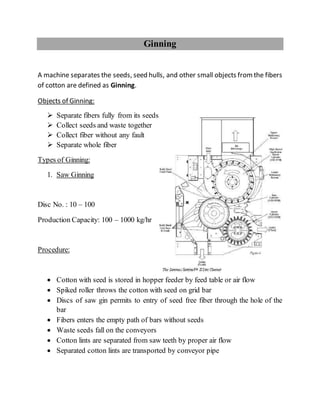
Ginning
A machine separates the seeds, seed hulls, and other small objects fromthe fibers
of cotton are defined as Ginning.
Objects of Ginning:
 Separate fibers fully from its seeds
 Collect seeds and waste together
 Collect fiber without any fault
 Separate whole fiber
Types of Ginning:
1. Saw Ginning
Disc No. : 10 – 100
Production Capacity: 100 – 1000 kg/hr
Procedure:
 Cotton with seed is stored in hopper feeder by feed table or air flow
 Spiked roller throws the cotton with seed on grid bar
 Discs of saw gin permits to entry of seed free fiber through the hole of the
bar
 Fibers enters the empty path of bars without seeds
 Waste seeds fall on the conveyors
 Cotton lints are separated from saw teeth by proper air flow
 Separated cotton lints are transported by conveyor pipe
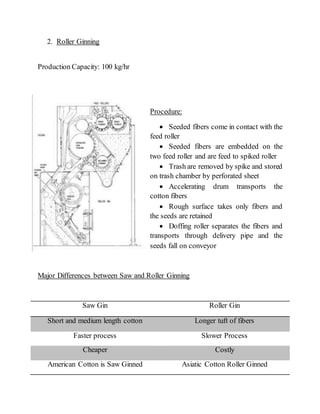
2. Roller Ginning
Production Capacity: 100 kg/hr
Procedure:
 Seeded fibers come in contact with the
feed roller
 Seeded fibers are embedded on the
two feed roller and are feed to spiked roller
 Trash are removed by spike and stored
on trash chamber by perforated sheet
 Accelerating drum transports the
cotton fibers
 Rough surface takes only fibers and
the seeds are retained
 Doffing roller separates the fibers and
transports through delivery pipe and the
seeds fall on conveyor
Major Differences between Saw and Roller Ginning
Saw Gin Roller Gin
Short and medium length cotton Longer tuft of fibers
Faster process Slower Process
Cheaper Costly
American Cotton is Saw Ginned Asiatic Cotton Roller Ginned
Lint and Linters
Long fibers which are primarily obtained after separating, cotton fibers from
seeds are called lint. These fibers are used for textile applications.
For Example: Yarn, Fabric etc.
The short fibers obtained after separating lints are called linters. These are
obtained in second ginning. It is a source of pure cellulose and stuffing upholstery.
Uses of Bi-product of cotton fibers
1. Seeds
Uses: Oils (Soap Manufacturing)
Residue: After extraction of oil used as food
2. Hulls
Uses: Fertilizer, Foods foranimals, Paper, Plastic
3. Linters
Uses: Photographic Paper, Special Bank notes, Plastic, Acetate and Rayon
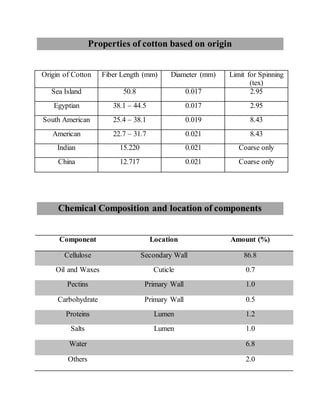
Properties of cotton based on origin
Origin of Cotton Fiber Length (mm) Diameter (mm) Limit for Spinning
(tex)
Sea Island 50.8 0.017 2.95
Egyptian 38.1 – 44.5 0.017 2.95
South American 25.4 – 38.1 0.019 8.43
American 22.7 – 31.7 0.021 8.43
Indian 15.220 0.021 Coarse only
China 12.717 0.021 Coarse only
Chemical Composition and location of components
Component Location Amount (%)
Cellulose Secondary Wall 86.8
Oil and Waxes Cuticle 0.7
Pectins Primary Wall 1.0
Carbohydrate Primary Wall 0.5
Proteins Lumen 1.2
Salts Lumen 1.0
Water 6.8
Others 2.0
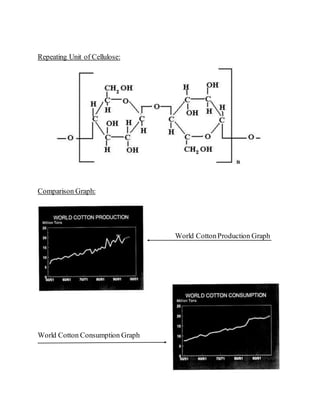
Repeating Unit of Cellulose:
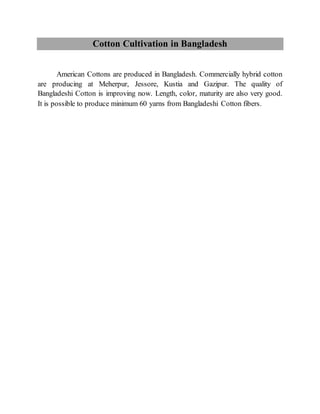
Comparison Graph:
World CottonProduction Graph
World Cotton Consumption Graph
Cotton Cultivation in Bangladesh
American Cottons are produced in Bangladesh. Commercially hybrid cotton
are producing at Meherpur, Jessore, Kustia and Gazipur. The quality of
Bangladeshi Cotton is improving now. Length, color, maturity are also very good.
It is possible to produce minimum 60 yarns from Bangladeshi Cotton fibers.

Cotton Processing & Cultivation

  • 1.
    Prepared By Md. RubaietIbn Raihan Department of Textile Engineering www.linkedin.com/in/rubaiet-raihan-a1a57a12a
  • 2.
    Introduction Cotton fiber isa cellulosic fiber. Cotton is a soft, fluffy staple fiber that grows in a boll, or protective capsule, around the seeds of cotton plants of the genus Gossypium. Characteristics of Cotton Fiber Cotton, as a natural cellulosic fiber, has a lot of characteristics, such as;  Comfortable Soft hand  Good absorbency  Color retention  Prints well  Machine-washable  Dry-cleanable  Good strength  Drapes well  Easy to handle and sew
  • 3.
    Classification Botanically it isclassified in the following order with length and color: Name Plant Length Color Gossypium hirsutum 6 feet Red Gossypium barbadense 6 feet to 15 feet Yellow Gossypium peruvianum No length No color Gossypium herbaceum 3 feet to 6 feet Yellow According to the quality and Country based, chronologically ordered: 1. Sea Island Cotton 2. Egyptian Cotton 3. South American Cotton 4. American Cotton 5. Indian Cotton 6. China Cotton
  • 4.
    Reference to staplelength: Long Staple Length 26 mm – 65 mm Diameter 10 – 15 microns Example Sea Island, Egyptian, American Pima Medium Staple Length 12 mm – 33 mm Diameter 12 – 17 microns Example American Upland and Peruvian Long Staple Length 9 mm – 26 mm Diameter 13 – 22 microns Example Indian and Asiatic According to Maturity: 1. Mature Fiber – Well developed secondarywall and very small lumen 2. Immature Fiber – Thinner secondary cell wall and larger lumen 3. Dead Fiber – Only primary cell wall Mature Fiber Immature Fiber Dead Fiber
  • 5.
    Cotton Cultivating Countries 1.India 6. China 11. Argentina 2. Russia 7. Mexico 3. Egypt 8. Pakistan 4. Brazil 9. Turkey 5. USSR 10. Peru Most importantly USA produces almost one – fifth of the total crop in the world. Atmosphere for cultivation 1. Tropical and Sub tropical Climate 2. Heavy rainfall of about 20 inch to 40 inch per year and humidity 3. Sufficient sunshine, no frost 4. Irrigation is compulsory
  • 6.
    Flowchart of Cultivation SeedPlanted Two leaves appear on the plant (2 weeks later) First flower appears (5 or 6 weeks later) First flower blooms (At 8 to 9 weeks) Flower fall of leaving boll Seed hairs grow inside the bolls Fiber length and perimeter achieved (for 16 - 18 days) Cellulose is deposited inside the fibers (Next 22 - 50 days) Bolls picked up manually or by machine (1 - 3 months) Ginning is done to collect the cotton fibers
  • 7.
    Ginning A machine separatesthe seeds, seed hulls, and other small objects fromthe fibers of cotton are defined as Ginning. Objects of Ginning:  Separate fibers fully from its seeds  Collect seeds and waste together  Collect fiber without any fault  Separate whole fiber Types of Ginning: 1. Saw Ginning Disc No. : 10 – 100 Production Capacity: 100 – 1000 kg/hr Procedure:  Cotton with seed is stored in hopper feeder by feed table or air flow  Spiked roller throws the cotton with seed on grid bar  Discs of saw gin permits to entry of seed free fiber through the hole of the bar  Fibers enters the empty path of bars without seeds  Waste seeds fall on the conveyors  Cotton lints are separated from saw teeth by proper air flow  Separated cotton lints are transported by conveyor pipe
  • 8.
    2. Roller Ginning ProductionCapacity: 100 kg/hr Procedure:  Seeded fibers come in contact with the feed roller  Seeded fibers are embedded on the two feed roller and are feed to spiked roller  Trash are removed by spike and stored on trash chamber by perforated sheet  Accelerating drum transports the cotton fibers  Rough surface takes only fibers and the seeds are retained  Doffing roller separates the fibers and transports through delivery pipe and the seeds fall on conveyor Major Differences between Saw and Roller Ginning Saw Gin Roller Gin Short and medium length cotton Longer tuft of fibers Faster process Slower Process Cheaper Costly American Cotton is Saw Ginned Asiatic Cotton Roller Ginned
  • 9.
    Lint and Linters Longfibers which are primarily obtained after separating, cotton fibers from seeds are called lint. These fibers are used for textile applications. For Example: Yarn, Fabric etc. The short fibers obtained after separating lints are called linters. These are obtained in second ginning. It is a source of pure cellulose and stuffing upholstery. Uses of Bi-product of cotton fibers 1. Seeds Uses: Oils (Soap Manufacturing) Residue: After extraction of oil used as food 2. Hulls Uses: Fertilizer, Foods foranimals, Paper, Plastic 3. Linters Uses: Photographic Paper, Special Bank notes, Plastic, Acetate and Rayon
  • 10.
    Properties of cottonbased on origin Origin of Cotton Fiber Length (mm) Diameter (mm) Limit for Spinning (tex) Sea Island 50.8 0.017 2.95 Egyptian 38.1 – 44.5 0.017 2.95 South American 25.4 – 38.1 0.019 8.43 American 22.7 – 31.7 0.021 8.43 Indian 15.220 0.021 Coarse only China 12.717 0.021 Coarse only Chemical Composition and location of components Component Location Amount (%) Cellulose Secondary Wall 86.8 Oil and Waxes Cuticle 0.7 Pectins Primary Wall 1.0 Carbohydrate Primary Wall 0.5 Proteins Lumen 1.2 Salts Lumen 1.0 Water 6.8 Others 2.0
  • 11.
    Repeating Unit ofCellulose: Comparison Graph: World CottonProduction Graph World Cotton Consumption Graph
  • 12.
    Cotton Cultivation inBangladesh American Cottons are produced in Bangladesh. Commercially hybrid cotton are producing at Meherpur, Jessore, Kustia and Gazipur. The quality of Bangladeshi Cotton is improving now. Length, color, maturity are also very good. It is possible to produce minimum 60 yarns from Bangladeshi Cotton fibers.