Signals
&
Systems
2/20
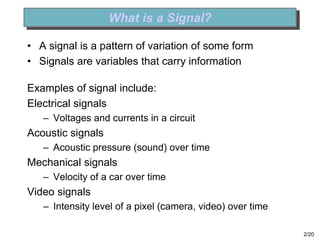
What is a Signal?
• A signal is a pattern of variation of some form
• Signals are variables that carry information
Examples of signal include:
Electrical signals
– Voltages and currents in a circuit
Acoustic signals
– Acoustic pressure (sound) over time
Mechanical signals
– Velocity of a car over time
Video signals
– Intensity level of a pixel (camera, video) over time
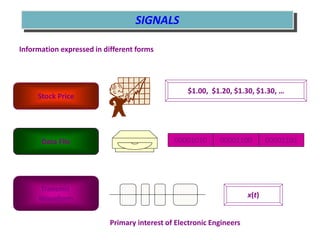
SIGNALS
Information expressed in different forms
Stock Price
Transmit
Waveform
$1.00, $1.20, $1.30, $1.30, …
Data File
x(t)
00001010 00001100 00001101
Primary interest of Electronic Engineers
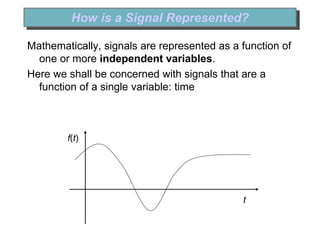
How is a Signal Represented?
Mathematically, signals are represented as a function of
one or more independent variables.
Here we shall be concerned with signals that are a
function of a single variable: time
t
f(t)
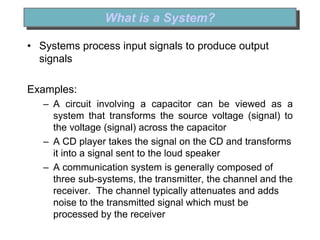
What is a System?
• Systems process input signals to produce output
signals
Examples:
– A circuit involving a capacitor can be viewed as a
system that transforms the source voltage (signal) to
the voltage (signal) across the capacitor
– A CD player takes the signal on the CD and transforms
it into a signal sent to the loud speaker
– A communication system is generally composed of
three sub-systems, the transmitter, the channel and the
receiver. The channel typically attenuates and adds
noise to the transmitted signal which must be
processed by the receiver
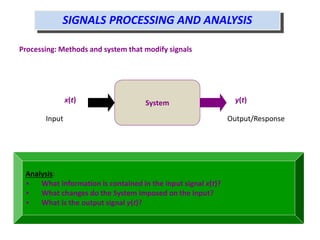
SIGNALS PROCESSING AND ANALYSIS
Processing: Methods and system that modify signals
System y(t)
x(t)
Analysis:
• What information is contained in the input signal x(t)?
• What changes do the System imposed on the input?
• What is the output signal y(t)?
Input Output/Response
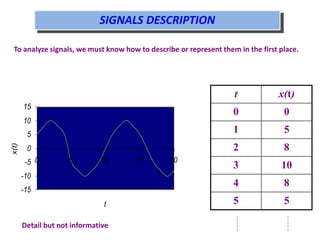
SIGNALS DESCRIPTION
To analyze signals, we must know how to describe or represent them in the first place.
-15
-10
-5
0
5
10
15
0 5 10 15 20
t
x(t)
t x(t)
0 0
1 5
2 8
3 10
4 8
5 5
Detail but not informative
TIME SIGNALS DESCRIPTION
1. Mathematical expression: x(t)=Asin()
2. Continuous (Analogue)
-15
-10
-5
0
5
10
15
0 5 10 15 20
3. Discrete (Digital)
x[n]
n
TIME SIGNALS DESCRIPTION
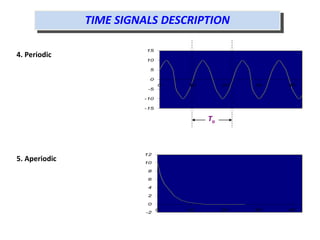
4. Periodic
-15
-10
-5
0
5
10
15
0 10 20 30 40
To
5. Aperiodic
-2
0
2
4
6
8
10
12
0 10 20 30 40
Continuous & Discrete-Time Signals
Continuous-Time Signals
Most signals in the real world are
continuous time, as the scale is
infinitesimally fine.
Eg voltage, velocity,
Denote by x(t), where the time
interval may be bounded (finite) or
infinite
Discrete-Time Signals
Some real world and many digital
signals are discrete time, as they
are sampled
E.g. pixels, daily stock price (anything
that a digital computer processes)
Denote by x[n], where n is an integer
value that varies discretely
x(t)
t
x[n]
n
Analog signals
• A signal could be an analog quantity that means it is
defined with respect to the time. It is a continuous
signal.
• These signals are defined over continuous
independent variables. They are difficult to analyze,
as they carry a huge number of values.
• They are very much accurate due to a large sample
of values. In order to store these signals , you require
an infinite memory because it can achieve infinite
values on a real line.
• Analog signals are denoted by sin waves.
Analog signals
Human voice
Human voice is an example of analog signals. When
you speak, the voice that is produced travel through
air in the form of pressure waves and thus belongs to
a mathematical function, having independent
variables time.
Digital signals
• As compared to analog signals, digital signals are very
easy to analyze. They are discontinuous signals.
• The word digital stands for discrete values and hence it
means that they use specific values to represent any
information.
• In digital signal, only two values are used to represent
something i-e: 1 and 0 (binary values).
• Digital signals are less accurate then analog signals
because they are the discrete samples of an analog
signal taken over some period of time.
• However digital signals are not subject to noise. So
they last long and are easy to interpret.
Digital signals
Computer keyboard
Whenever a key is pressed from the keyboard, the
appropriate electrical signal is sent to keyboard
controller containing the ASCII value that particular
key.
For example the electrical signal that is generated
when keyboard key a is pressed, carry information of
digit 97 in the form of 0 and 1, which is the ASCII
value of character a.
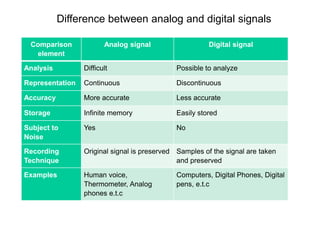
Comparison
element
Analog signal Digital signal
Analysis Difficult Possible to analyze
Representation Continuous Discontinuous
Accuracy More accurate Less accurate
Storage Infinite memory Easily stored
Subject to
Noise
Yes No
Recording
Technique
Original signal is preserved Samples of the signal are taken
and preserved
Examples Human voice,
Thermometer, Analog
phones e.t.c
Computers, Digital Phones, Digital
pens, e.t.c
Difference between analog and digital signals
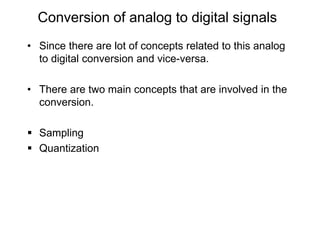
Conversion of analog to digital signals
• Since there are lot of concepts related to this analog
to digital conversion and vice-versa.
• There are two main concepts that are involved in the
conversion.
 Sampling
 Quantization
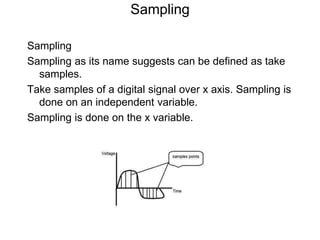
Sampling
Sampling
Sampling as its name suggests can be defined as take
samples.
Take samples of a digital signal over x axis. Sampling is
done on an independent variable.
Sampling is done on the x variable.
Quantization
Quantization as its name suggest can be defined as
dividing into quanta (partitions). Quantization is done
on dependent variable.
In case of this mathematical equation y = sin(x)
Quantization is done on the Y variable.
EE-2027 SaS, L1 18/20
Signal in Time and Frequency Domain
Time domain refers to variation of amplitude of signal with time.
For example consider a typical Electro cardiogram (ECG). If the doctor
maps the heartbeat with time say the recording is done for 20
minutes, we call it a time domain signal.
However, as in ECG a number of peaks are there (of different types).
Say in one heartbeat 4 types of peaks or variation in amplitude
occurs.
So in frequency domain, over the entire time period of recording, how
many times each peak comes is recorded.
Frequency is nothing but the number of times each event has occurred
during total period of observation.
Frequency domain analysis is much simple as you can figure out the
key points in the total interval rather than putting your eye on every
variation which occurs in time domain analysis.

Signals basics

  • 1.
  • 2.
    2/20 What is aSignal? • A signal is a pattern of variation of some form • Signals are variables that carry information Examples of signal include: Electrical signals – Voltages and currents in a circuit Acoustic signals – Acoustic pressure (sound) over time Mechanical signals – Velocity of a car over time Video signals – Intensity level of a pixel (camera, video) over time
  • 3.
    SIGNALS Information expressed indifferent forms Stock Price Transmit Waveform $1.00, $1.20, $1.30, $1.30, … Data File x(t) 00001010 00001100 00001101 Primary interest of Electronic Engineers
  • 4.
    How is aSignal Represented? Mathematically, signals are represented as a function of one or more independent variables. Here we shall be concerned with signals that are a function of a single variable: time t f(t)
  • 5.
    What is aSystem? • Systems process input signals to produce output signals Examples: – A circuit involving a capacitor can be viewed as a system that transforms the source voltage (signal) to the voltage (signal) across the capacitor – A CD player takes the signal on the CD and transforms it into a signal sent to the loud speaker – A communication system is generally composed of three sub-systems, the transmitter, the channel and the receiver. The channel typically attenuates and adds noise to the transmitted signal which must be processed by the receiver
  • 6.
    SIGNALS PROCESSING ANDANALYSIS Processing: Methods and system that modify signals System y(t) x(t) Analysis: • What information is contained in the input signal x(t)? • What changes do the System imposed on the input? • What is the output signal y(t)? Input Output/Response
  • 7.
    SIGNALS DESCRIPTION To analyzesignals, we must know how to describe or represent them in the first place. -15 -10 -5 0 5 10 15 0 5 10 15 20 t x(t) t x(t) 0 0 1 5 2 8 3 10 4 8 5 5 Detail but not informative
  • 8.
    TIME SIGNALS DESCRIPTION 1.Mathematical expression: x(t)=Asin() 2. Continuous (Analogue) -15 -10 -5 0 5 10 15 0 5 10 15 20 3. Discrete (Digital) x[n] n
  • 9.
    TIME SIGNALS DESCRIPTION 4.Periodic -15 -10 -5 0 5 10 15 0 10 20 30 40 To 5. Aperiodic -2 0 2 4 6 8 10 12 0 10 20 30 40
  • 10.
    Continuous & Discrete-TimeSignals Continuous-Time Signals Most signals in the real world are continuous time, as the scale is infinitesimally fine. Eg voltage, velocity, Denote by x(t), where the time interval may be bounded (finite) or infinite Discrete-Time Signals Some real world and many digital signals are discrete time, as they are sampled E.g. pixels, daily stock price (anything that a digital computer processes) Denote by x[n], where n is an integer value that varies discretely x(t) t x[n] n
  • 11.
    Analog signals • Asignal could be an analog quantity that means it is defined with respect to the time. It is a continuous signal. • These signals are defined over continuous independent variables. They are difficult to analyze, as they carry a huge number of values. • They are very much accurate due to a large sample of values. In order to store these signals , you require an infinite memory because it can achieve infinite values on a real line. • Analog signals are denoted by sin waves.
  • 12.
    Analog signals Human voice Humanvoice is an example of analog signals. When you speak, the voice that is produced travel through air in the form of pressure waves and thus belongs to a mathematical function, having independent variables time.
  • 13.
    Digital signals • Ascompared to analog signals, digital signals are very easy to analyze. They are discontinuous signals. • The word digital stands for discrete values and hence it means that they use specific values to represent any information. • In digital signal, only two values are used to represent something i-e: 1 and 0 (binary values). • Digital signals are less accurate then analog signals because they are the discrete samples of an analog signal taken over some period of time. • However digital signals are not subject to noise. So they last long and are easy to interpret.
  • 14.
    Digital signals Computer keyboard Whenevera key is pressed from the keyboard, the appropriate electrical signal is sent to keyboard controller containing the ASCII value that particular key. For example the electrical signal that is generated when keyboard key a is pressed, carry information of digit 97 in the form of 0 and 1, which is the ASCII value of character a.
  • 15.
    Comparison element Analog signal Digitalsignal Analysis Difficult Possible to analyze Representation Continuous Discontinuous Accuracy More accurate Less accurate Storage Infinite memory Easily stored Subject to Noise Yes No Recording Technique Original signal is preserved Samples of the signal are taken and preserved Examples Human voice, Thermometer, Analog phones e.t.c Computers, Digital Phones, Digital pens, e.t.c Difference between analog and digital signals
  • 16.
    Conversion of analogto digital signals • Since there are lot of concepts related to this analog to digital conversion and vice-versa. • There are two main concepts that are involved in the conversion.  Sampling  Quantization
  • 17.
    Sampling Sampling Sampling as itsname suggests can be defined as take samples. Take samples of a digital signal over x axis. Sampling is done on an independent variable. Sampling is done on the x variable.
  • 18.
    Quantization Quantization as itsname suggest can be defined as dividing into quanta (partitions). Quantization is done on dependent variable. In case of this mathematical equation y = sin(x) Quantization is done on the Y variable. EE-2027 SaS, L1 18/20
  • 19.
    Signal in Timeand Frequency Domain Time domain refers to variation of amplitude of signal with time. For example consider a typical Electro cardiogram (ECG). If the doctor maps the heartbeat with time say the recording is done for 20 minutes, we call it a time domain signal. However, as in ECG a number of peaks are there (of different types). Say in one heartbeat 4 types of peaks or variation in amplitude occurs. So in frequency domain, over the entire time period of recording, how many times each peak comes is recorded. Frequency is nothing but the number of times each event has occurred during total period of observation. Frequency domain analysis is much simple as you can figure out the key points in the total interval rather than putting your eye on every variation which occurs in time domain analysis.