Comprehensive Shoulder US
Examination: A Standardized Approach
with Multimodality Correlation for
Common Shoulder Disease
Journal report by
Kevin Eric R. Santos, MD, DPBR
SOURCE
Lee MH, Sheehan SE, Orwin JF, Lee KS. Comprehensive Shoulder US
Examination: A Standardized Approach with Multimodality Correlation for
Common Shoulder Disease. Radiographics. 2016 Oct;36(6):1606-1627. doi:
10.1148/rg.2016160030. PMID: 27726738; PMCID: PMC5084996.
Introduction
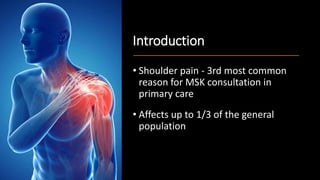
• Shoulder pain - 3rd most common
reason for MSK consultation in
primary care
• Affects up to 1/3 of the general
population
Imaging
diagnostics for
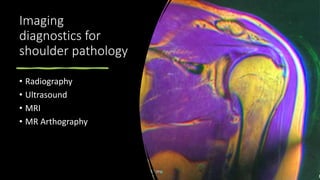
shoulder pathology
• Radiography
• Ultrasound
• MRI
• MR Arthography
Advantages of Ultrasound for Shoulder Imaging
• Comparable diagnostic accuracy for diseases involving:
• Rotator cuff
• Subacromial subdeltoid bursa
• long head of the biceps tendon
• Low cost, accessible
• Realtime imaging and patient feedback
• No contraindication for px w/ pacemaker
• No artifact from surgical hardware
Disadvantages
of Ultrasound
for Shoulder
Imaging
• Steep learning curve
• May be time consuming
• Lack of experienced sonographers
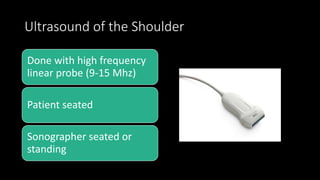
Ultrasound of the Shoulder
Done with high frequency
linear probe (9-15 Mhz)
Patient seated
Sonographer seated or
standing
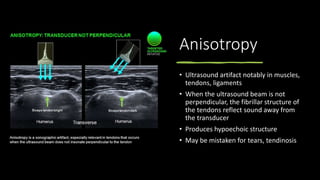
Anisotropy
• Ultrasound artifact notably in muscles,
tendons, ligaments
• When the ultrasound beam is not
perpendicular, the fibrillar structure of
the tendons reflect sound away from
the transducer
• Produces hypoechoic structure
• May be mistaken for tears, tendinosis
Scanning
Protocol
A – Anterior
S – Superior
A – Anterolateral
P – Posterior
Scanning
Protocol
A – Anterior
S – Superior
A – Anterolateral
P – Posterior
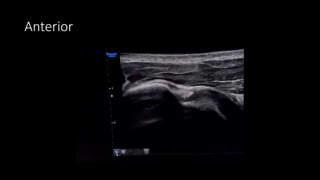
Anterior region
• Relevant anatomy
• Subscapularis tendon
• Long head of the biceps tendon
• Scanning protocol
• Common pathologies
• Biceps tendinosis and tenosynovitis
• Biceps tendon rupture
• Biceps tendon subluxation and dislocation
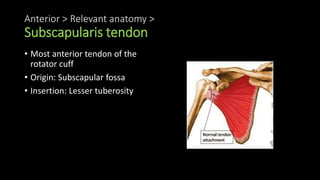
Anterior > Relevant anatomy >
Subscapularis tendon
• Most anterior tendon of the
rotator cuff
• Origin: Subscapular fossa
• Insertion: Lesser tuberosity
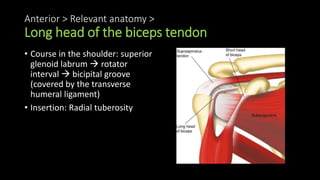
Anterior > Relevant anatomy >
Long head of the biceps tendon
• Course in the shoulder: superior
glenoid labrum  rotator
interval  bicipital groove
(covered by the transverse
humeral ligament)
• Insertion: Radial tuberosity
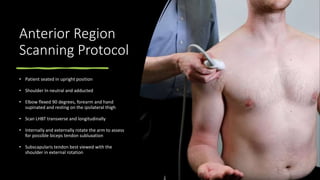
Anterior Region
Scanning Protocol
• Patient seated in upright position
• Shoulder In neutral and adducted
• Elbow flexed 90 degrees, forearm and hand
supinated and resting on the ipsilateral thigh
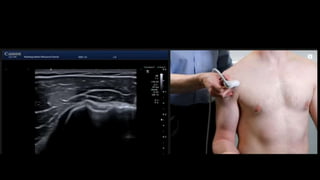
• Scan LHBT transverse and longitudinally
• Internally and externally rotate the arm to assess
for possible biceps tendon subluxation
• Subscapularis tendon best viewed with the
shoulder in external rotation
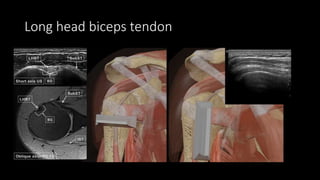
Long head biceps tendon
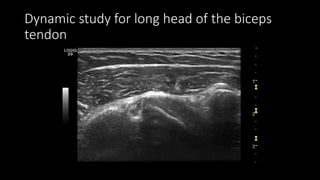
Dynamic study for long head of the biceps
tendon
Anterior > Pathology >
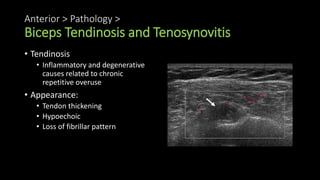
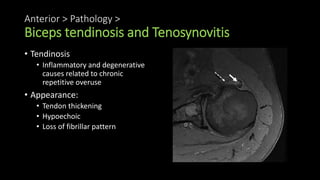
Biceps Tendinosis and Tenosynovitis
• Tendinosis
• Inflammatory and degenerative
causes related to chronic
repetitive overuse
• Appearance:
• Tendon thickening
• Hypoechoic
• Loss of fibrillar pattern
Anterior > Pathology >
Biceps tendinosis and Tenosynovitis
• Tendinosis
• Inflammatory and degenerative
causes related to chronic
repetitive overuse
• Appearance:
• Tendon thickening
• Hypoechoic
• Loss of fibrillar pattern
Anterior > Pathology >
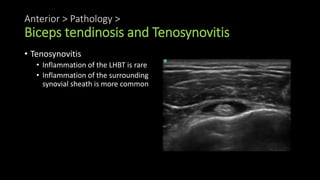
Biceps tendinosis and Tenosynovitis
• Tenosynovitis
• Inflammation of the LHBT is rare
• Inflammation of the surrounding
synovial sheath is more common
Anterior > Pathology >
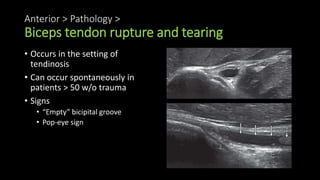
Biceps tendon rupture and tearing
• Occurs in the setting of
tendinosis
• Can occur spontaneously in
patients > 50 w/o trauma
• Signs
• “Empty” bicipital groove
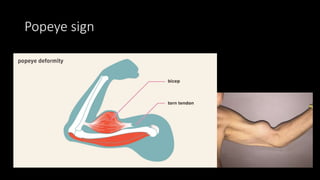
• Pop-eye sign
Anterior > Pathology >
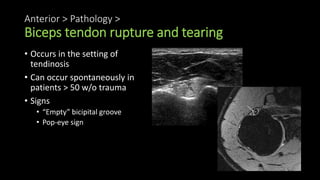
Biceps tendon rupture and tearing
• Occurs in the setting of
tendinosis
• Can occur spontaneously in
patients > 50 w/o trauma
• Signs
• “Empty” bicipital groove
• Pop-eye sign
Popeye sign
Anterior > Pathology >
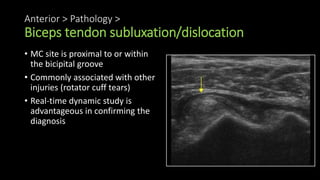
Biceps tendon subluxation/dislocation
• MC site is proximal to or within
the bicipital groove
• Commonly associated with other
injuries (rotator cuff tears)
• Real-time dynamic study is
advantageous in confirming the
diagnosis
Scanning
Protocol
A – Anterior
S – Superior
A – Anterolateral
P – Posterior
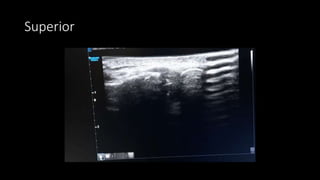
Superior region
• Relevant anatomy
• Acromioclavicular joint
• Scanning protocol
• Common pathologies
• Capsular hypertrophy and distension
• AC joint dislocation
Superior > Relevant anatomy >
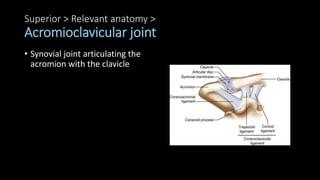
Acromioclavicular joint
• Synovial joint articulating the
acromion with the clavicle
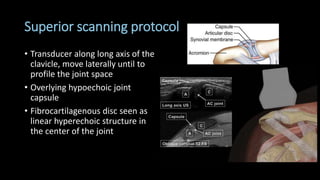
Superior scanning protocol
• Transducer along long axis of the
clavicle, move laterally until to
profile the joint space
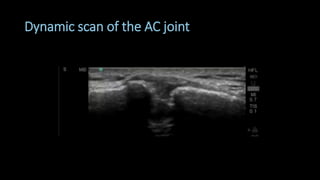
• Overlying hypoechoic joint
capsule
• Fibrocartilagenous disc seen as
linear hyperechoic structure in
the center of the joint
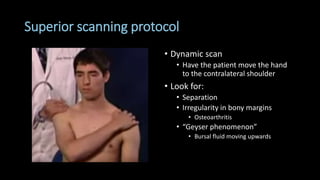
Superior scanning protocol
• Dynamic scan
• Have the patient move the hand
to the contralateral shoulder
• Look for:
• Separation
• Irregularity in bony margins
• Osteoarthritis
• “Geyser phenomenon”
• Bursal fluid moving upwards
Dynamic scan of the AC joint
Superior > Pathology >
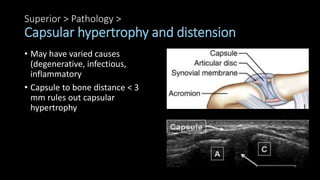
Capsular hypertrophy and distension
• May have varied causes
(degenerative, infectious,
inflammatory
• Capsule to bone distance < 3
mm rules out capsular
hypertrophy
Superior > Pathology >
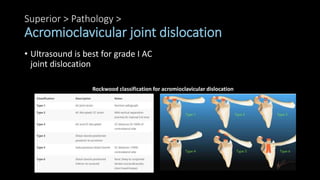
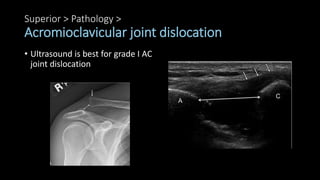
Acromioclavicular joint dislocation
• Ultrasound is best for grade I AC
joint dislocation
Rockwood classification for acromioclavicular dislocation
Superior > Pathology >
Acromioclavicular joint dislocation
• Ultrasound is best for grade I AC
joint dislocation
Scanning
Protocol
A – Anterior
S – Superior
A – Anterolateral
P – Posterior
Anterolateral region
• Relevant anatomy
• Supraspinatus tendon
• Subacromial subdeltoid bursa
• Scanning protocol
• Common pathologies
• Rotator cuff tear
• Subacromial impingement
• Bursitis
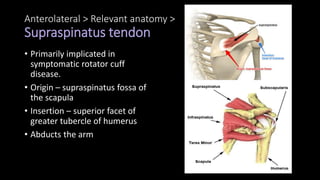
Anterolateral > Relevant anatomy >
Supraspinatus tendon
• Primarily implicated in
symptomatic rotator cuff
disease.
• Origin – supraspinatus fossa of
the scapula
• Insertion – superior facet of
greater tubercle of humerus
• Abducts the arm
Anterolateral > Relevant anatomy >
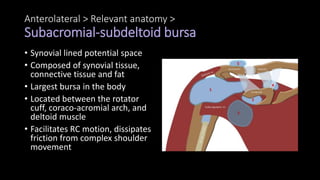
Subacromial-subdeltoid bursa
• Synovial lined potential space
• Composed of synovial tissue,
connective tissue and fat
• Largest bursa in the body
• Located between the rotator
cuff, coraco-acromial arch, and
deltoid muscle
• Facilitates RC motion, dissipates
friction from complex shoulder
movement
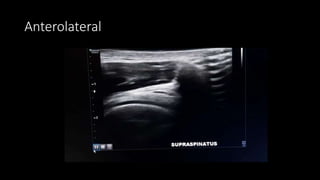
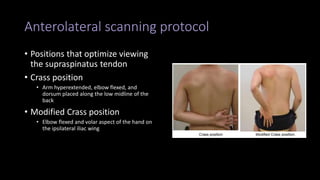
Anterolateral scanning protocol
• Positions that optimize viewing
the supraspinatus tendon
• Crass position
• Arm hyperextended, elbow flexed, and
dorsum placed along the low midline of the
back
• Modified Crass position
• Elbow flexed and volar aspect of the hand on
the ipsilateral iliac wing
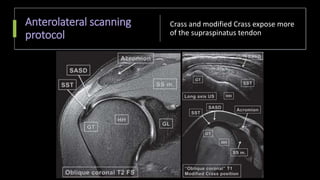
Anterolateral scanning
protocol
Crass and modified Crass expose more
of the supraspinatus tendon
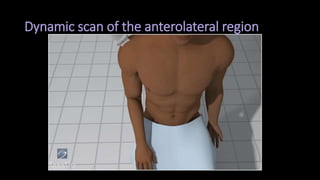
Dynamic scan of the anterolateral region
• Start with patient in neutral
shoulder position, adducted
with elbow flexed
• Probe in long axis of
supraspinatus tendon, cephalad
end of the probe over the
acromion
• Have the patient abduct the arm
Dynamic scan of the anterolateral region
Anterolateral > Pathology >
Rotator Cuff Tear
• Multifactorial
• Intrinsic (genetic, tendon
thinning), extrinsic (trauma,
impingement syndrome),
environmental
• Risk factors include increased age,
hand dominance, history of
trauma
Anterolateral > Pathology >
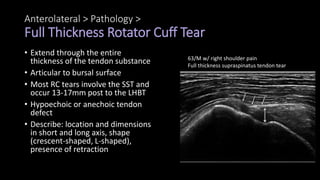
Full Thickness Rotator Cuff Tear
• Extend through the entire
thickness of the tendon substance
• Articular to bursal surface
• Most RC tears involve the SST and
occur 13-17mm post to the LHBT
• Hypoechoic or anechoic tendon
defect
• Describe: location and dimensions
in short and long axis, shape
(crescent-shaped, L-shaped),
presence of retraction
63/M w/ right shoulder pain
Full thickness supraspinatus tendon tear
Anterolateral > Pathology >
Full Thickness Rotator Cuff Tear
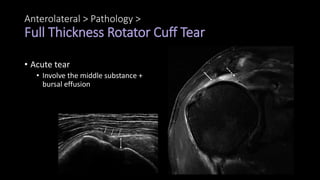
• Acute tear
• Involve the middle substance +
bursal effusion
Anterolateral > Pathology >
Full Thickness Rotator Cuff Tear
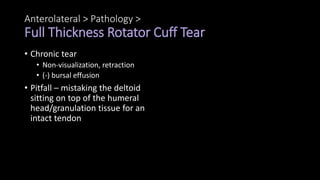
• Chronic tear
• Non-visualization, retraction
• (-) bursal effusion
• Pitfall – mistaking the deltoid
sitting on top of the humeral
head/granulation tissue for an
intact tendon
Anterolateral > Pathology >
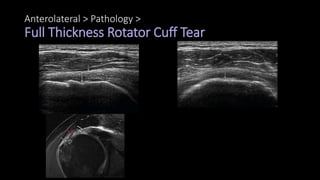
Full Thickness Rotator Cuff Tear
Anterolateral > Pathology >
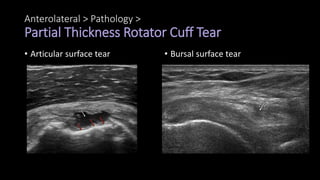
Partial Thickness Rotator Cuff Tear
• Articular surface tear • Bursal surface tear
Anterolateral > Pathology >
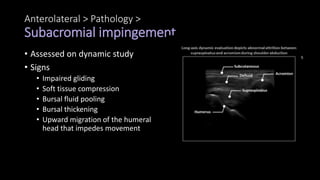
Subacromial impingement
• Assessed on dynamic study
• Signs
• Impaired gliding
• Soft tissue compression
• Bursal fluid pooling
• Bursal thickening
• Upward migration of the humeral
head that impedes movement
Anterolateral > Pathology >
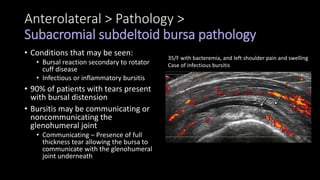
Subacromial subdeltoid bursa pathology
• Conditions that may be seen:
• Bursal reaction secondary to rotator
cuff disease
• Infectious or inflammatory bursitis
• 90% of patients with tears present
with bursal distension
• Bursitis may be communicating or
noncommunicating the
glenohumeral joint
• Communicating – Presence of full
thickness tear allowing the bursa to
communicate with the glenohumeral
joint underneath
35/F with bacteremia, and left shoulder pain and swelling
Case of infectious bursitis
Anterolateral > Pathology >
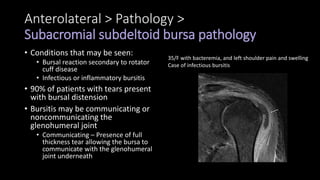
Subacromial subdeltoid bursa pathology
• Conditions that may be seen:
• Bursal reaction secondary to rotator
cuff disease
• Infectious or inflammatory bursitis
• 90% of patients with tears present
with bursal distension
• Bursitis may be communicating or
noncommunicating the
glenohumeral joint
• Communicating – Presence of full
thickness tear allowing the bursa to
communicate with the glenohumeral
joint underneath
35/F with bacteremia, and left shoulder pain and swelling
Case of infectious bursitis
Scanning
Protocol
A – Anterior
S – Superior
A – Anterolateral
P – Posterior
Posterior region
• Relevant anatomy
• Supraspinatus muscle
• Infraspinatus tendon
• Teres minor
• Glenohumeral joint and spinoglenoid notch
• Scanning protocol
• Common pathologies
• Rotator cuff tear and muscle atrophy
• Spinoglenoid notch and posterior labrum cyst
• Glenohumeral joint disease
Posterior > Relevant anatomy >
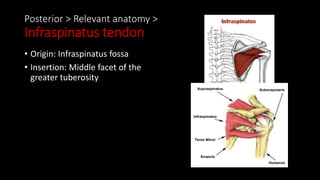
Infraspinatus tendon
• Origin: Infraspinatus fossa
• Insertion: Middle facet of the
greater tuberosity
Posterior > Relevant anatomy >
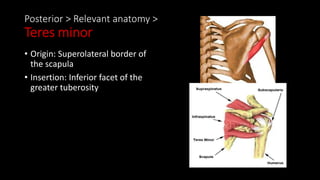
Teres minor
• Origin: Superolateral border of
the scapula
• Insertion: Inferior facet of the
greater tuberosity
Posterior > Relevant anatomy >
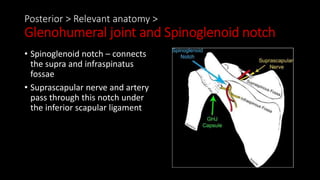
Glenohumeral joint and Spinoglenoid notch
• Spinoglenoid notch – connects
the supra and infraspinatus
fossae
• Suprascapular nerve and artery
pass through this notch under
the inferior scapular ligament
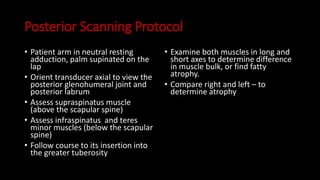
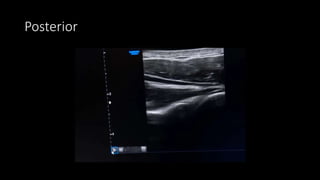
Posterior Scanning Protocol
• Patient arm in neutral resting
adduction, palm supinated on the
lap
• Orient transducer axial to view the
posterior glenohumeral joint and
posterior labrum
• Assess supraspinatus muscle
(above the scapular spine)
• Assess infraspinatus and teres
minor muscles (below the scapular
spine)
• Follow course to its insertion into
the greater tuberosity
• Examine both muscles in long and
short axes to determine difference
in muscle bulk, or find fatty
atrophy.
• Compare right and left – to
determine atrophy
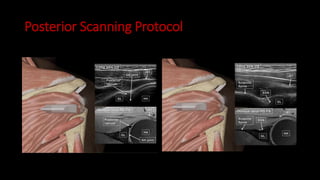
Posterior Scanning Protocol
Posterior > Pathology >
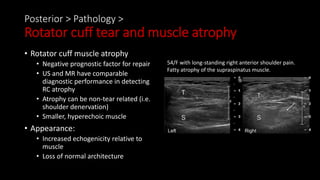
Rotator cuff tear and muscle atrophy
• Rotator cuff muscle atrophy
• Negative prognostic factor for repair
• US and MR have comparable
diagnostic performance in detecting
RC atrophy
• Atrophy can be non-tear related (i.e.
shoulder denervation)
• Smaller, hyperechoic muscle
• Appearance:
• Increased echogenicity relative to
muscle
• Loss of normal architecture
54/F with long-standing right anterior shoulder pain.
Fatty atrophy of the supraspinatus muscle.
Posterior > Pathology >
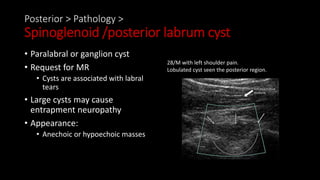
Spinoglenoid /posterior labrum cyst
• Paralabral or ganglion cyst
• Request for MR
• Cysts are associated with labral
tears
• Large cysts may cause
entrapment neuropathy
• Appearance:
• Anechoic or hypoechoic masses
28/M with left shoulder pain.
Lobulated cyst seen the posterior region.
Posterior > Pathology >
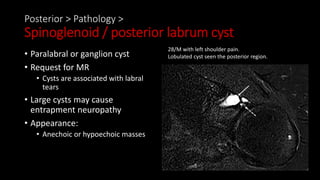
Spinoglenoid / posterior labrum cyst
• Paralabral or ganglion cyst
• Request for MR
• Cysts are associated with labral
tears
• Large cysts may cause
entrapment neuropathy
• Appearance:
• Anechoic or hypoechoic masses
28/M with left shoulder pain.
Lobulated cyst seen the posterior region.
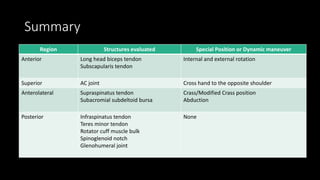
Summary
Region Structures evaluated Special Position or Dynamic maneuver
Anterior Long head biceps tendon
Subscapularis tendon
Internal and external rotation
Superior AC joint Cross hand to the opposite shoulder
Anterolateral Supraspinatus tendon
Subacromial subdeltoid bursa
Crass/Modified Crass position
Abduction
Posterior Infraspinatus tendon
Teres minor tendon
Rotator cuff muscle bulk
Spinoglenoid notch
Glenohumeral joint
None
Anterior
Superior
Anterolateral
Posterior
Conclusion
• US is an important and complementary imaging tool for the
evaluation of the superficial soft-tissue structures of the shoulder.
• To facilitate these objectives, the study used a standardized shoulder
US examination framework (ASAP [anterior, superior, anterolateral,
and posterior])
• Using a standardized approach to shoulder US will aid radiologists,
sonographers, and technologists in overcoming the barriers to
implementing shoulder US in clinical practice and help to promote
high-quality diagnostic imaging.
Other sources:
• Radiology Nation. Ultrasound Tutorial: MSK Series: Shoulder/Rotator
Cuff. https://www.youtube.com/watch?v=BwSJCkTBN0c&t=141s
• Fujifilm Sonosite. How To: Acromioclavicular Joint Ultrasound Exam.
https://www.youtube.com/watch?v=KqwfHguKZlI
• Musculoskeletal US. Subacromial impingement on dynamic real-time
shoulder ultrasound (case 6).
https://www.youtube.com/watch?v=GjSVvyowZq0

Comprehensive Shoulder US Examination.pptx

  • 1.
    Comprehensive Shoulder US Examination:A Standardized Approach with Multimodality Correlation for Common Shoulder Disease Journal report by Kevin Eric R. Santos, MD, DPBR
  • 2.
    SOURCE Lee MH, SheehanSE, Orwin JF, Lee KS. Comprehensive Shoulder US Examination: A Standardized Approach with Multimodality Correlation for Common Shoulder Disease. Radiographics. 2016 Oct;36(6):1606-1627. doi: 10.1148/rg.2016160030. PMID: 27726738; PMCID: PMC5084996.
  • 3.
    Introduction • Shoulder pain- 3rd most common reason for MSK consultation in primary care • Affects up to 1/3 of the general population
  • 4.
    Imaging diagnostics for shoulder pathology •Radiography • Ultrasound • MRI • MR Arthography
  • 5.
    Advantages of Ultrasoundfor Shoulder Imaging • Comparable diagnostic accuracy for diseases involving: • Rotator cuff • Subacromial subdeltoid bursa • long head of the biceps tendon • Low cost, accessible • Realtime imaging and patient feedback • No contraindication for px w/ pacemaker • No artifact from surgical hardware
  • 6.
    Disadvantages of Ultrasound for Shoulder Imaging •Steep learning curve • May be time consuming • Lack of experienced sonographers
  • 7.
    Ultrasound of theShoulder Done with high frequency linear probe (9-15 Mhz) Patient seated Sonographer seated or standing
  • 8.
    Anisotropy • Ultrasound artifactnotably in muscles, tendons, ligaments • When the ultrasound beam is not perpendicular, the fibrillar structure of the tendons reflect sound away from the transducer • Produces hypoechoic structure • May be mistaken for tears, tendinosis
  • 9.
    Scanning Protocol A – Anterior S– Superior A – Anterolateral P – Posterior
  • 10.
    Scanning Protocol A – Anterior S– Superior A – Anterolateral P – Posterior
  • 11.
    Anterior region • Relevantanatomy • Subscapularis tendon • Long head of the biceps tendon • Scanning protocol • Common pathologies • Biceps tendinosis and tenosynovitis • Biceps tendon rupture • Biceps tendon subluxation and dislocation
  • 12.
    Anterior > Relevantanatomy > Subscapularis tendon • Most anterior tendon of the rotator cuff • Origin: Subscapular fossa • Insertion: Lesser tuberosity
  • 13.
    Anterior > Relevantanatomy > Long head of the biceps tendon • Course in the shoulder: superior glenoid labrum  rotator interval  bicipital groove (covered by the transverse humeral ligament) • Insertion: Radial tuberosity
  • 14.
    Anterior Region Scanning Protocol •Patient seated in upright position • Shoulder In neutral and adducted • Elbow flexed 90 degrees, forearm and hand supinated and resting on the ipsilateral thigh • Scan LHBT transverse and longitudinally • Internally and externally rotate the arm to assess for possible biceps tendon subluxation • Subscapularis tendon best viewed with the shoulder in external rotation
  • 15.
  • 17.
    Dynamic study forlong head of the biceps tendon
  • 18.
    Anterior > Pathology> Biceps Tendinosis and Tenosynovitis • Tendinosis • Inflammatory and degenerative causes related to chronic repetitive overuse • Appearance: • Tendon thickening • Hypoechoic • Loss of fibrillar pattern
  • 19.
    Anterior > Pathology> Biceps tendinosis and Tenosynovitis • Tendinosis • Inflammatory and degenerative causes related to chronic repetitive overuse • Appearance: • Tendon thickening • Hypoechoic • Loss of fibrillar pattern
  • 20.
    Anterior > Pathology> Biceps tendinosis and Tenosynovitis • Tenosynovitis • Inflammation of the LHBT is rare • Inflammation of the surrounding synovial sheath is more common
  • 21.
    Anterior > Pathology> Biceps tendon rupture and tearing • Occurs in the setting of tendinosis • Can occur spontaneously in patients > 50 w/o trauma • Signs • “Empty” bicipital groove • Pop-eye sign
  • 22.
    Anterior > Pathology> Biceps tendon rupture and tearing • Occurs in the setting of tendinosis • Can occur spontaneously in patients > 50 w/o trauma • Signs • “Empty” bicipital groove • Pop-eye sign
  • 23.
  • 24.
    Anterior > Pathology> Biceps tendon subluxation/dislocation • MC site is proximal to or within the bicipital groove • Commonly associated with other injuries (rotator cuff tears) • Real-time dynamic study is advantageous in confirming the diagnosis
  • 25.
    Scanning Protocol A – Anterior S– Superior A – Anterolateral P – Posterior
  • 26.
    Superior region • Relevantanatomy • Acromioclavicular joint • Scanning protocol • Common pathologies • Capsular hypertrophy and distension • AC joint dislocation
  • 27.
    Superior > Relevantanatomy > Acromioclavicular joint • Synovial joint articulating the acromion with the clavicle
  • 28.
    Superior scanning protocol •Transducer along long axis of the clavicle, move laterally until to profile the joint space • Overlying hypoechoic joint capsule • Fibrocartilagenous disc seen as linear hyperechoic structure in the center of the joint
  • 29.
    Superior scanning protocol •Dynamic scan • Have the patient move the hand to the contralateral shoulder • Look for: • Separation • Irregularity in bony margins • Osteoarthritis • “Geyser phenomenon” • Bursal fluid moving upwards
  • 30.
    Dynamic scan ofthe AC joint
  • 31.
    Superior > Pathology> Capsular hypertrophy and distension • May have varied causes (degenerative, infectious, inflammatory • Capsule to bone distance < 3 mm rules out capsular hypertrophy
  • 32.
    Superior > Pathology> Acromioclavicular joint dislocation • Ultrasound is best for grade I AC joint dislocation Rockwood classification for acromioclavicular dislocation
  • 33.
    Superior > Pathology> Acromioclavicular joint dislocation • Ultrasound is best for grade I AC joint dislocation
  • 34.
    Scanning Protocol A – Anterior S– Superior A – Anterolateral P – Posterior
  • 35.
    Anterolateral region • Relevantanatomy • Supraspinatus tendon • Subacromial subdeltoid bursa • Scanning protocol • Common pathologies • Rotator cuff tear • Subacromial impingement • Bursitis
  • 36.
    Anterolateral > Relevantanatomy > Supraspinatus tendon • Primarily implicated in symptomatic rotator cuff disease. • Origin – supraspinatus fossa of the scapula • Insertion – superior facet of greater tubercle of humerus • Abducts the arm
  • 37.
    Anterolateral > Relevantanatomy > Subacromial-subdeltoid bursa • Synovial lined potential space • Composed of synovial tissue, connective tissue and fat • Largest bursa in the body • Located between the rotator cuff, coraco-acromial arch, and deltoid muscle • Facilitates RC motion, dissipates friction from complex shoulder movement
  • 38.
    Anterolateral scanning protocol •Positions that optimize viewing the supraspinatus tendon • Crass position • Arm hyperextended, elbow flexed, and dorsum placed along the low midline of the back • Modified Crass position • Elbow flexed and volar aspect of the hand on the ipsilateral iliac wing
  • 39.
    Anterolateral scanning protocol Crass andmodified Crass expose more of the supraspinatus tendon
  • 40.
    Dynamic scan ofthe anterolateral region • Start with patient in neutral shoulder position, adducted with elbow flexed • Probe in long axis of supraspinatus tendon, cephalad end of the probe over the acromion • Have the patient abduct the arm
  • 41.
    Dynamic scan ofthe anterolateral region
  • 42.
    Anterolateral > Pathology> Rotator Cuff Tear • Multifactorial • Intrinsic (genetic, tendon thinning), extrinsic (trauma, impingement syndrome), environmental • Risk factors include increased age, hand dominance, history of trauma
  • 43.
    Anterolateral > Pathology> Full Thickness Rotator Cuff Tear • Extend through the entire thickness of the tendon substance • Articular to bursal surface • Most RC tears involve the SST and occur 13-17mm post to the LHBT • Hypoechoic or anechoic tendon defect • Describe: location and dimensions in short and long axis, shape (crescent-shaped, L-shaped), presence of retraction 63/M w/ right shoulder pain Full thickness supraspinatus tendon tear
  • 44.
    Anterolateral > Pathology> Full Thickness Rotator Cuff Tear • Acute tear • Involve the middle substance + bursal effusion
  • 45.
    Anterolateral > Pathology> Full Thickness Rotator Cuff Tear • Chronic tear • Non-visualization, retraction • (-) bursal effusion • Pitfall – mistaking the deltoid sitting on top of the humeral head/granulation tissue for an intact tendon
  • 46.
    Anterolateral > Pathology> Full Thickness Rotator Cuff Tear
  • 47.
    Anterolateral > Pathology> Partial Thickness Rotator Cuff Tear • Articular surface tear • Bursal surface tear
  • 48.
    Anterolateral > Pathology> Subacromial impingement • Assessed on dynamic study • Signs • Impaired gliding • Soft tissue compression • Bursal fluid pooling • Bursal thickening • Upward migration of the humeral head that impedes movement
  • 49.
    Anterolateral > Pathology> Subacromial subdeltoid bursa pathology • Conditions that may be seen: • Bursal reaction secondary to rotator cuff disease • Infectious or inflammatory bursitis • 90% of patients with tears present with bursal distension • Bursitis may be communicating or noncommunicating the glenohumeral joint • Communicating – Presence of full thickness tear allowing the bursa to communicate with the glenohumeral joint underneath 35/F with bacteremia, and left shoulder pain and swelling Case of infectious bursitis
  • 50.
    Anterolateral > Pathology> Subacromial subdeltoid bursa pathology • Conditions that may be seen: • Bursal reaction secondary to rotator cuff disease • Infectious or inflammatory bursitis • 90% of patients with tears present with bursal distension • Bursitis may be communicating or noncommunicating the glenohumeral joint • Communicating – Presence of full thickness tear allowing the bursa to communicate with the glenohumeral joint underneath 35/F with bacteremia, and left shoulder pain and swelling Case of infectious bursitis
  • 51.
    Scanning Protocol A – Anterior S– Superior A – Anterolateral P – Posterior
  • 52.
    Posterior region • Relevantanatomy • Supraspinatus muscle • Infraspinatus tendon • Teres minor • Glenohumeral joint and spinoglenoid notch • Scanning protocol • Common pathologies • Rotator cuff tear and muscle atrophy • Spinoglenoid notch and posterior labrum cyst • Glenohumeral joint disease
  • 53.
    Posterior > Relevantanatomy > Infraspinatus tendon • Origin: Infraspinatus fossa • Insertion: Middle facet of the greater tuberosity
  • 54.
    Posterior > Relevantanatomy > Teres minor • Origin: Superolateral border of the scapula • Insertion: Inferior facet of the greater tuberosity
  • 55.
    Posterior > Relevantanatomy > Glenohumeral joint and Spinoglenoid notch • Spinoglenoid notch – connects the supra and infraspinatus fossae • Suprascapular nerve and artery pass through this notch under the inferior scapular ligament
  • 56.
    Posterior Scanning Protocol •Patient arm in neutral resting adduction, palm supinated on the lap • Orient transducer axial to view the posterior glenohumeral joint and posterior labrum • Assess supraspinatus muscle (above the scapular spine) • Assess infraspinatus and teres minor muscles (below the scapular spine) • Follow course to its insertion into the greater tuberosity • Examine both muscles in long and short axes to determine difference in muscle bulk, or find fatty atrophy. • Compare right and left – to determine atrophy
  • 57.
  • 58.
    Posterior > Pathology> Rotator cuff tear and muscle atrophy • Rotator cuff muscle atrophy • Negative prognostic factor for repair • US and MR have comparable diagnostic performance in detecting RC atrophy • Atrophy can be non-tear related (i.e. shoulder denervation) • Smaller, hyperechoic muscle • Appearance: • Increased echogenicity relative to muscle • Loss of normal architecture 54/F with long-standing right anterior shoulder pain. Fatty atrophy of the supraspinatus muscle.
  • 59.
    Posterior > Pathology> Spinoglenoid /posterior labrum cyst • Paralabral or ganglion cyst • Request for MR • Cysts are associated with labral tears • Large cysts may cause entrapment neuropathy • Appearance: • Anechoic or hypoechoic masses 28/M with left shoulder pain. Lobulated cyst seen the posterior region.
  • 60.
    Posterior > Pathology> Spinoglenoid / posterior labrum cyst • Paralabral or ganglion cyst • Request for MR • Cysts are associated with labral tears • Large cysts may cause entrapment neuropathy • Appearance: • Anechoic or hypoechoic masses 28/M with left shoulder pain. Lobulated cyst seen the posterior region.
  • 61.
    Summary Region Structures evaluatedSpecial Position or Dynamic maneuver Anterior Long head biceps tendon Subscapularis tendon Internal and external rotation Superior AC joint Cross hand to the opposite shoulder Anterolateral Supraspinatus tendon Subacromial subdeltoid bursa Crass/Modified Crass position Abduction Posterior Infraspinatus tendon Teres minor tendon Rotator cuff muscle bulk Spinoglenoid notch Glenohumeral joint None
  • 62.
  • 63.
  • 64.
  • 65.
  • 66.
    Conclusion • US isan important and complementary imaging tool for the evaluation of the superficial soft-tissue structures of the shoulder. • To facilitate these objectives, the study used a standardized shoulder US examination framework (ASAP [anterior, superior, anterolateral, and posterior]) • Using a standardized approach to shoulder US will aid radiologists, sonographers, and technologists in overcoming the barriers to implementing shoulder US in clinical practice and help to promote high-quality diagnostic imaging.
  • 67.
    Other sources: • RadiologyNation. Ultrasound Tutorial: MSK Series: Shoulder/Rotator Cuff. https://www.youtube.com/watch?v=BwSJCkTBN0c&t=141s • Fujifilm Sonosite. How To: Acromioclavicular Joint Ultrasound Exam. https://www.youtube.com/watch?v=KqwfHguKZlI • Musculoskeletal US. Subacromial impingement on dynamic real-time shoulder ultrasound (case 6). https://www.youtube.com/watch?v=GjSVvyowZq0

Editor's Notes

  • #4 Shoulder pain - 3rd most common reason for musculoskeletal consultations in primary care And is the usual indication for imaging in the shoulder Affects up to 1/3 of the general population
  • #5 Imaging diagnostics for shoulder pathology Shoulder radiograph Ultrasound MRI MRA arthography Utrasound will be the focus of this report
  • #9 This is our enemy when we do our MSK ultrasound Anisotropy is an ultrasound artifact that is seen notably in muscles, tendons, ligaments When the ultrasound beam is not perpendicular, or in other words the beam is oblique to the structure being examined the fibrillar structure of the tendons reflect sound away from the transducer This produces hypoechoic structure And may be mistaken for tears, tendinosis
  • #10 For each region, I will be discussing the relevant anatomy, scanning protocol, and common pathologies that we may encounter
  • #16 So we scan the long head biceps tendon in axial and longitudinal views Left most image shows correlation of axial ultrasound and MRI images We see the biceps tendon resting in the bicipital groove The subscapularis tendon is immediately medial to it. On the right we see a normal longitudinal image of the long head biceps tendon. Normal tendon pattern = Fibrillar pattern. This represents the parallel collagen fibers of the tendon.
  • #17 For the subscapularis tendon, we have the patient do external rotation of the arm
  • #18 This is a dynamic study for this region. This is for evaluating for biceps tendon dislocation. We have the patient perform internal and external rotation of the arm. We look at the biceps tendon if it migrates from the bicipital groove. In cases of dislocation the tendon will actually be removed from the bicipital groove.
  • #19 Tendinosis Inflammatory and degenerative causes related to chronic repetitive overuse Appearance: Tendon thickening Hypoechoic Loss of fibrillar pattern Sonogram shows axial view of the tendon, and it is thickened and hypo-echoic
  • #20 Sonogram shows thickened biceps tendon with hypechoic pattern. This is a proton density weighted axial image of the shoulder. There is medial subluxation and increased signal due to partial tearing.
  • #22 Example of 29/M who felt a pop while lifting weights. Top photo shows axial view of empty fluid-filled tendon sheath. Bottom photo show longitudinal view with retraction of the tendon stump distally.
  • #23 Small hypodensity in the biceps tendon on transverse ultrasound
  • #24 Popeye sign – distal migration of the biceps muscle in patients with tendon tear
  • #26 Next we will be discussing the superior region
  • #30 If pathology is suspected, Have the patient move the hand to the contralateral shoulder We look for Separation Irregularity in bone margins, which may be related to osteoarthritis An we also have the geyser phenomenon
  • #32 Example of 43/M shows focal hypoechoic linear lesion in the tendon on axial ultrasound. Top photo shows axial view CT of empty fluid-filled tendon sheath. Bottom photo show longitudinal view with retraction of the tendon stump distally.
  • #33 Example of 43/M shows focal hypoechoic linear lesion in the tendon on axial ultrasound. Top photo shows axial view CT of empty fluid-filled tendon sheath. Bottom photo show longitudinal view with retraction of the tendon stump distally.
  • #34 Ultrasound is best for grade I AC joint dislocations. 68/M with fall onto an outstretched hand On radiograph and ultrasound we see AC joint widening and elevation of the acromioclavicular joint.
  • #35 Next we weill discuss the anterolateral approach
  • #40 Coronal T2 image of the shoulder
  • #43 Ultrasound is best for grade I AC joint dislocations. 68/M with fall onto an outstretched hand On radiograph and ultrasound we see AC joint widening and elevation of the acromioclavicular joint.
  • #44 63/M presenting with right shoulder paint Long axis ultrasound shows full thickness supraspinatus tendon tear, represented by the hypoechoic defect We know it is full thickness because it extends from the bursal to articular surface
  • #45 MRI T2 coronoal image done a few months later confirms these findings where we appreciate tendon discontinuity and retraction
  • #47 52/M with chronic shoulder pain On the left are longitudinal ultrasound and corresponding coronal MRI images On the right are the axial ultrasound and corresponding axial MRI images The MRI images are T2 weighted On ultrasound we see fairly hyperechoic structures under the deltoid muscle, but these are not the tendon. There is no fibrillar pattern and if we observe, the structure does not attach to the greater tuberosity. On MRI it is revealed that there is tendon discontinuity and granulation tissue is present
  • #48 On the left we have a 57-year old man with right shoulder pain Short axis ultrasound image shows a disrupted tendon along the articular surface with irregular cortical margins which is a secondary finding in articular surface tear. On the right we have an 84/F with chronic right shoulder pain. Long axis ultrasound shows tendon defect at the bursal surface, where we also observe depression of the bursa into the defect, which is a secondary finding in bursal surface tear. We elicit this finding by applying pressure on the area with the probe.
  • #50 Short axis image shows bursal thickening and fluid collection, with hyperemia on color Dopper.
  • #51 Short axis image shows bursal thickening and fluid collection, with hyperemia on color Dopper. T1 FS image shows complex thick-walled bursal collection compatible with an abscess.
  • #52 For each region, I will be discussing the relevant anatomy, scanning protocol, and common pathologies that we may encounter
  • #56 Suprascapular artery arises from thyrocervical trung from the subclavian artery Suprascapular artery < thyrocervical trunk < subclavian artery > aortic arch (left)/brachiocephalic artery (right) Suprascapular nerve branches of from the Trunk of the Lateral cord of the brachial plexus
  • #58 We scan in transverse to view the structure. Laterally we see the infraspinatus tendon, and glenohumeral joint We move the probe laterally to find the spinoglenoid notch
  • #59 54/F with long-standing right anterior shoulder pain. Long-axis US images were obtained. Superficially we see the Trapezius, and underneath is the supraspinatus muscle. The left is unremarkable On the right we see increased echogenicity of the supraspinatus muscle, and loss of normal muscle architecture. This represents fatty atrophy of the muscle.
  • #60 28/M with left shoulder pain. Lobulated cyst seen the posterior shoulder region, occupying the spinoglenoid notch.
  • #61 28/M with left shoulder pain. Lobulated cyst seen the posterior shoulder region, occupying the spinoglenoid notch. Axial T2 MR image shows the cyst associated with a posterior-superior labral tear pointed at by the dashed arrow.