Downloaded 685 times


![Items to be evaluated(anatomy and pathology).
Articulating bones.
Tendons [ supra &
infraspinatus,
subscapularis and biceps]
Ligaments [ gleno-humeral]
Bones [ acromion & A/C
joint]
Labrium.
Bursae.
Synovial membrane.
Fibrous capsule.
Muscles.](https://image.slidesharecdn.com/presentation1-140226142813-phpapp01/85/Presentation1-pptx-shoulder-joint-5-320.jpg)




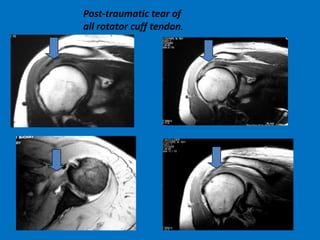




MRI of the shoulder can be useful for evaluating several clinical scenarios involving shoulder pain, trauma, impingement, instability, or limited range of motion. It allows visualization of bones, articulating surfaces, tendons, ligaments, labrum, bursae and other soft tissues. Common findings on MRI of the shoulder include tendinopathy, full and partial thickness rotator cuff tears, bursitis, and labral tears.


