`
ABHYANTARA SNEHAPANA
Dr. Ketan Mahajan
M.D. Panchakarma
Assistant Professor
Department of Panchakarma
Patanjali Bhartiya Ayurvigyan Evam Anusandhan Sansthan
Haridwar, U.K.
Email: ketanmahajan82@gmail.com
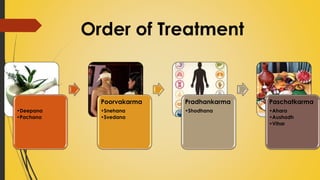
Order of Treatment
•Deepana
•Pachana
Poorvakarma
•Snehana
•Svedana
Pradhankarma
•Shodhana
Paschatkarma
•Ahara
•Aushadh
•Vihar
Classification
Bahya
Abhyantara
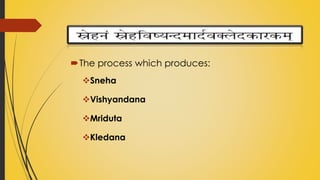
The process which produces:
Sneha
Vishyandana
Mriduta
Kledana
Sneha therapy can be administered only
when:-
There is good Agnideepti
There is Srotoshodhana
For this purpose Deepana, Pachana, Rooksha
aushadhis are given before Snehana.
Deepana- Pachana Chikitsa
Enhances the Agni
Clears the Srotas
Better absorption & efficacy
Reduces the risk of complications
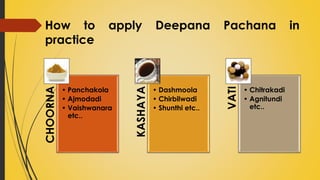
How to apply Deepana Pachana in
practice
CHOORNA
• Panchakola
• Ajmodadi
• Vaishwanara
etc..
KASHAYA
• Dashmoola
• Chirbilwadi
• Shunthi etc..
VATI
• Chitrakadi
• Agnitundi
etc..
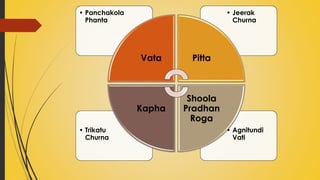
• Agnitundi
Vati
• Trikatu
Churna
• Jeerak
Churna
• Panchakola
Phanta
Vata Pitta
Shoola
Pradhan
Roga
Kapha
Note: If necessary mild Anulomana Dravyas can be advised
during Deepana Pachana like Abhayarishta, Avipattikara
Churna etc..
 If Rukshana is necessary Takrarishta, Udvartana can be
adviced.
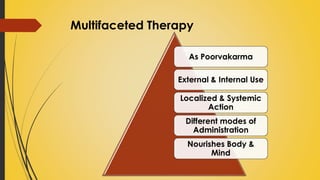
Multifaceted Therapy
As Poorvakarma
External & Internal Use
Localized & Systemic
Action
Different modes of
Administration
Nourishes Body &
Mind
Where can we give Sneha ??
Indications
 Svedya
 Samshodya
 Ruksha
 Vata Vikara
 Vyayamanitya
 Madhyanitya
 Streenitya
 Chintaka
 Vriddha
 Bala
 Abala
 Krisha
 Ksheenasra
 Ksheenaretas
 Syanda
 Timira
 Daruna Pratibodhinah
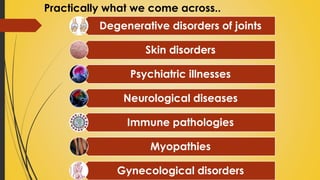
Practically what we come across..
Degenerative disorders of joints
Skin disorders
Psychiatric illnesses
Neurological diseases
Immune pathologies
Myopathies
Gynecological disorders
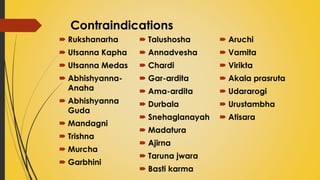
Contraindications
 Rukshanarha
 Utsanna Kapha
 Utsanna Medas
 Abhishyanna-
Anaha
 Abhishyanna
Guda
 Mandagni
 Trishna
 Murcha
 Garbhini
 Talushosha
 Annadvesha
 Chardi
 Gar-ardita
 Ama-ardita
 Durbala
 Snehaglanayah
 Madatura
 Ajirna
 Taruna jwara
 Basti karma
 Aruchi
 Vamita
 Virikta
 Akala prasruta
 Udararogi
 Urustambha
 Atisara
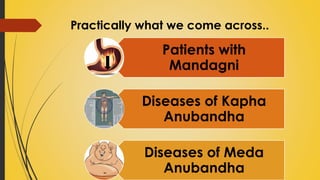
Practically what we come across..
Patients with
Mandagni
Diseases of Kapha
Anubandha
Diseases of Meda
Anubandha
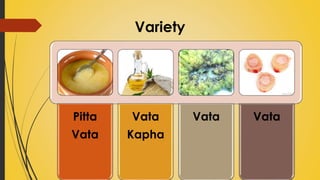
Variety
Pitta
Vata
Vata
Kapha
Vata Vata
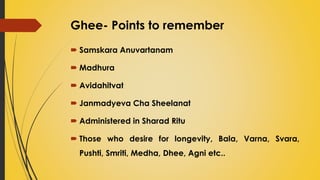
Ghee- Points to remember
 Samskara Anuvartanam
 Madhura
 Avidahitvat
 Janmadyeva Cha Sheelanat
 Administered in Sharad Ritu
 Those who desire for longevity, Bala, Varna, Svara,
Pushti, Smriti, Medha, Dhee, Agni etc..
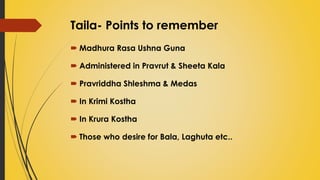
Taila- Points to remember
 Madhura Rasa Ushna Guna
 Administered in Pravrut & Sheeta Kala
 Pravriddha Shleshma & Medas
 In Krimi Kostha
 In Krura Kostha
 Those who desire for Bala, Laghuta etc..
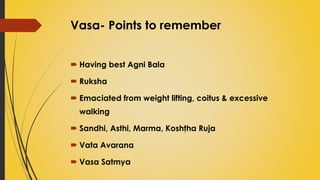
Vasa- Points to remember
 Having best Agni Bala
 Ruksha
 Emaciated from weight lifting, coitus & excessive
walking
 Sandhi, Asthi, Marma, Koshţha Ruja
 Vata Avarana
 Vasa Satmya
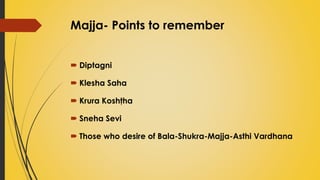
Majja- Points to remember
 Diptagni
 Klesha Saha
 Krura Koshţha
 Sneha Sevi
 Those who desire of Bala-Shukra-Majja-Asthi Vardhana
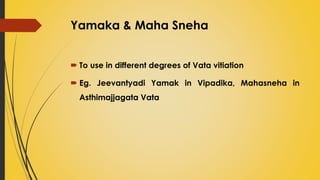
Yamaka & Maha Sneha
 To use in different degrees of Vata vitiation
 Eg. Jeevantyadi Yamak in Vipadika, Mahasneha in
Asthimajjagata Vata
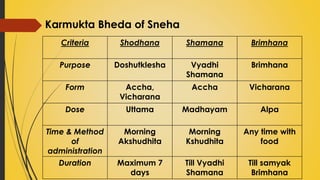
Karmukta Bheda of Sneha
Criteria Shodhana Shamana Brimhana
Purpose Doshutklesha Vyadhi
Shamana
Brimhana
Form Accha,
Vicharana
Accha Vicharana
Dose Uttama Madhayam Alpa
Time & Method
of
administration
Morning
Akshudhita
Morning
Kshudhita
Any time with
food
Duration Maximum 7
days
Till Vyadhi
Shamana
Till samyak
Brimhana
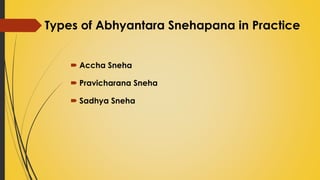
Types of Abhyantara Snehapana in Practice
 Accha Sneha
 Pravicharana Sneha
 Sadhya Sneha
Accha Sneha
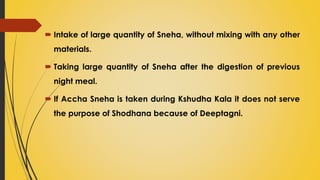
 Intake of large quantity of Sneha, without mixing with any other
materials.
 Taking large quantity of Sneha after the digestion of previous
night meal.
 If Accha Sneha is taken during Kshudha Kala it does not serve
the purpose of Shodhana because of Deeptagni.
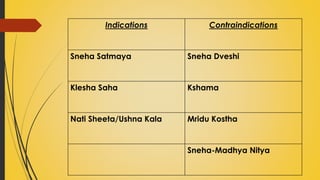
Indications Contraindications
Sneha Satmaya Sneha Dveshi
Klesha Saha Kshama
Nati Sheeta/Ushna Kala Mridu Kostha
Sneha-Madhya Nitya
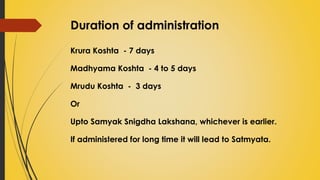
Duration of administration
Krura Koshta - 7 days
Madhyama Koshta - 4 to 5 days
Mrudu Koshta - 3 days
Or
Upto Samyak Snigdha Lakshana, whichever is earlier.
If administered for long time it will lead to Satmyata.
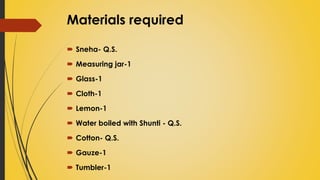
Materials required
 Sneha- Q.S.
 Measuring jar-1
 Glass-1
 Cloth-1
 Lemon-1
 Water boiled with Shunti - Q.S.
 Cotton- Q.S.
 Gauze-1
 Tumbler-1
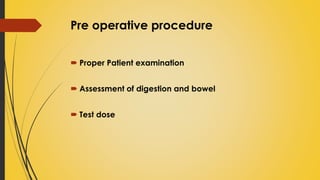
Pre operative procedure
 Proper Patient examination
 Assessment of digestion and bowel
 Test dose
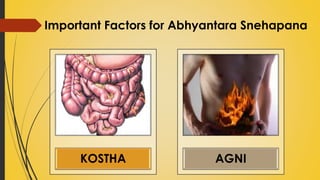
Important Factors for Abhyantara Snehapana
KOSTHA AGNI
Assessment of Kostha
 Frequency of stool
 Consistency of stool
 Time for defecation
 Level of satisfaction
 Effect of food items & medicines
 Any GIT pathology
Assessment of Agni
 Understand the level and degree of Appetite
 Details of Food habit
 Any history of Ajeerna
 Quantity and Quality of food
 Timing and interval of Food
Investigations required prior to Accha
Snehapana
 Blood - RE, LFT, Sugar levels , Lipid profiles.
 Urine - RE
 Stool - RE
Procedure
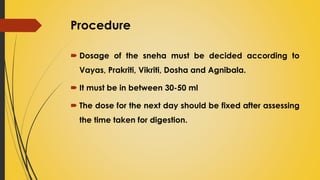
 Dosage of the sneha must be decided according to
Vayas, Prakriti, Vikriti, Dosha and Agnibala.
 It must be in between 30-50 ml
 The dose for the next day should be fixed after assessing
the time taken for digestion.
 Within half an hour of sunrise, patient should be seated in a
comfortable position and Sneha should be given in empty
stomach.
 After giving the Sneha warm water should be given as
Anupana
Specific Anupana
 Ushnodaka for most of the sneha except those
processed with Tuvarak & Bhallatak
 Yusha- for Taila
 Manda- Vasa & Majja
 Then the patient should wash the face and mouth with
hot water to remove the taste of Sneha.
 When thirst occurs, hot water can be given.
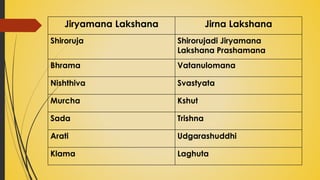
Jiryamana Lakshana Jirna Lakshana
Shiroruja Shirorujadi Jiryamana
Lakshana Prashamana
Bhrama Vatanulomana
Nishthiva Svastyata
Murcha Kshut
Sada Trishna
Arati Udgarashuddhi
Klama Laghuta
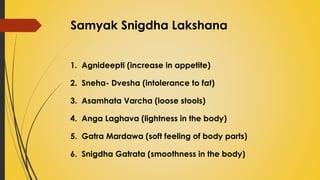
Samyak Snigdha Lakshana
1. Agnideepti (increase in appetite)
2. Sneha- Dvesha (intolerance to fat)
3. Asamhata Varcha (loose stools)
4. Anga Laghava (lightness in the body)
5. Gatra Mardawa (soft feeling of body parts)
6. Snigdha Gatrata (smoothness in the body)
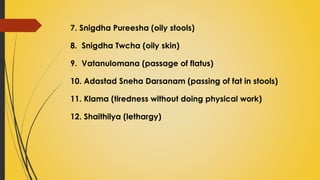
7. Snigdha Pureesha (oily stools)
8. Snigdha Twcha (oily skin)
9. Vatanulomana (passage of flatus)
10. Adastad Sneha Darsanam (passing of fat in stools)
11. Klama (tiredness without doing physical work)
12. Shaithilya (lethargy)
Key Points
 Vatanulomana – Normal GIT movements
 Agnideepti – Normal Appetite
 Varcha Snigdhata and Asamhata – Oily stool
 Snehodwega – Aversion to Sneha
 Klama - Lassitude
Asnigdha Lakshana
1. Grathita Purisha (passing of hard stools)
2. Ruksha Purisha (passing of dry stools)
3. Agnimandya (weak digestive power)
4. Vayu Pratilomata (unregulated vata)
5. Gatra Kharata (roughness of body)
6. Gatra Rukshata (dryness of body)
7. Urovidaha (burning sensation in chest)
8. Dourbalya (weakness)
9. Kricchra Annapachana (late digestion)
10.Susnigdha Viparyaya (features opposite to those of Samyak
Sneha)
Atisnigdha Lakshana
1. Panduta (pallor)
2. Sharira Gaurava (heaviness of body)
3. Jadyata (sluggishness)
4. Apakva Purisha (undigested foods in stools)
5. Tandra (drowsiness)
6. Aruchi (lack of taste in the mouth)
7. Utklesha (nausea)
8. Bhaktadvesha (aversion to take food)
9. Mukhasrava (Excessive salivation)
10. Ghranasrava (discharge from the nose)
11. Gudasrava (secretions in the anus)
12. Gudadaha (burning sensation in the anal region)
13. Pravahika (dysentery)
14. Purisha - Atipravritti (excessive passing of stools)
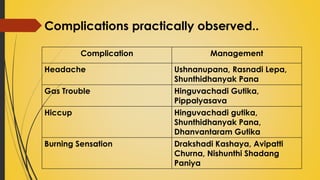
Complications practically observed..
Complication Management
Headache Ushnanupana, Rasnadi Lepa,
Shunthidhanyak Pana
Gas Trouble Hinguvachadi Gutika,
Pippalyasava
Hiccup Hinguvachadi gutika,
Shunthidhanyak Pana,
Dhanvantaram Gutika
Burning Sensation Drakshadi Kashaya, Avipatti
Churna, Nishunthi Shadang
Paniya
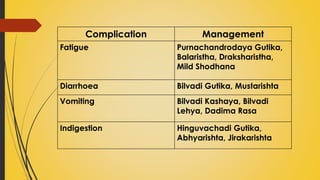
Complication Management
Fatigue Purnachandrodaya Gutika,
Balaristha, Draksharistha,
Mild Shodhana
Diarrhoea Bilvadi Gutika, Mustarishta
Vomiting Bilvadi Kashaya, Bilvadi
Lehya, Dadima Rasa
Indigestion Hinguvachadi Gutika,
Abhyarishta, Jirakarishta
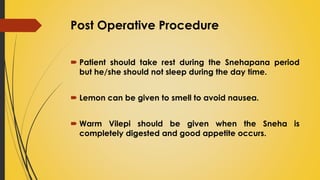
Post Operative Procedure
 Patient should take rest during the Snehapana period
but he/she should not sleep during the day time.
 Lemon can be given to smell to avoid nausea.
 Warm Vilepi should be given when the Sneha is
completely digested and good appetite occurs.
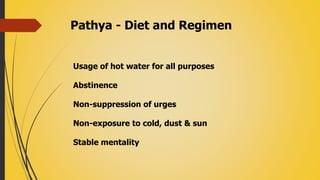
Pathya - Diet and Regimen
Usage of hot water for all purposes
Abstinence
Non-suppression of urges
Non-exposure to cold, dust & sun
Stable mentality
Pravicharana Sneha
 When Sneha is particularly used in the form of Bhaksha, Pana,
Leha, Abhyanjana etc. it is called as‘Pravicharana’.
 While describing the ‘Brimhana Snehapana’ Hemadri says that
Rasa, Madya etc. when mixed according to taste, palatability
and Satmya of the individual in the Sneha is called as
‘Vicharana’.
 As per the mode of application these preparations can be divided
in to two groups as –
a) Internal Pravicharana.
b) External Pravicharana.
 The preparations like Odana, Vilepi, Mamsarasa, Paya (milk),
Dadhi, Yavagu, Supa, Shaka, Yush, Kambalika, Khada, Saktu, Tila
pishta, Madya, Lehya etc. comes under internal use category.
 Whereas, Abhyanga, Basti, Uttarbasti, Gandusha, Karnatail, Nasya,
Akshitarpana, Karnatarpana are the external types of
Pravicharana.
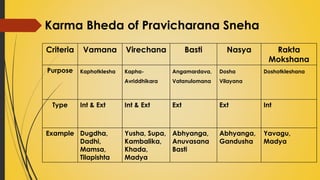
Karma Bheda of Pravicharana Sneha
Criteria Vamana Virechana Basti Nasya Rakta
Mokshana
Purpose Kaphotklesha Kapha-
Avriddhikara
Angamardava,
Vatanulomana
Dosha
Vilayana
Doshotkleshana
Type Int & Ext Int & Ext Ext Ext Int
Example Dugdha,
Dadhi,
Mamsa,
Tilapishta
Yusha, Supa,
Kambalika,
Khada,
Madya
Abhyanga,
Anuvasana
Basti
Abhyanga,
Gandusha
Yavagu,
Madya
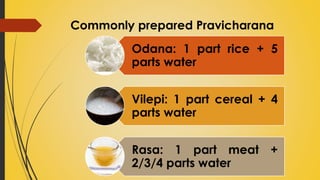
Commonly prepared Pravicharana
Odana: 1 part rice + 5
parts water
Vilepi: 1 part cereal + 4
parts water
Rasa: 1 part meat +
2/3/4 parts water
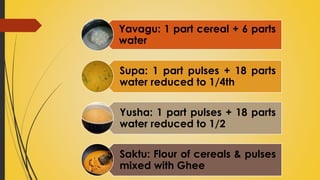
Yavagu: 1 part cereal + 6 parts
water
Supa: 1 part pulses + 18 parts
water reduced to 1/4th
Yusha: 1 part pulses + 18 parts
water reduced to 1/2
Saktu: Flour of cereals & pulses
mixed with Ghee
Sadhyo Sneha
 To achieve Samyak Snigdha Lakshana immediately
 Lakshanas are attained within 1-3 days
 Based mainly on the principal of Pravicharana Sneha
Indications
 Bala
 Vriddha
 Sneha Parihara Asahishnu
 Balahina
 Mridu Agni
 Alpa Dosha
Contra-Indications
 In Kustha, Prameha & Shotha it should not be given with
Gramya, Anupa, Audaka Mamsa, Kshira, Guda, Dadhi
and Tila.
Commonly used Sadhyo Sneha Yogas
 Pippali, Saindhava, Tila Pishta, Ghee
 Ghee, powdered sugar, milk – Ruksha Person
 Yavagu ( rice & milk) with Ghee
 Dugdha with Ghee & Lavana
 Pancha Prasruta Sneha – Chatur Sneha ( 1 Prastha each)
mixed with 1 Prastha rice
 Lavanayukta Sneha – Instant Snehana due to
Abhishyandi, Sukshma, Ushna , Vyavayi Guna
How Snehana acts..
Sneho Anilam Hanti…
 Vata Shamak property of Sneha
 Sneha have opposite Gunas of Vata
 Vatanulomana 1st Samyak Snigdha Lakshana
 Helps in proper Gati of Vata
Mrudukaroti Deham
 Snigdha & Mridu Guna of Sneha
 Sneha Mardavkrut
 Can be assessed by Gatra Mardava
Malanam Vihanti Sangam
 Malasanga is caused due to Rukshata
 Snigdha property of Sneha overcomes the Rukshata
 Sanga is corrected
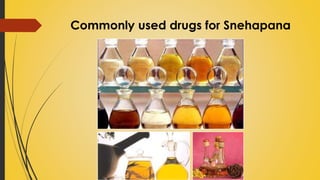
Commonly used drugs for Snehapana
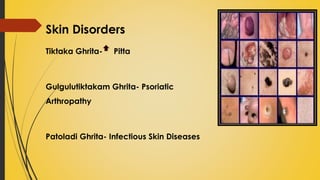
Skin Disorders
Tiktaka Ghrita- Pitta
Gulgulutiktakam Ghrita- Psoriatic
Arthropathy
Patoladi Ghrita- Infectious Skin Diseases
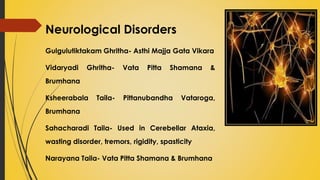
Neurological Disorders
Gulgulutiktakam Ghritha- Asthi Majja Gata Vikara
Vidaryadi Ghritha- Vata Pitta Shamana &
Brumhana
Ksheerabala Taila- Pittanubandha Vataroga,
Brumhana
Sahacharadi Taila- Used in Cerebellar Ataxia,
wasting disorder, tremors, rigidity, spasticity
Narayana Taila- Vata Pitta Shamana & Brumhana
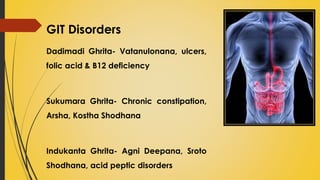
GIT Disorders
Dadimadi Ghrita- Vatanulonana, ulcers,
folic acid & B12 deficiency
Sukumara Ghrita- Chronic constipation,
Arsha, Kostha Shodhana
Indukanta Ghrita- Agni Deepana, Sroto
Shodhana, acid peptic disorders
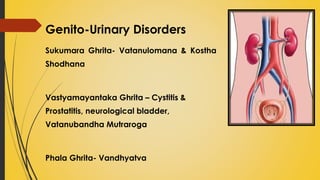
Genito-Urinary Disorders
Sukumara Ghrita- Vatanulomana & Kostha
Shodhana
Vastyamayantaka Ghrita – Cystitis &
Prostatitis, neurological bladder,
Vatanubandha Mutraroga
Phala Ghrita- Vandhyatva
Psychiatric Disorders
Panchagavya Ghrita- Vatapradhana
Manovikara
Kalyanaka Ghrita- Tridoshahara,
Apasmara, Vaksanga
Brahmi Ghrita- Medhya
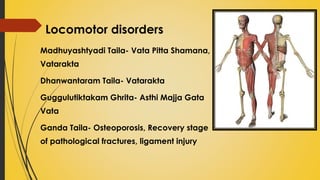
Locomotor disorders
Madhuyashtyadi Taila- Vata Pitta Shamana,
Vatarakta
Dhanwantaram Taila- Vatarakta
Guggulutiktakam Ghrita- Asthi Majja Gata
Vata
Ganda Taila- Osteoporosis, Recovery stage
of pathological fractures, ligament injury
Immunopathology
Indukanta ghrita- Agni Deepana, Sroto
Shodhana, Jwara Hara
Shatpala Ghrita- Vatahara, Agnideepana,
bronchial ailments
Practical considerations
during Snehapana
 In Paittika disorders, Kevala Ghrita should be given.
 In Vatika cases mixed with Lavana
 In Bahu Kapha Ghrita should be combined with Trikatu and
Yavakshara
 In Mandagni to enhance Agni Ghrita should to be administered
along with Kshara and Lavana
 In Kushta, Shopha, and Prameha one should not use Gramya-
Anupa- Audaka Mamsa, Guda, Dadhi, Kshira, and Tila for
Sadyo-Snehana.
 Snehas processed with Pippali, Haritaki and Triphala.
 Agni & Kostha should be considered before Snehapana.
 Onset of Samyak Snigdha occur in sequential manner which is
helpful in predicting duration of snehapana.
 Selection of Sneha is very important for desired
therapeutic effect.
 Rukshana should be done in Mamsala, Medura, Bahu
Kapha, Vishamagni & Sneha Satmya before Snehapana.
Abhyantara sneha
Abhyantara sneha

Abhyantara sneha

  • 1.
  • 2.
    ABHYANTARA SNEHAPANA Dr. KetanMahajan M.D. Panchakarma Assistant Professor Department of Panchakarma Patanjali Bhartiya Ayurvigyan Evam Anusandhan Sansthan Haridwar, U.K. Email: ketanmahajan82@gmail.com
  • 3.
  • 4.
  • 5.
    The process whichproduces: Sneha Vishyandana Mriduta Kledana
  • 6.
    Sneha therapy canbe administered only when:- There is good Agnideepti There is Srotoshodhana For this purpose Deepana, Pachana, Rooksha aushadhis are given before Snehana.
  • 7.
    Deepana- Pachana Chikitsa Enhancesthe Agni Clears the Srotas Better absorption & efficacy Reduces the risk of complications
  • 8.
    How to applyDeepana Pachana in practice CHOORNA • Panchakola • Ajmodadi • Vaishwanara etc.. KASHAYA • Dashmoola • Chirbilwadi • Shunthi etc.. VATI • Chitrakadi • Agnitundi etc..
  • 9.
    • Agnitundi Vati • Trikatu Churna •Jeerak Churna • Panchakola Phanta Vata Pitta Shoola Pradhan Roga Kapha
  • 10.
    Note: If necessarymild Anulomana Dravyas can be advised during Deepana Pachana like Abhayarishta, Avipattikara Churna etc..  If Rukshana is necessary Takrarishta, Udvartana can be adviced.
  • 11.
    Multifaceted Therapy As Poorvakarma External& Internal Use Localized & Systemic Action Different modes of Administration Nourishes Body & Mind
  • 12.
    Where can wegive Sneha ??
  • 13.
    Indications  Svedya  Samshodya Ruksha  Vata Vikara  Vyayamanitya  Madhyanitya  Streenitya  Chintaka  Vriddha  Bala  Abala  Krisha  Ksheenasra  Ksheenaretas  Syanda  Timira  Daruna Pratibodhinah
  • 14.
    Practically what wecome across.. Degenerative disorders of joints Skin disorders Psychiatric illnesses Neurological diseases Immune pathologies Myopathies Gynecological disorders
  • 15.
    Contraindications  Rukshanarha  UtsannaKapha  Utsanna Medas  Abhishyanna- Anaha  Abhishyanna Guda  Mandagni  Trishna  Murcha  Garbhini  Talushosha  Annadvesha  Chardi  Gar-ardita  Ama-ardita  Durbala  Snehaglanayah  Madatura  Ajirna  Taruna jwara  Basti karma  Aruchi  Vamita  Virikta  Akala prasruta  Udararogi  Urustambha  Atisara
  • 16.
    Practically what wecome across.. Patients with Mandagni Diseases of Kapha Anubandha Diseases of Meda Anubandha
  • 17.
  • 18.
    Ghee- Points toremember  Samskara Anuvartanam  Madhura  Avidahitvat  Janmadyeva Cha Sheelanat  Administered in Sharad Ritu  Those who desire for longevity, Bala, Varna, Svara, Pushti, Smriti, Medha, Dhee, Agni etc..
  • 19.
    Taila- Points toremember  Madhura Rasa Ushna Guna  Administered in Pravrut & Sheeta Kala  Pravriddha Shleshma & Medas  In Krimi Kostha  In Krura Kostha  Those who desire for Bala, Laghuta etc..
  • 20.
    Vasa- Points toremember  Having best Agni Bala  Ruksha  Emaciated from weight lifting, coitus & excessive walking  Sandhi, Asthi, Marma, Koshţha Ruja  Vata Avarana  Vasa Satmya
  • 21.
    Majja- Points toremember  Diptagni  Klesha Saha  Krura Koshţha  Sneha Sevi  Those who desire of Bala-Shukra-Majja-Asthi Vardhana
  • 22.
    Yamaka & MahaSneha  To use in different degrees of Vata vitiation  Eg. Jeevantyadi Yamak in Vipadika, Mahasneha in Asthimajjagata Vata
  • 23.
    Karmukta Bheda ofSneha Criteria Shodhana Shamana Brimhana Purpose Doshutklesha Vyadhi Shamana Brimhana Form Accha, Vicharana Accha Vicharana Dose Uttama Madhayam Alpa Time & Method of administration Morning Akshudhita Morning Kshudhita Any time with food Duration Maximum 7 days Till Vyadhi Shamana Till samyak Brimhana
  • 24.
    Types of AbhyantaraSnehapana in Practice  Accha Sneha  Pravicharana Sneha  Sadhya Sneha
  • 25.
  • 26.
     Intake oflarge quantity of Sneha, without mixing with any other materials.  Taking large quantity of Sneha after the digestion of previous night meal.  If Accha Sneha is taken during Kshudha Kala it does not serve the purpose of Shodhana because of Deeptagni.
  • 27.
    Indications Contraindications Sneha SatmayaSneha Dveshi Klesha Saha Kshama Nati Sheeta/Ushna Kala Mridu Kostha Sneha-Madhya Nitya
  • 28.
    Duration of administration KruraKoshta - 7 days Madhyama Koshta - 4 to 5 days Mrudu Koshta - 3 days Or Upto Samyak Snigdha Lakshana, whichever is earlier. If administered for long time it will lead to Satmyata.
  • 29.
    Materials required  Sneha-Q.S.  Measuring jar-1  Glass-1  Cloth-1  Lemon-1  Water boiled with Shunti - Q.S.  Cotton- Q.S.  Gauze-1  Tumbler-1
  • 30.
    Pre operative procedure Proper Patient examination  Assessment of digestion and bowel  Test dose
  • 31.
    Important Factors forAbhyantara Snehapana KOSTHA AGNI
  • 32.
    Assessment of Kostha Frequency of stool  Consistency of stool  Time for defecation  Level of satisfaction  Effect of food items & medicines  Any GIT pathology
  • 33.
    Assessment of Agni Understand the level and degree of Appetite  Details of Food habit  Any history of Ajeerna  Quantity and Quality of food  Timing and interval of Food
  • 34.
    Investigations required priorto Accha Snehapana  Blood - RE, LFT, Sugar levels , Lipid profiles.  Urine - RE  Stool - RE
  • 35.
    Procedure  Dosage ofthe sneha must be decided according to Vayas, Prakriti, Vikriti, Dosha and Agnibala.  It must be in between 30-50 ml  The dose for the next day should be fixed after assessing the time taken for digestion.
  • 36.
     Within halfan hour of sunrise, patient should be seated in a comfortable position and Sneha should be given in empty stomach.  After giving the Sneha warm water should be given as Anupana
  • 37.
    Specific Anupana  Ushnodakafor most of the sneha except those processed with Tuvarak & Bhallatak  Yusha- for Taila  Manda- Vasa & Majja
  • 38.
     Then thepatient should wash the face and mouth with hot water to remove the taste of Sneha.  When thirst occurs, hot water can be given.
  • 39.
    Jiryamana Lakshana JirnaLakshana Shiroruja Shirorujadi Jiryamana Lakshana Prashamana Bhrama Vatanulomana Nishthiva Svastyata Murcha Kshut Sada Trishna Arati Udgarashuddhi Klama Laghuta
  • 40.
    Samyak Snigdha Lakshana 1.Agnideepti (increase in appetite) 2. Sneha- Dvesha (intolerance to fat) 3. Asamhata Varcha (loose stools) 4. Anga Laghava (lightness in the body) 5. Gatra Mardawa (soft feeling of body parts) 6. Snigdha Gatrata (smoothness in the body)
  • 41.
    7. Snigdha Pureesha(oily stools) 8. Snigdha Twcha (oily skin) 9. Vatanulomana (passage of flatus) 10. Adastad Sneha Darsanam (passing of fat in stools) 11. Klama (tiredness without doing physical work) 12. Shaithilya (lethargy)
  • 42.
    Key Points  Vatanulomana– Normal GIT movements  Agnideepti – Normal Appetite  Varcha Snigdhata and Asamhata – Oily stool  Snehodwega – Aversion to Sneha  Klama - Lassitude
  • 43.
    Asnigdha Lakshana 1. GrathitaPurisha (passing of hard stools) 2. Ruksha Purisha (passing of dry stools) 3. Agnimandya (weak digestive power) 4. Vayu Pratilomata (unregulated vata) 5. Gatra Kharata (roughness of body) 6. Gatra Rukshata (dryness of body) 7. Urovidaha (burning sensation in chest) 8. Dourbalya (weakness) 9. Kricchra Annapachana (late digestion) 10.Susnigdha Viparyaya (features opposite to those of Samyak Sneha)
  • 44.
    Atisnigdha Lakshana 1. Panduta(pallor) 2. Sharira Gaurava (heaviness of body) 3. Jadyata (sluggishness) 4. Apakva Purisha (undigested foods in stools) 5. Tandra (drowsiness) 6. Aruchi (lack of taste in the mouth) 7. Utklesha (nausea)
  • 45.
    8. Bhaktadvesha (aversionto take food) 9. Mukhasrava (Excessive salivation) 10. Ghranasrava (discharge from the nose) 11. Gudasrava (secretions in the anus) 12. Gudadaha (burning sensation in the anal region) 13. Pravahika (dysentery) 14. Purisha - Atipravritti (excessive passing of stools)
  • 46.
    Complications practically observed.. ComplicationManagement Headache Ushnanupana, Rasnadi Lepa, Shunthidhanyak Pana Gas Trouble Hinguvachadi Gutika, Pippalyasava Hiccup Hinguvachadi gutika, Shunthidhanyak Pana, Dhanvantaram Gutika Burning Sensation Drakshadi Kashaya, Avipatti Churna, Nishunthi Shadang Paniya
  • 47.
    Complication Management Fatigue PurnachandrodayaGutika, Balaristha, Draksharistha, Mild Shodhana Diarrhoea Bilvadi Gutika, Mustarishta Vomiting Bilvadi Kashaya, Bilvadi Lehya, Dadima Rasa Indigestion Hinguvachadi Gutika, Abhyarishta, Jirakarishta
  • 48.
    Post Operative Procedure Patient should take rest during the Snehapana period but he/she should not sleep during the day time.  Lemon can be given to smell to avoid nausea.  Warm Vilepi should be given when the Sneha is completely digested and good appetite occurs.
  • 49.
    Pathya - Dietand Regimen Usage of hot water for all purposes Abstinence Non-suppression of urges Non-exposure to cold, dust & sun Stable mentality
  • 50.
  • 51.
     When Snehais particularly used in the form of Bhaksha, Pana, Leha, Abhyanjana etc. it is called as‘Pravicharana’.  While describing the ‘Brimhana Snehapana’ Hemadri says that Rasa, Madya etc. when mixed according to taste, palatability and Satmya of the individual in the Sneha is called as ‘Vicharana’.
  • 52.
     As perthe mode of application these preparations can be divided in to two groups as – a) Internal Pravicharana. b) External Pravicharana.  The preparations like Odana, Vilepi, Mamsarasa, Paya (milk), Dadhi, Yavagu, Supa, Shaka, Yush, Kambalika, Khada, Saktu, Tila pishta, Madya, Lehya etc. comes under internal use category.  Whereas, Abhyanga, Basti, Uttarbasti, Gandusha, Karnatail, Nasya, Akshitarpana, Karnatarpana are the external types of Pravicharana.
  • 53.
    Karma Bheda ofPravicharana Sneha Criteria Vamana Virechana Basti Nasya Rakta Mokshana Purpose Kaphotklesha Kapha- Avriddhikara Angamardava, Vatanulomana Dosha Vilayana Doshotkleshana Type Int & Ext Int & Ext Ext Ext Int Example Dugdha, Dadhi, Mamsa, Tilapishta Yusha, Supa, Kambalika, Khada, Madya Abhyanga, Anuvasana Basti Abhyanga, Gandusha Yavagu, Madya
  • 54.
    Commonly prepared Pravicharana Odana:1 part rice + 5 parts water Vilepi: 1 part cereal + 4 parts water Rasa: 1 part meat + 2/3/4 parts water
  • 55.
    Yavagu: 1 partcereal + 6 parts water Supa: 1 part pulses + 18 parts water reduced to 1/4th Yusha: 1 part pulses + 18 parts water reduced to 1/2 Saktu: Flour of cereals & pulses mixed with Ghee
  • 56.
  • 57.
     To achieveSamyak Snigdha Lakshana immediately  Lakshanas are attained within 1-3 days  Based mainly on the principal of Pravicharana Sneha
  • 58.
    Indications  Bala  Vriddha Sneha Parihara Asahishnu  Balahina  Mridu Agni  Alpa Dosha
  • 59.
    Contra-Indications  In Kustha,Prameha & Shotha it should not be given with Gramya, Anupa, Audaka Mamsa, Kshira, Guda, Dadhi and Tila.
  • 60.
    Commonly used SadhyoSneha Yogas  Pippali, Saindhava, Tila Pishta, Ghee  Ghee, powdered sugar, milk – Ruksha Person  Yavagu ( rice & milk) with Ghee  Dugdha with Ghee & Lavana
  • 61.
     Pancha PrasrutaSneha – Chatur Sneha ( 1 Prastha each) mixed with 1 Prastha rice  Lavanayukta Sneha – Instant Snehana due to Abhishyandi, Sukshma, Ushna , Vyavayi Guna
  • 62.
  • 63.
    Sneho Anilam Hanti… Vata Shamak property of Sneha  Sneha have opposite Gunas of Vata  Vatanulomana 1st Samyak Snigdha Lakshana  Helps in proper Gati of Vata
  • 64.
    Mrudukaroti Deham  Snigdha& Mridu Guna of Sneha  Sneha Mardavkrut  Can be assessed by Gatra Mardava
  • 65.
    Malanam Vihanti Sangam Malasanga is caused due to Rukshata  Snigdha property of Sneha overcomes the Rukshata  Sanga is corrected
  • 66.
    Commonly used drugsfor Snehapana
  • 67.
    Skin Disorders Tiktaka Ghrita-Pitta Gulgulutiktakam Ghrita- Psoriatic Arthropathy Patoladi Ghrita- Infectious Skin Diseases
  • 68.
    Neurological Disorders Gulgulutiktakam Ghritha-Asthi Majja Gata Vikara Vidaryadi Ghritha- Vata Pitta Shamana & Brumhana Ksheerabala Taila- Pittanubandha Vataroga, Brumhana Sahacharadi Taila- Used in Cerebellar Ataxia, wasting disorder, tremors, rigidity, spasticity Narayana Taila- Vata Pitta Shamana & Brumhana
  • 69.
    GIT Disorders Dadimadi Ghrita-Vatanulonana, ulcers, folic acid & B12 deficiency Sukumara Ghrita- Chronic constipation, Arsha, Kostha Shodhana Indukanta Ghrita- Agni Deepana, Sroto Shodhana, acid peptic disorders
  • 70.
    Genito-Urinary Disorders Sukumara Ghrita-Vatanulomana & Kostha Shodhana Vastyamayantaka Ghrita – Cystitis & Prostatitis, neurological bladder, Vatanubandha Mutraroga Phala Ghrita- Vandhyatva
  • 71.
    Psychiatric Disorders Panchagavya Ghrita-Vatapradhana Manovikara Kalyanaka Ghrita- Tridoshahara, Apasmara, Vaksanga Brahmi Ghrita- Medhya
  • 72.
    Locomotor disorders Madhuyashtyadi Taila-Vata Pitta Shamana, Vatarakta Dhanwantaram Taila- Vatarakta Guggulutiktakam Ghrita- Asthi Majja Gata Vata Ganda Taila- Osteoporosis, Recovery stage of pathological fractures, ligament injury
  • 73.
    Immunopathology Indukanta ghrita- AgniDeepana, Sroto Shodhana, Jwara Hara Shatpala Ghrita- Vatahara, Agnideepana, bronchial ailments
  • 74.
  • 75.
     In Paittikadisorders, Kevala Ghrita should be given.  In Vatika cases mixed with Lavana  In Bahu Kapha Ghrita should be combined with Trikatu and Yavakshara  In Mandagni to enhance Agni Ghrita should to be administered along with Kshara and Lavana
  • 76.
     In Kushta,Shopha, and Prameha one should not use Gramya- Anupa- Audaka Mamsa, Guda, Dadhi, Kshira, and Tila for Sadyo-Snehana.  Snehas processed with Pippali, Haritaki and Triphala.  Agni & Kostha should be considered before Snehapana.  Onset of Samyak Snigdha occur in sequential manner which is helpful in predicting duration of snehapana.
  • 77.
     Selection ofSneha is very important for desired therapeutic effect.  Rukshana should be done in Mamsala, Medura, Bahu Kapha, Vishamagni & Sneha Satmya before Snehapana.