1/ 30
A Quick note on Regional Economics What is rural? Rural economic decline
What should we do when communities
struggle?
Intervene or not?
Mouhcine Guettabi, PhD
Associate Professor of Economics
Director of the Investing for Alaska’s Future Program
Institute of Social and Economic Research
University of Alaska Anchorage
University of North Carolina Wilmington
January 16th, 2020
2/ 30
A Quick note on Regional Economics What is rural? Rural economic decline
Outline
A Quick note on Regional Economics
Why does it matter?
Thinking on a sub-national level
What is rural?
A few definitions
Rural economic decline
What should be done?
A simple decomposition
Takeaways
3/ 30
A Quick note on Regional Economics What is rural? Rural economic decline
Outline
A Quick note on Regional Economics
Why does it matter?
Thinking on a sub-national level
What is rural?
A few definitions
Rural economic decline
What should be done?
A simple decomposition
Takeaways
4/ 30
A Quick note on Regional Economics What is rural? Rural economic decline
A simple definition of the field
Regional and urban economics examines issues related to the
intersection of economics with geography and public policy.
Central to this field is the study of economic forces related to
the development and growth of urban and rural areas.
5/ 30
A Quick note on Regional Economics What is rural? Rural economic decline
A very incomplete list of topics
• Sub-national economic growth and development
• Location choices of utility-maximizing households and
profit-maximizing firms
• Spatial differences in incomes, unemployment, and
individual well-being
• Advantages and disadvantages of spatially concentrating
economic activity
• Transportation of goods, people, and ideas across areas
• Land use, land prices, housing markets, and state and
local public finance and governance
5/ 30
A Quick note on Regional Economics What is rural? Rural economic decline
A very incomplete list of topics
• Sub-national economic growth and development
• Location choices of utility-maximizing households and
profit-maximizing firms
• Spatial differences in incomes, unemployment, and
individual well-being
• Advantages and disadvantages of spatially concentrating
economic activity
• Transportation of goods, people, and ideas across areas
• Land use, land prices, housing markets, and state and
local public finance and governance
5/ 30
A Quick note on Regional Economics What is rural? Rural economic decline
A very incomplete list of topics
• Sub-national economic growth and development
• Location choices of utility-maximizing households and
profit-maximizing firms
• Spatial differences in incomes, unemployment, and
individual well-being
• Advantages and disadvantages of spatially concentrating
economic activity
• Transportation of goods, people, and ideas across areas
• Land use, land prices, housing markets, and state and
local public finance and governance
5/ 30
A Quick note on Regional Economics What is rural? Rural economic decline
A very incomplete list of topics
• Sub-national economic growth and development
• Location choices of utility-maximizing households and
profit-maximizing firms
• Spatial differences in incomes, unemployment, and
individual well-being
• Advantages and disadvantages of spatially concentrating
economic activity
• Transportation of goods, people, and ideas across areas
• Land use, land prices, housing markets, and state and
local public finance and governance
5/ 30
A Quick note on Regional Economics What is rural? Rural economic decline
A very incomplete list of topics
• Sub-national economic growth and development
• Location choices of utility-maximizing households and
profit-maximizing firms
• Spatial differences in incomes, unemployment, and
individual well-being
• Advantages and disadvantages of spatially concentrating
economic activity
• Transportation of goods, people, and ideas across areas
• Land use, land prices, housing markets, and state and
local public finance and governance
5/ 30
A Quick note on Regional Economics What is rural? Rural economic decline
A very incomplete list of topics
• Sub-national economic growth and development
• Location choices of utility-maximizing households and
profit-maximizing firms
• Spatial differences in incomes, unemployment, and
individual well-being
• Advantages and disadvantages of spatially concentrating
economic activity
• Transportation of goods, people, and ideas across areas
• Land use, land prices, housing markets, and state and
local public finance and governance
6/ 30
A Quick note on Regional Economics What is rural? Rural economic decline
Outline
A Quick note on Regional Economics
Why does it matter?
Thinking on a sub-national level
What is rural?
A few definitions
Rural economic decline
What should be done?
A simple decomposition
Takeaways
7/ 30
A Quick note on Regional Economics What is rural? Rural economic decline
8/ 30
A Quick note on Regional Economics What is rural? Rural economic decline
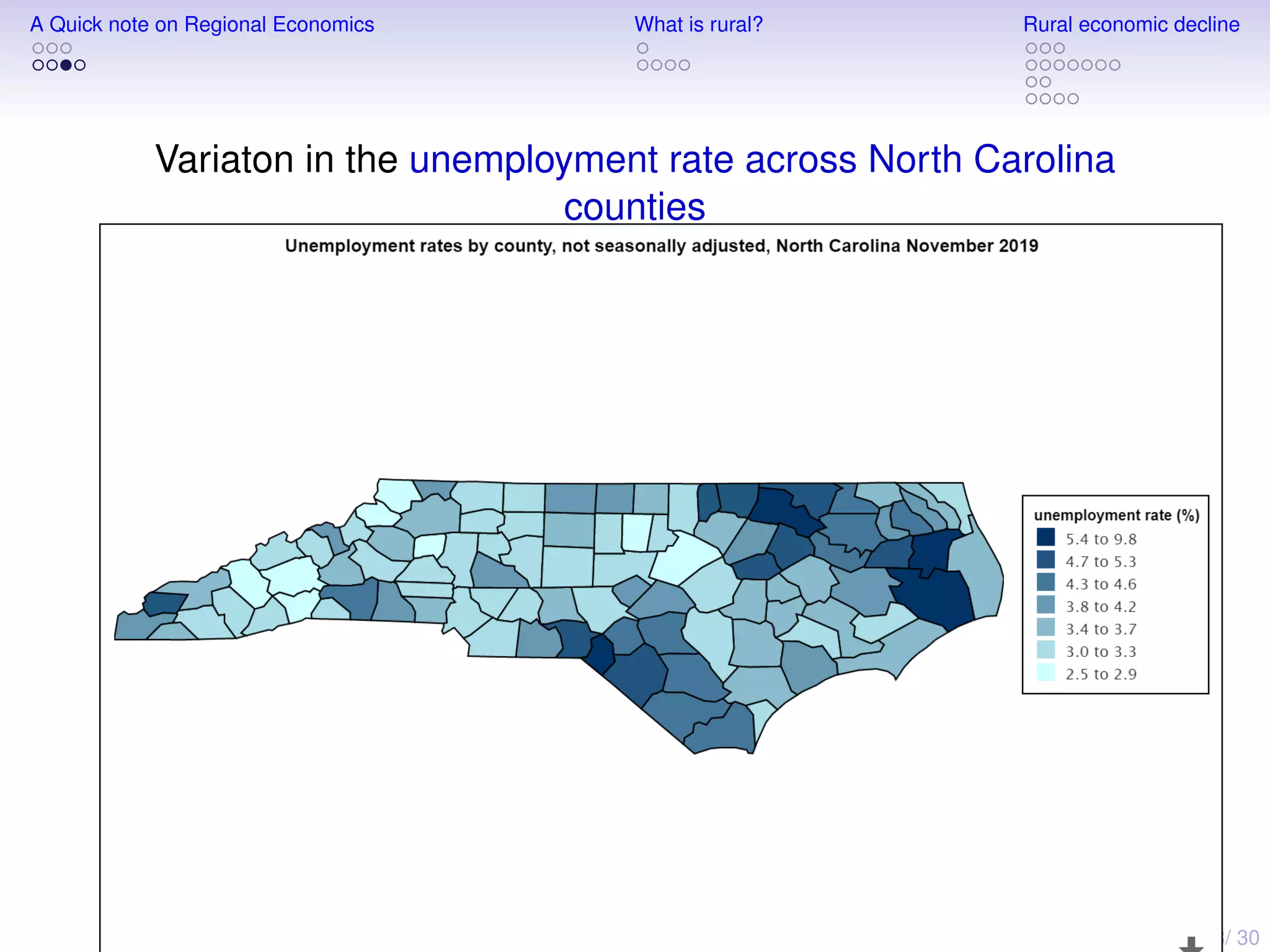
Variaton in the unemployment rate across North Carolina
counties
9/ 30
A Quick note on Regional Economics What is rural? Rural economic decline
What exactly is the issue?
• There is considerable variation in economic opportunity
and outcomes across and even within states.
• One of the questions that concerns regional economists,
politicians, and economic developers is whether to
intervene when communities are struggling.
• This question has become particularly important due to the
significant economic decline that has been occurring in
many rural communities across the country.
9/ 30
A Quick note on Regional Economics What is rural? Rural economic decline
What exactly is the issue?
• There is considerable variation in economic opportunity
and outcomes across and even within states.
• One of the questions that concerns regional economists,
politicians, and economic developers is whether to
intervene when communities are struggling.
• This question has become particularly important due to the
significant economic decline that has been occurring in
many rural communities across the country.
10/ 30
A Quick note on Regional Economics What is rural? Rural economic decline
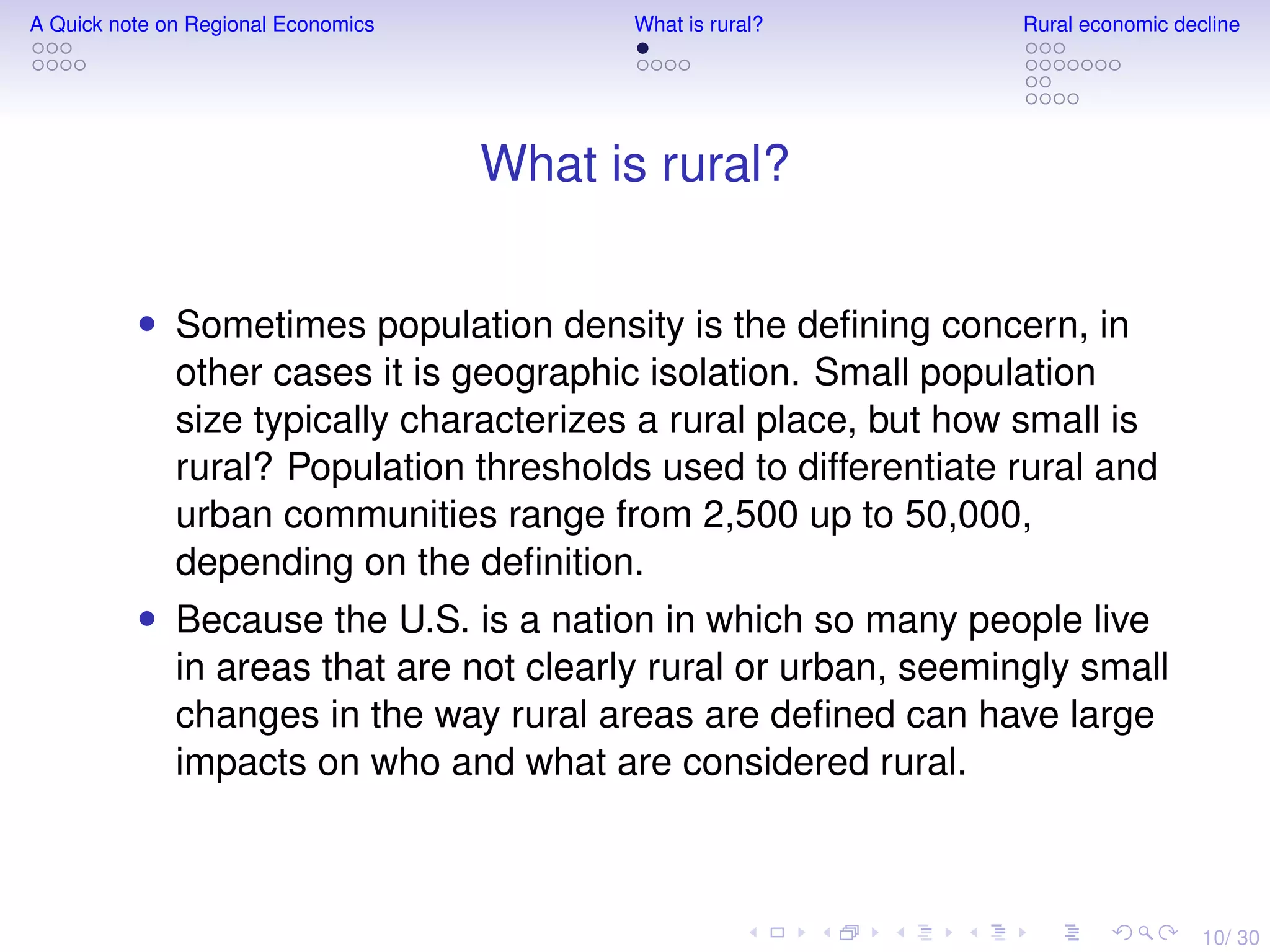
What is rural?
• Sometimes population density is the defining concern, in
other cases it is geographic isolation. Small population
size typically characterizes a rural place, but how small is
rural? Population thresholds used to differentiate rural and
urban communities range from 2,500 up to 50,000,
depending on the definition.
• Because the U.S. is a nation in which so many people live
in areas that are not clearly rural or urban, seemingly small
changes in the way rural areas are defined can have large
impacts on who and what are considered rural.
10/ 30
A Quick note on Regional Economics What is rural? Rural economic decline
What is rural?
• Sometimes population density is the defining concern, in
other cases it is geographic isolation. Small population
size typically characterizes a rural place, but how small is
rural? Population thresholds used to differentiate rural and
urban communities range from 2,500 up to 50,000,
depending on the definition.
• Because the U.S. is a nation in which so many people live
in areas that are not clearly rural or urban, seemingly small
changes in the way rural areas are defined can have large
impacts on who and what are considered rural.
11/ 30
A Quick note on Regional Economics What is rural? Rural economic decline
Outline
A Quick note on Regional Economics
Why does it matter?
Thinking on a sub-national level
What is rural?
A few definitions
Rural economic decline
What should be done?
A simple decomposition
Takeaways
12/ 30
A Quick note on Regional Economics What is rural? Rural economic decline
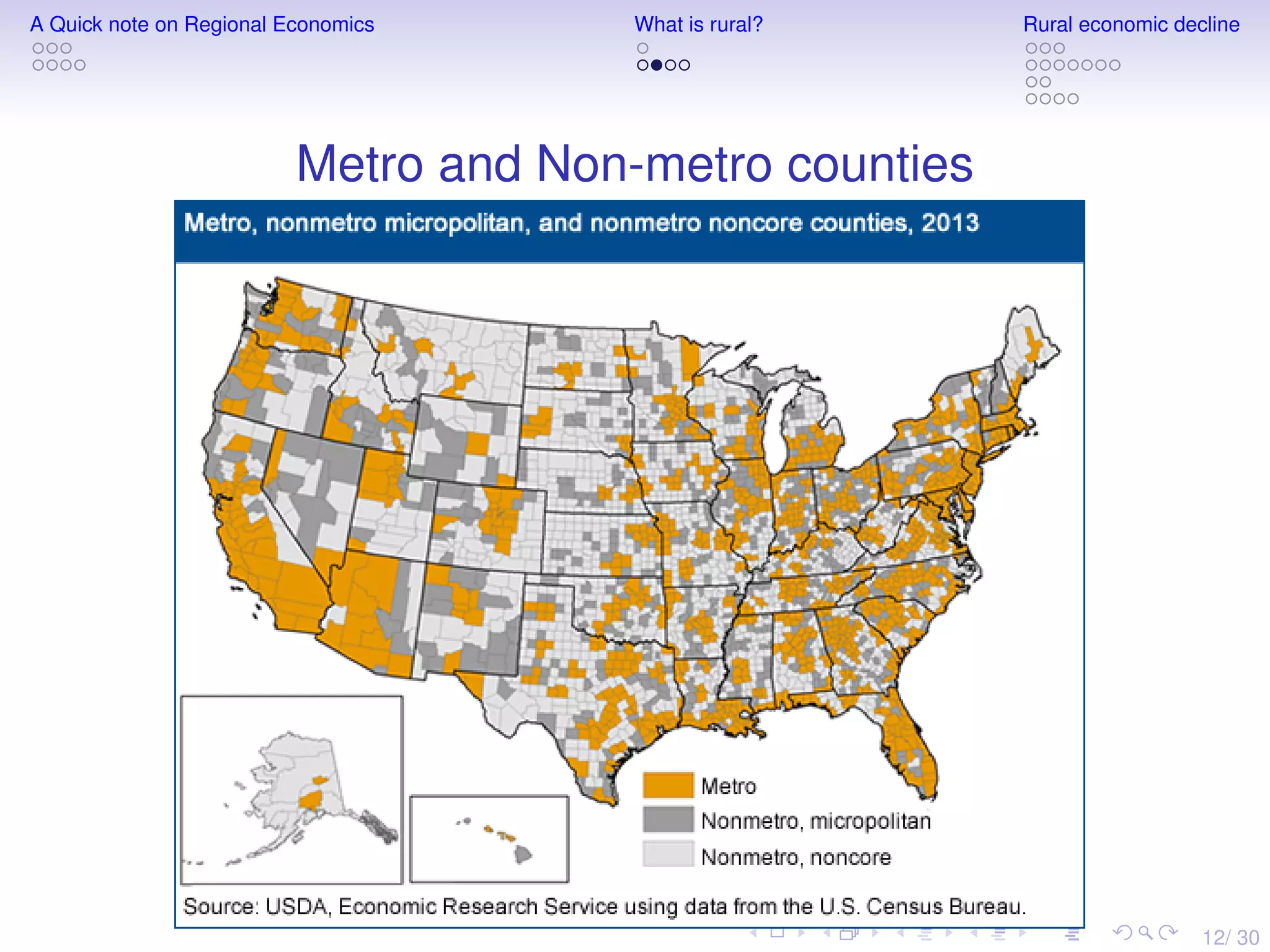
Metro and Non-metro counties
13/ 30
A Quick note on Regional Economics What is rural? Rural economic decline
Metro and Non-Metro definitions from OMB 2013
In 2013, OMB defined metropolitan (metro) areas as broad
labor-market areas that include: Central counties with one or
more urbanized areas; urbanized areas are densely-settled
urban entities with 50,000 or more people. Outlying counties
that are economically tied to the core counties as measured by
labor-force commuting.
- Non-metropolitan counties are outside the boundaries of
metro areas and are further subdivided into two types:
- Micropolitan (micro) areas, which are nonmetro labor-market
areas centered on urban clusters of 10,000-49,999 persons
and defined with the same criteria used to define metro areas.
All remaining counties, often labeled "noncore" counties
because they are not part of "core-based" metro or micro areas.
14/ 30
A Quick note on Regional Economics What is rural? Rural economic decline
Useful ERS definitions
The USDA classifies counties from 1-9:
• 1-3 are Metropolitan counties
• 4-9 are Non-metropolitan counties.
• North Carolina, for example, has 100 counties with 51 of
them being considered Non-metropolitan counties. New
Hanover is considered a metropolitan county -classification
of 2- as it is a county in a metropolitan area of 250,000 to 1
million people.
15/ 30
A Quick note on Regional Economics What is rural? Rural economic decline
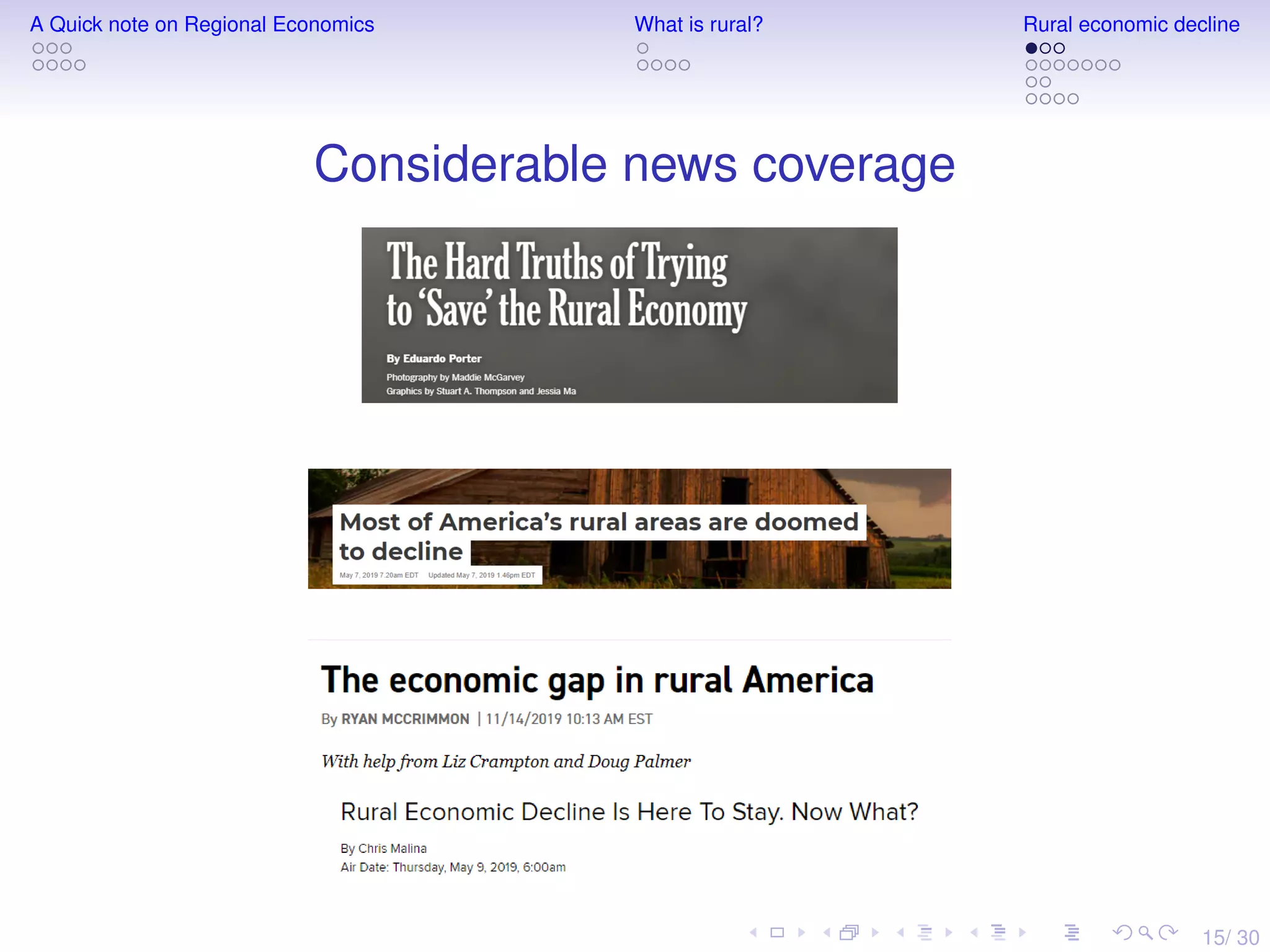
Considerable news coverage
16/ 30
A Quick note on Regional Economics What is rural? Rural economic decline
Very significant differences in growth across places
17/ 30
A Quick note on Regional Economics What is rural? Rural economic decline
Uneven recovery by the numbers
Source: Chart: The Conversation, CC-BY-ND Source: Bureau of Economic Analysis, analyzed by David Swenson at
Iowa State University
18/ 30
A Quick note on Regional Economics What is rural? Rural economic decline
Outline
A Quick note on Regional Economics
Why does it matter?
Thinking on a sub-national level
What is rural?
A few definitions
Rural economic decline
What should be done?
A simple decomposition
Takeaways
19/ 30
A Quick note on Regional Economics What is rural? Rural economic decline
Now what?
• Faced with these facts, what should states or localities do?
• Do nothing
• Help people move to thriving areas
• Promote economic development and try to revive dying
areas
20/ 30
A Quick note on Regional Economics What is rural? Rural economic decline
Economic development
• Economic development strategists can pursue a wide
variety of avenues, from improving quality of life, human
capital, and infrastructure to provision of business tax
incentives.
• Although these efforts are often surrounded by significant
controversy and debate regarding their relative
effectiveness, one central element that influences the net
value of these efforts to voters is who benefits from the
new jobs.
20/ 30
A Quick note on Regional Economics What is rural? Rural economic decline
Economic development
• Economic development strategists can pursue a wide
variety of avenues, from improving quality of life, human
capital, and infrastructure to provision of business tax
incentives.
• Although these efforts are often surrounded by significant
controversy and debate regarding their relative
effectiveness, one central element that influences the net
value of these efforts to voters is who benefits from the
new jobs.
21/ 30
A Quick note on Regional Economics What is rural? Rural economic decline
Let’s start with the basics
• The United States has often been characterized by
academic economists as having perfectly mobile labor
(Blanchard and Katz, 1992), which according to
neoclassical economic theory argues against targeting
specific rural areas for economic development.
• If households are fully (costlessly) mobile, they reside in
the location delivering them the most satisfaction. They
respond to local job losses by relocating to areas with
better economic prospects. This equalizes satisfaction with
location of residence across all areas.
• So no attempt need be made by states to improve the
welfare of their residents through within-state
geographically targeted economic development (and by
implication no need for rural development by the federal
government).
21/ 30
A Quick note on Regional Economics What is rural? Rural economic decline
Let’s start with the basics
• The United States has often been characterized by
academic economists as having perfectly mobile labor
(Blanchard and Katz, 1992), which according to
neoclassical economic theory argues against targeting
specific rural areas for economic development.
• If households are fully (costlessly) mobile, they reside in
the location delivering them the most satisfaction. They
respond to local job losses by relocating to areas with
better economic prospects. This equalizes satisfaction with
location of residence across all areas.
• So no attempt need be made by states to improve the
welfare of their residents through within-state
geographically targeted economic development (and by
implication no need for rural development by the federal
government).
21/ 30
A Quick note on Regional Economics What is rural? Rural economic decline
Let’s start with the basics
• The United States has often been characterized by
academic economists as having perfectly mobile labor
(Blanchard and Katz, 1992), which according to
neoclassical economic theory argues against targeting
specific rural areas for economic development.
• If households are fully (costlessly) mobile, they reside in
the location delivering them the most satisfaction. They
respond to local job losses by relocating to areas with
better economic prospects. This equalizes satisfaction with
location of residence across all areas.
• So no attempt need be made by states to improve the
welfare of their residents through within-state
geographically targeted economic development (and by
implication no need for rural development by the federal
government).
22/ 30
A Quick note on Regional Economics What is rural? Rural economic decline
What do we know about mobility?
• There is substantial evidence that rural households are not
perfectly mobile. Households with lower levels of education
and skills, who are typically least likely to be employed,
have been observed to be less geographically mobile than
the typical American household (Yankow, 2003).
• Distance to potential migration destinations creates
transport and psychic costs of relocation for rural
households, impeding their mobility.
• Likewise, cultural differences between rural residents in
many remote areas and those in more urbanized areas
may make rural residents reluctant to move.
22/ 30
A Quick note on Regional Economics What is rural? Rural economic decline
What do we know about mobility?
• There is substantial evidence that rural households are not
perfectly mobile. Households with lower levels of education
and skills, who are typically least likely to be employed,
have been observed to be less geographically mobile than
the typical American household (Yankow, 2003).
• Distance to potential migration destinations creates
transport and psychic costs of relocation for rural
households, impeding their mobility.
• Likewise, cultural differences between rural residents in
many remote areas and those in more urbanized areas
may make rural residents reluctant to move.
22/ 30
A Quick note on Regional Economics What is rural? Rural economic decline
What do we know about mobility?
• There is substantial evidence that rural households are not
perfectly mobile. Households with lower levels of education
and skills, who are typically least likely to be employed,
have been observed to be less geographically mobile than
the typical American household (Yankow, 2003).
• Distance to potential migration destinations creates
transport and psychic costs of relocation for rural
households, impeding their mobility.
• Likewise, cultural differences between rural residents in
many remote areas and those in more urbanized areas
may make rural residents reluctant to move.
23/ 30
A Quick note on Regional Economics What is rural? Rural economic decline
Who benefits?
• state economic development efforts that successfully
stimulate employment in remote rural areas could
potentially improve the welfare of their residents who may
have been left behind economically, particularly in the
short run (Partridge and Rickman, 2003b).
• Indeed, research on rural poverty reveals that remote rural
areas possessing high rates of poverty particularly benefit
from job growth (Partridge and Rickman, 2005a).
According to this research, area job growth increases
employment rates, increases wage rates, and thereby
reduces poverty rates.
23/ 30
A Quick note on Regional Economics What is rural? Rural economic decline
Who benefits?
• state economic development efforts that successfully
stimulate employment in remote rural areas could
potentially improve the welfare of their residents who may
have been left behind economically, particularly in the
short run (Partridge and Rickman, 2003b).
• Indeed, research on rural poverty reveals that remote rural
areas possessing high rates of poverty particularly benefit
from job growth (Partridge and Rickman, 2005a).
According to this research, area job growth increases
employment rates, increases wage rates, and thereby
reduces poverty rates.
24/ 30
A Quick note on Regional Economics What is rural? Rural economic decline
Job creation
• Supply responses to labor demand shocks can be in the
form of commuting, unemployment, labor force
participation, and migration responses.
• Employment by firm (place of work) location E(F ) is
decomposed into four labor supply components:
(a) the ratio of employment by firm location to employment
by place of residence: (EF )/(ER).
(b) employment/labor force (ER)/(LF)
(c) labor force/population (LF)/(Pop),
(d) population
25/ 30
A Quick note on Regional Economics What is rural? Rural economic decline
Outline
A Quick note on Regional Economics
Why does it matter?
Thinking on a sub-national level
What is rural?
A few definitions
Rural economic decline
What should be done?
A simple decomposition
Takeaways
26/ 30
A Quick note on Regional Economics What is rural? Rural economic decline
A simple decomposition
Often when promoters make a case for economic development,
the intended beneficiaries are the location’s original
(pre-development policy) residents. Indeed, the question of
whether economic development policies pass a costâbenefit
analysis would then hinge on who takes the new jobs. The job
benefits accrued by original residents critically depend on the
commuting and migration responses to local job creation
E(F
) = (EF
)/(ER
)
Net commuting
x (ER
)/(LF)
Emp. rate
x (LF)/(Pop)
Labor force
x (Pop)
Migration
27/ 30
A Quick note on Regional Economics What is rural? Rural economic decline
Outline
A Quick note on Regional Economics
Why does it matter?
Thinking on a sub-national level
What is rural?
A few definitions
Rural economic decline
What should be done?
A simple decomposition
Takeaways
28/ 30
A Quick note on Regional Economics What is rural? Rural economic decline
Why can development in rural areas work?
• The primary causal mechanisms for the greater
anti-poverty effects of job growth are lower rates of
migration and commuting in remote rural areas.
• Potential in-migrants or in-commuters may be unwilling to
take work in these counties or are simply unaware of the
jobs in these regions because of their remoteness. Lower
out-migration and out-commuting of residents occurs in
response to job losses for the reasons mentioned above.
28/ 30
A Quick note on Regional Economics What is rural? Rural economic decline
Why can development in rural areas work?
• The primary causal mechanisms for the greater
anti-poverty effects of job growth are lower rates of
migration and commuting in remote rural areas.
• Potential in-migrants or in-commuters may be unwilling to
take work in these counties or are simply unaware of the
jobs in these regions because of their remoteness. Lower
out-migration and out-commuting of residents occurs in
response to job losses for the reasons mentioned above.
29/ 30
A Quick note on Regional Economics What is rural? Rural economic decline
Some big caveats and a few things to keep in mind
• People in many rural areas have been left behind
economically. Yet, rural areas most in need of economic
development may be the most difficult to develop:
• First, consideration should be given to the reason for an
area’s decline
• Second, states should identify which firms are most able to
be competitive in more remote rural areas.
• Third, rural economic development policy should be
combined and coordinated with people-based policies.
• Fourth, states should develop regional centers of economic
activity. Economic competitiveness requires some
concentration of economic activity.
• Fifth, and perhaps most importantly, a balance between
need and cost must be struck. This requires a sound
understanding of the strengths and weaknesses of rural
areas.
29/ 30
A Quick note on Regional Economics What is rural? Rural economic decline
Some big caveats and a few things to keep in mind
• People in many rural areas have been left behind
economically. Yet, rural areas most in need of economic
development may be the most difficult to develop:
• First, consideration should be given to the reason for an
area’s decline
• Second, states should identify which firms are most able to
be competitive in more remote rural areas.
• Third, rural economic development policy should be
combined and coordinated with people-based policies.
• Fourth, states should develop regional centers of economic
activity. Economic competitiveness requires some
concentration of economic activity.
• Fifth, and perhaps most importantly, a balance between
need and cost must be struck. This requires a sound
understanding of the strengths and weaknesses of rural
areas.
29/ 30
A Quick note on Regional Economics What is rural? Rural economic decline
Some big caveats and a few things to keep in mind
• People in many rural areas have been left behind
economically. Yet, rural areas most in need of economic
development may be the most difficult to develop:
• First, consideration should be given to the reason for an
area’s decline
• Second, states should identify which firms are most able to
be competitive in more remote rural areas.
• Third, rural economic development policy should be
combined and coordinated with people-based policies.
• Fourth, states should develop regional centers of economic
activity. Economic competitiveness requires some
concentration of economic activity.
• Fifth, and perhaps most importantly, a balance between
need and cost must be struck. This requires a sound
understanding of the strengths and weaknesses of rural
areas.
29/ 30
A Quick note on Regional Economics What is rural? Rural economic decline
Some big caveats and a few things to keep in mind
• People in many rural areas have been left behind
economically. Yet, rural areas most in need of economic
development may be the most difficult to develop:
• First, consideration should be given to the reason for an
area’s decline
• Second, states should identify which firms are most able to
be competitive in more remote rural areas.
• Third, rural economic development policy should be
combined and coordinated with people-based policies.
• Fourth, states should develop regional centers of economic
activity. Economic competitiveness requires some
concentration of economic activity.
• Fifth, and perhaps most importantly, a balance between
need and cost must be struck. This requires a sound
understanding of the strengths and weaknesses of rural
areas.
29/ 30
A Quick note on Regional Economics What is rural? Rural economic decline
Some big caveats and a few things to keep in mind
• People in many rural areas have been left behind
economically. Yet, rural areas most in need of economic
development may be the most difficult to develop:
• First, consideration should be given to the reason for an
area’s decline
• Second, states should identify which firms are most able to
be competitive in more remote rural areas.
• Third, rural economic development policy should be
combined and coordinated with people-based policies.
• Fourth, states should develop regional centers of economic
activity. Economic competitiveness requires some
concentration of economic activity.
• Fifth, and perhaps most importantly, a balance between
need and cost must be struck. This requires a sound
understanding of the strengths and weaknesses of rural
areas.
29/ 30
A Quick note on Regional Economics What is rural? Rural economic decline
Some big caveats and a few things to keep in mind
• People in many rural areas have been left behind
economically. Yet, rural areas most in need of economic
development may be the most difficult to develop:
• First, consideration should be given to the reason for an
area’s decline
• Second, states should identify which firms are most able to
be competitive in more remote rural areas.
• Third, rural economic development policy should be
combined and coordinated with people-based policies.
• Fourth, states should develop regional centers of economic
activity. Economic competitiveness requires some
concentration of economic activity.
• Fifth, and perhaps most importantly, a balance between
need and cost must be struck. This requires a sound
understanding of the strengths and weaknesses of rural
areas.
30/ 30
A Quick note on Regional Economics What is rural? Rural economic decline
Thank You
Mouhcine Guettabi, PhD
Associate Professor of Economics
Director of the Investing for Alaska’s Future Program
Institute of Social and Economic Research
Phone Number : 907-786-5496
email : mguettabi@alaska.edu

Should we help_dying_areas

  • 1.
    1/ 30 A Quicknote on Regional Economics What is rural? Rural economic decline What should we do when communities struggle? Intervene or not? Mouhcine Guettabi, PhD Associate Professor of Economics Director of the Investing for Alaska’s Future Program Institute of Social and Economic Research University of Alaska Anchorage University of North Carolina Wilmington January 16th, 2020
  • 2.
    2/ 30 A Quicknote on Regional Economics What is rural? Rural economic decline Outline A Quick note on Regional Economics Why does it matter? Thinking on a sub-national level What is rural? A few definitions Rural economic decline What should be done? A simple decomposition Takeaways
  • 3.
    3/ 30 A Quicknote on Regional Economics What is rural? Rural economic decline Outline A Quick note on Regional Economics Why does it matter? Thinking on a sub-national level What is rural? A few definitions Rural economic decline What should be done? A simple decomposition Takeaways
  • 4.
    4/ 30 A Quicknote on Regional Economics What is rural? Rural economic decline A simple definition of the field Regional and urban economics examines issues related to the intersection of economics with geography and public policy. Central to this field is the study of economic forces related to the development and growth of urban and rural areas.
  • 5.
    5/ 30 A Quicknote on Regional Economics What is rural? Rural economic decline A very incomplete list of topics • Sub-national economic growth and development • Location choices of utility-maximizing households and profit-maximizing firms • Spatial differences in incomes, unemployment, and individual well-being • Advantages and disadvantages of spatially concentrating economic activity • Transportation of goods, people, and ideas across areas • Land use, land prices, housing markets, and state and local public finance and governance
  • 6.
    5/ 30 A Quicknote on Regional Economics What is rural? Rural economic decline A very incomplete list of topics • Sub-national economic growth and development • Location choices of utility-maximizing households and profit-maximizing firms • Spatial differences in incomes, unemployment, and individual well-being • Advantages and disadvantages of spatially concentrating economic activity • Transportation of goods, people, and ideas across areas • Land use, land prices, housing markets, and state and local public finance and governance
  • 7.
    5/ 30 A Quicknote on Regional Economics What is rural? Rural economic decline A very incomplete list of topics • Sub-national economic growth and development • Location choices of utility-maximizing households and profit-maximizing firms • Spatial differences in incomes, unemployment, and individual well-being • Advantages and disadvantages of spatially concentrating economic activity • Transportation of goods, people, and ideas across areas • Land use, land prices, housing markets, and state and local public finance and governance
  • 8.
    5/ 30 A Quicknote on Regional Economics What is rural? Rural economic decline A very incomplete list of topics • Sub-national economic growth and development • Location choices of utility-maximizing households and profit-maximizing firms • Spatial differences in incomes, unemployment, and individual well-being • Advantages and disadvantages of spatially concentrating economic activity • Transportation of goods, people, and ideas across areas • Land use, land prices, housing markets, and state and local public finance and governance
  • 9.
    5/ 30 A Quicknote on Regional Economics What is rural? Rural economic decline A very incomplete list of topics • Sub-national economic growth and development • Location choices of utility-maximizing households and profit-maximizing firms • Spatial differences in incomes, unemployment, and individual well-being • Advantages and disadvantages of spatially concentrating economic activity • Transportation of goods, people, and ideas across areas • Land use, land prices, housing markets, and state and local public finance and governance
  • 10.
    5/ 30 A Quicknote on Regional Economics What is rural? Rural economic decline A very incomplete list of topics • Sub-national economic growth and development • Location choices of utility-maximizing households and profit-maximizing firms • Spatial differences in incomes, unemployment, and individual well-being • Advantages and disadvantages of spatially concentrating economic activity • Transportation of goods, people, and ideas across areas • Land use, land prices, housing markets, and state and local public finance and governance
  • 11.
    6/ 30 A Quicknote on Regional Economics What is rural? Rural economic decline Outline A Quick note on Regional Economics Why does it matter? Thinking on a sub-national level What is rural? A few definitions Rural economic decline What should be done? A simple decomposition Takeaways
  • 12.
    7/ 30 A Quicknote on Regional Economics What is rural? Rural economic decline
  • 13.
    8/ 30 A Quicknote on Regional Economics What is rural? Rural economic decline Variaton in the unemployment rate across North Carolina counties
  • 14.
    9/ 30 A Quicknote on Regional Economics What is rural? Rural economic decline What exactly is the issue? • There is considerable variation in economic opportunity and outcomes across and even within states. • One of the questions that concerns regional economists, politicians, and economic developers is whether to intervene when communities are struggling. • This question has become particularly important due to the significant economic decline that has been occurring in many rural communities across the country.
  • 15.
    9/ 30 A Quicknote on Regional Economics What is rural? Rural economic decline What exactly is the issue? • There is considerable variation in economic opportunity and outcomes across and even within states. • One of the questions that concerns regional economists, politicians, and economic developers is whether to intervene when communities are struggling. • This question has become particularly important due to the significant economic decline that has been occurring in many rural communities across the country.
  • 16.
    10/ 30 A Quicknote on Regional Economics What is rural? Rural economic decline What is rural? • Sometimes population density is the defining concern, in other cases it is geographic isolation. Small population size typically characterizes a rural place, but how small is rural? Population thresholds used to differentiate rural and urban communities range from 2,500 up to 50,000, depending on the definition. • Because the U.S. is a nation in which so many people live in areas that are not clearly rural or urban, seemingly small changes in the way rural areas are defined can have large impacts on who and what are considered rural.
  • 17.
    10/ 30 A Quicknote on Regional Economics What is rural? Rural economic decline What is rural? • Sometimes population density is the defining concern, in other cases it is geographic isolation. Small population size typically characterizes a rural place, but how small is rural? Population thresholds used to differentiate rural and urban communities range from 2,500 up to 50,000, depending on the definition. • Because the U.S. is a nation in which so many people live in areas that are not clearly rural or urban, seemingly small changes in the way rural areas are defined can have large impacts on who and what are considered rural.
  • 18.
    11/ 30 A Quicknote on Regional Economics What is rural? Rural economic decline Outline A Quick note on Regional Economics Why does it matter? Thinking on a sub-national level What is rural? A few definitions Rural economic decline What should be done? A simple decomposition Takeaways
  • 19.
    12/ 30 A Quicknote on Regional Economics What is rural? Rural economic decline Metro and Non-metro counties
  • 20.
    13/ 30 A Quicknote on Regional Economics What is rural? Rural economic decline Metro and Non-Metro definitions from OMB 2013 In 2013, OMB defined metropolitan (metro) areas as broad labor-market areas that include: Central counties with one or more urbanized areas; urbanized areas are densely-settled urban entities with 50,000 or more people. Outlying counties that are economically tied to the core counties as measured by labor-force commuting. - Non-metropolitan counties are outside the boundaries of metro areas and are further subdivided into two types: - Micropolitan (micro) areas, which are nonmetro labor-market areas centered on urban clusters of 10,000-49,999 persons and defined with the same criteria used to define metro areas. All remaining counties, often labeled "noncore" counties because they are not part of "core-based" metro or micro areas.
  • 21.
    14/ 30 A Quicknote on Regional Economics What is rural? Rural economic decline Useful ERS definitions The USDA classifies counties from 1-9: • 1-3 are Metropolitan counties • 4-9 are Non-metropolitan counties. • North Carolina, for example, has 100 counties with 51 of them being considered Non-metropolitan counties. New Hanover is considered a metropolitan county -classification of 2- as it is a county in a metropolitan area of 250,000 to 1 million people.
  • 22.
    15/ 30 A Quicknote on Regional Economics What is rural? Rural economic decline Considerable news coverage
  • 23.
    16/ 30 A Quicknote on Regional Economics What is rural? Rural economic decline Very significant differences in growth across places
  • 24.
    17/ 30 A Quicknote on Regional Economics What is rural? Rural economic decline Uneven recovery by the numbers Source: Chart: The Conversation, CC-BY-ND Source: Bureau of Economic Analysis, analyzed by David Swenson at Iowa State University
  • 25.
    18/ 30 A Quicknote on Regional Economics What is rural? Rural economic decline Outline A Quick note on Regional Economics Why does it matter? Thinking on a sub-national level What is rural? A few definitions Rural economic decline What should be done? A simple decomposition Takeaways
  • 26.
    19/ 30 A Quicknote on Regional Economics What is rural? Rural economic decline Now what? • Faced with these facts, what should states or localities do? • Do nothing • Help people move to thriving areas • Promote economic development and try to revive dying areas
  • 27.
    20/ 30 A Quicknote on Regional Economics What is rural? Rural economic decline Economic development • Economic development strategists can pursue a wide variety of avenues, from improving quality of life, human capital, and infrastructure to provision of business tax incentives. • Although these efforts are often surrounded by significant controversy and debate regarding their relative effectiveness, one central element that influences the net value of these efforts to voters is who benefits from the new jobs.
  • 28.
    20/ 30 A Quicknote on Regional Economics What is rural? Rural economic decline Economic development • Economic development strategists can pursue a wide variety of avenues, from improving quality of life, human capital, and infrastructure to provision of business tax incentives. • Although these efforts are often surrounded by significant controversy and debate regarding their relative effectiveness, one central element that influences the net value of these efforts to voters is who benefits from the new jobs.
  • 29.
    21/ 30 A Quicknote on Regional Economics What is rural? Rural economic decline Let’s start with the basics • The United States has often been characterized by academic economists as having perfectly mobile labor (Blanchard and Katz, 1992), which according to neoclassical economic theory argues against targeting specific rural areas for economic development. • If households are fully (costlessly) mobile, they reside in the location delivering them the most satisfaction. They respond to local job losses by relocating to areas with better economic prospects. This equalizes satisfaction with location of residence across all areas. • So no attempt need be made by states to improve the welfare of their residents through within-state geographically targeted economic development (and by implication no need for rural development by the federal government).
  • 30.
    21/ 30 A Quicknote on Regional Economics What is rural? Rural economic decline Let’s start with the basics • The United States has often been characterized by academic economists as having perfectly mobile labor (Blanchard and Katz, 1992), which according to neoclassical economic theory argues against targeting specific rural areas for economic development. • If households are fully (costlessly) mobile, they reside in the location delivering them the most satisfaction. They respond to local job losses by relocating to areas with better economic prospects. This equalizes satisfaction with location of residence across all areas. • So no attempt need be made by states to improve the welfare of their residents through within-state geographically targeted economic development (and by implication no need for rural development by the federal government).
  • 31.
    21/ 30 A Quicknote on Regional Economics What is rural? Rural economic decline Let’s start with the basics • The United States has often been characterized by academic economists as having perfectly mobile labor (Blanchard and Katz, 1992), which according to neoclassical economic theory argues against targeting specific rural areas for economic development. • If households are fully (costlessly) mobile, they reside in the location delivering them the most satisfaction. They respond to local job losses by relocating to areas with better economic prospects. This equalizes satisfaction with location of residence across all areas. • So no attempt need be made by states to improve the welfare of their residents through within-state geographically targeted economic development (and by implication no need for rural development by the federal government).
  • 32.
    22/ 30 A Quicknote on Regional Economics What is rural? Rural economic decline What do we know about mobility? • There is substantial evidence that rural households are not perfectly mobile. Households with lower levels of education and skills, who are typically least likely to be employed, have been observed to be less geographically mobile than the typical American household (Yankow, 2003). • Distance to potential migration destinations creates transport and psychic costs of relocation for rural households, impeding their mobility. • Likewise, cultural differences between rural residents in many remote areas and those in more urbanized areas may make rural residents reluctant to move.
  • 33.
    22/ 30 A Quicknote on Regional Economics What is rural? Rural economic decline What do we know about mobility? • There is substantial evidence that rural households are not perfectly mobile. Households with lower levels of education and skills, who are typically least likely to be employed, have been observed to be less geographically mobile than the typical American household (Yankow, 2003). • Distance to potential migration destinations creates transport and psychic costs of relocation for rural households, impeding their mobility. • Likewise, cultural differences between rural residents in many remote areas and those in more urbanized areas may make rural residents reluctant to move.
  • 34.
    22/ 30 A Quicknote on Regional Economics What is rural? Rural economic decline What do we know about mobility? • There is substantial evidence that rural households are not perfectly mobile. Households with lower levels of education and skills, who are typically least likely to be employed, have been observed to be less geographically mobile than the typical American household (Yankow, 2003). • Distance to potential migration destinations creates transport and psychic costs of relocation for rural households, impeding their mobility. • Likewise, cultural differences between rural residents in many remote areas and those in more urbanized areas may make rural residents reluctant to move.
  • 35.
    23/ 30 A Quicknote on Regional Economics What is rural? Rural economic decline Who benefits? • state economic development efforts that successfully stimulate employment in remote rural areas could potentially improve the welfare of their residents who may have been left behind economically, particularly in the short run (Partridge and Rickman, 2003b). • Indeed, research on rural poverty reveals that remote rural areas possessing high rates of poverty particularly benefit from job growth (Partridge and Rickman, 2005a). According to this research, area job growth increases employment rates, increases wage rates, and thereby reduces poverty rates.
  • 36.
    23/ 30 A Quicknote on Regional Economics What is rural? Rural economic decline Who benefits? • state economic development efforts that successfully stimulate employment in remote rural areas could potentially improve the welfare of their residents who may have been left behind economically, particularly in the short run (Partridge and Rickman, 2003b). • Indeed, research on rural poverty reveals that remote rural areas possessing high rates of poverty particularly benefit from job growth (Partridge and Rickman, 2005a). According to this research, area job growth increases employment rates, increases wage rates, and thereby reduces poverty rates.
  • 37.
    24/ 30 A Quicknote on Regional Economics What is rural? Rural economic decline Job creation • Supply responses to labor demand shocks can be in the form of commuting, unemployment, labor force participation, and migration responses. • Employment by firm (place of work) location E(F ) is decomposed into four labor supply components: (a) the ratio of employment by firm location to employment by place of residence: (EF )/(ER). (b) employment/labor force (ER)/(LF) (c) labor force/population (LF)/(Pop), (d) population
  • 38.
    25/ 30 A Quicknote on Regional Economics What is rural? Rural economic decline Outline A Quick note on Regional Economics Why does it matter? Thinking on a sub-national level What is rural? A few definitions Rural economic decline What should be done? A simple decomposition Takeaways
  • 39.
    26/ 30 A Quicknote on Regional Economics What is rural? Rural economic decline A simple decomposition Often when promoters make a case for economic development, the intended beneficiaries are the location’s original (pre-development policy) residents. Indeed, the question of whether economic development policies pass a costâbenefit analysis would then hinge on who takes the new jobs. The job benefits accrued by original residents critically depend on the commuting and migration responses to local job creation E(F ) = (EF )/(ER ) Net commuting x (ER )/(LF) Emp. rate x (LF)/(Pop) Labor force x (Pop) Migration
  • 40.
    27/ 30 A Quicknote on Regional Economics What is rural? Rural economic decline Outline A Quick note on Regional Economics Why does it matter? Thinking on a sub-national level What is rural? A few definitions Rural economic decline What should be done? A simple decomposition Takeaways
  • 41.
    28/ 30 A Quicknote on Regional Economics What is rural? Rural economic decline Why can development in rural areas work? • The primary causal mechanisms for the greater anti-poverty effects of job growth are lower rates of migration and commuting in remote rural areas. • Potential in-migrants or in-commuters may be unwilling to take work in these counties or are simply unaware of the jobs in these regions because of their remoteness. Lower out-migration and out-commuting of residents occurs in response to job losses for the reasons mentioned above.
  • 42.
    28/ 30 A Quicknote on Regional Economics What is rural? Rural economic decline Why can development in rural areas work? • The primary causal mechanisms for the greater anti-poverty effects of job growth are lower rates of migration and commuting in remote rural areas. • Potential in-migrants or in-commuters may be unwilling to take work in these counties or are simply unaware of the jobs in these regions because of their remoteness. Lower out-migration and out-commuting of residents occurs in response to job losses for the reasons mentioned above.
  • 43.
    29/ 30 A Quicknote on Regional Economics What is rural? Rural economic decline Some big caveats and a few things to keep in mind • People in many rural areas have been left behind economically. Yet, rural areas most in need of economic development may be the most difficult to develop: • First, consideration should be given to the reason for an area’s decline • Second, states should identify which firms are most able to be competitive in more remote rural areas. • Third, rural economic development policy should be combined and coordinated with people-based policies. • Fourth, states should develop regional centers of economic activity. Economic competitiveness requires some concentration of economic activity. • Fifth, and perhaps most importantly, a balance between need and cost must be struck. This requires a sound understanding of the strengths and weaknesses of rural areas.
  • 44.
    29/ 30 A Quicknote on Regional Economics What is rural? Rural economic decline Some big caveats and a few things to keep in mind • People in many rural areas have been left behind economically. Yet, rural areas most in need of economic development may be the most difficult to develop: • First, consideration should be given to the reason for an area’s decline • Second, states should identify which firms are most able to be competitive in more remote rural areas. • Third, rural economic development policy should be combined and coordinated with people-based policies. • Fourth, states should develop regional centers of economic activity. Economic competitiveness requires some concentration of economic activity. • Fifth, and perhaps most importantly, a balance between need and cost must be struck. This requires a sound understanding of the strengths and weaknesses of rural areas.
  • 45.
    29/ 30 A Quicknote on Regional Economics What is rural? Rural economic decline Some big caveats and a few things to keep in mind • People in many rural areas have been left behind economically. Yet, rural areas most in need of economic development may be the most difficult to develop: • First, consideration should be given to the reason for an area’s decline • Second, states should identify which firms are most able to be competitive in more remote rural areas. • Third, rural economic development policy should be combined and coordinated with people-based policies. • Fourth, states should develop regional centers of economic activity. Economic competitiveness requires some concentration of economic activity. • Fifth, and perhaps most importantly, a balance between need and cost must be struck. This requires a sound understanding of the strengths and weaknesses of rural areas.
  • 46.
    29/ 30 A Quicknote on Regional Economics What is rural? Rural economic decline Some big caveats and a few things to keep in mind • People in many rural areas have been left behind economically. Yet, rural areas most in need of economic development may be the most difficult to develop: • First, consideration should be given to the reason for an area’s decline • Second, states should identify which firms are most able to be competitive in more remote rural areas. • Third, rural economic development policy should be combined and coordinated with people-based policies. • Fourth, states should develop regional centers of economic activity. Economic competitiveness requires some concentration of economic activity. • Fifth, and perhaps most importantly, a balance between need and cost must be struck. This requires a sound understanding of the strengths and weaknesses of rural areas.
  • 47.
    29/ 30 A Quicknote on Regional Economics What is rural? Rural economic decline Some big caveats and a few things to keep in mind • People in many rural areas have been left behind economically. Yet, rural areas most in need of economic development may be the most difficult to develop: • First, consideration should be given to the reason for an area’s decline • Second, states should identify which firms are most able to be competitive in more remote rural areas. • Third, rural economic development policy should be combined and coordinated with people-based policies. • Fourth, states should develop regional centers of economic activity. Economic competitiveness requires some concentration of economic activity. • Fifth, and perhaps most importantly, a balance between need and cost must be struck. This requires a sound understanding of the strengths and weaknesses of rural areas.
  • 48.
    29/ 30 A Quicknote on Regional Economics What is rural? Rural economic decline Some big caveats and a few things to keep in mind • People in many rural areas have been left behind economically. Yet, rural areas most in need of economic development may be the most difficult to develop: • First, consideration should be given to the reason for an area’s decline • Second, states should identify which firms are most able to be competitive in more remote rural areas. • Third, rural economic development policy should be combined and coordinated with people-based policies. • Fourth, states should develop regional centers of economic activity. Economic competitiveness requires some concentration of economic activity. • Fifth, and perhaps most importantly, a balance between need and cost must be struck. This requires a sound understanding of the strengths and weaknesses of rural areas.
  • 49.
    30/ 30 A Quicknote on Regional Economics What is rural? Rural economic decline Thank You Mouhcine Guettabi, PhD Associate Professor of Economics Director of the Investing for Alaska’s Future Program Institute of Social and Economic Research Phone Number : 907-786-5496 email : mguettabi@alaska.edu