Unexplained persistence
Essential facts for a theory of the
postcolonial world economy
© CREATIVE COMMONS LICENSE
ALAN FREEMAN, GEOPOLITICAL ECONOMY RESEARCH GROUP DATA PROJECT,
UNIVERSITY OF MANITOBA
PROJECT AND DATASET: HTTPS://GITHUB.COM/AXFREEMAN/ECONOMIC-HISTORY
RESEARCH GROUP SITE: HTTPS://GEOPOLITICALECONOMY.ORG
PAPERS:HTTPS://GEOPOLITICALECONOMY.ACADEMIA.EDU/ALANFREEMAN
Brief clarification
• ‘North’ means ‘Economic North’: a neutral term for ‘Advanced’,
‘Industrialised’, ‘First World’ or just plain ‘Imperialist’
• ‘South’ means everyone else
• Includes transitional coutries but only when there are data
• Excludes China
• ‘Growth’ means average annualised growth in the given period
• ‘Average Growth’ means weighted by population
• ‘Divergence’ means the ratio between GDP in current dollars at market
exchange rates with that of the North
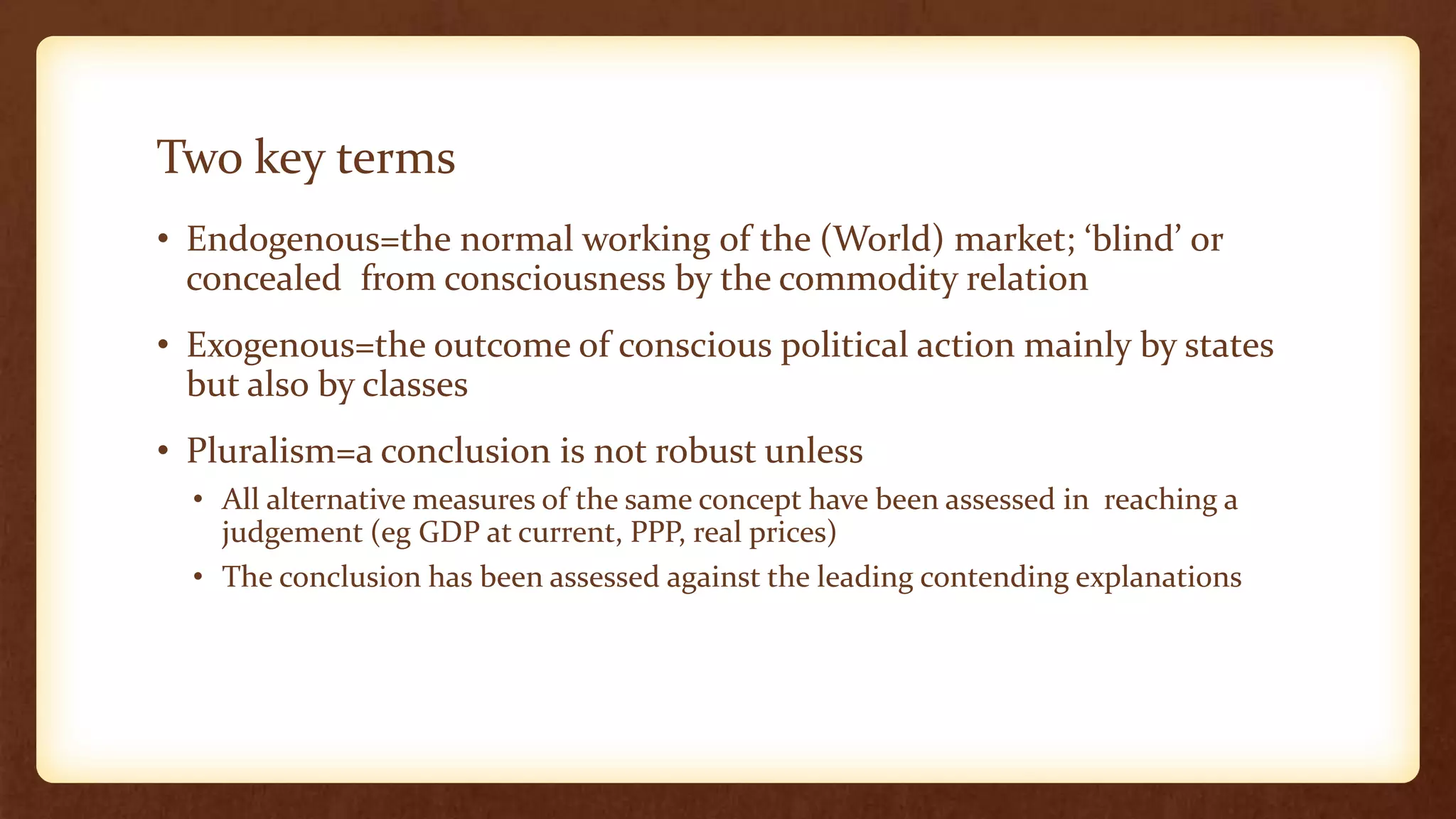
Two key terms
• Endogenous=the normal working of the (World) market; ‘blind’ or
concealed from consciousness by the commodity relation
• Exogenous=the outcome of conscious political action mainly by states
but also by classes
• Pluralism=a conclusion is not robust unless
• All alternative measures of the same concept have been assessed in reaching a
judgement (eg GDP at current, PPP, real prices)
• The conclusion has been assessed against the leading contending explanations
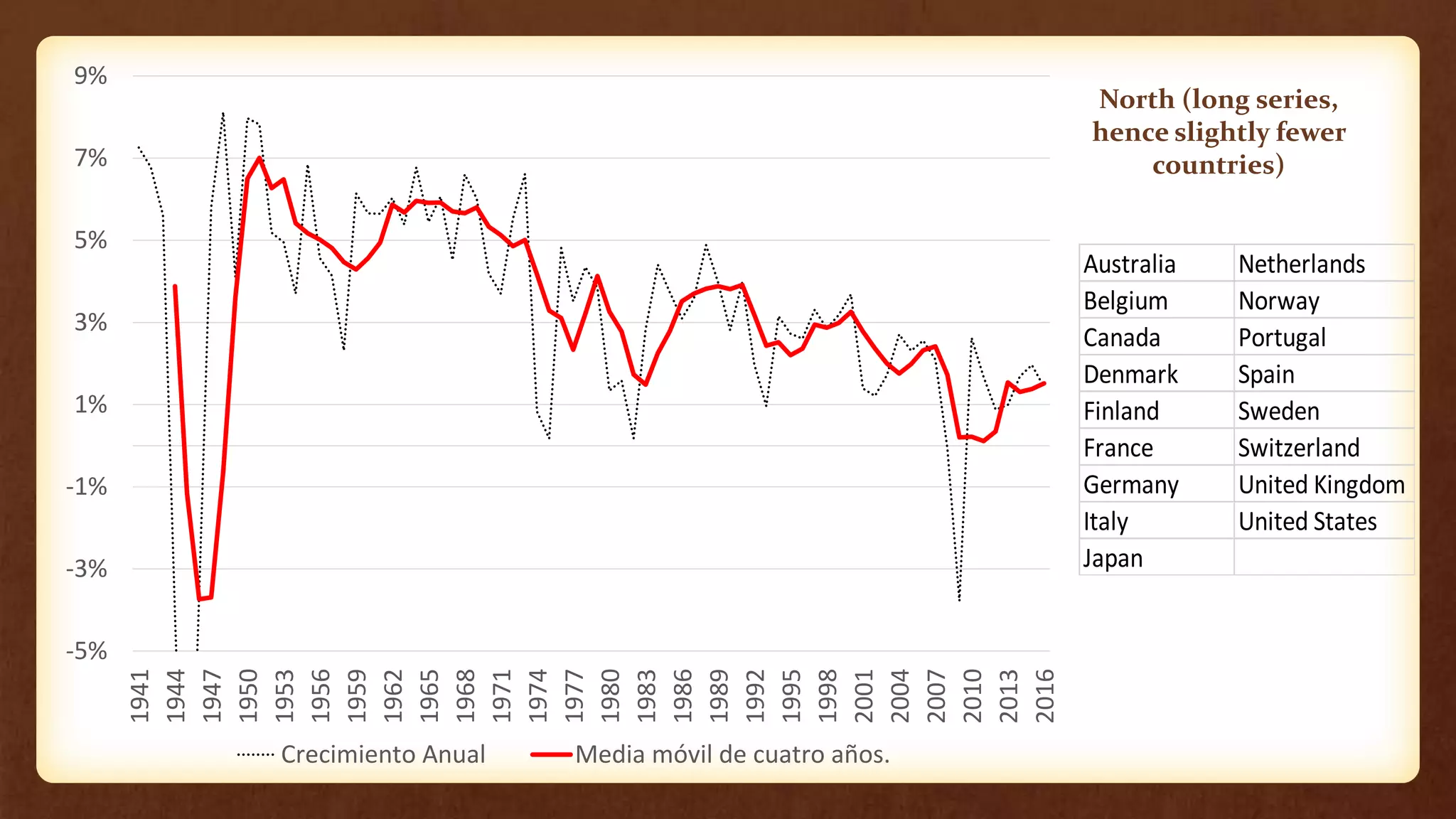
North (long series,
hence slightly fewer
countries)
Australia Netherlands
Belgium Norway
Canada Portugal
Denmark Spain
Finland Sweden
France Switzerland
Germany United Kingdom
Italy United States
Japan
-5%
-3%
-1%
1%
3%
5%
7%
9%
1941
1944
1947
1950
1953
1956
1959
1962
1965
1968
1971
1974
1977
1980
1983
1986
1989
1992
1995
1998
2001
2004
2007
2010
2013
2016
Crecimiento Anual Media móvil de cuatro años.
-5%
-3%
-1%
1%
3%
5%
7%
9%
1941
1944
1947
1950
1953
1956
1959
1962
1965
1968
1971
1974
1977
1980
1983
1986
1989
1992
1995
1998
2001
2004
2007
2010
2013
2016
Endogenous Oscillations (trade cycle)
Exogenous start
(war)
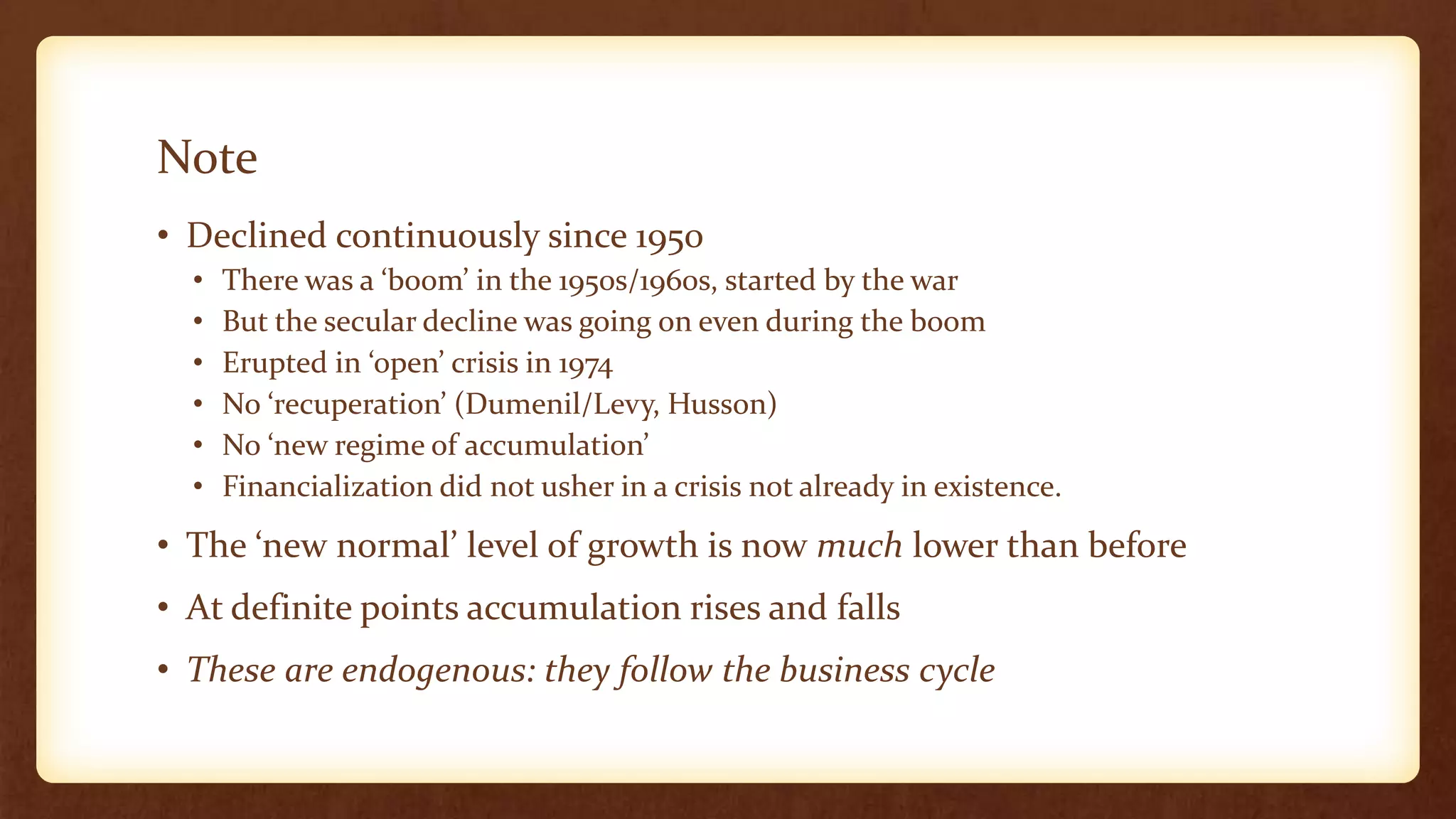
Note
• Declined continuously since 1950
• There was a ‘boom’ in the 1950s/1960s, started by the war
• But the secular decline was going on even during the boom
• Erupted in ‘open’ crisis in 1974
• No ‘recuperation’ (Dumenil/Levy, Husson)
• No ‘new regime of accumulation’
• Financialization did not usher in a crisis not already in existence.
• The ‘new normal’ level of growth is now much lower than before
• At definite points accumulation rises and falls
• These are endogenous: they follow the business cycle
0%
1%
2%
3%
4%
5%
6%
7%
1949-19531954-19571957-19611961-19691969-19751975-19811981-19911991-20012001-20082008-2018
A game of two halves: annualised growth over NBER cycles
The story in short
• The North set out to solve its problems at the expense of the South
• This was the real content of neoliberalism
• It failed (the problems continued)
• But the resultant political convulsion transformed the South
• We are living through the combined consequences of these two facts
The North, the whole North, and
nothing but the North
0%
1%
2%
3%
4%
5%
6%
7%
8%
9%
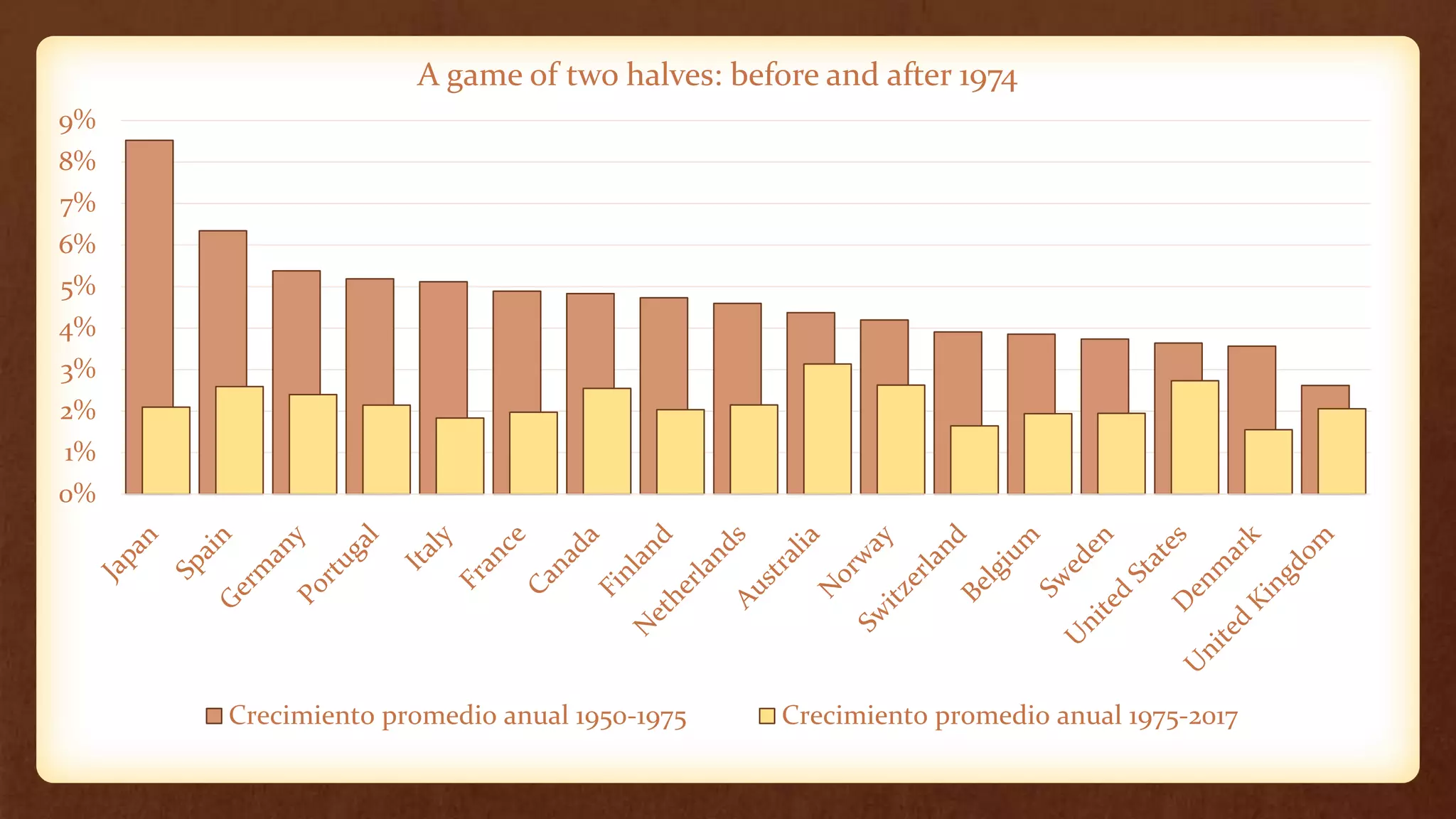
A game of two halves: before and after 1974
Crecimiento promedio anual 1950-1975 Crecimiento promedio anual 1975-2017
0.0%
0.5%
1.0%
1.5%
2.0%
2.5%
3.0%
3.5%
4.0%
4.5%
5.0%
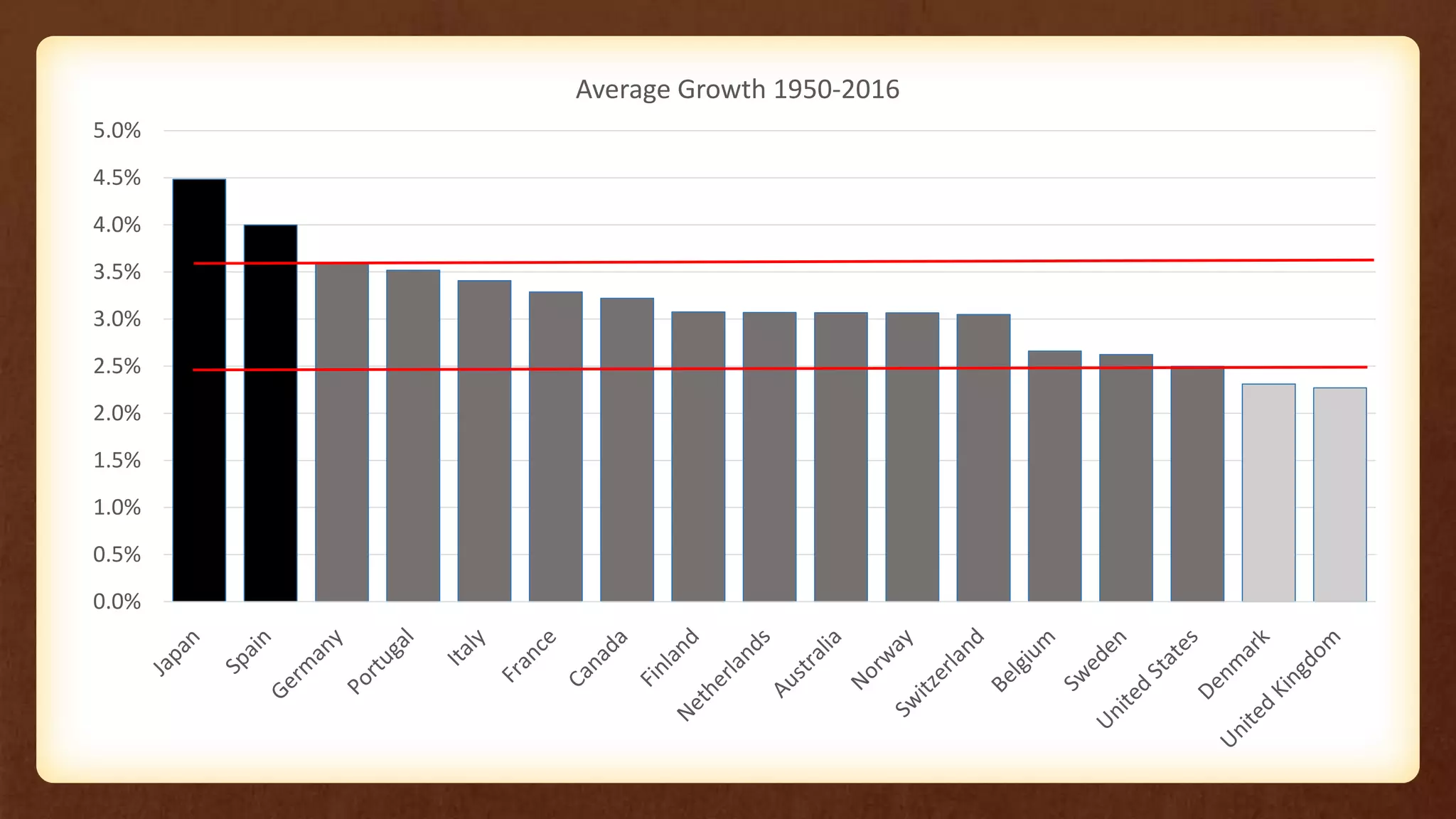
Average Growth 1950-2016
15%
17%
19%
21%
23%
25%
27%
29%
1950
1953
1956
1959
1962
1965
1968
1971
1974
1977
1980
1983
1986
1989
1992
1995
1998
2001
2004
2007
2010
2013
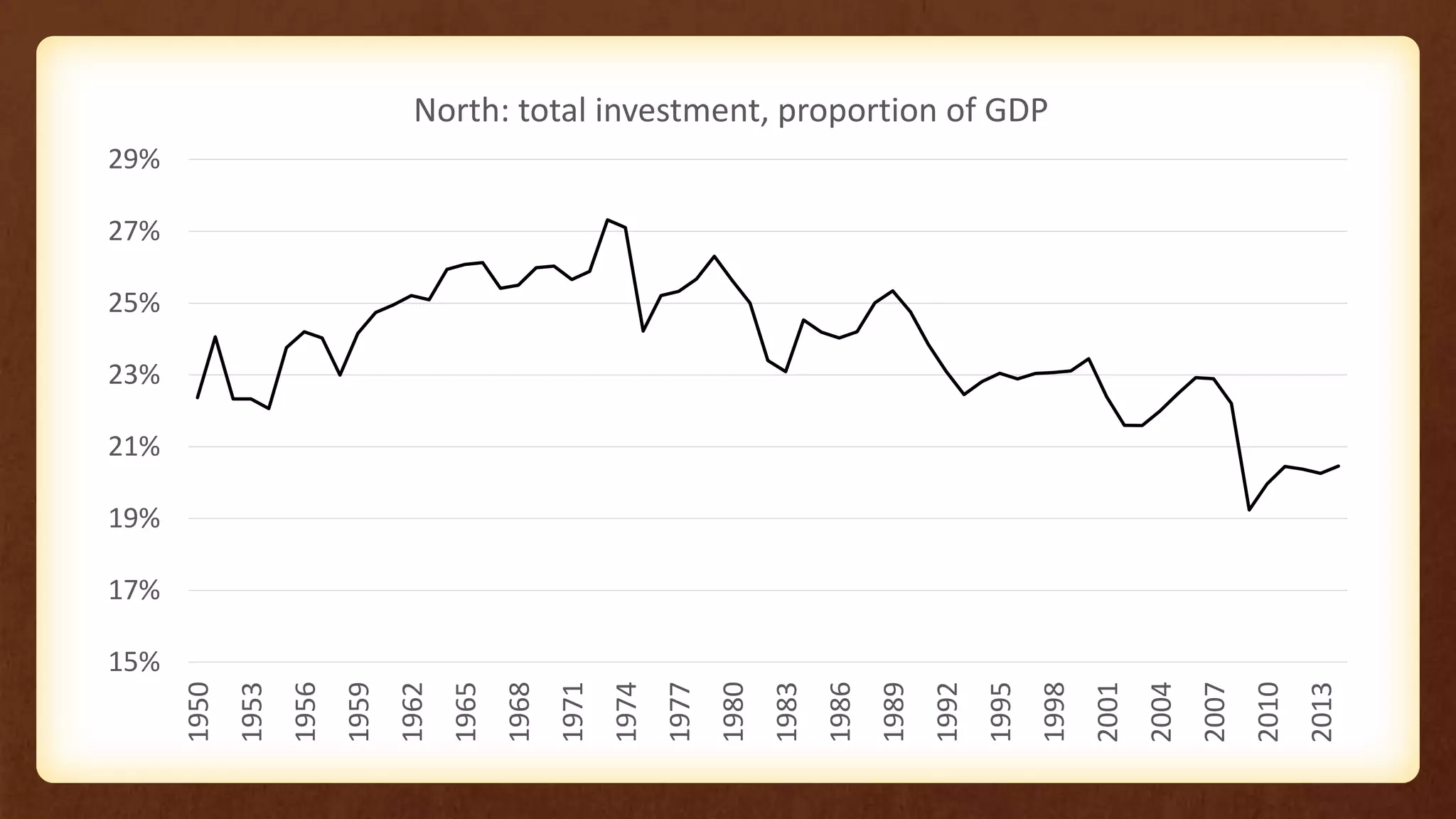
North: total investment, proportion of GDP
The South
0%
1%
2%
3%
4%
5%
6%
7%
8%
1971
1973
1975
1977
1979
1981
1983
1985
1987
1989
1991
1993
1995
1997
1999
2001
2003
2005
2007
2009
2011
2013
2015
2017
Annualised Growth, four-year moving average
Norte Sur
0%
2%
4%
6%
8%
10%
12%
14%
16%
18% 1950
1953
1956
1959
1962
1965
1968
1971
1974
1977
1980
1983
1986
1989
1992
1995
1998
2001
2004
2007
2010
2013
2016
Divergence: GDP per capita of the South, except
transitional economies and China, ratio to the North South =
All the rest, but
1950-1970
A smaller group due to
data restrictions
1970-2017
Absolutely everyone
But the two series
coincide with minor
differences
So the tendency is a
robust fact and not the
result of data selection
0%
2%
4%
6%
8%
10%
12%
14%
16%
18%
1950
1953
1956
1959
1962
1965
1968
1971
1974
1977
1980
1983
1986
1989
1992
1995
1998
2001
2004
2007
2010
2013
2016
Exogenous
Volcker Shock
Debt Crisis
Structural Adjustment
THIS IS WHAT
WE HAVE TO
EXPLAIN
Endogenous decline
Started at least as early as 1950
Exogenous
Shock Therapy and
collapse of USSR
The average income of
the richest 25% of the
South is one tenth that
of the poorest 25% of
the North
Any other fact about
poverty and
inequality pales into
insignificance by
comparison
Inequality between
nations is the Main
causal factor for
inequality within
nations
Yet the agencies have
ceased measuring it
$1,529 $1,925 $3,853
$38,265
$51,746
$72,954
$0
$10,000
$20,000
$30,000
$40,000
$50,000
$60,000
$70,000
$80,000
25% mas bajo Mediano (50%) 25% mas alto
Scale: the elephant in the inequality dining room:
Population-weighted medians and quartiles of GDP per
capita
Sur Norte
The exception
0%
2%
4%
6%
8%
10%
12%
14%
16%
18%
20%
1952
1955
1958
1961
1964
1967
1970
1973
1976
1979
1982
1985
1988
1991
1994
1997
2000
2003
2006
2009
2012
2015
China GDP per capita, ratio with the South
Amejoramiento (disminución) en la Divergencia
País Población 1990-2017 1990-2002 2002-2012 2012-2017
China Mainland 1,408,567,808 1053% 145% 250% 35%
Vietnam 95,535,024 1008% 228% 157% 32%
Equatorial Guinea 1,271,085 1008% 646% 237% -56%
Laos 6,884,045 419% 19% 192% 50%
Myanmar 53,426,064 341% 25% 246% 2%
Lebanon 6,046,806 263% 254% 8% -5%
Poland 38,150,660 256% 117% 61% 3%
Cambodia 16,020,147 227% 31% 78% 41%
Romania 19,644,192 180% -11% 157% 23%
Guatemala 16,958,840 172% 68% 23% 31%
Chile 18,054,660 161% 24% 119% -3%
Bangladesh 164,719,376 153% -5% 53% 75%
Dominican Republic 10,779,750 138% 59% 31% 14%
Czechoslovakia (Former) 16,035,373 138% 35% 75% 0%
Indonesia (Former) 265,517,655 135% -6% 147% 1%
India 1,340,129,280 134% -10% 106% 27%
Costa Rica 4,908,432 124% 26% 57%
Exception that proves the rule
(1) Divergence for the remainder is worse
(2) There is no comparator, other than Vietnam
0%
50%
100%
150%
200%
250%
300%
350%
400%
1960
1963
1966
1969
1972
1975
1978
1981
1984
1987
1990
1993
1996
1999
2002
2005
2008
2011
2014
East Asia Latin America and Caribbean
Middle East and North Africa South Asia
Sub-Saharan Africa China
North
Who is ‘catching up’
and why doesn’t
increased output
lead to increased
monetary
purchasing power?
0%
2%
4%
6%
8%
10%
12%
0%
5%
10%
15%
20%
25%
30%
1970
1975
1980
1985
1990
1995
2000
2005
2010
2015
Chart 9: High GDP per capita
regions
Latin America and Caribbean
Middle East and North Africa
South Total (right scale)
0%
2%
4%
6%
8%
10%
12%
1970
1974
1978
1982
1986
1990
1994
1998
2002
2006
2010
2014
Chart 10: Low GDP per capita Regions
South Asia
Sub-Saharan Africa
South Total (excluding Transitional)
0%
2%
4%
6%
8%
10%
12%
14%
1970
1972
1974
1976
1978
1980
1982
1984
1986
1988
1990
1992
1994
1996
1998
2000
2002
2004
2006
2008
2010
2012
2014
2016
Chart 11: Middle GDP per capita regions
East Asia Pacific Central Asia South Total (excluding Transitional)
$0
$10,000
$20,000
$30,000
$40,000
$50,000
$60,000
- 0.2 0.4 0.6 0.8 1.0 1.2 1.4 1.6
Chart 16: Relation between price level and GDP per capita, 1995
North South
Myths, dreams and nightmares
• Kondratieff: the myth of endogenous recovery
• Neoclassical trade theory: the myth of endogenous convergence
• Marxist theories of decline (SSA, Dumenil, Husson, Financialization) that
signal a ‘recuperation’ in 1980 miss the point
• What really took place was a temporary respite at the expense of the South
• The myth of the BRICS
• What is really taking place is the relative decline of the North
• Plus the end of South fragmentation and the initiation of concerted South action
• The reality of Dependence, the necessity of Development
• North can rely on ‘natural’ working of market and ‘prod’ at decisive moments
• South has to use state (exogenous)
Northern Ideology: why the North thinks it is special
• Free trade ‘looks Good’ from the North
• Is taken to be a recipe for all
• Is the ‘natural’ view of the Northern and Southern elites
• The only possible explanation for the South’s poverty is racial
• This is rooted in colonial history
• The racialization of the North-South relation
• And the geneticization of labour
$0
$50
$100
$150
$200
$250
$300
$350
$400
$450
$500
1970
1973
1976
1979
1982
1985
1988
1991
1994
1997
2000
2003
2006
2009
2012
$USMillion
US outward Foreign Direct
Investment
-$2
$0
$2
$4
$6
$8
$10
$12
$14
1948
1952
1956
1960
1964
1968
1972
1976
1980
1984
1988
1992
1996
2000
2004
2008
2012
Billions
Total Investment Outflows
China
The Rest
Industrialised
-$600
-$400
-$200
$0
$200
$400
$600
1970
1972
1974
1976
1978
1980
1982
1984
1986
1988
1990
1992
1994
1996
1998
2000
2002
2004
2006
2008
2010
2012
2014
Billions Transferencias financieras del extranjero
Norte Sur
-4.0%
-3.5%
-3.0%
-2.5%
-2.0%
-1.5%
-1.0%
-0.5%
0.0%
0.5%
1.0%
1.5%
1970
1972
1974
1976
1978
1980
1982
1984
1986
1988
1990
1992
1994
1996
1998
2000
2002
2004
2006
2008
2010
2012
2014
Foreign transfers, proportion of GDP
Norte Sur
Project and dataset:
https://github.com/axfreeman/Economic-History
Research Group Site:
https://geopoliticaleconomy.org
Papers:
https://geopoliticaleconomy.academia.edu/AlanFree
man

Unexplained persistence facts for a post-colonial history