Models of Development
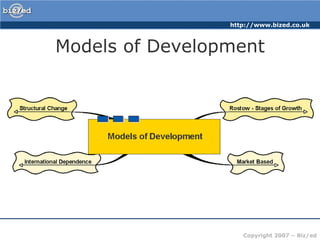
Models of DevelopmentHow do countries develop?If we can understand how development occurs, strategies can be adopted to help countries to developNumber of approaches:
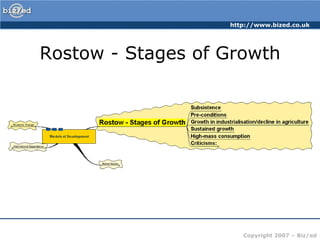
Rostow - Stages of Growth
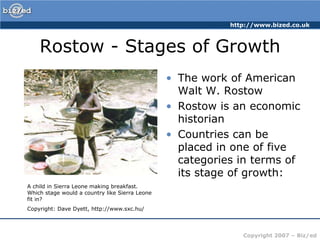
Rostow - Stages of GrowthThe work of American Walt W. RostowRostow is an economic historianCountries can be placed in one of five categories in terms of its stage of growth:A child in Sierra Leone making breakfast. Which stage would a country like Sierra Leone fit in?Copyright: Dave Dyett, http://www.sxc.hu/
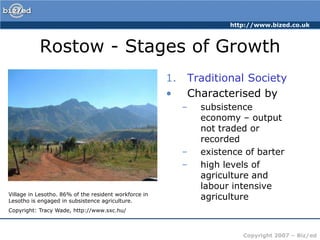
Rostow - Stages of GrowthTraditional SocietyCharacterised bysubsistence economy – output not traded or recorded existence of barter high levels of agriculture and labour intensive agricultureVillage in Lesotho. 86% of the resident workforce in Lesotho is engaged in subsistence agriculture.Copyright: Tracy Wade, http://www.sxc.hu/
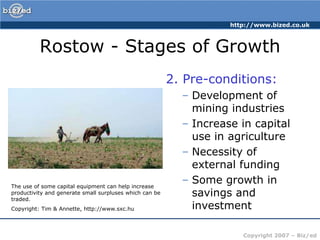
Rostow - Stages of Growth2. Pre-conditions:Development of mining industriesIncrease in capital use in agricultureNecessity of external fundingSome growth in savings and investmentThe use of some capital equipment can help increase productivity and generate small surpluses which can be traded.Copyright: Tim & Annette, http://www.sxc.hu
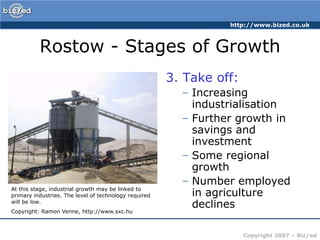
Rostow - Stages of Growth3. Take off:Increasing industrialisationFurther growth in savings and investmentSome regional growthNumber employed in agriculture declinesAt this stage, industrial growth may be linked to primary industries. The level of technology required will be low.Copyright: Ramon Venne, http://www.sxc.hu
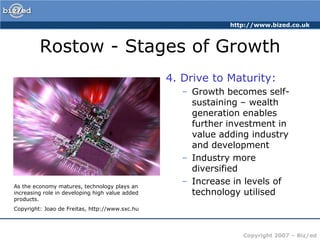
Rostow - Stages of Growth4. Drive to Maturity:Growth becomes self-sustaining – wealth generation enables further investment in value adding industry and developmentIndustry more diversifiedIncrease in levels of technology utilisedAs the economy matures, technology plays an increasing role in developing high value added products.Copyright: Joao de Freitas, http://www.sxc.hu
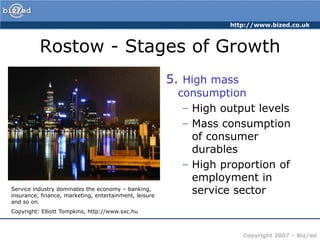
Rostow - Stages of Growth5. High mass consumptionHigh output levelsMass consumption of consumer durablesHigh proportion of employment in service sectorService industry dominates the economy – banking, insurance, finance, marketing, entertainment, leisure and so on. Copyright: Elliott Tompkins, http://www.sxc.hu
Criticisms:Too simplisticNecessity of a financial infrastructure to channel any savings that are made into investmentWill such investment yield growth? Not necessarilyNeed for other infrastructure – human resources (education), roads, rail, communications networksEfficiency of use of investment – in palaces or productive activities?Rostow argued economies would learn from one another and reduce the time taken to develop – has this happened?
Market Based
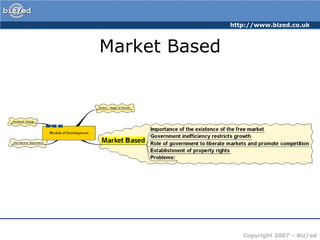
Market BasedDevelopment is determined by the extent to which the market is able to allocate resources The price signal acts to allocate scarce resourcesGovernments limit interference in the working of the economyGovernment role is to encourage enterprise and to reduce regulation and inefficiencies in free markets and establish ownership of property rights
Problems:Existence of market failure – externalities, monopoly power, public goodsProblems of lack of infrastructure – education and health, public transport, legal structureProblems of equity in allocation – wealth and income distribution
International Dependence
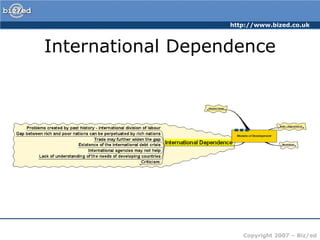
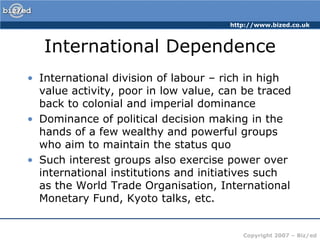
International DependenceInternational division of labour – rich in high value activity, poor in low value, can be traced back to colonial and imperial dominanceDominance of political decision making in the hands of a few wealthy and powerful groups who aim to maintain the status quoSuch interest groups also exercise power over international institutions and initiatives such as the World Trade Organisation, International Monetary Fund, Kyoto talks, etc.
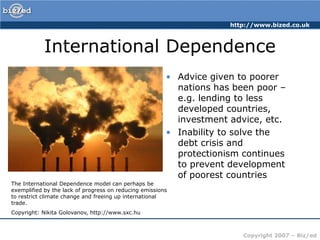
International DependenceAdvice given to poorer nations has been poor – e.g. lending to less developed countries, investment advice, etc.Inability to solve the debt crisis and protectionism continues to prevent development of poorest countriesThe International Dependence model can perhaps be exemplified by the lack of progress on reducing emissions to restrict climate change and freeing up international trade.Copyright: Nikita Golovanov, http://www.sxc.hu
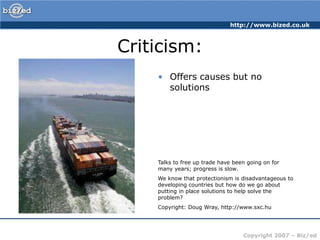
Criticism:Offers causes but no solutionsTalks to free up trade have been going on for many years; progress is slow. We know that protectionism is disadvantageous to developing countries but how do we go about putting in place solutions to help solve the problem?Copyright: Doug Wray, http://www.sxc.hu
Structural Change
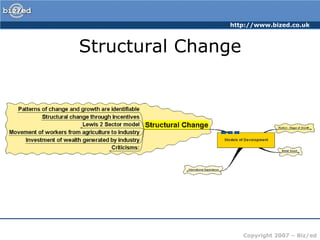
Structural ChangeStructural change models focus on the different productivity levels of economiesProcess of structural change determines the rate of developmentCan such structural changes be accommodated?
Structural ChangeLess developed nations – tend to be dominated by primary industries – low value added, difficult to generate wealth and thus sources of investmentDeveloped nations – diverse economies, high value added, high levels of investmentStructural change can be encouraged by incentives
Lewis 2 Sector modelAgriculture - low value addedIndustrial sector - higher productivity and wealth generationIncentives to encourage workers to migrate from rural economy to urbanRural workers have very low if not zero marginal productivityWage premiums in urban industry 30% above rural wages would encourage migration from rural to urban whilst still allowing profits to be madeRe-investment of profits would lead to a self perpetuating development
Criticisms:Labour re-allocation not always productiveWealth not re-invested locallyWealth goes abroadImperfections in the labour marketImportance of complementary policies by all countries involved

Economic Development (Introduction)

  • 1.
  • 2.
  • 3.
    Models of DevelopmentHowdo countries develop?If we can understand how development occurs, strategies can be adopted to help countries to developNumber of approaches:
  • 4.
  • 5.
    Rostow - Stagesof GrowthThe work of American Walt W. RostowRostow is an economic historianCountries can be placed in one of five categories in terms of its stage of growth:A child in Sierra Leone making breakfast. Which stage would a country like Sierra Leone fit in?Copyright: Dave Dyett, http://www.sxc.hu/
  • 6.
    Rostow - Stagesof GrowthTraditional SocietyCharacterised bysubsistence economy – output not traded or recorded existence of barter high levels of agriculture and labour intensive agricultureVillage in Lesotho. 86% of the resident workforce in Lesotho is engaged in subsistence agriculture.Copyright: Tracy Wade, http://www.sxc.hu/
  • 7.
    Rostow - Stagesof Growth2. Pre-conditions:Development of mining industriesIncrease in capital use in agricultureNecessity of external fundingSome growth in savings and investmentThe use of some capital equipment can help increase productivity and generate small surpluses which can be traded.Copyright: Tim & Annette, http://www.sxc.hu
  • 8.
    Rostow - Stagesof Growth3. Take off:Increasing industrialisationFurther growth in savings and investmentSome regional growthNumber employed in agriculture declinesAt this stage, industrial growth may be linked to primary industries. The level of technology required will be low.Copyright: Ramon Venne, http://www.sxc.hu
  • 9.
    Rostow - Stagesof Growth4. Drive to Maturity:Growth becomes self-sustaining – wealth generation enables further investment in value adding industry and developmentIndustry more diversifiedIncrease in levels of technology utilisedAs the economy matures, technology plays an increasing role in developing high value added products.Copyright: Joao de Freitas, http://www.sxc.hu
  • 10.
    Rostow - Stagesof Growth5. High mass consumptionHigh output levelsMass consumption of consumer durablesHigh proportion of employment in service sectorService industry dominates the economy – banking, insurance, finance, marketing, entertainment, leisure and so on. Copyright: Elliott Tompkins, http://www.sxc.hu
  • 11.
    Criticisms:Too simplisticNecessity ofa financial infrastructure to channel any savings that are made into investmentWill such investment yield growth? Not necessarilyNeed for other infrastructure – human resources (education), roads, rail, communications networksEfficiency of use of investment – in palaces or productive activities?Rostow argued economies would learn from one another and reduce the time taken to develop – has this happened?
  • 12.
  • 13.
    Market BasedDevelopment isdetermined by the extent to which the market is able to allocate resources The price signal acts to allocate scarce resourcesGovernments limit interference in the working of the economyGovernment role is to encourage enterprise and to reduce regulation and inefficiencies in free markets and establish ownership of property rights
  • 14.
    Problems:Existence of marketfailure – externalities, monopoly power, public goodsProblems of lack of infrastructure – education and health, public transport, legal structureProblems of equity in allocation – wealth and income distribution
  • 15.
  • 16.
    International DependenceInternational divisionof labour – rich in high value activity, poor in low value, can be traced back to colonial and imperial dominanceDominance of political decision making in the hands of a few wealthy and powerful groups who aim to maintain the status quoSuch interest groups also exercise power over international institutions and initiatives such as the World Trade Organisation, International Monetary Fund, Kyoto talks, etc.
  • 17.
    International DependenceAdvice givento poorer nations has been poor – e.g. lending to less developed countries, investment advice, etc.Inability to solve the debt crisis and protectionism continues to prevent development of poorest countriesThe International Dependence model can perhaps be exemplified by the lack of progress on reducing emissions to restrict climate change and freeing up international trade.Copyright: Nikita Golovanov, http://www.sxc.hu
  • 18.
    Criticism:Offers causes butno solutionsTalks to free up trade have been going on for many years; progress is slow. We know that protectionism is disadvantageous to developing countries but how do we go about putting in place solutions to help solve the problem?Copyright: Doug Wray, http://www.sxc.hu
  • 19.
  • 20.
    Structural ChangeStructural changemodels focus on the different productivity levels of economiesProcess of structural change determines the rate of developmentCan such structural changes be accommodated?
  • 21.
    Structural ChangeLess developednations – tend to be dominated by primary industries – low value added, difficult to generate wealth and thus sources of investmentDeveloped nations – diverse economies, high value added, high levels of investmentStructural change can be encouraged by incentives
  • 22.
    Lewis 2 SectormodelAgriculture - low value addedIndustrial sector - higher productivity and wealth generationIncentives to encourage workers to migrate from rural economy to urbanRural workers have very low if not zero marginal productivityWage premiums in urban industry 30% above rural wages would encourage migration from rural to urban whilst still allowing profits to be madeRe-investment of profits would lead to a self perpetuating development
  • 23.
    Criticisms:Labour re-allocation notalways productiveWealth not re-invested locallyWealth goes abroadImperfections in the labour marketImportance of complementary policies by all countries involved