Seeing the Forest and the Trees:Seeing the Forest and the Trees:
The Unique CEOs for Cities LensThe Unique CEOs for Cities Lens
Annual Meeting
May 6, 2005
by: Robert Weissbourd
RW Ventures, LLC
THE FOLLOWING PRESENTATION HAS BEEN APPROVED FOR
MATURE AUDIENCES
THE FOLLOWING PRESENTATION HAS BEEN APPROVED FOR
MATURE AUDIENCES
R THIS PRESENTATION HAS BEEN RATED R FOR
CONTENT. AUDIENCE DISCRETION ADVISED.
R E S T R I C T E D
CONTENT MAY BE UNSUBSTANTIATED,
OPINIONATED AND PROVOCATIVE
AgendaAgenda
What Have We Learned?
Implications for Policy and Practice
Organizational Implications
Comments and Discussion
AgendaAgenda
What Have We Learned?
•The Role of Cities
•Geography of the New Economy
•Drivers of the New Economy
•Market Forces
Cities Drive the National EconomyCities Drive the National Economy
0% 20% 40% 60% 80% 100%
Aggregate Personal Income
Consumer Expenditures
Tax Payments
Total Economic Grow th
Manufacturing Value Added
Exports
Business Establishments
MSA as % of US Total Nonmetro as % of US Total
The Role of CitiesThe Role of Cities
Cities and Economic Prosperity
• Cities make a disproportionate
contribution to the nation’s
economic output
• City economies are particularly
concentrated in key types of new
economic activity
• Cities are hubs for metropolitan
areas
• Cities are drivers of metropolitan
economies
0% 10% 20% 30% 40% 50% 60% 70% 80% 90%
Museums, botanical, zoological gardens
Educational services
Legal Services
Health Services
Depository institutions
Insurance Carriers
Communication
Air Transportation
Hub Functions of Cities
Suburban % of Total MSA Employment
City % of Total MSA Employment
The Role of CitiesThe Role of Cities
Cities are Even More
Important in the Global, Knowledge Economy
Cities are Even More
Important in the Global, Knowledge Economy
Increased Value of
Knowledge Factors…
• High skilled labor force
• Intellectual property
• Product innovation; flexible
customization
• Customer networks
• Knowledge management capacities300%
400%
500%
600%
Lead to New Drivers of
Productivity which Favor Cities
• Dense knowledge networks
• Functional specialization
• Innovative capacity
hange
Gross Domestic Product
% Growth over last 50 years
0%
100%
200%
$s lbs
%C
Greenspan:Greenspan: Fundamental changeFundamental change
in the economy towards intangiblein the economy towards intangible
assetsassets
Economic Growth Worldwide has been Characterized by Urbanization
The Role of CitesThe Role of Cites
Demographic Shifts Enhance CitiesDemographic Shifts Enhance Cities
US Population Growth
800,000
3,456,577
Population Growth 1990-2000
(Top 100 Cities)
Native Born
Foreign Born
The top 100 cities added 4.3 million in
population between 1990 and 2000. 80%
of this growth was due to increases in the
foreign born population.
The U.S. added 33 million in population
between 1990 and 2000. 35% of this
growth was due to increases in the foreign
born population.
65%
35%
• Population growth fueled by immigrants
settling primarily in urban areas
• Aging baby boomers increasingly choose to
return to cities
• Young and singles get married later, enjoy
urban lifestyle longer
• Cities Increasingly perceived as centers of
business, culture and progress rather than
crime and poverty (Celinda Lake Poll)
Median Growth (1990-2000)
0
2
4
6
8
10
12
Population Per Capita Income
1st Principle1st Principle
The Role of CitiesThe Role of Cities
Adapted from Gastner, Shalizi and Newman, University of Michigan
National PolicyNational Policy == Urban PolicyUrban Policy
(and vice(and vice--versa)versa)
Geography of the New EconomyGeography of the New Economy
Cities Perform in a Global EconomyCities Perform in a Global Economy
0
1,000,000
2,000,000
3,000,000
4,000,000
5,000,000
6,000,000
7,000,000
8,000,000
1976
1978
1980
1982
1984
1986
1988
1990
1992
1994
1996
1998
2000
2002
(in Millions of $)
0
50,000
100,000
150,000
200,000
250,000
300,000
350,000
1994 1995 1996 1997 1998 1999 2000
Source: BEA
The World is Smaller –
Markets are Transnational
U.S. Assets Abroad up 1500% Since 1976
(in Millions of $)
Foreign Assets in US up 600% (1994 - 2000)
Cost of a 3 Minute Phone Call from NY to London
$0.00
$10.00
$20.00
$30.00
$40.00
$50.00
$60.00
$70.00
1960 1970 1980 1990 2000
Source: Paul Masson, 2001
Geography of the New EconomyGeography of the New Economy
Markets Are Specializing Across CountriesMarkets Are Specializing Across Countries
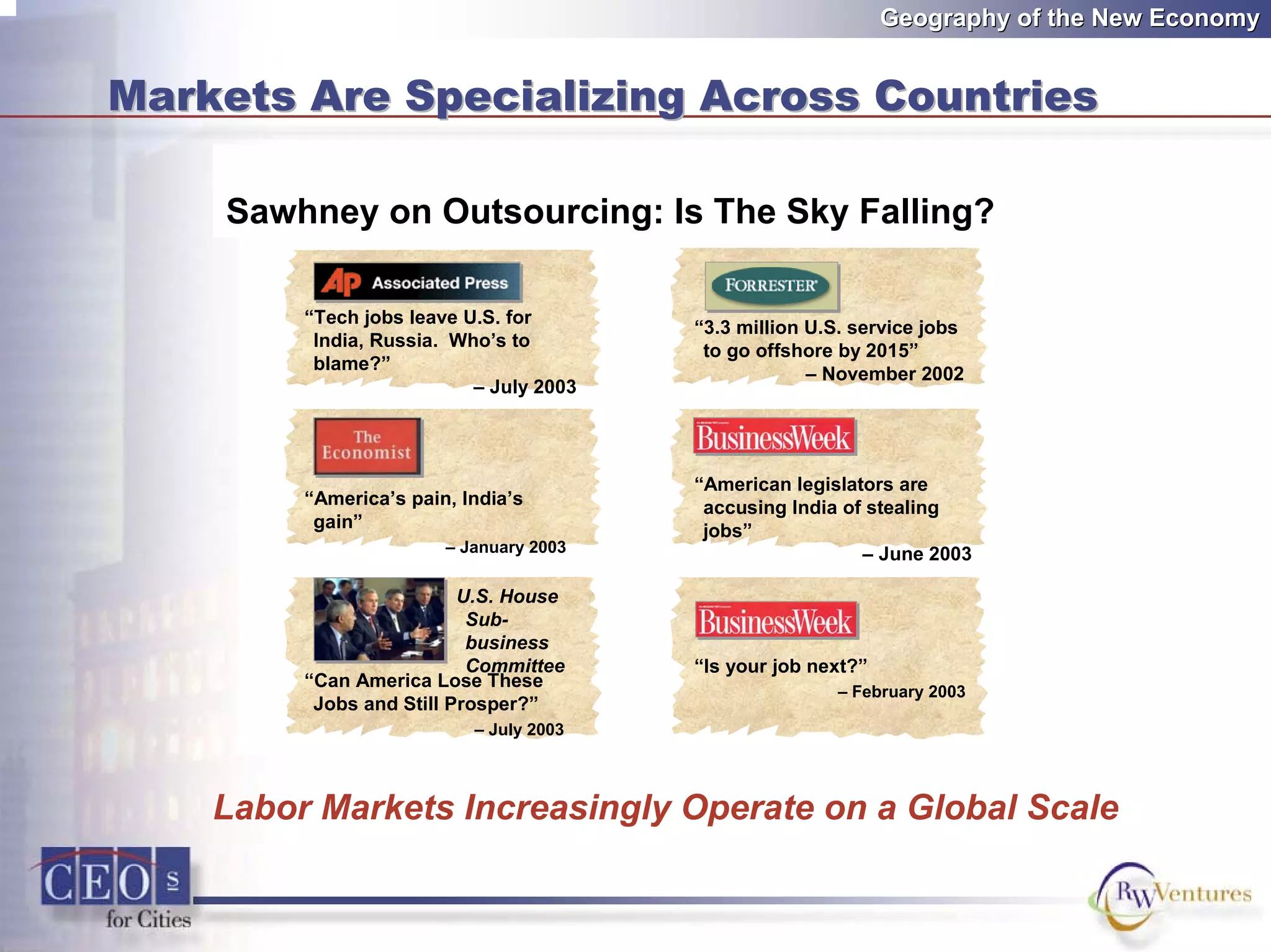
Is the sky falling?
“Tech jobs leave U.S. for
India, Russia. Who’s to
blame?”
– July 2003
“Is your job next?”
– February 2003
“American legislators are
accusing India of stealing
jobs”
– June 2003
“America’s pain, India’s
gain”
– January 2003
“3.3 million U.S. service jobs
to go offshore by 2015”
– November 2002
“Can America Lose These
Jobs and Still Prosper?”
– July 2003
U.S. House
Sub-
business
Committee
Sawhney on Outsourcing: Is The Sky Falling?
Labor Markets Increasingly Operate on a Global Scale
2nd Principle2nd Principle
Geography of the New EconomyGeography of the New Economy
Urban Policy Must Reflect that the Economy is GlobalUrban Policy Must Reflect that the Economy is Global
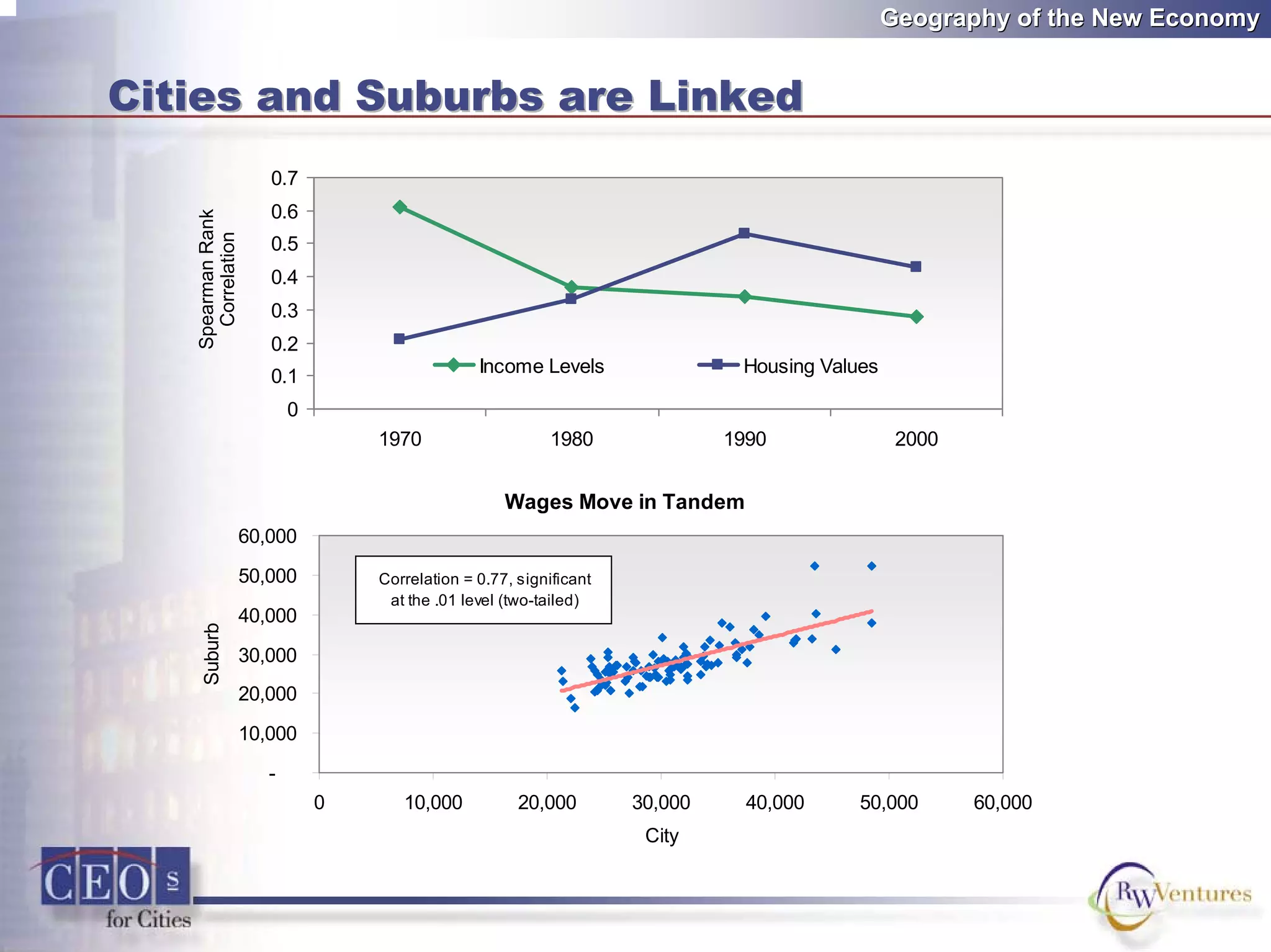
Cities and Suburbs are LinkedCities and Suburbs are Linked
0
0.1
0.2
0.3
0.4
0.5
0.6
0.7
1970 1980 1990 2000
Income Levels Housing Values
SpearmanRank
Correlation
Wages Move in Tandem
-
10,000
20,000
30,000
40,000
50,000
60,000
0 10,000 20,000 30,000 40,000 50,000 60,000
City
Suburb
Correlation = 0.77, significant
at the .01 level (two-tailed)
Geography of the New EconomyGeography of the New Economy
The Economy is RegionalThe Economy is Regional
CITY
REGIONAL ECONOMY
ENVIRONMENT
AMENITIES
UTILITIES
TRANSPORTATION
HOSPITALS
AIRPORTS
HOUSING
JOBS
CITYCITY
CORPORATE SERVICES
SUPPLY CHAINS
MUSEUMS
CONSUMER MARKETS
Geography of the New EconomyGeography of the New Economy
3rd Principle3rd Principle
Geography of the New EconomyGeography of the New Economy
Urban Policy Must Be RegionalUrban Policy Must Be Regional
Drivers of the New EconomyDrivers of the New Economy
Are Current Growth Patterns Efficient?Are Current Growth Patterns Efficient?
Regional Economic
Efficiency Requires:
• Taking Advantage of Density
• Building Livable Communities
• Aligning Components of the
Economy (e.g. Reducing
Jobs-Housing Mismatch)
• Efficient Regional
Infrastructure
Source: Chicago Metropolis 2020
Drivers of the New EconomyDrivers of the New Economy
Equity and Opportunity are Good for BusinessEquity and Opportunity are Good for Business
-.20.2.4.6
WageGrowth(1990-2000)
0 .1 .2 .3 .4
Poverty Rate (1990)
Changing Dynamics Findings:
• Inequality has negative effect
on income growth
• Hispanic Segregation has a
negative effect on income
growth
Regional Economic Efficiency Requires:
•Using All Deployable Assets
•Avoiding Costs of Concentrated Poverty
4th Principle4th Principle
Drivers of the New EconomyDrivers of the New Economy
An Efficient Regional Economy Uses allAn Efficient Regional Economy Uses all
of its Assets and Organizes them Wellof its Assets and Organizes them Well
The Role of Knowledge Factors
is Increasing Throughout the Economy
The Role of Knowledge Factors
is Increasing Throughout the Economy
Drivers of the New EconomyDrivers of the New Economy
Wage Growth Increases with Digital Economy
1
.8
.4
.2
0 5-5
WageGrowth
1990-2000(PMSA)
.6
Grand Rapids, MI
Rochester, NY
San Diego, CA
Austin, TX
Presence of Digital Economy Factors
The Value of Output per Hour has Increased
More than Ten-Fold Over the Last 100 Years
Drivers of the New EconomyDrivers of the New Economy
The Importance of EducationThe Importance of Education
WageGrowth1990-2000(Log,MSA)
% Adults with BA or Higher 1990
-.20.2.4.6
.1 .2 .3 .4 .5
Cleveland, OH
Washington D.C.
Richmond, VA
Providence, RI
St. Paul, MN
Houston, TX
Chicago, IL
Columbus, OH
Indianapolis, IN
San Antonio, TX
College Education is the Biggest Driver of Economic Growth
(and High School Alone is Barely Significant Anymore)
Functional and Occupational
Concentrations are Increasingly Important
Functional and Occupational
Concentrations are Increasingly Important
Sectoral Specialization
(Manufacturing)
0.33
0.34
0.34
0.35
0.35
0.36
0.36
0.37
0.37
0.38
0.38
1977 1987 1997
GiniCoeff.BasedonEmploymentShare
Functional Specialization
(Management vs. Production)
0%
5%
10%
15%
20%
25%
30%
35%
40%
45%
1970 1980 1990
PercentDifferencefromNationalAverage
Drivers of the New EconomyDrivers of the New Economy
MSAs with Pop > 5,000,000
Source: Duranton and Puga 2002
Estimated Effect on
Income Growth (MSA)
0.0
Professional
Managerial
Sales
Clerical
Precision Production
Machine Operator
Transportation Equipment*
Material Handler & Laborer
Farming*
Services (Non HHD)
Knowledge Industries, Functions and
Occupations Attract BAs and Drive Growth
Knowledge Industries, Functions and
Occupations Attract BAs and Drive Growth
Information Sector
0510
AttainmentGrowth(1990-2000)
.1 .2 .3 .4 .5
Information Sector as % Total Earnings
Finance, Insurance, and Real Estate
0510
AttainmentGrowth(1990-2000)
0 .05 .1 .15
Share workers in Finance, Insurance, and Real Estate
Manufacturing
0510
AttainmentGrowth(1990-2000)
0 .05 .1 .15 .2 .25
% Employment In Manufacturing
Drivers of the New EconomyDrivers of the New Economy
Business Services
0510
AttainmentGrowth(1990-2000)
.02 .03 .04 .05 .06 .07
% Employed In Business and Repair Services
KnowledgeKnowledge
FunctionsFunctions
ProductiveProductive
IndustriesIndustries
High HCHigh HC
OccupationsOccupations
Drivers of the New EconomyDrivers of the New Economy
5th Principle5th Principle
Invest WiselyInvest Wisely
Create a Knowledge Intensive EconomyCreate a Knowledge Intensive Economy
Drivers of the New EconomyDrivers of the New Economy
Multiple Drivers of SuccessMultiple Drivers of Success
High School Degree
Age 35-44
Business Services
Sprawl Index
Professional Jobs
College Degree
Exports
Immigration (1980s)
Hispanic Segregation
-0.6 -0.4 -0.2 0.0 0.2 0.4 0.6 0.8 1.0
Estimated Effect on Income Growth
(Standardized Regression Coefficient: with 95% Confidence Interval)
No Silver Bullet: Many Factors Matter
Drivers of the New EconomyDrivers of the New Economy
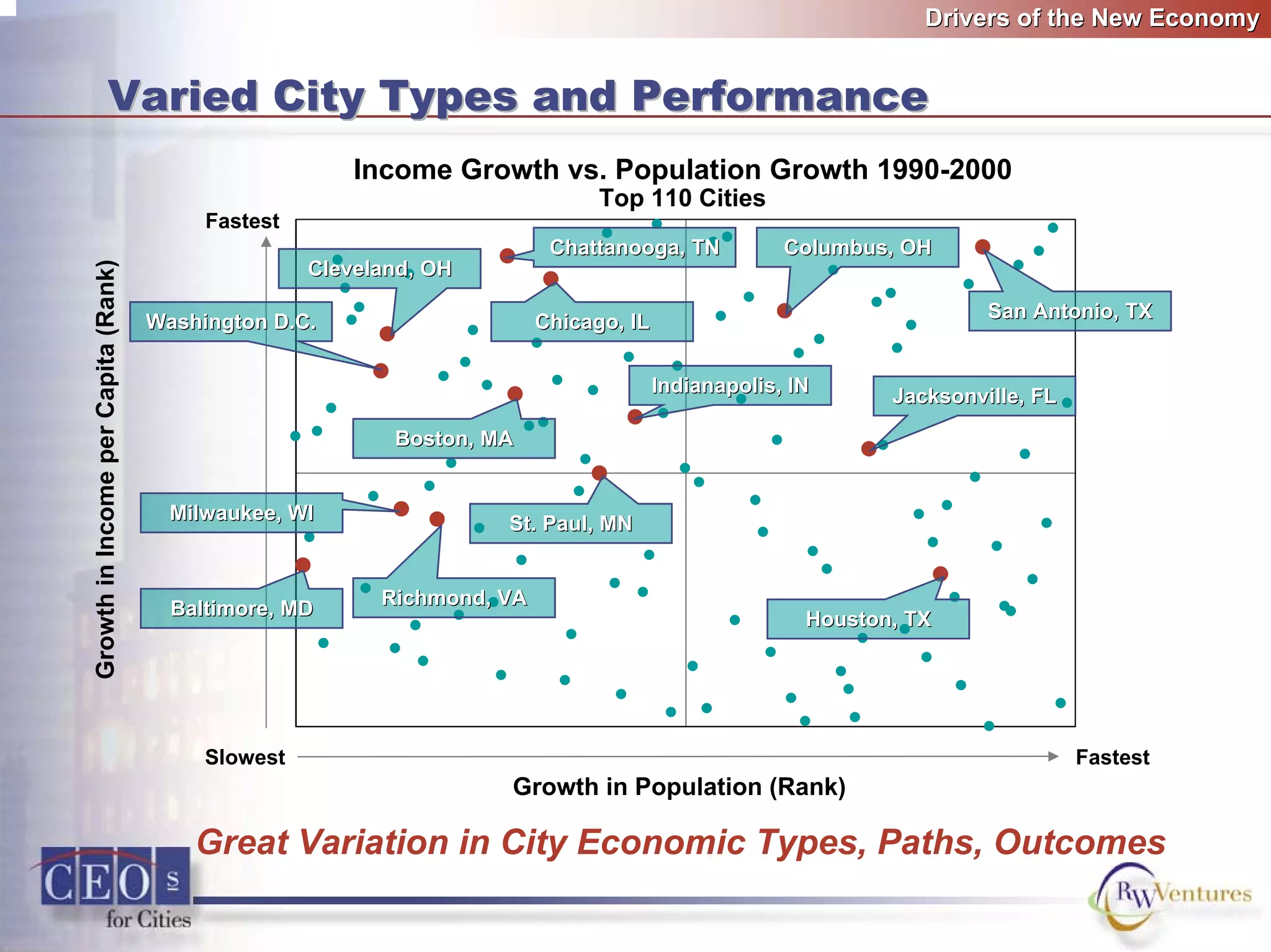
Varied City Types and PerformanceVaried City Types and Performance
Income Growth vs. Population Growth 1990-2000
Top 110 Cities
Fastest
Slowest Fastest
Growth in Population (Rank)
GrowthinIncomeperCapita(Rank)
WashiWashington D.C.ngton D.C.
Jacksonville, FLJacksonville, FL
Chicago, ILChicago, IL
Indianapolis, INIndianapolis, IN
Boston, MABoston, MA
Baltimore, MDBaltimore, MD
St. Paul, MNSt. Paul, MN
Cleveland, OHCleveland, OH
Columbus, OHColumbus, OHChattanooga, TNChattanooga, TN
Houston, TXHouston, TX
San Antonio, TXSan Antonio, TX
Richmond, VARichmond, VA
MilwMilwaukee, WIaukee, WI
Great Variation in City Economic Types, Paths, Outcomes
Drivers of the New EconomyDrivers of the New Economy
7th Principle7th Principle
Build on Your Unique StrengthsBuild on Your Unique Strengths
Learnings from the Field: the Business of DevelopmentLearnings from the Field: the Business of Development
Market ForcesMarket Forces
$0
$50
$100
$150
$200
$250
$300
1999 2000 2001 2002 2003
Shorebank Corporation:
Total Community Development Investment
(in millions)
$0
$2
$4
$6
$8
1999 2000 2001 2002 2003
ShoreBank Corporation: Net Income
(in millions)
• Widespread Success of CDFIs
• Effective Tax Credit Policies (EITC, LIHTC, NMTC)
• Annie E. Casey Foundation – from children to families
to neighborhoods to economics…
Market ForcesMarket Forces
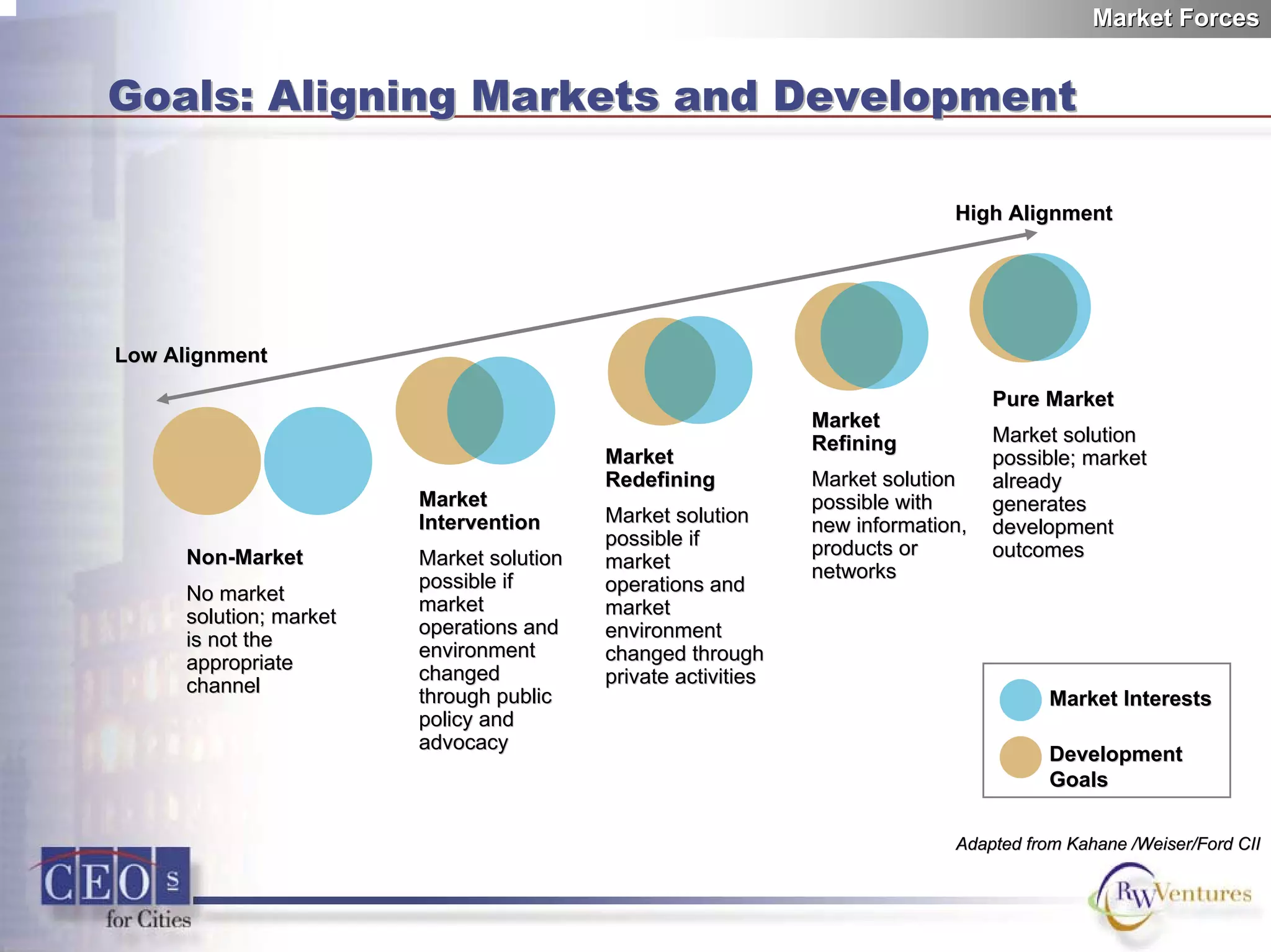
Goals: Aligning Markets and DevelopmentGoals: Aligning Markets and Development
High AlignmentHigh Alignment
Low AlignmentLow Alignment
MarketMarket
RefiningRefining
Market solutionMarket solution
possible withpossible with
new information,new information,
products orproducts or
networks
MarketMarket
InterventionIntervention
Market solutionMarket solution
possible ifpossible if
marketmarket
operations andoperations and
environmentenvironment
changedchanged
through publicthrough public
policy andpolicy and
advocacy
MarketMarket
RedefiningRedefining
Market solutionMarket solution
possible ifpossible if
marketmarket
operations andoperations and
marketmarket
environmentenvironment
changed throughchanged through
private activities
networks
private activities
Pure MarketPure Market
Market solutionMarket solution
possible; marketpossible; market
alreadyalready
generatesgenerates
developmentdevelopment
outcomesoutcomesNonNon--MarketMarket
No marketNo market
solution; marketsolution; market
is not theis not the
appropriateappropriate
channelchannel
advocacy
Market InterestsMarket Interests
DevelopmentDevelopment
GoalsGoals
Adapted from Kahane /Weiser/Ford CIIAdapted from Kahane /Weiser/Ford CII
Market ForcesMarket Forces
Goals: Aligning Markets and DevelopmentGoals: Aligning Markets and Development
High AlignmentHigh Alignment
Low AlignmentLow Alignment
MarketMarket
RefiningRefining
Market solutionMarket solution
possible withpossible with
new information,new information,
products orproducts or
networks
MarketMarket
InterventionIntervention
Market solutionMarket solution
possible ifpossible if
marketmarket
operations andoperations and
environmentenvironment
changedchanged
through publicthrough public
policy andpolicy and
advocacy
MarketMarket
RedefiningRedefining
Market solutionMarket solution
possible ifpossible if
marketmarket
operations andoperations and
marketmarket
environmentenvironment
changed throughchanged through
private activities
networks
private activities
advocacy
Pure MarketPure Market
Market solutionMarket solution
possible; marketpossible; market
alreadyalready
generates CEDgenerates CED
outcomesoutcomes
NonNon--MarketMarket
No marketNo market
solution; marketsolution; market
is not theis not the
appropriateappropriate
channelchannel
Market InterestsMarket Interests
CED GoalsCED Goals
Adapted from Kahane, Weiser, Ford CIIAdapted from Kahane, Weiser, Ford CII
Make MarketMake Market
WorkWork
(Addressing(Addressing
InternalInternal
Imperfections)Imperfections)Change MarketChange Market
ParametersParameters
(Using Market(Using Market
Mechanisms)Mechanisms)
Change MarketChange Market
ParametersParameters
(Using Non(Using Non--
marketmarket
Mechanisms)Mechanisms)
Vital WorkVital Work ––
but not marketbut not market
based!based!
Market Works:Market Works:
Company profitsCompany profits
while providingwhile providing
DevelopmentDevelopment
impact.impact.
Market ForcesMarket Forces
6th Principle6th Principle
In Our Economy, Markets are the Most PowerfulIn Our Economy, Markets are the Most Powerful
Mechanism for Wealth CreationMechanism for Wealth Creation
Harness Market ForcesHarness Market Forces
What Have We Learned?What Have We Learned?
1. National Policy = Urban Policy
2. Urban Policy must Reflect that the Economy is Global
3. Urban Policy must be Regional (the region is the economic
unit that performs in the global economy)
4. An Efficient Regional Economy Uses all of its Assets
and Organizes them Well
5. Invest Wisely -- Create a Knowledge-Intensive
Economy
6. Harness Market Forces
7. Build on Your Unique Strengths
AgendaAgenda
What Have We Learned?
Implications for Policy and Practice
Organizational Implications
Comments and Discussion
1. National Policy = Urban Policy1. National Policy = Urban Policy
• Strategy 1.1: Strengthen Urban Economies to
Strengthen the Nation
• Policies and Programs:
– See, Everything under the other Principles
• Strategy 1.2: Focus on the Urban Economic Effects of
National Policies
• Policies and Programs:
– Tailor immigration policy to local labor force needs;
– Health care;
– Banking regulation (e.g. CRA)
– Transportation.
2. Urban Policy Must Reflect that the
Economy is Global
2. Urban Policy Must Reflect that the
Economy is Global
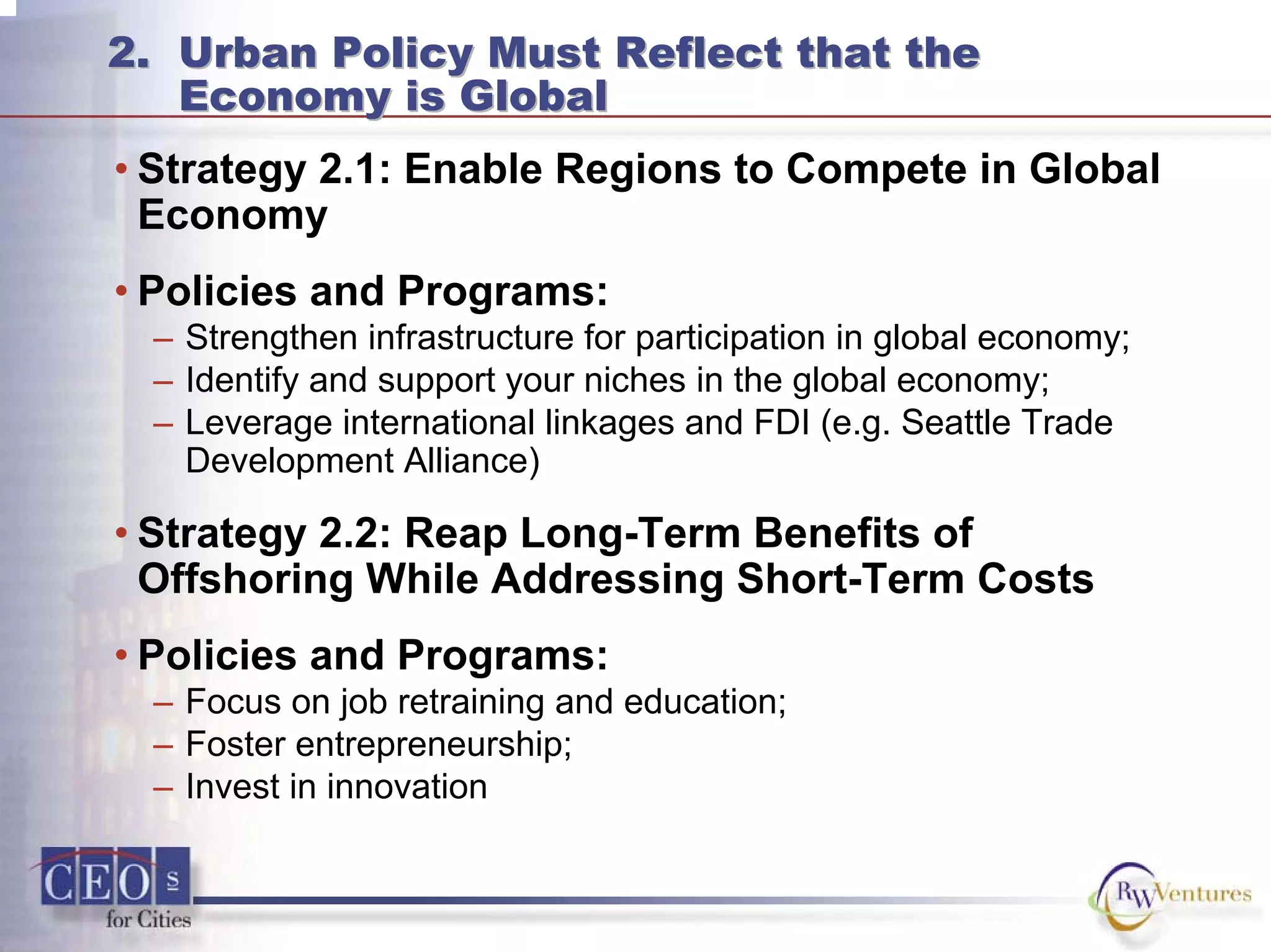
• Strategy 2.1: Enable Regions to Compete in Global
Economy
• Policies and Programs:
– Strengthen infrastructure for participation in global economy;
– Identify and support your niches in the global economy;
– Leverage international linkages and FDI (e.g. Seattle Trade
Development Alliance)
• Strategy 2.2: Reap Long-Term Benefits of
Offshoring While Addressing Short-Term Costs
• Policies and Programs:
– Focus on job retraining and education;
– Foster entrepreneurship;
– Invest in innovation
3. Urban Policy Must Be Regional3. Urban Policy Must Be Regional
• Strategy 3.1: Support Regional Infrastructure,
Integration and Planning
• Policies and Programs:
– City-suburb partnerships, particularly aimed at managing growth
patterns (e.g. Metro regional government in Portland);
– States limiting government fragmentation and consolidating land
use and zoning powers;
– State and federal governments encouraging cooperation among
jurisdictions
[See Strategy 4 and related Policies and Programs as well.]
4. An Efficient Regional Economy Uses All of
its Assets and Organizes Them Well
4. An Efficient Regional Economy Uses All of
its Assets and Organizes Them Well
• Strategy 4.1: Deploy Human Capital, Take Advantage of Diversity
• Policies and Programs:
– Workforce Development;
– Regional Housing and Transportation Planning (Chicago Metropolis 2020);
– ESL Classes and Targeted Workforce Development for Immigrant Population;
– Reduce cost of healthcare
• Strategy 4.2: Reduce Negative Effects of Concentrated Poverty
• Policies and Programs:
– Financial Education and IDAs
– Earned Income Tax Credit;
– Affordable Housing and Mixed-Income Communities (HOPE VI, Sec. 8, LIHTC)
• Strategy 4.3: Promote Regional Economic Efficiency
• Policies and Programs:
– “Fix it first” transportation policy (Maryland)
– Correct State and Federal Policies that Favor Sprawl
– Downtown Revitalization (e.g. Central Philadelphia Dev. Corp; Denver Downtown
Housing Office)
– Asset-Based, rather than Deficiency-Based, Community Economic Development
5. Invest Wisely -- Create a Knowledge-
Intensive Economy
5. Invest Wisely -- Create a Knowledge-
Intensive Economy
• Strategy 5.1: Focus on Innovation and Commercialization of
Knowledge
• Policies and Programs:
– R&D tax credit;
– University-industry partnerships (e.g. Research Triangle Park);
– Industry Innovation Initiatives (e.g. Innovation @ Scale in Rhode
Island, Bay Area Science and Innovation Consortium);
– Investment in Business Incubators;
– Incentives for Start Up and Academic Inventors.
• Strategy 5.2: Invest in Knowledge Functions, Industries and
Occupations
• Policies and Programs:
– Identify and build on your unique concentration of human capital-
intensive industries and occupations
– Look beyond industry clusters
5. Invest Wisely to Create a Knowledge-
Intensive Economy
5. Invest Wisely to Create a Knowledge-
Intensive Economy
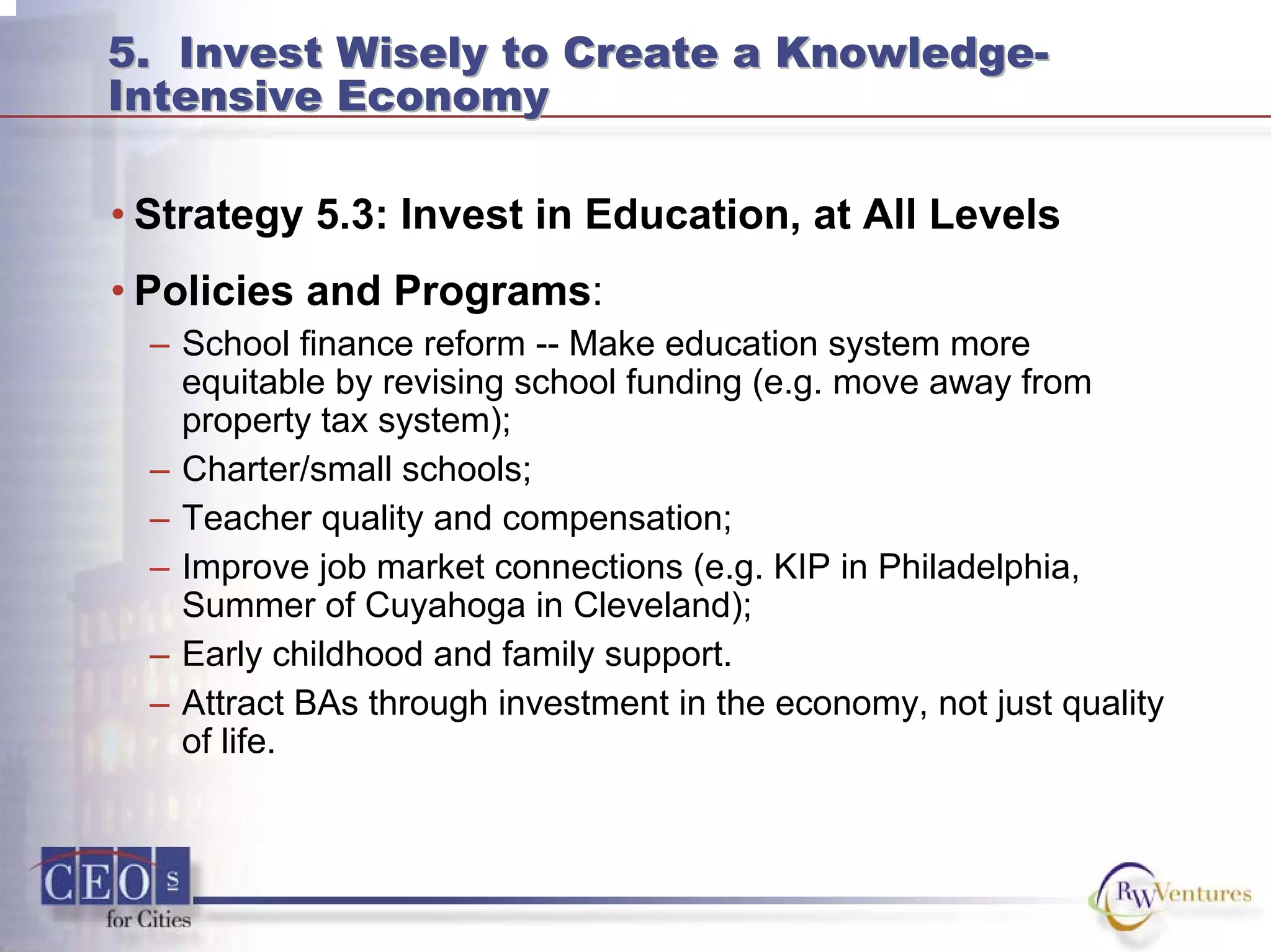
• Strategy 5.3: Invest in Education, at All Levels
• Policies and Programs:
– School finance reform -- Make education system more
equitable by revising school funding (e.g. move away from
property tax system);
– Charter/small schools;
– Teacher quality and compensation;
– Improve job market connections (e.g. KIP in Philadelphia,
Summer of Cuyahoga in Cleveland);
– Early childhood and family support.
– Attract BAs through investment in the economy, not just quality
of life.
6. Harness Market Forces6. Harness Market Forces
• Strategy 6.1: Use Government as Market Enabler
• Policies and Programs:
– Focus direct interventions on areas where markets can’t work;
– Provide the market preconditions of infrastructure and human
capital (health and education)
– Supplement – don’t supplant – the market where possible:
EITC, LIHTC, and New Markets Tax Credit
– Support CDFIs;
– Gather and release critical information that can improve market
operations in urban areas (e.g. American Community Survey);
– Increase government efficiency (e.g. e-government, inter-
agency cooperation).
7. Build on Your Unique Strengths7. Build on Your Unique Strengths
• Strategy 7.1: Build on Overlap of Local Assets,
Economic Drivers and Geographic Connections
• Policies and Programs:
– Increase availability of flexible funding sources (e.g. CDBG)
– Develop more targeted economic investment programs to
support varying economic functional concentrations;
– Take into account different roles cities play in the context of
regional and global economy.
– Focus here should be first on practice, not policy.
AgendaAgenda
Organizational Implications
“It is one of the happy incidents of the federal
system that one courageous State may ... serve as
a laboratory; and try novel social and economic
experiments without risk to the rest of the
country”
- Supreme Court Justice Louis Brandeis,
quoted in Osbourne, Laboratories of Democracy
The Unique CEOs for Cities LensThe Unique CEOs for Cities Lens
Applied Research: addressing
current problems; leading to
practical solutions
Policy informed by
best practices
Grounded Knowledge to
test and inform policy
Three Priority Areas of FocusThree Priority Areas of Focus
•R&D: Value Added Economic Strategies
•Practice: “Clinical Economics” (Sachs)
•Policy: Build Majority Coalition
R&D
Value Added Economic StrategiesValue Added Economic Strategies
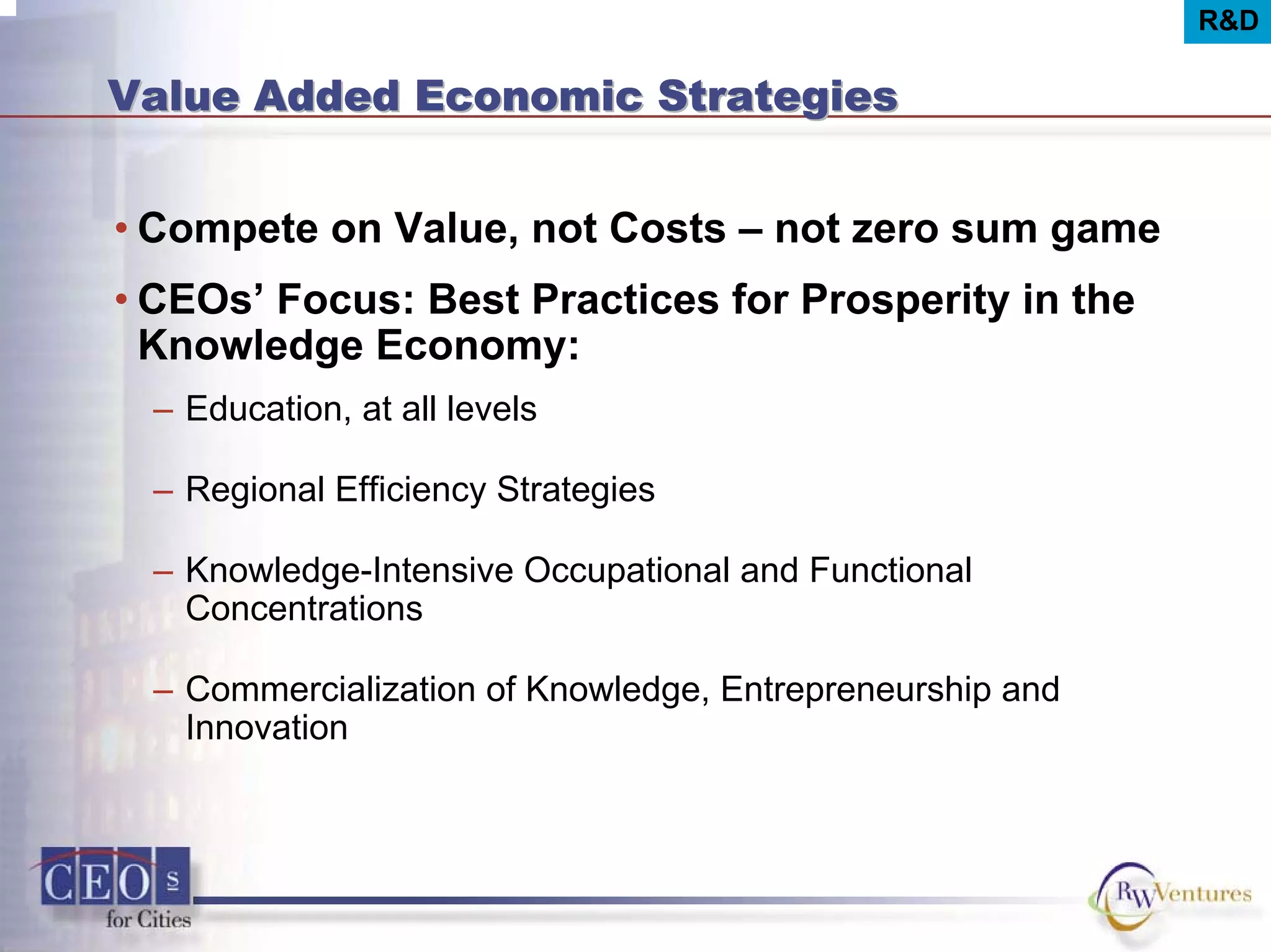
• Compete on Value, not Costs – not zero sum game
• CEOs’ Focus: Best Practices for Prosperity in the
Knowledge Economy:
– Education, at all levels
– Regional Efficiency Strategies
– Knowledge-Intensive Occupational and Functional
Concentrations
– Commercialization of Knowledge, Entrepreneurship and
Innovation
Practice
“Clinical Economics”“Clinical Economics”
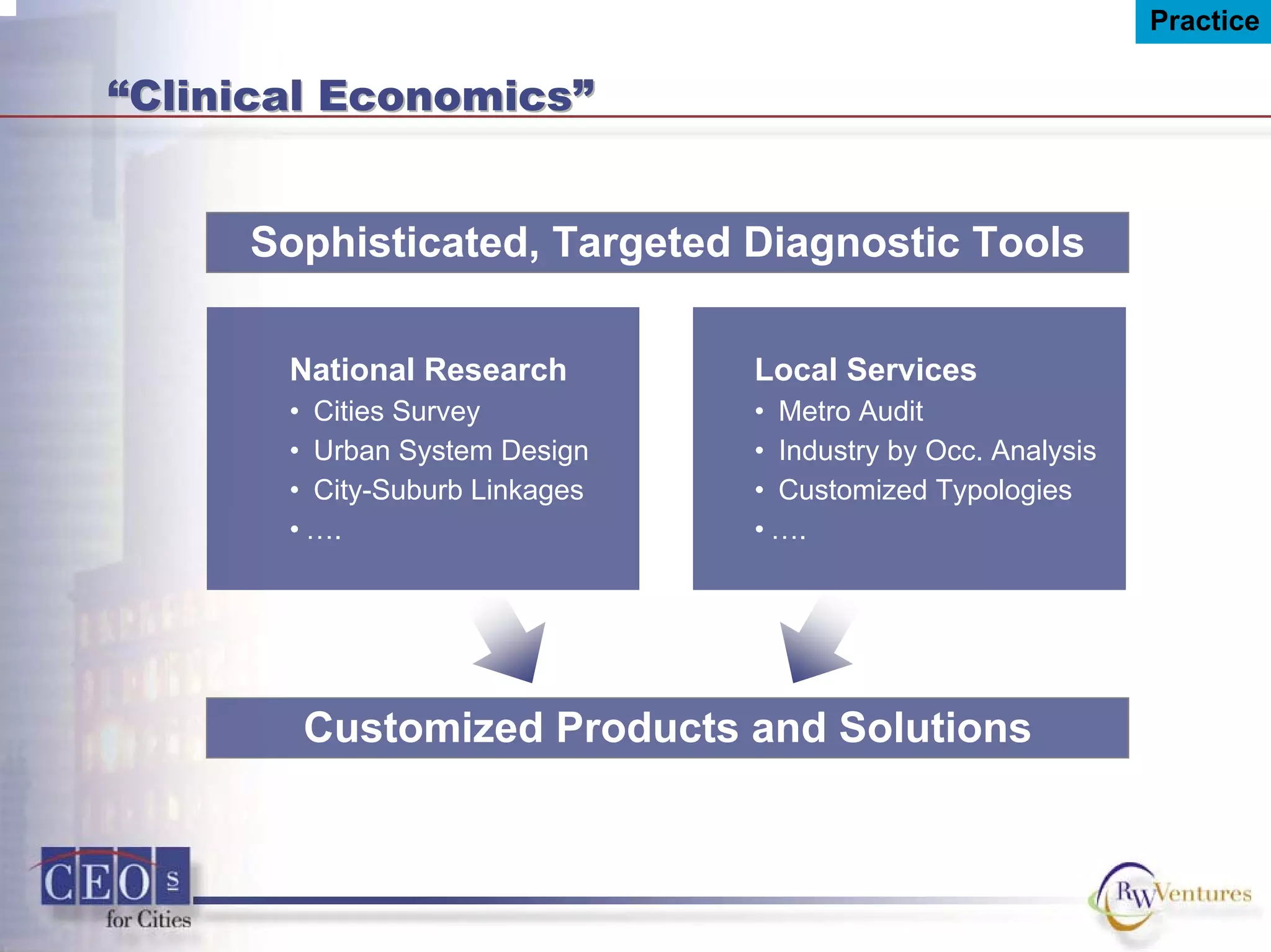
Sophisticated, Targeted Diagnostic Tools
National Research
• Cities Survey
• Urban System Design
• City-Suburb Linkages
• ….
Local Services
• Metro Audit
• Industry by Occ. Analysis
• Customized Typologies
• ….
Customized Products and Solutions
Policy
Making Policy HappenMaking Policy Happen
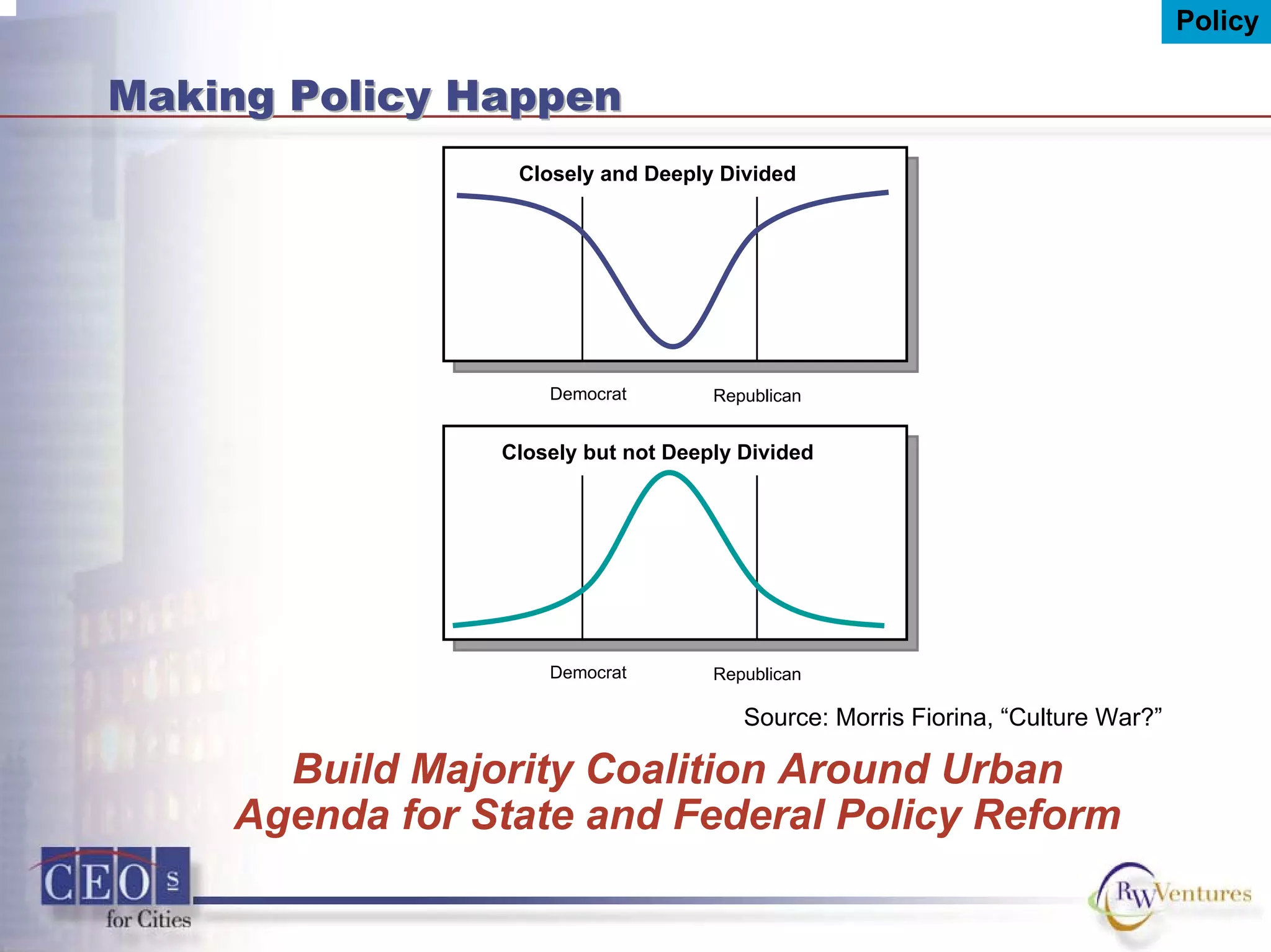
Closely and Deeply Divided
RepublicanDemocrat
Closely but not Deeply Divided
RepublicanDemocrat
Source: Morris Fiorina, “Culture War?”
Build Majority Coalition Around Urban
Agenda for State and Federal Policy Reform
AgendaAgenda
What Have We Learned?
Implications for Policy and Practice
Organizational Implications
Comments and Discussion
Seeing the Forest and the Trees:Seeing the Forest and the Trees:
The Unique CEOs for Cities LensThe Unique CEOs for Cities Lens
Annual Meeting
May 6, 2005
by: Robert Weissbourd
RW Ventures, LLC

Seeing the Forest and the Trees

  • 1.
    Seeing the Forestand the Trees:Seeing the Forest and the Trees: The Unique CEOs for Cities LensThe Unique CEOs for Cities Lens Annual Meeting May 6, 2005 by: Robert Weissbourd RW Ventures, LLC
  • 2.
    THE FOLLOWING PRESENTATIONHAS BEEN APPROVED FOR MATURE AUDIENCES THE FOLLOWING PRESENTATION HAS BEEN APPROVED FOR MATURE AUDIENCES R THIS PRESENTATION HAS BEEN RATED R FOR CONTENT. AUDIENCE DISCRETION ADVISED. R E S T R I C T E D CONTENT MAY BE UNSUBSTANTIATED, OPINIONATED AND PROVOCATIVE
  • 3.
    AgendaAgenda What Have WeLearned? Implications for Policy and Practice Organizational Implications Comments and Discussion
  • 4.
    AgendaAgenda What Have WeLearned? •The Role of Cities •Geography of the New Economy •Drivers of the New Economy •Market Forces
  • 5.
    Cities Drive theNational EconomyCities Drive the National Economy 0% 20% 40% 60% 80% 100% Aggregate Personal Income Consumer Expenditures Tax Payments Total Economic Grow th Manufacturing Value Added Exports Business Establishments MSA as % of US Total Nonmetro as % of US Total The Role of CitiesThe Role of Cities Cities and Economic Prosperity • Cities make a disproportionate contribution to the nation’s economic output • City economies are particularly concentrated in key types of new economic activity • Cities are hubs for metropolitan areas • Cities are drivers of metropolitan economies 0% 10% 20% 30% 40% 50% 60% 70% 80% 90% Museums, botanical, zoological gardens Educational services Legal Services Health Services Depository institutions Insurance Carriers Communication Air Transportation Hub Functions of Cities Suburban % of Total MSA Employment City % of Total MSA Employment
  • 6.
    The Role ofCitiesThe Role of Cities Cities are Even More Important in the Global, Knowledge Economy Cities are Even More Important in the Global, Knowledge Economy Increased Value of Knowledge Factors… • High skilled labor force • Intellectual property • Product innovation; flexible customization • Customer networks • Knowledge management capacities300% 400% 500% 600% Lead to New Drivers of Productivity which Favor Cities • Dense knowledge networks • Functional specialization • Innovative capacity hange Gross Domestic Product % Growth over last 50 years 0% 100% 200% $s lbs %C Greenspan:Greenspan: Fundamental changeFundamental change in the economy towards intangiblein the economy towards intangible assetsassets Economic Growth Worldwide has been Characterized by Urbanization
  • 7.
    The Role ofCitesThe Role of Cites Demographic Shifts Enhance CitiesDemographic Shifts Enhance Cities US Population Growth 800,000 3,456,577 Population Growth 1990-2000 (Top 100 Cities) Native Born Foreign Born The top 100 cities added 4.3 million in population between 1990 and 2000. 80% of this growth was due to increases in the foreign born population. The U.S. added 33 million in population between 1990 and 2000. 35% of this growth was due to increases in the foreign born population. 65% 35% • Population growth fueled by immigrants settling primarily in urban areas • Aging baby boomers increasingly choose to return to cities • Young and singles get married later, enjoy urban lifestyle longer • Cities Increasingly perceived as centers of business, culture and progress rather than crime and poverty (Celinda Lake Poll) Median Growth (1990-2000) 0 2 4 6 8 10 12 Population Per Capita Income
  • 8.
    1st Principle1st Principle TheRole of CitiesThe Role of Cities Adapted from Gastner, Shalizi and Newman, University of Michigan National PolicyNational Policy == Urban PolicyUrban Policy (and vice(and vice--versa)versa)
  • 9.
    Geography of theNew EconomyGeography of the New Economy Cities Perform in a Global EconomyCities Perform in a Global Economy 0 1,000,000 2,000,000 3,000,000 4,000,000 5,000,000 6,000,000 7,000,000 8,000,000 1976 1978 1980 1982 1984 1986 1988 1990 1992 1994 1996 1998 2000 2002 (in Millions of $) 0 50,000 100,000 150,000 200,000 250,000 300,000 350,000 1994 1995 1996 1997 1998 1999 2000 Source: BEA The World is Smaller – Markets are Transnational U.S. Assets Abroad up 1500% Since 1976 (in Millions of $) Foreign Assets in US up 600% (1994 - 2000) Cost of a 3 Minute Phone Call from NY to London $0.00 $10.00 $20.00 $30.00 $40.00 $50.00 $60.00 $70.00 1960 1970 1980 1990 2000 Source: Paul Masson, 2001
  • 10.
    Geography of theNew EconomyGeography of the New Economy Markets Are Specializing Across CountriesMarkets Are Specializing Across Countries Is the sky falling? “Tech jobs leave U.S. for India, Russia. Who’s to blame?” – July 2003 “Is your job next?” – February 2003 “American legislators are accusing India of stealing jobs” – June 2003 “America’s pain, India’s gain” – January 2003 “3.3 million U.S. service jobs to go offshore by 2015” – November 2002 “Can America Lose These Jobs and Still Prosper?” – July 2003 U.S. House Sub- business Committee Sawhney on Outsourcing: Is The Sky Falling? Labor Markets Increasingly Operate on a Global Scale
  • 11.
    2nd Principle2nd Principle Geographyof the New EconomyGeography of the New Economy Urban Policy Must Reflect that the Economy is GlobalUrban Policy Must Reflect that the Economy is Global
  • 12.
    Cities and Suburbsare LinkedCities and Suburbs are Linked 0 0.1 0.2 0.3 0.4 0.5 0.6 0.7 1970 1980 1990 2000 Income Levels Housing Values SpearmanRank Correlation Wages Move in Tandem - 10,000 20,000 30,000 40,000 50,000 60,000 0 10,000 20,000 30,000 40,000 50,000 60,000 City Suburb Correlation = 0.77, significant at the .01 level (two-tailed) Geography of the New EconomyGeography of the New Economy
  • 13.
    The Economy isRegionalThe Economy is Regional CITY REGIONAL ECONOMY ENVIRONMENT AMENITIES UTILITIES TRANSPORTATION HOSPITALS AIRPORTS HOUSING JOBS CITYCITY CORPORATE SERVICES SUPPLY CHAINS MUSEUMS CONSUMER MARKETS Geography of the New EconomyGeography of the New Economy
  • 14.
    3rd Principle3rd Principle Geographyof the New EconomyGeography of the New Economy Urban Policy Must Be RegionalUrban Policy Must Be Regional
  • 15.
    Drivers of theNew EconomyDrivers of the New Economy Are Current Growth Patterns Efficient?Are Current Growth Patterns Efficient? Regional Economic Efficiency Requires: • Taking Advantage of Density • Building Livable Communities • Aligning Components of the Economy (e.g. Reducing Jobs-Housing Mismatch) • Efficient Regional Infrastructure Source: Chicago Metropolis 2020
  • 16.
    Drivers of theNew EconomyDrivers of the New Economy Equity and Opportunity are Good for BusinessEquity and Opportunity are Good for Business -.20.2.4.6 WageGrowth(1990-2000) 0 .1 .2 .3 .4 Poverty Rate (1990) Changing Dynamics Findings: • Inequality has negative effect on income growth • Hispanic Segregation has a negative effect on income growth Regional Economic Efficiency Requires: •Using All Deployable Assets •Avoiding Costs of Concentrated Poverty
  • 17.
    4th Principle4th Principle Driversof the New EconomyDrivers of the New Economy An Efficient Regional Economy Uses allAn Efficient Regional Economy Uses all of its Assets and Organizes them Wellof its Assets and Organizes them Well
  • 18.
    The Role ofKnowledge Factors is Increasing Throughout the Economy The Role of Knowledge Factors is Increasing Throughout the Economy Drivers of the New EconomyDrivers of the New Economy Wage Growth Increases with Digital Economy 1 .8 .4 .2 0 5-5 WageGrowth 1990-2000(PMSA) .6 Grand Rapids, MI Rochester, NY San Diego, CA Austin, TX Presence of Digital Economy Factors The Value of Output per Hour has Increased More than Ten-Fold Over the Last 100 Years
  • 19.
    Drivers of theNew EconomyDrivers of the New Economy The Importance of EducationThe Importance of Education WageGrowth1990-2000(Log,MSA) % Adults with BA or Higher 1990 -.20.2.4.6 .1 .2 .3 .4 .5 Cleveland, OH Washington D.C. Richmond, VA Providence, RI St. Paul, MN Houston, TX Chicago, IL Columbus, OH Indianapolis, IN San Antonio, TX College Education is the Biggest Driver of Economic Growth (and High School Alone is Barely Significant Anymore)
  • 20.
    Functional and Occupational Concentrationsare Increasingly Important Functional and Occupational Concentrations are Increasingly Important Sectoral Specialization (Manufacturing) 0.33 0.34 0.34 0.35 0.35 0.36 0.36 0.37 0.37 0.38 0.38 1977 1987 1997 GiniCoeff.BasedonEmploymentShare Functional Specialization (Management vs. Production) 0% 5% 10% 15% 20% 25% 30% 35% 40% 45% 1970 1980 1990 PercentDifferencefromNationalAverage Drivers of the New EconomyDrivers of the New Economy MSAs with Pop > 5,000,000 Source: Duranton and Puga 2002 Estimated Effect on Income Growth (MSA) 0.0 Professional Managerial Sales Clerical Precision Production Machine Operator Transportation Equipment* Material Handler & Laborer Farming* Services (Non HHD)
  • 21.
    Knowledge Industries, Functionsand Occupations Attract BAs and Drive Growth Knowledge Industries, Functions and Occupations Attract BAs and Drive Growth Information Sector 0510 AttainmentGrowth(1990-2000) .1 .2 .3 .4 .5 Information Sector as % Total Earnings Finance, Insurance, and Real Estate 0510 AttainmentGrowth(1990-2000) 0 .05 .1 .15 Share workers in Finance, Insurance, and Real Estate Manufacturing 0510 AttainmentGrowth(1990-2000) 0 .05 .1 .15 .2 .25 % Employment In Manufacturing Drivers of the New EconomyDrivers of the New Economy Business Services 0510 AttainmentGrowth(1990-2000) .02 .03 .04 .05 .06 .07 % Employed In Business and Repair Services KnowledgeKnowledge FunctionsFunctions ProductiveProductive IndustriesIndustries High HCHigh HC OccupationsOccupations
  • 22.
    Drivers of theNew EconomyDrivers of the New Economy 5th Principle5th Principle Invest WiselyInvest Wisely Create a Knowledge Intensive EconomyCreate a Knowledge Intensive Economy
  • 23.
    Drivers of theNew EconomyDrivers of the New Economy Multiple Drivers of SuccessMultiple Drivers of Success High School Degree Age 35-44 Business Services Sprawl Index Professional Jobs College Degree Exports Immigration (1980s) Hispanic Segregation -0.6 -0.4 -0.2 0.0 0.2 0.4 0.6 0.8 1.0 Estimated Effect on Income Growth (Standardized Regression Coefficient: with 95% Confidence Interval) No Silver Bullet: Many Factors Matter
  • 24.
    Drivers of theNew EconomyDrivers of the New Economy Varied City Types and PerformanceVaried City Types and Performance Income Growth vs. Population Growth 1990-2000 Top 110 Cities Fastest Slowest Fastest Growth in Population (Rank) GrowthinIncomeperCapita(Rank) WashiWashington D.C.ngton D.C. Jacksonville, FLJacksonville, FL Chicago, ILChicago, IL Indianapolis, INIndianapolis, IN Boston, MABoston, MA Baltimore, MDBaltimore, MD St. Paul, MNSt. Paul, MN Cleveland, OHCleveland, OH Columbus, OHColumbus, OHChattanooga, TNChattanooga, TN Houston, TXHouston, TX San Antonio, TXSan Antonio, TX Richmond, VARichmond, VA MilwMilwaukee, WIaukee, WI Great Variation in City Economic Types, Paths, Outcomes
  • 25.
    Drivers of theNew EconomyDrivers of the New Economy 7th Principle7th Principle Build on Your Unique StrengthsBuild on Your Unique Strengths
  • 26.
    Learnings from theField: the Business of DevelopmentLearnings from the Field: the Business of Development Market ForcesMarket Forces $0 $50 $100 $150 $200 $250 $300 1999 2000 2001 2002 2003 Shorebank Corporation: Total Community Development Investment (in millions) $0 $2 $4 $6 $8 1999 2000 2001 2002 2003 ShoreBank Corporation: Net Income (in millions) • Widespread Success of CDFIs • Effective Tax Credit Policies (EITC, LIHTC, NMTC) • Annie E. Casey Foundation – from children to families to neighborhoods to economics…
  • 27.
    Market ForcesMarket Forces Goals:Aligning Markets and DevelopmentGoals: Aligning Markets and Development High AlignmentHigh Alignment Low AlignmentLow Alignment MarketMarket RefiningRefining Market solutionMarket solution possible withpossible with new information,new information, products orproducts or networks MarketMarket InterventionIntervention Market solutionMarket solution possible ifpossible if marketmarket operations andoperations and environmentenvironment changedchanged through publicthrough public policy andpolicy and advocacy MarketMarket RedefiningRedefining Market solutionMarket solution possible ifpossible if marketmarket operations andoperations and marketmarket environmentenvironment changed throughchanged through private activities networks private activities Pure MarketPure Market Market solutionMarket solution possible; marketpossible; market alreadyalready generatesgenerates developmentdevelopment outcomesoutcomesNonNon--MarketMarket No marketNo market solution; marketsolution; market is not theis not the appropriateappropriate channelchannel advocacy Market InterestsMarket Interests DevelopmentDevelopment GoalsGoals Adapted from Kahane /Weiser/Ford CIIAdapted from Kahane /Weiser/Ford CII
  • 28.
    Market ForcesMarket Forces Goals:Aligning Markets and DevelopmentGoals: Aligning Markets and Development High AlignmentHigh Alignment Low AlignmentLow Alignment MarketMarket RefiningRefining Market solutionMarket solution possible withpossible with new information,new information, products orproducts or networks MarketMarket InterventionIntervention Market solutionMarket solution possible ifpossible if marketmarket operations andoperations and environmentenvironment changedchanged through publicthrough public policy andpolicy and advocacy MarketMarket RedefiningRedefining Market solutionMarket solution possible ifpossible if marketmarket operations andoperations and marketmarket environmentenvironment changed throughchanged through private activities networks private activities advocacy Pure MarketPure Market Market solutionMarket solution possible; marketpossible; market alreadyalready generates CEDgenerates CED outcomesoutcomes NonNon--MarketMarket No marketNo market solution; marketsolution; market is not theis not the appropriateappropriate channelchannel Market InterestsMarket Interests CED GoalsCED Goals Adapted from Kahane, Weiser, Ford CIIAdapted from Kahane, Weiser, Ford CII Make MarketMake Market WorkWork (Addressing(Addressing InternalInternal Imperfections)Imperfections)Change MarketChange Market ParametersParameters (Using Market(Using Market Mechanisms)Mechanisms) Change MarketChange Market ParametersParameters (Using Non(Using Non-- marketmarket Mechanisms)Mechanisms) Vital WorkVital Work –– but not marketbut not market based!based! Market Works:Market Works: Company profitsCompany profits while providingwhile providing DevelopmentDevelopment impact.impact.
  • 29.
    Market ForcesMarket Forces 6thPrinciple6th Principle In Our Economy, Markets are the Most PowerfulIn Our Economy, Markets are the Most Powerful Mechanism for Wealth CreationMechanism for Wealth Creation Harness Market ForcesHarness Market Forces
  • 30.
    What Have WeLearned?What Have We Learned? 1. National Policy = Urban Policy 2. Urban Policy must Reflect that the Economy is Global 3. Urban Policy must be Regional (the region is the economic unit that performs in the global economy) 4. An Efficient Regional Economy Uses all of its Assets and Organizes them Well 5. Invest Wisely -- Create a Knowledge-Intensive Economy 6. Harness Market Forces 7. Build on Your Unique Strengths
  • 31.
    AgendaAgenda What Have WeLearned? Implications for Policy and Practice Organizational Implications Comments and Discussion
  • 32.
    1. National Policy= Urban Policy1. National Policy = Urban Policy • Strategy 1.1: Strengthen Urban Economies to Strengthen the Nation • Policies and Programs: – See, Everything under the other Principles • Strategy 1.2: Focus on the Urban Economic Effects of National Policies • Policies and Programs: – Tailor immigration policy to local labor force needs; – Health care; – Banking regulation (e.g. CRA) – Transportation.
  • 33.
    2. Urban PolicyMust Reflect that the Economy is Global 2. Urban Policy Must Reflect that the Economy is Global • Strategy 2.1: Enable Regions to Compete in Global Economy • Policies and Programs: – Strengthen infrastructure for participation in global economy; – Identify and support your niches in the global economy; – Leverage international linkages and FDI (e.g. Seattle Trade Development Alliance) • Strategy 2.2: Reap Long-Term Benefits of Offshoring While Addressing Short-Term Costs • Policies and Programs: – Focus on job retraining and education; – Foster entrepreneurship; – Invest in innovation
  • 34.
    3. Urban PolicyMust Be Regional3. Urban Policy Must Be Regional • Strategy 3.1: Support Regional Infrastructure, Integration and Planning • Policies and Programs: – City-suburb partnerships, particularly aimed at managing growth patterns (e.g. Metro regional government in Portland); – States limiting government fragmentation and consolidating land use and zoning powers; – State and federal governments encouraging cooperation among jurisdictions [See Strategy 4 and related Policies and Programs as well.]
  • 35.
    4. An EfficientRegional Economy Uses All of its Assets and Organizes Them Well 4. An Efficient Regional Economy Uses All of its Assets and Organizes Them Well • Strategy 4.1: Deploy Human Capital, Take Advantage of Diversity • Policies and Programs: – Workforce Development; – Regional Housing and Transportation Planning (Chicago Metropolis 2020); – ESL Classes and Targeted Workforce Development for Immigrant Population; – Reduce cost of healthcare • Strategy 4.2: Reduce Negative Effects of Concentrated Poverty • Policies and Programs: – Financial Education and IDAs – Earned Income Tax Credit; – Affordable Housing and Mixed-Income Communities (HOPE VI, Sec. 8, LIHTC) • Strategy 4.3: Promote Regional Economic Efficiency • Policies and Programs: – “Fix it first” transportation policy (Maryland) – Correct State and Federal Policies that Favor Sprawl – Downtown Revitalization (e.g. Central Philadelphia Dev. Corp; Denver Downtown Housing Office) – Asset-Based, rather than Deficiency-Based, Community Economic Development
  • 36.
    5. Invest Wisely-- Create a Knowledge- Intensive Economy 5. Invest Wisely -- Create a Knowledge- Intensive Economy • Strategy 5.1: Focus on Innovation and Commercialization of Knowledge • Policies and Programs: – R&D tax credit; – University-industry partnerships (e.g. Research Triangle Park); – Industry Innovation Initiatives (e.g. Innovation @ Scale in Rhode Island, Bay Area Science and Innovation Consortium); – Investment in Business Incubators; – Incentives for Start Up and Academic Inventors. • Strategy 5.2: Invest in Knowledge Functions, Industries and Occupations • Policies and Programs: – Identify and build on your unique concentration of human capital- intensive industries and occupations – Look beyond industry clusters
  • 37.
    5. Invest Wiselyto Create a Knowledge- Intensive Economy 5. Invest Wisely to Create a Knowledge- Intensive Economy • Strategy 5.3: Invest in Education, at All Levels • Policies and Programs: – School finance reform -- Make education system more equitable by revising school funding (e.g. move away from property tax system); – Charter/small schools; – Teacher quality and compensation; – Improve job market connections (e.g. KIP in Philadelphia, Summer of Cuyahoga in Cleveland); – Early childhood and family support. – Attract BAs through investment in the economy, not just quality of life.
  • 38.
    6. Harness MarketForces6. Harness Market Forces • Strategy 6.1: Use Government as Market Enabler • Policies and Programs: – Focus direct interventions on areas where markets can’t work; – Provide the market preconditions of infrastructure and human capital (health and education) – Supplement – don’t supplant – the market where possible: EITC, LIHTC, and New Markets Tax Credit – Support CDFIs; – Gather and release critical information that can improve market operations in urban areas (e.g. American Community Survey); – Increase government efficiency (e.g. e-government, inter- agency cooperation).
  • 39.
    7. Build onYour Unique Strengths7. Build on Your Unique Strengths • Strategy 7.1: Build on Overlap of Local Assets, Economic Drivers and Geographic Connections • Policies and Programs: – Increase availability of flexible funding sources (e.g. CDBG) – Develop more targeted economic investment programs to support varying economic functional concentrations; – Take into account different roles cities play in the context of regional and global economy. – Focus here should be first on practice, not policy.
  • 41.
    AgendaAgenda Organizational Implications “It isone of the happy incidents of the federal system that one courageous State may ... serve as a laboratory; and try novel social and economic experiments without risk to the rest of the country” - Supreme Court Justice Louis Brandeis, quoted in Osbourne, Laboratories of Democracy
  • 42.
    The Unique CEOsfor Cities LensThe Unique CEOs for Cities Lens Applied Research: addressing current problems; leading to practical solutions Policy informed by best practices Grounded Knowledge to test and inform policy
  • 43.
    Three Priority Areasof FocusThree Priority Areas of Focus •R&D: Value Added Economic Strategies •Practice: “Clinical Economics” (Sachs) •Policy: Build Majority Coalition
  • 44.
    R&D Value Added EconomicStrategiesValue Added Economic Strategies • Compete on Value, not Costs – not zero sum game • CEOs’ Focus: Best Practices for Prosperity in the Knowledge Economy: – Education, at all levels – Regional Efficiency Strategies – Knowledge-Intensive Occupational and Functional Concentrations – Commercialization of Knowledge, Entrepreneurship and Innovation
  • 45.
    Practice “Clinical Economics”“Clinical Economics” Sophisticated,Targeted Diagnostic Tools National Research • Cities Survey • Urban System Design • City-Suburb Linkages • …. Local Services • Metro Audit • Industry by Occ. Analysis • Customized Typologies • …. Customized Products and Solutions
  • 46.
    Policy Making Policy HappenMakingPolicy Happen Closely and Deeply Divided RepublicanDemocrat Closely but not Deeply Divided RepublicanDemocrat Source: Morris Fiorina, “Culture War?” Build Majority Coalition Around Urban Agenda for State and Federal Policy Reform
  • 47.
    AgendaAgenda What Have WeLearned? Implications for Policy and Practice Organizational Implications Comments and Discussion
  • 48.
    Seeing the Forestand the Trees:Seeing the Forest and the Trees: The Unique CEOs for Cities LensThe Unique CEOs for Cities Lens Annual Meeting May 6, 2005 by: Robert Weissbourd RW Ventures, LLC