Why Everyone is Concerned About The
Environment but Nobody Seems to be
Doing Anything To Save It
0
Objectives
 How do people make decisions?
 How can we “nudge” them?
1
Shifting Norms…
2
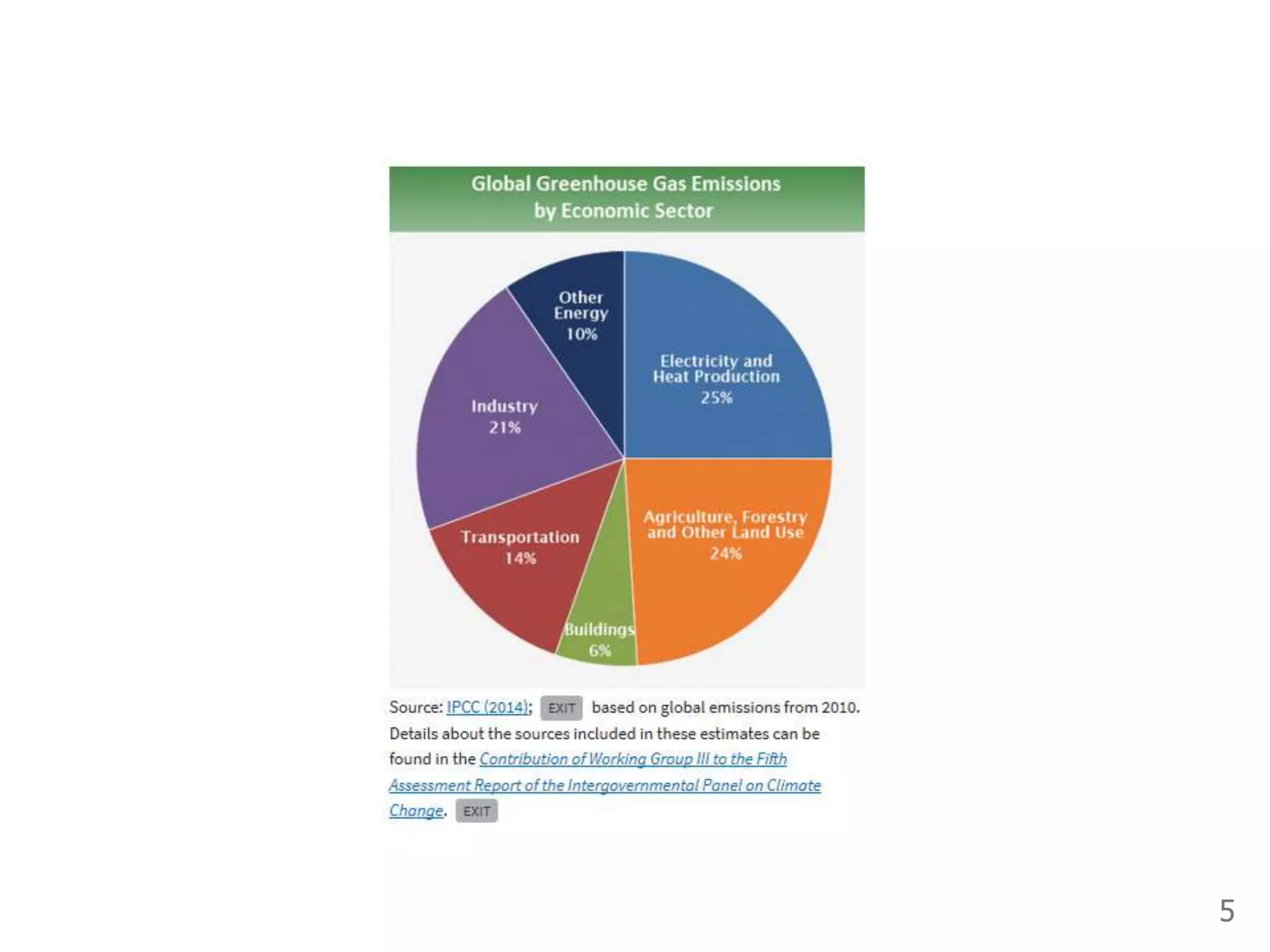
Sources of CO2
3
4
5
 https://data.worldbank.org/indicator/EN.ATM.CO
2E.PC?view=chart&year_high_desc=true
 https://www.afdc.energy.gov/data/10315
6
So What’s Going on and How Do We
Nudge Behavior?
(Chapter 1)
7
Some Assumptions
 Resources are scarce – limited in nature
 Economics studies behavior, individual and
societal, about managing scarce resources
 Scarcity is a (the?) fundamental assumption
 Can apply ideas to environmental questions
9
HOW PEOPLE MAKE DECISIONS
Principle #1: People Face Tradeoffs
All decisions involve tradeoffs.
 Limited nature of resources means we cannot
do/buy everything
OR
HOW PEOPLE MAKE DECISIONS
 Labor / Leisure
 More labor  $  Consumption, but less leisure
time
 Less labor  More Leisure
Principle #1: People Face Tradeoffs
Resources (time, labor…)
Protect the
Environment
Produce
Consumer Goods
Regenerative Thermal Oxidizer
(RTO) burns VOCs
Power Coating Oven
OR
11
HOW PEOPLE MAKE DECISIONS
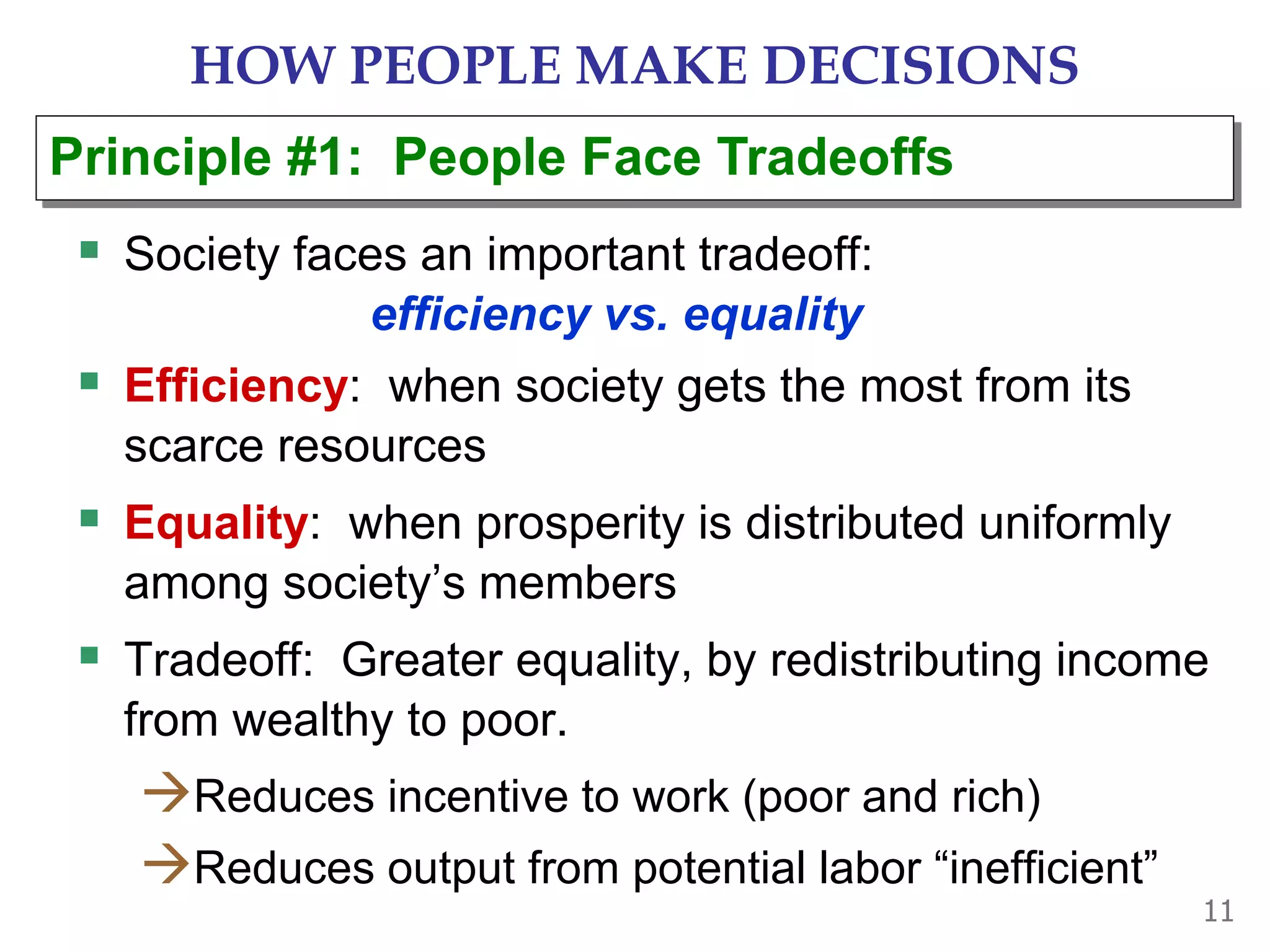
 Society faces an important tradeoff:
efficiency vs. equality
 Efficiency: when society gets the most from its
scarce resources
 Equality: when prosperity is distributed uniformly
among society’s members
 Tradeoff: Greater equality, by redistributing income
from wealthy to poor.
Reduces incentive to work (poor and rich)
Reduces output from potential labor “inefficient”
Principle #1: People Face Tradeoffs
Efficiency means more than
simply using everything!!!!
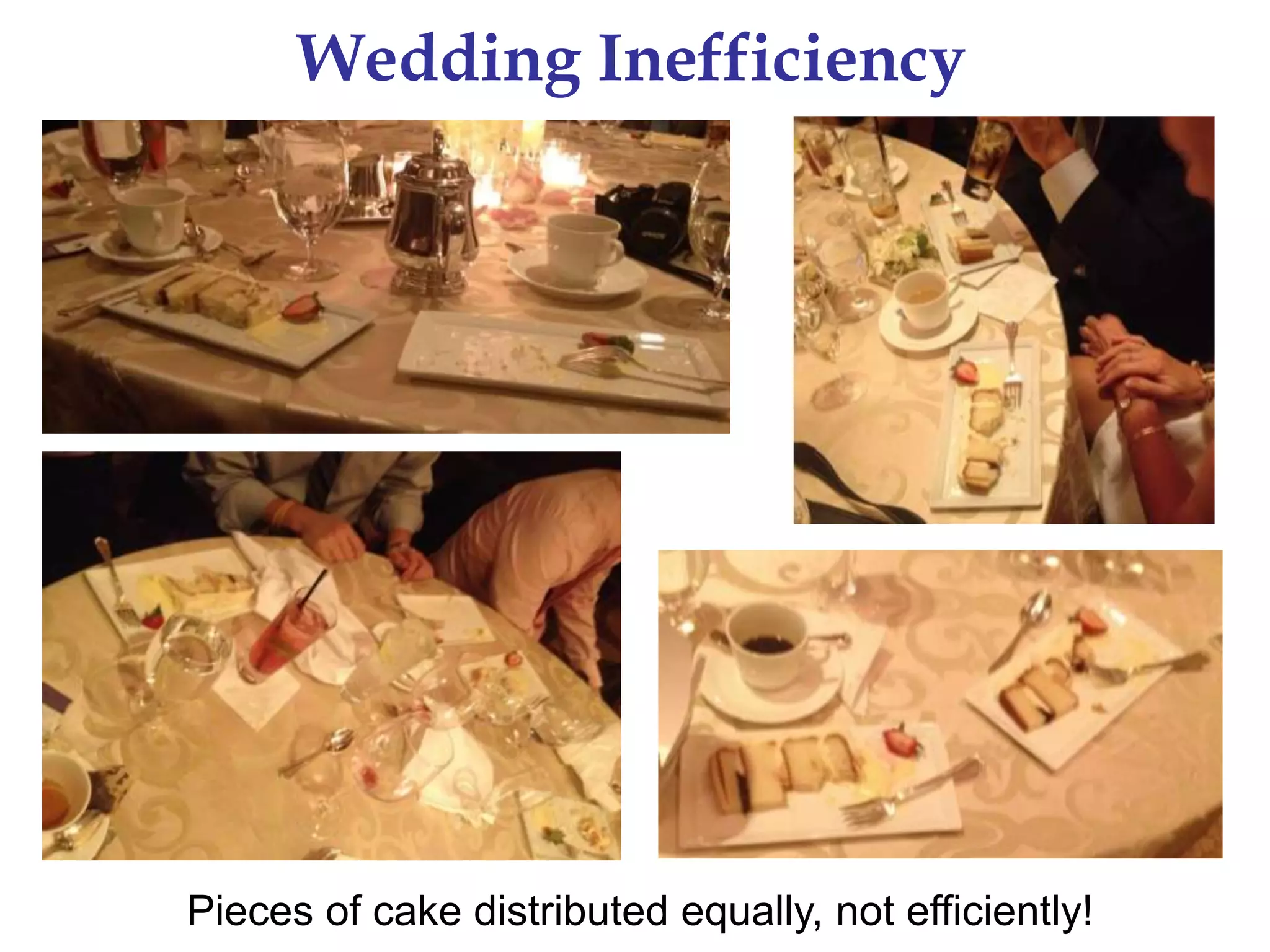
Wedding Inefficiency
Pieces of cake distributed equally, not efficiently!
14
HOW PEOPLE MAKE DECISIONS
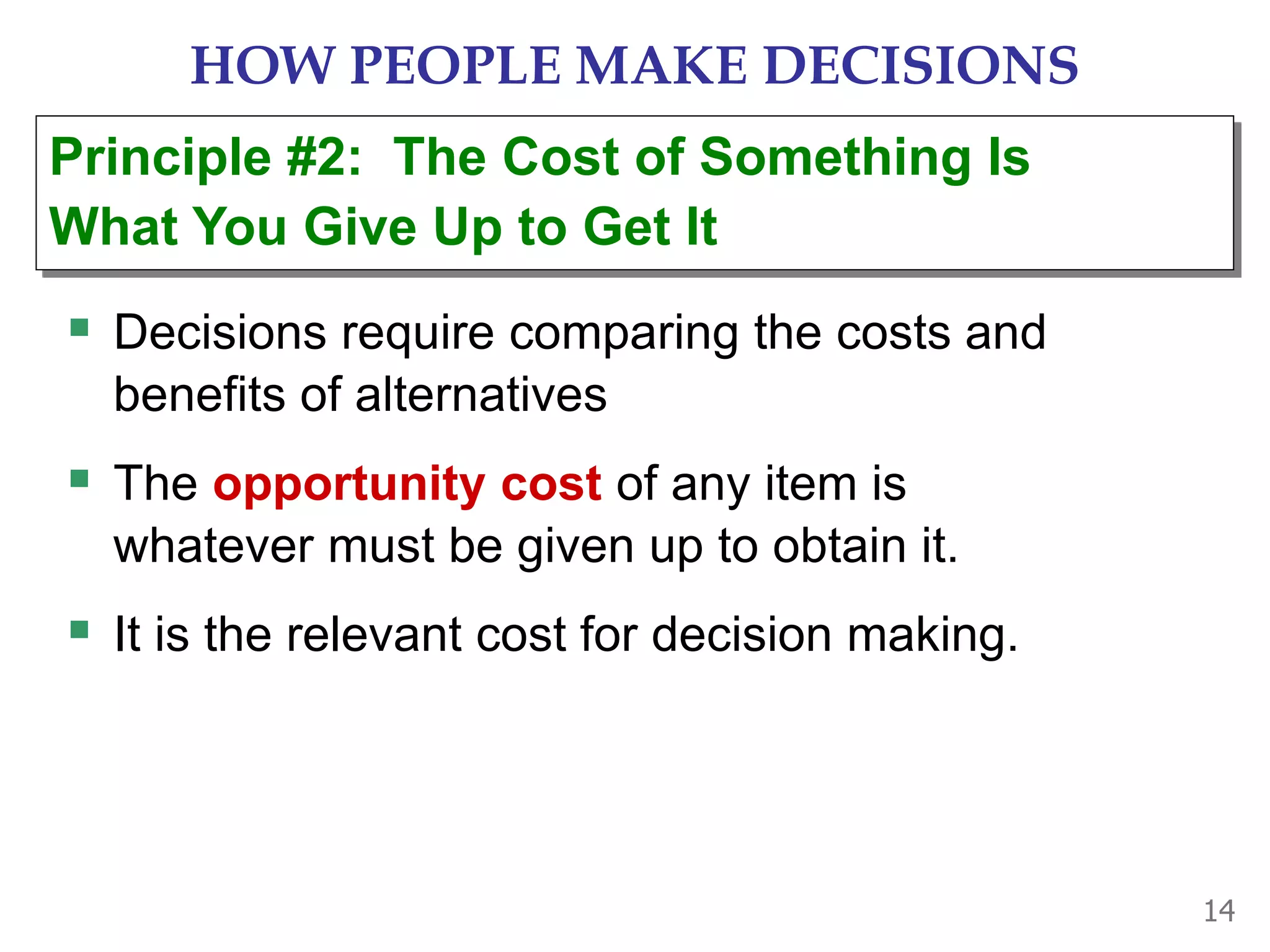
 Decisions require comparing the costs and
benefits of alternatives
 The opportunity cost of any item is
whatever must be given up to obtain it.
 It is the relevant cost for decision making.
Principle #2: The Cost of Something Is
What You Give Up to Get It
15
HOW PEOPLE MAKE DECISIONS
Examples:
The opportunity cost of…
…a movie:
Ticket price but also the time in theater
…Protecting the environment with fuel efficient cars:
smaller space during travels, less range, less safe
than larger polluting vehicles
…Opportunity cost of protecting Cape Fear River
from Gen-X?
Principle #2: The Cost of Something Is
What You Give Up to Get It
Actually what you
would have bought
instead…
The Best Things in Life are Free
 Really????
 Give me an example
 There is no such thing as a free lunch.
 There is an opportunity cost to everything!
16
17
HOW PEOPLE MAKE DECISIONS
Rational people
 systematically and purposefully do the best they
can to achieve their objectives. (self interest)
 Evaluate costs and benefits of marginal
changes – incremental adjustments to an
existing plan (more to come)
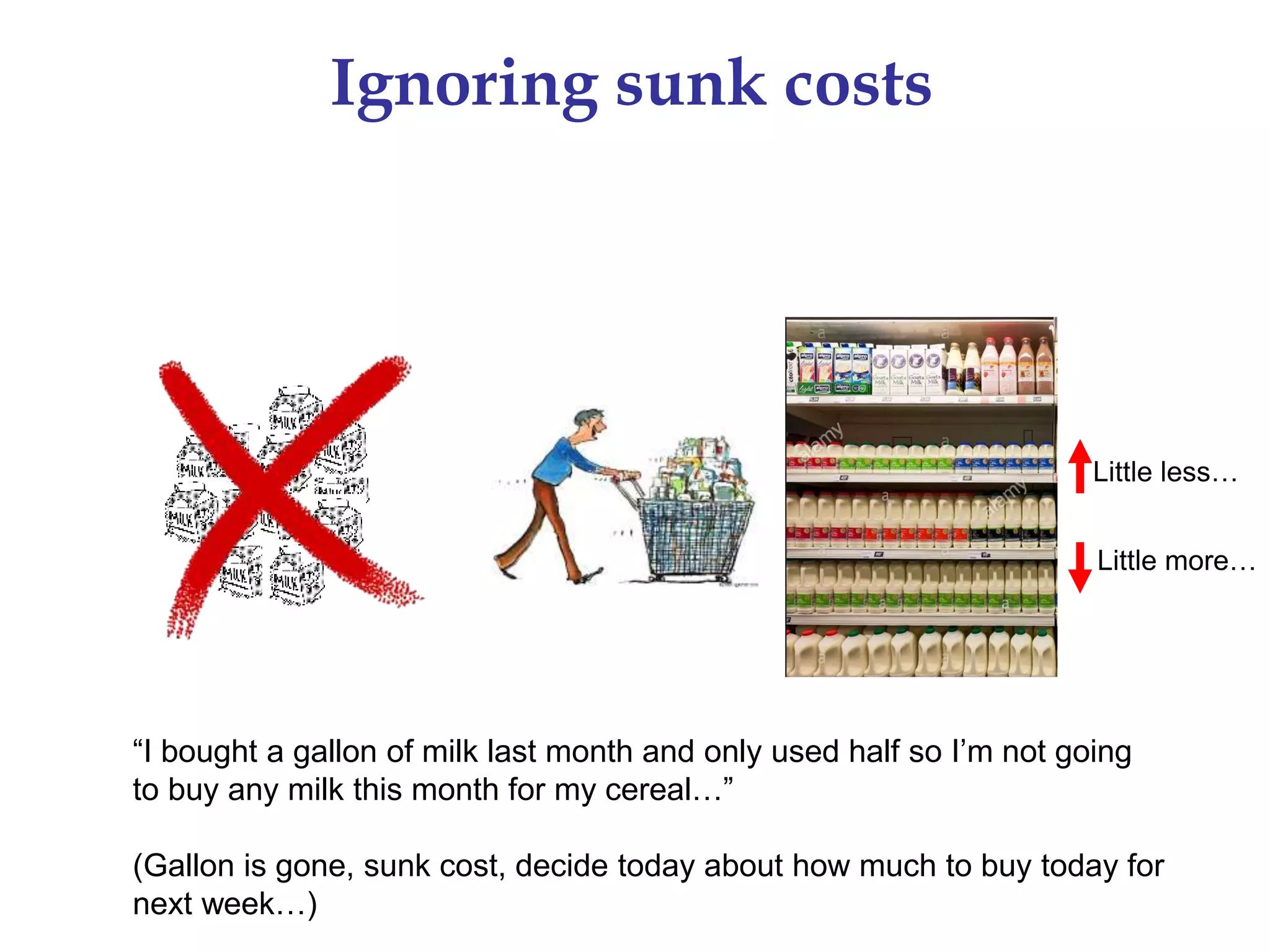
 Ignore sunk costs – costs that have already
been incurred (can’t be changed  ignore)
Principle #3: Rational People Think at the
Margin
Eyes naturally
focus here
Little less…
Little more…
Marginal Change
Little less…
Little more…
Ignoring sunk costs
“I bought a gallon of milk last month and only used half so I’m not going
to buy any milk this month for my cereal…”
(Gallon is gone, sunk cost, decide today about how much to buy today for
next week…)
20
HOW PEOPLE MAKE DECISIONS
Principle #3: Rational People Think at the
Margin
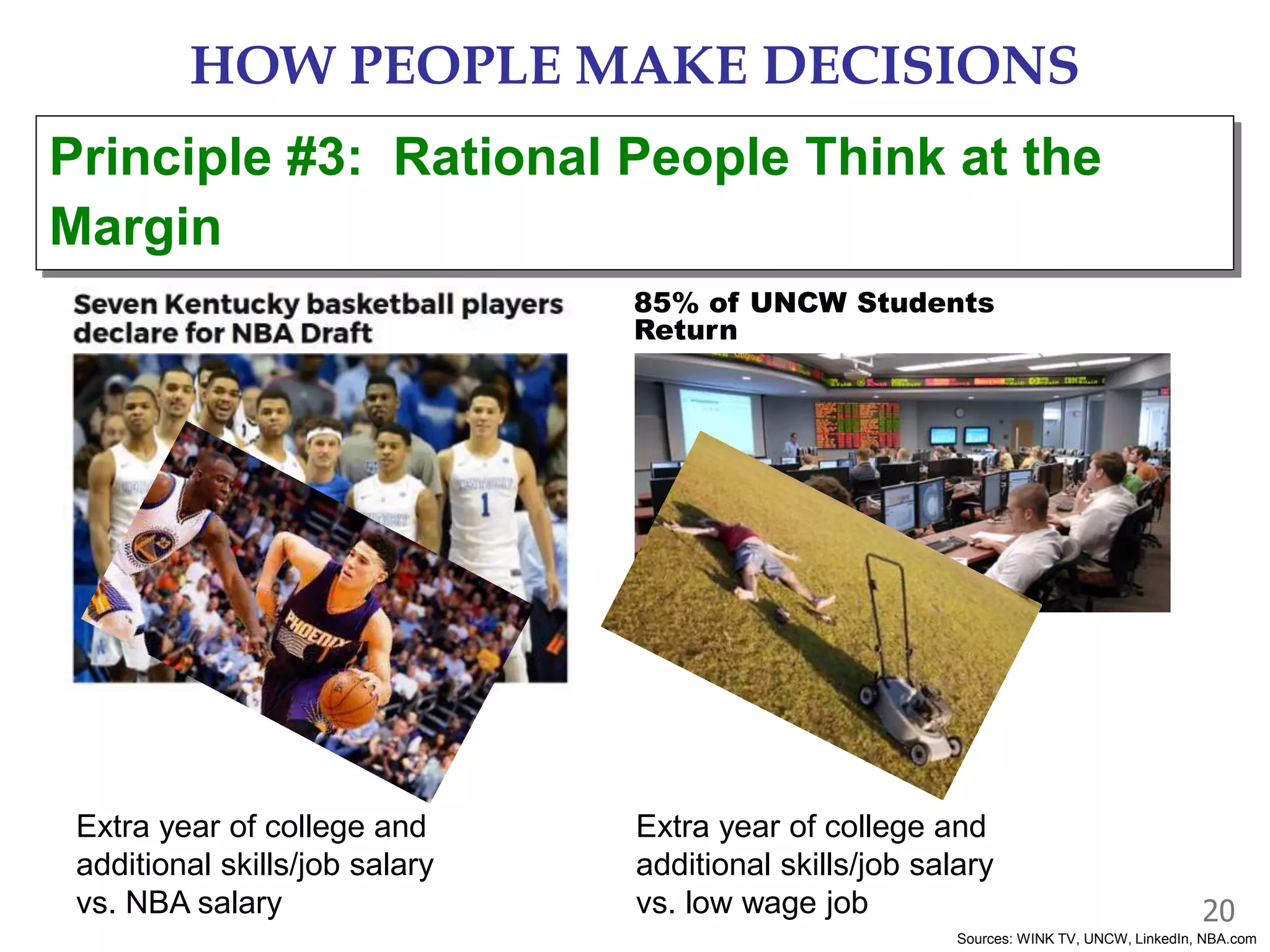
85% of UNCW Students
Return
Sources: WINK TV, UNCW, LinkedIn, NBA.com
Extra year of college and
additional skills/job salary
vs. NBA salary
Extra year of college and
additional skills/job salary
vs. low wage job
21
HOW PEOPLE MAKE DECISIONS
Question:
Why do airlines offer discounted “standby”
tickets?
Marginal Revenue (~$40) > Marginal Cost (~$0)
Principle #3: Rational People Think at the
Margin
Thinking at the Margin
22
Thinking at the Margin
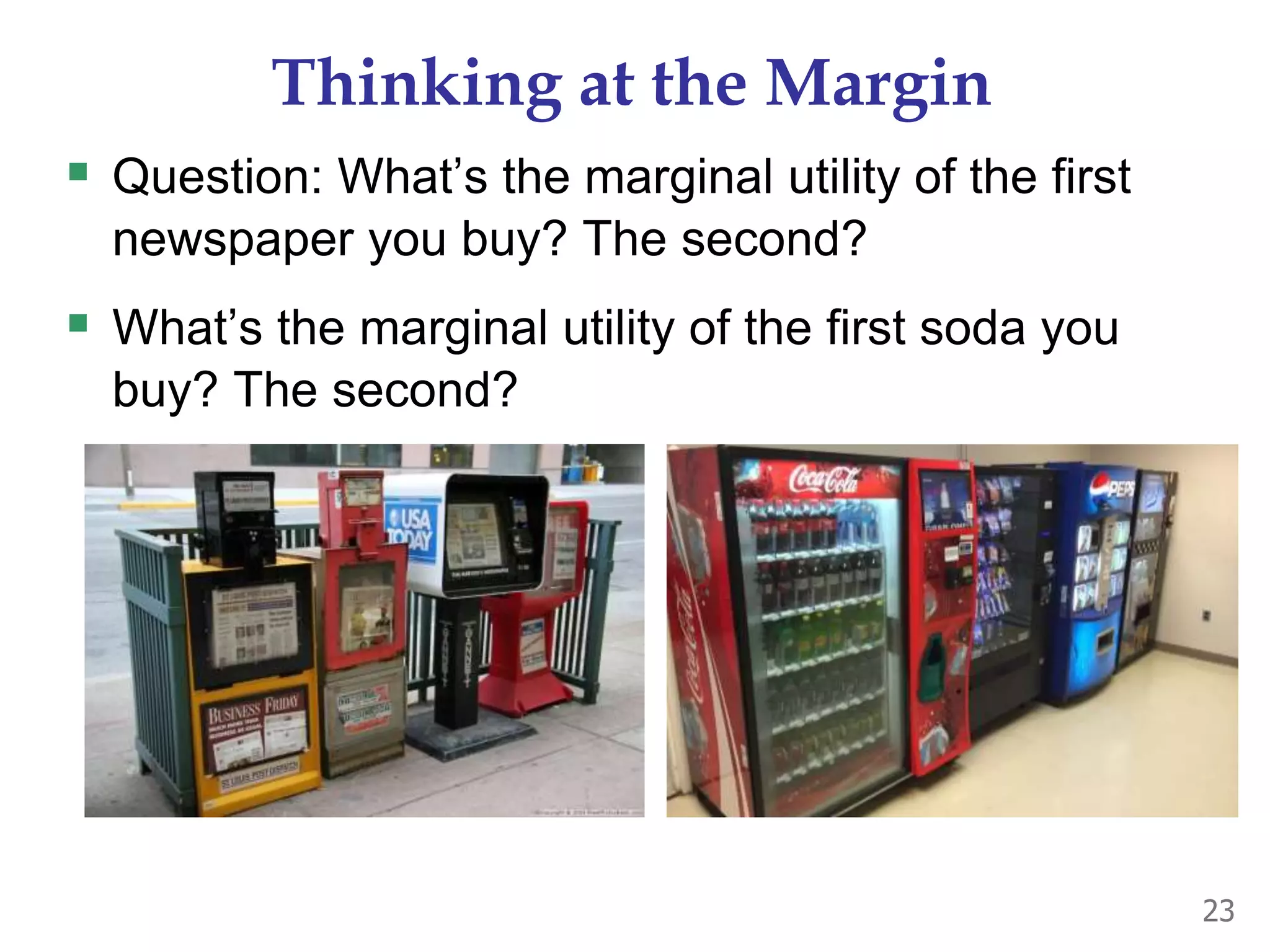
 Question: What’s the marginal utility of the first
newspaper you buy? The second?
 What’s the marginal utility of the first soda you
buy? The second?
23
Applying the principles
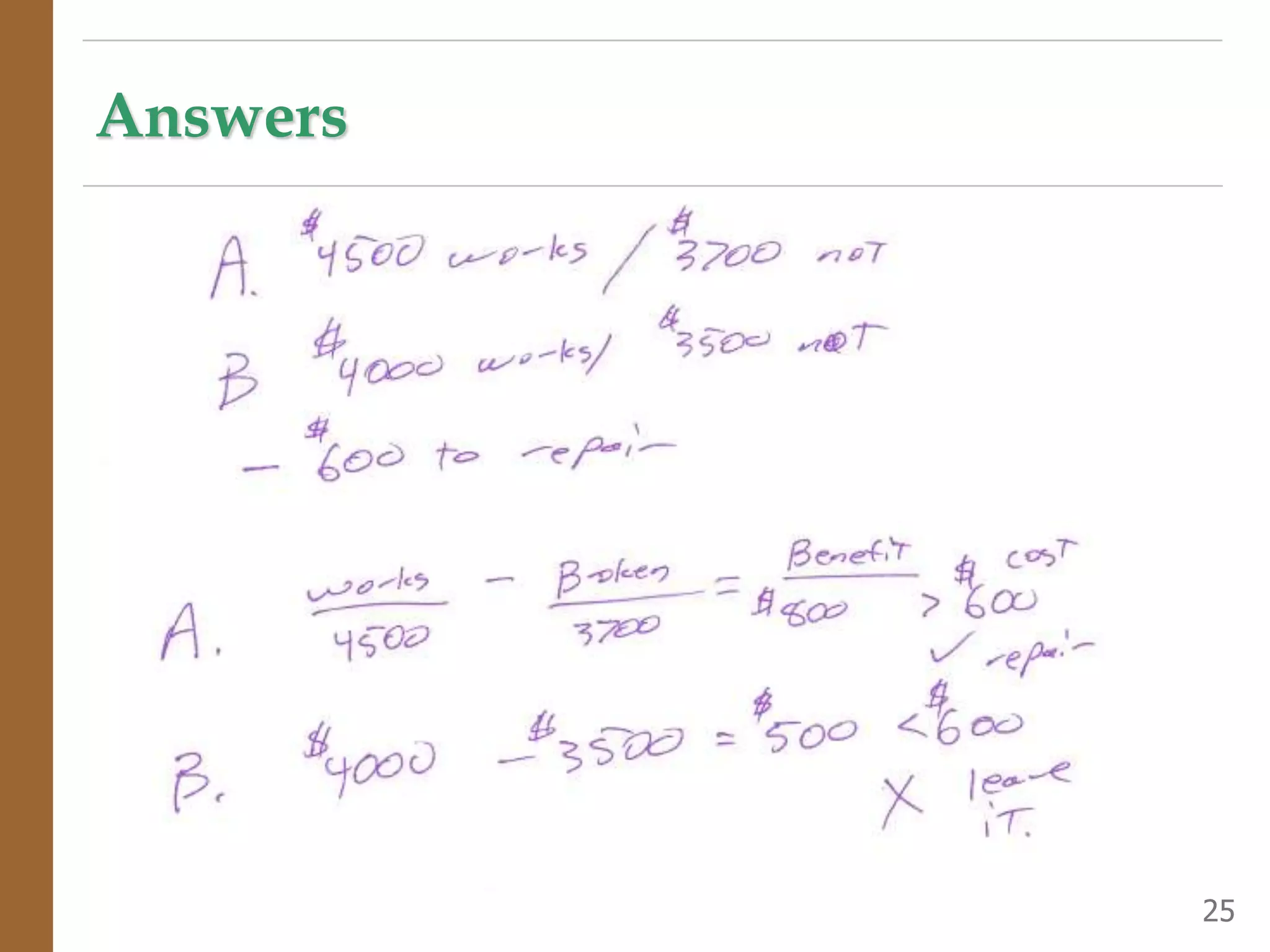
Suppose you have a 2004.5 Volvo you just put
$600 worth of tires on and you are pondering
trading the car in for a new car.
On a Sunday drive, the transmission dies. You
can pay $600 to repair it, or trade-in “as is.”
In each of the following scenarios, should you
have the transmission repaired? Explain.
A. Blue book value is $4500 if transmission works,
$3700 if it doesn’t
B. Blue book value is $4000 if transmission works,
$3500 if it doesn’t
24
Answers
25
Answers
Observations:
 The $6000 you previously spent on repairs is
irrelevant. What matters is the cost and benefit
of the marginal repair (the transmission).
 The change in incentives from scenario A
to scenario B caused your decision to change.
26
27
HOW PEOPLE MAKE DECISIONS
 Incentive: something that induces a person to
act, i.e. the prospect of a reward or punishment.
 Rational people respond to incentives.
Examples:
 Increase in gas prices
More hybrids sold…
More used trucks for sale
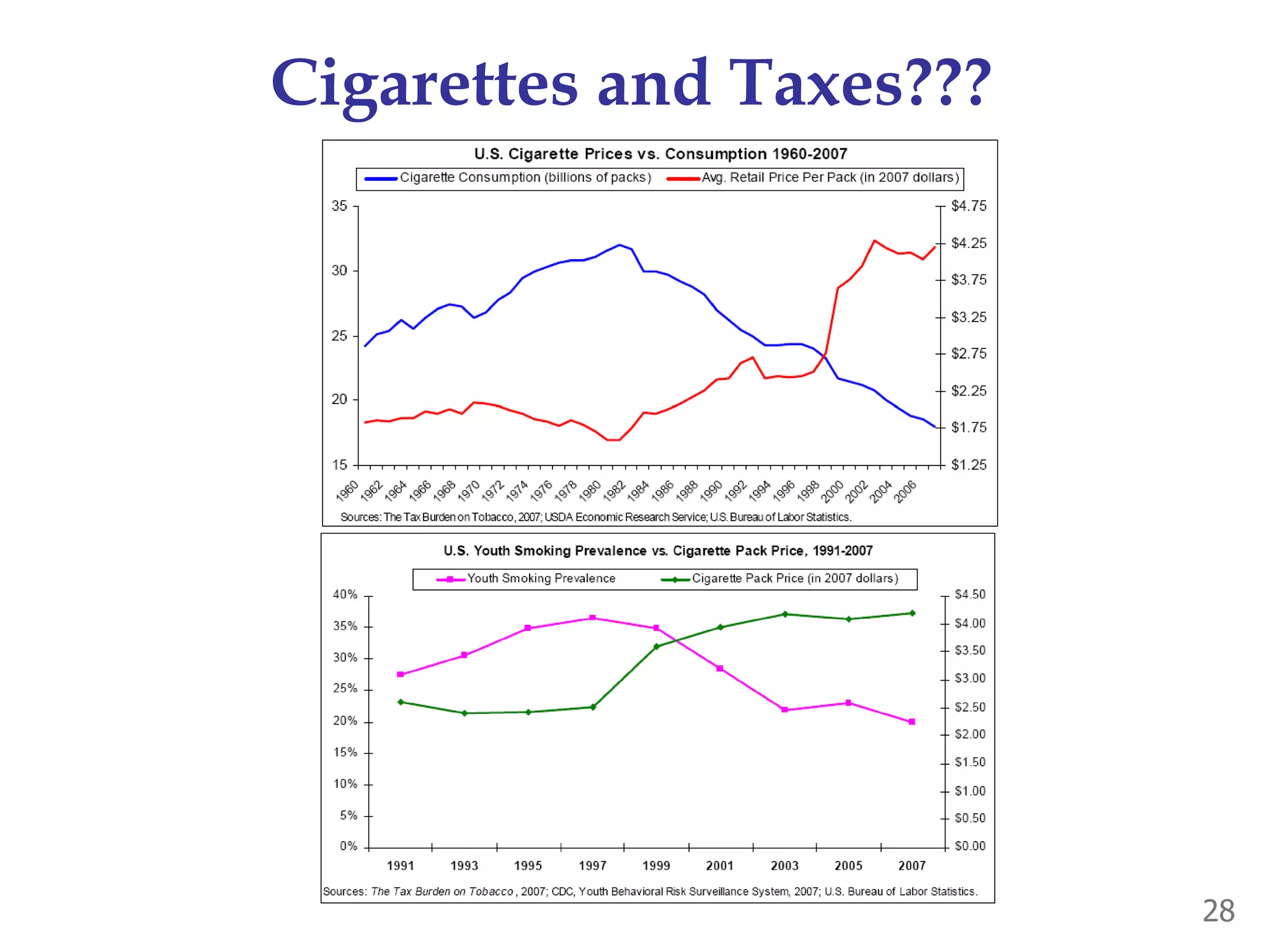
 When cigarette taxes increase,
teen smoking falls.
Principle #4: People Respond to Incentives
Cigarettes and Taxes???
28
Wall Street
Michael Douglas, (young, clean)
Charlie Sheen
1987
30
Wall Street
People Respond to Incentives
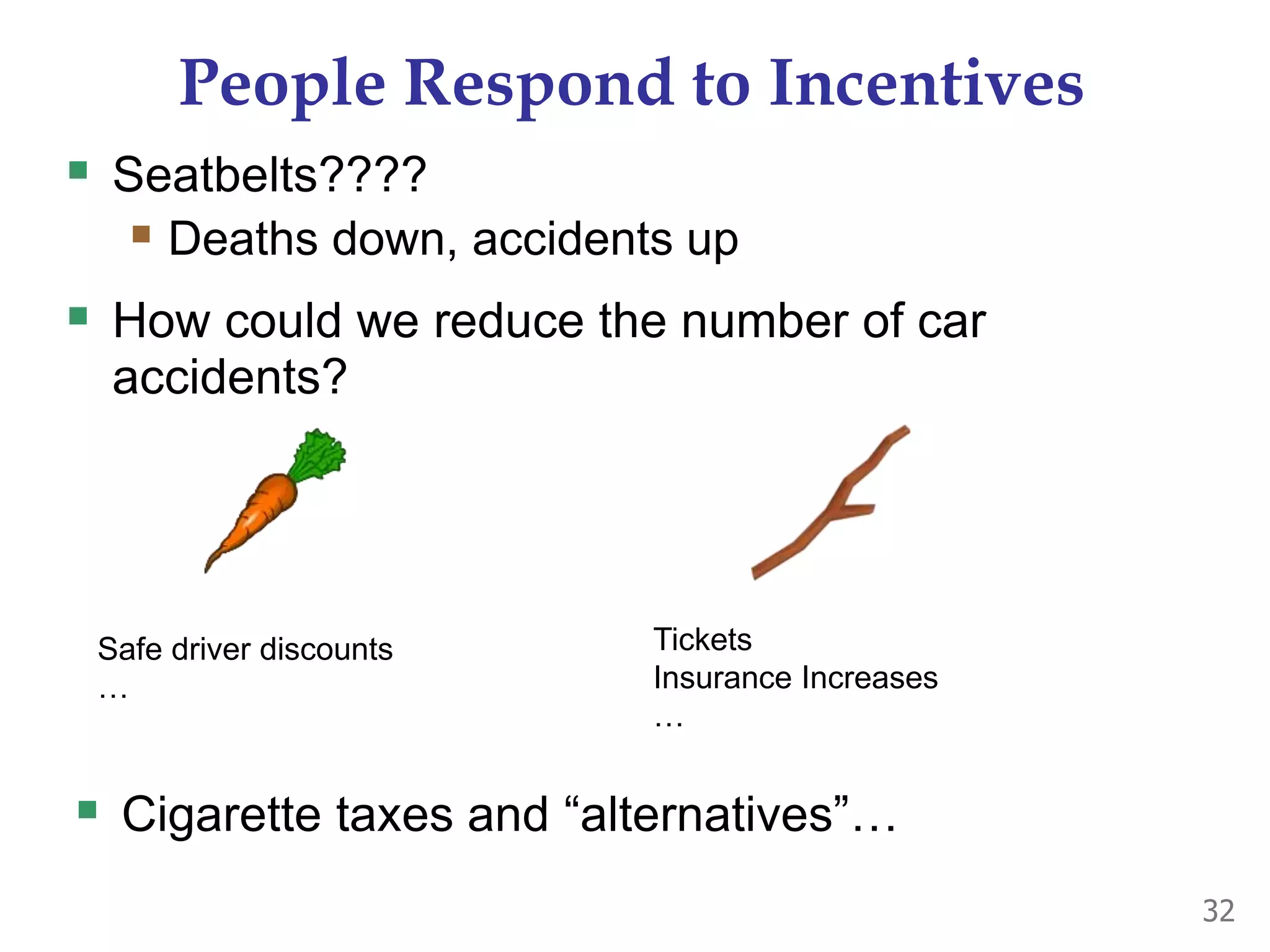
 Seatbelts????
 Deaths down, accidents up
 How could we reduce the number of car
accidents?
32
Safe driver discounts
…
Tickets
Insurance Increases
…
 Cigarette taxes and “alternatives”…
People Respond to Incentives
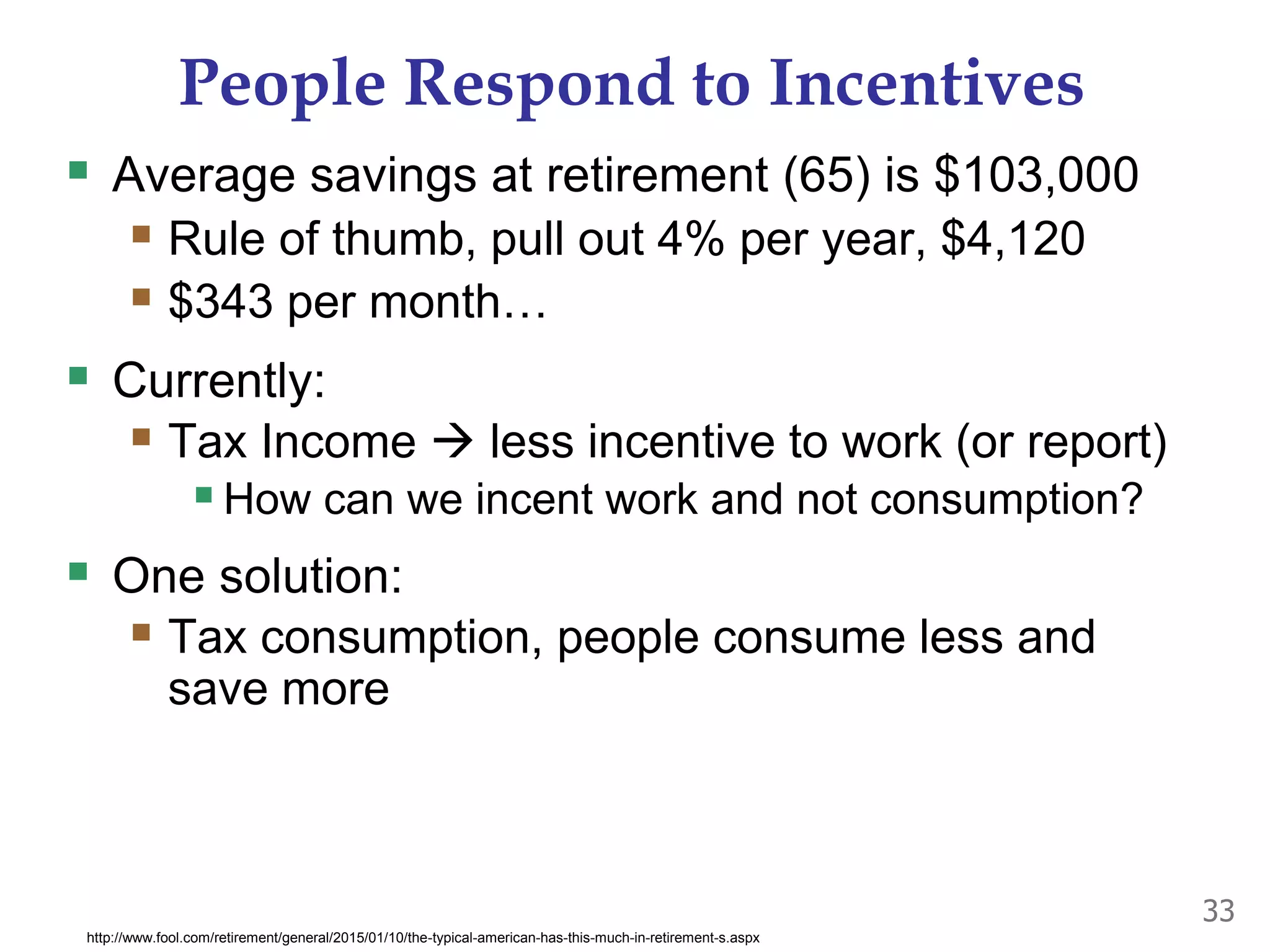
 Average savings at retirement (65) is $103,000
 Rule of thumb, pull out 4% per year, $4,120
 $343 per month…
 Currently:
 Tax Income  less incentive to work (or report)
How can we incent work and not consumption?
 One solution:
 Tax consumption, people consume less and
save more
33
http://www.fool.com/retirement/general/2015/01/10/the-typical-american-has-this-much-in-retirement-s.aspx
Fixing the Environment
 Get the incentives right
 Taxes on gasoline
 Subsidies for efficient vehicles etc.
 Note: Easy to say, hard to do
 Federal and State E-vehicle credit was ~$6-8K
 Everyone bought golf carts!
34
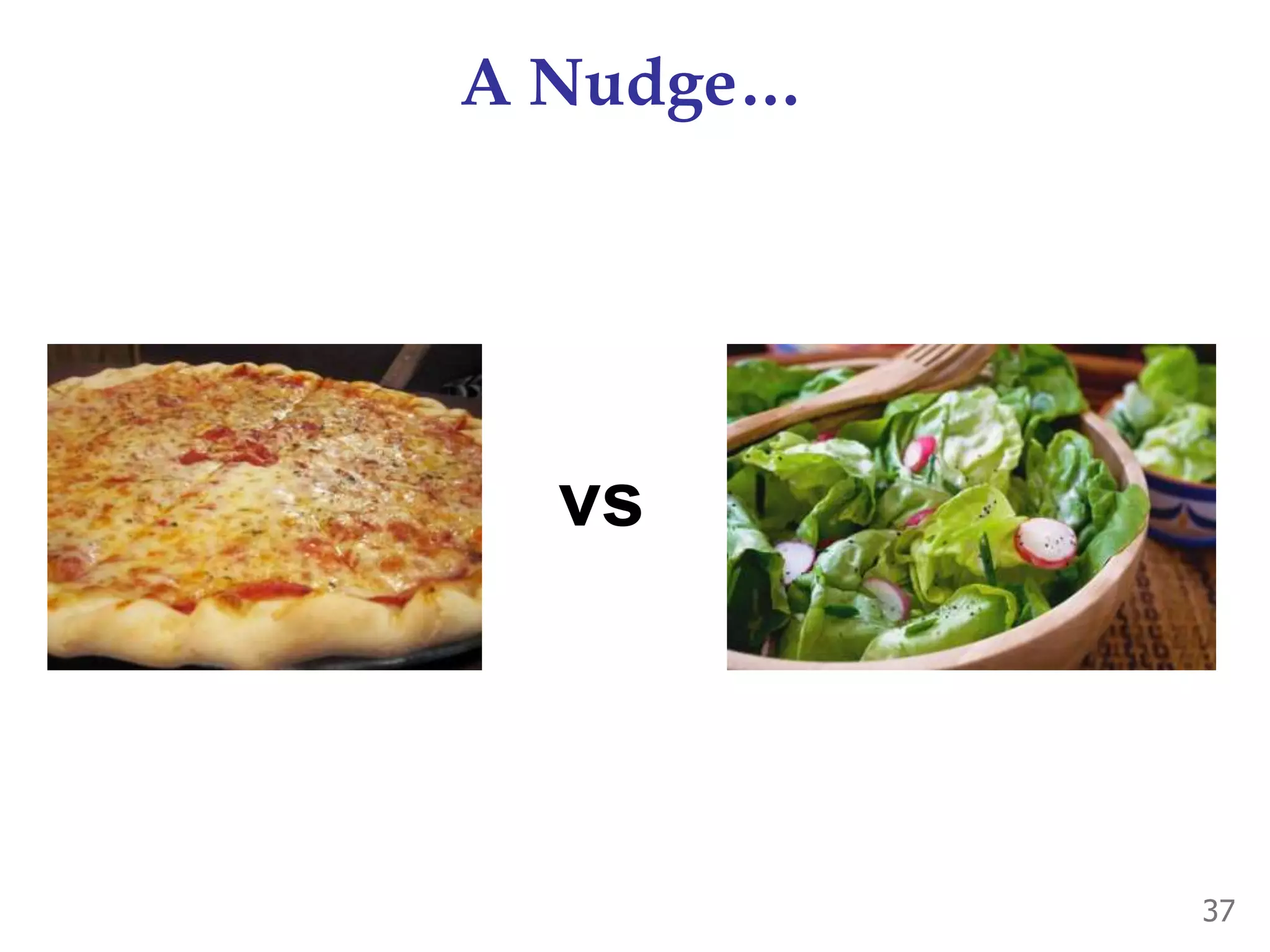
A Nudge…
 Libertarian – a person who believes in the
doctrine of free will (essentially no gov’t)
 Paternalism – a system in which an authority
undertakes to supply needs or regulate conduct
of those under its control
 Libertarian Paternalism – influencing behavior
while still also respecting freedom of choice
36
A Nudge…
37
vs
A Nudge…
38
Decision
Maker
Choices Response

Eats
Pizza

Eats (more)
Salad
Scenario
1.)
2.)
Further Reading: “Nudge” by Richard Thaler and Cass Sunstein
Flaming Amy’s Bowl
Cheap
Ingredients
Expensive
Ingredients
How to Move People to Be More
Environmental
40
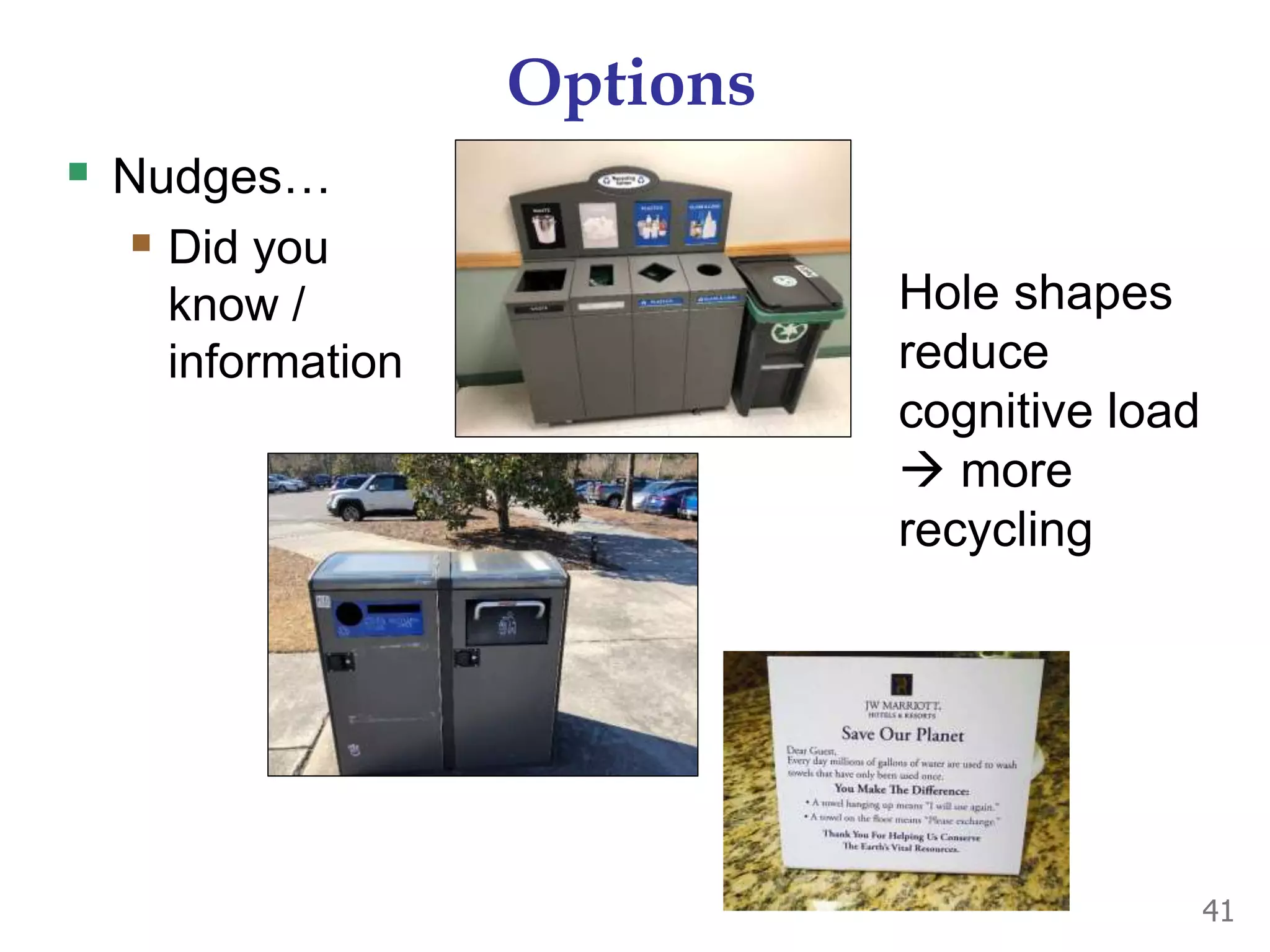
Options
 Nudges…
 Did you
know /
information
41
Hole shapes
reduce
cognitive load
 more
recycling
Options for Env.
42
 Use economics!
 Recall
 Resources are scarce  Tradeoffs
 Rational people think at the margin
 People respond to incentives
  Get the incentives right
 Use nudges to influence behavior too.
0
0.1
0.2
0.3
0.4
0.5
0.6
0.7
0.8
0.9
1
0
5
10
15
20
25
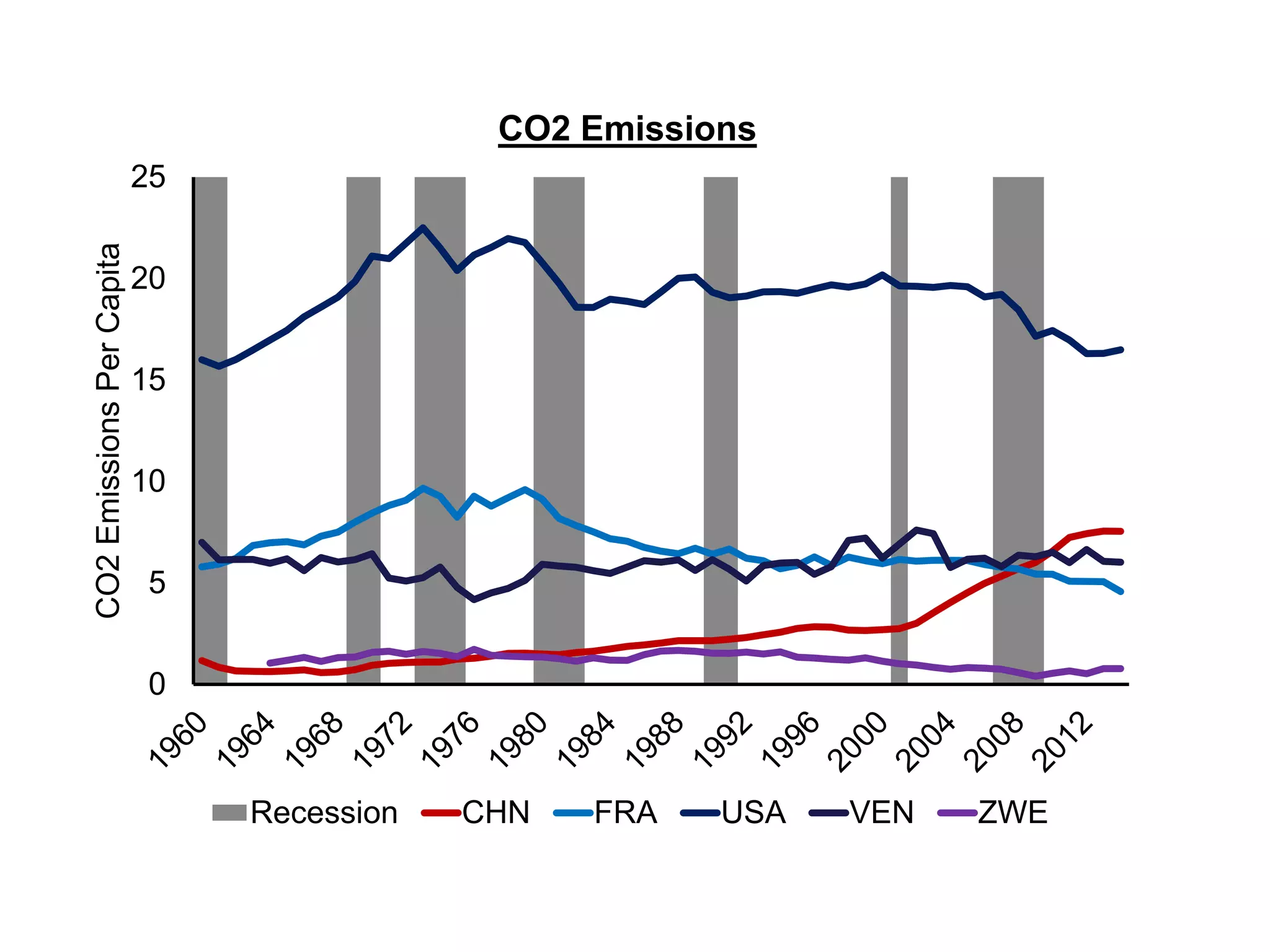
CO2EmissionsPerCapita
CO2 Emissions
Recession CHN FRA USA VEN ZWE
0
5
10
15
20
25
CO2EmissionsPerCapita CO2 Emissions
USA
0.000
50.000
100.000
150.000
200.000
250.000
300.000
350.000
0
5
10
15
20
25
CO2EmissionsPerCapita CO2 Emissions
USA Gasoline Prices
Takeaways
 Remember our principles
 Scarcity  tradeoffs  opportunity costs 
balance rationally  respond to incentives
 Move behavior in desired direction
 Frame the tradeoffs
 Change the incentives
46

Saving the environment

  • 1.
    Why Everyone isConcerned About The Environment but Nobody Seems to be Doing Anything To Save It 0
  • 2.
    Objectives  How dopeople make decisions?  How can we “nudge” them? 1
  • 3.
  • 4.
  • 5.
  • 6.
  • 7.
  • 8.
    So What’s Goingon and How Do We Nudge Behavior? (Chapter 1) 7
  • 9.
    Some Assumptions  Resourcesare scarce – limited in nature  Economics studies behavior, individual and societal, about managing scarce resources  Scarcity is a (the?) fundamental assumption  Can apply ideas to environmental questions
  • 10.
    9 HOW PEOPLE MAKEDECISIONS Principle #1: People Face Tradeoffs All decisions involve tradeoffs.  Limited nature of resources means we cannot do/buy everything OR
  • 11.
    HOW PEOPLE MAKEDECISIONS  Labor / Leisure  More labor  $  Consumption, but less leisure time  Less labor  More Leisure Principle #1: People Face Tradeoffs Resources (time, labor…) Protect the Environment Produce Consumer Goods Regenerative Thermal Oxidizer (RTO) burns VOCs Power Coating Oven OR
  • 12.
    11 HOW PEOPLE MAKEDECISIONS  Society faces an important tradeoff: efficiency vs. equality  Efficiency: when society gets the most from its scarce resources  Equality: when prosperity is distributed uniformly among society’s members  Tradeoff: Greater equality, by redistributing income from wealthy to poor. Reduces incentive to work (poor and rich) Reduces output from potential labor “inefficient” Principle #1: People Face Tradeoffs
  • 13.
    Efficiency means morethan simply using everything!!!!
  • 14.
    Wedding Inefficiency Pieces ofcake distributed equally, not efficiently!
  • 15.
    14 HOW PEOPLE MAKEDECISIONS  Decisions require comparing the costs and benefits of alternatives  The opportunity cost of any item is whatever must be given up to obtain it.  It is the relevant cost for decision making. Principle #2: The Cost of Something Is What You Give Up to Get It
  • 16.
    15 HOW PEOPLE MAKEDECISIONS Examples: The opportunity cost of… …a movie: Ticket price but also the time in theater …Protecting the environment with fuel efficient cars: smaller space during travels, less range, less safe than larger polluting vehicles …Opportunity cost of protecting Cape Fear River from Gen-X? Principle #2: The Cost of Something Is What You Give Up to Get It Actually what you would have bought instead…
  • 17.
    The Best Thingsin Life are Free  Really????  Give me an example  There is no such thing as a free lunch.  There is an opportunity cost to everything! 16
  • 18.
    17 HOW PEOPLE MAKEDECISIONS Rational people  systematically and purposefully do the best they can to achieve their objectives. (self interest)  Evaluate costs and benefits of marginal changes – incremental adjustments to an existing plan (more to come)  Ignore sunk costs – costs that have already been incurred (can’t be changed  ignore) Principle #3: Rational People Think at the Margin
  • 19.
    Eyes naturally focus here Littleless… Little more… Marginal Change
  • 20.
    Little less… Little more… Ignoringsunk costs “I bought a gallon of milk last month and only used half so I’m not going to buy any milk this month for my cereal…” (Gallon is gone, sunk cost, decide today about how much to buy today for next week…)
  • 21.
    20 HOW PEOPLE MAKEDECISIONS Principle #3: Rational People Think at the Margin 85% of UNCW Students Return Sources: WINK TV, UNCW, LinkedIn, NBA.com Extra year of college and additional skills/job salary vs. NBA salary Extra year of college and additional skills/job salary vs. low wage job
  • 22.
    21 HOW PEOPLE MAKEDECISIONS Question: Why do airlines offer discounted “standby” tickets? Marginal Revenue (~$40) > Marginal Cost (~$0) Principle #3: Rational People Think at the Margin
  • 23.
    Thinking at theMargin 22
  • 24.
    Thinking at theMargin  Question: What’s the marginal utility of the first newspaper you buy? The second?  What’s the marginal utility of the first soda you buy? The second? 23
  • 25.
    Applying the principles Supposeyou have a 2004.5 Volvo you just put $600 worth of tires on and you are pondering trading the car in for a new car. On a Sunday drive, the transmission dies. You can pay $600 to repair it, or trade-in “as is.” In each of the following scenarios, should you have the transmission repaired? Explain. A. Blue book value is $4500 if transmission works, $3700 if it doesn’t B. Blue book value is $4000 if transmission works, $3500 if it doesn’t 24
  • 26.
  • 27.
    Answers Observations:  The $6000you previously spent on repairs is irrelevant. What matters is the cost and benefit of the marginal repair (the transmission).  The change in incentives from scenario A to scenario B caused your decision to change. 26
  • 28.
    27 HOW PEOPLE MAKEDECISIONS  Incentive: something that induces a person to act, i.e. the prospect of a reward or punishment.  Rational people respond to incentives. Examples:  Increase in gas prices More hybrids sold… More used trucks for sale  When cigarette taxes increase, teen smoking falls. Principle #4: People Respond to Incentives
  • 29.
  • 30.
    Wall Street Michael Douglas,(young, clean) Charlie Sheen 1987
  • 31.
  • 32.
  • 33.
    People Respond toIncentives  Seatbelts????  Deaths down, accidents up  How could we reduce the number of car accidents? 32 Safe driver discounts … Tickets Insurance Increases …  Cigarette taxes and “alternatives”…
  • 34.
    People Respond toIncentives  Average savings at retirement (65) is $103,000  Rule of thumb, pull out 4% per year, $4,120  $343 per month…  Currently:  Tax Income  less incentive to work (or report) How can we incent work and not consumption?  One solution:  Tax consumption, people consume less and save more 33 http://www.fool.com/retirement/general/2015/01/10/the-typical-american-has-this-much-in-retirement-s.aspx
  • 35.
    Fixing the Environment Get the incentives right  Taxes on gasoline  Subsidies for efficient vehicles etc.  Note: Easy to say, hard to do  Federal and State E-vehicle credit was ~$6-8K  Everyone bought golf carts! 34
  • 36.
    A Nudge…  Libertarian– a person who believes in the doctrine of free will (essentially no gov’t)  Paternalism – a system in which an authority undertakes to supply needs or regulate conduct of those under its control  Libertarian Paternalism – influencing behavior while still also respecting freedom of choice 36
  • 37.
  • 38.
    A Nudge… 38 Decision Maker Choices Response  Eats Pizza  Eats(more) Salad Scenario 1.) 2.) Further Reading: “Nudge” by Richard Thaler and Cass Sunstein
  • 39.
  • 40.
    How to MovePeople to Be More Environmental 40
  • 41.
    Options  Nudges…  Didyou know / information 41 Hole shapes reduce cognitive load  more recycling
  • 42.
    Options for Env. 42 Use economics!  Recall  Resources are scarce  Tradeoffs  Rational people think at the margin  People respond to incentives   Get the incentives right  Use nudges to influence behavior too.
  • 43.
  • 44.
  • 45.
  • 46.
    Takeaways  Remember ourprinciples  Scarcity  tradeoffs  opportunity costs  balance rationally  respond to incentives  Move behavior in desired direction  Frame the tradeoffs  Change the incentives 46