Inequality, Economic Growth and
Development
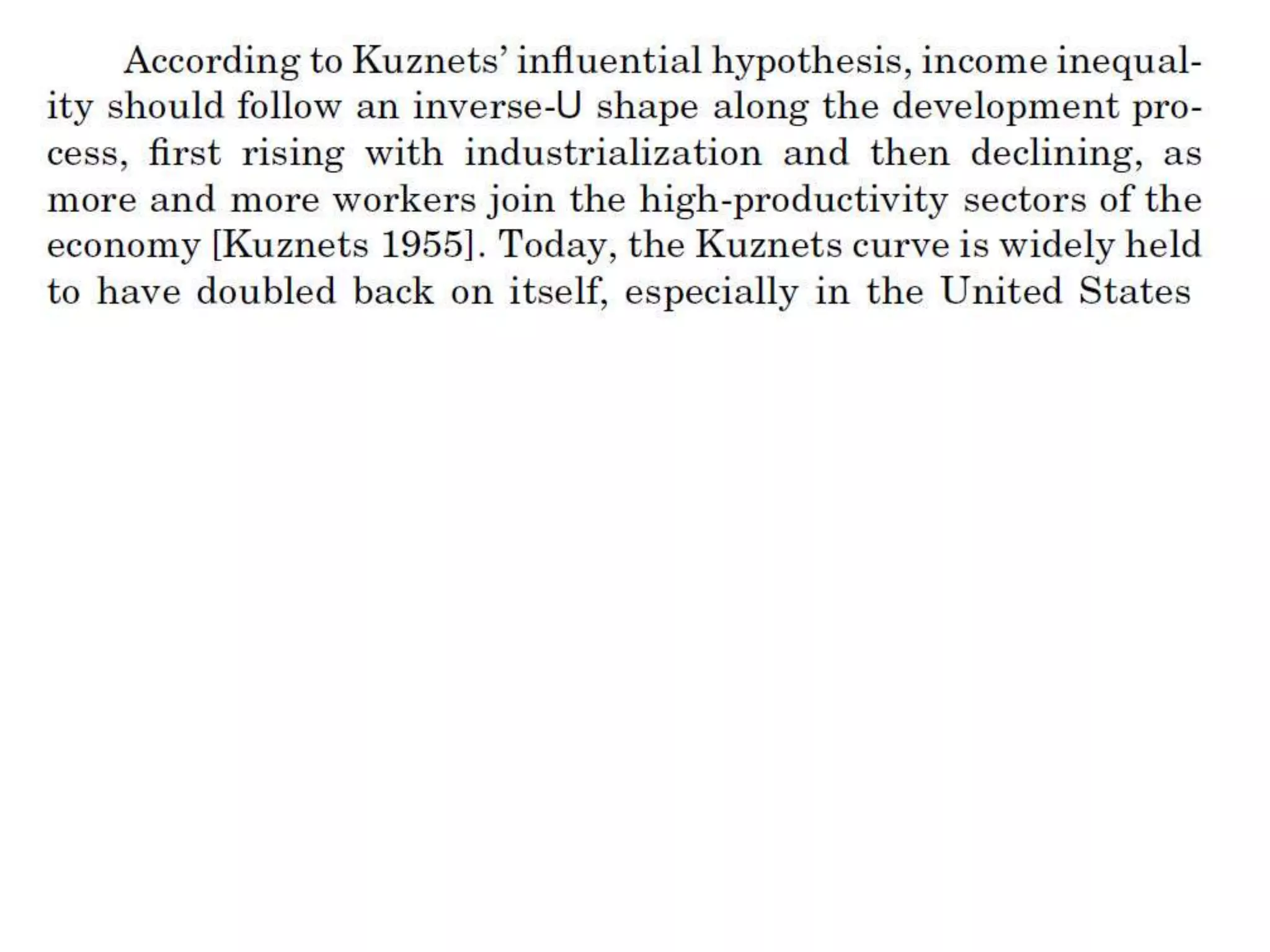
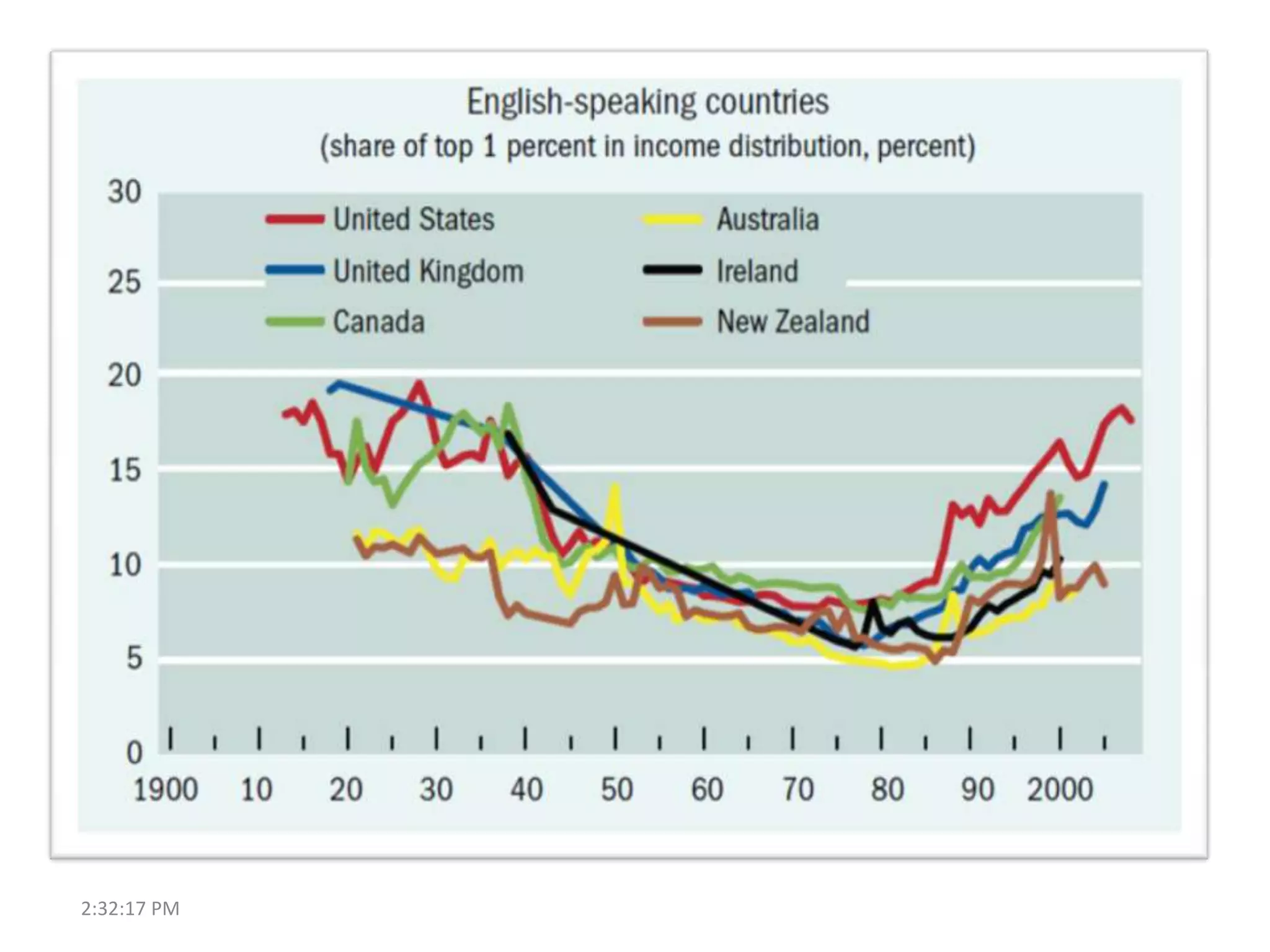
Kuznets and Income Inequality
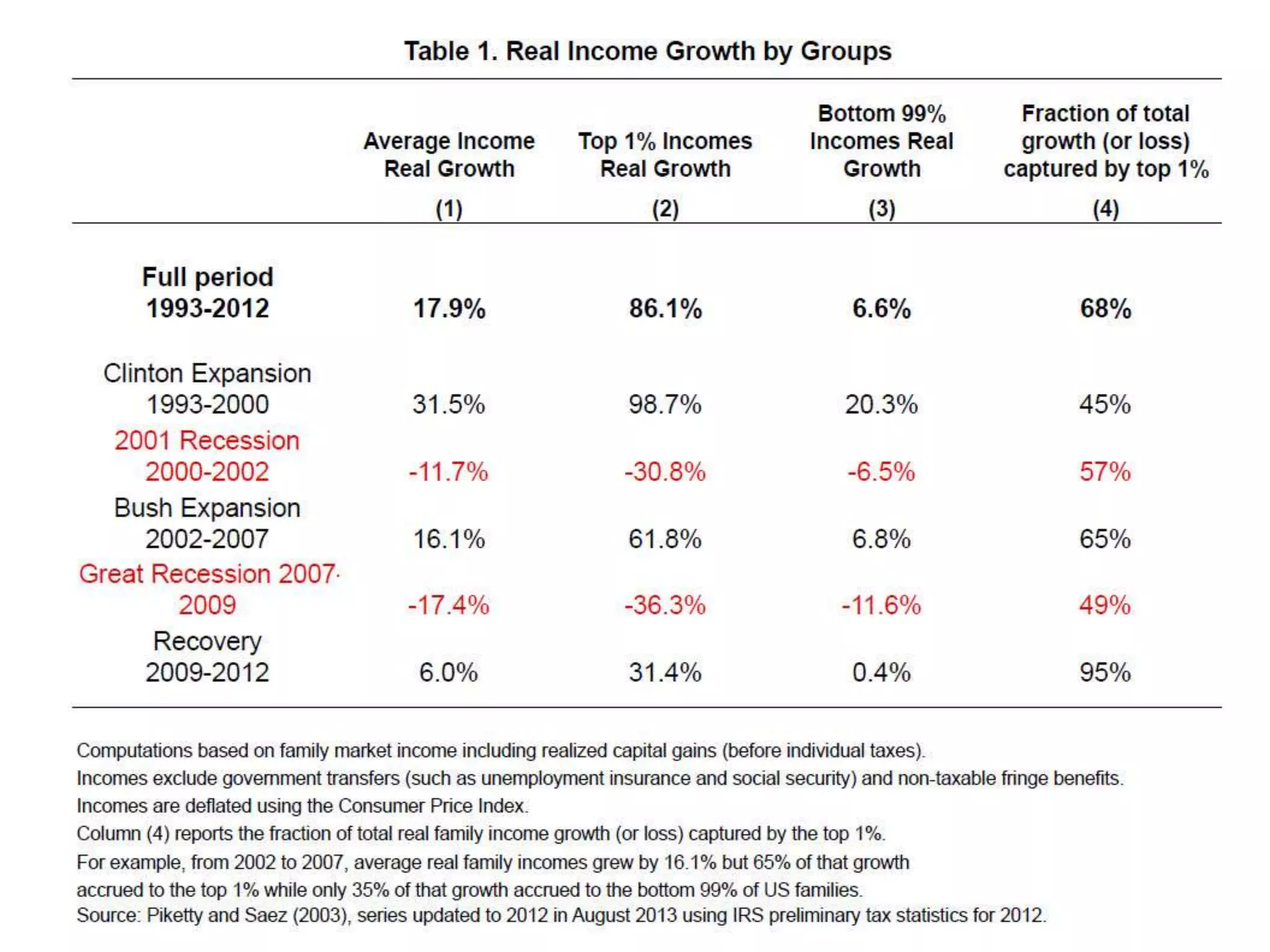
Real Income Growth in the USA
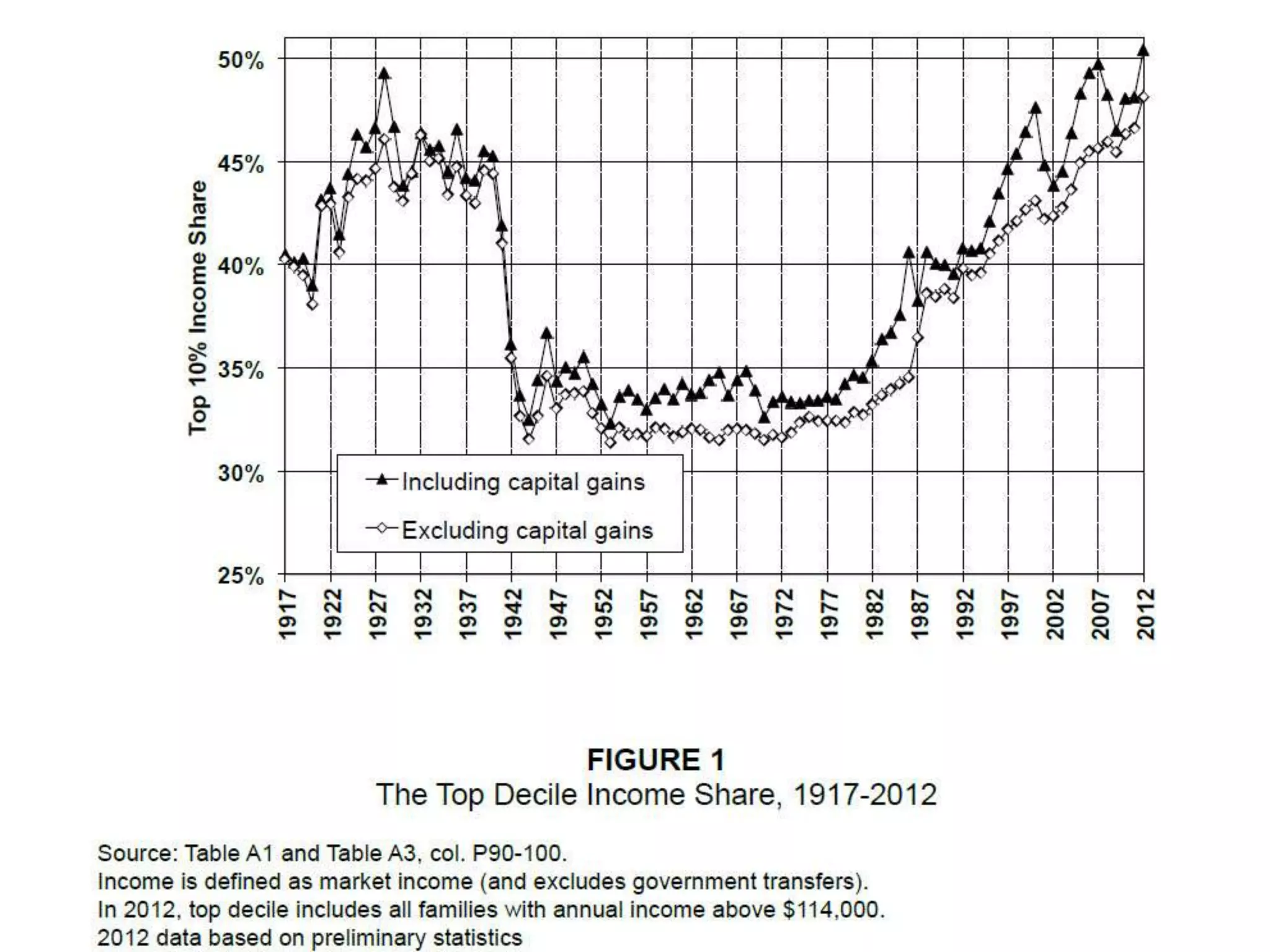
Top Decile Income Share in USA
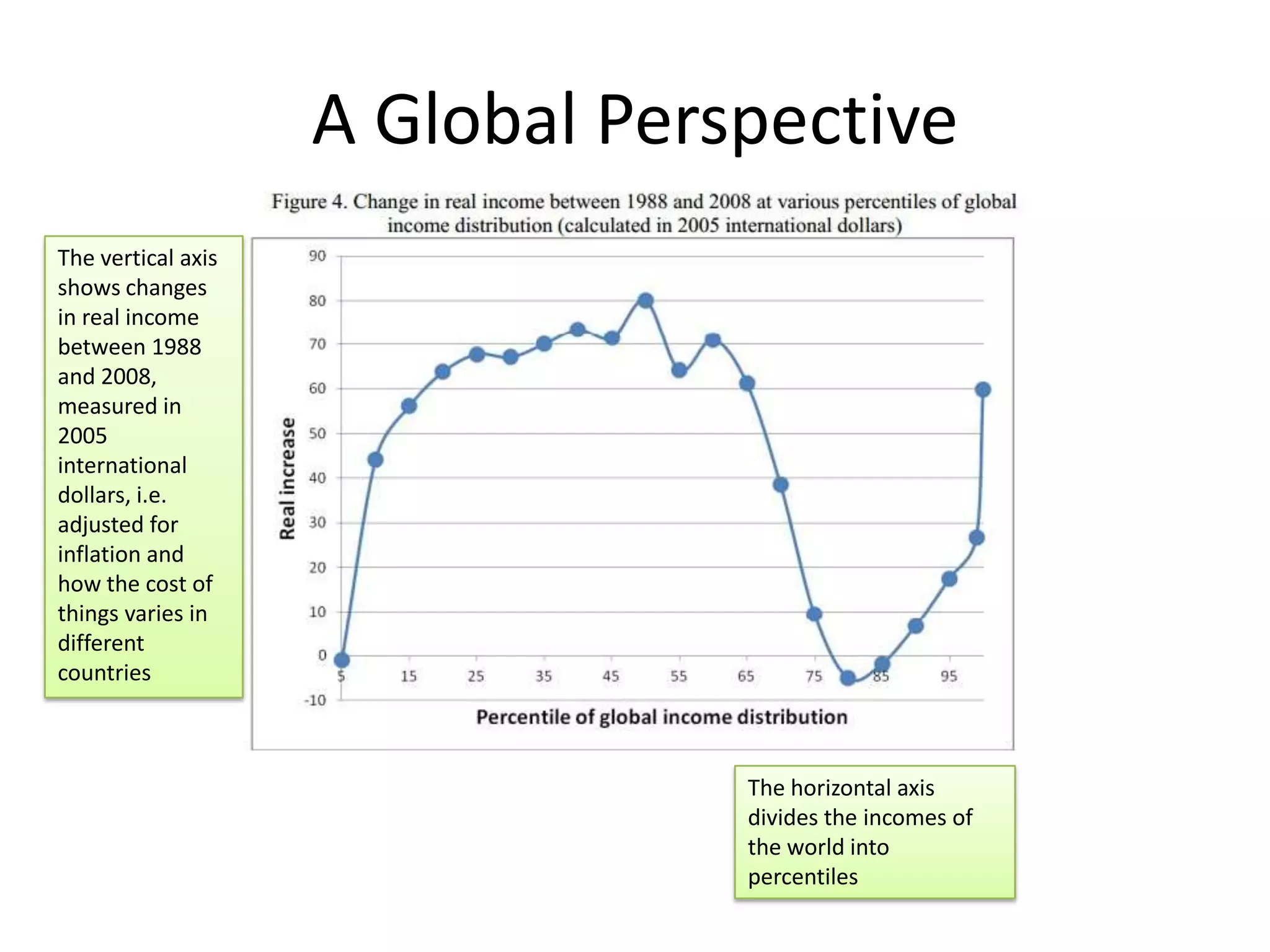
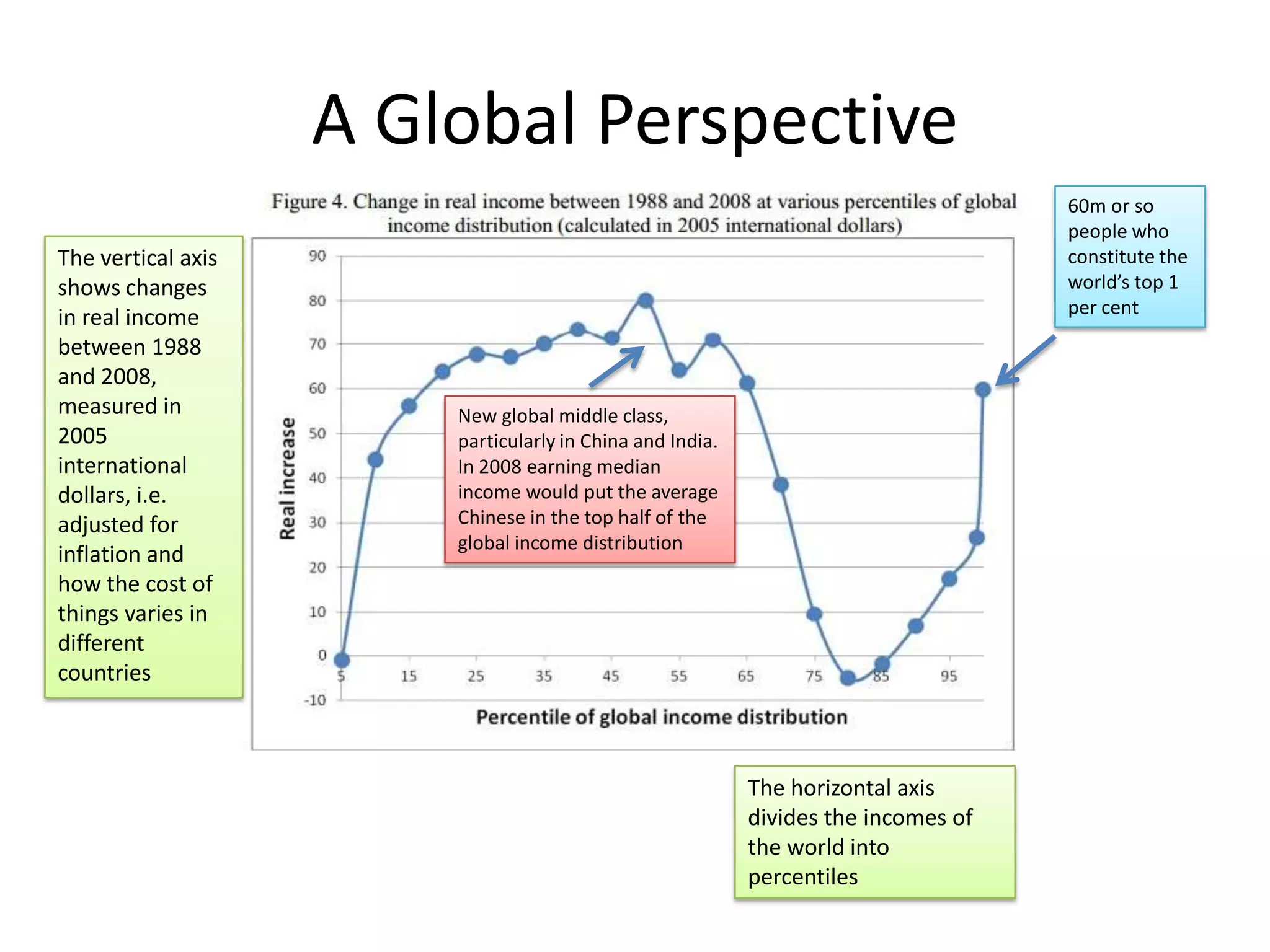
A Global Perspective
The vertical axis
shows changes
in real income
between 1988
and 2008,
measured in
2005
international
dollars, i.e.
adjusted for
inflation and
how the cost of
things varies in
different
countries

The horizontal axis
divides the incomes of
the world into
percentiles
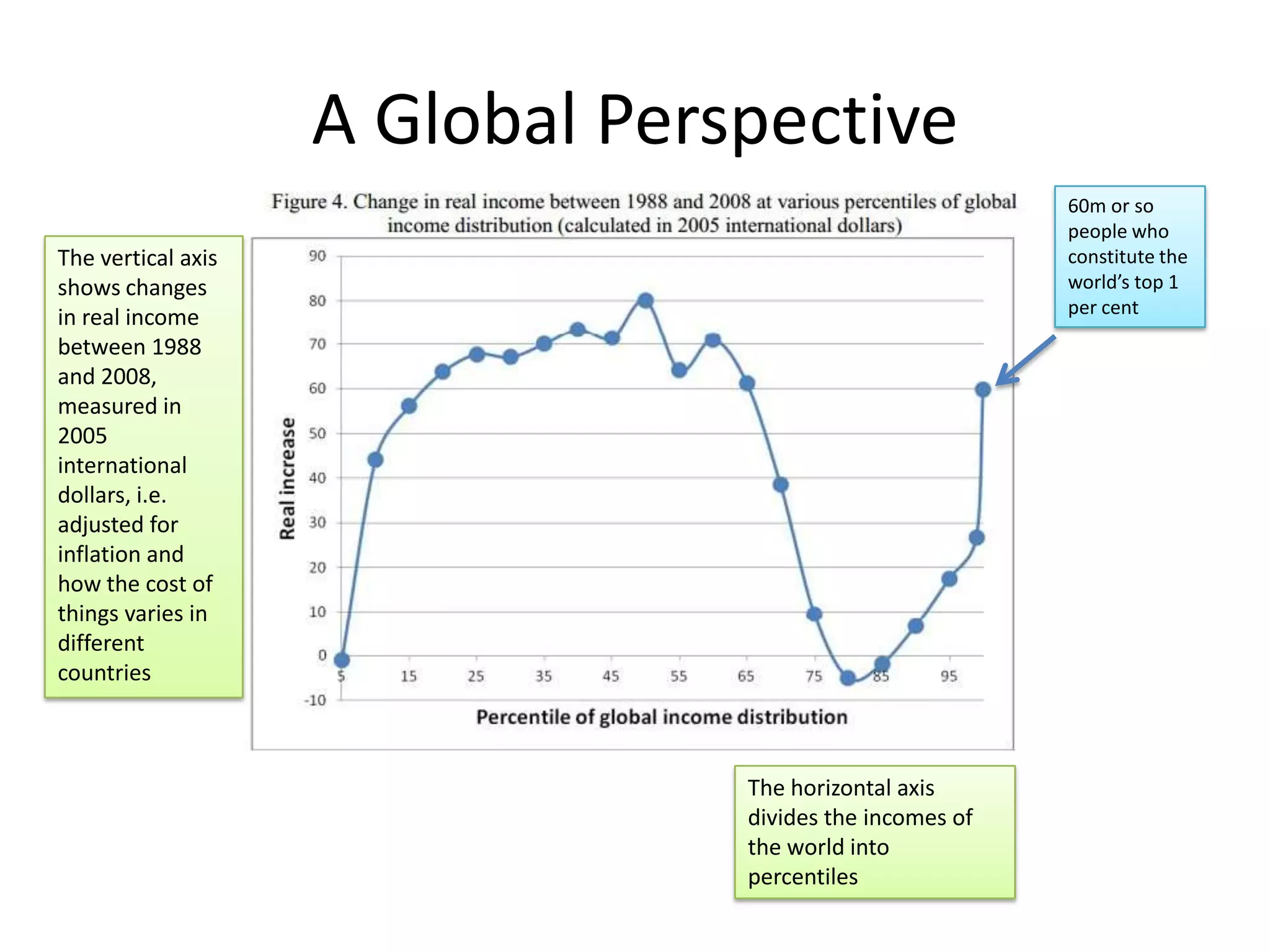
A Global Perspective
60m or so
people who
constitute the
world’s top 1
per cent

The vertical axis
shows changes
in real income
between 1988
and 2008,
measured in
2005
international
dollars, i.e.
adjusted for
inflation and
how the cost of
things varies in
different
countries

The horizontal axis
divides the incomes of
the world into
percentiles
A Global Perspective
The vertical axis
shows changes
in real income
between 1988
and 2008,
measured in
2005
international
dollars, i.e.
adjusted for
inflation and
how the cost of
things varies in
different
countries

60m or so
people who
constitute the
world’s top 1
per cent

New global middle class,
particularly in China and India.
In 2008 earning median
income would put the average
Chinese in the top half of the
global income distribution

The horizontal axis
divides the incomes of
the world into
percentiles
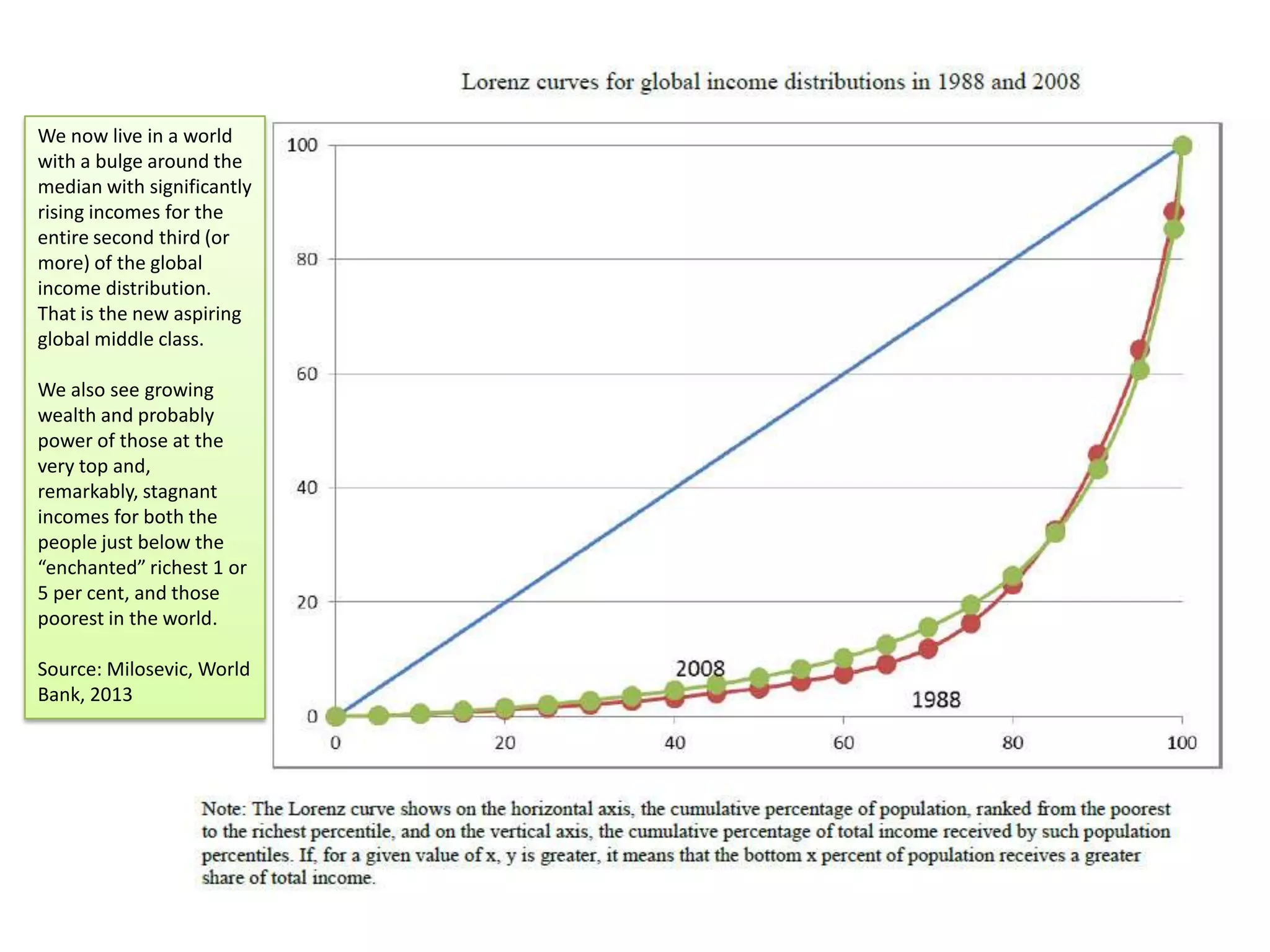
We now live in a world
with a bulge around the
median with significantly
rising incomes for the
entire second third (or
more) of the global
income distribution.
That is the new aspiring
global middle class.
We also see growing
wealth and probably
power of those at the
very top and,
remarkably, stagnant
incomes for both the
people just below the
“enchanted” richest 1 or
5 per cent, and those
poorest in the world.
Source: Milosevic, World
Bank, 2013

A Global Perspective
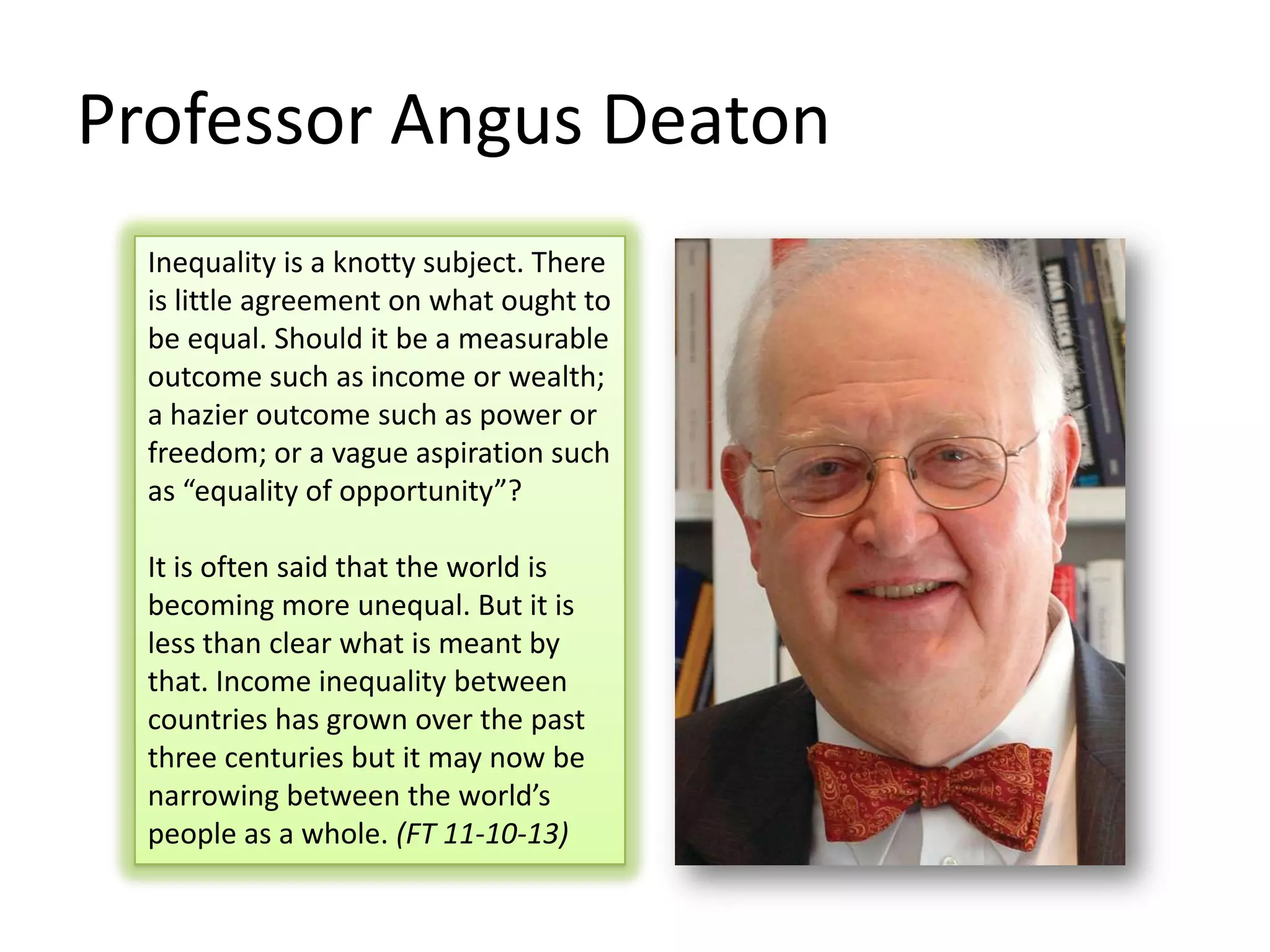
Professor Angus Deaton
Inequality is a knotty subject. There
is little agreement on what ought to
be equal. Should it be a measurable
outcome such as income or wealth;
a hazier outcome such as power or
freedom; or a vague aspiration such
as “equality of opportunity”?
It is often said that the world is
becoming more unequal. But it is
less than clear what is meant by
that. Income inequality between
countries has grown over the past
three centuries but it may now be
narrowing between the world’s
people as a whole. (FT 11-10-13)
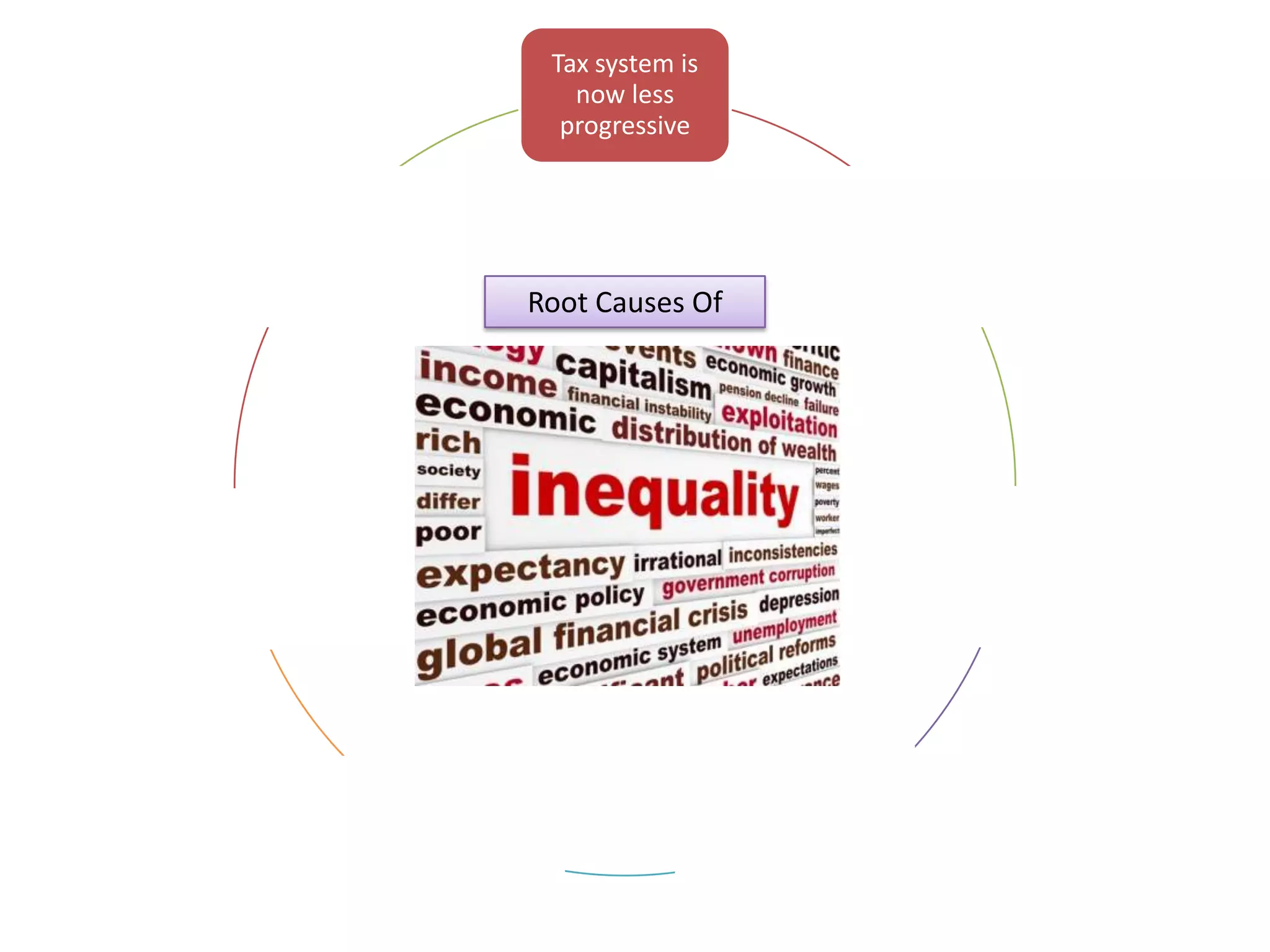
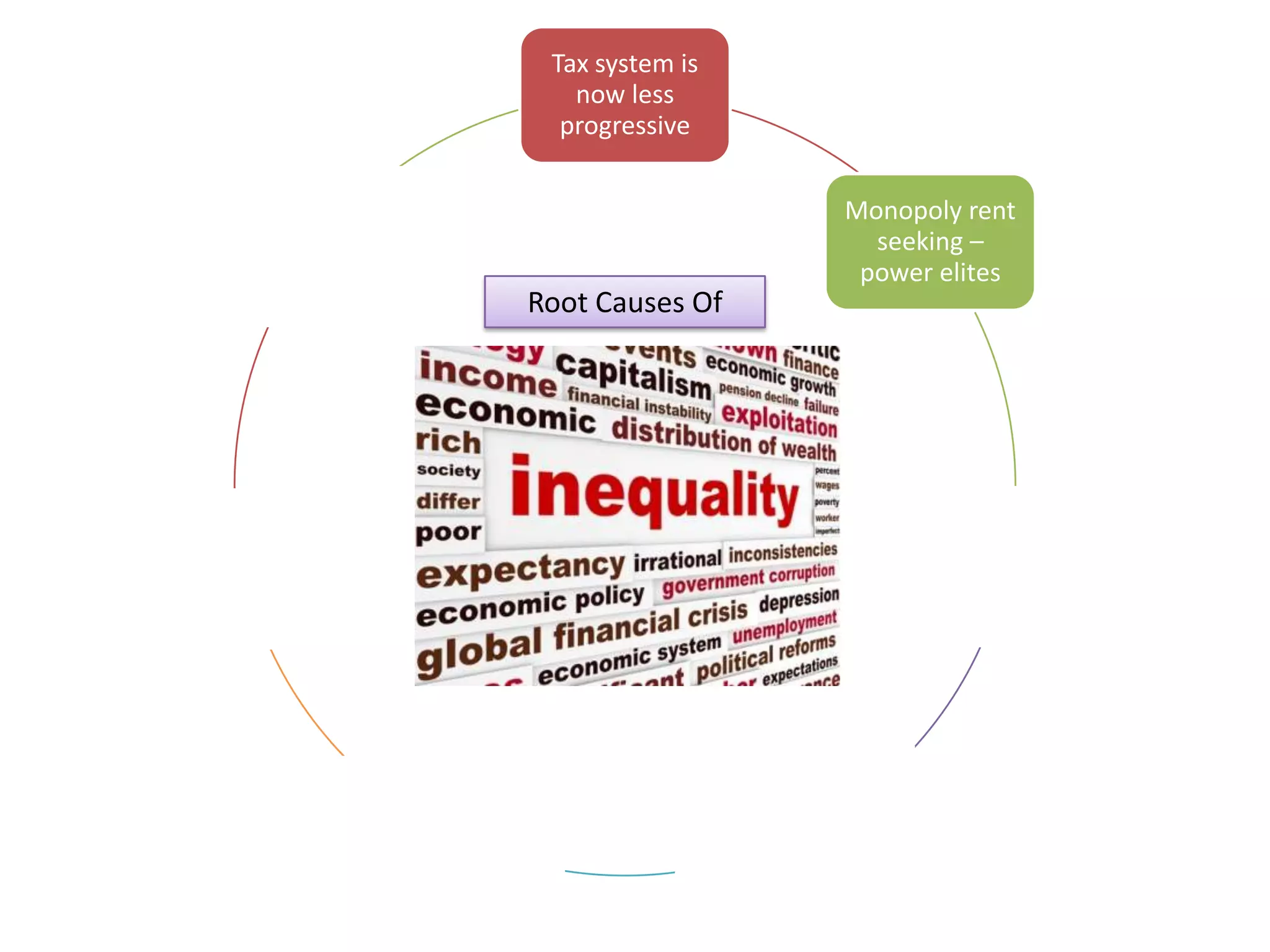
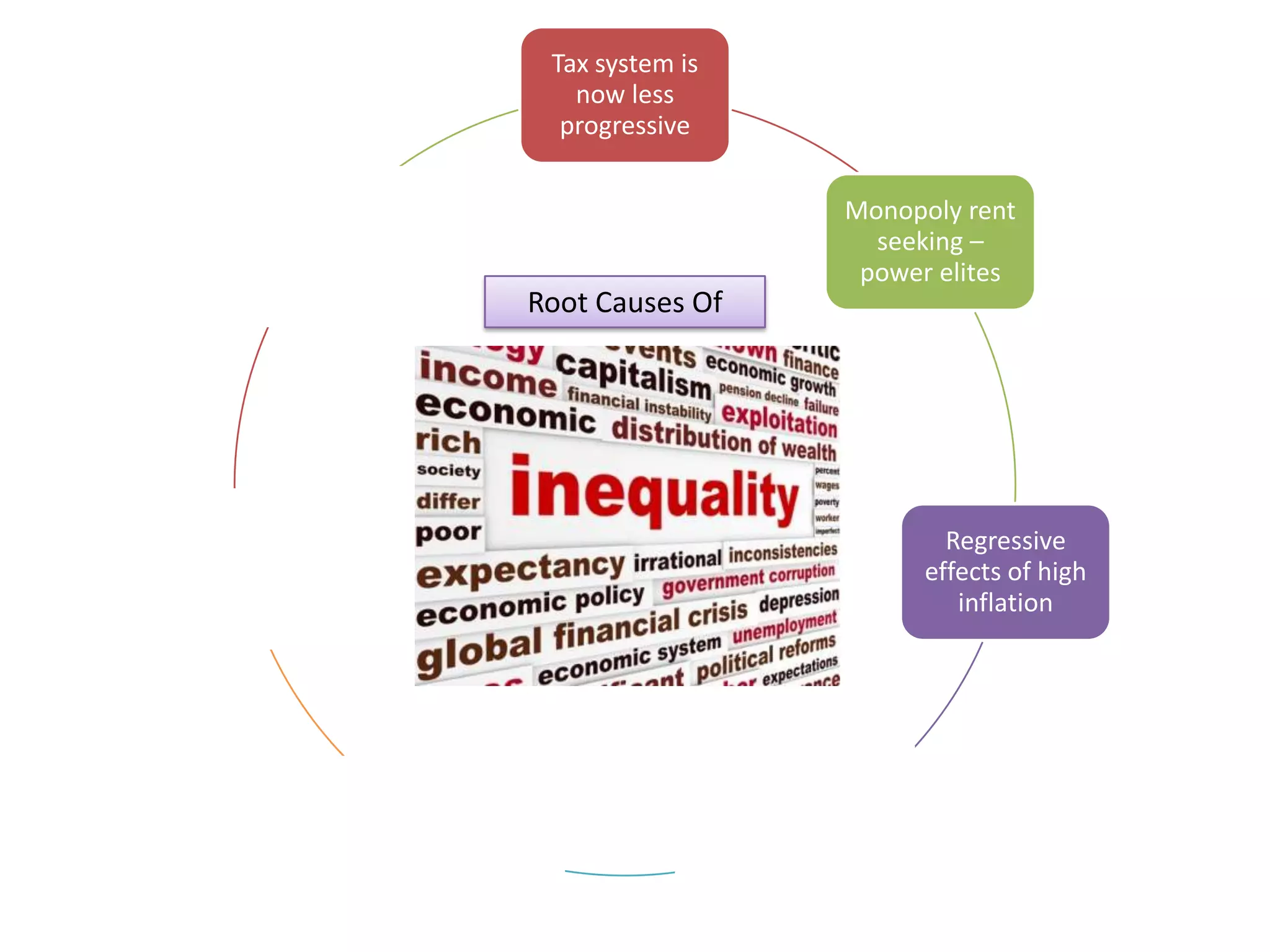
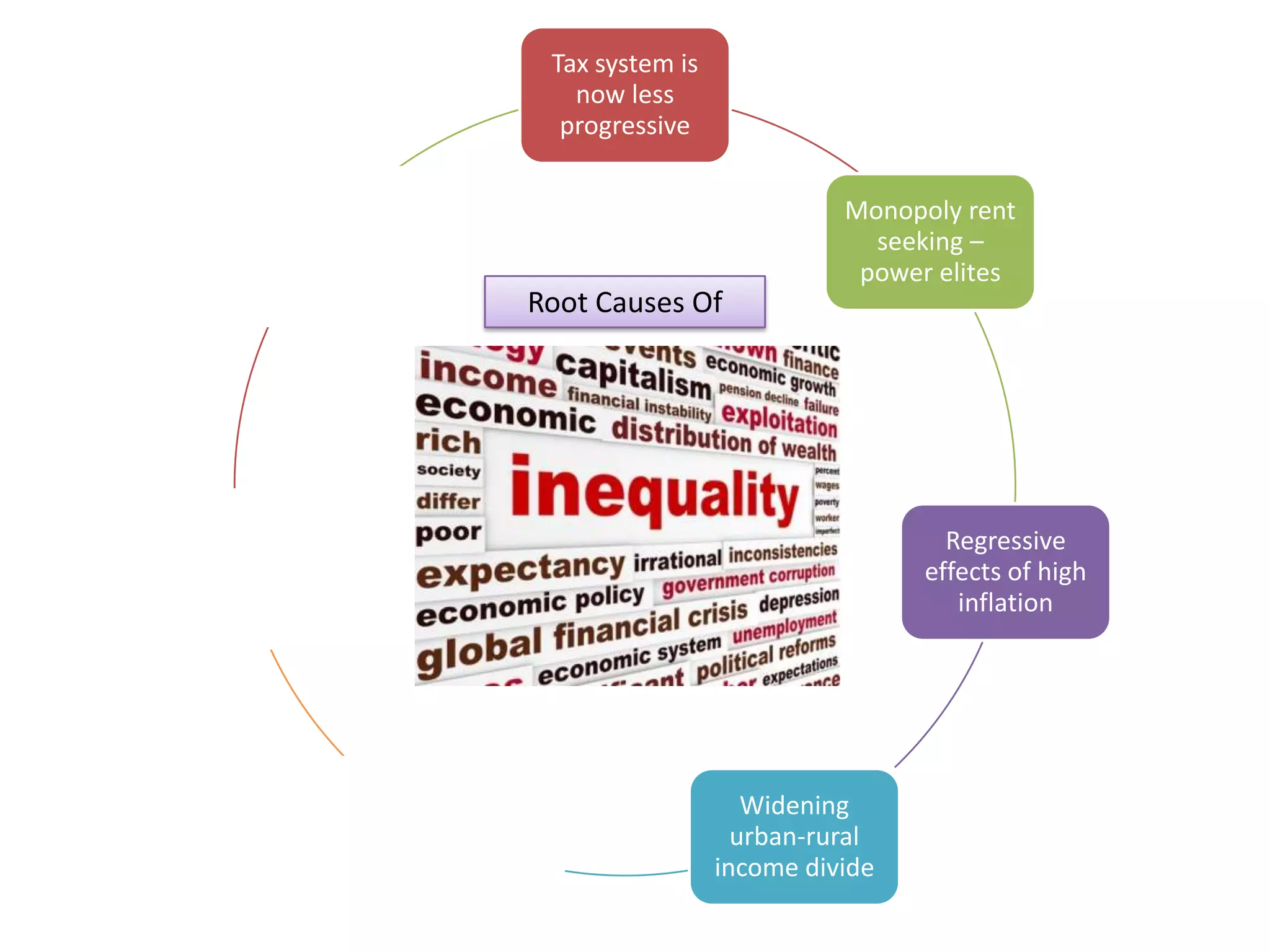
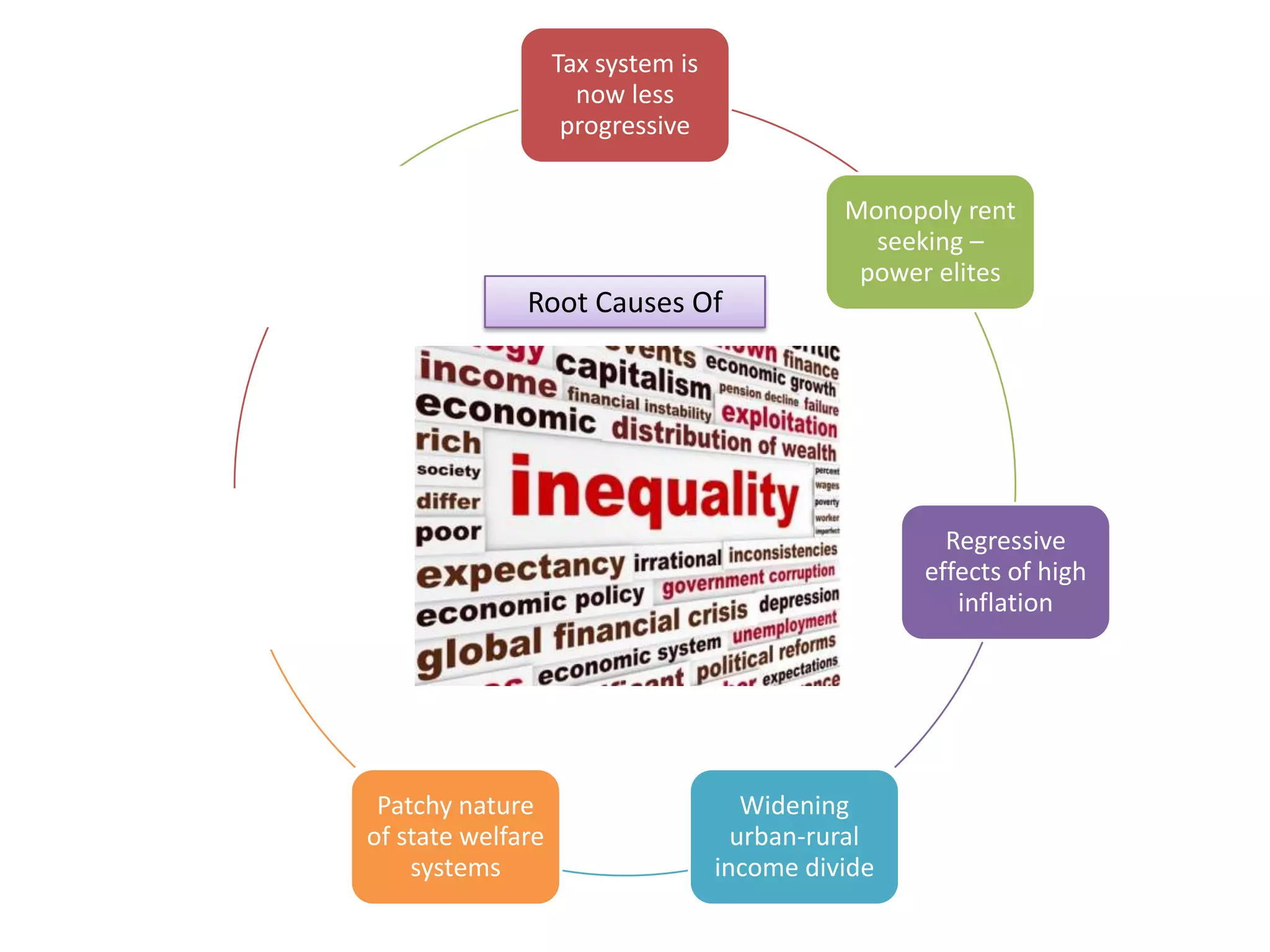
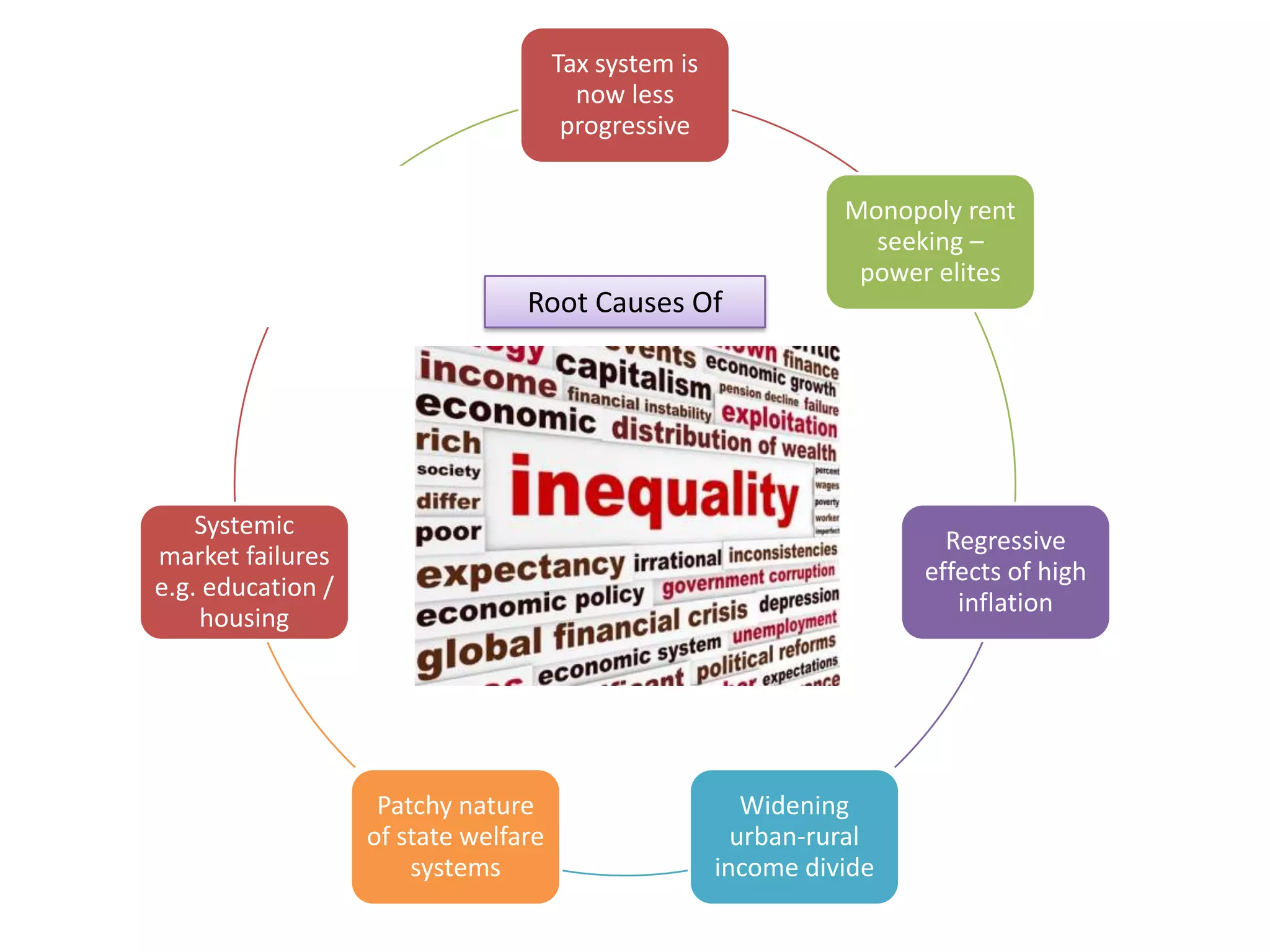
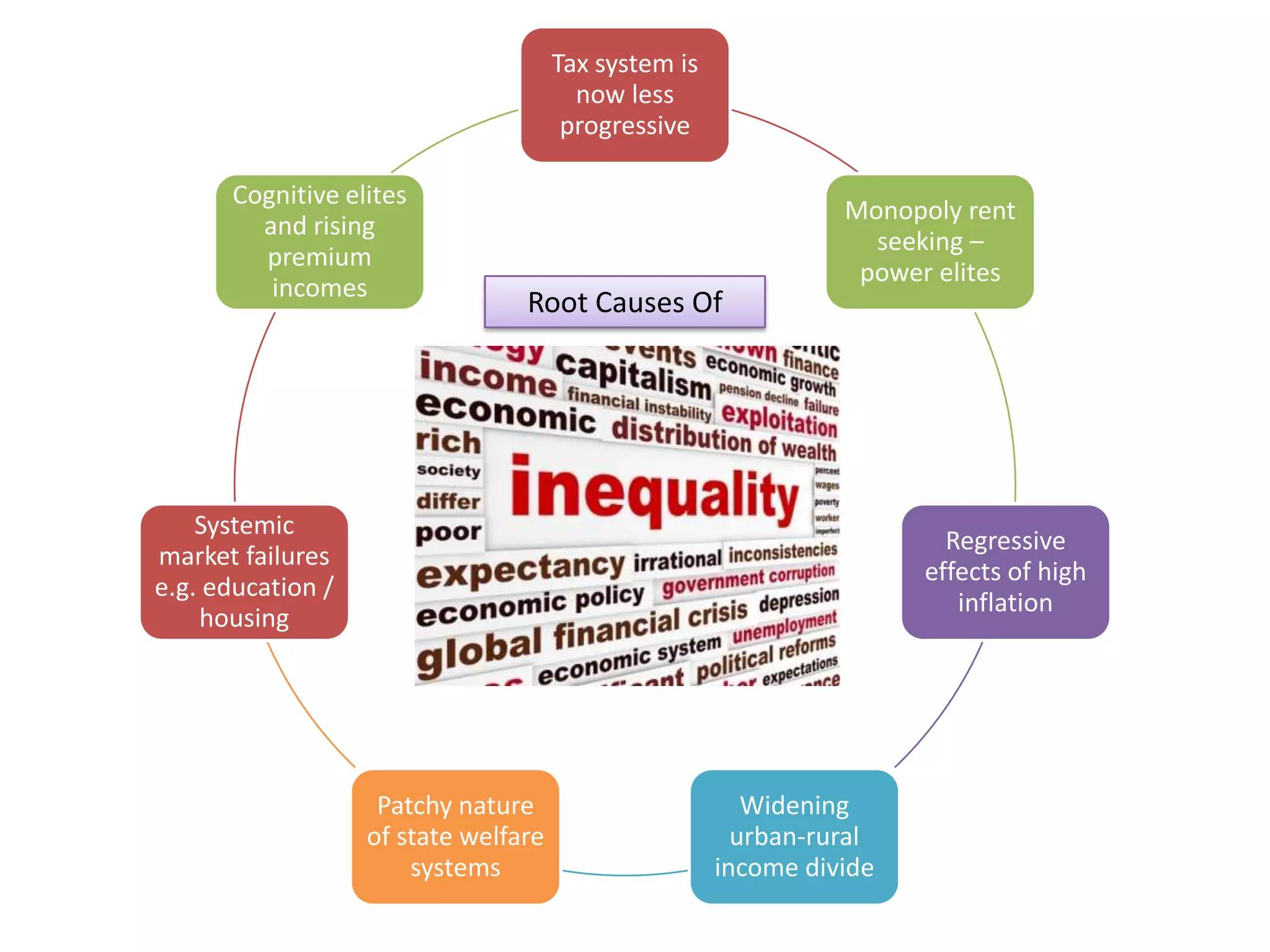
Tax system is
now less
progressive
Cognitive elites
and rising
premium
incomes

Monopoly rent
seeking –
power elites

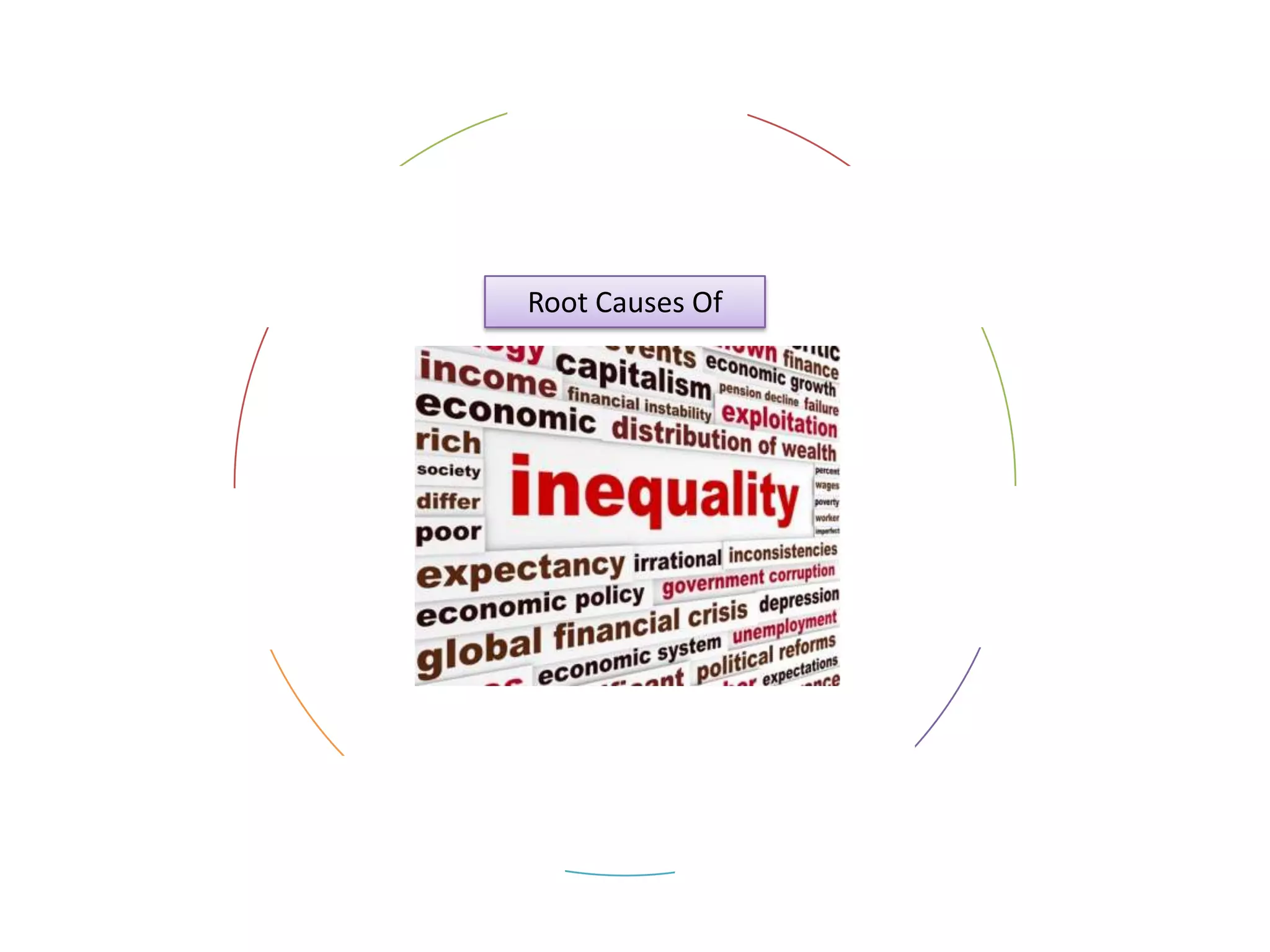
Root Causes Of

Systemic
market failures
e.g. education /
housing

Regressive
effects of high
inflation

Patchy nature
of state welfare
systems

Widening
urban-rural
income divide
Tax system is
now less
progressive
Cognitive elites
and rising
premium
incomes

Monopoly rent
seeking –
power elites

Root Causes Of

Systemic
market failures
e.g. education /
housing

Regressive
effects of high
inflation

Patchy nature
of state welfare
systems

Widening
urban-rural
income divide
Tax system is
now less
progressive
Cognitive elites
and rising
premium
incomes

Monopoly rent
seeking –
power elites

Root Causes Of

Systemic
market failures
e.g. education /
housing

Regressive
effects of high
inflation

Patchy nature
of state welfare
systems

Widening
urban-rural
income divide
Tax system is
now less
progressive
Cognitive elites
and rising
premium
incomes

Monopoly rent
seeking –
power elites

Root Causes Of

Systemic
market failures
e.g. education /
housing

Regressive
effects of high
inflation

Patchy nature
of state welfare
systems

Widening
urban-rural
income divide
Tax system is
now less
progressive
Cognitive elites
and rising
premium
incomes

Monopoly rent
seeking –
power elites

Root Causes Of

Systemic
market failures
e.g. education /
housing

Regressive
effects of high
inflation

Patchy nature
of state welfare
systems

Widening
urban-rural
income divide
Tax system is
now less
progressive
Cognitive elites
and rising
premium
incomes

Monopoly rent
seeking –
power elites

Root Causes Of

Systemic
market failures
e.g. education /
housing

Regressive
effects of high
inflation

Patchy nature
of state welfare
systems

Widening
urban-rural
income divide
Tax system is
now less
progressive
Cognitive elites
and rising
premium
incomes

Monopoly rent
seeking –
power elites

Root Causes Of

Systemic
market failures
e.g. education /
housing

Regressive
effects of high
inflation

Patchy nature
of state welfare
systems

Widening
urban-rural
income divide
Tax system is
now less
progressive
Cognitive elites
and rising
premium
incomes

Monopoly rent
seeking –
power elites

Root Causes Of

Systemic
market failures
e.g. education /
housing

Regressive
effects of high
inflation

Patchy nature
of state welfare
systems

Widening
urban-rural
income divide
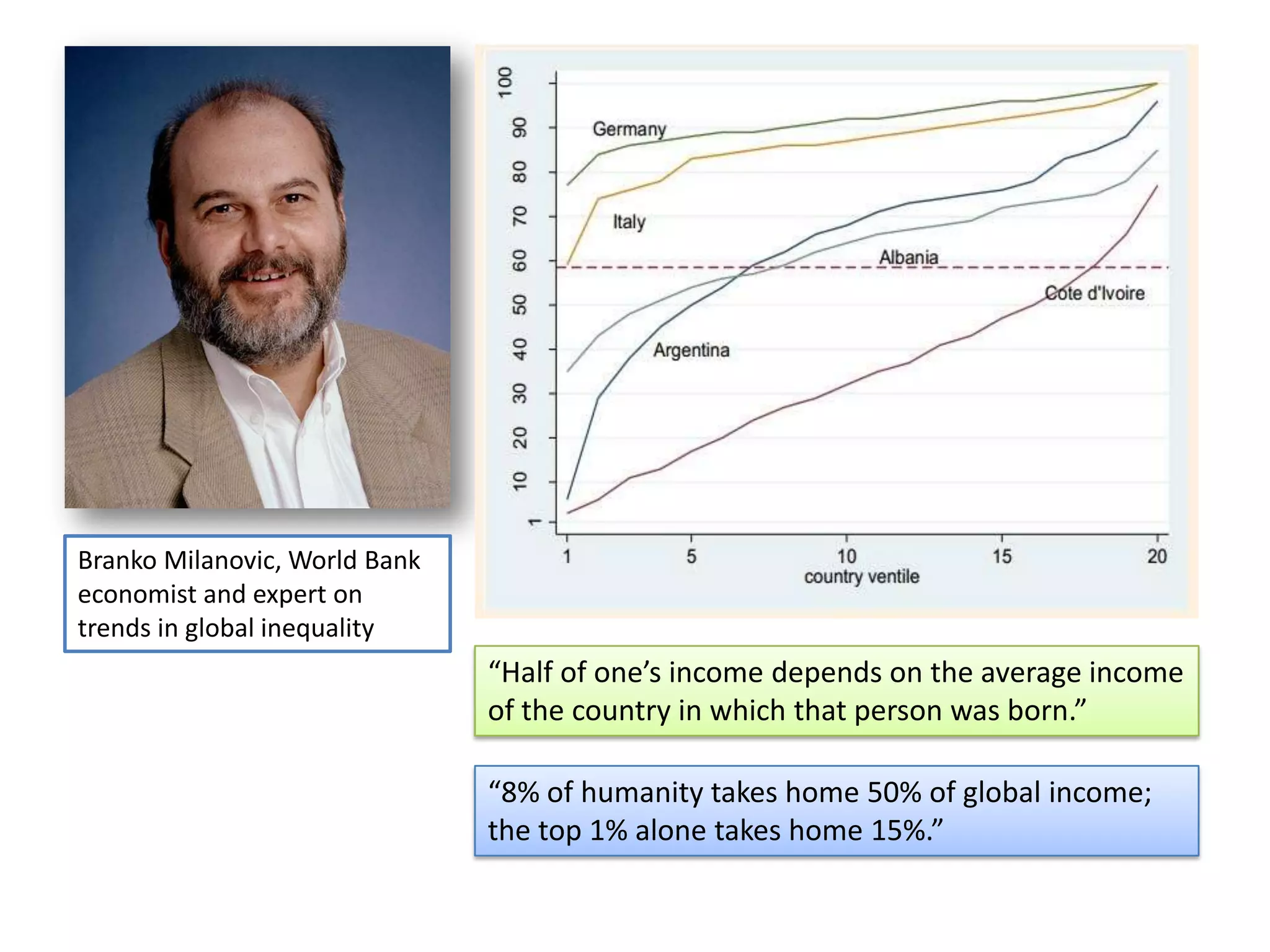
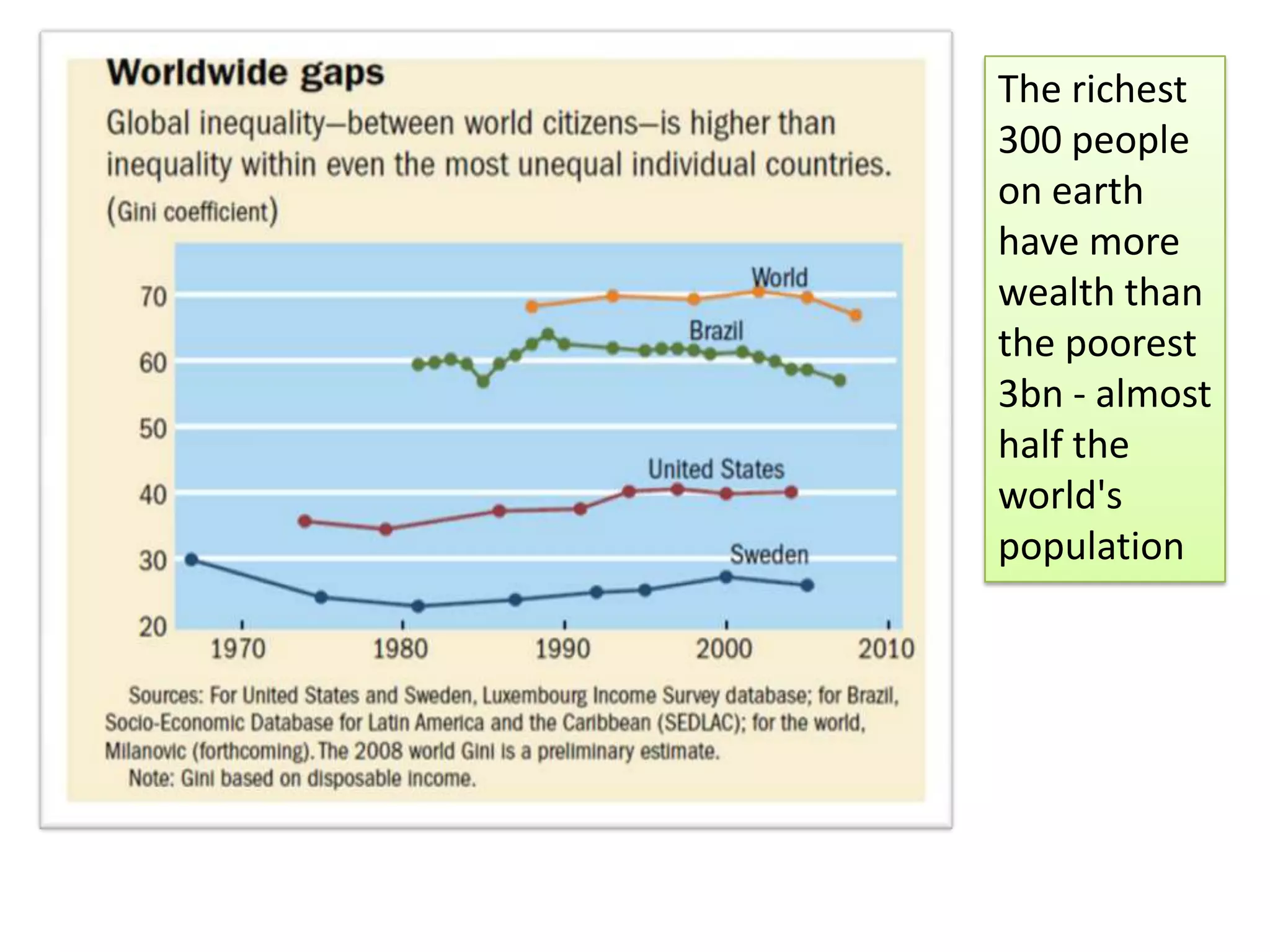
Branko Milanovic, World Bank
economist and expert on
trends in global inequality

“Half of one’s income depends on the average income
of the country in which that person was born.”
“8% of humanity takes home 50% of global income;
the top 1% alone takes home 15%.”
Some countries have made
progress

The richest
300 people
on earth
have more
wealth than
the poorest
3bn - almost
half the
world's
population
Rising inequality

2:32:17 PM
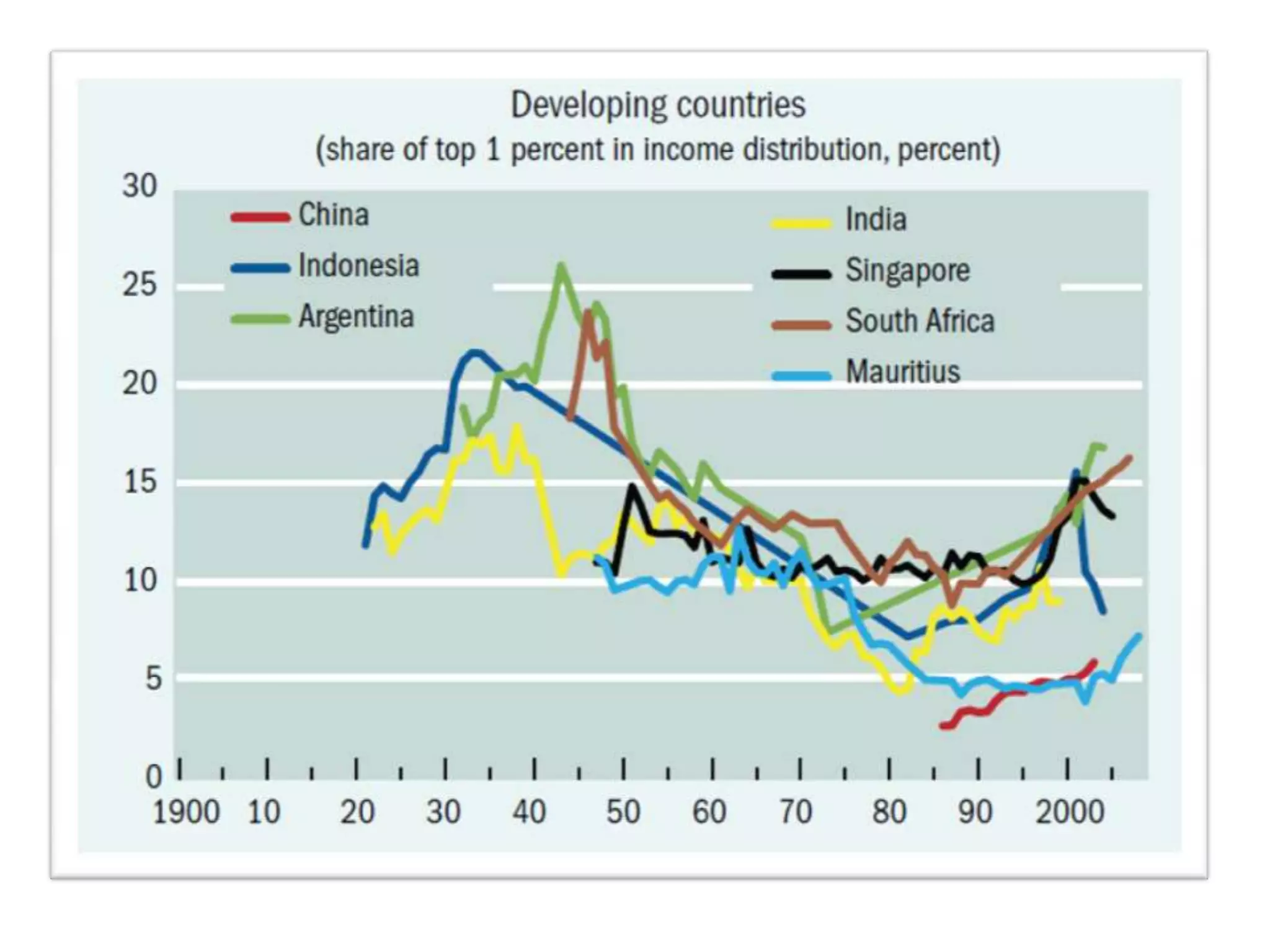
Inequality in developing countries
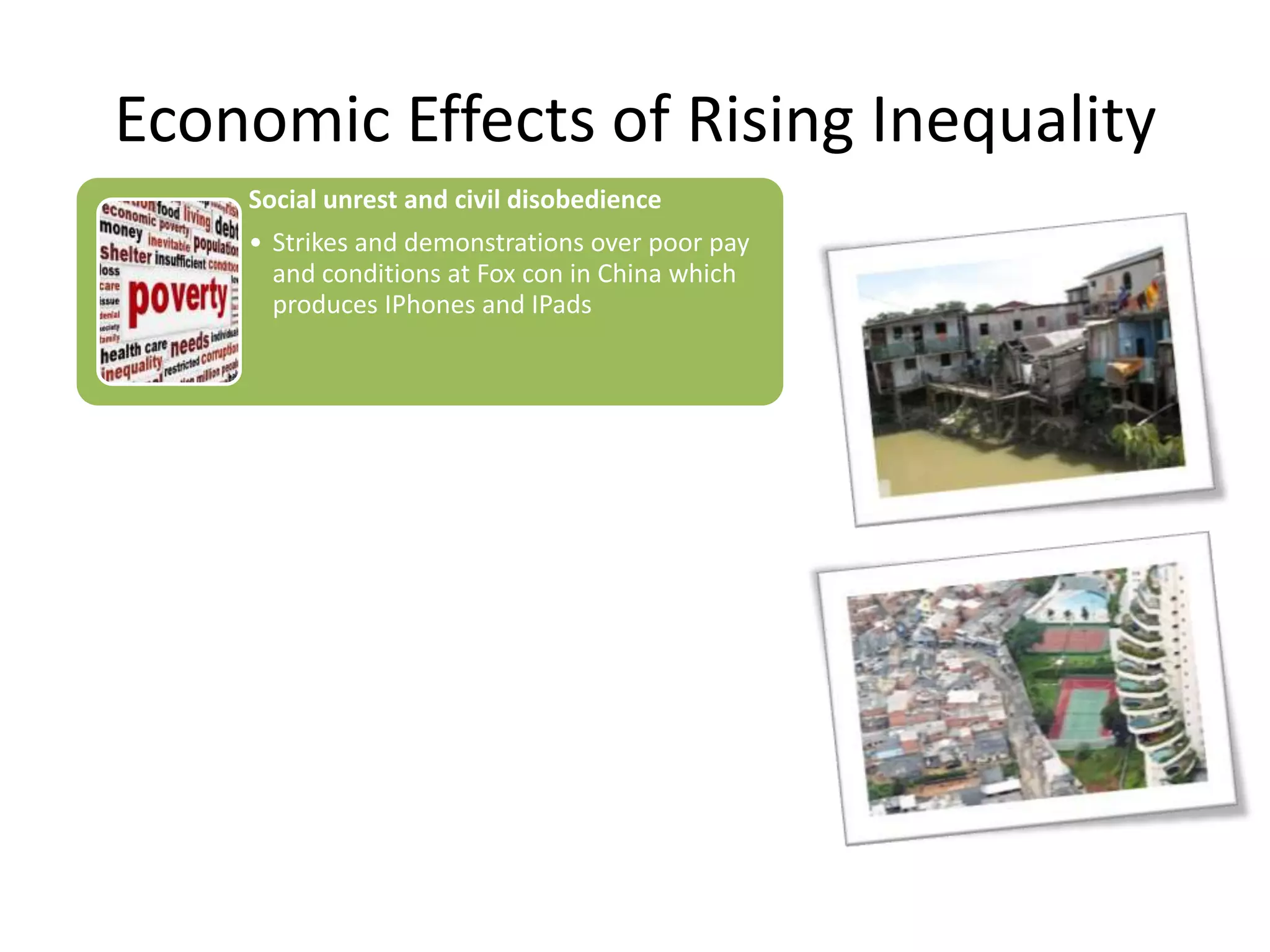
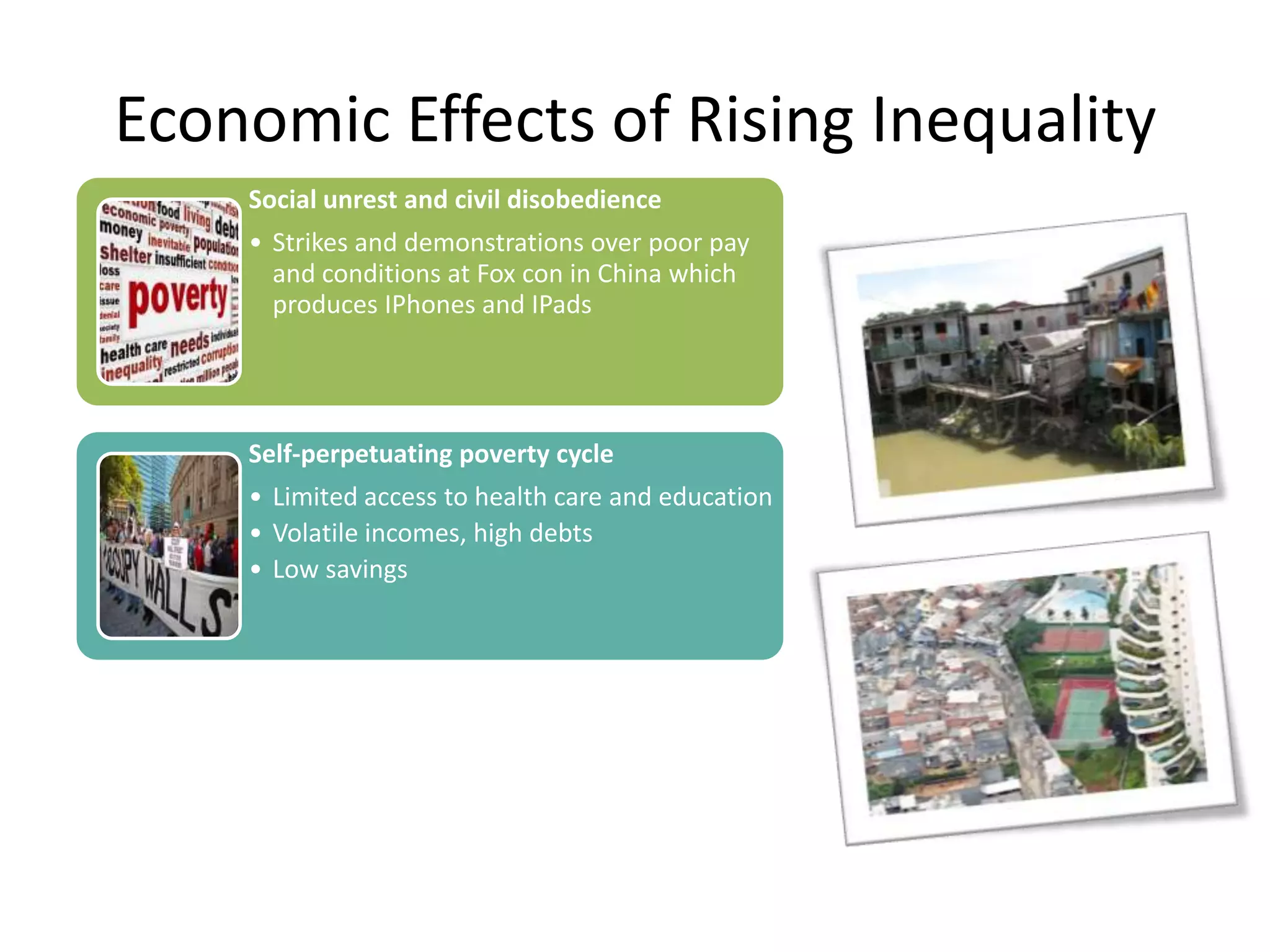
Economic Effects of Rising Inequality
Social unrest and civil disobedience
• Strikes and demonstrations over poor pay
and conditions at Fox con in China which
produces IPhones and IPads

Self-perpetuating poverty cycle

• Limited access to health care and education
• Volatile incomes, high debts
• Low savings

Misallocation of scarce resources
Capital investment skewed towards
preferences of the rich
Low collateral – limits entrepreneurship

Capital flight by the rich
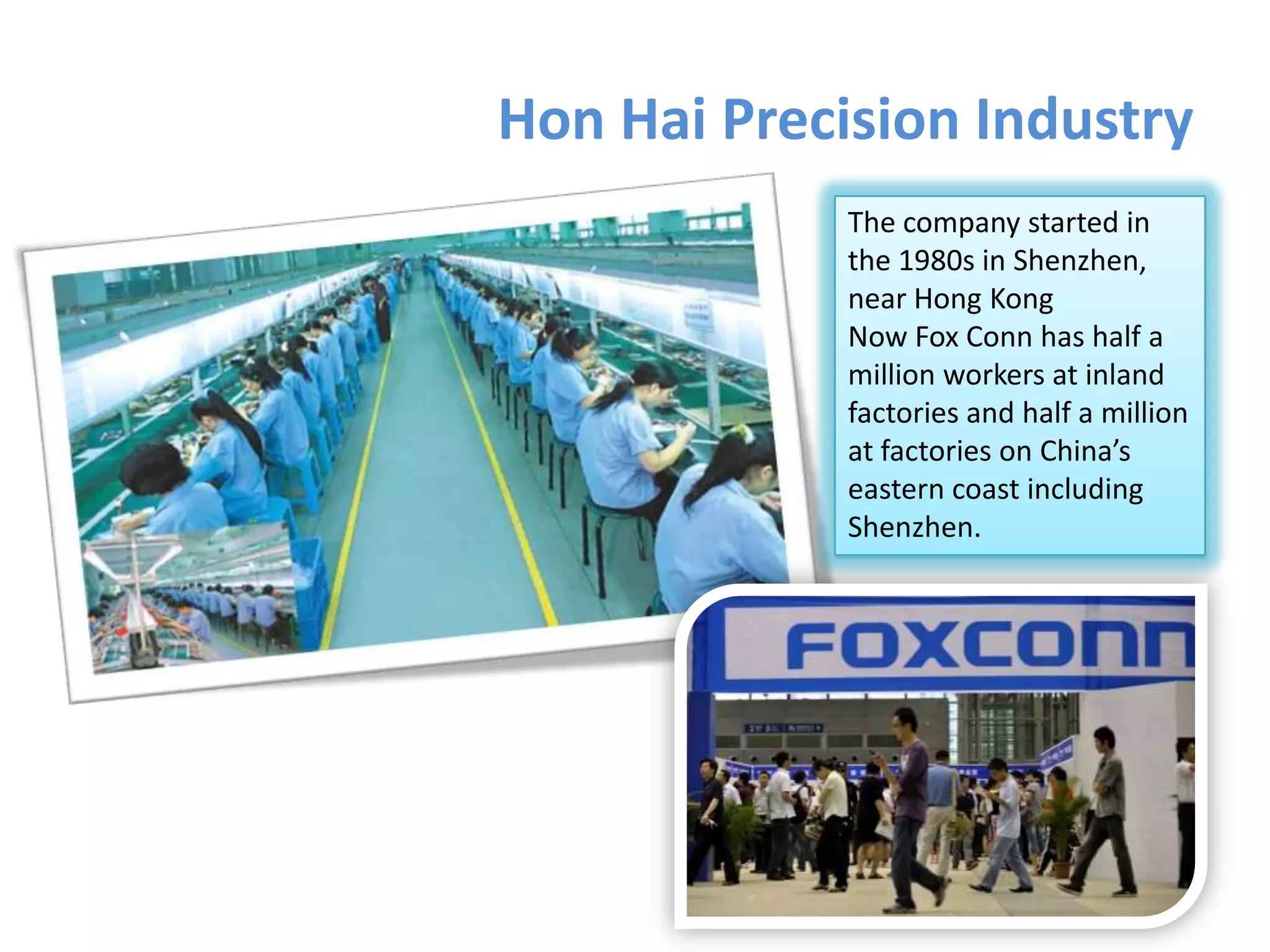
Hon Hai Precision Industry
The company started in
the 1980s in Shenzhen,
near Hong Kong
Now Fox Conn has half a
million workers at inland
factories and half a million
at factories on China’s
eastern coast including
Shenzhen.
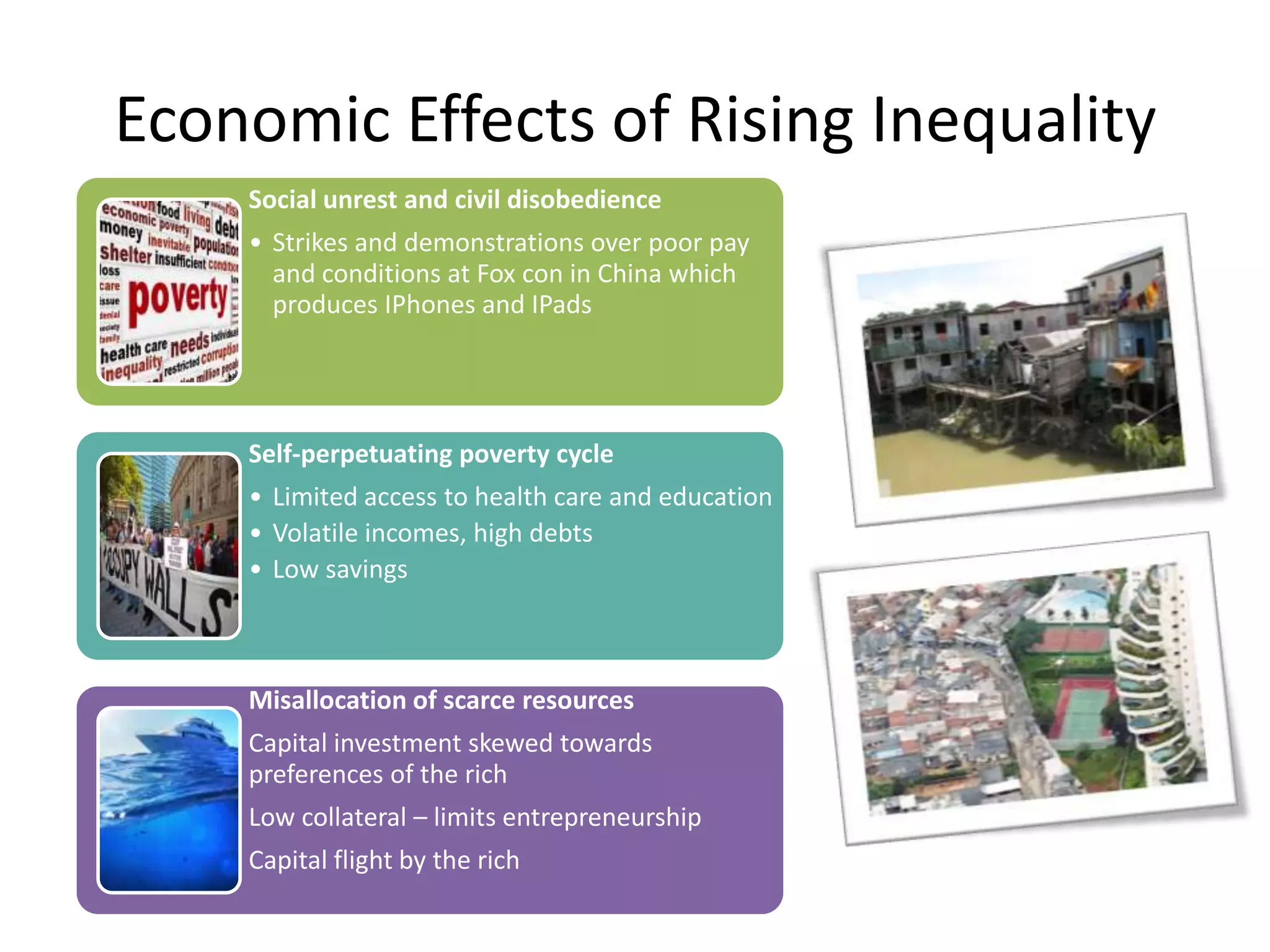
Economic Effects of Rising Inequality
Social unrest and civil disobedience
• Strikes and demonstrations over poor pay
and conditions at Fox con in China which
produces IPhones and IPads

Self-perpetuating poverty cycle

• Limited access to health care and education
• Volatile incomes, high debts
• Low savings

Misallocation of scarce resources
Capital investment skewed towards
preferences of the rich
Low collateral – limits entrepreneurship

Capital flight by the rich
Economic Effects of Rising Inequality
Social unrest and civil disobedience
• Strikes and demonstrations over poor pay
and conditions at Fox con in China which
produces IPhones and IPads

Self-perpetuating poverty cycle

• Limited access to health care and education
• Volatile incomes, high debts
• Low savings

Misallocation of scarce resources
Capital investment skewed towards
preferences of the rich
Low collateral – limits entrepreneurship

Capital flight by the rich
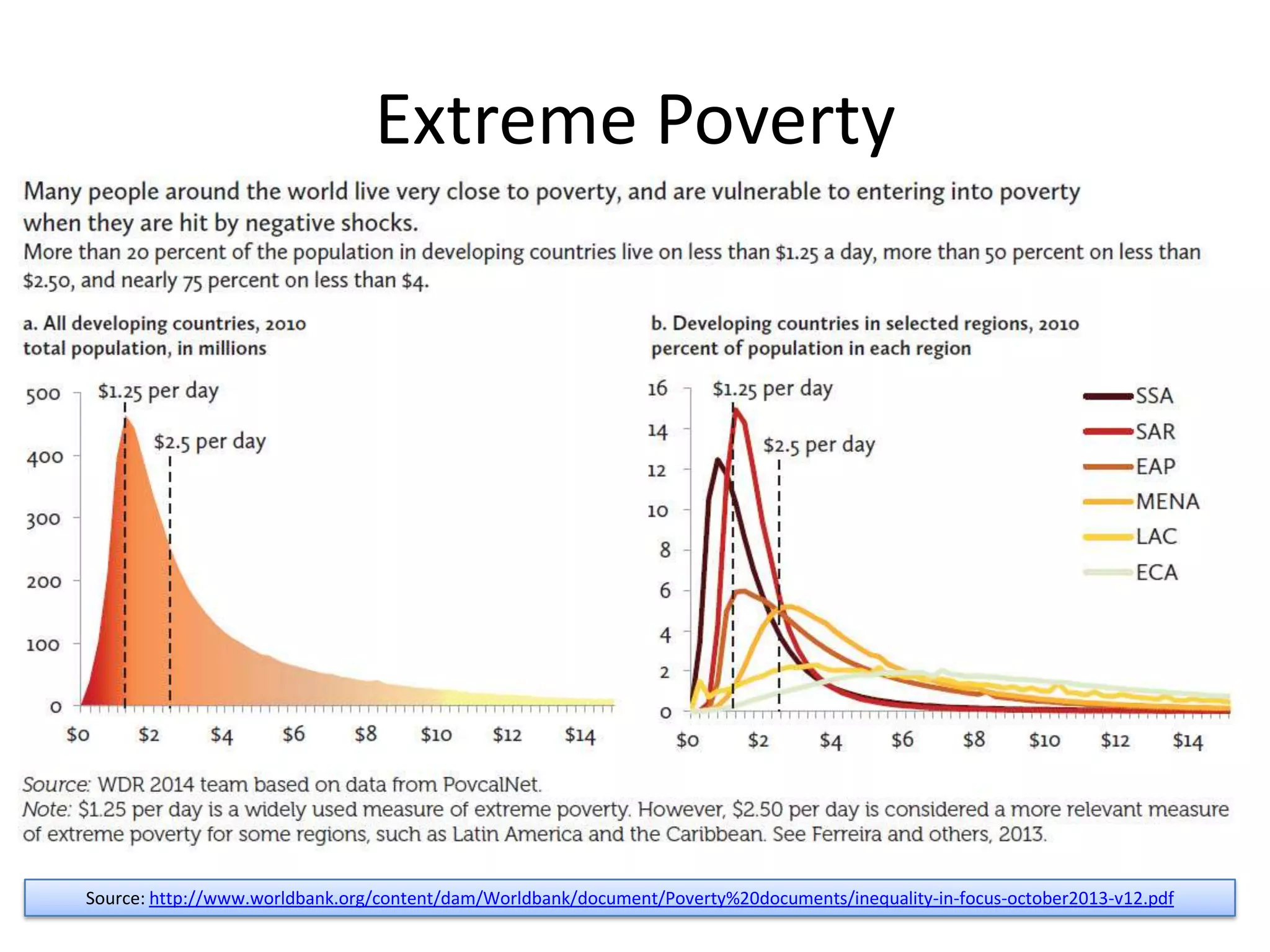
Extreme Poverty

Source: http://www.worldbank.org/content/dam/Worldbank/document/Poverty%20documents/inequality-in-focus-october2013-v12.pdf
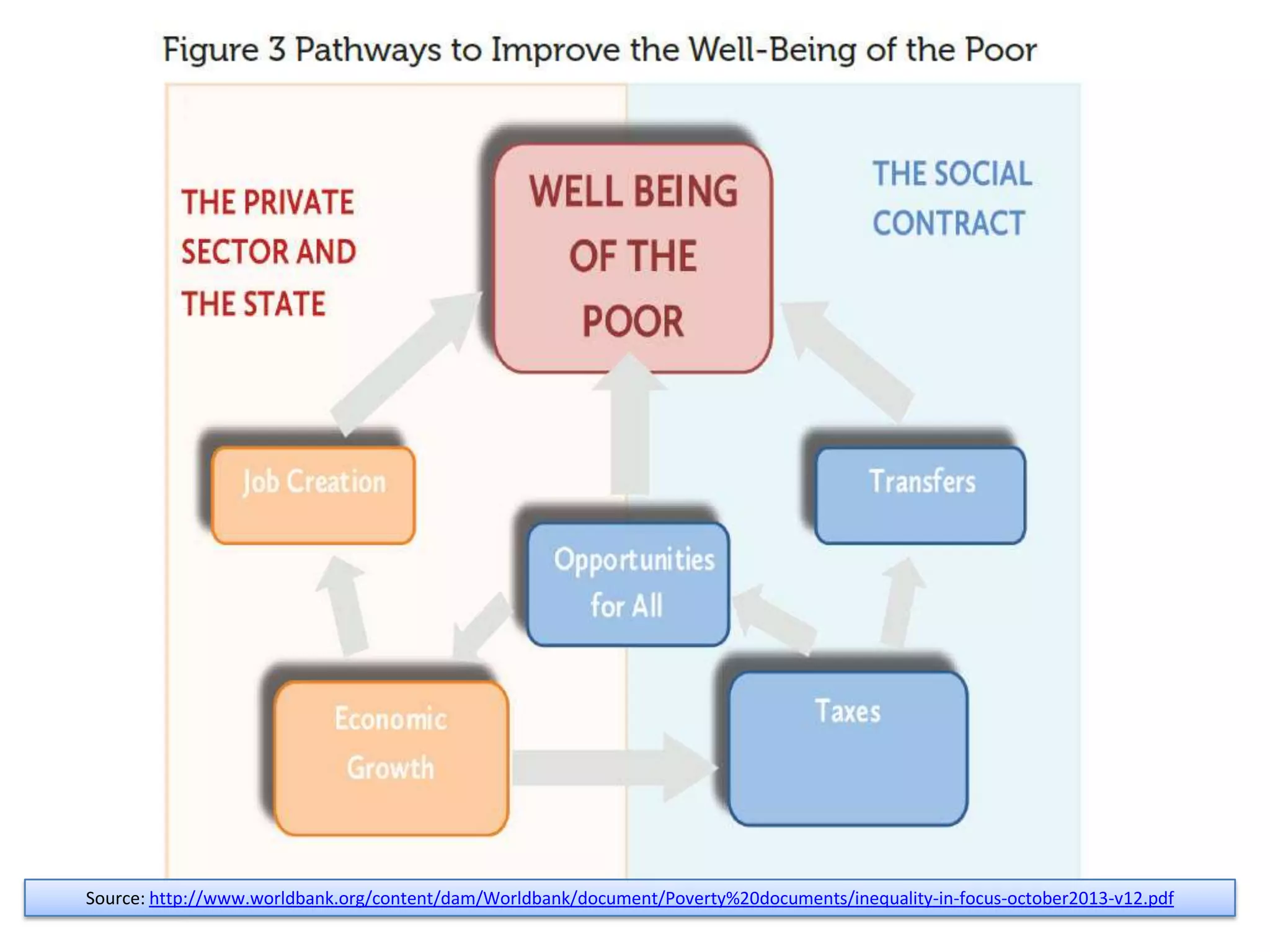
Poverty Reduction Pathways

Source: http://www.worldbank.org/content/dam/Worldbank/document/Poverty%20documents/inequality-in-focus-october2013-v12.pdf
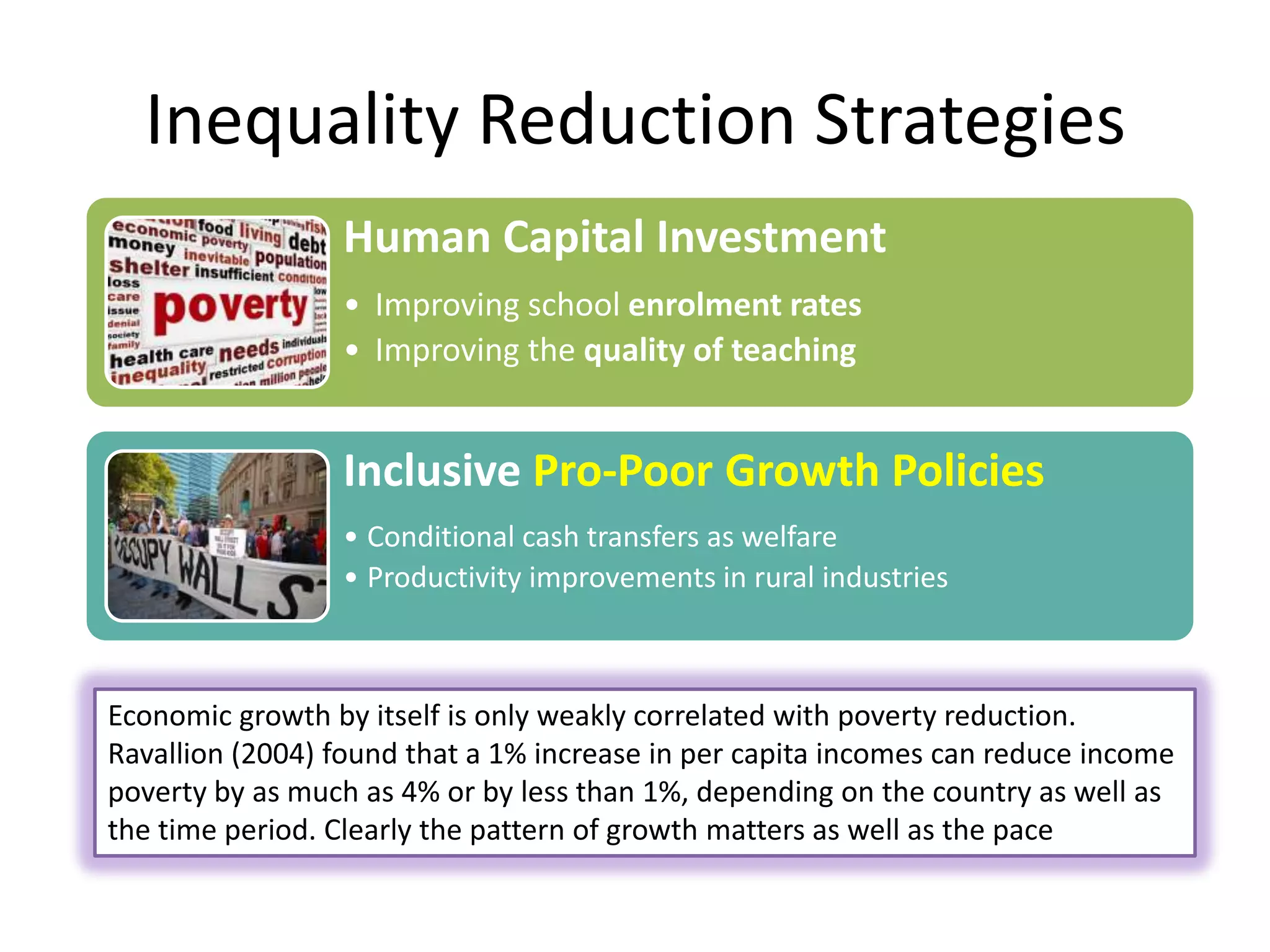
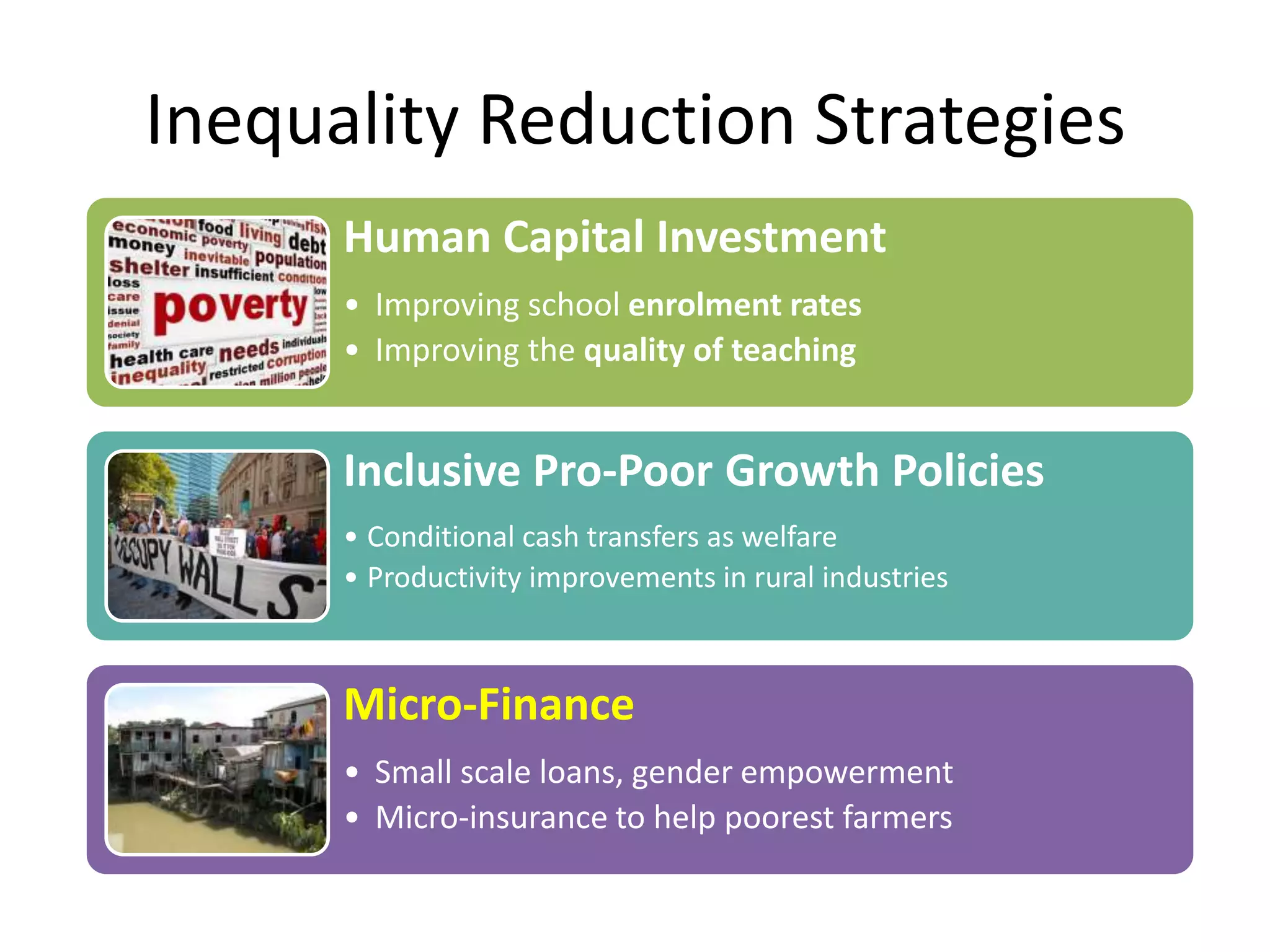
Inequality Reduction Strategies
Human Capital Investment
• Improving school enrolment rates
• Improving the quality of teaching

Inclusive Growth Policies
• Raising incomes for people
• Conditional cash transfers as welfare

Micro-Finance
• Small scale loans, gender empowerment
• Micro-insurance to help poorest farmers
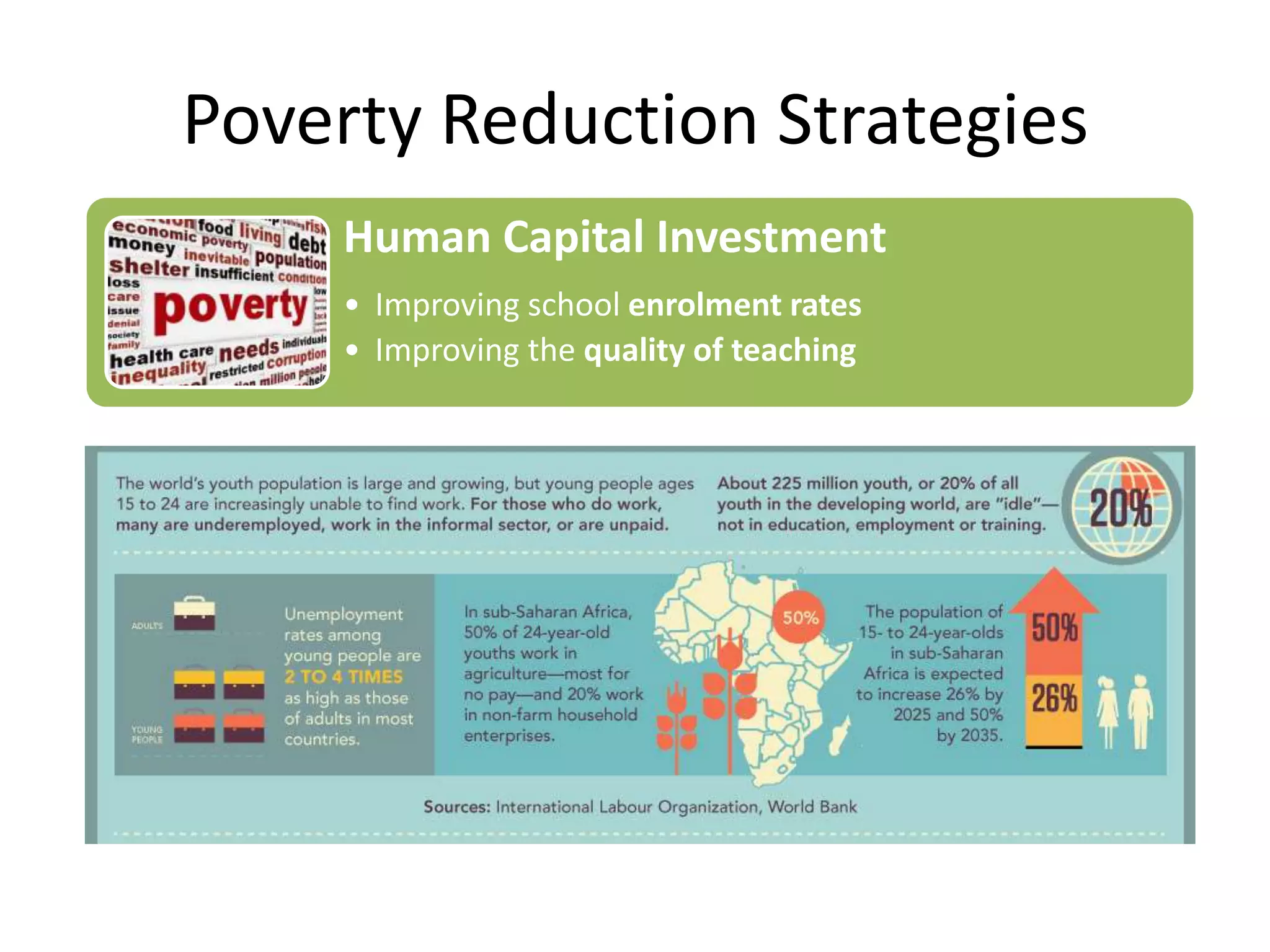
Poverty Reduction Strategies
Human Capital Investment
• Improving school enrolment rates
• Improving the quality of teaching

Inclusive Growth Policies
• Raising incomes for people
• Conditional cash transfers as welfare

Micro-Finance
• Small scale loans, gender empowerment
• Micro-insurance to help poorest farmers
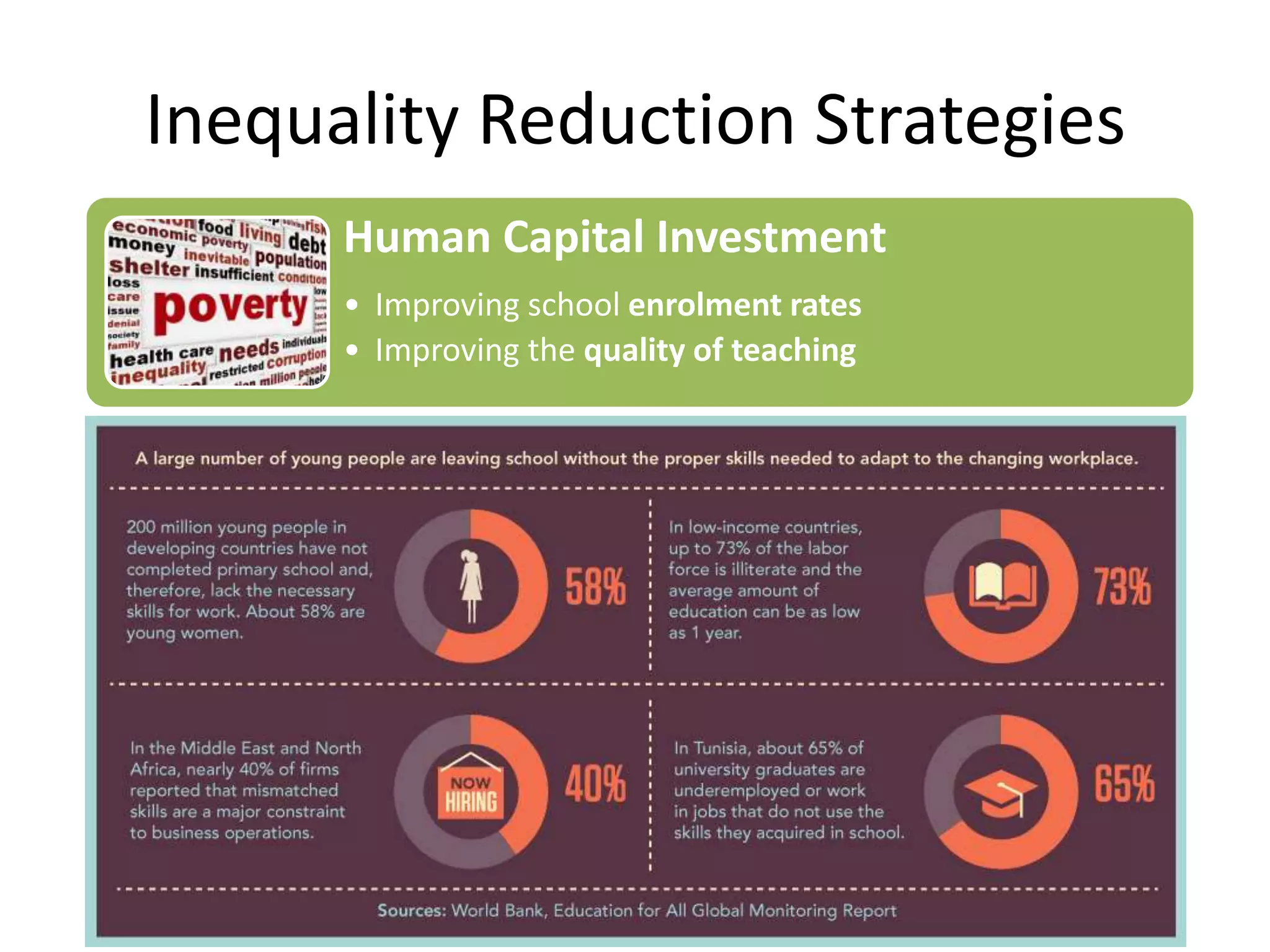
Inequality Reduction Strategies
Human Capital Investment
• Improving school enrolment rates
• Improving the quality of teaching

Inclusive Growth Policies
• Raising incomes for people
• Conditional cash transfers as welfare

Micro-Finance
• Small scale loans, gender empowerment
• Micro-insurance to help poorest farmers
Inequality Reduction Strategies
Human Capital Investment
• Improving school enrolment rates
• Improving the quality of teaching

Inclusive Pro-Poor Growth Policies
• Conditional cash transfers as welfare
• Productivity improvements in rural industries

Micro-Finance
Economic growth by itself is only weakly correlated with poverty reduction.
Ravallion (2004) found that a 1% increase in per capita incomes can reduce income
• Small scale loans, gender empowerment
poverty by as much as 4% or by less than 1%, depending on the country as well as
• Micro-insurance to help poorest well as the
the time period. Clearly the pattern of growth matters as farmers pace
Inequality Reduction Strategies
Human Capital Investment
• Improving school enrolment rates
• Improving the quality of teaching

Inclusive Pro-Poor Growth Policies
• Conditional cash transfers as welfare
• Productivity improvements in rural industries

Micro-Finance
• Small scale loans, gender empowerment
• Micro-insurance to help poorest farmers
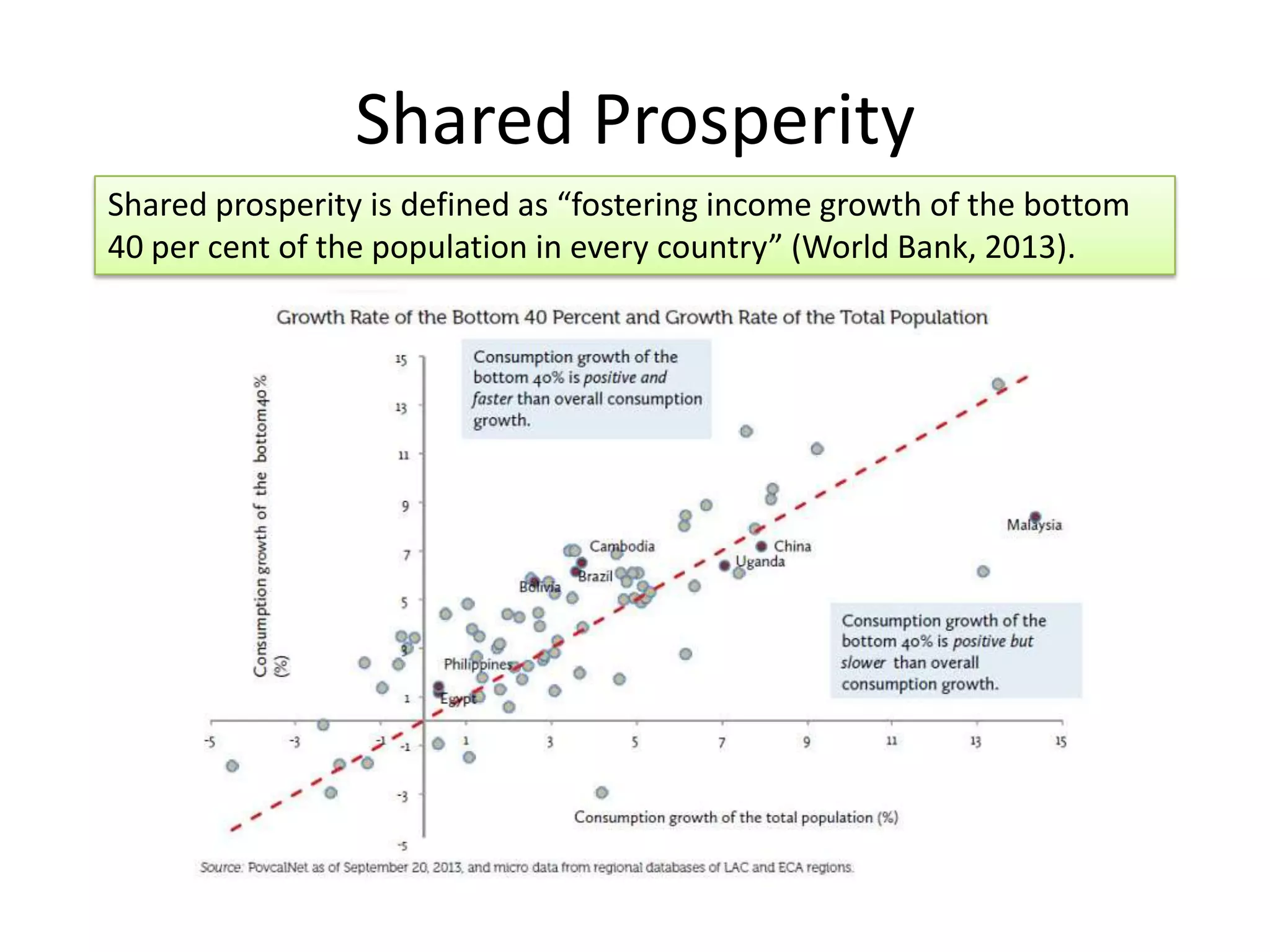
Shared Prosperity
Shared prosperity is defined as “fostering income growth of the bottom
40 per cent of the population in every country” (World Bank, 2013).
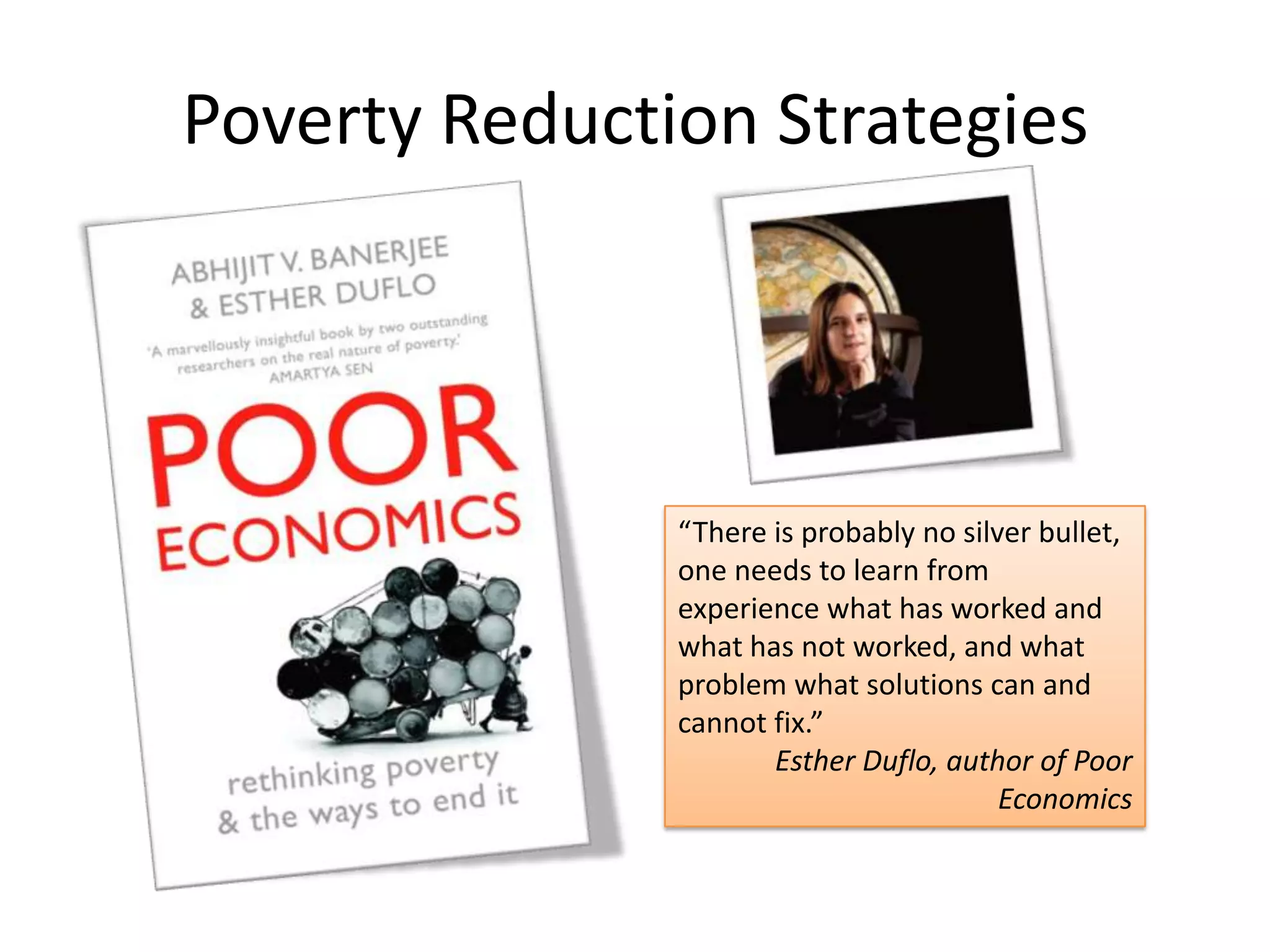
Poverty Reduction Strategies

“There is probably no silver bullet,
one needs to learn from
experience what has worked and
what has not worked, and what
problem what solutions can and
cannot fix.”
Esther Duflo, author of Poor
Economics
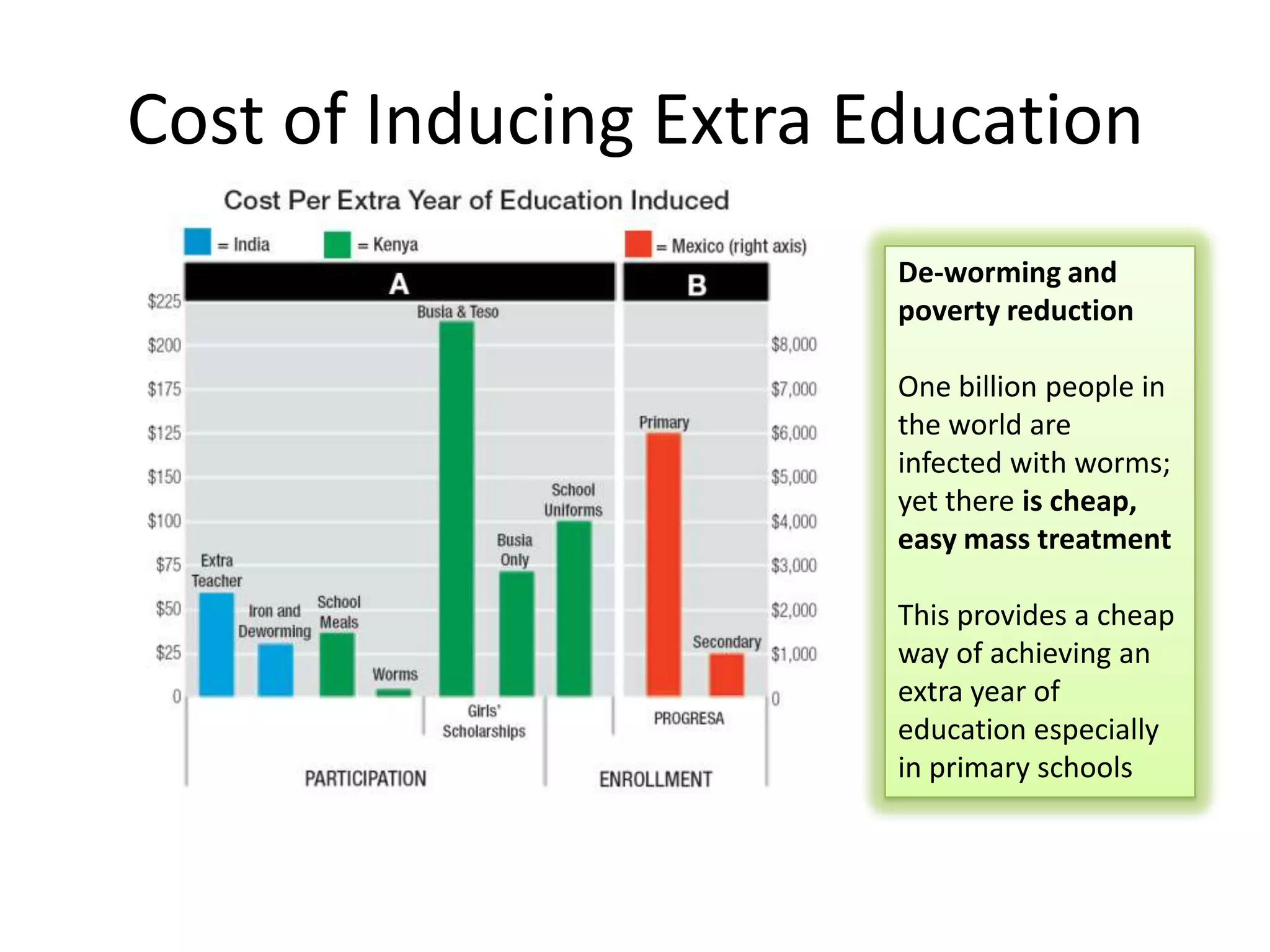
Cost of Inducing Extra Education
De-worming and
poverty reduction
One billion people in
the world are
infected with worms;
yet there is cheap,
easy mass treatment
This provides a cheap
way of achieving an
extra year of
education especially
in primary schools
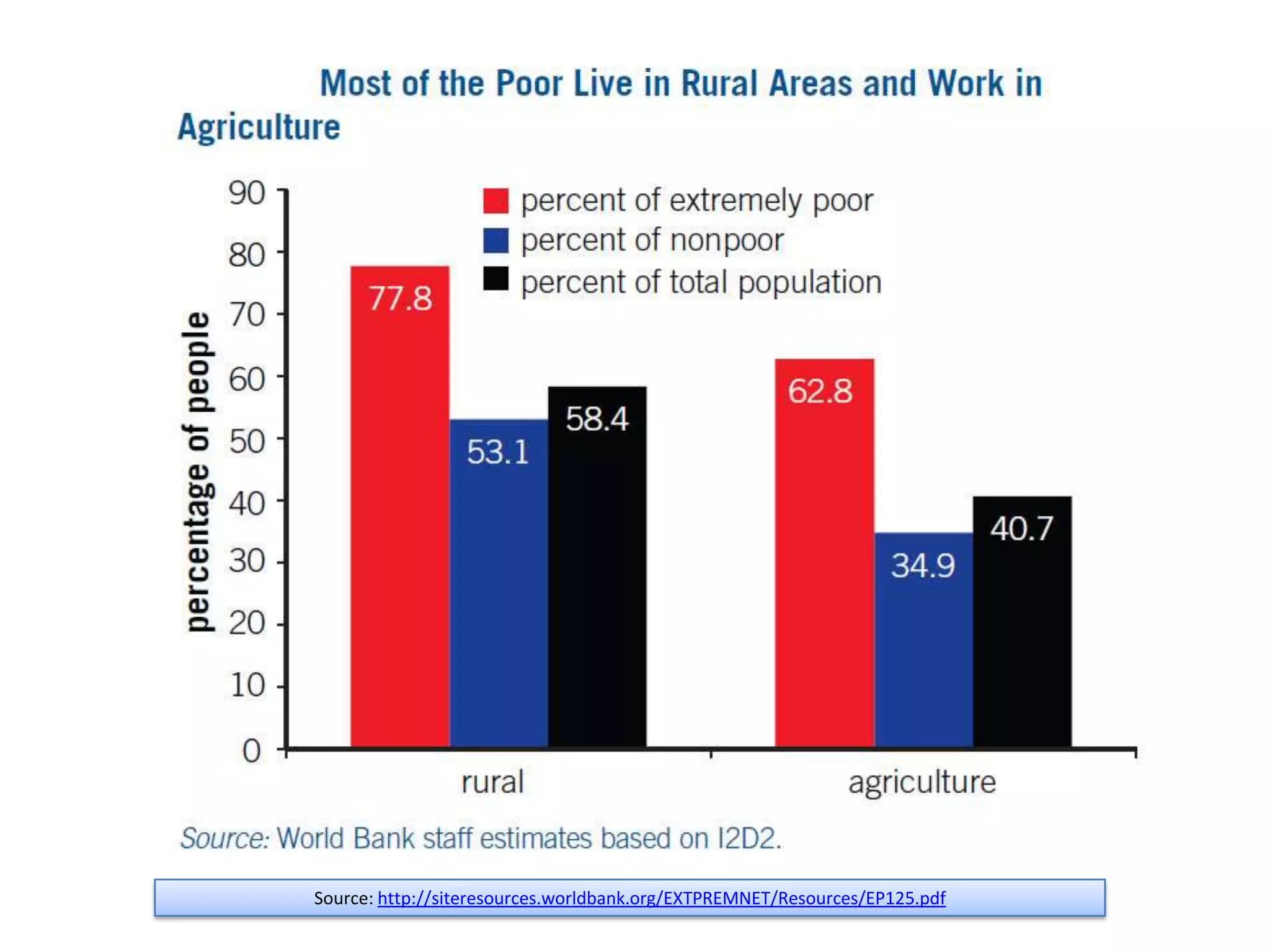
Addressing rural poverty is key

Source: http://siteresources.worldbank.org/EXTPREMNET/Resources/EP125.pdf
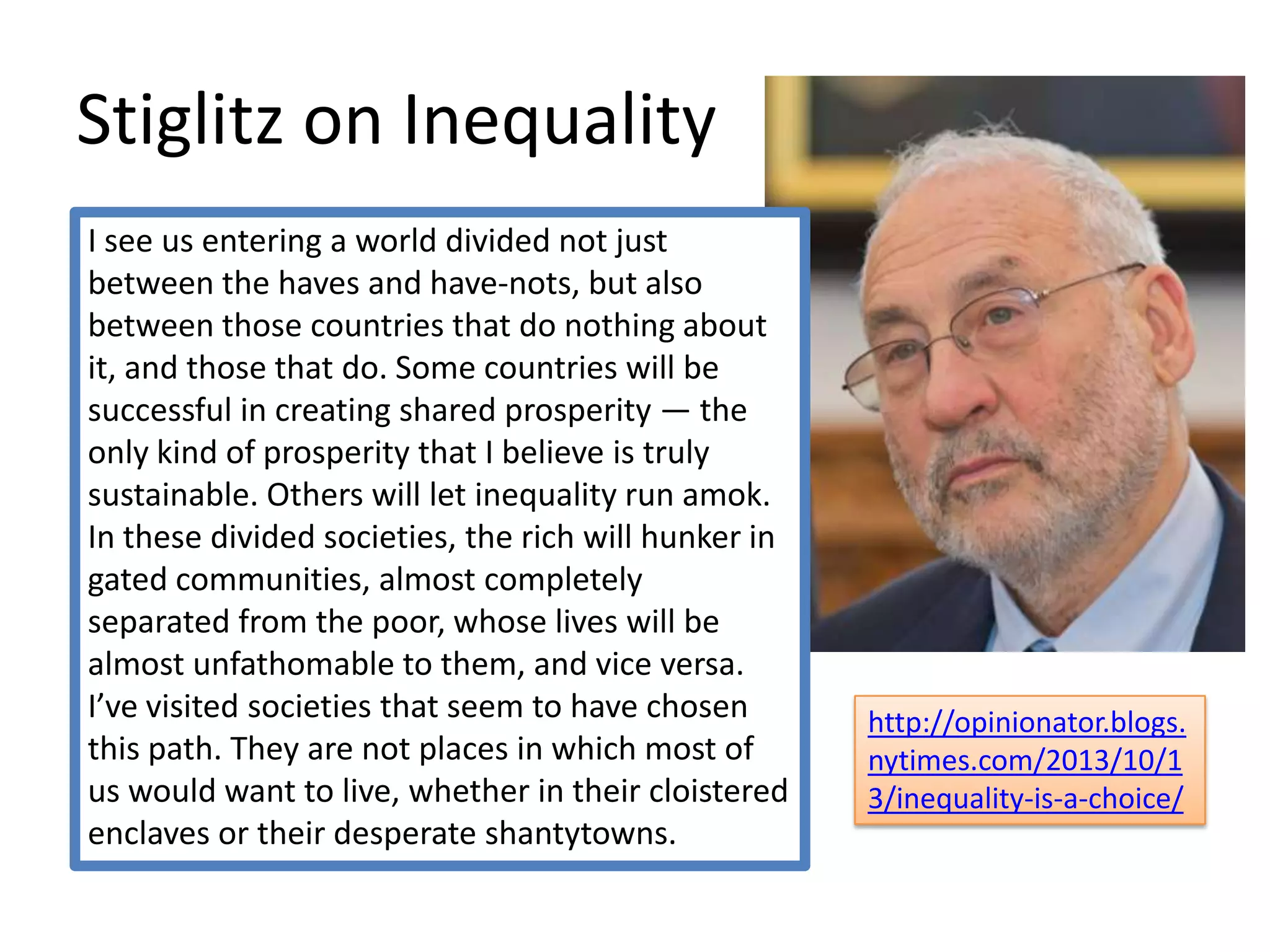
Stiglitz on Inequality
I see us entering a world divided not just
between the haves and have-nots, but also
between those countries that do nothing about
it, and those that do. Some countries will be
successful in creating shared prosperity — the
only kind of prosperity that I believe is truly
sustainable. Others will let inequality run amok.
In these divided societies, the rich will hunker in
gated communities, almost completely
separated from the poor, whose lives will be
almost unfathomable to them, and vice versa.
I’ve visited societies that seem to have chosen
this path. They are not places in which most of
us would want to live, whether in their cloistered
enclaves or their desperate shantytowns.

http://opinionator.blogs.
nytimes.com/2013/10/1
3/inequality-is-a-choice/
Two Economists on
Inequality
Recommended Structure
One Main
Point/Argument
per paragraph

Questions Requiring Evaluation

Analyse / Build
Connectives

Examine
To what extent

Use Supporting
Examples &
Evidence
Then evaluate
the actual point
made

Evaluate

Discuss
Assess
Get help for unit 4 from
fellow students,
teachers and tutor2u
on Twitter:

#econ4
@tutor2u_econ

Inequality, Economic Growth and Development

  • 1.
  • 4.
  • 5.
  • 6.
    Top Decile IncomeShare in USA
  • 7.
    A Global Perspective Thevertical axis shows changes in real income between 1988 and 2008, measured in 2005 international dollars, i.e. adjusted for inflation and how the cost of things varies in different countries The horizontal axis divides the incomes of the world into percentiles
  • 8.
    A Global Perspective 60mor so people who constitute the world’s top 1 per cent The vertical axis shows changes in real income between 1988 and 2008, measured in 2005 international dollars, i.e. adjusted for inflation and how the cost of things varies in different countries The horizontal axis divides the incomes of the world into percentiles
  • 9.
    A Global Perspective Thevertical axis shows changes in real income between 1988 and 2008, measured in 2005 international dollars, i.e. adjusted for inflation and how the cost of things varies in different countries 60m or so people who constitute the world’s top 1 per cent New global middle class, particularly in China and India. In 2008 earning median income would put the average Chinese in the top half of the global income distribution The horizontal axis divides the incomes of the world into percentiles
  • 10.
    We now livein a world with a bulge around the median with significantly rising incomes for the entire second third (or more) of the global income distribution. That is the new aspiring global middle class. We also see growing wealth and probably power of those at the very top and, remarkably, stagnant incomes for both the people just below the “enchanted” richest 1 or 5 per cent, and those poorest in the world. Source: Milosevic, World Bank, 2013 A Global Perspective
  • 11.
    Professor Angus Deaton Inequalityis a knotty subject. There is little agreement on what ought to be equal. Should it be a measurable outcome such as income or wealth; a hazier outcome such as power or freedom; or a vague aspiration such as “equality of opportunity”? It is often said that the world is becoming more unequal. But it is less than clear what is meant by that. Income inequality between countries has grown over the past three centuries but it may now be narrowing between the world’s people as a whole. (FT 11-10-13)
  • 12.
    Tax system is nowless progressive Cognitive elites and rising premium incomes Monopoly rent seeking – power elites Root Causes Of Systemic market failures e.g. education / housing Regressive effects of high inflation Patchy nature of state welfare systems Widening urban-rural income divide
  • 13.
    Tax system is nowless progressive Cognitive elites and rising premium incomes Monopoly rent seeking – power elites Root Causes Of Systemic market failures e.g. education / housing Regressive effects of high inflation Patchy nature of state welfare systems Widening urban-rural income divide
  • 14.
    Tax system is nowless progressive Cognitive elites and rising premium incomes Monopoly rent seeking – power elites Root Causes Of Systemic market failures e.g. education / housing Regressive effects of high inflation Patchy nature of state welfare systems Widening urban-rural income divide
  • 15.
    Tax system is nowless progressive Cognitive elites and rising premium incomes Monopoly rent seeking – power elites Root Causes Of Systemic market failures e.g. education / housing Regressive effects of high inflation Patchy nature of state welfare systems Widening urban-rural income divide
  • 16.
    Tax system is nowless progressive Cognitive elites and rising premium incomes Monopoly rent seeking – power elites Root Causes Of Systemic market failures e.g. education / housing Regressive effects of high inflation Patchy nature of state welfare systems Widening urban-rural income divide
  • 17.
    Tax system is nowless progressive Cognitive elites and rising premium incomes Monopoly rent seeking – power elites Root Causes Of Systemic market failures e.g. education / housing Regressive effects of high inflation Patchy nature of state welfare systems Widening urban-rural income divide
  • 18.
    Tax system is nowless progressive Cognitive elites and rising premium incomes Monopoly rent seeking – power elites Root Causes Of Systemic market failures e.g. education / housing Regressive effects of high inflation Patchy nature of state welfare systems Widening urban-rural income divide
  • 19.
    Tax system is nowless progressive Cognitive elites and rising premium incomes Monopoly rent seeking – power elites Root Causes Of Systemic market failures e.g. education / housing Regressive effects of high inflation Patchy nature of state welfare systems Widening urban-rural income divide
  • 20.
    Branko Milanovic, WorldBank economist and expert on trends in global inequality “Half of one’s income depends on the average income of the country in which that person was born.” “8% of humanity takes home 50% of global income; the top 1% alone takes home 15%.”
  • 21.
    Some countries havemade progress The richest 300 people on earth have more wealth than the poorest 3bn - almost half the world's population
  • 22.
  • 23.
  • 24.
    Economic Effects ofRising Inequality Social unrest and civil disobedience • Strikes and demonstrations over poor pay and conditions at Fox con in China which produces IPhones and IPads Self-perpetuating poverty cycle • Limited access to health care and education • Volatile incomes, high debts • Low savings Misallocation of scarce resources Capital investment skewed towards preferences of the rich Low collateral – limits entrepreneurship Capital flight by the rich
  • 25.
    Hon Hai PrecisionIndustry The company started in the 1980s in Shenzhen, near Hong Kong Now Fox Conn has half a million workers at inland factories and half a million at factories on China’s eastern coast including Shenzhen.
  • 26.
    Economic Effects ofRising Inequality Social unrest and civil disobedience • Strikes and demonstrations over poor pay and conditions at Fox con in China which produces IPhones and IPads Self-perpetuating poverty cycle • Limited access to health care and education • Volatile incomes, high debts • Low savings Misallocation of scarce resources Capital investment skewed towards preferences of the rich Low collateral – limits entrepreneurship Capital flight by the rich
  • 27.
    Economic Effects ofRising Inequality Social unrest and civil disobedience • Strikes and demonstrations over poor pay and conditions at Fox con in China which produces IPhones and IPads Self-perpetuating poverty cycle • Limited access to health care and education • Volatile incomes, high debts • Low savings Misallocation of scarce resources Capital investment skewed towards preferences of the rich Low collateral – limits entrepreneurship Capital flight by the rich
  • 28.
  • 29.
    Poverty Reduction Pathways Source:http://www.worldbank.org/content/dam/Worldbank/document/Poverty%20documents/inequality-in-focus-october2013-v12.pdf
  • 30.
    Inequality Reduction Strategies HumanCapital Investment • Improving school enrolment rates • Improving the quality of teaching Inclusive Growth Policies • Raising incomes for people • Conditional cash transfers as welfare Micro-Finance • Small scale loans, gender empowerment • Micro-insurance to help poorest farmers
  • 31.
    Poverty Reduction Strategies HumanCapital Investment • Improving school enrolment rates • Improving the quality of teaching Inclusive Growth Policies • Raising incomes for people • Conditional cash transfers as welfare Micro-Finance • Small scale loans, gender empowerment • Micro-insurance to help poorest farmers
  • 32.
    Inequality Reduction Strategies HumanCapital Investment • Improving school enrolment rates • Improving the quality of teaching Inclusive Growth Policies • Raising incomes for people • Conditional cash transfers as welfare Micro-Finance • Small scale loans, gender empowerment • Micro-insurance to help poorest farmers
  • 33.
    Inequality Reduction Strategies HumanCapital Investment • Improving school enrolment rates • Improving the quality of teaching Inclusive Pro-Poor Growth Policies • Conditional cash transfers as welfare • Productivity improvements in rural industries Micro-Finance Economic growth by itself is only weakly correlated with poverty reduction. Ravallion (2004) found that a 1% increase in per capita incomes can reduce income • Small scale loans, gender empowerment poverty by as much as 4% or by less than 1%, depending on the country as well as • Micro-insurance to help poorest well as the the time period. Clearly the pattern of growth matters as farmers pace
  • 34.
    Inequality Reduction Strategies HumanCapital Investment • Improving school enrolment rates • Improving the quality of teaching Inclusive Pro-Poor Growth Policies • Conditional cash transfers as welfare • Productivity improvements in rural industries Micro-Finance • Small scale loans, gender empowerment • Micro-insurance to help poorest farmers
  • 35.
    Shared Prosperity Shared prosperityis defined as “fostering income growth of the bottom 40 per cent of the population in every country” (World Bank, 2013).
  • 36.
    Poverty Reduction Strategies “Thereis probably no silver bullet, one needs to learn from experience what has worked and what has not worked, and what problem what solutions can and cannot fix.” Esther Duflo, author of Poor Economics
  • 37.
    Cost of InducingExtra Education De-worming and poverty reduction One billion people in the world are infected with worms; yet there is cheap, easy mass treatment This provides a cheap way of achieving an extra year of education especially in primary schools
  • 38.
    Addressing rural povertyis key Source: http://siteresources.worldbank.org/EXTPREMNET/Resources/EP125.pdf
  • 39.
    Stiglitz on Inequality Isee us entering a world divided not just between the haves and have-nots, but also between those countries that do nothing about it, and those that do. Some countries will be successful in creating shared prosperity — the only kind of prosperity that I believe is truly sustainable. Others will let inequality run amok. In these divided societies, the rich will hunker in gated communities, almost completely separated from the poor, whose lives will be almost unfathomable to them, and vice versa. I’ve visited societies that seem to have chosen this path. They are not places in which most of us would want to live, whether in their cloistered enclaves or their desperate shantytowns. http://opinionator.blogs. nytimes.com/2013/10/1 3/inequality-is-a-choice/
  • 40.
  • 41.
    Recommended Structure One Main Point/Argument perparagraph Questions Requiring Evaluation Analyse / Build Connectives Examine To what extent Use Supporting Examples & Evidence Then evaluate the actual point made Evaluate Discuss Assess
  • 42.
    Get help forunit 4 from fellow students, teachers and tutor2u on Twitter: #econ4 @tutor2u_econ