Shot types
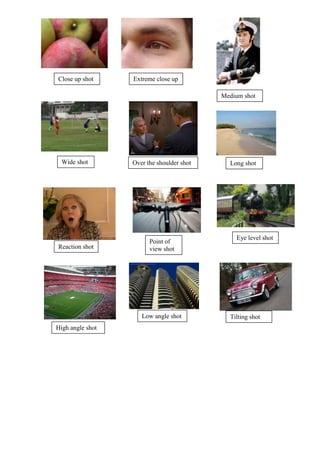
Close up shots – they convey detail and emotion to the viewer. There are
different types of close up such as standard head and shoulders shots. These
typically contain the face and shoulders of a subject with little head room
above.
Extreme close up –Any shot that zooms in very close to a particular part of a
subject. They usually focus on a certain part of a person such as face, mouth
eyes, hands, etc. These shots can create a feeling of intimacy or to convey a
mood or emotion.
Medium shot – This shot is ideal when the subject is speaking or delivering
information and the fine detail isn’t need. It is also useful when people are
making arm gestures. They don’t show as much detail as close up shots.
Two shot or three shot – Often medium or wide shots, these are shots of two
or three people in one scene. Often used in interviews and are good for
establishing a relationship between subjects.
Long shot –shows a great deal of background. These are essential to
establish the scene for the viewer and to put the rest of the film into context.
Extreme wide shot – these shots are far removed from the subject and often
shot with a wide angle lens.
Wide shot – provide an overall view of the whole scene.
Creative shots – can fall into the close up, medium or long shot category.
They provide a different perspective for your viewer.
Over the shoulder shot – these shots are filmed from just behind a person.
They tend to show the back of a person’s head and sometimes one shoulder.
Reaction shot – these shots show a person’s face listening or reacting to
something. Common in interviews and also used to cut into a sequence and
hide jump cuts.
Point of view shot – aka subjective shot. The camcorder adopts the
perspective of a character. We see what a character sees and therefore
identify with him/her. The person whose point of view it is should never be
seen in the shot. These shots are often used to add drama in chase scenes.
Cutaway – placed between main shots. Usually something other than the
current action. These are used as transactions between main shots or to add
interest or information.
Eye level angle – one of the most commonly used shots because this is the
perspective most familiar to us.
High angle – in these shots, the camcorder looks down on the subject making
it appear smaller and less important. Often used to make a person seem
vulnerable.
Low angle – the camcorder looks up at the subject. Used to make the subject
appear larger and more important to the viewer.
Tilting shot – experiment with panning in the vertical plane instead of the
horizontal.
Forward/backward tracking shot – shooting a moving subject fropm behind or
when they are coming towards you.
Close up shot     Extreme close up

                                           Medium shot


  Wide shot       Over the shoulder shot     Long shot


                                               Eye level shot
                        Point of
Reaction shot           view shot


                     Low angle shot          Tilting shot
High angle shot

Shot types

  • 1.
    Shot types Close upshots – they convey detail and emotion to the viewer. There are different types of close up such as standard head and shoulders shots. These typically contain the face and shoulders of a subject with little head room above. Extreme close up –Any shot that zooms in very close to a particular part of a subject. They usually focus on a certain part of a person such as face, mouth eyes, hands, etc. These shots can create a feeling of intimacy or to convey a mood or emotion. Medium shot – This shot is ideal when the subject is speaking or delivering information and the fine detail isn’t need. It is also useful when people are making arm gestures. They don’t show as much detail as close up shots. Two shot or three shot – Often medium or wide shots, these are shots of two or three people in one scene. Often used in interviews and are good for establishing a relationship between subjects. Long shot –shows a great deal of background. These are essential to establish the scene for the viewer and to put the rest of the film into context. Extreme wide shot – these shots are far removed from the subject and often shot with a wide angle lens. Wide shot – provide an overall view of the whole scene. Creative shots – can fall into the close up, medium or long shot category. They provide a different perspective for your viewer. Over the shoulder shot – these shots are filmed from just behind a person. They tend to show the back of a person’s head and sometimes one shoulder. Reaction shot – these shots show a person’s face listening or reacting to something. Common in interviews and also used to cut into a sequence and hide jump cuts. Point of view shot – aka subjective shot. The camcorder adopts the perspective of a character. We see what a character sees and therefore identify with him/her. The person whose point of view it is should never be seen in the shot. These shots are often used to add drama in chase scenes. Cutaway – placed between main shots. Usually something other than the current action. These are used as transactions between main shots or to add interest or information. Eye level angle – one of the most commonly used shots because this is the perspective most familiar to us. High angle – in these shots, the camcorder looks down on the subject making it appear smaller and less important. Often used to make a person seem vulnerable. Low angle – the camcorder looks up at the subject. Used to make the subject appear larger and more important to the viewer. Tilting shot – experiment with panning in the vertical plane instead of the horizontal. Forward/backward tracking shot – shooting a moving subject fropm behind or when they are coming towards you.
  • 2.
    Close up shot Extreme close up Medium shot Wide shot Over the shoulder shot Long shot Eye level shot Point of Reaction shot view shot Low angle shot Tilting shot High angle shot